19 480 résultats
réf. 123238France: c. 1809-1820. 8vo 36 leaves printed rectos only illustrated. Brown pebbled cloth rebacked leather backstrip with raised bands gilt-stamped bees and the binder's title "Florilége" sic in the compartments green coated endpapers. Cloth considerably stained backstrip rubbed pages lightly toned and foxed but sound overall. § A curious book appearing to be a lithographic facsimile of a manuscript in which pious reflections are inspired by wayside flowers in the format of a flora. With adept illustrations of the flowers and some religious scenes apparently drawn by the author printed on better paper in monochrome in one of three inks and tipped to each facing page. There is no title page instead the book opens with a quote from Chateaubriand's Les Martyrs published 1809 beneath which is the stamp "Déposé" and the handwritten inscription "Propriété de l'auteur." the name that follows is unfortunately illegible. The author appears to have been a French priest appending the suffix "ptre" here and also to the printed name "Jean" which closes the facsimile manuscript. Presumably multiple copies would have been printed but no others have been located. This copy came from the famous eccentrica and erotica collection of Gershon Legman. c. 1809-1820]. 8vo hardcover books
1565réf. 5777"FOR MANY YEARS THE MOST IMPORTANT WORK ON THE MEDICINAL PLANTS OF THE NEW WORLD" 8vo 13.4 x 9.1 cm 132 ff. with woodcut border to title page and woodcut initials. Bound in later stiff vellum title stamped on spine gift inscription on the front flyleaf to a certain 'Carmen Ballina' dated 1922 now covered in paper. Only minor wear and rubbing to binding. 'Tassa' price of 51 maravedis entered in manuscript on title page as issued early signature of a certain 'Henrique Correa' at fol. aiiir the occasional contemporary annotation in the text minor occasional dampstaining very minor occasional marginal worming. Very rare first edition 1565 – virtually unacquirable for the past half century or more – of the first printed work devoted to the botanical and medicinal discoveries made in the Americas a treatise which through its later expansions and numerous translations would remain "for many years the most important work on the medicinal plants of the New World" Garrison & Morton. The Dos libros was written by the renowned physician Nicolás Monardes 1493-1588 in Seville then the center of the Spanish printing industry and the only port from which ships were authorized to sail to and from the New World. Born in 1493 in the very year Columbus returned from his first voyage Monardes thus both occupied a front row seat for first decades of the 'Columbian Exchange' and was ideally positioned to disseminate his findings to a wider European indeed global audience. Monardes shared much with his contemporary Garcia d'Orta 1501-68 the Portuguese physician stationed in India and famed for his Coloquios dos simples e drogas e consas medicinais da India Goa 1563: "Just as d'Orta gave the learned world of the West the first accurate accounts of various Asian medicinal and commercial plants so did Monardes with those of America … Monardes like Garcia d'Orta has a strong claim to be regarded as one of the fathers of the science of pharmacognosy. Both of them compiled what were virtually complete monographs on many important items of our actual materia medica which were then unknown or only inaccurately known to the Western World Boxer pp. 23-24. Even the diffusion of these two authors throughout the learned world of early modern Europe shared a common source in the Latin versions made of them by the Flemish physician and botanist Charles de L'Ecluse Carolus Clusius 1526-1609 who published them together for the first time at Antwerp by Plantin in 1574 and afterwards. Monardes eagerly capitalized on his unique position in Seville to acquire botanical news specimens and seeds from the New World cultivating his own garden of American plants and distributing cuttings to correspondents throughout Spain and Europe. In 1553 he established a transatlantic business partnership with a colleague in Tierra Firme and over the next three decades Monardes' three sons and four daughters emigrated to Tierra Firme and New Spain thus providing him with a network which would prove invaluable in collecting information for the 1565 Dos libros and in expanding the treatise in its 1571 and 1574 editions published as Segunda Parte and Primera y Segunda y Tercera Partes de la Historia Medicinal. In the Dos libros Monardes describes more than two dozen botanical remedies sarsaparilla copal and other aromatic balsams guaiacum lignum vitae etc. their medicinal applications native nomenclature and where they were to be found Mexico City Jalisco Michoacán Cuba Santo Domingo San Juan Cartagena Honduras Peru Nicaragua. Fascinatingly he views this specialized information through the broader lens of early American exploration discussing the voyages of Columbus and Hernán Cortés Monardes' near contemporary the spread of New World diseases among the first conquistadors and assessing the value of America's medicinal riches against her wealth of gold and silver. In his first printed work Dialogo llamado pharmacodilosis o declaracion medicinal Seville 1536 Monardes noted that he was skeptical of the therapeutic value of plants from the New World but "his change of heart between 1536 and 1565 about the value of American materia medica was a gradual process and was due to his own experience" Boxer p. 22. Monardes "took great care after about 1536 to examine those plants imported and/or transplanted into Spain – a self-imposed task facilitated by the unrivaled position of Seville as the sole entrepôt for Spanish trade with the New World … just as d'Orta cultivated Asian plants in his gardens and orchards at Goa and Bombay so Monardes had a botanical garden with native and exotic plants at Sevilla" Boxer 22. In addition to Clusius' Latin translation of Monardes De simplicibus medicamentis ex Occidentli India delatis 1574 first Latin edition an English translation appeared in 1577 by John Frampton under the title Joyful newes out of the newe found world. Italian French and German translations followed with the work going through 19 editions during Monardes' lifetime and 14 after his death. In the present 1565 first edition of the Dos libros Monardes challenged European travelers and residents in the Americas to "'investigate and experiment with the many kinds of medicines that the Indians sell in their markets or Tianguez; it would be a thing of great utility and profit to see and know their properties and to experiment with their varied and great effects which the Indians make public and manifest through the great experiences they make of them among themselves'" Monardes quoted from Bleichmar Visual Voyages p. 51. But tapping into native knowledge of medicinal matters apparently proved more difficult than Monardes had anticipated: In the 1571 Segunda Parte he notes that the increasing Amerindian hostility to the European presence in the Americas was provoking them to keep their medicinal/botanical practices secret to the point of providing misleading information to colonists seeking local remedies and consequently his 1565 Dos Libros had in fact become the primary source for Indian medicinal knowledge even among Europeans stationed and living in the Americas among the native populace see Bleichmar Visual Voyages p. 51. Monardes' other published works include the 1539 De secanda vena in pleuriti inter Grecos et Arabes concordia and his 1540 De rosa et partibus eius. His treatise on the medicinal properties of the bezoar stone is appended to the present Dos libros. OCLC locates U.S. examples of this 1565 Dos Libros of Monardes at the National Library of Medicine John Carter Brown Wisconsin Hunt Botanical SMU and NYPL. Alden European Americana 565/45; Medina BHA 194; JCB vol. 1 no. 240; Palau 175485; Wellcome 4390; USTC 340089; Garrison & Morton 1817; ; Hunt 106 1569 ed.; Sabin 49936 the 2nd ed.; F. Guerra Nicolás Bautista Monardes; D. Bleichmar Visual Voyages: Images of Latin American Nature from Columbus to Darwin; J. Jiménez-Castellanos y Calvo-Rubio Historia medicinal de las cosas… Seville Padilla 1988; D. Bleichmar "Books Bodies and Fields: Sixteenth-Century Transatlantic Encounters with New World Materia Medica" in L. Schiebinger and C. Swan eds. Colonial Botany: Science Commerce and Politics pp. 83–99; J. M. López Piñero "Las 'Nuevas Medicinas' Americanas en la Obra 1565-1574 de Nicolás Monardes" Asclepio vol. 42 no. 1 1990 pp. 3-67; A. Barrera "Local Herbs Global Medicines: Commerce Knowledge and Commodities in Spanish America" in P. Smith and P. Findlen eds. Merchants and Marvels: Commerce Science and Art in Early Modern Europe pp. 163-81; J. D. Sauer "Changing Perception and Exploitation of New World Plants in Europe" in F. Chiappelli ed. First Images of America vol. 2 pp.-813-32; F. Egmond The World of Carolus Clusius: Natural History in the Making 1550-1610; A. Ubrizy and J. Heniger "Carolus Clusius and American Plants" Taxon vol. 32 no 3 1983 pp. 424-35; C. R. Boxer Two Pioneers of Tropical Medicine: Garcia d'Orta and Nicolás Monardes Wellcome Lecture Series No. 1 1963. Sebastian Trugillo hardcover books
1955réf. 27519Jamaica Plain: Arnold Arboretum of Harvard University 1955. First edition. Cloth. Fine. Very heavy and wide clothbound volume. 1144 pp. Maps in pocket at rear of volume. Illustrated with additional fold-out maps within the text. A fine copy. Not issued with dustwrapper. A thorough recordation of and study of various people and groups who made exploratory botanical visits to the American West during the period 1790 to 1850. Due to the size and weight of this volume additional shipping charges may apply. Arnold Arboretum of Harvard University unknown books
1949réf. 25356Jamaica Plain MA: The Arnold Arboretum of Harvard University 1949. First edition. Hardcover. Fine. Hardbound quarto. 296 pp. A fine copy of this botanical reference work. Issued without dustwrapper. All text - no illustrations. Scarce reference work. The Arnold Arboretum of Harvard University hardcover books
1989réf. 27435NY:: Cambridge University Press. Near Fine. 1989. Hardcover. 0521372941 . First edition. Review copy with slip laid in. Number stamped on front free endpaper else near fine in glossy illustrated boards. No dust jacket. . Cambridge University Press, hardcover books
1995réf. 1064172 Vols. 8vo cloth gilt title on spine 517 655 pp. Clean and sturdy in fine condition overall. Excllent set reprinted from the 1958 first edition. Contains a detailed list of botanical titles beginning from the 12th century. Volume one covers works from 1150 to 1700. The second and slightly larger volume covers works from 1701 to 1800. Martino Publishing, books
1998réf. 106416Large 8vo cloth. 782 pp. Firm and crisp and in fine condition. Compiled by Ethelyn Maria Tucker and is a facsimile of the 1914 edition. Substantial collection of botanical titles arranged in an alphabetically by author. Martino Publishing, books
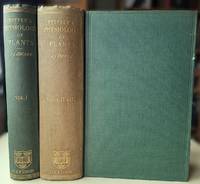
1900réf. 023620Oxford at The Clarendon Press 1900. Second edition revised. Three volumes 1900 - 1906 bound in two. Large thick octavo pp xii 632; viii 296; viii 451 illustrated with approximately 160 small text drawings with the tipped-in errata slip to the first volume very clean internally original green cloth the fore-edge of the second volume slightly snaggedand the spine faded otherwise very good. From the collection of the Chelsea Physic Garden and donated to it by the plant physiologist W.O. James. Complete sets seem extremely scarce. "Wilhelm Pfeffer was a pioneer of modern plant physiology. His scientific interests included the thermonastic and photonastic movements of flowers the nyctinastic movements of leaves protoplastic physics and photosynthesis. In 1877 while researching plant metabolism Pfeffer developed a semi-porous membrane to study the phenomena of osmosis. The eponymous Pfeffer cell is named for the osmometric device he constructed for determining the osmotic pressure of a solution. During his tenure at Leipzig Pfeffer published an article on the use of photography to study plant growth. He wanted to extend the chronophotographic experiments of Étienne-Jules Marey 1830-1904 by producing a short film involving the stages of plant growth. This "movie" would be filmed over a period of weeks by frame-at-a-time exposure taken at regular spaced intervals. Later time-lapse photography would become a commonplace procedure.". "It was Julius Sachs the acknowledged founder of plant physiology who showed Pfeffer the path to physiology. At the instigation of Sachs Pfeffer undertook his first purely physiological investigation which dealt with the effect of different colours of light on the assimilation of carbon dioxide 1871c. In the end Pfeffer went further than Sachs. Sachs treated plant physiology as an area of botany which had been neglected up to this point. He introduced the use of hydroponics and he dealt with the physiology of germination of roots of stimulation and with photosynthesis. He thus gave a significant impetus to the further research of these processes. These phenomena were also of interest to Pfeffer but to him they were primarily keys to the solution of general problems of biology. It may be said of Sachs and of many other outstanding biologists that they investigated separate subject areas with success. At the risk of oversimplification it may be said of Pfeffer that he investigated diverse areas with the objective of finding as many starting points as possible to penetrate the molecular foundations of life's processes" Bunning pp. 18-19. Second edition revised and enlarged. Cloth. Very Good. Oxford at The Clarendon Press Hardcover
2026réf. x-0197831494Oxford University Press Inc 2026. Hardcover. New. 352 pages. 6.14x0.93x9.25 inches. Oxford University Press Inc hardcover
2025réf. x-1836993285Cabi Publishing 2025. Paperback. New. 448 pages. 6.77x2.00x9.61 inches. Cabi Publishing paperback
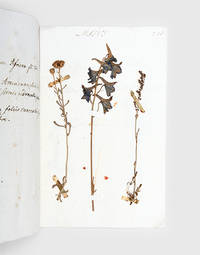
réf. 189373Germany: 18th century. A charming fragment of a methodically organized collection A scientific compilation of dried plants each annotated with a Latin binomial and many with their seasonality; this selection comprises spring and summer samples. Such herbariums began to be compiled in the 16th century and many featured in "cabinets of curiosities". They were a tool used by the most influential natural philosophers of the day including Linnaeus Rousseau and Goethe. The box lettered "gewürzpflanzen" and "gewürz" was originally intended to house spice plants. The individual gatherings are numbered and the box reads "nicht voll" not full showing that it was an evolving project that functioned as a reference tool and is likely a surviving specimen of a now-separated larger private collection. Many of the samples are also annotated with reference numbers perhaps to a printed botanical catalogue owned by the compiler or to other parts of the now-scattered collection. "A botanist who came across an unfamiliar plant might send it as a herbarium specimen to a colleague for identification. By comparing dried plants it was possible to discover duplicates of the same plant but with different names. Such uses were possible only if the herbarium sheets were kept separate rather than being bound into books which also made it easier to rearrange their order as new ideas about classification were developed and tested" Allaby p. 61. Comprising 17 booklets individually sewn at folds page size: 212 x 139 mm samples affixed with thin strips of paper or copper contents annotated in black and green ink. Paper stock watermarked with snake on staff with double knobs and star countermarked "BB" perhaps referring to Beckh paper mill Göppingen founded 1747. Housed in contemporary card case with partially-obscured paper labels lettered "No 3" "Gewurz" and "Invatio ecum bot Tom VI. 708 ad pa". First leaf of single booklet and handful of samples not present paper lightly foxed else crisp; box worn and with some worming. Overall in very good condition. Michael Allaby Plants: Food Medicine and the Green Earth 2010. unknown
2025réf. x-1836991002Cabi Publishing 2025. Hardcover. New. 192 pages. 6.77x2.00x9.61 inches. Cabi Publishing hardcover
2002réf. 1-1571457216Thunder Bay Pr 2002. Paperback. New. 608 pages. 7.75x2.75x1.75 inches. Thunder Bay Pr paperback
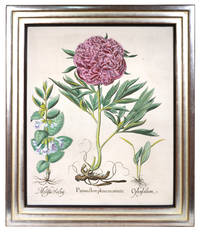
réf. 96802Nuremberg & Eichstatt 1640. . Four copper engraved plates with hand-colour; framed and glazed; plate size: 500 x 440 mm.; overall size: 512 x 603 mm. Magnificent plates from Hortus Eystettensis one of the earliest and most famous works in the field which provides a pictorial record of the flowers grown in the greatest German garden of its time that of Prince Bishop of Eichstatt Johann Conrad von Gemmingen. The garden was begun by Joachim Camerarius in 1596 and after his death in 1598 completed by Basil Besler a pharmacist from Nuremberg. A visitor Philipp Hainhofer in 1611 marvelled at the eight gardens each containing 'flowers from a different country; they varied in the beds and flowers especially in the beautiful roses lilies tulips'. The Hortus records this variety and beauty. The book is exceptional in every sense; in its variety and range of flowers in its size in its fine quality of engraving. It is also one of the earliest records of flowers from a specific documented garden. Besler was asked to complete the work by Gemmingen in 1606; the huge nature of the task was clear to Besler and he enlisted the help of his younger brother Hieronymus and Ludwig Jungermann a nephew of Camerarius. Printing the Hortus may have begun as early as 1607. Drawings were made in situ and from specimens sent by the Bishop to Nuremberg; the Bishop reported to Hainhofer that he had boxes of fresh flowers sent every week to Besler at Nuremberg for sketching. A team of at least 10 engravers were employed to translate the drawings to copperplates. The gardens along with most of the town of Eichstatt were destroyed by the invading Swedish troops under Herzog Bernhard von Weimar in 1633-4 although they were partially restored by later bishops. Many of the original drawings survive in the University Library Erlangen. Nissen 158; Pritzel 745; Hunt 430; Blunt pp 95-97; Stafleu & Cowan 497. Nuremberg & Eichstatt, 1640. unknown
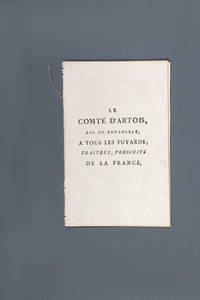
1790réf. 4504805Paris 1790. Small hole to A4 affecting one word otherwise fine. Octavo 19 1 pp; disbound from a volume. A very rare early "satire on French politics and English colonization" Ferguson. Likening those who fled the tumult of the French Revolution to the English convicts transported to Australia the author petitions them to join the future king of France in the newly established penal colony at Botany Bay: "le vaste continent des Terres Australes leur offre un pays nouveau asyle fait pour eux" "The vast continent of the Southern Lands offers them a new country a refuge made for them". The "count" continues that "c'est la Nation que vous etes dignes d'etentre c'est la Nation que je suis fait pour commander" "this is the nation that you deserve and that I am meant to command" and explains that in the Antipodes the laws are very different and virtue and vice are often upended. The satire evidently found an audience in Revolutionary France: a second edition was published in 1799. It appeared in the very first years of the English colonisation of Australia at a time when France had its own interests in the region and its own problems at home. La Pérouse commanding the Astrolabe and the Boussole arrived at Botany Bay on 24 January 1788 just as Arthur Phillip was moving the English settlement to Port Jackson. They spent six weeks in Australia before moving on. Toby R. Benis uses the pamplet to begin the introduction to his Romantic Diasporas: French Émigrés British Convicts and Jews 2009: "In 1799 a satirical pamphlet aimed at French émigrés and those inside the republic who sympathized with them appeared in England. Claiming to be produced in London the text was framed as an appeal from the Comte d'Artois Louis XVI's youngest brother calling on the 'cowards who fled France and to all those who have been banned from France-princes and valets traitors and bandits princesses and prostitutes' to join him in the British penal colony of Botany Bay: 'a new country made especially for them'. Styling d'Artois the "king of Botany Bay" the writer characterizes Australia as a de Sadian refuge for the worst elements of both Britain and the ancien regime bequeathed by the British government to the emigrant Prince and his circle to rule. A historical curiosity this document nonetheless points to a political and social dimension to exile in the Romantic period.". Romantic Diasporas focuses on how French emigrés Australian convicts and Britain's Jews embodied this state for Georgian society. . unknown
1833réf. 3409328Rio de Janeiro: Miranda & Carneiro 1833. Occasional light spotting. A fine copy. Three parts in one volume small octavo; in contemporary green quarter calf gilt. The first edition in Portuguese of this unrecorded reference to Botany Bay. First published in 1789 in Paris Barère de Vieuzac's La Liberté des Mers was an invective against the British government whose maritime supremacy he described in such terms as "despotism" and "tyranny". This volume is a translation from a Spanish edition of Barère published circa 1820. In the Introduction Barère charges the British with a multitude of crimes including responsibility for the evils of the French Revolution; conspiring with American Indians to attack non-British settlers; aiding and abetting pirates; and exiling Irish and Scottish political prisoners to Botany Bay. This reference consists of seven lines of text which appear on p. xv: '"Quem concebeo e executou o terrivel plano de desterrar para o arido Solo de Botany-Bay aos Irlandezes e Escocezes e de assassinar em Hollanda Italia França e America todos os Virtuaosos patriotas que sustentavão com energia a liberdade e gloria de seu paiz". O Gevenrno Britanico'. Barère 1755-1841 was born in Gascony and practiced law until elected to the States-General in 1789. Elected president of the Convention in December 1792 he presided over the trial and execution of Louis XVI. This is the first edition to have appeared in Portuguese. None of the editions in Spanish or French have been traced in Ferguson. . Miranda & Carneiro unknown
1998réf. ZB394626National Institute of Agricultural Botany 1998-2000. volumes 11-13. 1998-2000. partly bound library markings textually clean & tight PRICE IS FOR THE LOT. - If you are reading this this item is actually physically in our stock and ready for shipment once ordered. We are not bookjackers. Buyer is responsible for any additional duties taxes or fees required by recipient's country. Photos available upon request. National Institute of Agricultural Botany unknown
réf. 9934Calcutta: Royal Botanic Garden 1905. First edition. The boards are browned with some worm holes; the text is generally clean with some tanning to the first few pages only there are a few marginal worm holes also called pin holes due to their small size to the text; overall a good solid copy of a rare work. Pp. i-iv i-ii 115-197 1 i-lxxv 1-2; 25 full page plates fine line-drawings. Publishers original portfolio case in one-quarter dark green leather over printed pale green boards with three internal black flaps that hold the monograph folio 14 3/4 x 11 1/2 inches. Annals of the Royal Botanic Gardens Calcutta Volume X Part II. This is the original and complete work published in Calcutta in 1905. Aconitum Aconites is a genus of over 250 species of flowering plants belonging to the family Ranunculaceae; these herbaceous perennial plants are chiefly native to the mountainous parts of the northern hemisphere. Most species in this genus are extremely poisonious; this has resulted in some unusual common names such as monkshood wolf's bane leopard's bane mousebane women's bane devil's helmet Queen of all Poisons or blue rocket modified after Wiki. The second monograph by D. Prain is a biography of Francis Buchanan who was an East India Company surgeon surveyor and botanist. Dr. Francis Buchanan later Hamilton or Hamilton-Buchanan published works on the geography flora and fauna of India where he lived and explored from the end of the 18th century until 1815 after Wiki. No ownership marks. Calcutta: Royal Botanic Garden, 1905. First edition. hardcover
2010réf. DADAX1160814961Kessinger Publishing 2010-03-19. paperback. New. 6.00x1.62x9.00. Buy with confidence. Excellent Customer Service & Return policy. Kessinger Publishing paperback
réf. 2i10666Institute of Botany Polish Academy of Sciences - W. Szafer Kraków 2008-2011. Insgesamt ca. 1000 S. mit vielen teils ausklappbaren Abbildungen sowie Diagrammen und Tabellen kartonierte Einbände quart geringe Gebrauchsspuren. - sonst gute Exemplare / good condition / Enthalten: Vol. 48/2008 No. 1 and No. 2 / Vol. 49/2009 No. 1 / Vol. 50/2010 No. 1 and No. 2 / Vol. 51/2011 No. 1 and No. 2 / Text englisch - unknown
réf. 6241Johannesburg: Aloe Books 1985. Limited edition. A fine as new copy. Pp. i-xl 2-150; frontispiece portrait of Adrian H. Haworth 120 color photographs 31 black-and-white photos and half-tones 24 distribution maps. Publisher's original dark green morocco leather spine with five raised bands red morocco title/author label in one compartment two-color map endpapers in gray cloth-covered slipcase with green marbled paper on the top side and bottom of the slipcase and dark green morocco flange at the opening of the slipcase sm 4to 11 x 8 1/4 inches. This is Sponsors' edition limited to 27 signed copies lettered A-Z signed by the author on the limitation page; this is copy letter V. The subscriber's page shows that there were sixteen sponsors to this work presumably they received letters A-Q; this left only eleven copies available for sale. The copy offered here is one of these eleven available for sale. Haworthia is a large genus of small succulent plants endemic to Southern Africa Mozambique Namibia Lesotho Swaziland South Africa. Like the Aloes they are members of the subfamily Asphodeloideae and they generally resemble miniature aloes except in their flowers which are distinctive in appearance. Horticulturally they are popular garden and container plants from Wiki. This is an important taxonomic revision of the genus Haworthia that was named after Adrian H. Haworth who was an English entomologist botanist and crustacean expert. This very rare offering is finely bound in attractive dark green morocco that is housed in a custom slipcase. Johannesburg: Aloe Books, 1985. Limited edition. hardcover
réf. 5195México: Sociedad Mexicana de Historia Natural 1976. Reprint. Small bump to front outer top corner which has caused some pages to bend forward wrappers on spine a little sunned some browning to the front wrappers only the text and plates are bright and clean; overall a very good copy. Pp. iv 298 70 full page plates. Original green pictorial printed wrappers lg 4to. This is a facsimile reprint of the rare 1909 first edition. The work covers the ferns of Mexico with finely executed plates of many species. México: Sociedad Mexicana de Historia Natural, 1976. Reprint. unknown
2002réf. DADAX1571457216Brand: Laurel Glen Publishing 2002-09-28. First Editiion. paperback. New. 6.00x1.75x7.75. Buy with confidence. Excellent Customer Service & Return policy. Brand: Laurel Glen Publishing paperback
réf. 3617Hong Kong: Orchid Press 2003-2007. First edition. Fine new condition. Pp. 103; 108; 108 300 fine color photos of orchids. Color pictorial boards hardback with color pictorial dust jacket beautiful color pictorial endpapers 4to 10.75 x 10.5 inches. Volume 1: Highlight Edition Volume 2: A Poem of Wild Orchids and Volume 3: Shangri-La of Wild Orchids. A total of six volumes were planned in 2003 but only three have been published. Since five years have passed since volume 3 was published it is doubtful any more will appear. Hong Kong: Orchid Press, 2003-2007. First edition hardcover
réf. 3404New York: Ivison Blakeman Taylor and Co. 1878-1884. First edition. Spine cloth of volume 2 part 1 is a bit sunned and has a nick to cloth just below the title as well as wear to the cloth at the head and foot of the spine there is also some light spotting to the cloth of volume 1 part 2 - overall a good solid copy. Pp. vi 402; iv 402. Publisher's original brown cloth gilt-lettered on the spine sm 4to. Vol. 1 Part 2 covers Caprifoliaceae to Compositae Vol. 2 Part 1 covers Gamopetalae after Compositae. See Stafleu and Cowan 2132. Vol. 1 Part 1 was published in 1895-97 after Gray's death. Name sticker of C.D. Fretz M.D. Sellersville on the front endpaper. New York: Ivison, Blakeman, Taylor and Co., 1878-1884. First edition hardcover