SICARD (Guillaume).Livre Rare Book

4 067 résultats
1884réf. 12152Paris, Librairie Charles Delagrave, 1884. Un fort vol. in-8 (276 x 176 mm) de xv - 308 pp. et 75 planches, broché.
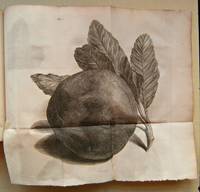
1888réf. 10048Sacramento Cal: State Office: J.D. Young Supt. State Printing 1888. Slim octavo 23 x 15 cm 96 pages. Illustrated with a chromolithograph frontispiece and wood engravings throughout. Several errata have been overprinted in purple ink rubber stamp. FIRST EDITION. Byron Martin Lelong 1856-1901 was the Secretary of California's State Board of Horticulture and amongst a generation of farmer-scholars working and publishing in California in the 1880s and 90s. Others included Thomas Garey and William Andrew Spaulding and in a different way Santa Rosa's Luther Burbank the great seedsman. Lelong's published work focused on citrus as well as prunes figs and walnuts. This treatise is mostly a technical manual on the best varieties of oranges and other citrus to plant in California as well as a guide for how to care for them. It also includes recipes for lemon pie orange souffle and citron cake. Illustrations show the physical differences in each variety of citrus including one of the cross section of a "Pumpel-mouse". Boards lightly scuffed with soiling to margins and fading to spine. Corners bumped and gently rubbed with boards bowing out at fore-edge. Rippling to endsheets with page margins lightly toned. Title page offset by frontis. Text has overprinted errata in blue to correct spellings to a few pages. In publisher's dark blue pebble-grained cloth lettered in gilt. Overall very good or better. Presentation slip tipped in at first free endsheet presented by Ellwood Cooper the then-president of California's Board of Horticulture. Zamorano Select 65. State Office: J.D. Young, Supt. State Printing hardcover
1888réf. 10048Sacramento Cal: State Office: J.D. Young Supt. State Printing 1888. Slim octavo 23 x 15 cm 96 pages. Illustrated with a chromolithograph frontispiece and wood engravings throughout. Several errata have been overprinted in purple ink rubber stamp. FIRST EDITION. Byron Martin Lelong 1856-1901 was the Secretary of California's State Board of Horticulture and amongst a generation of farmer-scholars working and publishing in California in the 1880s and 90s. Others included Thomas Garey and William Andrew Spaulding and in a different way Santa Rosa's Luther Burbank the great seedsman. Lelong's published work focused on citrus as well as prunes figs and walnuts. This treatise is mostly a technical manual on the best varieties of oranges and other citrus to plant in California as well as a guide for how to care for them. It also includes recipes for lemon pie orange souffle and citron cake. Illustrations show the physical differences in each variety of citrus including one of the cross section of a "Pumpel-mouse". Boards lightly scuffed with soiling to margins and fading to spine. Corners bumped and gently rubbed with boards bowing out at fore-edge. Rippling to endsheets with page margins lightly toned. Title page offset by frontis. Text has overprinted errata in blue to correct spellings to a few pages. In publisher's dark blue pebble-grained cloth lettered in gilt. Overall very good or better. Presentation slip tipped in at first free endsheet presented by Ellwood Cooper the then-president of California's Board of Horticulture. Zamorano Select 65. State Office: J.D. Young, Supt. State Printing hardcover books
179912mo., neat contemporary signature on front paste-down, some light and intermittent age-staining to text, title and first two leaves of Table open awkwardly; contemporary mottled calf, sometime rebacked in calf to style, backstrip with black leather label lettered and tooled in gilt, boards rubbed at edges and corners else a bright, clean copy. Bright copy of the most famous herbal in English, first published in 1652 and commonly known as 'Culpeper's Herbal'. In the following year the author altered the format of his work, apparently to differentiate it from the two well-known piracies issued by Bentley immediately after first publication. VERY SCARCE. Henrey 102.
1750réf. 015882Leyden & Amsterdam: Samuel Luchtmans & Meynard Uytwerf 1750. Illustrated with 13 finely engraved plates one with a tear and one with tears along the folds one full page plan within the text small quarto pp xxiv 6 412 32 contents a little age-toned but otherwise remarkably clean pages unpressed lacking the half-title contemporary full calf rather worn particularly at the corners joints cracked lacking the lower panel of the spine and a small piece at the head original marbled endpapers. LACKING one plate. "French edition of the first treatise in Dutch to provide a theoretical basis for garden design. It also addressed various practical issues including the cultivation of plants propagation and stove and hothouse technology the latter presumably embodying the knowledge held within the family - the author's father having grown the first pineapple at Meerburg in 1658" - Patrick Taylor . Full-Leather. Good. Samuel Luchtmans & Meynard Uytwerf Hardcover
1928réf. 120404Berlin, Springer, 1928-64. M. zahlr. Abb. Meist OHefte. Meist unaufgeschn. Ex. Umschl. teilw. stärker beschäd. od. m. St. u. Sign. Buchbl. teilw. gebrochen. Bd. 19-23 Bibl.-Hlwdbde. Bd. 1 fehlen Tit. u. Inh.-Verz.
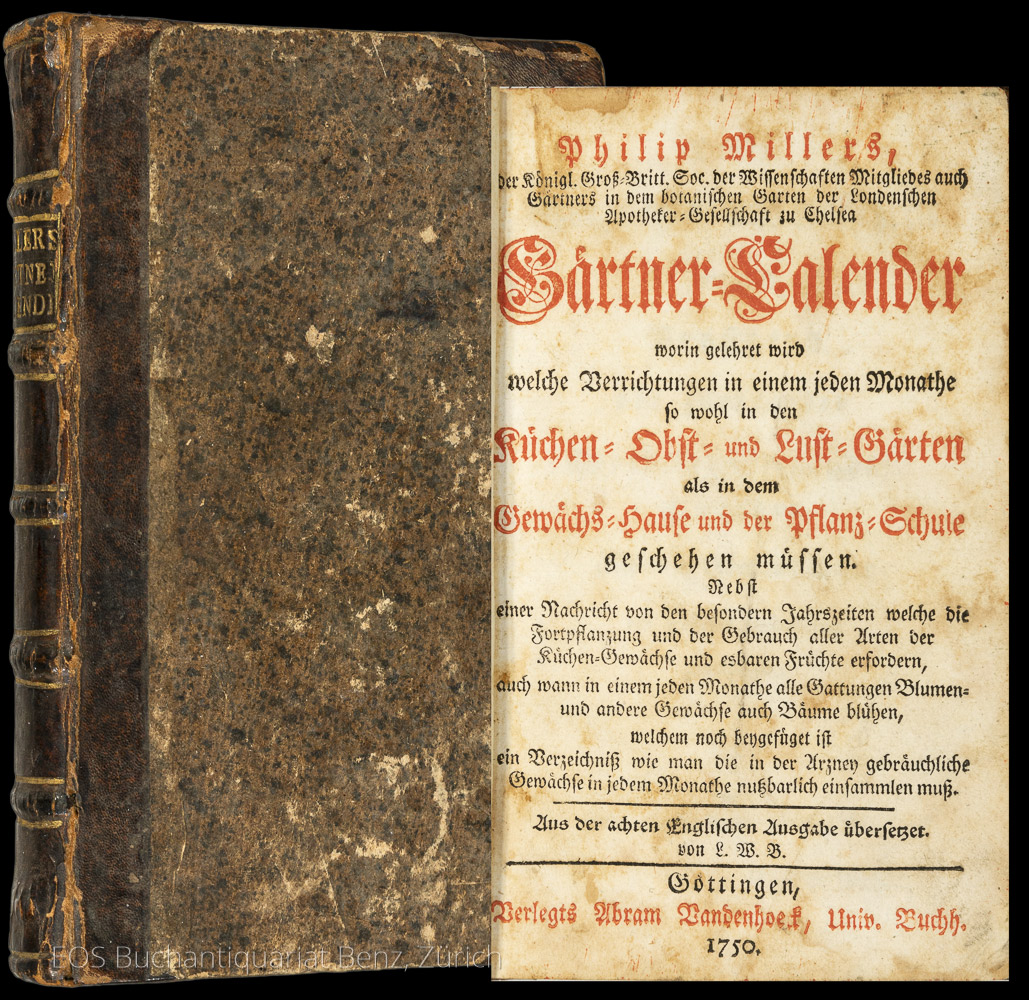
1750réf. 4823DBGöttingen, Vandenhoeck, 1750. 8°. 16, 410 (recte 393) S., (1) Bl. Halblederband der Zeit mit verg. Rückentitel. + Wichtig: Für unsere Kunden in der EU erfolgt der Versand alle 14 Tage verzollt ab Deutschland / Postbank-Konto in Deutschland vorhanden +, 4823DB|4823DB_2 [2 Warenabbildungen] Aus der achten englischen Ausgabe übersetzt.
18448 vols., 8vo., Second Edition, with many hundreds of fine wood-engraved illustrations (a number folding), some mild and occasional spotting (mainly marginal) in some plate volumes; original green cloth, boards elaborately framed and blocked in blind, gilt back, ivory endpapers, uncut, covers a little age-soiled, backstrips lightly browned, a few joints lightly rubbed else a very good, bright, clean, firm set. Vols I-IV: text; Vols V-VIII: plates. Freeman 2319.
First edition, 8vo (206 x 122 mm), [18], 259, [1], [12], 120pp., complete with supplement and Latin title page for both the main work and the supplement (usually lacking), cont. calf, red morocco spine label lettered in gilt, a nice copy. "This in its time was a standard handbook, used by botanists, gardeners, nurseries, seedsmen. It lists trees and shrubs, herbaceous plates, greenhouse plants, stove plants, and seeds according to their Linnaean binomial and English names."?Hunt. Provenance: Bookplate of Edward Winnington, 1786; B. O. Mulligan, purchased from Blackwell's in 1945 with their invoice tipped-in at rear. Hunt, 647; Henrey, 1483; Pritzel, 10205.
réf. Z1-R-014-01267General Books LLC. Used - Like New. Used - Like New. Book is new and unread but may have minor shelf wear. Ships from UK in 48 hours or less usually same day. Your purchase helps support Sri Lankan Children's Charity 'The Rainbow Centre'. 100% money back guarantee. We are a world class secondhand bookstore based in Hertfordshire United Kingdom and specialize in high quality textbooks across an enormous variety of subjects. We aim to provide a vast range of textbooks rare and collectible books at a great price. Our donations to The Rainbow Centre have helped provide an education and a safe haven to hundreds of children who live in appalling conditions. We provide a 100% money back guarantee and are dedicated to providing our customers with the highest standards of service in the bookselling industry. General Books LLC unknown
1918Folio, First Edition, with coloured frontispiece (original tissue guard present), title in red and black, title-vignette, and many hundreds of fine photographs (many full-page), marbled endpapers, marbled endpapers; original blue buckram, upper board and backstrip lettered in gilt, gilt edges, joints and extremities mildly rubbed as usual, covers lightly age-marked and faded else very good, clean copy. This magnificent standard reference comprises introductory text and a superb assembly of photographs of garden ornaments of every kind, including wood and iron gates, steps, balustrades, urns, vases, courts, paved ways, seats, loggias, orangeries, dovecotes, parterres, sundials, topiary, pergolas, treillage, canals, ponds, water gardens, bridges, fountains, dipping wells, borders, wall gardens, Japanese gardens and many more. The examples are chosen primarily from England, with a few from Italy. One of the finest garden books of the twentieth century. Scarce, especially in this condition.
réf. 6364120 fascicules In4 (format 33cmX25cm)
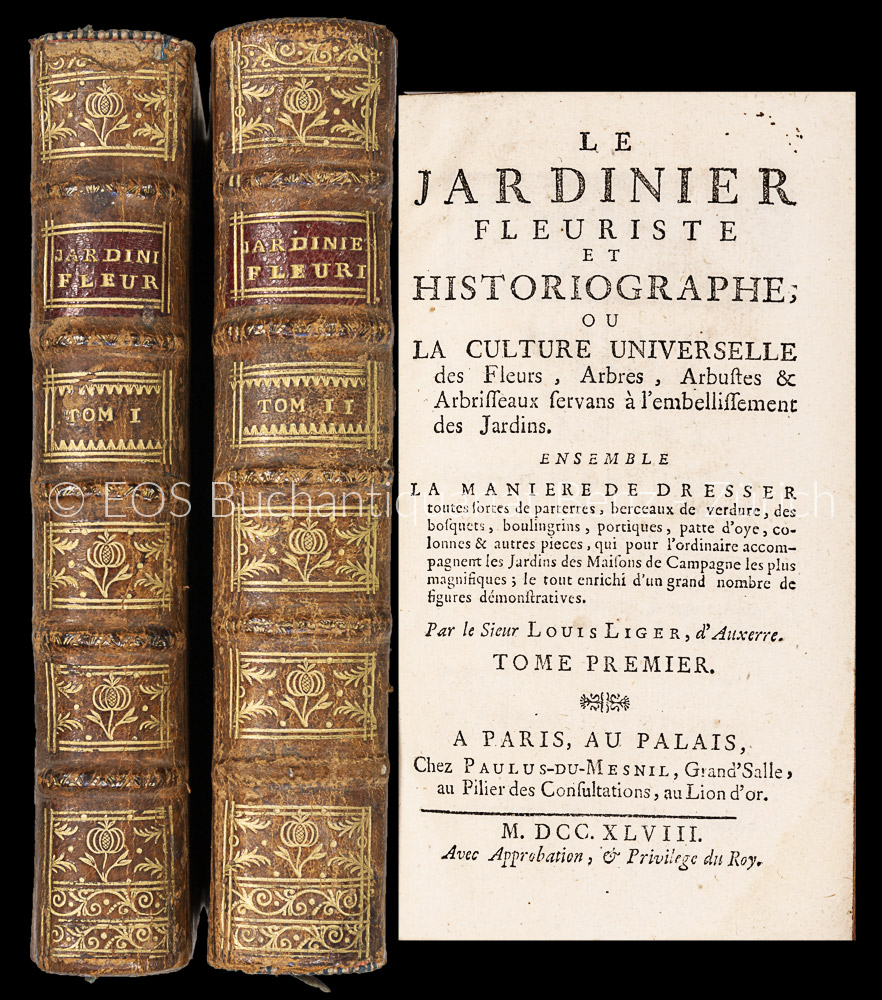
1748réf. 6860CBParis, Paulus-du-Mesnil, 1748. 8°. (12) Bl., 379, (13) S.; (3) Bl., 480 S., (5) Bl. Mit 20 gef. Holzschnitt-Tafeln und 47 Textholzschnitten. Marmorierte Lederbände aus der Zeit mit reicher Rückenvergoldung und roten Rückenschildern. + Wichtig: Für unsere Kunden in der EU erfolgt der Versand alle 14 Tage verzollt ab Deutschland / Postbank-Konto in Deutschland vorhanden +, A|B 2 Bände. [2 Warenabbildungen]
réf. 76230Gand (Belgique), éd. J.-S. Van Doosselaere, s.d. (circa 1863), in-12, plein chagrin brun "cognac", reliure contemporaine, 15 - (1 bl.) pp., belle grande planche représentant 3 figures en noir (un plan d'implantation en coupe dans une serre, une vue intérieure d'une vigne dans la serre et un plan d'une vigne en "espalier" dans la serre), L'auteur, Van Hulle, fut jardinier du Jardin Botanique de Gand en Belgique durant les années 1860 et 1870. Il publia quelques brochures horticoles et agricoles. Ce livret nous parle de l'implantation de vignes qui produisent du raisin de table, l'utilisation de ce genre de serre est à son apogée dans les année 1860/70 en Belgique, notamment au sud de Bruxelles et au nord du pays. Cette brochure nous explique la construction de la serre en verre et métal, le choix des cépages adaptés à la culture en serre, le chauffage de la serre, la taille et le palissage spécifiques, la gestion de l'humidité et la ventilation ainsi que le calendrier de production pour obtenir des raisins précoses. Un livret pratique, court et très technique ! Agrémenté par une très belle planche dépliable avec 3 figures en noir. Ce livret est probablement à un tirage très limité (inférieur à 300 exemplaires); les brochures horticoles belges de cette époque étaient imprimées "à la demande", souvent pour des dociétés d'horticulture ou des propriétaires de domaines, ce qui en fait la rareté aussi c'est qu'il s'agit d'un petit imprimeurs flamand du XIXe siècle qui furant peu conservés ! Il s'agit d'un "témoignage" rare d'une pratique viticole de ce 19e siècle en Belgique ! L'éditeur et l'imprimeur ont complètement disparus de nos jours. En résumé, il s'agit d'une publication qui n'existe que dans quelques rares bibliothèques universitaires dans quelques fonds privés. Ce livre n'a jamais été numérisé et n'est présent sur aucun site de vente de libraires. Ce livret est donc un "INTROUVABLE" ! Je termine par la reliure, moderne, mais neuve et sans indications, ni sur le dos, ni sur les plats. Trrès bon état de la reliure, du papier et de la planche dépliable
1750réf. 4823DBAus der achten englischen Ausgabe übersetzt. Göttingen, Vandenhoeck, 1750. 8°. 16, 410 (recte 393) S., (1) Bl. Halblederband der Zeit mit verg. Rückentitel.
1756folio [42 x 26 cm]; xii, 719, [i, publisher's ads] pp, copper engraved frontis plus 12 copper-engraved plates, one of which is double-page, engraved headpieces, tailpieces and other illustrations. contemporary full paneled leather, worn especially on spine & edges, joints cracked through with covers holding by strings, front blank endpaper chipped, old damp stain to gutter and fore-edge of first 50 pages, text block solid, contents very good. A pic The title, a minor essay in itself, goes on to mention crops, breeding and preserving cattle, curing their diseases, managing the orchard, the brewhouse and the dairy. The plates include farming implements, plants, plans, buildings and one of a dung pit. Most plates have several figures. Fussell p. 37. Later editions had fewer plates. Macdonald 210 mentions only the Dublin edition of 1757 in two volumes which had only 5 plates and the London 1758 edition. A detailed and early agricultural work covering all aspects of the subject.
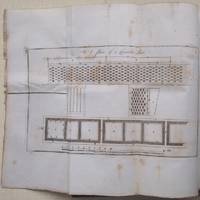
1795réf. 017372The Strand London & Edinburgh: T. Cadell & W. Davies; Bell & Bradfute 1795. Second edition. Illustrated with a folding plan of a cucmber bed a little foxed and browned slightly frayed at the fore-edge octavo pp xvi 312 fore-edge and bottom edge untrimmed a little foxed and age-toned throughout a neat early signature on the title page bound by Spink & Thackray of Leeds in a brown half buckram and boards slightly worn and with an armorial crest at the base of the spine. Blanche Henrey 1000. RARE - a good wide-margined copy. Second edition of the work which brought MacPhail's forcing frame and controversial method of cultivation to the public view. McPhail was gardener to Lord Hawkesbury at Addiscombe Place in Surrey. The brick frame was of his own design and a notable feature of this book is the detailed weather observations covering a complete year together with the precise treatment given to the plants on each day. The frame proved immensely popular and within 40 years Rogers 1839 was to state " an excellent invention that has certainly rendered the forcing of this vegetable more simple.there are few gentleman's gardens and few principal market gardens without them". . Second edition. Half cloth and boards. Very Good. T. Cadell & W. Davies; Bell & Bradfute Hardcover
1844Eight Volumes. Volumes 5, 6, 7 and 8 are plate volumes. Wonderfully illustrated. Bookplate of R. B. Wardlaw Ramsay. 8vo. Original full cloth bindings embossed in blind. Volume one missing spine. Hardbound set. Second edition. The Scotsman, John Claudius Loudon (1783-1843), was the most eminent early 19th century expert on landscapes, gardening, and agriculture. At the age of 20 he visited London and was shocked by the gloomy trees and plantings in the public squares. He published an article, Observations on Laying out the Public Squares of London" in the Literary Journal, in which he recommended the Oriental plane, almond, sycamore, and other lighter trees, instead of the lugubrious plantings that had hitherto been in vogue. His advice gradually prevailed, and the effect is still to be seen in London and throughout the kingdom. Now he was an author, as well as practical workman, and his pen went onward with little intermission for forty years. , until his life terminated. Many of his works were enriched with copperplate engravings of landscape scenery, drawn by himself. He became a successful practitioner and instructor in agriculture, gardening, architecture, botany, etc. His greatest work, which would of itself have been sufficient for any ordinary lifetime, was this Arboretum et Fruticetum Britannicum," in which he gave an account, with pictorial illustrations, of all the trees, wild or cultivated, that grow in Great Britain. This production, which was published in 1838, at his own risk, was so unsuccessful, that after paying artists and other persons engaged in it, he found himself in debt to the amount of L10,000 to the printer, stationer, and wood-engraver, while the sale of such a splendid publication was so slow, that there was no prospect that it would ever pay its own expenses. Though sick of heart and body, he went on to publish other enormously significant works that are valued today by collectors, historians, scientists, and all who work with plants in any capacity. **PRICE JUST REDUCED! PLANTS W133
1838pp. viii, 151 + Half title and forty nine mounted engraved plates on India paper. Early engraved bookplate. Most plates foxed but mainly in the margins. Text slightly foxed. 4to. Original early cloth binding, rebacked preserving the original backstrip. Spine label. Binding slightly worn at extremities and a few small stains on front board. Hardbound. Jacob George Strutt (17841867) painter and etcher, studied in London, and was a contributor to the Royal Academy and British Institution at intervals between 1819 and 1858. For a few years he practiced portrait-painting, but from 1824 to 1831 exhibited studies of forest scenery, and he is now best known by two sets of etchings which he published at this period `Sylva Britannica, or portraits of Forest Trees distinguished for their Antiquity' (1822; reissued, as here, in 1838), and `Delicia Sylvarum, or grand and romantic Forest Scenery in England and Scotland' (1828). About 1831 Strutt went abroad, and, after residing for a time at Lausanne, settled in Rome. In 1851 he returned to England, but was not active after 1858. Nice copy of the First Quarto Edition, with the plates being mounted proofs on India paper. Bridson & White C537; Nissen BBI 1907. RARE. **PRICE MUCH REDUCED! PLANTS W134
1800réf. 14070Frankfurt: Behrens 1800 & 1801. First Editions. Rebound in blue paper wrappers. Fine; blank fore edge of the first pamphlet appears somewhat trimmed. 8vo I - 28 4 - adverts pp. one color plate; II - 16 pp. one color plate. Mueller provides the history use and cultivation of this edible plant that had been cultivated in parts of Europe since the late 16th century. The plant is the Cyperus esculentis tiger nut yellow nutsedge etc. Unlocated. Behrens unknown books
réf. 017330London: Baldwin & Craddock 1831 - 1836. A complete set of five volumes. Illustrated with 10 hand coloured plates 7 black and white plates of which three are folding various text illustrations some full page some offsetting of text on to plates some browning and ageing throughout one weak internal hinge in the fifth volume otherwise all firm and tight. Volumes 1 - 3 bound in half calf and marbled boards rubbed joints slightly weak with the book label of Joseph Alexander Walton; Volumes 4 and 5 in original ribbed cloth with rubbed paper labels a little fraying of the spines bookplate of Thomas Bowyer Bower. A scarce complete set. Paxton was an English gardener architect engineer and Member of Parliament best known for designing the Crystal Palace and for cultivating the Cavendish banana the most consumed banana in the Western world. He was appointed head gardener at Chatsworth at the age of twenty and created an important range of glasshouses and frames when the use of such things was in its infancy. First Edition. Mixed bindings. Good. Baldwin & Craddock Paperback
1748réf. 6860CB2 Bände. Paris, Paulus-du-Mesnil, 1748. 8°. (12) Bl., 379, (13) S.; (3) Bl., 480 S., (5) Bl. Mit 20 gef. Holzschnitt-Tafeln und 47 Textholzschnitten. Marmorierte Lederbände aus der Zeit mit reicher Rückenvergoldung und roten Rückenschildern.
réf. 23715Paris, Bureau du journal de l'Académie d'horticulture, 1831 - 1834. Collection de 9 volumes composée comme suit : 7 volumes au format in-8 de 320 pages chacun, complets de leurs 9 planches et illustrations in-texte et couvrant la période d'avril 1831 à avril 1833. Suivis de deux volumes grands in-8 de 383 pages chacun avec 2 planches au premier volume et couvrant la période de aout 1833 à aout 1834. Edition originale. Très bon état intérieur malgré des rousseurs à deux volumes et sur certaines planches. Très agréables reliures homogènes en demi-veau vert foncé à coins, roulette dorée sur les plats, dos lisse très orné de filets, larges roulettes et fleurons dorés. Papier des plats d'un joli vert plus clair, et tranches bleutées. Très bon état pour cette attractive collection.
1545In 8° (15,8x10,8 cm); 69, (1) cc.. Legatura in cartoncino molle. Un piccolo ed ininfluente forellino di tarlo abilmente restaurato nell'angolo bianco alto delle ultime 3 carte. Una piccola e leggerissima macchiolina, anche questa ininfluente al margine esterno bianco delle ultime 10 carte, praticamente invisibile e nel complesso esemplare in buone-ottime condizioni di conservazione. Celebre marca tipografica di Valgrisi al frontespizio ed all'ultima carta con "Serpente attorcigliato a bastone a forma di tau sostenuto da mani uscenti da nuvole". Prima traduzione italiana, fatta dal noto letterato modenese Pietro Lauro, di questa importante opera botanica del grande medico ed anatomista francese Charles Estienne. Terzo figlio di Henri Estienne, uno dei più grandi stampatori nel XVI secolo, lasciò un profondo segno nell'agricoltura cinquecentesca e seicentesca. Ispirandosi ai classici greci e latini pubblicò alcune delle opere più importanti in tema botanico e di orticoltura della sua epoca come il "Seminarium'', il '' Re Vinetum Ortensia" o il ''Praedium Rusticum". Nell'opera qui presentata, in prima edizione italiana, l'autore descrive le piante più adatte e migliori da piantarsi negli orti, la disposizione da tenersi ed il modo migliore di allevarle e accudirle con notizie utili anche sul come proteggerle dalle intemperie e dagli animali. Prima edizione italiana, non comune e ancor meno comune, dato l'uso manualistico che ne veniva fatto, in queste buone-ottime condizioni di conservazione.
1846réf. R300022800"LIBRAIRIE AGRICOLE DE DUSACQ. 1846. In-12. Relié. Bon état, Couv. convenable, Dos abîmé, Intérieur frais. 560 pages illustrées de 17 planches couleurs. Ouvrage accompagné du supplément au catalogue n°27 ""Cultures de Louis VAN HOUTTE"". . . . Classification Dewey : 635-Horticulture"