[BIRDS & FLOWERS] Imao KEINENBiblio.com

5.404 Ergebnisse
1891Best.-Nr. 871711891. BIRDS & FLOWERS Imao KEINEN. KEINEN KACHO GAFU. Kyoto: Tanaka Jihei. Meiji 24-25 1891-2. 4 vols. each approx. 35.5 x 25.1 cm. Stringbound fukuro-toji Japanese style. Vol.1 Spring has 31 color woodblock prints of birds and flowers of which 7 are huge double page prints. Vol.2 Summer has 32 plates of which 8 are double page. Vol.3 Autumn has 38 prints of which 4 are double page. Vol.4 Winter has 34 plates of which 4 are double page and one is a four page spread. These original Tanaka Jihei issues which preceded the Unsodo versions have become quite scarce complete sets even more so and sets with the western number captioning the true first printing almost impossible to find. The covers are original with the titles directly printed there and the gold flecking. The summer issue has a single worm track in the margins else it and the other volumes are impeccable the printing excellent the colors subtle and lovely. The nicest set we have ever handled. All in a clasped chitsu case which itself is quite rough. 4 vols. complete as issued by Tanaka Jihei very unusual thus. unknown
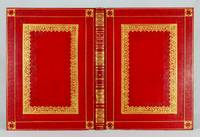
1819Best.-Nr. ST12549London: Published by Thomas McLean 1819. Second Edition. 368 x 273 mm. 14 1/2 x 10 3/4". 26 leaves of text including 3 pp. ads. Three parts in one volume. SPLENDID CONTEMPORARY ENGLISH RED STRAIGHT-GRAIN MOROCCO ELABORATELY TOOLED IN GILT AND BLIND covers with concentric filigree frames in alternating gilt and blind tooling raised bands spine panels intricately gilt with two large lozenges formed by rectangular and triangular tools surrounded by curling botanical ornaments turn-ins gilt all edges gilt. In an excellent recent matching morocco-lipped slipcase. WITH 36 VERY APPEALING ILLUSTRATIONS BEING 18 ENGRAVINGS six flowers six fruits six birds EACH IN TWO STATES monochrome and fully hand colored. Dunthorne 53-55; Sitwell "Fine Bird Books" p. 82. Text leaves with faint mottled foxing and minor browning and off-setting just a few plates with negligible faint spots or smudges otherwise A WONDERFUL COPY THE ORIGINAL SPARKLING BINDING IN AN AMAZING STATE OF PRESERVATION. This is a sumptuously bound copy of three manuals intended to teach the art of drawing to young persons written by the accomplished botanical painter who produced the renowned "Pomona Britannia." In an earlier career Brookshaw ca. 1751-1823 was a successful London cabinet-maker whose painted Neoclassical furniture attracted such titled enthusiasts as the Duke of Devonshire and the Prince of Wales but he suddenly abandoned this livelihood in the 1790s. Art historian Lucy Wood speculates that the sudden change was prompted by involvement in a financial or sexual scandal as he also parted company with his wealthy wife around this time. He spent a decade living under the name "G. Brown" teaching flower painting to refined young ladies before producing his first manual "A New Treatise of Flower Painting" which was finally issued under his real name in 1816. The three guides that make up the present volume were intended as a supplement to that work and they expand the subjects covered to fruit and birds. In the preface to this work Brookshaw observes that flower painting is a "peculiarly appropriate" accomplishment that may be obtained "without the expense of a Master a few elementary instructions and good copies being sufficient." The plates here are more highly finished than the examples in his original "Treatise" in order to "lead the young artist onward in a progressive line of improvement." Fruits and birds are added to offer a new challenge for the pupil and Brookshaw notes that while avian subjects lack the variety of botanical ones they compensate with "the inifinite number of attitudes they assume." Our elaborate and immaculately preserved binding is testament that our volume was never used as a drawing manual but was more likely enjoyed for its own merits as an attractive object. Published by Thomas McLean unknown
1655Best.-Nr. 28459First or early editions. Various places and publishers 1655-1897 1655. See Beverly Seaton The Language of Flowers A History. University Press of Virginia 1995. A detailed description of the collection is available via pdf on our website on the catalogues page. The Language of Flowers phenomenon flourished for almost eighty years beginning in France in the early 19th century. As both potent and subtle symbols in Western culture flowers are found in religious texts poetry heraldic and emblematic literature from the classical period and early Christianity through medieval literature and the enlightenment. In the early 19th century books were written and published for the first time under titles such as Abécédaire de Flore ou Langage des Fleurs 1811 Oracles de Flore 1816 Emblemes de Flore et des Végéaux 1819 and Le Langage des Fleurs 1819. With those publications the language of flowers and its exploration of floral symbolism in communication - usually as a language of love and romance - gained acceptance and popularity. During its nascent years in France the language of flowers had a relatively limited affluent audience but once publishers saw the potential for profit and obtained the ability to print and illustrate books on a large scale they began to publish language of flowers texts in the popular formats of literary annuals gift books and almanacs. By 1830 the genre was widely available to a new world of fervent book buyers and readers in the working and middle classes. The vogue for language of flowers books was so prevalent that it became the subject of parodies and satires by among others Frederick Marryat and J. J. Grandville. Herman Melville was a devotee of symbolic flower language and referred to it in Mardi and Pierre and poems written to his wife Lizzie. The core of this collection of language of flowers titles was assembled by Doris Ann Elmore a French teacher in San Francisco and lifelong Francophile. The collection is unusual for its scope. The collection is for sale en bloc. First or early editions. Various places and publishers, 1655-1897 unknown
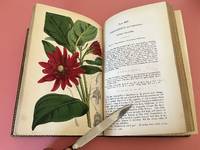
1793Best.-Nr. 039192Stephen Couchman 1793. Book. Very Good. Hardcover. Royal 8vo. The Botanical Magazine which in 1801 became Curtis's Botanical Magazine is generally recognised as being the most important journal of its kind and still published today. Magnificent illustrations and beauty of production are combined with a high standard of science. This is probably the most comprehensive set ever offered either through the trade or at auction: the first 200 volumes 1793 - 1999 missing just three volumes - nos. 123 124 & 125 1897-1899. Additionally the two Companion volumes dated 1835-1836 are present plus the Dedications volume and various index volumes as documented below. In the main series a total of c. 9380 superb hand-coloured plates plus c. 125 etched or lithographic uncoloured plates plus c. 1265 colour-printed plates a total of c. 10770 plates. The majority of this collection handsomely bound in more or less matching contemporary full straight-grained green morocco extra gilt decoration to the spines all edges richly gilt marbled end papers. These volumes originally from the Library of Henry Rogers Broughton 2nd Baron Fairhaven the earlier volumes in turn from Havringland Hall Norfolk seat of the Fellows family with the Haverland armorial bookplate the later volumes with the Broughton bookplate. Volumes bound thus 1-69 71-88 97-105 108-122 127-131 156-163 the later ones bound by C. Fox W.1 of London. Otherwise vol. 70 bound in half brown Morocco also by Fox; vols. 89-96 106-107 & 126 in the publisher's green cloth; vols 132 & 133 in brown cloth to match; vols. 134-155 vols 138-146 & 148-155 with the armorial bookplate of George Walter Erskine Lodder & 164-184 in the publisher's brown cloth or brown cloth to match some with the bookplate of William Jocelyn Lewis Palmer or David Jamison. Vols. 185-200 in the original 4 parts per volume in wrappers from 1984-1994 the publication was renamed "Kew Magazine" thereafter reverting to Curtis's Botanical Magazine. Vols. 1-5 are reprints overseen by William Curtis published 1793 the first edition was published in 1787 1796 1797 1796 & 1796 respectively thereafter all first editions. Vol. 1 with an engraved frontispiece portrait of W. Curtis this was not present in the first edition and is different from that which appears in the 1828 "General Index". Vols. 132 & 133 1906 -1907 are uncoloured 120 plates: nos. 8052 -8171. At this time the Botanical Magazine was issued in coloured and uncoloured versions the latter have a different quality as the purity of the stone lithography is displayed to full advantage. Additionally: "General Indexes. the first twenty volumes." pub. 1805 contemporary half brown calf. And: "General Indexes.the first forty-two volumes." pub. 1817 contemporary half dark green morocco marbled end papers J. H. Langston. Sarsden bookplate. And: "General Indexes. the first fifty-three volumes." pub. 1828 engraved frontispiece portrait of William Curtis dated 1800 full straight-grained green morocco to match main set Haverland bookplate. And: "General index.the first hundred and seven volumes." pub 1883 publisher's red cloth. And: "Companion to the Botanical Magazine; Being a Journal". vol. I 1835 & vol. II 1836 together 30 engraved plates of which 25 partially hand-coloured; full straight-grained green morocco as above Haverland bookplate. And "Curtis's Botanical Magazine Dedications 1827-1927" 100 b/w portrait plates pub. 1931 publisher's brown cloth. Condition is generally fine to very good all bindings strong some of the earlier volumes lightly faded to the spines. Plates mostly very clean a few with a little spotting or offsetting. A few of the volumes in original paper wrappers are slightly more worn. This virtually full set of the first 200 volumes offers a rare opportunity to acquire what is undoubtedly one of the cornerstones of the botanical literature. Please note this is a large heavy set and a postal surcharge may apply. . Stephen Couchman Hardcover