628 résultats
1870réf. 12481Paris: Dusacq. Edr. 14 Boulev. De Poissonniere c.1870. Image: 517 by 835mm 20.25 by 32.75 inches. Sheet: 650 by 905mm 25.5 by 35.75 inches. Engraving with aquatint. The sixth and final state of the print "retouched" by Guesnu. Brunel's Hungerford Suspension Bridge has been re-engraved to become the Charing Cross Railway Bridge though some of its suspension cables are still visible. It shows Charing Cross Station Victoria Embankment Albert Embankment St Thomas's Hospital Cannon Street Railway Bridge but not Station and Blackfriars Railway Bridge very sketchily. We are aware of a fifth state without the additions by Guesnu but with the imprint 'Imp. Ch. et Alf. Chardon r. Hautefeuille 30 Paris'. The Bibliothèque Nationale's Inventaire du Fonds Français après 1808 Vol. 1 lists an edition printed in 1857 by Chardon which presumably is the date for this fifth state. Dusacq. Edr. 14 Boulev. De Poissonniere, unknown
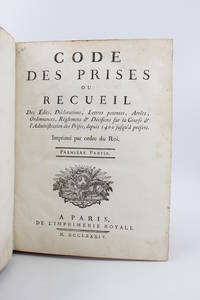
1784réf. 89299Imprimerie Royale (1640-1792) | Paris 1784 | 19.4 x 25.8 cm | 2 volumes reliés
1784réf. 89299Paris: Imprimerie Royale 1640-1792 1784. Fine. Privateering and naval warfare at the close of the 18th century Imprimerie Royale 1640-1792 Paris 1784 19.4 x 25.8 cm 2 volumes reliés Rare first edition cf. Polak 1808; Quérard II 133. Not in Crowne Library. Absent from Brunet. Contemporary full marbled calf spines with five raised bands framed by gilt fillets and decorated with gilt double compartments and ornamental tools red morocco lettering-pieces marbled endpapers gilt edge-rolls and red edges. Some early restoration to the joints; gilding at the spine ends and on the numbering-piece of the second volume partly faded. Occasional foxing; final leaves and endpapers of both volumes lightly toned in the margins. At a time when American privateers were being fitted out in French ports and their captures were raising unprecedented questions of law Daniel-Marc-Antoine Chardon occupied a position of particular importance. As attorney general to the Royal Prize Council he was the magistrate called upon to argue cases in which maritime warfare the interests of the French Crown and those of the young American nation converged. First edition of the Code des prises the extensive collection of maritime legislation compiled by Chardon and printed by order of the King. Two substantial quarto volumes 19.4 x 25.8 cm. Volume I: 2 unnumbered leaves xxxv xxvii and 610 pages 1 unnumbered leaf; volume II: 1 unnumbered leaf pp. 611-1230 and xlii pages. The Bibliothèque nationale de France records the Paris edition of 1784 with the same overall collation. The work brings together almost four centuries of edicts declarations letters patent judgments ordinances regulations and decisions concerning privateering and the administration of maritime prizes from 1400 to 1784. The great Marine Ordinance of August 1681 naturally occupies a central place accompanied by the legislation that preceded it defined its application or adapted its principles to the successive conflicts fought by France. In the closing sections this long legislative history meets the immediate realities of the American War of Independence. Chardon includes articles from the Treaty of Amity and Commerce concluded between Louis XVI and the United States on 6 February 1778 together with decisions concerning captures made by American privateers fitted out in French ports. The book therefore does more than preserve earlier jurisprudence: it records how French maritime law accommodated a new power allied to the Crown but still foreign to its legal institutions. Chardon's authority rested upon experience acquired in the colonies the courts and the ports. Intendant and first president of the Superior Council of Saint Lucia from 1763 to 1764 he became a maître des requêtes in 1765 then intendant of the troops in Corsica and first president of the Superior Council at Bastia. By an order of 23 November 1777 he was appointed to perform the duties of attorney general to the Royal Prize Council. During the American war he was sent to the principal Atlantic ports to accelerate the settlement of prizes and adjudicate the disputes arising from them. It was in this capacity that he entered into direct correspondence with Benjamin Franklin then minister plenipotentiary of the United States in Paris. On 19 March 1779 after reading Chardon's submissions in the case of Captain McNeill Franklin addressed him in terms of unusual warmth. Having praised the magistrate's learning and skill he declared that the American nation would know ""that it is treated there as a brother and defended by you as a friend."" The phrase reveals the political significance of the collection. Prize law was no abstract discipline: it determined the fate of vessels cargoes and crews but also the confidence binding allied powers. The decisions assembled by Chardon trace the delicate adjustment between the French monarchy and the United States and between the established maritime law of the kingdom and the deman Imprimerie Royale (1640-1792) hardcover