13 983 résultats
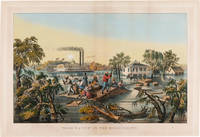
1868réf. 62593New York: Currier & Ives 1868. Scene of African-American Life on the Mississippi During Reconstruction by an Important Woman Artist An excellent Currier & Ives Mississippi River scene created just a few years after the Civil War after an original illustration by the important and prolific artist Frances Palmer. Though ostensibly presented as a nostalgic representation of the South a modern interpretation might conclude that it demonstrates a new sense of freedom and independence felt by formerly enslaved people in the first few years of Reconstruction. This image also demonstrates a simple but poignant and even uncomfortable truth about how life on the Mississippi River is contingent upon external circumstances most notably the whims of the weather. "High Water in the Mississippi presents a scene of a Mississippi River flood in which several former slaves sit atop the roof of a house among the flotsam and jetsam two of the men with long poles trying to recover furniture floating in the river. One man tries to rescue a mule struggling in the water. A plantation house stands in the background with two White residents waving at the large steamship Stonewall Jackson which chugs by in the background. The lithograph is signed "J.M.I. Del." in the image indicating that James Ives drew the lithograph from Palmer's original artwork. The illustration for this Currier & Ives print was created by the important artist Frances Flora Bond Palmer. Palmer 1812–76 was the first woman in the United States to work as a professional artist and to make a living with her art. She produced more Currier & Ives prints than any other artist. Known as Fanny she was according to Gloria Deák "the foremost woman lithographer of her time." Born and raised in England by a cultivated family she was already an accomplished painter and lithographer when she came to America in 1844 at which time she exhibited two works at the National Academy of Design. By 1849 she was working for Currier producing landscapes and still lifes lithographing these prints herself usually after her own sketches. She worked for Currier & Ives from 1849 into the 1870s bringing in much needed income for her family and producing about 200 of the company's best scenes and landscapes. Palmer was one of the most important and prolific artists and lithographers ever employed by Nathaniel Currier and she gave important assistance to Charles Currier in inventing a superior lithographic crayon. This Mississippi River scene is one the most popular pictures among the thirty-plus Mississippi River lithographs produced by the company. "In 1868 three years after the Civil War ended James Ives who had found Palmer to be an excellent collaborator on his visions of broad symbolic images of American life worked with her on eight large important lithographs.Among them is a pair of lithographs - 'High Water' in the Mississippi and Low Water in the Mississippi - this time portraying the mighty river's fickle moods. The subject was particularly timely because Southern levees had been destroyed during the war and serious flooding had occurred in 1862 1865 and 1867" - Rubinstein. Rubinstein notes that the Currier & Ives audience had always enjoyed scenes of natural disasters but goes on to find significant allegorical content in the images depicted in "High Water" and Low Water: "Now in the Reconstruction period instead of focusing on the North's victory both black and white Southerners are seen bravely struggling to recover from the aftermath of a great flood the Civil War.Abolitionists and Radical Republicans could read 'High Water' as a poignant image of newly freed slaves struggling to salvage something for their future the 'forty acres and a mule' promised to them by General Grant but rescinded by President Johnson but to white Southerners and to many Northerners as well Low Water suggested that everyone would be better off if freed black people went peacefully back to work for their former masters instead of demanding their own land or trying to vote and run for office." A fantastic Currier & Ives handcolored lithograph which was originally intended as a companion piece to Low Water in the Mississippi. Toning in the margins from previous matting. Some very light surface wear. Overall very good plus with excellent visual appeal. Charlotte Streifer Rubinstein Fanny Palmer: The Life and Works of a Currier & Ives Artist Syracuse NY 2018 item 3-59 pp.144-45 203. PETERS CURRIER & IVES pp.110-16; items 3944 3946. CURRIER & IVES: CATALOGUE RAISONNÉ 3057 4149. CONNINGHAM 2819 3824. GALE 3057 4150. DEÃK PICTURING AMERICA 647 ref. unknown books
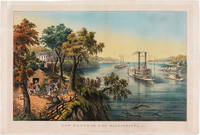
1868réf. 62595New York: Currier & Ives 1868. Scene of African-American Life on the Mississippi During Reconstruction by an Important Woman Artist An excellent Currier & Ives Mississippi River scene created just a few years after the Civil War after an original illustration by the important and prolific artist Frances Palmer. Though ostensibly presented as a nostalgic representation of the South a modern interpretation might conclude that it demonstrates a new sense of freedom and independence felt by formerly enslaved people in the first few years of Reconstruction. This image also demonstrates a simple but poignant and even uncomfortable truth about how life on the Mississippi River is contingent upon external circumstances most notably the whims of the weather. Low Water portrays former slaves dancing merrily outside their cabin with the plantation house in the deep background as the great steamship Robert E. Lee and another riverboat roar down the river. The Lee passes by a small barge on which sits a cabin labeled "Grocery." The water here is indeed low sitting several feet below the top of the riverbank. The sense of celebration among the African-American subjects is palpable. The lithograph is signed "J.M.I. Del." in the image indicating that James Ives drew the lithograph from Palmer's original artwork. The illustration for this Currier & Ives print was created by the important artist Frances Flora Bond Palmer. Palmer 1812-1876 was the first woman in the United States to work as a professional artist and to make a living with her art. She produced more Currier & Ives prints than any other artist. Known as Fanny she was according to Gloria Deák "the foremost woman lithographer of her time." Born and raised in England by a cultivated family she was already an accomplished painter and lithographer when she came to America in 1844 at which time she exhibited two works at the National Academy of Design. By 1849 she was working for Currier producing landscapes and still lifes lithographing these prints herself usually after her own sketches. She worked for Currier & Ives from 1849 into the 1870s bringing in much needed income for her family and producing about 200 of the company's best scenes and landscapes. Palmer was one of the most important and prolific artists and lithographers ever employed by Nathaniel Currier and she gave important assistance to Charles Currier in inventing a superior lithographic crayon. This Mississippi River scene is one the most popular pictures among the thirty-plus Mississippi River lithographs produced by the company. "In 1868 three years after the Civil War ended James Ives who had found Palmer to be an excellent collaborator on his visions of broad symbolic images of American life worked with her on eight large important lithographs.Among them is a pair of lithographs - 'High Water' in the Mississippi and Low Water in the Mississippi - this time portraying the mighty river's fickle moods. The subject was particularly timely because Southern levees had been destroyed during the war and serious flooding had occurred in 1862 1865 and 1867" - Rubinstein. Rubinstein notes that the Currier & Ives audience had always enjoyed scenes of natural disasters and of the Mississippi River but goes on to find significant allegorical content in the image depicted in Low Water as well as noting significant changes between Palmer's original artwork and the published lithograph: "Low Water a peaceful scene of the river at low tide shows a group of brightly dressed African American adults and children dancing and playing the banjo in front of their cabin while white owners of the plantation house stroll about their land.Scholars have critiqued Palmer's presentation in Low Water of childlike African Americans enjoying their lives on the old plantation - reminiscent of the 'Sambo' minstrel show character. In fact Low Water demonstrates how the heavy hand of her employers affected her work. Palmer had originally drawn a fully developed pencil study for Low Water in the Mississippi in which two shirt-sleeved African American men are ferrying three white men to the other side of the river while a group of well-dressed white people seated at leisure in front of the plantation mansion enjoy the view. For the final lithograph however someone perhaps James Ives who signed his name as the lithographer on the print had removed the hard-working black boatmen and substituted the usual minstrel show clichés.Low Water suggested that everyone would be better off if freed black people went peacefully back to work for their former masters instead of demanding their own land or trying to vote and run for office." A fantastic Currier & Ives handcolored lithograph which was originally intended as a companion piece to "High Water" in the Mississippi. Toning in the margins from previous matting. Closed marginal tears a few intruding into the image repaired on verso and with no loss of image. Very good overall with excellent visual appeal. Charlotte Streifer Rubinstein Fanny Palmer: The Life and Works of a Currier & Ives Artist Syracuse NY 2018 item 3-77A pp.144-45 203. PETERS CURRIER & IVES pp.110-16; items 3944 3946. CURRIER & IVES: CATALOGUE RAISONNÉ 3057 4149. CONNINGHAM 2819 3824. GALE 3057 4150. DEÃK PICTURING AMERICA 647 ref. unknown books
1868réf. 62593New York: Currier & Ives 1868. Scene of African-American Life on the Mississippi During Reconstruction by an Important Woman Artist An excellent Currier & Ives Mississippi River scene created just a few years after the Civil War after an original illustration by the important and prolific artist Frances Palmer. Though ostensibly presented as a nostalgic representation of the South a modern interpretation might conclude that it demonstrates a new sense of freedom and independence felt by formerly enslaved people in the first few years of Reconstruction. This image also demonstrates a simple but poignant and even uncomfortable truth about how life on the Mississippi River is contingent upon external circumstances most notably the whims of the weather. "High Water in the Mississippi presents a scene of a Mississippi River flood in which several former slaves sit atop the roof of a house among the flotsam and jetsam two of the men with long poles trying to recover furniture floating in the river. One man tries to rescue a mule struggling in the water. A plantation house stands in the background with two White residents waving at the large steamship Stonewall Jackson which chugs by in the background. The lithograph is signed "J.M.I. Del." in the image indicating that James Ives drew the lithograph from Palmer's original artwork. The illustration for this Currier & Ives print was created by the important artist Frances Flora Bond Palmer. Palmer 1812–76 was the first woman in the United States to work as a professional artist and to make a living with her art. She produced more Currier & Ives prints than any other artist. Known as Fanny she was according to Gloria Deák "the foremost woman lithographer of her time." Born and raised in England by a cultivated family she was already an accomplished painter and lithographer when she came to America in 1844 at which time she exhibited two works at the National Academy of Design. By 1849 she was working for Currier producing landscapes and still lifes lithographing these prints herself usually after her own sketches. She worked for Currier & Ives from 1849 into the 1870s bringing in much needed income for her family and producing about 200 of the company's best scenes and landscapes. Palmer was one of the most important and prolific artists and lithographers ever employed by Nathaniel Currier and she gave important assistance to Charles Currier in inventing a superior lithographic crayon. This Mississippi River scene is one the most popular pictures among the thirty-plus Mississippi River lithographs produced by the company. "In 1868 three years after the Civil War ended James Ives who had found Palmer to be an excellent collaborator on his visions of broad symbolic images of American life worked with her on eight large important lithographs.Among them is a pair of lithographs - 'High Water' in the Mississippi and Low Water in the Mississippi - this time portraying the mighty river's fickle moods. The subject was particularly timely because Southern levees had been destroyed during the war and serious flooding had occurred in 1862 1865 and 1867" - Rubinstein. Rubinstein notes that the Currier & Ives audience had always enjoyed scenes of natural disasters but goes on to find significant allegorical content in the images depicted in "High Water" and Low Water: "Now in the Reconstruction period instead of focusing on the North's victory both black and white Southerners are seen bravely struggling to recover from the aftermath of a great flood the Civil War.Abolitionists and Radical Republicans could read 'High Water' as a poignant image of newly freed slaves struggling to salvage something for their future the 'forty acres and a mule' promised to them by General Grant but rescinded by President Johnson but to white Southerners and to many Northerners as well Low Water suggested that everyone would be better off if freed black people went peacefully back to work for their former masters instead of demanding their own land or trying to vote and run for office." A fantastic Currier & Ives handcolored lithograph which was originally intended as a companion piece to Low Water in the Mississippi. Toning in the margins from previous matting. Some very light surface wear. Overall very good plus with excellent visual appeal. Charlotte Streifer Rubinstein Fanny Palmer: The Life and Works of a Currier & Ives Artist Syracuse NY 2018 item 3-59 pp.144-45 203. PETERS CURRIER & IVES pp.110-16; items 3944 3946. CURRIER & IVES: CATALOGUE RAISONNÉ 3057 4149. CONNINGHAM 2819 3824. GALE 3057 4150. DEÃK PICTURING AMERICA 647 ref. unknown
1868réf. 62595New York: Currier & Ives 1868. Scene of African-American Life on the Mississippi During Reconstruction by an Important Woman Artist An excellent Currier & Ives Mississippi River scene created just a few years after the Civil War after an original illustration by the important and prolific artist Frances Palmer. Though ostensibly presented as a nostalgic representation of the South a modern interpretation might conclude that it demonstrates a new sense of freedom and independence felt by formerly enslaved people in the first few years of Reconstruction. This image also demonstrates a simple but poignant and even uncomfortable truth about how life on the Mississippi River is contingent upon external circumstances most notably the whims of the weather. Low Water portrays former slaves dancing merrily outside their cabin with the plantation house in the deep background as the great steamship Robert E. Lee and another riverboat roar down the river. The Lee passes by a small barge on which sits a cabin labeled "Grocery." The water here is indeed low sitting several feet below the top of the riverbank. The sense of celebration among the African-American subjects is palpable. The lithograph is signed "J.M.I. Del." in the image indicating that James Ives drew the lithograph from Palmer's original artwork. The illustration for this Currier & Ives print was created by the important artist Frances Flora Bond Palmer. Palmer 1812-1876 was the first woman in the United States to work as a professional artist and to make a living with her art. She produced more Currier & Ives prints than any other artist. Known as Fanny she was according to Gloria Deák "the foremost woman lithographer of her time." Born and raised in England by a cultivated family she was already an accomplished painter and lithographer when she came to America in 1844 at which time she exhibited two works at the National Academy of Design. By 1849 she was working for Currier producing landscapes and still lifes lithographing these prints herself usually after her own sketches. She worked for Currier & Ives from 1849 into the 1870s bringing in much needed income for her family and producing about 200 of the company's best scenes and landscapes. Palmer was one of the most important and prolific artists and lithographers ever employed by Nathaniel Currier and she gave important assistance to Charles Currier in inventing a superior lithographic crayon. This Mississippi River scene is one the most popular pictures among the thirty-plus Mississippi River lithographs produced by the company. "In 1868 three years after the Civil War ended James Ives who had found Palmer to be an excellent collaborator on his visions of broad symbolic images of American life worked with her on eight large important lithographs.Among them is a pair of lithographs - 'High Water' in the Mississippi and Low Water in the Mississippi - this time portraying the mighty river's fickle moods. The subject was particularly timely because Southern levees had been destroyed during the war and serious flooding had occurred in 1862 1865 and 1867" - Rubinstein. Rubinstein notes that the Currier & Ives audience had always enjoyed scenes of natural disasters and of the Mississippi River but goes on to find significant allegorical content in the image depicted in Low Water as well as noting significant changes between Palmer's original artwork and the published lithograph: "Low Water a peaceful scene of the river at low tide shows a group of brightly dressed African American adults and children dancing and playing the banjo in front of their cabin while white owners of the plantation house stroll about their land.Scholars have critiqued Palmer's presentation in Low Water of childlike African Americans enjoying their lives on the old plantation - reminiscent of the 'Sambo' minstrel show character. In fact Low Water demonstrates how the heavy hand of her employers affected her work. Palmer had originally drawn a fully developed pencil study for Low Water in the Mississippi in which two shirt-sleeved African American men are ferrying three white men to the other side of the river while a group of well-dressed white people seated at leisure in front of the plantation mansion enjoy the view. For the final lithograph however someone perhaps James Ives who signed his name as the lithographer on the print had removed the hard-working black boatmen and substituted the usual minstrel show clichés.Low Water suggested that everyone would be better off if freed black people went peacefully back to work for their former masters instead of demanding their own land or trying to vote and run for office." A fantastic Currier & Ives handcolored lithograph which was originally intended as a companion piece to "High Water" in the Mississippi. Toning in the margins from previous matting. Closed marginal tears a few intruding into the image repaired on verso and with no loss of image. Very good overall with excellent visual appeal. Charlotte Streifer Rubinstein Fanny Palmer: The Life and Works of a Currier & Ives Artist Syracuse NY 2018 item 3-77A pp.144-45 203. PETERS CURRIER & IVES pp.110-16; items 3944 3946. CURRIER & IVES: CATALOGUE RAISONNÉ 3057 4149. CONNINGHAM 2819 3824. GALE 3057 4150. DEÃK PICTURING AMERICA 647 ref. unknown
19731ère édition de cette "nouvelle flore", publiée par Joseph-Edgar DE LANGHE, Léon DELVOSALLE, Jacques DUVIGNEAUD, Jacques LAMBINON et Constant VANDEN BERGHEN et divers collaborateurs; nombreuses figures in texte, 20 planches couleurs; glossaire; index des noms latins et français. Français
1925réf. 18611Paris, Librairie Larousse, 1925. Fort in-8 de [4]-XII-590 pages, pleine toile illustrée et imprimée de l'éditeur.
réf. 10545Clermont-Ferrand, P. Juliot,1896 ; in-8. VIII-340pp. - 12 planches hors-texte. Pleine toile écrue, pièce de titre de maroquin rouge.Couverture conservée. (Reliure XXe s.). Bon état.
2004réf. LFA-126723635Un ouvrage de 719 pages, format 195 x 290 mm, 3000 photos et illustrations, relié cartonnage couleurs, publié en 2004, Oxadis, bon état
réf. 201703335Paris, Editions serpenoise, 1992 ; in-4, 88+30 pp., cartonnage de l'éditeur. Avec jaquette.
1959Neuchatel, Delachaux et Niestlé, 1959; in-8, 326 pp., reliure d'éditeur avec jaquette illustrée. Avec 57 illustrations dont 39 en couleurs et 18 dessins à la plume.
1910Amsterdam, Koninklijke Akademie van Wetenschappen, 1910; 177 x 260 mm, 12 pp., couverture et cahier agrafés. Tiré à part, en langue anglaise. Proceedings of the Meeting of Saturday January 29, 1910 (Reprinted from :). Bon état.
1928Cracovie, Imprimerie de l'Université, 1928; 172 x 242 mm, 148 pp. + 26 pl. hors-texte, broché. Tiré-à-part, en langue allemande. Bulletin de l'Académie Polonaise des Sciences et des Lettres. Classe des Sciences Mathématiques et Naturelles (Extrait du) 1928. Bon état.
1890Leipzig, Verlag Arthur Felix, 1890; 197 x 240 mm, 8 pp., double-feuille (quelques déchirures). Tiré à part, en langue allemande. Botanische Zeitung. 1890. No. 4 (Separat-Abdruck aus der). État moyen.
1928Warszava, s.e., 1928; 163 x 243 mm, 36 pp. + 4 pl. hors-texte, broché. Tiré-à-part, en langue allemande. Acta Societatis Botanicorum Poloniae (Extrait des). Vo. V. Nr. 2. 1928. Bon état.
1924Cracovie, Imprimerie de l'Université, 1924; 170 x 248 mm, 8 pp. + 4 pl. hors-texte, couverture et cahiers agrafés. Tiré à part, en langue française. Bulletin de l'Académie des Sciences de Cracovie (Extrait du) classe des Sciences Mathématiques et Naturelles, série B : Sciences Naturelles. 1924. Bon état.
1930Tokyo, s.e., 1930; 173 x 250 mm, 8 pp. + 1 pl. hors-texte, couverture et double-feuilles collées. Tiré à part, en langue allemande. the Botanical Magazine (Abdruck aus; Tokyo, Vol. XLIV, No. 517. Bon état.
1922Genève, Imprimerie Jent, Société Anonyme, 1922; 152 x 231 mm, 52 pp., couverture et cahier agrafés. Thèse (N° 693) en langue française. Bon état.
1910Baltimore (Maryland), Physiological Researches Station, s.d. (vers 1910); 174 x 260 mm, 4 pp., couverture et cahier agrafés (quelques déchirures). Tiré à part, en langue anglaise. Vol. I, No. 3, August, 1913. État moyen.
1907Berlin, Gebrüder Borntræger, 1907; 159 x 244 mm, 2 pp., couverture et feuille collées. Tiré à part, en langue allemande. Berichten der Deutschen Botanischen Gesellschaft. Jahrgang 1907, Band XXV, Heft 10 (Sonderabdruck aus den). Bon état.
1909Cracovie, Imprimerie de l'Université, 1909; 170 x 248 mm, 82 pp., broché. Tiré-à-part, en langue allemande. Bulletin international de l'Académie des Sciences de Cracovie. Classe des Sciences mathématiques et naturelles (Extrait du) octobre 1909. Bon état.
1907Cracovie, Imprimerie de l'Université, 1907; 166 x 248 mm, 10 pp. + 1 pl. hors-texte, couverture et cahier agrafés. Tiré-à-part, en langue allemande. Bulletin international de l'Académie des Sciences de Cracovie. Classe des Sciences mathématiques et naturelles (Extrait du) juin 1907. Bon état.
1926Cracovie, Imprimerie de l'Université, 1926; in-8, 11 pp. + 1 planche, broché. Hommage de l'auteur. Bon état.
1926Cracovie, Imprimerie de l'Université, 1926; in-8, 22 pp. + 4 planches, broché. Hommage de l'auteur. Bon état.
1907Cracovie, Imprimerie de l'Université, 1907; 167 x 248 mm, 16 pp. + 1 pl. hors-texte, couverture et cahier agrafés. Tiré-à-part, en langue allemande. Bulletin international de l'Académie des Sciences de Cracovie. Classe des Sciences mathématiques et naturelles (Extrait du) juin 1907. Bon état.
1906Cracovie, Imprimerie de l'Université, 1906; 171 x 250 mm, 50 pp. + 3 pl. hors-texte, broché. Tiré-à-part, en langue allemande. Bulletin international de l'Académie des Sciences de Cracovie. Classe des Sciences mathématiques et naturelles (Extrait du) juillet 1906. Bon état.