726 resultados
ref. 51-6957London: 19 Buckingham Palace Mansions 1953. Original announcement with silkscreen cover and ties. 4pp. With 4 page Als invitation from 19 Buckingham Palace from Muriel Mrs. David Gamauss sp. and a typed invitation with the League's letterhead . Among the high profile attendees: "LORD and LADY MANCROFT stop to talk to screen star AVA GARDNER and her crooning husband FRANK SINATRA when they were guests at the Primrose League Coronation Ball at the Dorchester Hotel in London.".The personal copy of Begum Ra’ana Liaquat Ali Khan 1905–1990 who was a Pakistani diplomat and the country’s first female governor.She was born Sheila Irene Pant on 13 February 1905 in Almora British India today’s India to a Brahmin family who had converted to Christianity two generations prior.Academically brilliant she graduated from the University of Lucknow in 1927 with bachelor’s degrees in economics and theology. She obtained a double master’s degree in economics and sociology in 1929. In 1931 she became professor of economics at Indraprastha College in Delhi where she met her future husband lawyer Liaquat Ali Khan when he visited to deliver a lecture on law.The couple married in 1932 despite her family’s objection. The bride converted to Islam and took the name Begum Ra’ana. She became involved with the Muslim League devoting herself to creating political consciousness among the Muslim women in British India.After the Partition in 1947 Liaquat Ali Khan became Pakistan’s first prime minister. As the first First Lady of Pakistan Begum Ra’ana founded or helped establish organisations that uplifted women’s rights and women’s public role such as the Pakistan Women’s National Guard PWNG the Women’s Naval Reserves and All Pakistan Women’s Association APWA. London: 19 Buckingham Palace Mansions, 1953 unknown
ref. 66960London: Marcus Ward & Co. Limited circa 1896-1904. News Cuttings Album ORIGINAL CUTTINGS AND LETTERS. Quarto 30 x 24cm with 70 numbered pages of news clippings 111 blank numbered pages and 12 pages of official typed letters from the Robert Louis Stevenson Memorial Committee at rear. Publisher's burgundy cloth with black and gilt titles and decoration to spine and upper. Moderate spotting and toning throughout. Cloth shows moderate general wear and some toning to spine. Very good. An extremely comprehensive record of developments in the campaign to erect a memorial to the late author Robert Louis Stevenson in Edinburgh including many clippings from Scottish newspapers such as The Scotsman where the process began on 25th August 1896 with a letter to the Editor from Lord Rosebery: "How will this generation stand with posterity if it neglect to show its appreciation of a consummate and delightful artist whose originality and imagination have enriched our literature as well as our time" A memorial was finally unveiled by Lord Rosebery in St Giles Cathedral on 27th June 1904 where it remains today. London: Marcus Ward & Co., Limited, circa 1896-1904 unknown
1966ref. 664G4538Canada: Okanagan Historical Society 1966. Book. Illus. by G.K.L. Good. Paperback. First Edition. 8vo - over 7¾" - 9¾" tall. 284 pages. Includes sixteen-page index of the first twenty-nine issues of this report - an invaluable reference tool. Many reproductions of wonderful archival black and white photos. The dozens of articles include such titles as: Edgar Emeny; The Bassetts of Okanagan; The Okanagan Language; Hector Whitaker; The Story of the Postill Family; Max Herman Ruhmann; William Bill Ruhmann; The Joyce Hostel; Hugh Charles Musgrove Leir; Robert Carswell; Mr. & Mrs. W.J. Woods; Pioneer Canadian Nurse; William and Mary Rice; and many more. Year written on spine otherwise unmarked with average wear. Binding intact. A sound copy. Okanagan Historical Society Paperback
2016ref. CBS-9780323239110Elsevier Np 2016. New. Elsevier (Np) unknown
2016ref. CBS-9780323239110Elsevier Np 2016. New. Elsevier (Np) unknown
ref. 30514150-nnew. unknown
ref. 30514150like new. unknown
1658ref. BS7GLTBN1312Rotterdam: Arnold Leers 1658. Hardback contemporary calf rebacked with gilt title to spine. 13.5cm x 8cm. Text in Latin. Pp. 20 561. Title in red & black with woodcut vignette. Previous owner's details to head of title page note that reads 'This book belongs to the Library in the Charity School Chamber in Nottingham given by Dr. William Steinfowl' to verso of title page. This was first published in England 1638 and contains information on the taking of mercury on tobacco and opium on gold boiled broth as a cure for consumption the use of unicorn horn and an attack on William Harvey and his discovery of the circulation of the blood. Binding worn especially at the corners of boards. An interesting read. bs7. Hard Cover. Good. Arnold Leers Hardcover
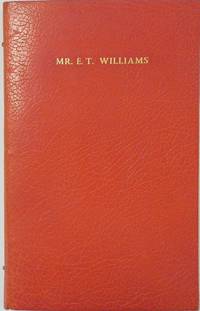
1959ref. 543192London: Her Majesty's Stationery Office 1959. Very good condition red gilt embossed hardcover no dust jacket with gilt edged page block and complementary patterned pastedowns and endpapers. Copy of government report on Nyasaland in presentation binding to Mr E.T. Williams member of the commisson of inquiry signed by the chairman Patrick Devlin and includes later correspondence by the two and a newspaper clipping. Sir Edgar Williams was a British historian and Army military intelligence officer in World War II. He later became an esteemed scholar in Oxford. LW. Hardcover. Very Good/No Dust Jacket. Used. Her Majesty's Stationery Office Hardcover
1913ref. 940P1Glasgow: James Maclehose and Sons 1913. First edition. Leather. Very Good. 9.5" by 6.5". Various. A limited edition work exploring the religious history of Glasgow a smart illustrated volume signed by the publisher. A limited edition this being one of sixty copies made on handmade paper signed by the publisher to the verso of the half-title.'Mediaeval Glasgow' explores the vast history of the city and shows the important part that Glasgow has played in the national history. The volume focuses on religious history each chapter being dedicated to a Bishop Pope or Archbishop. These include Bishop Jocelyn Pope Nicholas V Archbishop Robert Blackadder Archbishop James Beaton II and more across a total of fourteen chapter. Illustrated with a frontispiece sixteen plates and the occasional in-text engraving. Collated complete.Written by Reverend James Primrose. In the original publisher's quarter morocco binding with cloth to the boards. Externally smart. Gilt to the spine is a little rubbed. Small chip to the front joint. Light marks and a little discolouration to the leather. Hinges have been reinforced with tape. Internally firmly bound. Pages are bright and clean. Very Good James Maclehose and Sons hardcover
2022ref. __1789909058Edward Elgar 2022. Hardcover. New. 544 pages. 9.63x6.63x0.59 inches. Edward Elgar hardcover
ref. 46748108-nnew. unknown
ref. 46748108like new. unknown
ref. 3999459-nnew. unknown
ref. 3999459like new. unknown
Bulino misura: mm 245 x 158 Pittore ed incisore italiano, secondogenito di una famiglia di artisti. La sua formazione avvenne nell'ambiente manieristico sia fiorentino che romano che precede l'accademia carraccesca. In tutte le sue opere pittoriche troviamo come caratteri tipici la tendenza decorativa e un virtuosismo accademico strettamente legato a contenuti letterari e retorici. Eccetto rari momenti in cui tornò nella sua città natale egli si formò e svolse la sua attività principalmente a Roma nella bottega di Cornelis Cort per poi guardare al lavoro di Agostino Carracci, degli Zuccari e del Villamena. In incisione, egli ne realizzerà circa duecento tra il 1568 e il 1612, riproduce sculture antiche, opere di Raffaello, Michelangelo e artisti contemporanei. Diventato Direttore dell’Accademia di San Luca, è oggi ricordato per affreschi in palazzi e chiese di Roma. In questa stampa, tratta dalla serie Le quattro stagioni da un invenzione di Polidoro da Caravaggio, l'artista realizza all'interno di una nicchia architettonica, l'allegoria della Primavera. Viene rappresentata come una donna nuda, leggermente coperta da un drappo morbido e fluttuante. Il suo capo è abbellito da ghirlande e ha gli occhi fissi e ammiccanti verso lo spettatore. Nella mano sinistra regge copiose ghirlande e attraverso l'abile uso della tecnica, sembra scendere ed uscire da questa struttura architettonica appoggiandosi alle nubi, gonfie e riccamente contrastate. In alto al centro è iscritto in titolo e in basso il monogramma. Monogrammata anche a penna, in basso a sinistra. Impressione eccellente. Ottimo stato di conservazione. Rifilata alla battuta del rame. Filigrana: "stella a sei punte" Bibliografia: Bartsch XVII.84.101; Manescalchi 133.
1924AA.VV. (Angeloni, Italo Mario - Benelli, Sem - Colla, Guido - Foà, Pio - Geymonat, Ermanno - Scoffone, Riccardo: testi) L'Arte nella Fotografia (Prima Esposizione Internazionale di Fotografia Ottica e Cinematografia - Primavera 1923 - Torino). Milano-Roma, Casa Editrice d'Arte Bestetti and Tumminelli 1924 italian, in quarto pp. 54+(158) in "carta ruvida avorio Roma - Made in Italy"con barbe=212 ed. s.d. (ma 1924) con tiratura limitata a 1300 copie (esemplare N. 166) del catalogo della Prima Esposizione Internazionale di Fotografia Ottica e Cinematografia, Torino, Palazzo del Giornale (al Valentino, oggi raso al suolo), Primavera (maggio-giuno) 1923. IV/ 54+(158) in "carta ruvida avorio Roma - Made in Italy" con barbe=212/ rilegatura in mezza tela blu marine con piatti rifiniti in carrta ruvida beige con titoli e ornati in rosso mattone e dorati al primo piatto. Illustrazioni fotografiche in b/n applicate nel testo e in b/n e a colori nelle tavole f.t.. Firma ad inchiostro nero in frontespizio (Sem Benelli?). Stato mediocre (usura della copertina, in particolare all'angolo inferiore destro del primo piatto che presenta una rottura di una certa entità - copertina brunita, polverosa e con qualche gora). Indice: Dedica; Sem Benelli (Torino, maggio 1924) - Comitato d'Onore - Comitato Generale - Giunta Esecutiva - Comitato Francese - Copmmissioni - Giurie - Come l'esposizione ebbe origine e si sviluppò; Guido Colla, Segretario della Giunta Esecutiva, Torino, febbraio 1924 (La Sede - Gli Espositori - I mezzi finanziari - L'Esposizione e le Manifestazioni che l'accompagnarono - I lavori delle Giurie - Risultnze finanziarie)-Donatori - Relazione della Giuria Superiore; Prof. Pio Foà, Presidente della Giuria Superiore e Senatore del Regno, e Riccardo Scoffone, Segretario Generale, Torino, 7 luglio 1923 - Concorso Cinematografico; Segretario e Avv. Ermanno Geymonat - Premiazioni - La Fotografia Artistica alla Prima Esposizione Internazionale, Torino, maggio-giugno 1923; Italo Mario Angeloni, Ala di Stura, agosto 1923 - Indici (Indice del testo - Indice delle illustrazioni) - Illustrazioni. Autori delle fotografie: A. Enrie, Torino - L. Vaghi, Parma - E. Sommariva, Milano - F. Masino, Torino - E. O. Hoppé, Londra - N. Perscheid, Londra - E. Massaglia, Torino - S. Bricarelli, Torino - Wadenoyen, Cardiff - C. Schenker, Berlino - C. Scarabello, Torino - W. Prochnow, Berlino - E. Sommariva, Milano - J. Brozik, Praga - M. Adam, Londra - A. M. Schein, Vienna - A. Riess, Berlino - I. Pokés, Praga - G. Dall'Armi, Torino - N. Perscheid, Berlino - F. Stock, Berlino - H. Lambert, Bath - C. De Marchi, Milano - C. Scarabello, Torino - R. Scoffone, Torino - Bassano, Londra - G. B. Vercellone, Torino - C. Schiapparelli, Torino - H. Zink, Colonia - A. Schneeberger, Praga - Binder, Berlino - E. Spitzer, Vienna - Castagneri-Sfrai, Milano - C. Baravalle, Torino - R. Scoffone, Torino - Drtikol, Praga - A. Bologna, Torino - R. Padouk, Praga - Nunes Vais, Firenze - Scmidt, Berlino - Rude, Cristiania - A. Miska, Praga - Atelier Riess, Berlino - Barberis, Torino - E. Massaglia, Torino - M. Crimella-Sfrai, Milano - H. Zink, Colonia - G. Dall'Armi, Torino - A. Schellens, Eindhoven - G. Casalegno, Torino - Sciutto, Genova - Bettini, Roma - C. Verschnur, Rossum - P. Oneglio, Torino - Weinberg, Groninga - F.lli Alinari S. A. Idea, Firenze - I. M. Angeloni - Castagneri-Sfrai, Milano - Brasil, Londra - D'Alessandri, Roma - V. Aragozzini, Milano - A. Badodi, Milano - Pozzini, Riva s. Garda - R. Bianchi, Monza - Callegari, Roma.
2021ref. SBS-9781645340485AcademiQ Infomedia 2021. Hardcover. New. AcademiQ Infomedia hardcover
2021ref. SBS-9781645340485AcademiQ Infomedia 2021. Hardcover. New. AcademiQ Infomedia hardcover
2021ref. SBS-9781645340539AcademiQ Infomedia 2021. Hardcover. New. AcademiQ Infomedia hardcover
2021ref. SBS-9781645340539AcademiQ Infomedia 2021. Hardcover. New. AcademiQ Infomedia hardcover
2021ref. SBS-9781645340546AcademiQ Infomedia 2021. Hardcover. New. AcademiQ Infomedia hardcover
2021ref. SBS-9781645340546AcademiQ Infomedia 2021. Hardcover. New. AcademiQ Infomedia hardcover
2003ref. x-0415264537Routledge 2003. Hardcover. New. reprint edition. 72 pages. 8.74x6.30x0.39 inches. Routledge hardcover
1886ref. 100335AB1886. London Given at the Foreign Office 1886. 27.7 cm x 38.2 cm. 1 sheet. Original Softcover. Excellent condition with only minor signs of external wear. Signed by Archibald Philip Primrose 5th Earl of Rosebery. Fantastic and important document of british foreign office history. Archibald Philip Primrose 5th Earl of Rosebery 1st Earl of Midlothian KG KT PC FRS FBA 7 May 1847 21 May 1929 was a British Liberal politician who served as Prime Minister of the United Kingdom from March 1894 to June 1895. Between the death of his father in 1851 and the death of his grandfather the 4th Earl of Rosebery in 1868 he was known by the courtesy title of Lord Dalmeny. Rosebery first came to national attention in 1879 by sponsoring the successful Midlothian campaign of William Ewart Gladstone. He briefly was in charge of Scottish affairs. His most successful performance in office came as chairman of the London County Council in 1889. He entered the cabinet in 1885 and served twice as foreign minister paying special attention to French and German affairs. He succeeded Gladstone as prime minister and leader of the Liberal Party in 1894; the Liberals lost the 1895 election. He resigned the party leadership in 1896 and never again held political office. Rosebery was widely known as a brilliant orator an outstanding sportsman and marksman a writer and historian connoisseur and collector. All of these activities attracted him more than politics which grew boring and unattractive. Furthermore he drifted to the right of the Liberal party and became a bitter critic of its policies. Winston Churchill observing that he never adapted to democratic electoral competition quipped: "He would not stoop; he did not conquer." Rosebery was a Liberal Imperialist who favoured strong national defence and imperialism abroad and social reform at home while being solidly anti-socialist. Historians judge him a failure as foreign minister and as prime minister. At Eton Rosebery notably attacked Charles I of England for his despotism and went on to praise his Whig forebears his ancestor James Stanhope 1st Earl Stanhope was a minister to George I of Great Britain. Benjamin Disraeli often met with Rosebery in the 1870s to try to recruit him for his party but this proved futile. Disraeli's major rival William Ewart Gladstone also pursued Rosebery with considerable success. As part of the Liberal plan to get Gladstone to be MP for Midlothian Rosebery sponsored and largely ran the Midlothian Campaign of 1879. He based this on what he had observed in elections in the United States. Gladstone spoke from open-deck trains and gathered mass support. In 1880 he was duly elected Member for Midlothian and returned to the premiership. Rosebery served as Foreign Secretary in Gladstone's brief third ministry in 1886. He served as the first chairman of the London County Council set up by the Conservatives in 1889. Rosebery Avenue in Clerkenwell is named after him. He served as President of the first day of the 1890 Co-operative Congress. Rosebery's second period as Foreign Secretary 18921894 predominantly involved quarrels with France over Uganda. To quote his hero Napoleon Rosebery thought that "the Master of Egypt is the Master of India"; thus he pursued the policy of expansion in Africa. Rosebery helped Gladstone's Second Home Rule Bill in the House of Lords; nevertheless it was defeated overwhelmingly in the autumn of 1893. The first bill had been defeated in the House of Commons in 1886. Rosebery became a leader of the Liberal Imperialist faction of the Liberal Party and when Gladstone retired in 1894 Rosebery succeeded him as Prime Minister much to the disgust of Sir William Harcourt the Chancellor of the Exchequer and leader of the more left-wing Liberals. Rosebery's selection was largely because Queen Victoria disliked most of the other leading Liberals. Rosebery was in the Lords but Harcourt controlled the Commons where he often undercut the prime minister. Rosebery was the only one of the ten Prime Ministers to serve during Queen Victoria's reign who was born after her accession to the throne in 1837. Rosebery's government was largely unsuccessful as in the Armenian crisis of 1895-96. He spoke out for a strongly pro-Armenian and anti-Turkish policy. Gladstone a prime minister in retirement called on Britain to intervene alone. The added pressure weakened Rosebery. His designs in foreign policy such as expansion of the fleet were defeated by disagreements within the Liberal Party. He angered all the European powers. The Unionist-dominated House of Lords stopped the whole of the Liberals' domestic legislation. The strongest figure in the cabinet was Rosebery's rival Harcourt.citation needed He and his son Lewis were perennial critics of Rosebery's policies. There were two future prime ministers in the Cabinet Home Secretary H. H. Asquith and Secretary of State for War Henry Campbell-Bannerman. Rosebery rapidly lost interest in running the government. In the last year of his premiership he was increasingly haggard: he suffered insomnia due to the continual dissension in his Cabinet. On 21 June 1895 the government lost a vote in committee on army supply by just seven votes. While this might have been treated merely as a vote of no confidence in Secretary for War Campbell-Bannerman Rosebery chose to treat it as a vote of censure on his government. On 22 June he and his ministers tendered their resignations to the Queen who invited the Unionist leader Lord Salisbury to form a government. The following month the Unionists won a crushing victory in the 1895 general election and held power for ten years 18951905 under Salisbury and Arthur Balfour. Rosebery remained the Liberal leader for another year then permanently retired from politics. Wikipedia paperback