82.322 Ergebnisse
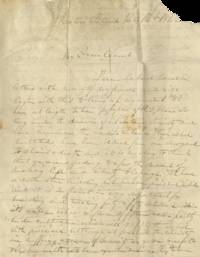
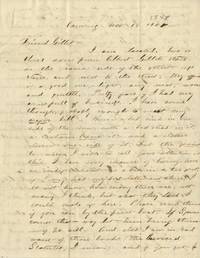
1848Best.-Nr. List3729Corning New York 1848. Two autograph letters signed from C. H. Berry. Each 3 pp measuring 8 x 10 inches. Very good plus. A pair of letters from C. H. Berry of Corning New York who was apparently both a schoolteacher and active in Free Soil circles in the area. The earlier letter written in 1847 provides an unexpected look at corporal punishment in the classroom. Berry writes: "I am in my school yet. I have four weeks or nearly that to keep yet. I storm round like an old sailor have my hands full but enjoy the pleasure of seeing the little 'varmints' learn. I had a speck of variety today. Several boys stayed out this forenoon after recess. This afternoon I called them up & after talking a spell told them I should punish them for staying out. One fellow squared himself & said he should not be punished! He was a huge fellow with a boxer's ring on his fingers weighing one or two ounces. He swore flat in my face when I began to talk with him. I told him in consideration of his being saucy he must take off his coat. I took the young man by the collar with one hand and applied a strap of harness leather to his legs with the other. He flourished his tongue his arms & legs in a furious way till finding my own was too long for him to reach me he dove for the poker. I just laid him out a couple of times & then plied my straps till his coat came off with a rush & numerous apologies followed it. He said he swore because he was mad he always did so & thought it very unfortunate that he had such a habit. I then punished him for staying out and told him to take his seat which he did very quietly." The second letter written during the immediate aftermath of the election of 1848 shifts dramatically toward national politics. Berry offers a frank assessment of the political future of anti-slavery organization: "In 'Free Soil' matters we have done up all we expected to here and are perfectly satisfied. Our party is firmly organized. Our cause has the sympathy of honest men of all parties and as Taylor is elected let me tell you just what I think of it: Cass has showed his hand and that party can not claim to be free soil men in 1852 or at any time hereafter. Taylor is in a position where he will be obliged to declare himself also. Now if Taylor disappoints the South and comes out a freedom man it will be in consequence of this Northern movement and we have attained all we wanted. But if which is more likely he goes for the South his supporters in the free states will be without the least color of excuse in 1852 and they must join our party & there will not be a grease spot of their organization left. The case then is this: Nothing but 'liberty' will satisfy the people of the north. The Hunkers can not stand on this platform for they have repudiated it; the honest ones will be with us. The Whigs must come on to our ground and join us as a party by the acts of their Executive or declare against liberty which will destroy their party here and bring them to us in a disorganized mass. Then with 'repeal' as our motto we will teach them the error of their ways. We can not fail to succeed in my view of the case. Free soil forever." Written before the formation of the Republican Party and more than a decade before secession the letter captures anti-slavery political sentiment at a transitional moment when Free Soil activists believed sectional political realignment increasingly inevitable. An unusually readable pair balancing ordinary rural life with emerging sectional politics in antebellum New York. books
1842Best.-Nr. List3738Ship Saluda Bound for Monrovia 1842. Two autograph letters signed approximately seven manuscript pages total. 1839 letter measuring 8 x 12 ¾ inches foxed with small tears at folds very good; 1842 letter measuring 8 x 10 inches tears at folds with larger tear to top right some text missing very good minus. Overall very good. A pair of letters documenting the work of Dr. Wesley Johnson 1813-1844 physician educator and colonial official associated with Bassa Cove during Liberia's formative decades. Written three years apart the letters preserve Johnson's involvement in medicine colonial administration anti-slave trade efforts agricultural reform and the establishment of one of Liberia's earliest advanced educational institutions. Born in Hillsdale New York Johnson studied medicine at Jefferson Medical College in Philadelphia under Dr. Jacob Green receiving his degree in 1837 before departing almost immediately for West Africa.1 He entered service at Bassa Cove a settlement approximately seventy miles south of Monrovia supported jointly by the New York and Pennsylvania Colonization Societies. Established as part of the larger Liberian colonization project Bassa Cove existed under difficult conditions: high mortality limited resources dependence upon outside support and periodic violence associated both with local conflict and the wider Atlantic slave trade. Johnson's responsibilities expanded rapidly after his arrival. He worked closely with Governor Thomas Buchanan and within a year had served in command of local militia forces and assumed administrative authority at Bassa Cove. Following conflict involving Theodore Canot a trader in enslaved people and violence affecting nearby settlements Johnson was reportedly injured; he shifted increasingly toward educational work becoming central to the establishment of the Ladies Liberia High School at Factory Island an ambitious project intended to educate future leadership within the colony. The earlier letter written aboard the ship Saluda on October 2 1839 finds Johnson struggling with declining health; a "bilious attack" that "was succeeded by an enlargement of the spleen" and he travelled along the coast towards Sierra Leone and Cape Mount "for my health." Even while discussing illness however Johnson remained focused on institutional work and future responsibilities: "When I return to Bassa I shall take charge of a high school about to be established there and carried on by the Ladies of Philad'a." That brief reference points toward one of the more ambitious educational efforts connected to early Liberia. Organized in Philadelphia in 1832 the Ladies' Liberia School Association sought to support educational development in Liberia through funding schools teachers and educational infrastructure.2 By the late 1830s the organization had developed a broad network of support and had undertaken plans for a secondary school at Factory Island near Bassa Cove. Johnson would become central to its implementation. He writes: "As long as I have serviceable health it is doubtless my duty to remain here for why should new persons come here continually at the risk of their lives & unacquainted with the colony or country. It seems hardly credible that I have been here more than two years already. "10th. I have been today drawing a plan of the buildings for the high school on Factory Island but this evening the vessel rolls and I cannot make straight marks & will go on with my letter. My health is better & better. I drink wine occasionally & we have five courses at dinner. I stopped at Monrovia several days as we came along and found high life at the Govt. house. When we get back to Bassa a school will give my employment & as my agency for the Col. Soc. will be exchanged for that of the Ladies Soc. of Phil. for African Education. Of this change I am glad. It will relieve me of care trouble and vexation and business which I have no means of accomplishing to my mind. "The Colony was never more prospered. Gov. Buchanan drives hard at the Slavers and they cannot stand it. You will see by the . something of what has been going on here. O that I was worth a million. I would make a great jam in Liberia. As it is I take it extempore make the best moves that I can for the time." Three years later writing from Factory Island on July 14 1842 Johnson reports that the educational institution envisioned in the earlier letter had become reality. He writes: "We have at length taken possession of this place so long under the dominion of his Satanic Majesty and have commenced the Ladies Liberia High School. Multitudes have been doomed from our door-yard to chains & death and it is consoling to think that we are affording to a few the means of making life and liberty blessings. We have a noble stone building not however finished inside and it is sufficient in every department for boarding and teaching forty or fifty scholars within its walls. Also a farm of fifteen acres partly under cultivation which will supply the school with provisions. Although at present the colonists are suffering a season of scarcity we go on comfortably. My health has been excellent since my return paper loss indeed it received an important improvement immediately after my arrival. My objects are to get the School thoroughly established an improved system of agriculture in operation and some other person properly introduced to my place & then to return to America. I should not add the last item so readily at present not knowing what circumstances may indicate of my duty but I made a general promise to my friends to return in two years. We are introducing the improved and labor saving plans and means of farming which are from five to ten times as efficient as those in common use here and as novel to the colonists as theirs would be in the good state of New York. We are in want of funds for these purposes all having been exhausted which were appropriated to them by the Ladies and I am obliged to furnish means from my own funds. We have a kind of manual labour system - the pupils work from 6 to 8 & from 4 to 6 & study from 9 to 12 2 to 4 & 7 to 8. My mode of teaching is much improved on what it was in Cin. by invention reflection & teaching others to teach and no other employment is so agreeable to me. I am father mother preceptor & religious teacher to my scholars & universal agent & factotum to the School and would to Heaven that I were better prepared for the work and could show an influential example of the power of living holiness." The physical cost of such work proved severe. Tropical illness permanently damaged Johnson's health. By the time of the present letters he was already recording prolonged illness and enlargement of the spleen. He ultimately returned to Hillsdale in 1844 and died shortly afterward at only thirty-one years old. Contemporary memorials praised both his educational work and personal sacrifice describing Liberia as having lost "a devoted friend and martyr." Taken together the letters preserve the work of an unusually capable participant operating at multiple levels of early Liberian development-physician educator administrator agricultural reformer and institution builder-while documenting educational work colonial administration medicine anti-slave trade activity and daily life through firsthand observation during Liberia's formative decades. An important Liberia grouping. 1 Otteson Ron. Ron Otteson "Dr. Wesley Johnson of Hillsdale: A Gentleman of Talent and Liberal Education" Roeliff Jansen Historical Society accessed May 22 2026 https://www.roeliffjansenhs.org/about-6. 2 Karen Fisher Younger "Philadelphia's Ladies' Liberia School Association and the Rise and Decline of Northern Female Colonization Support" Pennsylvania Magazine of History and Biography 134 no. 3 2010: 235-260. books
1832Best.-Nr. ST20735Boston: Marsh Capen and Lyon 1832. First American Edition. 188 x 120 mm. 7 3/8 x 4 3/4". xii 318 pp. Original tan cloth smooth spine with printed paper label. Front pastedown with bookplate of John A. Seaverns; front free endpaper with ownership signature of John Stevens dated 31 January 1833. Cloth somewhat faded slight fraying at tail of upper joint label a bit scuffed contents with occasional small stains one marginal tear and browning to a handful of leaves but an extremely well-preserved copy of a fragile book very clean and the condition issues all quite minor. In its original publisher's binding and from a major collection this is an excellent copy of the first American printing of an influential work on education. Spurzheim 1776-1832 was better known as an exponent of phrenology and an authority on mental illness than as an educational theorist but his "View of the Elementary Principles of Education" is nevertheless an important work that for the most part is sensible and progressive. Especially significant are his assertion that all influences from birth onward contribute to the physical and mental development of the child and the inference he draws from this that in addition to the conventional education of the intellect an optimal upbringing must include attention to such things as clean air proper diet and suitable exercise. He favors public education over private instruction because children will benefit by meeting a variety of people with "different manners of feeling and thinking." Spurzheim shows himself to be generally tolerant and forward thinking as he maintains that good education can improve almost anybody it would certainly reduce the number of criminals. But he sometimes disappoints as in his belief that many limitations are hereditary and must be taken into account in designing the most fitting education for an individual. He states for example that the poor ought to be prevented from reproducing as if poverty were in the genes. And in answering the claims of Mary Wollstonecraft's "Vindication of the Rights of Women" he says "I cannot perceive any arrangement of nature that can lead me to expect that women will cease to be considered as subordinate to men. Let them endeavor if they please to acquire the same degree of talent but till they have acquired it let them cherish order and exercise the virtues of their actual condition in society rather than attempt to rise into a sphere for which they are not at present fitted." Also appended here is a section on the treatment and reform of criminals in which the author calls for a better understanding of the causes of crime for the requiring of prisoners to undertake useful work and courses of instruction while in prison and for the study of the prison system instituted by William Penn at Philadelphia. This copy is from the library of John A. Seavers a self-described "omnivorous collector" whose interests ran particularly toward equestrian books as well as books and ephemera across genres. Much of his collection now resides at Tufts University. Marsh Capen and Lyon unknown books
1945Best.-Nr. List3642The Bronx New York 1945. Approximately 120 drawings with one short school essay and one photograph captioned verso. Drawings generally measuring 9 x 12 inches. Conditions vary; drawings generally fairly delicate with damage to margins. Overall very good to excellent. A collection of artworks produced by Joan Meredith Legg 1931-2012 and her future husband Adrian C. Winkelhoff 1924-2016 when they were children in the Bronx about 1937 to 1945. Based on one caption the two were likely students at P.S. 46. Subjects include indoor and outdoor scenes many with New York City apartment blocks with figures standing outside; advertisements and PSAs for Fitch's Shampoo and Hair Tonic and for eating one's fruits and veggies; historical topics such as pilgrims and Indigenous people Thanksgiving scenes and several drawings themed around China with one of a man with a queue captioned on the verso "In the olde times in Chinia all Chiniamen wore pig tales and this Chinia man came from Chinia and got killed here". There are animals and circus scenes houses and boats gardens and snowmen. Legg also drew a series of geometric pattern designs from floral and Christmas-themed to an "Indian" design likely for a unit in school; and designs for a handkerchief napkin and several vases including a brightly-colored vase with a figure in a sombrero and poncho resting under a cactus. Several drawings are potentially related to current events such as a drawing of a factory and a series of two ships one with an American flag and another flying a nonspecific red flag. Overall the collection covers the children's observations of their neighborhood's apartment blocks and storefronts; their usual activities including church play and domestic scenes; units in school; and experiences of advertising and PSAs. Of interest to researchers studying urban childhood education and children's visual culture in late Depression- and World War II-era New York City. books
1954Best.-Nr. 010565New York: Bruce Publishing 1954 48 pgs. 9 x 6 inches 23 x 16 cm. Pictorial wraps printed in red ink. A catalog of educational books ranging from vocational & technical education arts education and common school subjects such as history and mathematics. Illustrated with b&w photographs. The foldout order forms are intact and unused. Pictorial Wraps. Very Good/No Jacket. Illus. by Photographs. 8vo. Bruce Publishing unknown books
1920Best.-Nr. 010566New Britain CT: New Britain Schools 1920 67 pgs. 5.875 x 8.75 in 22 x 15 cm. Yellow card covers printed in black some dust soil and light wear. A booklet intended to promote the New Britain Public Schools demonstrating the typical school day for elementary grades through Senior High School as well as the trade school. The book begins with the cost to run the entire school system as well as the per-student cost for each level of education. Following the cost breakdown each page of text is accompanied by a b&w photograph demonstrating what students might expect from their education. A fascinating look at the public school system. Original Wraps. Very Good/No Jacket. Illus. by Photographs. Oblong 8vo. New Britain Schools paperback books
1960Best.-Nr. 3286Various locations around New York City: Chester Studios and others 1960. Very good. Eighty-eight black-and-white photographs most approximately 8 x 10 inches with five in slightly smaller format. Minor wear some with adhesive remnants on versos a few with editorial markings in the image area most with photo credits and other information on versos. An informative collection of midcentury press photographs capturing the state of mostly public education in New York City. A little more than a dozen images capture young students in the classroom in the mist of class instruction studying and writing at their desks or at the chalkboard presenting "new Safety Posters" to the class and more. A particularly interesting aspect of the youth education photographs is in showing that classes in New York were well integrated by this time. One image shows a starkly-decorated classroom of just seven students and a teacher amidst a few benches at the Talmud School. About half of the photographs feature various school buildings around New York almost all featuring exteriors of primary and secondary public schools in Manhattan the Bronx Brooklyn and Queens. The most notable portion of the photographs about two dozen document adult education in the city most notably featuring language and "Americanization" classes for new citizens immigrants and non-English speakers. One image shows a class of about fifteen students in session; a manuscript annotation on the verso describes the class: "Adult Education P.S. 225 - Subject of Class: English to foreign born or to new citizens." Another photograph captures an adult education class in White Plains with a manuscript notation and a printed label stapled to the verso both reading "Americanization Class." Another image depicts a New York City class with all of the students reading from the same pamphlets as the class in White Plains. Yet another photo shows a teacher presenting basic language lessons on supermarket foods to a class of young adults; the top right portion of the chalkboard reads "Americanization Beginning English." Other images in the collection show three young Asian-American women reading in front of a language class with the manuscript annotation on the verso reading "Chinese Students;" a young Asian-American man presenting to a class of younger students; ethnically-diverse populations of adult students in the classroom and at registration; adult students engaged in learning at the Avenue R Temple; a small class meeting at P.S. 17 in Manhattan; and other class photos from the City of New York's Adult Education Section. In one photograph an adult woman is writing a message on a chalkboard under the supervision of her teacher; the message reads "Our Constitution guarantees freedom and justice." She is in the middle of writing another sentence about "Our Flag." The dates of the photographs are taken from the earliest and latest dates written on the versos of the images. An interesting and diverse collection of photographs providing an interesting snapshot of education in New York City in the mid-20th century. Chester Studios and others unknown books
1928Best.-Nr. 17241Chicago: Laurel Book Company n.d. 1928 First edition. All enclosed in a brown paper envelope printed with a woodcut of two children practicing penmanship. . Folder 8 x 8 " with a packet of fifty-six printed copy slips 8 x 1" mounted with cord. Includes fifteen original sheets of lined paper 7 x 8 ". Brown paper folder is printed with a list of "Hints to Pupils" in a floral border. Copy slips are printed on both sides so the directions for a copying activity appears alongside its example text. The position of the mounted copy slips on the folder allows a sheet of paper to be slipped underneath the packet which turns the folder into a sort of clipboard. Some wear and chipping to creases of envelope. A few pencil ownership signatures to envelope seemingly written by a child of a Janice Charlier. The folder slips and leaves of paper are very bright. A very good clean copy of a scarce item. The present item teaches children the proper steps for good penmanship for example: "'Swing out' the strokes of capital 'W' and pause between strokes until you can make the letter well; then take up each word separately" card 33. Text printed on the folder instructs students to pay attention to posture and hand position while writing and to "Do your best. Do it every time. Practice makes perfect." Laurel Book Company, books
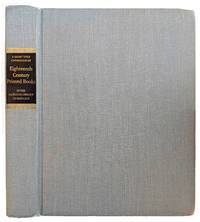
2000Best.-Nr. EEG1379Mansfield CT:: Martino c. 2000. 2000. 4to. xiv 1315 1 pp. Index. Gray gilt-stamped cloth publisher's shrink wrap. As new. EXTRA POSTAGE WILL APPLY. Martino, [c. 2000]. hardcover books
1967Best.-Nr. EEG1377Bethesda MD:: U.S. Department of Health Education and Welfare 1967. 1967. 4to. xii 698 pp. Index. Gray gilt-stamped cloth. Very good. EXTRA POSTAGE MAY APPLY U.S. Department of Health, Education, and Welfare, 1967. hardcover books
1989Best.-Nr. EEG1378Bethesda MD:: U.S. Department of Health Education and Welfare 1989. 1989. 4to. xiv 1315 1 pp. Index. Gray gilt-stamped cloth. Very good. First edition. EXTRA POSTAGE WILL APPLY. U.S. Department of Health, Education, and Welfare, 1989. hardcover books
1979Best.-Nr. EEG1376Bethesda MD:: U.S. Department of Health Education and Welfare 1979. 1979. 4to. vi 501 1 pp. Indexes. Gray gilt-stamped cloth. Very good. U.S. Department of Health, Education, and Welfare, 1979. hardcover books
2000Best.-Nr. EEG1380Mansfield CT:: Martino c. 2000. 2000. 4to. xiv 1315 1 pp. Index. Gray gilt-stamped cloth. Very good. EXTRA POSTAGE WILL APPLY. Martino, [c. 2000]. hardcover books
2000Best.-Nr. EEG1381Mansfield CT:: Martino c. 2000. 2000. 4to. xiv 1315 1 pp. Index. Gray gilt-stamped cloth. Very good. EXTRA POSTAGE WILL APPLY. Martino, [c. 2000]. hardcover books
1979Best.-Nr. EEG1375Bethesda MD:: U.S. Department of Health Education and Welfare 1979. 1979. 4to. vi 501 1 pp. Indexes. Gray gilt-stamped cloth. Very good. U.S. Department of Health, Education, and Welfare, 1979. hardcover books
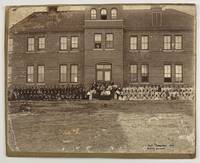
1920Best.-Nr. 12734Fort Thompson SD 1920. Albumen photograph 7.5 x 9.75 inches on a slightly larger plain mount manuscript title at bottom right "Fort Tompson sic S.D. Indian School." Some staining surface wear and edge wear bottom left corner a bit chipped mount worn at corners. Notations in marker and pen in verso reading "Ft. Tompson sic Indian School D OKonnor Collection" and "Dixie O'Connor Collection." Good condition. A striking group photograph featuring the students and teachers of the Fort Thompson Indian School more commonly known as the Crow Creek Tribal School in the early-20th century. The image shows about 120 students arranged in three rows split almost evenly into two groups with half the students dressed in black on the left and the other half of the students dressed in white at right. Between the students are over a dozen teachers and staff members. All of the students faculty and staff are posed in front of a large three-story brick building. The indigenous school at Fort Thompson was started in the late-1880s by Father Pierre DeSmet. The school remains open today serving the population of Crow Creek Sioux on their reservation on the east bank of the Missouri River in central South Dakota. The present photograph remains a stark visual reminder of the U.S. government's assimilationist activities among Native Americans over the past two centuries. unknown books
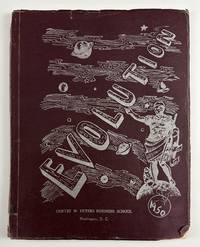
1950Best.-Nr. 5036Washington DC: Cortez W. Peters Business School 1950. About very good. 60pp. Original purple wrappers printed in silver. Some soiling and staining to covers minor chipping and rubbing. Small unobtrusive stain to fore-edge of text overall even toning. A seemingly-unrecorded yearbook from the Washington D.C. branch of the Cortez W. Peters Business School the first African-American-owned business school in the United States. The co-educational school was founded in 1834 in the Nation's Capital followed in the next few years by branches in Chicago and Baltimore. The founder Cortez W. Peters taught himself to type as a child and went on to become the first African-American champion of the World's Amateur Typing Contest. Peters' school was one of the first to teach typing to Black students while also offering instruction in shorthand and other clerical skills. The present yearbook begins with a message from Peters which strikes a conciliatory tone in the wake of racial tensions that followed the conclusion of the Second World War: "We naturally resent discrimination lack of opportunities oppression.But on the other hand there are many other values to be considered which should make us tolerant and willing to work out these traditional handicaps generally." This is followed by messages from the dean and class president Eva Itene Brown then portraits of students and faculty a class history a class prophecy class will class poem and twelve pages of group photographs including shots of the men's and women's basketball teams the coronation ball and images featuring students in the classroom. Many of the students both men and women have included words of advice or stated their personal goals which are printed beside their portraits "To be a good typist" "To be a stenographer" and so forth. OCLC lists a single copy of three similar yearbooks all under different titles from other years and branches of the school Washington D.C. and Chicago in 1948 and an undated yearbook from Baltimore but not this particular year at the school's home base. Cortez W. Peters Business School unknown books
1928Best.-Nr. 4895San Francisco: Frances Thompson Studio 1928. Very good plus. Sepia-toned photograph 4.5 x 7.5 inches on a studio mount measuring 9.25 x 10.75 inches. Minor wear. A striking photograph documenting the diverse student population in a San Francisco grade school class in 1928. The class is comprised of a combination of white African American and Asian American students emblematic of the racial diversity of the Bay Area then and now. Some of the children clutch American flags as well as dolls flowers and in one case a small drum. The image was produced by noted female photographer Frances Thompson and mounted on one of Thompson's printed cards. Thompson was the official photographer for the San Francisco Board of Education at the time; the specific school is not identified here. The mount displays a Craftsman-style logo which reads "FTS Frances Thompson Studio San Francisco" opposite the year "1928." According to a 2019 San Francisco Gate story Thompson was known as "The Picture Lady" by the thousands of children she photographed over her career. Frances Thompson Studio unknown books
1962Best.-Nr. 173920New York: Macmillan 1962. Very Good. 4th ptg. Very good. Edges bumped and rubbed. Macmillan unknown books
1905Best.-Nr. 58077Trenton N.J.: MacCrellish & Quigley State Printers; 1905. First Edition. Scarce!. 8vo. brown cloth with gilt; 255 pages. Very Good some discoloration covers; contents clean & tight. MacCrellish & Quigley, State Printers; unknown books
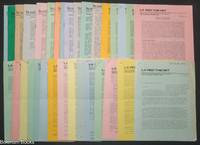
1987Best.-Nr. 345438Ann Arbor: National Chicano Research Network Institute for Social Research University of Michigan 1987. Newsletter. 31 newsletters some wear but generally in very good condition. Present in this run are no. 1 August 1977 no. 3 December 1977 to no. 12 November 1978 no. 17 April 1979 to no. 19 June 1979 no. 22 September 1979 no. 24 November 1979 no. 26 January 1980 to no. 27 February 1980 no. 26 April 1980 no. 31 June 1980 no. 87 July 1985 No. 93 Jan/Feb. 1986 no. 95 April 1986 to no. 104 January 1987. National Chicano Research Network, Institute for Social Research, University of Michigan unknown books
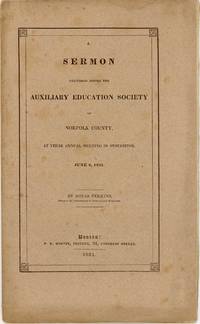
1831Best.-Nr. 38727Boston: T.R. Marvin Printer 1831. First edition. Stitched paper wrappers. A very good copy edge worn wrappers and contents lightly soiled. 24 pp. 8vo. Concerns religious education especially of ministers. Includes list of members and treasurer's report. Reverend Jonas Perkins was paster of The Union Religious Society of Weymouth and Braintree for 45 years from 1815 to 1860. Sabin 60960. American Imprints 8700. T.R. Marvin, Printer unknown books
1839Best.-Nr. 38723Boston: Marsh Capen Lyon and Webb 1839. First edition. Stitched plain paper wrappers. A very good copy lacking the front wrapper scattered foxing. xlviii pp. 12mo. Rare printing of the introduction to this educational undertaking in two series of fifty volumes each one for juveniles and one for older children and their parents. This introduction maps out the plan of the series and was sent out shortly after the prospectus. It was later printed as part of the first volume of the series. OCLC locates only one copy of the separate printing Univ. College London. AAS has a similar item with different pagination. Marsh, Capen, Lyon, and Webb unknown books
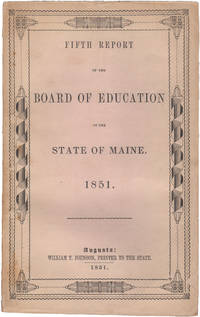
1851Best.-Nr. 38808Augusta: William T. Johnson Printer 1851. First edition. Stitched paper wrappers. Wear to the wrappers and spine few chips to edges faint marginal soilings one page with ink mark else very good. 171 1 pp. Illus. with 12 b/w plans 2 lvs. with school desk illus. Sm. 8vo. Separate printing of this fifth and next to last Report. Notes that "It is the imperative duty of every district to employ a competent teacher. On this point there has been a sad dereliction of duty in some sections of the State. …During the past year one hundred and fifty-two schools have been broken up through the incompetency of teachers." Sabin 43933n. William T. Johnson, Printer unknown books
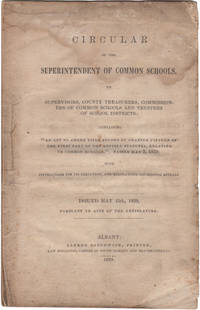
1839Best.-Nr. 38798Albany: Alfred Southwick Printer 1839. First edition. Self wrappers. About very good edge worn and torn with light soiling on wrappers dampstain on top quarter of leaves and small tear to fore edge throughout. 30 pp. 8vo. Concerns school finances and the requirement that towns apportion monies for the schools. OCLC locates only 12 copies. American Imprints 57519. Alfred Southwick, Printer unknown books