52 659 résultats
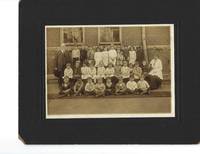
réf. 15394Vintage Gelatin Silver Photograph on original heavy black backing. 1913-1914. An older male and younger female teacher stand outdoors with approximately 20 students of kindergarten age outside a brick urban school building. The class includes two young African American children a boy in the front row and a girl in the back row decades before Brown v Board of Education. The verso includes names of all the students and tells us this is the Irving School Kindergarten. Dayton Oh. 1913-1914. The teacher who is seen seated next to her students wrote on the verso "Ruth L Sharp .my first class" Image in very good condition. unknown books
réf. 16390An early turn of the century Wellesley College student"s hand decorated fan with over 150 photographic or printed image pasted on including her Ivy league friends and many other university logos. One side of fan has 66 small black and white cutout photographs that show her college friends and other images during her Wellesley years. The reverse of the fan has another 84 small color print and gild paper logos and badges these 84 small ephemera are mostly from colleges and social clubs in New England and the US Northeast but includes some from across America. Among many others it includes logos from Wellesley College Worcester Polytechnic Institute Stanford University and Cark University. The fan when open measures about 10.5 in x 19 in. Fan is in very good condition with fabric lightly soiled at edges. Scarce item since woman college education was just taking off at the turn of the century. Minor wear on wooden handle and fan. Very unique and enchanting Wellesley memorabilia Good. . unknown books
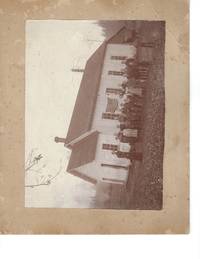
réf. 15393Vintage Albumen photograph on heavy backing. C. 1890. A young female teacher stands outdoors with approximately 20 students of all ages. An American flag hangs on the schoolhouse wall. A rural scene with a large load of firewood visible at the back of the school building and some fog on he trees in the background. The school seems to be in an opening in a forested area. The teacher's outfit is late 19th century. Some age staining to mat Image in very good condition. unknown books
réf. 15265Extensive correspondence collection 1920-1940s. 66 letters by various authors mostly women native to the Indian sub-continent all very unusual in the fact that they are highly educated and in the midst of further studies or early in their careers decades prior to Indian Independence. The letters are addressed to a young teacher Probha who was former classmate to most of the writers as well as a few to her sister Rani or to both and follows them as they finish school enter teacher training college and ultimately fan out over India as bearers of a new generation of independent Indian women. In 1931 Indian female literacy hovered at just under 3% making the experiences of these forerunners and their correspondence incredibly rare. Prior to Indian Independence from Britain Gandhi called for uplifting the status of women through education and recognition of their inherent worth as human beings. Determined to inculcate the equality of the sexes into Indian culture Gandhi publicly did household tasks that were traditionally women's work and declared that "the future is with women." Indeed other activists also equated India's independence with new freedoms for women. However by 1931 Indian female literacy hovered under 3% and was often lower in the rural provinces where schools were few child marriage was prevalent and patriarchal norms dominated society. On the cusp of vast cultural change educated women and female schoolteachers and professionals were the rare exception. These letters record the interactions between a rare group of highly educated women their thirst for personal and financial independence as well as their conflicting feelings regarding the traditions that defined their lives and restricted them. Their nexus was the Queen Victoria Girls' High School in Agra a small city in the rural northern province of Uttar Pradesh most notable for being the home of the world famous Taj Mahal a symbol of reverence to a much-loved wife of antiquity and of honor to the traditional woman. In its tall shadow young sisters Probha and Rani Thomas attended high school at "QVHS" in the late 1920s-early 1930s where lifelong friendships developed with female students Libawati Ivy Monica Lila Mercy Winnie among others. Most of them became teachers where the extraordinary nature of their achievement stood in stark relief to the lot of most other women "This year only one out of five girls has passed from our village schools." As their lives continued and they spread across the country education became the uniting factor that drove the young women forward and brought them back to each other. "Probha what are you going to do now I am going back to old Q.V. to become a teacher and I am feeling very sad as my dear old class girls won't be there. All these past years seem like a dream. So soon the parting took place.No more Tenthies no more H.M. Club. All have faded like a passing cloud.I shall never find such a jolly set again Probha. This future seems very hard." They were witness to an extraordinary moment in history when the world was changing particularly for women and with their education they are in a unique position to describe the change "It is funny that when it is time for us to be silent we have to look after our visitors and perform useless ceremonies-someday we'll change but not yet." One recalls a train ride in which she sat near "a bold Gandhi's follower.In his eloquent poetical language he was telling people that he had been to jail and was saying that for the love of country he can endure anything." Probha and Rani's father a judge had lessons for them about the danger of Revolutionary activities when one of their friends gets involved "Arel De is intelligent and emotional but he has no self control.You may write to him but make it plain that you will drop correspondence if he writes politics again. He is either already on Police books or will soon be." Though they shied away from direct involvement in politics they encapsulated Indian women's liberation in the early century: striving after independent employment deferring marriage yet with respect for their elders. In one letter Monica sadly reports to Probha "I am not coming back to school. Although I am feeling very bad but yes father has done what is good for me. I asked many times to let me go but he forced me to stay here." And in another poignant letter "Lovey" writes "Rani sis do you remember once we were talking about this problem of getting married Now very soon I shall be facing it. John wants to settle down after my working for one year only & I wish to work for at least two years. I think I shall have to do my parents will decide. Please pray that I may get a chance of working for at least two years." In tone the women are warm and sisterly to an extent not found in letters of Western cultural origin and also profoundly honest in reporting to one another their successes and failures; a good or bad test score the struggle to study while encountering difficulties such as lack of clean drinking water and large snakes and even having the security of their families placed on their young shoulders "May God help me. May I pass in the 3rd division only for it is difficult time for us two sisters. Our father's money is nearly spent and if I pass I go for training. Please remember us in your prayers that we may soon become independent." As one of the young women finds out who goes back to QVHS as a student teacher life becomes more complicated as time goes on "My examination result is so bad.my poor mother is working so hard at home. It was too much to disappoint her.I know you would ask me but why have you done so badly The only answer I can give you is that I got 7 periods a week to teach & being a slow writer the notes of lessons & the preparation took all my study time." What they share is a clarify on the value of their education to all their future lives: "All the Normal Students High School and the middle candidates.tell each one of them that I wish them a very brilliant success. Tell them that I remember each one of them in my prayers that they all may pass in the 1st Division with scholarships." Cultural references show the writers and recipients of these letters were generally native of India although they often went by Western cognoms. A few of the letters from British servicemen or coworkers offer an interesting perspective on intercultural understanding and friendship in the days when Indian Independence loomed so closely on the horizon. A serviceman befriended by Probha writes "In those days we were very ignorant. We knew nothing at all of the country or the people and their ways and customs. I think we were most surprised to find that you spoke English.We were astounded to see such bad conditions existed for some people and very upset to find such a feeling of bitterness between our two peoples." Reflecting the dichotomy inherent to the lives of these girls several letters are from their mother who simultaneously pushes them on to achieve independence and reminds them of their cultural anchor. anxious for them and resolute that they will have every opportunity possible. An intelligent woman in her own right Probha's mother offers advice on her exams "Your last quarterly should have had better marks. I wrote a few little hints in my last letter. Please keep them in mind.I'll send your saris in a day or two.I couldn't get even a bit of voil in the bazaar. There was no chance of getting it from any out station. I've used the bits I had at home.I pray God to be with my baby & help her to be a true hearted & brave soldier." The letters are in English except for a few brief passages in Hindi as English was the primary language of education and commerce prior to Independence. A few are from an object of romance; a male teacher who courts Probha with poetry but does not succeed in convincing her to give up her freedom as a single woman. A rare archive of letters from an extremely uncommon cross-section of pre-Independence society: the forerunner of the modern educated and independent woman of India. unknown books
réf. 15036Pamphlet copy of Frederick J. Gould's lecture "Why Educate" which he delivered to the meeting of the National Union of Women Teachers in Chesterfield England in 1926. Between 700-800 teachers were in attendance for the Annual Educational Weekend conference at which Gould spoke.Among the highlights of Gould's lecture are his exploration of "What is education It is the showing the revelation to youth of Order Beauty Service Progress" and his assertion that "to teach is to show to reveal." He concludes "I dream of the day when the whole world will waken to the enthusiasm of education when the school bell will speak to every citizen." Stamped on first and last page with "Board of Education Library" and with some markings. Docket hole in top right. Comes with one page "Educational Reform. unknown books
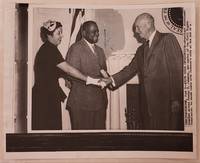
réf. 16373Civil Rights Movement Four First Edition government reports related to the Civil Rights movement in the United States. The reports cover issues such as the ongoing struggles to desegregate schools problems with voter suppression for African-Americans and the ongoing struggles for equality. Comes with 2 original press photos of the Civil Rights Committee with President Eisenhower in 1959 and photo of new members the following year. This collection documents racial inequality in the 50's and 60"s that the government sought to address. Two reports on the "Civil Rights Hearings before the Congressional Committee on Civil Rights": the 1959 report details proposed bills to strengthen the Civil Rights Act of 1957 and addresses issues such as Poll Taxes and the violent ways that white segregationists intimidated Black students from integrating such as making threats to bomb schools. The 1963 document includes a statement from President Kennedy that recognizes the progress made yet outlines priorities for Civil Rights legislation in the US including: voting rights and integrated education. "Civil rights USA: Public Schools Southern States 1963 North Carolina" details the barriers that President Kennedy spoke about with many examples of de facto segregationist policies in public schools. Many of these issues were addressed in the monumental Civil Rights Act of 1964 yet the "Hearing Before the United States Commission on Civil Rights" from 1966 includes over 600 pages of testimony regarding the ongoing fight for racial equality in the US with maps charts graphs and photographic illustrations throughout to support various testimony. All in very good condition with original wrappers; some minor soiling and discoloration. unknown books
réf. 16646Photo Album Education Co-educational Primary School in Tokyo. Three-Wood Common Elementary School1941 during World War 2. Album of Gelatin silver print photos. Original textured paper wrapper. Album opens right to left. 6.9 x 9.75 in. Album cover is dated "March of the 15th year of the Showa Dynasty" in Japanese. 7 photographs measuring 4.5 x 6 in. Each class photo includes names of sitters printed on rice paper in Japanese. Of note in the 6 class photographs of school children and faculty are the mix of men and women as teachers and the mix of girls and boys as students. In the first image of the entire school boys and girls are lined up next to each other although they stand in rows of their own single-gender classes. Two class photos have additional small portraits of students who were absent for picture day. In Japan at this time education was not compulsory beyond primary school but childhood was regarded as an important time to foster learning growth and intellectual curiosity for both boys and girls. Very good condition. unknown books
réf. 15396Albumen photo mounted on heavy backing. 1912. image is 7"x5" on a 10"x8" original mat. "Guy Brouillard. Zwingle School. First to 8th Grade." A young male teacher stands in the back of a classroom with 30-40 students of all ages at their desks. An enormous book most likely a teacher's edition has its own bench desk at the front of the room. 4 large windows on the wall have made the image over exposed some aging to mat Image in very good condition. unknown books
réf. 16298Women's Education. Photo Album: Truro Cornwall Teacher Training College. Truro Cornwall UK: 1925-1927. Oblong octavo. Bradbound brown boards patterned for leather effect "Album" stamped in gilt on cover. Modest rubbing to the front hinge and slight bumping at the corners. 164 glossy-finish snapshot photographs of the female college students and their life at Cornwall in a variety of sizes including 3.5" x 5.5" 2.5" x 4.5" 3.5" x 2.5" inches both black and white and sepia. Most are captioned in white ink. Slight warp to some photographs from being pasted to the pages and occasion residue from fingerprints. Beautiful impressionistic portraits of the life of these hopeful young teachers in Cornwall. In addition to the many vivid photos of the teachers going for outings and picnicks "Help yourself to the cream" and lively portraits "the long and short of it" under a photograph of a tall young woman smiling ruefully there are photographs of the ancient city of Cornwall which carry a beautiful spectral quality. In the 1920s teaching was one of the only pursuits available to women who wanted economic enfranchisement outside of waged domestic service. However there were many restrictions placed on female teachers; The women we see smiling in these photos although choosing liberation in one sense also faced much personal sacrifice. These women had to live morally exemplary lives by the rigorous contemporary standards since they were entrusted to raise the youth. Additionally until 1944 in the UK no married women were allowed to work as teachers. If a woman teacher married she had to resign from her job; if she was already married she was sacked. Some women found a way around the marriage bars by marrying in secret and then living apart from their husband or by having a very long engagement. Most female teachers however remained single in a time when marriage and motherhood signified adult female identity. The tensions between two identities-- that of the professional teacher and that of the feminine woman-- coupled with the influence of the suffrage movement and systematic unfair treatment in the teacher's unions led to teachers becoming some of the most ardent feminists of the movement. unknown books
réf. 15405African-American Education Pair of photographs depicting the first Catholic elementary school that educated girls of color both free and enslaved which was located at the oldest black parish in the United States St. Augustine's Catholic Church. Circa 1840. Albumen photographs 7" x 5" inches one mounted on board and the other unmounted. The unmounted photo is captioned in cursive at the bottom edge "Catholic School Manderville La". Both photographs show African American nuns assembled with male and female students in front of the school. Religious instruction was one of the few accessible paths to an education for African-Americans in the mid-19th century. At a time when literacy was considered a dangerous advantage the Catholic School at Manderville is notable not just for educating children of color but including girls among that calculus as well as children of both the freed and the enslaved. The property on which the Catholic School of Saint Augustine Church stood was originally part of a plantation owned by Claude Treme who subdivided his estate and sold off large tracts to free blacks and others on a first-come first-serve basis; the school itself was likely founded by Henriette Delille a free woman of color and Juliette Gaudin a Cuban worshippers at St. Augustine's Church who devoted their lives to aiding slaves orphan girls the uneducated and the sick and elderly among people of color. Their particular concern for the education and care of black children aided greatly in the founding the city's early private school for the colored. Widespread illiteracy among Afrcan-Americans was a cornerstone of white supremacy in the South. The objections to slave literacy were threefold: 1 Slaves did not have the mental capacity for education and would only become confused; 2 Slaves might learn to forge passes to non-slave states; and 3 Insurrection and rebellion might result from slaves reading abolitionist writings. Literacy was so loaded in fact that the new restrictions resulting from Nat Turner's 1842 slave revolt-- only two years after the Manderville Catholic School photographed here was started-- included anti-literacy laws and punishments for slaves who tried to learn to read and write. Yet many African-Americans both free and enslaved found ways around such laws to satisfy their hunger for learning. The main antebellum resource for teaching literacy was the Bible which some whites permitted because they believed the Bible would teach African-Americans about their "divine" role as servants. With the Second Great Awakening which lasted through the 1840s the opportunity for African-Americans to receive an education was greatly expanded by the religious notion that all men and women from every race were in need of salvation and that all redeemed individuals were to be "useful" in God's kingdom; thus clearing the way to a new path for literacy and education among African-Americans through the lens of religious teaching. unknown books
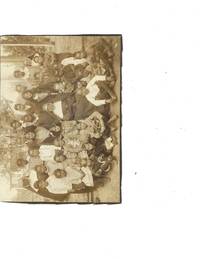
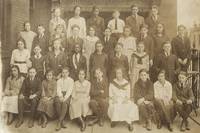
réf. 15401Early Integrated Class Vintage Silver Gelatin photograph Approx. 3" x 5". Moorhead School. A class of approximately 30 high school age students stand on the steps of an urban brick schoolhouse under the door frame which is carved to read "Moorhead School." The class is very diversewith several African American students several apparently Italian students and others of various descents and complexions decades before Brown v Board of Education. The students outfits seem to be turn of century 1895-1905. Image in very good condition. unknown books
réf. 15151NIGHTINGALE Florence. Collection of 32 pieces celebrating the first 50 years of nursing education which made nursing into the first respected medical profession for women. This collection includes a First Edition of Nightingale's influential guide Notes on Nursing 1859 and a handwritten Nightingale letter with wonderful content on her training school and hospital followed by many more tactile and visual pieces from the period ranging from approximately 1880-1930 when women entered the first official nursing programs to obtain theoretical education on disease prevention and antisepsis practical training in patient-centered care and certification and accolades for their excellent work. While nursing was initially considered a volunteer service the founding of the Nightingale School of Nursing in 1862 caused rapid changes developing nursing into a true medical profession. Programs opened worldwide basing their training on the "Nightingale Principles" that emphasized patient-centered care through systemic cleanliness and stemming of infection in hospitals. The first time these important ideas were placed in print was in Nightingale's 1859 Notes on Nursing¸ a guide to patient care within the hospital and community which has remained relevant to the present day. A First Edition of Nightingale's Notes on Nursing published before even her training hospital was founded is included with this collection. A wonderful early letter on St. Thomas Hospital the site of Nightingale's first training school which she wrote in 1864 shortly after its founding is included here are well. In this letter Nightingale laments that "poor St. Thomas is in such a "fix & has so many bad friends that he ought to keep all his good ones." She is no doubt referring to the back-handed business deal that led to the hospital's moved to an abandoned music hall with sub-par hygiene for nine years starting shortly after her training program had found its home there. She discusses the immediate effects on her own students "I should never have placed my Probationers at St. Thomas but that Mr Whitfield & Mrs Wardroper were there.and when St Thomas' with its ample income has not contributed one farthing to but has profited by the Services of my Training School." Nightingale herself championed the creation of a new building and helped design it for modern standards of safety and hygiene. Among the first programs to model itself after Nightingale's example wertr the Spelman Nursing Program founded in 1886 and the Johns Hopkins School of Nursing in 1889. In order to distinguish nurses' uniforms from those of servants the programs instructed nurses to wear pocketed aprons for carrying tools and the schools provided ruffled caps that were easy for patients to identify in hospital hallways. An early vintage cap from circa 1880 is included in this collection. By the turn of the century nursing education had aligned with university criteria and rigorous training became mandatory. In 1902 the U.S. and New Zealand initiated standard requirements for registered nurses to pass medical examinations; and by 1909 the University of Minnesota was the first to award a bachelor's degree in nursing. In 1919 the U.K. passed the Nursing Act requiring all nurses to join a registry; and in 1923 Yale University School of Nursing became the first autonomous college in the field. Such programs required women to take 2-3 years of medical coursework and pass certification exams. As is evident by this collection's handwritten nursing class notebook these women gained intensive knowledge about anatomy nutrition and disease. The notes in this collection include anatomical drawings as well as detailed information on "the practice of hygiene important in care of patient.how to prevent infection.uses to body of food and amount of food needed by individual patient" based on condition and diagnosis. It comes with a very rare 1911 "The Trained Nurse" booklet which contains educational matter on sexual and dental hygiene for patients to lower the risk of infection as well as information about a nurse's commitment to her training program. OCLC Worldcat lists no other known copies. After completing classes nursing students apprenticed in their program's hospital until graduation. Instructors and administrators continued to value the use of uniforms and they made the clothing more functional for women whose daily tasks ranged from explaining doctors' diagnoses and treatments during consultations to the dressing of wounds. While uniforms evolved to become more streamlined they still bore visual signs of a student's experience and accomplishments. The nursing cap continued to be the most recognizable sign of entrance to the profession and getting her cap was a formal right of passage to a young nurse. Women only obtained the cap during a ceremony in which nurses from the program pinned the caps to the new nurses' heads. As students rose through the ranks and ultimately graduated they would receive a nursing lapel pin showing their entrance into a specialized field. This collection includes each of these important pieces: a white vintage nursing cap and lapel pin. In addition it contains a handwritten journal with beautiful colored handdrawn illustrations poems and diary entries by a nurse during her hospital training. The women who graduated from nursing programs had met the mandatory benchmarks; indeed these women also often exceeded requirements and won honors for their work. Celebrating these landmark accomplishments this collection includes a set of 5 turn of the century graduation invitations an early commencement booklet with individual nursing graduation photos 3 early diplomas for women graduating from nursing programs 8 class photos and 7 individual female graduate portraits. The photos visually document the collective changes that these nurses' uniforms underwent across the decades as well as the women's pride in obtaining their degree. The collection also contains a "Champion of Head Nurses" trophy awarded to a young nurse for her leadership within her new hospital. As this collection shows these women's educations led them to become proud and dedicated professionals excited to apply their knowledge in ways that made a difference. University of Pennsylvania "American Nursing" p. 1-11. "A Nurse's World" p.1. Heineman "Timelines in American Women's History" p. 219. unknown books
réf. 15275Female Correspondence Education. Book Set 1929. Delphian Society Correspondence Course 18 Hard bound books The Delphian Society was a national organization that promoted the education of women in the United States. This organization was founded around 1910 in Chicago. the Delphian Society published the Delphian Course of Reading: "A systematic plan of education embracing the world's progress and development of the liberal arts." The original volume course covers "history literature philosophy poetry fiction drama art ethics music" than developed to 18 volumes by 1929. the importance of the adult-education and self-culture movements and places the Delphian publications within the progressive milieu and the development of women's clubs. These publications were unique in the era as no other texts institutions or organizations were devoted to women's education at the highest level or fostered deliberative social interaction and civic advancement. The publications provided education to adult women at a moment in history when their roles in American social and civil life changed dramatically. The volumes are in good condition and heavy. Extra shipping charges may apply. unknown books
réf. 16862Women's Education Penn State First women enrolled in the College of Earth and Mineral Sciences at Pennsylvania State University. October 17 1934. Original silver gelatin print press photograph. 8 x 6 in. Original press caption typed on image verso. "Taking a Man's Course. Alexandra Tillson the first girl to enroll in the school of Mineral Industries at Penn State with Dean Edward Steidle who is showing her around the school's Museum of Minerals. Miss Tillson is taking the metallurgy curriculum which deals with the study of iron and non-ferrous metals. She is the daughter of Benjamin Franklin Tillson noted mining engineer of Montclair N.J. Miss Tillson can't be discouraged from pursuing a study which may eventually take her to the steel mills or to the mines. 10/17/34." The Steidle Building one of the most iconic pieces of architecture at Penn State was named in honor of Dean Steidle pictured with Tillson. Some wrinkling to center right edge. Good to very good condition. A groundbreaking woman pictured at the start of her academic career. unknown books
réf. 16962Women's Education Photo album from woman student at co-educational Williamette University 1913-1915. Images come from campus events student plays and various outdoor locations around the college's location in Salem Oregon. 53 original silver gelatin print photographs of various sizes from 1.5 x 2.5" to 3.25 x 4.25". Many of the photos include brief captions identifying the location or event. Images dated from 1913-1915. Original black leather boards. 11 x 14 in. "Photographs" on cover with gilt detail and embossed flower motif. 32 pages last 14 blank. Photo of first page shows "Williamette University" spelled out on an earthen embankment. Willamette University was founded in 1842 as a coeducational institution and its first graduate was a woman. Album is full of images of women and men students learning and working together. Unsent color postcard of Eaton Hall at Williamette University. Many of the photographs focus on women students although there are many with mixed genders. Photo of a a group of women outside with books looking for birds labeled "Ornithologists". Photos of girl classmates "Gertrude-Alice / Inseparable friends". Even though Williamette was a co-educational college there were several university rules restricting contact between men and women students outside the classroom. One of the rules from the 1870s stipulated that women and men had to maintain a one-block distance between them while walking to class. Despite this young men and women worked together to form professional and personal connections. Photo of a man and woman seated at an outdoor table with an open book in front of them: "They said they were studying Zoology". In another image 3 men and 1 woman sit together writing and studying at a table with Corvallis Oregon written on a large bulletin board behind them. Photos specifically from graduation events. "Seniors 1915 Party at Grahams" 30 figures crowd behind a round table and over half are women. Photos from commencement day. 5 women in cap and gowns line up on a sidewalk. Flanked by two smaller snapshots from "The Campus Serpentine" in which the graduating class can be seen talking in a line around the campus. Photos of different social events around the school and community. "Soph-Frosh Formal Reception 1913": over 50 young men in suits and women in long gowns and gloves pose around a lighted archway. "Kloshe Kitchen Force 1914" with 3 men and 1 woman in an industrial kitchen. The Kloshe Klub was a popular spot for students at the time. "Junior Feed in Gym": around 20 figures seated on either sides of a long table. "The gym feed aftermath" shows a team 9 women and men laughing together on an outdoor veranda. "A Quartette of Folk Dancers" "A Junior Quintette". The following page shows dancers in action in "A Fancy Minuet". Performing a play outside the school with specific images labelled "Queen Mary Enthroned" "Yes here is Marie also Ann" and "In Battle Array" from different points in the production. Some of the captions contain inside jokes or references. "The Father of 'Rats'" written under a photo of 4 women falling over from laughing with 1 man all around a pile of chopped firewood. Outdoor life around the college such as at Silver Creek an Oregon State Park. "'Cooed' Life at Silver Creek" Women wash dishes at an outdoor campsite. Two figures read books: "We like canoeing but sometimes we study". Another set of photos show people crowded at an outdoor table and seated on the grassy spot with picnic plates. "A full table under the Lausanne Maples". Very good condition. unknown books
réf. 16935Women's College Photo album from student at Georgia State College for Women class of 1923. Album includes time she was at school with images of classmates around school buildings. 138 photographs of various size approximately 1 x 1" to 3.5 x 2.5". Photos are dated from 1919-1926. Original black textured cloth boards. 8.25 x 11". "Photographs" gilt on front cover. 100 pages. Hand lettered on first page: "Marion Tye / Devereux / GA". Images of young women at leisure between classes. One page labelled "Roomies / Terrell Annex - Room 211" has photos of friends captioned "A Queen of hearts" "Flossie" "The Black Sheep" and "My Gurls." Page 7 features small cutouts of women's portraits arranged in a "23" configuration likely containing images of all members of the class of 1923. Georgia State College for Women was founded in 1889 as the Georgia Normal & Industrial College as a women's institute; and in 1917 it was authorized to grant 4-year degrees to women pursuing teaching degrees. It is now Georgia College recognized as one of the best undergraduate teaching programs in the US South. The remaining pages are filled with memories of friends and family. Some include interesting trips from nearby locations such as Lake Junaluska North Carolina and "Mt. City" Mountain City GA. A photo of 8 young men wear "Landa Park" tanks. One photo of a man playing saxophone with caption "Alabamy Bound." Many of the remaining photos are of young children. As this figure attended a teacher's college these photos could likely be from students she later taught. 2 pages detached 3 loose photos. Good to very good condition. unknown books
1800réf. 347111800. 2pp. with integral blank leaf. Disbound. Minor foxing. A short but interesting work consisting of advice and rules for Wright's Academy of Kighley presumably Keighley England. The first page is a letter to the pupils and the second page lists eight rules "to be observed by the pupils attending Mr. Wright's Seminary." A rare and possibly unique work as no records of another copy can be found anywhere. unknown books
1971réf. 23256Jeffersonville: KOA / Arrakis 1971. First edition. Paperback. Very Good. Tall stapled wrappers. Rare first issue of this experimental newsletter covering topics in the field of educational theory. 15 pp. The newsletter is primarily about the KOA-Konference On Alternatives held on Fordham University's Campus April 16th and 17th 1971. Text by Ruth Messinger John Holt Larry Cole and others. A very good example. Page 5/6 has a crease. Only a handful of copies in institutional holdings. This issue was mailed to Iris Lezak and Jackson Mac LOw with their handwritten address sticker on the rear cover. KOA / Arrakis paperback books
1958réf. 23935New York New York: The City College of New York 1958. 23 pages; a few black and white illustrations; cover story on Townsend Harris founder of the CCNY and especially concerning the 20th Century-Fox film The Barbarian and the Geisha starring John Wayne and CCNY alumnus Sam Jaffe written by another alumnus Ellis St. Joseph and directed by John Huston; in a Memo to Alumni the president of the Alumni Association Harold A. Lifton notes the Crisis at the College and the challenge of funding education in the coming years; also an article about Jewish publisher-writer Harry L. Golden by Alice Nadel and his newspaper The Carolina Israelite; and with the class president of '58 Michael Rizzo's address; with many smaller items on the notable doings of alumni class offerings awards publications by CCNY graduates; approx. 5 1/2" x7 1/2" size; old subscribers' label on back cover little wrinkling; in very good condition. First Edition. Soft Cover. Very Good. The City College of New York Paperback books
1975réf. 494521975. Legislative History of Radiation Control for Health and Safety Act of 1968. 2 vols. Washington D.C.: United States Government Printing Office 1975. Vol. I: ix 636 pp.; Vol. II: ix 637-1494 pp. Ex-library with stamps. Cloth worn with gilt lettering. $60. U.S. Department of Health Education and Welfare. Food and Drug Administration. DHEW Publication FDA 75-8033. Volume I: 1-1000 & Volume II: 1001-2000. unknown books
1875réf. 418771875. C.1875 French Lecture Notes on Family and Constitutional Law Legal Education. L'Enseignement de L'Histoire du Droit en Doctoral: Caractere Utilite Esprit de cet Enseignement. Choix d'un Sujet: Le Droit des Gens Maries. various paginations. n.p.: s.n. c.1875. And Droit Constitutionnel 1re Annee. 247 pp. n.p.: s.n. c.1875. Photo-reproduced autograph lecture notes bound in contemporary quarter cloth over marbled boards. Moderate shelfwear front hinge of first volume cracked but secure fading to spines light browning to texts. Occasional underlining and a few annotations interior otherwise clean. $250. These are two volumes from the series Repetitions Ecrites which offered general lecture notes on various academic topics to university and professional school students. The second volume's subtitle states: "Summary: Object of constitutional law. The state. Its role in the representative system. Course plan. Four parts: Sources of constitutional law theoretical sources the canonists the legists the economists. The theories of St. Thomas Aquinas Hobbes Francois Hotman Jean Bodin Locke Montesquieu and Rousseau. Sources of positive constitutional law. Written and unwritten constitutions. The British constitution: compacts statutes treaties. Written constitutions" 2 Valuable guides to the general state of these areas in France at the time these volumes will reward further research. unknown books
1973réf. 112821973. 36 pages. Quarto original printed and illustrated wrappers some loosening. With photographs by Vance Allen. A list of black literature for children and young adults published since 1971; and several articles concerning the teaching of black literature. unknown books
1845réf. 9751New York 1845. Original printed wrappers stitched 32pp. Light scattered wear and fox. Very Good. "There never yet was a young people able to furnish themselves with the literary institutions they needed. It was true of New-England: her Harvard Yale and Dartmouth owed their existence to foreign munificence; and if ever similar institutions are to rise up in the West and exert a like power in molding the character of that vast empire they must receive their first impulse from abroad. This is what the Society aims to do." Officers included Edward Beecher Leonard Bacon Horace Bushnell and Samuel Walley Jr. FIRST EDITION. Sabin 85916. unknown books
1949réf. 265810New York: National Council for American Education 1949. Pamphlet. 19p. wraps mimeographed on one side only very good condition 8.5x11 inches. Red-baiting attack on Harvard with a list of 76 professors and their alleged communist front connections. Those attacked include Gordon Allport Zechariah Chafee Jr. John King Fairbank Alice Hamilton Walter Gropius John Kenneth Galbraith Francis Otto Mathiessen Rocoe Pound Arthur Meier Schlesinger. National Council for American Education unknown books
1769réf. 1071972 vols. London: Newbery and Carnan 1769. 2 vols. 16mo xl 264; 286 2 adspp. Original quarter green vellum over black coated boards with paper label to spine. Slight wear and rubbing to extremities; else very good clean copies. § Two from the seven volume series which was an early attempt to introduce children to logic philosophy mathematics etc. All the early editions are scarce. Oliver Goldsmith has been named as a possible contributor to the series. Roscoe J663 and J694. Newbery and Carnan hardcover books