104,150 results
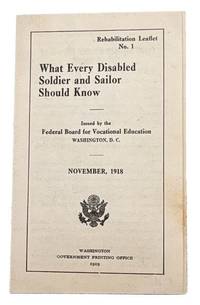
1919ref. 96204Washington: GPO 1919. 1st ed. Very Good. Single sheet folded to form a small unnumbered 6-page leaflet. 13 cm. Some browning. GPO unknown books
1946ref. 96367Fairfield: Board of Education 1946. Paperback. Very Good. photos 24 p. Softcover in original wrapper. 23 cm. Light vertical crease. Modest cover soil. The number of students for the Fairfielf public school school system in 1946 is given as 1100 white and 1800 African American. The booklet does include seven photos of the African American students and thier buildings. The Industrial High School for African American focused on vocational training plus vocal music and band. The booklet lists the building for African American education as numerous but admits: "Even these are not sufficient. Many pupils are on part time and others are in over-crowded classes. Board of Education paperback books
1961ref. 238151961. Mexican American education and civil rights archive circa 1961 to 1973 documenting the expansion of American civil rights work from organized nonviolent confrontation of racial discrimination to federal investigation of unequal treatment within public institutions. The group begins with a Congress of Racial Equality pamphlet explaining the sit in the "standing line" and CORE's system of local direct action then moves to two U.S. Commission on Civil Rights publications addressing Mexican American civil rights and educational inequality. Three pamphlets and booklets issued by the Congress of Racial Equality and the U.S. Commission on Civil Rights New York and Washington D.C. circa 1961 to 1973. 1 Congress of Racial Equality. This Is CORE. New York: Congress of Racial Equality circa 1961. Folding illustrated pamphlet issued from CORE's 38 Park Row headquarters explaining the organization's philosophy and practical methods of nonviolent direct action. The text identifies CORE as a pioneer in applying Gandhian nonviolence to discrimination in hotels swimming pools barber shops restaurants and other public accommodations and describes student sit ins that began in February 1960 and spread through southern communities. Illustrated sections explain "THE SIT-IN" and "THE STANDING LINE" the latter a technique in which CORE members remained in line behind Black patrons refused service preventing the establishment from simply continuing business around them. The pamphlet also explains local chapter organization National CORE financing and the planning required before public demonstrations. 2 U.S. Commission on Civil Rights. Stranger in One's Land. Washington D.C.: U.S. Government Printing Office May 1970. Clearinghouse Publication No. 19. Federal civil rights publication devoted to the status of Mexican Americans issued at the beginning of a decade in which the Commission increasingly examined discrimination against Mexican American communities as a distinct civil rights question rather than treating American racial inequality solely through a Black and white framework. Its title defines the central contradiction investigated by the Commission: Mexican Americans encountering discriminatory treatment within the country of their citizenship and residence. 3 U.S. Commission on Civil Rights. Teachers and Students: Differences in Teacher Interaction With Mexican American and Anglo Students. Report V Mexican American Education Study. Washington D.C.: U.S. Government Printing Office March 1973. A systematic federal study of classroom behavior based on direct observation and interviews in 429 classrooms in California New Mexico and Texas. The Commission organized its findings around six disparities: teacher praise and encouragement; teacher acceptance and use of student ideas; positive teacher response; teacher questioning; noncriticizing teacher talk; and the amount of student speaking. Its transmittal letter states that Mexican American students were "neglected in comparison to Anglo students" that teachers praised or encouraged Anglo children "considerably more often" built on Anglo students' ideas more frequently and directed questions to Mexican American pupils less often. The report concludes that Mexican American children consequently spoke significantly less in the classroom and argues that these patterns reflected the educational system's failure to adapt its programs to Mexican American students. These publications record a change in the evidentiary language of the civil rights movement. CORE's pamphlet teaches activists how to force visible racial barriers into public confrontation through disciplined collective action; by 1973 the Commission on Civil Rights was identifying discrimination that could operate without a posted prohibition or formally segregated classroom. Teachers and Students makes that shift measurable by analyzing the ordinary exchanges through which teachers distributed attention encouragement questions and opportunities to speak. Its findings locate inequality within routine institutional behavior extending the question of equal educational opportunity beyond enrollment and access to what happened after Mexican American children entered the classroom. The two Commission publications also belong to a broader federal effort during the Chicano movement era to document Mexican American exclusion in the Southwest at the same moment that activists were challenging school segregation unequal resources language policies and institutional discrimination. Light handling wear and minor edge rubbing to wrappers; scattered toning with interiors clean and legible. Overall very good condition. A compact documentary sequence tracing civil rights strategy from direct action against explicit racial exclusion to federal measurement of unequal treatment experienced by Mexican American students inside American public schools. unknown books
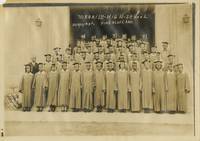
1943ref. BK0057Pine Bluff Arkansas 1943. Gelatin silver photograph 5 x 7 inches. Minor loss or wear at upper left corner otherwise very good. A class photograph of the 1943 graduating class of Merrill High School one of only a handful of schools serving Black students in Pine Bluff before integration. Approximately fifty graduates and several faculty members pose in caps and gowns before the school with the image captioned in the negative "Merrill High School / May 22 1943 / Pine Bluff Ark." Merrill was established in 1886 and graduated its first students in 1894. It became an important center of Black secondary education in Pine Bluff and was the third Black high school in Arkansas accredited by the North Central Association. The school continued as a Black high school until the integration of Pine Bluff's public schools around 1970-71. unknown books
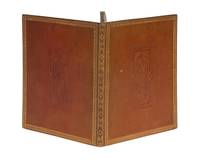
1824ref. 856741824. Copy of a Rare 1824 Scottish Advocate's Thesis on Roman Water Rights in a Fine Contemporary Binding that Belonged to the Notable Scottish Bibliophile Robert Maxtone Graham Legal Education. Robertson William 1802-1883. Disputatio Juridica Ad Lib. XLIII. Tit. XXII. Digest. De Fonte; Quam Favente Numine Ex Auctoritate Clarissimi ac Consultissimi Viri D. Georgii Cranstoun De Corehouse Inclytae Facultatis Juridicae Decani; Nec non ex Ejusdem Facultatis Consensu et Decreto Pro Advocati Munere Consequendo Publicae Disquisitioni Subjicit Gulielmus Robertson Auct. et Resp. Ad Diem VI. Martii Hor. Loc. Sol. Edinburgh: Apud Alex. Smellie Facultatis Juridicae Typographum 1824. 13 1 pp. Quarto 8-3/4" x 6-3/4"; 22 x 17.5 cm. Contemporary straight-grained russet morocco boards with central blind ornaments and gilt fillet frames spine richly gilt gilt tooling to board edges and turn-ins all edges gilt marbled endpapers with several early blank leaves bound before and after the text. Light rubbing to boards a small nick to front board slightly bowed moderate wear to extremities light wear to spine ends and corners. Later armorial bookplate of Robert Maxtone Graham to front free endpaper with brief penciled notes likely in his hand to its verso. Light toning and occasional foxing to interior. A handsome copy in an attractive contemporary binding. $450. Only edition. Candidates for admission to the Faculty of Advocates in Scotland were required to submit and publicly defend brief Latin dissertations on topics drawn from Roman law the foundation of Scottish civil law and legal education. These exercises though often handsomely printed were produced in very small numbers for limited distribution among members of the Faculty and were not intended for commercial circulation. This dissertation written by William Robertson treats Digest 43.22 De Fonte "On Springs" concerning water rights in relation to natural sources. Robertson was admitted as an advocate on March 9 1824. Such productions are today of considerable interest as survivals of Scotland's distinctive legal training and its enduring engagement with Roman jurisprudence. Robert Maxtone Graham 1931-2018 a later owner of this copy was a noted Scottish writer genealogist and bibliophile. He was himself a member of the Faculty of Adv. unknown books
1865ref. 95059New Orleans: Duncan & Co. Stationer's and Booksellers 124 Camp Street 1865. Very Good. Partly printed receipt dated November 7 1865. Approximately 13 x 20 cm. Property owned by individual listed on back side. Taxing white property owners in Louisiana to support education of African Americans was probably the primary method of funding education for African Americans in Union-controlled Louisiana since African Americans were too poor for their taxes to support such schools. This receipt is signed by a Captain Sheridan on behalf of the Provost Marshall. After the end of the Civil War the newly created Freedmen's Bureau would replace this Board of Education for Freedmen in the Army's Department of the Gulf. Efforts to seize and redistribute property from defeated Confederates to those formerly enslaved were thwarted by President Andrew Johnson. We doubt that the Freedmen's Bureau had authority to continue this property tax. Duncan & Co., Stationer's and Booksellers, 124 Camp Street unknown books
1992ref. 93464Langley Va: Central Intelligence Agency 1992. Paperback. Very Good. 43p. Softcover in original wrapper. 28 cm. TE/CSI 92-002. Central Intelligence Agency paperback books
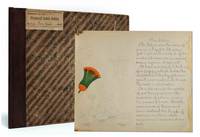
1876ref. 167221876. Healy Laura E. Mathematical notebook 1876 documents arithmetic education within a nineteenth-century American grammar school illustrating the instructional expectations placed on female students and the integration of practical mathematics into everyday reasoning. The volume supports research into girls' education numeracy training and the pedagogical emphasis on applied problem-solving in the post-Civil War period. The later reuse of the notebook for recording death and marriage notices further situates the object within domestic record-keeping practices demonstrating how educational materials were incorporated into family and social memory. Healy Laura E. Mathematical notebook. 1876-1884. Manuscript volume inscribed "Laura E. Healy Room No. 2 Point Street Grammar School September 6th 1876" containing 214 pages of handwritten arithmetic problems and solutions. The problems range from abstract calculations to applied scenarios involving commerce agriculture and household management including exercises such as determining orchard composition "¾ apple trees 1/10 peach trees.how many trees in the orchard" calculating material requirements for interior spaces "How many rolls of paper.to cover 4 sides of a room" pricing strategies "Bought a shawl for $18.make a dis. of 10% and yet sell for $18" and interest computations across specific dates. These examples demonstrate an educational framework grounded in real-world application preparing students for participation in domestic and economic life. The first approximately 30 pages were later repurposed between 1879 and 1884 to paste in and label newspaper clippings of death and marriage notices with a handwritten cover title "Deaths and Marriages" indicating a shift from formal schooling to personal and familial record preservation. A loose handwritten exchange between children including the verse "You be the gal which I adore.more than buckwheat cakes & 'lasses" followed by the response "That is foolish and you know it. Pass this back" provides additional evidence of informal social interaction within the school environment. This notebook emerges from a period in which expanding public education systems increasingly included girls with curricula designed to balance intellectual training and preparation for socially prescribed roles. Arithmetic instruction emphasized accuracy discipline and applicability aligning with broader educational reforms of the late nineteenth century. The later incorporation of obituary and marriage notices reflects common practices of memorialization within the domestic sphere particularly among women tasked with maintaining family histories. Original boards; approximately 214 pages; measures 8 ¼ x 7 inches. Boards heavily worn with loss at the tail of spine; discoloration surrounding pasted clippings; good condition. A combined record of female education practical mathematics and domestic documentation practices in late nineteenth-century America. unknown books
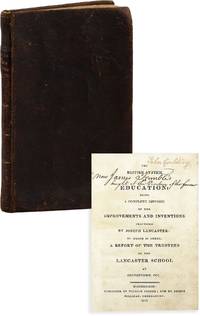
1812ref. 89512Georgetown Washington D.C.: William Cooper and Joseph Milligan 1812. First American Edition. 12mo. Contemporary full sheep; xx1-130pp; frontispiece 5 leaves of plates. A complete but somewhat worn copy with typical darkening to text leaves; a few brief marginal chips including a small loss to frontispiece costing a couple of characters of the printed margin; Good and sound. Early holograph ex-libris of a John Goulding. A very early exposition of the Lancasterian method of education following by just a few years the American edition of Lancaster's own book Improvements in Education NY: 1807 and perhaps the first to delineate the application of his methods in a strictly American setting. Lancaster's method which involved strict regimentation and the use of student monitors enabled the "teaching" of hundreds of students in a single classroom. Lancasterian grammar schools were extremely popular in the early years of the Republic as they filled an urgent need to build a literate working class in a nation with a paucity of qualified profefssional teachers; by the mid-19th century the method fell out of favor in large part due to the influence of reformer Horace Mann. The "Epitome" printed here is followed by the full report of the Georgetown D.C. Lancaster School Society for the year just past to which is appended a letter from Lancaster himself praising the Society's efforts. Six wood-engraved plates illustrate aspects of the Lancasterian approach. Scarce in commerce. SHAW & SHOEMAKER 25817. William Cooper and Joseph Milligan unknown books
ref. 88664N.p. n.d. ca 1880s-1900. Cloth-bound leporello binding gilt-ruled gilt-titled "FOLDING." on front cover 8-3/4" "x 8". Opens to reveal 42 panels 21 on each side of the accordion fold of which 26 are used containing a total of approximately two hundred folded examples laid-down but otherwise fully openable by unfolding; each unique some arranged into complex compositions on the page. Occasional mild foxing but Near Fine overall with three or four pieces possibly lacking from the final pages. The album is presumably American based on its source a regional American auction house purchased 2025 though conceivably British in origin. A beautifully-preserved "papierfalten" album of the late nineteenth or early twentieth century likely the work of either an advanced elementary-school student or a kindergarten teacher in training. Paper-folding was first introduced in American schools in the 1890s an adaptation of Friedrich Fröbel's kindergarten curriculum developed to train children in both manual skills and geometrical and mathematical concepts. The apotheosis of Fröbel's papierfalten technique was the so-called "Froebel Star" a complex three-dimensional composition based on the traditional German folk-art "Moravian Star." Numerous examples of the technique are collected here along with many more basic folds and several wonderful full-page compositions comprised of multiple folded sheets arranged to resemble snowflakes and other objects. We've encountered other examples of the papierfalten genre usually in single sheets with a few examples; none nearly as comprehensive or complex as this one and certainly none as beautifully preserved. A unique and beautiful documentation both of American folk art and educational technique. unknown books
1835ref. 87853Springfield: G. and C. Merriam 1835. Stated Second Edition. Octavo 19cm; purple pebbled cloth-covered boards with titling and decorations stamped in gilt on spine; xi214-21223-4pp; illustrated frontispiece with light off-setting to title page. Pencilled notes to front endpaper. Sunning to spine and board margins with modest shelf-wear tiny tears to spine ends rubbing to cloth of corners and foxing to endpapers and pastedowns; Very Good. First Edition published in 1834 and this text focuses on early childhood education reform with sections on food exercise religious instruction educational toys punishment and music. Dwight 1796-1866 was the son of the New England author and legislator Theodore Dwight 1764-1846 and the nephew of Timothy Dwight the theologian and President of Yale University. The younger Dwight was an active advocate for education reform establishing one of the earliest "infant schools" in New York in the 1830s from which experience the current work likely springs. Additionally Dwight introduced vocal music to public schools in New York and this is regarded as one of his more important books see DAB p.571. AMERICAN IMPRINTS 31444. DICTIONARY OF AMERICAN BIBLIOGRAPHY pp.570-571. 87853. G. and C. Merriam unknown books
1873ref. 87855New York Cincinnati Chicago: American Book Company 1873. Octavo 19cm; red cloth-covered boards with titling stamped in gilt on front cover and decorations ruling and blocking blind stamped to spine and covers; 1213-1191pp; concludes with 12 numbered plate illustrations. Pencilled notes to front endpaper and rear pastedown. Modest shelf-wear and -soil with rubbing to cloth of spine ends and board edges and occasional tiny tears and creases to page margins; Very Good. Leader of the kindergarten movement in the U.S. and later President of the Froebel Institute of North America shares his work on Froebel's early education system with attention to children and their caregivers in the U.S. Sections of this text emphasize kindergarten culture within households and schools and focuses on tablets sticks drawing social games and songs. Hailman and his wife promoted Froebelian doctrines and the application of kindergarten principles in schools and his works on Froebel's doctrines are considered the most lucid within educational literature see DAB p. 91. DICTIONARY OF AMERICAN BIBLIOGRAPHY pp.90-91. 87855. American Book Company unknown books
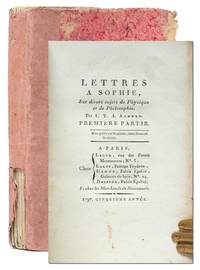
1797ref. 7223Paris: Leger 1797. First edition. Octavo. xxvi 2 96 2 pp. Part one only - the planned part two was never published. Publisher's pink pastepaper wrappers with pink paper spine. Binding somewhat loose. Edges untrimmed. Very clean and fresh throughout. A Very Good copy of a rare work on physics for women unrecorded in OCLC. This guide to physics and philosophy for women is one of the many works on women's education written during the Revolutionary period in France when a stronger interest in women's education began to arise. The letters cover topics including optics velocity and magnetism. Leger unknown books
1834ref. 88467Boston: Carter Hendee and Co 1834-37. First Edition. Five octavo volumes. Uniform plum cloth; printed paper spine labels; 317;275;291;184;262pp. Bindings spine-sunned and slightly worn; volume for 1833 more so with some external damp rippling not affecting text and a small gouge at front joint. Internally very fresh with most pages unopened. Good and sound. The 3rd through 7th volumes of the Institute's proceedings each including transcriptions of lectures on public education by such writers as Joseph Story A.A. Gould C.T. Jackson Beriah Green Warren Burton Walter Channing William A. Alcott Samuel Howe and others. The Institute was founded in 1830 and was a direct progenitor of the National Education Association. Though the vast majority of the Institute's members were from New England it was the first meaningful interstate body of public school instructors and administrators and set standards for public education into the first decades of the 20th century when it was subsumed by the NEA; writing in 1847 the Institute's President Horace Mann wrote: "The Institute may justly be considered as the source of all the improvements in education which have since 1830 been made in New England and other Northern States and its influence is slowly diffusing itself through the uncongenial regions of the South." The lectures are a particular point of interest in this series as they cover a wide variety of topics of interest to historians of education ranging from "The Importance of a Knowledge of the Principles of Physiology to Parents and Teachers" Edward Reynolds 1833 to "The Comparative Merits of Private and Public Schools" Theodore Edson 1837. A key source for early pedagogical theory in America rarely seen in commerce. Carter, Hendee, and Co unknown books
1933ref. 87307New York: For Affiliated Schools for Workers Later the American Labor Education Service ALES 1933. First Edition. 28cm. Staple bound white paper stock titled to first leaf. 32pp typewritten rectos only mimeo'd. Some toning to the edges of the front cover some light chipping and creasing to the spine edge of the title leaf "1933" added in ink to the upper front corner of the title sheet strong and solid; internally clean and fresh. A very good copy of an object clearly not intended to last. The first significant progress report issued by the ASW/ALES under the helm of dauntless and energetic educator Eleanor Gwinnell Coit whose name appears at the end of the document and who was appointed to the project in 1929 when it was in its infancy and continued steering the ALES through various advances in workforce education until its disbanding in 1962. Coit's advocacy for worker's education continued unflaggingly until her death in 1976. The primary objective of the ALES was to provide straightforward access to education for the working class access to advocacy and representation for those denied significant autonomy and to advance their rights and safeguards often through support of union initiatives and programs. An interesting takeaway from the report is how many of the "summer" education projects took place on spaces provided by historically women's colleges and higher education institutions like Bryn Mawr Coit herself had followed the then unusual route of higher education earning her degree from Smith before continuing and achieving her Master's from Columbia. A significant amount of the administrational and organizational labor of the early stages of the ALES was performed by women volunteers in higher educational institutions. The ALES under Coit also introduced a number of initiatives devoted to the publication of educational books for workers the majority of which were written by women who in the early 1930's would have found it very difficult to gain traction and recognition in the field of educational and social reform page 11 of this document lists a number of early publications and speaks of the creation of a required reading list for students comprising fiction poetry plays and biographies dealing with the social and economic problems faced by the laboring population and their families: "The Educational Secretary is the Chairman of a committee of Local #189 American Federation of Teachers under the auspices of which has been prepared an ANNOTATED LIST OF MATERIAL FOR WORKERS' CLASSES and a SUGGESTED READING LIST." Footnote #1 at the base of p.8. Necessarily scarce and ephemeral with only a single institutional holding of this title. For Affiliated Schools for Workers [Later the American Labor Education Service (ALES)] unknown books
1819ref. 1262421819. London: Dean and Munday 1819. 12mo 35 pp. Original printed wrappers. Covers and folding color frontispiece both detached frontispiece with large chip from top left corner some offsetting but generally clean. § A rare children's puzzle book; no copies on OCLC. The publisher's catalogue on lower wrapper lists "Puzzle-all's entertaining Riddle Book" which was published the previous year and is recorded on OCLC in just a single copy at the British Library. Dean and Munday was headed by two sisters Mary Ann and Anna Maria who were born into the Bailey dynasty of publisher's. Their mother Susanna Bailey printed under her own imprint after the death of her husband and after her death in 1810 willed the company solely to her two daughters. "For whatever reason Susan left her sons only a pittance. In her will 'The whole of my business and.everything thereunto belonging' was left to her daughters. By that time both girls had married apprentices from their parent's shop Mr. Thomas Dean Sr. and Mr. William Munday. Nevertheless Susan's will stipulated adamantly that the business was 'for their own sole use and benefit absolutely not to be subject of control of any present or future husband.my two daughters will share equally any profits arising from the printing business.for their own solo use and benefit absolutely independent of any present or future husbands.' Indeed records show that the company Dean & Munday had both sisters Mary Ann Dean and Anna Maria Munday listed as its principals between 1812 and 1840. Perhaps it was because of all the babies the sisters bore or the customs of the early nineteenth century that regardless of Mother Susan's attempts to ensure the female succession of the business it would become identified primarily with the husbands." From Dean & Son Publishers - A Short History: As published by vintagepopupbooks.com in the May 2013 edition of the Movable Book Society Newsletter "Movable Stationary". unknown books
1966ref. 82726Pennington NJ: Educational Consultants Collaborative 1966. First Edition. Slim octavo 21.5cm; original photo-illustrated card wrappers stapled; iv262pp. Gentle sunning and light wear along the spine-fold; contents fresh; Near Fine. An essay and a report discussing the legal and moral responsibility schools face in "preparing individuals for full citizenship" zeroing in on the increasing rise in unskilled and uneducated students from the slums and backwoods and discussing "how a painting studio workshop as a formal part of the school curriculum can help resolve conflict and consolidate cultures" from the introductory matter. Front cover reproduces a photograph by Sol Libsohn 1914-2001 a documentary photographer and co-founder of the New York Workers Film and Photo League. Uncommon in commerce with OCLC showing just 4 holdings Columbia UC Davis Rutgers RISD. 82726. Educational Consultants Collaborative unknown books
ref. 62320San Francisco: 1930. Broadside 42cm x 23cm. Printed in black on newsprint; text in 32 lines surrounding a central graphic depicting "Politics" in the person of a spoiled child begging to be given the school system to destroy after having broken all his other 'toys' - the State House the trolley and road systems etc. Faint old folds; mild toning to paperstock; still complete and Very Good or better. Broadside issued without imprint or attribution relating to the ongoing debate over control of public schools in San Francisco - a debate that played out more broadly in most American urban school systems through much of the Twentieth Century. The issue at stake here is a proposal Amendment 27 to the San Francisco City Charter to replace appointed School Board representatives with a new Board directly elected by city residents. Objections raised to the amendment by the anonymous authors include assertions that the new system will favor only well-heeled candidates who can afford the cost of campaigning; that the Board will be opened to political manipulation at the expense of teachers and students; and that the work of the Parent-Teacher Association and allied advocacy groups will be marginalized. The so-called "centralization movement" in American education reform began in earnest during the Progressive Era influenced by the growth of corporate consolidation bureaucratization and the "efficiency movement" in other contemporary spheres of public and private administration. Nominally "progressive" in origin centralization sought to remove schools from the political sphere and to place decision-making in the hands of appointed experts. This closed and hierarchical system prevailed in many large urban school districts for most of the 20th century despite frequent attempts such as this one in San Francisco in 1930 to democratize the process. Despite more or less quadrennial attempts to undo the appointed board system San Francisco's school board remained centralized through the 1960s. At least one scholar has noted that in San Francisco at least the debate over centralization had distinct racial undertones; supporters of the appointed Board were deliberately attempting to protect the schools from the influence of majority-Catholic wards. Writing in the context of a similar 1920 San Francisco vote Victor L. Schrader notes that the Protestant working class played a key role in swinging the vote towards centralization: "The Protestant working class acted as a swing vote which was both necessary and aided the vote of the middle and upper classes to bring about a victory for Amendment 37 the 1920 ballot measure.The Protestant working class acted as a deciding block without whose support the centralization measure probably would not have passed" see Victor L. Schrader. "Ethnicity Religion and Class: Progressive School Reform in San Francisco in History of Education Quarterly Vol. 20 no. 4 Winter 1980. Such background would suggest that the current broadside pandering to working class distrust of political figures especially strong in the first years of the Depression to support what was an essentially undemocratic process was more than a little bit cynical. This perhaps explains the absence of any imprint or attribution. Rare and local; no copies separately catalogued in OCLC no others traced in commerce. REF: Snauwaert Dale. "Administration Reform in the Progressive Era: The Chicago Debate" in Democracy Education and Governance: a Developmental Conception. Albany: SUNY Press 1993. Victor L. Schrader. "Ethnicity Religion and Class: Progressive School Reform in San Francisco in History of Education Quarterly Vol. 20 no. 4 Winter 1980. unknown books
1900ref. 5954Fulton Pittsburgh 1900. Faux cloth over marbled boards with ownership label to upper left corner with school district and compiler information. Measuring 9 x 11.5 inches and comprised of 22 pages of sketches herbal specimens and sample essays all recto. Firmly bound and with some dampstaining to the lower gutter not affecting text. Representing a range of exercises completed by state normal school student Flora Yagle the book presents researchers with a range of study opportunities including turn of the century pedagogical practice and curricula as well as genealogical and social history work regarding the family structure work and education of first-generation immigrants living on the East Coast. One of seven children born to German immigrants Flora Yagle b. 1886-7 clearly grew up in a family that emphasized education and upward mobility. The paper label identifies Yagle as an eighth-year student indicating that she was probably in her early teens when she completed these lessons. Census documents from around the time of her birth and childhood list her father as a foundry worker; and into her adulthood they shift to record him as the general manager of the foundry. Similar ambition was instilled in his children who are documented in census information as students or unemployed during their childhoods with work only appearing in their adulthoods. During Flora's youth she had brothers working as clerks and bookkeepers. By the time of her adulthood she has become a school clerk while her sister has obtained a position as a librarian. Part of Flora's training would have been conducted at the Fulton Elementary School located in Pittsburgh's Highland Park. A neighborhood for the rising middle class Highland Park and its schools were still in their infancy while Flora was in hers; while the residential district had been opened in 1879 the school was founded in 1894 and both intended to provide fresh air open spaces and pleasant living to skilled workers and their families who were flocking to Pittsburgh for its work opportunities. Historically Pennsylvania had been a vanguard for public and progressive education. "In his 1830 address to the state legislature Governor George Wold championed the cause of universal public education" as a scaffold for "the security and stability of the individual privileges we have inherited from our ancestors" Explore History. Before the decade was over "more than 1000 local school districts under a single statewide system of instruction" had been founded working to regularize "educational standards curriculum and instructional credentials" in tandem with the 1857 Normal School Act which founded "a network of ten state academies to prepare public school teachers" Explore History. Flora's generation was a beneficiary of these policies. Her notebook shows a range of work with creativity and visual arts central to her learning. In addition to pressed floral specimens likely from the school grounds or her home garden her book also contains a visual and textual representation of the spectrum of colors in a rainbow; illustrated lotus blossoms with a short essay on the botanical facts and cultural uses of the flower in Egypt; black and white sketches focused on perspective and shading; geometrical figures designed to be cut out and folded but here present; and figure drawings of children in Victorian clothing much like she and her classmates would wear. US Census 1890 1900 1910 1920. unknown books
1890ref. 5955Kutztown PA 1890. Quarter roan over marbled boards measuring 8 x 6.25 inches and comprised of 73 pages of manuscript text including a mixture of notes passed between friends on the verso of the final leaf and on the rear pastedown. Spine largely perished with boards and textblock held together by cords. Several leaves neatly excised towards rear. Containing notes from Fannie Hottenstein's courses in teacher training the present volumes offer researchers a range of study topics including the history of pedagogy and women's increasingly visible place in American education; the book also is a valuable resource for examining how educated young women were thinking through their own lives and roles -- as individuals and as a generation. Trained in one of the most educationally progressive states at the time Fannie Hottenstein was one of a generation of women who could more widely dream about and pursue more independent lives than their matriarchs. Historically Pennsylvania had been a vanguard for public and progressive education. "In his 1830 address to the state legislature Governor George Wold championed the cause of universal public education" as a scaffold for "the security and stability of the individual privileges we have inherited from our ancestors" Explore History. Before the decade was over "more than 1000 local school districts under a single statewide system of instruction" had been founded working to regularize "educational standards curriculum and instructional credentials" in tandem with the 1857 Normal School Act which founded "a network of ten state academies to prepare public school teachers" Explore History. Fannie attended one of these preparing for a career in education that would give her a new level of social and economic independence. Much of Fannie's notebook reflects the kind of rigorous work required to teach middle and high school students. Contents include for example three pages of facts on basic Botany; fifteen pages on the practice of Logic in writing and debate including an extensive section on presenting proper Opposition accompanied by text book page numbers; and five pages on pedagogical methods for helping students develop curiosity and drive it forward into productive study. There are additional fairly staid essay samples on topics such as Influence and Gentleness. Yet it is in the thirteen page essay We Girls that sparks of Fannie's individuality ambition and independence show. In it she reveals how much contact she has had with the period's literature on women's rights and suffrage; she shows her familiarity with anti-feminist arguments in opposition to women like her; and she powerfully expresses her hopes not only for her generation but the ones that follow. Fannie opens: "It is a recognized fact that the degree of civilization of every nation is marked by the social position of woman. Indeed one of the most prominent features of the progress of civilization is her gradual elevation in society and the clear perception and recognition of her rights. In the earlier ages of the world when the sphere of her influence was bounded by the narrow prejudices of the opposite sex her happiness as well as her mental improvement and social rank depended more on what was done for her at the hands of men than on what she could do for herself. All this is changed now." Fannie praises the hard-won changes women accomplished in accessing education and job training; and she touts how many opportunities are available for women to dream about and pursue. This does not mean she's unaware of the challenges that continue -- particularly from men. "We have to contend with the prejudice sometimes entertained against us that our highest destiny in life is to be a pretty piece of furniture in a handsome parlor. Men who entertain this notion we girls must always urge to get their furniture somewhere else." To those who accuse women of being too emotional and insufficiently intellectual she also has a response. "Our aim must be to develop and perfect our entire nature mental social and moral" she argues. Only by embracing both thinking and feeling as strengths can any individual -- man or women she contends -- succeed. Women are in a unique position to embrace both. A truly rich document which also includes brief notes among Fannie and her friends about their flirtations and recent purchases of accessories at the end gives insight into the development of a young woman who would go on to live what she preached. According to the US Census of 1900 Fannie remained single and lived in a boarding house working as an office stenographer. unknown books
1971ref. 80643New York: Delacorte Press 1971. First Edition. First Printing. Octavo. 21.5cm. Publisher's black cloth titled and decorated in red and purple gilt. Dustjacket. 184pp. Very light wear to the cloth predominantly shallow bumping to the spine ends a bright clean copy in a dustjacket that has seen some use with creasing and small closed tears to the upper edge of the front panel chipping to the spine ends and some light soiling to the white rear panel. There's tape residue from some unnecessary reinforcement attempts but it is essentially a very good copy with some shelfwear. A groundbreaking work at the time of publication and an exapnsion of the authors' earlier theories on teaching as a radical mechanism for change rather than a reinforcement and continuation of the status quo. Delacorte Press unknown books
1867ref. 62239London: George Routledge & Sons 1867. First Edition. First printing. Octavo 19cm. Blue cloth stamped in gilt and blind; noncontinuous pagination; black and white in-text illustrations throughout. Rubbed but bright and straight one central gathering pulled complete around Very Good. Question-and-answer guide for children about household items food animals birds and plants. 62239. George Routledge & Sons unknown books
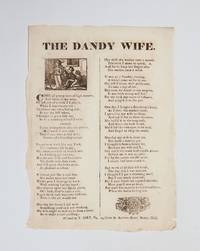
1828ref. 5421London: T. Birt 1828. First edition. Single sheet measuring 250 x 185mm and printed in two columns to recto. Some edgewear to margins not affecting text; a bit of foxing and toning largely confined to margins. A scarce and delicate survivor OCLC documents only one example at the National Library of Scotland. The present is the only example on the market. The Dandy Wife is narrated by a man who aimed "to choose me out a loving wife" at the age of twenty-one but whose experience becomes a warning to "all young men of high renown": "If you want a tidy wife Beware of a boarding school." What unfolds is a satire of how the marriage economy is affected when women have access to knowledge -- intellectual and physical -- and how by meeting a man's superficial expectations a woman can fulfill her own more pressing needs. Thinking that a boarding school girl will have the innocence submissiveness and domestic skill he desires the narrator selects a wife from among their ranks. Thinking only of what he can obtain from such a bargain he is unprepared for what an educated woman brings into his house. The Dandy Wife he describes understands the commodity value of her own beauty and material adornment and that these are her key means for acquiring wealth of her own. "She takes one-half of what I earn In drinking gin and tea; Besides such frills and furbelows My Dandy Wife does wear.Her sleeves upon her dandy gown Oh! Lack they're such a size You'd think they were two balloons that in the air would rise." Aside from staying on par with fashion trends her clothing assists her in avoiding domestic tasks she abhors. She refuses to do laundry more than monthly and through ridiculous cooking failures she rapidly establishes that the kitchen is not a showcase for her skillset. Accustomed to a life of learning she is not trained to conduct domestic business. By the ballad's end it becomes clear that the Dandy Wife was savvier in managing a marriage than her husband was. For not only does her superior intellect help her carve out a more satisfying role but she also has physical knowledge that predates him: "The day that I was married I thought I'd got a charming maid But I was much deceived.For scarce five months we'd married been When she had a darling son. T. Birt unknown books
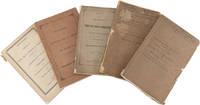
1844ref. 56150Boston 1844-45. 1. MANN Horace Seventh Annual Report of the Board of Education; Together with the Seventh Annual Report of the Secretary of the Board. Boston: Dutton and Wentworth 1844. First edition. Octavo 25cm. Original brown paper wrappers with printed title on front untrimmed; 1991pp. Inscribed "J. F. Bumstead Esq. / with best regards from / Horace Mann" on front wrapper. With a few contemporary pencil annotations. A fresh copy edges gently rubbed one or two small stains to wraps: Very Good or better. This copy presented by Mann to J. F. Bumstead-plausibly Josiah Freeman Bumstead 1797-1868 who authored primary school primers readers and spellers published by Ticknor and other Boston firms in the 1840s. 2. MANN Horace. The Common School Journal vol. VI no. 5; March 1 1844. Containing the "Seventh Annual Report of the Secretary of the Board of Education to the Board of Education." PRESENTATION COPY FROM SAMUEL MAY TO ADIN BALLOU. Octavo 26cm. Original paper wrappers printed on front; 64-200pp. Inscribed to "Rev. Adin Ballou / with the best regards of / Sam J. May - / Let all that have eyes read / or all that have ears hear this / admirable document -" With one or two minor marginal pencil marks. Ex libris and discard stamp of Swarthmore College to final leaf. Textblock sound though rubbed but front cover detached rear cover lacking; some staining to outer leaves minor foxing: Good. Presentation copy from Samuel Joseph May 1797-1871 to Adin Ballou 1803-1890 founder of the Hopedale Community. May was one of Mann's allies in establishing the Massachusetts state school system and both he and Ballou were members of the New England Non-Resistance Society a peace organization founded by William Lloyd Garrison. 3. Association of Masters of the Boston Public Schools. Remarks on the Seventh Annual Report of the Hon. Horace Mann Secretary of the Massachusetts Board of Education. Boston: Charles C. Little and James Brown 1844. Octavo 23cm. In original brown paper wrappers printed in black on front; 144pp. Inscribed "B. A. Gould" to front upper cover--possibly pioneering Boston astronomer Benjamin Apthorp Gould 1824-1896. With occasional marginal pencil marks. A fresh copy with one or two tiny chips to spine: Very Good or better. 4. MANN Horace. Reply to the "Remarks" of Thirty-One Boston Schoolmasters on the Seventh Annual Report of the Secretary of the Massachusetts Board of Education. Boston: Wm B. Fowle and Nahum Capen 1844. Octavo 23cm. In original dark beige paper wrappers printed in black on front; 176pp. A sound copy with losses at head and tail of spine joints partly split but holding internally clean: Very Good. 5. ASSOCIATION OF THE MASTERS OF THE BOSTON PUBLIC SCHOOLS. Barnum Field; Wm A. Shepard; S. S. Greene; Joseph Hale. Rejoinder to the "Reply" of the Hon. Horace Mann Secretary of the Massachusetts Board of Education to the "Remarks" of the Association of Boston Masters Upon His Seventh Annual Report. Boston: Charles C. Little and James Brown 1845. First edition. Octavo 22cm. Original beige wrappers printed in black on front; 55 1 56 40 64pp. Inscribed "The Misses Adams / 1 May 1922" on verso of title page. A sound fresh copy with split at front upper joint chip at tail minor dirt to wraps but internally clean: Very Good. Five pamphlets on Horace Mann's 1844 annual report to the Board of Education including two presentation copies of different editions of the report itself and three responses. Mann had toured Europe with his new wife Mary Peabody and friend Samuel Gridley Howe and studied schools in eight countries with special interest in the Prussian school system. His 1844 annual report comparing American and European school systems was received with great offense by Boston schoolteachers. "A group of thirty-one schoolmasters. . . published a sharply worded critique of his seventh Annual Report" targeting "Mann's recommendations for teacher training as well as his opposition to corporal punishment." However this group "soon faced Mann's wrath in the form of written rejoinders" and were ultimately vanquished when "Mann's allies were elected to the Boston School Committee." Despite the controversy Mann's efforts to "merge the best that he found in European educational systems with the principles of the growing American common school movement" saw remarkable success. Under his direction the Board of Education spent over $2 million on improved school buildings increased teacher salaries by over 50% opened fifty new high schools commissioned uniform school textbooks from Boston publishers and alotted time for student exercise-shaping the public school system as we know it ANB. All the titles in this collection are uncommon in the book trade. unknown books
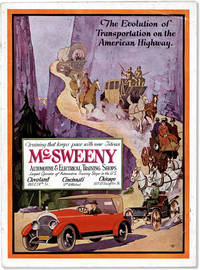
ref. 60350Cleveland: McSweeny Automotive & Electrical Training Shops 1925. Quarto. Color pictorial wrappers; 64pp; illus. Mild external wear; contents complete fresh and unmarked - a solidly Very Good copy. Elaborate and well-illustrated prospectus for the McSweeny Automotive Training Shops a chain of private training schools for would-be auto mechanics that operated at least through the early 1930s. In addition to detailed course descriptions the brochure emphasizes the growing need for mechanics due to the explosive growth of the automobile industry in the Twenties; promises that "Mac's Shop-Plan Makes the Big Pay Man." Not recorded in OCLC nor is any other publication by this company. unknown books