Livre Rare Book

3 920 résultats
1835réf. 16427Paris, Crapelet, 1835 ; grand in-8 ; demi-chagrin à coins bleu-roi, dos à nerfs, titre doré, tête dorée (reliure ancienne) ; (4), VIII, 110, (2) pp., frontispice lithographié par Thierry Frères, d'après V. Adam, représentant le Monument de la Bataille des Trente élevé dans la Lande de Mi-voie, 6 planches de blasons reproduisant les blasons des 30 chevaliers bretons qui combattaient. Ce volume contient aussi le fac-similé de 2 pages du manuscrit original.
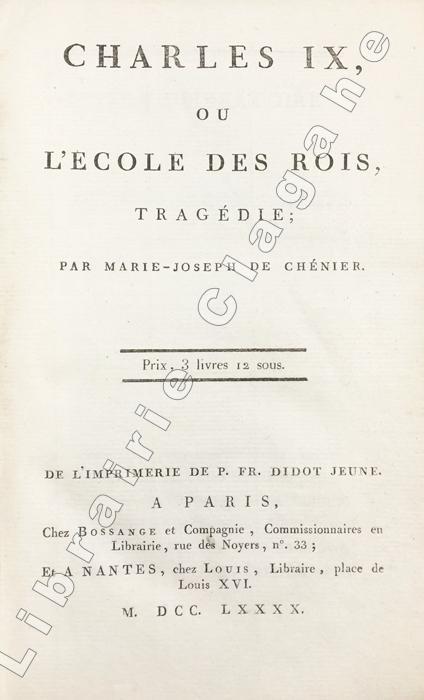
1790réf. 6385Paris, Bossange (Imprimerie de P. Fr. Didot Jeune) et Nantes, Louis, 1790 ; (2) ff., 262 pp., (1) p.La pièce Charles IX est suivie de : Discours prononcés devant M.M. les Représentants de la Commune, le vingt-trois aoust 1789 ; De la liberté du théâtre en France ; de huit lettres ; Épître aux manes de Voltaire.Suivi de : [Dulaure, Jacques-Antoine] Crimes et forfaits de la Noblesse et du Clergé, depuis le commencement de la Monarchie jusqu'à nos jours. Paris, sans nom, sans date (1793) ; VI, 164 pp. et frontispice satirique gravé. Deux volumes reliés en un tome in-8 ; plein veau marbré, dos lisse orné et doré, pièce de titre en maroquin vert, tranches jaspées (reliure de l'époque).
1723réf. 818681723 Brusselle, Françoi Foppens, 1723, 5 volumes petit in 8° reliés plein veau de l'apoque, dos à nerfs ornés, tranches rouges ; des rousseurs ; reliures habilement restaurées aux coins et coiffes;
réf. 159999Clermont-Ferrand, F. Thibaud, Paris, Ch. Dumoulin, 1867 in-4, [6]-CCV-606 pp., 6 pl. dépl., toile verte, couv. cons. (reliure postérieure).
réf. Bloomsbury-9780567685513T&T Clark. Hardback. New. 328 pages T&T Clark hardcover
réf. Bloomsbury-9780567685513T&T Clark. Hardback. New. 328 pages T&T Clark hardcover
réf. Bloomsbury-9780567685544T&T Clark. Hardback. New. 360 pages T&T Clark hardcover
réf. Bloomsbury-9780567685544T&T Clark. Hardback. New. 360 pages T&T Clark hardcover
18741 vol. in-4 reliure demi-chagrin maroquiné rouge, dos à 5 nerfs dorés, couvertures conservées, Imprimerie Gounouilhou, Bordeaux, 1874, 624 pp. frontispice (eau-forte par Léo Drouyn), avec grande carte dépliante et nomb. illustrations dans le texte Bon état pour ce rare ouvrage aux marges immenses, imprimé sur beau papier vergé (dos un peu frotté, carte dépliante détachée avec petite restauration au verso, rares rouss.). Chargé par la Municipalité de Bordeaux d'établir un plan de Bordeaux vers la fin du Moyen-Age ainsi qu'une nomenclature topographique, le grand érudit et artiste Léo Drouyn (1816-1896) avait tout d'abord espéré des "Recherches et Mémoires" de l'abbé Baurein. Mais l'excellent auteur se taisant sur des points essentiels, Léo Drouyn décida de se plonger dans les Archives tant publiques que privées permettant de renseigner les points obscurs et de rédiger cet impressionnant ouvrage, qui demeure une somme incontournable pour la connaissance du Bordeaux médiéval. Français
1877réf. 12482Tours 1877 1 Texte critique accompagné d'une traduction nouvelle et précédé d'une introduction historique par Léon Gautier, professeur à l'Ecole des Chartres, avec eaux-fortes par CHIFFLART et V. FOULQUIER, et un fac-similé. Tours, Alfred Mame et Fils éditeurs, M DCCC LXXII, demi-maroquin bleu à coins, dos à 5 nerfs, entrenerfs ornés dorés, 507 pp., errata, table, (David relieur).
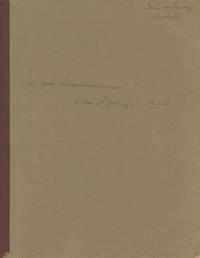
1926réf. List3141Quincy Massachusetts: unpublished 1926. 201 pp cardstock wraps. Normal wear to wraps; overall Near Fine. Alice Brackett White Coolidge 1864–1927 was a Boston socialite of the prominent Richardson family; her grandfather was merchant and Massachusetts State Legislator Jeffrey Richardson. Coolidge was also the author of three children’s books: The Bunnies of Evergreen Village 1917 The Refugees in Evergreen Village 1918 and Evergreen Village to the Rescue 1922. Offered here is Coolidge’s unpublished memoir of her early life written in 1926 titled My Early Reminiscences. The memoir recalls Coolidge’s childhood and teen years spent mainly in Massachusetts New Hampshire and Maine. Her recollections typically involve extensive descriptions of the houses at which her family stayed the scenery around them and the various families they met and visited with. Given her position in society her acquaintances are sometimes quite influential people: Princeton president John Grier Hibben enjoys Coolidge’s fishcakes; Trinity Church rector Phillips Brooks gives her grandfather an “excellent pew” in the newly-finished church; pioneering doctor Alfred Worcester mistakes red pepper for mercury in a scientific demonstration at her school; and she recalls brief correspondences with John Greenleaf Whittier and William James. Coolidge also took dance lessons from Augustus Papanti whom she describes as “one of the thinnest men I ever saw” who was “very melancholy. I hardly remember his ever smiling”; and remembers Judge Charles Devens for “his great stature his charming face his courtliness of manner and his really boyish simplicity in entering into our evening games” including a game of “mind reading” which Devens played “with zest.” One of her longtime friends was Rear Admiral John E. Pillsbury. She recalls: “Mr. Pillsbury as a young naval man a brother-in-law of my uncle Dr. Richardson used to take me out in the swan-boats on the Public Garden Pond. Later he went through all the ranks up to being retired as a Rear Admiral but time and circumstances never changed him. We always met at Thanksgiving and Christmas dinners and always talked at great length. . He was a wonderfully interesting lovable man and very modest and unassuming and shy. I always considered him one of my best friends though older by many years than I.” Another interesting New England figure Coolidge encountered was Joseph Lee. She describes Lee’s hotel in Newton: “The house where we stayed was kept by a remarkable man named Joseph Lee. He was a mulatto much above many of his kind and his wife was a handsome woman partly Indian. They did the cooking and he waited on table with a colored maid to help him. In fact there were no white women in the house. The cooking was delicious.” Lee was born enslaved in South Carolina freed in 1865 and went on to invent the automatic bread kneading and bread crumbing machines. Though nearly all of her childhood was spent in New England she also remembers being invited to visit Charles Joseph Bonaparte in Baltimore: “We had never been so far south except to Washington and I felt a curious feeling of being in a different atmosphere from any I had known. . We were met at the station by Mrs. Bonaparte in a large roomy covered vehicle with two horses. The coachman and footman were in the Bonaparte colors -- a deep wine color. The footman I well remember. He was a light-colored young negro very handsome and smiling and excited over having young ladies from the North. . All the servants were colored and lived in cabins near the house. . I never knew Mr. Bonaparte in public life so my memories of him are quite intimate and I fancy I saw much of his real self. . His mind was very active. He used to talk or listen as he walked and he moved his head in a curious way from one side to the other with a slightly rolling motion which was distinctly individual. . I never saw him irritated or excited and he was always very simple. In the group picture we had taken at the Maplewood he sat down cross-legged on the piazza floor like a boy. That was in about 1887. I suppose in public life or in law he was different but he was very equable and charming as we met him in his home and at the mountains. Most of all I admired his sweet tender ways with his flower-like wife.” This was not too long after the end of Reconstruction and Coolidge remarks on the tense atmosphere: “Mrs. Bonaparte had warned me to be careful about questions regarding the North and South as the ‘feeling’ had not yet died away. I was so glad she had warned me. A gentleman slipped in and sat down beside me to watch a parade and whispered in my ear as the bands had been playing ‘Dixie’ how glad he was to meet a Northerner. I was glad to meet him too although I remember neither his name nor face but I felt I breathed freer in his sympathetic locality. . I had no idea that this feeling still remained as far North as Baltimore and of course I remembered how our Massachusetts troops had been fired upon in Baltimore at the outset of the war but I was admonished and very wise and only returned my unremembered neighbor’s greeting with a sympathetic word and look.” Besides individuals Coolidge does cover a few historical events including the Great Boston Fire of 1872: “Oh! a horrible sight met our eyes. Back of the opposite houses in Park Square was a background of sheets of red flames and heavy black smoke rising high into the air. . On the Parade Ground all was in confusion and the sight was very sad and never-to-be-forgotten. It was literally covered with boxes and bales of furniture and sad forlorn desperate looking people crouching or sitting or standing amidst what they had saved from their homes . At night . the whole city was in darkness as there was no gas.” The family also frequently stayed at hotels in the White Mountains of New Hampshire and Coolidge recalls the “overwhelmingly tragic” effects of the 1867 sale of this land to logging companies; she writes that looking out from the Flume House in Franconia “all about were brown scarred places marking the woodchoppers’ work which was cutting away our beautiful trees for lumber”. In this memoir Coolidge supplies detailed remembrances of the private personalities of influential figures of Gilded Age New England. We find two copies of My Early Reminiscences on OCLC. Of interest to historians of the era especially as told through the perspective of a young woman. unpublished unknown
1926réf. List3141Quincy Massachusetts: unpublished 1926. 201 pp cardstock wraps. Normal wear to wraps; overall Near Fine. Alice Brackett White Coolidge 1864–1927 was a Boston socialite of the prominent Richardson family; her grandfather was merchant and Massachusetts State Legislator Jeffrey Richardson. Coolidge was also the author of three children’s books: The Bunnies of Evergreen Village 1917 The Refugees in Evergreen Village 1918 and Evergreen Village to the Rescue 1922. Offered here is Coolidge’s unpublished memoir of her early life written in 1926 titled My Early Reminiscences. The memoir recalls Coolidge’s childhood and teen years spent mainly in Massachusetts New Hampshire and Maine. Her recollections typically involve extensive descriptions of the houses at which her family stayed the scenery around them and the various families they met and visited with. Given her position in society her acquaintances are sometimes quite influential people: Princeton president John Grier Hibben enjoys Coolidge’s fishcakes; Trinity Church rector Phillips Brooks gives her grandfather an “excellent pew” in the newly-finished church; pioneering doctor Alfred Worcester mistakes red pepper for mercury in a scientific demonstration at her school; and she recalls brief correspondences with John Greenleaf Whittier and William James. Coolidge also took dance lessons from Augustus Papanti whom she describes as “one of the thinnest men I ever saw” who was “very melancholy. I hardly remember his ever smiling”; and remembers Judge Charles Devens for “his great stature his charming face his courtliness of manner and his really boyish simplicity in entering into our evening games” including a game of “mind reading” which Devens played “with zest.” One of her longtime friends was Rear Admiral John E. Pillsbury. She recalls: “Mr. Pillsbury as a young naval man a brother-in-law of my uncle Dr. Richardson used to take me out in the swan-boats on the Public Garden Pond. Later he went through all the ranks up to being retired as a Rear Admiral but time and circumstances never changed him. We always met at Thanksgiving and Christmas dinners and always talked at great length. . He was a wonderfully interesting lovable man and very modest and unassuming and shy. I always considered him one of my best friends though older by many years than I.” Another interesting New England figure Coolidge encountered was Joseph Lee. She describes Lee’s hotel in Newton: “The house where we stayed was kept by a remarkable man named Joseph Lee. He was a mulatto much above many of his kind and his wife was a handsome woman partly Indian. They did the cooking and he waited on table with a colored maid to help him. In fact there were no white women in the house. The cooking was delicious.” Lee was born enslaved in South Carolina freed in 1865 and went on to invent the automatic bread kneading and bread crumbing machines. Though nearly all of her childhood was spent in New England she also remembers being invited to visit Charles Joseph Bonaparte in Baltimore: “We had never been so far south except to Washington and I felt a curious feeling of being in a different atmosphere from any I had known. . We were met at the station by Mrs. Bonaparte in a large roomy covered vehicle with two horses. The coachman and footman were in the Bonaparte colors -- a deep wine color. The footman I well remember. He was a light-colored young negro very handsome and smiling and excited over having young ladies from the North. . All the servants were colored and lived in cabins near the house. . I never knew Mr. Bonaparte in public life so my memories of him are quite intimate and I fancy I saw much of his real self. . His mind was very active. He used to talk or listen as he walked and he moved his head in a curious way from one side to the other with a slightly rolling motion which was distinctly individual. . I never saw him irritated or excited and he was always very simple. In the group picture we had taken at the Maplewood he sat down cross-legged on the piazza floor like a boy. That was in about 1887. I suppose in public life or in law he was different but he was very equable and charming as we met him in his home and at the mountains. Most of all I admired his sweet tender ways with his flower-like wife.” This was not too long after the end of Reconstruction and Coolidge remarks on the tense atmosphere: “Mrs. Bonaparte had warned me to be careful about questions regarding the North and South as the ‘feeling’ had not yet died away. I was so glad she had warned me. A gentleman slipped in and sat down beside me to watch a parade and whispered in my ear as the bands had been playing ‘Dixie’ how glad he was to meet a Northerner. I was glad to meet him too although I remember neither his name nor face but I felt I breathed freer in his sympathetic locality. . I had no idea that this feeling still remained as far North as Baltimore and of course I remembered how our Massachusetts troops had been fired upon in Baltimore at the outset of the war but I was admonished and very wise and only returned my unremembered neighbor’s greeting with a sympathetic word and look.” Besides individuals Coolidge does cover a few historical events including the Great Boston Fire of 1872: “Oh! a horrible sight met our eyes. Back of the opposite houses in Park Square was a background of sheets of red flames and heavy black smoke rising high into the air. . On the Parade Ground all was in confusion and the sight was very sad and never-to-be-forgotten. It was literally covered with boxes and bales of furniture and sad forlorn desperate looking people crouching or sitting or standing amidst what they had saved from their homes . At night . the whole city was in darkness as there was no gas.” The family also frequently stayed at hotels in the White Mountains of New Hampshire and Coolidge recalls the “overwhelmingly tragic” effects of the 1867 sale of this land to logging companies; she writes that looking out from the Flume House in Franconia “all about were brown scarred places marking the woodchoppers’ work which was cutting away our beautiful trees for lumber”. In this memoir Coolidge supplies detailed remembrances of the private personalities of influential figures of Gilded Age New England. We find two copies of My Early Reminiscences on OCLC. Of interest to historians of the era especially as told through the perspective of a young woman. unpublished unknown books
1866réf. 69620Texte restitué par M. l'Abbé Delaunay, Curé de St Etienne du Mont, Honoré du Suffrage de N.S. Père le Pape Pie IX, 2 vol. in-4 reliure postérieure demi-chagrin à coins rouge, dos à 5 nerfs dorés orné, mors dorés et estampés à froid, L. Curmer, 1866 - 1867, Tome I : 12 ff., 214 pp. et 4 ff. n. ch. avec portrait du Pape Pie IX et 53 chromolithographies hors texte ; Tome II : Liste des souscripteurs, la préface, la biographie de Jehan Foucquet, description de ses oeuvres, celle des miniatures reproduites dans le premier tome, une notice sur ses oeuvres présumées, l'opinion de la presse sur l'ouvrage, une description des ornements accompagnant le texte et 4 tables, avec 1 figure dessiné par Fossey gravée par Colin tirée sur chine, 5 chromolithographies hors texte et 17 titre en chromo, portrait de femme par Pauquet sur Chine rapporté dans le texte à la fin de la préface
18911 vol. fort in-8 carré reliure demi-veau brun, dos à 5 nerfs richement orné, G. Gounouilhou, Bordeaux, Paris, 1891, X-457 pp. avec pl. dont une dépliantes et G. Gounouilhou, Bordeaux, J. Rouam, Paris, 1893, 231 pp. Très bel exemplaire réunissant les deux ouvrages consacrés par le professeur Emile Labroue au Périgord Blanc et à Bergerac. L'auteur précise dans la préface à cette seconde édition de "Bergerac sous les Anglais" : "Notre éditeur bordelais, M. G. Gounouilhou, qui ne néglige aucune occasion de mettre en lumière tout ce qui intéresse l'histoire de Bergerac, sa ville natale, a pensé qu'il convenait de présenter au public, sous un même format, nos deux études d'histoire provinciale, "Bergerac sous les Anglais" et "Le Livre de Vie", et de faire ainsi, en deux volumes in-4, comme une "Histoire de Bergerac au XIVe siècle". C'est avec plaisir que nous avons répondu à son invitation, et nous publions aujourd'hui une seconde édition de "Bergerac sous les Anglais". Français
1620Concinnata & Historica narratione (sed brevi) illustrata Opera ac Studio Ioannis Iacobi Luckii Argentoratensis, Cum gratia et privilegio Sacrae Caesareae Maiestatis, 1 vol. in-folio reliure de l'époque pleine basane marron, dos à 6 nerfs orné, Sumptibis Ipsi Authoris, Typis Reppianis, Argentinae [Strasbourg ], 1620, 4 ff., 383 pp. et 1 f. Plus qu'un superbe catalogue numismatique recueillant les pièces et médailles provenant de la collection de l'auteur, ce bel ouvrage richement illustré des portrait des grands personnages du temps évoque les faits et geste de chacun d'entre eux, de manière chronologique. Brunet évoque un "recueil devenu assez rare". Grand généalogiste et collectionneur, Johann Jacob Luck (1574-1635) finit sa carrière en tant que bailli du Staufenberg (Bade). Etat satisfaisant (manque important à un feuillet - le folio H - un manque en coiffe sup., qq. mouill. discrètes, coins frottés, bon état par ailleurs). Prix en l'état. (Brunet, III, 1217) Latin
1978Published in the late 1970s, this magnificently illustrated set brings to life the richness of our real Canadian past, in all its colour and vitality. "There are no fictional embellishments. Some of Canada's best authors have used sensitivity, imagination, and true literary skill to tell Canada's story as it really was. These are not academic textbooks, but a fascinating and accurate 'social history' that should appeal to everyone." - Professor J. Michael Bliss, University of Toronto. "Delivers a totally new and essential look at ourselves, with a broad down-to-realities approach." - Peter C. Newman. Includes the following volumes: The First Canadians, The Colonial Dream 1497-1760, Redcoats and Loyalists 1760-1815, Days of the Rebels 1815-1840, Pioneer Days 1840-1860, Dawn of the Nation 1860-1870, The Age of Innocence 1870-1880, Canada Moves Westward 1880-1890, The Naughty Nineties 1890-1900, Into the 20th Century 1900-1910, The Years of Agony 1910-1920, The Crazy Twenties 1920-1930, The Hungry Thirties 1930-1940, A Time of Heroes 1940-1950, The Booming Fifites 1950-1960, The Years of Progress 1960-1970. Moderate to average wear. Unmarked with the exception of the last volume which bears a few library markings. Binding of the 1930-1940 volume is taped at title page. Binding of the 1900-1910 volume is weak at title page. A quality copy of this magnificent set. Book
1854réf. 8696Paris Le Normant & Garnier 1854 12 volumes petit in-8 deVIII-420, 430, 418, 434, 432, 439, 415, 418, 448, 448, 446, 465 pp., demi chagrin vert, dos à nerfs ornés, rousseurs.
réf. 3410paris picard 1901-1906 - 6 volumes In8 demi chagrin noir dos à 5 nerfs 2 pièces de titre - 286/322/244/354/CLXXXVII-196/218 pages.
réf. 7727Paris, Lacroix, Verboeckhoven et Cie, 1870 - 1872 ; trois tomes in-8, brochés ; (4), 418 ; (4), 419 ; (4), 491 pp., couvertures jaunes imprimées.
1829réf. 507894Knight and Lacey London 1829. Card Covers. Very Good Condition. The Mechanics' Magazine in October 1829 documented one of the most pivotal moments in railway history the Rainhill Trials a competition held to determine the best locomotive for the Liverpool & Manchester Railway. This event showcased several steam engines : The Rocket designed by Robert Stephenson won the competition and established a standard for future steam engines. It introduced a multi-tubular boiler improving efficiency and speed. The Sans Pareil built by Timothy Hackworth this locomotive was a strong contender but was ultimately less efficient than the Rocket and The Novelty designed by John Braithwaite and John Ericsson this locomotive was lightweight and innovative but suffered mechanical failures during the trials. The Rainhill Trials proved that locomotives were feasible for railway transport shaping the future of rail travel and marking the beginning of the age of speed transforming how people lived worked and travelled. Three complete issues of the Mechanics' Magazine No's 323 324 & 325 for October 1829. Genuine Original and Packed with Innovation! This weekly magazine isn't just a fragment of history it's a window into the cutting-edge advancements of the Victorian era! Since 1823 The Mechanics' Magazine has tackled revolutionary topics from printing presses to vapor baths hydrostatics and hydraulics. It dives into breakthrough safety measures preventing explosive contaminated air while exploring the mechanics of oxy-hydrogen blowpipes and self-laying rail carriages. Every page crackles with Victorian-era engineering brilliance capturing the relentless drive for invention that shaped the modern world! This is an exclusive standalone issue carefully separated from its original volume; authentic original and uniquely crafted. It is not a reprint or reproduction but a distinct piece in its own right. Preserved in a modern card cover prepared for practicality - an unassuming but serviceable presentation that favours function over finery. Size: 13 x 21 cms. Category: Mechanics' Magazine; Special Interest. This item may require more postage than the rates shown for delivery outside the UK. If extra postage is required we will contact you before processing your order and you will be given the details and option to decline the extra cost. Knight and Lacey unknown
1724réf. DZN-1055Paris au palais chez Denis Mouchet 1724, 3 volumes in-12, (1)-(36)-196 pages+(2)de la page 197 à la page 510-9 pages+ (1) de la page 511 à la page 757-(3). Basane brune époque, dos à nerfs ornés,tranches rouges; coiffes,coins et coupes usés, papier jauni. Bon état général.(XXXIX)-(600 gr)
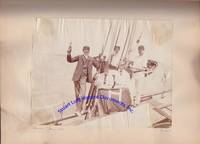
réf. 6174LONG ISLAND. This scrapbook displays photographs taken between 1887-1889 that capture a wealthy familys life on Long Island during the Gilded Age. The term The Gilded Age created by Mark Twain refers to the period of the late nineteenth century typically the 1870s through the turn of the 20th century during which rapid economic growth rapid industrialization and widespread European immigration primarily unskilled labor transformed the economies of the Northern and Western United States. According to the United States Census the era saw a real wage growth of 40% from 1860 to 1890 with the average annual wage per industrial worker including men women and children rising from $380 in 1880 $11523 in 2022 dollars to $584 in 1890 $18370 in 2022 dollars a gain of 59%. This rise in wealth resulted in the rise of a New Money elite those who made their money not through generational wealth and family connections but rather through oil the railroads and other rising industries. They are best exemplified by John D. Rockefeller Jay Gould Henry Clay Frick Andrew Mellon Andrew Carnegie Henry Flagler J. P. Morgan Leland Stanford and Cornelius Vanderbilt. New York was often at the center of the Gilded Age as the worlds dominant financial market and the nations leader in economic investment immigration political corruption and culture. This scrapbook contains 59 black-and-white photographs. They are affixed or mounted to 43 of 70 pages in the album. 29 of the photographs are 3.5 x 4.5 19 are 6.5 x 4.5 and 11 are 5.5 x 7.5. Two of these images are cyanotypes. Though the family is not named in the album and photographs with names underneath lead to nothing online there is a photograph in front of a house labeled Westbrook. The Westbrook estate on Long Island was designed in 1886 for William Bayard Cutting 18501912 by the architect Charles C. Haight in the Tudor Revival style. It contained the first private golf course in the United States and is now a part of a state park called the Bayard-Cutting Arboretum. Cutting started the sugar beet industry in the United States in 1888 was a builder of railroads operated the ferries of New York City his maternal grandfather was a partner of Robert Fulton and developed part of the south Brooklyn waterfront Red Hook. Images include a large extended family repeatedly and leisurely photographed the Harvard-Yale sailing race in 1887 at New London young men likely Yale students yachting and relaxing on a boat named the Princess and beautiful images of the scenery and waters of Long Island. Overall the album is in good shape. One photograph is damaged and several others have minor tears or chips. The scrapbook is half-leather and half-cloth so the spine is worn and the corners are rubbed and bumped. Regardless the scrapbook is a prize for anyone interested in this fascinating and relevant era in American history. It provides fantastic insight into the life of a wealthy Long Island family including what they did what they wore and how they presented themselves to each other and their neighbors. hardcover
réf. 6174LONG ISLAND. This scrapbook displays photographs taken between 1887-1889 that capture a wealthy familys life on Long Island during the Gilded Age. The term The Gilded Age created by Mark Twain refers to the period of the late nineteenth century typically the 1870s through the turn of the 20th century during which rapid economic growth rapid industrialization and widespread European immigration primarily unskilled labor transformed the economies of the Northern and Western United States. According to the United States Census the era saw a real wage growth of 40% from 1860 to 1890 with the average annual wage per industrial worker including men women and children rising from $380 in 1880 $11523 in 2022 dollars to $584 in 1890 $18370 in 2022 dollars a gain of 59%. This rise in wealth resulted in the rise of a New Money elite those who made their money not through generational wealth and family connections but rather through oil the railroads and other rising industries. They are best exemplified by John D. Rockefeller Jay Gould Henry Clay Frick Andrew Mellon Andrew Carnegie Henry Flagler J. P. Morgan Leland Stanford and Cornelius Vanderbilt. New York was often at the center of the Gilded Age as the worlds dominant financial market and the nations leader in economic investment immigration political corruption and culture. This scrapbook contains 59 black-and-white photographs. They are affixed or mounted to 43 of 70 pages in the album. 29 of the photographs are 3.5 x 4.5 19 are 6.5 x 4.5 and 11 are 5.5 x 7.5. Two of these images are cyanotypes. Though the family is not named in the album and photographs with names underneath lead to nothing online there is a photograph in front of a house labeled Westbrook. The Westbrook estate on Long Island was designed in 1886 for William Bayard Cutting 18501912 by the architect Charles C. Haight in the Tudor Revival style. It contained the first private golf course in the United States and is now a part of a state park called the Bayard-Cutting Arboretum. Cutting started the sugar beet industry in the United States in 1888 was a builder of railroads operated the ferries of New York City his maternal grandfather was a partner of Robert Fulton and developed part of the south Brooklyn waterfront Red Hook. Images include a large extended family repeatedly and leisurely photographed the Harvard-Yale sailing race in 1887 at New London young men likely Yale students yachting and relaxing on a boat named the Princess and beautiful images of the scenery and waters of Long Island. Overall the album is in good shape. One photograph is damaged and several others have minor tears or chips. The scrapbook is half-leather and half-cloth so the spine is worn and the corners are rubbed and bumped. Regardless the scrapbook is a prize for anyone interested in this fascinating and relevant era in American history. It provides fantastic insight into the life of a wealthy Long Island family including what they did what they wore and how they presented themselves to each other and their neighbors. hardcover books
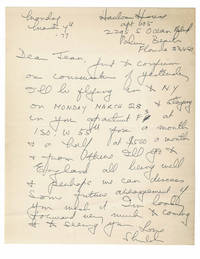
1977réf. 99587Palm Beach Florida March 7th through March 14th 1977. 1977. Very good. - Three autograph letters signed by Sheilah Graham in 1977 together with a photocopy of the article about her by Wright Tyson with notes penned in ink by Graham on October 21st 1985 also addressed to Jean Dalrymple. In her first letter of March 7th 1977 Sheilah Graham has penned over 70 words on 10 inch high by 8 inch wide buff paper confirming her arrangements to rent Jean Dalrymple's New York City apartment. She informs Jean that she'll be arriving on "Monday March 28" and staying for a month & a half". "I look forward to coming & to seeing you" Signed "Love Sheilah". The letter is folded for mailing else fine. The letter is accompanied by a retained copy of Jean Dalrymple's typed reply offering to cook dinner for Sheilah and correcting the address "except that my address is 150 West 55th Street not 130 . as I'm sure you well know! My office is 130 West 56th Street as on this letterhead! Often confuses people!" Sheilah Graham's second letter consists of over 116 words penned on both sides of 9 inch high by 6 inch wide buff paper. She mentions including her check for $500 for one month "It's an answer to my prayer." She'll be in New York on the 14th though moving in on the 28th and as she's working on a new book asks if Jean could call "Plaza Typewriter" and have them deliver an "IBM Standard Electric not the ball keys" to her apartment. Signed "Love Sheilah". In her third letter dated March 14th Sheilah Graham pens over 170 words on both sides of a 10 inch high by 8 inch wide sheet of cream paper. The thought of Jean "cooking dinner on the 28th wafts me to Paradise" though she expresses concerns "since my upset tummy landed me in the hospital I'm being very careful". She goes on to state that "I'm coming along well with my new book & I'm going to try to sell it to a network or for a movie." Signed "Love Sheilah". The letter is folded vertically & horizontally for mailing with a couple of short tears to the top & bottom of the folds. Very good. The letter is accompanied by a retained copy of Jean Dalrymple's typed reply dated March 17. "I'm so happy I can get your dinner on the 28th. and of course I wouldn't invite anyone else! But if you ever want to have people in. I can do very fine 'catering' for you!!!!" She reassures Sheilah about her diet "I am the original "Regime Minceur" cook. now made famous by the great French chef Bocuse." "By the way I'm sure you remember that we had a fatal fire at my apartment house. The owner is still fixing the house up and we have new doors but the hall still needs some painting. but I'm pretty sure it will be done within the next eleven days so it wll be pretty when you arrive!" There is also a photocopy of Wright Tyson's article on Sheilah Graham from the September 1985 issue of Andy Warhol's "Interview" Magazine illustrated with a portrait of Sheila in Jean Dalrymple's apartment. Graham has penned a lengthy note along the left border of the page dated October 21st 1985. "Dear Jean this was taken at your apartment. The screen was added but if you look closely you will see some of your things on the table! Love Sheilah". The British-born American gossip columnist Sheilah Graham born Lily Shiel 1904-1988 was a nationally syndicated gossip columnist during Hollywood's Golden Age. Her career spanned nearly four decades. She was involved in a relationship with F. Scott Fitzgerald in the latter years of his life which she immortalized in her autobiographical book "Beloved Infidel". The book became a best seller and was subsequently made into a movie starring Deborah Kerr and Gregory Peck. The recipient Jean Dalrymple 1902-1998 was the dynamic producer and director of theater and light-opera at Manhattan's City Center. Dalrymple began her career in Vaudeville appearing with James Cagney and Carey Grant in the early 1930s. She was a founding member of the American Theatre Wing the theatre service organization. She worked over the years as a personal manager for the likes of Leopold Stokowski Mary Martin Jos Iturbi Andre Kostalanetz Nathan Milstein and Lily Pons. She began her work at City Center with its founding in 1943 serving as a board member and publicist. Her productions there from the 1940s through the 1960s were a revitalizing influence on the whole New York theatre scene. In 1951 Jean Dalrymple married Major-General Philip deWitt Ginder commander of the Thunderbirds in Korea. She was a friend to Presidents and entertainment personalities throughout the world. Palm Beach, Florida, March 7th through March 14th, 1977.
1914réf. 28380George H. Doran New York 1914. HARDBACK NODUSTJACKET VG/VG- NOJACKET 1914 on copyright pg First Printing First Edition without "Printed in" on copyright page. First state with copyright date and publishers name only on copyright page. in brown paper boards and with blank leaves Before Title pg BROWN CLOTH LITE Wear WITH LABEL ON FRONT CVR & SPINE & Embossed Design on front CVR Medium brown paper covered boards with title and author paper labels on front board and spine. Gold Gilt rubbed of at top Outer pgs FOX to Labels & lite chips to spiner Cvr Ends Slim 8vo 75 pgs JOYCE KILMER' HE WAS THE LEADING AMERICAN POET OF HIS GENERATION AND PAST AWAY TO EARLY IN LIFE First state with copyright date and publishers name only on copyright page. death of joyce kilmer in France Aug. 1918 age 31 graduate Columbia University Kilmer was killed in action during World War I and was posthumously awarded the Croix de Guerre. Signed by Author. 1st Edition. Hard Cover. Very Good/No Jacket. George H. Doran, New York, hardcover