9195 risultati
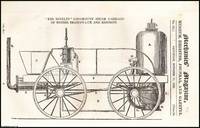
1829rif. 507896Knight and Lacey London 1829. Card Covers. Very Good Condition. The Mechanics Magazine Issue No. 327 from 1829 showcased advancements in steam-powered transport and engineering. It featured the Patent Steam-Carriage by Sir James Anderson and W.H. James which aimed to replace horse-drawn carriages with steam propulsion carrying 24 passengers at 15 miles per hour during trials. It also highlighted Braithwaite and Ericsson's multi-tubular Steam-Engine Boiler which improved efficiency and reduced explosion risks contributing to steam locomotives and naval steam engines. This issue captured a pivotal moment in transportation history as inventors refined steam-powered vehicles for road and rail applications. 32 Pages with woodcuts. Genuine Original and Packed with Innovation! This weekly magazine isn't just a fragment of history it's a window into the cutting-edge advancements of the Victorian era! Since 1823 The Mechanics' Magazine has tackled revolutionary topics from printing presses to vapor baths hydrostatics and hydraulics. It dives into breakthrough safety measures preventing explosive contaminated air while exploring the mechanics of oxy-hydrogen blowpipes and self-laying rail carriages. Every page crackles with Victorian-era engineering brilliance capturing the relentless drive for invention that shaped the modern world! This is an exclusive standalone issue carefully separated from its original volume; authentic original and uniquely crafted. It is not a reprint or reproduction but a distinct piece in its own right. Preserved in a modern card cover prepared for practicality - an unassuming but serviceable presentation that favours function over finery. Size: 13 x 21 cms. Category: Mechanics' Magazine; Special Interest. Knight and Lacey unknown
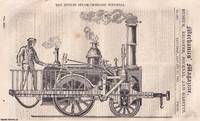
1829rif. 507894Knight and Lacey London 1829. Card Covers. Very Good Condition. The Mechanics' Magazine in October 1829 documented one of the most pivotal moments in railway history the Rainhill Trials a competition held to determine the best locomotive for the Liverpool & Manchester Railway. This event showcased several steam engines : The Rocket designed by Robert Stephenson won the competition and established a standard for future steam engines. It introduced a multi-tubular boiler improving efficiency and speed. The Sans Pareil built by Timothy Hackworth this locomotive was a strong contender but was ultimately less efficient than the Rocket and The Novelty designed by John Braithwaite and John Ericsson this locomotive was lightweight and innovative but suffered mechanical failures during the trials. The Rainhill Trials proved that locomotives were feasible for railway transport shaping the future of rail travel and marking the beginning of the age of speed transforming how people lived worked and travelled. Three complete issues of the Mechanics' Magazine No's 323 324 & 325 for October 1829. Genuine Original and Packed with Innovation! This weekly magazine isn't just a fragment of history it's a window into the cutting-edge advancements of the Victorian era! Since 1823 The Mechanics' Magazine has tackled revolutionary topics from printing presses to vapor baths hydrostatics and hydraulics. It dives into breakthrough safety measures preventing explosive contaminated air while exploring the mechanics of oxy-hydrogen blowpipes and self-laying rail carriages. Every page crackles with Victorian-era engineering brilliance capturing the relentless drive for invention that shaped the modern world! This is an exclusive standalone issue carefully separated from its original volume; authentic original and uniquely crafted. It is not a reprint or reproduction but a distinct piece in its own right. Preserved in a modern card cover prepared for practicality - an unassuming but serviceable presentation that favours function over finery. Size: 13 x 21 cms. Category: Mechanics' Magazine; Special Interest. This item may require more postage than the rates shown for delivery outside the UK. If extra postage is required we will contact you before processing your order and you will be given the details and option to decline the extra cost. Knight and Lacey unknown
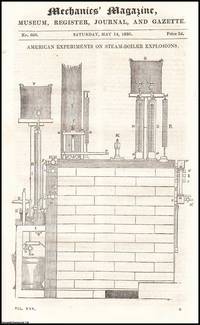
1836rif. 507966Knight and Lacey London 1836. Card Covers. Very Good Condition. 48 pages. With woodcuts. Genuine Original and Packed with Innovation! This weekly magazine isn't just a fragment of history it's a window into the cutting-edge advancements of the Victorian era! Since 1823 The Mechanics' Magazine has tackled revolutionary topics from printing presses to vapor baths hydrostatics and hydraulics. It dives into breakthrough safety measures preventing explosive contaminated air while exploring the mechanics of oxy-hydrogen blowpipes and self-laying rail carriages. Every page crackles with Victorian-era engineering brilliance capturing the relentless drive for invention that shaped the modern world! This is an exclusive standalone issue carefully separated from its original volume; authentic original and uniquely crafted. It is not a reprint or reproduction but a distinct piece in its own right. Preserved in a modern card cover prepared for practicality - an unassuming but serviceable presentation that favours function over finery. Size: 13 x 21 cms. Category: Mechanics' Magazine; Special Interest. This item may require more postage than the rates shown for delivery outside the UK. If extra postage is required we will contact you before processing your order and you will be given the details and option to decline the extra cost. Knight and Lacey unknown
rif. 0912322551.Gpaperback. Good. Access codes and supplements are not guaranteed with used items. May be an ex-library book. paperback
1988rif. 261001065Natl Textbook Co Trade 1988. hardcover. New. 7x0x9. Natl Textbook Co Trade hardcover
rif. 1843763451.Ghardcover. Good. Access codes and supplements are not guaranteed with used items. May be an ex-library book. hardcover
rif. 1621160130.Gtoy. Good. Access codes and supplements are not guaranteed with used items. May be an ex-library book. unknown
2012rif. CBS-9781849730518Sp Rsc Publishing 2012. New. Sp Rsc Publishing unknown
2012rif. CBS-9781849730518Sp Rsc Publishing 2012. New. Sp Rsc Publishing unknown
rif. 0912322012.Gpaperback. Good. Access codes and supplements are not guaranteed with used items. May be an ex-library book. paperback
rif. 097679599X.Ghardcover. Good. Access codes and supplements are not guaranteed with used items. May be an ex-library book. hardcover
1835rif. 373895Salmon London 1835. Softcover Booklet - Unbound Pages. Very Good Condition. 32 Pages with woodcuts. Small piece missing from inner margin of first leaf with no loss of text. See pictures for detail. Genuine Original and Packed with Innovation! This weekly magazine isn't just a fragment of history it's a window into the cutting-edge advancements of the Victorian era! Since 1823 The Mechanics' Magazine has tackled revolutionary topics from printing presses to vapor baths hydrostatics and hydraulics. It dives into breakthrough safety measures preventing explosive contaminated air while exploring the mechanics of oxy-hydrogen blowpipes and self-laying rail carriages. Every page crackles with Victorian-era engineering brilliance capturing the relentless drive for invention that shaped the modern world! This is an exclusive standalone issue carefully separated from its original volume; authentic original and uniquely crafted. It is not a reprint or reproduction but a distinct piece in its own right. Preserved in a modern card cover prepared for practicality - an unassuming but serviceable presentation that favours function over finery. Size: 13 x 21 cms. Category: Mechanics' Magazine;. Salmon paperback
2007rif. mon0003035740National Academies Press 2007-06-29. Hardcover. Very Good. 1.2000 9.0000 6.1000. National Academies Press hardcover
rif. A9781394211210Hardback. New. hardcover
rif. 1933180714.Gspiral_bound. Good. Access codes and supplements are not guaranteed with used items. May be an ex-library book. unknown
rif. 1933180056.Gspiral_bound. Good. Access codes and supplements are not guaranteed with used items. May be an ex-library book. unknown
rif. 113694Paris Picard 1911. LXV515 p. H.cl. 22 cm Rebound unknown
rif. 1934855103.Gspiral_bound. Good. Access codes and supplements are not guaranteed with used items. May be an ex-library book. unknown
rif. B9781545300633Paperback / softback. New. paperback
rif. 1849024596.Ghardcover. Good. Access codes and supplements are not guaranteed with used items. May be an ex-library book. hardcover
rif. 1933180439.Gspiral_bound. Good. Access codes and supplements are not guaranteed with used items. May be an ex-library book. unknown
rif. 35148230-nnew. unknown
rif. 1546535-nnew. unknown
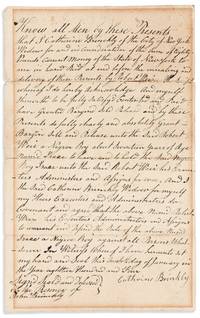
1804rif. 42382New York 1804. Single sheet written in ink script on recto. A deed 8" x 12-3/4" recording the sale of the 17-year-old "Negroe Boy Isaac" to Robert Weir by Catherine Brinckly 12 January 1804. Signed at the end "Catherine Brinkly" and witness John Brinckly. Toned old folds stabilized with text preserved by matting in a contemporary frame. Good plus. British policy in the early 17th century under the Duke of York owner of substantial interests in the Royal African Company encouraged importation of slaves to New York. By the early 18th century slavery was a cornerstone of the City's economy. Slave Codes rigidly regulated the activities and lives of slaves. But by 1804 slavery in New York was in decline thanks to tireless emancipation efforts of the New York Manumission Society Aaron Burr and Alexander Hamilton. In 1799 New York passed an Act emancipating everyone born after 1799. But "It was not until March 31 1817 that the New York legislature ended two centuries of slavery within its borders setting July 4 1827 as the date of final emancipation and making New York the first state to pass a law for the total abolition of legal slavery. When Emancipation Day finally arrived the number of emancipated men and women freed was roughly 4600." Celebrations and parades occurred throughout the state web site of Historical Society of the New York Courts. By this deed Isaac became the property of Robert Weir 1770-1825 a prosperous New York merchant from Scotland who had recently married Mary Katherine Brinckley Brinkley 1783-1840. Mary Katherine Weir is known as composer of the song "The Lord of the Castle." Their infant son Robert Walter Weir 1803-1889 just six months old when this deed was signed became a well-known Hudson River School painter; two of his sons also became famous artists. Robert Sr. declared bankruptcy in 1813 due to French confiscation of shipping goods. "Weir Robert 1770-" Robert Weir Papers Brigham Young University Library Vault MSS 511 Series 1. The grantor Catherine Brinckly was likely Weir's grandmother-in-law mother of Mary Katherine's father Thomas Brinckley born 1754; or some other close relative. We located Thomas Brinckley spelled with the "ck" listed in early New York City directories as city marshal. His name last appeared in 1794 at Cedar Street and Catherine's name began appearing in 1795 at the same street with "widow" following her name. The 1810 census shows one free person of color living with the Robert Weir family and no enslaved people suggesting that Weir had emancipated Isaac . "Weir Family Background" Chester County Historical Society website accessed August 2026; Duncan's New York City Directory and Register for 1794 1795 1800; Claghorn Charles: WOMEN COMPOSERS AND SONGWRITERS Univ. of Michigan: 1996 pp. 231; Ancestry website census and genealogical records. unknown
rif. G8205119988I3N00Gyldendal Norsk. Hardcover. Good. Pages can have notes/highlighting. Spine may show signs of wear. ~ ThriftBooks: Read More Spend Less.Dust jacket quality is not guaranteed. Gyldendal Norsk hardcover