3 051 résultats
réf. DADAX0300126085New unknown
1985réf. 2091202133001921New Science 1985. Soft Cover. Fine. Number of books: 1 New Science paperback
1931réf. 5466London. Walter Perry and Co. Ltd. 1931. Gilt titled crimson cloth. 4to. Edition for 1931. Profusely illustrated with photographs drawings and period advertisements. An absolute treasure depicting the grand and elegant days of travel. A complete guide to Hotels and boarding houses in Great Britain Europe Australia New Zealand South Africa Canada and the USA. Charming period advertising allows one to travel back to the heady romantic days of Somerset Maugham and the Orient Express. Indexed and tabbed this is a true gem of nostalgia. A Very Good copy Walter Perry and Co. Ltd. hardcover
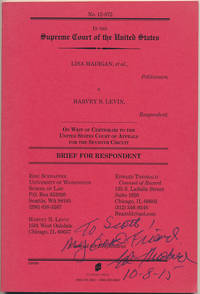
réf. 47419N.p.: Counsel Press n.y. Paperback. Small 4to. Stiff red wrappers. xii 54pp. Near fine. Rear wrappers and last leaf only mildly warped. Bright tight copy of this legal pamphlet No. 12-872 part of an age discrimination suit filed by an Illinois state's attorney who argued he was dismissed because of his age 61 to make room for a younger female attorney. Remarked one commentator "He won a major victory in the Seventh Circuit Court allowing him to go forward with a claim that his constitutional right not to be discriminated against because of his age had been violated. The state took the case on to the Supreme Court claiming that his right to sue under the Fourteenth Amendment had been displaced by the federal Age Discrimination in Employment Act. The problem in brief was that the Seventh Circuit decided the case before it was due to go to trial and the professors had questioned its authority to do that. If that was right Justices Samuel A. Alito Jr. and Anthony M. Kennedy commented why did the Supreme Court have any business stepping in" The Illinois Solicitor General got spanked by the justices during his questioning. Then "Levin's lawyer Edward R. Theobald III took to the podium. His appearance began on an unfortunate note as Justice Alito tried unsuccessfully to get him to take a firm position on whether or not Levin was an employee under the ADEA. For reasons that were not clear Theobald contented himself with simply reciting what the Seventh Circuit had said in ruling for his client." It goes on: "Chief Justice Roberts promptly took on Theobald saying that he had gotten what he had sought from the court of appeals and now was trying to insulate that result from any review. The Chief Justice was referring mainly to Theobald's merits brief in which he had put heavy emphasis on whether the ADEA issue was involved at all in the case since Levin he said got no protection under that law. The argument it was clear was getting far out of Theobald's opportunity to control it in his client's favor. Finally Justice Scalia had had enough. He noted that many of Theobald's arguments had not been made in his brief opposing the Court's review. 'We don't like to dismiss a case as improvidently granted' the Justice said impatiently. 'We depend upon counsel' to make arguments in a way that puts them before the Court. 'You should have told us' earlier Scalia said." This pamphlet is the aforementioned brief opposing the Court's review -- and the front wrapper is inscribed and signed large and bold by Levin's attorney: "To -- / My Good Friend / Ed Theobald / 10-8-15." These briefs are produced in small quantities for distrbution to those parties involved and are therefore rather scarce. This unusual item is accompanied by five large glossy Christmas cards each imprinted with Theobald's full name and each signed on inside panel with a holiday greeting. For good measure also included is a copy of Lyle Denniston's 2013 legal analysis of Levin v. Madigan "Argument recap: A bad way to open a Term" which includes a court artist's rendering showing Theobald presenting the case before Ruth Bader Ginsburg. Counsel Press paperback
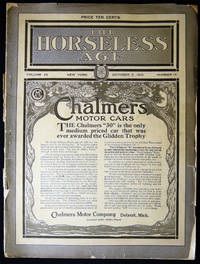
1910réf. 030025New York NY: The Horseless Age 1910. Pagination: 12 449 - 488 13- 59. The separately numbered front & back sections are primarily advertisements many illustrated for automobile & related manufacturers and service enterprises of the time. Contents include news of an auto-tour of El Camino Real with a little map; a dictionary of automobile terms; new vehicle model news for 1911 with pictorial descriptions; industry news snippets; commercial applications of truck equipment; a lengthy illustrated article including track lap time coverage by entrants chart for the Long Island NY Vanderbilt Cup racing event as well as the Massapequa sweepstakes race results; garage & salesroom news; industry & trade information and more. Approx. 9" x 12" size; top cover detached & edge-chipped; contents in good condition. Periodical. Soft Cover. Good. The Horseless Age paperback
1935réf. 141672ca 1935. paperback. Oversize 9-1/2 X 12-1/4 double-weight gelatin silver photograph inscribed in blue ink fountain pen by Montgomery to Hollywood photographer George Watson. The inscription is undated but most likely dates from the mid to late 1930's. Damage to lower left corner else VG Montgomery 1904-1981 began his acting career in 1929 and has the distinction of having played both Lord Peter Wimsey in 1940 "Haunted Honeymoon" based on BUSMAN'S HONEYMOON and Philp Marlowe in 1947 "Lady in the Lake". He also directed and starred in one of the great film noirs of the forties "Ride the Pink Horse" 1947 based on the Dorothy B. Hughes novel. Watson was a member of the notable Watson family of photographers that has flourished in Los Angeles for nearly a century. He was one of the first staff photographers at the Los Angeles Times and covered notable stories throughout the twenties paperback
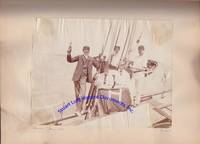
réf. 6174LONG ISLAND. This scrapbook displays photographs taken between 1887-1889 that capture a wealthy familys life on Long Island during the Gilded Age. The term The Gilded Age created by Mark Twain refers to the period of the late nineteenth century typically the 1870s through the turn of the 20th century during which rapid economic growth rapid industrialization and widespread European immigration primarily unskilled labor transformed the economies of the Northern and Western United States. According to the United States Census the era saw a real wage growth of 40% from 1860 to 1890 with the average annual wage per industrial worker including men women and children rising from $380 in 1880 $11523 in 2022 dollars to $584 in 1890 $18370 in 2022 dollars a gain of 59%. This rise in wealth resulted in the rise of a New Money elite those who made their money not through generational wealth and family connections but rather through oil the railroads and other rising industries. They are best exemplified by John D. Rockefeller Jay Gould Henry Clay Frick Andrew Mellon Andrew Carnegie Henry Flagler J. P. Morgan Leland Stanford and Cornelius Vanderbilt. New York was often at the center of the Gilded Age as the worlds dominant financial market and the nations leader in economic investment immigration political corruption and culture. This scrapbook contains 59 black-and-white photographs. They are affixed or mounted to 43 of 70 pages in the album. 29 of the photographs are 3.5 x 4.5 19 are 6.5 x 4.5 and 11 are 5.5 x 7.5. Two of these images are cyanotypes. Though the family is not named in the album and photographs with names underneath lead to nothing online there is a photograph in front of a house labeled Westbrook. The Westbrook estate on Long Island was designed in 1886 for William Bayard Cutting 18501912 by the architect Charles C. Haight in the Tudor Revival style. It contained the first private golf course in the United States and is now a part of a state park called the Bayard-Cutting Arboretum. Cutting started the sugar beet industry in the United States in 1888 was a builder of railroads operated the ferries of New York City his maternal grandfather was a partner of Robert Fulton and developed part of the south Brooklyn waterfront Red Hook. Images include a large extended family repeatedly and leisurely photographed the Harvard-Yale sailing race in 1887 at New London young men likely Yale students yachting and relaxing on a boat named the Princess and beautiful images of the scenery and waters of Long Island. Overall the album is in good shape. One photograph is damaged and several others have minor tears or chips. The scrapbook is half-leather and half-cloth so the spine is worn and the corners are rubbed and bumped. Regardless the scrapbook is a prize for anyone interested in this fascinating and relevant era in American history. It provides fantastic insight into the life of a wealthy Long Island family including what they did what they wore and how they presented themselves to each other and their neighbors. hardcover
1976réf. biblio556MGNA 1976 1977. The complete series: First Year Sets 1 - 6; Second Year Sets 1 - 6; Third Year Sets 1 - 6; Fourth Year Sets 1 - 3; Fifth Year Set 1 final set published. 22 staplebound pamphlets in very-good to fine condition. An outgrowth of the Alice Bailey teachings MGNA was founded by the eminent Italian psychotherapist Roberto Assagioli. MGNA paperback
1963réf. 2110502150413073Eiga Geijutsusha Co. Ltd. 1963. Soft Cover. Fine. Volume: 1 Eiga Geijutsusha Co., Ltd. paperback
1982réf. 2110502150414026Heibonshuppan 1982. Soft Cover. Fine. Volume: 1 Heibonshuppan paperback
1978réf. 2110502150415291Special feature of company story 1978. Soft Cover. Fine. Volume: 1 Special feature of company story paperback
réf. SONG3981826035Used: Good unknown
réf. DADAX0415615895New unknown
réf. DADAX0830817611New unknown
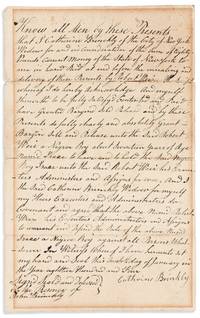
1804réf. 42382New York 1804. Single sheet written in ink script on recto. A deed 8" x 12-3/4" recording the sale of the 17-year-old "Negroe Boy Isaac" to Robert Weir by Catherine Brinckly 12 January 1804. Signed at the end "Catherine Brinkly" and witness John Brinckly. Toned old folds stabilized with text preserved by matting in a contemporary frame. Good plus. British policy in the early 17th century under the Duke of York owner of substantial interests in the Royal African Company encouraged importation of slaves to New York. By the early 18th century slavery was a cornerstone of the City's economy. Slave Codes rigidly regulated the activities and lives of slaves. But by 1804 slavery in New York was in decline thanks to tireless emancipation efforts of the New York Manumission Society Aaron Burr and Alexander Hamilton. In 1799 New York passed an Act emancipating everyone born after 1799. But "It was not until March 31 1817 that the New York legislature ended two centuries of slavery within its borders setting July 4 1827 as the date of final emancipation and making New York the first state to pass a law for the total abolition of legal slavery. When Emancipation Day finally arrived the number of emancipated men and women freed was roughly 4600." Celebrations and parades occurred throughout the state web site of Historical Society of the New York Courts. By this deed Isaac became the property of Robert Weir 1770-1825 a prosperous New York merchant from Scotland who had recently married Mary Katherine Brinckley Brinkley 1783-1840. Mary Katherine Weir is known as composer of the song "The Lord of the Castle." Their infant son Robert Walter Weir 1803-1889 just six months old when this deed was signed became a well-known Hudson River School painter; two of his sons also became famous artists. Robert Sr. declared bankruptcy in 1813 due to French confiscation of shipping goods. "Weir Robert 1770-" Robert Weir Papers Brigham Young University Library Vault MSS 511 Series 1. The grantor Catherine Brinckly was likely Weir's grandmother-in-law mother of Mary Katherine's father Thomas Brinckley born 1754; or some other close relative. We located Thomas Brinckley spelled with the "ck" listed in early New York City directories as city marshal. His name last appeared in 1794 at Cedar Street and Catherine's name began appearing in 1795 at the same street with "widow" following her name. The 1810 census shows one free person of color living with the Robert Weir family and no enslaved people suggesting that Weir had emancipated Isaac . "Weir Family Background" Chester County Historical Society website accessed August 2026; Duncan's New York City Directory and Register for 1794 1795 1800; Claghorn Charles: WOMEN COMPOSERS AND SONGWRITERS Univ. of Michigan: 1996 pp. 231; Ancestry website census and genealogical records. unknown
1921réf. 51295Scranton PA: International Textbook Co. 1921. Thick 8vo. vii 1 approx 450 pp sections separately paginated ix-xxi 1 pp. With 100s of text illustrations diagrams colour plates. Publisher’s three-quarter red buckram over green gilt lettering & ruling on spine marbled endpapers minor shelfwear dustsoiling to spine still VG copy. First editions of this very scarce and lavishly illustrated educational course on how to design construct and arrange window displays and floor displays of men and women’s clothing during the Jazz Age. Koerber 1871-1937 was an Hungarian-American designer and amazingly successful Display Manager for the Strawbridge & Clothier Department Store in Philadelphia at their five-story edifice flagship at Market & 8th. He emphasized and promoted the use of elaborate window displays with wax mannequins often with a particular theme and these needed to be constantly refreshed by the design department. In addition he highlighted the staging of merchandise on the floor such as putting men’s ties with their multi-coloured silks drawing shoppers to the men’s department and arranging women’s undergarments silks and evening wear in prominent positions to draw women further into specified sections. This work provides technical and practical information on wooden display forms flooring how to construct mannequins draperies holiday themes floor displays how to paint backdrops and more. The hundreds of photo images of window displays and floor displays provide an invaluable historical record for marketing during the Roaring 20s as well as offering a methodology of how these could be repeated and successful for other designers. Of particular interest is the extensive section on animatronics and motorized displays filled with information on lighting automatons and creating special effects. No copies located in Worldcat. International Textbook Co., hardcover
1926réf. 59638Chicago IL: Crane Co. 836 S. Michigan Ave. 1926. 4to. 47 1 pp. With over 150 of colour illustrations & blueprint floor plans throughout Gray printed boards w/ black & blue lettering on front cover minor shelfwear very slight chipping at foot of spine faint rust to staples at gutter margin of text block still VG copy. First edition of this scarce catalogue emphasizing the importance of colour and the latest modern crane fixtures valves and fittings mixing their compact and graceful gleaming white enamel on iron units with fine marbles and flawless crystal. Each of the individual designs includes elevation drawings along with each wall illustrated as it would appear on the blueprints on the facing page for the floor plans. Some feature Greco-Roman or Pompeian design elements while others show vivid Art Deco influences. Worldcat locates 6 copies The Strong DLC Hagley MO Hist. Mus. Cincinnati Carnegie. Crane Co., 836 S. Michigan Ave., hardcover
1930réf. 53742New York: Macmillan Company 1930. 8vo. 8 230 pp. Navy-blue publisher’s cloth gilt lettering minor rubbing to spine very minor shelfwear w/ d.j. printed on metallic silver coated paper Art Deco cover art of 1920s limousine and the well-dressed set in orange & black minor chipping to head & foot of spine very minor edgewear & creasing upper fore-edge couple very small closed tears w/ minor very small tape repair still a VG/VG- copy. First edition of this fast-paced novel set against the backdrop of a penniless Russian Prince exiled by the Revolution who makes a deal with a clever Chicago fashion buyer to act as chauffeur and purchase the sumptuous “Car of Croesus” rented at exorbitant rates to patrons wishing to appear as millionaires. Poole won the first Pulitzer Prize for The Family in 1918. Very scarce in the original dustjacket. Macmillan Company, hardcover
1963réf. 9152Berkeley: The Space Craft Convention 1963. First edition. 21x14cm 20pp. Reproduced from typescript. Staple bound in illustrated paper wraps green endpapers. Some staining and scuffing to covers clean internally and very good. Very scarce booklet being a special lecture given at the Space Craft Convention at Berkeley on November 2nd and 3rd 1963. Hunt 1900-1973 was an English spiritual healer who specifically wrote about and practiced chromatherapy. His most famous work was The Seven Keys to Color Healing 1940. This esoteric text is about achieving higher attunement and knowledge through the building of a spiritual bridge via light energy of different frequencies and colors. Not to be found in OCLC nor can we find it mentioned elsewhere. . The Space Craft Convention unknown
1930réf. 58055Portland OR: Hollywood College of Music Dancing & Fine Arts Baker Studio Granada Studio La Vere Photo Shoppe Photo Craft Studios ca. 1930-1933. Oblong 4to. 24 original photographs all preserved in archival mylar sleeves sized 6.25 x 7 in. up to 8 x 10 in. some w/ photographer’s imprint w/in negative others w/ manuscript captions added a few w/ annotations and/or photographer’s instructions on versos all with bright strong contrast a few w/ offsetting from previous mounting on versos and one w/ very small pinholes at corners from prior mounting. Recent cloth binder stamping front cover excellent grouping. These photographs vividly document the dance and music studio operated by Annabelle Knowles reflecting the fast evolving costumes and aesthetics of the twilight of the Roaring 20’s as the U.S. descended into the Great Depression. These photos also clearly reflect the influence of Gus Edwards 1879-1945 vaudeville’s premier producer of kiddie acts and who had produced and released the shorts “Kiddie Revue” in 1930 and 1931. His influence was not only driven by his songs “By the Light of the Silvery Moon & “School Days” but also discovering such stars as Groucho Marx Eddie Cantor Mae Murray Sally Rand and many others. The images depict girls in two-piece outfits in front of Art Deco staging for “Body and Soul”; bare-backed girls in Flapper Era inspired costumes for chorus line “Kiddie Revue”; song and dance routines featuring Ronald Chetwood in top hat with Marcile Shillito Virginia Collins and chorus line in Jazz Age era costumes and canes; and several show Barbara Jane Wicks Shirley Jay Mulkey and Sunny Dentler in Spanish inspired costumes for “Baby Vanities.” Another shows adolescent boy and girl dance team in an “Apache” dance inspired costume number. The Hollywood College of Music Dance & Fine Arts offered classes and instruction in all ages with the last few photos showing teenage girls in chorus line with short hair coquettish expressions and teamwork or chorus line numbers. Annabelle Knowles 1900-1989 was a musician and dancer who founded the Hollywood College of Music Dancing & FIne Arts at 4112 NE Sandy Blvd. some time in the late 1920’s. Most of the street directory references focus on 1929-1932 and her British-America theatre-director husband at the time Vincent Knowles 1883-1944 worked at the studio as well. Baker 1882-1972 was a longtime commercial studio photographer in Portland OR who had initially begun as a photographer with noted tourist travel guide Howard Eaton photographing tours through National Pakrs. Beem 1892-1984 was founder and photographer at Granada Studio located in the 1930’s at 515 Swetland Building in Portland. Centlivere 1878-1964 owned and operated La Vere Photo Shoppe and Photo Craft Studios on Sandy Blvd. in Portland for nearly all of his career. We could find no similar collections or photographs or even references to Annabelle Knowles and very few examples of any of these three photography studios in institutional holdings. Hollywood College of Music, Dancing & Fine Arts, Baker Studio, Granada Studio, La Vere Photo Shoppe, Photo Craft Studios, hardcover
1923réf. 58318New York: Arthur Murray 801 Madison Ave. 1923. 4to. 32 pp. Blue-tinted photo illustrations text diagram illustrations. Textured brown softcovers gilt lettering & decorative border on front cover yapp fore-edges minor soiling & fading front cover to lettering minor bumping to couple corners still a VG copy. First edition of one of the renowned dance studios’ instruction books after they opened their dance studio in New York in 1923 in conjunction with their struggling mail-order business. Murray pioneered dance instruction and dance schools to encourage exercise and build self-confidence and poise and was the first to broadcast live dance music on the radio in March 1920. Murray originated the idea of the “footprints” style of teaching dance now an Arthur Murray trademark and this book includes instructions for The Chasse Waltz the Tango foxtrot and The Cortez. Worldcat locates 4 copies w/ similar titles and different collations NYPL - 2 copies 51 & 24 pp. British Lib. 51 pp. BYU 63 pp. Arthur Murray, 801 Madison Ave., paperback
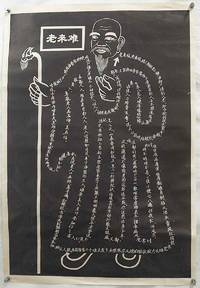
1980réf. 223104Unknown.: No publication details. circa1980. A poster with the image of an old man Lao Lai Zi outlined with white characters on a black background text in simplified Chinese characters 77 x 52.5cm small 1cm closed tear right edge and lower left corner repaired. In good condition with clear and well defined characters making the text easy to read. Lao Lai Zi a symbol of aging and filial piety is here represented in what appears to be a white line drawing on a black background. On closer inspection however the lines are made up of poignant and occasionally amusing rhyming verses listing the indignities of old age imploring the young not to look down on the elderly. The original stele carved with a similar image titled “Lao Lai Nan” Growing Old is Hard is located at the Temple of the Medicine King in Beipo village in Shaanxi Province. It isn’t known exactly when the Beipo stele was carved but it is said to be related to a Mrs Li who lived in the temple and wanted it carved to teach her unfilial children a lesson. The use of simplified characters and catchy verse written in modern Chinese indicate that it is a 20th century artefact. The Beipo stele includes smaller carvings of eight old people using sticks along the vertical edges. This poster is a modern artistic stone rubbing interpretation of the main visual feature on the Beipo stele i.e. the central figure outlined in characters in a pose and design similar to the original. A well known educational Chinese folk illustration “Lao Lai Nan” is a moral lesson on respect for the elderly. 老来难, 老来难,劝人别把老人嫌, 当初嫌别人老,如今轮到我头前,千般苦, 万般难,听我从头说一番。耳聋难与人说话, 差七差八惹人嫌. … Getting old is hard it’s hard I urge you not to look down on the elderly. Earlier I despised others for being old but now that I’m facing it head on with a thousand kinds of troubles and difficulties listen to everything I say. Being hard of hearing makes it difficult to communicate if you miss this or that you annoy people… … …痛苦难言聆,明不明睡不着, 一夜小便七八遍,怕夜长, 怕风寒, 时常受风病来缠 年老肺虚常咳嗽, 一口一口吐粘痰,儿女们都恨咱说,我邋遢不像前,老的这样还不死,你还想活多少年… … … It’s hard to explain all the difficulties one can’t sleep and every night one gets up to urinate seven or eight times. I hate long nights cold breezes and I get sick from being in draughts. My lungs are weak and I cough and cough and cough up phlegm so my children dislike talking to me. They seem to think I’m unkempt and don’t look like my former self. So old and still not dead how much longer am I planning to live . No publication details. unknown
1924réf. 47496Dayton OH: The Comer Manufacturing Co. 1924. Tall 8vo. 5.5 x 10.5 in. 36 pp. Numerous illustrations 4 colour plates 4 sepia-tinted plates 64 wool wool blend canvas linen leather cotton and patterned fabrics some treated w/ coating tipped-in occasional offsetting from samples either surrounding the sample or on facing leaves. Dark red printed softcovers decoration & lettering in orange & blue minor soiling some creasing still a VG- copy. First edition of this scarce salesman sample catalogue for men and women’s Jazz Age raincoats and overcoats in the mid-1920s. The company was founded before World War I by Charles E. Comer b. 1887 who quickly established the company as one of the largest manufacturers in Ohio of raincoats. The colour fashion plates are quite striking for the period and offer invaluable historical reference for the styles and weight of raincoats sold during the Flapper Era. Comer produced rubber-lined coats offered deals if you ordered two coats at once and also offered Mackinaws General Purpose coats Rubber rain slickers reversible coats and even waterproof aprons for housewives. This catalogue notes that they had just completed their new 40000 square foot and even offered waterproof luggage and garment bags. They were well known for advertising in labor magazines trade magazines and professional magazines constantly promoting their product and recruiting new salesmen. Worldcat locates only 1 copy Vol. 166. The Comer Manufacturing Co., paperback
1926réf. 58100New York & Chicago: J.L. Taylor & Co. 1926. Thick elephant folio 17 x 23.25 x 2.5 ins. 75 3 pp. printed on thick card stock each mounted on linen hinge. With 17 colour fashion plates illustrating Taylor styles of the period verso of almost all pages with 364 of 375 mounted textile samples in wool wool-rayon blends some felt backed silk moleskin corduroy cashmere waistband sample and more -- all samples clearly marked with prices and availability some of the 12 missing samples are indicated in pencil as being “Out” as well as a few present 1 additional pinned-in numerous illustrations throughout in blue-green colour tinting including Chicago & New York factories some diagrams charts and graphs. Original half-green cloth over gray green cloth corners gilt lettering on front cover colour plate w/ J.L. Taylor tailor mounted front cover some wear & minor bumping to fore-edges corners some minor soiling & occasional foxing to interior leaves -- some of it dust from the wool samples 10-15 samples with minor deterioration and evidence of old predation still a very good unsophisticated and remarkably complete example w/ original 9 x 21 in. double-sided stock list in red & black laid-in. First edition of this scarce and unusually complete salesman sample catalogue for Jazz era men’s suits in 1928-1929. J.L. Taylor maintained a huge tailoring operation in both Chicago and New York until after World War II employing hundreds of tailors and seamstresses to fill orders. The catalogues were very expensive to produce and so were most often found in department stores mercantiles and men’s stores which would have these catalogues on the sales floor for two years or more. The catalogue offers invaluable illustrated historical reference for the colours styles and fabrics during the era of F. Scott Fitzgerald and the Flappers. Most of the colour fashion plates illustrating the available styles have elegantly dressed women and settings in the background including with an emphasis on sporting in summer so golf tennis croquet canoeing boating and swimming all make an appearance. Of particular interest is the wonderful dress chart indicating styles needed clothes accessories and shoes which one would need for Day Wedding Matinee Reception Evening Dress and many others offering an excellent marketing opportunity for the store to sell the customer items to compliment his suits overcoats and other fashion wear ordered from J.L. Taylor. The final plate focuses on the lightweight “Palm Beach” & “Mohair” suits at the height of the 1920’s boom in Florida featuring snappily dressed models in Panama straw hats and a lightweight fedora. Worldcat locates 1 partial copy Preserved at the Library of Congress stripped of samples and used as scrapbook for Wilbur’s Drug Store prescriptions of Portland ME -- not an unusual occurrence. J.L. Taylor & Co., hardcover
1926réf. 61473New York: Grosset & Dunlap 1926. 8vo. 350 pp. plus 2 pp. publisher’s ads. Dark-blue publisher’s cloth red lettering & ruling embossed News Service ownership stamp at lower right corner title w/ d.j. vivid cover art of flapper “Joanna” in red by Charles Wrenn minor chip & closed tear to lower fore-edge minor chipping head of spine VG/VG- copy. First Grosset edition this novel was released along with the First National flapper silent film now lost and directed by Edwin Carewe co-wrote screenplay with Lois Zellner and starred Dorothy Mackaill Jack Muluall and Paul Nicholson. Grosset & Dunlap, hardcover