9195 resultados
1978Published in the late 1970s, this magnificently illustrated set brings to life the richness of our real Canadian past, in all its colour and vitality. "There are no fictional embellishments. Some of Canada's best authors have used sensitivity, imagination, and true literary skill to tell Canada's story as it really was. These are not academic textbooks, but a fascinating and accurate 'social history' that should appeal to everyone." - Professor J. Michael Bliss, University of Toronto. "Delivers a totally new and essential look at ourselves, with a broad down-to-realities approach." - Peter C. Newman. Includes the following volumes: The First Canadians, The Colonial Dream 1497-1760, Redcoats and Loyalists 1760-1815, Days of the Rebels 1815-1840, Pioneer Days 1840-1860, Dawn of the Nation 1860-1870, The Age of Innocence 1870-1880, Canada Moves Westward 1880-1890, The Naughty Nineties 1890-1900, Into the 20th Century 1900-1910, The Years of Agony 1910-1920, The Crazy Twenties 1920-1930, The Hungry Thirties 1930-1940, A Time of Heroes 1940-1950, The Booming Fifites 1950-1960, The Years of Progress 1960-1970. Moderate to average wear. Unmarked with the exception of the last volume which bears a few library markings. Binding of the 1930-1940 volume is taped at title page. Binding of the 1900-1910 volume is weak at title page. A quality copy of this magnificent set. Book
1866ref. 69620Texte restitué par M. l'Abbé Delaunay, Curé de St Etienne du Mont, Honoré du Suffrage de N.S. Père le Pape Pie IX, 2 vol. in-4 reliure postérieure demi-chagrin à coins rouge, dos à 5 nerfs dorés orné, mors dorés et estampés à froid, L. Curmer, 1866 - 1867, Tome I : 12 ff., 214 pp. et 4 ff. n. ch. avec portrait du Pape Pie IX et 53 chromolithographies hors texte ; Tome II : Liste des souscripteurs, la préface, la biographie de Jehan Foucquet, description de ses oeuvres, celle des miniatures reproduites dans le premier tome, une notice sur ses oeuvres présumées, l'opinion de la presse sur l'ouvrage, une description des ornements accompagnant le texte et 4 tables, avec 1 figure dessiné par Fossey gravée par Colin tirée sur chine, 5 chromolithographies hors texte et 17 titre en chromo, portrait de femme par Pauquet sur Chine rapporté dans le texte à la fin de la préface
18911 vol. fort in-8 carré reliure demi-veau brun, dos à 5 nerfs richement orné, G. Gounouilhou, Bordeaux, Paris, 1891, X-457 pp. avec pl. dont une dépliantes et G. Gounouilhou, Bordeaux, J. Rouam, Paris, 1893, 231 pp. Très bel exemplaire réunissant les deux ouvrages consacrés par le professeur Emile Labroue au Périgord Blanc et à Bergerac. L'auteur précise dans la préface à cette seconde édition de "Bergerac sous les Anglais" : "Notre éditeur bordelais, M. G. Gounouilhou, qui ne néglige aucune occasion de mettre en lumière tout ce qui intéresse l'histoire de Bergerac, sa ville natale, a pensé qu'il convenait de présenter au public, sous un même format, nos deux études d'histoire provinciale, "Bergerac sous les Anglais" et "Le Livre de Vie", et de faire ainsi, en deux volumes in-4, comme une "Histoire de Bergerac au XIVe siècle". C'est avec plaisir que nous avons répondu à son invitation, et nous publions aujourd'hui une seconde édition de "Bergerac sous les Anglais". Français
1620Concinnata & Historica narratione (sed brevi) illustrata Opera ac Studio Ioannis Iacobi Luckii Argentoratensis, Cum gratia et privilegio Sacrae Caesareae Maiestatis, 1 vol. in-folio reliure de l'époque pleine basane marron, dos à 6 nerfs orné, Sumptibis Ipsi Authoris, Typis Reppianis, Argentinae [Strasbourg ], 1620, 4 ff., 383 pp. et 1 f. Plus qu'un superbe catalogue numismatique recueillant les pièces et médailles provenant de la collection de l'auteur, ce bel ouvrage richement illustré des portrait des grands personnages du temps évoque les faits et geste de chacun d'entre eux, de manière chronologique. Brunet évoque un "recueil devenu assez rare". Grand généalogiste et collectionneur, Johann Jacob Luck (1574-1635) finit sa carrière en tant que bailli du Staufenberg (Bade). Etat satisfaisant (manque important à un feuillet - le folio H - un manque en coiffe sup., qq. mouill. discrètes, coins frottés, bon état par ailleurs). Prix en l'état. (Brunet, III, 1217) Latin
1914ref. 2111902160201098Ima Furudo shoten 1914. Soft Cover. Fine. Volume: 1 Ima Furudo shoten paperback
1953ref. 7053COLAS 1953 1 Eaux-fortes d'Omer BOUCHERY. Paris, Colas, 1953. In-4, en feuilles, sous couverture rempliée, sous chemise et étui cartonnés, 154 pp.
1926ref. List3141Quincy Massachusetts: unpublished 1926. 201 pp cardstock wraps. Normal wear to wraps; overall Near Fine. Alice Brackett White Coolidge 1864–1927 was a Boston socialite of the prominent Richardson family; her grandfather was merchant and Massachusetts State Legislator Jeffrey Richardson. Coolidge was also the author of three children’s books: The Bunnies of Evergreen Village 1917 The Refugees in Evergreen Village 1918 and Evergreen Village to the Rescue 1922. Offered here is Coolidge’s unpublished memoir of her early life written in 1926 titled My Early Reminiscences. The memoir recalls Coolidge’s childhood and teen years spent mainly in Massachusetts New Hampshire and Maine. Her recollections typically involve extensive descriptions of the houses at which her family stayed the scenery around them and the various families they met and visited with. Given her position in society her acquaintances are sometimes quite influential people: Princeton president John Grier Hibben enjoys Coolidge’s fishcakes; Trinity Church rector Phillips Brooks gives her grandfather an “excellent pew” in the newly-finished church; pioneering doctor Alfred Worcester mistakes red pepper for mercury in a scientific demonstration at her school; and she recalls brief correspondences with John Greenleaf Whittier and William James. Coolidge also took dance lessons from Augustus Papanti whom she describes as “one of the thinnest men I ever saw” who was “very melancholy. I hardly remember his ever smiling”; and remembers Judge Charles Devens for “his great stature his charming face his courtliness of manner and his really boyish simplicity in entering into our evening games” including a game of “mind reading” which Devens played “with zest.” One of her longtime friends was Rear Admiral John E. Pillsbury. She recalls: “Mr. Pillsbury as a young naval man a brother-in-law of my uncle Dr. Richardson used to take me out in the swan-boats on the Public Garden Pond. Later he went through all the ranks up to being retired as a Rear Admiral but time and circumstances never changed him. We always met at Thanksgiving and Christmas dinners and always talked at great length. . He was a wonderfully interesting lovable man and very modest and unassuming and shy. I always considered him one of my best friends though older by many years than I.” Another interesting New England figure Coolidge encountered was Joseph Lee. She describes Lee’s hotel in Newton: “The house where we stayed was kept by a remarkable man named Joseph Lee. He was a mulatto much above many of his kind and his wife was a handsome woman partly Indian. They did the cooking and he waited on table with a colored maid to help him. In fact there were no white women in the house. The cooking was delicious.” Lee was born enslaved in South Carolina freed in 1865 and went on to invent the automatic bread kneading and bread crumbing machines. Though nearly all of her childhood was spent in New England she also remembers being invited to visit Charles Joseph Bonaparte in Baltimore: “We had never been so far south except to Washington and I felt a curious feeling of being in a different atmosphere from any I had known. . We were met at the station by Mrs. Bonaparte in a large roomy covered vehicle with two horses. The coachman and footman were in the Bonaparte colors -- a deep wine color. The footman I well remember. He was a light-colored young negro very handsome and smiling and excited over having young ladies from the North. . All the servants were colored and lived in cabins near the house. . I never knew Mr. Bonaparte in public life so my memories of him are quite intimate and I fancy I saw much of his real self. . His mind was very active. He used to talk or listen as he walked and he moved his head in a curious way from one side to the other with a slightly rolling motion which was distinctly individual. . I never saw him irritated or excited and he was always very simple. In the group picture we had taken at the Maplewood he sat down cross-legged on the piazza floor like a boy. That was in about 1887. I suppose in public life or in law he was different but he was very equable and charming as we met him in his home and at the mountains. Most of all I admired his sweet tender ways with his flower-like wife.” This was not too long after the end of Reconstruction and Coolidge remarks on the tense atmosphere: “Mrs. Bonaparte had warned me to be careful about questions regarding the North and South as the ‘feeling’ had not yet died away. I was so glad she had warned me. A gentleman slipped in and sat down beside me to watch a parade and whispered in my ear as the bands had been playing ‘Dixie’ how glad he was to meet a Northerner. I was glad to meet him too although I remember neither his name nor face but I felt I breathed freer in his sympathetic locality. . I had no idea that this feeling still remained as far North as Baltimore and of course I remembered how our Massachusetts troops had been fired upon in Baltimore at the outset of the war but I was admonished and very wise and only returned my unremembered neighbor’s greeting with a sympathetic word and look.” Besides individuals Coolidge does cover a few historical events including the Great Boston Fire of 1872: “Oh! a horrible sight met our eyes. Back of the opposite houses in Park Square was a background of sheets of red flames and heavy black smoke rising high into the air. . On the Parade Ground all was in confusion and the sight was very sad and never-to-be-forgotten. It was literally covered with boxes and bales of furniture and sad forlorn desperate looking people crouching or sitting or standing amidst what they had saved from their homes . At night . the whole city was in darkness as there was no gas.” The family also frequently stayed at hotels in the White Mountains of New Hampshire and Coolidge recalls the “overwhelmingly tragic” effects of the 1867 sale of this land to logging companies; she writes that looking out from the Flume House in Franconia “all about were brown scarred places marking the woodchoppers’ work which was cutting away our beautiful trees for lumber”. In this memoir Coolidge supplies detailed remembrances of the private personalities of influential figures of Gilded Age New England. We find two copies of My Early Reminiscences on OCLC. Of interest to historians of the era especially as told through the perspective of a young woman. unpublished unknown
ref. 19932P., Société de l'HIstoire Nationale, et Plon, 1931-36, 6 forts volumes in 4° (sur 7, le dernier volume manque) reliés demi-basane racinée à coins de l'éditeur, dos lisse richement décorés, couvertures conservées ; très importante iconographie, en noir et en couleurs. BEL EXEMPLAIRE.
1877ref. 12482Tours 1877 1 Texte critique accompagné d'une traduction nouvelle et précédé d'une introduction historique par Léon Gautier, professeur à l'Ecole des Chartres, avec eaux-fortes par CHIFFLART et V. FOULQUIER, et un fac-similé. Tours, Alfred Mame et Fils éditeurs, M DCCC LXXII, demi-maroquin bleu à coins, dos à 5 nerfs, entrenerfs ornés dorés, 507 pp., errata, table, (David relieur).
ref. 19593PARIS, Lib. des Bibliophiles - 1875 à 1883 - 11 volumes - Tirage à petit nombre - Grand in-8 - 1/2 reliures à coins - Plats marbrés - Dos lisse avec titre doré - Très beaux exemplaires
PARIS, Lib. des Bibliophiles - 1875 à 1883 - 11 volumes - Tirage à petit nombre - Grand in-8 - 1/2 reliures à coins - Plats marbrés - Dos lisse avec titre doré - Très beaux exemplaires
2013ref. 22780EPlaya Vista CA: Paramount Pictures 2013. Original Archive of Scouting Locations and Production Material for the Film Transformers: Age of Extinction comprised of two ring binders and one presentation folder all of which belonged to a location manager for the film. The largest binder is approximately 3/4” thick with a title page slipped into the clear sleeve at the front reading: “Transformers E74 Tech Scout Notebook E74 Office Bungalow 4 Playa Vista CA” and contains color copies of exterior and interior locations with printed and handwritten notes. The presentation folder is 17 pages long and is titled “E74 Tech Scout Hong Kong Locations” with printed and handwritten notes. The smaller binder is about 200 pages and contains crew lists a ‘Welcome to China’ section and various production memos and miscellaneous material. All material is in very good to fine condition with minor signs of handling. The film Transformers: Age of Extinction is the fourth installment in the Transformers film series released in the US on June 27 2014 and represents a sequel to Dark of the Moon 2011 taking place five years after its events. Like its predecessors it was directed by Michael Bay and written by Ehren Kruger with Steven Spielberg and Michael Bay as executive producers. It stars Mark Wahlberg Stanley Tucci Kelsey Grammer Nicola Peltz Jack Raynor Sophia Miles Bingbing Li Titus Welliver and T.J. Miller. Transformers: Age of Extinction was the first feature film to be shot on smaller digital IMAX cameras as well as various other film formats such as IMAX 70mm film cameras digital stereo 3-D and anamorphic and spherical 35mm film. Paramount Pictures unknown books
18741 vol. in-4 reliure demi-chagrin maroquiné rouge, dos à 5 nerfs dorés, couvertures conservées, Imprimerie Gounouilhou, Bordeaux, 1874, 624 pp. frontispice (eau-forte par Léo Drouyn), avec grande carte dépliante et nomb. illustrations dans le texte Bon état pour ce rare ouvrage aux marges immenses, imprimé sur beau papier vergé (dos un peu frotté, carte dépliante détachée avec petite restauration au verso, rares rouss.). Chargé par la Municipalité de Bordeaux d'établir un plan de Bordeaux vers la fin du Moyen-Age ainsi qu'une nomenclature topographique, le grand érudit et artiste Léo Drouyn (1816-1896) avait tout d'abord espéré des "Recherches et Mémoires" de l'abbé Baurein. Mais l'excellent auteur se taisant sur des points essentiels, Léo Drouyn décida de se plonger dans les Archives tant publiques que privées permettant de renseigner les points obscurs et de rédiger cet impressionnant ouvrage, qui demeure une somme incontournable pour la connaissance du Bordeaux médiéval. Français
ref. 4800Bourg, P.F. Bottier, 1838 - 1844 ; cinq volumes in-8 ; demi-percaline marron à coins, faux-nerfs, titre manuscrit en doré, plats conservés (reliure mi-XXe) ; XXIV, 224 ; XIV, 350 ; XXV, 404 ; XXXIII, 427 ; III, 304, 67, VIII pp.
ref. Bloomsbury-9780567685513T&T Clark. Hardback. New. 328 pages T&T Clark hardcover
ref. Bloomsbury-9780567685513T&T Clark. Hardback. New. 328 pages T&T Clark hardcover
ref. Bloomsbury-9780567685544T&T Clark. Hardback. New. 360 pages T&T Clark hardcover
ref. Bloomsbury-9780567685544T&T Clark. Hardback. New. 360 pages T&T Clark hardcover
1857ref. 132Histoire du costume et de l'ameublement et des arts et industries qui s'y rattachent sous la direction de HANGARD-MAUGE dessins de Cl. CIAPPORI introduction génèrale et texte explicatif de Charles LOUANDRE impressions en couleurs par HANGARD-MAUGE à Paris, chez HANGARD-MAUGE Lithographe-Libraire-Editeur-1857- 4 tomes en 3 volumes de format : 23,5 x 29 cm. reliures demi-basane rouge, dos à 5 nerfs richement ornés, plats de percaline, gardes marbrées, têtes dorées. Volume 1 : 2 tomes de texte reliés à la suite, 1 frontispice en tête de chaque partie (donc 2 ...) 344 pages et 280 pages volume 2 : 16 pagesde préface et 158 planches sous serpentes volume 3 : 164 planches sous serpentes COMPLET : 324 lithographies en couleurs portant principalement sur les périodes du VI ième au XVII ième siècle. Etat : traces de frottements aux mors (sans gravité), une tache sur un plat, 2 coiffes légèrement usées, petit grignotage en marge d'un frontispice (voir photos) sinon TRES BON ETAT
1835ref. 16427Paris, Crapelet, 1835 ; grand in-8 ; demi-chagrin à coins bleu-roi, dos à nerfs, titre doré, tête dorée (reliure ancienne) ; (4), VIII, 110, (2) pp., frontispice lithographié par Thierry Frères, d'après V. Adam, représentant le Monument de la Bataille des Trente élevé dans la Lande de Mi-voie, 6 planches de blasons reproduisant les blasons des 30 chevaliers bretons qui combattaient. Ce volume contient aussi le fac-similé de 2 pages du manuscrit original.
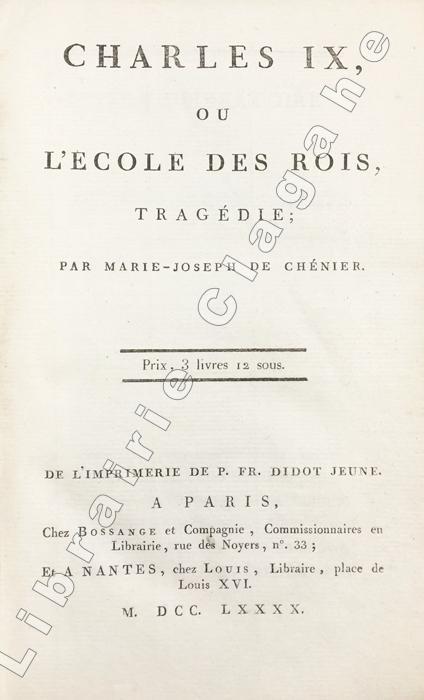
1790ref. 6385Paris, Bossange (Imprimerie de P. Fr. Didot Jeune) et Nantes, Louis, 1790 ; (2) ff., 262 pp., (1) p.La pièce Charles IX est suivie de : Discours prononcés devant M.M. les Représentants de la Commune, le vingt-trois aoust 1789 ; De la liberté du théâtre en France ; de huit lettres ; Épître aux manes de Voltaire.Suivi de : [Dulaure, Jacques-Antoine] Crimes et forfaits de la Noblesse et du Clergé, depuis le commencement de la Monarchie jusqu'à nos jours. Paris, sans nom, sans date (1793) ; VI, 164 pp. et frontispice satirique gravé. Deux volumes reliés en un tome in-8 ; plein veau marbré, dos lisse orné et doré, pièce de titre en maroquin vert, tranches jaspées (reliure de l'époque).
1723ref. 818681723 Brusselle, Françoi Foppens, 1723, 5 volumes petit in 8° reliés plein veau de l'apoque, dos à nerfs ornés, tranches rouges ; des rousseurs ; reliures habilement restaurées aux coins et coiffes;
1842In -4°, pp. 22.
ref. 159999Clermont-Ferrand, F. Thibaud, Paris, Ch. Dumoulin, 1867 in-4, [6]-CCV-606 pp., 6 pl. dépl., toile verte, couv. cons. (reliure postérieure).