Jean PanielLivre Rare Book

rif. 6259Hachette, 1961. Format 16x21 cm, cartonnage editeur de 200 pages. Traces de scotch sur les pages de garde.Bon etat, petites traces d'usage sur un livre d'occasion.
rif. 32540Hachette, 1959. Format 16x21 cm, cartonnage editeur de 200 pages. Bon etat, petites traces d'usage sur un livre d'occasion.
1994rif. 500141853Nathan 1994 1994. Broché.
1973rif. 5026Paris, Flammarion, 1973 ; in-8, broché ; 270 pp., bande-annonce d'éditeur reproduisant une photographie de l'auteur en noir et blanc.
1967rif. 3835Éditions de gigord 1967 319 pages in8. 1967. Reliure editeur cartonnée. 319 pages.
1960rif. ABE-1561012285210DATE ET SIGNATURE DE PROPRIETAIRE EN PAGE 2-192 PAGES-COINS SUP LEGEREMENT TASSES-COIFFE DE PIED LEGEREMENT FROTTEE-SINON ETAT DE NEUF-(22D)
rif. 15610cartonnage éditeur - 17 x 23 - 190 pp - éditions classiques Hachette - année 1968 -
2016rif. 64360Nathan 2016 180 pages 28x21x1cm. 2016. Broché. 180 pages.
rif. 500373182Hachette Sans date.
2016rif. 63642Bordas 2016 176 pages 28x21x1cm. 2016. Broché. 176 pages.
rif. 500338863Bordas Sans date.
1961rif. 131349Couverture souple. Revue.
2000rif. 55124Bordas 2000 264 pages 28x21x1cm. 2000. Broché. 264 pages.
1986rif. 64295Bordas 1986 80 pages grand in8. 1986. Broché. 80 pages. Chaque maison cache un secret les murs ont des oreilles mais la bouche cousue. Il faut poser longtemps la joue contre leur sein comme un docteur fiévreux pour les entendre respirer. A Dun-le-Palestel dans la Creuse la maison de famille du narrateur en a si gros sur le c?ur et tant à dire qu'on va la confesser pièce après pièce l'écouter se raconter souvenirs dérangés vérités arrangées les choses et les gens tels qu'ils furent les échos et les ombres qu'il en reste. Elle finira bien par lâcher cequ'elle sait. Elle sait l'histoire d'un père qui lui avait choisi de se taire
2007rif. 500104109Bordas Editions 2007 19 6x0 8x28 4cm. 2007. Broché.
1939rif. 100074965Paris. 13 cm x 18 5 cm. 1939. Broché. 503 pages. Paris Éditions Hachette 1939. Cartonné et toilé 13 cm x 18 5 cm 503 pages plans illustrations et photographies noir & blanc in-texte 1 carte dépliante hors-texte - Texte de V. Boulet et A. Obré. Très bon état
1974rif. 49411Couverture souple. Broché. 386 pages.
rif. QWA-13967Olivier Orban, 1987, in-8 br. (15,5 x 23,5), 419 p., avec la collaboration d'Anne-Marie Dethomas, bon état.
2015rif. 78463Delagrave 2015 160 pages 21x15x2cm. 2015. Broché. 160 pages.
1966pages are clean, bright and tight.
1938Un volume de format petit in 8° de 156 pp.; très nombreuses illustrations dans le texte. Reliure cartonnée verte de l'éditeur, décor en rouge, titres en noir. Couverture un peu défraîchie. Sinon bon état. Voir photo.
1960Un volume de format petit in 8° de 448 pp.; très nombreuses illustrations en noir dans le texte. Cartonnage de l'éditeur vert, décor en rouge; estampé. Bel état.
grand in-8°, 176 pp, broché, couverture illustree. Bel exemplaire (Specimen hors commerce). [FRA-2]
grand in-8°, 60 pp, broché, couverture illustree. Bel exemplaire (Specimen hors commerce). [FRA-2]
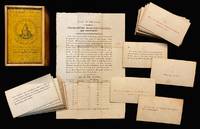
1834rif. 322002724 printed cards 9.5 x 5.4 cm including 12 question cards printed in red and 12 Answer cards printed in black; a folding printed sheet of instructions; contained in the original wooden box two sides very skilfully replaced; sliding lid with printed title label depicting a seated Moses reading from the Tablets. The game is intended for six players who are each provided with a piece of scrap paper called 'Contracts'. The Answer cards are dealt to the players and the Question cards retained by the dealer. The players each examine their aAswer card they have been given after which the dealer selects a question card and lays it down in front of the players and then asks each in turn until the Answer card is produced. If no answer is forthcoming then the dealer refers to a 'key' which matches questions to the correct answers. Whoever reads the wrong answer or fails to recognise they have the correct card in their hand forfeits a Contract. The player who has parted with the fewest Contracts is the winner. Questions include 2 'What time did God employ in forming the Creation' the Answer 'Six days: and rested on the seventh day. We are not to suppose by this expression that God was weary and required rest but that he rested from or left off creating.' 16 'Who is supposed to have arranged and published the Old Testament' Answer 'Ezra a priest of the Jews. Some of the answers stray into the New Testament and are also fearsomely long for children to remember:- 15 'How did the Jews forfeit the favour of God; and will they ever regain it' Answer 'They forfeited the divine favour but their obstinate rejection of the Son of God whose pure doctrine of humility and love was in direct opposition to the worldly pomp and glory which they had falsely led themselves to expect at the coming of Christ. It is predict that they will one day acknowledge Christ as the Messiah and be restored to their former privileges' One has to admit there is quite a lot of anti Jewish feeling in many of the Answer cards reinforcing contemporary prejudices - 22 'In reading the Bible what part may be passed over in order to connect the historical records' - Answer 'You may be allowed to pass over the book of Leviticus and the eight first chapters of the book of Numbers. The books of Chronicles may be read as a repetition of the book of Kings both bring you to the Babylonish Captivity; you then pursue the History of the Jews and read to the end of Esther. The writings of the Prophets as connected with the History of the Bible should be read next. The book of Job the Psalms &. are beautiful compositions and may be read as such at any time.' Produced by the short lived partnership of William Mason Wood a typefounder and shareholder in the Austin Letter Foundry in Aldergate and Kilelm Chandler a printer from Tewkesbury who had recently moved to London and married in 1834. The partnership in Beech street was a few hundred yards from the Austin Letter foundry and as far as we can tell lasted as a business for only a few months before it was dissolved in October 1834. Chandler was successively a printer Station Master Compositor and latterly a Fruitier. We have found no other item issued from their partnership and one feels as a product of their business the cards were a commercial failure. Wood and Chandler, Printers, 41, Beech Street, Barbican.