6 931 résultats
1895réf. c2312260292xbvkMainly Lunéville / [Chateau] Le Frehaut (Maire's Autographs), Lunéville, Nice etc. ('secretary') and 1887/1895-96 ('Rimes feminines . . .'). 108 written pages on 88 sheets of different sizes and different papers varying between small-8vo and small-4to (Maire's autographs) / 60+ pages on 60 sheets (Maire's poetry written by another hand of the period) / 144 pages on 94 sm-4to sheets (Facsimile of 'Rimes feminines. . .', in a different order than in the printed book). - All bound together (Facsimile > Maire's autographs > Other writer, with a few M's inbetween) in a private black halfcloth binding with dark marbled panels, tipped-on the printed part of the original frontcover of 'Rimes feminines. . .' with Rasenberger's added autograph ''Handschrift-Faksimile! Am Schluss Original-Handschriften!''(transl.: ''Manuscript-facsimile! At the End Original-Manuscripts'') surrounded by an ornamental section of the frontcover of a German artistic and geographic series ('Die blauen Bücher') which used this design between 1910 and 1930; 4to. (ca. 26 x 19 x 3 cm; ca. 1 kg.).
1888réf. 6182Savannah GA: The Morning News Print 1888. Good. 8¼" x 6". Green cloth over boards title gilt. Pp. 5 A-E 6 iv-v blank page 360. Good: Ex-library with remnants of call number to spine bookplate due cards and embossed stamp on title page; moderately shaken boards moderately worn with losses at spine tips ffep heavily notated. This is another copy of Love's History with several outstanding associations. A partially obscured inscription on the front pastedown shows that this particular copy was presented by R.R. Wright to D.C. Suggs. Richard Robert Wright Sr. who wrote part of the book's introduction was born into slavery in Georgia in 1855 and was valedictorian of the first graduating class of Atlanta University now known as the HBCU Clark Atlanta. He became an educator and newspaper editor who went on to serve as the first president of the Georgia Industrial College for Colred Youths GICCY the first public institution of higher learning for African Americans in the state. Under Wright's leadership GICCY hosted renowned lecturers including Booker T. Washington Mary McLeod Bethune and Mary Church Terrell. Wright later founded the first Black-owned bank in Philadelphia and co-founded the first organization of Black-owned banks in the country. The recipient of the book Dr. Daniel Cato Suggs was born in Wilson North Carolina in 1865. He was a wealthy Black businessman active in real estate and a teacher in the public school systems of North Carolina. He served as a professor at GICCY before being elected president in 1917 of Livingston College a private HBCU in Salisbury North Carolina noted for its strong affiliation with the African Methodist Episcopal Zion Church. This volume also contains a bookplate from Bennett College in Greensboro. Founded in 1873 as a normal school to educate freedmen and train both men and women as teachers Bennett is now a private HBCU liberal arts college for women. There is yet another interesting facet to this copy: the front free endpaper has two pages of handwritten notes regarding a speech given by David B. Hill in Savannah in 1892 as he was campaigning to be the Democratic candidate for United States President. We found the entirety of the speech's text in a newspaper account online and note the oddity of the possibility of a Southern African American attending a Democratic candidate' speech at that time. OCLC shows six holdings of the physical book over four entries. A unique copy with wonderful associations of Love's important history of the First African Baptist Church. The Morning News Print unknown books
1816réf. 757P57London: T. Hookham 1816. Leather. Very Good Indeed. 6.5" by 4". None. A lovely second edition of Thomas Love Peacock's first novel from the library of the Bloomsbury founder Lytton Strachey. The second edition of this work; the first and second edition were published in the same year and both are very scarce.From the library of Lytton Strachey with his bookplate to the front pastedown. Strachey was one of the founding members of the Bloomsbury Group bringing together influential figures such as Virginia Woolf and Vita Sackville-West. He was also a historian of the Victorian era publishing 'Eminent Victorians' and a noted biography of Queen Victoria.In a signed binding by Charles Lewis. Lewis was lauded was one of the best bookbinders of his day patronised by the 2nd Earl Spencer and the 6th Duke of Devonshire binding books for both Althorp and Chatsworth.'Headlong Hall' was Peacock's first long work of fiction grouping a selection of eccentric and obsessive people together at a country estate in Wales.Peacock was an English novelist active during the nineteenth century. He was a close friend of Percy Shelley the friends influencing each other's works. Peacock was a satirical writer best known for 'Nightmare Abbey' and 'Crotchet Castle'.Bound without half-title. In a full calf signed binding by Charles Lewis. Externally smart. A little rubbing and a few minor marks and spots to the boards and spine. Bookplate and binder's label to the front pastedown. Internally firmly bound. Pages are lightly age-toned and clean with just a couple of occasional light spots. Very Good Indeed T. Hookham hardcover
1812réf. 757P50London: William Bulmer and Co Shakespeare Press; et al 1812. First edition. Leather. Good. 11" by 9". None. A very scarce first edition of Peacock's romantic poem on melancholy written in the same year that Peacock met Percy Shelley. The first edition of this work.A very scarce work.'The Philosophy of Melancholy' is an elaborate poem a mythological poem pondering the topic of melancholy.Written by Thomas Love Peacock. Peacock was an English novelist active during the nineteenth century. He was a close friend of Percy Shelley the friends influencing each other's works. Peacock was a satirical writer best known for 'Nightmare Abbey' and 'Crotchet Castle'.This work was published in the same year that Peacock met Shelley.Bookplate of Joseph Strutt to the pastedowns. This is possibly the businessman and philanthropist who came from a wealthy textile dynasty. He was a radical social reformer. In the original diced calf binding rebacked with the original boards restored. Externally generally smart with some marks to the boards including a ringmark to the front board. Spine is a little rubbed. Boards are lightly discoloured. A small amount of loss to the extremities. Bookplate to the pastedowns. Internally firmly bound. Pages are bright with some spots. Good William Bulmer and Co, Shakespeare Press; et al hardcover
1953réf. 311614NP: WAYNE FELLOWS PRODUCTIONS/WARNER BROS. Near Fine. 1953. First Edition. Script. Final Script. Dated: May 1 1953. 90pp. Near fine in peach-colored studio covers with bradbound blue mechanically produced sheets. White revision sheets are present as well. Pencilled notes on blank reverse of a few pages Directed by John Farrow starring John Wayne in one of his signature roles as Calvary scout Hondo Lane with actress Geraldine Page in her supporting Oscar nominated debut performance. Also features Ward Bond in the memorable part of Buffalo Baker. Originally released in the 3-D process. O . WAYNE FELLOWS PRODUCTIONS/WARNER BROS. unknown
réf. 22510S.l., s.n.1930. In-4, 57 pp., maorquin vert de Marot-Rodde mosaïqué de maroquin gris clair et orné de filets dorés au premier plat, dos long, important encadrement intérieur orné de même et d'un filet au palladium, doublure et garde de soie moirée verte, tranches dorées sur témoins, couverture conservée, chemise de demi-maroquin à bande vert orné de 2 filets au palladium doublée de basane grise, étui bordé (dos de la reliure et doublure de l'étui jaunis, une déchirure à cette doublure, quelques petites rousseurs, petits frottements et un accident à l'étui).
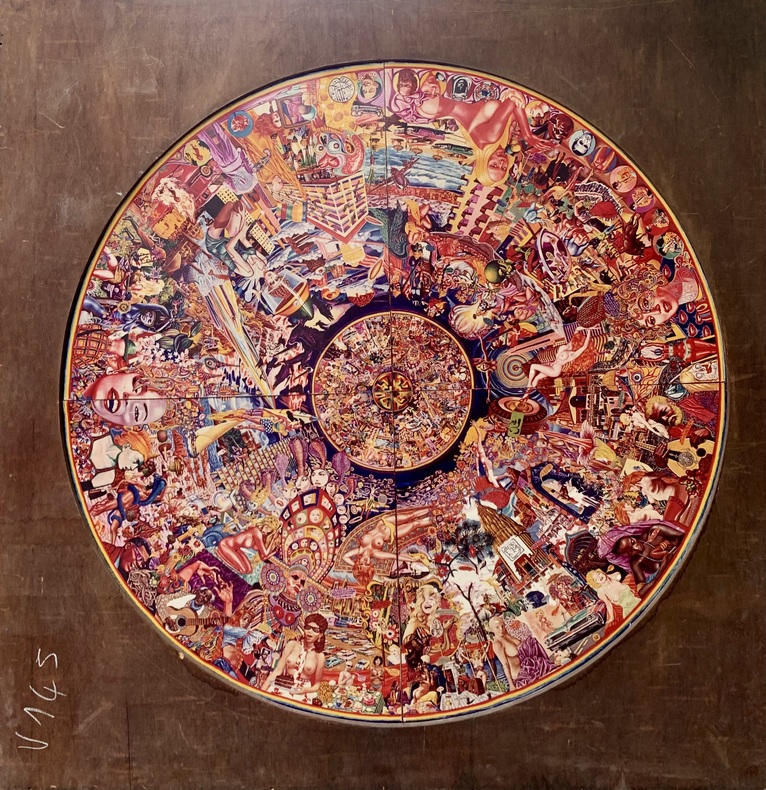
réf. awd-1157Important tirage photographique en couleurs monté dans un encadrement carré en bois, ajouré en cercle au centre. Très rare épreuve, peut-être tirée pour un essai de couleurs lors de la commercialisation d’une affiche en 1969. Mentions Mati Klarwein, Grain of Sand, Robert Crandall Assoc., 1968 sur le côté avec échelles chromatiques, petits manques de pigmentation dans la partie basse (111,5/117,2 cm dans un cadre de 122/122 cm).
1615réf. 002850Paris, Chez Toussainct du Bray, 1615
1837Very Good Turkish, Ottoman (1500-1928) Contemporary quarter leather binding with gilt decorations without title lettering. Demy 8vo. (22 x 14 cm). In Ottoman script (Old Turkish with Arabic letters). Seven different books and tractates (nine works) in one volume: (235, [1] p., 24 p., 143 p., 80 p., [6], 71 p., 84 p., 22 p.). Two leaves are torn from the hinge in the first book but not missing, one tractate is trimmed by margins, the board's extremities are worn, overall a good volume including multiple books. First editions (except for one) of these exceedingly rare poetic tractates collected together contemporarily in one handsome volume, reflecting early Ottoman poetic pleasure, including thematic mystic and erotic poetry mostly printed in the early 19th century. This volume includes the multiple works of Enderunlu Fazil and Sünbülzâde Vehbi, which are the earliest erotic and homosexual poems that seem to have been concealed by adding Keçecizâde's works to the beginning and the end of the volume. "Defter-i ask" [i.e. The book of love] by Fazil, in which he tells about his own romances, is a masnavi of 438 couplets. It begins with a description of divine love and tells the story of the poet's romances, which he fell into only to regret and repent afterward. "Hubannâme" [i.e. The book of beautiful young men] consists of 796 couplets with various titles and it has a mystical analysis of beauty in the first chapter. After an introduction that gives geographical information that may be considered novel for its period, it describes the beauties of male bodies of many countries from India to America. This style is unique and the first in Turkish / Ottoman literature. In the work titled "Zenannâme" [i.e. The book of women], which is a masnavi of 1101 couplets, women of various nations are described. The poet indicated in the introduction of his work that he does not want to talk about women, and that he has no orientation towards women. Enderunlu Fazil was an Ottoman poet who depicted the beauty of men from various lands of the Ottoman Empire. He achieved fame through his erotic works, which were published posthumously. Among his most famous works is The Book of Women, which was banned in the Ottoman Empire. The book describes the advantages and disadvantages of women from different nations. Fazil was born in Acre into an Arab family originally of Medina. He spent his early years in Safed in Ottoman Palestine. His grandfather Zahir al-Umar and father Ali Tâhir were both executed (in 1775 and 1776, respectively ) for participating in a rebellion. After his father's death, Fazil moved to Istanbul. There, he was admitted to the Enderun palace school (thus taking on the name Enderuni or Enderûnlu), but was expelled in 1783 as a result of his love affairs with other men there. In 1799, he was exiled to Rhodes because of his satirical writings and was only allowed to return to Istanbul after becoming blind. He spent the rest of his life there, ill and bedridden. Other books in the volume: Manzumetü'l-müsemma be-mihnet-kesan, Ceride-i Havadis Matbaasi, Ist., AH 1269 = AD 1853. 235 p., 1 portrait of Keçecizâde. Lithography. Özege 13354.; Two copies are located in OCLC 57242940 - 51281526. This work is a social satire type masnavi in which Izzet Molla was exiled to Kesan, telling of the troubles he suffered there, and his pardon and returns to Istanbul. Destar-i hayâl., Osman Nevres Efendi (1820-1876), Matbaa-i Âmire, Ist., AH 1289 = AD 1872. 24 p., Özege 3899. First and Only Edition. This rare work is a masnavi consisting of six stories. Defter-i ask, Hubannâme, Zenânnâme and Sevkengîz., Enderuni Fazil (1757-1810) and Sümbülzâde [or Sünbülzâde] Vehbi, (1718-1809)., Darü't-Tibaatü'l-Âmire, Ist., AH 1253 = AD 1837., 143 p. (pp. 1-20 Defter-i ask; pp. 22-55 Hubânnâme; pp. 56-111 Zenânnâme; pp. 112-143 Sevkengîz.). Özege 18902. First Edition. Tuhfe-i Dilkes Nâli, Yusuf Nabi [sic] [Nâlî, Muhammed b. Osman el-Konevî, (For more info please visit our website)
1957réf. 8665AWesterham Press Limited London 1957 HB NODJ issuedBound in full vellum LEATHER with a gold feur de lis pattern Decorative Cover decorated Beautifully in Gold Gilt Cover Has Very Slight Curve1957 1st Limited Edition Blue Slipcase small Stain & light wear 66 pgs edges pages Gold Gilt Minor Wear 5 1/2 X 9 inches NF/VG AS-IS NODJ. Signed by Author. First Edition. Hard Cover. Westerham Press Limited London hardcover
1783réf. 002461Paris, Bastien, 1783
1777réf. AMO-4489A Genève et se trouve à Paris, chés la Veuve Duchêne, 1777. 2 parties reliées en 1 volume in-12 (17,7 x 10,2 cm environ) de 244 et 244 pages (+ 6 feuillets non chiffrés). 15 figures hors-texte. Reliure de l'époque plein veau brun tacheté à l'acide, dos lisse à faux-nerfs filetés, pièces de titre en maroquin rouge, tranches rouge pâle, doublures et gardes de papier marbré. Exemplaire très frais conservé dans sa première reliure. Exemplaire bien complet des 6 feuillets de Revue des ouvrages de l'auteur qui manquent presque toujours à la fin du volume. Quelques restaurations professionnelles de qualité à la reliure (mors, coiffes et coins), petite épidermure au premier plat (coin inférieur). Les restaurations sont à peine visibles. L'ensemble est de très grande qualité. Edition originale et unique édition du premier ouvrage illustré de Rétif de la Bretonne.
1688réf. 47558London: Printed for John Taylor at the Ship in S. Paul's Church-Yard 1688. .Measures of Land. Moreover a More Facile and Sure Way of Surveying by the Chain than has Hitherto Been Taught. As also How to Lay-out New Lands in America or elsewhere: And how to make a Perfect Map of a River's Mouth or Harbour; with several other Things never yet Publish'd in our Language. Leather scuffed corners heavily bumped with minor loss light but large stain to front board front hinge heavily cracked and front board nearly detached rear hinge weak and rear gutter cracked. Heavy period ink mathematical notes to both pastedowns with the odd calculation to logarithm tables to rear and odd pencil mathematical drawing or calculation at certain points within. Previous owner stamp to title page. Some dampspots and general discolouration to closed edges. The occasional fingerprint spot or light stain to pages otherwise text block tight text and diagrams in good order clean and bright. Full Leather. Good Minus/No Jacket. 8vo. Printed for John Taylor, at the Ship in S. Paul's Church-Yard Hardcover
réf. 100391aafParis, "La Connaissance", (typographie de R. Coulouma, Argenteuil), 1926, gr. in-8vo, 2 ff., titre en bistre et noir + XII + 215 ff., orné de 166 bandeaux et culs-de-lampe, gravés sur cuivre et tirés en bistre + 15 pointes-sèches rehaussées à la gouache et à l'aquarelle (coloris de Tabary), non rogné, minime déchirure en haut de la page de garde devant, reliure en maroquin mosaïqué faite à la main par Vera Créola sur brochure originale illustrée (avec une jolie vignette en couleurs).
1830réf. 000655Paris Levavasseur 1830
2003réf. G0723432392I4N00Mosby Ltd. 2003. Hardcover. Very Good. May have limited writing in cover pages. Pages are unmarked. ~ ThriftBooks: Read More Spend Less.Dust jacket quality is not guaranteed. Mosby Ltd. hardcover
Four volumes. A COMPLETE SET, ON SPECIAL PAPER, OF THE MOST IMPORTANT PUBLICATION OF SPANISH MEDIEVAL TEXTS. Comprises, IN FIRST EDITION, (I) the Poema del Cid, (II) the complete works of Berceo, (III) the Poem of Alejandro Magno, and (IV) the Arcipreste de Hita's Libro de buen amor (this fourth volume is almost always missing.) This is A SPECIAL SET, PRINTED ON THICK PAPER. This is furthermore AN ASSOCIATION COPY, from the library of DANIEL DEVOTO AND MARIA BEATRIZ DEL VALLE-INCLAN (their stamp on rear endpapers). Devoto (1916-2001) was an important intellectual figure who counted among his close friends many of the great literary figures of 20th-century Spain, France, and Latin America. He wrote many books and articles, some of which concern the texts which appear in the present publication. COMPLETE WITH ALL HALF-TITLES. 8vos. ATTRACTIVELY BOUND IN SPANISH CALF. Tiny traces of wear to bindings, else an EXCELLENT SET. In the introduction to his edition of El poema del Cid, Colin Smith emphasizes the great importance of this publication, pointing out that Sanchez was way ahead of his time as a textual editor. AN OUTSTANDING SET OF AN EXTREMELY RARE AND IMPORTANT PUBLICATION, WITH A FINE PROVENANCE.
1754réf. AMO-4507Sans lieu, sans nom, 1754 [Paris, Grangé]. 5 volumes petits in-12 (16 x 10 cm | Hauteur des marges : 158 mm) de (2)-VI-(2)-368, (2)-283-(1), (2)-390 pages et 1 feuillet de table paginé par erreur 387/388, (2)-320, (2)-314-(2) pages chiffrées, sans compter les feuillets liminaires et les feuillets de table. Chaque volume possède un titre-frontispice gravé à l'eau-forte d'après Choffard. Reliure plein maroquin bleu nuit, dos à nerfs, chiffre couronné répété (voir provenance) dans les caissons aux dos et dans les angles des plats, encadrement intérieur composé de roulettes et filets dorés, doublures et gardes de papier peigne, non rogné (ébarbé), relié sur brochure. Splendide exemplaire parfaitement établi par Capé au milieu du XIXe siècle, exceptionnellement grand de marges. Très frais. Nouvelle édition.
1931réf. 20137Bibliophiles de l'Automobile-Club de France 1931 1 Préface en partie inédite de M.Théodore Decalandre, illustré d'eaux-fortes en couleur à 2 planches de J.-E. Laboureur. Paris, les Bibliophiles de l'Automobile-Club de France, 1931, grand in-8, maroquin vert, dos titré or, tête dorée, couverture imprimée, sous étui d'un papier façon tissage vert et noir bordé de maroquin vert, 6 pages, LII et 155 pages, (AT.Boichot Relieur).
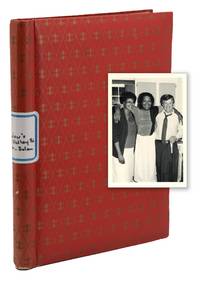
réf. 140947542Winston-Salem NC: No publisher 1980. Very Good. Photo album containing candid snapshots of Maya Angelou and her friends and associates. Fifty-seven photos of which 23 are in color and 34 in black and white under glassine on sticky album pages. Bound in padded red and gold paper-covered boards handlettered label sticker to spine internal spiral binding. Very Good with rubbed lower edges fading to spine and split to paper at lower rear joint. Pages toned adhesive coating weak; most pictures have shifted around and are loose behind the glassine. Most of the photos were taken at the same event at Angelou's house during the 1980s though several near-duplicates depict Eugene B. Redmond and Ruth Love standing in front of an art installation. One street scene portrait of Redmond is inscribed on the back: "To Ruth - Best Imani. Street scene New York Fall '85." Maya Angelou moved to the North Carolinian city of Winston-Salem after accepting a lifetime professorship at Wake Forest University in 1981 which she held until her death in 2014. Angelou who appears in eleven of these photos found the experience transformative. She once told a USA Today reporter that "I'm not a writer who teaches. I'm a teacher who writes. But I had to work at Wake Forest to know that." Among Angelou's many guests was the poet and professor Eugene B. Redmond a longtime close friend who appears twenty-four times in this album and who stamped many of the photos on verso with "Compliments Poet-Eugene B. Redmond." The educator Ruth Love appears in forty of the photographs. As the Superintendent of the Oakland School system in the late 1970s she created programming to bring prominent African Americans including Maya Angelou face to face with students in order to inspire and educate them. The two women maintained their friendship and traveled to Ghana together in 1993. An intimate look into the personal life of one of the greatest figures of American writing touching in its ordinariness. [No publisher] unknown
réf. 140947542Winston-Salem NC: No publisher 1980. Very Good. Photo album containing candid snapshots of Maya Angelou and her friends and associates. Fifty-seven photos of which 23 are in color and 34 in black and white under glassine on sticky album pages. Bound in padded red and gold paper-covered boards handlettered label sticker to spine internal spiral binding. Very Good with rubbed lower edges fading to spine and split to paper at lower rear joint. Pages toned adhesive coating weak; most pictures have shifted around and are loose behind the glassine. Most of the photos were taken at the same event at Angelou's house during the 1980s though several near-duplicates depict Eugene B. Redmond and Ruth Love standing in front of an art installation. One street scene portrait of Redmond is inscribed on the back: "To Ruth - Best Imani. Street scene New York Fall '85." Maya Angelou moved to the North Carolinian city of Winston-Salem after accepting a lifetime professorship at Wake Forest University in 1981 which she held until her death in 2014. Angelou who appears in eleven of these photos found the experience transformative. She once told a USA Today reporter that "I'm not a writer who teaches. I'm a teacher who writes. But I had to work at Wake Forest to know that." Among Angelou's many guests was the poet and professor Eugene B. Redmond a longtime close friend who appears twenty-four times in this album and who stamped many of the photos on verso with "Compliments Poet-Eugene B. Redmond." The educator Ruth Love appears in forty of the photographs. As the Superintendent of the Oakland School system in the late 1970s she created programming to bring prominent African Americans including Maya Angelou face to face with students in order to inspire and educate them. The two women maintained their friendship and traveled to Ghana together in 1993. An intimate look into the personal life of one of the greatest figures of American writing touching in its ordinariness. [No publisher] unknown books
1946réf. 3933Éditions du Chêne, Paris 1946. In-4 (340 x 260 mm) en feuilles. 95 pp. + ffnch., en feuilles, sous couverture rempliée illustrée sur les deux plats, chemise titrée toilée et étui de l'éditeur. Édition originale des poésies de Pierre Reverdy "illustrée" de 14 LITHOGRAPHIES ORIGINALES A PLEINE-PAGE PAR HENRI MATISSE, tirées en sanguine, 17 LINOGRAVURES en noir et blanc (3 sur la couverture et 14 culs-de-lampe) et 14 lettrines composées par l'artiste. Tirage à 250 exemplaires : celui-ci, 1 des 200 numérotés sur vélin à la forme de Lana, SIGNÉ AU CRAYON PAR LE PEINTRE ET LE POÈTE. Les lithographies ont été tirées par Mourlot Frères, les linogravures et le texte par Fequet et Baudier, Paris. - ENGLISH DESCRIPTION: The complete book/portfolio with 14 original full-page original lithographs in sanguine, 14 original linocuts in black with 3 on the wrappers. The book is signed with pencil by Pierre Reverdy and Henri Matisse on the justification page. The 14 hors-text lithographs are in perfect condition, no offseting, no foxing, no dirt or stains. A perfect copy in loose sheets as issued. Suite de très beaux portraits féminins illustrée par la poésie de Pierre Reverdy et non l'inverse comme le précise Matisse dans le titre.
1824réf. 181153Likely London: c. 1824. Peacock the company man A draft official document composed by Peacock in his capacity as an assistant examiner at East India House. The submission to the Board of Trade summarizing the views of the Court of Directors responds to complaints from tea-dealers in Edinburgh that the company was failing to adequately supply the home market forcing prices upwards and delivering inferior products. Peacock's "provisional appointment. was approved by the court of directors in May 1819 as part of a larger experiment to open the higher posts in the examiner's office to outside talent. At the East India House he showed great skill in drafting dispatches and his appointment was confirmed in April 1821 with a salary rise to £800. His subsequent career was one of steady advancement" ODNB. This document is a provisional draft differing somewhat in wording and content from the final version published in parliamentary papers and signed by Joseph Dart the company's secretary. The document is discussed in the expansive 1924-34 edition of Peacock's works: "The latest Peacock MS. to be discovered consists of his 'Observations on a Memorial which has been presented to the Right Honourable the Lords Commissioners of His Majesty's Treasury from certain Tea-dealers of the City of Edinburgh.' It is a pencil draft written on paper bearing the East India Company's watermark probably in 1824 the date '6th February 1824' is mentioned in the Postscript and the first paragraph explains that the Memorial having been transmitted 'for the consideration and remarks of the Court of Directors of the East India Company the Court have taken the subject into due consideration and submit their observations accordingly.'" Brett-Smith & Jones pp. 461-2. Accompanying this manuscript is a small portion from a manuscript seemingly unpublished Peacock wrote for the London Magazine. It concerns the pleasures of the scenery of Surrey. Bifolia 315 x 200 mm watermarked East India Company J. Whatman 1821 written across 3 sides in pencil with 20th-century typescript transcription couple of handwritten amendments. Provenance: Thomas Love Peacock 1785-1866 - by descent to Edith Nicholls Peacock's granddaughter her handwritten note on the front of the bifolium in which the manuscript is housed: "I suppose this to be part of an article on Indian exports by T.L.P. but it is almost impossible to read it" - reported by Brett-Smith & Jones as acquired in February 1933 by Roger Ingpen 1868-1936 the literary scholar specializing in Shelley and his circle - Charles Dudley Massey 1905-1980 - by descent to Stephen C. Massey. 10 bifolia and single sheet 335 x 210 mm watermarked East India Company J. Whatman 1823 written across 32 sides in pencil enclosed in bifolium of same paper. Enclosed in folded sheet of brown paper folded down to 295 x 210 mm. Toning nicking and other signs of handling more so to enclosing bifolium: very good. H. F. B. Brett-Smith & Clifford Ernest Jones eds. The Works of Thomas Love Peacock Volume VIII 1934. unknown
1817réf. 757L1London: T Hookham 1817. First edition. Leather. Very Good Indeed. 6.5" by 4". None. A very scarce first edition of Thomas Love Peacock's noted novel 'Melincourt'. It is Love Peacock's second novel. In a contemporary quarter calf binding with paper covered boards.The premise of this novel is Love Peacock's attempt to ridicule the so-called Rotten Boroughs of the United Kingdom. These areas had electorate so small that they were frequently used by a patron to gain unrepresentative influence within the unreformed House of Commons. It is a vibrant satire which sees an orangutan as a member of parliament. Sir Oran visits Melincourt where he meets the heroine of the tale Anthelia Melincourt. Other themes in this satire include consumerism the dangers of paper-money the value of chivalry and the boundaries between humans and animals. Bound without the half-titles.With the bookplate of John Phillips Beavan to the front pastedown. A rare work and one of Thomas Love Peacock's best satires. In a half calf binding with paper covered boards. Externally very smart with light patches of rubbing to the head and tail of spines. Bookplates to the front pastedowns. Internally firmly bound. Pages are bright. Scattered spots to the endpapers. Occasional light spots throughout. Very Good Indeed T Hookham hardcover
1910réf. 6245Various locations 1910. Very good. Approximately 150 letters totaling around 600pp. With approximately 250 photographs. Several letters with envelopes stamps clipped. Old folds some light wear and soiling. An extensive archive of letters and photographs belonging to an American diplomat in Morocco and Ethiopia. Guy Robert Love 1876-1913 was a dentist in Coshocton Ohio when he sought adventure in 1907 -- opening up a dentistry practice in Tangier Morocco. In June 1908 he was appointed Vice Consul in the United States diplomatic corps and then took the same post at Addis Ababa in Abyssinia now Ethiopia during the last years of the venerable Emperor Menelik II. Although the United States had previously appointed African-American consuls such as Frederick Douglass Love was not Black. His letters here are primarily written to his mother along with several other family members and most are several pages long. The bulk of the correspondence was sent from Abyssinia and is on American Legation letterhead. The correspondence begins on October 7 1907 with Love's arrival at Gibraltar and he then sends his first letter from Tangier on October 30 1907. On December 27 1907 he explains his market niche: "There are a couple of Spanish dentists here who work very cheap. They get the cheap class as my prices are way over their heads. I get the rich Moors and foreign ministers and members of the diplomatic corps." In quick order he was able to meet Kaïd Sir Harry Maclean a famed Scottish instructor to the Moroccan army March 2 1908 and on June 20 1908 he reports "I had a new job last Monday and Tuesday. Was appointed clerk of the U.S. Consulate Court here." By November 28 1908 he was considering following the consul to a new position in Abyssinia. He discusses the consul Hoffman Philip on January 5 1909: "We are to be I think the only Americans in Addis Ababa. He was one of Theodore Roosevelt's Rough Riders in the Cuban campaign and has been here as consul general ever since." Philip's connections proved handy as they made the long journey from Morocco through the Mediterranean -- en route to Ethiopia Love crossed paths with ex-president Theodore Roosevelt who was on his way to beginning the Smithsonian-Roosevelt African expedition. A postscript of April 9th encloses a faded snapshot of him with Roosevelt on deck and another of "Kermit Roosevelt & the naturalists going ashore at Ismailia halfway through canal. They shot birds & joined boat at Suez." Another photograph shows Theodore and Kermit Roosevelt with Love aboard a launch boat per the caption. They parted ways on April 17th in Aden Arabia: "Everyone was at the rail to get a look at Mr. Roosevelt. They had a big teddy bear on a platform just under the bridge and all cheered when we passed as Mr. R was enjoying it as much as anyone. Mr. Rosevelt bid me good bye and wished me all the success in the world and asked me to express his gratitude to Emperor Menelik for his kindness." Love's first letter from Ethiopia was May 2 1909 at Dire Dawa between Djibouti and Addis Ababa where he remained for several weeks waiting for Mr. Philip and trying to secure transportation to the capital. He arrived in Addis Ababa on June 19th and a fragment of a letter from July 6th describes his first encounter with the Emperor: "We were notified that Menelik would be pleased to receive us at the Guebbi palace on Tuesday the 6th." With perhaps 10000 in attendance "all standing except his majesty who was propped up on cushions on his throne. It was a very formal affair but he is a good sort but is certainly not going to last many moons. His voice is very weak and he was breathing quite heavy." Love attended a banquet on the anniversary of Menelik's coronation on September 30 1909: "The two court fools made fools of themselves during the feast and a man was brought in for our benefit as a curiosity who sat on the floor in front of the king and eat over half a bullock raw. I don't blame you for not believing this." The Ethiopian staple injera is described: "Native bread was also served in huge quantities and is like an enormous pancake." He accompanied Philip for a personal audience with the Emperor and Empress on October 15th. Their interpreter "is usually a very proud old man and is highly respected by all the natives but they are all held in such subjection by the Emperor that they are scared to death in his presence." The letters are full of good local color. On October 28 1909 Love explains mail delays: "It was supposed that the couriers had been murdered in the Dankali country as the couriers of July 9 had been as the natives there have been looting caravans and amusing themselves general at someone else's expense and inconvenience but the couriers turned up last night and said the delay was caused by the mules dying on the way and as there are no animals in that part of the country except camels and they are owned by hostile tribes it was a difficult matter to get mules." On November 5 1909 he reports: "The Emperor had a third stroke last Thursday and is not expected to live but a few days. The crown prince Lij Iyasu has been publicly proclaimed successor and for the past week the government affairs have been practically in his hands." The Emperor lived four more years until December 1913 longer than Consul Love did. He died suddenly several months earlier only in his mid-thirties. The regular correspondence comes to an end on December 31 1910 although Love remained in Addis Ababa for more than two years after that. Only two later letters are present dated March 1911 and August 1912. The collection also includes a large collection of photographs taken by Love in North Africa and Abyssinia. Most are about 3½ x 5½ inches plus one larger cabinet card of Love and two views of Love's 1913 funeral procession. A fabulous record of American diplomacy in Eastern Africa during the early-20th century. unknown