Norman Rockwell and Philip H LoveBiblio.com
8.136 Ergebnisse
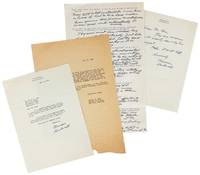
1960Best.-Nr. 50099Stockbridge MA / Washington DC 1960. Very Good. Stockbridge MA & Washington DC: 1960. Small but important archive of correspondence between the beloved artist/illustrator Norman Rockwell 1894-1978 and the DC-based journalist Philip H. Love 1905-1977. Carbon copy of Love's letter toned and foxed with large loss at bottom edge not approaching text else Very Good. Love was the author of the popular syndicated series "Love on Life" consisting of short humorous pieces on the foibles of the times. This collection of correspondence dates from the spring and summer of 1960 when Love was putting together a series of essays called "Why Study." for an issue of The Evening Star's Sunday Magazine. The series comprised of short essays by authorities in their respective fields explaining the importance of studying these fields. This archive relates to Love inviting Rockwell to answer the question "Why Study Art" The collection consists of the following: 1. Short one-paged typed letter signed by Rockwell dated Stockbridge MA May 19 1960. Rockwell responds to a letter not present from Love inviting the artist to contribute an essay on Art for an issue of The Evening Star Sunday Magazine. "I do appreciate being asked to write an article on Art for you but quite honestly I am no writer and I don't have the time to do it. If you care to write something which seems appropriate to you and send it to me I will check it and sign it if it seems OK." 2. Carbon copy of Love's response dated May 25 1960 in which he refers to a questionnaire he has included with his letter. "If you could jot down your answers to the attached questions in the spaces provided and send it back I would have a writer put something together and submit it to you for your approval." 3. Original typescript leaf of Love's questionnaire a series of seven prompts filled out in manuscript ink by Rockwell. The first question asks "Does a good artist just 'grow' or does he have to work to develop his talent" Rockwell responded "Every good artist or illustrator I ever knew or heard of had to be a hard worker. Even genius does not produce masterpieces or even good work automatically or easily." 4. Short undated autograph note signed by Rockwell to Love "By my answers you will easily see why I'm no essayist." Indeed the meat of Rockwell's answers were cleaned up and arranged into a short essay published in the August 21 1960 issue of The Star Magazine. "His" piece was accompanied by contributions by President Eisenhower on "Why Study Languages"; Edward Teller on Physics; Eugene Ormandy on Music; and Patricia McGerr on Literature. unknown
1960Best.-Nr. 50099Stockbridge MA / Washington DC 1960. Very Good. Stockbridge MA & Washington DC: 1960. Small but important archive of correspondence between the beloved artist/illustrator Norman Rockwell 1894-1978 and the DC-based journalist Philip H. Love 1905-1977. Carbon copy of Love's letter toned and foxed with large loss at bottom edge not approaching text else Very Good. Love was the author of the popular syndicated series "Love on Life" consisting of short humorous pieces on the foibles of the times. This collection of correspondence dates from the spring and summer of 1960 when Love was putting together a series of essays called "Why Study." for an issue of The Evening Star's Sunday Magazine. The series comprised of short essays by authorities in their respective fields explaining the importance of studying these fields. This archive relates to Love inviting Rockwell to answer the question "Why Study Art" The collection consists of the following: 1. Short one-paged typed letter signed by Rockwell dated Stockbridge MA May 19 1960. Rockwell responds to a letter not present from Love inviting the artist to contribute an essay on Art for an issue of The Evening Star Sunday Magazine. "I do appreciate being asked to write an article on Art for you but quite honestly I am no writer and I don't have the time to do it. If you care to write something which seems appropriate to you and send it to me I will check it and sign it if it seems OK." 2. Carbon copy of Love's response dated May 25 1960 in which he refers to a questionnaire he has included with his letter. "If you could jot down your answers to the attached questions in the spaces provided and send it back I would have a writer put something together and submit it to you for your approval." 3. Original typescript leaf of Love's questionnaire a series of seven prompts filled out in manuscript ink by Rockwell. The first question asks "Does a good artist just 'grow' or does he have to work to develop his talent" Rockwell responded "Every good artist or illustrator I ever knew or heard of had to be a hard worker. Even genius does not produce masterpieces or even good work automatically or easily." 4. Short undated autograph note signed by Rockwell to Love "By my answers you will easily see why I'm no essayist." Indeed the meat of Rockwell's answers were cleaned up and arranged into a short essay published in the August 21 1960 issue of The Star Magazine. "His" piece was accompanied by contributions by President Eisenhower on "Why Study Languages"; Edward Teller on Physics; Eugene Ormandy on Music; and Patricia McGerr on Literature. unknown books
1895Best.-Nr. c2312260292xbvkMainly Lunéville / [Chateau] Le Frehaut (Maire's Autographs), Lunéville, Nice etc. ('secretary') and 1887/1895-96 ('Rimes feminines . . .'). 108 written pages on 88 sheets of different sizes and different papers varying between small-8vo and small-4to (Maire's autographs) / 60+ pages on 60 sheets (Maire's poetry written by another hand of the period) / 144 pages on 94 sm-4to sheets (Facsimile of 'Rimes feminines. . .', in a different order than in the printed book). - All bound together (Facsimile > Maire's autographs > Other writer, with a few M's inbetween) in a private black halfcloth binding with dark marbled panels, tipped-on the printed part of the original frontcover of 'Rimes feminines. . .' with Rasenberger's added autograph ''Handschrift-Faksimile! Am Schluss Original-Handschriften!''(transl.: ''Manuscript-facsimile! At the End Original-Manuscripts'') surrounded by an ornamental section of the frontcover of a German artistic and geographic series ('Die blauen Bücher') which used this design between 1910 and 1930; 4to. (ca. 26 x 19 x 3 cm; ca. 1 kg.).
1888Best.-Nr. 6182Savannah GA: The Morning News Print 1888. Good. 8¼" x 6". Green cloth over boards title gilt. Pp. 5 A-E 6 iv-v blank page 360. Good: Ex-library with remnants of call number to spine bookplate due cards and embossed stamp on title page; moderately shaken boards moderately worn with losses at spine tips ffep heavily notated. This is another copy of Love's History with several outstanding associations. A partially obscured inscription on the front pastedown shows that this particular copy was presented by R.R. Wright to D.C. Suggs. Richard Robert Wright Sr. who wrote part of the book's introduction was born into slavery in Georgia in 1855 and was valedictorian of the first graduating class of Atlanta University now known as the HBCU Clark Atlanta. He became an educator and newspaper editor who went on to serve as the first president of the Georgia Industrial College for Colred Youths GICCY the first public institution of higher learning for African Americans in the state. Under Wright's leadership GICCY hosted renowned lecturers including Booker T. Washington Mary McLeod Bethune and Mary Church Terrell. Wright later founded the first Black-owned bank in Philadelphia and co-founded the first organization of Black-owned banks in the country. The recipient of the book Dr. Daniel Cato Suggs was born in Wilson North Carolina in 1865. He was a wealthy Black businessman active in real estate and a teacher in the public school systems of North Carolina. He served as a professor at GICCY before being elected president in 1917 of Livingston College a private HBCU in Salisbury North Carolina noted for its strong affiliation with the African Methodist Episcopal Zion Church. This volume also contains a bookplate from Bennett College in Greensboro. Founded in 1873 as a normal school to educate freedmen and train both men and women as teachers Bennett is now a private HBCU liberal arts college for women. There is yet another interesting facet to this copy: the front free endpaper has two pages of handwritten notes regarding a speech given by David B. Hill in Savannah in 1892 as he was campaigning to be the Democratic candidate for United States President. We found the entirety of the speech's text in a newspaper account online and note the oddity of the possibility of a Southern African American attending a Democratic candidate' speech at that time. OCLC shows six holdings of the physical book over four entries. A unique copy with wonderful associations of Love's important history of the First African Baptist Church. The Morning News Print unknown
1888Best.-Nr. 6182Savannah GA: The Morning News Print 1888. Good. 8¼" x 6". Green cloth over boards title gilt. Pp. 5 A-E 6 iv-v blank page 360. Good: Ex-library with remnants of call number to spine bookplate due cards and embossed stamp on title page; moderately shaken boards moderately worn with losses at spine tips ffep heavily notated. This is another copy of Love's History with several outstanding associations. A partially obscured inscription on the front pastedown shows that this particular copy was presented by R.R. Wright to D.C. Suggs. Richard Robert Wright Sr. who wrote part of the book's introduction was born into slavery in Georgia in 1855 and was valedictorian of the first graduating class of Atlanta University now known as the HBCU Clark Atlanta. He became an educator and newspaper editor who went on to serve as the first president of the Georgia Industrial College for Colred Youths GICCY the first public institution of higher learning for African Americans in the state. Under Wright's leadership GICCY hosted renowned lecturers including Booker T. Washington Mary McLeod Bethune and Mary Church Terrell. Wright later founded the first Black-owned bank in Philadelphia and co-founded the first organization of Black-owned banks in the country. The recipient of the book Dr. Daniel Cato Suggs was born in Wilson North Carolina in 1865. He was a wealthy Black businessman active in real estate and a teacher in the public school systems of North Carolina. He served as a professor at GICCY before being elected president in 1917 of Livingston College a private HBCU in Salisbury North Carolina noted for its strong affiliation with the African Methodist Episcopal Zion Church. This volume also contains a bookplate from Bennett College in Greensboro. Founded in 1873 as a normal school to educate freedmen and train both men and women as teachers Bennett is now a private HBCU liberal arts college for women. There is yet another interesting facet to this copy: the front free endpaper has two pages of handwritten notes regarding a speech given by David B. Hill in Savannah in 1892 as he was campaigning to be the Democratic candidate for United States President. We found the entirety of the speech's text in a newspaper account online and note the oddity of the possibility of a Southern African American attending a Democratic candidate' speech at that time. OCLC shows six holdings of the physical book over four entries. A unique copy with wonderful associations of Love's important history of the First African Baptist Church. The Morning News Print unknown books
1816Best.-Nr. 757P57London: T. Hookham 1816. Leather. Very Good Indeed. 6.5" by 4". None. A lovely second edition of Thomas Love Peacock's first novel from the library of the Bloomsbury founder Lytton Strachey. The second edition of this work; the first and second edition were published in the same year and both are very scarce.From the library of Lytton Strachey with his bookplate to the front pastedown. Strachey was one of the founding members of the Bloomsbury Group bringing together influential figures such as Virginia Woolf and Vita Sackville-West. He was also a historian of the Victorian era publishing 'Eminent Victorians' and a noted biography of Queen Victoria.In a signed binding by Charles Lewis. Lewis was lauded was one of the best bookbinders of his day patronised by the 2nd Earl Spencer and the 6th Duke of Devonshire binding books for both Althorp and Chatsworth.'Headlong Hall' was Peacock's first long work of fiction grouping a selection of eccentric and obsessive people together at a country estate in Wales.Peacock was an English novelist active during the nineteenth century. He was a close friend of Percy Shelley the friends influencing each other's works. Peacock was a satirical writer best known for 'Nightmare Abbey' and 'Crotchet Castle'.Bound without half-title. In a full calf signed binding by Charles Lewis. Externally smart. A little rubbing and a few minor marks and spots to the boards and spine. Bookplate and binder's label to the front pastedown. Internally firmly bound. Pages are lightly age-toned and clean with just a couple of occasional light spots. Very Good Indeed T. Hookham hardcover
1812Best.-Nr. 757P50London: William Bulmer and Co Shakespeare Press; et al 1812. First edition. Leather. Good. 11" by 9". None. A very scarce first edition of Peacock's romantic poem on melancholy written in the same year that Peacock met Percy Shelley. The first edition of this work.A very scarce work.'The Philosophy of Melancholy' is an elaborate poem a mythological poem pondering the topic of melancholy.Written by Thomas Love Peacock. Peacock was an English novelist active during the nineteenth century. He was a close friend of Percy Shelley the friends influencing each other's works. Peacock was a satirical writer best known for 'Nightmare Abbey' and 'Crotchet Castle'.This work was published in the same year that Peacock met Shelley.Bookplate of Joseph Strutt to the pastedowns. This is possibly the businessman and philanthropist who came from a wealthy textile dynasty. He was a radical social reformer. In the original diced calf binding rebacked with the original boards restored. Externally generally smart with some marks to the boards including a ringmark to the front board. Spine is a little rubbed. Boards are lightly discoloured. A small amount of loss to the extremities. Bookplate to the pastedowns. Internally firmly bound. Pages are bright with some spots. Good William Bulmer and Co, Shakespeare Press; et al hardcover
1965Best.-Nr. 0010314Bocas DE Cenzia Panama Bright. Very Good with no dust jacket. 1965-1966. Hardcover. On offer is a manuscript logbook of extensive notes plus two typed reports from the Director of Investigations of an environmental commission responsible for the conservation and management of marine resources in the eastern Pacific Ocean. This collection feels particularly important when one considers the 21st century focus on environmental protection and climate change. This collection was compiled as part of a large project commissioned by the Inter-American Tropical Tuna Commission IATTC. The IATTC was initially established as a treaty between the United States and Costa Rica in 1949 with a mission to conduct research on marine resources in the ocean. According to its website its reason for being is responsibility for the conservation and management of tuna and other marine resources in the eastern Pacific Ocean from Canada in the north to Chile in the south. Additionally the IATTC has significant responsibilities for the implementation of the International Dolphin Conservation Program. Between 1965 and 1966 the IATTC carried out four Augmented Colombian EI Nino Oceanography ACENTO research cruises. The ACENTO project was intended to study the area of the Panama Bright to determine correlation between tuna availability and environmental conditions. All four research cruises took place on the ship Bocas de Cenzia which was owned and operated by Empresa Puertos de Colombia and had previously been used by the United States Army during World War II. The 1965 cruises took place in May August and November of 1965. The fourth and final cruise was scheduled for February of 1966. The collection on offer contains the printed report on the itinerary and findings of the November 1965 cruise as well as all the field notes and final typed report of the February 1966 cruise. The IATTC researchers on the 1966 cruise were lead by Director of Investigations Eric D. Forsbergh. His scientific team included Witold L. Klawe Enrique L. Diaz and Cuthbert M. Love. The expedition also included a large naval team to run ship operations. Finally the research cruise was attended by Tuna Commission guests including two professors from the University of Valle Universidad de Valle del Cauca in Cali Columbia. The Scientific Logbook contains detailed near constant handwritten notes from all four scientists. The notes take the reader through the minute to minute work of the research team. Through their notes we know exactly when they arrived at each research station and what they accomplished in each location. We get a sense of their ongoing challenges such as nets that are not properly tied mandated government labels that dont stick to samples challenges with the supplied specimen bottles that have leaks causing the oxygen to aerate wire getting caught in their nets and compromising their abilities to catch fish a broken down gas-powered alternator inclement weather and injuries to crew members. An excerpt that gives the flavor of how these issues are described in the logbook follows: Dr. Patino and Regalado plan to get off Dr. Regalado has been quite seasick a Coke bottle fell on a crew member and broke his nose. He will also be let off at Tumaco for treatment at Hospital Feb 21 1966. Through the notes the reader not only gets a deep sense of the research being accomplished but also of the personalities of the research team. For example head investigator Eric D. Forsbergh becomes increasingly frustrated by technical issues on the ship noting ongoing issues in all-caps and eventually using a red pencil crayon to write THERE MUST BE A CURSE ON US ON THIS WRETCHED SHIP Feb 23 1966. Forsbergh also notes non-research related events at the research station. For example at Station #18 on Gorgona Island he writes Yesterday the prisoners revolted killed some guards and took over a boat Feb 23 1966. An example of the scientific research notes follow: Apparently there is a very strong under current at bearing 00 which screwed up the nice timing we had made in the previous ACENTO cruises. Moved the boat several times until the direction of the current was estimated. Changed weights to a very heavy one <100 lbs Zooplankton haul went smoothly and got 5 bottles of samples; this seemsto be a rich area p 8. Accompanying the manuscript logbook are two reports on the ACENTO missions prepared and typed by Forsbergh. It seems that Forsbergh used his 1965 report for reference during the 1966 expedition. The 1966 report summarizes and expands upon the notes in the scientific logbook. One can assume the 1965 report does the same though we do not have that logbook to compare. These are excellent examples of the work that was being done in the mid-1960s in an effort to monitor and manage tuna fishery in the Pacific. Through its Alcotines Laboratory the IATTC provides a unique research ability for tuna and other pelagic species. For marine scientists or biologists these reports offer a terrific view of the level of work being done at that time and an interesting comparison point to work being done today. The report consists of a hardbound notebook accompanied by two type-written reports. The notebook measures 10.5 inches by 8 inches. It contains 72 pages and is approximately 85% complete. The notebook is in good condition with undamaged covers intact binding and legible handwriting. The two accompanying reports are single-sided typewritten pages. They are seven pages and six pages respectively. The notebook contains data recorded from an expedition in February 1966 and the two reports are dated Dec 1965 and March 1966 respectively. BIO NOTES ON DIRECTOR FORSBERGH: Eric D. Forsbergh. Forsbergh was a biological oceanographer who worked as a senior scientist with the IATTC. He was a Harvard graduate with a B. A. In biology and he lived in San Diego California until his death in 2014 at the age of 86. In his role with the IATCC Forsbergh co-published several papers on topics associated with marine biology. ; Manuscripts; Large 8vo 9" - 10" tall; 72 pages; Signed by Author . hardcover
1953Best.-Nr. 311614NP: WAYNE FELLOWS PRODUCTIONS/WARNER BROS. Near Fine. 1953. First Edition. Script. Final Script. Dated: May 1 1953. 90pp. Near fine in peach-colored studio covers with bradbound blue mechanically produced sheets. White revision sheets are present as well. Pencilled notes on blank reverse of a few pages Directed by John Farrow starring John Wayne in one of his signature roles as Calvary scout Hondo Lane with actress Geraldine Page in her supporting Oscar nominated debut performance. Also features Ward Bond in the memorable part of Buffalo Baker. Originally released in the 3-D process. O . WAYNE FELLOWS PRODUCTIONS/WARNER BROS. unknown
Best.-Nr. 22510S.l., s.n.1930. In-4, 57 pp., maorquin vert de Marot-Rodde mosaïqué de maroquin gris clair et orné de filets dorés au premier plat, dos long, important encadrement intérieur orné de même et d'un filet au palladium, doublure et garde de soie moirée verte, tranches dorées sur témoins, couverture conservée, chemise de demi-maroquin à bande vert orné de 2 filets au palladium doublée de basane grise, étui bordé (dos de la reliure et doublure de l'étui jaunis, une déchirure à cette doublure, quelques petites rousseurs, petits frottements et un accident à l'étui).
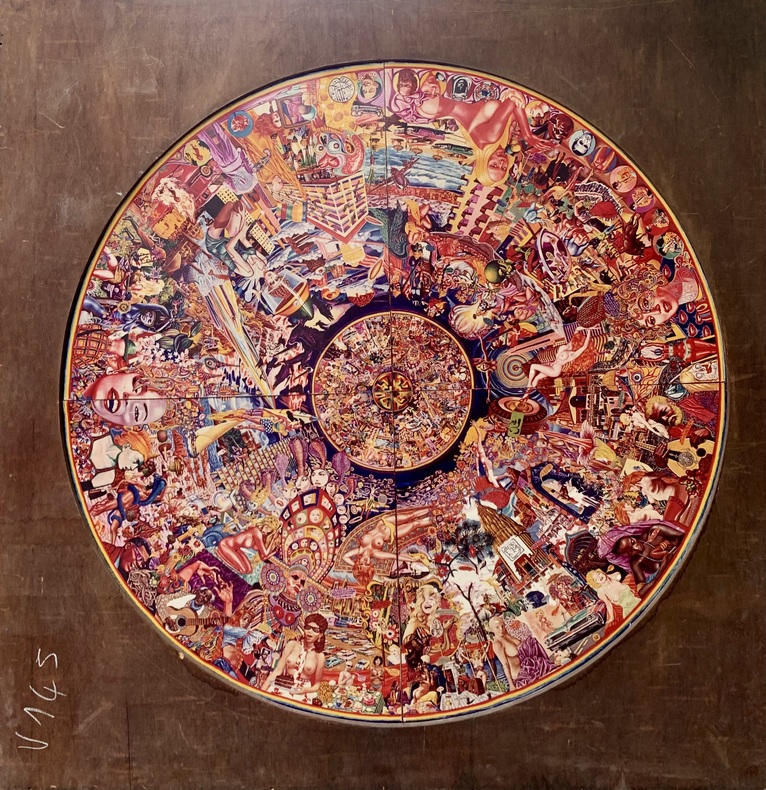
Best.-Nr. awd-1157Important tirage photographique en couleurs monté dans un encadrement carré en bois, ajouré en cercle au centre. Très rare épreuve, peut-être tirée pour un essai de couleurs lors de la commercialisation d’une affiche en 1969. Mentions Mati Klarwein, Grain of Sand, Robert Crandall Assoc., 1968 sur le côté avec échelles chromatiques, petits manques de pigmentation dans la partie basse (111,5/117,2 cm dans un cadre de 122/122 cm).
1615Best.-Nr. 002850Paris, Chez Toussainct du Bray, 1615
1837Very Good Turkish, Ottoman (1500-1928) Contemporary quarter leather binding with gilt decorations without title lettering. Demy 8vo. (22 x 14 cm). In Ottoman script (Old Turkish with Arabic letters). Seven different books and tractates (nine works) in one volume: (235, [1] p., 24 p., 143 p., 80 p., [6], 71 p., 84 p., 22 p.). Two leaves are torn from the hinge in the first book but not missing, one tractate is trimmed by margins, the board's extremities are worn, overall a good volume including multiple books. First editions (except for one) of these exceedingly rare poetic tractates collected together contemporarily in one handsome volume, reflecting early Ottoman poetic pleasure, including thematic mystic and erotic poetry mostly printed in the early 19th century. This volume includes the multiple works of Enderunlu Fazil and Sünbülzâde Vehbi, which are the earliest erotic and homosexual poems that seem to have been concealed by adding Keçecizâde's works to the beginning and the end of the volume. "Defter-i ask" [i.e. The book of love] by Fazil, in which he tells about his own romances, is a masnavi of 438 couplets. It begins with a description of divine love and tells the story of the poet's romances, which he fell into only to regret and repent afterward. "Hubannâme" [i.e. The book of beautiful young men] consists of 796 couplets with various titles and it has a mystical analysis of beauty in the first chapter. After an introduction that gives geographical information that may be considered novel for its period, it describes the beauties of male bodies of many countries from India to America. This style is unique and the first in Turkish / Ottoman literature. In the work titled "Zenannâme" [i.e. The book of women], which is a masnavi of 1101 couplets, women of various nations are described. The poet indicated in the introduction of his work that he does not want to talk about women, and that he has no orientation towards women. Enderunlu Fazil was an Ottoman poet who depicted the beauty of men from various lands of the Ottoman Empire. He achieved fame through his erotic works, which were published posthumously. Among his most famous works is The Book of Women, which was banned in the Ottoman Empire. The book describes the advantages and disadvantages of women from different nations. Fazil was born in Acre into an Arab family originally of Medina. He spent his early years in Safed in Ottoman Palestine. His grandfather Zahir al-Umar and father Ali Tâhir were both executed (in 1775 and 1776, respectively ) for participating in a rebellion. After his father's death, Fazil moved to Istanbul. There, he was admitted to the Enderun palace school (thus taking on the name Enderuni or Enderûnlu), but was expelled in 1783 as a result of his love affairs with other men there. In 1799, he was exiled to Rhodes because of his satirical writings and was only allowed to return to Istanbul after becoming blind. He spent the rest of his life there, ill and bedridden. Other books in the volume: Manzumetü'l-müsemma be-mihnet-kesan, Ceride-i Havadis Matbaasi, Ist., AH 1269 = AD 1853. 235 p., 1 portrait of Keçecizâde. Lithography. Özege 13354.; Two copies are located in OCLC 57242940 - 51281526. This work is a social satire type masnavi in which Izzet Molla was exiled to Kesan, telling of the troubles he suffered there, and his pardon and returns to Istanbul. Destar-i hayâl., Osman Nevres Efendi (1820-1876), Matbaa-i Âmire, Ist., AH 1289 = AD 1872. 24 p., Özege 3899. First and Only Edition. This rare work is a masnavi consisting of six stories. Defter-i ask, Hubannâme, Zenânnâme and Sevkengîz., Enderuni Fazil (1757-1810) and Sümbülzâde [or Sünbülzâde] Vehbi, (1718-1809)., Darü't-Tibaatü'l-Âmire, Ist., AH 1253 = AD 1837., 143 p. (pp. 1-20 Defter-i ask; pp. 22-55 Hubânnâme; pp. 56-111 Zenânnâme; pp. 112-143 Sevkengîz.). Özege 18902. First Edition. Tuhfe-i Dilkes Nâli, Yusuf Nabi [sic] [Nâlî, Muhammed b. Osman el-Konevî, (For more info please visit our website)
1957Best.-Nr. 8665AWesterham Press Limited London 1957 HB NODJ issuedBound in full vellum LEATHER with a gold feur de lis pattern Decorative Cover decorated Beautifully in Gold Gilt Cover Has Very Slight Curve1957 1st Limited Edition Blue Slipcase small Stain & light wear 66 pgs edges pages Gold Gilt Minor Wear 5 1/2 X 9 inches NF/VG AS-IS NODJ. Signed by Author. First Edition. Hard Cover. Westerham Press Limited London hardcover
1783Best.-Nr. 002461Paris, Bastien, 1783
1777Best.-Nr. AMO-4489A Genève et se trouve à Paris, chés la Veuve Duchêne, 1777. 2 parties reliées en 1 volume in-12 (17,7 x 10,2 cm environ) de 244 et 244 pages (+ 6 feuillets non chiffrés). 15 figures hors-texte. Reliure de l'époque plein veau brun tacheté à l'acide, dos lisse à faux-nerfs filetés, pièces de titre en maroquin rouge, tranches rouge pâle, doublures et gardes de papier marbré. Exemplaire très frais conservé dans sa première reliure. Exemplaire bien complet des 6 feuillets de Revue des ouvrages de l'auteur qui manquent presque toujours à la fin du volume. Quelques restaurations professionnelles de qualité à la reliure (mors, coiffes et coins), petite épidermure au premier plat (coin inférieur). Les restaurations sont à peine visibles. L'ensemble est de très grande qualité. Edition originale et unique édition du premier ouvrage illustré de Rétif de la Bretonne.
1688Best.-Nr. 47558London: Printed for John Taylor at the Ship in S. Paul's Church-Yard 1688. .Measures of Land. Moreover a More Facile and Sure Way of Surveying by the Chain than has Hitherto Been Taught. As also How to Lay-out New Lands in America or elsewhere: And how to make a Perfect Map of a River's Mouth or Harbour; with several other Things never yet Publish'd in our Language. Leather scuffed corners heavily bumped with minor loss light but large stain to front board front hinge heavily cracked and front board nearly detached rear hinge weak and rear gutter cracked. Heavy period ink mathematical notes to both pastedowns with the odd calculation to logarithm tables to rear and odd pencil mathematical drawing or calculation at certain points within. Previous owner stamp to title page. Some dampspots and general discolouration to closed edges. The occasional fingerprint spot or light stain to pages otherwise text block tight text and diagrams in good order clean and bright. Full Leather. Good Minus/No Jacket. 8vo. Printed for John Taylor, at the Ship in S. Paul's Church-Yard Hardcover
Best.-Nr. 100391aafParis, "La Connaissance", (typographie de R. Coulouma, Argenteuil), 1926, gr. in-8vo, 2 ff., titre en bistre et noir + XII + 215 ff., orné de 166 bandeaux et culs-de-lampe, gravés sur cuivre et tirés en bistre + 15 pointes-sèches rehaussées à la gouache et à l'aquarelle (coloris de Tabary), non rogné, minime déchirure en haut de la page de garde devant, reliure en maroquin mosaïqué faite à la main par Vera Créola sur brochure originale illustrée (avec une jolie vignette en couleurs).
1830Best.-Nr. 000655Paris Levavasseur 1830
2003Best.-Nr. G0723432392I4N00Mosby Ltd. 2003. Hardcover. Very Good. May have limited writing in cover pages. Pages are unmarked. ~ ThriftBooks: Read More Spend Less.Dust jacket quality is not guaranteed. Mosby Ltd. hardcover
Four volumes. A COMPLETE SET, ON SPECIAL PAPER, OF THE MOST IMPORTANT PUBLICATION OF SPANISH MEDIEVAL TEXTS. Comprises, IN FIRST EDITION, (I) the Poema del Cid, (II) the complete works of Berceo, (III) the Poem of Alejandro Magno, and (IV) the Arcipreste de Hita's Libro de buen amor (this fourth volume is almost always missing.) This is A SPECIAL SET, PRINTED ON THICK PAPER. This is furthermore AN ASSOCIATION COPY, from the library of DANIEL DEVOTO AND MARIA BEATRIZ DEL VALLE-INCLAN (their stamp on rear endpapers). Devoto (1916-2001) was an important intellectual figure who counted among his close friends many of the great literary figures of 20th-century Spain, France, and Latin America. He wrote many books and articles, some of which concern the texts which appear in the present publication. COMPLETE WITH ALL HALF-TITLES. 8vos. ATTRACTIVELY BOUND IN SPANISH CALF. Tiny traces of wear to bindings, else an EXCELLENT SET. In the introduction to his edition of El poema del Cid, Colin Smith emphasizes the great importance of this publication, pointing out that Sanchez was way ahead of his time as a textual editor. AN OUTSTANDING SET OF AN EXTREMELY RARE AND IMPORTANT PUBLICATION, WITH A FINE PROVENANCE.
1754Best.-Nr. AMO-4507Sans lieu, sans nom, 1754 [Paris, Grangé]. 5 volumes petits in-12 (16 x 10 cm | Hauteur des marges : 158 mm) de (2)-VI-(2)-368, (2)-283-(1), (2)-390 pages et 1 feuillet de table paginé par erreur 387/388, (2)-320, (2)-314-(2) pages chiffrées, sans compter les feuillets liminaires et les feuillets de table. Chaque volume possède un titre-frontispice gravé à l'eau-forte d'après Choffard. Reliure plein maroquin bleu nuit, dos à nerfs, chiffre couronné répété (voir provenance) dans les caissons aux dos et dans les angles des plats, encadrement intérieur composé de roulettes et filets dorés, doublures et gardes de papier peigne, non rogné (ébarbé), relié sur brochure. Splendide exemplaire parfaitement établi par Capé au milieu du XIXe siècle, exceptionnellement grand de marges. Très frais. Nouvelle édition.
1931Best.-Nr. 20137Bibliophiles de l'Automobile-Club de France 1931 1 Préface en partie inédite de M.Théodore Decalandre, illustré d'eaux-fortes en couleur à 2 planches de J.-E. Laboureur. Paris, les Bibliophiles de l'Automobile-Club de France, 1931, grand in-8, maroquin vert, dos titré or, tête dorée, couverture imprimée, sous étui d'un papier façon tissage vert et noir bordé de maroquin vert, 6 pages, LII et 155 pages, (AT.Boichot Relieur).
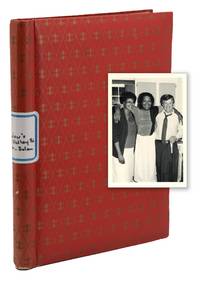
Best.-Nr. 140947542Winston-Salem NC: No publisher 1980. Very Good. Photo album containing candid snapshots of Maya Angelou and her friends and associates. Fifty-seven photos of which 23 are in color and 34 in black and white under glassine on sticky album pages. Bound in padded red and gold paper-covered boards handlettered label sticker to spine internal spiral binding. Very Good with rubbed lower edges fading to spine and split to paper at lower rear joint. Pages toned adhesive coating weak; most pictures have shifted around and are loose behind the glassine. Most of the photos were taken at the same event at Angelou's house during the 1980s though several near-duplicates depict Eugene B. Redmond and Ruth Love standing in front of an art installation. One street scene portrait of Redmond is inscribed on the back: "To Ruth - Best Imani. Street scene New York Fall '85." Maya Angelou moved to the North Carolinian city of Winston-Salem after accepting a lifetime professorship at Wake Forest University in 1981 which she held until her death in 2014. Angelou who appears in eleven of these photos found the experience transformative. She once told a USA Today reporter that "I'm not a writer who teaches. I'm a teacher who writes. But I had to work at Wake Forest to know that." Among Angelou's many guests was the poet and professor Eugene B. Redmond a longtime close friend who appears twenty-four times in this album and who stamped many of the photos on verso with "Compliments Poet-Eugene B. Redmond." The educator Ruth Love appears in forty of the photographs. As the Superintendent of the Oakland School system in the late 1970s she created programming to bring prominent African Americans including Maya Angelou face to face with students in order to inspire and educate them. The two women maintained their friendship and traveled to Ghana together in 1993. An intimate look into the personal life of one of the greatest figures of American writing touching in its ordinariness. [No publisher] unknown
Best.-Nr. 140947542Winston-Salem NC: No publisher 1980. Very Good. Photo album containing candid snapshots of Maya Angelou and her friends and associates. Fifty-seven photos of which 23 are in color and 34 in black and white under glassine on sticky album pages. Bound in padded red and gold paper-covered boards handlettered label sticker to spine internal spiral binding. Very Good with rubbed lower edges fading to spine and split to paper at lower rear joint. Pages toned adhesive coating weak; most pictures have shifted around and are loose behind the glassine. Most of the photos were taken at the same event at Angelou's house during the 1980s though several near-duplicates depict Eugene B. Redmond and Ruth Love standing in front of an art installation. One street scene portrait of Redmond is inscribed on the back: "To Ruth - Best Imani. Street scene New York Fall '85." Maya Angelou moved to the North Carolinian city of Winston-Salem after accepting a lifetime professorship at Wake Forest University in 1981 which she held until her death in 2014. Angelou who appears in eleven of these photos found the experience transformative. She once told a USA Today reporter that "I'm not a writer who teaches. I'm a teacher who writes. But I had to work at Wake Forest to know that." Among Angelou's many guests was the poet and professor Eugene B. Redmond a longtime close friend who appears twenty-four times in this album and who stamped many of the photos on verso with "Compliments Poet-Eugene B. Redmond." The educator Ruth Love appears in forty of the photographs. As the Superintendent of the Oakland School system in the late 1970s she created programming to bring prominent African Americans including Maya Angelou face to face with students in order to inspire and educate them. The two women maintained their friendship and traveled to Ghana together in 1993. An intimate look into the personal life of one of the greatest figures of American writing touching in its ordinariness. [No publisher] unknown books