DI GRADO ViolaLivre Rare Book

8 137 résultats
2012réf. 143264Couverture souple. Broché. 230 pages. Jaquette légèrement abîmée.
1846Very Good Turkish, Ottoman (1500-1928) Paperback. Chipped on margins. Some owner notes. Otherwise a good copy. Roy. 8vo. (24 x 18 cm). In Ottoman script. 32 p. This rare book includes the royal travel of Sultan Abdülmecid in 1262 AH [1846 AD] to Roumelia. From Edirne, Abdülmecid proceeded to Eski Zagra (Stara Zagora), Kizanlik (Kazanluk), Gabrova (Gabrovo), Tirnova (Turnovo), Rusçuk (Ruse), Silistre (Silistra), and Varna. The route of the 1846 tour followed closely, except in reverse order, Mahmud II's tour of 1837. According to witness accounts, along the way, the sultan was greeted everywhere with poetic recitations and songs of praise and prayer, both in Ottoman and Bulgarian. The pride of place among welcoming parties invariably fell on students, of all creeds, most clad in white uniforms, some in solemn church-going attire, with flowers and green branches in their hands. At every stop, ceremonial cannon salvos were fired during the day and elaborate firework illuminations were performed at night. In the town of Kizanlik, known then as now for the most fragrant roses and the best rose oil, the sultan's visit coincided, possibly by design, with the rose harvesting season. So the locals sprinkled rose water and poured rose oil before the sultan's cavalcade. According to Hristo Stambolski, in the three days of the sultan's stay in town, no rose harvesting was done so that the whole area would be exquisitely scented in his honor. For his part, the sultan had doctors vaccinate all children against smallpox in public before sending each one off with a small gift of money. Even people with rare diseases were, on occasion, summoned to the sultan's presence so his doctors could cure them. The sublime visit caused the locals, who were unaccustomed to direct contact with the center of power, quite a stir. The most detailed account, albeit from a hostile source, relates the sultan's visit to Rusçuk, which, at four days, may have also been the longest. According to Nayden Gerov, the greeting ceremonies proceeded on a communal basis, with the Jews being placed closest to the town walls, next to them the Armenians, then the Bulgarians, and finally, the Muslims, situated the farthest from town, yet being the first to see and welcome the sultan. As the sultan approached, each group of youngsters would in turn sing for him, everyone else bowing profusely. Based on Gerov's description, it seems that Abdülmecid was dressed in a slightly more luxurious fashion than during state ceremonies in Istanbul. ((Source: Sultan Abdülmecid's Tour of Rumelia and the Trope of Love by Stephanov). The sultan began to travel by the way of the gate of Yedikule in Istanbul in May 6, 1846. He followed the way of Ayastefanos, Silivri, Çorlu, Burgaz, Edirne, Zagra-i Atik, Kizanli, Trnova, Rusçuk, Silistre, Rusçuk, Shumnu, and Varna and came back to Istanbul by way of the sea on June 14, 1846. During this travel, the Sultan listened to people's problems and ordered the authorities to be solved with those problems. He received successful military and administrative authorities in settlements on the way of travel and rewarded them. He also received the governors of Serbia, Eflak and Bogdan, and the representatives of foreign states. With this travel, the Sultan aimed to strengthen the connection to the center of people and administrators in provinces. Özege 17910. First Edition.
1870Very Good Turkish, Ottoman (1500-1928) Contemporary cloth bdg. Rebacked spine. Roy. 8vo. (23 x 14 cm). In Ottoman script (Old Turkish with Arabic letters). 143 p. Slight tear on two leaves, wear on extremities of original marbled boards, otherwise a good copy. Early printed edition of this exceedingly rare collection of early Ottoman erotic poems of homosexuality and bisexuality, of the 18th century including the multiple works of Enderunlu Fazil and Sünbülzâde Vehbi. This book includes five works originally: Defter-i ask [i.e. The book of love] (pp. 1-21); Hubannâme [i.e. The book of male lovers] (pp. 22-55); Zenannâme [i.e. The book of beautiful women] (as well as "Çenginâme" of Fazil Bey in Zenannâme, pp. 102-111); and Sevkengiz [i.e. Inspiring] (pp. 112-143). "Defter-i ask" [i.e. The book of love] by Fazil, in which he tells about his own romances, is a mathnavi of 438 couplets. It begins with a description of divine love and tells the story of the poet's romances, which he fell into only to regret and repent afterward. "Hubannâme" [i.e. The book of male lovers] consists of 796 couplets with various titles and it has a mystical analysis of beauty in the first chapter. After an introduction that gives geographical information that may be considered novel for its period, it describes the beauties of male bodies in many countries from India to America. This style is unique and the first in Turkish / Ottoman literature. In the work titled "Zenannâme" [i.e. The book of beautiful women], which is a mathnavi of 1101 couplets, women of various nations are described. The poet indicated in the introduction of his work that he does not want to talk about women, and that he has no orientation towards women. Enderunlu Fazil was an Ottoman poet who depicted the beauty of men from various lands of the Ottoman Empire. He achieved fame through his erotic works, which were published posthumously. Among his most famous works is The Book of Women, which was banned in the Ottoman Empire. The book describes the advantages and disadvantages of women from different nations. Fazil was born in Acre into an Arab family originally from Medina. He spent his early years in Safed in Ottoman Palestine. His grandfather Zahir al-Umar and his father Ali Tâhir were both executed (in 1775 and 1776, respectively ) for participating in a rebellion. After his father's death, Fazil moved to Istanbul. There, he was admitted to the Enderun palace school (thus taking on the name Enderuni or Enderûnlu) but was expelled in 1783 as a result of his love affairs with other men there. In 1799, he was exiled to Rhodes because of his satirical writings and was only allowed to return to Istanbul after becoming blind. He spent the rest of his life there, ill and bedridden. Sümbülzâde's "Sevkengiz" [i.e. The Inspiring] is an erotic and mystical poem in which heterosexual and bisexual narratives compare male and female beauties and eventually turn to divine love. It has 770 couplets in the "münâzara" genre. Özege 7711.
1837Very Good Turkish, Ottoman (1500-1928) Contemporary quarter leather binding with gilt decorations without title lettering. Demy 8vo. (22 x 14 cm). In Ottoman script (Old Turkish with Arabic letters). Seven different books and tractates (nine works) in one volume: (235, [1] p., 24 p., 143 p., 80 p., [6], 71 p., 84 p., 22 p.). Two leaves are torn from the hinge in the first book but not missing, one tractate is trimmed by margins, the board's extremities are worn, overall a good volume including multiple books. First editions (except for one) of these exceedingly rare poetic tractates collected together contemporarily in one handsome volume, reflecting early Ottoman poetic pleasure, including thematic mystic and erotic poetry mostly printed in the early 19th century. This volume includes the multiple works of Enderunlu Fazil and Sünbülzâde Vehbi, which are the earliest erotic and homosexual poems that seem to have been concealed by adding Keçecizâde's works to the beginning and the end of the volume. "Defter-i ask" [i.e. The book of love] by Fazil, in which he tells about his own romances, is a masnavi of 438 couplets. It begins with a description of divine love and tells the story of the poet's romances, which he fell into only to regret and repent afterward. "Hubannâme" [i.e. The book of beautiful young men] consists of 796 couplets with various titles and it has a mystical analysis of beauty in the first chapter. After an introduction that gives geographical information that may be considered novel for its period, it describes the beauties of male bodies of many countries from India to America. This style is unique and the first in Turkish / Ottoman literature. In the work titled "Zenannâme" [i.e. The book of women], which is a masnavi of 1101 couplets, women of various nations are described. The poet indicated in the introduction of his work that he does not want to talk about women, and that he has no orientation towards women. Enderunlu Fazil was an Ottoman poet who depicted the beauty of men from various lands of the Ottoman Empire. He achieved fame through his erotic works, which were published posthumously. Among his most famous works is The Book of Women, which was banned in the Ottoman Empire. The book describes the advantages and disadvantages of women from different nations. Fazil was born in Acre into an Arab family originally of Medina. He spent his early years in Safed in Ottoman Palestine. His grandfather Zahir al-Umar and father Ali Tâhir were both executed (in 1775 and 1776, respectively ) for participating in a rebellion. After his father's death, Fazil moved to Istanbul. There, he was admitted to the Enderun palace school (thus taking on the name Enderuni or Enderûnlu), but was expelled in 1783 as a result of his love affairs with other men there. In 1799, he was exiled to Rhodes because of his satirical writings and was only allowed to return to Istanbul after becoming blind. He spent the rest of his life there, ill and bedridden. Other books in the volume: Manzumetü'l-müsemma be-mihnet-kesan, Ceride-i Havadis Matbaasi, Ist., AH 1269 = AD 1853. 235 p., 1 portrait of Keçecizâde. Lithography. Özege 13354.; Two copies are located in OCLC 57242940 - 51281526. This work is a social satire type masnavi in which Izzet Molla was exiled to Kesan, telling of the troubles he suffered there, and his pardon and returns to Istanbul. Destar-i hayâl., Osman Nevres Efendi (1820-1876), Matbaa-i Âmire, Ist., AH 1289 = AD 1872. 24 p., Özege 3899. First and Only Edition. This rare work is a masnavi consisting of six stories. Defter-i ask, Hubannâme, Zenânnâme and Sevkengîz., Enderuni Fazil (1757-1810) and Sümbülzâde [or Sünbülzâde] Vehbi, (1718-1809)., Darü't-Tibaatü'l-Âmire, Ist., AH 1253 = AD 1837., 143 p. (pp. 1-20 Defter-i ask; pp. 22-55 Hubânnâme; pp. 56-111 Zenânnâme; pp. 112-143 Sevkengîz.). Özege 18902. First Edition. Tuhfe-i Dilkes Nâli, Yusuf Nabi [sic] [Nâlî, Muhammed b. Osman el-Konevî, (For more info please visit our website)
1977Great color cover photo of inspirational vocalist Whitney Houston who was tragically taken from us far too early through the ravages of substance abuse. 6 pages. Store ink stamp on front cover, otherwise unmarked with moderate wear. A sound copy of this, perhaps Whitney Houston's trademark song. Book
1730réf. 910091CGAmsterdam:, Reimer & Ottens, um 1730. Kupferstich, Bildgröße 20,5 x 15,5 cm (hoch), Blattgröße 31,5 x 19,5 cm.
1955réf. B70407Ligonier PA: Rolling Rock Country Club 1955. Hardcover. Very good. RARE! Gilt stamped blue cloth boards octavo illustrated in b&w. Book has mild shelfwear to boards and spine binding tight text clean and unmarked. Retirement token to a steel magnate. Rolling Rock Country Club hardcover
réf. 1648081355.Gpaperback. Good. Access codes and supplements are not guaranteed with used items. May be an ex-library book. paperback
réf. 1648087205.Ghardcover. Good. Access codes and supplements are not guaranteed with used items. May be an ex-library book. hardcover
réf. 0595716040.Ghardcover. Good. Access codes and supplements are not guaranteed with used items. May be an ex-library book. hardcover
2007réf. 2-1425743978Xlibris Corp 2007. Paperback. New. new title edition. 300 pages. 9.00x6.00x0.67 inches. Xlibris Corp paperback
réf. 1648087477.Ghardcover. Good. Access codes and supplements are not guaranteed with used items. May be an ex-library book. hardcover
réf. 1648087485.Ghardcover. Good. Access codes and supplements are not guaranteed with used items. May be an ex-library book. hardcover
2005réf. 2111902158300599Kikuragesha 2005. Soft Cover. Fine. Number of pages: 107 p Size: Size cm: 27 x 21 x 1 Number of books: 1 Kikuragesha paperback
réf. 1894255038.Gpaperback. Good. Access codes and supplements are not guaranteed with used items. May be an ex-library book. paperback
1999réf. R260195647PARIGRAMME. 1999. In-12. Broché. Bon état, Couv. convenable, Dos satisfaisant, Intérieur frais. 109 pages - Certaines pages desolidarisées -. . . . Classification Dewey : 800-LITTERATURE (BELLES-LETTRES)
1999réf. R320098046PARIGRAMME. 1999. In-16. Broché. Bon état, Couv. convenable, Dos satisfaisant, Intérieur frais. 101 pages - Nombreux dessins en noir et blanc dans le texte.. . . . Classification Dewey : 848-Ecrits divers, citations, journaux intimes, souvenirs, mémoires
réf. KN2376Parigramme poche en très bon état.
1973Book has creaseless covers and spine, Binding is solid and square, covers have sharp corners, exterior shows very light shelf wear only, slightly sunned spine, text/interior is clean and free of marking of any kind on age-toned paper. Marked "First Vintage Books Ediiton" on publisher's page. Smells a bit of Nag Champa incense.
réf. 0526647280.Ghardcover. Good. Access codes and supplements are not guaranteed with used items. May be an ex-library book. hardcover
1966A clean, unmarked book with a tight binding. In a Very Good slipcase. 46 pages.
2011réf. 2262180705053Sony Music 2011-01-01. Audio CD. Like New. DVD plays perfectly & the case looks good. Sony Music unknown
1979réf. 2083002116206061Children's Charter Love Club 1979. Soft Cover. Fine. The book is in fine condition. Children's Charter Love Club paperback
1934réf. 2082702114602505Shomotsutenbosha 1934. Soft Cover. Fine. Number of books: 1 Shomotsutenbosha paperback
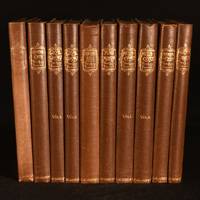
1891réf. 980T78London: J. M. Dent & Co 1891. Cloth. Very Good Indeed. 8.5" by 5.5". None. A smart ten volume set of the large paper edition of Thomas Love Peacock's works limited to one hundred copies. Complete in ten volumes. Large paper edition limited to one hundred copies of which this is number twenty-nine. With a frontispiece to each volume. A collection of works written by Thomas Love Peacock an English novelist poet and official of the East India Company. Peacock is noted for his satirical novels each with the same basic setting: characters at a table discussing and criticising the philosophical opinions of the day. Edited by Richard Garnett a British scholar librarian biographer and poet who was keeper of printed books at British Museum from 1890 to 1899. This set contains: Calidore & Miscellanea 1891. Being a collection of shorter works including Calidore: A Fragment of an Unfinished Romance The Four Ages of Poetry and Horae Dramaticae I-III amongst others. Crochet Castle 1891. Peacock assembles a group of eccentrics each with a single monomaniacal obsession and derives humour and social satire from their various interactions and conversations at Crochet Hall. Gryll Grange 1891. Complete in two volumes. The author's final novel beginning with a discussion around the dinner table of Mr. Gryll in which his friend the genial gourmet the Rev. Dr. Opimian holds forth on misnomers fish and the contemporary fashion for lectures. Headlong Hall 1891. As four visitors arrive at Headlong Hall they find further guests and are lead through a series of dinners and Christmas celebrations by Squire Headlong. Maid Marian 1891. A novella set against the backdrop of medieval England focusing on themes of romance adventure and social justice. Following noble Matilda Fitzwater and her intended the Earl of Huntingdon who is embroiled in conflict with the king's authority. Melincourt 1891. Complete in two volumes. A satirical novel in which an orangutan called Sir Oran Haut-ton is put forward as a candidate for election as a Member of Parliament. The Misfortunes of Elphin 1891. A short historical romance set in sixth century Wales which recounts the adventures of the bard Taliesin the princes Elphin ap Gwythno Seithenyn ap Seithyn and King Arthur. Nightmare Abbey 1891. A novella which makes good-natured fun of contemporary literary trends. It follows the fortunes of Christopher Glowry a morose widower who lives with his only son Scythrop in the isolated family mansion Nightmare Abbey. In the original full cloth binding. Externally smart with light rubbing to the extremities and fading to the spines and board edges. The odd small mark. Internally firmly bound. Pages are very bright and clean. With age toning and minor spotting to the endpapers. Previous owner's bookplate to the front pastedown. Very Good Indeed J. M. Dent & Co hardcover