936 risultati
1977rif. 63820-A-58953Odijk 1977. Bulletin 297 x 21 cms. 16 up to 36 pp. text in Dutch illustrations. Eds. Coby Veldhuis Jacques Schmitz Dick Krananburg France Truyman Jos Dohmen Addie de Visser Carel Kuitenbrouwer Ton Gerrits. ADDED: The Index on year 1977 2 bulletins. General art unknown
1976rif. 63819-A-58952Odijk 1976. Bulletin 297 x 21 cms. 16 up to 36 pp. text in Dutch illustrations. Eds. Coby Veldhuis Jacques Schmitz Dick Krananburg France Truyman Jos Dohmen Addie de Visser Carel Kuitenbrouwer Ton Gerrits. General art unknown
1968rif. 82020Buffalo NY: SUNYAB LeMar 1968. First Edition. Quarto 28cm; pink sheets with text mimeographed in black on recto and verso and stapled at upper left corner; 8pp. Mild handling some very subtle toning to text edges; Near Fine. A substantial document prepared by Michael Aldrich head of LeMar International for the 21st Congress of the United States National Student Association USNSA which from 1947-1978 functioned as the dominant national union of students in the U.S. responsible for an extensive variety of student organizing throughout its history. The contents clearly aimed to educate covered such topics as psychological dependence the physical effects of marijuana whether marijuana contributes to insanity the commission of crimes or leads to heroin usage with discussion of the drugs' positive properties in comparison to alcohol usage. The document concludes with 34-point list of notes and sources and a plug for both the LeMar Information Kit $2.50 and back issues of The Marijuana Review. An uncommon survival not separately listed in OCLC. 82020. SUNYAB LeMar] unknown
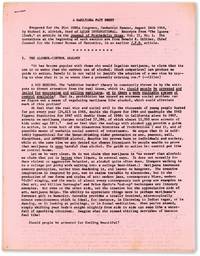
1968rif. 82019Buffalo NY: S.U.N.Y. at Buffalo LEMAR 1968. Original mimeographed flyer with text printed in black recto and verso on jade green stock measuring 8.5" x 11". Faint horizontal fold smoothed-out at center modest handling some creases and subtle toning to extremities a few tiny edge tears a few old splash marks and two titles circled on verso in red marker; just Very Good. Concise bibliography of marijuana literature containing 20 books journals and magazines spanning the years 1913-1968. Produced by the Buffalo-based LeMar International LeMar being short for Legalize Marijuana an early marijuana legalization advocacy group founded by Ed Sanders Allen Ginsberg and Ginsberg's assistant Michael Aldrich. While he was a student at University of Buffalo Aldrich helped launch Marijuana Review "America's first cannabis culture and information magazine.featuring information on legalization updates advocacy campaigns cannabis pricing psychedelic imagery and poetry" ref: "First Cannabis Magazine in U.S. was Made in Buffalo." March 18 2022. Cannabuf. 82019. S.U.N.Y. at Buffalo LEMAR unknown
1973rif. 81969San Francisco: Amorphia 1973. First Edition. Bifolium 28cm; original wraps with text and illustrations printed in dark green on white stock; 4pp; illus. Old folds and staple holes from mailing some trivial dust-soil and foxing with original recipient's address label mounted to rear wrapper; Very Good. Single early issue of this short-lived bulletin published by the California-based cannabis co-operative between 1973-74. The publication circulated among its membership focussed on the latest studies centered around marijuana use issues pertaining to marijuana and law enforcement topics on reform and brief articles on the health benefits of marijuana use. This issue features the article "Jail Is Not The Answer" a commentary on Gov. Rockefeller's NY drug law by David S. Michaels brief articles on the Michigan Task Force urging decriminalization civil fines for marijuana use being considered by Congress Amorphia organizational changes and a review of Dr. Tod H. Mikuriya's Marijuana: Medical Papers 1839-1972. All issues are uncommon with none available in commerce as of August 2024 and OCLC noting 8 locations with any holdings. Amorphia unknown
1974rif. 81968San Francisco: Amorphia 1974. First Editions. Three bifolium issues 28cm; original wraps with text photos and illustrations printed in dark green on white stock; 4pp per issue; illus. Old horzontal folds and staple holes from mailing with the original recipient's address label on the rear wrapper of each issue; some faint foxing and mild handling small loss from rough opening to lower margin of Vol.II No.1 with a holograph notation in ink to rear wrapper of Vol.II No.3; Very Good. The complete final year of this short-lived bulletin published by the California-based cannabis co-operative between 1973-74. The publication circulated among its membership focussed on the latest studies centered around marijuana use issues pertaining to marijuana and law enforcement topics on reform and brief articles on the health benefits of marijuana use. The final issue is largely dedicated to the impending merger of Amorphia and NORML the major East Coast marijuana reform group. All issues are uncommon with none available in commerce as of August 2024 and OCLC noting 8 locations with any holdings. Amorphia unknown
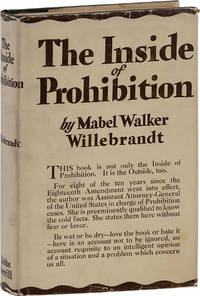
1929rif. 63853Indianapolis: The Bobbs-Merrill Company 1929. First Edition. First Printing. Octavo 20.5cm; evergreen cloth with titles stamped in gilt on spine and front cover; dustjacket; iv89-3471pp. Small faint dampstain to upper left corner of rear cover else a fresh very Near Fine copy. Dustjacket is price-clipped showing light wear mild dust-soil a few small tears and creases and a corresponding faint dampstain to upper rear flap fold; Very Good. Lengthy volume by the former assistant attorney general for the Justice Department responsible for enforcing the Volstead Act from 1921-1929. "She worked closely with both the Woman's Christian Temperance Union and the Anti-Saloon League to build public support for the federal efforts. She also used liquor prosecutions to generate headlines. A number of times Willebrandt sat in the courtroom while one of her assistants pressed a case. Since women government lawyers were quite a novelty in the 1920s her actions generated press coverage. Similarly she focused much of her action on corruption cases that grew out of the violation of prohibition again headline grabbers. She did not seek press notice gratuitously but as a part of a Justice Department campaign to showcase prohibition enforcement activity and to make a case to the public for cleaner government. Willebrandt published first in syndicated newspaper column form and then as a book The Inside of Prohibition her vision for effective prohibition law enforcement. She called for clean government greater coordination between national and local officials and especially for common people to take responsibility for seeing the laws enforced" Badr Jehad and Mark Weir. "Prohibition's Portia: Mabel Walker Willebrandt." online resource. An attractive copy uncommon in commerce. The Bobbs-Merrill Company unknown
1998rif. x-0306458381Plenum Pub Corp 1998. Hardcover. New. 315 pages. 10.25x7.00x0.75 inches. Plenum Pub Corp hardcover
1960rif. 82151New York: Josiah Macy Jr. Foundation 1960. First Edition. Octavo. 23.5cm. Publisher's grey-green cloth boards titled in gilt to spine. 304pp. Light scuffing and rubbing to extremities sunning to the spine with some dulling of the gilt minor bumping to spine ends a very good copy. Internally clean lengthy gift inscription to front flyleaf where the initials LSD are given several new definitions: "Lewd Sexy and Devil May Care" being a catchy example. Illustrated throughout with folding chart. An early attempt to analyse and discuss the effects upon and potential to treat a case group of psychiatric patients utilising LSD as a method of accessing their subconscious to facilitate understanding of their behavior. Essentially an extended question and answer session between a distinguished group of medical authorities ranging from Paul Hoch of Columbia's Dept. of Psychiatry Gregory Bateson of the VA a number of specialists in addiction and recovery Cecilia Jett-Jackson of Sandoz Pharmaceuticals who at least partially sponsored the conference and a number of others. Details are given of treatments and results additional experiments upon lab animals a 300 item list of patient responses at various stages of treatment whilst under the influence of the drug and a number of conclusions both positive and negative that the conference reached. Dr. Harold Abramson now known to have been a part of the CIA's "MK Ultra" program researching potential military applications for hallucinogenics went on the edit a 1967 study leading on from this one entitled "The Use of LSD in Psychotherapy and Alcoholism. Josiah Macy Jr. Foundation unknown
1969rif. 63547New York: Funk & Wagnalls 1969. First American Edition. First Printing. Octavo 21.5cm; black cloth with titling and decorations stamped in silver and gilt on spine and a large syringe embossed onto front cover; dustjacket; viii2053pp; illus. Light wear to spine ends and lower corners with a De Quincey quote written in pencil on front endpaper and a small stain to upper edge of textblock; contents clean; Very Good. Dustjacket is unclipped priced $5.95 showing moderate wear gentle sunning to spine with several tiny tears and attendant creases; Very Good. A comprehensive history of the opium poppy plant papavar somniferum from which heroin morphine codeine and at least 50 other compounds are manufactured. 63547. Funk & Wagnalls unknown
1970rif. 63520Philadelphia: Winston Smith Society Inc 1970. Original poster with text and photographic illustration offset printed in black on white stock measuring 28cm x 43.25cm 11" x 17". Modest handling some light toning and dust-soil to margins with a few faint creases; Very Good. An advertising poster produced by the Philadelphia-based Winston Smith Society as part of their Marijuana Civil Liberties Project. "The Winston Smith Society was formed for the purpose of providing funds for the Marijuana Civil Liberties Project of the American Civil Liberties Union. To do this they are selling artificial marijuana plants which they "feel will provide a symbolic rallying point for the pot smoking public at the grass roots level" Satyagraha Vol.54 No.6 Nov.3 1970 p.2. The lower portion of the poster consists of an order form one could fill out to receive their reproduction plant. Not separately listed in OCLC. 63520. Winston Smith Society, Inc unknown
1979rif. 63559New York: Macmillan Publishing Co. Inc 1979. First Revised and Enlarged Edition. First Printing. Quarto 26cm; green paper-covered boards and cream cloth backstrip with titles stamped in bronze on spine; dustjacket; xviii206pp; illus. Faint foxing to text edges endpapers and backstrip with small remainder dots to upper and lower text edges; Very Good. Dustjacket is unclipped priced $15.95 shelfworn with some scattered foxing on verso and a few tears and creases; Very Good. A substantially revised and expanded version of Emboden's comprehensive 1972 work on psychoactive plants placing them in historical perspective and providing excellent illustrations. "He presents a fascinating narrative of how drug use extended to almost every civilization of the ancient and modern world and how it influenced music dance the visual arts architecture religion science and medicine" from front flap. Macmillan Publishing Co., Inc unknown
1968rif. 57041San Francisco: Frank Reynolds / Hells Angels Motorcycle Club 1968. First Edition. Quarto 26.75cm; twelve 12 five-color broadsides measuring 20cm X 26cm printed on rectos only and housed in an illustrated portfolio on glossy cardstock. A few stress creases and some subtle toning along the spine-fold of the portfolio else Fine. An off-the-wall collection of free-form poems written by Freewheelin' Frank Reynolds former Secretary of the San Francisco chapter of the Hells Angels Motorcycle Club. The broadsides reproduce hand-lettered illustrated poems written by Reynolds in the mid-1960's printed by the Diggers and issued the year after his 1967 memoir written with Michael McClure. Content ranges from personal history and camaraderie within the club to things of a more mystical and metaphysical nature - references to Satan astrological signs alternately written in an optimistic tone or with a pervading sense of doom. The mystical and metaphysical realm would continue to hold Reynolds's attention through his later life. After leaving the Angels Reynolds spent 5 years in Soldedad Prison on an arson charge; while doing time McClure sent him a book by Zen master Shunryu Suzuki Roshi to help him clear his head which Reynolds credited with saving his life. He spent the remaining years of his life living in the mountains next to a waterfall where he spent his days meditating in isolation. One of the most interesting documents created by any Hells Angels club members one that epitomizes the spirit of the 1960's and outsider art. OCLC notes 18 holdings in US institutions. Frank Reynolds / Hells Angels Motorcycle Club unknown
1962rif. 46531Copenhagen: Munksgaard 1962. Second Separate Printing. One of appoximately 100 copies printed for distribution to members of the International Federation for Internal Freedom in 1963. Slim octavo 23cm; white wrappers printed in black stapled; 40pp. Gentle sunning along spine-fold and upper edge of front wrapper with a faint tiny scuff beneath Leary's name else a fresh Near Fine copy. An offprint revised of the first book appearance of this talk - the first and only occasion Huxley and Leary lectured together. "The XIV International Conference of Applied Psychology took place in Copenhagen Aug. 13-19 1961. In addition to Leary Frank Barron of the Harvard psychology department and author Aldous Huxley were also invited to speak.Huxley's lecture was entitled "Visionary Experience"; it was delivered earlier than Leary's and concludes with a reference to Leary's upcoming lecture "We shall hear from Dr. Leary about the induction of such experiences by such substances as psilocybin". Barron's talk contains the first reference in print to his "commending the mushroom to the attention of Dr. Leary who immediately seized upon its possibilities as a vehicle for inducing change in behavior as a result of the altered state of consciousness which the drug produced" HOROWITZ WALLS & SMITH AA23D. Huxley who had written extensively about his psychedelic experiences under the influence of mescaline in Doors of Perception 1954 here writes about the pursuit of the visionary experience as a vehicle for change and a more beautiful reality. He elaborates on the various methods of access to the visionary world including spontaneous induced and chemical access with separate sections on the usage of mushrooms and how light can enhance the visionary experience. This and the first separate printing are substantially expanded from the two which precede them both produced by mimeograph and issued in small numbers. BROMER B113. Munksgaard unknown
1985rif. 41785Washington DC: Smoke-In Central 1985. First Edition. Offset lithographed poster in colors 58cm x 43cm ca 23" x 17". Original vertical and horizontal folds as issued else a fine fresh apparently uncirculated example. Terrific punk-inflected poster advertising a 1985 rally in the Capital to promote marijuana legalization and oppose police brutality especially the then-burgeoning phenomenon of police tasers here called "stun-guns". Features a vivid central caricature of President Ronald Reagan who is surrounded by vignettes of police brutality; along the upper quadrant Nancy Reagan chases a line of potheads including Groucho Marx and the Fabulous Furry Freak Brothers through the sky wielding a stun-gun while sitting astride a flying pig. Copy at the Center for the Study for Political Graphics and not uncommon in commerce though fine copies are unusual; otherwise unlocated in institutional collectons. Smoke-In Central unknown
rif. C1-S91-0926good. unknown
1966rif. 145666N.p.: N.p. 1966. Notebook belonging to an unknown pharmacist detailing the pharmacy's on hand stock of amphetamines barbiturates tranquilizers and other drugs which contained one or more of those in combination and noted "effective Feb. 1 - 1966." Also noted is that the inventory was compiled in accordance with recently passed Drug Abuse Control Amendment Act of 1965 which in an effort to control what Congress saw as an increasing epidemic of prescription drug abuse created harsh penalties for possession or sale without a prescription stricter controls for distribution and inventory and broadly expanded powers for the Food and Drug Administration eventually leading to the formation of the Drug Enforcement Agency as an entirely separate federal agency in 1973. Generic spiral bound stenographers notebook with 10 pages of handwritten text on rectos only. Boards Very Good plus pages Near Fine. N.p. unknown
1982rif. 42652Station NY: Smoke-In Central 1982. First Edition. Good. Striking poster from the 1982 DC "White House Smoke In" executed in a underground comix style by artist Dana Franzen and featuring a large central image of Ron and Nancy Reagan smoking a big fat j. A bold work of pro-legalization propoganda. "Pot Is An Herb / Reagan Is a Dope." Full-color offset poster measuring 23" x 17" approx. Centerfold removed and preserved from an issue of OVERTHROW formerly Yipster Times. Mild wear soil. Bright and sound overall. Very good. Smoke-In Central unknown
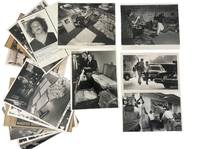
1970rif. 231661970. Narcotics raids arrests rehabilitation scenes and evidence displays across Florida in press photographs and magazine pages. Photograph archive spanning Miami Fort Lauderdale Pasco County and related Florida sites from 1970 to the early 1990s establishing how drug control operated through police action newspaper circulation and treatment institutions during the War on Drugs. Produced for press use by newspaper staff photographers wire services and law enforcement publicity channels the group shows the public face of narcotics enforcement at the point when South Florida had become a major corridor in the national drug economy and anti drug policy was being made newly visible through staged photographs official briefings and widely circulated arrest imagery. Named figures included such as Bob Gladden Larry Csonka Jim Kiick Admiral Rickover Carl Mingo and several rehab subjects identified by hand on the versos. The photographs depict suspects detained searched paraded identified displayed beside seized contraband and in other cases shown within rehabilitation settings revealing how law enforcement courts newsrooms and treatment programs handled the same crisis through different institutional forms. Photo archive of 18 press photographs including 16 silver gelatin press photographs and 2 wire photos approximately 8 x 10 inches Florida 1970 to early 1990s. The core images show narcotics policing in action: a helmeted officer beside a paddy wagon crowded with detainees; a bench filled with young men under detention in an interior holding space; two handcuffed men led from a courthouse or station entrance; a police-released mugshot with typed caption identifying former New England Patriots running back Bob Gladden after arrest in Fort Lauderdale on a marijuana charge; and a street arrest with an armed officer escorting a suspect between parked cars. Several photographs center on the staged display of evidence including tables covered with packets of drugs stacked currency pistols taped "cookie sheets" and open suitcases packed with bricks or cutting materials. One image shows a narcotics dog inspecting rows of luggage; another shows officials at microphones before a sign for the Vice President's National Narcotics Border Interdiction System; another records cocaine seized from a concealed boat compartment. The group also includes rehabilitation scenes with young adults identified en verso in cursive extending the archive beyond arrest photography into treatment culture. Versos carry a dense record of press handling and editorial use including Miami Herald staff photo stamps dated Dec. 15 1970 and Jan. 5 1971 a St. Petersburg Times credit and clipping backing for a Pasco County drug ring case dated May 29 1974 typed bureau captions circled editorial notations such as "cocaine" "marijuana" "drug raid" and "Operation Crackdown" plus handwritten shot descriptions and date-used stamps. The earliest prints fall at the threshold of the modern War on Drugs while later additions carry the record forward into the crack era and the more theatrical seizure photography of the 1980s and early 1990s. Florida is central to that story not only as a site of smuggling and interdiction but as a place where narcotics enforcement became highly visual with press conferences celebrity linked arrests tactical raids canine inspections and rehabilitation coverage all translated into newspaper images for public consumption. The present grouping combines an earlier core of related press photographs with later additions and it preserves a strong visual record of how narcotics control was communicated to the public through local papers wire distribution and agency captioning. Light surface wear minor edge and corner handling editorial markings and stamps to versos scattered adhesive residue and toning; overall very good condition. A concentrated Florida press record of the machinery publicity and human management of drug enforcement across two decades. unknown
rif. A9789210031776Paperback / softback. New. paperback
rif. A9789210030175Paperback / softback. New. To support Member States and the international community in efforts to prevent violence and strengthen responses the fourth edition of the Global Homicide Study offers a comprehensive examination of intentional homicide trends and patterns around the world and analysis of the complex dynamics behind the numbers. paperback
rif. A9789210034524Paperback / softback. New. paperback
rif. A9780309072731Hardback. New. Recommends ways to close gaps in our understanding - by obtaining the necessary data on drug prices and consumption quantity in addition to frequency; upgrading federal management of drug statistics; and improving our evaluation of prevention interdiction enforcement and treatment efforts. hardcover
2017rif. 29634Boston:: Houghton Mifflin Harcourt 2017. Third Printing of the First Edition. A Fine copy in a Fine dust jacket. The Nazi regime preached an ideology of physical mental and moral purity. But as Norman Ohler reveals in this gripping new history the Third Reich was saturated with drugs. On the eve of World War II Germany was a pharmaceutical powerhouse and companies such as Merck and Bayer cooked up cocaine opiates and most of all methamphetamines to be consumed by everyone from factory workers to housewives to millions of German soldiers. In fact troops regularly took rations of a form of crystal meth—the elevated energy and feelings of invincibility associated with the high even help to explain certain German military victories. While drugs alone cannot explain the Nazis’ toxic racial theories or the events of World War II Ohler’s investigation makes an overwhelming case that if drugs are not taken into account our understanding of the Third Reich is fundamentally incomplete. Houghton Mifflin Harcourt, unknown
rif. BN261630Droga do wolności ŚCIEŻKA KU OŚWIECENIU Dalajlama Droga do wolności ŚCIEŻKA KU OŚWIECENIU Dalajlama Droga do wolności ŚCIEŻKA KU OŚWIECENIU Dalajlama unknown