FIRST OPIUM WARBiblio.com
76 résultats
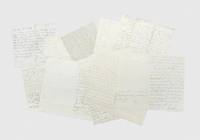
1841réf. 192022September 1840-February 1841. Noble fragments A moving and historically significant record of companionship in confinement Anne Noble being one of the few Western women to see the interior of China before the opening of the treaty ports. These notes sent surreptitiously by two British officers detained in nearby cells are the most important surviving artefacts of her extraordinary five-month imprisonment. An experienced seafarer and traveller Noble née Watson 1814-1877 ventured to China in the late 1830s onboard the Kite a trading ship captained by her husband James Smith Noble. Following the outbreak of the First Opium War the ship was requisitioned as a transport ship but ran aground on 15 September off the Chinese coast near Zhenhai. The survivors - Noble's husband and infant son both drowned - were carried in cages to Ningbo where Noble and the ship's military commander Lieutenant Charles Douglas were incarcerated in separate lice-ridden cells at the residence of the city's ranking mandarin. Douglas was soon joined by Captain Philip Anstruther known to contemporaries as "the life of every party he joined" quoted in D'Arcy-Brown p. 92 who was captured in mid-September while reconnoitring near Dinghai. The captives met only when they were carried in cages to meet Chinese officials and they were not released until 21 February 1841. By bribing jailers and locals with money received from Chinese officials and British forces Noble and Anstruther & Douglas could exchange notes hastily written on whatever paper they had to hand. The 40 here - the only that appear to have survived - convey the camaraderie and close bond shared by the prisoners their hopes and uncertainty concerning their detention and their experiences of isolation. The two cells frequently shared suggestions and snippets of gossip concerning the prospects of their release; Anstruther & Douglas could communicate with British forces by letter and pass on to Noble morale-boosting reassurances "They dare not keep us longer" - Douglas 15 November 1840; "do not give way to doubt and fear" - Anstruther undated. Noble occupied her time mending clothes sent by the men while they advised on how to deal with the corruptible jailers. They sent money and soup; she provided needle and thread in return. During the five months they were assisted by the enterprising Bu Dingbang - known as "the comprador" - who had been arrested for treason while assisting the British fleet near Chusan. Despite being a convict Bu appears to have had regular access to the outside world and to the Westerners including to cook them food and Noble acted as an indispensable conduit of information between Bu and the men. Some of these concerned the matter of their release but the officers were equally concerned with their health and the well-being of the rank-and-file British soldiers and sailors held in the city jail. Anstruther was seemingly often preoccupied with the state of Bu's cooking "a little less garlic and more chilly sic" - undated but likely mid-October 1840. Unfortunately for him the beer wine and cheroots ran out by mid-November. The final firmly dated note in this collection was sent on 18 February 1841. The preceding month British ships sacked the forts at Canton which forced Ningbo's officials to release their hostages on 21 February. Noble and her ordeal became a sensation in China and back home and her account of her confinement was rushed into print in the Chinese Repository "Loss of the ship Kite and Mrs. Noble's narrative of her captivity and sufferings in prison in China in 1840-41; in a letter to a friend". The British community around Canton raised $8000 for her passage back to England and her prison cage was displayed in London. In 1844 she emigrated to the United States. This collection surfaced in the early 21st century as part of a broader group of papers from the Noble family sold at a New Hampshire auction. They were bought from the purchaser a member of the American trade by an American private collector in 2015. The contents of the notes are discussed on pages 108-110 and in Chapter VI of "A White Barbarian Lady" by Liam D'Arcy-Brown who used a rough transcription made when the material was offered for sale in the early 2010s. The notes are accompanied by five letters sent to Noble shortly after her release including one from Douglas as well as 44 letters and documents associated with Noble and her family. Together 40 sheets or bifolia ranging in size up to 210 x 260 mm many on fragile paper. Written in ink or pencil ink annotations in a different hand perhaps Noble's. Full listing available on request. Old folds 5 split into two or more fragments and with small losses slightly affecting sense 1 seemingly a fragment of a much longer note: a well-preserved collection of delicate material. Liam D'Arcy-Brown "A White Barbarian Lady": The Story of Anne Noble a Victorian Woman Imprisoned in China 2016. hardcover