3 231 résultats
1974français In-4 de 315 pp. + Bibliographie; reliure pleine toile ornée de l'éditeur, sous jaquette illustrée en couleurs. Analyse critique de Carlo Arturo Quintavalle, traduction de Jocelyne de Pass. Riche iconographie.
réf. 11813Moulins, P. A. Desrosiers [1835] ; Titre, 1 dessin original et 40 planches. / Vannes, Cauderan, 1847 ; 20 planches. 1 volume in-4. Demi-percaline verte, dos muet. papier parfois jauni.
1859réf. 66Petit in 4 percaline marron d'éditeur décorée,plaque dorée dans un encadrement vert,frise décorative dorée,bleue et rouge en encadrement sur les plats,titre et décors dorés et en couleurs en long au dos.192 pages sur papier fort.texte encadré d'un double filet noir,quatre lithographies hors texte sous serpentes,lettrines illustrées (dont séance de lanterne magique) Martial ardant éditeur 1859.Dorure ternie par endroit
1969réf. 37281Paris, André Sauret Editeur, Collection des douze meilleurs romans policiers N°6, 1969, 405 pages. Reliure éditeur sous emboitage. Tête dorée. Un des 3000 ex. sur vélin d'Arches filigrané à la marque de l'éditeur. Petit accident bien réparé au mors supérieur sinon bon état.
1954réf. CCC00075159. edite André Vial, 1954. Couverture rigide. État : Très bon. Etat de la jaquette : Très bon. Edition originale de " L'art d'aimer à travrers les ages" réalisée sous la direction de Henri Jonquières. Tirage à 5000 expl N°2217. Tome premier; 1954-1789, gravures sur cuivre de Dignimont, Oberlé, Touchagues, Vertès. - Tome deuxième; De la Révolution au Moyen Âge, gravures sur cuivre de Gaston Barret, Gus Bofa, Yves Brayer, Berthold Mahn. - Tome troisième; De l'antiquité aux temps légendaires, gravures sur cuivre de Lucien Boucher, Hermine David, Valentine Hugo, Kroll. Complet en 3 vol. Nombreuses illustrations noir et blanc ainsi que des hors texte couleurs de Digimont, Touchagues, Vertes, Renoir, Toulouse-Lautrec, Mahn, Brayer, Barret ECT .. TRES BON ETAT photos possibles
réf. RO30326707. Non daté. In-Folio. En feuillets. Bon état, Couv. convenable, Dos satisfaisant, Intérieur frais. Environ 10 pages. Pages manquantes. 2ème plat manquant. 10 lithographies en couleurs et en noir et blanc. Quelques rousseurs.. . . . Classification Dewey : 763-Lithographies
réf. 106517Paris, Les Editions de la Roseraie, 1926, 1 volume in-4 de 290x210 mm environ, 82 pages, 3ff.(table), broché sous couverture rempliée avec titre doré sur le premier plat, feuillets non rognés. Exemplaire N° 84, un des 200 exemplaires sur vélin d'Arches, numérotés de 51 à 250. Édition ornée de 11 LITHOGRAPHIES ORIGINALES EN COULEURS HORS TEXTE DE MARCEL VERTÈS, une lithographie originale en plus et une dédicace sur la première garde blanche. Dos avec petits plis de lecture et frottements sur le haut et le bas, bordures de la lithographie supplémentaire et la première garde blanche insolées avec mouillure, une partie de texte de dédicace en partie effacée, sinon bon état.
1982réf. 22491982 Pierre de Tartas et Edition du Cerf, Bièvres, 1982. 1 volume in folio en feuilles, sous emboitage transparent en plexigas de l'éditeur, ornée d'un glaive. Tirage à 550 exemplaires numérotés, 1 des grand vélin d'arches, le n°304. 11 lithographies en couleurs de Chapelain Midy, dont 6 sur double planche et 6 empreintes. Signé par l'éditeur et Chapelain-Midy. Manque à la garde du glaive, sinon très bon état.
réf. 2125LITHOGRAPHIE EN COULEURS SUR JOHANNOT (50 X 66 CENTIMETRES ENVIRON), SIGNEE DANS LA PLANCHE EN BAS A DROITE ET DATEE 56. " LUIS VIDAL MOLNE, PEINTRE DE COMPOSITIONS, FIGURES, NATURES MORTES ET ILLUSTRATEUR, NE A BARCELONE, RESIDAIT A MONTE-CARLO. ELEVE DE L'ECOLE DES BEAUX-ARTS DE SA VILLE NATALE, IL VINT EN FRANCE EN 1939. ECOLE ESPAGNOLE ". (BENEZIT).
réf. 4091 En feuillets, sous couverture illustrée rempliée et emboîtage en pleine toile de l'éditeur. Quelques traces d'usure sur l'emboîtage. Bièvres, Pierre de Tartas, 1973.
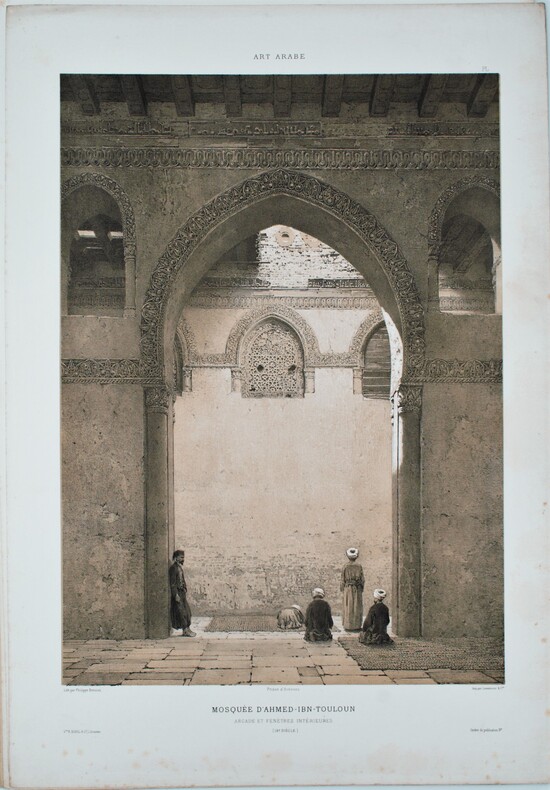
1877réf. PHO-2147Paris, Morel, 1877, 4 volumes, 3 volumes de gravures in-folio et 1 volume de texte in-4 Texte ; VIII-296pp, illustré de 34 gravures h.t. et de nombreuse dans le texte, demi basane époque, dos lisse avec titre, frottements, rousseurs éparses. Atlas ; 3 volumes in-folio en feuilles, sous emboîtages moderne. Comprenant pages de titre et tables des planches, complets des 199 (sur 200) planches (22 gravées et 177 lithographiées dont 39 vues teintées et 130 chromolithographies, plusieurs rehaussées d'or), lithographiées ou gravées, parfois en couleurs et certaines d'après Girault de Prangey, l'un des tout premiers voyageurs français à photographier Le Caire et Jérusalem. Les planches représentent des vues de vestiges, de nombreux détails d'ornementations (portes, heurtoirs, flambeaux, plats, etc.) ainsi que des meubles, des textiles, des céramiques, des boiseries, des carrelages, des armes et des armures, des verres et des émaux, des tapis, des manuscrits et des corans, une planche déchirée sans manque. Édition originale de l'ouvrage le plus important du XIXe siècle entièrement consacré à l'art arabe.
1978réf. R300282389Balland. 1978. In-8. Relié. Bon état, Couv. convenable, Dos satisfaisant, Intérieur frais. 269 pages - nombreuses illustrations en noir et blanc dans et hors texte. Légères traces noires sur le 2e plat.. . . . Classification Dewey : 763-Lithographies
réf. YRG-327in-folio, reliure d'art signée S B ( Suzanne Buissonnet), tête dorée, tirées à la presse à bras par R. Guillard, un des 50 exemplaires sur pur fil des Papeteries Johannot N° II. Dédicace texte manuscrit de Serge Lifar reproduit en fac-similéà madame Lucienne Pageot-Rousseaux, signée et datée le 28 juillet 1954. Quelques frottements sur la reliure, page légèrement jaunie dans les marges. Très bel exemplaire.
réf. 135890aafGera-Untermhaus, Verlag v. Fr. Eugen Köhler, (Druck des Textes von Ramm & Seemann, Leipzig), 1887, gr. in-4°, 4 Bl. + 54 S. (Liste d. Pflanzen n.d. Eichler System) + 115 n.n. S. (Beschreibung d. Pflanzentafeln) + 92 Tafeln in Farbendruck nach O.-Zeichnungen v. Walther Müller in Gera, Original-Lederband mit Ecken (J.A. Hodel relieur à Neuchâtel).
1949260X330mm. 25 pages + 83 black and white plates. Softcover in dust jacket and cardboard box. Cardboard box slightly yellowing. Else in good condition.
1927réf. 005871Praze Prague: V. Neubert 1927. First Edition . Illustrated Wrappers. Very Good. 11 7/8" Tall. First Edition. 32 Pp Of Stunning Full-Color Lithographs Including Covers Endpapers Title Page Etc. Every Side Of Covers And Every Side Of Every Page Is So Illustrated. Apparently The Translator's Copy For The 1929 New York Edition In English As Translations For Each Page Are Laid In Loosely. A Bright Clean Copy. Three Small Chips Along Bottom Of Front Cover Spine Partially Split And All Pages And Cover Have A 3/4" Closed Tear Along The Bottom Edge. V. Neubert unknown
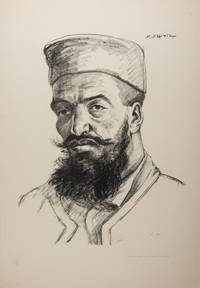
1916réf. 43931Berlin: Dietrich Reimer Ernst Vohsen 1916. Limited First edition. Hardcover. g- to vg. 1/50. Folio 19 1/2 x 13 1/2". 6 28pp Booklet 100 loose leaves Plates as issued. Original full vellum portfolio with lettering and publisher's logo in gilt to front cover. Booklet's front cover gold-lettered numbered and hand-signed by the artist Hermann Struck. The plates are housed in their stiff paper chemise as issued with printed title to front cover. In this spectacular monograph artist Hermann Struck who was serving in the Imperial German army as a translator liaison officer and military artist sketched the faces of one hundred prisoners of war in the German camps. Among the French British Belgian and Russian inmates were also included soldiers from the British Empire mostly from India as well as the French Empire Algeria Tunisia Morocco and Senegal. The prisoners' age range from 12 Anton Matyszewski a volunteer from Lomza Russian Poland to 56 Mohammed ben Ahmed Spahi from Djelfa French Algeria. It is interesting to note that the Jewish prisoners were identified first by their religion then by the place they came from exemple: Chacus Krasikow Jew from Lubin Russian Poland; Isaak Chotoran Jew from Kiev Ukraine; Bomblatt David Polish Jew from Warsaw etc. Bomblatt David is sketched twice: After Struck drew his face he added a second sketch depicting the prisoner reading the Talmud. Each plate is handsigned in pencil by the artist. The booklet contains a foreword and an essay on ethnology in the World War by Prof. Dr. Felix von Luschan 1854-1924 an Austrian doctor anthropologist explorer archaeologist and ethnographer who joined the German Society for Racial Hygiene in 1908. The society was an eugenic organization whose goal was "for society to return to a healthy and blooming strong and beautiful life." As Alfred Ploetz its founder put it the Nordic race was supposed to regain its "purity" through selective reproduction and sterilization. The society ceased to exist after WWI. One of 50 numbered copies of which this is No. 30. Some foxing to portfolio with strings missing. Minor age-toning and foxing to wrappers of booklet. 5" closed tear at lower front joint of chemise. Only plates 4 and 5 are foxed along edges not affecting illustrations. Text in German Gothic script Booklet captions of plates in German. Portfolio in overall fair to good booklet in very good chemise in fair to good- plates in very good condition. Hermann Struck 1876-1944 was a German Jewish artist known for his etchings. A fervent Zionist and Jewish activist Struck visited the Land of Israel in 1903 displayed his art at the Fifth Zionist Congress and was a founder of the Mizrachi Religious Zionist movement. At the same time he was a German patriot and volunteered for military service in World War I serving as a translator liaison officer and military artist. Hermann Struck was awarded the Iron Cross 1st Class and promoted to an officer for bravery in 1917 he became the referent for Jewish affairs at the German Eastern Front High Command. Struck immigrated to Palestine in 1922 taught at Bezalel Academy and helped establish the Tel Aviv Museum of Art. He visited Berlin every summer until the Nazis rose to power. From the beginning of the war the German authorities found themselves confronted with an unexpected influx of prisoners. In September 1914 125050 French soldiers and 94000 Russian ones were held captive. Before 1915 conditions of detention in Germany were very harsh and marked by temporary lodging and the absence of infrastructure. The prisoners slept in hangars or tents where they dug holes to keep warm. The humid forts requisitioned to serve as places of detention led to numerous cases of pulmonary illness. The German authorities also commandeered schools barns and various other types of shelters. Camps were established in the countryside as well as near the towns which had consequences when epidemics of cholera or typhus threatened to spread to the civilian population. Not all the camps were situated on German territory; a certain number were built in occupied territories notably in northern and eastern France. They began to be developed starting in 1915 when the number of prisoners being held captive in Germany reached 652000. According to official directives each prisoner had to have use of 26.9 square foot 2.5 m². The camps mixed a large number of nationalities sharing the same quarters: French Russian British American Canadian Belgian Italian Romanian Serbian Montenegrin Portuguese and Japanese prisoners were found there as well as Greeks and Brazilians. Equally soldiers of various social origins rubbed elbows: workers peasants bureaucrats and intellectuals were among those held. The number of prisoners rose very quickly. From February to August 1915 it went from 652000 to 1045232. In August 1916 it reached 1625000 jumping to 2415000 by October 1918. For more information see: Uta Hinz's "Gefangen im Großen Krieg: Kriegsgefangenschaft in Deutschland 1914-1921" in German. Essen Klartext Verlag 2006. Dietrich Reimer (Ernst Vohsen) hardcover books
1916réf. 43931Berlin: Dietrich Reimer Ernst Vohsen 1916. Limited First edition. Hardcover. g- to vg. 1/50. Folio 19 1/2 x 13 1/2". 6 28pp Booklet 100 loose leaves Plates as issued. Original full vellum portfolio with lettering and publisher's logo in gilt to front cover. Booklet's front cover gold-lettered numbered and hand-signed by the artist Hermann Struck. The plates are housed in their stiff paper chemise as issued with printed title to front cover. In this spectacular monograph artist Hermann Struck who was serving in the Imperial German army as a translator liaison officer and military artist sketched the faces of one hundred prisoners of war in the German camps. Among the French British Belgian and Russian inmates were also included soldiers from the British Empire mostly from India as well as the French Empire Algeria Tunisia Morocco and Senegal. The prisoners' age range from 12 Anton Matyszewski a volunteer from Lomza Russian Poland to 56 Mohammed ben Ahmed Spahi from Djelfa French Algeria. It is interesting to note that the Jewish prisoners were identified first by their religion then by the place they came from exemple: Chacus Krasikow Jew from Lubin Russian Poland; Isaak Chotoran Jew from Kiev Ukraine; Bomblatt David Polish Jew from Warsaw etc. Bomblatt David is sketched twice: After Struck drew his face he added a second sketch depicting the prisoner reading the Talmud. Each plate is handsigned in pencil by the artist. The booklet contains a foreword and an essay on ethnology in the World War by Prof. Dr. Felix von Luschan 1854-1924 an Austrian doctor anthropologist explorer archaeologist and ethnographer who joined the German Society for Racial Hygiene in 1908. The society was an eugenic organization whose goal was "for society to return to a healthy and blooming strong and beautiful life." As Alfred Ploetz its founder put it the Nordic race was supposed to regain its "purity" through selective reproduction and sterilization. The society ceased to exist after WWI. One of 50 numbered copies of which this is No. 30. Some foxing to portfolio with strings missing. Minor age-toning and foxing to wrappers of booklet. 5" closed tear at lower front joint of chemise. Only plates 4 and 5 are foxed along edges not affecting illustrations. Text in German Gothic script Booklet captions of plates in German. Portfolio in overall fair to good booklet in very good chemise in fair to good- plates in very good condition. Hermann Struck 1876-1944 was a German Jewish artist known for his etchings. A fervent Zionist and Jewish activist Struck visited the Land of Israel in 1903 displayed his art at the Fifth Zionist Congress and was a founder of the Mizrachi Religious Zionist movement. At the same time he was a German patriot and volunteered for military service in World War I serving as a translator liaison officer and military artist. Hermann Struck was awarded the Iron Cross 1st Class and promoted to an officer for bravery in 1917 he became the referent for Jewish affairs at the German Eastern Front High Command. Struck immigrated to Palestine in 1922 taught at Bezalel Academy and helped establish the Tel Aviv Museum of Art. He visited Berlin every summer until the Nazis rose to power. From the beginning of the war the German authorities found themselves confronted with an unexpected influx of prisoners. In September 1914 125050 French soldiers and 94000 Russian ones were held captive. Before 1915 conditions of detention in Germany were very harsh and marked by temporary lodging and the absence of infrastructure. The prisoners slept in hangars or tents where they dug holes to keep warm. The humid forts requisitioned to serve as places of detention led to numerous cases of pulmonary illness. The German authorities also commandeered schools barns and various other types of shelters. Camps were established in the countryside as well as near the towns which had consequences when epidemics of cholera or typhus threatened to spread to the civilian population. Not all the camps were situated on German territory; a certain number were built in occupied territories notably in northern and eastern France. They began to be developed starting in 1915 when the number of prisoners being held captive in Germany reached 652000. According to official directives each prisoner had to have use of 26.9 square foot 2.5 m². The camps mixed a large number of nationalities sharing the same quarters: French Russian British American Canadian Belgian Italian Romanian Serbian Montenegrin Portuguese and Japanese prisoners were found there as well as Greeks and Brazilians. Equally soldiers of various social origins rubbed elbows: workers peasants bureaucrats and intellectuals were among those held. The number of prisoners rose very quickly. From February to August 1915 it went from 652000 to 1045232. In August 1916 it reached 1625000 jumping to 2415000 by October 1918. For more information see: Uta Hinz's "Gefangen im Großen Krieg: Kriegsgefangenschaft in Deutschland 1914-1921" in German. Essen Klartext Verlag 2006. Dietrich Reimer (Ernst Vohsen) hardcover
réf. 6557, London, The Tate Gallery, 1962, Paperback, originale wrappers illustrated in color ( photo), 20x21cm, 120pp, illustrated b/w.
1949réf. 2234Paris, Manuel Bruker, 1949 ; in-4, en feuillets ; 77 pp., (4) ff. (notes, justification, 1 bl.) ; 17 lithographies en noir hors-texte ; couverture blanche à rabats imprimée rouge et noir.
1959Une affiche de dimensions 51 x 71 cm; belle lithographie de Mourlot. Discrète trace d'adhésif en pied; sinon bien fraîche. Voir photo.
1959réf. 15884Paris à la Galerie 1959 1 Une affiche de dimensions 51 x 71 cm; belle lithographie de Mourlot.
1938réf. 143261938. Bruxelles Editions des Artistes 1938. Un vol. au format in-4 327 x 252 mm de 62 pp. Plein cartonnage illustr d'dition dos toil rouge. Edition originale de cette publication peu commune agrmente - ici en premier tirage - des dlicieuses lithographies en couleurs d'Olga Kovalevsky. Angles mousses. Plats prsentant un clat lgÂrement altr. Annotations au stylo et tches parses au premier. Un cahier dsolidaris. Quelques discrÂes marques sombres en marge infrieure des feuillets. Du reste bonne condition. Rare. b42961 unknown
1938réf. 14326Bruxelles, Editions des Artistes, (1938). Un vol. au format in-4 (327 x 252 mm) de 62 pp. Plein cartonnage illustré d'édition, dos toilé rouge.