GESTA Adrien (Docteur)MareMagnum
HOCHENEGG Docteur LeonhardMareMagnum
Les miracles du thé. Les recettes secrétes du Docteur Leonhard Hochenegg
1986Godefroy 1986, In-8 broché, 510 pages. Bon état.
806 résultats
1982Broch?. 194 pages.
1986Godefroy 1986, In-8 broché, 510 pages. Bon état.
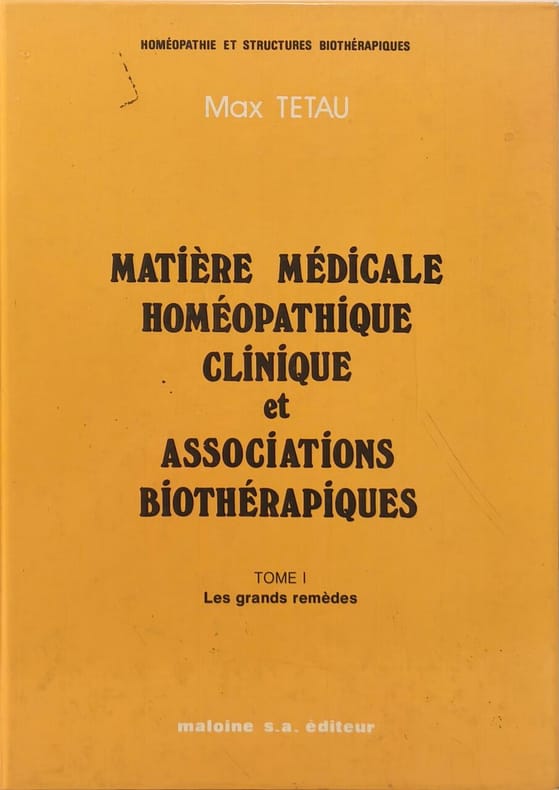
1982réf. 4573Maloine s.a. éditeur 1982 313 pages in8. 1982. Reliure editeur cartonnée. 313 pages. Ouvrage de référence en homéopathie clinique présentant les associations de biothérapies rédigé par Max Tétau et publié par Maloine Éditeur. Le livre s'adresse aux professionnels de santé cherchant à intégrer l'homéopathie dans leur pratique thérapeutique
1982Robert Laffont 1982, In-8 broché de 370 pages. Bon état. Broché
1990Paris, LMV 1990. In-8 broché de 432 pages. Très bon état
1990réf. 37965Paris, LMV 1990. In Paris, LMV 1990. In-8 broché de 432 pages. Très bon état
1990réf. vk2069Editions Roudil L'Essentiel de la connaissance Dos carré collé 1990 In-8 (13,6 x 21 cm), dos carré collé, 108 pages ; couverture jaunie, par ailleurs intérieur frais, bon état. Livraison a domicile (La Poste) ou en Mondial Relay sur simple demande.
1976réf. 207326Couverture souple. Broché. 159 pages. Couverture légèrement défraîchie.
1995réf. 207944Couverture souple. Broché. 198 pages.
1940réf. 126114Couverture souple. Broché. 40 pages.
1985réf. 205258Couverture souple. Broché. 110 pages.
2004réf. 207943Couverture souple. Broché. 333 pages.
1976réf. vk1096Robert Laffont Médecines et traitements naturels Cartonné 1976 In-8 (16,2 x 24,7 cm), cartonné toilé, 301 pages ; quelques petites traces sur les plats et le dos, par ailleurs bon état général. Livraison a domicile (La Poste) ou en Mondial Relay sur simple demande.
1994réf. vb2560Editions Similia Pensée homéopathique Broché 1994 In-8 (15,7 x 22,3 cm), broché, 268 pages ; pliures et trace d'étiquette au premier plat, par ailleurs assez bel état. Livraison a domicile (La Poste) ou en Mondial Relay sur simple demande.
réf. 201703593Paris, LMV EDITIONS, 2005 ; in-8, 454 pp., br.
réf. 81080St Jean de Braye (France), Editions Dangles, 1985. 15 x 21, 155 pp., reliure d'édition carton imprimé, très bon état.
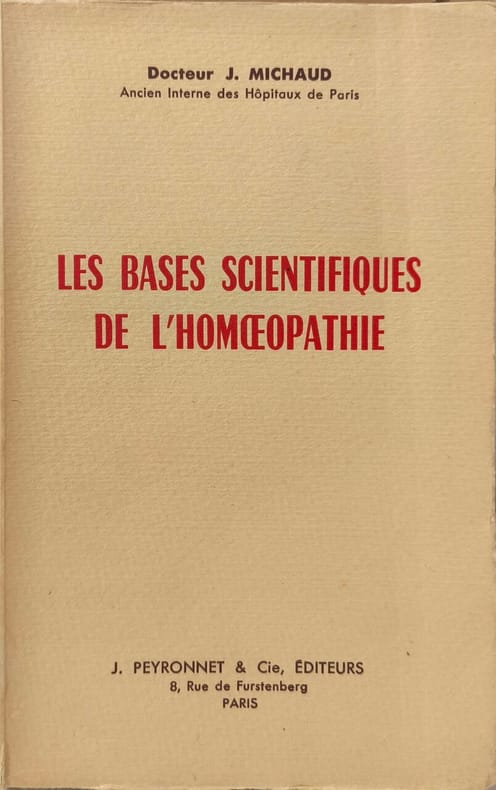
1954réf. 5036J. Peyronnet & Cie Éditeurs 1954 207 pages in12. 1954. broché. 207 pages. Ouvrage du Docteur Michaud présentant les fondements théoriques et pratiques de l'homéopathie selon une approche se voulant scientifique publié par l'éditeur Peyronnet Cie
1955réf. 109G. Doin & Cie 1955 224 pages grand in8. 1955. Boché. 224 pages.
2002réf. 118297Robert Laffont 2002 Robert Laffont, 361p, 2002, in-8 broché. bon état.
réf. 40844Editions Québec/Amérique, 1987. 15 x 23, 145 pp., broché, bon état.
2010Edi Inter, 2010. In-8 broché de 432 pages. Très bon état.
2010réf. 160384Edi Inter Edi Inter, 2010. In-8 broché de 432 pages. Très bon état.
1602réf. 55051602 Broché, comme neuf, 160x240,458 gr, 223 pages, illustrations et photographies couleurs en un cahier hors texte de 16 pages ISBN: 9782842510091
1965réf. 1131267Philadelphia;, 1965. S. 66 - 128; 23,5 cm; fadengeh. Orig.-Pappband.
2022About The Book : Hahnemann wrote this book in order to document his new system of medicine, "Homoeopathy". In 1796, some six years after Hahnemann first experienced the effect of Peruvian Bark Cinchona in 1790 he published an article under the title "Essay on a New Principle".After conducting personal observations and experiments, Hahnemann published his new account of homoeopathy in book form in 1810. The original title of the book was Organon of Rational Art of Healing. In 1819, the second edition was published, with the revised title Organon of Healing Art. The third edition (1824) and fourth edition (1829) kept this new title, while the latter introduced Hahnemann's "Theory of Chronic Diseases".The fifth edition was published in 1833, and included the doctrine of vital force and drug-dynamization. The sixth edition, written in 1842, a year before his death, was retitled Organon of Medicine and not published until 1921. About The Author : Samuel Hahnemann, in full Christian Friedrich Samuel Hahnemann, (1755-1843), German physician, founder of the system of therapeutics known as homeopathy. Hahnemann was dissatisfied with the state of medicine in his time, and particularly objected to practices such as bloodletting. He claimed that the medicine he had been taught to practice sometimes did the patient more harm than good: After giving up his practice around 1784, Hahnemann made his living chiefly as a writer and translator, while resolving also to investigate the causes of medicine's alleged errors. While translating William Cullen's A Treatise on the Materia Medica, Hahnemann encountered the claim that cinchona, the bark of a Peruvian tree, was effective in treating malaria because of its astringency. Hahnemann believed that other astringent substances are not effective against malaria and began to research cinchona's effect on the human body by self-application. Noting that the drug induced malaria-like symptoms in himself, he concluded that it would do so in any healthy individual. This led him to postulate a healing principle: "that which can produce a set of symptoms in a healthy individual, can treat a sick individual who is manifesting a similar set of symptoms." This principle, like cures like, became the basis for an approach to medicine which he gave the name homeopathy. He first used the term homeopathy in his essay Indications of the Homeopathic Employment of Medicines in Ordinary Practice, published in Hufeland's Journal in 1807. This translation brings about new and original expressions of Dr. Hahnemann's original work. The expressions, figures of speech and even the tautological style of the original book has been retained by Dr. C. Wesselhoeft during this translation. The Title 'ORGANON OF THE ART OF HEALING written/authored/edited by SAMUEL HAHNEMANN, C. Wesselhoeft', published in the year 2022. The ISBN 9788121267007 is assigned to the Hardcover version of this title. This book has total of pp. 252 (Pages). The publisher of this title is Gyan Publishing House. This Book is in English. The subject of this book is HOMEOPATHY . Size of the book is 14.34 x 22.59 cms Vol:-