3,260 results
1620ref. 52951BB(Schweiz oder Süddeutschland, um 1620. 8°. 456 num. Seiten. Lädierter Lederband der Zeit mit Rollstempelverzierung.
1843ref. 9153Erlangen: F Enke 1843-`47. First Edition. original publisher's printed wrappers. A fine set; unopened. 8vo. There are some text illus. A most important book in pharmaceutical science. It covers a wide variety of topics apart from the chemistry e.g. there are lengthy sections devoted to medical jurisprudence organic and inorganic sources for drugs proper practices for the trade of pharmacist toxicology testing of pharmaceutical preparations etc. The is copy is almost as new in the original publisher's printed wrappers. F Enke unknown books
1805ref. 57942BBBerlin, in Commission bei L.W. Wittich., 1805. 12°. 1 w. Bl., 1 Bl. Titel, S. (5)-99. Pappband der Zeit mit blauem Papierbezug und rotem, schwargeprägtem Rückenschild. [2 Warenabbildungen]
ref. 104911Parisiis, Apud Martinum Iuueem (Martin le jeune) sub infigni D. Christofori, è regione gymnasu Camera1555 (premère partie), - Apud Ioanem Foucherium, sub. Scuto Florentiae, Via ad Diuum Iacobum, 1543 (deuxième partie), 2 ff.blancs, 1 titre, 104-229 pages, 5ff. (Index), 1 volume in-18 de 120x75 mm environ, plein parchemin crème à recouvrements avec traces de liens sur les plats. Parchemin gondolé sans les liens de fermeture, erreur de numérotation (première partie : 64 au lieu de 46 et deuxième partie : 291 au lieu de 129), quelques rousseurs, des notes manuscrites anciennes sur les pages de garde.
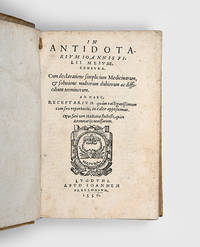
1550ref. 193590Lyon: Jean Frellon 1550. A combination of Arabic and European medicine A commentary on the pharmacopeia of Mesue known as the Antidotarium or Grabadin one of the most influential manuals for apothecaries in the late medieval and early Renaissance periods. "It familiarized Latin Europe with Arabic pharmacy and therapeutics and many hundred editions were issued in Europe during the Middle Ages" Campbell p. 76. This commentary sought to correct and clarify the text for students and apothecaries part of the wider sixteenth-century humanist effort to "purify" pharmaceutical texts. "In materia medica the scientific discussion in the 1510s to 1540s had the appearance of a crisis in which several trends conflicted with each other: the tradition of Arabic pharmacology the new humanist call for a return to ancient pharmacology and the empirical trend towards testing and botanical depiction. The heated controversy about the value of Arabic materia medica and the refined Renaissance commentary tradition on Arabic pharmacologists greatly helped to master this complexity: Renaissance botanists and pharmacologists successfully connected the information in Arabic sources with Greek and contemporary knowledge" Hasse pp. 296-7. After Venice Lyon was the city in which the most works of Arabic or pseudo-Arabic origin were printed in the sixteenth century. The title's "Ioannis filii Mesuae" reflects the traditional attribution of the Antidotarium to Yuhanna ibn Masawaih c.777857 known as Mesue the Elder. The work is now thought to be by an unidentified later author writing under his name usually called Mesue the Younger or pseudo-Mesue. This commentary is also anonymous but is sometimes attributed to the Franciscan friars Bartolomeo di Civitavecchia or da Orvieto and Angelo Paglia. It was first published in 1543 in Venice. A Lyon edition first appeared in 1546. Octavo 162 x 100 mm pp. xxxii 622 2 81 15. Woodcut initials publisher's device on title page. Contemporary vellum spine lettered in manuscript. Occasional pencil underlining to contents early annotations in ink on rear pastedown. Spine soiled small worm trails at head of a few gatherings occasionally touching text contents generally clean: a very good copy. Baudrier V p. 219; Durling 483; USTC 150575. Donald Campbell Arabian Medicine and Its Influence on the Middle Ages 1926; Dag Nikolaus Hasse Success and Suppression: Arabic Sciences and Philosophy in the Renaissance 2016. hardcover
1589Folio, cc. (8), 258; cc. (6), 277, 1 c.b., (12). Frontespizio stampato in nero e rosso, con marca tipografica incisa su legno. Il Supplementum ha un proprio frontespizio. All'ultima carta Registro e marca tipografica. Numerosi legni nel testo raffigurano le piante. Il testo è su due colonne con capilettera figurati incisi su legno. Legatura in mezza pergamena. enciclopedica opera di medicina, che è anche una farmacopea, di ibn Masawaih, originario di Damasco (777-875 ca) divenne direttore di un ospedale a Bagdad; fu scrittore assai prolifico, trattò di oftalmologia, fisica, dietologia, depressione ecc. botanica medicina medicine botany piante farmacologia segreti ricette recipe givanni costeo
ref. 12Petropoli, Typis academiae scientiarum, 1778; petit in 4, (5), 142pp., plein veau (reliure e l'époque), (coiffes et coins émoussés)
1559In-4° rilegato in piena pergamena. 1) Bartolomeo Maranta, Methodi cognoscendorum simplicium, Venezia, Valgrisi, 1559 . (36), 296, marca tipografica incisa su legno al frontespizio, Durling 2950. Opera sulle proprietà medicinali delle piante, divisa in tre libri, che si inserisce nel filone dei testi di botanica farmaceutica, in cui le piante, come i fiori e i frutti, vengono esaminati dal punto di vista della nomenclatura, della nascita della specie e delle proprietà medico-farmacologiche. Maranta individua qui nel cytisus la "medicago arborea" nota agli antichi per le sue proprietà di erba medica. Bartolomeo Maranta, medico e botanico nato a Venosa verso il 1500 e morto a Molfetta nel 1571. Allievo di Luca Ghini, fu un naturalista stimato formatosi presso il Giardino dei Semplici a Pisa, lavorò presso il Giardino botanico di Napoli dal 1554 al 1556, esperienza che mise a frutto dal 1568 a Roma progettando un nuovo giardino. Fu medico del Duca di Mantova e del cardinale Branda Castiglione. 2) Prospero Alpini, De plantis aegypti, accessit etiam Liber de Balsamo, Venezia, de Franceschi, 1592. Prima edizione del De plantis e seconda del De balsamo; cc. (4), 80, (8), con 50 belle incisioni su legno nel testo, molte a piena pagina, e marca tipografica sui due frontespizi: il Dialogus de balsamo ha un suo frontespizio, la paginazione è continua. Durling 179. Edizione originale della prima opera sulle piante dell’Egitto e sull’opera considerata la più importante di Prospero Alpini; l’autore fu tra i primi botanici e medici del XVI secolo a studiare le piante per il loro specifico interesse botanico e non soltanto per gli utilizzi che se ne potevano fare in medicina; inoltre, il metodo autoptico adottato, sia sulle piante selvatiche che su quelle da lui coltivate, permise di fare in campo botanico grandi passi avanti. Sono qui rappresentate per la prima volta in un trattato di botanica europeo la pianta del caffè (?), del baobab (pianta e frutto) e della banana, i cui frutti vengono descritti come assai nutrienti, profumati ma un po’ pesanti per lo stomaco. Delle foglie e dei frutti si descrive la morfologia, l’utilizzo in cucina nel caso delle piante edibili, le proprietà benefiche e loro utilizzi nella preparazione di decotti. L’opera, di certo un trattato pioneristico, fu utilizzata come base sistemica per I successivi studi sulla flora egiziana. Le 49 xilografie, quasi tutte a piena pagina che illustrano piante, alberi e frutti, sono molto chiare e precise scientificamente. Il De balsamo è un approfondito trattato, anche questo in forma di dialogo, sulla materia con note storiche e scientifiche, con una illustrazione sulla pianta del balsamo, e la descrizione dei luoghi dove questa nasce, principalmente l’Egitto e l’Arabia, e i modi in cui viene utilizzata. Prospero Alpini (1553-1617), medico e botanico, ebbe l’occasione di viaggiare in Egitto quando divenne medico personale del console veneziano al Cairo, Giorgio Emo. DSB pp. 124-125 In-4 ° bound in full vellum. 1) pp. (36), 296, printer’s mark engraved on wood on the title page, Durling 2950. Work on the medicinal properties of plants, divided into three books, which is part of the of pharmaceutical botany texts, in which plants, such as flowers and fruits, are examined from the point of view of nomenclature, the birth of the species and medical-pharmacological properties. Here in the cytisus Maranta identifies the “medicago arborea“ known to the ancients for its properties of medical herb. Bartolomeo Maranta, physician and botanist born in Venosa around 1500 and died in Molfetta in 1571. A pupil of Luca Ghini, he was an esteemed naturalist trained at the Giardino de Semplici in Pisa and worked at the Botanical Garden of Naples from 1554 to 1556, an experience that he put to good use in Rome from 1568 by designing. He was doctor of the Duke of Mantua and of the cadinal Branda Castiglione 2) First edition of De plantis and second of De balsamo; cc. (4), 80, (8), with 50 beautiful wood engravings in the text, many in full page, and printer’s mark on the two title pages: the Dialogus de balsamo has its own title page, the pagination is continuous. Durling 179. Original edition of the first work on plants of Egypt and on the work considered the most important by Prospero Alpini; the author was among the first botanists and doctors of the sixteenth century to study plants for their specific botanical interest and not only for the uses that could be made of them in medicine; moreover, the autopsy methods adopted, both on wild plants and on those cultivated by him, made it possible to make great strides in the botanical field. The coffee plant (?), The baobab (plant and fruit) and the banana plant are represented here for the first time in a European botanical treatise, whose fruits are described as very nutritious, fragrant but a little heavy for the stomach. . The morphology of the leaves and fruits are described, their use in the kitchen in the case of edible plants, their beneficial properties and their uses in the preparation of decoctions. The work, certainly a pioneering treatise, was used as a systemic basis for subsequent studies on Egyptian flora. The 49 woodcuts, almost all full page illustrating plants, trees and fruits, are very clear and scientifically accurate. De balsamo is an in-depth treatise, also in the form of a dialogue, on the subject with historical and scientific notes, with an illustration on the balsam plant, and the description of the places where it was born, mainly Egypt and Arabia, and ways in which it is used. Prospero Alpini (1553-1617), physician and botanist, had the opportunity to travel to Egypt when he became the personal physician of the Venetian consul in Cairo, Giorgio Emo. DSB pp. 124-125.
ref. 4571slnd (circa 1750), un volume in 4 relié en pleine basane, dos orné de fers dorés, tranches rouges (reliure de l'époque), (habile restauration à une coiffe), 211pp., (1pp., (1)
ref. 89084A Paris, de l'Imprimerie de Monsieur, chez l'auteur, Didot le jeune, Barrois le jeune, Belin libraire, 1784-1809, 6 volumes in-folio de 245x365 mm environ, demi maroquin à long grain rouge bourgogne, dos lisses portant titres et tomaisons dorés, ornés de motifs fleurs et feuillages romantiques dorés, gardes marbrées. 604 planches au total et non 602 comme annoncé.Histoire des Champignons, 4 volumes : (1) f., xvi-700 pages (pagination continue sur les 4 volumes) + 395 planches, (1) f. (errata), (2) f., (1) f. (explication des 2 planches 601 et 602), 2 planches rarissimes (601 et 602), (1) f. (rectification bibliographique)+ 2 planches Observations microscopiques + 2 planches Tableau des genres - Plantes médicinales, 1 volume : (1) f., 1 faux-titre, 1 titre,(1) f. (avis au relieur), suivi de 128 planches, (1) f., - Plantes vénéneuses, 1 volume : (1) f., 1 faux-titre, 1 titre, x-177 pages + 81 planches, (1) f., (1) f. (avis au relieur), (1) f. Seule l'Histoire des Plantes vénéneuses en Edition Originale, feuillets non rognés. Coins émoussés, coupes frottées, quelques rousseurs et mouillures claires dans les marges, un mors interne en partie fendu dans le volume des plantes médicinales mais la structure reste solide, bel ensemble rare.