6,641 results
ref. 234491974. Transgender Intersex Studies Clinics in Plastic Surgery: Intersex and Gender Identity Disorders April 1974. An early medical volume exploring sex and gender as separate complex concepts rather than biologically self-evident bringing intersex variation into direct conversation with psychiatry pediatrics and reconstructive surgery. Many contributors associated with Johns Hopkins' groundbreaking gender identity clinic the first of its kind in the country. The clinic closed in 1979 due to internal political pressure and institutional controversy and remained closed for nearly 40 years until it was revived in 2017. Centered on intersex patients and transsexual surgery the volume includes the work of John Money Jon K. Meyer Howard W. Jones Jr. Milton T. Edgerton Theodore A. Baramki and other physicians working across different medical disciplines to study variations of intersex biology and gender psychology. The articles address how intersex bodies challenged fixed assumptions about chromosomes genital morphology gonads gender identity and social sex assignment. John Money's contribution states that "gender identity differentiation is largely a postnatal product of experience" while Howard W. Jones Jr. and I. James Park argue that a child's sex of rearing could be determined by surgical potential when genital anatomy was ambiguous. The volume preserves the clinical experiments that later became central to intersex studies. Prior to the dawn of sex change operations in the early 20th century medical profession treated sex as inextricable from gender but the complications of intersex variations exposed the instability of rigid enforced gender identity. Clinics in Plastic Surgery. Vol. 1 No. 2. Intersex and Gender Identity Disorders. Philadelphia: W. B. Saunders Company April 1974. First edition first printing. Quarto-format publisher's cloth issue stamped in gilt to upper board: "Clinics in Plastic Surgery / April 1974 / Intersex and Gender Identity Disorders." Contributors page lists Theodore A. Baramki Milton T. Edgerton Rainer M. E. Engel Donald W. Hastings John E. Hoopes Howard W. Jones Jr. Jon K. Meyer John Money and I. James Park with affiliations centered on Johns Hopkins University School of Medicine and related clinical departments. Contents include "Embryology of the Urogenital System in Man and Genetic Factors in Intersex Problems and Transsexualism" "Psychologic Consideration of Sex Assignment in Intersexuality" "Differential Diagnosis in Intersex Conditions" "Surgical Construction of the Male External Genitalia" "Surgical Construction of Female Genitalia" "Long-Term Psychologic Follow-Up of Intersexed Patients" "Psychiatric Considerations in the Sexual Reassignment of Non-Intersex Individuals" and "The Surgical Treatment of Male Transsexuals." Published during a still early and developing clinical understanding gender identity this issue capturing physicians beginning to treat sex and gender as clinically complex and distinct rather than intrinsically linked. The writings separate chromosomal sex genital form surgical possibility psychological development and social role introducing intersex variation as a vital factor that would later shape transgender medicine bioethics and the history of sexuality. The volume's terminology including "pseudohermaphrodites" "intersexed patients" "transsexuals" and "eonists" are largely outdated but essential for tracing how clinical language and treatment changed over time. Scarce with only 13 listings found in the U.S. out of thousands of library on OCLC at the time of this writing. Light rubbing and handling wear to boards; internally clean with strong hinges and bright pages. Overall good condition. unknown books
ref. 234491974. Transgender Intersex Studies Clinics in Plastic Surgery: Intersex and Gender Identity Disorders April 1974. An early medical volume exploring sex and gender as separate complex concepts rather than biologically self-evident bringing intersex variation into direct conversation with psychiatry pediatrics and reconstructive surgery. Many contributors associated with Johns Hopkins' groundbreaking gender identity clinic the first of its kind in the country. The clinic closed in 1979 due to internal political pressure and institutional controversy and remained closed for nearly 40 years until it was revived in 2017. Centered on intersex patients and transsexual surgery the volume includes the work of John Money Jon K. Meyer Howard W. Jones Jr. Milton T. Edgerton Theodore A. Baramki and other physicians working across different medical disciplines to study variations of intersex biology and gender psychology. The articles address how intersex bodies challenged fixed assumptions about chromosomes genital morphology gonads gender identity and social sex assignment. John Money's contribution states that "gender identity differentiation is largely a postnatal product of experience" while Howard W. Jones Jr. and I. James Park argue that a child's sex of rearing could be determined by surgical potential when genital anatomy was ambiguous. The volume preserves the clinical experiments that later became central to intersex studies. Prior to the dawn of sex change operations in the early 20th century medical profession treated sex as inextricable from gender but the complications of intersex variations exposed the instability of rigid enforced gender identity. Clinics in Plastic Surgery. Vol. 1 No. 2. Intersex and Gender Identity Disorders. Philadelphia: W. B. Saunders Company April 1974. First edition first printing. Quarto-format publisher's cloth issue stamped in gilt to upper board: "Clinics in Plastic Surgery / April 1974 / Intersex and Gender Identity Disorders." Contributors page lists Theodore A. Baramki Milton T. Edgerton Rainer M. E. Engel Donald W. Hastings John E. Hoopes Howard W. Jones Jr. Jon K. Meyer John Money and I. James Park with affiliations centered on Johns Hopkins University School of Medicine and related clinical departments. Contents include "Embryology of the Urogenital System in Man and Genetic Factors in Intersex Problems and Transsexualism" "Psychologic Consideration of Sex Assignment in Intersexuality" "Differential Diagnosis in Intersex Conditions" "Surgical Construction of the Male External Genitalia" "Surgical Construction of Female Genitalia" "Long-Term Psychologic Follow-Up of Intersexed Patients" "Psychiatric Considerations in the Sexual Reassignment of Non-Intersex Individuals" and "The Surgical Treatment of Male Transsexuals." Published during a still early and developing clinical understanding gender identity this issue capturing physicians beginning to treat sex and gender as clinically complex and distinct rather than intrinsically linked. The writings separate chromosomal sex genital form surgical possibility psychological development and social role introducing intersex variation as a vital factor that would later shape transgender medicine bioethics and the history of sexuality. The volume's terminology including "pseudohermaphrodites" "intersexed patients" "transsexuals" and "eonists" are largely outdated but essential for tracing how clinical language and treatment changed over time. Scarce with only 13 listings found in the U.S. out of thousands of library on OCLC at the time of this writing. Light rubbing and handling wear to boards; internally clean with strong hinges and bright pages. Overall good condition. unknown
ref. CSP-1983Chez Philippe Borde, Lyon 1641. Grand format relié cuir, dos à 7 nerfs en excellent état, traces d'usures sur le dos avec un intérieur très frais. Reliure d'apparat très solide faite pour un usage professionnel. Richement illustré de gravures sur bois anatomiques et chirurgicales.
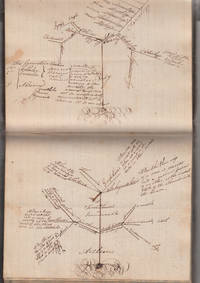
1843ref. 13041New York: not published. 1843 - `45. Unique. Three quarter calf with marbled bds. A very good copy; some scuffing to the binding. 4to appx. 300 pages. Ephraim Clark attended the 1843 lectures of V Mott. He also attended the lectures of CR Gilman in 1844 and 1845. The volume offered here is appx. 300 pages in length. The Gilman lectures are recorded in shorthand; the Mott lectures in regular script. Each occupies about half the volume. Preceding the lectures are about ten pages of notes for cases introduced by doctors Post Parker and Buck. Mott's course of surgical lectures is an ambitious and aggressive approach to medicine and surgery. The cases are complex and Mott whose opinions and statements are recorded by Clark is often incorrect in his conclusions and observations; this is especially so when discussing neuro-surgical procedures. A marvelous record by one of the foremost surgeons of the period. Kelly & Burrage 468 and 880. not published. unknown books
1871ref. MEDI1349Paris, H. Lauwereyens 1871. Lex.-8°. VIII, 275(1) S. Mit 190 Textholzstichen und 22 Tafeln mit aufgewalzten Orig.-Albuminabzügen. Brauner Halblerband der Zeit auf 4 Bünden mit goldgeprägtem Rückentitel und Fileten, Kopfgoldschnitt, Kanten berieben, Exemplar aus einer Spitalsbibliothek mit den entsprechenden Kennzeichnungen, stockfleckig. 8° de Lex. VIII, 275(1) p. avec 190 gravures sur bois en texte et 22 planches avec des épreuves en albumine originales laminées. Demi-reliure brune de l'époque à 4 nerfs avec titre doré au dos et filets, tête dorée, bords frottés, exemplaire provenant d'une bibliothèque d'hôpital avec les marquages correspondants, mouillures. Erste und einzige Ausgabe des weltweit ersten fotoillustrierten Werks zur Augenchirurgie. Diese neu Technologie war zwar in der Herstellung teurer als gestochene Tafeln oder Litographien, lieferte aber auch eine wirklichkeitsgetreuere Darstellung. Lange Zeit gab es in keinem chirurgischen Bereich ein vergleichbares Werk. Die photographischen Aufnahmen zeigen verschiedenen Operationen am Auge (Kystotomie, Sortie de la cataracte, Strabisme, Cantoplastie etc). Da die Photoausrüstung der Zeit noch nicht so ausgereift war, führte man die Operationen an Leichen durch. - Meyer (1838?1902), berühmter Augenarzt in Paris, verheiratet mit der Tochter der Familie Rothschild, deren Ophthalmologe er auch war, studierte in Halle und später in Berlin bei Graefe, wo er 1860 zum Augenarzt promovierte. Dann ließ er sich auf Rat Graefes 1863 in Paris nieder, fast gleichzeitig mit Liebreich und L. Wecker. ?Aber nur E. Meyer besaß das ganze Herz Graefe?s, der ihm folgendes Zeugnis mit auf den Weg gab: ,Ich freue mich, dass E. Meyer durch seine Arbeit sich die Beherrschung aller Zweige der Ophthalmologie angeeignet hat?. Arthur de Montméja, Augenarzt im Pariser 'Hospital Saint Louis', begann 1865 photographische Aufnahmen von Patienten zu machen um einen besseren Austausch mit seinen Kollegen zu ermöglichen. So wurde er zum führenden Verleger im Bereich der Medizinphotographie. Ab 1869 gab er auch die erste medizinphotographische Zeitschrift heraus ('Revue photographique des hôpitaux de Paris'). Albert 1555; Hirschberg/Blodi 1267-68. Sehr selten, NUC verzeichnet weltweit lediglich zwei komplette Exemplare (Harvard, NLM). - Première et unique édition du premier ouvrage photo-illustré au monde sur la chirurgie oculaire. Cette nouvelle technologie était certes plus chère à produire que les planches gravées ou les litographies, mais elle fournissait également une représentation plus fidèle de la réalité. Pendant longtemps, il n'existait aucun ouvrage comparable dans le domaine de la chirurgie. Les photographies montrent différentes opérations de l'?il (cystotomie, sortie de la cataracte, strabisme, cantoplastie, etc). Comme l'équipement photographique de l'époque n'était pas encore aussi perfectionné, les opérations étaient réalisées sur des cadavres. - Meyer (1838-1902), célèbre ophtalmologue à Paris, marié à la fille de la famille Rothschild, dont il était également l'ophtalmologue, fit ses études à Halle puis à Berlin sous la direction de Graefe, où il obtint son doctorat en ophtalmologie en 1860. Puis, sur le conseil de Graefe, il s'installa à Paris en 1863, presque en même temps que Liebreich et L. Wecker. "Mais seul E. Meyer possédait tout le c?ur de Graefe, qui lui apporta le témoignage suivant : Je me réjouis que E. Meyer ait acquis par son travail la maîtrise de toutes les branches de l'ophtalmologie". Arthur de Montméja, ophtalmologue à l'hôpital Saint-Louis à Paris, commença en 1865 à prendre des photos de patients afin de permettre un meilleur échange avec ses collègues. Il est ainsi devenu le principal éditeur dans le domaine de la photographie médicale. A partir de 1869, il publia également la première revue de photographie médicale ('Revue photographique des hôpitaux de Paris').
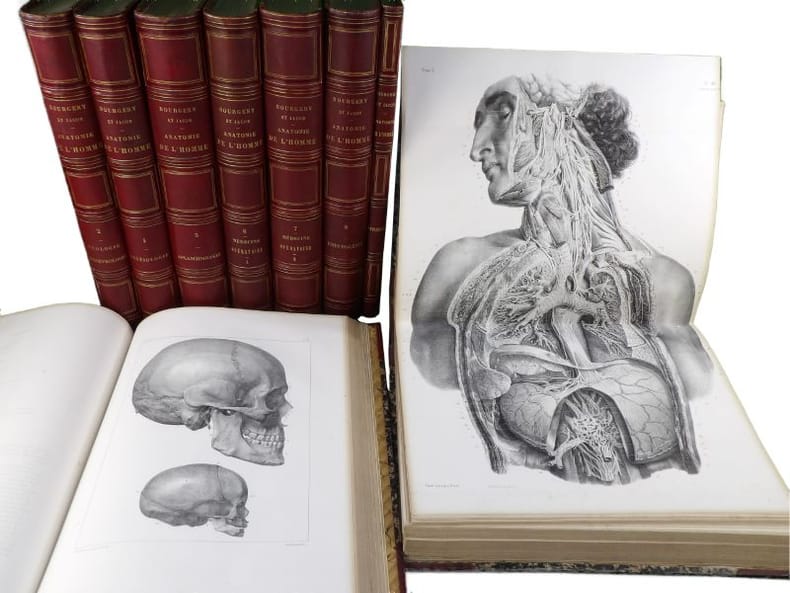
1866ref. 2789Paris, L. Guérin, 1866-1871. 9 Volumes in-folio + 1 Supplément. COMPLET. In-folio - 44 x 34 cm. Reliure de l'époque en demi-chagrin rouge à coins, dos à 4 nerfs orné de caissons à filets dorés. Ouvrage orné de 750 planches lithographiées en noir d'après nature par Jacob (726 gravures + 24 gravures in Supplément). Rehauts de couleur bleu et rouge pour différencier veines et artères sur quelques planches. Cette collection se divise ainsi : Tome 1 : Anatomie descriptive et physiologique. Appareil de relation. Organes de la locomotion. Ostéologie. Syndesmologie. 191 pages + 59 planches (N°1-59) ; Tome 2 : Appareil de locomotion. Myologie. Aponévrologie. 141 pages + 100 planches (N°60-159) ; Tome 3 : Appareil de relation. Névrologie ou organes de l'innervation. 341 pages + 115 planches [100 planches (N°1-100) + 15 bis] ; Tome 4 : Appareil de nutrition. Angéiologie. 162 pages + 98 planches [91 planches (N°1-91) + 7 bis] ; Tome 5 : Appareil de nutrition. Splanchnologie. 342 pages + 96 planches [76 planches (N°1-76) + 20 bis] ; Tome 6 : Sclérotomie. Ophtalmologie. Ténotomie (1e partie). 280 pages + 93 planches [91 planches + 2 bis] ; Tome 7 : Sclérotomie. Ophtalmologie. Ténotomie (2e partie). 356 pages + 98 planches [77 planches + 5 bis + 16 lettrées de A à P] ; Tome 8 : Embryogénie. 335 pages + 67 planches [60 planches (N°1-60) + 7 bissées] ; Suppléments, par le Dr Duchaussoy : 108 pages + 24 planches (1 déchirure restaurée page 31 sans manque de texte, 1 petit manque en marge dans la page de texte de la planche 19, sans conséquence pour le texte). Claude Bernard collabora à cette somme médicale à partir de 1845, en présentant des pièces anatomiques.
1912ref. 5925ABStuttgart, Ferdinand Enke, 1912-1943. 8°. Zahlr. Illustr.. Orig.-Ln. + Wichtig: Für unsere Kunden in der EU erfolgt der Versand alle 14 Tage verzollt ab Deutschland / Postbank-Konto in Deutschland vorhanden + Bd 1-65 (Bde 5, 29 u. 55 fehlen).
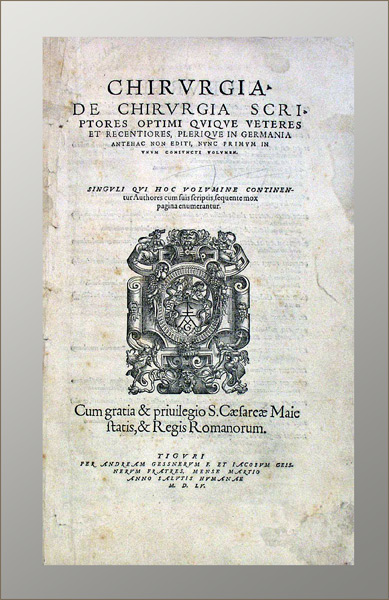
1555ref. 30015DBZürich, Andreas und Jakob Gessner, 1555. Folio. 10 n.n. Bl. (das letzte weiss), 408 (recte 406) Bl., 2 n.n. Bl. Druckermarke, 19 n.n. Bl. Register, 1 weisses Bl. Mit über 150 Textholzschnitten. Pergamentband des 20. Jahrhunderts mit handschriftlichem Rückentitel unter Verwendung einer gemalten Initiale im Stil des 15. Jahrhunderts und mit Schliessbändern. + Wichtig: Für unsere Kunden in der EU erfolgt der Versand alle 14 Tage verzollt ab Deutschland / Postbank-Konto in Deutschland vorhanden +, 30015DB|30015DB_2 [2 Warenabbildungen]
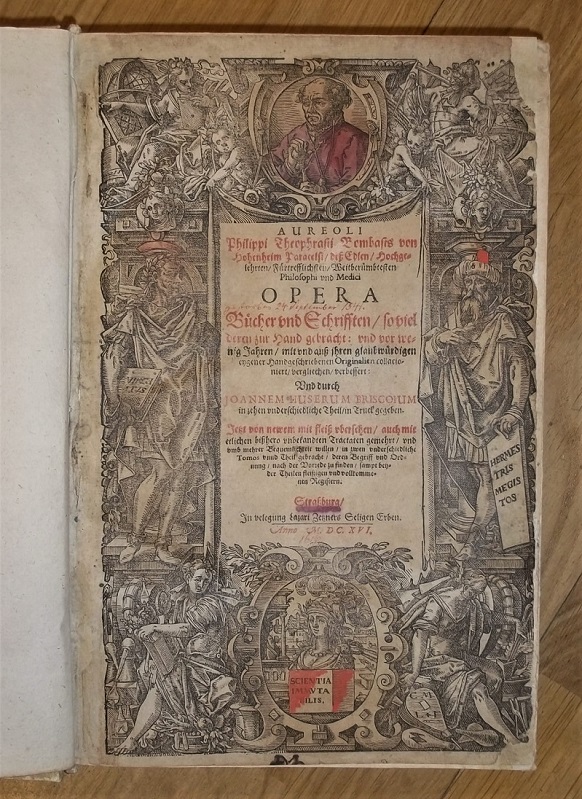
1618ref. 10867Straßburg, Zetzner, 1616 - 1618. 2 Werke in 3 Bdn. 6 Bll., 1127 S., 26 Bll.; 4 Bll., 691 S., 6 Bll.; 6 Bll., 795 (recte 797) S., 19 Bll. mit 2 Holzschnitt-Titelbordüren und einigen Textholzschnitten. Kl.-4°. Mod. Pgmt. mit hs. Rückenschild. [6 Warenabbildungen]
1912ref. 5925ABBd 1-65 (Bde 5, 29 u. 55 fehlen). Stuttgart, Ferdinand Enke, 1912-1943. 8°. Zahlr. Illustr.. Orig.-Ln.
1555ref. 30015BBZürich, Andreas und Jakob Gessner, 1555. Folio. 10 n.n. Bl. (das letzte weiss), 408 (recte 406) Bl., 2 n.n. Bl. Druckermarke, 19 n.n. Bl. Register, 1 w. Bl. Mit über 150 Textholzschnitten. Pergamentband des 20. Jahrhunderts mit handschriftlichem Rückentitel unter Verwendung einer gemalten Initiale im Stil des 15. Jahrhunderts und mit Schliessbändern. [2 Warenabbildungen]
1555ref. 30015BBZürich, Andreas und Jakob Gessner, 1555. Folio. 10 n.n. Bl. (das letzte weiss), 408 (recte 406) Bl., 2 n.n. Bl. Druckermarke, 19 n.n. Bl. Register, 1 w. Bl. Mit über 150 Textholzschnitten. Pergamentband des 20. Jahrhunderts mit handschriftlichem Rückentitel unter Verwendung einer gemalten Initiale im Stil des 15. Jahrhunderts und mit Schliessbändern.
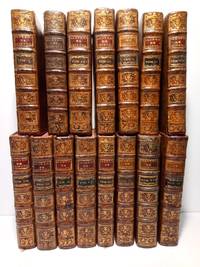
1764ref. 20218Paris: Chez P. Alex. Le Prieur tomos 1 al 12 M. DCC.LXIV 1764 y 1771 y Chez P. Fr. Didot le jeune tomos 13 al 15 M.DCC.LXXIV 1774.- EN TOTAL SON 15 VOLS.: 1º con 2 h. 391 p. / 2º con 2 h. 439 p. y 6 láminas plegadas / 3º con 1 h. 479 p. y 12 láminas plegadas / 4º con CLXXIV232 p. y 4 láminas plegadas / 5º con 1 h 489 p. y 16 láminas plegadas / 6º con 1 h. 406 p. y 2 láminas plegadas / 7º con 1 h. 432 p. y 3 láminas plegadas / 8º con 1 h. 456 p. y 5 nláminas plegadas / 9º con 2 h. 516 p. y 11 láminas plegadas / 10º con 213 p. y 4 láminas plegadas / 11º con 2 h. 516 p. y 2 láminas plegadas / 12º con 2 h.388 p. y 2 láminas plegadas / 13º con XLVIII 431 p. y 9 láminas plegadas / 14º con 2 h. 534 p. 1 h. y 4 láminas plegadas / 15º con VIII 544 p. y 6 láminas plegadas Todas suman un conjunto de 89 láminas plegadas de anatomía e instrumental quirúrgico finamente grabadas al cobre; 8º menor 17 x 104 cm; Buena impresión sobre fuerte papel verjurado; Texto en francés; Plena Piel Epoca lomo cuajado en oro cortes pintados en rojo.- RARO. Las encuadernaciónes con ligeros roces en bordes y esquinasque han sido restaurados. Pequeñas faltas en las cabezas de las lomeras y los tejuelos de algunos tomos. Pero en conjunto la obra presenta un buen aspecto con el interior en excelente estado. Aunque los libros son de dos imprentas presentan un aspecto perfectamente uniforme. Según datos de la actual Académie Nationale de Chirurgie de Francia estas primeras Mémoires de l'Académie Royale de Chirurgie fueron publicadas entre los años 1743-1774. DESCRIPCION EXACTA DE FECHAS POR TOMOS: Paris Chez Le Prieur Tome I partie I 1764; Tome I partie II 1765; Tome I partie III 1743; Tomes IV V y VI 1768; Tomes VII VIII y IX 1771; Tomes X XI y XII 1768; Y Paris Chez P. Fr. Didot le jeune Tomes XIII XIV y XV 1774. CIRUGIA EN GENERAL Y TRAUMATOLOGIA Livre en français P. Alex Le Prieur y Fr. Didot le jeune hardcover
1725ref. 5551Leiden, J. du Vivie et J. & H. Verbeek, 1725. 2 Bde. 21 Bll., 572 S.; 4 Bll.; S. 577 - 684, 1 Bl., S. 685 - 1156, 26 Bll. mit 2 wdh. Kupfer-Titelvignetten und 38 Textkupfern. 1 Kupfertitel und 82 (12 gefalt.) Kupfertafeln (es fehlt das Kupfer-Porträt). Gr.-Fol. Mod. HLdr. auf 5 Bünden mit Rückentitel und modernen Buntpapierbezügen ((etw. berieben). [6 Warenabbildungen]
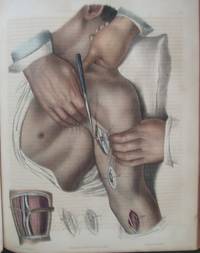
1844ref. 14056Philadelphia: Carey and Hart 1844. First Edition. later marbled boards. Good; binding worn and scraped; some moderate foxing to the text; all the color plates are clean and bright; diminishing tide mark along lower border touching the text for the first 25 pages. large 4to. There are 80 color lithograph plates. The text contains four sections Elementary and Minor Operations General Operations Special Operations and Plastic and Subcutaneous Operations thereby making this the first text on plastic surgery published in the United States as well as one of the earliest atlases of surgical procedures. Pancoast taught at Jefferson Medical College in Philadelphia. He developed a number of new operative procedures G - M # 4170 & G - M # 4855 as well as new procedures notably the 'plow and groove' or plastic suture critical to rhinoplastic operations. The illustrations in the book are graphic instructive and beautifully rendered by James Queen A. Newsam P. C. Hollis L. Brechemin and S.Cichowski and are beautifully lithographed by Peter S. Duvall of Philadelphia. Norman stated in his catalog # 4 1978 that the book was hand-colored. The subtle detail features of operations are hand highlighted but the high quality lithography of Duval shines throughout. The plates in these handful of color copies are printed on a superior quality paper resistant to the usual foxing found in ordinary black and white issue of the book.The book in its uncolored state is widely held by the institutions and shows up with some regularity at auction; but there has been no copy of the first edition in its colored state at auction for more than three-quarters of a century. Reese Nineteenth Century American Color Plate Books cites only the third edition and states: 'Pancoast's work was one of the most extensively illustrated medical works published in America before the Civil War. It was available with either uncolored or colored plates and in the latter format it is one of the most impressive color plate books of its era.' The binder of this copy mistakenly placed two groups signatures out of order. The book however is complete with all 80 plates and 380 pages of text. The backstrip is worn away and crudely 'repaired' with cloth tape. G - M # 5598; Cushing P 38; not in Bennet; Reese citing only a much later printing. Carey and Hart hardcover books
1979ref. LFA-126727334Un ouvrage de 252 pages, format 155 x 240 mm, broché, publié en 1979, Pygmalion, collection "Dossiers de Notre Temps", bon état