|
|
|
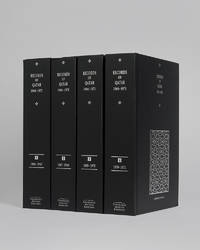
[ARABIAN GULF; QATAR]; BURDETT, Anita L (editor).
Records of Qatar: 1966-1971.
Cambridge Cambridge Archive Editions 2021. . 4 vols 8vo 25.5 x 16.5 cm; 5 large folding maps loose in rear pocket; publisher's original black cloth silver gilt lettering a fine set.<br /> A comprehensive collection of documents recording the history of Qatar between the years 1966 and 1971 which saw the withdrawal of Britain from the region and the eventual establishment of Qatar as an independent nation rather than joining the Emirates in a confederation.<br /> Cambridge, Cambridge Archive Editions, 2021. hardcover
Riferimento per il libraio : 121953
|
|
|
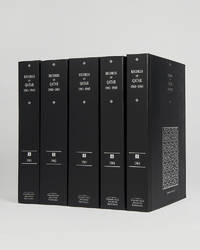
[ARABIAN GULF; QATAR]; BURDETT, Anita L (editor).
Records of Qatar: 1961-1965.
Cambridge Cambridge Archive Editions 2021. . 5 vols 25.5 x 16.5 cm; publisher's original black cloth silver gilt lettering a fine set.<br /> A very important collection of documents charting the the history of Qatar during the years 1961 to 1965 including the rise of the National Unity Front the growth of the Qatar Petroleum Company and the decline of British-Qatari relations. Chapters divide the documents into sections: the Royal Court Council of Ministers communications economy foreign affairs internal affairs judiciary labour and oil among others.<br /> Cambridge, Cambridge Archive Editions, 2021. hardcover
Riferimento per il libraio : 121951
|
|
|
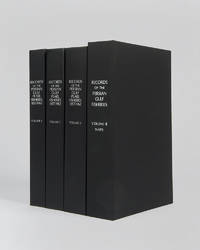
[ARABIAN GULF]; BURDETT, Anita (editor).
Records of the Persian Gulf Pearl Fisheries 1857-1962.
London Archive editions 2026. . 4 vols 8vo; includes a map portfolio with 7 maps original black cloth lettered in white a fine set.<br /> A very important work on the pearl fisheries of the Arabian Gulf bringing together in a single research collection all relevant documents from British government records relating to the pearl industry the most important economic activity in the Gulf before the oil era.<br /> London, Archive editions, 2026. hardcover
Riferimento per il libraio : 122017
|
|
|
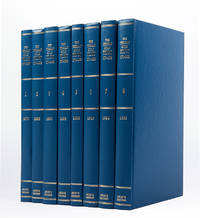
[ARABIAN GULF].
The Persian Gulf pilot 1870-1953.
London Archive Editions 1989. . 8 vols 8vo; original blue cloth gilt a fine set.<br /> A complete set of this handsome facsimile edition of all eight Persian Gulf pilots published between 1870 to 1932. Invaluable not only for sailing directions but also for descriptions of the coast and its towns and villages and how they have grown over the period.<br /> London, Archive Editions, 1989. hardcover
Riferimento per il libraio : 121085
|
|
|
[Arabian Gulf - Bushire].
Bushire (N.H-39, fourth edition). Tehran (N.I-39, third edition). [London], Geographical Section, General Staff, 1951.
Silk-printed colour map, 1:1,000,000. 68 x 62 cm. Classed as "Restricted", this Ordnance Survey map, printed on fabric to sustain extreme conditions of weather and handling, shows the northern end of the Gulf from the Saudi Arabian border and Kuwait, the Shatt Al Arab with Khorramshahr, and the Iranian coastline to Bushire and beyond. The reverse shows the area north of this, including Isfahan and Tehran. - Very rare; in clean and apparently unused condition. Folded. OCLC 249320989.

|
|
|
[Arabian Gulf - Shatt Al Arab].
Persian Gulf. Mouth of the Euphrates. Shatt Al Arab and Bahmanshir River. From surveys by the Port Directorate, Basra, 1926-38. Khor Abdullah surveyed by Commr. H. E. F. Paine RIN, 1941-1942. London, 1944.
Map (67 x 98 cm). Lights and beacons highlighted in purple. Wartime reprint, “reproduced by the U.S. Hydrographic Office from British Admiralty Chart”. First issued in 1921, with changes in 1923, 1928, 1931, 1936, 1940, and 1943. Not in Al Ankary; Al-Qasimi.

|
|
|
[Arabian Gulf - WWI Operations].
East India (Military). Despatches Regarding Operations in the Persian Gulf and in Mesopotamia. London, Darling & Son, 1915.
Folio (211 x 330 mm). 54 pp. Original blue printed wrappers. Sewn. Detailed official military reports from the war theatre in the Gulf region, issued by Generals W. S. Delamain, A. A. Barrett, and J. E. Nixon between February and August 1915 (covering operations as early as November 1914), in the early months of the British Empire's Mesopotamian campaign against the Ottoman Empire, while T. E. Lawrence was still posted to the military intelligence staff at the Arab Bureau in Cairo. - A few edge and corner flaws to the first few pages.
|
|
|
[Arabian Gulf].
Persian Gulf and adjacent countries. London, War Office, Topographical Section, 1908.
Coloured map (72 x 57 cm). Scale 1:4,055,040. Map of the Arabian Gulf. “It must have been drawn to show the zones of influence of Russia and Great Britain in Persia, as defined by the Anglo-Russian convention on 31st of august 1907” (Alai). Alai, General maps E.354. OCLC 221059917. Not in Al Ankary; Al-Qasimi.
|
|
|
[Arabian Gulf].
Weather in the Indian Ocean to Latitude 30° S. and Longitude 95° E. Including the Red Sea and Persian Gulf. Volume II. Local information. Part 9 Coast of East Africa from the equator to Cape Delgado [...]. London, Meteorological office, Air Ministry, 1940.
4to. 63 pp., final blank page. With map frontispiece and several illustrations and tables in the text. Contemporary printed wrappers. Stapled. First edition. Rare climatological study originating from a series of meteorological handbooks of the Indian Ocean issued by the British government between 1940 and 1944. The three-volume series, comprising a total of 12 parts, was prepared by the Meteorologial Office, Air Ministry, in cooperation with the Naval Meteorological Branch, Admiralty, London; it was reprinted for the U.S. Navy as late as 1980. The ESSA Technical Memorandum of 1969 mentions another reprint in 1945. - The present volume is the last of nine parts of volume II, covering the climate of the East African coast from the equator to Cape Delgado, discussing tropical cyclones and depressions, winds, visibility, clouds, rain and hail, temperature, humidity and other meteorological events. The frontispiece shows a map of the relevant area; additional diagrams illustrate surface winds and higher winds, as well as the amount of clouds and rainfall. The tables show the general climate in Mombasa, Tanga, Zanzibar, Dar es Salaam, Kilwa, and Lindi, as well as the monthly frequency of wind direction and force at sea and in the upper air, and the visibility at coastal stations. - Library shelfmark in pencil, as well as a mounted blank loaning sheet to final blank page. 7 combinations of letters and digits in black felt pen to lower cover. Traces of a shelfmark label and a cancelled inscription to front cover. Not a single copy in auction records. U.S. Department of Commerce, ESSA Technical Memorandum EDSTM10, A Note on Climatology of Thailand and Southeast Asia, 164, 19. OCLC 1181290135.
|
|
|
[Arabian Horse Breeding].
A library on Arabian horse breeding, including Stud Books and General Reference. From the Le Vivier, Marcia Parkinson and Finkelmeyer Family Collections, with Additions from the Library of Duke Maximilian in Bavaria. Various places, 1788-2011.
The largest collection of its kind in private hands. 330 works in more than 1100 volumes. Mostly original or first editions. Published in Austin, Cairo, Chicago, Hildesheim, London, Marburg, Moscow, New York, Philadelphia, Riga, Tehran, Warsaw and other places in the years 1788 to 2011. Amassed over the last fifty years and covering four centuries of relevant material, the present collection spans all aspects of the history and development of the breeding of Arabian horses. It comprises within itself many books from the Le Vivier collection: fine press books of racing and thoroughbred literature produced by Eugene Connett's famous Derrydale press, as well as numerous important items from the library of Duke Maximilian in Bavaria (1808-88), himself a great enthusiast of Arabic horses. We here find the early Arabian Horse Registry of America Stud Books, and many items also bear presentation inscriptions from the authors (Carl Raswan, Gladys Brown Edwards, etc.). The common practice in such a specialized field, most of the publications here were issued for a very limited circulation in runs of 1,000 or fewer individually-numbered copies. - As a reference library for breeding the collection is unparalleled: almost any Arabian horse's forefathers will be found amongst the exhaustive stud books and breeding serials from the 18th to the 20th century, from Egypt, Australia, Iran, Spain, Russia, the USA, etc., often with accompanying photographs. Perhaps the most famous reference work is the Raswan Index, of which only 380 copies were printed (and many destroyed by a flood). Raswan became an expert on the Arabian breed through his lengthy trips to the desert, where he lived with the Bedouins and learned their language and customs. Several scarce early 20th century works also testify to the Western fascination with the Bedouin and desert roots of the Arabian horse: Homer Davenport's 'My Quest of the Arabian Horse' (1909) and Raswan's 'The Black Tents of Arabia: My Life Amongst the Bedouins' (1935). - Alongside modern surveys of the key centres of horse-breeding in the Arab world, the early Western classics are also found here in their scarce first editions. French and German authors are also well-represented, including the text and first French translation of the 'Hilyat al-fursân wa-shi'âr ash-shuj'ân', an abridgement of Ibn Hudhail's horse treatise, prepared around 1400. Finally, the owner's collection of notable catalogues and magazines paints a fascinating composite picture of the evolution, and heyday, of Arabian horse-breeding in the Arab world, Poland, America, and the United Kingdom. - Also contained in this magnificent collection are the classic reference works on Arabian and Anglo-Arabian racehorses and their breeding. These standard works and encompassing sets of specialised thoroughbred literature include not only the indispensable guides to horse pedigrees, the Racing Calendar, General Stud Book, Spanish, American and Australian Stud Books, Bloodstock Breeders' Review, and Prior's Register of Thoroughbred Stallions, in near-complete runs stretching back as far as the 18th century, but also British and international horseracing history, and several volumes of exquisite coloured plates. - The size and comprehensiveness of the present collection cannot be overstated; it is safe to say that it represents the largest private collection of its kind which has come up for sale in recent decades. Many of the items found here can be located in just a handful of public institutions worldwide. Such items come into the market so rarely (and have recently, like the Raswan Index and the AHRA Stud Books, commanded prices of five figures) that it would be impossible to build a comparable collection item-by-item; the volumes here represent a lifetime of serious dedication to the task. Yet the value of such a collection lies not simply in its impressive number of important publications, but in the vast amount of practical knowledge contained within. - Illustrated catalogue available upon request.
|
|
|
[Arabian Horse Breeding].
Collection of 19 original photographs. [Prob. Cuba, 1920s].
Gelatin silver prints (vintage). Approx. 87 x 142 mm. Rare collection of vintage photographs showing the breeding of race horses, mostly Arabians: the sire covering the dam, surrounded by handlers; individual portraits of horses, captioned on reverse ("Jerez Arabe", "Bourbon Barrymore", "Idilio I Arabe", "Hoyo Arabe"). - Two additional images show the breeding of donkeys. Removed from an album, with traces of glue mounting on reverse. Some brownstaining; occasional nicks or slight edge damage (slight loss to left of one image).

|
|
|
[Arabian Horses at the Hungarian National Stud].
Collection of original vintage photographs. Bábolna, c. 1885.
11 vintage photo prints (ca. 90 x 120 mm, but one 105 x 170 mm) on backing cardboard (20 x 25 cm). Highly uncommon photographs of Arabian horses (all individually captioned) at the famous Bábolna stud in Hungary, the principal stud for producing the best horses for the Austro-Hungarian military in the 19th century. The "Bábolna Nemzeti Ménesbirtok" (Bábolna National Stud) was founded by Emperor Joseph II in 1789. In 1816 it was decreed that henceforth only Arabian stallions should be used for stud service - a policy that raised the quality of the Austrian cavalry's horses to a famous level and necessitated the frequent introduction of new pure-bred Arabian stallions from the Middle East. One of the greatest commanders and stud-masters of Bábolna, Mihály Fadlallah el Hedad, hailed from Syria. - The photos show portraits of the horses Sechun, Nadir, Tahita, Nasira, Celeby, Dzerid, El Hafi, El Denedzi, Hiläl, Riat, as well as a larger group portrait showing several of the horses with their Arabian and Austro-Hungarian trainers. Some slight staining to backboards, but altogether well-preserved. Extremely rare.

|
|
|
[Arabian Nights]. Burton, Richard Francis.
A plain and literal translation of the Arabian Nights' entertainments, now entituled the book of the Thousand Nights and a Night. (Including: Supplemental nights). [London?], Richard Burton Club, [c. 1910].
17 vols. Royal 8vo (24 x 16 cm). With numerous illustrations (including the series by Albert Letchford), repeated on laid paper; the 17 frontispieces repeated in colour. Contemporary three quarter olive green morocco, gold-tooled spine, tops gilt. A handsome edition of Burton's "Arabian Nights", finely illustrated and printed in a limited edition of 100 hand-numbered copies. Bold to a fault, Richard Burton travelled to Mecca, explored the African Great Lakes, shocked his readers with his candid travel accounts, and gained fame and riches with his translation of the Arabian Nights. The first edition was published in 1885-88 and re-issued by the Burton Club shortly thereafter. The present edition is a reprint of the first Burton Club edition, illustrated with, among others, Albert Letchford's famous plates. - Spines slightly faded. Fine set, uncut and partly unopened. Cf. Howgego III, B98 (p. 146, first ed. 1885-88).
|
|
|
[Arabian Nights]. Burton, Richard Francis.
A Plain and Literal Translation of the Arabian Nights' Entertainments, Now Entituled the Book of the Thousand Nights and a Night. (Including: Supplemental Nights). [Boston?], The Burton Club, [ca. 1904].
Royal 8vo (24 x 16 cm). 14 (instead of 17) vols. With frontispieces and numerous illustrations (vol. 8 lacking one image). Contemporary richly gilt full cloth. Top edges gilt. - (2) The same. The Book of the Thousand Nights and a Night. A Plain and Literal Translation of the Arabian Nights Entertainments. Vol. IV. (Including: Supplemental nights, vol. VI). (Colophons: USA), ibid., [ca. 1940]. Contemporary richly gilt and silvered full cloth. Top edges red. The first Burton Club edition of Richard Burton's celebrated translation of Alf Laylah wa-Laylah, commonly known in English as the Arabian Nights. These Arabic tales, cherished in Europe since the early 18th century, are often erotic in content, and in Burton's unexpurgated translation they outraged Victorian England. Burton included numerous footnotes and a scholarly apparatus, offering a vivid picture of Arabian life, which set his translation apart from earlier English renderings. Bold to a fault, Richard Burton travelled to Mecca, explored the African Great Lakes, shocked his readers with his candid travel accounts, and gained fame and riches with his translation of the Arabian Nights. The first edition was published in 1885-88 and re-issued by the Burton Club shortly thereafter. - The present set lacks volume 4 of the "Nights", as well as volumes 4 and 7 of the "Supplemental Nights". The volumes numbered "IV" and "V" of the "Supplemental Nights" are in fact volumes 5 and 6. In lieu of the missing tomes the collection includes volume 4 of the "Arabian Nights" and volume 6 of the "Supplemental Nights" from a later 16-volume Burton Club edition, which Ross dates ca. 1940. This later date is supported by the fact that this edition is not included in Penzer's thorough bibliography published in 1923. - Spines slightly faded; extremities lightly worn. A fine set, uncut and partly unopened. Penzer 131. (2) Scheherazade's Web: The 1001 Nights & Comparative Literature, J. Ross 10 & 11.
|
|
|
[Arabian Nights]. Burton, Richard Francis.
The Book of the Thousand Nights and a Night. A Plain and Literal Translation of the Arabian Nights Entertainments. (Colophons: U.S.A. [Boston, MA?]), The Burton Club, [ca. 1940].
(2) Burton, Richard F. Supplemental Nights. (3) Burton, Richard F. [Autograph manuscript book review of an 1881 Panchatantra edition]. 16 volumes (including 6 supplements). 8vo. With an original manuscript leaf written by Burton (with the manuscript heading: "Proof to Sir R.F.B. Hotel des Bains, Aigle, Canton Vaud, Switzerland" and a note "Long Primer Pressig.") and each volume with a different frontispiece in two states (coloured and uncoloured). Contemporary richly gold-blocked green morocco, boards with Arabic script in gold, spine with raised bands, gold-tooled turn-ins, marbled paste-downs. The so-called "manuscript edition" of Richard Burton's celebrated translation of Alf Laylah Wa Laylah, commonly known in English as the Arabian nights. These Arabic tales, cherished in Europe since the early 18th century, are often erotic in content, and in Burton's unexpurgated translation they outraged Victorian England. Burton included numerous footnotes and a scholarly apparatus, offering a vivid picture of Arabian life, which set his translation apart from earlier English renderings. - The present edition (limited to 99 sets, the present being copy no. 49) includes a manuscript leaf from a text by Burton. In the present copy this is a book review by Burton, of a French translation of Johannis de Capua's Latin translation of a Hebrew translation of the Panchatantra, a Sanskrit frame story written several centuries before the Arabian nights. The notes at the head show that it was used as printer's copy. - The title-page of volume one uses the correct main title, The book of the thousand nights and a night, but confusingly mixes it with part of the subtitle of the Supplemental nights: "to the book of the thousand one nights with notes anthropological and explanatory". To add further confusion it says "volume three", though the content is that of volume one. The volume number is clearly a printer's error, apparently corrected early in the press run. - Ross dates the (regular copies of the) present edition ca. 1940. This later date is supported by the fact that this edition is not included in Penzer's thorough bibliography published in 1923. - Some minor browning to the endpapers, those of the first volume partly detached and with a small pieces torn off, the binding has some very minor wear to the hinges, and a few headbands have been carefully repaired. A fine set. Scheherazade's Web: The 1001 Nights & Comparative Literature, J. Ross 10 & 11. Cf. Penzer, pp. 126-132 (other Burton club editions).
|
|
|
[Arabian Nights]. Lane, Edward William (translator).
The Thousand and One Nights, commonly called, in England, the Arabian Nights' Entertainments. London, Charles Knight and Co. (back of title-page volume 1 & 3: William Clowes and sons; volume 2: Whitehead & Co.), 1840 (vol. 2) - 1841 (vols. 1 & 3).
3 volumes. 8vo in 4s. XXXII, 618; XII, 643, (1); XII, 763, (1) pp. With a different lithographed title-page to each volume and hundreds of wood engraved illustrations in text. 19th-century red morocco (signed on flyleaf: Jefferies & Sons, Bristol), richly gold-tooled spines, boards, board edges and turn-ins, gilt edges. Attractively bound set of the first accurate English translation of the of Alf Laylah wa Laylah, commonly known in English as the "Arabian Nights". The British orientalist Edward William Lane (1801-76) lived in Egypt for several years and had integrated well with the Arabic population. - It looks like by the time of publication of the third volume, the run of the first was sold out and the publisher had turned to a new printer for the third and a second edition of the first volume to complete the set. The second edition of the first volume is a line for line reprint, but omits the final printer's imprint and the occasionally included translator's advertisement. - With the bookplate of the American collector Henry T. Cox, whose library was auctioned in 1899, and the library stamps of the American businessman Henry T. Sloane (1845-1937). A very good set. Scheherazade's Web: The 1001 Nights & Comparative Literature, J. Ross 24 (1839-1841).
|
|
|
[Arabian Peninsula - Middle East].
Vorderasien. 1:5,000,000. [Berlin], German General Staff, 1941.
Colour-printed map, ca. 124 x 97 cm. Constant ratio linear horizontal scale 1:5,000,000. Conic projection. Rare German military wall map of the Near and Middle East, produced during the Second World War for the German General Staff. Marked as "First special edition, for service use only!". Shows international and administrative boundaries, as well as railways, roads, tracks, telegraph lines, and oil pipelines. - Traces of folds; a few minor edge chips. Formerly in the collections of the Geographical Institute of the University of Berlin with the Institute's stamp and pencil shelfmark. OCLC 49986920.
|
|
|
[Arabian Peninsula - Near and Middle East].
Blizhnij i srednij vostok. Moscow, [Main Directorate of Geodesy and Cartography under the Council of Ministers of the USSR], 1972.
88 x 100 cm. Original colour-printed map. Scale 1:6,000,000. Rare political map of the Middle East from the Cold War era, centred on the Arabian Peninsula and the Gulf region, but also comprising Egypt, Sudan, Ethiopia and Somalia, as well as Greece, Turkey and the Levant, Iraq, Iran, Pakistan, and Afghanistan. With Cyrillic titles and captions. - Small marginal flaws.
|
|
|
[Arabian Peninsula - Southwest Asia].
Jugo-zapadnaja Azija. Moscow, [Main Directorate of Geodesy and Cartography under the Council of Ministers of the USSR], 1972.
82 x 96 cm. Original colour-printed map. Scale 1:5,000,000. Rare political map of Southwest Asia from the Cold War era, centred on the Arabian Peninsula and the Gulf region but including Turkey and the Levant, Iraq and Iran. With Cyrillic titles and captions. - Small marginal flaws.
|
|
|
[Arabian Peninsula and India].
Südwest-Asien. 1:5,000,000. Grundlage: Stielers Handatlas. Gotha, Justus Perthes, 1942.
117 x 78 cm. Constant ratio linear horizontal scale: 1:5,000,000. Relief shown by hachures, contours, and spot heights. Depth shown by soundings. Loosely stored within printer wrappers. Third edition of this German wartime map of the Middle East, parts of Asia, and India, first published thus in 1940. Based on "Stielers Handatlas" and issued within Perthes' "Ubique terrarum" series (no. 20). - In excellent state of preservation, detached from its original wrappers. OCLC 164843864.
|
|
|
[Arabian Peninsula].
Laila. North F-38. Second edition. Army/Air Style. [London], War Office, 1944.
707:601 mm. Photolithographed in 3 colours. Scale 1:1,000,000. Rare RAF map of central Arabia, showing Jebal Tuwaiq, the desert west, and Wadi ad-Dawasir south. Compiled by the R.G.S., drawn by the War Office, and photolithographed by the O.S. in 1943 for the Royal Air Force. The first edition was published in 1925. - Slightly wrinkled, but in good condition. OCLC 634949403.

|
|
|
[Arabian Peninsula].
Laila. North F-38. Second edition. Army/Air Style. Sales copy. [London], War Office, 1944.
Photolithographed map in 3 colours (705:600 mm). Scale 1:1,000,000. Rare RAF map of central Arabia, showing Jebal Tuwaiq, the desert west, and Wadi ad-Dawasir south. The first edition was published in 1925. - In good condition. OCLC 634949403. Not in Al Ankary; Al-Qasimi.
|
|
|
[Arabian Peninsula].
Map of Arabia. G.S. 4016. London, published at the Survey of Egypt for Arab Bureau, under authority from the War Office, Sept. 1916.
794 x 628 mm. Scale 1:4,000,000. Mounted on cloth. Folded. Rare, large-scale map of western Arabia including all but the easternmost part of the Peninsula (ending about 100 miles east of Qatar). "This map has been compiled almost entirely from published sources, of which the principal are (1) Hunter's Arabia 1:2,000,000; (2) War Office quarter inch of S.W. Arabia; (3) War Office 1:250,000 of the rest of the Turkish Empire; R.G.S. materials have also been used" (editor's note). Some slight brownstaining in places, otherwise well-preserved. Not in OCLC.
|
|
|
[Arabian Peninsula]. - Craufurd, C[harles Edward Vereker].
The Dhofar District. (From: The Geographical Journal. Vol. LXIII No. 2 [February 1919]). London, The Royal Geographical Society, 1919.
8vo. pp. 97-105. With 2 photoplates. Modern wrappers. Early account of a visit to the seaport of Dhofar (Oman) on the southern coast of the Peninsula, including an interesting account of the local boats and the sailing skills of their owners. The illustrations show Makalla in Hadramaut, a camel drawing water in Dhofar, and the ruins of the temple of al-Bilad. Macro, Bibliography of the Arabian Peninsula, 777. OCLC 49427292.

|
|
|
[Arabian Peninsula]. - Craufurd, C[harles Edward Vereker].
The Dhofar District. In: The Geographical Journal. Vol. LXIII No. 2 (February 1919). London, The Royal Geographical Society, 1919.
8vo. pp. 97-105 (entire volume: iv, 65-128 pp., with 18 photographic illustrations and a folding colour map). Original printed blue wrappers. Early account of a visit to the seaport of Dhofar (Oman) on the southern coast of the Peninsula, including an interesting account of the local boats and the sailing skills of their owners. The illustrations show Makalla in Hadramaut, a camel drawing water in Dhofar, and the ruins of the temple of al-Bilad. Macro 777. OCLC 49427292.

|
|
|
[Arabian Peninsula]. Thomson, John.
Arabia, Egypt, Abyssinia, Red Sea &c. [Edinburgh, John Thomson & Co., ca. 1823].
Engraved map in hand-drawn outline colour. 720 x 533 mm. Constant ratio linear horizontal scale 1:7,000,000. Relief shown by hachures and shading. Greenwich meridian. A fine engraved map of the Arabian Peninsula, also showing the Arabian Gulf, the Red Sea, and the Horn of Africa. Shows boundaries, rivers, deserts, caravan routes and principal settlements. With early outline hand-colouring on wove paper with watermark date of "1823". Also issued as plate 46 in Thomson's "A New General Atlas" (1821-29). - Well preserved. Cf. Al-Qasimi (2nd ed.) pp. 255 & 258. Tooley's IV, 271. OCLC 43216571.
|
|
|
[Arabic manuscript].
Arabic manuscript on polished paper. Arzu'r-Rum (Erzurum), [1650 CE] = first days of Muharram 1060 H.
Tall 4to (183 x 305 mm). 61 unnumbered ff. Complete Arabic manuscript with two intercalated sections (ff. 18v-23r, 53r-57r) in Ottoman Turkish. Page layout carefully organized; writing luxuriantly penned in an elegant hybrid style mixing tulut and tawqi, associated with manuscripts of highly dignified content or commissioned by a wealthy patron. Black ink, 9 lines per extensum within a gilt "gadwal" border. With a brightly coloured "sarlawh" headpiece (f. 3v) of illuminated bulb-shaped forms in gold, pink and light green, with vegetal twists unfolding on a bright blue background veined with green stems and dotted by reddish and golden buds. Contemporary giltstamped calf binding with fore-edge flap (repaired). A finely preserved manuscript comprising "'arqam" (official notes) related to the Great Mosque (Ulu Camii) of Erzurum in Eastern Turkey, occasioned by the successful completion of major restoration work on the building begun in AD 1639 under the appointed local governor Hüseyn Pasha. The manuscript's opening pages contain a summary of "the estates depending on the complex of the mosque", followed by a catalogue of places, buildings or factories belonging to or administrated by it, such as a "masbaga" (dye-works), a "mamlaha" (saltern), a "madbaga" (tannery, here given with the Turkish translation of the term, "bi't-Turki debag-hana"), etc. Leaf 2r lists both the Great Mosque's officials and contractors or stipendiaries, along with their respective wages ("li'l-mudarris asarat darahim fi kull yawm" - "to the principal of the madrasa: ten dirhams a day"; "li-'l waiz saba darahim fi kull yawm" - "to the (official) preacher of the Mosque: six dirhams a day"; to the first Imam of the Mosque four dirhams a day, etc.). The remainder of the text sets out detailed accounts for the summarized information, but also includes liturgical exaltations of Allah and the Prophet Muhammad, praised in Koran- and Sunan-derived eulogies. - Dated separately twice: first in Arabic, in the final three text lines of the Turkish section of f. 23r ("the first days [i.e. 1st/10th] of the month of Du'l-Higga of the Islamic year 1058", i.e., between 17 and 26 December 1648 AD); then at the end, last four lines of f. 60r, stating that the manuscript was completed on "the first days of the sacred month of Muharram of the year 1060"AH (i.e., between 4 and 13 January 1650 AD). - A well-preserved, complete 17th-century manuscript drawn up for the recently restored Erzurum Mosque and its extensive appurtenances, likely also in recognition of their status of inalienability, i.e. the establishment of an Islamic waqf, or mortmain regime. Thus, the manuscript records the mosque's administration in both legal and religious terms, in accordance with the Sunni law of the Ottoman Empire.
|
|
|
[Arabic Manuscript].
Collection of texts in Arabic. Istanbul, [1502/03 CE] = 908 H.
8vo (18 x 13 cm). 78 ff., naskh script with features of ta'liq, in several different hands. Half-leather Oriental binding with a flap and pasted boards. A collective volume with texts in Arabic on Arabic manuscript paper (for ff. 43-45 and from f. 73 onwards European paper is used). It was copied by Ahmad b. 'Uthman al-Arzan al-Rumi in the city of Qustantiniyya (Istanbul) in one of the eight madrasas (colophon in a later hand on f. 78a). - 1) ff. 1v-13v. Fragment without beginning or end, and possibly misbound, of a gloss on logic (Qala-aqulu structure). Possibly this is the commentary by Qutb al-Din al-Razi al-Tahtani (d. 766/1364) on al-Risala al-Shamsiyya fi al-Quawa 'id al-Maniqiyya, by Nagm al-Din 'Ali b. 'Umar al-Quazwini al-Katibi (d. 675/1276 or 693/1294), Gal G I, 466. Outb al-Din is mentioned on f. 1v. Heavy interlinear and marginal glossing. - 2) ff. 14b-59b. Gloss on logic (Qala-aqulu structure), apparently by al-Sayyid al-Sharif, whose name is mentioned variously. This is the gloss by al-Sayyid al-Sharif al-Gurgani (d. 816/1413), GAL G II, 216, on the commentary by Muhammad b. Qutb al-Din Muhammad al-Razi al-Tahtani (d. 766/1364), GAL G II, 209, on al-Risala al-Shamsiyya fi al-Qawa 'id al-Mantiqiyya, by Magm al-Din 'Ali b. 'Umar al-Qazwini al-Katibi (d. 675/1276, or 693/1294), GAL G I, 466, as confirmed by comparison with MS Berlin Mq. 63 (= Ahlwardt 5260). - 3) ff. 60a-78b. Acephalous fragment of a gloss on logic (Qala-aqulu structure). In the margin of f. 60a is the name "'Sayyid Tasdiqat'", which may indicate that his is another gloss by al-Sayyid al-Sharif al-Gurgani.

|
|
|
[Arabic Medicine].
The Sudhoff Collection of the History of Arabic Medicine, deaccessioned from the Department of the History of Medicine of the University of Leipzig. Various places, 1855-1941.
74 catalogued items, comprising 88 volumes of printed books. In Arabic, English, French, German, Italian, Latin, Swedish, and Syriac. A highly important ensemble of books on early Islamic medicine and science, assembled by one of the most renowned medical research institutes of its age, comprising not only rare historical and bibliographical studies, but also many first printed editions of crucial scientific texts in Arabic, frequently in the form of doctoral theses that remain almost impossible to find in libraries. Several titles, such as Steinschneider's "Introduction to the Arabic Literature of the Jews" (published in no more than 20 copies, "for private circulation" only), have not been seen on the market in decades, making the present offering a unique opportunity to acquire some of the most elusive relevant literature published in the late 19th and early 20th century. - Established in 1906, the Karl Sudhoff Institute in Leipzig was the first institute for the study of the history of medicine established worldwide. Its founder Karl Sudhoff (1853-1938) is regarded as one of the 20th century's foremost historians of medicine. A practicing physician for most of his life, Sudhoff published more than four hundred articles as well as many monographs, edited standard works and editions of original manuscripts. He was personally involved in building the institute's library and thus in assembling the present collection. - The 88 volumes offered here include numerous relevant issues of scholarly journals as well as journal articles. They often unite within a single volume several items published separately but forming a clear thematic unit, sometimes bringing together between two covers material that appeared at various times and in several places but was intended by the author to be considered as a whole. Deaccessioned from the Department of the History of Medicine of the University of Leipzig, most books bear the usual shelfmarks and stamps, but are otherwise in fine condition. - Catalogue available upon request.
|
|
|
[Arabic-script wood-printing block].
Hand-carved woodblock engraved with "Safr Nishd al-Nishad li-Suleyman" (the Song of Solomon). [Probably Ottoman provinces, mid-18th century (ca. 1750)].
A single hand-carved woodblock (ca. 170 by 110/92 by 220 mm) for use as printing block, together with a print on 18th century paper (165 x 105 mm). Woodblock in Ottoman Turkish for a Hebrew publication of the Song of Solomon, probably produced in the Ottoman regions of the Levant for a rural printing press. A rare survival of a printing tool, and also an important witness to cross-cultural printing for minority audiences in the Ottoman world. - Includes a print of the text reading "Safr Nishd al-Nishad li-Suleyman wa'ighal ba-l'Abraniyat Sir Hashirim", printed on a piece of 18th-century paper pasted to a cutting from a Croatian printed book ("Pasha Duhovna", on Spirituality and the Passover). - Some small wormholes in the wood, post-dating the print; carved side stained black from ink used for printing. Printing devices such as this are often discarded or recycled and rarely survive in such condition as the present example.
|
|
|
[Aramco - Map of Saudi Arabia].
Western Area. Scale 1:1,000,000. [Dhahran, Aramco / USGS, 1953].
760 x 750 mm. Scale 1:1,000,000. Relief shown by hachures, spot heights, submarine contours, airports and airstrips, mining activity, and land routes. Key in English. Printed on cloth. Blueprint map of Saudi Arabia covering 20-26° N and 38-45° E, extending from the Nejd to the Red Sea coast including Jeddah and Yanbu al-Nakhal. It pays particular attention to geological features, showing the lava fields of Harrat Rahat, Harrat Kishb, Harrat Khaybar, Harrat Nawasif, Harrat Buqum and Harrat Hadan, as well as the Uruq Subay dunes and the tribal areas of Bilad Zahran and Bilad Ghamid. Among the most prominent labelled cities are Mecca with its environs (Muna, Shumaysi), Medina, Jeddah and Taif; the Darb al-Hijaz (Riyad-Jeddah Road) is named. - The sheet was prepared as a working document by Aramco and the US Geological Survey to help them in the early stages of comprehensive nationwide mapping and exploration work for the Saudi Government. - Slightly toned along folding lines and right margin.
|
|
|
[ARAMCO - Trans-Arabian Pipe Line].
Tapline. The Story of the World's Biggest Oil Pipe Line. New York, January 1951.
Large 4to (216 x 280 mm). (6), 40 pp., final blank leaf. Illustrated throughout, staple-bound in original illustrated wrappers. A celebratory magazine describing the thought put into, the hardships endured, the challenges faced, the difficulties overcome and the political points proved in the construction of what was then the world's largest oil pipeline system. The so-called "Tapline" connected Aramco's oil fields and refineries on the east coast of Saudi Arabia with the Mediterranean port of Sidon, in Lebanon. Aramco completed its Tapline in 1950 with an initial capacity of 320,000 bpd. At the same time, however, King Ibn Saud threatened to nationalize his country's oil production, prompting Aramco to offer a 50/50 split of all profits and to shift its headquarters from New York to Dhahran. - In good condition.
|
|
|
[ARAMCO].
Arabian American Oil Company. Dental Assistance Plan. [San Francisco], (Aramco, 1983).
8vo. (2), V, (1), 18, (6) pp. Original printed wrappers. Rare information booklet for Aramco workers, outlining the dental care expense benefits extended to the company's full-time salaried or retired employees and their dependents under Aramco's dental insurance plan. - Well preserved.
|
|
|
[Aramco].
Aramco Handbook: Oil and the Middle East. Revised edition. Dhahran, Saudi Arabia, Arabian American Oil Company (back of title-page: printed in the Netherlands by Enschedé and Sons, Haarlem), 1968.
4to. (8), 279, (1 blank) pp. Red cloth, with title on front board and on spine. Beautifully illustrated handbook on Aramco and Saudi Arabia for Aramco employees. - "The Aramco Handbook was originated to fill the void in comprehensive texts written in English about the Middle East. Employees of the Arabian American Oil Company coming to Saudi Arabia from abroad, principally Americans, needed reliable and fairly detailed knowledge of the kingdom. … In order to describe the Aramco venture in perspective, an unusual range of topics must be covered in the pages of this handbook: the history, culture, geography, geography, religion and economic development of Saudi Arabia; the fundamentals of the oil industry; Aramco's early history and its present operations" (introduction). It was first published in 1950 in five spiral-bound booklets. - A very good copy.
|
|
|
[Aramco].
Aramco World. Vol. 21 no. 2: March-April 1970. New York, Aramco, 1970.
4to. 32 pp. Illustrated wrappers. The Arabic Superman issue of the Aramco World Magazine, with a charming illustration of Superman on the front and Batman and Robin on the back. An included article explains the history of these Arabic counterparts of these American superheroes. In 1964 the Arabic Superman was introduced into the Middle East operating under the guise of Nabil Fawzi instead of Clark Kent, followed a year later by Sobhi (Batman) and Zakkour (Robin). The comics of course read from right to left, as does the "S" on the costume of Superman. The article seems to be an important source on these Arabic comics. Other articles cover David Roberts, Cotton Castle, the history of Aramco and the journey of father Abd al-Masih. - A fine copy.
|
|
|
[Aramco].
Aramco World. Vol. 21 no. 2: March-April 1970. New York, Aramco, 1970.
4to. 32 pp. Illustrated wrappers. The Arabic Superman issue of the Aramco World Magazine, with a charming illustration of Superman on the front and Batman and Robin on the back. An included article explains the history of these Arabic counterparts of these American superheroes. In 1964 the Arabic Superman was introduced into the Middle East operating under the guise of Nabil Fawzi instead of Clark Kent, followed a year later by Sobhi (Batman) and Zakkour (Robin). The comics of course read from right to left, as does the "S" on the costume of Superman. The article seems to be an important source on these Arabic comics. Other articles cover David Roberts, Cotton Castle, the history of Aramco and the journey of father Abd al-Masih. - In good condition.
|
|
|
[Aramco].
Dhahran. Scale 1:500,000. Dhahran, Aramco, 1954.
985 x 645 mm. Scale 1:500,000. Key in English. Printed on cloth. Blueprint map of the Gulf, showing Saudi Arabia, Bahrain, and parts of Qatar. The map pays particular interest to oil and gas exploration, detailing the Trans-Arabian Pipeline, the old tapline survey route, and the offshore terminal and refinery at Ras Tanura, as well as the Jafurah basin, the largest natural gas field in the Kingdom stretching 170 by 100 kilometers. - Among the most notable places are Hofuf, Dhahran, and Abqaiq in Saudi Arabia, as well as Manama, Awali, and al-Muharraq in Bahrain. Labelled locations in the displayed portion of Qatar's coast include Hawar Island, Dukhan and Salwa. The map illustrates trails, roads, and airstrips, as well as topographical features such as dunes, sand and gravel patches, and sabkhas. - The sheet was prepared as a working document by Aramco and the U.S. Geological Survey to help them in the early stages of comprehensive nationwide mapping and exploration work for the Saudi Government. First published in May 1953, the present map was revised in February 1954. - Two minor brown spots; upper left edge a little toned and frayed.
|
|
|
[ARAMCO].
Saudi Arabian road map. Dammam, Al-Mutawa press company, 1973.
Large folding map (60 × 90.5 cm), printed in light orange with darker purple, depicting the Kingdom of Saudi Arabia and its main roads. With on the right the title in both Arabic and English and a table with the distances from one city to another. Large folding map, published by the Arabian American Oil Company, depicting the Kingdom of Saudi Arabia. It depicts the country’s roads, trails, railroads, roads that are still under construction and proposed roads, as well as cities, villages, airports and deserts. The table on the right shows the distance in kilometres from several towns and cities to some of the major cities: Buraidah, Dhahran, Dammam, Hofuf, Jeddah, Mecca, Medina, Riyadh and Ta’if. - Slightly discoloured along the folds, with only some very minor tears along the folds. Otherwise in very good condition
|
|
|
[Aramco].
Saudi Arabian road map. Dammam, Altraiki Printing Press, 1978.
Large folding map (60 x 90.5 cm), printed in colour, depicting the Kingdom of Saudi Arabia and its main roads. With the title in both Arabic and English and a table with the distances from one city to another. Printed on two sides, one side with the map in English and the other in Arabic. Bilingual road map of the Arabian Peninsula for Aramco employees. Focusing on Saudi Arabia, the map shows the main roads as well as surfaced roads, trails, roads under construction and even proposed roads. A list titled "hints for survival" mentions straightforward traffic rules such as "come to a complete stop at stop signs and observe stop-and-go signals" and "observe speed laws in the community where you live as well as on the highway". The headline makes readers fear the worst for Saudi Arabian traffic of this period. The Arabic side of the map contains the same "hints" as well as a list of road signs in Arabic and English. A table lists the distance in kilometres from several towns and cities to some of the major cities: Buraidah, Dhahran, Dammam, Hofuf, Jeddah, Mecca, Medina, Riyadh and Ta'if. - In very good condition.
|
|
|
[Aramco].
Saudi Arabian Road Map. Dammam, printed by the Al-Mutawa Press for the Arabian American Oil Company, 1973.
Large folding map (60 x 90.5 cm), printed in colour, depicting the Kingdom of Saudi Arabia and its main roads. With on the right the title in both Arabic and English and a table with the distances from one city to another. Printed on two sides, one side with the map in English and the other in Arabic. Bilingual road map of the Arabian Peninsula for Aramco employees. Focused on Saudi Arabia, the map shows the main roads, as well as surfaced roads, trails, roads under constructions and even proposed roads. A list titled "hints for survival" mentions extremely logical traffic rules such as "come to a complete stop at stop signs and observe stop-and-go signals" and "observe speed laws in the community where you live as well as on the highway". Placing common traffic rules under the header "hints for survival" makes one fear the worst for Saudi Arabian traffic in this period. The Arabic side of the map contains the same "hints" as well as a list of road signs in Arabic and English. A table lists the distance in kilometres from several towns and cities to some of the major cities: Buraidah, Dhahran, Dammam, Hofuf, Jeddah, Mecca, Medina, Riyadh and Ta'if. - In very good condition.
|
|
|
[Aramco].
Saudi Arabian road map. Dammam, printed by the Al-Mutawa Press for the Arabian American Oil Company, 1975.
Large folding map (60 x 90.5 cm), printed in colour, depicting the Kingdom of Saudi Arabia and its main roads. With on the right the title in both Arabic and English and a table with the distances from one city to another. Printed on two sides, one side with the map in English and the other in Arabic. Bilingual road map of the Arabian Peninsula for Aramco employees. Focused on Saudi Arabia, the map shows the main roads, as well as surfaced roads, trails, roads under constructions and even proposed roads. A list titled "hints for survival" mentions extremely logical traffic rules such as "come to a complete stop at stop signs and observe stop-and-go signals" and "observe speed laws in the community where you live as well as on the highway". Placing common traffic rules under the header "hints for survival" makes one fear the worst for Saudi Arabian traffic in this period. The Arabic side of the map contains the same "hints" as well as a list of road signs in Arabic and English. A table lists the distance in kilometres from several towns and cities to some of the major cities: Buraidah, Dhahran, Dammam, Hofuf, Jeddah, Mecca, Medina, Riyadh and Ta'if. - In very good condition.
|
|
|
[Aramco].
The Arabian Sun. Dharan, Saudi Arabia, Aramco, 1973-1976.
Folio. 17 separate issues, plus 2 duplicates. A selection of Aramco's weekly publication that provided news and feature stories covering company events, news, and appointments in addition to employee and community activities. The present collection starts in May 1973 and ends in November 1976. - The collection includes the followings issues: Vol. V (1973), nos. 5, 6. Vol XXIX (1973), nos. 19, 22, 36, 43, special supplement 21 Nov. 1973. Vol. VI (1974), no. 1. Vol. XXX (1974), nos. 6, 10, 16 (plus duplicate), 24. Vol. XXXI (1975), no. 46. Vol. XXXII (1976), nos. 9, 13 (plus duplicate), 14, 46. - Somewhat browned, otherwise in very good condition.
|
|
|
[Aramco].
You Discover Saudi Arabia. New York, Arabian American Oil Co. / You Discover, Inc., 1969-1972.
Educational material on Saudi Arabia, comprising 1 book, 1 Arabian flag, 2 Arabian coins, 2 Arabian stamps, 1 string of worry beads, 24 study posters (17" x 22") and 1 study guide in a cardboard container (33 x 27 x 4.5 cms). Book: Theodore O. Phillips. Getting to Know Saudi Arabia. Illustrated by Haris Petie. NY, Coward, McCann & Geoghegan, Inc., 1963, 8th impression, revised 1972. 8vo. 64 pp. Original illustrated wrappers. - Further includes: Documentary still film, 41 frames, colour, 35 mm, stored in waterproof plastic can labelled "You Discover Saudi Arabia Filmstrip". 1971. Remarkable educational kit issued by Aramco to teachers throughout the U.S. from late 1969 into the early 1970s. In the words of a contemporary Aramco advertisement, "The multi-media 'You Discover Saudi Arabia Kit' is designed to allow teachers to introduce into the classroom by sight and touch, as well as the printed word, many facets of Aramco's operations in Saudi Arabia and some of the economic-sociologial aspects of life in that country". The kit includes a miniature flag of Saudi Arabia, sample coins, stamps, and worry beads, as well as an introductory booklet on Saudi Arabia and extensive information on the country, its geography, history, and culture, spread out on 24 folding instructional posters. While the book is directed at juvenile audiences, the posters and the study guide that accompanies them appear designed to be used in junior and senior college classes. Containing a wealth of information for expats, the set was also made available to university graduates considering a career in the oil industry. - A slightly later example with the book revised in 1972, this set is remarkable for including the separately issued 1971 documentary film to go with the kit. Comprising two titles and 39 captioned stills, it provides a brief overview of the people, history, topography, culture, economic development, and future of Saudi Arabia. - In the original cardboard box with shipping label addressed to the Meade Public Library, Kansas. Box a little grease-stained, otherwise in excellent state throughout. OCLC 2959261, 2723896.
|
|
|
[Aramco].
You Discover Saudi Arabia. New York, Arabian American Oil Co. / You Discover, Inc., 1969.
Educational material on Saudi Arabia, comprising 1 book, 1 Arabian flag, 2 Arabian coins, 2 Arabian stamps, 1 string of worry beads, 24 study posters (17" x 22") and 1 study guide in a cardboard container (33 x 27 x 4.5 cms). Book: Theodore O. Phillips. Getting to Know Saudi Arabia. Illustrated by Haris Petie. NY, Coward-McCann, 1963, 5th impression, revised 1969. 8vo. 64 pp. Original illustrated wrappers. Remarkable educational kit issued by Aramco to teachers throughout the U.S. from late 1969 into the early 1970s. In the words of a contemporary Aramco advertisement, "The multi-media 'You Discover Saudi Arabia Kit' is designed to allow teachers to introduce into the classroom by sight and touch, as well as the printed word, many facets of Aramco's operations in Saudi Arabia and some of the economic-sociologial aspects of life in that country". The kit includes a miniature flag of Saudi Arabia, sample coins, stamps, and worry beads, as well as an introductory booklet on Saudi Arabia and extensive information on the country, its geography, history, and culture, spread out on 24 folding instructional posters. While the book is directed at juvenile audiences, the posters and the study guide that accompanies them appear designed to be used in junior and senior college classes. Containing a wealth of information for expats, the set was also made available to university graduates considering a career in the oil industry. This specimen, in its original box shipped in December 1969 with a label stating, "This Comes to You Through The Instructor", is addressed to Thomas J. Paccillo (1946-2000) of New Brunswick, New Jersey, a '69 Monmouth graduate. - A very finely preserved example. OCLC 2959261.
|
|
|
[Ashtiname].
Ashtiname of the Prophet Muhammad, for the Christians of Egypt. Legal document certified by Isma'il, the Ottoman qadi of Egypt. Ottoman Egypt, 18th century.
Folio (213 x 442 mm). Black Naskhi on paper, decorated with an illuminated sarlowh in red and blue. Mounted on cloth. Rare 18th century copy of the "Ashtiname" (Covenant), a charter granting protection and other privileges to the followers of Jesus, issued to the Christian monks of St Catherine's Monastery, Sinai, supposedly by the Prophet Muhammad and dated Muharram of the year 2 of the Hegira. - A handwritten copy of a famous document from the early history of Islam: it assures the Christian populations of the protection of their property as well as their places of worship, among other privileges. While the authenticity of the text has been called into question by many scholars, the history of its reception over the centuries remains a fascinating subject. The supposed original document, which was given by the Prophet Muhammad to the monks of St Catherine's Monastery in Sinai, was confiscated by Sultan Selim I (ruled 1512-20) during his campaign in Egypt and Syria in 1516/17. Subsequently, numerous copies were drawn up so as to renew the protection offered to Christians. Their authenticity is assured by the certification of a qadi, our document bearing the signature of the qadi of Egypt, a certain Isma'il, affixed by way of a seal in the right margin of the document. - Minor repairs and dampstaining, but well preserved.
|
|
|
[Astronomical manuscript].
Three Persian treatises on astronomy. [Probably Iran], [1844 CE =] 1260 H.
4to (180 x 220 mm). Persian manuscript on polished oriental paper. (16), 1 blank, (23), 1 blank, (13), 1 blank ff., 17-20 lines, per extensum, text enclosed by red and black rules. Black ink with red emphases. With numerous ink diagrams in the text. Contemporary blindstamped full calf, restored and spine rebacked. A mid-19th century Persian manuscript comprising three treatises on astronomical matters, illustrated throughout with diagrams in red and black ink and containing several tables. - Some worming throughout the text but not affecting legibility. Corners bumped. A loose slip of paper inserted at the beginning mentions three titles which do not appear to correspond to the works here contained.
|
|
|
[Astronomy].
Astronomical manuscript in Arabic. No place, ca. 1790, or late 18th century CE / ca. 1200 H.
4to (170 x 227 mm). Arabic manuscript on polished paper. 42 written pp., 19-24 lines, per extensum, black and occasional red ink with red underlinings. With several astronomical diagrams in the text. Modern brown cloth binding with the original 18th century blindstamped leather covers pasted on the boards. An Arabic astronomical manuscript on quadrants in three parts, comprising: 1. Muhammad ibn al-Sheikh al-Hamid, Risalat al-kura (dhat al-kursi). - 2. Sabat Al-Mardini, Risalat mukhtasirat fi aleamal bialrabe alshamalii almaqtue (A brief treatise on the work in the northern quadrant). - 3. Sabat Al-Mardini, Risalat fi aleamal bialrabe almajib al-risalat al-fathiat fi al'aemal al-jibia (A treatise on work in the responding quadrant). All parts include detailed astronomical tables and diagrams in ink. - Well preserved manuscript in a professionally restored modern binding.
|
|
|
[Aswan Dam Construction].
A collection of more than 250 vintage photographs of the construction of the Aswan Dam. Upper Egypt, ca. 1899-1910.
A total of 267 photographs of construction work on the Aswan Dam. Comprises 190 large photographs (ca 25 x 30 cm), frequently with captions in the negative, mainly by D. S. George but also including A. Gianny and G. Kemble Bolam of Cairo (56 tipped in to an album and captioned, 21 loosely inserted within another album, 108 stored loosely within a portfolio, and 5 separately matted). Also, 77 smaller photographs (gelatin prints) of the dam and its environs, ca 15 x 18 cm (including a few duplicates), in an envelope. An impressive collection of photographs detailing the construction and opening of the Aswan Low Dam between 1899 and 1902 and of the work to raise it in 1907-1912. The images (frequently captioned in English on reverse) include views of the navigation channel in various stages of completion, the countless hundreds of local workers toiling in the unfinished West Channel and on the masonry of Bab el Maroum, the locks, trenches, Asyut Barrage, the accumulator house, the inauguration ceremony, but also a friendly football match between the "10th Soudanese Regiment (Blacks)" and the "Whites" (final score: Blacks 0, Whites 5). A stark panoramic shot shows the solar eclipse of 28 May 1900 above the Mohammed Ali Channel, seen from Awad. - Owing to its rainless climate Egypt has always depended on the annual flooding of the Nile for irrigation. The Aswan dam was designed by eminent British engineers to provide storage of annual floodwater and to augment dry season flows; construction about 1000 kilometres up the river from Cairo was begun in February 1899 by the London-based contractor John Aird & Co. Nothing of its scale had ever been attempted; on completion, it was the largest masonry dam in the world. It created an artificial lake extending 200 miles up the valley, partly submerging Ptolemy's temple on the island of Philae. The 1.25 mile-long dam with 180 sluice gates cost 3 million pounds sterling. It was opened by the Khedive on 10 December 1902. Originally limited in height by conservation concerns, the dam worked as designed but provided inadequate storage capacity for planned development and was raised between 1907 and 1912. The heightening still did not meet irrigation demands, and in the 1960s the Aswan High Dam was built 6 kilometres upstream. - A few nicks along the edges, some gelatin prints somewhat faded and with occasional creases. Mats generally foxed, with some foxing to the matted images, but on the whole an outstandingly preserved ensemble printed in rich, crisp detail.
|
|
|
[Auto Collection]
AUTO COLLECTION n° 55 : VOLKWAGEN GOLF GTI
Une publication de 34 pages, format 210 x 295 mm, illustrée, brochée couverture couleurs, publiée en 2000, SNEP, bon état
Riferimento per il libraio : LFA-126737169
|
|
|
[Australian Second Light Horse Brigade].
Duplicate typescript copies of confidential reports from HQ. [Palestine], November/December 1917.
Foolscap folio (ca. 205 x 330 mm). (30) and (31) ff. (rectos only) of duplicate typescript with occasional manuscript corrigenda and addenda. Split-pin fastener in the top left-hand corner of each month. Unpublished confidential daily field reports from the Sinai and Palestine campaign of the Middle Eastern theatre of World War I, fought by the Arab Revolt and the British Empire against the Ottoman Empire and its Imperial German allies. The reports include the critical period between the Battle of Beersheba in late October and the fall of Jerusalem at the end of 1917. - Usually comprising one leaf for each day of the month, the individual reports commence with an overview of the brigade's activities, followed by further details for each regiment. The account of 9 November, e.g., records the strategically highly important advance on Burayr, one of the first places to be captured by the Allied Forces from the Ottoman Empire, consolidating the British hold on positions controlling the approaches to Jaffa and Jerusalem: "A great day for the Brigade 5th and 7th Regts. moving parallel on left and right respectively and 6th in support were heavily shelled from right flank; but made Bureir and Huleikat without opposition from those places, but had number of casualties from this shell fire. Great quantities of stores waggons and material of all sorts taken 7th Regt took a convoy of about 150 waggons 350 prisoners and many animals most of latter in a wretched condition at Kaukabah. Very many abandoned waggons on the road and stores being looted by Arabs. In afternoon moved on again and 5th Regt supported by one Sqdn of 7th most dashingly rushed another convoy of over 100 wagons and took over 350 prisoners. This convoy subjected to heavy shell fire from enemy on friend and foe alike. Squadron of 7th attached to 5th cleverly took 231 more prisoners in the dark [...]". - The 2nd Light Horse Brigade, a mounted infantry brigade of the Australian Imperial Force consisting of the 5th, 6th and 7th Light Horse Regiments, formed a very distinctive national force within the Egyptian Expeditionary Force, the British and allied army that drove the Ottoman Turks and their German allies back across the Sinai desert in 1916, into Palestine in 1917, and went on to capture Damascus on the first day of October 1918, shortly before the armistice. - Lacks the sheet for the first day of each month; reports of 9 November and 14 December comprising two leaves. Both first leaves (2 November and 2 December) detached, with some marginal loss, as well as slight loss of text to 2 November. Occasional marginal chips and creases throughout, early leaves tanned. - From the Paul Lucas Collection of Australian military history. A unique survival.
|
|
|

 Ricevere i risultati per e-mail
 Scaricare i risultati in PDF
 RSS feed
 Link
Link


