|
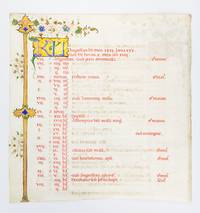
A MEDIEVAL ILLUMINATED VELLUM CALENDAR LEAF FROM THE LLANGATTOCK BREVIARY
TEXT FROM JULY AND AUGUST
Italy Ferrara 1441-48. 205 x 200 mm. 8 x 7 7/8". 35 lines in a very fine rounded gothic hand. <br/> Text in dark brown and red capitals touched with yellow two four-line "KL" initials in blue pink and green on burnished gold ground with leafy marginal extensions the initials on the recto crowned with an exuberant spray of green blue and gold acanthus hairline tendrils pink flowers and gilt bezants and leaves the verso initials with a long bar border on outer margin painted pink on gilt ground with pink green and blue motifs at middle and top the border traced with black the top of the border accompanied by a spray of hairline tendrils colorful flowers gold bezants and leaves. ◆Lower margin of the verso trimmed away with loss of the end of bar border though not the text some of the other margins trimmed close crowding but not affecting the decoration some fading to brown ink less faded on recto legible on both sides in any case negligible dampstain in upper margin short closed tear just entering gold bar at top left of verso; not without imperfections but still an exquisite and very desirable leaf with richly colored and gilt embellishment.<br/> <br/> This item presents a very special perhaps singular opportunity to own the only known calendar leaf from the renowned Llangattock Breviary to emerge since the manuscript was taken apart in the 20th century. Executed with great skill and delicacy in sensitive Italianate colors highlighted by spring green and pink our leaf is unsurprisingly from a manuscript intended for a powerful aristocrat. It comes from the celebrated Breviary illuminated for the chapel of the Marquises of Este rulers of Ferrara and Mantua a manuscript commissioned by Leonello d'Este duke of Ferrara from 1441-50. According to the d'Este family records this manuscript seems to be the Breviary done for Leonello by Giorgio d'Alemagna Bartolomeo de Beninc Guglielmo Giraldi and Matteo de' Pasti see Toniolo "La Miniatura a Ferrara dal Tempo di Cosm Tura all'eredit di Ercole de' Roberti" 1998 pp. 19-20 and 76-77. Leaves from this manuscript show subtle variations in the style of the illuminations a result of work performed individually by a team of artists doing variations on a theme. At one time in a Spanish library the manuscript was brought to Britain during the Peninsular War and came to be owned by the Rolls family later Lords Llangattock of Monmouth in Wales from whom it takes its name. By the time the work reached Britain most of the miniatures had already been cut out. The Breviary sold at Christie's on 8 December 1958 lot #190 after which it was acquired and subsequently dismembered by Goodspeed's of Boston. The attribution of this leaf to the Llangattock Breviary is based its script ruling and style of decoration as well as physical attributes such as width of the leaf and the appearance of the vellum which all correlate to other known leaves from this manuscript. Furthermore according to the 1958 auction description of the complete manuscript the entire calendar section had its lower margins trimmed away as here. The present leaf appeared in a 1979 catalogue of bookseller Kenneth Rendell and it remains the only known calendar leaf from this manuscript that has ever been advertised. unknown
Bookseller reference : ST19882
|
|
|
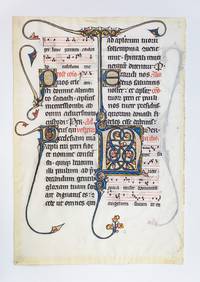
A MEDIEVAL ILLUMINATED VELLUM MANUSCRIPT LEAF FROM THE BEAUVAIS MISSAL
TEXT FROM THE VIGIL OF STS. PETER AND PAUL 28 JUNE AND THE FEAST OF STS. PETER AND PAUL 29 JUNE
Northern France perhaps Beauvais or Amiens late 13th or early 14th century. 286 x 199 mm. 11 1/4 x 7 3/4". Double column containing a mixture of staves and text approximately 21 lines in an excellent formal gothic book hand. <br/> Attractively matted. Rubrics in red chant text containing black penwork initials with red and yellow geometric elaboration BEAUTIFULLY ILLUMINATED with five two-line initials painted blue or pink with white tracery on a ground in the contrasting color two of the initials filled with grotesques and swirling vines and two with the filler design traced out but never completed each initial with blue and pink extensions terminating in orange leaves or spiky shapes; the verso featuring AN IMPRESSIVE SIX-LINE "N" 58 x 50 mm. in the same style filled with an intricate knotwork design and orange leaves with long extensions including a horizontal extension across the upper margin. Margins with light offsetting of the designs from the facing leaf; remnants of mounting tape on recto corners and bottom edge; verso apparently with a barely visible Medieval "14" in lower margin. An area measuring 5 mm. at edges just faintly yellowed from mat burn but IN FINE CONDITION the vellum otherwise quite bright the paint rich and the gold brightly glittering.<br/> <br/> This sumptuously decorated leaf--which is beautifully preserved and contains a particularly large and handsome initial--comes from the last volume of a three-volume Missal presented to Beauvais Cathedral by Canon Robert de Hangest d. 1356. The Missal remained at the cathedral at least through the 17th century when it is noted in an inventory but was removed from the church at some point likely in the aftermath of the French Revolution. The parent volume eventually entered the collection of Henri-Auguste Brölemann 1775-1854 of Lyon who passed it to his grand-daughter Etienne Mallet who then sold it at Sotheby's in 1926. It was then acquired for the collection of William Hearst where it remained for the next 25 years. In 1941 it was again sold at auction and subsequently dismembered. Though long thought to have been the work of famed biblioclast Otto Ege recent scholarship suggests that it was actually Phillip Duschnes who was responsible for breaking up the book keeping some leaves for himself and selling others on to his colleague Ege for inclusion in his portfolios of "Fifty Original Leaves from Medieval Manuscripts." The Beauvais Missal has been a subject of interest for many notable scholars chief among them being Christopher de Hamel--see: "Otto Ege and the Beauvais Missal" in "Gilding the Lilly: A Hundred Medieval and Illuminated Manuscripts in the Lilly Library" and it is currently the focus of a major effort to "reconstruct" the manuscript digitally--a project spearheaded by Lisa Fagin Davis. Other leaves from the parent volume are in the collections of the Morgan Library the Metropolitan Museum of Art the Cleveland Museum of Art and the Houghton Library at Harvard among many others. Although there is some dispute among art historians the illumination has been tentatively attributed to the artist of the Hours of Yolande of Soissons produced in Amiens ca. 1280 and now held by the Morgan Library MS M.729. It is worth noting that the town of Hangest home to the original owner is only 10 miles from Amiens and is a likely place of origin for the Missal. The present leaf contains a text for a major feast day and thus contains a large and extravagantly decorated initial for its opening "'Nunc scio vere." It is not too much to say that the decoration here is masterful but curiously--and of special interest to us from a modern perspective--the illuminators seem to have forgotten to put the finishing touches on the two smaller initials above which still contain sketches of the preliminary design. unknown
Bookseller reference : ST20214
|
|
|
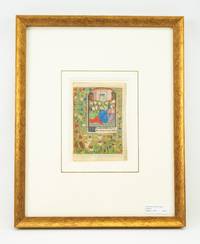
A MEDIEVAL ILLUMINATED VELLUM MANUSCRIPT LEAF FROM A BOOK OF HOURS, WITH A MINIATURE OF PENTECOST
TEXT FROM THE HOURS OF THE HOLY SPIRIT
France ca. 1490. 144 x 99 mm. 5 5/8 x 3 3/4". Single column recto with 14 lines in a gothic book hand. <br/> Attractively matted and framed. Rubrics in red two two-line initials one painted pink on blue ground with flowers the other painted blue and inhabited by a rampant lion on pink and gold ground recto with a panel border featuring long-stemmed flowers and owls on a pink ground verso WITH A HALF-PAGE ARCH-TOPPED MINIATURE DEPICTING PENTECOST WITH A FULL BORDER featuring a plethora of different flowers berries greenery songbirds an owl and a butterfly all ON A RICHLY PAINTED GOLD GROUND. Trimmed close on one side and just grazing a border on the opposite side very minor chipping to faces trivial signs of rubbing or wear otherwise a fine leaf--colorful bright and very pleasing to the eye.<br/> <br/> This leaf contains the customary Pentecost miniature associated with the Hours of the Holy Spirit but with several attributes that set it apart from other examples we have encountered. The miniature here depicts a densely crowded scene with the Virgin at the center surrounded by the apostles each of whom wears a burnished gold halo. Packed tightly together they gaze up at a white dove who emanates small red tongues of fire above their heads. According to biblical tradition this visitation by the Holy Ghost in the form of a dove enabled Christ's disciples to start preaching marking the beginning of the Christian Church. The artist favors an unusual pastel palette choosing pale pink for the walls and eggshell blue for some of the floor tiles as well as bright yellow muted lilac rose and lime green for the robes of the apostles. Looking more closely at the figures we see that each face is carefully individualized each with its own features and expressions. Although most crane their necks to get a view of the miracle unfolding one of the apostles looks directly out at the viewer as if surprised by our presence. Moving outside the miniature we note that the leaf features a particularly exuberant border with tangles of flowers fruit acanthus leaves and several birds including an owl in one corner. There is additional interest on the verso with another bright border painted an intense pink and filled with more flowers and owls. unknown
Bookseller reference : ST20853
|
|
|
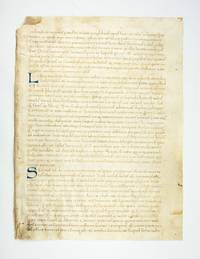
A MEDIEVAL VELLUM MANUSCRIPT LEAF IN A NEAT HUMANIST HAND
TEXT FROM LACTANTIUS' "DE OPIFICIO DEI.
Italy 15th century. 264 x 200 mm. 10 3/8 x 7 7/8". Single column 41 lines in a neat humanist hand. <br/> With two two-line initials in blue. One corner torn away not affecting text a few marginal wormholes vellum a bit soiled and with a few small stains but a very good example the text entirely legible and overall clean and presentable.<br/> <br/> Containing text by an author who was much admired during the Renaissance this leaf is a lovely example of the humanistic script that emerged in Italy during the 15th century. The elegance and legibility of humanistic script derives from Caroline miniscule the predominant style of writing in Western manuscripts from the ninth through 12th centuries. Both scripts favor clear rounded letter forms wider spacing between letters and few abbreviations resulting in manuscripts that are extremely attractive and easy to read. The text here comes from a work titled "De Opificio Dei" exploring the handiwork of God with a concentration on the marvels of the human body and soul. The present leaf includes chapters 8-10 which discuss the human head including especially the seats of the senses: eyes ears nose and tongue. Our author Lactantius ca. 260-340 was a late-in-life Christian who became one of the ablest defenders of the faith in its early centuries. He was held in high esteem by Renaissance intellectuals and was one of the earliest authors to be printed first appearing in 1465. unknown
Bookseller reference : ST20981
|
|
|
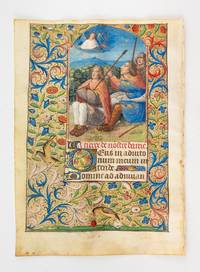
A MEDIEVAL VELLUM MANUSCRIPT LEAF FROM A BOOK OF HOURS IN LATIN AND FRENCH, WITH A LARGE MINIATURE OF THE ANNUNCIATION TO THE SH
TEXT FROM TERCE
Paris ca. 1500. 165 x 117 mm. 6 1/2 x 4 5/8". Single column 18 lines in a gothic book hand. <br/> Rubrics in red line fillers in blue and pink with gold bezant five one-line initials in burnished gold on pink and blue ground one two-line initial in blue on gold ground with a flower in the center one three-line initial in blue filled with ivy on gold ground recto with panel border of colorful flowers vase and acanthus verso with A LARGE ARCH-TOPPED MINIATURE OF THE ANNUNCIATION TO THE SHEPHERDS surrounded by A FULL BORDER of acanthus flowers and two birds all on a painted gold ground. Slight soiling to vellum but a very well-preserved leaf in fine condition.<br/> <br/> From what was surely a costly Book of Hours this leaf features a charming and skillfully painted miniature of the Annunciation to the Shepherds attributable to the workshop of Jean Pichore fl. ca. 1502-20 a major figure among illuminators of the period and one of the most sought-after artists in France at the turn of the 16th century. Depicting the traditional subject associated with the hour of Terce our miniature portrays as usual an angel appearing to shepherds tending their flock bringing news of the birth of Christ. Although the biblical narrative suggests that the shepherds were startled by the angel's appearance the three figures in this miniature appear remarkably unmoved--in fact only one of them seems to take any notice at all. The first shepherd sits on the ground looking straight ahead; the second holds his hands in prayer but looks little more than well prayerful at the angel in the sky; and a third figure maintains a slightly aloof expression taking no particular interest in the unfolding miraculous event. What may seem to be indifference can be explained easily enough by the artist's successful portrayal of nighttime cold! All three shepherds are thickly dressed one with his arms pressed tightly against his chest another with a hood partly covering his face and the sheep are tightly huddled together into one woolly white cluster. Another manifestation of the artist's success here is seen in the particularly well done molding of the faces with subtle shading attractively rendered features and clear individuation. Moreover although the shepherds seem essentially unmoved their garments are dusted with a glistening gold radiance from above a further subtle touch revealing a high level of achievement on the part of the painter. Finally the borders are one last source of delight with a small bird shown in mid-flight and a second one investigating a single strawberry that seems to have been placed there just for him. All of these indications of sophistication suggest that the original manuscript must have been commissioned by a patron able to pay a premium for the work of a highly skilled atelier. unknown
Bookseller reference : ST20810P
|
|
|
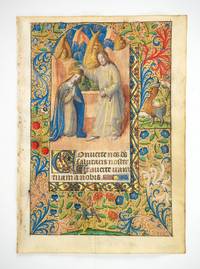
A MEDIEVAL VELLUM MANUSCRIPT LEAF FROM A BOOK OF HOURS IN LATIN, WITH A LARGE MINIATURE OF THE CORONATION OF THE VIRGIN
TEXT FROM COMPLINE
Paris ca. 1500. 163 x 115 mm. 6 1/2 x 4 1/2". Single column 18 lines in a gothic book hand. <br/> Rubrics in red line fillers in blue and pink with gold bezant six one-line initials in burnished gold on pink and blue ground two two-line initials in blue on gold ground with a flower in the center one three-line initial in blue filled with ivy on gold ground verso with panel border of colorful flowers and acanthus recto with A LARGE ARCH-TOPPED MINIATURE OF THE CORONATION OF THE VIRGIN with an "L" shaped frame of burnished gold and painted flowers and A FULL BORDER of acanthus flowers a man playing a bagpipe and a hybrid creature wearing a hat all on a painted gold ground. Very minor wrinkling to vellum but the leaf IN LOVELY CONDITION with the gold everywhere gleaming brightly.<br/> <br/> From a luxuriously appointed Book of Hours this leaf features a handsome miniature of the Coronation of the Virgin attributed to the workshop of Jean Pichore fl. ca. 1502-20 a major figure among illuminators of the period and one of the most sought-after artists in France at the turn of the 16th century. Executed with imagination and delicacy the miniature features the traditional subject associated with the hour of Compline showing the Virgin being crowned Queen of Heaven following her Death and Assumption. The composition here is quite intimate with the Virgin kneeling before her son as she accepts with humility the crown he lays upon her head. Christ is depicted barefoot and slightly bowed toward his mother in a gentle display of respect. The artist creates a wonderful backdrop for this scene composed entirely of seraphim painted gold blue light pink and green closely packed together. Two of the seraphim hold up light pink draperies behind the central figures as if to shield this tender moment from prying eyes. The borders here are a source of delight featuring a figure wearing a jester-like cap and playing the bagpipe as well as a creature with the body of a bird and the face of a human donning a rather fashionable bycocket cap. The illumination here is of high quality features a liberal use of gold and contains unique marginal details suggesting that the original manuscript must have been a costly commission for a wealthy patron. unknown
Bookseller reference : ST20810R
|
|
|
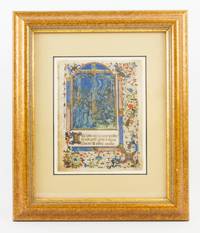
A MEDIEVAL ILLUMINATED VELLUM MANUSCRIPT LEAF WITH A BREATHTAKING MINIATURE OF THE CRUCIFIXION, FROM A BOOK OF HOURS IN FRENCH
TEXT PRESUMABLY FROM THE HOURS OF THE CROSS
Metz ca. 1440. Leaf: 162 x 124 mm. 6 3/8 x 4 7/8". Frame: 308 x 258 mm. 12 1/8 x 10 1/8". Single column three lines of text under the miniature obverse with 18 ruled lines five of which contain text in a gothic book hand. <br/> Attractively matted and framed. Recto with one three-line initial in gold on pink and blue ground WITH A LARGE MINIATURE OF THE CRUCIFIXION WASHED IN BLUE Christ on a painted gold cross flanked by two thieves on painted gold crosses surrounded by throngs of people including the Virgin St. John Mary Magdalene and numerous soldiers all in an arched gold frame inside a three-sided painted and gilt baguette and a FULL BORDER of colorful vine sprays and flowers inhabited by a peacock. See: "The Jeanne Miles Blacburn Collection of Manuscript Illuminations" nos. 29-38; Avril & Reynaud pp. 182 & 190. Minor soiling/browning right at inner edge away from border and image otherwise IN VERY FINE CONDITION THE MINIATURE REMARKABLY WELL PRESERVED WITHOUT ANY LOSS OF PAINT.<br/> <br/> This stunning miniature with its memorable nocturnal scene comes from a very fine Book of Hours probably executed by Henri d'Orquevaulz or d'Orquevaulx or a member of his workshop. D'Oquevaulz was active during the second quarter of the 15th century in Metz the cultural and commercial capital of Lorraine during the period and the center of a growing book trade. According to the catalogue of the Jeanne Miles Blackburn Collection in the Cleveland Museum of Art which owns 10 leaves from the original manuscript the parent Book of Hours can be localized based on the Lorraine dialect found in the French text on some of the leaves including the present example and because the calendar singled out two bishop-saints of Metz Clement and Arnoul. Although little is known about d'Orquevaulz his dated signature in the colophon of a Livy manuscript that he illuminated for an alderman of Metz indicates that he was active in that city in 1440. Artistic affinities with northern European styles make it possible that d'Orquevaulz had emigrated from the Netherlands or Germany to Lorraine; another possibility one that Avril and Renaud suggest is that the master himself was from Metz but that he had German associates perhaps from the Rhineland area. According to these two scholars the painter's use of large flat areas of colors is more typical of the Rhineland the Netherlands or Bohemia than of France; in any case they praise his "exquisite color harmonies." The artist has outdone himself in the present miniature rising to the height of pathos and making it one of the most extraordinary leaves we have ever offered for sale. In contrast to the bright colors used in Books of Hours even to depict the most serious scenes the present leaf presents a remarkable visual nocturne with the figures and buildings painted in the same shades of blue as the sky suggesting that heaven itself is darkening at the death of Christ. Mary Magdalen kneels at the foot of the cross while St. John supports the devastated Virgin as a soldier pierces the Savior's side with a lance. The miniature is crowded with figures we see well-defined faces of no fewer than 18 persons and two horses but the artist has not lost his dramatic focus as Christ on his cross of brushed gold dominates the scene. In choosing to make this a darkened composition the artist has risked obscuring detail but his skill has been equal to his concept here as he has used a diluted blue paint that allows for a very successful delineation in various shades almost like grisaille this technique not incidentally has prevented the cracking and erosion so commonly seen with the normal thick applications of typical cobalt blue. The result of the decision to show the world in eclipse at Christ's death is to heighten and universalize the drama here to such an extent that the scene leaves a powerful and lasting impression. The text on this leaf is entirely in French in rhyming verse. Roughly it translates as: "Jesus on the cross did hang / And took upon himself our sins / Gave to humankind redemption / Rendered up his soul to God. / The sunshine lost its glowing light / The earth did tremble and did crack / Grieving for the bitter death / Suffered by the son of God." Although the original Book of Hours was dismembered some time in the 20th century extant leaves suggest that its visual program was much bigger than usual and probably the result of an important commission by a wealthy patron--something likely to be painted by one of the chief artists in the workshop. Illuminated manuscripts from Metz--let alone examples of this quality--are uncommonly seen on the market. unknown
Bookseller reference : ST19540a
|
|
|
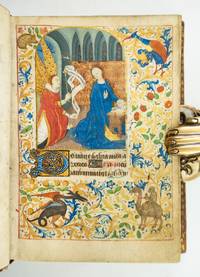
A MEDIEVAL ILLUMINATED VELLUM MANUSCRIPT BOOK OF HOURS IN LATIN, WITH FOUR VERY FINE MINIATURES
USE OF ANGERS
Western France Angers ca. 1470. 122 x 88 mm. 4 3/4 x 3 1/2". Single column 15 lines in a neat bâtarde hand. 152 leaves first and last three are ruled blank leaves; leaf count does not include the first blank endleaf erroneously included in the modern pencil foliation. COMPLETE. Contents: early ownership inscriptions f. 2v Calendar f. 5r Hours of the Virgin f. 17r Extract from the Gospel of John f. 55v Obsecro Te f. 57r Penitential Psalms and Litany f. 61r Office of the Dead f. 78r series of devotional prayers in Latin to the Virgin Mary Christ and the Archangel Michael f. 115r O Intemerata f. 134v series of devotional prayers in Latin f. 138r ruled blank leaves with family records of Jacques Bille f. 150v. <br/> Pleasing early 19th century caramel colored straight-grain morocco covers bordered with a double gilt rule smooth spine gilt in compartments divided with a double gilt rule and dotted roll and cross centerpieces neat early repair to head of spine turn-ins gilt marbled endpapers all edges gilt. Housed in a 20th century felt-lined slipcase with a gilt monogram on front. Ruled in red rubricated in red and blue two one-line burnished gold initials on a blue or pink ground one three-line blue and red penwork initial eight three- to four-line initials in pink and blue filled with ivy leaves on a burnished gold ground these pages with three-quarter borders of acanthus leaves dense rinceaux colorful fruit and flowers gold ivy leaves and bezants and WITH FOUR ARCH-TOPPED MINIATURES above a three- or four-line initial painted blue or pink on gold ground each surrounded by a full border of painted gold and brightly colored acanthus leaves vines and flowers studded with burnished gold bezants three borders inhabited with fantastical creatures the subjects of the miniatures including the Annunciation f. 17r; King David in Prayer f. 61r; a funeral procession f. 78r; and the Pietà f. 115r. Verso of first leaf with signature of Jacques Bille or Billes and the following page with a note in a different contemporary hand with the day and year erased and written over: "Ces presentes heures sont a iaques bille qui les trouvera si les luy Rende et il paiera voluntriers le VIII le jour de la sainct martin. Tesmoion son seign manuel cy mis le huytiesme jour de Avril L'an mil cinqcens et seze" "These present hours belong to Jaques Bille; whoever finds them should return them to him and he will gladly pay on the eighth the day of Saint Martin. Witness his manual signature placed here on the eighth day of April in the year one thousand five hundred and sixteen" followed by Bille's signature; third blank leaf with the ownership inscription "Tussanus Philippus Adeline Presbyter anno 1763"; verso of final text leaf and next three blanks with family records see below. Superficial crease to spine other insignificant signs of use to the leather but the binding sound and attractive. A hint of thumbing at lower corners of first half of the manuscript miniatures with a few isolated minor spots of rubbing not affecting faces otherwise in very fine condition internally the paint bright and fresh and the vellum clean.<br/> <br/> Almost certainly made in western France and with early ownership inscriptions tying it to that area this Book of Hours contains four extraordinarily high-quality miniatures by an accomplished artist very likely related to one of the greatest French manuscript illuminators of the period. Stylistic markers here include drapery with crisp folds figures with pale skin and high foreheads simple but perfectly executed scenery and a flair for detail. The latter talent is particularly evident on the various textiles and garments which include almost impossibly fine gold trimmings and sophisticated draping. It was in fact on the basis of the extraordinary drapery that the manuscript had previously been associated with the circle of Jean Fouquet called by Avril and Reynaud "the greatest French painter and illuminator of the 15th century." In a case of twin summits recent scholarship suggests an alternative attribution to the similarly illustrious circle of Maître de Jouvenel des Ursins a contemporary of Fouquet who according to Avril and Reynaud was "the most important illuminator of the mid 15th century in western France." Around him sprung up a group of artists collectively referred to as the "Jouvenel group" who were based primarily in the area between Tours Nantes and Angers. The illuminations in the present work are so skillful that with additional research it may be possible to pin down an attribution with more certainty; whatever the identity of the artists the level of finishing in these illuminations--from the careful molding of the faces and bodies to the expertly balanced compositions and elegant brushwork--are the hallmarks of a superior hand. When this item was sold at Sotheby's on 13 July 1977 the auction catalogue said that the miniatures "are painted with fine clear colours with great delicacy in the modelling of faces and costumes. The finest miniature is that of the Pietà set against a deep green hill with a fiery sun setting behind dark mountains and buildings and lighting up the evening sky." Indeed this image is a quiet masterpiece of illumination and an excellent example of this artist's work. The naked figure of Christ exhibits a real command of anatomy and proportion while subtle details such as the foreshortening to Christ's face and the whisper-thin cloth clinging to the lower body are done with an exquisite touch. The miniature of the funeral procession also stands out for its superior quality. The composition is quite different from the Pietà being a large group of people rather than an intimate portrait of two figures but it is approached with equal rigor and devotion to detail. The faces turning toward the viewer all show impressive individualization with the figure dressed in blue being particularly well formed and highly differentiated from the crowd--so much so that this could possibly be considered a patron portrait. Three of the miniatures in this work contain borders with delightful examples of marginalia including a court jester a hedgehog a male and female centaur wielding weapons a monkey riding a camel another monkey rubbing his posterior and other whimsical hybrid creatures. These stand out because they are rendered with the characteristic skill and attention to detail found in the larger miniatures so it is possible that they could also be the work of the miniature artist. Although the Calendar in this manuscript is fairly sparse at least two unusual entries in red point toward western France: St. Julian Bishop of Le Mans 27 January; and St. Maurilius patron saint of Angers 13 September. Significantly the Translation of St. Maurilius also appears on both 16 August and 19 of October in black. Strengthening this association with the west are the early ownership inscriptions tying to the Bille family from at least the early 16th century and possibly before. The final three leaves contain family records that include the date of Jacques Bille's wedding 8 April 1516 and the births of 15 children written in two or three hands between approximately 1520 and 1549. The name of our former owner was difficult to trace with certainty but we find mention of a Jacques Bille in the French National Archives where he is listed as a notary in Bourg in southwestern France. This would make sense given Bille's complex signatures found on the first two leaves--the extra flourishes may well reflect notarial signatures that he used in his work. In modern times our manuscript was sold at Sotheby's on 25 February 1946 lot 57 to Maggs who may well have sold it to Sven Ericcson who is listed as the owner of this and four other 15th century illuminated Books of Hours when it was sold at Sotheby's in 1977 for £3200. According to RBH it was purchased at that auction by "Malle" almost certainly Bernard Malle 1929-2008 brother of filmmaker Louis Malle and an eminent collector and bibliographer. In an elegant tribute to his late friend and mentor Bernard Clavreuil calls Malle "one of the most discerning . . . collectors of the postwar era" someone who "never ceased to refine and improve in order to achieve an impossible perfection." Malle also acted as a private advisor to more than one major collection and it is possible that he purchased the present manuscript on behalf of an unknown collector rather than his own library. These former owners clearly looked after this Book of Hours carefully over the years and for good reason: it is a work of considerable craftsmanship and beauty with illuminations distinguished by very substantial artistic skill. unknown
Bookseller reference : ST20836
|
|
|
A MEDIEVAL ILLUMINATED VELLUM MANUSCRIPT BOOK OF HOURS IN LATIN AND FRENCH, WITH A TOTAL OF 13 LARGE AND SMALL MINIATURES
USE OF PARIS
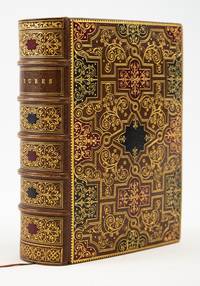
Northern France probably Paris third quarter of 15th century. 130 x 100 mm. 5 1/8 x 3 7/8". Single column 15 lines in an elegant gothic book hand. 280 leaves. First four leaves misbound lacking at least seven leaves five of which probably contained miniatures. Contents: Devotion to the Passion f. 1r; blank f. 4; Calendar f. 5r; Gospel Lessons f. 17r; "Obsecro te" and "O intemerata" f. 23r; blank f. 23; Hours of the Virgin lacking opening leaves for Terce Nones and Vespers f. 33r; Penitential Psalms and Litany f. 100r; Hours of the Cross lacking preliminary leaf f. 120r; Hours of the Holy Spirit p. 123r; Office of the Dead lacking preliminary leaf f. 127r; "Sept Vers de Saint Bernard" and Suffrages f. 176v; series of devotional prayers in Latin and French including the Hours of the Conception an indulgence devotional poems in French prayers for specific occasions such as when facing tribulations going to confession protection against storms and for friends abroad the Stabat Mater the Seven Joys of the Virgin Gospel sequences "Le chemin de paradis" and many others f. 199r; blank f. 280. <br/> ESPECIALLY BEAUTIFUL MID-19TH CENTURY LIGHT BROWN MOROCCO LAVISHLY GILT IN THE "FANFARE" STYLE BY CAPÉ stamp-signed in gilt on front turn-in covers with large green and red morocco inlaid panels gilt strapwork scrolling and small star tools raised bands spine compartments with red or green morocco inlay surrounded by gilt scrolling embellishments gilt lettering RED MOROCCO DOUBLURES gilt in the style of Duodo with repeating pattern of flowers encircled by vines marbled endleaves modern paper and vellum flyleaves all edges gilt. Housed in a fine suede-lined pebble-grained leather pull-off case with gilt lettering on spine. Light red ruling and rubrics numerous line-fillers in blue and pink with gilt embellishments many one- and two-line initials in burnished gold on pink and blue ground three four-line initials in pink or blue filled with ivy leaves on a burnished gold ground two of these with a gilt and painted baguette along the outer edge of text and all with a three-quarter border of hairline vines flowers acanthus and gold leaves the majority of the leaves with a panel border of hairline vines and flowers on one side one historiated initial painted blue on a burnished gold ground depicting the Virgin accompanied by a gilt and painted baguette and three-quarter border FOUR SMALL MINIATURES DEPICTING THE APOSTLES each with a gilt and painted baguette and surrounded by a three-quarter border and EIGHT LARGE ARCH-TOPPED MINIATURES above a three-line initial painted blue or pink on gold ground a gilt "L" shaped bar border incorporating colorful flowers and a full border of border of hairline vines flowers acanthus and gold leaves and A HALF-PAGE RECTANGULAR MINIATURE with a border along the lower half. The subjects of the large miniatures include: the Mass of St. Gregory f. 1r; Annunciation f. 33r; Visitation f. 57r; Nativity f. 70r; Adoration of the Magi f. 80v; Crowning of the Virgin f. 94v; David in Prayer f. 100r; Pentecost f. 123r; and a rectangular miniature of the Holy Wound or perhaps the Bleeding Host of Dijon f. 241v. Isolated light rubbing and negligible chips to miniatures the dark blue paint appearing slightly worn in places as is often the case occasional faint smudges to borders and other imperfections but all of these trivial. IN THOROUGHLY FINE CONDITION INTERNALLY--the paint fresh the vellum clean and the margins quite comfortable--AND THE EXTRAORDINARILY FINE BINDING FLAWLESS.<br/> <br/> In a spectacular 19th century binding this lovely thick little Book of Hours was executed by a talented follower of Maître François and the Master of Jean Rolin and contains a large number of prayers and devotional texts many of them in French. The manuscript includes a fine array of large and small miniatures executed with a colorful palette and careful attention to detail. Particularly noteworthy is the excellent molding of faces. Each figure--no matter their station or importance to the scene--displays unique characteristics that give us a sense of their age sentiments and demeanor. This is an impressive feat given the small scale of the compositions and this individualization adds a great deal of value to the miniatures as well as the viewer's emotional experience connecting to the images. Our artist owes much to the work of the so-called Maître François and slightly before him the Master of Jean Rolin the latter an eponym attached to the illuminator of missals done for Rolin cardinal-bishop of Autun d. 1483. Perhaps of Burgundian origin the Master of Jean Rolin completed his artistic education in Paris probably in the workshop of the Bedford Master and afterward established his own atelier in Burgundy. There he played a key role in the transition from the Bedford Master's slightly more gothic style to the more thoroughly Renaissance style of Maître François who ran the most successful Parisian workshop during the years between 1460 and 1480 producing illuminated manuscripts small and large sacred and secular. Characteristic of Maître François's style are richly colored scenes interiors depicted with considerable detail women and children with pale porcelain complexions and male figures with darker weathered flesh tones--all of which can be seen in the present work. The final miniature present in this work however seems to have been executed by a different artist altogether being rather more flat in appearance and without the detailed facial molding noted earlier. About two-thirds of the manuscript follows fairly regular arrangement of texts with the exception of the Mass of St. Gregory which is misbound at the beginning of the volume. Then following the Suffrages are approximately 80 leaves of devotional texts in Latin and French including popular verses such as the "Seven Joys of the Virgin" and the "Stabat Mater" as well as more unusual texts such as the Hours of the Conception prayers for specific occasions or protections--for example against storms "Contre tempeste" and when one passes over water "Quant on passe par eaue"--indulgences and other related texts. Two of the more interesting passages are "Le chemin de paradis" a French prayer beginning "Qui en paradis veult aller" and a series of Latin poems that claim to be copied from originals found at the church of St. Paul in Rome. These copious additional prayers suggest a high degree of customization for a client who may have been particularly religious or at least very concerned with self-preservation! and they present intriguing possibilities for further study. The manuscript was rebound sometime in the middle years of the 19th century by Capé d. 1867 one of the most distinguished binders in France in his day. He was especially well known for the delicacy of his work which can be observed to great effect in the present example. He was the binder to the Empress Eugenie and Béraldi calls him "the Bozérian of the second Empire." His work has always been highly sought after and it resides in all of the great collections where bindings are considered important. This volume seems to have been sold to bookseller Francis Edwards as lot no. 95 at Sotheby's sale on 3 April 1957 and has been in private hands ever since. The manuscript is a little jewel inside and out and has obviously been a treasured vessel of prayer and art for generations of owners. unknown
Bookseller reference : ST20295
|
|
|
A MEDIEVAL ILLUMINATED VELLUM BOOK OF HOURS IN LATIN AND FRENCH, WITH 14 LARGE AND 27 SMALL MINIATURES
USE OF ROME
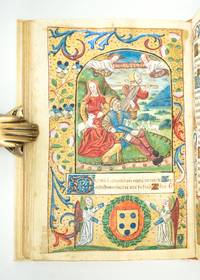
Northern France late 15th or early 16th century. 176 x 128 mm. 7 x 5". Single column 23 lines in a neat batârde hand. i blank 101 ii blank leaves. Lacking one leaf after f. 87 possibly containing a miniature otherwise complete. Contents: Calendar f. 1r; Gospel Lessons f. 7r; Passion according to John f. 10v; Hours of the Virgin f. 15v; Penitential Psalms and Litany f. 45r; Office of the Dead f. 54v; Hours of the Cross f. 68v; Hours of the Holy Spirit f. 70v; Prayers to the Trinity St. Veronica "Obsecro Te" "O Intemerata" and "Stabat Mater" f. 72v; Suffrages f. 79r; Prayers in French to be said on various occasions f. 86v; verse prayer in French beginning "Royne des cieulx glorieuse" f. 90r; additional prayers in French and Latin f. 93v. <br/> Attractive 19th century vellum with lacy gilt border raised bands ruled in gilt gilt lettering tan silk endleaves all edges gilt. Housed in a felt-lined reddish-brown pebbled morocco clamshell box with gilt lettering on spine. Rubrics in red numerous one- and two-line initials in painted gold on burgundy or blue ground WITH 27 SMALL MINIATURES one miniature of Christ Carrying the Cross measuring 60 x 68 mm. the rest depicting saints and measuring between eight and nine lines each surrounded by a full border of acanthus flowers and small dots on bare or painted vellum and 14 LARGE MINIATURES EACH OPENING WITH A FULL BORDER either with acanthus and flowers as before or architectural some borders embellished with figures animals or hybrids two with a small scene in the lower margin and about a dozen with the added coats of arms and/or mottos of Jean Boutin. The subjects of the large miniatures include the following: St. John of Patmos f. 7r; Annunciation f. 15v; Visitation f. 23r; Nativity f. 27v; Annunciation to the Shepherds f. 29v; Adoration of the Magi f. 31v; Presentation in the Temple f. 33v; Flight into Egypt f. 35v; Death of the Virgin f. 38v; Bathsheba bathing f. 45r; Funeral Mass f. 54v; Crucifixion f. 68v; Pentecost f .70v; Trinity f. 72v. See: Fairfax-Murray "French" p. 265-266. Vellum binding soiled but perfectly sound. Small portions of some border figures and perhaps three or four miniatures touched up in the 16th century see below occasional chipping to white paint small hole in the border of ff. 11 & 29 light scattered spotting fading thumb soiling and other minor issues but an attractive and substantially complete manuscript the illumination extensive and mostly well preserved.<br/> <br/> This heavily illustrated Book of Hours is a lovely example of provincial illumination; it calls attention in an interesting way to the influence of printed books on manuscript art; and it contains intriguing traces of an early prominent owner. Our manuscript contains a total of 41 large and small miniatures by a skilled artist who clearly had some training and familiarity with the prevailing styles of the time. The overall appearance of the work suggests the artist or workshop was located in Northern France and although the figures and backgrounds are indicative of a provincial hand the rich colors profuse use of liquid gold and sumptuous borders are unmistakable marks of luxury. The image of the Trinity is particularly lovely demanding the viewer's attention with God the Father's piercing gaze and conveying the majesty of the subject with a patterned throne set against a starry sky. Of special interest here are the compositions of the large miniatures many of which seem to have been copied from printed Books of Hours of the period. When we talk about the transition from manuscripts to print culture in the late-15th and 16th centuries the discussion often focuses on how the art of manuscripts influenced the appearance of printed works. There is no better example than Books of Hours which in printed editions often mimic the look of their manuscript predecessors in appearance and the way many were finished by hand. However as the present example demonstrates the opposite was also true as printed works inevitably made their way into the hands of manuscript artists. Some even worked simultaneously both as illustrators for publishers working with metal- and woodcuts and as manuscript painters. As a reflection of this point in the present work we find distinct similarities between our miniatures and a series of metalcuts used by Philippe Pigouchet for the publisher Simon Vostre beginning in 1496 Fairfax-Murray's set 2. According to Fairfax-Murray "These cuts . . . were evidently very favourably received by Pigouchet's rivals and imitators for one finds several close copies and adaptations in the various productions of other presses" including a very close imitation of woodcut images commissioned by the publisher Antoine Vérard. Evidently the popularity of these plates extended to manuscript artists and it is fascinating to see the adaptation of each composition to suit the painter's own style and the patron's needs. Most of the compositions in our manuscript are essentially simplified versions of the printed miniatures retaining the central figures their gestures garments and props but with complex backgrounds eschewed as are extra figures deemed unnecessary to fulfill the narrative. The resulting miniatures are far less busy than their printed counterparts allowing the viewer to focus on the central story. In a few instances the artist has added small scenes beneath the large miniatures. An example on f. 35 depicts the so-called "Miracle of the Wheat" featuring harvesters misleading Herod's soldiers by truthfully saying that the fleeing Holy Family passed by when their now miraculously matured crop was just being sown. This kind of inclusion may have been influenced by the copious small metalcut scenes that decorate the borders of numerous printed Books of Hours of this period. The text here follows a fairly typical structure but includes prayers in French to be said for each day of the week and on various occasions such as when one awakens or when one leaves a house. Also in French are additional verses to the Virgin--one of which is credited to the Franciscan preacher Jean Tisserand d. 1497 who founded an order for repentant women. Another accessory prayer included here f. 98 appeared in both prayer books and conjuring manuals of the period straddling the line between religion and popular magic. Based on an apocryphal encounter between Pope Leo III and Charlemagne during the Battle of Roncevaux this prayer was often used as a protective amulet against all manner of evil; here it is said to "conquer demons and one's enemies." Although we do not know for whom this manuscript was originally made the book shows a number of marginal customizations in the form of different coats of arms the motto "Soit avenu" "Let it come to pass" and the name of Jean Boutin written on ff. 23 and 35. This owner could have been Jean Boutin Sieur de la Court et de Chamballan and Mayor of Nantes from 1575-76. In addition to the marginal customizations the manuscript may possibly have some very neat replenishing of white facial paint in a handful of marginal figures and perhaps in a very small number of the miniatures. Using magnification and strong light we are unable to find convincing evidence that this retouching took place at least in the miniatures and if it was we think it was done quite early perhaps in the 16th century. Worst case it would necessarily be termed subtle and skillful enough to cause uncertainty now and whatever the verdict is in this respect the manuscript remains very fresh and attractive features attractively executed paintings is complete but for one leaf and would provide ample room for additional research. unknown
Bookseller reference : ST20620
|
|
|
A MEDIEVAL ILLUMINATED VELLUM MANUSCRIPT BOOK OF HOURS IN LATIN, WITH EIGHT MINIATURES IN THE STYLE OF THE MASTERS OF OTTO VAN M
USE OF ROME
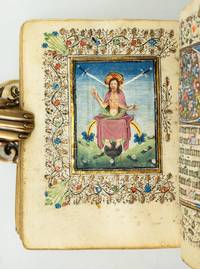
Flanders ca. 1450. 109 x 81 mm. 4 1/4 x 3 1/8". Single column 14 lines in a gothic book hand. 161 leaves. COMPLETE. Contents: Calendar f. 1r; Mass of the Holy Spirit f. 14r; Mass of the Holy Cross f. 23r; Requiem Mass f. 30r; Prayer on the Seven Last Words of Christ by the Venerable Bede f. 36v; Passion according to John f. 40v; blank f. 53; Hours of the Holy Cross f. 55r; Mass of the Virgin Mary f. 60r; Gospel Lessons f. 66v; Hours of the Virgin f. 73r; Penitential Psalms f. 126r; Litany f. 138r; Office of the Dead f. 144r. <br/> PLEASING NEAR-CONTEMPORARY BLIND-ROLLED CALF apparently with some old skilled restoration to joints spine and corners covers with rolled vine border surrounding a panel of three columns bearing a roll with parts of the inscription "AVE MARIA GRACIA PLENA" each word separated by one of four small motifs a flower a human profile the lamb of god and a sitting animal--perhaps a lion raised bands compartments with part of the same inscription roll. Lacking the original ties. Housed in a very attractive custom-made brown calf folding case with blind-stamped lettering on the spine interior lined in suede the whole within a calf-lipped suede-lined matching slipcase. Rubrics in red numerous one-line initials in blue with red penwork or gold with dark blue penwork many two-line initials in burnished gold on pink and blue ground with white embellishments several larger "I" initials between four and 11 lines in burnished gold on pink and blue ground with white embellishments 12 six- to seven-line initials some painted pink or blue with white embellishments and filled with flowers and tendrils on a gold ground or the initial in burnished gold on pink and blue ground with white embellishments EIGHT LARGE MINIATURES each inside a thin gold frame and with a three-quarter border of gilt leaves hairline vines and floral spays each facing page with a similar three-quarter border the subjects of the miniatures being: the Holy Spirit in the form of a dove f. 13v; St. Helena and the True Cross f. 22v; Raising of Lazarus f. 29v; Crucifixion f. 54v; Virgin and Child Enthroned f. 59v; Annunciation f. 72v; Last Judgment f. 125v; Funeral Mass f. 143v. Prickings visible in fore margins. See: Defoer et. al "The Golden Age of Dutch Manuscript Illumination" pp. 75-86. Just minor wear to the solid very pleasing early binding. A little chipping almost always mild to four of the miniatures with square frames the fifth the Annunciation somewhat rubbed and faded the three domed miniatures perfectly intact vellum with minor soiling and thumbing in places especially in lower corners of leaves in second half other trivial imperfections but overall a very well-preserved manuscript with no major issues.<br/> <br/> This enchanting little prayer book features eight attractive miniatures large gleaming burnished gold initials and a pleasing period binding--all in an excellent state of preservation. The miniature program here can be attributed to the so-called Masters of Otto van Moerdrecht the name given to a variety of Dutch artists active in the 1430s and '40s all working in a similar mode rather than to a specific master or workshop. According to Defoer et al. the work of these miniaturists "exhibit varied compositional formulas and bright highly contrasting colors . . . . The small somewhat doll-like figures appear rather wooden but their expressive gestures give the scenes a varied and vivid character." Two artistic hands are responsible for the present miniatures. The artist behind the first three miniatures all set within domed gilt frames the Holy Spirit St. Helena and Raising of Lazarus shows particular skill with a very smooth application of color figures with long eloquent hands and faces with subtle white highlighting. A second artist was responsible for the remaining five miniatures set within square golden frames Crucifixion Virgin and Child Enthroned Annunciation Last Judgment and Funeral Mass. Though this hand is less polished and the miniatures slightly smaller in size the scenes are all quite charming and attractively colored with vivid splashes of bright orange bubblegum pink sky blue and pale green. It is worth noting that the miniatures differ not only because of the artists' degree of success but also because of their condition: whereas the five are generally well preserved the other three are in a virtually perfect state. In addition to the central text of the Hours of the Virgin this manuscript contains several Masses each of which is preceded by a miniature. Perhaps the most interesting of these is the Mass of the Holy Cross which is paired with a miniature of St. Helena mother of Constantine the Great. According to Christian tradition Helena found the wooden cross used in the Crucifixion while she was travelling in Jerusalem in the fourth century. Constantine built the Basilica of the Holy Sepulchre in its honor and installed the relic there to be venerated. Britannica says that the adoration of the True Cross led to wide-spread sale of its fragments sought after as objects of devotion. It is unusual to find St. Helena depicted in a Book of Hours and this image is especially appealing with Helena in a beautiful red robe crown and halo embracing a large wooden cross in the center of the composition. The background is reminiscent of the work of the Gold Scrolls group with small swirls of liquid gold swimming in a scarlet sky the same scrolling motif graces the Holy Dove miniature. There is no indication of former ownership in this manuscript although the Calendar presents a few unusual saints that confirm a Flanders connection. These include St. Amandus in red known as the "Apostle of Flanders" on 2 February; St. Guido known as the "Poor Man of Anderlecht" on 9 September; St. Bavo in red patron saint of Ghent where a Cathedral is named in his honor on 10 October; and St. Eligius patron saint of goldsmiths and metalworkers on 1 December. The binding here is very close to contemporary and probably dates to the late 15th century. Neither the floral roll nor the "Ave Maria" roll seems to appear in EBDB. Similar rolls include r001954 r000623 and r000670 but ours is the only one with four different and charming tools one of each used between every "Ave" and "Maria." For a manuscript only slightly bigger than the palm of one’s hand this Book of Hours has a great deal to offer. In addition to its early binding and lovely illumination by an influential group of artists great care has been put into its preservation so that it resolutely endures for our pleasure and for owners in the centuries to come. unknown
Bookseller reference : ST20835
|
|
|
A MEDIEVAL ILLUMINATED VELLUM MANUSCRIPT BOOK OF HOURS IN LATIN, WITH 36 LARGE AND SMALL MINIATURES BY THE MAITRE DU LIVRE DE LA
USE OF ROME
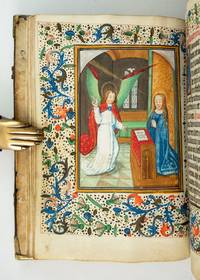
Low Countries probably Bruges ca. 1470-80. 186 x 135 mm. 7 3/8 x 5 1/4". Single column 20 lines in a gothic book hand. i blank 108 i blank leaves bound too tightly for a close collation but APPARENTLY COMPLETE. Contents: Calendar f. 1r; Gospel Lessons f. 7r; Hours of the Holy Cross f. 11r; Hours of the Holy Spirit f. 15r; Mass of the Virgin 18r; "Obsecro te" f. 21r; "O Intemerata" f. 23r; Suffrages f. 24r; Hours of the Virgin f. 33r; Office of the Virgin as said throughout Advent f. 71r; Penitential Psalms f. 76r; Litany and petitions f. 81v; Office of the Dead f. 87r. <br/> HANDSOME RENAISSANCE ENTRELAC BINDING upper joint and parts of spine very skillfully repaired covers with a gilt floral border surrounding a central panel of gilt strapwork design with traces of original polychrome painting raised bands spine gilt in compartments original bosses and catchplates clasps renewed all edges gilt. Rubrics in red numerous one-line initials in blue with red penwork or gold with dark purple penwork many two-line initials in burnished gold on pink and blue ground with white highlights most of these with floral sprays extending into the margins 22 SMALL MINIATURES measuring approximately 45 x 37 mm. each with panel borders of colorful acanthus and flowers at the top and bottom of the page connected by a strand of gilt bezants and 14 FULL-PAGE MINIATURES each surrounded by a full border of acanthus flowers and bezants the facing pages also with full borders and a large six-line initial painted pink or blue filled with swirling vines and flowers on gilt and painted ground. Subjects of the large miniatures being: Crucifixion f. 10v; Pentecost f. 14v; Virgin and Child f. 17v; Annunciation f. 32v; Visitation f. 42v; Nativity f. 49v; Annunciation to the Shepherds f. 52v; Adoration of the Magi f. 55v; Presentation in the Temple f. 58v; Massacre of the Innocents f. 61v; Flight into Egypt f. 66v; Coronation of the Virgin f. 70v; David in Prayer f. 75v; Raising of Lazarus f. 86v. Front pastedown with a 16th century inscription see below; rear pastedown with a 17th century ownership inscription in ink signed François le Paige. Lower joint a bit rubbed margins with a little soiling and occasional wrinkle fore-edge border rule just grazed by binder in a few places the other borders quite ample miniatures with tiny chips light fading or rubbing in a couple places etc. but IN EXCELLENT CONDITION the attractive period binding very well preserved with boards showing virtually no signs of wear the vellum generally clean and bright and the miniatures fresh and richly colored.<br/> <br/> This is an extensively illustrated Book of Hours preserved in an especially attractive early binding with richly colored miniatures attributed to the Master of Philip of Cleves' "Book of the Hunt." Active in the Low Countries from approximately 1470-90 this artist was patronized by some of the area's wealthiest elite and is known to have collaborated with another important illuminator called the Bruges Master of 1482. Some trademarks of our painter include faces with subtle blue shading; high arched eyebrows; thin golden halos; and women with very straight shoulder-length hair highlighted with strands of gold. Outdoor scenes often contain narrative elements in the distance such as the figures of a young David and Goliath in the miniature of King David at Prayer or pagan idols dropping from a column in the Flight into Egypt recalling a popular apocryphal tale of pagan relics miraculously falling to pieces as the Holy Family passes by. Some miniatures of note in addition to these two are the Raising of Lazarus for the Office of the Dead--a popular alternative to funeral images particularly among Flemish illuminators--and the Massacre of the Innocents for the hour of Vespers a particularly violent episode in which King Herod commands his soldiers to slaughter the male infants of Bethlehem. Like other miniatures in this work the action in these scenes is spread out between the fore middle and background creating a multi-layered narrative that invites the eye to explore and meditate. The artist's color palette in this manuscript is quite memorable and includes a bright mustard yellow pale green and cherry blossom pink. The Coronation of the Virgin makes particularly strong use of color with a sunset-like gradient giving way to billowy blue clouds. The Annunciation miniature also demonstrates the Master's facility with color; here the Angel Gabriel's red and green wings are fully extended while the Virgin is radiant against a golden yellow wall covering. In addition to the large compositions we are treated to 22 smaller miniatures depicting the Evangelists and saints each of which is charming in its more confined presentation. Although the saints found in the Suffrages are quite typical for a Book of Hours the Calendar is another story. Despite being rather sparsely filled out the calendar here includes several feast days some of them unusual enough to provide additional insight into the manuscript's localization and use. For example there is St. Landoaldi 19 March a missionary to Northern France and Belgium and St. Winnoc 6 November the son of a Breton king with a former abbey in the far north of France. The calendar is idiosyncratic in other ways as well with saints' names that are repeated and others that are either extremely obscure or whose dates seem to be wrong. Whatever the case additional research into the calendar would undoubtedly prove revealing. We are fortunate to have some early provenance information written into this Book of Hours. The inscription on the front pastedown reads: "This last day of September 1590 we name erased but Claude le Paige lieutenant of the guards of his highness of Bar le Duc on the one hand and Alix de la Taxe on the other hand have married in front of the holy Catholic church at the place of Mirecourt." Below this inscription are notes indicating the ages of the bride and groom 17 and 36 respectively as well as the dates of their deaths: he died on 9 May 1610 and she on 14 September 1622. Located in the strategically important Meuse region in northeastern France the Duchy of Bar-le-Duc unified with Lorraine in 1480 and became extremely wealthy during the 16th century. Although we do not know for whom the manuscript was originally made it seems quite possible that it was commissioned for a forebear of the named Bar-le-Duc spouses and was perhaps passed down through later generations of the family. The signature on the pastedown indicates that François le Paige son of Claude and Alix inherited the book from his parents. This manuscript was lavishly and tastefully bound early in the 16th century and has survived in excellent condition to the present day. This binding would originally have been painted but even without its original colors it is still quite attractive perhaps even splendid. In excellent condition inside and out the manuscript is a fortunate survival and a testament to generations of careful stewardship. unknown
Bookseller reference : CLe2501
|
|
|
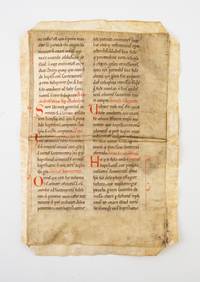
A MEDIEVAL ILLUMINATED VELLUM MANUSCRIPT LEAF, RECOVERED FROM A BINDING
WITH TEXT IN LATIN FROM THE "SENTENTIAE" OF PETER LOMBARD
Germany late 12th or early 13th century. 335 x 224 mm. 13 1/4 x 8 7/8". Double column 29 lines in an elegant proto-gothic book hand. <br/> Rubrics in red several two-line initials in red. Recovered from a binding and so the vellum a bit soiled creased and wavy recto with a lighter patch where a title label was once situated light stains and glue and paper residue on the verso but overall the leaf remarkably clean entirely legible and surprisingly well preserved.<br/> <br/> Once serving as a cover for a later book this leaf comes from a nearly contemporaneous copy of Peter Lombard's "Sentences" considered the most important theological book of the 12th century. Written between 1155 and 1158 and arranged topically Lombard's "Sententiae" summarize past learning about Christian doctrine by quoting authorities in an attempt to resolve textual disagreement by dialectical analysis. As a source collection that continued to spark discussion Lombard's great work enjoyed sustained success as a theological textbook until the 17th century and inspired numerous commentaries including those of Aquinas and Luther. This leaf comes from Book IV "On the Doctrine of Signs" which is primarily concerned with the seven sacraments: Baptism Confirmation the Eucharist Penance Extreme Unction Sacred Orders and Matrimony. The script is an upright and very legible proto-gothic book hand with a few distinctive letter forms and abbreviations that may help determine a more definitive point of origin these include a "g" with a downward cross on its tail and a conjoined "qe" for "que". It is unusual and very lucky that this leaf survives completely intact as Medieval manuscripts used in later bindings were often cut down in size to make smaller covers or used as waste paper for pastedowns or other binding elements. unknown
Bookseller reference : ST20837b
|
|
|
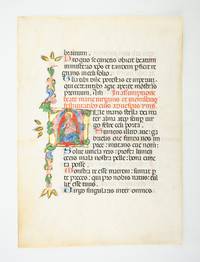
A MEDIEVAL ILLUMINATED VELLUM MANUSCRIPT LEAF FROM A HYMNAL IN LATIN, WITH A LARGE HISTORIATED INITIAL
WITH TEXT FROM "AVE MARIS STELLA.
Italy 15th century. 364 x 260 mm. 14 3/8 x 10 1/4". Single column 22 lines in a rounded gothic book hand. <br/> Rubrics in red versal initials alternating red and blue with purple penwork one three-line initial in blue with purple penwork A SIX-LINE "A" DEPICTING THE ASSUMPTION OF THE VIRGIN the initial painted pink with red green and blue nodes and acanthus on a burnished gold ground with extensions running the length of the text column incorporating more acanthus and small gold embellishments with sprays of the gold leaves at the top bottom and center. A little rubbing to the paint negligible soiling and small spots to margins but in excellent condition overall.<br/> <br/> This very large handsomely preserved leaf features a strikingly attractive initial of the Virgin opening the beloved hymn "Ave Maris Stella" "Hail Star of the Sea". Dating back to at least the ninth century and traditionally associated with the hour of Vespers on Marian feast days as here the hymn praises the Virgin's purity meekness and mercy calling upon her as the "Nurturing Mother of God" to dispel evil and free us from our sins. Inside the gilt and painted initial is a lovely portrait of the Virgin who is depicted seated against a red mandorla dressed in pink and wrapped in a green and blue mantle--perhaps a reference to the colors of the ocean. Her hands are raised in prayer fingers lightly touching above her heart and her well-defined features appear both strong and serene. Judging from the size of the initial liberal use of gold and the wide margins of this leaf the original manuscript must have been a costly item produced for a wealthy church or monastery. unknown
Bookseller reference : ST20973
|
|
|
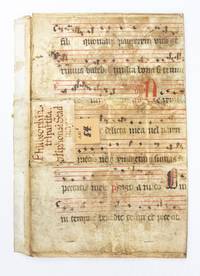
A PARTIAL MEDIEVAL VELLUM MANUSCRIPT LEAF FROM AN ANTIPHONARY, RECOVERED FROM A BINDING
TEXT IN LATIN
Germany 14th century. 250 x 175 mm. 9 7/8 x 6 7/8". Six extant lines of text and music in a gothic hand. <br/> Rubrics and staves in red one large initial in red and two large decorative initials in black and red. With the binding's original paper labels on spine remnants of old paper lining on verso. Somewhat soiled and stained but a good specimen overall.<br/> <br/> Recovered from a 17th century binding this specimen presents an excellent opportunity to examine how Medieval manuscripts were used in the construction of later bindings. The two preserved spine labels tell us that the leaf previously covered a copy of Alphonso Stadlmayer's "Philosophia Tripartita" first published in 1650. unknown
Bookseller reference : ST19350-050
|
|
|
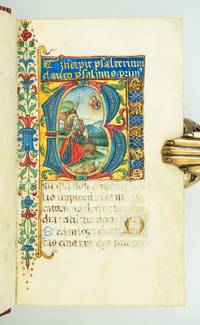
A RENAISSANCE ILLUMINATED VELLUM MANUSCRIPT PSALTER, WITH TWO LARGE HISTORIATED INITIALS
TEXT IN LATIN
Italy Florence completed in 1536. 155 x 96 mm. 6 1/8 x 3 3/4". Single column 17 lines in a rounded gothic hand. 225 leaves first leaf and last three leaves blank. One signature bound upside-down the calendar bound at end but COMPLETE. With modern foliation in pencil i 225 leaves f. 222 omitted in numbering. <br/> Attractive 19th century red straight-grain morocco covers with lacy gilt border raised bands compartments with floral a scrolling tools with small stars and bezants green morocco label with gilt lettering gilt floral turn-ins all edges gilt and gauffered. In a fine modern pebble-grained red morocco folding box by A. Lobstein gilt lettering on spine lined with velvet. Rubrics in red numerous one-line initials and paragraph marks in red or blue many two-line gilt initials on ground of two colors red blue green or purple with small gold embellishments three-line "KL" initials for each calendar month in gilt TWO LARGE HISTORIATED INITIALS the first measuring approximately 11 lines 65 mm. and featuring King David in prayer the initial painted blue and embellished with green and pink acanthus on gold ground surrounded on two sides by bars of gilt lettering on blue and pink ground inner margin decorated with colorful floral motifs decorated with gilt bezants the second initial measuring six lines 35 mm. and featuring the Holy Trinity the initial painted pink with colorful acanthus on gilt ground and with a similar floral border in the outer margin and extending over the initial along the top. See: Alexander "The Painted Page" nos. 1 3 & 4; and Salmi "Italian Miniatures" frontispiece and pp. 52-53. Text rather faded in places though sense always recoverable isolated insignificant rubbing or chipping to the gilt a handful of trivial stains and instances of soiling or foxing but a nevertheless lovely manuscript--very clean and fresh with wide margins and the historiated initials especially well preserved. Just the slightest signs of use to the lustrous binding.<br/> <br/> This is a fine example of Florentine manuscript production from the early 16th century with a beautiful rounded gothic script sparkling initials and historiation that suggests a link to some of the most important miniaturists of the period. The decoration is composed of rich jewel tones and includes a half-page initial opening "Beatus vir" depicting King David in prayer and a smaller "D" opening Psalm 109 "Dixit Dominus Domino meo: a sede adextris meis" depicting the Holy Trinity. Each initial is embellished by a lovely partial border of floral motifs and many gilt bezants in a typical Florentine style. The large "Beatus vir" initial is particularly well done with excellent molding and shading and careful attention to even the smallest hair on David's beard. Into a relatively small space the artist manages to fit an entire outdoor scene complete with foreground middle ground and background including rolling hills a river and a distinctive rock formation that adds dimension scale and a sense of realism to the painting. Although whoever had the box made for this work attributed the manuscript to Giovanni Boccardi known as Boccardino il Vecchio 1460-1529 the figures and border decoration are stylistically closer to the work of two other contemporary workshops: that of Attavante degli Attavanti 1452-1525 and brothers Gherardo 1445-97 and Monte 1448-1532 di Giovanni del Fora. Of Attavante Salmi notes that he was "At one time the most celebrated miniaturist of the Renaissance" and Alexander says that he "was one of the most successful entrepreneurs in the Florentine book trade in obtaining commissions from patrons outside Florence." He counted European royalty among his patrons and executed celebrated manuscripts for Mattias Corvinus King of Hungary and Manuel I King of Portugal as well as high ranking members of the church including Pope Leo X. Among the many hands employed by Attavante were those of Gherardo and Monte di Giovanni del Fora which explains the closely related styles of the two workshops. Salmi notes that "As expert miniaturists Gherardo and Monte composed magnificent interiors evoking historical events and landscapes of great depth and drama abounding in descriptive details and precious minutiae worthy of the Books of Hours of Flemish and French Masters." In addition to stylistic similarities we have been able to find two other examples of miniatures with compositions that are very close to the "Beatus vir" initial in the present work both of which are attributed to Gherardo and Monte Giovanni del Fora or their workshop. These are: an "S" initial in a Choirbook at the Museo dell'Opera di S. Maria del Fiore we found a black & white reproduction only; and a full-page miniature in the Biblioteca Medicea Laurenziana MS Plut. 15.17. Like our opening initial these miniatures both depict King David kneeling in prayer dressed in similarly draped and shaped garments in the miniature with color reproductions available the garments are identically colored red and blue with an unusual lobed harp on the ground and a rocky outcropping in the background. Most notably in the latter miniature as well as our initial this rock formation includes a natural archway that has formed over a river. If we are to believe the final rubricated lines indicating that the manuscript was completed on 25 October 1536 then the historiated initials were probably painted by an artist who was at the very least quite familiar with the work of the aforementioned miniaturists if not directly employed by one of their workshops. The most likely workshop would be that of Monte Giovanni del Fora who died in 1532--four years before this work was supposedly completed. It is perhaps even conceivable that the production of the Psalter took long enough that the initials might have been executed during Monte's lifetime. It is unfortunate that three lines in the colophon have been erased as they may have provided additional information about the making of this manuscript. Whatever the case may be this is a lovely object with tasteful decoration that clearly echoes the work of some of Florence's finest workshops. Italian prayer books such as this are increasingly difficult to come by and the present item being complete and in excellent condition would be a fine addition to any private or institutional collection. unknown
Bookseller reference : ST20557
|
|
|
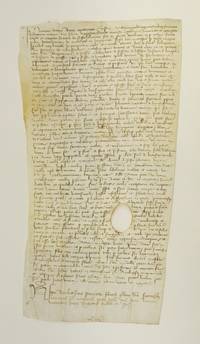
A VELLUM DOCUMENT IN LATIN
TEXT CONCERNING PAYMENTS BETWEEN A CHAPEL AND CONVENT
Italy 1429. 323 x 173 mm. 12 3/4 x 6 3/4". Single column 60 lines in a neat cursive script. <br/> Notarial signature at lower left; verso with a date and notations in contemporary hands. ◆Vellum trimmed a little close four horizontal and three vertical fold creases slight darkening to verso five very small holes no text obscured and one larger naturally-occurring hole in the text otherwise in excellent condition with a very clear hand.<br/> <br/> This is a notarized document recording an agreement made between the chapel and convent i.e. the whole community of the house of St. John a group of female religious located in the parish of St. Peter and the brothers of Bonsignioribus another religious house in the parish of St. Laurence Major. The women of St. John agree to pay to the brothers of Bonsignioribus a sum of 11 libras 8 soldas and 9 denarios. The reason for this payment is unclear pending further investigation into some of the more abbreviated portions of the text. The document is of additional interest for the fact that several female members of the house of St. John are mentioned by name. Based on these names and that of the notary Ambrosius Spanzota . . . Parmensis it would appear that the document was written in Italy possibly in Parma and that the two houses were also located there. unknown
Bookseller reference : ST12778-0360
|
|
|
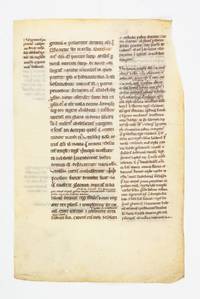
A VELLUM MANUSCRIPT LEAF FROM AN EARLY GLOSSED BIBLE IN LATIN
TEXT BEGINNING WITH 2 CHRONICLES 36:14
Abbey of St. Oyan at St.-Claude du Jura France ca. 1175. 245 x 158 mm. 9 3/4 x 6 1/4". Single column of text with two columns of gloss text column with 26 lines in a fine proto-gothic book hand. <br/> Verso with scant remnants of mounting tape in a couple of places along one edge. See Gwara Handlist no. 77. ◆Upper margin of fore edge unevenly trimmed away but no text lost a dozen-and-a-half small round wormholes touching just a couple letters light soiling to edges and other minor imperfections but still IN FINE CONDITION the vellum very clean and the ink dark and legible.<br/> <br/> The most important innovation in biblical scholarship during the 12th century was the development of the "Glossa Ordinaria" to the Bible. Drawing on the whole earlier tradition of biblical exegesis but especially that of Latin patristic writers like Augustine and Jerome scholars working in the French cathedral schools of Laon and Paris systematized this material in an apparatus of marginal and interlinear glosses arranged around the relevant biblical passages. The present leaf showing a particularly beautiful and regular script is a lovely example of one such work. The biblical text appearing in the center column is differentiated by larger lettering and gloss appears interlineally and in a column on either side of the main text all in smaller lettering by the same hand. Scott Gwara notes that the parent manuscript was formerly in the Medieval library of St. Oyan at St.-Claude du Jura a Benedictine monastery founded as the Abbey of Condat around 425 and later known as St. Oyen after an obscure saint who served as Condat's fourth abbot. In the 13th century it was renamed St.-Claude. By the 20th century the manuscript was in the collection of William L. Clements d. 1934 the bulk of which was sold by his estate between 1934-37. The manuscript was then acquired and dismembered by biblioclast Otto Ege around 1939. Gwara notes that the manuscript was incomplete by the time it reached Ege containing only 80 leaves but was "otherwise in excellent condition." The present leaf certainly attests to this assertion being extremely clean bright and with comfortable margins. unknown
Bookseller reference : ST17586
|
|
|
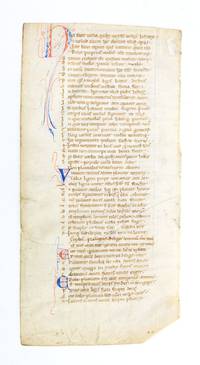
A VELLUM MANUSCRIPT LEAF FROM PETRUS RIGA'S "AURORA
TEXT FROM THE END OF THE COMMENTARY ON NUMBERS AND THE OPENING OF THE PROLOGUE FOR THE COMMENTARY ON DEUTERONOMY
England first half of 13th century. 235 x 117 mm. 9 1/4 x 4 1/2". Single column 49-50 lines in a gothic hand. <br/> Rubrics in dark brown ink three two-line initials in red or blue with contrasting penwork one four-line puzzle initial in red and blue with red and blue penwork decorations and long marginal extenders. With a few contemporary corrections in a different hand verso with scant remnants of mounting tape. Gwara Handlist no. 7. ◆Top edge trimmed cutting into the large initial's ascender one corner cut away not affecting text a couple of wrinkles and a bit of soiling to vellum but in excellent condition overall quite clean and entirely legible.<br/> <br/> Noticeably different in appearance from the Medieval leaves more commonly encountered on the market such as Books of Hours Bibles liturgical books etc. this leaf features a tall thin "ledger" format and offset initials spaced slightly apart from the rest of the line. The text here comes from the "Aurora" a commentary on the Bible in verse form written in the late 12th century by French poet Petrus Riga 1140-1209 a canon of Rheims cathedral. Although little is known about the author's life Riga's text became immensely popular throughout Europe and was routinely studied in Medieval universities. In fact it is likely that the present leaf came from a manuscript intended for a student or academic as its dimensions suggest it was made for easy transport and could even have been slipped into a pocket. In the 20th century the parent manuscript was owned and dismembered by biblioclast Otto Ege and leaves appeared as specimen no. 7 in his "Fifty Original Leaves from Medieval Manuscripts Western Europe XII to XVI Century." Single leaves from this manuscript appear at auction very rarely. The last example we were able to track on RBH and ABPC sold at Bloomsbury in 2016 for an all-in price of £3100. unknown
Bookseller reference : ST18250b
|
|
|
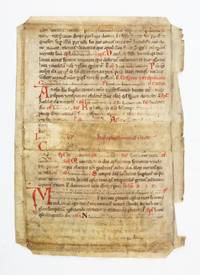
A VELLUM MANUSCRIPT LEAF FROM A NOTED MISSAL IN LATIN, RECOVERED FROM A BINDING
WITH TEXT FROM THE END OF THE SANCTORAL AND BEGINNING OF THE COMMON OF SAINTS
Germany early 13th century. 273 x 193 mm. 10 3/4 x 7 1/2". Single column 31 lines text in two sizes in a gothic hand. <br/> Rubrics in red several one- and two-line initials in red and two larger initials in red. A few lines with neumes later notations in the margins now quite faded. ◆Vellum a bit soiled and creased as expected fading to four or five lines where the spine was placed several notches along one edge other imperfections due to its reuse as binding scrap but still an excellent specimen that is almost entirely legible.<br/> <br/> Written in a neat and attractive hand this sizable leaf from a Missal remains mostly quite legible with all its rubrication intact despite having been used as part of a binding. A few lines also show musical notation from the earliest generation of neumes. They are described as "in campo aperto" which means literally "in an open field" because they and they alone occupy the space or "field" above the text. They are also described as adiastematic because they appear in a straight line whereas later diastematic neumes reflect changes in pitch by being placed in a higher or lower vertical position above the text. At the time the present leaf was written out the neumes here simply served as an "aide memoire" to the singer who had already learned the melody orally. unknown
Bookseller reference : ST19350-013
|
|
|
A VERY EARLY VELLUM MANUSCRIPT LEAF FROM A SACRAMENTARY OR RITUALE
TEXT INCLUDING BENEDICTIONS FOR TREES
Probably France or Rhineland 10th century. Irregularly shaped but approximately 298 x 225 mm. 11 3/4 x 8 7/8". Single column 33 lines on recto and 29 on verso in a neat Caroline minuscule. <br/> Rubrics in red nine two-line initials in red and/or brown one with a light yellow wash and feathered extender one with feathered ascender. ◆Recovered from a binding with the verso consequently somewhat soiled and with a vertical crease obscuring a letter or two on each line a little loss of blank vellum margin but no text lost other light stains and imperfections as expected but still in remarkably good condition the text almost entirely legible and the recto still generally quite pleasing.<br/> <br/> Written in an attractive and highly legible Caroline minuscule this early leaf is desirable not only for its age and script but also for the many initials opening each separate prayer. Inked in brown and orange and sometimes tinged with yellow these initials are reminiscent of those found in the Gellone Sacramentary BNF Latin 12048 an eighth century manuscript with extraordinarily inventive designs incorporating animals knotwork and a multitude of patterns and favoring a color palette of green orange yellow and brown. Although the present examples are simpler in their execution we can see similar tendencies in terms of colors and shapes--especially in the winged designs on two of the initials here. The smaller "S" residing in the larger "D" initial on the recto signifying the word "Deus" is a feature that can also be seen in the Gellone Sacramentary for example on f. 7r. The text here probably comes from a Sacramentary a type of manuscript containing only the words said by a priest or bishop rather than the congregant during Mass and other liturgical services or possibly a Rituale containing the services not included in the Missal or Pontifical. The text on this particular leaf includes blessings for trees. Though recovered from a binding the damage on this leaf is far less severe than is often encountered with such specimens; the text on both sides is intact all but a few letters are entirely legible the margins are quite generous and the initials have been well preserved. unknown
Bookseller reference : ST17235
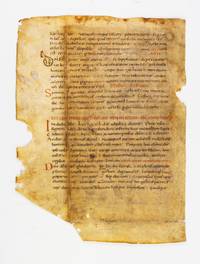
|
|
|
A VERY EARLY VELLUM MANUSCRIPT LEAF FROM A LECTIONARY IN LATIN
WITH READINGS FROM MATTHEW 21:35-46 AND GENESIS 27:6-28
Probably Germany third quarter of ninth century. 285 x 245 mm. 11 1/4 x 9 3/4". Single column 25 lines in a Caroline minuscule book hand. <br/> Tipped into a paper folder and presented in a tan cloth binding with ink notation on spine and a small sticker on upper cover. Rubrics in red. Front pastedown of folder with the bookplate of the Schøyen collection. With several pages of typed and handwritten notes including Bernard Rosenthal's cataloguing and a copy of a letter from Bernhard Bischoff to Rosenthal concerning the dating of the leaf. ◆Recovered from a binding and thus with some expected browning staining and wrinkling a long vertical fold through the text touching a couple letters of each line recto with the first few words of each line roughened and somewhat obscured a couple of other words a bit hard to make out but the vast majority of text very legible with fore and tail margins very ample and in all quite a good specimen representing a remarkable survival.<br/> <br/> Featuring a lovely Caroline miniscule hand this very early leaf from a Lectionary may have been made for the use of a particular church or individual and comes with recent distinguished scholarship and provenance. Although the text here contains familiar passages from the Old and New Testaments their juxtaposition in this context presents a bit of a conundrum: as the enclosed cataloguing explains the story of the wicked husbandmen from Matthew followed by the story of Esau surrendering his birthright to Jacob from Genesis "is an irregular and indeed unrecorded liturgical sequence of texts and suggests that this particular collection of lections was compiled for a particular church or private chapel." It is also possible that the Lectionary was made for the use of an individual rather than an institution with certain needs or preferences—perhaps a scholar or theologian or even a Carolingian nobleman many of whom were literate and educated. The hand here is an excellent example of the legible and elegant Caroline minuscule that dominated Western Europe in this period; distinctive letter forms include clubbed ascenders such as on the letters "b" "d" and "l" a long "s" with the shaft on the line and the use of the ampersand as a general abbreviation for the letters "et" occurring anywhere in a word for example "conter&" for "conteret". Termed the "integrated ampersand" this usage is especially characteristic of Caroline minuscule manuscripts of the late eighth and ninth centuries. Our leaf comes with bookseller Bernard M. Rosenthal's catalogue description noting that it was "Purchased from Schab New York Feb. 1969." William H. Schab was a book and art dealer in the firm of Gilhofer and & Ranschburg in Vienna before fleeing Austria in 1938 and settling in New York where he founded his own business. Also included here is a copy of a handwritten note regarding the date of the present leaf from renowned paleographer Bernard Bischoff. The leaf was also featured in Quaritch's 1991 catalogue 1147 Bookhands of the Middle Ages V no. 25.5 and was until recently part of the Schøyen Collection their MS 623. Four additional pages of cataloguing are also included here. Despite having been used as binding scrap at some point in its life this leaf is very well preserved with no words lost from trimming with distinctly visible ink and in a clear and very pleasing hand. unknown
Bookseller reference : ST17766
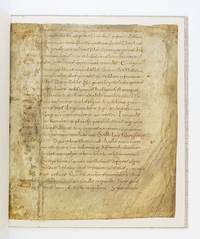
|
|
|
A VERY FINE MEDIEVAL ILLUMINATED VELLUM MANUSCRIPT LEAF IN LATIN, FROM THE LLANGATTOCK BREVIARY, WITH AN HISTORIATED INITIAL DEP
TEXT FROM THE FEAST OF STS. PETER AND PAUL
Italy Ferrara 1441-48. Visible leaf: 245 x 187 mm. 9 5/8 x 7 3/8"; Frame: 380 x 315 mm. 15 x 12 1/4". Double column 30 lines in a very fine rounded gothic hand a few lines of text in the same hand but smaller. <br/> Mounted and in a simple but pleasing gold frame. Visible side with rubrics in red one-line initials in burnished gold or painted blue one two-line initial in burnished gold on a pale pink ground with white tracery a lovely illuminated bar between the columns with a central plant knot AND SPROUTING IN UPPER AND LOWER MARGINS CLUSTERS OF FLOWERS AND LEAVES IN VARIOUS COLORS AS WELL AS GOLD BEZANTS outer margin with swirling penwork studded with gilt bezants running the length of the column each penwork swirl enclosing a painted and gilt flower with ONE FIVE-LINE HISTORIATED INITIAL DEPICTING ST. PAUL HOLDING A SWORD AND BOOK the initial painted pink with green leaves and a blue and green acanthus extension on a gilt ground. ◆Not examined outside of frame but in very fine condition: vellum slightly wavy text in the bottom margin just a bit faded but by all appearances A VERY CLEAN BRIGHT LEAF SPARKLING WITH GILT.<br/> <br/> Executed with great skill and delicacy and in sensitive Italianate colors highlighted especially by spring green and pink the present leaf is from a manuscript intended for a powerful aristocrat. It comes from the celebrated Breviary illuminated for the chapel of the Marquises of Este rulers of Ferrara and Mantua a manuscript commissioned by Leonello d'Este duke of Ferrara from 1441-50. Because the d'Este family kept excellent records we have confidence that this manuscript was done for Leonello by Giorgio d'Alemagna Bartolomeo de Benincà Guglielmo Giraldi and Matteo de' Pasti see Toniolo "La Miniatura a Ferrara dal Tempo di Cosmè Tura all'eredità di Ercole de' Roberti" 1998 pp. 19-20 and 76-77. The leaves show subtle variations in the style of the illuminations a result of work done by a team of artists doing variations on a theme. At one time in a Spanish library the manuscript was brought to Britain during the Peninsular War and came to be owned by the Rolls family later Lords Llangattock of Monmouth in Wales from whom it takes its name. By the time the work reached Britain most of the miniatures had already been cut out. The Breviary sold at Christie's on 8 December 1958 lot #190 to Goodspeed's of Boston who broke it up. The intact first quire of 10 leaves was purchased by Philip Hofer and given to Harvard cf. Wieck "Late Medieval and Renaissance Illuminated Manuscripts" p. 130 and fig. 74 and individual leaves appeared in 1967 in the catalogues of Folio Fine Art "the quality of the leaves is extremely high" Maggs Brothers "of a very high quality" and Alan Thomas "of exquisite quality". The present example is especially desirable for the portrait of St. Paul who is depicted holding a sword and book and whose carefully molded features reflect the growing interest in realistic portraiture in Renaissance Italy. unknown
Bookseller reference : ST19880
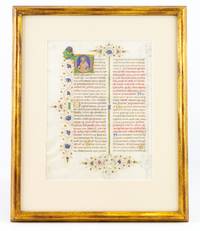
|
|
|
A VERY LARGE EARLY VELLUM MANUSCRIPT LEAF WITH AN IMPRESSIVE INITIAL, FROM SAINT GREGORY THE GREAT'S "XL HOMILARIUM IN EVANGELIA
TEXT FROM HOMILY XXII FOR EASTER SUNDAY
Italy ca. 1150. 406 x 273 mm. 16 x 10 3/4". Double column 42 lines in a fine rounded early proto-gothic hand. <br/> With rubrics in red one three-line initial "I" and A PANELLED 13-LINE INITIAL "F" all of these on the very faded recto and consequently indistinct. Formerly used in a binding with text on the recto unreadable the verso with a narrow band of darkening along one edge not obscuring text edges very wormed but 90 percent of the worming in the margin with very little damage to the text; some obvious condition problems but the large and beautiful script on one of the sides entirely legible and certainly very pleasing.<br/> <br/> This leaf comes from a very large copy of one of the major texts by one of the great popes of the early Middle Ages and it is notable for the spaciousness and elegance of its script. The sermon here is based on the Gospel reading for Easter Sunday John 20:1-9 which reports Mary Magdalene's discovery of the empty tomb and her running to tell the apostles what she had--and hadn't--found. Given the fact that the passage under discussion celebrates the most critical event in Christianity the opening phrase "Fractus longa molestia stomachus" is unexpected who would have thought it appropriate to mention protracted gastrointestinal problems and probably more effective as a result. Gregory says he is so weakened that he had given up explaining the Gospel to his flock but now he must resume. He recounts how Mary Magdalene told John and Peter about the empty tomb how John arrived first but did not enter the sepulcher and how Peter the tardier one did. Gregory then gives an allegorical interpretation of this episode: John he says represents the Synagogue Peter the Church; the Jews were prior to the Christians but they hesitated on the brink of belief in the Son of God while the Christians entered into full belief. unknown
Bookseller reference : ST12083f

|
|
|
A VERY LARGE EARLY VELLUM MANUSCRIPT LEAF FROM SAINT GREGORY THE GREAT'S "XL HOMILARIUM IN EVANGELIA" IN LATIN
TEXT FROM HOMILY XXVI FOR THE FIRST SUNDAY AFTER EASTER
Italy ca. 1150. 406 x 273 mm. 16 x 10 3/4". Double column 42 lines in a fine rounded early proto-gothic hand. <br/> Recto with a pleasing three-line red initial. ◆Formerly used in a binding and consequently a bit soiled and trimmed at the head with loss of the first line perhaps 100 or so small wormholes in the margin only a few causing trivial harm to the text a faint grayish stain affecting a couple of words in the top 20 lines of one column on each side but the entirety of the text completely clear and the stately leaf quite fresh and unusually well-preserved in general for a recovered specimen.<br/> <br/> This leaf comes from a very large copy of one of the major texts by one of the great popes of the early Middle Ages. Dealing in part with the central occurrence in the salvation of humanity the text here treats of John 20:19-31 which tells of the risen Christ's appearance to the Apostles. Doubting Thomas insists on touching the Lord's wounds before he will be convinced of the Resurrection. Gregory tells his audience that Thomas was healed of unbelief and so must they be although they cannot see Jesus in the flesh as did Thomas. Written ca. 593 Pope Gregory's 40 homilies on the Gospels enjoyed enduring popularity throughout Medieval times as they offered ordinary Christians practical guidance on applying the lessons of the Gospels to their own lives. Elected pope in 590 Gregory ca. 540-604 was one of the most influential pontiffs in the history of the Church. In addition to revising liturgical worship he wrote extensively on theology offering homespun wisdom rather than esoteric debates. He was declared a saint immediately upon his death. The script here is regular rounded and very pleasing--almost soothing--to the eye. Moreover the letters are so large and there is so little significant damage to the leaf that the text can be easily read from a considerable distance. unknown
Bookseller reference : ST12083e

|
|
|
Abbé F. de LAMENNAIS
Imitation de Jésus-Christ
1886 Pellion et Marchet, Editeurs, Dijon - 1886 - Un fort volume in-4, reliure plein chagrin noir, décors à froid sur le premier plat, dos à 5 nerfs avec titre en doré et fleurons à froid, toutes tranches dorées, dorures sur les coiffes et les bords des contreplats, filet doré sur les tranches, frontispice - 616 pages - Nombreuses illustrations hors-texte et ornements en N&B (bandeaux, lettrines, vignettes, culs-de-lampe)
Bookseller reference : 124571
|
|
|
ADES Albert - JOSIPOVICI Albert
Le Livre de Goha le simple
Paris Editions du Compas 1947 broché, couverture rempliée, chemise et étui de l'éditeur
Bookseller reference : 013358
|
|
|
Adrian Vellum
The History of the Future: How Power Always Predicts What Comes Next
paperback. Good. Access codes and supplements are not guaranteed with used items. May be an ex-library book. paperback
Bookseller reference : 8199242477.G ISBN : 8199242477 9788199242470

|
|
|
Aesopus (Esope)
Mythologia Aesopica, in qua, Aesopi Fabulae Graecolatinae CCXCVII. quarum CXXXVI. primum prodeunt. Accedunt Babriae Fabulae etiam auctiores [...]. Haec omnia ex Bibliotheca Palatina [...] opera & studio Isaaci Nicolai Neveleti [...].
1610 Francoforti, Nic. Hoffmanni1610 [16]-678-[2 bl.] pp. 237 gravures sur bois d'après Virgil Solis (1514-1562). Marque de gravure sur bois sur le titre. Imprimé en 2 col. avec les textes grecs et latins. Reliure en parchemin illustré d'un manuscrit d'époque avec enluminures !!! tres beau à regretter un petit manque sur la première de couverture, dos bon état , quatrième de couverture bon état . Première édition, "Wichtigste Anthologie der humanistischen und nachhumanistischen Sammlungen und Neuentdeckungen, mit einem umfangreichen Anmerkungsapparat des Neveletus ("Notae") in fünf Abschnitten als Anhang, in denen ausser den Fabeln des Abstemius jede Sammlung einzeln kommentiert wird." (Bodemann). (Bodemann). Neveletus est à l'origine de cette édition réimprimé la collection d'Accursius, qu'il enrichira de 136 fables . La Fontaine y puisera son univers ...
Bookseller reference : 7255

|
|
|
Aimé Césaire
Ferrements, poèmes
AIMÉ CÉSAIRE - Ferrements - EO 1/105 sur Vélin neige BROCHÉ - SANS ILLUSTRATEUR - 1960 Auteur : Aimé Césaire Titre : Ferrements, poèmes Édition : Éditions du Seuil, Paris, 1960 Tirage : Édition originale, exemplaire n° 82, l'un des 105 exemplaires numérotés sur papier Vélin Neige. Gravures : Sans illustrateur pour le texte. Reliure : Ouvrage broché sous couverture souple d'éditeur à rabats, dos lisse. Exemplaire conservé à l'état de parution avec ses marges non coupées. Dimensions : 14 x 19,5 cm État : Très bel état de conservation. La couverture est propre avec d'infimes frottements d'usage aux coiffes. L'intérieur est très frais, le papier est blanc et exempt de rousseurs, les feuillets sont préservés avec leurs marges non coupées. Les documents annexes sont en parfait état. Nombre de pages : 93 pages
Bookseller reference : boz_001534

|
|
|
Ainsworth, William Harrison.
HISTORICAL ROMANCES. TWENTY VOLUMES.
Twenty Volumes. Illustrated with Etchings, proofs-before-letters on Japan Vellum, and impressions of the Historical Portraits on India Paper. Offsetting from tissue guards marring a few illustrations. Title pages printed in red and black. Uncut. Top edges gold. 8vo. Original full blue cloth bindings, some wear. Original spine paper labels. Spines faded. Victorian Edition. Limited Edition. Number 996 of only 1000 copies. Nice set. Impressive. SET/W49
|
|
|
ALBERT-BIROT Pierre
Poèmes à l'autre moi
Paris Jean Budry 1927 Broché
Bookseller reference : 009370
|
|
|
ALBERTI Henri-Dante
Dans l'argile de Picasso
Vallauris Imprimerie Arnéra 1957 plaquette in-8 Agrafé, couverture illustrée
Bookseller reference : 014114
|
|
|
ALECHINSKY Pierre
Codicille à Horie Cobra
Paris L'Echoppe 1997 In-16 Broché, couverture à rabats Signé par l'auteur
Bookseller reference : 016185
|
|
|
ALECHINSKY Pierre
Parfois répondre à un questionnaire
Paris L'Echoppe - Collection "Envois" 2002 In-16 Broché, couverture à rabats Signé par l'auteur
Bookseller reference : 015918
|
|
|
ALECHINSKY Pierre
Un Cheveu
Paris L'Echoppe - Collection "Envois" 1995 In-16 Broché, couverture à rabats Signé par l'auteur
Bookseller reference : 016184
|
|
|
Alexandre Arnoux
Géographie sentimentale/ EO numérotée 249/250 sur vélin du marais
H. Lardanchet 1946 180 pages in8. 1946. Broché couverture rempliée. 180 pages. Géographie sentimentale est un ouvrage d'Alexandre Arnoux romancier et dramaturge français membre de l'Académie Goncourt qui constitue un chant d'amour à Lyon et à la Haute-Provence. Le livre est décrit comme un hommage littéraire et sentimental à ces deux régions
Bookseller reference : 8123
|
|
|
ALEXANDRE Maurice
Mythologie personnelle
Paris Éditions des Cahiers libres 1933 In-8 Broché, couverture rempliée
Bookseller reference : 011848
|
|
|
Allen Tate
Les Ancêtres (The Fathers)
Auteur : Allen Tate Titre : Les Ancêtres (The Fathers), roman traduit de l'américain par Marie Canavaggia Édition : Gallimard, Paris, 1948 Collection : « Du Monde Entier » (LXX) Tirage : Édition originale de la traduction française. Un des 210 exemplaires sur vélin pur fil Lafuma-Navarre (celui-ci portant le n° 76), seul grand papier Reliure : Broché Dimensions : 14,1 x 21 cm État : Très bel état de conservation, intérieur frais, marges non coupées. Dos légèrement insolé Nombre de pages : 282 pages
Bookseller reference : boz_001578
|
|
|
Alphonse Daudet
Sapho : mœurs parisiennes numéroté sur vélin - burin original de DECARIS
André Sauret Éditeur 1957 277 pages in8. 1957. broché couverture rempliée avec boitier. 277 pages. Sapho (Mœurs parisiennes) d'Alphonse Daudet est un roman publié à la fin du XIXe siècle explorant les relations amoureuses complexes et les mœurs de l'époque parisienne. L'histoire d'inspiration autobiographique relate la passion tumultueuse du narrateur avec une femme plus âgée Marie Rieu modèle du personnage éponyme une relation que Daudet dut interrompre avant son mariage bourgeois
Bookseller reference : 14398
|
|
|
Altenberg, Peter
Wie ich es sehe.
Hans von Weber, München, S. Fischer, Berlin, 1913. Rodenberg 414. Originalpergamentband mit Deckelvignette (Doppelsignet beider Verleger) und Kopfgoldschnitt. [8[, 278, [4] Seiten. 28 : 20 cm.
Bookseller reference : 25630

|
|
|
Alvarez de la Fuente, Joseph
Succession real de Espana:. Vidas, y hechos de sus Esclarecidos Reyes de Leon, y Castilla desde D. Pelayo, que fue el primero que dio principio a su restauracion, hasta nuestro Gloriosissimo Monarca, el Senor Fernando VI. que oy reina, y reine por muchos anos; con sus nacimientos, hechos memorables, Conquistas, Chronologias, Fundaciones que hicieron, Leyes que ordenaron en el tiempo de sus Reynados. 2 Bde.
Madrid, Joseph Mathias Escrivano, ( 1748). Titel, 11 Bll., 392 S.; 442 S., 1 Bl. Kl.-8vo. Flexibles Pgt. d. Zt.
Bookseller reference : 57794

|
|
|
Amandine Velin
Insya veut danser le léwòz
Jasor 2020. Paperback. Very Good. Former library book. Edition 2020. Ammareal gives back up to 15% of this item's net price to charity organizations. Jasor paperback
Bookseller reference : I-328-057 ISBN : 979109067594x 9791090675
|
|
|
Amans-Alexis Monteil (Jules Taschereau, editor)
Promenades dans la Touraine
THE UNIQUE COPY PRINTED ON REAL VELLUM ("peau de vÈlin") OF THE FIRST AND ONLY EDITION OF THIS EXTREMELY IMPORTANT AND RARE BOOK ABOUT THE TOURAINE. XVI, 208 pp. Beautifully printed on fine vellum, with huge margins, for Jules Taschereau, an important Touraine intellectual, politician, and bibliophile who was also the editor of this volume. 8vo (the remainder of the edition, 180 copies on paper for the SociÈtÈ des Bibliophiles de Touraine, was printed 12mo.) BEAUTIFULLY BOUND BY CAP… IN FULL MOROCCO, spine elegantly gilt in six compartments, triple gilt fillet on covers, turn-ins elegantly gilt. Tiny traces of wear to lower extremties of joints, else FINE AND BRIGHT, COMPLETELY UNCUT, WITH NO DEFECTS. Taschereau I, p. XIX; Taschereau auction catalogue (1875) n∫ 30. UNIQUE AND IMPORTANT.
|
|
|
AN EARLY VELLUM MANUSCRIPT LEAF FROM A SACRAMENTARY IN LATIN, WITH A LARGE ROMANESQUE INITIAL
WITH TEXT FROM MASSES FOR SAINTS' DAYS IN AUGUST
Germany mid- to late 12th century. 290 x 217 mm. 11 3/8 x 8 1/2". Single column 21 lines in an attractive proto-gothic book hand. <br/> Rubrics in red several one-line initials in red five red initials measuring two to four lines long and with penwork embellishment A LOVELY SEVEN-LINE WHITE-VINE INITIAL outlined in red and with a pale yellow wash along the edge the lower half of the ground filled with green wash. Lower margins with notations in later Medieval hands. ◆A handful of original holes in the vellum no doubt from stretching the skin during processing with the scribe writing around the flaws where necessary a little soiling to lower outside corner one or two negligible spots otherwise IN FINE CONDITION the ink unusually rich and the paint very bright.<br/> <br/> From a Sacramentary a service book that contained the prayers said during Mass subsumed by the Missal in the 13th century this early leaf was once part of an attractive manuscript of very high quality. The very large and superb "F" opens the Mass for the Feast of the Assumption and the other readings here include Masses for Sts. Hippolytus and Cassian celebrated on 13 August; St. Eusabius 14 August; Vigil of the Assumption of the Virgin 14 August; Assumption of the Virgin 15 August; St. Agapitus 18 August; and the beginning of the Mass for Sts. Timothy Hippolytus and Symphorian 22 August. Sister leaves from this same manuscript have previously appeared in Sam Fogg Cat. 16 "Text Manuscripts and Documents 2200BC to 1600AD" 1995 nos. 30 and 31; Maggs Bros. European Bulletin 20 1995 no. 37; Quaritch Cat. 1270 "Bookhands of the Middle Ages VI" 2000 nos. 69 and 70; Sotheby's 6 December 2001 lot 8; and Bloomsbury 6 December 2017 lot 16. The Fogg description notes that similar initials can be seen in French German and Flemish manuscripts of the period "but very few manuscripts have the special characteristics of this one." For example the initials on the sister leaves described by Fogg contain atypically mauve and green as well as an "unusual . . . exterior contoured ground which is not confined by any geometric form." This means there is no line or shape to box in or define the capital's form; rather it appears as if surrounded by an aura or gentle shadow. Our initial contains a green ground only no mauve but the same unusual and attractive yellow aura. It is rare to find Romanesque leaves of this size and caliber in such fine condition and the present leaf with its beautiful regular proto-gothic hand exceptional white-vine initial and several large decorative initials in red is especially desirable. unknown
Bookseller reference : ST17236
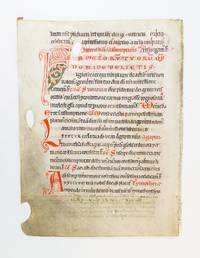
|
|
|
AN EARLY VELLUM MANUSCRIPT LEAF FROM A HOMILIARY IN LATIN
WITH TEXT FROM HAIMO'S HOMILY XI ON ST. JOHN THE EVANGELIST
<p>England second half of 12th century but before 1180. 313 x 198 mm. 12 1/4 x 7 3/4. Double column 32 lines in a lovely late Caroline hand verso with some lines erased and corrected in a smaller hand. <br />Mounted in a fine tan cloth folder between sheets of textured acid-free paper. Front pastedown with book label of the Schøyen Collection with their shelf mark MS 237 written in ink. ◆Recovered from a binding and thus with overall toning and soiling recto somewhat browned from binder's glue but almost entirely confined to three margins and the verso virtually unaffected other trivial imperfections but in surprisingly good condition given its history the very rich ink especially dark and well preserved.<br /><br />This is an exceptionally lovely example of an early English book hand standing at the crossroads of the Caroline and proto-gothic calligraphic traditions. According to Thompson "In the twelfth century the scribes seem to have vied with each other in producing the best types of book-writing of which they were capable with the result that remarkable precision in the formation of the letters was attained and that the century may be named as excelling all others for the beauty of its MSS." "Greek and Latin Paleography" p. 436 The present leaf certainly lives up to this description being notable for its exceptionally neat and legible script written with uncommonly pretty and regular letter forms by a practiced and confident hand. The Caroline tradition is apparent in certain tendencies such as the use of "&" for "et" and the lack of biting curves between letters while a shift toward the proto-gothic can be seen in the vertical and compressed letter forms as well as the increased use of abbreviations and ligatures. Although the present work has often been credited to Haymo of Halberstadt due to a longstanding error in attribution reaching back to the 15th century modern scholarship now recognizes Haimo of Auxerre a monk at the Abbey of Saint-Germain in Auxerre d. ca. 875 as its true author. A prominent theologist and writer during the Caroline Renaissance Haimo produced a number of influential commentaries on various books of the Bible. The provenance on this leaf can be traced back as far as the mid-19th century when it was auctioned at Sotheby's on 21 August 1858 lot 119.2 sold as part of an album containing various leaves and fragments put together by Philip Bliss 1787-1857 registrar of the University of Oxford. It then went into the celebrated collection of Sir Thomas Phillipps 1792-1872 and was eventually sold by the Robinson Brothers on 24 April 1911 lot 390.3. This leaf has previously appeared in Quartich's catalogue 1036 "Bookhands of the Middle Ages" no. 79.5 and was most recently in the collection of Martin Schøyen his MS 237.</p>
Bookseller reference : ST17768
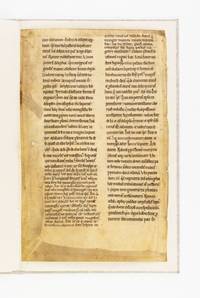
|
|
|
AN ENGLISH VELLUM MANUSCRIPT LEAF, IN LATIN, FROM PETRUS RIGA'S "AURORA
TEXT FROM COMMENTARY ON I KINGS LINES 185-248
England ca. 1375. 287 x 198 mm. 11 1/4 x 7 3/4. Single column 32 lines in a small rounded English gothic hand with rubrics in the margins. <br/> Rubrics in red running title in red paragraph marks in red or blue two initials measuring two lines in height and colored blue with red penwork. See: P. E. Beichner "Aurora Petri Rigae Biblia Versificata A Verse Commentary on the Bible." ◆Remnants of mounting tape in top margin of recto but a really excellent specimen the hand very clear the ink especially rich and the vellum extremely clean and quite bright.<br/> <br/> Written in a gothic hand heavily influenced by the English secretarial style this leaf comes from a copy of the "Aurora" a commentary on the Bible in verse form written in the late 12th century by French poet Petrus Riga 1140-1209 a canon of Rheims cathedral. Although little is known about the author's life Riga's text became immensely popular throughout Europe and was routinely studied in Medieval universities. According to Beichner "for those who could read Latin it supplied Scriptural lore in a popular form and it also served as a book of popular theology devotional reading moral instruction and entertainment. Its influence was propagated by teachers preachers and lexicographers by poets and other writers. It was studied imitated translated and quoted. Not only was it widely read in monasteries and convents but it was also recommended reading for the sons of nobles." It is interesting to note that although Riga's work was copied numerous times in the 13th century copies from the later Medieval period such as the present work are uncommonly rare. The parent manuscript containing our leaf was previously in the possession of the Dukes of Westminster and was sold at Sotheby's on 11 July 1966 lot 229 when it was advertised as having 267 leaves missing the first gathering plus 13 other leaves. Bookseller Francis Edwards acquired the manuscript at that sale removed three damaged leaves and sold the remainder. It was thereafter broken up and dispersed. Several sister leaves are now in the collections of Marquette University Lawrence University and the University of South Carolina. unknown
Bookseller reference : ST18542
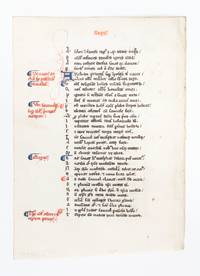
|
|
|
AN ILLUMINATED VELLUM MANUSCRIPT LEAF WITH CHARMING BORDER ILLUSTRATION
FROM A LARGE BOOK OF HOURS WITH TEXT IN LATIN
France probably Besançon 3rd quarter of 15th century. 239 x 165 mm. 9 3/8 x 6 1/2". Single column 15 lines in an elegant gothic book hand. <br/> Rubrics in dark pink line enders in pink and blue with white tracery and gold bezant one- and two-line initials painted gold on pink and blue ground with white tracery each side with a panel border decorated with hairline vines gold bezants and ivy and colorful flowers and acanthus RECTO BORDER INHABITED BY A CHARMING DOG-LIKE CREATURE. ◆A small light stain in border decoration largely masked by dense hairline vines but IN FINE CONDITION--bright clean and well preserved.<br/> <br/> From a large Book of Hours probably produced in Besançon this leaf features very pretty panel borders including one with a particularly charming inhabitant in the form of a dog-like creature with no front legs wearing an orange collar and emitting an acanthus leaf from its mouth. Imaginative touches like this and luxurious elements such as the several dozen gilt bezants and ivy leaves in each border and the unusually wide margins point to this manuscript having been quite a costly production. For additional leaves from this same manuscript at different price points please check our website. unknown
Bookseller reference : ST17060N
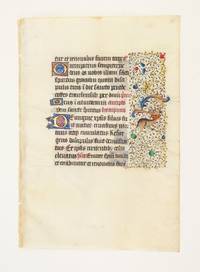
|
|
|
AN ILLUMINATED VELLUM MANUSCRIPT LEAF WITH CHARMING BORDER DECORATION
FROM A LARGE BOOK OF HOURS WITH TEXT IN LATIN
France probably Besançon 3rd quarter of 15th century. 239 x 165 mm. 9 3/8 x 6 1/2". Single column 15 lines in an elegant gothic book hand. <br/> Rubrics in dark pink line enders in pink and blue with white tracery and gold bezant several one-line initials and one two-line initial in burnished gold on dark pink and blue ground with white tracery each side with a panel border composed of hairline vines with gold ivy and bezants a few colorful flowers and EACH FEATURING THE FACE OF A MAN EMITTING ACANTHUS LEAVES FROM HIS MOUTH. ◆A few tiny marginal spots one of the faces slightly rubbed otherwise IN BEAUTIFUL CONDITION.<br/> <br/> In addition to the floral decoration and vines often found in the borders of Books of Hours this leaf features a duo of delightful inhabitants in the form of faces emitting colorful acanthus from their mouths. Each figure is individualized the face on the recto with dark hair flushed cheeks and a prominent nose; on the verso is a face with a much paler complexion a tonsured hairstyle a large but very short nose and fine gray whiskers. This kind of imaginative work together with luxurious touches such as the many gilt initials several dozen gilt bezants and ivy leaves in each panel border and the unusually wide margins point to this manuscript having been a costly production. For additional leaves from this same manuscript at different price points please check our website. unknown
Bookseller reference : ST17060R
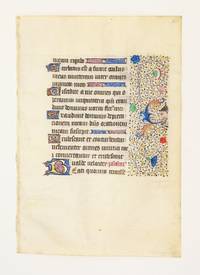
|
|
|
AN ILLUMINATED VELLUM MANUSCRIPT LEAF FROM A DUTCH BOOK OF HOURS, WITH A VERY FINE MINIATURE OF THE HARROWING OF HELL BY THE MAS
PROBABLY FROM THE OFFICE OF THE DEAD
Delft ca. 1470. Leaf: 175 x 122 mm. 6 7/8 x 4 3/4"; Frame: 250 x 195 mm. 9 3/4 x 7 3/4". No text on recto or verso. <br/> In an attractive wooden frame. A FINELY PAINTED MINIATURE OF THE HARROWING OF HELL within an arch-topped compartment the mouth of hell depicted on the left with a fiery red interior and five people emerging from it the figure of Christ on the left holding a cross on a long staff and half-clothed in a pink and blue robe the background with a castle in the distance ALL OF THIS BENEATH A VERY DETAILED ARCHITECTURAL CANOPY suspended in the sky AND THE WHOLE WITHIN A FULL BORDER of acanthus leaves and other foliage and flowers in reds blues greens yellows and brushed gold along with very many small burnished gold ivy leaves and buds on hairline stems a small stork in the bottom border and a large delicately shaded angel in the left border. ◆Left margin trimmed very close to decoration just escaping loss and the other three margins ample mild darkening right at fore and tail edge but not reaching into borders otherwise IN FINE CONDITION the colors rich and true and the burnished gold still shimmering.<br/> <br/> This extraordinary miniature notable for its uncommon subject matter memorable imagery and fine workmanship was produced by a talented artist belonging to the stylistic group known as the Masters of the Delft Half-Length Figures. The subject here is infrequently depicted in Books of Hours: the Harrowing of Hell appears as a full-page miniature in only three of the 119 prayer books described by Roger Wieck in his "Time Sanctified" and three others contain a Harrowing depiction inside an initial. Christian theological tradition tells us that after his crucifixion Christ went to liberate souls from Limbo--a location inhabited by those barred from entry into Heaven because they died before the Redemption. In our scene Christ wrapped in a regal cloak and carrying a long staff his hands and feet still bleeding from the wounds he received on the Cross reaches into an absolutely wonderful Hellmouth to extricate Adam and Eve and other naked souls while the recently deceased and original saint John the Baptist still clad in an animal skin garment waits patiently for his turn to emerge. The great maw of Hell as depicted here has bulging eyes a distended snout thickly matted hair and a bad complexion; his gaping mouth punctuated by sharp gray teeth glows red hot and one can tell from the creature's expression that he is loath to comply with this rescue of souls. In addition to its compelling subject matter there is a high level of artistic achievement here including delicately molded figures impressively detailed architectural elements and a lovely color palette. The elegance and quiet sophistication observed in this miniature distinguishes the artist responsible for this work as a particularly talented member of his circle. Active from about 1450-80 the Masters of the Delft Half-Length Figures were named by James Marrow after the angels and other figures whose upper bodies are typically found emerging from a cloud within the borders. Although the present leaf uncharacteristically contains a full-length angel in the border it shares other stylistic similarities such as the elaborate architectural canopy hovering over the main composition; and it particularly resembles the work of the artist of Keble College MS 77 an illuminator described in "The Golden Age of Dutch Manuscript Illumination" as "one of the more articulate of the group" whose "figures are more fully modelled and his palette . . . deeper and brighter" than that of his contemporaries. Because the subject of the present miniature goes beyond the standard image program seen in routine productions and because of the high level of artistic accomplishment seen here this leaf was almost certainly part of an elaborate Book of Hours produced in response to an important commission. unknown
Bookseller reference : ST17764
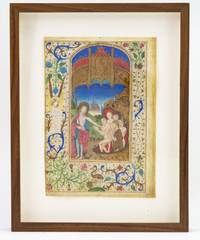
|
|

 Receive by email
 Download as PDF document
 RSS feed
 Permanent link


