|
CHAMPFLEURY (Fleury, Jules dit)
Les souffrances du professeur Delteil.
Paris, Michel Lévy Frères, 1857. In-8°, 247p. Reliure demi-veau glacé bleu, dos à nerfs, pièces de titre rouge et marron, tête dorée.
Referentie van de boekhandelaar : 38205

|
|
|
CHAMPFLEURY (J. Fleury, dit)
Le violon de faïence.
P., Dentu, 1877. In-8 reliure demi-maroquin bleu marine à coins, dos à 5 nerfs ornés d'un pointillé doré, caissons bordés d'un double filet doré et ornés aux petits fers, auteur et titre dorés, double filet doré aux plats, tête dorée, couv. sup. conservée [Weber], VIII-173 pp., [1] f. d'annonce, 2 planches gravées à l'eau-forte par J. Adeline, première page illustrée, bandeaux et culs-de-lampe en couleurs d'après Emile Renard.
Referentie van de boekhandelaar : 546643

|
|
|
CHAMPFLEURY (Jules Fleury dit).
Contes choisis. - Les Trouvailles de Monsieur Bretoncel. - La Sonnette de Monsieur Berloquin. - Monsieur Tringle. Nombreuses illustrations dans le texte à l'eau-forte et en typographie par EVERT VAN MUYDEN.
Paris, Maison Quantin, 1889. In-8 ; [2] ff. (faux-titre ; au V°, justification du tirage) ; [1] f. (titre rouge et noir, orné d'une vignette) ; 130 pp. ; et 1 f. n. ch. (table des matières). Demi-chagrin brodeaux à larges coins, filet doré sur les plats, dos à nerfs richement ornés, tête dorée, belle couverture bleue imprimée conservée (reliure signée V. CHAMPS).
Referentie van de boekhandelaar : 28110

|
|
|
CHAMPFLEURY (Jules Fleury, dit)
Contes choisis. Les trouvailles de Monsieur Bretoncel - La sonnette de Monsieur Berloquin - Monsieur Tringle.
Paris, Maison Quantin, 1889. Gr. in-8°, 130p. Broché, couverture illustrée rempliée.
Referentie van de boekhandelaar : 34253

|
|
|
CHAMPFLEURY (Jules Fleury, dit) (1821-1889):
Les souffrances du Professeur Delteil. 5e éd. ‘Edition de Luxe’.
Paris, J. Rothschild, 1870, in-8°, frontispice + 4 ff. + 298 p., ill. de vignettes + 5 planches asde Crafty , brochure originale illustrée. Dos fendu, avec qqs déchirures et manques.
Referentie van de boekhandelaar : 34651aaf
|
|
|
CHAMPFLEURY (Jules Franois Flix HUSSON, dit Fleury).
N Laon. 1821-1889. Ecrivain et critique d'art franais. L.A.S. "Champfleury" Gabriel Dentu. S.l., 19 juin 1866.
19/06/1866 ...Voudriez-vous avoir l'obligeance de demander Mr Jacquemart dans lequel de ses ouvrages de cramique et quel endroit il a donn une demande potiers anglais tendant obtenir un brevet ou un monopole en France de fabrication par impression... demande Champfleury qui dsire ...citer le passage dans un livre...Auteur de romans tels Les souffrances du professeur Delteil (1853) et Les bourgeois de Molinchart (1855), Champfleury ddia sa nouvelle Chien-Caillou, fantaisie d'hiver (1847) Victor Hugo qui le flicita chaleureusement. Il fut galement critique d'art pour L'vnement et Le messager de l'Assemble et ses comptes rendus des Salons contriburent lancer la carrirre de Gustave Courbet.
Referentie van de boekhandelaar : 2179
|
|
|
CHAMPFLEURY (Jules François Félix Husson, dit Fleury, dit)
Contes de Printemps - Les Aventures de Mademoiselle Mariette. Contes d'Automnes. Les Souffrances du Professeur Delteil. La Succession Camus - Les Amis de la Nature. Monsieur de Boisdhyver. Histoire de l'imagerie populaire. Histoire de la caricature antique. Histoire de la caricature moderne.
Contes de Printemps : Paris, Victor Lecou, 1853. Contes d'Automnes : Paris, Vicor Lecou, 1954. Les Souffrances du Professeur Delteil, La Succession Camus - Les Amis de la Nature et Monsieur de Boisdhyver : Paris, Poulet-Malassis et de Broise, 1861. Histoire de l'imagerie populaire : Paris, E. Dentu, 1869. Histoire de la caricature antique et Histoire de la caricature moderne : Paris, E. Dentu, s.d. 8 volumes in-8, demi maroquin grenat à coins, dos à nerfs janséniste, tête dorée, tranches de gouttière et de queue non rognées, reliures signées Pouget (frottements discrets, petite épidermure sur le plat supérieur de "Contes de printemps", mors du plat supérieur de "Monsieur de Boidhyver" partiellement fendu).
Referentie van de boekhandelaar : 15797

|
|
|
Champfleury (Jules François Félix Husson, dit Fleury, dit)
Histoire de l'imagerie populaire.
Paris, Dentu 1869. In-12., br, Reliure postérieure moderne demi cuir grenat, [6| L-312 pp., [4], 36 gravures à pleine page. Très bel exemplaire dans une pagination très blanche.
Referentie van de boekhandelaar : 21441

|
|
|
Champfleury (Jules François Félix Husson, dit Fleury, dit)
Histoire de la Caricature Antique. Deuxième édition considérablement augmentée.
Dentu, Juillet 1867. In-12, reliure postérieure demi cuir grenat sur cuve jaspé dans les tons, [3] XXIV- 332, (4ff). nombreuse fig. in text.
Referentie van de boekhandelaar : 21445
|
|
|
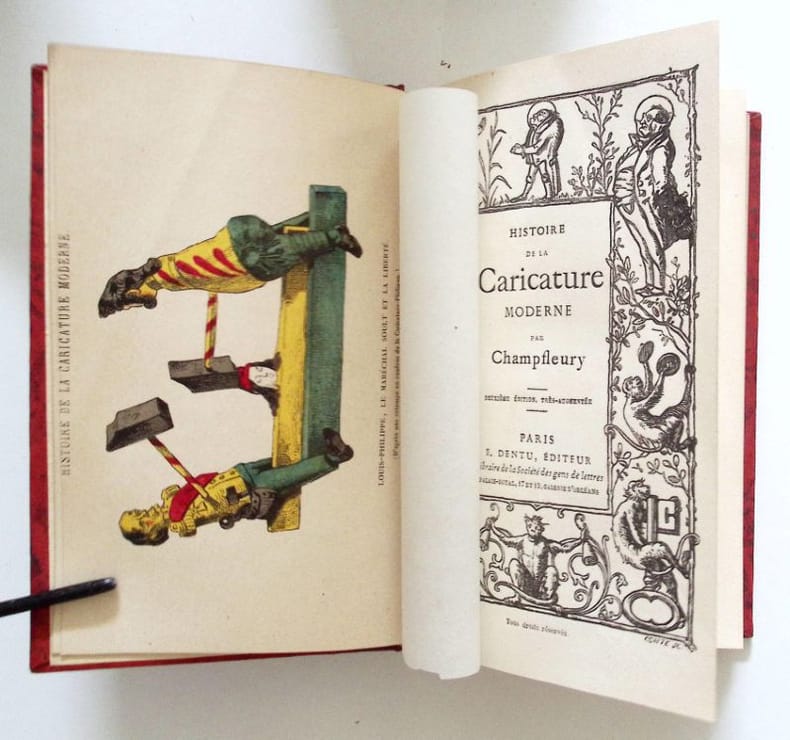
Champfleury (Jules François Félix Husson, dit Fleury, dit)
Histoire de la caricature moderne. Deuxième édition, très augmentée.
Paris, Dentu, [ sd] In-12, reliure postérieure demi cuir grenat sur cuve jaspé, dos lisse titrés sobrement, [3] XX-522pp., [9] nf, nombreuses fig. dans le texte, complet de l'extrait du catalogue. Bel exemplaire.
Referentie van de boekhandelaar : 21444
|
|
|
Champfleury (Jules François Félix Husson, dit Fleury, dit)
Histoire de la caricature sous la république l'empire et la restauration.
Paris, E. Dentu, éditeur [sd] (1874). In-12., reliure demi cuir grenat postérieure moderne conservant les couvertures, [4] 356pp., [4]. Un frontispice colorié sous serpente, 351 gravure dans le texte. Bel exemplaire sous tous rapports.
Referentie van de boekhandelaar : 21440

|
|
|
Champfleury (Jules François Félix Husson, dit Fleury, dit)
Les faïences patriotiques sous la révolution.
Dentu, 1875. Ment° de troisième ed. In-12°, reliure post. moderne demi cuir grenat, XII-382 [2]. Bel exemplaire.
Referentie van de boekhandelaar : 21442

|
|
|
CHAMPFLEURY (Jules Husson , dit Fleury).
Les Souffrances du Professeur Delteil par Champfleury. Vignettes par Crafty. Cinquième édition.
1870 Paris, Rothschild, 1870; in-8°, demi-chagrin rouge de l'époque, dos à nerfs orné de fleurons dorés, titre doré, plats de toile granitée rouge, tranches dorées; (IV) - II - 298 et (2) ff. (catalogue Rothschild). Vignettes in texte et 6 planches hors texte, chacune protégée d'une serpente.
Referentie van de boekhandelaar : 10886
|
|
|
CHAMPFLEURY ; (Jules Fleury dit CHAMPFLEURY)
Le Violon de Faïence. [ Edition originale ]
E.O., L'avocat qui trompe son client - Les amis de la nature - Les enfants du professeur Turck, 1 vol. in-12 reliure demi-chagrin vert, dos à 5 nerfs orné, collection Hetzel, Jung-Treuttel, Paris, s.d. (1862), 2 ff., 292 pp. et 1 f. n. ch. avec une eau-forte de Bracquemond d'après Courtiet
Referentie van de boekhandelaar : 52094

|
|
|
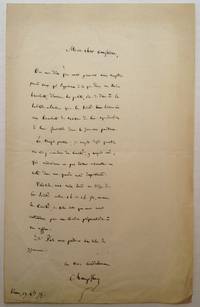
CHAMPFLEURY Jules Felix Fleury Husson 1820 1889
Autographed Letter Signed in French
Sevres France 1879. unbound. 1 page 8.25 x 5.25 inches Sevres France October 19 1879. Signed "Champfleury" by the novelist in tiny handwriting to an unnamed colleague hoping he can count on him to oppose certain Parisian journalists in part: ".Le temps presse; je compte deja quatre ou cinq membres du Comite y compris moi qui voudraient ne pas laisser escamoter un vote dans une question aussi importante." One horizontal fold; light creasing and toning at the edges. Very good- condition.<br/><br/> unknown books
Referentie van de boekhandelaar : 178838
|
|
|
CHAMPFLEURY Jules Fleury dit.
Histoire de la caricature Antique. Nouvelle édition, très augmentée.
Paris, E. Dentu, 1872. In-18, couverture orange imprimée et illustrée. XX pp (fx-titre, titre orné de vignettes, dédicace et préface) ; 332 pp plus page d'extrait du catalogue.
Referentie van de boekhandelaar : 20481
|
|
|
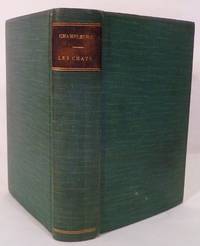
Champfleury Jules Francois Felix Fleury Husson
Les Chats; Histoire - Moeurs - Observations - Anecdotes - Illustre e 80 dessins par Eugene Delacroix Viollet-Le-duc Merimee Manet J.J. Grandville Prisse D'Avennes Ribot Kreutzberger Mind. Or'Sai Burbanck
Paris: J. Rothschild 1870. Fourth edition. Hardcover. Green cloth with beveled edges leather spine label printed in gilt. Very good. 332 pages. 18 x 12 cm. Inscribed and signed by Chamfleury on half title. Extra illustrated with 28 additional engravings etchings and woodcuts: some in color. Original wrappers bound-in. Interior contents fresh and clean small book label The author was an art critic and novelist a prominent supporter of the Realist movement in painting and fiction. CARTERET III 142. VICAIRE II 200. J. Rothschild hardcover books
Referentie van de boekhandelaar : 20455
|
|
|
CHAMPFLEURY, (Jules Fleury, dit. 1821-1889):
Contes de printemps. Les aventures de mademoiselle Mariette.
Paris, Victor Lecou, Libraire-Editeur, 1853, in-8vo, 8 ff. + 343 p., quelques p. non-rognée, reliure en demi-toile d’époque.
Referentie van de boekhandelaar : 55644aaf
|
|
|
CHAMPFLEURY, Jules Fleury dit.
Monsieur Tringle, avec une carte du théâtre des événements.
1866 Paris, E. Dentu, 1866 ; in-18 de (4) - XXII - 152pp. et 1 feuillet de carte en frontispice. reliure de pleine percaline vert bronze à la bradel, titre doré au dos sur étiquette de maroquin rouge, date dorée en pied, fleuron au centre du dos, garde et contre-plats de tabis à motif floral, tête rouge. Ex-libris étiquette aux initiales R.G., gravé par Devambez d'après un dessin de P. Collin,
Referentie van de boekhandelaar : 11941

|
|
|
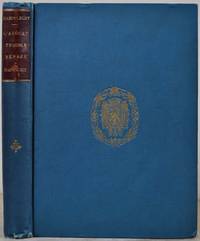
Champfleury; pseudonym of Jules Francois Felix Fleury Husson
Manuscrit de L'avocat trouble-menage. Original manuscript by Champfleury.
Paris France: No publisher 1867. Book. Very good condition. Hardcover. Signed by Authors. First Edition. Octavo 8vo. A bound volume containing over 120 manuscript leaves used by art critic and Realist novelist Jules François Felix Fleury-Husson to write the original manuscript for his work "l'avocat trouble-menage" under the pseudonym Champfleury. The paper is a wide variety of shapes sizes color etc. and was collected from many sources including Parisian exhibition catalogues. On the back of one sheet is a drawing of a cat. Bound in blue cloth with a leather spine label. Engraved armorial bookplate on the inside front cover "Vaillant et Veillant" and the bookplate of Jacques Dalyphard on the front endpaper. The inner front hinge is detached. No publisher Hardcover books
Referentie van de boekhandelaar : 017623
|
|
|
Changeux - Claus, Francoise/ Dietsch-Volkringer, Marie/ Fleury, Christian/ Humbert, Henriette/ Szwaja, Olivier
Histoire CM1-CM2 : Guide pédagogique 1Cédérom
Magnard 2017. Paperback. New. 240 pages. French language. 10.79x7.64x0.63 inches. Magnard paperback
Referentie van de boekhandelaar : 2-2210503337 ISBN : 2210503337 9782210503335
|
|
|
Changeux Françoise, Fleury Christian, Humbert H.
Histoire Cycle 3
Magnard. 2005. In-4. Broché. Bon état, Coins frottés, Dos satisfaisant, Intérieur frais. 208 pages. Nombreuses photos, illustrations et quelques cartes en noir et blanc et en couleurs, in texte. tampon en page de garde.. . . . Classification Dewey : 372.89-Livre scolaire : histoire / géographie
Referentie van de boekhandelaar : RO30353937

|
|
|
Charles FLEURY
L'idée johannique de la vie
Alençon: Félix Guy & Cie 1905. Fine. Félix Guy & Cie Alençon 1905 16.50 x 25.50 cm broché First edition. This is a thesis presented to the Protestant theological faculty of Paris. Worming to boards fine interior condition. Félix Guy & Cie hardcover
Referentie van de boekhandelaar : 4906

|
|
|
Charles FLEURY
L'idée johannique de la vie
Félix Guy & Cie | Alençon 1905 | 16.50 x 25.50 cm | broché
Referentie van de boekhandelaar : 4906
|
|
|
Charles Fleury
Précis de technologie mécanique à l'usage des Elèves des Ecoles Techniques et Professionnelles, des Contremaîtres et Ouvriers.
Paris, Dunot et Pinat, 1919, in-8, Demi-reliure, 545 pages. Bon état. Demi-reliure muette. Nombreuses illustrations NB
Referentie van de boekhandelaar : 17244

|
|
|
Charles Louis Fleury Panckoucke,
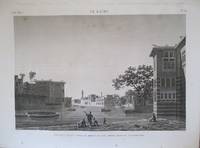
Birket-el-Fyl Cairo during the flood. " Vue de la Place Appelée Birket-el-Fyl prise pendant L'Inondation._Le Kaire
Middle East: Paris Impremerie de C.L.F.Pancoucke 1820-1829. Copper engraved view of the grand square of Birket-el-Fyl Cairo from the first volume of the "Etat Modene "of the "Description de l'Egypte" 2nd Edition; 1822; black & white; verso blank. Blind stamp of the publisher Panckoucke to margin. The view shows the square in a state of flood with boats upon the water. Good dark impression; some foxing to plate darker spots to lower margin; in the upper margin remains of glue from tissue guard outside the platemark. "Description de l'Egypte ou Recueil des observations et des recherches qui ont été faites en Egypte pendant l'expédition de l'armée française." When Napoleon Bonaparte invaded Egypt in 1798 he brought with him an entourage of more than 160 scholars and scientists. Known as the French Commission on the Sciences and Arts of Egypt these experts undertook an extensive survey of the country's archeology topography and natural history. . For four years more than 150 artists engineers linguists and scientists traveled throughout the country examining almost every aspect of ancient and contemporary Egypt. They recorded and measured in meticulous detail Egypt's topography flora and fauna and its ancient and contemporary architecture. A soldier who was part of the expedition found the famous Rosetta Stone which the French linguist and scholar Jean-François Champollion 1790-1832 later used to unlock many of the mysteries that long had surrounded the language of ancient Egypt. The Egyptian expedition ended with a total military failure. The French left Egypt in 1801 with the honors of war but defeated; yet military failure remains a significant event in the history of knowledge because it is the first time a military expedition was accompanied by a scientific expedition. In 1802 Napoleon authorized the publication of the commission's findings in a monumental multi-volume work that included plates maps scholarly essays and a detailed index. Publication of the original Imperial edition began in 1809 and continued to 1822 sold by subscription. It proved so popular that a second edition was published under the post-Napoleonic Bourbon Restoration. The "Royal edition" published in Paris by C.L.F. Panckoucke from 1820-1830. The Second edition consists of 11 or 12 volumes of plates in folio and 24 of text bound as 26 8vo. Brunet:II 617; Blackmer/Navari: 476 1st edition Middle East Egypt Cairo Birket-el-Fyl Paris Impremerie de C.L.F.Pancoucke 1820-1829 unknown
Referentie van de boekhandelaar : 1965
|
|
|
Charles Louis Fleury Panckoucke,
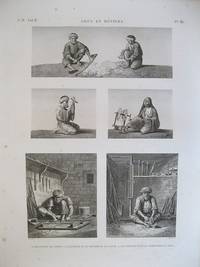
Cotton Comber. Wool Spinner. Wood Turner and Planer. "L'Arçonneur de Coton. Le Fileur et la Dévideuse de Laine. Le Tourneur et Le Serrurier en Bois
Trades Professions & the Arts: Paris Impremerie de C.L.F.Pancoucke 1820-1829. Copper engravings 5 on 1 plate showing a variety of trades from the second volume of "Etat Moderne" of the "Description de l'Egypte" 2nd Edition; black & white; verso blank. Blind stamp of the publisher Panckoucke to margin. The images show cotton being sorted and spun; the spinning of woolen thread; A wood turner using his foot to shape the wood on the lathe and the "serrurier" planing a block of wood. Good dark impression; some light spotting to margins; remains of glue and tissue guard to right margin. "Description de l'Egypte ou Recueil des observations et des recherches qui ont été faites en Egypte pendant l'expédition de l'armée française." When Napoleon Bonaparte invaded Egypt in 1798 he brought with him an entourage of more than 160 scholars and scientists. Known as the French Commission on the Sciences and Arts of Egypt these experts undertook an extensive survey of the country's archeology topography and natural history. . For four years more than 150 artists engineers linguists and scientists traveled throughout the country examining almost every aspect of ancient and contemporary Egypt. They recorded and measured in meticulous detail Egypt's topography flora and fauna and its ancient and contemporary architecture. A soldier who was part of the expedition found the famous Rosetta Stone which the French linguist and scholar Jean-François Champollion 1790-1832 later used to unlock many of the mysteries that long had surrounded the language of ancient Egypt. The Egyptian expedition ended with a total military failure. The French left Egypt in 1801 with the honors of war but defeated; yet military failure remains a significant event in the history of knowledge because it is the first time a military expedition was accompanied by a scientific expedition. In 1802 Napoleon authorized the publication of the commission's findings in a monumental multi-volume work that included plates maps scholarly essays and a detailed index. Publication of the original Imperial edition began in 1809 and continued to 1822 sold by subscription. It proved so popular that a second edition was published under the post-Napoleonic Bourbon Restoration. The "Royal edition" published in Paris by C.L.F. Panckoucke from 1820-1830. The Second edition consists of 11 or 12 volumes of plates in folio and 24 of text bound as 26 8vo. Brunet:II 617; Blackmer/Navari: 476 1st edition Trades Professions & the Arts Egypt Spinning Wood workers Paris Impremerie de C.L.F.Pancoucke 1820-1829 unknown
Referentie van de boekhandelaar : 1997
|
|
|
Charles Louis Fleury Panckoucke
Description De L'égypte: Ou Recueil Des Observations Et Des Recherches Qui Ont Été Faites En Égypte Pendant L'expédition De L'armée Française; Volume 17
Hardcover. New. New Book; Fast Shipping from UK; Not signed; Not First Edition; N/A hardcover
Referentie van de boekhandelaar : ria9781019663295_inp ISBN : 1019663294 9781019663295
|
|
|
Charles Louis Fleury Panckoucke
Description De L'égypte: Ou Recueil Des Observations Et Des Recherches Qui Ont Été Faites En Égypte Pendant L'expédition De L'armée Française; Volume 2
Hardcover. New. New Book; Fast Shipping from UK; Not signed; Not First Edition; N/A hardcover
Referentie van de boekhandelaar : ria9781019660133_inp ISBN : 1019660139 9781019660133
|
|
|
Charles Louis Fleury Panckoucke
Description De L'égypte: Ou Recueil Des Observations Et Des Recherches Qui Ont Été Faites En Égypte Pendant L'expédition De L'armée Française; Volume 15
Hardcover. New. New Book; Fast Shipping from UK; Not signed; Not First Edition; This work has been selected by scholars as being culturally important and is part of the knowledge base of civilization as we know it.This work is in the "public domain in the United States of America and possibly other nations. Withi hardcover
Referentie van de boekhandelaar : ria9781017369380_inp ISBN : 1017369380 9781017369380
|
|
|
Charles Louis Fleury Panckoucke
Description De L'égypte: Ou Recueil Des Observations Et Des Recherches Qui Ont Été Faites En Égypte Pendant L'expédition De L'armée Française; Volume 1
Hardcover. New. New Book; Fast Shipping from UK; Not signed; Not First Edition; This work has been selected by scholars as being culturally important and is part of the knowledge base of civilization as we know it.This work is in the "public domain in the United States of America and possibly other nations. Withi hardcover
Referentie van de boekhandelaar : ria9781019075623_inp ISBN : 1019075627 9781019075623
|
|
|
Charles Louis Fleury Panckoucke
Description De L'égypte: Ou Recueil Des Observations Et Des Recherches Qui Ont Été Faites En Égypte Pendant L'expédition De L'armée Française; Volume 1
like new. unknown
Referentie van de boekhandelaar : 45269406 ISBN : 1019082011 9781019082010
|
|
|
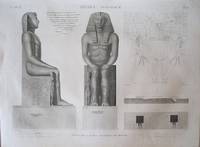
Charles Louis Fleury Panckoucke,
Details of a Colossal Statue of Memnon Thebes. "Details de la Statue Colossalle de Memnon_Thèbes Memnonium
Middle East: Paris Impremerie de C.L.F.Pancoucke 1820-1829. Copper engraving showing one of the Colossi of Mnemnon Thebes from the second volume of the "Antiquities "of the "Description de l'Egypte" 2nd Edition; black & white; verso blank. Blind stamp of the publisher Panckoucke to margin. The image shows the statue reconstructed from the front and side sides showing the Greek graffiti carved on the massive legs of the statue and on the sides of the pedestal; with a detail of the carving of the Nile god Hapy from the side of his throne. The statue depicts Amenhotep III fl. 14th century BC in a seated position his hands resting on his knees and his gaze facing eastwards towards the river. Two shorter figures are carved into the front throne alongside his legs: these are his wife Tiy and mother Mutemwiya. Good dark impression; generally clean a few very minor spots. "Description de l'Egypte ou Recueil des observations et des recherches qui ont été faites en Egypte pendant l'expédition de l'armée française." When Napoleon Bonaparte invaded Egypt in 1798 he brought with him an entourage of more than 160 scholars and scientists. Known as the French Commission on the Sciences and Arts of Egypt these experts undertook an extensive survey of the country's archeology topography and natural history. . For four years more than 150 artists engineers linguists and scientists traveled throughout the country examining almost every aspect of ancient and contemporary Egypt. They recorded and measured in meticulous detail Egypt's topography flora and fauna and its ancient and contemporary architecture. A soldier who was part of the expedition found the famous Rosetta Stone which the French linguist and scholar Jean-François Champollion 1790-1832 later used to unlock many of the mysteries that long had surrounded the language of ancient Egypt. The Egyptian expedition ended with a total military failure. The French left Egypt in 1801 with the honors of war but defeated; yet military failure remains a significant event in the history of knowledge because it is the first time a military expedition was accompanied by a scientific expedition. In 1802 Napoleon authorized the publication of the commission's findings in a monumental multi-volume work that included plates maps scholarly essays and a detailed index. Publication of the original Imperial edition began in 1809 and continued to 1822 sold by subscription. It proved so popular that a second edition was published under the post-Napoleonic Bourbon Restoration. The "Royal edition" published in Paris by C.L.F. Panckoucke from 1820-1830. The Second edition consists of 11 or 12 volumes of plates in folio and 24 of text bound as 26 8vo. Brunet:II 617; Blackmer/Navari: 476 1st edition Middle East Antiquities Colossi of Memnon Paris Impremerie de C.L.F.Pancoucke 1820-1829 unknown
Referentie van de boekhandelaar : 1977
|
|
|
Charles Louis Fleury Panckoucke,
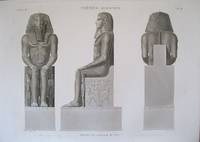
Details of the Southern Colossos of Memnon Thebes. "Details de Colosse du Sud_Thèbes Memnonium
Middle East: Paris Impremerie de C.L.F.Pancoucke 1820-1829. Copper engraving showing one of the Colossi of Mnemnon Thebes from the second volume of the "Antiquities "of the "Description de l'Egypte" 2nd Edition; black & white; verso blank. Blind stamp of the publisher Panckoucke to margin. The image shows the statue from three sides and in a reconstructed condition The statue depicts Amenhotep III fl. 14th century BC in a seated position his hands resting on his knees and his gaze facing eastwards towards the river. Two shorter figures are carved into the front throne alongside his legs: these are his wife Tiy and mother Mutemwiya. The side panels depict the Nile god Hapy. Good dark impression; generally clean a few very minor spots. "Description de l'Egypte ou Recueil des observations et des recherches qui ont été faites en Egypte pendant l'expédition de l'armée française." When Napoleon Bonaparte invaded Egypt in 1798 he brought with him an entourage of more than 160 scholars and scientists. Known as the French Commission on the Sciences and Arts of Egypt these experts undertook an extensive survey of the country's archeology topography and natural history. . For four years more than 150 artists engineers linguists and scientists traveled throughout the country examining almost every aspect of ancient and contemporary Egypt. They recorded and measured in meticulous detail Egypt's topography flora and fauna and its ancient and contemporary architecture. A soldier who was part of the expedition found the famous Rosetta Stone which the French linguist and scholar Jean-François Champollion 1790-1832 later used to unlock many of the mysteries that long had surrounded the language of ancient Egypt. The Egyptian expedition ended with a total military failure. The French left Egypt in 1801 with the honors of war but defeated; yet military failure remains a significant event in the history of knowledge because it is the first time a military expedition was accompanied by a scientific expedition. In 1802 Napoleon authorized the publication of the commission's findings in a monumental multi-volume work that included plates maps scholarly essays and a detailed index. Publication of the original Imperial edition began in 1809 and continued to 1822 sold by subscription. It proved so popular that a second edition was published under the post-Napoleonic Bourbon Restoration. The "Royal edition" published in Paris by C.L.F. Panckoucke from 1820-1830. The Second edition consists of 11 or 12 volumes of plates in folio and 24 of text bound as 26 8vo. Brunet:II 617; Blackmer/Navari: 476 1st edition Middle East Antiquities Colossi of Memnon Paris Impremerie de C.L.F.Pancoucke 1820-1829 unknown
Referentie van de boekhandelaar : 1976
|
|
|
Charles Louis Fleury Panckoucke,
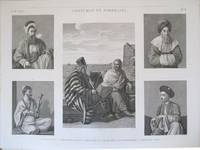
Emir Haggy. Inhabitants of the Oasis & Mount Sinai; Sheikh Sàdàt; The Violin Player; Inhabitant of Damascus. "L'Emir Hàggy. Habitants de l'Oasis et du Mont Sinaï. Cheykh Sàdàt. Le Joueur de Violon. Habitant de Damas
Middle East: Paris Impremerie de C.L.F.Pancoucke 1820-1829. Copper engravings 5 on 1 plate showing portraits and costumes from the second volume of "Etat Moderne" of the "Description de l'Egypte" 2nd Edition; black & white; verso blank. Blind stamp of the publisher Panckoucke to margin. The central image of two men by the seashore is surrounded by 4 smaller portaits Good dark impression; some light spotting to margins; remains of glue and tissue guard to right margin. The print is black and white. "Description de l'Egypte ou Recueil des observations et des recherches qui ont été faites en Egypte pendant l'expédition de l'armée française." When Napoleon Bonaparte invaded Egypt in 1798 he brought with him an entourage of more than 160 scholars and scientists. Known as the French Commission on the Sciences and Arts of Egypt these experts undertook an extensive survey of the country's archeology topography and natural history. . For four years more than 150 artists engineers linguists and scientists traveled throughout the country examining almost every aspect of ancient and contemporary Egypt. They recorded and measured in meticulous detail Egypt's topography flora and fauna and its ancient and contemporary architecture. A soldier who was part of the expedition found the famous Rosetta Stone which the French linguist and scholar Jean-François Champollion 1790-1832 later used to unlock many of the mysteries that long had surrounded the language of ancient Egypt. The Egyptian expedition ended with a total military failure. The French left Egypt in 1801 with the honors of war but defeated; yet military failure remains a significant event in the history of knowledge because it is the first time a military expedition was accompanied by a scientific expedition. In 1802 Napoleon authorized the publication of the commission's findings in a monumental multi-volume work that included plates maps scholarly essays and a detailed index. Publication of the original Imperial edition began in 1809 and continued to 1822 sold by subscription. It proved so popular that a second edition was published under the post-Napoleonic Bourbon Restoration. The "Royal edition" published in Paris by C.L.F. Panckoucke from 1820-1830. The Second edition consists of 11 or 12 volumes of plates in folio and 24 of text bound as 26 8vo. Brunet:II 617; Blackmer/Navari: 476 1st edition Middle East Egypt Costumes Paris Impremerie de C.L.F.Pancoucke 1820-1829 unknown
Referentie van de boekhandelaar : 1998
|
|
|
Charles Louis Fleury Panckoucke Martial
Epigrammes de M. Val. Martial Vol. 3 Classic Reprint French Edition
hardcover. Good. Access codes and supplements are not guaranteed with used items. May be an ex-library book. hardcover
Referentie van de boekhandelaar : 0267163932.G ISBN : 0267163932 9780267163939

|
|
|
Charles Louis Fleury Panckoucke Martial
Epigrammes de M. Val. Martial Vol. 3 Classic Reprint French Edition
paperback. Good. Access codes and supplements are not guaranteed with used items. May be an ex-library book. paperback
Referentie van de boekhandelaar : 0259120987.G ISBN : 0259120987 9780259120988

|
|
|
Charles Louis Fleury Panckoucke,
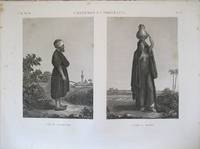
Groom. Woman of the People "Sàys ou Palefrenier. Femme du Peuple
Middle East: Paris Impremerie de C.L.F.Pancoucke 1820-1829. Copper engravings 2 on 1 plate showing costumes from the second volume of "Etat Moderne" of the "Description de l'Egypte" 2nd Edition; black & white; verso blank. Blind stamp of the publisher Panckoucke to margin. The images show the grooms tanding in the countryside; the woman with a water jar on her head stands on the edge of the desert with the Pyramids in the background. Good dark impression; some light spotting to margins; remains of glue and tissue guard to right margin. "Description de l'Egypte ou Recueil des observations et des recherches qui ont été faites en Egypte pendant l'expédition de l'armée française." When Napoleon Bonaparte invaded Egypt in 1798 he brought with him an entourage of more than 160 scholars and scientists. Known as the French Commission on the Sciences and Arts of Egypt these experts undertook an extensive survey of the country's archeology topography and natural history. . For four years more than 150 artists engineers linguists and scientists traveled throughout the country examining almost every aspect of ancient and contemporary Egypt. They recorded and measured in meticulous detail Egypt's topography flora and fauna and its ancient and contemporary architecture. A soldier who was part of the expedition found the famous Rosetta Stone which the French linguist and scholar Jean-François Champollion 1790-1832 later used to unlock many of the mysteries that long had surrounded the language of ancient Egypt. The Egyptian expedition ended with a total military failure. The French left Egypt in 1801 with the honors of war but defeated; yet military failure remains a significant event in the history of knowledge because it is the first time a military expedition was accompanied by a scientific expedition. In 1802 Napoleon authorized the publication of the commission's findings in a monumental multi-volume work that included plates maps scholarly essays and a detailed index. Publication of the original Imperial edition began in 1809 and continued to 1822 sold by subscription. It proved so popular that a second edition was published under the post-Napoleonic Bourbon Restoration. The "Royal edition" published in Paris by C.L.F. Panckoucke from 1820-1830. The Second edition consists of 11 or 12 volumes of plates in folio and 24 of text bound as 26 8vo. Brunet:II 617; Blackmer/Navari: 476 1st edition Middle East Egypt Costumes Paris Impremerie de C.L.F.Pancoucke 1820-1829 unknown
Referentie van de boekhandelaar : 1999
|
|
|
Charles Louis Fleury Panckoucke
La Germanie
paperback. Good. Access codes and supplements are not guaranteed with used items. May be an ex-library book. paperback
Referentie van de boekhandelaar : 0282521909.G ISBN : 0282521909 9780282521905

|
|
|
Charles Louis Fleury Panckoucke,
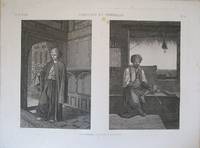
Marmeluke & Sailor of Alexandria. "Le Mamlouk. Le Marin d'Alexandrie
Middle East: Paris Impremerie de C.L.F.Pancoucke 1820-1829. Copper engravings 2 on 1 plate showing costumes from the second volume of "Etat Moderne" of the "Description de l'Egypte" 2nd Edition; black & white; verso blank. Blind stamp of the publisher Panckoucke to margin. The images show the marmeluke standing inside a richly decorated house; the Sailor sits in a simple seaside house; they are both smoking chibouques Good dark impression; some light spotting to margins; remains of glue and tissue guard to right margin. "Description de l'Egypte ou Recueil des observations et des recherches qui ont été faites en Egypte pendant l'expédition de l'armée française." When Napoleon Bonaparte invaded Egypt in 1798 he brought with him an entourage of more than 160 scholars and scientists. Known as the French Commission on the Sciences and Arts of Egypt these experts undertook an extensive survey of the country's archeology topography and natural history. . For four years more than 150 artists engineers linguists and scientists traveled throughout the country examining almost every aspect of ancient and contemporary Egypt. They recorded and measured in meticulous detail Egypt's topography flora and fauna and its ancient and contemporary architecture. A soldier who was part of the expedition found the famous Rosetta Stone which the French linguist and scholar Jean-François Champollion 1790-1832 later used to unlock many of the mysteries that long had surrounded the language of ancient Egypt. The Egyptian expedition ended with a total military failure. The French left Egypt in 1801 with the honors of war but defeated; yet military failure remains a significant event in the history of knowledge because it is the first time a military expedition was accompanied by a scientific expedition. In 1802 Napoleon authorized the publication of the commission's findings in a monumental multi-volume work that included plates maps scholarly essays and a detailed index. Publication of the original Imperial edition began in 1809 and continued to 1822 sold by subscription. It proved so popular that a second edition was published under the post-Napoleonic Bourbon Restoration. The "Royal edition" published in Paris by C.L.F. Panckoucke from 1820-1830. The Second edition consists of 11 or 12 volumes of plates in folio and 24 of text bound as 26 8vo. Brunet:II 617; Blackmer/Navari: 476 1st edition Middle East Egypt Costumes Paris Impremerie de C.L.F.Pancoucke 1820-1829 unknown
Referentie van de boekhandelaar : 2000
|
|
|
Charles Louis Fleury Panckoucke,
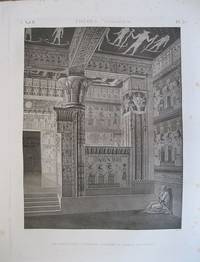
Perspective view of the Painted Interior of the West Temple of the Memnonium Thebes "Vue Perspective Intérieure Coloriée de Temple de L'ouestThèbes
Middle East: Paris Impremerie de C.L.F.Pancoucke 1820-1829. Copper engraved view of the painted interior of the temple of Mnemnon Thebes from the third volume of the "Antiquities "of the "Description de l'Egypte" 2nd Edition; black & white; verso blank. Blind stamp of the publisher Panckoucke to margin. The view shows the highly decorated interior of the palace and temple of Remeses II. erroneously called the Memnonium. Good dark impression; some light foxing mainly to margins. "Description de l'Egypte ou Recueil des observations et des recherches qui ont été faites en Egypte pendant l'expédition de l'armée française." When Napoleon Bonaparte invaded Egypt in 1798 he brought with him an entourage of more than 160 scholars and scientists. Known as the French Commission on the Sciences and Arts of Egypt these experts undertook an extensive survey of the country's archeology topography and natural history. . For four years more than 150 artists engineers linguists and scientists traveled throughout the country examining almost every aspect of ancient and contemporary Egypt. They recorded and measured in meticulous detail Egypt's topography flora and fauna and its ancient and contemporary architecture. A soldier who was part of the expedition found the famous Rosetta Stone which the French linguist and scholar Jean-François Champollion 1790-1832 later used to unlock many of the mysteries that long had surrounded the language of ancient Egypt. The Egyptian expedition ended with a total military failure. The French left Egypt in 1801 with the honors of war but defeated; yet military failure remains a significant event in the history of knowledge because it is the first time a military expedition was accompanied by a scientific expedition. In 1802 Napoleon authorized the publication of the commission's findings in a monumental multi-volume work that included plates maps scholarly essays and a detailed index. Publication of the original Imperial edition began in 1809 and continued to 1822 sold by subscription. It proved so popular that a second edition was published under the post-Napoleonic Bourbon Restoration. The "Royal edition" published in Paris by C.L.F. Panckoucke from 1820-1830. The Second edition consists of 11 or 12 volumes of plates in folio and 24 of text bound as 26 8vo. Brunet:II 617; Blackmer/Navari: 476 1st edition Middle East Egypt Memnonium. Thebes Paris Impremerie de C.L.F.Pancoucke 1820-1829 unknown
Referentie van de boekhandelaar : 1975
|
|
|
Charles Louis Fleury Panckoucke,
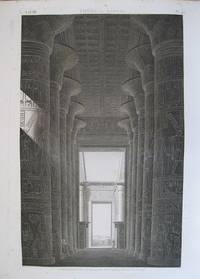
Perspective view of the interior of the Palace looking East _ Karnak Thebes. "Vue Perspective Intérieure du palais prise de l'Est du palais_ Thèbes.Karnak
Middle East: Paris Impremerie de C.L.F.Pancoucke 1820-1829. Copper engraved view view of the great hypostyle hall in the Precinct of Amun Re Karnak Thebes from the third volume of the "Antiquities "of the "Description de l'Egypte" 2nd Edition; black & white; verso blank. Blind stamp of the publisher Panckoucke to margin. The view shows the great hypostyle hall in the Precinct of Amun Re with the massive carved columns. Good dark impression; some light foxing. "Description de l'Egypte ou Recueil des observations et des recherches qui ont été faites en Egypte pendant l'expédition de l'armée française." When Napoleon Bonaparte invaded Egypt in 1798 he brought with him an entourage of more than 160 scholars and scientists. Known as the French Commission on the Sciences and Arts of Egypt these experts undertook an extensive survey of the country's archeology topography and natural history. . For four years more than 150 artists engineers linguists and scientists traveled throughout the country examining almost every aspect of ancient and contemporary Egypt. They recorded and measured in meticulous detail Egypt's topography flora and fauna and its ancient and contemporary architecture. A soldier who was part of the expedition found the famous Rosetta Stone which the French linguist and scholar Jean-François Champollion 1790-1832 later used to unlock many of the mysteries that long had surrounded the language of ancient Egypt. The Egyptian expedition ended with a total military failure. The French left Egypt in 1801 with the honors of war but defeated; yet military failure remains a significant event in the history of knowledge because it is the first time a military expedition was accompanied by a scientific expedition. In 1802 Napoleon authorized the publication of the commission's findings in a monumental multi-volume work that included plates maps scholarly essays and a detailed index. Publication of the original Imperial edition began in 1809 and continued to 1822 sold by subscription. It proved so popular that a second edition was published under the post-Napoleonic Bourbon Restoration. The "Royal edition" published in Paris by C.L.F. Panckoucke from 1820-1830. The Second edition consists of 11 or 12 volumes of plates in folio and 24 of text bound as 26 8vo. Brunet:II 617; Blackmer/Navari: 476 1st edition Middle East Egypt Karnak Thebes Paris Impremerie de C.L.F.Pancoucke 1820-1829 unknown
Referentie van de boekhandelaar : 1974
|
|
|
Charles Louis Fleury Panckoucke,
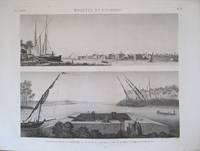
Rosetta and Environs; View of the Townof Rosette and the island of Farchel. View of the entrance of the Nile. "Vue de la Ville rosette et de l'Isle de Farchel"; "Vue du Boghâz ou Embouchure du Nil
Middle East: Paris Impremerie de C.L.F.Pancoucke 1820-1829. 2 copper engraved views on 1 plate: View of the port town of Rosetta Rashid & a view of the fort at the entrance to the Nile from the first volume of the "Etat Modene "of the "Description de l'Egypte" 2nd Edition; 1822; black & white; verso blank. Blind stamp of the publisher Panckoucke to margin. The upper view shows the town of Rosetta on the banks of the Nile near which the Rosetta stone was found. The lower view shows the fort at the entrance to the Nile from above the battery. Good dark impression; some light foxing. "Description de l'Egypte ou Recueil des observations et des recherches qui ont été faites en Egypte pendant l'expédition de l'armée française." When Napoleon Bonaparte invaded Egypt in 1798 he brought with him an entourage of more than 160 scholars and scientists. Known as the French Commission on the Sciences and Arts of Egypt these experts undertook an extensive survey of the country's archeology topography and natural history. . For four years more than 150 artists engineers linguists and scientists traveled throughout the country examining almost every aspect of ancient and contemporary Egypt. They recorded and measured in meticulous detail Egypt's topography flora and fauna and its ancient and contemporary architecture. A soldier who was part of the expedition found the famous Rosetta Stone which the French linguist and scholar Jean-François Champollion 1790-1832 later used to unlock many of the mysteries that long had surrounded the language of ancient Egypt. The Egyptian expedition ended with a total military failure. The French left Egypt in 1801 with the honors of war but defeated; yet military failure remains a significant event in the history of knowledge because it is the first time a military expedition was accompanied by a scientific expedition. In 1802 Napoleon authorized the publication of the commission's findings in a monumental multi-volume work that included plates maps scholarly essays and a detailed index. Publication of the original Imperial edition began in 1809 and continued to 1822 sold by subscription. It proved so popular that a second edition was published under the post-Napoleonic Bourbon Restoration. The "Royal edition" published in Paris by C.L.F. Panckoucke from 1820-1830. The Second edition consists of 11 or 12 volumes of plates in folio and 24 of text bound as 26 8vo. Brunet:II 617; Blackmer/Navari: 476 1st edition Middle East Egypt Rosetta Rosette Rashid Farchel Paris Impremerie de C.L.F.Pancoucke 1820-1829 unknown
Referentie van de boekhandelaar : 1972
|
|
|
Charles Louis Fleury Panckoucke,
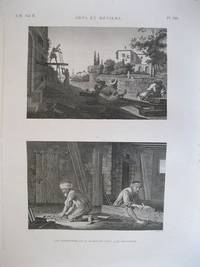
The Carpenter and Sawyer. The Joiner. "Le Charentier et le Scieur de Long. Le Menuisier
Trades Professions & the Arts: Paris Impremerie de C.L.F.Pancoucke 1820-1829. Copper engravings 2 on 1 plate showing the trades of carpenter with a sawyer and joiner from the second volume of "Etat Moderne" of the "Description de l'Egypte" 2nd Edition; black & white; verso blank. Blind stamp of the publisher Panckoucke to margin. Good dark impression; some light spotting to extreme left margin; remains of glue and tissue guard to right margin. "Description de l'Egypte ou Recueil des observations et des recherches qui ont été faites en Egypte pendant l'expédition de l'armée française." When Napoleon Bonaparte invaded Egypt in 1798 he brought with him an entourage of more than 160 scholars and scientists. Known as the French Commission on the Sciences and Arts of Egypt these experts undertook an extensive survey of the country's archeology topography and natural history. . For four years more than 150 artists engineers linguists and scientists traveled throughout the country examining almost every aspect of ancient and contemporary Egypt. They recorded and measured in meticulous detail Egypt's topography flora and fauna and its ancient and contemporary architecture. A soldier who was part of the expedition found the famous Rosetta Stone which the French linguist and scholar Jean-François Champollion 1790-1832 later used to unlock many of the mysteries that long had surrounded the language of ancient Egypt. The Egyptian expedition ended with a total military failure. The French left Egypt in 1801 with the honors of war but defeated; yet military failure remains a significant event in the history of knowledge because it is the first time a military expedition was accompanied by a scientific expedition. In 1802 Napoleon authorized the publication of the commission's findings in a monumental multi-volume work that included plates maps scholarly essays and a detailed index. Publication of the original Imperial edition began in 1809 and continued to 1822 sold by subscription. It proved so popular that a second edition was published under the post-Napoleonic Bourbon Restoration. The "Royal edition" published in Paris by C.L.F. Panckoucke from 1820-1830. The Second edition consists of 11 or 12 volumes of plates in folio and 24 of text bound as 26 8vo. Brunet:II 617; Blackmer/Navari: 476 1st edition Trades Professions & the Arts Egypt Carpenter Sawyer Joiner Paris Impremerie de C.L.F.Pancoucke 1820-1829 unknown
Referentie van de boekhandelaar : 1992
|
|
|
Charles Louis Fleury Panckoucke,
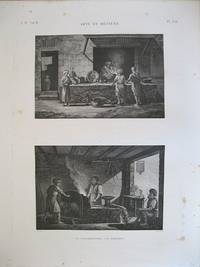
The Coppermith. The Blacksmith. "Le Chaudronnier. Le Forgeron
Trades Professions & the Arts: Paris Impremerie de C.L.F.Pancoucke 1820-1829. Copper engravings 2 on 1 plate showing the trades of coppersmith and blacksmith from the second volume of "Etat Moderne" of the "Description de l'Egypte" 2nd Edition; black & white; verso blank. Blind stamp of the publisher Panckoucke to margin. The images show the coppersmith's workshop as he makes a bowl and the interior of the blacksmith's forge. Good dark impression; some spotting to margins; remains of glue and tissue guard to right margin. "Description de l'Egypte ou Recueil des observations et des recherches qui ont été faites en Egypte pendant l'expédition de l'armée française." When Napoleon Bonaparte invaded Egypt in 1798 he brought with him an entourage of more than 160 scholars and scientists. Known as the French Commission on the Sciences and Arts of Egypt these experts undertook an extensive survey of the country's archeology topography and natural history. . For four years more than 150 artists engineers linguists and scientists traveled throughout the country examining almost every aspect of ancient and contemporary Egypt. They recorded and measured in meticulous detail Egypt's topography flora and fauna and its ancient and contemporary architecture. A soldier who was part of the expedition found the famous Rosetta Stone which the French linguist and scholar Jean-François Champollion 1790-1832 later used to unlock many of the mysteries that long had surrounded the language of ancient Egypt. The Egyptian expedition ended with a total military failure. The French left Egypt in 1801 with the honors of war but defeated; yet military failure remains a significant event in the history of knowledge because it is the first time a military expedition was accompanied by a scientific expedition. In 1802 Napoleon authorized the publication of the commission's findings in a monumental multi-volume work that included plates maps scholarly essays and a detailed index. Publication of the original Imperial edition began in 1809 and continued to 1822 sold by subscription. It proved so popular that a second edition was published under the post-Napoleonic Bourbon Restoration. The "Royal edition" published in Paris by C.L.F. Panckoucke from 1820-1830. The Second edition consists of 11 or 12 volumes of plates in folio and 24 of text bound as 26 8vo. Brunet:II 617; Blackmer/Navari: 476 1st edition Trades Professions & the Arts Egypt Coppersmith Blacksmith Paris Impremerie de C.L.F.Pancoucke 1820-1829 unknown
Referentie van de boekhandelaar : 1995
|
|
|
Charles Louis Fleury Panckoucke,
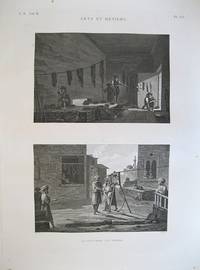
The Dyer. The Rope Maker "Le Teinturier. Le Cordier
Trades Professions & the Arts: Paris Impremerie de C.L.F.Pancoucke 1820-1829. Copper engravings 2 on 1 plate showing the trades of dyer & rope maker from the second volume of "Etat Moderne" of the "Description de l'Egypte" 2nd Edition; black & white; verso blank. Blind stamp of the publisher Panckoucke to margin. Good dark impression; a few spots to extreme margins; remains of glue and tissue guard to right margin. "Description de l'Egypte ou Recueil des observations et des recherches qui ont été faites en Egypte pendant l'expédition de l'armée française." When Napoleon Bonaparte invaded Egypt in 1798 he brought with him an entourage of more than 160 scholars and scientists. Known as the French Commission on the Sciences and Arts of Egypt these experts undertook an extensive survey of the country's archeology topography and natural history. . For four years more than 150 artists engineers linguists and scientists traveled throughout the country examining almost every aspect of ancient and contemporary Egypt. They recorded and measured in meticulous detail Egypt's topography flora and fauna and its ancient and contemporary architecture. A soldier who was part of the expedition found the famous Rosetta Stone which the French linguist and scholar Jean-François Champollion 1790-1832 later used to unlock many of the mysteries that long had surrounded the language of ancient Egypt. The Egyptian expedition ended with a total military failure. The French left Egypt in 1801 with the honors of war but defeated; yet military failure remains a significant event in the history of knowledge because it is the first time a military expedition was accompanied by a scientific expedition. In 1802 Napoleon authorized the publication of the commission's findings in a monumental multi-volume work that included plates maps scholarly essays and a detailed index. Publication of the original Imperial edition began in 1809 and continued to 1822 sold by subscription. It proved so popular that a second edition was published under the post-Napoleonic Bourbon Restoration. The "Royal edition" published in Paris by C.L.F. Panckoucke from 1820-1830. The Second edition consists of 11 or 12 volumes of plates in folio and 24 of text bound as 26 8vo. Brunet:II 617; Blackmer/Navari: 476 1st edition Trades Professions & the Arts Egypt Dyer Rope Maker Paris Impremerie de C.L.F.Pancoucke 1820-1829 unknown
Referentie van de boekhandelaar : 1993
|
|
|
Charles Louis Fleury Panckoucke,
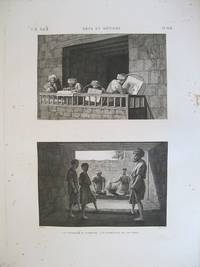
The Embroiderer. The Felt Maker. "Le Brodeur au tambour. Le Fabricant de Feutres
Trades Professions & the Arts: Paris Impremerie de C.L.F.Pancoucke 1820-1829. Copper engravings 2 on 1 plate showing the trades of embroiderer & the felt maker from the second volume of "Etat Moderne" of the "Description de l'Egypte" 2nd Edition; black & white; verso blank. Blind stamp of the publisher Panckoucke to margin. Good dark impression; spotting to margins; remains of glue and tissue guard to right margin. "Description de l'Egypte ou Recueil des observations et des recherches qui ont été faites en Egypte pendant l'expédition de l'armée française." When Napoleon Bonaparte invaded Egypt in 1798 he brought with him an entourage of more than 160 scholars and scientists. Known as the French Commission on the Sciences and Arts of Egypt these experts undertook an extensive survey of the country's archeology topography and natural history. . For four years more than 150 artists engineers linguists and scientists traveled throughout the country examining almost every aspect of ancient and contemporary Egypt. They recorded and measured in meticulous detail Egypt's topography flora and fauna and its ancient and contemporary architecture. A soldier who was part of the expedition found the famous Rosetta Stone which the French linguist and scholar Jean-François Champollion 1790-1832 later used to unlock many of the mysteries that long had surrounded the language of ancient Egypt. The Egyptian expedition ended with a total military failure. The French left Egypt in 1801 with the honors of war but defeated; yet military failure remains a significant event in the history of knowledge because it is the first time a military expedition was accompanied by a scientific expedition. In 1802 Napoleon authorized the publication of the commission's findings in a monumental multi-volume work that included plates maps scholarly essays and a detailed index. Publication of the original Imperial edition began in 1809 and continued to 1822 sold by subscription. It proved so popular that a second edition was published under the post-Napoleonic Bourbon Restoration. The "Royal edition" published in Paris by C.L.F. Panckoucke from 1820-1830. The Second edition consists of 11 or 12 volumes of plates in folio and 24 of text bound as 26 8vo. Brunet:II 617; Blackmer/Navari: 476 1st edition Trades Professions & the Arts Egypt Embroiderer Felt Maker Paris Impremerie de C.L.F.Pancoucke 1820-1829 unknown
Referentie van de boekhandelaar : 1994
|
|
|
Charles Louis Fleury Panckoucke,
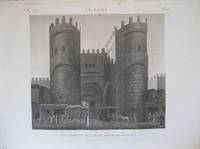
The Gate called Bâb el Nasr. "Vue Perspective de la Porte Appelée Bâb el Nasr._Le Kaire
Middle East: Paris Impremerie de C.L.F.Pancoucke 1820-1829. Copper engraved view of one of the gateways to Cairo from the first volume of the "Etat Modene "of the "Description de l'Egypte" 2nd Edition; 1822; black & white; verso blank. Blind stamp of the publisher Panckoucke to margin. Good dark impression; a few some spotting mainly to margins but also a few in image. "Description de l'Egypte ou Recueil des observations et des recherches qui ont été faites en Egypte pendant l'expédition de l'armée française." When Napoleon Bonaparte invaded Egypt in 1798 he brought with him an entourage of more than 160 scholars and scientists. Known as the French Commission on the Sciences and Arts of Egypt these experts undertook an extensive survey of the country's archeology topography and natural history. . For four years more than 150 artists engineers linguists and scientists traveled throughout the country examining almost every aspect of ancient and contemporary Egypt. They recorded and measured in meticulous detail Egypt's topography flora and fauna and its ancient and contemporary architecture. A soldier who was part of the expedition found the famous Rosetta Stone which the French linguist and scholar Jean-François Champollion 1790-1832 later used to unlock many of the mysteries that long had surrounded the language of ancient Egypt. The Egyptian expedition ended with a total military failure. The French left Egypt in 1801 with the honors of war but defeated; yet military failure remains a significant event in the history of knowledge because it is the first time a military expedition was accompanied by a scientific expedition. In 1802 Napoleon authorized the publication of the commission's findings in a monumental multi-volume work that included plates maps scholarly essays and a detailed index. Publication of the original Imperial edition began in 1809 and continued to 1822 sold by subscription. It proved so popular that a second edition was published under the post-Napoleonic Bourbon Restoration. The "Royal edition" published in Paris by C.L.F. Panckoucke from 1820-1830. The Second edition consists of 11 or 12 volumes of plates in folio and 24 of text bound as 26 8vo. Brunet:II 617; Blackmer/Navari: 476 1st edition Middle East Egypt Cairo Paris Impremerie de C.L.F.Pancoucke 1820-1829 unknown
Referentie van de boekhandelaar : 1964
|
|
|
Charles Louis Fleury Panckoucke,
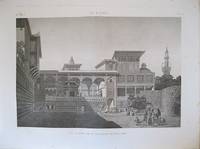
The interior of the house of Osman Bey Cairo. "Vue intérieure de la Maison d'Osman Bey._Le Kaire
Middle East: Paris Impremerie de C.L.F.Pancoucke 1820-1829. Copper engraved view of the interior of a noble Egyptian house Cairo from the first volume of the "Etat Modene "of the "Description de l'Egypte" 2nd Edition; 1822; black & white; verso blank. Blind stamp of the publisher Panckoucke to margin. The view shows the courtyard of the house belonging to Osman Bey Visitors arrive on horse and camel and are ushered up to an audience with the Bey. The view shows the ornate decoration of the house with a minaret in the background. Good dark impression; some foxing mainly to blank margins. "Description de l'Egypte ou Recueil des observations et des recherches qui ont été faites en Egypte pendant l'expédition de l'armée française." When Napoleon Bonaparte invaded Egypt in 1798 he brought with him an entourage of more than 160 scholars and scientists. Known as the French Commission on the Sciences and Arts of Egypt these experts undertook an extensive survey of the country's archeology topography and natural history. . For four years more than 150 artists engineers linguists and scientists traveled throughout the country examining almost every aspect of ancient and contemporary Egypt. They recorded and measured in meticulous detail Egypt's topography flora and fauna and its ancient and contemporary architecture. A soldier who was part of the expedition found the famous Rosetta Stone which the French linguist and scholar Jean-François Champollion 1790-1832 later used to unlock many of the mysteries that long had surrounded the language of ancient Egypt. The Egyptian expedition ended with a total military failure. The French left Egypt in 1801 with the honors of war but defeated; yet military failure remains a significant event in the history of knowledge because it is the first time a military expedition was accompanied by a scientific expedition. In 1802 Napoleon authorized the publication of the commission's findings in a monumental multi-volume work that included plates maps scholarly essays and a detailed index. Publication of the original Imperial edition began in 1809 and continued to 1822 sold by subscription. It proved so popular that a second edition was published under the post-Napoleonic Bourbon Restoration. The "Royal edition" published in Paris by C.L.F. Panckoucke from 1820-1830. The Second edition consists of 11 or 12 volumes of plates in folio and 24 of text bound as 26 8vo. Brunet:II 617; Blackmer/Navari: 476 1st edition Middle East Egypt Cairo House of Osman Bey Paris Impremerie de C.L.F.Pancoucke 1820-1829 unknown
Referentie van de boekhandelaar : 1967
|
|
|
Charles Louis Fleury Panckoucke,
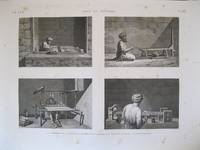
The Lacemaker. The Cordmaker. The Weaver of Woolen Fabrics. The Belt Weaver "Le Passementier Le Faiseur de Cordonnets. Le Fabricant d'Éoffes de Laine. Le Ceinturonnier
Trades Professions & the Arts: Paris Impremerie de C.L.F.Pancoucke 1820-1829. Copper engravings 4 on 1 plate showing the trades of lacemaker cord maker wool weaver and belt maker from the second volume of "Etat Moderne" of the "Description de l'Egypte" 2nd Edition; black & white; verso blank. Blind stamp of the publisher Panckoucke to margin. The images show the workshops of the various trades: all the trades use a kind of loom. Good dark impression; generally clean; some spotting to margins; remains of glue and tissue guard to upper margin. "Description de l'Egypte ou Recueil des observations et des recherches qui ont été faites en Egypte pendant l'expédition de l'armée française." When Napoleon Bonaparte invaded Egypt in 1798 he brought with him an entourage of more than 160 scholars and scientists. Known as the French Commission on the Sciences and Arts of Egypt these experts undertook an extensive survey of the country's archeology topography and natural history. . For four years more than 150 artists engineers linguists and scientists traveled throughout the country examining almost every aspect of ancient and contemporary Egypt. They recorded and measured in meticulous detail Egypt's topography flora and fauna and its ancient and contemporary architecture. A soldier who was part of the expedition found the famous Rosetta Stone which the French linguist and scholar Jean-François Champollion 1790-1832 later used to unlock many of the mysteries that long had surrounded the language of ancient Egypt. The Egyptian expedition ended with a total military failure. The French left Egypt in 1801 with the honors of war but defeated; yet military failure remains a significant event in the history of knowledge because it is the first time a military expedition was accompanied by a scientific expedition. In 1802 Napoleon authorized the publication of the commission's findings in a monumental multi-volume work that included plates maps scholarly essays and a detailed index. Publication of the original Imperial edition began in 1809 and continued to 1822 sold by subscription. It proved so popular that a second edition was published under the post-Napoleonic Bourbon Restoration. The "Royal edition" published in Paris by C.L.F. Panckoucke from 1820-1830. The Second edition consists of 11 or 12 volumes of plates in folio and 24 of text bound as 26 8vo. Brunet:II 617; Blackmer/Navari: 476 1st edition Trades Professions & the Arts Egypt Lacemaker Weaver of wool Cordmaker beltmaker Paris Impremerie de C.L.F.Pancoucke 1820-1829 unknown
Referentie van de boekhandelaar : 1987
|
|

 De zoekresultaten per email ontvangen
 Zoekresultaten downloaden als PDF
 RSS feed
 Permanente link


