|
Charles Louis Fleury Panckoucke,
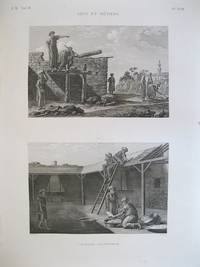
The Mason. The Roofer. "Le Maçon. Le Couvreur
Trades Professions & the Arts: Paris Impremerie de C.L.F.Pancoucke 1820-1829. Copper engravings 2 on 1 plate showing the trades of builder and roofer from the second volume of "Etat Moderne" of the "Description de l'Egypte" 2nd Edition; black & white; verso blank. Blind stamp of the publisher Panckoucke to margin. Good dark impression; some light spotting to extreme left margin; remains of glue and tissue guard to right margin. "Description de l'Egypte ou Recueil des observations et des recherches qui ont été faites en Egypte pendant l'expédition de l'armée française." When Napoleon Bonaparte invaded Egypt in 1798 he brought with him an entourage of more than 160 scholars and scientists. Known as the French Commission on the Sciences and Arts of Egypt these experts undertook an extensive survey of the country's archeology topography and natural history. . For four years more than 150 artists engineers linguists and scientists traveled throughout the country examining almost every aspect of ancient and contemporary Egypt. They recorded and measured in meticulous detail Egypt's topography flora and fauna and its ancient and contemporary architecture. A soldier who was part of the expedition found the famous Rosetta Stone which the French linguist and scholar Jean-François Champollion 1790-1832 later used to unlock many of the mysteries that long had surrounded the language of ancient Egypt. The Egyptian expedition ended with a total military failure. The French left Egypt in 1801 with the honors of war but defeated; yet military failure remains a significant event in the history of knowledge because it is the first time a military expedition was accompanied by a scientific expedition. In 1802 Napoleon authorized the publication of the commission's findings in a monumental multi-volume work that included plates maps scholarly essays and a detailed index. Publication of the original Imperial edition began in 1809 and continued to 1822 sold by subscription. It proved so popular that a second edition was published under the post-Napoleonic Bourbon Restoration. The "Royal edition" published in Paris by C.L.F. Panckoucke from 1820-1830. The Second edition consists of 11 or 12 volumes of plates in folio and 24 of text bound as 26 8vo. Brunet:II 617; Blackmer/Navari: 476 1st edition Trades Professions & the Arts Egypt Builder Mason Roofer Paris Impremerie de C.L.F.Pancoucke 1820-1829 unknown
Referentie van de boekhandelaar : 1991
|
|
|
Charles Louis Fleury Panckoucke,
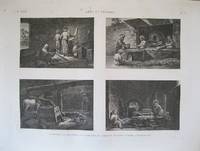
The Miller. The Baker. The Patstry Chef. The Confectioner. "Le Meunier. Le Boulanger. Le Confiseur ou Fabricant de Pâtes Sucrées. Le Patissier
Trades Professions & the Arts: Paris Impremerie de C.L.F.Pancoucke 1820-1829. Copper engravings 4 on 1 plate showing the trades of miller baker pastry chef & confectioner from the second volume of "Etat Moderne" of the "Description de l'Egypte" 2nd Edition; black & white; verso blank. Blind stamp of the publisher Panckoucke to margin. The images show the workshops of the various trades: the miller grinding flour; the Baker placing loaves in the oven; the confectioner cutting and pulling sugar; the pastry chef baking above a fire. Good dark impression; generally clean; some spotting to margins; remains of glue and tissue guard to upper margin. "Description de l'Egypte ou Recueil des observations et des recherches qui ont été faites en Egypte pendant l'expédition de l'armée française." When Napoleon Bonaparte invaded Egypt in 1798 he brought with him an entourage of more than 160 scholars and scientists. Known as the French Commission on the Sciences and Arts of Egypt these experts undertook an extensive survey of the country's archeology topography and natural history. . For four years more than 150 artists engineers linguists and scientists traveled throughout the country examining almost every aspect of ancient and contemporary Egypt. They recorded and measured in meticulous detail Egypt's topography flora and fauna and its ancient and contemporary architecture. A soldier who was part of the expedition found the famous Rosetta Stone which the French linguist and scholar Jean-François Champollion 1790-1832 later used to unlock many of the mysteries that long had surrounded the language of ancient Egypt. The Egyptian expedition ended with a total military failure. The French left Egypt in 1801 with the honors of war but defeated; yet military failure remains a significant event in the history of knowledge because it is the first time a military expedition was accompanied by a scientific expedition. In 1802 Napoleon authorized the publication of the commission's findings in a monumental multi-volume work that included plates maps scholarly essays and a detailed index. Publication of the original Imperial edition began in 1809 and continued to 1822 sold by subscription. It proved so popular that a second edition was published under the post-Napoleonic Bourbon Restoration. The "Royal edition" published in Paris by C.L.F. Panckoucke from 1820-1830. The Second edition consists of 11 or 12 volumes of plates in folio and 24 of text bound as 26 8vo. Brunet:II 617; Blackmer/Navari: 476 1st edition Trades Professions & the Arts Egypt Baker Miller Confectioner Pastry Chef Paris Impremerie de C.L.F.Pancoucke 1820-1829 unknown
Referentie van de boekhandelaar : 1985
|
|
|
Charles Louis Fleury Panckoucke,
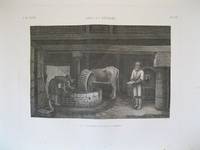
The Olive Press. "Vue intérieure d'un Moulin à Huile
Trades Professions & the Arts: Paris Impremerie de C.L.F.Pancoucke 1820-1829. Copper engraving showing the interior of an Olive press or mill from the second volume of "Etat Moderne" of the "Description de l'Egypte" 2nd Edition; black & white; verso blank. Blind stamp of the publisher Panckoucke to margin. Good dark impression; some light spotting to margins; remains of glue and tissue guard to upper margin. "Description de l'Egypte ou Recueil des observations et des recherches qui ont été faites en Egypte pendant l'expédition de l'armée française." When Napoleon Bonaparte invaded Egypt in 1798 he brought with him an entourage of more than 160 scholars and scientists. Known as the French Commission on the Sciences and Arts of Egypt these experts undertook an extensive survey of the country's archeology topography and natural history. . For four years more than 150 artists engineers linguists and scientists traveled throughout the country examining almost every aspect of ancient and contemporary Egypt. They recorded and measured in meticulous detail Egypt's topography flora and fauna and its ancient and contemporary architecture. A soldier who was part of the expedition found the famous Rosetta Stone which the French linguist and scholar Jean-François Champollion 1790-1832 later used to unlock many of the mysteries that long had surrounded the language of ancient Egypt. The Egyptian expedition ended with a total military failure. The French left Egypt in 1801 with the honors of war but defeated; yet military failure remains a significant event in the history of knowledge because it is the first time a military expedition was accompanied by a scientific expedition. In 1802 Napoleon authorized the publication of the commission's findings in a monumental multi-volume work that included plates maps scholarly essays and a detailed index. Publication of the original Imperial edition began in 1809 and continued to 1822 sold by subscription. It proved so popular that a second edition was published under the post-Napoleonic Bourbon Restoration. The "Royal edition" published in Paris by C.L.F. Panckoucke from 1820-1830. The Second edition consists of 11 or 12 volumes of plates in folio and 24 of text bound as 26 8vo. Brunet:II 617; Blackmer/Navari: 476 1st edition Trades Professions & the Arts Egypt Olive press Paris Impremerie de C.L.F.Pancoucke 1820-1829 unknown
Referentie van de boekhandelaar : 1990
|
|
|
Charles Louis Fleury Panckoucke,
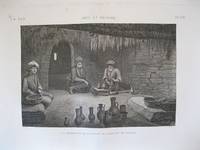
The Potter'sWorkshop "Vue intérieure de l'Attéllier de Fabricant de Potteries
Trades Professions & the Arts: Paris Impremerie de C.L.F.Pancoucke 1820-1829. Copper engraving showing the interior of a potter's workshop from the second volume of "Etat Moderne" of the "Description de l'Egypte" 2nd Edition; black & white; verso blank. Blind stamp of the publisher Panckoucke to margin. The image shows the workshop with the potter at his wheel. Good dark impression; some light spotting to margins; remains of glue and tissue guard to upper margin. "Description de l'Egypte ou Recueil des observations et des recherches qui ont été faites en Egypte pendant l'expédition de l'armée française." When Napoleon Bonaparte invaded Egypt in 1798 he brought with him an entourage of more than 160 scholars and scientists. Known as the French Commission on the Sciences and Arts of Egypt these experts undertook an extensive survey of the country's archeology topography and natural history. . For four years more than 150 artists engineers linguists and scientists traveled throughout the country examining almost every aspect of ancient and contemporary Egypt. They recorded and measured in meticulous detail Egypt's topography flora and fauna and its ancient and contemporary architecture. A soldier who was part of the expedition found the famous Rosetta Stone which the French linguist and scholar Jean-François Champollion 1790-1832 later used to unlock many of the mysteries that long had surrounded the language of ancient Egypt. The Egyptian expedition ended with a total military failure. The French left Egypt in 1801 with the honors of war but defeated; yet military failure remains a significant event in the history of knowledge because it is the first time a military expedition was accompanied by a scientific expedition. In 1802 Napoleon authorized the publication of the commission's findings in a monumental multi-volume work that included plates maps scholarly essays and a detailed index. Publication of the original Imperial edition began in 1809 and continued to 1822 sold by subscription. It proved so popular that a second edition was published under the post-Napoleonic Bourbon Restoration. The "Royal edition" published in Paris by C.L.F. Panckoucke from 1820-1830. The Second edition consists of 11 or 12 volumes of plates in folio and 24 of text bound as 26 8vo. Brunet:II 617; Blackmer/Navari: 476 1st edition Trades Professions & the Arts Egypt Pottery Paris Impremerie de C.L.F.Pancoucke 1820-1829 unknown
Referentie van de boekhandelaar : 1989
|
|
|
Charles Louis Fleury Panckoucke,
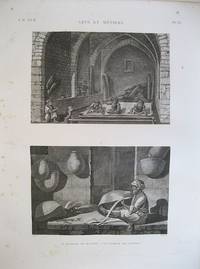
The Reed Mat Maker. The Basketweaver. "Le Faisuer de Nattes. Le Faiseur de Couffes
Trades Professions & the Arts: Paris Impremerie de C.L.F.Pancoucke 1820-1829. Copper engravings 2 on 1 plate showing the trades of reed mat and basket weaving from the second volume of "Etat Moderne" of the "Description de l'Egypte" 2nd Edition; black & white; verso blank. Blind stamp of the publisher Panckoucke to margin. The images show the mat maker weaving the reed and the basket weaver stitching the basket . Good dark impression; some spotting to margins; remains of glue and tissue guard to right margin. "Description de l'Egypte ou Recueil des observations et des recherches qui ont été faites en Egypte pendant l'expédition de l'armée française." When Napoleon Bonaparte invaded Egypt in 1798 he brought with him an entourage of more than 160 scholars and scientists. Known as the French Commission on the Sciences and Arts of Egypt these experts undertook an extensive survey of the country's archeology topography and natural history. . For four years more than 150 artists engineers linguists and scientists traveled throughout the country examining almost every aspect of ancient and contemporary Egypt. They recorded and measured in meticulous detail Egypt's topography flora and fauna and its ancient and contemporary architecture. A soldier who was part of the expedition found the famous Rosetta Stone which the French linguist and scholar Jean-François Champollion 1790-1832 later used to unlock many of the mysteries that long had surrounded the language of ancient Egypt. The Egyptian expedition ended with a total military failure. The French left Egypt in 1801 with the honors of war but defeated; yet military failure remains a significant event in the history of knowledge because it is the first time a military expedition was accompanied by a scientific expedition. In 1802 Napoleon authorized the publication of the commission's findings in a monumental multi-volume work that included plates maps scholarly essays and a detailed index. Publication of the original Imperial edition began in 1809 and continued to 1822 sold by subscription. It proved so popular that a second edition was published under the post-Napoleonic Bourbon Restoration. The "Royal edition" published in Paris by C.L.F. Panckoucke from 1820-1830. The Second edition consists of 11 or 12 volumes of plates in folio and 24 of text bound as 26 8vo. Brunet:II 617; Blackmer/Navari: 476 1st edition Trades Professions & the Arts Egypt Reed mat maker Basket weaver Paris Impremerie de C.L.F.Pancoucke 1820-1829 unknown
Referentie van de boekhandelaar : 1996
|
|
|
Charles Louis Fleury Panckoucke,
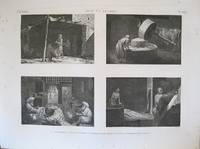
The Toolmaker; The Plaster or Gypsum Grinder; The Coffee Roaster and the Tanner or Currier . "Le Taillandier. Moulin à Plàtre; Attelier où l'on Brùle le Caffê; Le Fabricant de Moroquin
Trades Professions & the Arts: Paris Impremerie de C.L.F.Pancoucke 1820-1829. Copper engravings 4 on 1 plate showing the trades of toolmaker plaster grinder tanner or currier and coffee roaster from the second volume of "Etat Moderne" of the "Description de l'Egypte" 2nd Edition; black & white; verso blank. Blind stamp of the publisher Panckoucke to margin. The images show the workshops of the various trades: the toolmaker forging a pickhead; the miller of plaster with his mill powered by an ox; the coffee roaster stirring the beans over a fire and the naked curriers/tanners stretching the skins to make Marocco leather. Good dark impression; generally clean; some spotting to margins; remains of glue and tissue guard to upper margin. "Description de l'Egypte ou Recueil des observations et des recherches qui ont été faites en Egypte pendant l'expédition de l'armée française." When Napoleon Bonaparte invaded Egypt in 1798 he brought with him an entourage of more than 160 scholars and scientists. Known as the French Commission on the Sciences and Arts of Egypt these experts undertook an extensive survey of the country's archeology topography and natural history. . For four years more than 150 artists engineers linguists and scientists traveled throughout the country examining almost every aspect of ancient and contemporary Egypt. They recorded and measured in meticulous detail Egypt's topography flora and fauna and its ancient and contemporary architecture. A soldier who was part of the expedition found the famous Rosetta Stone which the French linguist and scholar Jean-François Champollion 1790-1832 later used to unlock many of the mysteries that long had surrounded the language of ancient Egypt. The Egyptian expedition ended with a total military failure. The French left Egypt in 1801 with the honors of war but defeated; yet military failure remains a significant event in the history of knowledge because it is the first time a military expedition was accompanied by a scientific expedition. In 1802 Napoleon authorized the publication of the commission's findings in a monumental multi-volume work that included plates maps scholarly essays and a detailed index. Publication of the original Imperial edition began in 1809 and continued to 1822 sold by subscription. It proved so popular that a second edition was published under the post-Napoleonic Bourbon Restoration. The "Royal edition" published in Paris by C.L.F. Panckoucke from 1820-1830. The Second edition consists of 11 or 12 volumes of plates in folio and 24 of text bound as 26 8vo. Brunet:II 617; Blackmer/Navari: 476 1st edition Trades Professions & the Arts Egypt Toolmaker Plaster Miller Coffee Roaster Tanner/ Currier Paris Impremerie de C.L.F.Pancoucke 1820-1829 hardcover
Referentie van de boekhandelaar : 1986
|
|
|
Charles Louis Fleury Panckoucke,
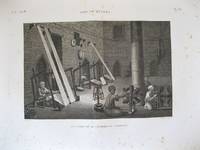
The Weaver's Workshop "Vue intérieure de l'Attéllier de Tisserand
Trades Professions & the Arts: Paris Impremerie de C.L.F.Pancoucke 1820-1829. Copper engraving showing the interior of a weaver's workshop from the second volume of "Etat Moderne" of the "Description de l'Egypte" 2nd Edition; black & white; verso blank. Blind stamp of the publisher Panckoucke to margin. The image shows the workshop with two weavers at their looms whilst apprentices spin threads. Good dark impression; foxing & spotting to margins; remains of glue and tissue guard to upper margin. "Description de l'Egypte ou Recueil des observations et des recherches qui ont été faites en Egypte pendant l'expédition de l'armée française." When Napoleon Bonaparte invaded Egypt in 1798 he brought with him an entourage of more than 160 scholars and scientists. Known as the French Commission on the Sciences and Arts of Egypt these experts undertook an extensive survey of the country's archeology topography and natural history. . For four years more than 150 artists engineers linguists and scientists traveled throughout the country examining almost every aspect of ancient and contemporary Egypt. They recorded and measured in meticulous detail Egypt's topography flora and fauna and its ancient and contemporary architecture. A soldier who was part of the expedition found the famous Rosetta Stone which the French linguist and scholar Jean-François Champollion 1790-1832 later used to unlock many of the mysteries that long had surrounded the language of ancient Egypt. The Egyptian expedition ended with a total military failure. The French left Egypt in 1801 with the honors of war but defeated; yet military failure remains a significant event in the history of knowledge because it is the first time a military expedition was accompanied by a scientific expedition. In 1802 Napoleon authorized the publication of the commission's findings in a monumental multi-volume work that included plates maps scholarly essays and a detailed index. Publication of the original Imperial edition began in 1809 and continued to 1822 sold by subscription. It proved so popular that a second edition was published under the post-Napoleonic Bourbon Restoration. The "Royal edition" published in Paris by C.L.F. Panckoucke from 1820-1830. The Second edition consists of 11 or 12 volumes of plates in folio and 24 of text bound as 26 8vo. Brunet:II 617; Blackmer/Navari: 476 1st edition Trades Professions & the Arts Egypt Weaving Paris Impremerie de C.L.F.Pancoucke 1820-1829 unknown
Referentie van de boekhandelaar : 1988
|
|
|
Charles Louis Fleury Panckoucke,
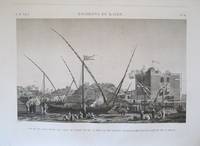
View close to the Canal of Cairo & of the Annual Festival celebrating the opening of the Dike Khaleej " Vue de la prise d'eau du Canal du Kaire et de la Fète qu'on Célèbre Annuellement a l'Ouverture de la Digue._Environs du Kaire
Middle East: Paris Impremerie de C.L.F.Pancoucke 1820-1829. Copper engraved view of Festival of the Nile flood and the opening of Khaleej dike Cairo from the first volume of the "Etat Modene "of the "Description de l'Egypte" 2nd Edition; 1822; black & white; verso blank. Blind stamp of the publisher Panckoucke to margin. The view shows the festival celebrated at the opening of the Khaleej dike so that the flood waters of the Nile can enter the canal. Since ancient times the Nile has played a vital role in Egypt to the point that it is the river that the Egyptians attributed the birth and existence of their country. As the waters of the Nile rose the Egyptians prepared to let them through for irrigation etc thus a most important moment each year to be celebrated. the sultan would proceed to the Misr point to open the dike. Called the cavalcade of the opening of the Khaleej. it was was one of the most important festivals of the year. Good dark impression; some light foxing; glue and remains of tissue guard to upper margin. "Description de l'Egypte ou Recueil des observations et des recherches qui ont été faites en Egypte pendant l'expédition de l'armée française." When Napoleon Bonaparte invaded Egypt in 1798 he brought with him an entourage of more than 160 scholars and scientists. Known as the French Commission on the Sciences and Arts of Egypt these experts undertook an extensive survey of the country's archeology topography and natural history. . For four years more than 150 artists engineers linguists and scientists traveled throughout the country examining almost every aspect of ancient and contemporary Egypt. They recorded and measured in meticulous detail Egypt's topography flora and fauna and its ancient and contemporary architecture. A soldier who was part of the expedition found the famous Rosetta Stone which the French linguist and scholar Jean-François Champollion 1790-1832 later used to unlock many of the mysteries that long had surrounded the language of ancient Egypt. The Egyptian expedition ended with a total military failure. The French left Egypt in 1801 with the honors of war but defeated; yet military failure remains a significant event in the history of knowledge because it is the first time a military expedition was accompanied by a scientific expedition. In 1802 Napoleon authorized the publication of the commission's findings in a monumental multi-volume work that included plates maps scholarly essays and a detailed index. Publication of the original Imperial edition began in 1809 and continued to 1822 sold by subscription. It proved so popular that a second edition was published under the post-Napoleonic Bourbon Restoration. The "Royal edition" published in Paris by C.L.F. Panckoucke from 1820-1830. The Second edition consists of 11 or 12 volumes of plates in folio and 24 of text bound as 26 8vo. Brunet:II 617; Blackmer/Navari: 476 1st edition Middle East Egypt Cairo Festival of the Khaleej Paris Impremerie de C.L.F.Pancoucke 1820-1829 unknown
Referentie van de boekhandelaar : 1971
|
|
|
Charles Louis Fleury Panckoucke,
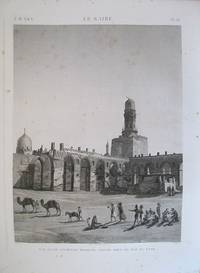
View of an ancient Mosque close to Bab el Nasr. " Vue d'une Ancienne Mosquée située près de Bàb el Nasr._Le Kaire
Middle East: Paris Impremerie de C.L.F.Pancoucke 1820-1829. Copper engraved view of an old mosque Cairo from the first volume of the "Etat Modene "of the "Description de l'Egypte" 2nd Edition; 1822; black & white; verso blank. Blind stamp of the publisher Panckoucke to margin. The view shows the mosque close to the gate of Bab el Nasr and the city walls. In the foreground are travelers arriving in the city by camel and donkey. Two French soldiers seem to be moving on a group of musicians and healers. Good dark impression; foxing to sky and blank margins. "Description de l'Egypte ou Recueil des observations et des recherches qui ont été faites en Egypte pendant l'expédition de l'armée française." When Napoleon Bonaparte invaded Egypt in 1798 he brought with him an entourage of more than 160 scholars and scientists. Known as the French Commission on the Sciences and Arts of Egypt these experts undertook an extensive survey of the country's archeology topography and natural history. . For four years more than 150 artists engineers linguists and scientists traveled throughout the country examining almost every aspect of ancient and contemporary Egypt. They recorded and measured in meticulous detail Egypt's topography flora and fauna and its ancient and contemporary architecture. A soldier who was part of the expedition found the famous Rosetta Stone which the French linguist and scholar Jean-François Champollion 1790-1832 later used to unlock many of the mysteries that long had surrounded the language of ancient Egypt. The Egyptian expedition ended with a total military failure. The French left Egypt in 1801 with the honors of war but defeated; yet military failure remains a significant event in the history of knowledge because it is the first time a military expedition was accompanied by a scientific expedition. In 1802 Napoleon authorized the publication of the commission's findings in a monumental multi-volume work that included plates maps scholarly essays and a detailed index. Publication of the original Imperial edition began in 1809 and continued to 1822 sold by subscription. It proved so popular that a second edition was published under the post-Napoleonic Bourbon Restoration. The "Royal edition" published in Paris by C.L.F. Panckoucke from 1820-1830. The Second edition consists of 11 or 12 volumes of plates in folio and 24 of text bound as 26 8vo. Brunet:II 617; Blackmer/Navari: 476 1st edition Middle East Egypt Cairo Bab el Nasr Paris Impremerie de C.L.F.Pancoucke 1820-1829 unknown
Referentie van de boekhandelaar : 1969
|
|
|
Charles Louis Fleury Panckoucke,
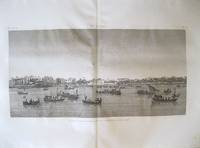
View of Ezbekyeh. Cairo. " Vue de la Place Ezbekyeh; Côté de l'Ouest et Du Nord -Ouest_Le Kaire
Middle East: Paris Impremerie de C.L.F.Pancoucke 1820-1829. Large double page copper engraved view of the area of Ezbekyeh North West Cairo from the first volume of the "Etat Modene "of the "Description de l'Egypte" 2nd Edition; 1822; black & white; verso blank. Blind stamp of the publisher Panckoucke to margin. The view shows the area of Ezbekieh in Cairo as seen from the Nile with many boats in the foreground. Ezbekieh is part of modern Cairo close to the gardens of the same name and popular with foreign visitors. Good dark impression; foxing to sky and blank margins. "Description de l'Egypte ou Recueil des observations et des recherches qui ont été faites en Egypte pendant l'expédition de l'armée française." When Napoleon Bonaparte invaded Egypt in 1798 he brought with him an entourage of more than 160 scholars and scientists. Known as the French Commission on the Sciences and Arts of Egypt these experts undertook an extensive survey of the country's archeology topography and natural history. . For four years more than 150 artists engineers linguists and scientists traveled throughout the country examining almost every aspect of ancient and contemporary Egypt. They recorded and measured in meticulous detail Egypt's topography flora and fauna and its ancient and contemporary architecture. A soldier who was part of the expedition found the famous Rosetta Stone which the French linguist and scholar Jean-François Champollion 1790-1832 later used to unlock many of the mysteries that long had surrounded the language of ancient Egypt. The Egyptian expedition ended with a total military failure. The French left Egypt in 1801 with the honors of war but defeated; yet military failure remains a significant event in the history of knowledge because it is the first time a military expedition was accompanied by a scientific expedition. In 1802 Napoleon authorized the publication of the commission's findings in a monumental multi-volume work that included plates maps scholarly essays and a detailed index. Publication of the original Imperial edition began in 1809 and continued to 1822 sold by subscription. It proved so popular that a second edition was published under the post-Napoleonic Bourbon Restoration. The "Royal edition" published in Paris by C.L.F. Panckoucke from 1820-1830. The Second edition consists of 11 or 12 volumes of plates in folio and 24 of text bound as 26 8vo. Brunet:II 617; Blackmer/Navari: 476 1st edition Middle East Egypt Cairo Ezbekieh Paris Impremerie de C.L.F.Pancoucke 1820-1829 unknown
Referentie van de boekhandelaar : 1968
|
|
|
Charles Louis Fleury Panckoucke,
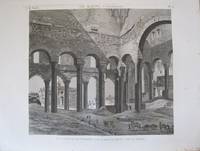
View of of the interior of a Mosque Known as the Bed of Joseph. " Vue Intérieure d'une Mosquée Connue sous le nom de Divan de Joseph._Le Kaire Citadelle
Middle East: Paris Impremerie de C.L.F.Pancoucke 1820-1829. Copper engraved view the interior of a mosque Cairo from the first volume of the "Etat Modene "of the "Description de l'Egypte" 2nd Edition; 1822; black & white; verso blank. Blind stamp of the publisher Panckoucke to margin. The view shows the interior of an abandoned mosque within the Citadel of Cairo. Engineers are excavating whilst a canon is brought forward by 2 camels. Good dark impression; some foxing to blank margins. "Description de l'Egypte ou Recueil des observations et des recherches qui ont été faites en Egypte pendant l'expédition de l'armée française." When Napoleon Bonaparte invaded Egypt in 1798 he brought with him an entourage of more than 160 scholars and scientists. Known as the French Commission on the Sciences and Arts of Egypt these experts undertook an extensive survey of the country's archeology topography and natural history. . For four years more than 150 artists engineers linguists and scientists traveled throughout the country examining almost every aspect of ancient and contemporary Egypt. They recorded and measured in meticulous detail Egypt's topography flora and fauna and its ancient and contemporary architecture. A soldier who was part of the expedition found the famous Rosetta Stone which the French linguist and scholar Jean-François Champollion 1790-1832 later used to unlock many of the mysteries that long had surrounded the language of ancient Egypt. The Egyptian expedition ended with a total military failure. The French left Egypt in 1801 with the honors of war but defeated; yet military failure remains a significant event in the history of knowledge because it is the first time a military expedition was accompanied by a scientific expedition. In 1802 Napoleon authorized the publication of the commission's findings in a monumental multi-volume work that included plates maps scholarly essays and a detailed index. Publication of the original Imperial edition began in 1809 and continued to 1822 sold by subscription. It proved so popular that a second edition was published under the post-Napoleonic Bourbon Restoration. The "Royal edition" published in Paris by C.L.F. Panckoucke from 1820-1830. The Second edition consists of 11 or 12 volumes of plates in folio and 24 of text bound as 26 8vo. Brunet:II 617; Blackmer/Navari: 476 1st edition Middle East Egypt Cairo Citadel Paris Impremerie de C.L.F.Pancoucke 1820-1829 unknown
Referentie van de boekhandelaar : 1970
|
|
|
Charles Louis Fleury Panckoucke,
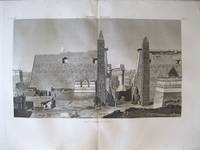
View of the Entrance to the Palace Luxor Thebes. "Vue de l'Entrée du palais_ Thèbes. Louqsor
Middle East: Paris Impremerie de C.L.F.Pancoucke 1820-1829. Large double page copper engraved view entrance to the Templeof Luxor Thebes from the third volume of the "Antiquities "of the "Description de l'Egypte" 2nd Edition; black & white; verso blank. Blind stamp of the publisher Panckoucke to margin. The view shows the entrance to the temple with the two obelisks the one on the right now stands in the Place de la Concorde in Paris with two defaced heads of statues buried in the sand in front of the pylons of the temple with their decorated walls; just glimpsed through the entrance can be seen the hall of columns. Good dark impression; some light foxing. mainly to upper margin. "Description de l'Egypte ou Recueil des observations et des recherches qui ont été faites en Egypte pendant l'expédition de l'armée française." When Napoleon Bonaparte invaded Egypt in 1798 he brought with him an entourage of more than 160 scholars and scientists. Known as the French Commission on the Sciences and Arts of Egypt these experts undertook an extensive survey of the country's archeology topography and natural history. . For four years more than 150 artists engineers linguists and scientists traveled throughout the country examining almost every aspect of ancient and contemporary Egypt. They recorded and measured in meticulous detail Egypt's topography flora and fauna and its ancient and contemporary architecture. A soldier who was part of the expedition found the famous Rosetta Stone which the French linguist and scholar Jean-François Champollion 1790-1832 later used to unlock many of the mysteries that long had surrounded the language of ancient Egypt. The Egyptian expedition ended with a total military failure. The French left Egypt in 1801 with the honors of war but defeated; yet military failure remains a significant event in the history of knowledge because it is the first time a military expedition was accompanied by a scientific expedition. In 1802 Napoleon authorized the publication of the commission's findings in a monumental multi-volume work that included plates maps scholarly essays and a detailed index. Publication of the original Imperial edition began in 1809 and continued to 1822 sold by subscription. It proved so popular that a second edition was published under the post-Napoleonic Bourbon Restoration. The "Royal edition" published in Paris by C.L.F. Panckoucke from 1820-1830. The Second edition consists of 11 or 12 volumes of plates in folio and 24 of text bound as 26 8vo. Brunet:II 617; Blackmer/Navari: 476 1st edition Middle East Egypt Luxor Thebes Paris Impremerie de C.L.F.Pancoucke 1820-1829 unknown
Referentie van de boekhandelaar : 1973
|
|
|
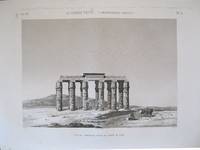
Charles Louis Fleury Panckoucke,
View of the Portico Achmouneyn Hermopolis Magna. "Vue du Portique prise du Côté-du Midi_ Achmouneyn Hermopolis Magna
Middle East: Paris Impremerie de C.L.F.Pancoucke 1820-1829. Copper engraved view of the temple of Hermopolis Magna Achmouneyn. from the fourth volume of the "Antiquities "of the "Description de l'Egypte" 2nd Edition; black & white; verso blank. Blind stamp of the publisher Panckoucke to margin. The view shows the ruins of the temple of Hermopolis which was dedicated to the Ibis-headed god. The emblems the Ibis and the Cynocephalus or ape are the most conspicuous among the sculptures upon the great portico of the temple. Good dark impression; generally clean; some spotting to margins; remains of glue and tissue guard to upper margin. "Description de l'Egypte ou Recueil des observations et des recherches qui ont été faites en Egypte pendant l'expédition de l'armée française." When Napoleon Bonaparte invaded Egypt in 1798 he brought with him an entourage of more than 160 scholars and scientists. Known as the French Commission on the Sciences and Arts of Egypt these experts undertook an extensive survey of the country's archeology topography and natural history. . For four years more than 150 artists engineers linguists and scientists traveled throughout the country examining almost every aspect of ancient and contemporary Egypt. They recorded and measured in meticulous detail Egypt's topography flora and fauna and its ancient and contemporary architecture. A soldier who was part of the expedition found the famous Rosetta Stone which the French linguist and scholar Jean-François Champollion 1790-1832 later used to unlock many of the mysteries that long had surrounded the language of ancient Egypt. The Egyptian expedition ended with a total military failure. The French left Egypt in 1801 with the honors of war but defeated; yet military failure remains a significant event in the history of knowledge because it is the first time a military expedition was accompanied by a scientific expedition. In 1802 Napoleon authorized the publication of the commission's findings in a monumental multi-volume work that included plates maps scholarly essays and a detailed index. Publication of the original Imperial edition began in 1809 and continued to 1822 sold by subscription. It proved so popular that a second edition was published under the post-Napoleonic Bourbon Restoration. The "Royal edition" published in Paris by C.L.F. Panckoucke from 1820-1830. The Second edition consists of 11 or 12 volumes of plates in folio and 24 of text bound as 26 8vo. Brunet:II 617; Blackmer/Navari: 476 1st edition Middle East Egypt Hermopolis Magna Achmouneyn Paris Impremerie de C.L.F.Pancoucke 1820-1829 unknown
Referentie van de boekhandelaar : 1983
|
|
|
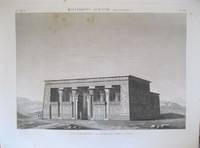
Charles Louis Fleury Panckoucke,
View of the Temple of Esna. "Vue perspective du Temple au Nord d'Esné _Environs d'Esné Latopolis
Middle East: Paris Impremerie de C.L.F.Pancoucke 1820-1829. Copper engraved view of the temple of Esna from the first volume of the "Antiquities "of the "Description de l'Egypte" 2nd Edition; black & white; verso blank. Blind stamp of the publisher Panckoucke to margin. The view shows a reconstruction of the temple of Khnum. at Esné The tutelary deities of Latopolis seem to have been the triad – Khnum and Neith and Heka their offspring. The temple of Esna dedicated to this triad was remarkable for the beauty of its site and the magnificence of its architecture. It was built of red sandstone and its portico consisted of six rows of four columns each with lotus-leaf capitals all of which however differ from each other Good dark impression; some foxing to sky and spotting to margins. "Description de l'Egypte ou Recueil des observations et des recherches qui ont été faites en Egypte pendant l'expédition de l'armée française." When Napoleon Bonaparte invaded Egypt in 1798 he brought with him an entourage of more than 160 scholars and scientists. Known as the French Commission on the Sciences and Arts of Egypt these experts undertook an extensive survey of the country's archeology topography and natural history. . For four years more than 150 artists engineers linguists and scientists traveled throughout the country examining almost every aspect of ancient and contemporary Egypt. They recorded and measured in meticulous detail Egypt's topography flora and fauna and its ancient and contemporary architecture. A soldier who was part of the expedition found the famous Rosetta Stone which the French linguist and scholar Jean-François Champollion 1790-1832 later used to unlock many of the mysteries that long had surrounded the language of ancient Egypt. The Egyptian expedition ended with a total military failure. The French left Egypt in 1801 with the honors of war but defeated; yet military failure remains a significant event in the history of knowledge because it is the first time a military expedition was accompanied by a scientific expedition. In 1802 Napoleon authorized the publication of the commission's findings in a monumental multi-volume work that included plates maps scholarly essays and a detailed index. Publication of the original Imperial edition began in 1809 and continued to 1822 sold by subscription. It proved so popular that a second edition was published under the post-Napoleonic Bourbon Restoration. The "Royal edition" published in Paris by C.L.F. Panckoucke from 1820-1830. The Second edition consists of 11 or 12 volumes of plates in folio and 24 of text bound as 26 8vo. Brunet:II 617; Blackmer/Navari: 476 1st edition Middle East Egypt Esne Esna Latopolis Paris Impremerie de C.L.F.Pancoucke 1820-1829 unknown
Referentie van de boekhandelaar : 1981
|
|
|
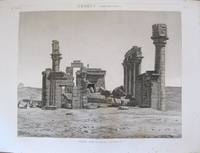
Charles Louis Fleury Panckoucke,
View of the temple of Hermonthis. "Vue du Temple prise a l'Ouest_ Erment Hermonthis
Middle East: Paris Impremerie de C.L.F.Pancoucke 1820-1829. Copper engraved view of the temple of Hermonthis. from the first volume of the "Antiquities "of the "Description de l'Egypte" 2nd Edition; black & white; verso blank. Blind stamp of the publisher Panckoucke to margin. The view shows the ruins of the temple of Hermonthis. The temple was dedicated to Menthu a god whose name means "nomad". Menthu was associated with raging bulls strength and war. He was also said to manifest himself in a white bull with a black face which was referred to as the Bakha. Egypt's greatest general-kings called themselves Mighty Bulls the sons of Menthu. Good dark impression; generally clean; some spotting to margins; remains of glue and tissue guard to upper margin. "Description de l'Egypte ou Recueil des observations et des recherches qui ont été faites en Egypte pendant l'expédition de l'armée française." When Napoleon Bonaparte invaded Egypt in 1798 he brought with him an entourage of more than 160 scholars and scientists. Known as the French Commission on the Sciences and Arts of Egypt these experts undertook an extensive survey of the country's archeology topography and natural history. . For four years more than 150 artists engineers linguists and scientists traveled throughout the country examining almost every aspect of ancient and contemporary Egypt. They recorded and measured in meticulous detail Egypt's topography flora and fauna and its ancient and contemporary architecture. A soldier who was part of the expedition found the famous Rosetta Stone which the French linguist and scholar Jean-François Champollion 1790-1832 later used to unlock many of the mysteries that long had surrounded the language of ancient Egypt. The Egyptian expedition ended with a total military failure. The French left Egypt in 1801 with the honors of war but defeated; yet military failure remains a significant event in the history of knowledge because it is the first time a military expedition was accompanied by a scientific expedition. In 1802 Napoleon authorized the publication of the commission's findings in a monumental multi-volume work that included plates maps scholarly essays and a detailed index. Publication of the original Imperial edition began in 1809 and continued to 1822 sold by subscription. It proved so popular that a second edition was published under the post-Napoleonic Bourbon Restoration. The "Royal edition" published in Paris by C.L.F. Panckoucke from 1820-1830. The Second edition consists of 11 or 12 volumes of plates in folio and 24 of text bound as 26 8vo. Brunet:II 617; Blackmer/Navari: 476 1st edition Middle East Egypt Hermonthis Erment Paris Impremerie de C.L.F.Pancoucke 1820-1829 unknown
Referentie van de boekhandelaar : 1984
|
|
|
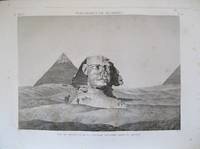
Charles Louis Fleury Panckoucke,
View of the Sphinx and the Second Pyramid . "Vue de Sphinx et de la Seconde Pyramide prise de Levant_ Pyramides de Memphis
Middle East: Paris Impremerie de C.L.F.Pancoucke 1820-1829. Copper engraved view of the Great Sphinx between the Pyramids of Giza from the fifth volume of the "Antiquities "of the "Description de l'Egypte" 2nd Edition; black & white; verso blank. Blind stamp of the publisher Panckoucke to margin. The view shows the Sphinx full face emerging from the sand with the Pyramid of Khafre behind. Good dark impression; some spotting mainly to margins a few to image. "Description de l'Egypte ou Recueil des observations et des recherches qui ont été faites en Egypte pendant l'expédition de l'armée française." When Napoleon Bonaparte invaded Egypt in 1798 he brought with him an entourage of more than 160 scholars and scientists. Known as the French Commission on the Sciences and Arts of Egypt these experts undertook an extensive survey of the country's archeology topography and natural history. . For four years more than 150 artists engineers linguists and scientists traveled throughout the country examining almost every aspect of ancient and contemporary Egypt. They recorded and measured in meticulous detail Egypt's topography flora and fauna and its ancient and contemporary architecture. A soldier who was part of the expedition found the famous Rosetta Stone which the French linguist and scholar Jean-François Champollion 1790-1832 later used to unlock many of the mysteries that long had surrounded the language of ancient Egypt. The Egyptian expedition ended with a total military failure. The French left Egypt in 1801 with the honors of war but defeated; yet military failure remains a significant event in the history of knowledge because it is the first time a military expedition was accompanied by a scientific expedition. In 1802 Napoleon authorized the publication of the commission's findings in a monumental multi-volume work that included plates maps scholarly essays and a detailed index. Publication of the original Imperial edition began in 1809 and continued to 1822 sold by subscription. It proved so popular that a second edition was published under the post-Napoleonic Bourbon Restoration. The "Royal edition" published in Paris by C.L.F. Panckoucke from 1820-1830. The Second edition consists of 11 or 12 volumes of plates in folio and 24 of text bound as 26 8vo. Brunet:II 617; Blackmer/Navari: 476 1st edition Middle East Egypt Sphinx Pyramids of Giza Memphis Paris Impremerie de C.L.F.Pancoucke 1820-1829 unknown
Referentie van de boekhandelaar : 1978
|
|
|
Charles Louis Fleury Panckoucke,
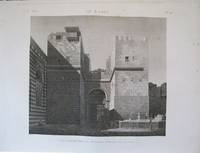
View of the Gate called Bab el Foutouh Cairo. " Vue Perspective de la Porte Appelée Bâb el Foutouh._Le Kaire
Middle East: Paris Impremerie de C.L.F.Pancoucke 1820-1829. Copper engraved view of one of the gateways to Cairo from the first volume of the "Etat Modene "of the "Description de l'Egypte" 2nd Edition; 1822; black & white; verso blank. Blind stamp of the publisher Panckoucke to margin. The view shows the massive gateway to the city with some small workshops & shops built against the walls. Good dark impression; a few some spotting mainly to margins but also a few in image. "Description de l'Egypte ou Recueil des observations et des recherches qui ont été faites en Egypte pendant l'expédition de l'armée française." When Napoleon Bonaparte invaded Egypt in 1798 he brought with him an entourage of more than 160 scholars and scientists. Known as the French Commission on the Sciences and Arts of Egypt these experts undertook an extensive survey of the country's archeology topography and natural history. . For four years more than 150 artists engineers linguists and scientists traveled throughout the country examining almost every aspect of ancient and contemporary Egypt. They recorded and measured in meticulous detail Egypt's topography flora and fauna and its ancient and contemporary architecture. A soldier who was part of the expedition found the famous Rosetta Stone which the French linguist and scholar Jean-François Champollion 1790-1832 later used to unlock many of the mysteries that long had surrounded the language of ancient Egypt. The Egyptian expedition ended with a total military failure. The French left Egypt in 1801 with the honors of war but defeated; yet military failure remains a significant event in the history of knowledge because it is the first time a military expedition was accompanied by a scientific expedition. In 1802 Napoleon authorized the publication of the commission's findings in a monumental multi-volume work that included plates maps scholarly essays and a detailed index. Publication of the original Imperial edition began in 1809 and continued to 1822 sold by subscription. It proved so popular that a second edition was published under the post-Napoleonic Bourbon Restoration. The "Royal edition" published in Paris by C.L.F. Panckoucke from 1820-1830. The Second edition consists of 11 or 12 volumes of plates in folio and 24 of text bound as 26 8vo. Brunet:II 617; Blackmer/Navari: 476 1st edition Middle East Egypt Cairo Paris Impremerie de C.L.F.Pancoucke 1820-1829 unknown
Referentie van de boekhandelaar : 1963
|
|
|
Charles Louis Fleury Panckoucke,
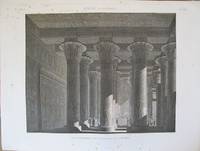
View of the Interior of the Portico Esna. "Vue perspective de l'Intérieur du Portique _Esné Latopolis
Middle East: Paris Impremerie de C.L.F.Pancoucke 1820-1829. Copper engraved view of the interior of the temple of Esna from the first volume of the "Antiquities "of the "Description de l'Egypte" 2nd Edition; black & white; verso blank. Blind stamp of the publisher Panckoucke to margin. The view shows the highly decorated columns and ceiling of the entrance to the temple with a procession moving through to the main temple The tutelary deities of Latopolis seem to have been the triad – Khnum and Neith and Heka their offspring. The temple of Esna dedicated to this triad was remarkable for the beauty of its site and the magnificence of its architecture. It was built of red sandstone and its portico consisted of six rows of four columns each with lotus-leaf capitals all of which however differ from each other Good dark impression; spotting mainly to margins. "Description de l'Egypte ou Recueil des observations et des recherches qui ont été faites en Egypte pendant l'expédition de l'armée française." When Napoleon Bonaparte invaded Egypt in 1798 he brought with him an entourage of more than 160 scholars and scientists. Known as the French Commission on the Sciences and Arts of Egypt these experts undertook an extensive survey of the country's archeology topography and natural history. . For four years more than 150 artists engineers linguists and scientists traveled throughout the country examining almost every aspect of ancient and contemporary Egypt. They recorded and measured in meticulous detail Egypt's topography flora and fauna and its ancient and contemporary architecture. A soldier who was part of the expedition found the famous Rosetta Stone which the French linguist and scholar Jean-François Champollion 1790-1832 later used to unlock many of the mysteries that long had surrounded the language of ancient Egypt. The Egyptian expedition ended with a total military failure. The French left Egypt in 1801 with the honors of war but defeated; yet military failure remains a significant event in the history of knowledge because it is the first time a military expedition was accompanied by a scientific expedition. In 1802 Napoleon authorized the publication of the commission's findings in a monumental multi-volume work that included plates maps scholarly essays and a detailed index. Publication of the original Imperial edition began in 1809 and continued to 1822 sold by subscription. It proved so popular that a second edition was published under the post-Napoleonic Bourbon Restoration. The "Royal edition" published in Paris by C.L.F. Panckoucke from 1820-1830. The Second edition consists of 11 or 12 volumes of plates in folio and 24 of text bound as 26 8vo. Brunet:II 617; Blackmer/Navari: 476 1st edition Middle East Egypt Esne Esna Latopolis Paris Impremerie de C.L.F.Pancoucke 1820-1829 unknown
Referentie van de boekhandelaar : 1980
|
|
|
Charles Louis Fleury Panckoucke,
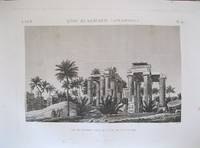
View of the Temple at Qâou El Kebyreh Antæopolis. "Vue du Temple prise du Cõté du Sud-ouest_Qâou el Kebyreh Antæopolis
Middle East: Paris Impremerie de C.L.F.Pancoucke 1820-1829. Copper engraved view of the temple of Qau el-Kebir from the fourth volume of the "Antiquities "of the "Description de l'Egypte" 2nd Edition; black & white; verso blank. Blind stamp of the publisher Panckoucke to margin. The view shows the ruins of the temple Qau or Qau el-Kebir surrounded by palm trees Qau is located by the site of ancient Tjebu known in ancient Greek records as Antaeopolis 'city of Antaeus' on the east bank of the Nile midway between the towns of Akhmim and Asyut The temple was built by Ptolemy IV. substantial parts of which were still standing at the beginning of the 19th century sadly it was swept away by the Nile flood of 1821 Good dark impression; some light foxing to sky and spotting to margins. "Description de l'Egypte ou Recueil des observations et des recherches qui ont été faites en Egypte pendant l'expédition de l'armée française." When Napoleon Bonaparte invaded Egypt in 1798 he brought with him an entourage of more than 160 scholars and scientists. Known as the French Commission on the Sciences and Arts of Egypt these experts undertook an extensive survey of the country's archeology topography and natural history. . For four years more than 150 artists engineers linguists and scientists traveled throughout the country examining almost every aspect of ancient and contemporary Egypt. They recorded and measured in meticulous detail Egypt's topography flora and fauna and its ancient and contemporary architecture. A soldier who was part of the expedition found the famous Rosetta Stone which the French linguist and scholar Jean-François Champollion 1790-1832 later used to unlock many of the mysteries that long had surrounded the language of ancient Egypt. The Egyptian expedition ended with a total military failure. The French left Egypt in 1801 with the honors of war but defeated; yet military failure remains a significant event in the history of knowledge because it is the first time a military expedition was accompanied by a scientific expedition. In 1802 Napoleon authorized the publication of the commission's findings in a monumental multi-volume work that included plates maps scholarly essays and a detailed index. Publication of the original Imperial edition began in 1809 and continued to 1822 sold by subscription. It proved so popular that a second edition was published under the post-Napoleonic Bourbon Restoration. The "Royal edition" published in Paris by C.L.F. Panckoucke from 1820-1830. The Second edition consists of 11 or 12 volumes of plates in folio and 24 of text bound as 26 8vo. Brunet:II 617; Blackmer/Navari: 476 1st edition Middle East Egypt Qau el-Kebir Qâou El Kebyreh Antæopolis. Paris Impremerie de C.L.F.Pancoucke 1820-1829 unknown
Referentie van de boekhandelaar : 1982
|
|
|
Charles Louis Fleury Panckoucke,
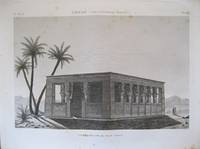
View of the Small Temple Edfu. "Vue perspective du petit Temple_ Edfoû Apollinopolis Magna
Middle East: Paris Impremerie de C.L.F.Pancoucke 1820-1829. Copper engraved view of the small temple or Birth House at Edfu from the first volume of the "Antiquities "of the "Description de l'Egypte" 2nd Edition; black & white; verso blank. Blind stamp of the publisher Panckoucke to margin. The view shows a reconstrucion of the small temple or Birth house described in the Antiquites. Opposite the large temple of Horus is another much smaller temple in a rather poorer state of preservation - the mammisi Birth House. The floral columns are crowned with sculptures of the god Bes a disfigured domestic god considered the guardian of expectant mothers and newborn infants. Since the scenes on the outside had been destroyed the French artists executed an imaginary reconstruction of the temple with all the decoration typical of similar monuments. Good dark impression; some spotting mainly to margins a few to image. "Description de l'Egypte ou Recueil des observations et des recherches qui ont été faites en Egypte pendant l'expédition de l'armée française." When Napoleon Bonaparte invaded Egypt in 1798 he brought with him an entourage of more than 160 scholars and scientists. Known as the French Commission on the Sciences and Arts of Egypt these experts undertook an extensive survey of the country's archeology topography and natural history. . For four years more than 150 artists engineers linguists and scientists traveled throughout the country examining almost every aspect of ancient and contemporary Egypt. They recorded and measured in meticulous detail Egypt's topography flora and fauna and its ancient and contemporary architecture. A soldier who was part of the expedition found the famous Rosetta Stone which the French linguist and scholar Jean-François Champollion 1790-1832 later used to unlock many of the mysteries that long had surrounded the language of ancient Egypt. The Egyptian expedition ended with a total military failure. The French left Egypt in 1801 with the honors of war but defeated; yet military failure remains a significant event in the history of knowledge because it is the first time a military expedition was accompanied by a scientific expedition. In 1802 Napoleon authorized the publication of the commission's findings in a monumental multi-volume work that included plates maps scholarly essays and a detailed index. Publication of the original Imperial edition began in 1809 and continued to 1822 sold by subscription. It proved so popular that a second edition was published under the post-Napoleonic Bourbon Restoration. The "Royal edition" published in Paris by C.L.F. Panckoucke from 1820-1830. The Second edition consists of 11 or 12 volumes of plates in folio and 24 of text bound as 26 8vo. Brunet:II 617; Blackmer/Navari: 476 1st edition Middle East Egypt Edfu Paris Impremerie de C.L.F.Pancoucke 1820-1829 unknown
Referentie van de boekhandelaar : 1979
|
|
|
Charles Louis Fleury Panckoucke,
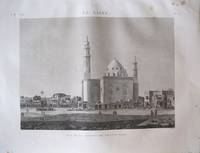
View of the Mosque of Sultan Hasan Cairo. "Vue de la Mosquée de Soultân Hasan._Le Kaire
Middle East: Paris Impremerie de C.L.F.Pancoucke 1820-1829. Copper engraved view of the mosque of Sultan Hasan Cairo from the first volume of the "Etat Modene "of the "Description de l'Egypte" 2nd Edition; 1822; black & white; verso blank. Blind stamp of the publisher Panckoucke to margin. The view shows the mosque towering over the nearby buildings with small shops and workshops in and around the Square. Good dark impression; some foxing to platemainly to blank margins. "Description de l'Egypte ou Recueil des observations et des recherches qui ont été faites en Egypte pendant l'expédition de l'armée française." When Napoleon Bonaparte invaded Egypt in 1798 he brought with him an entourage of more than 160 scholars and scientists. Known as the French Commission on the Sciences and Arts of Egypt these experts undertook an extensive survey of the country's archeology topography and natural history. . For four years more than 150 artists engineers linguists and scientists traveled throughout the country examining almost every aspect of ancient and contemporary Egypt. They recorded and measured in meticulous detail Egypt's topography flora and fauna and its ancient and contemporary architecture. A soldier who was part of the expedition found the famous Rosetta Stone which the French linguist and scholar Jean-François Champollion 1790-1832 later used to unlock many of the mysteries that long had surrounded the language of ancient Egypt. The Egyptian expedition ended with a total military failure. The French left Egypt in 1801 with the honors of war but defeated; yet military failure remains a significant event in the history of knowledge because it is the first time a military expedition was accompanied by a scientific expedition. In 1802 Napoleon authorized the publication of the commission's findings in a monumental multi-volume work that included plates maps scholarly essays and a detailed index. Publication of the original Imperial edition began in 1809 and continued to 1822 sold by subscription. It proved so popular that a second edition was published under the post-Napoleonic Bourbon Restoration. The "Royal edition" published in Paris by C.L.F. Panckoucke from 1820-1830. The Second edition consists of 11 or 12 volumes of plates in folio and 24 of text bound as 26 8vo. Brunet:II 617; Blackmer/Navari: 476 1st edition Middle East Egypt Cairo Sultan Hasan Mosque Paris Impremerie de C.L.F.Pancoucke 1820-1829 unknown
Referentie van de boekhandelaar : 1966
|
|
|
Charles Rohault Fleury
L'Évangile Vol. 1: Études Iconographiques Et Archéologiques Classic Reprint French Edition
paperback. Good. Access codes and supplements are not guaranteed with used items. May be an ex-library book. paperback
Referentie van de boekhandelaar : 0364829605.G ISBN : 0364829605 9780364829608
|
|
|
Charles Rohault de Fleury
L'Évangile Vol. 2: Études Iconographiques Et Archéologiques Classic Reprint French Edition
hardcover. Good. Access codes and supplements are not guaranteed with used items. May be an ex-library book. hardcover
Referentie van de boekhandelaar : 0364794070.G ISBN : 0364794070 9780364794074
|
|
|
Charles Rohault Fleury
L'Évangile Vol. 1: Études Iconographiques Et Archéologiques Classic Reprint French Edition
hardcover. Good. Access codes and supplements are not guaranteed with used items. May be an ex-library book. hardcover
Referentie van de boekhandelaar : 0364829729.G ISBN : 0364829729 9780364829721
|
|
|
Charles Rohault de Fleury
Mémoire sur les Instruments de la Passion de N.-S. J.-C
paperback. Good. Access codes and supplements are not guaranteed with used items. May be an ex-library book. paperback
Referentie van de boekhandelaar : 0259803014.G ISBN : 0259803014 9780259803010

|
|
|
Charles Rohault de Fleury
Mémoire sur les Instruments de la Passion de N.-S. J.-C Classic Reprint French Edition
hardcover. Good. Access codes and supplements are not guaranteed with used items. May be an ex-library book. hardcover
Referentie van de boekhandelaar : 0484153358.G ISBN : 0484153358 9780484153355

|
|
|
Charles, Fleury
L'Ideé johannique de la Vie French Edition
hardcover. Good. Access codes and supplements are not guaranteed with used items. May be an ex-library book. hardcover
Referentie van de boekhandelaar : 1385961090.G ISBN : 1385961090 9781385961094

|
|
|
Chavanne, Fleury
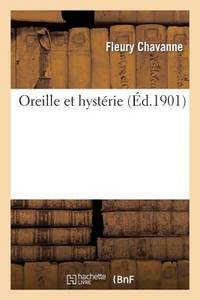
Oreille Et Hystérie Sciences French Edition
paperback. Good. Access codes and supplements are not guaranteed with used items. May be an ex-library book. paperback
Referentie van de boekhandelaar : 2012980171.G ISBN : 2012980171 9782012980174
|
|
|
CHAVANNE, Fleury
Oreille et Hystérie
Paris, J.B. Baillière et fils, 1901, in-8, VIII-320 pp, Broché, couverture imprimée de l'éditeur, non coupé, EDITION ORIGINALE de cette thèse sur l'hystérie auriculaire du Dr Fleury Chavanne, disciple de Lannois à qui il dédie cette étude. A travers cet ouvrage, Fleury Chavanne entend déterminer l'histoire des rapports entre l'oreille et l'hystérie, et regrouper les diverses manifestations auriculaires de la névrose. Découverte en premier lieu par Fabricius Hidanus en 1595, l'hystérie auriculaire fit l'objet de plusieurs études par la suite. Elle peut se manifester sous deux aspects : soit à l'état d'épiphénomènes, soit à l'état d'hystérie auriculaire monosymptomatique. Ainsi, ce trouble auditif engendre des cas d'anesthésie provoquant plusieurs formes de surdité, d'hyperesthésie (hypercousie douloureuse, zones hystérogènes, otalgie ou algie mastoïdienne), ainsi que des otorrhagies. Cette étude est agrémentée de 84 diagrammes dans le texte. Agréable exemplaire, deux légers manques restaurés au plat inférieur. Envoi signé de l'auteur à l'attention du docteur Carrier en tête d'ouvrage. Cachet ex-libris du docteur Carrier sur le plat supérieur et la page de titre. Couverture rigide
Referentie van de boekhandelaar : 68453
|
|
|
CHAVETTE (Eugène), BENASSIT, FLEURY
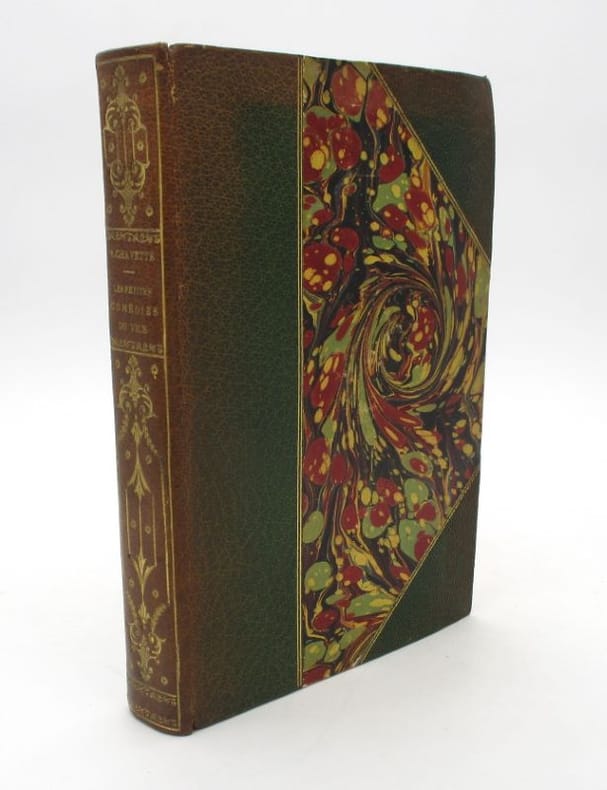
Les petites comédies du vice.
Paris, Lacroix, s.d. (1875). In-12 à grandes marges, non rogné, 323-(1) p., reliure demi-maroquin vert à coins, dos orné, vignettes dans le texte (Fleury), 7 planches hors-texte (dos insolé).
Referentie van de boekhandelaar : 6871
|
|
|
Chevalier Maurice,Fleury Jacques - Louiguy - Le Seyeux Jean,Willemetz Albert
Partition de la chanson : A Las Vegas Quincaillière de Chicago (La)
Partitions sur les États-Unis Hortensia 1956
Referentie van de boekhandelaar : 76261

|
|
|
Chiche Franck Fleury Georges
Je vous ai compris
Casterman 2013 168 pages 24x17x2cm. 2013. Album. 168 pages.
Referentie van de boekhandelaar : 28191

|
|
|
Chiche Franck Fleury Georges
Je vous ai compris
Casterman 2013 168 pages 24x17x2cm. 2013. Album. 168 pages.
Referentie van de boekhandelaar : 30742

|
|
|
CHOLLET sc - FLEURY del.
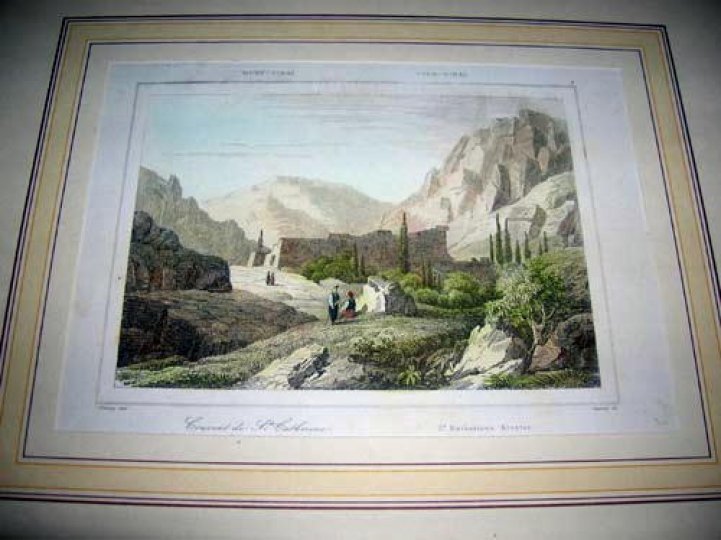
Gravure couleurs. Mont-Sinaï - Couvent de Ste. Catherine.
Gravure en couleurs. Mont-Sinaï - Couvent de Ste. Catherine. Vers 1850.Très bon état. Format in-8°(20x13) pour la gravure. Format in-4°(30x24) pour le passe-partout. Livré sans le passe-partout pour des raisons techniques.
Referentie van de boekhandelaar : 9091
|
|
|
Cholley (André) :
Études morphologiques sur le Jura méridional et l'île Crémieu. Influence de la tectonique hercynienne, surfaces tertiaires polygéniques.
In Annales de Géographie n°234 du 15 novembre 1932 ; in-8, broché ; pp. 561 à 582 et 3 planches hors-texte soit 6 photographies aériennes du capitaine Seive (Fleury).
Referentie van de boekhandelaar : 14918
|
|
|
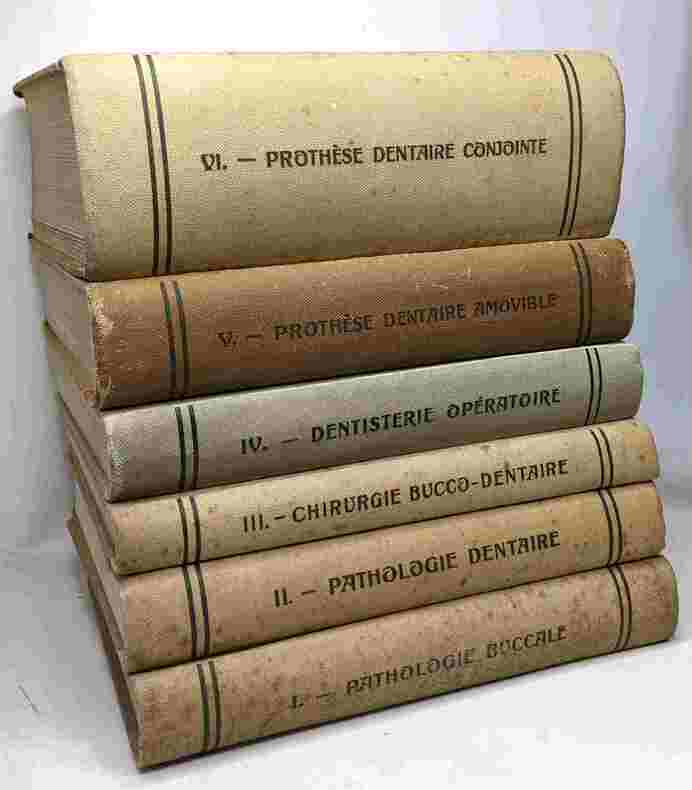
Chompret (ss La Direction) Guilly L'hirondel Thibault Nespoulous Dechaume Richard Bercher Fargin-Fayolle Fleury Friez Laicaisse
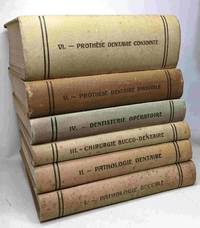
La pratique stomatologique - TOME 1 à 6 : Pathologie buccale Pathologie dentaire Technique chirurgicale bucco-dentaire Dentisterie opératoire Prothèse dentaire amovible Prothèse dentaire con
Masson et cie. couvertures défraîchies ternissures frottements rousseurs intérieurs propres. in8. Sans date. Cartonné. 7 volumes. La pratique stomatologique - TOME 1 à 6 de 1939 à 1941 : Pathologie buccale Pathologie dentaire Technique chirurgicale bucco-dentaire Dentisterie opératoire Prothèse dentaire amovible Prothèse dentaire conjointe abondante iconographie Masson et cie unknown
Referentie van de boekhandelaar : 100073662
|
|
|
Chompret (ss La Direction) Guilly L'hirondel Thibault Nespoulous Dechaume Richard Bercher Fargin-Fayolle Fleury Friez Laicaisse Rousseau-Decelle Raison Béliard
La pratique stomatologique - TOME 1 à 6 : Pathologie buccale + Pathologie dentaire + Technique chirurgicale bucco-dentaire + Dentisterie opératoire + Prothèse dentaire amovible + Prothèse dentaire con
Masson et cie in8. Sans date. Cartonné. 7 volume(s). La pratique stomatologique - TOME 1 à 6 (de 1939 à 1941) : Pathologie buccale + Pathologie dentaire + Technique chirurgicale bucco-dentaire + Dentisterie opératoire + Prothèse dentaire amovible + Prothèse dentaire conjointe abondante iconographie
Referentie van de boekhandelaar : 100073662
|
|
|
Christine Féret - Fleury
Les Vagues Sont Douces Comme Des Tigres
Arléa broché Bristol 1999 117 pages en format 13 - 19 cm Exemplaire de bibliothèque 2-86959-441-0
Referentie van de boekhandelaar : 038473
|
|
|
Christine Féret - Fleury
Sept Péchés
Arléa broché Bristol 2003 104 pages en format 13 - 19 cm 2-86959-635-9
Referentie van de boekhandelaar : 039783
|
|
|
Cize-Bolozon :
Photographie aérienne
en noir et blanc (14,5 x 19 cm) datant des années 1930 (capitaine Fleury Seive, photographe) ; vue générale à haute altitude du viaduc de Cize-Bolozon construit en 1875 (il sera dynamité par la Résistance et reconstruit en 1950) ; le barrage qui se situe un peu en amont n'était pas encore construit ; ce cliché montre admirablement la boucle de l'Ain.
Referentie van de boekhandelaar : 14905
|
|
|
Claude Fleury
A Short History of the Ancient Israelites: With an Account of Their Manners Customs Laws Polity Religion Sects Arts and Trades 1802
New. unknown
Referentie van de boekhandelaar : B9781164549369 ISBN : 1164549367 9781164549369

|
|
|
Claude Fleury
Abregé de l'Histoire Ecclesiastique de Mr. L'Abbé Fleury Vol. 2: Contenant les V. Et Vi. Siècles Classic Reprint French Edition
paperback. Good. Access codes and supplements are not guaranteed with used items. May be an ex-library book. paperback
Referentie van de boekhandelaar : 0259571822.G ISBN : 0259571822 9780259571827

|
|
|
Claude Fleury
Abregé de l'Histoire Ecclesiastique de Mr. L'Abbé Fleury Vol. 2: Contenant les V. Et Vi. Siècles Classic Reprint French Edition
hardcover. Good. Access codes and supplements are not guaranteed with used items. May be an ex-library book. hardcover
Referentie van de boekhandelaar : 0666720053.G ISBN : 0666720053 9780666720054

|
|
|
Claude Fleury
Abregé de l'Histoire Ecclesiastique Vol. 3: Contenant les VII. VIII. Et IX. Siècles Classic Reprint French Edition
hardcover. Good. Access codes and supplements are not guaranteed with used items. May be an ex-library book. hardcover
Referentie van de boekhandelaar : 0666663432.G ISBN : 0666663432 9780666663436
|
|
|
Claude Fleury
Abrégé de l'Histoire Ecclésiastique de M. L'Abbé Fleury Vol. 1: Contenant la Suite du XVI. Siécle Depuis l'Année 1596. Jusques à l'Année 1600.; Et du . Pontificat d'Alexandre VII French Edition
paperback. Good. Access codes and supplements are not guaranteed with used items. May be an ex-library book. paperback
Referentie van de boekhandelaar : 0259589241.G ISBN : 0259589241 9780259589242
|
|
|
Claude Fleury
Abrégé de l'Histoire Ecclésiastique Vol. 7: Contenant la Fin du XV. Siècle Depuis l'Année 1447 Jusques à l Année 1500 Et du XVI Depuis l'Année . 1555 Classic Reprint French Edition
paperback. Good. Access codes and supplements are not guaranteed with used items. May be an ex-library book. paperback
Referentie van de boekhandelaar : 0259800562.G ISBN : 0259800562 9780259800569
|
|
|
Claude Fleury
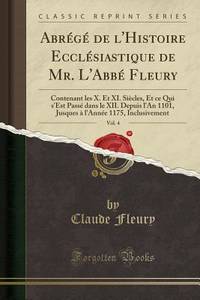
Abrégé de l'Histoire Ecclésiastique de Mr. L'Abbé Fleury Vol. 4: Contenant les X. Et XI. Siècles Et ce Qui s'Est Passé dans le XII. Depuis l'An . Classic Reprint French Edition
paperback. Good. Access codes and supplements are not guaranteed with used items. May be an ex-library book. paperback
Referentie van de boekhandelaar : 0259831638.G ISBN : 0259831638 9780259831631
|
|
|
Claude Fleury
Abrégé de l'Histoire Ecclésiastique de Mr. L'Abbé Fleury Vol. 1: Contenant les I. II. III. Et IV. Siècles Classic Reprint French Edition
paperback. Good. Access codes and supplements are not guaranteed with used items. May be an ex-library book. paperback
Referentie van de boekhandelaar : 0259814202.G ISBN : 0259814202 9780259814207

|
|
|
Claude Fleury
Abrégé de l'Histoire Ecclésiastique Vol. 7: Contenant la Fin du XV. Siècle Depuis l'Année 1447 Jusques à l'Année 1500 Et du XVI Depuis l'Année . 1555 Classic Reprint French Edition
hardcover. Good. Access codes and supplements are not guaranteed with used items. May be an ex-library book. hardcover
Referentie van de boekhandelaar : 0332547213.G ISBN : 0332547213 9780332547213

|
|
|
Claude Fleury
Abrégé de l'Histoire Ecclésiastique de Mr. L'Abbé Fleury Vol. 4: Contenant les X. Et XI. Siècles Et ce Qui s'Est Passé dans le XII. Depuis l'An . Classic Reprint French Edition
hardcover. Good. Access codes and supplements are not guaranteed with used items. May be an ex-library book. hardcover
Referentie van de boekhandelaar : 0331992930.G ISBN : 0331992930 9780331992939

|
|

 De zoekresultaten per email ontvangen
 Zoekresultaten downloaden als PDF
 RSS feed
 Permanente link


