|
|
|
DEREK [ISIDOR] KARTUN, (1919-2005).
[FIRST ARABIC EDITION OF 'AFRICA! AFRICA!' BY EDITOR OF THE DAILY WORKER] Ifriqiyah! Ifriqiyah! Qarat taqif ali qidmihâ. [i.e. Africa! Africa! A continent rises to its feet]. Translated by Ahmed Fouad Balbaa; Review by Hassan Lotfi Al-Manfalouti.
Very Good Arabic Half leather bound in Egyptian style raised six bands to spine, Arabic lettered gilt in second and fourth. 'Abdelzehar Binding' stamp on back endpaper. Roy. 8vo. (24 x 17 cm). In Arabic. 179, [1] p. First Arabic edition of Kartun's 'Africa! Africa! A continent rises to its feet' which describes the struggle for freedom in British colonial Africa in the face of horrible pressures. ABOUT THE AUTHOR: Kartun was the improbable combination of a leftist activist, a captain of industry, a Daily Worker journalist and an author of spy thrillers. Kartun was the son of a Russian-French father and a Polish-English mother. He was born into the world of the cultured bourgeoisie, his uncle being the pianist and conductor Léon Kartun. His father had left Paris Conservatoire when he realized that he would not be one of the great violinists of his generation, and went on to become a successful designer and trader of jewelry. He was sent to England for his schooling, first to a prep school in Redhill, where the combination of being bookish, Jewish, and French proved a hindrance to popularity, and then to St Paul's, where he instead flourished and claimed to be the school's first Jewish boy. As what should have been his sixth form years coincided with a temporary reversal of his father's fortunes, and he was set to work in an advertising agency, later on finding himself working a job on writing scripts for B movies for MGM, where he met Claude Cockburn (see separate entry). Becoming a contributor to Cockburn's scurrilous newssheet The Week merely led him into the Communist Party for the next two decades of his life. Bad eyesight confined him to civilian duties during the war but he wrote several books while in the Communist Party, including Tito's plot against Europe: The story of the Raik Conspiracy (1949), This is America (1947), and Africa, Africa! (1954). He became foreign editor of The Daily Worker, writing for the Party on a wide range of allied themes. He contributed a piece on the French political scene in April 1946 for Raji Dutt's Labour Monthly, when he replaced his brother, Clemens Dutt in March 1945 and joined the staff of the Daily Worker for the first time as its European correspondent, based in Paris. He was initially expelled from France by the Ministry of the Interior only a few hours after arriving! Kartun later covered the birth of the state of Israel, being present during the Siege of Jerusalem in April 1948. (Source: Independent - Obituary: Derek Kartun). [FIRST ARABIC EDITION OF 'AFRICA! AFRICA!' BY EDITOR OF THE DAILY WORKER] Ifriqiyah! Ifriqiyah! Qarat taqif ali qidmihâ. [i.e. Africa! Africa! A continent rises to its feet]. Translated by Ahmed Fouad Balbaa; Review by Hassan Lotfi Al-Manfalouti. ???????-??????? ???? ??? ??? ?????? One copy located in OCLC: 949535161 (Fondation du Roi Abdul-Aziz Al Saoud pour les Etudes Islamiques et les Sciences Humaines / King Abdul-Aziz Al Saoud Foundation for Islamic Studies and Human Sciences - Casablanca).
|
|
|
DERENBOURG (Hartwig) et SPIRO (Jean).
Chrestomathie élémentaire de l?arabe littéral. Avec un glosaire.
Paris, Ernest Leroux, 1895, 18?5 x 12?5 cm., p.e., XII págs. + 1 h. ? 220 págs. (Las primeras 68 págs. escritas en árabe, el glosario ocupa desde la página 69 al fin de la obra).
|
|
|
DESPARMET J.
Arabe dialectal d'après la méthode directe. Première partie: vocabulaire et lectures
Alger, Adolphe Jourdan 1907 xii + 206pp., 2e édition, 22cm., reliure cart. d'éditeur, bon état, X118284
Referentie van de boekhandelaar : X118284
|
|
|
DESSON Henri
Ce qu'il faut connaître de l'Islam.
Paris, Boivin, Editeur, 1932. 12 x 18, 160 pp., broché, bon état (couverture défraîchie).
Referentie van de boekhandelaar : 49992
|
|
|
DESCOINS (Général)
L' Equitation arabe. Ses principes - sa pratique.
Paris, Limoges, Nancy, Charles-Lavauzelle et Cie, éditeurs militaires, 1924, 1ère édition, broché, 14,5x23 cm, 167 pages, illustré de XV planches. (en annexe : harnachement des spahis)
Referentie van de boekhandelaar : 3858
|
|
|
DESTREE A., MEKHITARIAN A., Nicolaï, ORLOFF N. et alii
L'Afrique méditérranéenne. Unité et Diversité.
Bruxelles, Ateliers d'art graphique Meddens, 1977. 25 x 29, 208 pp., 145 illustrations en N/B et en couleurs, cartonnage éditeur illustré, très bon état
Referentie van de boekhandelaar : 63221
|
|
|
Deshayes Julien
La chapelle Saint-Germain de Querqueville [Manche] un édifice phare de la Normandie médiévale
ANTIQ NORMANDIE 2014 58 pages in8. 2014. Broché. 58 pages.
Referentie van de boekhandelaar : 100139369

|
|
|
DESJARDINS Thierry et PIRENNE Jacqueline
Yemen, Nord, Sud.
Paris, Editions Richer-Hoa-Qui/Vilo, 1986. 21 x 31, 127 pp., très nombreuses illustrations en couleurs, reliure d'édition carton + jaquette, très bon état.
Referentie van de boekhandelaar : 36420
|
|
|
DESJARDINS, Thierry.
CIEN MILLONES DE ARABES.
23x16. 308p. Trad. P. Ballús y J. Llobet. Enc. Cart. ed.

|
|
|
DESJARDINS, Thierry.
CIEN MILLONES DE ARABES.
23x16. 308p. Trad. P. Ballús y J. Llobet. Enc. Cart. ed. sobrecubierta.

|
|
|
DESTHIEUX Jean
La conscience m?diterrane.
Broch?. 208 pages.
|
|
|
DEVENS André
Le roman de l'Emir Séif, d'après les anciens textes orientaux.
Paris, Edition d'Art H. Piazza, 1925. 13 x 19, 232 pp., broché, couverture rempliée, bon état (dos abîmé).
Referentie van de boekhandelaar : 88073
|
|
|
Devens (André)
Le Roman de l'Emir Séif, d'après les anciens textes orientaux.
Paris Piazza 1925 Un volume in-8 reliure de l'éditeur en pleine basane noisette, dos à nerfs, titre doré, décor estampé sur le dos et sur les plats, tête dorée, couverture conservée, 230 pp. et table. Ex-libris manuscrit en page de faux-titre, dos légèrement frotté, néanmoins bel exemplaire.
Referentie van de boekhandelaar : 10282

|
|
|
DEVENS, Andre.
Le Roman de l’Émir Seif. D’après les anciens textes orientaux. Ornementation dessinee par P. ZENKER.
in-12, X-229 pages, notes, biblio, broche, couverture illustree Bel exemplaire [CA32-8]
|
|
|
DHORME P. (Père, O P.)
Langues et écritures sémitiques. Collection : Etudes sémitiques.
Paris, Librairie Orientaliste, Paul Geuthner, 1930. 16 x 24, 75 pp., reliure large dos percaline brune, tranches mouchetées, couverture conservée (avant-arrière), très bon état (sans aucune rousseur, ni annotation).
Referentie van de boekhandelaar : 105.426
|
|
|
Di Branco, Marco
Alessandro Magno Eroe Arabo Nel Medioevo
Mm 150x210 Piccoli Saggi. Brossura editoriale di pagine 150. nuovo. SPEDIZIONE IN 24 ORE DALLA CONFERMA DELL'ORDINE.

|
|
|
DIB Mohammed,
Cours sur la rive sauvage,
Seuil, 1957, édition originale non justifiée, 205 pp., broché, couverture légèrement défraîchie avec quelques rousseurs, état correct.
Referentie van de boekhandelaar : 68158

|
|
|
DIB, Mohammed.
O VIVE. Poemes.
in-8, 133 pp., broche, couv. pell. a rabats.- ISBN 2727401442 Tres bel exemplaire. [HA-4]
|
|
|
DIDERAL Jean
Egypte, mes yeux, mon solei (roman).
Paris, Les Editeurs Français Réunis, 1969. 12 x 19, 320 pp., broché, bon état.
Referentie van de boekhandelaar : 28924
|
|
|
DIDIER Charles
500 lieues sur le Nil
- Hachette & Cie, Paris 1858, 12x19,5cm, relié. - Edition originale. Reliure en demi chagrin marron, dos à quatre nerfs sertis de guirlandes dorées orné de caissons dorés, initiales dorées en queue, plats de papier marbré marginalement décolorés, gardes et contreplats de papier à la cuve, légers frottements sur les coupes, reliure de l'époque. Quelques petites rousseurs. [ENGLISH DESCRIPTION ON DEMAND]

|
|
|
DIDIER Charles
Séjour chez le grand-Chérif de La Mekke
- Hachette & Cie, Paris 1857, 11x18cm, relié. - Edition originale. Reliure en demi chagrin maroquiné chocolat, dos très légèrement passé à cinq nerfs comportant d'infimes traces de frottements sans gravité, plats de papier marbré, gardes et contreplats de papier à la cuve, tête rouge. Petites rousseurs éparses. Rare. [ENGLISH DESCRIPTION ON DEMAND]
|
|
|
DIEN
DESCRIPTION DE L'EGYPTE. Botanique. Crepis hispidula, Crepis senecioides, Santolina fragrantissima. (Histoire Naturelle, planche 42)
Imprimerie Impériale | Paris 1809-1829 | 71 x 54 cm | une feuille
Referentie van de boekhandelaar : 26433
|
|
|
DIEN
DESCRIPTION DE L'EGYPTE. Botanique. Spartium thebaicum, Indigofera paucifolia, Psoralea plicata. (Histoire Naturelle, planche 37)
Imprimerie Impériale | Paris 1809-1829 | 71 x 54 cm | une feuille
Referentie van de boekhandelaar : 26453
|
|
|
DIEN
DESCRIPTION DE L'EGYPTE. Botanique. Picris pilosa, Picris altissima. (Histoire Naturelle, planche 41)
Imprimerie Impériale | Paris 1809-1829 | 71 x 54 cm | une feuille
Referentie van de boekhandelaar : 26456
|
|
|
Diem (Werner)
Wurzelrepetition Und Wunschsatz. Untersuchungen Zur Stilgeschichte Des Arabischen Dokuments Des 7. Bis 20. Jahrhunderts.
allemand Fort in-8 de XI-863 pp.; cartonné toile à la Bradel de l'éditeur.
|
|
|
DIEN
DESCRIPTION DE L'EGYPTE. Botanique. Crepis hispidula, Crepis senecioides, Santolina fragrantissima. (Histoire Naturelle, planche 42)
- Imprimerie Impériale, Paris 1809-1829, 71x54cm, une feuille. - Original, unshaved, full-page etching from the "Imperial edition" of the Description de l'Égypte, or 'Recueil des observations et recherches faites en Égypte pendant l'expédition française, publié par les ordres de Sa Majesté l'Empereur Napoléon le Grand [A Collection of the observations and research carried out in Egypt during the French expedition, published on the orders of his Majesty the Emperor Napoleon the Great]'. Produced between February 1802 and 1830 on the orders of Naopleon Bonaparte and published between 1809 and 1828, 1,000 copies were printed and distributed to institutions, on vergé paper with an 'Égypte ancienne et moderne' watermark, visible when held up to the light. Light marginal spotting not touching image, otherwise in very fresh, fine condition. An engraving from the Description de l'Egypte, one of the masterpieces of French printing and the birth of a new field: Egyptology. A gigantic survey of Egypt at the time of Bonaparte's conquests in 1798 and 1799, the work is divided into 13 volumes of engravings making up 892 plates, of which 72 colored, as well as presenting the splendors of the Egypt of the Pharaohs in 9 volumes. The other volumes discuss natural history and present a fascinating portrait of Coptic and Islamic Egypt as it was seen by Bonaparte's Eastern Armies. The 'Egyptian campaign', militarily a disaster, demonstrates, through the engravings of the Description d'Egypte, the scientific success it nonetheless became thanks to the 167 expert members of the Commission of the Sciences and Arts of the Institut d'Egypte [Egyptian Institute] who followed Napoleon's army. The Institut gathered together in Egypt the mathematician Monge, the chemist Berthollet, the naturalist Geoffroy Saint-Hilaire as well as numerous artists, engineers, architects and doctors. They were tasked with re-discovering modern and ancient Egypt and displaying its natural treasures as well as the know-how of its inhabitants. This edition, the so-called "Imperial" edition of the plates for the Description de l'Egypte was printed in four large formats, two of which were specially created for it and christened "Moyen-Egypte" and "Grand-Egypte". A special press was built to print it, the process extending over 20 years, from 1809 to 1829. The "Imperial" edition proved so popular that a second edition, this time in black and white and without the "Egypte ancienne et moderne" watermark - known as the "Royal Edition" - was published during the Restoration by the printing house of C.-L.-F. Panckoucke (Paris). The engravings of the Description d'Egypte owe a great deal to Baron Dominique-Vivant Denon, illustrator, diplomat, collector and later Director of the Musée Napoléon (the Louvre). His exploration of the South of Egypt gave Bonaparte the idea of sending the experts of the Institut there, thus creating a faithful and complete portrait of the area. This was the research gathered together from 1802 in the mammoth Description de L'Egypte. Denon embarked on this story of archeological exploration at the age of 51, reaching first Alexandria and then Cairo before exploring Upper Egypt. Along with the members of the Institut d'Egypte, the Natural History Museum's painter H.J. Redouté (brother of Pierre-Joseph Redouté, author of Roses), the mineralogist Dolomiue, and the draughtsman Joly, Denon then explored the Nile Delta and Lower Egypt. When, however, he joined the 21st Light Infantry Regiment as it marched across Upper Egypt in pursuit of the retreating Mameluks in November 1798, he found himself the only civilian. In the very midst of the battle itself, he reeled off sketches of the works of art that peppered his path right up to the threshold of the Sudan. He said that he had crossed "a country that is, apart from its name, entirely unknown to Europeans, and therefore everything was worth describing" (Voyages dans la Basse et la Haute Egypte pendant le

|
|
|
DIEN
DESCRIPTION DE L'EGYPTE. Botanique. Picris pilosa, Picris altissima. (Histoire Naturelle, planche 41)
- Imprimerie Impériale, Paris 1809-1829, 71x54cm, une feuille. - Original, unshaved, full-page etching from the "Imperial edition" of the Description de l'Égypte, or 'Recueil des observations et recherches faites en Égypte pendant l'expédition française, publié par les ordres de Sa Majesté l'Empereur Napoléon le Grand [A Collection of the observations and research carried out in Egypt during the French expedition, published on the orders of his Majesty the Emperor Napoleon the Great]'. Produced between February 1802 and 1830 on the orders of Naopleon Bonaparte and published between 1809 and 1828, 1,000 copies were printed and distributed to institutions, on vergé paper with an 'Égypte ancienne et moderne' watermark, visible when held up to the light. Light marginal spotting not touching image, otherwise in very fresh, fine condition. An engraving from the Description de l'Egypte, one of the masterpieces of French printing and the birth of a new field: Egyptology. A gigantic survey of Egypt at the time of Bonaparte's conquests in 1798 and 1799, the work is divided into 13 volumes of engravings making up 892 plates, of which 72 colored, as well as presenting the splendors of the Egypt of the Pharaohs in 9 volumes. The other volumes discuss natural history and present a fascinating portrait of Coptic and Islamic Egypt as it was seen by Bonaparte's Eastern Armies. The 'Egyptian campaign', militarily a disaster, demonstrates, through the engravings of the Description d'Egypte, the scientific success it nonetheless became thanks to the 167 expert members of the Commission of the Sciences and Arts of the Institut d'Egypte [Egyptian Institute] who followed Napoleon's army. The Institut gathered together in Egypt the mathematician Monge, the chemist Berthollet, the naturalist Geoffroy Saint-Hilaire as well as numerous artists, engineers, architects and doctors. They were tasked with re-discovering modern and ancient Egypt and displaying its natural treasures as well as the know-how of its inhabitants. This edition, the so-called "Imperial" edition of the plates for the Description de l'Egypte was printed in four large formats, two of which were specially created for it and christened "Moyen-Egypte" and "Grand-Egypte". A special press was built to print it, the process extending over 20 years, from 1809 to 1829. The "Imperial" edition proved so popular that a second edition, this time in black and white and without the "Egypte ancienne et moderne" watermark - known as the "Royal Edition" - was published during the Restoration by the printing house of C.-L.-F. Panckoucke (Paris). The engravings of the Description d'Egypte owe a great deal to Baron Dominique-Vivant Denon, illustrator, diplomat, collector and later Director of the Musée Napoléon (the Louvre). His exploration of the South of Egypt gave Bonaparte the idea of sending the experts of the Institut there, thus creating a faithful and complete portrait of the area. This was the research gathered together from 1802 in the mammoth Description de L'Egypte. Denon embarked on this story of archeological exploration at the age of 51, reaching first Alexandria and then Cairo before exploring Upper Egypt. Along with the members of the Institut d'Egypte, the Natural History Museum's painter H.J. Redouté (brother of Pierre-Joseph Redouté, author of Roses), the mineralogist Dolomiue, and the draughtsman Joly, Denon then explored the Nile Delta and Lower Egypt. When, however, he joined the 21st Light Infantry Regiment as it marched across Upper Egypt in pursuit of the retreating Mameluks in November 1798, he found himself the only civilian. In the very midst of the battle itself, he reeled off sketches of the works of art that peppered his path right up to the threshold of the Sudan. He said that he had crossed "a country that is, apart from its name, entirely unknown to Europeans, and therefore everything was worth describing" (Voyages dans la Basse et la Haute Egypte pendant le

|
|
|
DIEN
DESCRIPTION DE L'EGYPTE. Botanique. Spartium thebaicum, Indigofera paucifolia, Psoralea plicata. (Histoire Naturelle, planche 37)
- Imprimerie Impériale, Paris 1809-1829, 71x54cm, une feuille. - Original, unshaved, full-page etching from the "Imperial edition" of the Description de l'Égypte, or 'Recueil des observations et recherches faites en Égypte pendant l'expédition française, publié par les ordres de Sa Majesté l'Empereur Napoléon le Grand [A Collection of the observations and research carried out in Egypt during the French expedition, published on the orders of his Majesty the Emperor Napoleon the Great]'. Produced between February 1802 and 1830 on the orders of Naopleon Bonaparte and published between 1809 and 1828, 1,000 copies were printed and distributed to institutions, on vergé paper with an 'Égypte ancienne et moderne' watermark, visible when held up to the light. Light marginal spotting not touching image, otherwise in very fresh, fine condition. An engraving from the Description de l'Egypte, one of the masterpieces of French printing and the birth of a new field: Egyptology. A gigantic survey of Egypt at the time of Bonaparte's conquests in 1798 and 1799, the work is divided into 13 volumes of engravings making up 892 plates, of which 72 colored, as well as presenting the splendors of the Egypt of the Pharaohs in 9 volumes. The other volumes discuss natural history and present a fascinating portrait of Coptic and Islamic Egypt as it was seen by Bonaparte's Eastern Armies. The 'Egyptian campaign', militarily a disaster, demonstrates, through the engravings of the Description d'Egypte, the scientific success it nonetheless became thanks to the 167 expert members of the Commission of the Sciences and Arts of the Institut d'Egypte [Egyptian Institute] who followed Napoleon's army. The Institut gathered together in Egypt the mathematician Monge, the chemist Berthollet, the naturalist Geoffroy Saint-Hilaire as well as numerous artists, engineers, architects and doctors. They were tasked with re-discovering modern and ancient Egypt and displaying its natural treasures as well as the know-how of its inhabitants. This edition, the so-called "Imperial" edition of the plates for the Description de l'Egypte was printed in four large formats, two of which were specially created for it and christened "Moyen-Egypte" and "Grand-Egypte". A special press was built to print it, the process extending over 20 years, from 1809 to 1829. The "Imperial" edition proved so popular that a second edition, this time in black and white and without the "Egypte ancienne et moderne" watermark - known as the "Royal Edition" - was published during the Restoration by the printing house of C.-L.-F. Panckoucke (Paris). The engravings of the Description d'Egypte owe a great deal to Baron Dominique-Vivant Denon, illustrator, diplomat, collector and later Director of the Musée Napoléon (the Louvre). His exploration of the South of Egypt gave Bonaparte the idea of sending the experts of the Institut there, thus creating a faithful and complete portrait of the area. This was the research gathered together from 1802 in the mammoth Description de L'Egypte. Denon embarked on this story of archeological exploration at the age of 51, reaching first Alexandria and then Cairo before exploring Upper Egypt. Along with the members of the Institut d'Egypte, the Natural History Museum's painter H.J. Redouté (brother of Pierre-Joseph Redouté, author of Roses), the mineralogist Dolomiue, and the draughtsman Joly, Denon then explored the Nile Delta and Lower Egypt. When, however, he joined the 21st Light Infantry Regiment as it marched across Upper Egypt in pursuit of the retreating Mameluks in November 1798, he found himself the only civilian. In the very midst of the battle itself, he reeled off sketches of the works of art that peppered his path right up to the threshold of the Sudan. He said that he had crossed "a country that is, apart from its name, entirely unknown to Europeans, and therefore everything was worth describing" (Voyages dans la Basse et la Haute Egypte pendant le

|
|
|
DIGNE Danielle
Le joaillier d'Ispahan.
Paris, Editions Le Passage, 2011. 15 x 20, 263 pp., quelques illustrations en N/B, broché, couverture à rabats, très bon état.
Referentie van de boekhandelaar : 85785
|
|
|
DIJAN Jean-Michel
Les manuscrits de Tombouctou, secrets, mythes et réalités.
Paris, JC Lattès, 2012. 18 x 24, 189 pp., très nombreuses illustrations en couleurs, broché, couverture à rabats, très bon état.
Referentie van de boekhandelaar : 102.890
|
|
|
DINET Etienne et BEN IBRAHIM Slimane
La vie de Muhammad.
Bruxelles, Ravda, 2006. 14 x 21, 352 pp., broché, très bon état.
Referentie van de boekhandelaar : 60852
|
|
|
DINET Etienne et BEN IBRAHIM Slimane
La vie de Muhammad.
Ravda, 2006. 14 x 20, 352 pp., broché, très bon état.
Referentie van de boekhandelaar : 84037
|
|
|
DINET ETIENNE SLIMAN BEN IBRAHIM
TABLEAUX DE LA VIE ARABE
H. Piazza et Cie éditeurs, Paris, s.d. In8 broché, illustrations sur papier couché, 193 p. Exemplaire non coupé . -
Referentie van de boekhandelaar : 989

|
|
|
DINET (E.) et SLIMAN BEN IBRAHIM.
Tableaux de la vie arabe. Composition de E. Dinet.
Paris, , Piazza, , (vers 1908) ; petit in-4° , cuir fauve, dos orné, tête dor., non rogné, couv. (Reliure de l’époque.) 4 ff., 193 pp., 2ff. "Portrait de Dinet et 25 planches hors-texte en noir de tableaux d’Etienne Dinet; l’une d’elles est un portrait de Sliman Ben Ibrahim. – Scènes de la vie arabe, légendes etc."
Referentie van de boekhandelaar : 46401455
|
|
|
Diogène - revue trimestrielle publiée sous les auspices du Conseil International de la Philosophie et des sciences humaines et avec l'aide de l'UNESCO
DIOGENE N° 39 de 1962 - revue trimestrielle publiée sous les auspices du Conseil International de la Philosophie et des sciences humaines et avec l'aide de l'UNESCO / GallimardPROBLEMES NOUVEAUX EN SOCIOLOGIE : La conquête spatiale et la souveraineté nationale ( François Perroux ) - L'objectivité dans les sciences sociales : problèmes historiques et perspectives d'avenir ( Irving L. Horowitz ) - Considérations théoriques sur la notion de " société de masse " ( Edward Shils ) - L'école des réformateurs ou quelques considérations sur l'opportunité historique ( Alfred Sauvy ) - L'acculturation, thème de la littérature arabe contemporaine ( G. E. Von Grunebaum ) - Sociologie de la connaissance et radio-télévisison ( Jean Cazeneuve )
In 8 - Broché - N° 39 de 1962
Referentie van de boekhandelaar : 24732
|
|
|
DIOLE Philippe
Le plus beau désert du monde.
Paris, Albin Michel, 1955. 14 x 19, 187 pp., 32 illustrations en N/B, 2 planches en couleurs, 1 carte, broché, bon état (couverture défraîchie).
Referentie van de boekhandelaar : 96671
|
|
|
Divers
Catalogue de l'exposition - Trésors fatimides du Caire
Institut du monde arabe, 1998. Format 21x21 cm, 239 pages.
Referentie van de boekhandelaar : 49485

|
|
|
Diyab, Ahmad Muhammad
Khawatir wa-dhikrayat diblumasiyah
Hardcover quarto with red spine. 423 pages : illustrations ; 24 cm In Arabic. Uncommon. || Diyab, Ahmad Muhammad; memoires; political. Ambassadors -- Sudan -- Biography.
|
|
|
DJAMI, MASSE (Henri).
Le Béharistan. Traduit pour la première fois du persan en français par Henri Massé.
Paris Paul Geuthner, coll. "Les joyaux de l'Orient" 1925 1 vol. broché in-8, broché, 233 pp., index (couverture un peu défraîchie).
Referentie van de boekhandelaar : 100804
|
|
|
DJAMI, MASSE (Henri).
Le Béharistan. Traduit pour la première fois du persan en français par Henri Massé.
Paris Paul Geuthner, coll. "Les joyaux de l'Orient" 1925 1 vol. broché in-8, broché, 233 pp., index (couverture un peu défraîchie).
Referentie van de boekhandelaar : 100804
|
|
|
DJALAL OD DIN RUMI
RUBAI YAT
ALBIN MICHEL. 1987. In-8. Broché. Très bon état, Couv. convenable, Dos satisfaisant, Intérieur frais. 224 pages. . . . Classification Dewey : 492.7-Arabe
Referentie van de boekhandelaar : R200051790
|
|
|
DJEBRAÏL ABOU
LIVRE DE LA MARCHE EN AVANT EVIDENTE DANS LA SCIENCE DE L'ARABE, OUVRAGE EN ARABE (VOIR PHOTOS), 2 PARTIES
Non précisé. 1899. In-8. Broché. Etat d'usage, Tâchée, Coiffe en tête abîmée, Intérieur acceptable. Texte en arabe (sens de lecture original droite-gauche). Etiquette de code sur la couverture. Quelques tampons et annotations de bibliothèque. Quelques annotations dans le texte.. . . . Classification Dewey : 492.7-Arabe
Referentie van de boekhandelaar : RO40261036
|
|
|
DJEBRAÏL ABOU
LIVRE DE LA MARCHE EN AVANT EVIDENTE DANS LA SCIENCE DE L'ARABE, OUVRAGE EN ARABE (VOIR PHOTOS), 2 PARTIES
Non précisé. 1899. In-8 Carré. Broché. Etat d'usage. Tâchée. Coiffe en tête abîmée. Intérieur acceptable. Texte en arabe (sens de lecture original droite-gauche). Etiquette de code sur la couverture. Quelques tampons et annotations de bibliothèque. Quelques annotations dans le texte.

|
|
|
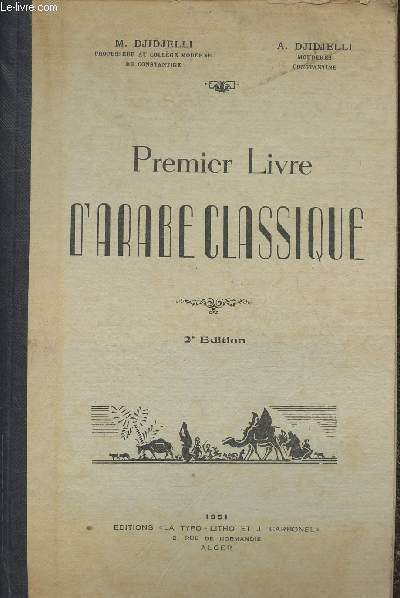
Djidjelli M. et A.
Premier livre d'Arabe classique
La Typo-Litho/ J. Carbonel. 1951. In-8. Cartonné. Etat d'usage, Couv. défraîchie, Coiffe en tête abîmée, Papier jauni. 218 pages.Quelques schémas en noir et blanc, dans le texte. Texte style manuscrit. Coins frottés et déchirues sur les plats Texte en arabe et Français.. . . . Classification Dewey : 492.7-Arabe
Referentie van de boekhandelaar : RO30329712
|
|
|
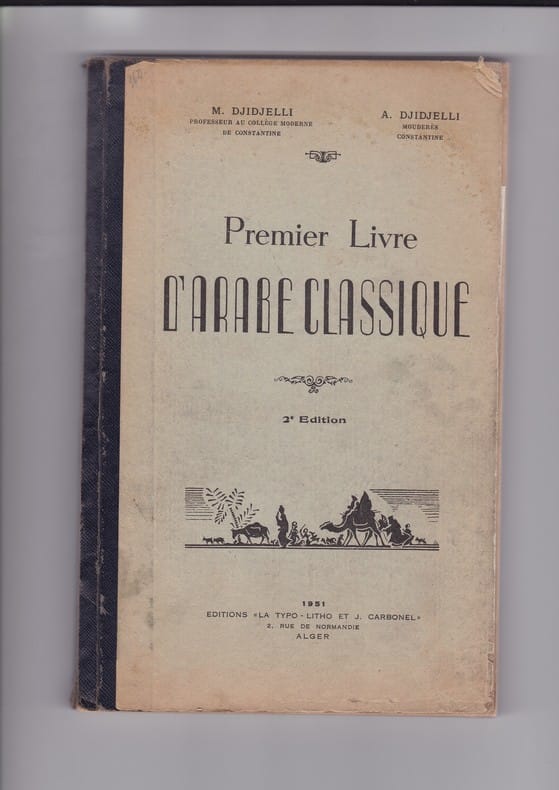
Djidjelli
Premier livre - l'Arabe classique
Alger carbonel 1951 Grand In8 - cartonnage de l'éditeur - 2e édition - 1951 - 218 pages - couverture défraichie sans gravité
Referentie van de boekhandelaar : 15Fd
|
|
|
Djidjelli
Premier livre - l'Arabe classique
Alger carbonel 1951 Grand In8 - cartonnage de l'éditeur - 2e édition - 1951 - 218 pages - couverture défraichie sans gravité
Referentie van de boekhandelaar : 15Fd
|
|
|
Docteur E. RENARD
Hammam R'hira près d'Alger - Station thermo-minérale d'été et d'hiver
Imprimerie Cerf | Paris 1900 | 15 x 21.50 cm | broché
Referentie van de boekhandelaar : 80395
|
|
|
Docteur L. CAPOLEONE
Une réponse à M. de Kératry, à propos de son ouvrage intitulé : Mourad V, prince-sultan-prisonnier d'état
S. n. | Contantinople 1878 | 16.50 x 24 cm | broché
Referentie van de boekhandelaar : 80394
|
|
|
DOMENECH Abbé
Les Secrets De Ma Valise, Voyages et Souvenirs
Lyon Vitte 1895 In-8 408 pp, petit impact sur les premiers ff
Referentie van de boekhandelaar : 25839
|
|
|
Dominique VIVANT DENON - DUFRENE (sculpsit) - PILLEMENT FILS (sculpsit)
Voyage dans la Basse et Haute Egypte : Abou-faqir, ou mendiants égyptiens. Vue de l'intérieur de la mosquée de St Athanase. Colonne de Pompée. Obélisque de Cléopâtre. (Planche 9).<br />
Didot | Paris 1803 | 40 x 54 cm | une feuille
Referentie van de boekhandelaar : 29627
|
|
|

 De zoekresultaten per email ontvangen
 Zoekresultaten downloaden als PDF
 RSS feed
 Permanente link


