|
|
|
LE RUMEUR Guy
Le Sahara avant le pétrole. Collection : Connaissance de l'Afrique.
Paris, Société Continentale d'Editions Modernes Illustrées, 1964. 16 x 24, 333 pp., 64 planches en héliogravure, 8 planches en couleurs, 17 cartes et croquis, reliure d'édition pleine toile, bon état.
Riferimento per il libraio : 45385
|
|
|
Learn Arabic in a Flash ! !
Learn Arabic in a Flash
Fine. Learn Arabic in a Flash ! NO Box or BOOK included. Flawless Disc in fine case/art. No box or book included! FAST Daily Shipping! H-7 unknown
Riferimento per il libraio : 7H-6B46-WAM5
|
|
|
LEBKIRI Moussa
"Il parlait à son balai; d'après un fait divers rapporté par Pierre Bellemare."
Paris, L'Harmattan, 1992. 14 x 22, 62 pp., broché, bon état.
Riferimento per il libraio : 45382
|
|
|
Leclerc Lucien
Histoire de la médecine arabe. Exposé complet des traductions du grec. Les Sciences en Orient, leur transmission à l'Occident par les traductions latines (Tome 2)
Paris, Ernest Leroux, éditeur Broché 1876 In-8 (16 x 24,5 cm), broché, 526 paget bords des plats usés, mouillure en début d'ouvrage et quelques brunissures à l'intérieur, état moyen. Livraison a domicile (La Poste) ou en Mondial Relay sur simple demande.
Riferimento per il libraio : za1187

|
|
|
LECLERC, Dr. Lucien
HISTOIRE DE LA MÉDECINE ARABE. Exposé complet des traductions du grec - Les sciences en Orient, leur transmission en Occident par les traductions latines. Tomes 1-2
Rabat Edité par Ministère des Habous et des Affaires Islamiques 1980 in 8 (23,5x15,5) 1 fort volume reliure demi basane havane, dos à nerfs soulignés de filets dorés, pièces de titre de cuir noir, 587 pages, 525 pages [2]. Réimpression en fac-similé de l'édition originale publiée chez Leroux en 1876. Bel exemplaire ( Photographies sur demande / We can send pictures of this book on simple request )
Riferimento per il libraio : 37846
|
|
|
LECLERCQ E. P.
Nous légionnaires.
Anvers, Imprimerie L. F. De Vos, s.d. (ca 1945). "14 x 22, 117 pp., plusieurs illustrations, broché, état moyen (couverture défraîchie; pages 105 et 109 avec des accrocs)."
Riferimento per il libraio : 48525
|
|
|
LECOMTE G - GHEDIRA A
METHODE D'ARABE LITTERAL
Paris, Klincksieck 1966. In-8 cartonné de IV + 242 pages. Carte.
|
|
|
LECOMTE G - GHEDIRA A
Méthode d'arabe littéral
Klincksieck Paris, Klincksieck, 1966. In-8 relié cartonné éditeur illustrée de IV + 242 pages. Carte. Bon état
Riferimento per il libraio : 189553

|
|
|
LECOMTE G. et A. GHEDIRA
Méthode d'arabe litteral. Premier livre.
1988 Paris, Klincksieck, 1988, volume in-8 broché, 242 pages, très bon état
Riferimento per il libraio : 3910
|
|
|
LECOMTE G?rard - GHEDIRA Ameur
M?thode d'arabe litt?ral. 1er livre. (Etudes arabes et islamiques).
Broch?. 242 pages.
|
|
|
LECOMTE GERARD / CHEDIRA AMEUR
"GRAMMAIRE DE L'ARABE - N°1275 DE LA COLLECTION ""QUE SAIS JE ?."
PRESSES UNIVERSITAIRES DE FRANCE. 1968. In-12. Broché. Bon état, Couv. convenable, Dos satisfaisant, Intérieur frais. 125 + 8 pages. Plats tres legerement frottés.. . . . Classification Dewey : 492.7-Arabe
Riferimento per il libraio : R320082116
|
|
|
LECOMTE GERARD / CHEDIRA AMEUR
GRAMMAIRE DE L'ARABE - N°1275 DE LA COLLECTION "QUE SAIS JE ?.
PRESSES UNIVERSITAIRES DE FRANCE. 1968. In-12 Carré. Broché. Bon état. Couv. convenable. Dos satisfaisant. Intérieur frais. 125 + 8 pages. Plats tres legerement frottés.
|
|
|
LECOMTE Gérard
Grammaire de l'arabe. Collection : Que sais-je ?, N° 1275.
Paris, Presses Universitaires de France, 1980. 11 x 18, 128 pp., broché, très bon état.
Riferimento per il libraio : 102.261 ISBN : 2130365620
|
|
|
LECOMTE Henry
Les textiles végétaux des colonies
- In La revue coloniale, Paris Mars-Juillet 1896, 16x25cm, relié. - Edition originale. Reliure en demi toile sapin, dos lisse muet, plats de papier marbré comportant de petites taches de décoloration, quelques accrocs sur les coupes, reliure de l'époque. Envoi autographe signé de l'auteur à monsieur Méline président du Conseil et ministre de l'agriculture. Gardes ombrées. [ENGLISH DESCRIPTION ON DEMAND]
|
|
|
LEDUC Pascal
Yémen, péninsule arabique : Arabie Saoudite, Oman, Emirats arabes unis, Qatar, Bahrein, Koweit. Guides Marcus.
Paris,Editions Marcus, 1988. 12 x 19, 64 pp., quelques cartes et illustrations, broché, bon état.
Riferimento per il libraio : 89902
|
|
|
LEE CHILDE Blanche
Impressions de voyage. Alexandrie et le Caire. La Haute Egypte
- Extraits de la Revue des deux mondes, s.l. (Paris) 1882, 15,5x25cm, agrafé. - First edition. Plain paper cover. Rare. [FRENCH VERSION FOLLOWS] Edition originale. Sous couverture muette. Rare.
|
|
|
LEGENTIL & JOMARD Edme-François & LANCRET & CHABROL & CHAILLY (sculpsit)
DESCRIPTION DE L'EGYPTE. Thèbes. Bybân el Molouk. Sujets mystérieux et détails de costumes, peints dans le cinquième tombeau des rois à l'est et dans d'autres tombeaux. (ANTIQUITES, volume II, planche 86)
- Imprimerie Impériale, Paris 1809-1829, 71x53,5cm, une feuille. - Original, unshaved, full-page etching from the "Imperial edition" of the Description de l'Égypte, or 'Recueil des observations et recherches faites en Égypte pendant l'expédition française, publié par les ordres de Sa Majesté l'Empereur Napoléon le Grand [A Collection of the observations and research carried out in Egypt during the French expedition, published on the orders of his Majesty the Emperor Napoleon the Great]'. Produced between February 1802 and 1830 on the orders of Naopleon Bonaparte and published between 1809 and 1828, 1,000 copies were printed and distributed to institutions, on vergé paper with an 'Égypte ancienne et moderne' watermark, visible when held up to the light. Light marginal spotting not touching image, otherwise in very fresh, fine condition. An engraving from the Description de l'Egypte, one of the masterpieces of French printing and the birth of a new field: Egyptology. A gigantic survey of Egypt at the time of Bonaparte's conquests in 1798 and 1799, the work is divided into 13 volumes of engravings making up 892 plates, of which 72 colored, as well as presenting the splendors of the Egypt of the Pharaohs in 9 volumes. The other volumes discuss natural history and present a fascinating portrait of Coptic and Islamic Egypt as it was seen by Bonaparte's Eastern Armies. The 'Egyptian campaign', militarily a disaster, demonstrates, through the engravings of the Description d'Egypte, the scientific success it nonetheless became thanks to the 167 expert members of the Commission of the Sciences and Arts of the Institut d'Egypte [Egyptian Institute] who followed Napoleon's army. The Institut gathered together in Egypt the mathematician Monge, the chemist Berthollet, the naturalist Geoffroy Saint-Hilaire as well as numerous artists, engineers, architects and doctors. They were tasked with re-discovering modern and ancient Egypt and displaying its natural treasures as well as the know-how of its inhabitants. This edition, the so-called "Imperial" edition of the plates for the Description de l'Egypte was printed in four large formats, two of which were specially created for it and christened "Moyen-Egypte" and "Grand-Egypte". A special press was built to print it, the process extending over 20 years, from 1809 to 1829. The "Imperial" edition proved so popular that a second edition, this time in black and white and without the "Egypte ancienne et moderne" watermark - known as the "Royal Edition" - was published during the Restoration by the printing house of C.-L.-F. Panckoucke (Paris). The engravings of the Description d'Egypte owe a great deal to Baron Dominique-Vivant Denon, illustrator, diplomat, collector and later Director of the Musée Napoléon (the Louvre). His exploration of the South of Egypt gave Bonaparte the idea of sending the experts of the Institut there, thus creating a faithful and complete portrait of the area. This was the research gathered together from 1802 in the mammoth Description de L'Egypte. Denon embarked on this story of archeological exploration at the age of 51, reaching first Alexandria and then Cairo before exploring Upper Egypt. Along with the members of the Institut d'Egypte, the Natural History Museum's painter H.J. Redouté (brother of Pierre-Joseph Redouté, author of Roses), the mineralogist Dolomiue, and the draughtsman Joly, Denon then explored the Nile Delta and Lower Egypt. When, however, he joined the 21st Light Infantry Regiment as it marched across Upper Egypt in pursuit of the retreating Mameluks in November 1798, he found himself the only civilian. In the very midst of the battle itself, he reeled off sketches of the works of art that peppered his path right up to the threshold of the Sudan. He said that he had crossed "a country that is, apart from its name, entirely unknown to Europeans, and therefore everything was worth describing" (Voyages dans la Basse et la Haute Egypte pendant

|
|
|
LEGENTIL & JOMARD Edme-François & LANCRET & CHABROL & CHAILLY (sculpsit)
DESCRIPTION DE L'EGYPTE. Thèbes. Bybân el Molouk. Sujets mystérieux et détails de costumes, peints dans le cinquième tombeau des rois à l'est et dans d'autres tombeaux. (ANTIQUITES, volume II, planche 86)
- Imprimerie Impériale, Paris 1809-1829, 71x53,5cm, une feuille. - Original, unshaved, full-page etching from the "Imperial edition" of the Description de l'Égypte, or 'Recueil des observations et recherches faites en Égypte pendant l'expédition française, publié par les ordres de Sa Majesté l'Empereur Napoléon le Grand [A Collection of the observations and research carried out in Egypt during the French expedition, published on the orders of his Majesty the Emperor Napoleon the Great]'. Produced between February 1802 and 1830 on the orders of Naopleon Bonaparte and published between 1809 and 1828, 1,000 copies were printed and distributed to institutions, on vergé paper with an 'Égypte ancienne et moderne' watermark, visible when held up to the light. Light marginal spotting not touching image, otherwise in very fresh, fine condition. An engraving from the Description de l'Egypte, one of the masterpieces of French printing and the birth of a new field: Egyptology. A gigantic survey of Egypt at the time of Bonaparte's conquests in 1798 and 1799, the work is divided into 13 volumes of engravings making up 892 plates, of which 72 colored, as well as presenting the splendors of the Egypt of the Pharaohs in 9 volumes. The other volumes discuss natural history and present a fascinating portrait of Coptic and Islamic Egypt as it was seen by Bonaparte's Eastern Armies. The 'Egyptian campaign', militarily a disaster, demonstrates, through the engravings of the Description d'Egypte, the scientific success it nonetheless became thanks to the 167 expert members of the Commission of the Sciences and Arts of the Institut d'Egypte [Egyptian Institute] who followed Napoleon's army. The Institut gathered together in Egypt the mathematician Monge, the chemist Berthollet, the naturalist Geoffroy Saint-Hilaire as well as numerous artists, engineers, architects and doctors. They were tasked with re-discovering modern and ancient Egypt and displaying its natural treasures as well as the know-how of its inhabitants. This edition, the so-called "Imperial" edition of the plates for the Description de l'Egypte was printed in four large formats, two of which were specially created for it and christened "Moyen-Egypte" and "Grand-Egypte". A special press was built to print it, the process extending over 20 years, from 1809 to 1829. The "Imperial" edition proved so popular that a second edition, this time in black and white and without the "Egypte ancienne et moderne" watermark - known as the "Royal Edition" - was published during the Restoration by the printing house of C.-L.-F. Panckoucke (Paris). The engravings of the Description d'Egypte owe a great deal to Baron Dominique-Vivant Denon, illustrator, diplomat, collector and later Director of the Musée Napoléon (the Louvre). His exploration of the South of Egypt gave Bonaparte the idea of sending the experts of the Institut there, thus creating a faithful and complete portrait of the area. This was the research gathered together from 1802 in the mammoth Description de L'Egypte. Denon embarked on this story of archeological exploration at the age of 51, reaching first Alexandria and then Cairo before exploring Upper Egypt. Along with the members of the Institut d'Egypte, the Natural History Museum's painter H.J. Redouté (brother of Pierre-Joseph Redouté, author of Roses), the mineralogist Dolomiue, and the draughtsman Joly, Denon then explored the Nile Delta and Lower Egypt. When, however, he joined the 21st Light Infantry Regiment as it marched across Upper Egypt in pursuit of the retreating Mameluks in November 1798, he found himself the only civilian. In the very midst of the battle itself, he reeled off sketches of the works of art that peppered his path right up to the threshold of the Sudan. He said that he had crossed "a country that is, apart from its name, entirely unknown to Europeans, and therefore everything was worth describing" (Voyages dans la Basse et la Haute Egypte pendant

|
|
|
LEGENTIL & LE ROY
DESCRIPTION DE L'EGYPTE. Thèbes. Bybân el Molouk. Tableau astronomique peint au plafond du premier tombeau des rois à l'ouest. (ANTIQUITES, volume II, planche 82)
- Imprimerie Impériale, Paris 1809-1829, 71x53,5cm, une feuille. - Original, unshaved, full-page etching from the "Imperial edition" of the Description de l'Égypte, or 'Recueil des observations et recherches faites en Égypte pendant l'expédition française, publié par les ordres de Sa Majesté l'Empereur Napoléon le Grand [A Collection of the observations and research carried out in Egypt during the French expedition, published on the orders of his Majesty the Emperor Napoleon the Great]'. Produced between February 1802 and 1830 on the orders of Naopleon Bonaparte and published between 1809 and 1828, 1,000 copies were printed and distributed to institutions, on vergé paper with an 'Égypte ancienne et moderne' watermark, visible when held up to the light. Light marginal spotting not touching image, otherwise in very fresh, fine condition. An engraving from the Description de l'Egypte, one of the masterpieces of French printing and the birth of a new field: Egyptology. A gigantic survey of Egypt at the time of Bonaparte's conquests in 1798 and 1799, the work is divided into 13 volumes of engravings making up 892 plates, of which 72 colored, as well as presenting the splendors of the Egypt of the Pharaohs in 9 volumes. The other volumes discuss natural history and present a fascinating portrait of Coptic and Islamic Egypt as it was seen by Bonaparte's Eastern Armies. The 'Egyptian campaign', militarily a disaster, demonstrates, through the engravings of the Description d'Egypte, the scientific success it nonetheless became thanks to the 167 expert members of the Commission of the Sciences and Arts of the Institut d'Egypte [Egyptian Institute] who followed Napoleon's army. The Institut gathered together in Egypt the mathematician Monge, the chemist Berthollet, the naturalist Geoffroy Saint-Hilaire as well as numerous artists, engineers, architects and doctors. They were tasked with re-discovering modern and ancient Egypt and displaying its natural treasures as well as the know-how of its inhabitants. This edition, the so-called "Imperial" edition of the plates for the Description de l'Egypte was printed in four large formats, two of which were specially created for it and christened "Moyen-Egypte" and "Grand-Egypte". A special press was built to print it, the process extending over 20 years, from 1809 to 1829. The "Imperial" edition proved so popular that a second edition, this time in black and white and without the "Egypte ancienne et moderne" watermark - known as the "Royal Edition" - was published during the Restoration by the printing house of C.-L.-F. Panckoucke (Paris). The engravings of the Description d'Egypte owe a great deal to Baron Dominique-Vivant Denon, illustrator, diplomat, collector and later Director of the Musée Napoléon (the Louvre). His exploration of the South of Egypt gave Bonaparte the idea of sending the experts of the Institut there, thus creating a faithful and complete portrait of the area. This was the research gathered together from 1802 in the mammoth Description de L'Egypte. Denon embarked on this story of archeological exploration at the age of 51, reaching first Alexandria and then Cairo before exploring Upper Egypt. Along with the members of the Institut d'Egypte, the Natural History Museum's painter H.J. Redouté (brother of Pierre-Joseph Redouté, author of Roses), the mineralogist Dolomiue, and the draughtsman Joly, Denon then explored the Nile Delta and Lower Egypt. When, however, he joined the 21st Light Infantry Regiment as it marched across Upper Egypt in pursuit of the retreating Mameluks in November 1798, he found himself the only civilian. In the very midst of the battle itself, he reeled off sketches of the works of art that peppered his path right up to the threshold of the Sudan. He said that he had crossed "a country that is, apart from its name, entirely unknown to Europeans, and therefore everything was worth describing" (Voyages dans la Basse et la Haute Egypte pendant

|
|
|
LEGENTIL - Edme-François JOMARD - Michel Ange LANCRET
DESCRIPTION DE L'EGYPTE. Thèbes. Bybân el Molouk. Sujets mystérieux et détails de costumes, peints dans le cinquième tombeau des rois à l'est et dans d'autres tombeaux. (ANTIQUITES, volume II, planche 86)
Imprimerie Impériale | Paris 1809-1829 | 71 x 53.50 cm | une feuille
Riferimento per il libraio : 26094
|
|
|
LEGENTIL - Edme-François JOMARD - Michel Ange LANCRET
DESCRIPTION DE L'EGYPTE. Thèbes. Bybân el Molouk. Sujets mystérieux et détails de costumes, peints dans le cinquième tombeau des rois à l'est et dans d'autres tombeaux. (ANTIQUITES, volume II, planche 86)
Imprimerie Impériale | Paris 1809-1829 | 71 x 53.50 cm | une feuille
Riferimento per il libraio : 32829
|
|
|
LEGENTIL - LE ROY
DESCRIPTION DE L'EGYPTE. Thèbes. Bybân el Molouk. Tableau astronomique peint au plafond du premier tombeau des rois à l'ouest. (ANTIQUITES, volume II, planche 82)
Imprimerie Impériale | Paris 1809-1829 | 71 x 53.50 cm | une feuille
Riferimento per il libraio : 26090
|
|
|
LEGRAND (Maxime) :
La vallée du Nil. Époque contemporaine.
Paris, Librairie Firmin Didot, sans date (1892). In-8, 253[dont faux-titre et titre]-(1) pp.-(1) f.[table], demi chagrin vieux rouge, orné de filets, de caissons décorés « à la grotesque » et du titre, dorés, plats encadrés à froid, fer de lycée (ors très passés) sur le plat supérieur (reliure de l’éditeur : traces de décoloration sur les plats ; rousseurs et quelques taches éparses ; exemplaire correct, décoratif). « Ouvrage illustré de 50 gravures », dont la moitié hors –texte compris dans la pagination, bois rarement signés. Imprimé sur papier teinté.
Riferimento per il libraio : E147

|
|
|
LEGUEST abbé
Moyen de rechercher la signification primitive des racines arabes et par suite des racines sémitiques
Paris, Benjamin Duprat 1860 xii + 146 + [2] pp., Edition originale de 1860, 25cm., brochure originale, texte et intérieur sont frais, bon état, X119704
Riferimento per il libraio : X119704
|
|
|
LELONG M.-H., O.P.
Le Sahara aux cent visages.
Paris, Editions Alsatia, 1945. 16 x 25, 305 pp., quelques illustrations en N/B, reliure d'édition dos/coins rexine verte, couverture conservée (avant-arrière), bon état.
Riferimento per il libraio : 103.820
|
|
|
LELONG Michel
J'ai rencontré l'Islam.
Paris, le Cerf, 1975. 13 x 19, 174 pp., broché, bon état.
Riferimento per il libraio : 17969
|
|
|
LEMERCIER Adrien, d'après Washington IRVING
CONQUETE DE GRENADE
Tours, Mame - Broché - 1841 - In-8 ° - 312 pages - Trous de lvers pages 301 à 312 n'altérant pas le texte - Orné de 4 Gravures sur acier. Propre. Autre exemplaire : 18 €
|
|
|
LEMERCIER Adrien, d'après Washington IRVING
CONQUETE DE GRENADE
Tours, Mame - Broché - 1841 - In-8 ° - 312 pages - Trous de lvers pages 301 à 312 n'altérant pas le texte - Orné de 4 Gravures sur acier. Propre.
Riferimento per il libraio : 972
|
|
|
LEMMET J.
Le sud algérien au point de vue agricole et économique
- Imprimerie Minerva, Alger 1931, 16x24,5cm, agrafé. - Edition originale. Envoi autographe de J. Lemmet sur le premier plat. Iconographie. Piqûres marginales sur les plats, agréable état intérieur. Rare. [ENGLISH DESCRIPTION ON DEMAND]
|
|
|
LENOIR & SMITH Constantin(aqua forti)
DESCRIPTION DE L'EGYPTE. Papyrus. Hiéroglyphes. Inscriptions et médailles. Inscriptions hiéroglyphiques et coiffures copiées à Denderah. (ANTIQUITES, volume V, planche 49)
- Imprimerie Impériale, Paris 1809-1829, 53,5x71cm, une feuille. - Original, unshaved, full-page etching from the "Imperial edition" of the Description de l'Égypte, or 'Recueil des observations et recherches faites en Égypte pendant l'expédition française, publié par les ordres de Sa Majesté l'Empereur Napoléon le Grand [A Collection of the observations and research carried out in Egypt during the French expedition, published on the orders of his Majesty the Emperor Napoleon the Great]'. Produced between February 1802 and 1830 on the orders of Naopleon Bonaparte and published between 1809 and 1828, 1,000 copies were printed and distributed to institutions, on vergé paper with an 'Égypte ancienne et moderne' watermark, visible when held up to the light. Light marginal spotting not touching image, otherwise in very fresh, fine condition. An engraving from the Description de l'Egypte, one of the masterpieces of French printing and the birth of a new field: Egyptology. A gigantic survey of Egypt at the time of Bonaparte's conquests in 1798 and 1799, the work is divided into 13 volumes of engravings making up 892 plates, of which 72 colored, as well as presenting the splendors of the Egypt of the Pharaohs in 9 volumes. The other volumes discuss natural history and present a fascinating portrait of Coptic and Islamic Egypt as it was seen by Bonaparte's Eastern Armies. The 'Egyptian campaign', militarily a disaster, demonstrates, through the engravings of the Description d'Egypte, the scientific success it nonetheless became thanks to the 167 expert members of the Commission of the Sciences and Arts of the Institut d'Egypte [Egyptian Institute] who followed Napoleon's army. The Institut gathered together in Egypt the mathematician Monge, the chemist Berthollet, the naturalist Geoffroy Saint-Hilaire as well as numerous artists, engineers, architects and doctors. They were tasked with re-discovering modern and ancient Egypt and displaying its natural treasures as well as the know-how of its inhabitants. This edition, the so-called "Imperial" edition of the plates for the Description de l'Egypte was printed in four large formats, two of which were specially created for it and christened "Moyen-Egypte" and "Grand-Egypte". A special press was built to print it, the process extending over 20 years, from 1809 to 1829. The "Imperial" edition proved so popular that a second edition, this time in black and white and without the "Egypte ancienne et moderne" watermark - known as the "Royal Edition" - was published during the Restoration by the printing house of C.-L.-F. Panckoucke (Paris). The engravings of the Description d'Egypte owe a great deal to Baron Dominique-Vivant Denon, illustrator, diplomat, collector and later Director of the Musée Napoléon (the Louvre). His exploration of the South of Egypt gave Bonaparte the idea of sending the experts of the Institut there, thus creating a faithful and complete portrait of the area. This was the research gathered together from 1802 in the mammoth Description de L'Egypte. Denon embarked on this story of archeological exploration at the age of 51, reaching first Alexandria and then Cairo before exploring Upper Egypt. Along with the members of the Institut d'Egypte, the Natural History Museum's painter H.J. Redouté (brother of Pierre-Joseph Redouté, author of Roses), the mineralogist Dolomiue, and the draughtsman Joly, Denon then explored the Nile Delta and Lower Egypt. When, however, he joined the 21st Light Infantry Regiment as it marched across Upper Egypt in pursuit of the retreating Mameluks in November 1798, he found himself the only civilian. In the very midst of the battle itself, he reeled off sketches of the works of art that peppered his path right up to the threshold of the Sudan. He said that he had crossed "a country that is, apart from its name, entirely unknown to Europeans, and therefore everything was worth describing" (Voyages dans la Basse et la Haute Egypte pendant

|
|
|
LENOIR - Constantin SMITH (aqua forti)
DESCRIPTION DE L'EGYPTE. Papyrus. Hiéroglyphes. Inscriptions et médailles. Inscriptions hiéroglyphiques et coiffures copiées à Denderah. (ANTIQUITES, volume V, planche 49)
Imprimerie Impériale | Paris 1809-1829 | 53.50 x 71 cm | une feuille
Riferimento per il libraio : 26218
|
|
|
LENTIN Jerome & GRAND'HENRY Jacques (eds.)
Moyen arabe et variétés mixtes de l'arabe à travers l'histoire. Actes du Premier Colloque International (Louvain-la-Neuve, 10-14 mai 2004)
lxxxvii + 508pp., brochure originale, 26cm., dans la série "Publications de l'Institut orientaliste de Louvain (PIOL)" volume 58, contient des articles en langues diverses, très bon état (état de neuf), X93241
|
|
|
LENTIN Jerome & GRAND'HENRY Jacques (eds.)
Moyen arabe et variétés mixtes de l'arabe à travers l'histoire. Actes du Premier Colloque International (Louvain-la-Neuve, 10-14 mai 2004)
Louvain-la-Neuve, Institut Orientaliste 2008 lxxxvii + 508pp., brochure originale, 26cm., dans la série "Publications de l'Institut orientaliste de Louvain (PIOL)" volume 58, contient des articles en langues diverses, très bon état (état de neuf), X93241
Riferimento per il libraio : X93241
|
|
|
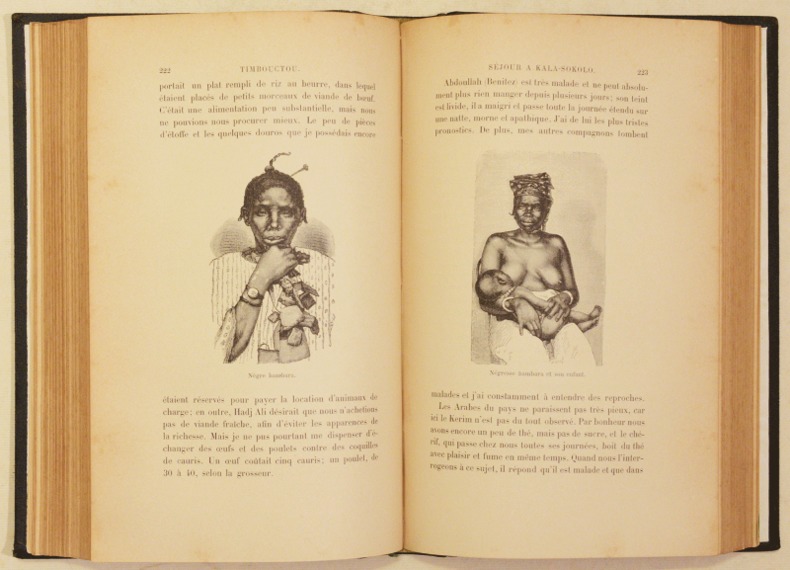
LENZ (Dr Oskar).
TIMBOUCTOU [TOMBOUCTOU]. Voyage au Maroc, au Sahara et au Soudan. Traduit de l'allemand avec l'autorisation de l'auteur par Pierre Lehautcourt et contenant 27 gravures et une carte. [2 volumes].
1886 Paris, Hachette, 1886. Deux volumes in-8 (166 X 245 mm) demi-chagrin vert lierre, plats de toile chagrinée ornés d'encadrements à froid, dos quatre nerfs plats, caissons dorés, auteur, titre et tomaison dorés, tranches dorées (reliure de l'éditeur). Tome I : (2) ff. blancs, XII-467 pages, une planche dépliante, (2) ff. blancs - Tome II : (2) ff. blancs, (2) ff. de faux-titre et titre, 438 pages, 1 carte couleurs dépliante, 4 planches à double page, (2) ff. blancs. Quelques rousseurs, très éparses, plus marquées sur les premiers feuillets de chaque volume, début de fente de 5 cm en tête du mors supérieur du tome I, déchirure sans manque à la carte dépliante.
Riferimento per il libraio : 004571
|
|
|
LEROY BEAULIEU Anatole
L'Egypte et le contrôle anglais français
- Extrait de la Revue des deux mondes, s.l. (Paris) 1882, 15,5x25cm, agrafé. - First edition. Plain paper cover. Rare. [FRENCH VERSION FOLLOWS] Edition originale. Sous couverture muette. Rare.
|
|
|
LEROY BEAULIEU Anatole
Les réformes de la Turquie. La politique russe et le panslavisme
- Extrait de la Revue des deux mondes, s.l. (Paris) 1876, 15,5x25cm, agrafé. - First edition. Plain paper cover. Rare. [FRENCH VERSION FOLLOWS] Edition originale. Sous couverture muette. Rare.
|
|
|
Les Cahiers de l'Orient - Revue d'étude et de réflexion sur le monde arabe et islamique - Direction de la rédaction : Antoine J. Sfeir
Les Cahiers de l'Orient : Algérie. La descente aux enfers- Le document de Rome- L'armée - Les groupes armés- Le FIS- L'Economie- La France - Les Etats-Unis(Kader Abderrahim, François Clémenceau, Rachid Tlemçani, Bruno Callis de Salie, Ammar Belhimer, Marie-Lucy Dumas, Naïma et Roland Laffite, Khadidja Abada, Tarik Mira...)
N° 36/37 - 4ème trimestre 94/1er trimestre 1995 - broché - 324 pages
Riferimento per il libraio : 31334
|
|
|
Les Cahiers de l'Orient - Revue d'étude et de réflexion sur le Liban et le monde arabe - Direction de la rédaction : Antoine J. Sfeir
Les Cahiers de l'Orient N° 3 : Dossier : L'Islam en France (Hervé Terrel) - Économie : La dette des pays arabes (Yves Gazzo) - Terrorisme : Pourquoi, qui et comment ? (Jean de Bernière) - Marseille, voyage en Islam (Anna Clerc)
1986 N° 3 - Troisième trimestre 1986 - In-8, broché - 303 pages
Riferimento per il libraio : 126873

|
|
|
LES COLLECTIONS ARABES DES MIRACLES DE LA SAINTE VIERGE
Les Collections Arabes des Miracles de la Sainte Vierge.
S.N. S.L. S.D. In-8 ( 250 X 175 mm ) de 74 pages, broché sous couverture imprimée. Couvertures muettes, titre manuscrit. Bel exemplaire.
Riferimento per il libraio : 920902

|
|
|
LESPES (René)
Alger. Etude de Géographie et d'Histoire urbaines.
In-4 (235 x 185 mm), broché, couverture cartonnée imprimée de l'éditeur, 860, (1) p, 16 planches de photographies, 21 planches d'illustrations, 4 cartes et plans dont dépliants. Paris, Félix Alcan, 1930.
Riferimento per il libraio : 38977

|
|
|
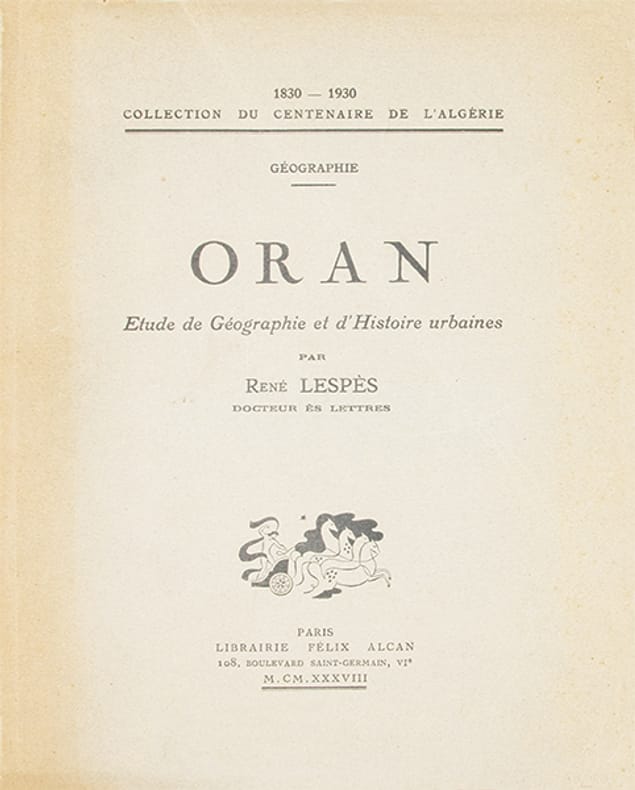
LESPES (René)
Oran. Etude de Géographie et d'Histoire urbaines.
In-4 (235 x 185 mm), broché, couverture cartonnée imprimée de l'éditeur, 509, (1) p, 8 planches hors texte et 24 cartes et plans dépliants dont un très grand en couleurs d'Oran. Paris, Félix Alcan (imprimé sur les presses de F. Fontana, Alger), 1938.
Riferimento per il libraio : 38976
|
|
|
LETANG GEORGES NICOLAS MARIE (GENERAL. 1788-1864).
RESUME DU SYSTEME DE M. LE GENERAL LETANG SUR L’ALGERIE.
PARIS. CHEZ ANSELIN, LIBRAIRE POUR L’ART MILITAIRE. AVRIL 1843. BROCHURE IN-12 (12,5 X 16 X 0,5 CENTIMETRES ENVIRON) DE 69 PAGES, COUVERTURE JAUNE, TITRE IMPRIME EN NOIR. OUVRAGE PEU COURANT. PETITES TACHES SUR LE PLAT SUPERIEUR DE LA COUVERTURE, SINON BON EXEMPLAIRE.
Riferimento per il libraio : 3568
|
|
|
LEURS Pol et MERTENS Edouard
Au pays des rivières mortes.
Bruxelles, Lucien De Meyer, 1962 16 x 21, 150 pp., 8 quadrichromies et 23 photographies, broché, bon état
Riferimento per il libraio : 7789
|
|
|
LEURS Pol et MERTENS Edouard
Au Pays des rivières mortes.
Bruxelles, Editions Arts et Voyages, Lucien De Meyer, 1962. 16 x 21, 149 pp., 8 quadrichromies et 23 planches, broché, bon état.
Riferimento per il libraio : 30406
|
|
|
LEURS Pol et MERTENS Edouard
Au pays des rivières mortes.
Bruxelles, Editions Arts et Voyages, Lucien de Meyer, 1962. 16 x 21, 150 pp., 8 quadrichromies et 23 photographies, broché, bon état (couverture défraîchie).
Riferimento per il libraio : 60853
|
|
|
Levey, Martin
Substitute Drugs in Early Arabic Medicine with Special Reference to the Texts of Masarjawaih, Al-Razi, and Pythagoras. By Martin Levey. (= Veröffentlichungen der Internationalen Gesellschaft für Geschichte der Pharmazie, Neue Folge, Band 37).
Stuttgart: Wissenschaftliche Verlagsgesellschaft 1971. 102 Seiten. 8° (17,5-22,5 cm). Orig.-Broschur. [Softcover / Paperback].
Riferimento per il libraio : 3125082

|
|
|
LEWIS Bernard
"Islam et laïcité; la naissance de la Turquie moderne."
Paris, Fayard, 1988. 16 x 24, 520 pp., 1 carte, broché, très bon état (cachet ex-particulier).
Riferimento per il libraio : 84359
|
|
|
LEWIS Bernard
"Islam, Collection : Quarto; 1. Sociétés musulmanes : les Arabes dans l'histoire; Race et esclavage au Proche-Orient; Juifs en terre d'Islam, ""comment l'Islam regardait l'Occident"", ""Masada et Cyrus le Grand""; 2. Les langages de l'Islam et la modernité : Le langage politique de l'Islam, Le retour de l'Islam, Que s'est-il passé ? L'Islam, L'Occident et la modernité. "
Paris, Gallimard, 2005. 14 x 21, 1337 pp., broché, très bon état.
Riferimento per il libraio : 103.812 ISBN : 2070774260
|
|
|
LEWIS Bernard
Le monde de l'Islam.
Anvers, Fonds Mercator, 1976 23 x 31, 367 pp., illustrations N/B et en couleurs, cartonnage éditeur + jaquette, très bon état
Riferimento per il libraio : 10015
|
|
|
LEWIS Bernard
Le monde de l'Islam.
Anvers, Fonds Mercator, 1976. 23 x 31, 367 pp., 505 illustrations en couleurs et en N/B, reliure d'édition pleine toile + jaquette, très bon état.
Riferimento per il libraio : 105.547
|
|
|

 Ricevere i risultati per e-mail
 Scaricare i risultati in PDF
 RSS feed
 Link
Link


