Il sito di sole librerie professionali

‎Leibniz‎

Main

Topic's parents ***

‎Philosophie‎
Numero di risultati : 1.682 (34 pagina/e)

[1] 2 3 4 5 6 7 ... 10 13 16 19 22 25 28 31 ... 34 Pagina successiva Ultima pagina

‎6. und 7. Leibniz-Festtage 2009/2010 : Predigten und Vorträge in der evangelisch-lutherischen Neustädter Hof- und Stadtkirche St. Johannis, Hannover ; Leibniz im Garten der Vernunft ; Glauben und Wissen.‎

‎Hannover, Hora-Verlag, 2011. 137 Seiten, H 21 x 15 cm, OKart. - Sehr guter Zustand. broschiert/ Taschenbuch/ paperback‎

Riferimento per il libraio : PHI965

‎Akten d. II. Internationalen Leibniz-Kongresses, Hannover, 17.-22. Juli 1972. Bd. 2: Wissenschaftstheorie u. Wissenschaftsgeschichte.‎

‎Wiesbaden, Steiner, 1974. 3 Bl., 325 S. Lwd. (Studia Leibnitiana. Suppl. 13).‎

Riferimento per il libraio : 606310

‎Bayle's & Leibniz' dröftelse af theodice-problemet - zwei Bände.‎

‎Köbenhavn Munksgaards Forlag, 1965. 745 S. 4° Quart Brosch. 2 Bände‎

‎En idehistorisk redegörelse af Leif Nedergaard-Hansen. I. del: Bayle. Med nogle traek af denne debats avspejling i dansk filosoferen fra Holberg til Kierkegaard. 482 S. II. del: Leibniz. 263 S. Der Vorderdeckel des ersten Bandes ist im unteren Bereich etwas knickspurig. Die Einbandkanten haben Randbestoßungen. Die unteren Kapitale sind bestoßen. Der Schnitt ist nicht beschnitten. Gute Exemplare. sehr guter Zustand‎

Riferimento per il libraio : 16412

‎Beiträge zur Leibniz-Forschung. Hrsg. v. G. Schischkoff.‎

‎Reutlingen, Gryphius, (1947). 240 S. OBr. Etwas berieben. St. a. Tit. (Monogr. z. philos. Forsch. 1).‎

Riferimento per il libraio : 605891

‎Geist d. Herrn v. Leibnitz oder auserlesene Gedanken üb. d. Religion, Moral, Sprachen u. Geschichte aus allen seinen Werken zusammengetragen. Dt. v. (L.L.W. Brunn). Bd. 1-2 (von 4) in 1.‎

‎Wittenberg, Zimmermann, 1775. 178 S., 4 Bl., 250 S. Ldr. d. Zt. Einbd. leicht berieben. Rücken gering beschäd.‎

Riferimento per il libraio : 606571

‎Leben und Werk von G.W. Leibniz. Eine Chronik. Bearbeitet von Kurt Müller und Gisela Krönert.‎

‎Frankfurt am Main, Klostermann 1969. 1969. Gr. 8°, 331 S. mit einigen s/w Tafeln. Orig.-Karton.‎

‎Erste Ausgabe.- (= Veröffentlichungen des Leibniz-Archivs Nr. 2).- Einband leicht lichtrandig. Gutes Exemplar.‎

Riferimento per il libraio : 94526

‎Leibniz (The) Renaissance. International Workshop (Firenze, 2-5 giugno 1986).‎

‎cm. 17 x 24, 308 pp. Biblioteca di storia della scienza Inglese 610 gr. 308 p.‎

‎Leibniz zu seinem 300. Geburtstag. 1646-1946. Mit Beiträgen von E. Benz, W. Conze, I. Döhl, K. Dürr, N. Hartmann (Leibniz als Metaphysiker), E. Hochstetter, J. E. Hofmann, R. F. Merkel, K. Reidemeister, J. Steudel, R. Zocher u.a. Lieferung 1-6 in 1 Band.‎

‎Berlin, Walter de Gruyter, 1946-1951. Gr.-8vo. Einzeln paginiert. Moderne Lwd. m. RSchild.‎

‎Beigebunden: Liselotte Richter: Leibniz und sein Rußlandbild. - Papier teils etw. gebräunt. Guter Band.‎

Riferimento per il libraio : 8526

‎Leibniz-Faksimiles. Bekanntes und Unbekanntes aus seinem Nachlaß. Übersetzt, transkribiert und erläutert mit Unterstützung der Niedersächsischen Landesbibliothek Hannover. Herausgegeben von der Stiftung Volkwagenwerk. Mit einem Beitrag von Joachim Otto Fleckenstein über Leibniz und die Wissenschaftlichen Akademien. 2 Bände.‎

‎Hildesheim/New York, Olm, 1971. 4°, VIII, 66 Seiten mit montiertem farbigen Titelportrait; 14 Faksimiles auf 24 losen, meist gefalteten Blättern. Orig.Karton / Mappe in illustrierter Orig.Pappkassette.‎

‎Numeriertes Exemplar 463 (von ?), als Jahresgabe an die Fördermitglieder verteilt. Textband mit Fußnoten. Unter den Faksimiles: Leibniz an Heinrich Brand (1678), Entwurf zur Konstruktionsverbesserung der Rechenmaschine (1682), Über dyadische Zahlen (1705), Leibniz an Kaiser Karl VI. (1713) - Kassette an den Kanten eingerissen und abgeschabt.‎

Riferimento per il libraio : 22467

‎Leibniz. Tradition und Aktualität. V. Internationaler Leibniz-Kongreß.. Vorträge. 2 Bde.‎

‎Hannover, Gottfried-Wilhelm-Leibniz-Gesellschaft 1988. 1080; 396 S. Original-Kartonband‎

‎Einband mit Knickspuren.‎

Riferimento per il libraio : 192117-1 ISBN : 398009782

‎Leibniz. Werk und Wirkung. IV. Internationaler Leibniz-Kongreß.. Vorträge. 2 Bde.‎

‎Hannover, Gottfried-Wilhelm-Leibniz-Gesellschaft 1983. 967; 246 S. Original-Kartonband‎

‎Gutes Exemplar.‎

Riferimento per il libraio : 192120-1

‎Spinozas Ethik und ihre frühe Wirkung. Herausgegeben von Konrad Cramer, Wilhelm G. Jacobs und .Wilhelm Schmidt-Biggemann. Vorträge gehalten anlässl. des 8. Wolfenbütteler Symposions vom 6. - 8. Dezember 1979 in der Herzog-August-Bibliothek.‎

‎Wolfenbüttel: Herzog August Bibliothek 1981. 130 S. 23 x 15 cm. Original-Broschur. (= Wolfenbütteler Forschungen. Herausgegeben von der Herzog August Bibliothek. Band 16.)‎

‎Erste Ausgabe. Gut erhalten. 3883730165‎

Riferimento per il libraio : 63929

‎"(TSCHIRNHAUS, EHRENFRIED W. von.). - URGING LEIBNIZ TO PUBLISH ON THE CALCULUS.‎

‎Methodus datae figurae, rectis lineis & curva Geometrica terminate, aut Quadraturam, aut impossibilitatem ejusdem Quadraturae determinandi. (+) Nova Methodus determinandi Maxima & Minima.‎

‎Leipzig, Grosse & Gleditsch, 1683. 4to. Without wrappers. In: ""Acta Eruditorum Anno MDCLXXXIII"", No.III + X (March and October issues). Pp. 81-128 + pp. 417-464 a. 2 engraved plates. (Entire issues offered). Tschirnhaus's papers: pp. 122-124 + pp. 433-437. Some browning as usual.‎

‎First appearance of Tschirnhaus's two papers in which he used infinitisimal methods which were very close to Leibniz's method and where he tried to lay down criteria for rational quadratures in the case of conic, cubic and quadratic curves, papers that led Leibniz to publish his first paper on the differential calculus, the ""Nova Methoda"" in the Acta for 1684 in order to secure his priority over Tschirnhaus concerning the calculus. Leibniz discovered, when he read Tschirnhaus' papers, that Tschirnhaus had here published results showing similarity with Leibniz's invention of the calculus as he had confided to Tschirnhaus earlier, during their Parisian stay, and this without references to Leibniz.The second issue contains an original paper by LEIBNIZ: ""Meditatio Juridico-Mathematica de Interusurio simplice"". Pp. 425-32.‎

Riferimento per il libraio : 45599

Livre Rare Book

Herman H. J. Lynge & Son
Copenhagen Denmark Dinamarca Dinamarca Danemark
[Books from Herman H. J. Lynge & Son]

€ 671,50 Informazioni/Compera

‎"[LEIBNIZ, GOTTFRIED WILHELM].‎

‎Collectanea Etymologica illustrationi linguarum veteris Celticae (+) Elogium Godofredi Guiliemi Leibnitii (+) Problema Posthum ab incomparabili Viro Perillustri Dn. Godefrido Guilielmo Lib (+) Notitia de Historia Brunsuicensi. - [LEIBNITZ'S OBITUARY BY WOLFF IN ACTA ERUDITORUM]‎

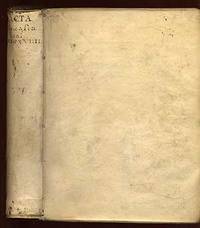
‎Leipzig, Grosse & Gleditsch, 1717. 4to. In: ""Acta Eruditorum Anno MDCCXVII"". The entire volume offered in contemporary full vellum. Hand written title on spine. A yellow label pasted on to top of spine. A small stamp to title-page and free front end-paper. Library label to pasted down front free end-paper. As usual with various browning to leaves and plates. Pp. 317-322" Pp. 322-336 Pp. 353-360 Pp. 360-362. [Entire volume: (4), 553, (39) pp. + seven engraved plates.].‎

‎First printing of the famous Libnitz-issue of Acta Eruditorum published a year after the death of Leibnitz, including the renowned obituary by the German philosopher Christian Wolff. In 1706, Leibniz recommended Wolff for the Professorship at Halle, the post Wolff held for seventeen years until his dismissal, and in 1711, Leibniz sponsored Wolff's membership to the Berlin Academy. It is also mentioned that during the year of Leibniz's death in 1716, Leibniz visited Wolff in Halle when returning to Hanover from Vienna. To honor Leibnitz memory Wolff undertook the project of writing ELOGIUM GODOFREDI GUILIEMI LEIBNITII, a treatise of the life of Leibnitz. As early as 1679 George I, acting as Leibnitz patron, directed him to write the history of the house of Brunswick. Immediately after he began arranging material he had collected. The work was, however, only the preparatory steps when Leibnitz died in 1716 and the work was never published. The present paper, NOTITIA DE HISTORIA BRUNSUICENSI, is the only part of the work, which could have become a opus magnum with historiography, that has ever been published. The volume also contains:Goldbach, Christian. Temperamentum Musicum Universale. Pp. 114-15.And many other papers by influential contemporary mathematicians, philosophers and historians.‎

Riferimento per il libraio : 44194

Livre Rare Book

Herman H. J. Lynge & Son
Copenhagen Denmark Dinamarca Dinamarca Danemark
[Books from Herman H. J. Lynge & Son]

€ 872,95 Informazioni/Compera

‎"[LEIBNIZ, GOTTFRIED WILHELM].‎

‎Observatio, quod rationes sive proportiones non habeant locum circa quantitates nihilo minores, et de vero sensu methodi infinitesimalis. - [LEIBNIZ ON INFINITESIMALS]‎

‎Leipzig, Grosse & Gleditsch, 1712. 4to. In: ""Acta Eruditorum Anno MDCCXII"". The entire volume offered in contemporary full vellum. Hand written title on spine. A yellow label pasted on to top of spine. A small stamp to title-page and free front end-paper. Library label to pasted down front free end-paper. As usual with various browning to leaves and plates. Pp. 167-69. [Entire volume: (2), 555, (35) pp. + five engraved plates.].‎

‎First printing of one of Leibniz's latest publications in which he proposed an interpretation of infinitesimals by a comparison of bodies of different extensions. The paper is a response to to a problem raised by French philosopher and mathematician Antoine Arnauld, who wrote an important philosophical work known as ""The Logic of Port-Royal"" from 1662 and ""Geometry"", 1667. In the book he includes an example of symbolic rules that he considers to be against our basic intuitions on magnitudes and proportions. His reasoning goes as follows ""Suppose we have two numbers, a larger and a smaller one. The proportion of the larger to the smaller one should evidently be larger than the proportion of the smaller to the larger one. But if we use 1 as the larger number and - 1 as the smaller one this would lead to (1/-1) > (-1/1) which is against the rules of algebra"". (Heeffer, The Methodological Relevance of the History of Mathematics for Mathematics Education, 1992).Leibniz saw this as a genuine mathematical problem but argued that the division should be performed as a symbolic calculation. ""Following Leibniz, the infinite appeared in two forms as the (i) Contiuous infinite and (ii) the discrete infinite. The status of the differentials is closely related to the status of the infinite. [...] As a consequence, there is no clear and consistence distinction between continua of different kind related to (i) geometry and to (ii) mechanics. [...] Leinbiz did neither consequently argue mathematically or arithmetically nor consequently geometrically, phenomenologically and mechanically. [But] The correlation between mathematics and physics is as impressive as possible. (Suisky, Euler as physicist, 2009, p. 89-90).The volume also contains:Bernoulli, Johann. Angulorum arcuumque sectio indefinita per formulam universalem expressa. Pp. 274-277" 329-30.And many other papers by influential contemporary mathematicians, philosophers and historians.‎

Riferimento per il libraio : 44073

Livre Rare Book

Herman H. J. Lynge & Son
Copenhagen Denmark Dinamarca Dinamarca Danemark
[Books from Herman H. J. Lynge & Son]

€ 738,65 Informazioni/Compera

‎"LEIBNIZ (LEIBNITZ), G.F. - JOHANN BERNOULLI - JAKOB BERNOUILLI. - CHRISTIAAN HUYGENS ET AL. - INTRODUCING THE LEMNISCATE CURVE.‎

‎1. Nova Calculi Differentialis. Applicatio & usus, ad multiplicem linearum constructionem, ex data tangentium conditione. 2. Constructio Propria Problematiis de Curva Isochrona Paracentrica....& de constructione linearum transcendentium, una maxima ge...‎

‎Leipzig, Grosse & Gleditsch, 1694. 4to. Contemp. full vellum. Faint handwritten title on spine. a small stamp on titlepage. In: ""Acta Eruditorum Anno MDCXCIV"". (2),518 pp.. and 11 folded engraved plates. As usual with various browning to leaves and plates. The entire volume offered. Leibniz's papers: pp. 311-316, pp. 364-375. - Johann Bernoulli's papers: pp. 200-206, pp. 394-99, pp. 435-437, pp. 437-441. - Huygen's papers: pp. 338, pp. 339-41. - Jakob Bernoulli's papers: pp. 262-276, pp. 276-280, pp. 336-338, pp. 391-400. Some mispaginations.‎

‎All papers first appearance, dealing with, and clarifying the problems and the new applications of Leibniz' inventions of the differential- and integral calculus.In the papers Leibniz shows how to reduce linear first order ordinary differential equations to quadratures. I the other paper he gives a general method of finding the envelope of a family of curves, which helped to spread the theory of plane curves.In the groundbreaking paper offered here, Jakob Bernoulli introduces THE LEMNISCATE, a symmetric self-intersecting curve resembling a figure eight and defined by the condition that the product of the distance of anay point on the curve from two fixed points is (d/2)2, where d is the distance between the fixed points.""Jacob Bernoulli was fascinated by curves and the calculus, and one curve bears his name - the ""lemniscate of Bernoulli"", given by the polar equation r2=a cos 2""0"". The curve was described in the Acta Eruditorum of 1694 as resembling a figure eight or a knotted ribbon (lemniscus). However the curve that most caught his fancy was the logarithmic spiral....he swowed that it had several strioking properties not noted before...it is easy to appreciate the feeling that led Bernoulli to request that the ""spira mirabils"" be engraved on his tombstone together with the inscription ""Eadem mutata resurgo"" (Though changed, I arise again the same)."" (Boyer in his History of Mathematics).‎

Riferimento per il libraio : 41704

Livre Rare Book

Herman H. J. Lynge & Son
Copenhagen Denmark Dinamarca Dinamarca Danemark
[Books from Herman H. J. Lynge & Son]

€ 1.275,85 Informazioni/Compera

‎"LEIBNIZ (LEIBNITZ), G.F. - CHRISTIAAN HUYGENS - JOHANN BERNOULLI - JACOB BERNOULLI ET AL. - THE DISCOVERY OF THE ""CATENARY CURVE"" , THE ""LOGARITHMIC CURVE"" AND THE ""POLAR COORDINATES"".‎

‎1. De Linea in quam Flexile se pondere proprio curvat, ejeuque usu insignia adinveniendi quotcunque medias proportionales & Logarithmos. - 2. De Solutionibus Problematis Catenarii vel Funicularis in Actis A. 1691, aliisque a Dn. I.B. propositis. (1-2:...‎

‎Leipzig, Grosse & Gleditsch, 1691. 4to. Contemp. full vellum. Faint handwritten title on spine. a small stamp on titlepage. In: ""Acta Eruditorum Anno MDCLXXXXI"". (8),590,(6) pp. and 13 (of 15) folded engraved plates. The 2 first plates lacks, but they do not belong to the papers listed.Leibniz' papers: pp.277-281 a. 1 plate, pp. 435-439. Johann Bernoulli: pp. 274-276 a. 1 plate. Huygens: pp. 281-282. - Jacob Bernoulli: pp. 282-290 a. 1 plate.‎

‎All papers first apperance. All 5 of extreme importence in the development of the Calculus. Leibniz' 2 papers on the catenary curve (paper 1-2 offered here) was written at the instigation of Jacques Bernoulli. Following the example of Blaise Pascal, who had initiated, in 1658, a contest for the construction of the cycloid, Leibniz also provoked the geometers of his time, by challenging them to submit, at the fixed date of mid-1691, their geometric method for the construction of the catenary curve. Leibniz later provided the answer, followed by Johann Bernoulli and Huygens.'These two papers are a historical account of the origin of the study of this transcendental curve, and, at the same time, the first physical-geometric construction showing the species-relationship between the catenary and the logarithmic curves, as two companion curves" one arithmetic, the other geometric. All of the differentials of the catenary curve, are arithmetic means of corresponding differentials of the logarithmic curve" and, all of the differentials of the logarithmic curve, are geometric means of the catenary.'""The Catenary is the form of a hanging fully flexible rope or chain (the name comes from ""catena"", which means 'chain'), suspended on two points. The interest in this curve originated with Galileo, who thought that is was a parabola. Young Christiaan Huygens proved in 1646 that this cannot be the case. What the actual form was remained an open question till 1691, when Leibniz, Johann Bernoulli and the then much older Huygens sent solutions to the problem to the ""Acta"" (Jakob Bernoulli, 1690, Johann Bernoulli 1691, Huygens 1691 and Leibniz 1691), - these 4 1691-papers offered here - in which the previous year Jakob Bernoulli had challenged mathematicians to solve it. As published, the solutions did not reveal the methods, but through later publications of manuscripts these methods have been known. Huygens applied with great ( paper 4) virtuosity the by then classical methods of 17th century infinitesimal mathematics, and he needed all his ingenuity to reach a satisfactory solution. Leibniz ( the papers 1-2) and Bernoulli (paper 3), applying the new Calculus, found the solutions in a much direct way. In fact, the catenary was a test-case between the old and the new style in the study of curves, and only because the champion of the old style was a giant like Huygens, the test-case can formally be considered as ending in a draw."" (Grattan-Guiness in ""From the Calculus to Set Theory, 1630-1910."").The paper by JACOB BERNOULLI ( no. 5 offered here) is a milestone papers as it marks the invention of the ""SYSTEM OF POLAR COORDINATES"" with points located by reference to a fixed point and a line through that point. Although newton had earlier also devised such a coordinate system (in 1671), his work was not known, so that the credit for the discovery generally goes to Bernoulli. (Parkinson, Breakthroughs (1691).Further papers contained in this volume of Acta Eruditorum:DENYS PAPIN: Mecanicorum de Viribus Motricibus sententia, asserta a D. Papino adversius C.G.G. L. (Leibniz) objectiones. pp. 6-13. The plate lacks. - and Dion. Papini Observationes quaedam circa materias ad Hydraulicam spectantes. Pp. 208-213 a. 1 plate. This importent paper is part of the LEIBNIZ-PAPIN-CONTROVERSY.JACOB BERNOULLI: Specimen Calculi Differentialis in dimensione Parabolæ helicoidis, ubi de flexuris curvarum in genere, carundem evolutionibus. Pp. 13-22. The plate lacks. - and J.B. Demonstratio Centri Oscillationis ex Natura Vectis, reperta occassione eorum, quæ super hac materia in Historia Literaria Roterodamensi recensentur, articulo...Pp.317-321.LEIBNIZ: O.V.E. Additio ad Schediasma de Medii Resistentia publicatum in Actis mensis Febr. 1889. Pp. 177-178. and O.V.E. Quadratura Arithmetica Communis Sectionum Conicarum quæ centrum babent,...Pp. 178-182 a. 1 plate.TSCHIRNHAUS: Singularia Effecta Vitri Caustici bipedalis, quod omnia magno sumtu hactenus constructa specula ustoria virtute superat, per D.T. Pp. 517-520‎

Riferimento per il libraio : 41859

Livre Rare Book

Herman H. J. Lynge & Son
Copenhagen Denmark Dinamarca Dinamarca Danemark
[Books from Herman H. J. Lynge & Son]

€ 3.357,50 Informazioni/Compera

‎"LEIBNIZ (LEIBNITZ), G.F. - THE APPEARANCE OF THE THEORY OF NORDIC ISRAELISM OR NORSE ISRAELISM.‎

‎Accessiones Historicae quibus potissimum continentur Scriptores Rerum Garmanicarum, & aliorum, hactenus inediti sequentes. Tom. I-II. Tom. I: 1. Chronographus Saxo. 2. Joh. Vito Durani Chronicon. 3. Gesta Trevirorum. 4. Vetus Chronicon Holsatiæ. (Tom....‎

‎Hannover, Nicolai Förster, 1700 - Leipzig, Nicolai Förster, 1698. 4to. Contemp. full calf. Raised bands, richly gilt spine. (16),315,40,124,119 pp. Tome 2: (12),292,592 pp. First titlepage and Praefatio (16) leaves a bit browned, otherwise clean with only a few scattered brownspots. Some neath marginal notes in 2 contemporary hands.‎

‎Second edition of volume one, and first edition of volume two. In the 15 century chronicle ""Vetus Chronicon Holsatiae"", first printed here by Leibnitz, states, that the Danes were of the Tribe of Dan, while the Jutes the Jews. This is the first announcement of the theory later called Nordic Israelism or Norse Israelism. ""It is the belief that Scandinavian peoples, or the Nordic countries (Denmark, Faroe Islands, Finland, Iceland, Norway, Sweden) descend from the Ten Lost Tribes of Israel. Although there is evidence of such a belief from literature during the Early Modern Period, Nordic Israelism as a movement and ideology only emerged in the latter half of the 19th century among several early proponents of British Israelism.""(Wikipedia).Ravier: 49 (tome I), 44 (Tome II, but Ravier is not clear on this point)‎

Riferimento per il libraio : 46424

Livre Rare Book

Herman H. J. Lynge & Son
Copenhagen Denmark Dinamarca Dinamarca Danemark
[Books from Herman H. J. Lynge & Son]

€ 1.007,25 Informazioni/Compera

‎"LEIBNITZ (LEIBNIZ), GOTTFRIED WILHELM.‎

‎Lettres de M. de Leibnitz á M. Herman. Part I-II. (I.No. I-III - II. No. 1-26).‎

‎(Berlin, Haude et Spener, 1759). 4to. No wrappers as issued in ""Memoires de l'Academie Royale des Sciences et Belles Lettres"". tome XIII, 1757. Titlepage (Classe de Philosophie Spéculative) and pp. (451-)522.‎

‎First appearance of this remarkable, mathematical correspondance, comprising 29 letters mostly of mathematical content, and after the death of Herman leading to some controveries in relation to priorities.Ravier ""Bibliographie des Oeuvres de Leibniz"" No. 465.‎

Riferimento per il libraio : 42999

Livre Rare Book

Herman H. J. Lynge & Son
Copenhagen Denmark Dinamarca Dinamarca Danemark
[Books from Herman H. J. Lynge & Son]

€ 604,35 Informazioni/Compera

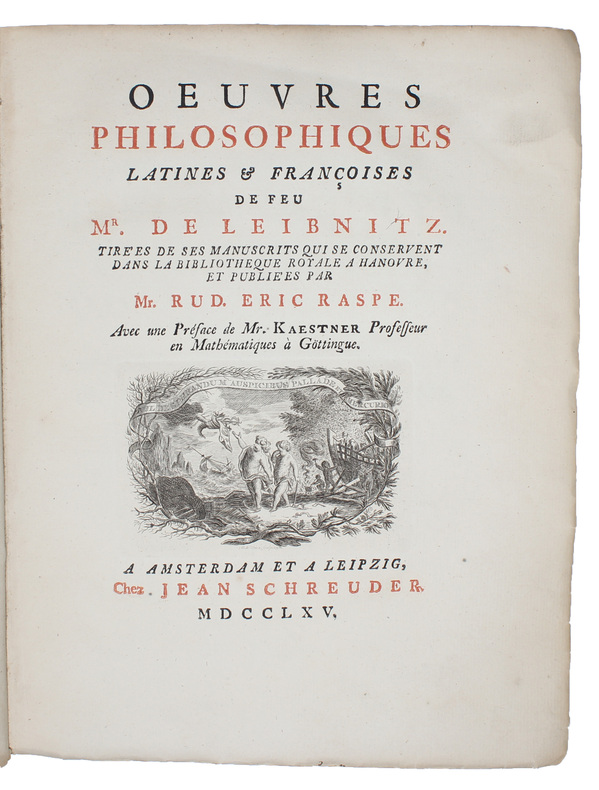
‎"LEIBNITZ, Mr. de (GOTTFRIED WILHELM LEIBNIZ).‎

‎Oeuvres philosophiques latines & francoises de feu. Tirées de ses manuscrits qui se conservent dans la bibliotheque royale a Hanovre et publiées par Mr. Rud. Eric Raspe. Avec une Préface de Mr. Kaestner. [Nouveau essais sur l'entendement humain, -New ... - [FIRST PRINTING OF ""NEW ESSAYS ON HUMAN UNDERSTANDING""]‎

‎Amsterdam et Leipzig, Chez Jean Schreuder, 1765. 4to. Uncut in the original marbled boards. Professionally rebacked preserving almost all of the original back. The fragile orginal binding is here preserved in its entirety, and it has quite a bit of overall wear. Apart from a small hole to two leaves in the index, affecting ab. one work on each of the four pages, it is internally nice and clean. Title-page printed in red and black. Beautiful eng. title-vignette and a few other woodcut vignettes and initials. (4), XVI, (2), 540, (18) pp.‎

‎First edition thus, being the first collected edition of Leibnitz' philosophical works in French and Latin, and containing the FIRST PRINTING of one of Leibnitz' most important philosophical works, his ""Nouveaux essays sur l'entendement humain"" (New Essays on Human Understanding), in which he attacks and refutes Locke and his ""Essay on Human Understanding"" and gives important testimony to his own philosophical ideas. With its 496 pages, this extensive work takes up most of this collection of philosophical works, and it also constitutes one of his largest and most important of his philosophical works. As explained by Raspe, the editor, in his preface to this publication, ""LES NOUVEAUX ESSAIS SUR L'ENTENDEMENT HUMAIN, qui sont la partie principale de recueil, sont connûs trés imparfaitement par l'histoire de la Philosophie de Leibnitz, que Mr. Ludovici a publiée"" (p. X), and the reason why the work was known, even though it had not been published, is because of a letter that Leibnitz had written in 1714, in which he explains why he did not wish to publish the work. Raspe quotes the letter (p. X), from which it becomes clear that Leibnitz had not wished to publish an attack on Locke and his work, because Locke had died in 1704 (the same year that Leibnitz had actually written the work), and because Leibnitz was against publishing refutations of dead authors: ""Mais je me suis degouté de publier des refutations des Auteurs morts, quoiqu'elles dissent paroitre Durant leur vie & étre communiqués à eux memes"". Raspe points to the nobleness of this decision, but he also points to what could be other reasons for Leibnitz not wishing to publish his seminal work, one of them being that towards the end of his life (he died in 1716), he did not wish to enter into any more controversies with the British, since he was already engaged in two very important ones that occuopied much of his time and energy: The first concerned the invention of the differential calculus, the second was against Mr. Clarke on liberty and important metaphysical and theological questions. Another reason could also be that he did not want to begin controversies with the friends of Locke, who at that time were many and important.Locke's ""An Essay Concerning Human Understanding"", which is the work here being refuted by Leibnitz, became the crucial groundwork for the future empiricists with David Hume in the foreground, and thus Leibnitz' work, though published posthumously, probably came to play a bigger role in the history of philosophy than it would have done had it been published just after he wrote it. Few philosophers of his time were susceptible to Leibnitz' ideas and his application of logic to the problems of metaphysics, as most of them were far more receptive to Locke's empiricism. However, when Leibnitz' ""Nouveaux essays..."" was finally published here in his ""Oeuvres philosophiques"" in 1765, it became hugely influential and was also an important factor in the development of Kant's transcendental philosophy.The hugely famous work by Locke, in which he stated his famous theory that the mind of the newborn is like a blank slate (tabula rasa) and concluded that all ideas come from experience and that there are no such things as innate principles, was generally sharply criticized by the rationalists, the most important of them being Leibnitz. Leibnitz' response, his ""Les nouveaux essays sur l'entendement humain"" constitutes the most important of the rationalist responses and it is written in the form of a chapter-by-chapter refutation. He refutes the major premise of Locke's work, that the senses are the source of all understanding, primarily by adding to this ""except the understanding itself"", thus going on to distinguish between his three levels of understanding, which are part of the centre of his philosophy.For Leibnitz as well as for Locke the great inspiration was Descartes, but they chose two fundamentally different directions, Locke the materialistic one and Leibnitz the idealistic one. The present work represents the greatest clash between the two giants of late 17th century philosophy. The effect of Leibnitz' work was enormous, and among the Germans he invoked a great passion for philosophical studies. Leibnitz represents a striking contrast to both Locke with his empiricism and Spinoza. One earlier collection of some of Leibnitz' works had been printed before this one, but it did not contain his ""New Essays on Human Understanding"", and only consisted of his ""Smaller Philosophical Works"". This is the German 1740-edition ""Kleinere philosohische Schriften"". The other writings contained in this publication are ""Examen du sentiment du P. Malebranche que nous voyons tout en Dieu"", """"Dialogus de connexione inter res & verba"", ""Difficultates quaedam Logicae"", ""Discours touchant la methode de la certitude & de l'art d'inventer"", ""Historia et commendatio charactericae universalis quae simul sit ars inveniendi"".Graesse IV:152.‎

Riferimento per il libraio : 38096

Livre Rare Book

Herman H. J. Lynge & Son
Copenhagen Denmark Dinamarca Dinamarca Danemark
[Books from Herman H. J. Lynge & Son]

€ 4.297,60 Informazioni/Compera

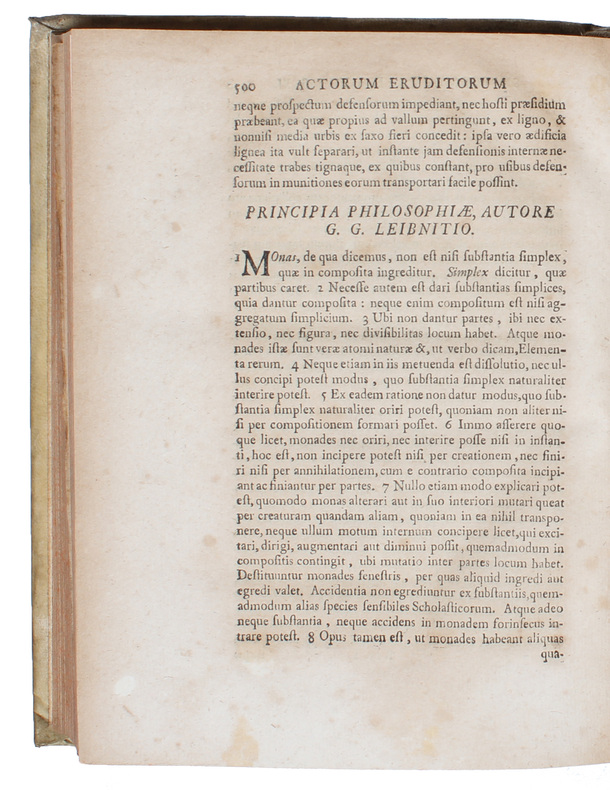
‎"LEIBNIZ, G.G. - LEIBNITZ [+ CHRISTIAN WOLFF].‎

‎Principia Philosophiae [i.e. ""The Monadology""/""Monadologie""/""Theory of Monads""] + (Chr. Wolff:) Das Herrn Gottfrid Wilhelm von Leibnitz Lehrsätze über die Monadologie &c... [In: Actorum Eruditorum, Supplementa. Tomus VII + Acta Eruditorum anno 1721]. - [THE MONADOLOGY - A NEW PHILOSOPHY]‎

‎Leipzig, 1721. 4to. Both entire volumes (Acta Eruditorum 1721 + Supplementa VII, 1721) present, in uniform contemporary full vellum bindings with handwriting to spines. A small later label to top of spines. Old handwritten ex libris-inscription to top of both title-pages as well as a small stamp. The supplement-volume with an additional stamp to title-page, and both volumes with library label (Archiv des k.k. militär.-geograf Institutes) to pasted down front free end-paper. As usual some brownspotting. A nice set. pp. 500-514 (Supplement-vol.) + pp. 94-95. [Entire volumes: (2), 537, (39) pp. + three plates (Suppl.-vol.) + (4), 547, (42) pp. + five plates].‎

‎The highly important first Latin translation of Leibnitz' seminal ""The Monadology"" - his main philosophical work and the work that stands as the epitomization of anti-materialism - which was not published in the original French until 1814, and which only appeared in a German translation (exceedingly scarce) in 1720 and in a Latin translation, by Christian Wolff, in 1721, as it is here. Up until then, Leibnitz' key philosophical text had only circulated in manuscript form (written in 1714). - Here sold together with Wolff's anonymously written review of (the German version of the) ""Monadology"", which had great impact upon the reception of the seminal philosophical text that is the ""Monadology"".""Until the XXth century, criticism about Leibniz's ""Principles of Nature and Grace"" and ""Monadology"" has been characterised by a number of mistakes and misunderstandings, which have roots in the circumstances surrounding the genesis of these manuscripts. As a consequence, erroneous information about these texts was included in an anonymous review, published in 1721 in the ""Acta eruditorum"" of Leipzig. Research on primary sources proves that the author of this review (who was in fact the author of the latin translation of the Monadology, published immediately afterwards) was Christian Wolff, who was in possession of a copy of Leibniz's manuscript as early as 1717. Wolff's initiative of translating the Monadology can be seen as part of a cultural strategy aiming to prevent any idealistic interpretation of Leibniz's monadological thought. From this point of view, to consider the theory of pre-established harmony as based on a system of strictly dualistic metaphysics was an essential element of Wolff's philosophical strategy.""(Antonio Lamarra: Contexte génétique et première reception de la ""Monadologie"". Leibniz, Wolff et la doctrine de l'harmonie préétablie""). During his last stay in Vienna from 1712 to September 1714, Leibniz wrote two short texts, which were meant as concise expositions of his philosophy, namely the ""Principes de la Nature et de la Grace fondés en raison"" (written as a letter to Prince Eugene of Savoy) and the work we now know as the ""Monadology"" (which he had been asked to write by Nicolas Redmond, Duke of Orleons) - the latter being the work that established Leibnitz' fame as a philosopher and which has gone down in history as, not only as one of the most important philosophical texts of the 18th century, but also, arguably the most important work of immaterialism. After his death ""Principes de la Nature et de la Grace fondés en raison"" appeared in French in the Netherlands. Without having seen this publication, Christian Wolff and collaborators had assumed that it contained the French original of the ""Monadology"" as well, although this in fact remained unpublished until 1840. Thus it happened that Leibnitz' key philosophical text, which came to be known as ""The Monadology"", was printed in German and Latin ab. 120 years before it appeared in the original French. The German translation appeared in 1720 as ""Lehrsätze über die Monadologie"" and the following year the Latin translation appeared, in Acta Eruditorum, as ""Principia philosophiae"". Three manuscript versions of the text exist: the first written by Leibniz and overcharged with corrections and two further emended copies with some corrections appearing in one but not the other. ""Leibniz was one of the last ""universal men"" of the type which the Italian Renaissance had ideally postulated: philosopher, historian, mathematician, scientist, lawyer, librarian, and diplomat. In all these fields either all his actual achievements or his seminal suggestions have become part and parcel of European thought. Although trained for the law, mathematics was his favourite subject. Independently of Newton he worked out the infinitesimal calculus, introduced a number of mathematical symbols now in general use, and constructed an early calculating machine, the ancestor of our computers. Mathematical conceptions also determine his philosophy. In it, Leibniz tried to combine physics and metaphysics and to reconcile philosophy and theology. The ""essay on a Theodicy"" is the only larger philosophical work published by himself"" but his fame as a philosopher rests on his ""Theory of Monads"". The original French text of this was published for the first time in 1840"" but it had circulated in manuscript in its initial form of a letter addressed to Prince Eugene of Savoy (1714) and it was printed in German (1720) and Latin (1721) translations. Leibniz proclaimed a ""pre-established harmony"" of the universe which he explained as composed of hierarchically ordered ""monads"", i.e. the ultimate substances of mind as well as matter. This concept clearly reflects the ideal of the properly organized absolutist state of the baroque period and derives partly from the ""idées simples"" of Descartes whom Leibniz greatly admired. A generation later, Voltaire ridiculed the ""pre-established harmony"" in ""Candide"""" but modern nuclear science has vindicated Leibniz's basic ideas, albeit from different presuppositions."" (Printing and the Mind of Man, pp. 105-6). The ""Monadology"" is an extremely condense work that consists of 90 (in this Latin version, 93) numbered sections/paragraphs, which outline a metaphysics of a single substance. The Monadology ends the dualistic mind-body-problem of Descartes and offers a new solution to the question of the interaction between mind and matter, by explaining the pre-established harmony and the synchronous (not causal) relationship between the realm of final causes and that of efficient causes. Leibniz' groundbreaking work came to profoundly influence not only 18th century thought, but also much later philosophy and logic. For this we have to thank Christian Wolff, the translator of the ""Monadology"" into Latin and the first reviewer of the work. It is through Wolff and his elaboration of the development of Leibniz' speculative and metaphysical views that Leibniz becomes a recognized figure of importance, particularly in Germany from the 1720'ies onwards, where Wolff's writings were standardly studied. ""Notably, Wolff's Leibnizianism made a deep impact on Kant, in whose ""Critique of Pure Reason"" (1781) Leibniz himself came to figure as one of the main targets of Kant's anti-metaphysical programme. In particular, Kant saw Leibniz as pretending to ""a priori"" knowledge of the world as it is in itself and presented his own claim that the only knowledge we can have is of the world as it appears in our experience as sharply opposed to the Leibnizian vision. [...] today shows that his thought has survived even the extreme empiricism of the Vienna Circle in the 1930s, which would have viewed its principal doctrines as unverifiable and hence utterly meaningless. Although not in evidence in the ""Monadology"" itself, one of Leibniz' preoccupations was with the philosophy of logic and language, and the twentieth-century's concern for those topics has discovered in what he had to say about them a treasure house of good sense and wisdom which can be detached from the less appealing of his metaphysical speculations. Then, more recent writers who have been interested in the metaphysics of possibility and necessity have found inspiration in the Leibnizian image of possible worlds, and that too has helped keep his name alive for us."" (Savile, ""Leibniz and the Monadology"", pp. 6-7). ""The long span of Leibniz' intellectual life and his early involvement with philosophy made for engagement with a wide variety of philosophical traditions and issues. Early studies at home exposed him to the thought of the Scholastics"" during his university years he was something of a materialist, influenced by the atomism of Bacon and Gassendi. In his mid-20s and early 30s, becoming disenchanted with the intellectual prospects for materialist thought, he turned towards the sort of immaterialism that came to shape his mature thinking after the decade between 1675 and 1685 when he was more narrowly concerned with mathematics than philosophy. It is this anti-materialism that is epitomized in the ""Monadology"" itself...Although Leibniz produced a prodigious quantity of philosophical writing very little of it was published in his lifetime"" indeed, very little was intended for publication. For the most part..., his philosophical thoughts were prepared for individual scholars he had met, or with whom he corresponded, and were never presented as a worked-out system... it was not until the last period of his life that he found the time and the impetus to set down the whole, which he did in two condensed papers written in French during a visit to Vienna.The more popular and less taxing of these was the ""Principles of Nature and Grace Founded on Reason"", which he prepared for Prince Eugène of Savoy, and the second, which he had been asked to write by the councellor of the Duke of Orleans, Nicolas Remond, but never sent off, was the ""Principles of Philosophy"" or, as he called it ""Elucidation Concerning Monads"" ... The title by which that work is known today, ""Monadology"", was not one that Leibniz ever gave it, but was invented by the work's first editor, Henrich Kohler, who published it in a German translation under that title in 1720."" (Savile, ""Leibniz and the Monadology"", pp. 3-4). ""Gottfried Wilhelm Leibniz (1646-1716) was one of the great thinkers of the seventeenth and eighteenth centuries and is known as the last ""universal genius"". He made deep and important contributions to the fields of metaphysics, epistemology, logic, philosophy of religion, as well as mathematics, physics, geology, jurisprudence, and history. Even the eighteenth-century French atheist and materialist Denis Diderot, whose views were very often at odds with those of Leibniz, could not help being awed by his achievement, writing in his entry on Leibniz in the Encyclopedia, ""Perhaps never has a man read as much, studied as much, meditated more, and written more than Leibniz... What he has composed on the world, God, nature, and the soul is of the most sublime eloquence. If his ideas had been expressed with the flair of Plato, the philosopher of Leipzig would cede nothing to the philosopher of Athens."" (""Oeuvres complètes"", vol. 7, p. 709) Indeed, Diderot was almost moved to despair in this piece: ""When one compares the talents one has with those of a Leibniz, one is tempted to throw away one's books and go die quietly in the dark of some forgotten corner."" (""Oeuvres complètes"", vol. 7, p. 678) More than a century later, Gottlob Frege, who fortunately did not cast his books away in despair, expressed similar admiration, declaring that ""in his writings, Leibniz threw out such a profusion of seeds of ideas that in this respect he is virtually in a class of his own."" (""Boole's logical Calculus and the Concept-script"" in ""Posthumous Writings"", p. 9)."" (SEP).Ravier: 357(PMM 177b - being the Latin translation)‎

Riferimento per il libraio : 49396

Livre Rare Book

Herman H. J. Lynge & Son
Copenhagen Denmark Dinamarca Dinamarca Danemark
[Books from Herman H. J. Lynge & Son]

€ 6.715,00 Informazioni/Compera

‎"LEIBNITII, GODOFREDI GUILIELMI. (GOTTFRIED WILHELM LEIBNIZ) & BERNOULLII (IACOBI). (JACOB BERNOULLI) & BERNOULLII (IOHANNIS). (JOHANN BERNOULLI).‎

‎Specimen Dynamicum (+) Notatiuncula Constructiones Lineae in qua Sacoma aequilibrium cum pondere moto faciens incedere debet. Et quaedam de Quadraturis (+) Resposio ad nonnullas Difficultates a Bern. Nieuwentüt circa Methodum differentialem motas (+) ... - [FIRST PUBLICATION OF THE ""BERNOULLI EQUATION"".]‎

‎Leipzig, Grosse & Gleditsch, 1695. 4to. Contemp. full vellum. Faint handwritten title on spine. A small stamp on titlepage and pasted library label to pasted down front free end-paper. In: ""Acta Eruditorum Anno MDCXCV"". (2), 560, (52) pp. + 10 plates. As usual with various browning to leaves and plates. The entire volume offered. Leibniz's papers: pp. 145-57" 184-185 310-316 369-372 493-495. Jacob Bernoulli's paper: pp. 537-553 + one folding table 65-66. Johann Bernoulli's: pp. 59-65" 374-376.‎

‎First printing of a series of influential papers by Leibniz, Jacob Bernoulli and Johann Bernoulli.First publication of Jakob Bernoulli's famous and influential ""Bernoulli Equation"". In ""Notatiuncula Constructiones Lineae"" Bernoulli proposed a solution to non linear equations which today is one of the most common used solutions of the general fluid. Bernoulli equations are significant because they are nonlinear differential equations with known exact solutions. In the ""Specimen dynamicum"" Leibniz presents a conception of body and force which distinct between primitive and derivative forces and between active and passive forces. This article is regarded as being the clearest exposition of Leibniz' dynamics. (DSB VII, 151b).""The first attempt at a detailed account of the dynamics was a long dialogue, the ""Phoranomus seu de potentia et legibus naturae,"" written in July 1689 while Leibniz was in Rome. This was quickly followed be the composition of the massive Dynamica de potential et legibus naturae corporeae (1689-90) [...]. Though it was written with the intention of publication, and though Leibniz work at publishing it, he never considered it entirely finished and it remained unpublished during his lifetime.The later [...] he finally revealed some of the metaphysical foundations of the project in an essay [the present paper]."" (Garber, Daniel. Leibniz: body, substance, monad. 2009. 132 p.)""Its title suggests a summary of or a selection from the earlier work [...]. However, it actually contains something in a way rather more interesting: a careful exposition of the metaphysical foundations of the new science, something that is hard to find in the old Dynamica or any of the more Technical pieces."" (Garber, Daniel. Leibniz: Body, Substance, Monad. 2009. 133 p.)‎

Riferimento per il libraio : 42860

Livre Rare Book

Herman H. J. Lynge & Son
Copenhagen Denmark Dinamarca Dinamarca Danemark
[Books from Herman H. J. Lynge & Son]

€ 2.014,50 Informazioni/Compera

‎"LEIBNIZ, GOTTFRIED & JOHANN BERNOULLI & JAKOB BERNOULLI & EHRENFRIED WALTHER VON TSCHIRNHAUS.‎

‎Supplementum defectus geometria Cartesianae circa inventionem locorum. [Joh. Bernoulli] + [Two other papers]. Notatiuncula ad acta decemb. 1695. [LEIBNIZ]. - [THE BRACHISTOCHRONE PROBLEM]‎

‎Leipzig, Grosse & Gleditsch, 1696. 4to. Entire volume present. Nice contemporary full vellum. Small yellow paper label pasted to top of spine and library-label to front free end-papers. Internally some browning and brownspotting. Overall a nice and tight copy. [Bernoulli paper:] pp. 264-69. [Leibniz-paper:] pp. 45-47. [Entire volume: (2), 603, (1) pp. + plates].‎

‎First printing of the famous 1696-edition of Acta Eruditorum in which Johann Bernoulli published a challenge to the best mathematicians:""Let two points A and B be given in a vertical plane. To find the curve that a point M, moving on a path AMB , must follow such that, starting from A, it reaches B in the shortest time under its own gravity.""Johann adds that this curve is not a straight line, but a curve well known to geometers, and that he will indicate that curve, if nobody would do so that year. Later that year Johann corresponded directly with Leibniz regarding his challenge. Leibniz solved the problem the same day he received notice of it, and almost correctly predicted a total of only five solutions: from the two Bernoullis, himself, L'Hospital, and Newton. Leibniz was convinced that the problem could only be solved by a mathematician who mastered the new field of calculus. (Galileo had formulated and given an incorrect solution to the problem in his Dialogo). But by the end of the year Johann had still not received any other solutions. However, Leibniz convinced Johann that he should extend the deadline to Easter and that he should republish the problem. Johann now had copies of the problem sent to Journal des sçavans, the Philosophical Transactions, and directly to Newton. Earlier that year Johann had accused Newton for having filched from Leibniz' papers. Manifestly, both Johann and Leibniz interpreted the silence from June to December as a demonstration that the problem had baffled Newton. They intended now to demonstrate their superiority publicly. But Newton sent a letter dated Jan. 30 1697 to Charles Montague, then president of the Royal Society, in which he gave his solution and mentioned that he had solved it the same day that he received it. Montague had Newton's solution published anonymously in the Philosophical Transactions. However, when Bernoulli saw this solution he realized from the authority which it displayed that it could only have come from Newton (Bernoulli later remarked that he 'recognized the lion by its claw'). The present volume contains the following articles of interest:Jakob Bernoulli: 1, Observatiuncula ad ea quaenupero mense novembri de Dimensionibus Curvarum leguntur.2, Constructio Generalis omnium Curvarum transcendentium ope simplicioris Tractoriae et Logarithmicae.3, Problema Beaunianum universalius conceptum.4, Complanatio Superficierum Conoidicarum et Sphaeroidicarum.Johann Bernoulli5, Demonstratio Analyticea et Syntetica fuae Constructionis Curvae Beaunianae.6, Tetragonismus universalis Figurarum Curvilinearum per Construitionem Geometricam continuo appropinquantem.Tschirnhaus7, Intimatio singularis novaeque emendationis Artis Vitriariae.8, Responsio ad Observationes Dnn. Bernoulliorum, quae in Act. Erud. Mense Junio continentur.9, Additio ad Intimationem de emendatione artis vitriariae.‎

Riferimento per il libraio : 42863

Livre Rare Book

Herman H. J. Lynge & Son
Copenhagen Denmark Dinamarca Dinamarca Danemark
[Books from Herman H. J. Lynge & Son]

€ 1.678,75 Informazioni/Compera

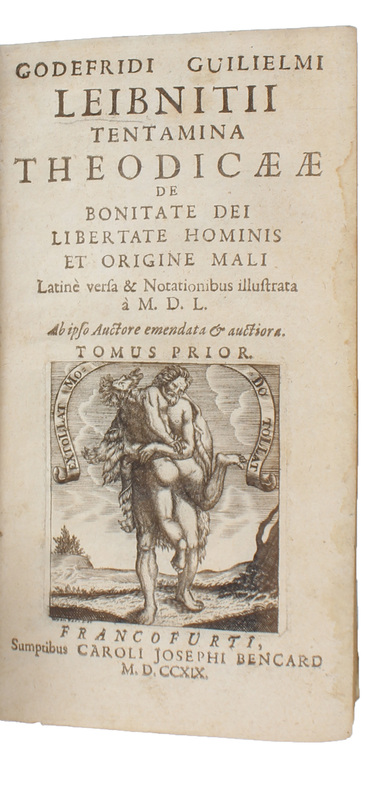
‎"LEIBNIZ (LEIBNITZ), GOTTFRIED WILHELM.‎

‎Tentamina Theodicaeae De Bonitate Dei Libertate Hominis Et Origine Mali / Latinè versa & Notationibus illustrata à M. D. L. (Barth. Des Bosses). Ab ipso Auctore emendata & auctiora. Tomus Primus (3 Parts, all). (Theodicy: Essays on the Goodness of God...‎

‎Franckfurt, Bencard, 1719. 8vo. Contemp. full vellum. A few small brownspots to covers. Large engraved titlevignette. (48),(40),408,(12) pp. 1 folded table (between p.48/49). Clean and fine.‎

‎Extremely scarce first Latin edition of Leibniz's hugely influential work ""Essais de Theodicée sur la Bonté de Dieu, la Liberté de L'Homme, et L'Origine du Mal"" (1710). It is his importent treatise on the goodnes of God, the free will of man and the causes of evil in the world, The principal subject of the work being the problem of liberty and free will. It is the only larger philosophical work published by Leibnitz himself.The ""Théodicée"" was a response to skeptical Pierre Bayle, who wrote in his work Dictionnaire Historique et Critique that, after rejecting three attempts to solve it, he saw no rational solution to the problem of evil.The work was composed at the instigation of Sophia Charlotte, with whom Leibniz had conversed concerning the views of Bayle. In response to a request from Prince Eugene for an abstract of the Théodicée, Leibniz in 1714 wrote the ""Principes de la nature et de la grâce fondées en raison and the Monadologie"".It is often the case, that this Latin edition is followed by the small work ""Causa Dei Asserta per Justitiam Ejus..."" (32) pp. This work is not withbound here.Ravier ""Bibliographie des Oeuvres de Leibniz"", No 344. - PMM (1710-edition).‎

Riferimento per il libraio : 49802

Livre Rare Book

Herman H. J. Lynge & Son
Copenhagen Denmark Dinamarca Dinamarca Danemark
[Books from Herman H. J. Lynge & Son]

€ 2.484,55 Informazioni/Compera

‎(DES MAIZEAUX, PIERRE) (DESMAIZEAU). (EDT.). - NEWTON, LEIBNIZ, CLARKE.‎

‎Recueil de diverses Pieces, sur la Philosophie, La Religion naturelle, L'Histoire, les Mathematiques, &c par Mrs. Leibniz, Clarke, Newton, & autres Aucteurs célèbres. Seconde Edition, Revue, corrigée, & augmentée. 2 Vols.‎

‎Amsterdam, Francois Changuion, 1740. Small 8vo. Bound in 2 fine contemp. full calf. Profusely gilt spines, title-and tomelabels in leather with gilt lettering. Gilt border on covers. Titlepages in red/black with engraved vignettes. CII,(2),429(6),550 pp. and 2 engraved plates, each with 3 portraits (Leibniz, Newton, Clarke). Printed on good paper. Internally fine and clean.‎

‎Scarce collection which contains among other correspondences, the correspondence of Leibnitz and A.S. Conti, on the dispute on the invention of the calculus and also Newton's remarks and Leibnitz's letter to him.Babson 233 (the 3rd edition) - Ravier: 410. - Gray: 380.‎

Riferimento per il libraio : 46487

Livre Rare Book

Herman H. J. Lynge & Son
Copenhagen Denmark Dinamarca Dinamarca Danemark
[Books from Herman H. J. Lynge & Son]

€ 651,35 Informazioni/Compera

‎(DES MAIZEAUX, PIERRE) (DESMAIZEAU). (EDT). - NEWTON, LEIBNIZ, CLARKE‎

‎Recueil de diverses Pieces sur la Philosophie La Religion naturelle L'Histoire les Mathematiques &c par Mrs. Leibniz Clarke Newton & autres Aucteurs célèbres. Seconde Edition Revue corrigée & augmentée. 2 Vols.‎

‎Amsterdam Francois Changuion 1740. Small 8vo. Bound in 2 fine contemp. full calf. Profusely gilt spines title-and tomelabels in leather with gilt lettering. Gilt border on covers. Titlepages in red/black with engraved vignettes. CII2429;6550 pp. and 2 engraved plates each with 3 portraits Leibniz Newton Clarke. Printed on good paper. Internally fine and clean. <br/><br/><em>Scarce collection which contains among other correspondences the correspondence of Leibnitz and A.S. Conti on the dispute on the invention of the calculus and also Newton's remarks and Leibnitz's letter to him.Babson 233 the 3rd edition - Ravier: 410. - Gray: 380. </em> hardcover‎

Riferimento per il libraio : 46487

‎(LEIBNITZ, G.W.) G.G.L. [= GOTTFREDUS GUGLIELMUS LEIBNITZ el. LEIBNIZ].‎

‎Leibnitzens System der Theologie. Nach dem Manuskripte von Hannover (den lateinischen Text zur seite) ins deutsche übersetzt von Andreas Räss un Nikolaus Weis, mit einer Vorrede von Lorenz Doller. Zweite Auflage.‎

‎Mainz, Simon Müller'schen Buchh., 1820. Contemp. full mottled calf. Titlelabel with gilt lettering. VI,CXXVI,346,(2) pp. A faint dampstain to lower right corners of thelast ca. 40 lvs. Clean and printed on good paper. German-Latin paralelltext.‎

Riferimento per il libraio : 44416

Livre Rare Book

Herman H. J. Lynge & Son
Copenhagen Denmark Dinamarca Dinamarca Danemark
[Books from Herman H. J. Lynge & Son]

€ 127,58 Informazioni/Compera

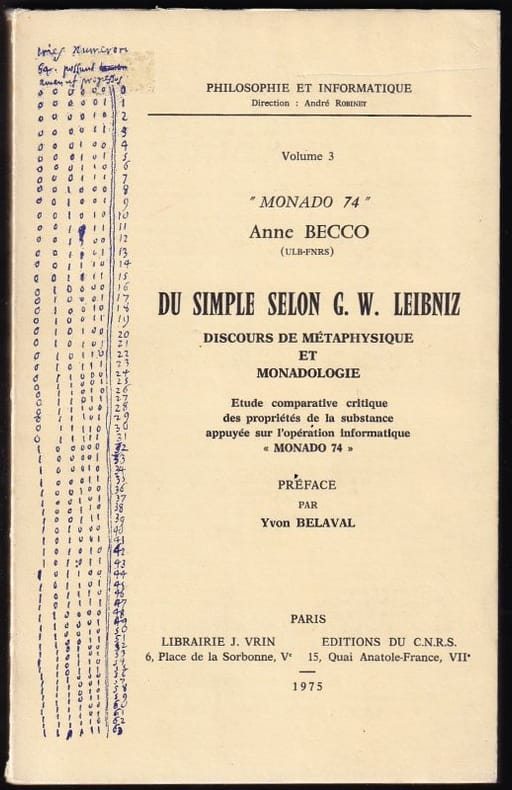
‎(LEIBNIZ) - BECCO Anne‎

‎MONADO 74. DU SIMPLE SELON LEIBNIZ. Discours de métaphysique et monadologie. Étude comparative critique des propriétés de la substance appuyée sur l'opération informatique "Monado 74".‎

‎Vrin 1975 Paris, librairie J. Vrin / éditions du CNRS, collection Philosophie et Informatique, 1975. Préface par Yvon Belaval. In-8 broché de IX - 198 pp. Très bon état, proche du neuf.‎

Riferimento per il libraio : 18239

Livre Rare Book

Le Livre Penseur
Paris France Francia França France
[Books from Le Livre Penseur]

€ 20,00 Informazioni/Compera

‎(LEIBNITZ, GW) GGL [= GOTTFREDUS GUGLIELMUS LEIBNITZ el LEIBNIZ]. G W G G L‎

‎Leibnitzens System der Theologie. Nach dem Manuskripte von Hannover den lateinischen Text zur seite ins deutsche übersetzt von Andreas Räss un Nikolaus Weis mit einer Vorrede von Lorenz Doller. Zweite Auflage.‎

‎Mainz Simon Müller'schen Buchh. 1820. Contemp. full mottled calf. Titlelabel with gilt lettering. VICXXVI3462 pp. A faint dampstain to lower right corners of thelast ca. 40 lvs. Clean and printed on good paper. German-Latin paralelltext. unknown‎

Riferimento per il libraio : 44416

‎(LEIBNIZ, GW, and Others) G W‎

‎Acta Eruditorum Anno MDCCXIX Publicata. Cum S. Caesareae Majestatis & Regis Pol. atque Electoris Saxoniae Priviligiis‎

‎Leipzig: Johan. Grossii Haeredes Joh.Frid. Gleditsch & Fil. Thomam Fritschium / Typis Bernardi Christop. Breitkopfii 1719. Hardcover. Near Fine. Quarto. Contemporary vellum. 540 pp. Indices errata. Four engraved plates one folding. Old institutional bookplate a nice near fine copy. Text in Latin. A volume in an annual series of books published from 1682 to 1734 containing surveys of recent advances in science and literature. Contains contributions by Leibniz and others. An attractive copy. Johan. Grossii Haeredes, Joh.Frid. Gleditsch & Fil., Thomam Fritschium / Typis Bernardi Christop. Breitkopfii hardcover‎

Riferimento per il libraio : 58539

Biblio.com

Between the Covers- Rare Books, Inc. ABAA
United States Estados Unidos Estados Unidos États-Unis
[Books from Between the Covers- Rare Books, Inc. ABAA]

€ 401,90 Informazioni/Compera

‎(LEIBNIZ, GW, and others) G W‎

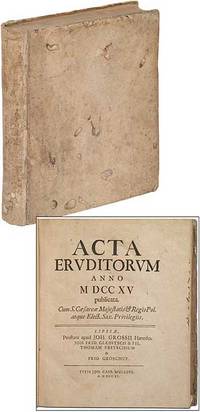
‎Acta Eruditorum Anno MDCCXV Publicata. Cum S. Caesareae Majestatis & Regis Pol. atque Elect. Sax. Priviligiis‎

‎Leipzig: J.OH. Grossii Haeredes Joh.Frid. Gleditsch & Fil. Thomam Fritschium & Frid. Groschuf 1715. Hardcover. Very Good. Quarto. 549 pp. Indices. Seven engraved plates three are folding. Contemporary stiff pastepaper boards. Some spotting to the boards still a sound very good copy. Text in Latin. A volume in an annual series of books published from 1682 to 1734 containing surveys of recent advances in science and literature. Includes Leibniz de Origine Francorum disquisitio. An attractive copy. J.OH. Grossii Haeredes, Joh.Frid. Gleditsch & Fil., Thomam Fritschium & Frid. Groschuf hardcover‎

Riferimento per il libraio : 56335

Biblio.com

Between the Covers- Rare Books, Inc. ABAA
United States Estados Unidos Estados Unidos États-Unis
[Books from Between the Covers- Rare Books, Inc. ABAA]

€ 423,05 Informazioni/Compera

‎(TSCHIRNHAUS, EHRENFRIED W von). - URGING LEIBNIZ TO PUBLISH ON THE CALCULUS‎

‎Methodus datae figurae rectis lineis & curva Geometrica terminate aut Quadraturam aut impossibilitatem ejusdem Quadraturae determinandi. Nova Methodus determinandi Maxima & Minima.‎

‎Leipzig Grosse & Gleditsch 1683. 4to. Without wrappers. In: "Acta Eruditorum Anno MDCLXXXIII" No.III X March and October issues. Pp. 81-128 pp. 417-464 a. 2 engraved plates. Entire issues offered. Tschirnhaus's papers: pp. 122-124 pp. 433-437. Some browning as usual. <br/><br/><em>First appearance of Tschirnhaus's two papers in which he used infinitisimal methods which were very close to Leibniz's method and where he tried to lay down criteria for rational quadratures in the case of conic cubic and quadratic curves papers that led Leibniz to publish his first paper on the differential calculus the "Nova Methoda" in the Acta for 1684 in order to secure his priority over Tschirnhaus concerning the calculus. Leibniz discovered when he read Tschirnhaus' papers that Tschirnhaus had here published results showing similarity with Leibniz's invention of the calculus as he had confided to Tschirnhaus earlier during their Parisian stay and this without references to Leibniz.The second issue contains an original paper by LEIBNIZ: "Meditatio Juridico-Mathematica de Interusurio simplice". Pp. 425-32. </em> unknown‎

Riferimento per il libraio : 45599

‎1646-1716, Leibniz Gottfried Wilhelm F‎

‎Discourse on Metaphysics; Correspondence with Arnauld; And Monadology‎

‎paperback. Good. Access codes and supplements are not guaranteed with used items. May be an ex-library book. paperback‎

Riferimento per il libraio : 1313823120.G ISBN : 1313823120 9781313823128

Biblio.com

Bonita
United States Estados Unidos Estados Unidos États-Unis
[Books from Bonita]

€ 42,47 Informazioni/Compera

‎1646-1716, Leibniz Gottfried Wilhelm F‎

‎Discourse on Metaphysics Correspondence with Arnauld and Monadology‎

‎paperback. Good. Access codes and supplements are not guaranteed with used items. May be an ex-library book. paperback‎

Riferimento per il libraio : 1313397644.G ISBN : 1313397644 9781313397643

Biblio.com

Bonita
United States Estados Unidos Estados Unidos États-Unis
[Books from Bonita]

€ 42,47 Informazioni/Compera

‎[Commentaire]‎

‎COMMENTAIRE - N° 114 (Eté 2006)‎

‎Revue trimestrielle fondée par Raymond Aron : 288 pages, format 185 x 255 mm, brochée, bon état‎

‎Au sommaire : L'Ordre mondial et l'énergie chère ; Juifs et Chrétiens ; Bishops follies ; Le fondamentalisme islamique ; L'entreprise aux travailleurs ? ; Les nouveaux déséquilibres économiques ; Pourquoi la concurrence favorise l'emploi ; Le modèle britannique ; La Ve République oligarchique ; Leibniz, Leo Strauss, Heidegger. Philosophie et politique ; Exercices littéraires ; Le Prince de Ligne et le XVIIIe siècle‎

Riferimento per il libraio : LFA-126719576

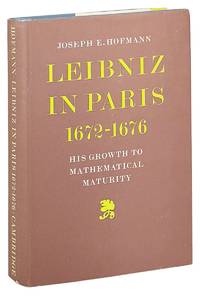
‎[Gottfried Wilhelm Leibniz] Joseph E Hofmann‎

‎Leibniz in Paris 1672-1676: His Growth to Mathematical Maturity‎

‎Cambridge: Cambridge University Press 1974. Very Good/Very Good. Cambridge: Cambridge University Press 1974. First U.K. Edition. Octavo; publisher's boards in brown price-clipped dust jacket designed by Michael and Shirley Tucker; xi1372pp.; portrait frontispiece mathematical equations throughout. Light shelf wear to jacket margins very slight spine lean corners bumped else Very Good and sound. Ownership ex libris of the late chemist and bibliophile Sydney Ross to front pastedown. Cambridge University Press unknown‎

Riferimento per il libraio : 46578 ISBN : 0521202582 9780521202589
Biblio.com

Capitol Hill Books, ABAA
United States Estados Unidos Estados Unidos États-Unis
[Books from Capitol Hill Books, ABAA]

€ 63,46 Informazioni/Compera

‎[Gottfried Wilhelm Leibniz] EJ Aiton E J‎

‎Leibniz: A Biography‎

‎Bristol: Adam Hilger Ltd 1985. Fine/Near Fine. Bristol: Adam Hilger Ltd 1985. First Edition. Octavo; publisher's boards in pictorial dust jacket; xiv370pp.; halftone illus. throughout. A Fine copy. Adam Hilger Ltd unknown‎

Riferimento per il libraio : 46582 ISBN : 0852744706 9780852744703

Biblio.com

Capitol Hill Books, ABAA
United States Estados Unidos Estados Unidos États-Unis
[Books from Capitol Hill Books, ABAA]

€ 105,76 Informazioni/Compera

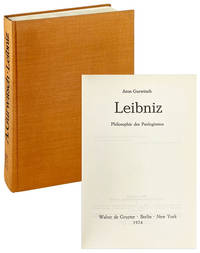
‎[Gottfried Wilhelm Leibniz]; Aron Gurwitsch‎

‎Leibniz: Philosophie des Panlogismus‎

‎Berlin: Walter de Gruyter 1974. Very Good. Berlin: Walter de Gruyter 1974. Octavo. 495 pp. Brown boards stamped in black. No dust jacket. Text in German. Light shelfwear and dust soiling to edges of boards and corners bumped. Binding is sound. Previous owner's inscription to front free endpaper but pages otherwise unmarked. Walter de Gruyter unknown‎

Riferimento per il libraio : 26719 ISBN : 3110043580 9783110043587
Biblio.com

Capitol Hill Books, ABAA
United States Estados Unidos Estados Unidos États-Unis
[Books from Capitol Hill Books, ABAA]

€ 42,31 Informazioni/Compera

‎[LEIBNIZ] MARTIN (Roger)‎

‎Deux mémoires sur le calcul différentiel et l'infini‎

‎Toulouse, 1782 et 1788, , 2 ouvrages en 1 volume in-4 de 22 pages et 1 planche, puis de 40 pages, demi-veau moderne, dos lisse portant une pièce de titre, Deux mémoires en édition originale tirés des "Histoire et mémoires de l'Académie royale des sciences, inscriptions et belles lettres de Toulouse" (pages 43-64 du premier volume paru en 1782, et pages 29-72 du troisième volume publié en 1788). Roger Martin, appelé aussi Abbé Martin jusqu'à la Révolution, naquit en 1742 à Estadens dans la Haute-Garonne ; brillant élève de sciences, il fut nommé professeur de philosophie à 20 ans au Collège Royal de Toulouse. Passionné de physique et de mathématique, il parvint à faire instaurer dans ce même Collège un cabinet de physique expérimentale ; les leçons qu'il y professait eurent un grand succès. Dans les deux présents mémoires, lus à sept ans d'intervalle devant l'Académie de Toulouse, l'auteur pose le problèmes de l'infini mathématique à l'aune de la méthode du calcul différentiel initié par Newton et développé par Leibniz, tout en appréhendant ses méthodes nouvelles et modernes par le biais de "la méthode des Anciens, connue sous le nom de méthode d'exhaustion ou des limites". Traces de mouillures anciennes sur le premier mémoire. Couverture rigide‎

‎Bon 2 ouvrages en 1 volume in-4‎

Riferimento per il libraio : 60306

Livre Rare Book

Librairie Alain Brieux
Paris France Francia França France
[Books from Librairie Alain Brieux]

€ 300,00 Informazioni/Compera

‎[LEIBNIZ] - NOURRISSON.-‎

‎La philosophie de Leibniz.‎

‎Paris, Hachette, 1860, in 8° relié demi-basane, dos orné de filets dorés, VIII-502 pages.‎

‎PHOTOS sur DEMANDE. ...................... Photos sur demande ...................‎

Riferimento per il libraio : 73016

‎[LEIBNIZ] - PIAT (Clodius).-‎

‎Leibniz.‎

‎P., Alcan, 1915, in 8° broché, VII-375 pages.‎

‎PHOTOS sur DEMANDE. ...................... Photos sur demande ...................‎

Riferimento per il libraio : 44785

‎[LEIBNIZ, GOTTFRIED WILHELM].‎

‎Collectanea Etymologica illustrationi linguarum veteris Celticae Elogium Godofredi Guiliemi Leibnitii Problema Posthum ab incomparabili Viro Perillustri Dn. Godefrido Guilielmo Lib Notitia de Historia Brunsuicensi. - LEIBNITZ'S OBITUARY BY WOLFF IN ACTA ERUDITORUM‎

‎Leipzig Grosse & Gleditsch 1717. 4to. In: "Acta Eruditorum Anno MDCCXVII". The entire volume offered in contemporary full vellum. Hand written title on spine. A yellow label pasted on to top of spine. A small stamp to title-page and free front end-paper. Library label to pasted down front free end-paper. As usual with various browning to leaves and plates. Pp. 317-322; Pp. 322-336; Pp. 353-360; Pp. 360-362. Entire volume: 4 553 39 pp. seven engraved plates. <br/><br/><em>First printing of the famous Libnitz-issue of Acta Eruditorum published a year after the death of Leibnitz including the renowned obituary by the German philosopher Christian Wolff. In 1706 Leibniz recommended Wolff for the Professorship at Halle the post Wolff held for seventeen years until his dismissal and in 1711 Leibniz sponsored Wolff's membership to the Berlin Academy. It is also mentioned that during the year of Leibniz's death in 1716 Leibniz visited Wolff in Halle when returning to Hanover from Vienna. To honor Leibnitz memory Wolff undertook the project of writing ELOGIUM GODOFREDI GUILIEMI LEIBNITII a treatise of the life of Leibnitz. As early as 1679 George I acting as Leibnitz patron directed him to write the history of the house of Brunswick. Immediately after he began arranging material he had collected. The work was however only the preparatory steps when Leibnitz died in 1716 and the work was never published. The present paper NOTITIA DE HISTORIA BRUNSUICENSI is the only part of the work which could have become a opus magnum with historiography that has ever been published. The volume also contains:Goldbach Christian. Temperamentum Musicum Universale. Pp. 114-15.And many other papers by influential contemporary mathematicians philosophers and historians. </em> hardcover‎

Riferimento per il libraio : 44194

‎[Leibniz, Gottfried Wilhelm]‎

‎Gothofredi. Guillelmi. Leibnitii. Relatio ad inclytam Societatem Leopoldinam Naturae Curiosorum de novo antidysenterico Americano magnis successibus comprobato‎

‎Hannov. et Gurlpherpit Hannover Wolfenbütte: Gothofredi Freytagii Gottfried Freytag 1696. First edition. Papered spine. Printer’s device on last page. In fine condition. First edition. Papered spine. Printer’s device on last page. 8º; a1–b8 c1–3 .; 37 1 p. <p><br /> Scarce pharmacological work on the ipecacuanha root that can be used as an emetic nauseant expectorant and diaphoretic. <br /> <p><p><br /> “Relatio ad inclytam Societatem Leopoldinam Naturae Curiosorum de novo antidysenterico Americano magnis successibus comprobato†Relation to the Illustrious Leopoldine Society of Naturalists Concerning the New American Anti-Dysentery Drug Attested with Great Success is Leibniz’s most comprehensive and influential contribution to the history of medicine and pharmacy. <br /> <p><p><br /> Leibniz wrote the treatise after he read the study on ipecacuanha root written by Willem Piso and Georg Marggraf published in Historia naturalis Brasilia 1648 and evidently after conducted experiences with the root himself. The root was made famous after it was used successfully to treat the King of France Louis XIV’s dysentery in 1672 by the Dutch physician John Frederick Helvetius 1625–1719. <br /> <p><p><br /> The work has been published in the same year as an appendix to Martin Lister’s “Sex exercitationes medicales de quibusdam morbis chronicis†Frankfurt and Leipzig 1696 and also to “Miscellanea curiosa sive Ephemeridum medico-physicarum Germanicarum†Nuremberg 1696. Lister’s work was printed by Freytag too the difference is merely the lack of the colophon on the “Lister-editionâ€.<br /> <p><p><br /> Ref.: Smith J. E. H.: Divine Machines. Leibniz and the Sciences of Life. Princeton University Press 2011.; Dutens II. 2. pp. 110–119.; Ravier 36.<br /> <p>. Gothofredi Freytagii (Gottfried Freytag) unknown‎

Riferimento per il libraio : 32

Biblio.com

Foldvaribooks
Hungary Hungría Hungria Hongrie
[Books from Foldvaribooks]

€ 3.300,81 Informazioni/Compera

‎[LEIBNIZ, GOTTFRIED WILHELM].‎

‎Observatio quod rationes sive proportiones non habeant locum circa quantitates nihilo minores et de vero sensu methodi infinitesimalis. - LEIBNIZ ON INFINITESIMALS‎

‎Leipzig Grosse & Gleditsch 1712. 4to. In: "Acta Eruditorum Anno MDCCXII". The entire volume offered in contemporary full vellum. Hand written title on spine. A yellow label pasted on to top of spine. A small stamp to title-page and free front end-paper. Library label to pasted down front free end-paper. As usual with various browning to leaves and plates. Pp. 167-69. Entire volume: 2 555 35 pp. five engraved plates. <br/><br/><em>First printing of one of Leibniz's latest publications in which he proposed an interpretation of infinitesimals by a comparison of bodies of different extensions. The paper is a response to to a problem raised by French philosopher and mathematician Antoine Arnauld who wrote an important philosophical work known as "The Logic of Port-Royal" from 1662 and "Geometry" 1667. In the book he includes an example of symbolic rules that he considers to be against our basic intuitions on magnitudes and proportions. His reasoning goes as follows "Suppose we have two numbers a larger and a smaller one. The proportion of the larger to the smaller one should evidently be larger than the proportion of the smaller to the larger one. But if we use 1 as the larger number and - 1 as the smaller one this would lead to 1/-1 > -1/1 which is against the rules of algebra". Heeffer The Methodological Relevance of the History of Mathematics for Mathematics Education 1992.Leibniz saw this as a genuine mathematical problem but argued that the division should be performed as a symbolic calculation. "Following Leibniz the infinite appeared in two forms as the i Contiuous infinite and ii the discrete infinite. The status of the differentials is closely related to the status of the infinite. . As a consequence there is no clear and consistence distinction between continua of different kind related to i geometry and to ii mechanics. . Leinbiz did neither consequently argue mathematically or arithmetically nor consequently geometrically phenomenologically and mechanically. But The correlation between mathematics and physics is as impressive as possible. Suisky Euler as physicist 2009 p. 89-90.The volume also contains:Bernoulli Johann. Angulorum arcuumque sectio indefinita per formulam universalem expressa. Pp. 274-277; 329-30.And many other papers by influential contemporary mathematicians philosophers and historians. </em> hardcover‎

Riferimento per il libraio : 44073

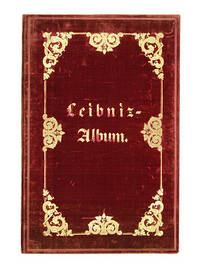
‎[Leibniz] Grotefend, C L‎

‎Leibniz-Album aus den Handschriften der Königlichen Bibliothek zu Hannover.‎

‎Hannover Hahn 1846. Folio 45.3 x 29.5 cm. vi 28 pp. With a nice engraved portrait of Leibniz and one wood-engraving of his house in Hannover. Very nice and highly unusual red velvet binding with elaborate gilt decorated embossed decorations and letterings. = Rare memorial contribution to the famous German polymath principally mathematician and philosopher Gottfried Wilhelm von Leibniz 1646-1716 in a fantastic binding. 'Leibniz sometimes spelled Leibnitz was a prominent German polymath and one of the most important logicians mathematicians and natural philosophers of the Enlightenment. As a representative of the seventeenth-century tradition of rationalism Leibniz's most prominent accomplishment was conceiving the ideas of differential and integral calculus independently of Isaac Newton's contemporaneous developments. Mathematical works have consistently favored Leibniz's notation as the conventional expression of calculus. It was only in the 20th century that Leibniz's law of continuity and transcendental law of homogeneity found mathematical implementation by means of non-standard analysis. He became one of the most prolific inventors in the field of mechanical calculators. While working on adding automatic multiplication and division to Pascal's calculator he was the first to describe a pinwheel calculator in 1685 and invented the Leibniz wheel used in the arithmometer the first mass-produced mechanical calculator. He also refined the binary number system which is the foundation of all digital computers. In philosophy Leibniz is most noted for his optimism i.e. his conclusion that our universe is in a restricted sense the best possible one that God could have created an idea that was often lampooned by others such as Voltaire. Leibniz along with René Descartes and Baruch Spinoza was one of the three great 17th-century advocates of rationalism. The work of Leibniz anticipated modern logic and analytic philosophy but his philosophy also assimilates elements of the scholastic tradition notably that conclusions are produced by applying reason to first principles or prior definitions rather than to empirical evidence. Leibniz made major contributions to physics and technology and anticipated notions that surfaced much later in philosophy probability theory biology medicine geology psychology linguistics and computer science. He wrote works on philosophy politics law ethics theology history and philology. Leibniz also contributed to the field of library science. While serving as overseer of the Wolfenbüttel library in Germany he devised a cataloging system that would serve as a guide for many of Europe's largest libraries. Leibniz's contributions to this vast array of subjects were scattered in various learned journals in tens of thousands of letters and in unpublished manuscripts. He wrote in several languages but primarily in Latin French and German.' Wikipedia. Editor of this memorial album was the German historian Carl or Karl Ludwig Grotefend 1807-1874 who also participated in the publication of Leibnizens Gesammelte Werke Leibniz's collected works. Inner hinge a bit tender; some light shelf-wear to one corner and some of the velvet but overall in great condition. unknown‎

Riferimento per il libraio : 37941

Biblio.com

Antiquariaat Schierenberg
Netherlands Países Bajos Holanda Pays-Bas
[Books from Antiquariaat Schierenberg]

€ 750,00 Informazioni/Compera

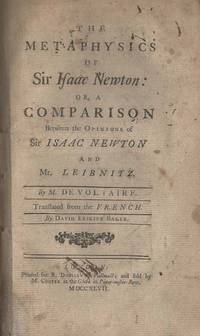
‎[Newton, Sir Isaac] Voltaire [Francois-Marie Arouet] / Leibniz / Baker, David Erskine / [Berkeley, George]‎

‎The Metaphysics of Sir Isaac Newton : Or A Comparison between the Opinions of Sir Isaac Newton and Mr. Leibnitz Gottfried Wilhelm Leibniz. By M. De Voltaire. Translated from the French by David Erskine Baker / Bound together with a First Edition of George Berkeley's Miscellaneous Tracts which also include "De Motu ; sive de motus principio & natura & de causa communicationis motuum" in which Berkeley rejected Sir Isaac Newton's absolute Space Time and Motion. "With this essay Berkeley is considered to be the "precursor of Mach and Einstein" - Karl Popper.‎

‎1747. First English Edition. London Printed for R.Dodsley 1747. Octavo. 72 pages. Modern cloth. The bookblock with signs of stitching to the inner margin possibly used to be part of a Sammelband. Last three leaves with paper-restoration and manuscript inscription to last page looks like a 18th century gift-inscription. With numerous manuscript - annotations in the tracts of George Berkeley namely in "A Word to the Wise" "Farther Thoughts on Tar-Water" "The Querist". From the library of Daniel Conner Manch House County Cork. Bound with: "Berkeley George Bishop of Coyne - "A Miscellany Containing Several Tracts on Various Subjects. By the Bishop of Cloyne. London Printed for J. and R. Tonson and S.Draper 1752. VI 267 1 pages. Title-page witme minor paper-restoration. This wonderful collection by the eminent ANglo-Irish Philosopher includes the following Pamphlets / Tracts as called for: 1. Farther Thoughts on Tar-Water 2. An Essay towards preventing the Ruin of Great-Britain 3. A Discourse addressed to Magistrates and Men in Authority. Occasioned by the enormous Licence and Irreligion of the Times. 4. A Word to the Wise - Or an Exhortation to the Roman Catholic Clergy of Ireland This section "A Word to the Wise" includes several interesting annotations: a. an underlining of the sentence: "Seeing you are obnoxious of the Law" with a comment "Oh! infamous" b. annotation: "the catholic clergy cannot be accused even by there greatest enemies of having been influenced by interested motives therefore this hint of his lordship was not of much avail" 5. A Letter to the Roman Catholics of the Diocese of Cloyne 6. Maxims concerning Patriotism 7. The Querist - Containing several Queries proposed to the Consideration of the Public 8. Verses on the Prospect of Planting Arts and Learning in America 9. A Proposal for the better supplying of Churches in our Foreign Plantations and for converting the Savage Americans to Christianity by a College to be erected in the Summer Islands otherwise called The Isles of Bermuda 10. A Sermon preached before the Incorporated Society for the Propagation of the Gospel in Foreign Parts; at their Anniversary Meeting in the Parish-Church of St.Mary-le-Bow in 1731 11. De Motu ; sive de motus principio & natura & de causa communicationis motuum ______________________________________________________________________________ hardcover‎

Riferimento per il libraio : 31752AB

Biblio.com

Inanna Rare Books Ltd.
Ireland Irlanda Irlanda Irlande
[Books from Inanna Rare Books Ltd.]

€ 2.800,00 Informazioni/Compera

‎[PHILOSOPHIE] - LEIBNIZ -‎

‎Oeuvres philosophiques.‎

‎Paris, Librairie Philosophique de Lagrange, 1866 ; in-8, 695-706 pp., cartonnage de l'éditeur. Les 2 volumes. Avec une introduction et des notes par M. Paul Janet en 2 volumes - Gravure en noir et blanc en frontispice du tome I (portrait). As dos.coins un peu usagés Tampons de bibliothèque en pages de titre. Bords des plats légèrement frottés. Avec une Intro. et des Notes par Paul Janet. In-8 Relié demi-cuir noir Bon état. Couv. convenable. Dos à nerfs. rousseurs.‎

‎Avec une introduction et des notes par M. Paul Janet en 2 volumes - Gravure en noir et blanc en frontispice du tome I (portrait). As dos.coins un peu usagés Tampons de bibliothèque en pages de titre. Bords des plats légèrement frottés. Avec une Intro. et des Notes par Paul Janet. In-8 Relié demi-cuir noir Bon état. Couv. convenable. Dos à nerfs. rousseurs.‎

Riferimento per il libraio : 201607780

Livre Rare Book

Librairie Lire et Chiner
Colmar France Francia França France
[Books from Librairie Lire et Chiner]

€ 110,00 Informazioni/Compera

‎[REVUE] COLLECTIF‎

‎Revue internationale de Philosophie Tome XIX (19e annee).‎

‎Hardcover in-8°, 496 pages, reliure plein simili, titre dore. (voir aussi "Revue Philosophique") N° 71-72 : Husserl - N° 73-74 : La Notion de structure Tres bel exemplaire. [NV-41] Tres bel exemplaire.‎

‎[REVUE] COLLECTIF‎

‎Revue internationale de Philosophie.- 20e annee.‎

‎Hardcover in-8°, 511 pages, reliure plein simili, titre dore. (voir aussi "Revue Philosophique") N° 75 : Maine de Biran - N° 76-77 : Leibniz - N° 78 : Franz Brentano. Tres bel exemplaire. [109B-6] Tres bel exemplaire.‎

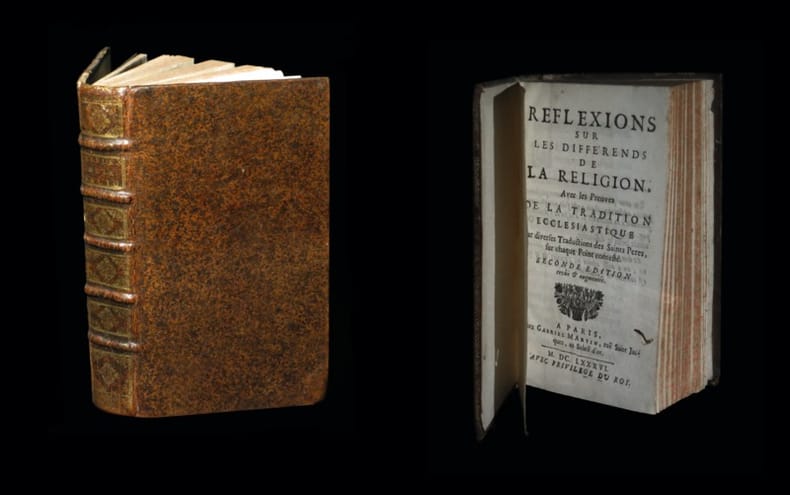
‎[sans auteur] - [PELLISSON FONTANIER (Paul)].‎

‎Réflexions sur les différends de la religion avec les preuves de la tradition ecclésiastique.‎

‎A Paris, chez Gabriel Martin, 1686. 3 parties reliées en un vol. au format in-12 (164 x 98 mm) de 10 ff. n.fol., 154 pp. et 1 f. bl. ; 164 pp. et 111 pp. Reliure de l'époque de plein veau glacé et moucheté havane, plats jansénistes, dos à nerfs orné de filets gras à froid, roulette dorée sur les nerfs, caissons d'encadrement dorés, larges fleurons dorés, titre doré, palette dorée en tête et queue, roulette dorée sur les coupes, tranches jaunes et mouchetées.‎

‎Edition en partie originale agrémentée de jolis ornements typographiques. Ensemble complet de ses 3 parties ; ici reliées en un volume. ''Si, dans la seconde moitié du XVIIème siècle, la tolérance est devenue un sujet de réflexion, les positions tranchées engendrent bien des débats. Un des plus célèbres est celui qui est initié par Paul Pellisson (1624-1693). Très proche de l’Académie française, dont il publie l’Histoire, et secrétaire du surintendant des finances Nicolas Fouquet, il devient historiographe du roi en 1666. Ayant abjuré le protestantisme en 1670, il est doté de riches bénéfices ecclésiastiques dont l’abbaye de Cluny. À côté d’une œuvre chantant le roi, comme son Panégyrique du Roy Louis Quatorzième (1671), il s’intéresse aux questions religieuses, donnant, par exemple, des Réflexions sur les différends de la religion (1686). Ses pensées sur la tolérance sont transmises à Leibniz (1646-1716) par la duchesse Sophie de Hanovre (1630-1714). Le philosophe lit ce texte, en fait une synthèse qu’il enrichit d’observations''. (Philippe Martin in Entre politique et philosophie). Barbier IV, Dictionnaire des ouvrages anonymes, 164-f - Cioranescu III, Bibliographie de la littérature française au XVIIème, 54067. Dos présentant un éclat légèrement altéré. Rares tout autant que discrètes rousseurs dans le texte. Petit travail de ver en marge des feuillets ; sans atteinte au texte. Du reste, bonne condition.‎

Riferimento per il libraio : 25828

Livre Rare Book

Babel Librairie
Périgueux France Francia França France
[Books from Babel Librairie]

€ 150,00 Informazioni/Compera

Numero di risultati : 1.682 (34 pagina/e)

[1] 2 3 4 5 6 7 ... 10 13 16 19 22 25 28 31 ... 34 Pagina successiva Ultima pagina