Washington DC: United States Department of the Army 1965. Presumed First printing thus. Wraps. Good. Format is approximately 5.5 inches by 8.5 inches. NOTE: This issuance is in a slightly smaller format than other copies observed. It lacks the distribution page number 133 which also contains the U.S. Government Printing Office statement. Contains the designation TAGO 5732-B. 132 4 pages. Illustrations. References. This manual supersedes FM 5-31 31 January 1956 including C 1 16 December 1957 and C 2 28 August 1959. Cover has some wear and soiling This reflects the state of the art the state of knowledge and the state of practice during a period of increasing U.S. operations during the Vietnam War. Boobytraps FM 5-31 Field Manual. Topics covered include introduction and principles of boobytraps basic doctrine planning and installation equipment firing devices demolition materials including small missile construction techniques miscellaneous boobytraps from improvised materials. Also chapter on detecting and removing boobytraps clearing and disarming methods. A booby trap is a device or setup that is intended to kill harm or surprise a person or animal unknowingly triggered by the presence or actions of the victim. As the word trap implies they sometimes have some form of bait designed to lure the victim towards it. At other times the trap is set to act upon trespassers that violate personal or restricted areas. The device can be triggered when the victim performs some type of everyday action e.g. opening a door picking something up or switching something on. They can also be triggered by vehicles driving along a road as in the case of victim-operated improvised explosive devices IEDs. Booby traps should not be confused with mantraps which are designed to catch a person. Lethal booby traps are often used in warfare particularly guerrilla warfare and traps designed to cause injury or pain are also sometimes used by criminals wanting to protect drugs or other illicit property and by some owners of legal property who wish to protect it from theft. United States, Department of the Army paperback
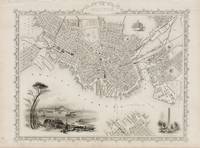
1851. London & New York John Tallis & Company 1851. Original steel engraving / Vintage map. Drawn and engraved by John Rapkin. Illustrated and Engraved by J. Watkins Plate Size: 32.5 cm x 26 cm. Sheet Size: 37.2 cm x 27.2 cm. Vintage 19th century map in very good condition. Published in the Illustrated Atlas And Modern History Of The World Geographical Political Commercial & Statistical Edited By R. Montgomery Martin. Handsome town-plan of Boston Massachusetts. The Charles River can be seen running between Boston and Charlestown. South Boston and East Boston are also included within Boston Harbour. Parts of Cambridge are also visible. The map covers downtown Boston prior to the Back Bay landfill projects extending from Dover Street to the Charles River. Railway street and district areas of the city are also included. Decorative scrolling and title cartouche around the edges of the map. The project of 'The Illustrated Atlas' was designed to be finished just in time for the anxiously awaited "Great Exhibition of the Works of Industry of All Nations" or The Great Exhibition sometimes referred to as the Crystal Palace Exhibition in reference to the temporary structure in which it was held was an international exhibition that took place in Hyde Park London from 1 May to 11 October 1851. It was the first in a series of World's Fairs exhibitions of culture and industry that became popular in the 19th century and it was a much-anticipated event. The Great Exhibition was organized by Henry Cole and Prince Albert husband of the reigning monarch Queen Victoria. It was attended by numerous notable figures of the time including Charles Darwin Samuel Colt members of the Orléanist Royal Family and the writers Charlotte Brontë Charles Dickens Lewis Carroll George Eliot and Alfred Tennyson. Music for the opening was under the direction of Sir George Thomas Smart and the continuous music from the exhibited organs for the Queen's procession was "under the superintendence of William Sterndale Bennett". Wikipedia unknown
Washington DC: United States Government Printing Office 1940. Presumed First Edition First printing. Wraps. Good. Format is approximately 4.25 inches by 7.5 inches. iii 1 227 1 pages. Photographs. Drawings. Diagrams. Tables. Index. Name rank and organization of former owner on front cover. Cover has some wear and soiling. The Browning automatic rifle caliber .30 M1918 without bipod is an air-cooled gas-operated magazine-fed shoulder weapon. See fig. 1. It weighs 15 pounds 14 ounces. The ammunition is loaded in magazines of 20 rounds each. The weight of the magazine when empty is 7 ounces; when filled 1 pound 7 ounces. The design permits semiautomatic and automatic fire. This manual addresses: Mechanical Training Marksmanship Moving Ground Targets Air Targets Technique of Fire and provides Advice to Instructors. This manual represents the state of knowledge the state of practice the standard of training and the state-of-the-art as the Second World War commenced and reflects what U.S. Army soldiers were trained to just prior to the entry of the United States into that global conflict. United States Government Printing Office paperback
Washington DC: United States Government Printing Office 1940. Wraps. Good. Format is approximately 4.5 inches by 7.5 inches. iv 217 3 pages. Photographs. Drawings. Diagrams. Index. This copy belonged to Maj. Carl J. Koenig Ord. Dept. name rank and organization in front cover. worn and soiled. This manual was prepared under the direction of the Chief of Cavalry. "The machine gun caliber .30 M1919A4 is recoil operated belt fed and air cooled. In recoil operation the rearward force of the expanding powder gas kick furnishes the operating energy. The moving parts while locked together at the moment of the explosion are left free within the receiver to be forced to the rear by the recoil. This movement is controlled by means of various springs cams and levers and is utilized to perform the necessary mechanical operations of unlocking the breech extraction and ejection of the empty case and feeding in of the new round as well as cocking locking and firing the mechanism. This manual addresses: Mechanical Training Light Machine Gun Training Marksmanship Ground Targets Air Targets Technique of Fire and provides advice to instructors. This manual represented the state of knowledge state of practice standard of training and state-of-the-art at the start of the Second World War and represents what the American soldier was trained to just prior to the United States entering the conflict. United States Government Printing Office paperback
Notre Dame IN: U. S. Navy Midshipman's School 1943. First edition. Hardcover. Very Good. 4to yearbook cloth <br/><br/>Extensively illustrated with photographs. Laid in are three official 8 x 10 glossies of a ship seamen and officers dated Charleston SC 1945. Note: the six officers in the third photo are identified on the verso. U. S. Navy Midshipman's School hardcover
London : Richard Bentley & Sons 1872. First Edition. Hardback. Very good copy in the original gilt-blocked cloth. Spine bands worn with panel edges slightly dust-toned and rubbed as with age. Some foxing to prelims and title. Remains particularly well-preserved overall; tight bright clean and strong.; 8vo 8"" - 9"" tall; 501 pages; Physical description: 501p. Folding map ; 25cm. Subjects: International relations - Arbitration. United States - History - Civil War 1861-1865. Alabama claims. International relations - Arbitration. Spine title: Alabama claims - case of the United States London : Richard Bentley & Sons hardcover
Washington: Blair and Rives 1841. Hardcover. Fair in No Dust Jacket dust jacket. Exlibrary markings. Ffep tattered but present. Hinges broken with gutter exposed. Binding shaken fragile but holding. Paper over boards is reinforced at spine and joints with cloth tape. Pages tanned foxed with creasing at corners not interfering with text. Arranged alphabetically by geographic location state region within state. Ex-Library; 11.0" tall; 195 pages. Blair and Rives hardcover