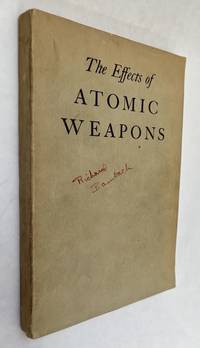
Washington: GPO 1950. Revised September 1950. Paperback. About very good with minors wear to exterior. Hand-written Washington DC street address in red ink to front wrapper verso. Small quarto in offwhite printed wraps; x 456 pages illustrations. Foot-notes partly bibliographical. Presentation copy. Signed by numerous contributors & editors: Signed by Richard Bambach on front cover and again by him "with compliments" on title page. Signed by all five Board of Editors beneath their printed names also on title page: Hirschfelder Kramish Parker Smith and Glasstone; by Los Alamos Scientifc Laboratory's then Director Norris E. Bradbury on title page verso statement of operations Univ. of Calif.; by Director of Civilian Mobilization Office Director Paul J. Larsen on top pf his printed statement toprelim; by contributor R. Reine three times after his printed name to Acknowledgment page; and lastly initialed three or four times by members of the Board of Editors at end of acknowledgments page over their printed names. A unique and very special presentation copy. Atomic bomb. Radiation. Nuclear Weapons. Effets des rayonnements. Guerre nucléaire. Atomic bomb. Biophysics. GPO paperback
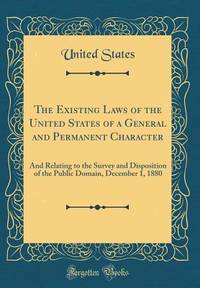
2017. Full Leather Bound. NEW. Size: 19.68 x 24.13 cms A Unique Premium Leather-Bound book for elite readers/collectors of old rare books. An Original Leather is being used for binding this book with Golden Leaf Printing and designing on Spine front and Back of the book with edge gilding. WE HAVE MULTIPLE OPTIONS IN COLOR OF LEATHER RED GREEN BLUE MAGENTA TAN PURPLE DEEP BROWN BLACK AND WITH DIFFERENT COLOR LABELS. YOU MAY CHOOSE ANY COLOR OF YOUR CHOICE AND MAIL US. This service is chargeable. Original edition was published in 1880 and this unique edition is Reprinted in 2017 with the help of original edition. Black & white printing on high quality natural shade paper with sewing binding for longer life professionally processed without changing its contents. As these are old books we processed each page manually on computer and make them readable. We give our best to give you the best book but in some cases we have to adjust few pages which are blur or missing or black spots. If it is multi volume set then it is only single volume. We hope that you understand these issues in these old treasure. This is an important book for the readers who want to know more about our old treasure. Our dedicated team is trying to bring these rare books back to the shelves. We are also giving service of printing the hard-to-find books which are not listed in our store. Hope you will like it and give your comments and suggestions. Lang: - English Pages 202. Product Disclaimer: Please be aware that because leather is a natural material slight discoloration or change in texture may be visible. FOLIO EDITION Size 12x19 Inches IS ALSO AVAILABLE ON REQUEST. hardcover
Army and Navy Pub. Co. January 1946. First Edition. Hardcover. Good - Cash/No Jacket. Oversize: Dark blue hardboards with raised lettering; red and gold division insignia on face. Heavier rubbing to corners and ends. Some soiling. Pages unmarked. Stock photos may not look exactly like the book. Army and Navy Pub. Co. hardcover
Washington DC: United States Government Printing Office 1928. Presumed first edition/first printing thus. Wraps. Good. No dust jacket. iv 71 pages. Highlighting/underlining. Cover has some wear and soiling. Some edge chipping. A few pencil marks and comments noted. Note the word 'signed' is in the title but this item IS NOT SIGNED. From Wikipedia: "The Kellogg Briand Pact officially the Pact of Paris was a 1928 international agreement in which signatory states promised not to use war to resolve "disputes or conflicts of whatever nature or of whatever origin they may be which may arise among them". Parties failing to abide by this promise "should be denied the benefits furnished by this treaty". It was signed by Germany France and the United States on August 27 1928 and by most other nations soon after. Sponsored by France and the U.S. the Pact renounced the use of war promoted peaceful settlement of disputes and called for collective force to prevent aggression. Its provisions were incorporated into the UN Charter and other treaties and it became a stepping stone to a more activist American policy. It is named after its authors: United States Secretary of State Frank B. Kellogg and French foreign minister Aristide Briand.The 1928 Kellogg Briand Pact was concluded outside the League of Nations and remains a binding treaty under international law. One month following its conclusion a similar agreement General Act for the Pacific Settlement of International Disputes was concluded in Geneva which obliged its signatory parties to establish conciliation commissions in any case of dispute. As a practical matter the Kellogg Briand Pact did not live up to its aim of ending war and in this sense it made no immediate contribution to international peace and proved to be ineffective in the years to come. Moreover the pact erased the legal distinction between war and peace since the signatories having renounced the use of war began to wage wars without declaring them as evidenced by the U.S. intervention in Central America the Japanese invasion of Manchuria in 1931 the Italian invasion of Abyssinia in 1935 the Soviet invasion of Finland in 1939 and the German and Soviet Union invasions of Poland. Nevertheless the pact is an important multilateral treaty because in addition to binding the particular nations that signed it it has also served as one of the legal bases establishing the international norms that the threat or use of military force in contravention of international law as well as the territorial acquisitions resulting from it are unlawful. Notably the pact served as the legal basis for the creation of the notion of crime against peace it was for committing this crime that the Nuremberg Tribunal sentenced a number of people responsible for starting World War II. The interdiction of aggressive war was confirmed and broadened by the United Nations Charter which provides in article 2 paragraph 4 that "All Members shall refrain in their international relations from the threat or use of force against the territorial integrity or political independence of any state or in any other manner inconsistent with the Purposes of the United Nations." One legal consequence of this is that it is clearly unlawful to annex territory by force. However neither this nor the original treaty have prevented the subsequent use of annexation. More broadly there is a strong presumption against the legality of using or threatening military force against another country. Nations that have resorted to the use of force since the Charter came into effect have typically invoked self-defense or the right of collective defense. United States Government Printing Office paperback

 検索結果のメールを受信する
 PDFファイルの検索結果をダウンロード
 RSSフィード
 パーマネントリンク