|
PLEE
DESCRIPTION DE L'EGYPTE. Botanique. Echium prostratum Echium setosum Anchusa spinocarpos. Histoire Naturelle planche 17
Paris: Imprimerie Impériale 1809. Fine. Imprimerie Impériale Paris 1809-1829 71 x 54 cm une feuille Original unshaved full-page etching from the Imperial edition of the Description de l'Égypte or Recueil des observations et recherches faites en Égypte pendant l'expédition française publié par les ordres de Sa Majesté l'Empereur Napoléon le Grand A Collection of the observations and research carried out in Egypt during the French expedition published on the orders of his Majesty the Emperor Napoleon the Great'.Produced between February 1802 and 1830 on the orders of Naopleon Bonaparte and published between 1809 and 1828 1000 copies were printed and distributed to institutions on vergé paper with an 'Égypte ancienne et moderne' watermark visible when held up to the light. Light marginal spotting not touching image otherwise in very fresh fine condition. An engraving from the Description de l'Egypte one of the masterpieces of French printing and the birth of a new field: Egyptology. A gigantic survey of Egypt at the time of Bonaparte's conquests in 1798 and 1799 the work is divided into 13 volumes of engravings making up 892 plates of which 72 colored as well as presenting the splendors of the Egypt of the Pharaohs in 9 volumes. The other volumes discuss natural history and present a fascinating portrait of Coptic and Islamic Egypt as it was seen by Bonaparte's Eastern Armies. The Egyptian campaign' militarily a disaster demonstrates through the engravings of the Description d'Egypte the scientific success it nonetheless became thanks to the 167 expert members of the Commission of the Sciences and Arts of the Institut d'Egypte Egyptian Institute who followed Napoleon's army. The Institut gathered together in Egypt the mathematician Monge the chemist Berthollet the naturalist Geoffroy Saint-Hilaire as well as numerous artists engineers architects and doctors. They were tasked with re-discovering modern and ancient Egypt and displaying its natural treasures as well as the know-how of its inhabitants.This edition the so-called Imperial edition of the plates for the Description de l'Egypte was printed in four large formats two of which were specially created for it and christened Moyen-Egypte and Grand-Egypte. A special press was built to print it the process extending over 20 years from 1809 to 1829. The Imperial edition proved so popular that a second edition this time in black and white and without the Egypte ancienne et moderne watermark known as the Royal Edition was published during the Restoration by the printing house of C.-L.-F. Panckoucke Paris.The engravings of the Description d'Egypte owe a great deal to Baron Dominique-Vivant Denon illustrator diplomat collector and later Director of the Musée Napoléon the Louvre. His exploration of the South of Egypt gave Bonaparte the idea of sending the experts of the Institut there thus creating a faithful and complete portrait of the area. This was the research gathered together from 1802 in the mammoth Description de L'Egypte.Denon embarked on this story of archeological exploration at the age of 51 reaching first Alexandria and then Cairo before exploring Upper Egypt. Along with the members of the Institut d'Egypte the Natural History Museum's painter H.J. Redouté brother of Pierre-Joseph Redouté author of Roses the mineralogist Dolomiue and the draughtsman Joly Denon then explored the Nile Delta and Lower Egypt. When however he joined the 21st Light Infantry Regiment as it marched across Upper Egypt in pursuit of the retreating Mameluks in November 1798 he found himself the only civilian. In the very midst of the battle itself he reeled off sketches of the works of art that peppered his path right up to the threshold of the Sudan. He said that he had crossed a country that is apart from its name entirely unknown to Europeans and therefore everything was worth describing Voyages dans la Basse et la Haute Egypte pendant les campagnes de Imprimerie Impériale unknown
书商的参考编号 : 26461

|
|
|
PLEE
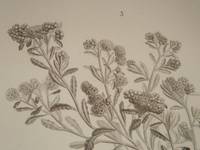
DESCRIPTION DE L'EGYPTE. Botanique. Gnaphalium pulvinatum Gnaphalium spathulatum Gnaphalium crispatulum. Histoire Naturelle planche 44
Paris: Imprimerie Impériale 1809. Fine. Imprimerie Impériale Paris 1809-1829 71 x 54 cm une feuille Original unshaved full-page etching from the Imperial edition of the Description de l'Égypte or Recueil des observations et recherches faites en Égypte pendant l'expédition française publié par les ordres de Sa Majesté l'Empereur Napoléon le Grand A Collection of the observations and research carried out in Egypt during the French expedition published on the orders of his Majesty the Emperor Napoleon the Great'.Produced between February 1802 and 1830 on the orders of Naopleon Bonaparte and published between 1809 and 1828 1000 copies were printed and distributed to institutions on vergé paper with an 'Égypte ancienne et moderne' watermark visible when held up to the light. Light marginal spotting not touching image otherwise in very fresh fine condition. An engraving from the Description de l'Egypte one of the masterpieces of French printing and the birth of a new field: Egyptology. A gigantic survey of Egypt at the time of Bonaparte's conquests in 1798 and 1799 the work is divided into 13 volumes of engravings making up 892 plates of which 72 colored as well as presenting the splendors of the Egypt of the Pharaohs in 9 volumes. The other volumes discuss natural history and present a fascinating portrait of Coptic and Islamic Egypt as it was seen by Bonaparte's Eastern Armies. The Egyptian campaign' militarily a disaster demonstrates through the engravings of the Description d'Egypte the scientific success it nonetheless became thanks to the 167 expert members of the Commission of the Sciences and Arts of the Institut d'Egypte Egyptian Institute who followed Napoleon's army. The Institut gathered together in Egypt the mathematician Monge the chemist Berthollet the naturalist Geoffroy Saint-Hilaire as well as numerous artists engineers architects and doctors. They were tasked with re-discovering modern and ancient Egypt and displaying its natural treasures as well as the know-how of its inhabitants.This edition the so-called Imperial edition of the plates for the Description de l'Egypte was printed in four large formats two of which were specially created for it and christened Moyen-Egypte and Grand-Egypte. A special press was built to print it the process extending over 20 years from 1809 to 1829. The Imperial edition proved so popular that a second edition this time in black and white and without the Egypte ancienne et moderne watermark known as the Royal Edition was published during the Restoration by the printing house of C.-L.-F. Panckoucke Paris.The engravings of the Description d'Egypte owe a great deal to Baron Dominique-Vivant Denon illustrator diplomat collector and later Director of the Musée Napoléon the Louvre. His exploration of the South of Egypt gave Bonaparte the idea of sending the experts of the Institut there thus creating a faithful and complete portrait of the area. This was the research gathered together from 1802 in the mammoth Description de L'Egypte.Denon embarked on this story of archeological exploration at the age of 51 reaching first Alexandria and then Cairo before exploring Upper Egypt. Along with the members of the Institut d'Egypte the Natural History Museum's painter H.J. Redouté brother of Pierre-Joseph Redouté author of Roses the mineralogist Dolomiue and the draughtsman Joly Denon then explored the Nile Delta and Lower Egypt. When however he joined the 21st Light Infantry Regiment as it marched across Upper Egypt in pursuit of the retreating Mameluks in November 1798 he found himself the only civilian. In the very midst of the battle itself he reeled off sketches of the works of art that peppered his path right up to the threshold of the Sudan. He said that he had crossed a country that is apart from its name entirely unknown to Europeans and therefore everything was worth describing Voyages dans la Basse et la Haute Egypte pendant les campagnes de Imprimerie Impériale unknown
书商的参考编号 : 26431
|
|
|
Plenderleith Harold James
The preservation of leather bookbindings
London: British Museum 1957. Small 8vo pp. 24; 4 illustrations on rectos and versos of 2 plates; fine in original limp green cloth printed in black on upper cover. Originally published in 1946. <br/><br/> British Museum hardcover books
书商的参考编号 : 51193
|
|
|
Plesset, Milton
Analytical Mechanics
Pasadena: California Institute Of Technology 1968. 1st Edition . Soft cover. Near Fine. Iii 168 Pp. Stapled Mimeo Sheets With 1968 Copyright. Advanced Class Text Of A Caltech Professor. Scarce; Indexed In Worldcat But No Institutional Holding Identified. <br/> <br/> California Institute Of Technology paperback
书商的参考编号 : 032520

|
|
|
Plimpton, George [Editor]. Interviews by Jean Stein [Edward M Kennedy]
American Journey: The Times of Robert Kennedy.
New York: Harcourt Brace Jovanovich Inc 1970. First edition of this remarkable biography of Robert F. Kennedy based on interviews by Jean Stein and edited by George Plimpton. Octavo original cloth. Association copy inscribed by George Plimpton on the front free endpaper to Robert Kennedy's youngest brother Ted Kennedy "To Senator Kennedy with great admiration and best wishes George." The recipient Ted Kennedy served as a United States senator from Massachusetts for almost 47 years from 1962 until his death in 2009. A member of the Democratic Party and the prominent political Kennedy family he was the second most senior member of the Senate when he died. During his tenure Kennedy became one of the most recognizable and influential members of his party and was sometimes called a "Democratic icon"as well as "The Lion of the Senate." Kennedy and his Senate staff authored around 2500 bills of which more than 300 were enacted into law. Very good in a good dust jacket. Jacket design by Hal Siegel. An exceptional association. "His life in a way was all aboard that funeral train; all the phases: the people he had known from school friends family friends college friends his early political friends and associates; and non-friends but people who had gotten woven into his life." So spoke American artist William Walton an old friend of the Kennedys and Chairman of the Commission of Fine Arts. For over eight hours on June 8 1968 Robert Kennedy's funeral train wound down the eastern seaboard from New York to Washington. Reminiscences of this journey - what Truman Capote called "the ride of the century" - are told in the words of those who were there and provide the framework of this book. the cradle upon which the other "journey" - that of Robert Kennedy's life story as recalled by his closest associates - is set. Harcourt Brace Jovanovich, Inc hardcover
书商的参考编号 : 142518

|
|
|
PLINIUS MINOR
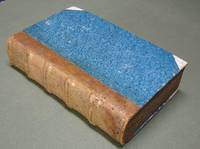
C. Plinii Caecilii Secundi Epistolarum libri X. Notis integris Is. Casauboni Jani Gruteri H. Stephani Augusti Buchneri Casp. Barthii Joh. Fred. Gronovii Selectissimisque Joh. Mariae Catanaei Ritterhusii & aliorum insertis suo loco integris commentariis Francisci Balduini J.C. Cunradi Ritterhusii J.C. & Gerh. Joh. Vossii in 'Relationem' seu consultationem 'Plinii' & ad hanc 'Rescriptum Trajani' Imper. de 'Christianis' illustrati & accurate recensiti a Johanne Veenhusio Brem.
Leiden Rotterdam Lugd. Batav. Roterodami Ex Officina Hackiana 1669. 8vo. LII81823 index1 blank p. frontispiece. 19th century half calf. 19.5 cm 'We shall have reason to congratulate ourselves on the acquisition of so elegant and desirable an edition' Ref: STCN ppn 840239440; Schweiger 2809; Brunet 4722: 'bonne édition'; Fabricius/Ernesti 2415 among the 'meliores editiones'; Dibdin 2331: 'is one of the scarcest and most valuable of the octavo Variorum classics'; Moss 2494/95: 'the text of Pliny is correct and the select notes of Veenhyseen sic do great credit to his learning and judgment'; Ebert 17351: 'eine der bessern Augaben cum notis varior.' Graesse 5347/48 Details: Back ruled gilt and with 4 raised bands. The frontispiece engraved by G. Wingendorp depicts Plinius at his desk in front of him 2 quills and an inkpot. Woodcut printer's mark on the title depicting a soaring eagle motto 'Movendo'. Dibdin adds: 'and whether we consider the elegance of its typography the accuracy of the text or perspicuity of the notes we shall have equal reason to congratulate ourselves on the acquisition of so elegant and desirable an edition'. Winckelmann used this 1669 edition of Pliny when he visited the Laurentine Villa Ep. II17 of Pliny Condition: Binding slightly scuffed. Seven small wormholes at the foot of the spine. New endpapers. Ownership entry on the title. Some foxing Note: The Roman civilian administrator Gaius Plinius Caecilius Secundus 61-112 A.D published 10 books of literary letters consisting of short essays character sketches and sensible observations. The letters paint the high society of the young Roman empire. The ninth book contains Pliny's correspondence with the emperor Trajan. Pliny is famous for his description of the eruption of the Vesuvius on the 24th of August in 79 A.D. He was a nephew of the encyclopedist Pliny the Elder who died observing the eruption from afar overcome by poisonous fumes. Pliny the Younger held under Trajanus a number of magistracies. In 111 or 112 he became governor of Bithynia. From here he was in constant correspondence with the Emperor. His letters which were conceived of as artistic productions are more or less epistolary essays. In the late antiquity and later in the Renaissance the literary letter had a widespread influence. § The German classical scholar Johannes Veenhusius of Bremen 1643-1675 published the 'Epistulae' with the complete commentaries of Casaubon Gruterus Henri Estienne Buchnerus Barthius Johannes Fredericus Gronovius and with select notes of Cattaneo Ritterhusius and himself. The emendations of Gronovius are published here for the first time. Added are Henri Estienne's 'Praefatio' and Conrad Lycosthenes' 'Vita Plinii' Boxhornius' essay on Pliny's alleged Christianity and the notes of Balduinus Ritterhusius and the Vossii. For his text of the 'Epistulae' Veenhusius generally follows Estienne/Cattaneo even when he reports in the footnotes the notes and the comments of other scholars who disagree with or correct the text he is printing. To confirm Pliny's authorship of book 10 he reprints at the beginning of that book the dedicatory letter of Giovanni Maria Cattaneo who published an edition of Pliny's letters in 1506 to Ambrogio del Maino. In his own dedication to the officials of the city of Bremen Veenhusius speaks of the difficult task of an editor. But he affirms that Pliny is an author worthy of their sponsorship; many of his letters deal with Roman law which would be useful to compare with common law and many contain learned observations about antiquity and politics which are not only useful but also necessary to know. 'Catalogus Translationum Et Commentariorum: Mediaeval and Renaissance Latin translations and commentaries annotated lists and guides'. Volume IX editors V. BrownJ. HankinsR. A. Kasterp Washington 2011 p. 94 § Not much is known about Veenhusius he is not to be found in ADB and NNBW. At the beginning of the 'dedicatio' to this edition he calls himself Johannes Veenhusen and Bremen his 'Patria'. In 1671 he produced for the Leiden publisher Hackius another 'Variorum' edition now of Statius. Provenance: On the title 'Bibliotheca vallis Sti Lamberti 1749'. We found on the internet one book with exactly this same provenance: crlvorg/bibliographie-des-voyages/1203. The Cistercian abbey Val St. Lambert was situated in Seraing Southwest of the Belgian city of Liège. It was founded in 1202 and closed down in 1796. Nowadays it is a crystal glass factory. See Wikipedia 'Val-Saint-Lambert'. On the front flyleaf the name of the Dutch specialist of Roman law 'J.W. Tellegen'. On the front pastedown a small label of 'Libreria dello Studente Add.: Paolo Franchini Firenze' Collation: -38 42; A-3G8 leaf 3G5 verso blank; minus leaf 3G6 7 & 8 Photographs on request hardcover
书商的参考编号 : 153325
|
|
|
PLINIUS MINOR
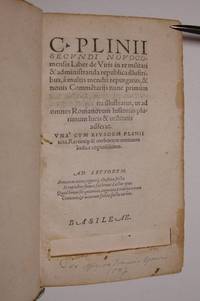
C. Pliniii Secundi Novocomensis Liber de viris in re militari & administranda republica illustribus a multis mendis repurgatus & novis commentariis nunc primum nunc primum per Conradum Lycosthenem ita illustratus ut ad omnes Romanorum historias plurimum lucis & utilitatis adferat. Una cum eiusdem Plinii vita rerumque & verborum omnium indice copiosissimo.
Basel Basileae no publisher n.d. Colophon on the last page: 'Basileae Ex officina Ioannis Oporini Anno salutis humanae 1547 mense Septembri 8vo. XXXII59575 index2 blank p. 19th century half vellum 17 cm Ref: VD16 P 3521; Schweiger 21139 under Sextus Aurelius Victor; Graesse 5350 Details: Back ruled gilt and with a green morocco shield. 2 woodcut initials Condition: On the title page the words 'per Conradum Lycosthenem' are carefully erased. This erasing has been repeated on the verso of the title where in the heading of the short biography of Pliny Minor the words 'a Conrado Lycosthene' have been erased. This erasure signals the attempt to eradicate the memory of the editor of this title the Alsatian protestant humanist and encyclopedist Konrad Wolffhart latinized as Conradus Lycosthenes 1518-1561. In 1557 he published at Basel a work 'Prodigiorum ac ostentorum chronicon' or ' Chronicle of omens and portents' with woodcuts of freaks human monsters of all types curious animals comets earthquakes etc. Two years later this title and at the same time the entire oeuvre of Lycosthenes was placed on the first catholic 'Index librorum prohibitorum' by Pope Paul IV. The 'Index' of forbidden books contained publications that were banned by the Catholic Church because they were deemed heretical anti-clerical or immoral. Often these books were censored or even destroyed. The censoring sometimes came down to the erasing or cutting out of names or passages or the removal of leaves even complete chapters by catholic librarians. This explains the erasing of his name on the title page of this Plinius. The censor also cut out the name of the famous protestant publisher Oporinus leaving a neat rectangular hole of 7.5x1 cm. The censor overlooked however the name 'Conradus Vuolfhardus' in the heading of the 'praefatio' Note: 'The full maturation of ancient biography did not occur before the Roman late republican and imperial periods. The purposes of Graeco-Roman biography were varied ranging from instructive praise of a subject's virtues to panegyric to providing insurance against the jaws of oblivion by immortalizing the 'fama' good or ill of notable individuals'. The Classical Tradition Cambr. Mass. 2010 p. 127 In the early imperial period the Greek author Plutarch composed a series of vitae which are discursive and generally show a strong moral bias. The Romans were in the writing of biography not wholly dependent on the Greeks. 'The attitudes and customs of their own political and family life led them to put a special value on recording the achievements of their great men'. OCD 2nd ed. p. 168 Tacitus Agricola Nepos Liber De Excellentibus Ducibus Gentium Suetonius Vitae XII imperatorum or Caesares are the principle Roman biographers. In late antiquity they found a number of imitators and continuators e.g. the 'Scriptores Historiae Augustae' or 'Sextus Aurelius Victor'. § This 'Liber de viris in re militari & administranda republica illustribus' nowadays called in the edition of Pilchmayr 'Incerti Auctoris liber de Viris Illustribus Urbis Romae' is one of those imiations. It contains more than 75 biographies of famous Romans from Romulus to Pompeius and Sulla. When it was written no one knows some say first or second century AD others the fourth. This collection of Lives of famous Romans including Hannibal his brother Hasdrubal and king Mithridates was long time primarily ascribed to Plinius Minor 62-ca. 113 AD. The editio princeps was printed ca. 1470 and enjoyed a great popularity among humanists and on schools. Since the edition of Aldus in 1508 the collection is often called the 'Liber de viris in re militari & administranda republica illustribus'. Schweiger records before this 1547 edition ca. 40 editions and there must be more. It was printed in the 16th century also under the name of Suetonius and of Nepos. Hyginus and Aemilius Probus are also mentioned as the authors. The Flemish scholar Andreas Schottus attibuted the text in 1577 to Sextus Aurelius Victor. From then on till the second half of the 19th century he was thought to be the author of this collection. Schweiger 2 1140/41 But nowadays the author is an anonymous because the style genus dicendi does not suit Sextus Aurelius Victor. It is doubtful whether the author was a christian. He belonged probably to the Optimates. Though many historical errors hurt the eye of the reader still this collection of biographies offers much that is of great help for our understanding of Roman history of the republican period. The collection figures anonymously in the 'Bibliotheca Teubneriana' edition of that writer of 1966 edited by Pilchmayr. Especially the praefatio of Pichlmayer offers much useful information p. X & XI § Conradus Lycosthenes lectured grammar and dialectics in Basel from 1542. In 1545 he was appointed deacon and preacher of the local 'St. Leonhardskirche'. He married Christine Herbster a sister of Johannes Oporinus the printer of this book. The biographer of Lycosthenes's short biography in ADB calls his commentary in this 1547 collection his most excellent work. ADB 19 727/28 Provenance: On the front pastedown in pencil: '24 dec. 1963' written by the Flemish linguist Walter Couvreur 1914-1996 Orientalist and professor of Indoeuropean linguistics at the University of Gent. It indicates the date of aquisition. The place of acquisition is written on the flyleaf at the end: 'Bologna Galliera' Collation: alpha-beta8 a-2T8 leaf 2T8 blank Photographs on request hardcover
书商的参考编号 : 120121
|
|
|
PLINIUS MINOR
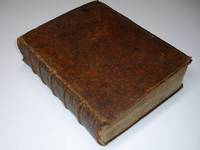
Caii Plinii Caecilii Secundi Epistolarum libros decem cum notis selectis Jo. Mariae Catanaei Jac. Schegkii Jac. Sirmondi Is. Casauboni Henrici Stephani Conradi Rittershusii Cl. Minois Casparis Barthii Aug. Buchneri Jo. Schefferi Jo. Frid. Gronovii Christophori Cellarii aliorumque recensuerunt suisque animadversionibus illustrarunt Gottlieb Cortius et Paullus Daniel Longolius qui etiam universum opus indicibus locupletissimis instruxit.
Amsterdam Amstelaedami Apud Janssonio-Waesbergios 1734. 4to. Frontispiece LII924;8461191 blank p. Contemporary mottled calf 26 cm Ref: STCN ppn 186700156; Schweiger 2809/10; Brunet 4722: 'bonne édition'; Dibdin 2332; Graesse 5343; Ebert 17356; Fabricius/Ernesti 2416 Details: Back with 5 raised bands and panelled in gilt with floral motives. Frontispiece it depicts Pliny writing a letter. Title in red & black. Engraved printer's mark on title; a mole with the motto: 'Vulgo caeca vocor. Video sed acutius ipso' Condition: Binding rather worn and scratched. Head & tail of the spine damaged. Back rubbed shield in the second compartment gone. Corners bumped. Endpapers chipping and loosening. Right margin of the frontispiece chipped. Title soiled and with a small hole and a small tear in the outer margin. Small tear in the outer margin of the first 5 leaves. Outer margin of last 6 leaves chipping. Some foxing Note: The Roman civilian administrator Gaius Plinius Caecilius Secundus 61-112 A.D published 9 books of literary letters consisting of short essays character sketches and sensible observations. The letters paint the high society of the young Roman empire. The tenth book contains Pliny's correspondence with the emperor Trajan. Pliny is famous for his description of the eruption of the Vesuvius in 79 A.D. § The German classical scholar Gotlieb Cortius or Kortte 1698-1731 made his name producing editions of Latin authors whose works were provided with very extensive commentaries in the manner of the Dutch scholar Petrus Burmannus to whom this edition is actually dedicated. Dibdin admires the work of Cortius: 'this' he says 'is a very critical and elaborate edition calculated for those who wish to enter minutely into all the niceties of grammatical construction and historical illustration'. Ernesti says that this is a work 'quae est sane luculenta et ut nunc est optima editio'. Cortius died before he could finish the job. Most remaining work was done by a pupil of Cortius the young German philologist Paul Daniel Longolius 1704-1779 from 1735 Rector of the Gymnasium in Hof Saale. He published 3 ancient authors in an exemplary manner the Letters of Pliny the Younger and the works of Diogenes Laertius 1739 and Gellius 1741. ADB 19156/7 The edition of the letters and the commentary is preceded by a 70 pages long biography of Pliny by J. Masson which was first published in Amsterdam in 1709 Collation: pi1 4 minus 4 2-74 minus 74; a-m4; A-5O4 a-p4 leaf p4 verso blank Photographs on request Heavy book may require extra shipping costs hardcover
书商的参考编号 : 140108
|
|
|
PLINIUS MINOR
Caii Plinii Caecilii Secundi Epistolarum libros decem cum notis selectis Jo. Mariae Catanaei Jac. Schegkii Jac. Sirmondi Is. Casauboni Henrici Stephani Conradi Rittershusii Cl. Minois Casparis Barthii Aug. Buchneri Jo. Schefferi Jo. Frid. Gronovii Christophori Cellarii aliorumque recensuerunt suisque animadversionibus illustrarunt Gottlieb Cortius et Paullus Daniel Longolius qui etiam universum opus indicibus locupletissimis instruxit.
Amsterdam Amstelaedami Apud Janssonio-Waesbergios 1734. 4to. Frontispiece LII924;8461191 blank p. Vellum 26.5 cm Ref: STCN ppn 186700156; Schweiger 2809/10; Brunet 4722: 'bonne édition'; Dibdin 2332; Graesse 5343; Fabricius/Ernesti 2416: 'optima editio' Details: Back with 5 raised bands. Short title in the second compartment. Blind tooled boards. The engraved frontispiece depicts a pensive Pliny busy writing a letter. Title printed in red & black. The engraved printer's mark on the title shows a mole flanked by Athena and Hermes; the motto reads: 'Vulgo caeca vocor. Video sed acutius ipso' Condition: Nice copy. Vellum very slightly soiled. Vellum at the outer edge of the upper board very slightly damaged Note: The Roman civilian administrator Gaius Plinius Caecilius Secundus 61-112 A.D published 9 books of literary letters consisting of short essays character sketches and sensible observations. The letters paint the high society of the young Roman empire. The tenth book contains Pliny's correspondence with the emperor Trajan. Pliny is famous for his description of the eruption of the Vesuvius in 79 A.D. The German classical scholar Gotlieb Cortius or Kortte 1698-1731 made his name producing editions of Latin authors whose works were provided with very extensive commentaries 'cum notis Variorum' in the manner of the Dutch scholar Petrus Burmannus to whom this edition is actually dedicated. Such commentaries are 'Fundgruben' for the classical scholar. The students should bear in mind that the outdated commentaries were the work of scholars who knew their latin far beter than they do. Dibdin shows admiration for the work of Cortius. 'This' he says 'is a very critical and elaborate edition calculated for those who wish to enter minutely into all the niceties of grammatical construction and historical illustration'. Ernesti says that this is a work 'quae est sane luculenta et ut nunc est optima editio'. Cortius died before he could finish the job. Most work was done by a pupil of Cortius the young German philologist Paul Daniel Longolius 1704-1779 from 1735 Rector of the Gymnasium in Hof Saale. He published 3 ancient authors in an exemplary manner the Letters of Pliny the Younger Diogenes Laertius 1739 and Gellius 1741. ADB 19156/7 The edition of the letters and its commentary is preceded by a 70 pages long biography of Pliny by J. Masson which was first published in Amsterdam in 1709. Schweiger 2818 Collation: pi1 4 minus leaf 4 2-74 leaf 74 blank; a-m4; A-5O4 a-p4 leaf p4 verso blank Photographs on request Heavy book may require extra shipping costs hardcover
书商的参考编号 : 140054
|
|
|
PLINIUS MINOR
Caii Plinii Caecilii Secundi Opera quae supersunt omnia. Ad fidem optimarum editionum diligenter expressa. Liber I-X: ex recensione Cortii et Longolii. Panegyricus Nervae Trajano Augusto dictus ex editione T. Hearne
Glasgow Glasguae In aedibus academicis excudebant Robertus et Andreas Foulis Academiae typographi 1751. 12mo. 3 volumes in 2: IV1-2751 blank; IV277-6331 blank23 p. index1 blank p. Vellum 13 cm Ref: Gaskell no. 208 p. 163 and especially no. 208 p. 419; ESTC Citation No. T190303; Schweiger 2807: 'Sehr saubrer Abdruck des Textes der Briefe nach Corte und Longolius und des Panegyricus nach Th. Hearne'; Graesse 5346; Ebert 17358; cf. Dibdin 2331 & 332; cf. Moss 2495 Details: 2 thongs laced through the joints. Short title in ink on the back Condition: Vellum slightly soiled and scratched. Some foxing. Paper yellowing Note: The Roman civilian administrator Gaius Plinius Caecilius Secundus 61-112 A.D published 9 books of literary letters consisting of short essays character sketches and sensible observations. The letters paint the high society of the young Roman empire. The tenth book contains Pliny's correspondence with the emperor Trajan. Pliny is famous for his description of the eruption of the Vesuvius on the 24th of August in 79 A.D. He was a nephew of the encyclopedist Pliny the Elder who died observing the eruption from afar overcome by poisonous fumes. Pliny the Younger held under Trajanus a number of magistracies. In 111 or 112 he became governor of Bithynia. From here he was in constant correspondence with the Emperor. His letters which were conceived of as artistic productions are more or less epistolary essays. In the late antiquity and later in the Renaissance the literary letter had a widespread influence. § The Scottish printers Robert and Andrew Foulis chose for this edition of Pliny's 247 letters the best available text at the time. It was produced by the German classical scholar Gottlieb Cortius or Kortte 1698-1731 who made his name producing editions of Latin authors and whose works were provided with very extensive commentaries in the manner of the Dutch scholar Petrus Burmannus. His very critical and elaborate Plinus Minor edition was published in Amsterdam in 1734. Cortius died before he could finish the job. Most publishing work was done by a pupil of his the young German philologist Paul Daniel Longolius 1704-1779. He added also emendations of his own. Longolius published 3 ancient authors in an exemplary manner these Letters of Pliny the Younger and also Diogenes Laertius 1739 and Gellius 1741. ADB 19156/7 His Plinius edition is called by Ernesti the editio optima Ernesti/Fabricius Bibliotheca Latina 2416 For the Panegyricus Foulis used the edition of Pliny the Younger which was produced by the English scholar Thomas Hearne 1678-1735 and which dates from 1703 Oxford. It is called by Dibdin a 'very respectable edition'. § Thousands of panegyrics must have been delivered in antiquity. Only a few of them survive. A panegyric is an elaborate eulogy a formal set-piece oration in praise of an emperors or a high dignitary and was an integral part of the ceremony of politics in the Roman empire. The most influential panegyric speech was delivered in 100 A.D. by Plinius Minor before Trajan and the Senate in Rome in which he thanks the emperor for his election to the consulship. It served as a model of rhetoricians in late antiquity. 'It went on to teach many Renaissance and Baroque ceremonial orators how to address supreme political authorities in public speeches. The Classical Tradition Cambr. Mass. 2010 p. 745. His most famous imitator in the Renaissance was Erasmus. By the 18th century the panegyric was treated with suspicion for it easily slid from a showpiece of praise to mindless flattery. 'For Enlightenment critics panegyrics were not to be seen as part of a vital political culture; rather they were a sure index of the constriction of personal liberty and the inevitable bankruptcy of language under autocracy'. The Classical Tradition Cambr. Mass. 2010 p. 684 In the 35 years between 1742 and 1776 the learned Foulis brothers who were University Printers to the University of Glasgow produced ca. 590 titles. Circa 100 of them are Greek or Latin editions. The Foulises printed textbooks for the University but also works of learning and general literature. From their presses have come some of the finest specimens of accurate and elegant printing that was produced in the eighteenth century. They once hung up the sheets of an Horace edition 1744 which was being printed in the college of Glasgow and offered a reward to those who could discover an inaccuracy. It seems that this Pliny edition was originally planned in two volumes. On the verso of the titles of volume 1 and 2 one reads: 'Epistolarum libri sex priores' and 'Epistolarum libri quatuor posteriores. Panegyricus Nervae Trajano Augusto dictus'. However at the bottom of page 503 the first page of the Panegyricus is printed 'Vol. III'. It was probably intended later on that the Panegyricus should comprise the third volume 'but no copy has been seen with a separately-bound vol. III nor one with a Vol. III title page'. Gaskell p. 164 The Panegyricus is instead of a title preceded by 2 leaves which only announce the Panegyricus and donot have an imprint. The Foulises produced in this same year also a quarto edition of the Letters of Pliny. Gaskell 207 Collation: Vol. 1: pi2 A-L12; M6. Vol. 2: pi2 N-X12 Y6 minus blank leaf Y6; pi2 leaf pi1 half-title pi2 volume title Z-2D12 2E6 2F12 leaf 2F12 verso blank Photographs on request hardcover
书商的参考编号 : 120516
|
|
|
PLINIUS MINOR
Caji Plinii Caecilii Secundi Panegyricus cum notis integris Francisci Jureti Joannis Livineji Justi Lipsii Petri Fabri Conradi Rittershusii Jani Gruteri Christiani Gotlibi Schwarzii et selectis aliorum curante Joanne Arntzenio qui & suas adnotationes adjecit. Accedit Joannis Masson Vita Plinii editio tertia auctior.
Amsterdam Amstelaedami Apud Janssonio Waesbergios 1738. 4to. XXIV including frontispieceXCII4 index; 46957 index p. Half vellum 25 cm Ref: STCN ppn 186699948; Schweiger 2812/3; Dibdin 2335; Moss 2495/6; Fabricius/Ernesti 2423; Graesse 5349: 'Bonne édition'; Ebert 17374 Details: Early 20th century binding. Brown gilt morocco shield on the back. Title in red & black. Engraved printer's mark on the title depicting a mole flanked by a seating Hermes and Athena; the motto is: 'vulgo caeca vocor video sed acutius ipso' 'By the crowd I am called blind; but I see better than itself'. The frontispiece is bound after the title it is engraved by W. Jongman; on it we see on orator Plinius standing on a kind of pedestal; he is pronouncing his eulogy in the Senate in front of a statue of the emperor Trajanus; the senate is listening and someone enters with a laurel wreath for the orator in his hand Condition: paper browning and browned Note: In 100 A.D. The Roman civilian administrator Gaius Plinius Caecilius Secundus or Pliny the Younger 61-112 A.D was elected 'consul electus'. On the occasion of his entry on the position of consul Pliny pronounced in the Senate an eulogy to thank the emperor. This specimen of his eloquence survived and is known as the 'Panegyricus'. In his speech he elaborated on all the admirable actions and good qualities of the emperor Trajanus. Pliny published also 9 books of literary letters consisting of short essays character sketches and sensible observations. The letters paint the high society of the young Roman empire. The tenth book contains Pliny's correspondence with the emperor Trajan. Pliny is famous for his description of the eruption of the Vesuvius on the 24th of August in 79 A.D. He was a nephew of the encyclopedist Pliny the Elder who died observing the eruption from afar overcome by poisonous fumes. Pliny the Younger held under Trajanus a number of magistracies. In 111 or 112 he became governor of Bithynia. From here he was in constant correspondence with the Emperor. The Dutch scholar Johannes Arntzenius 1702 - 1759 had experience with Panegyrics and late Latin. In 1733 he already had edited the Roman eulogist Aurelius Victor. Later in life in 1753 he produced an edition of another Panegyricus that of the late antique author Pacatus Drepanius. Arntzenius was professor of Eloquentia and Historia of the University at Franeker since 1743. NNBW 1 179/80 Provenance: Name on front flyleaf: 'J.W. Tellegen' Collation: -34 first gathering: 1 4 frontispiece then 2 & 3 i.e. leaf pi1 of the STCN copy the frontispiece has been bound in our copy immediately after the title leaf 1; 2-34; a - m4; chi1 A-3V4 minus blank leaf 3V4 Photographs on request hardcover
书商的参考编号 : 140117
|
|
|
PLINIUS MINOR
Lettere di Plinio il Giovane tradotte in lingua Italiana e dedicate all'Illustriss. ed Eccellentiss. Signore D. Alessandro Albani nipote di nostro Signore Clemente XI Pontefice Ottimo Massimo dal Canonico Gio. Antonio Tedeschi e tra gli Arcadi Orticolo Eleo.
Roma Della Stamperia di Gio. Maria Salvioni nella Sapienza 1717. 4to. XXXV1 blank; 4411 errori2 blank p. Calf 24 cm Ref: Schweiger 2816; Moss 2502 quotes Nicola Francesco Haym 'Biblioteca Italiana o sia notizia de libri rari nella lingua italiana' Venice/Milan 1741 p. 157: 'La traduzione e l'impressione sono ambi bellissime'; Ebert 17379; Graesse 3351 Details: Back with 5 raised bands and a gilt red morocco shield in the second compartment. Title printed in red and black. Woodcut initials. Excellent quality paper Condition: Binding scuffed. Boards scratches and spotted. Corners bumped. Foot of the spine slightly damaged. Front joint partly split. Bookplate and small label on the front pastedown. Front hinge cracking but strong. First two leaves foxed. Faint name on the title Note: The Roman civilian administrator Gaius Plinius Caecilius Secundus 61-112 A.D published 10 books of literary letters consisting of short essays character sketches and sensible observations. The letters paint the high society of the young Roman empire. The ninth book contains Pliny's correspondence with the emperor Trajan. Pliny is famous for his description of the eruption of the Vesuvius on the 24th of August in 79 A.D. He was a nephew of the encyclopedist Pliny the Elder who died observing the eruption from afar overcome by poisonous fumes. Pliny the Younger held under Trajanus a number of magistracies. In 111 /112 he became governor of Bithynia. From here he was in constant correspondence with the Emperor. His letters which were conceived of as artistic productions are more or less epistolary essays. In the late antiquity and later in the Renaissance the literary letter had a widespread influence. § Not much is known about the Canon Giovanni Antonio Tedeschi or Johannes Antonius Tedeschi who produced this first complete Italian translation of the correspondence of Pliny Minor. He also published a translation of the letters of Symmachus 1724. He died in 1727. We found one Giovanni Antonio Tedeschi who was dean archiprete of the family Borghese in whose palace he died in 1727 and who was buried in S. Lucia della Tinta. Claudio De Dominicis 'Carlo De Dominicis architetto del settecento romano' Roma 2006 p. 73 This must be our Tedeschi for he dedicated his Symmachus translation to Marcantonio Borghese. Tedeschi was a member of the Italian literary academy/society 'Accademia degli Arcadi' or 'Accademia dell'Arcadia'. In 'Prose degli Arcadi tomo terzo' Roma 1718 p. CV he is described as 'Orticolo Eleo. Il Canonico Gio. Antonio Tedeschi da Pesaro'. 'Orticolo Eleo' being his 'nome arcadico' i.e. his pen name or pseudonym. So the phrase 'e tra gli Arcadi Orticolo Eleo' probably means 'and among the Arcadi his name is 'Orticolo Eleo''. Might this pen name refer to a 'olive grove' A problem is that there is in this same period a namesake who was a sculptor/stonemason Provenance: On the title the name of 'Harriet Taylor'. This is Harriet Taylor Upton 1853 - 1945 who was an American political activist and author. Taylor 'Upton is best remembered as a leading Ohio state and national figure in the struggle for women's right to vote and as the first woman to become a vice chairman of the Republican National Committee'. Harriet Taylor married in 1884 the attorney George W. Upton. She 'was a key organizer and the first president of the Suffrage Association of Warren. She was also a member of the National Woman Suffrage Association NWSA from 1890. In 1891 Upton hosted a conclave of women seeking equal rights with men Ohio Women in Convention in her home. . Harriet Upton was inducted into the Ohio Women's Hall of Fame in 1981 in the category of Government and Military Service. In early 2010 Upton was proposed by the Ohio Historical Society as a finalist in a statewide vote for inclusion in Statuary Hall at the United States Capitol'. She probably wrote her name before 1884. See Harriet's lemma in Wikipedia § On the French title in pencil: 'J.W. Tellegen' § On the front pastedown the bookplate of 'Thomas Conolly' depicting a round garter with the motto: 'En Dieu Est Tout'; in the center a cubit arm the hand is grasping an annulet. Someone wrote once in pencil beneath the plate: 'One time Speaker in the Irish House of Commons'. This is not correct. This Speaker was William Conolly of humble descent who was the first of his line and in his time the wealthiest and the most powerful politician in Ireland. He died childless in 1729. Thomas Conolly 1738-1803 was a son of his nephew William James Conolly. Thomas inherited the estate of his father William James when he was still a minor. 'Thomas Conolly was the quintessential Irish gentleman a keen huntsman and a fine horseman as well as a politician and landowner. Regarded as the wealthiest commoner in the kingdom: he actually spent much of his career in debt because of large debts he inherited from his father. Conolly sat in the Irish parliament for forty years where he prided himself on his often imagined independence'. See for this interesting family: wwwcastletown.ie Collation: pi4 b-c4 d6 leaf d6 verso blank; A-3H4 3I6 leaf 3I6 blank Photographs on request hardcover
书商的参考编号 : 153326
|
|
|
Plinval de Guillebon, Regine de
Faïence et Porcelaine de Paris XVIIIe - XIXe Siècles
Dijon: Editions Faton 1995. 1st. Hardcover. Fine/Very Good. 12.7x9.7x1.9in. dust jacket with small tear at top of rear fold very good slipcase with rubbing at extremities. Dust jacket in clear protector. <br>With 409 illustrations almost all in color 406 marks glossary bibliography and index of proper names. Text in French. <br>475pp 7.15lb 12.7x9.7x1.9in <br>EXTRA SHIPPING CHARGES NECESSARY Editions Faton hardcover
书商的参考编号 : 25410 ???????? : 2878440226 9782878440225

|
|
|
Plinval de Guillebon, Regine de
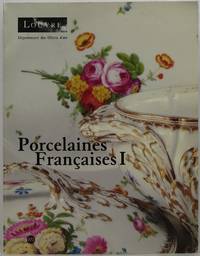
Musée du Louvre Department des Objets d'Art Porcelaines Françaises I: Chantilly Mennecy Saint-Cloud Boissette Bordeaux Limoges Niderviller Paris Valenciennes
Paris: Reunion des Musées Nationaux 1992. 1st. Soft cover. Near Fine. 10.7x8.3x1.0in. light wear at corners of front cover. <br>The first volume on the French porcelain in the collection of the Louvre. Illustrated with 14 color and 117 monochrome plates. Text in French. <br>314pp 2.76lb 10.7x8.3x1.0in Reunion des Musées Nationaux paperback
书商的参考编号 : 25411 ???????? : 2711822869 9782711822867
|
|
|
Plinval de Guillebon, Regine de
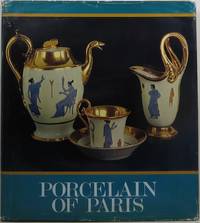
Porcelain of Paris
New York: Walker and Company 1972. 1st. Hardcover. Very Good/Very Good. 11.5x10.3x1.6in. bumping to bottom corner of text block dust jacket with small tears at head of spine and light edge wear. Dust jacket in clear protector. <br>With 242 color and black-and-white illustrations. <br>361pp 5.41lb 11.5x10.3x1.6in Walker and Company hardcover
书商的参考编号 : 23823 ???????? : 080270395X 9780802703958
|
|
|
PLOMER HENRY
A Short History of English Printing 1476-1900
London: Kegan Paul Trench Trubner & Co. Ltd 1915. Second popular edition 8vo ix & 276pp. cloth paper label small bookplate on front pastedown; light stains on upper cover else very good. Part of Books about Books Series edited by Pollard. <br/><br/> Kegan Paul, Trench, Trubner & Co., Ltd hardcover books
书商的参考编号 : 29285
|
|
|
PLOMER HENRY R.
Wynkyn de Worde & his contemporaries from the death of Caxton to 1535. A chapter in English printing
Kent: Dawsons of Pall Mall 1974. Reprint of the 1925 edition pp. 263 1; illus.; very good in original maroon cloth spine gilt-lettered. <br/><br/> Dawsons of Pall Mall hardcover books
书商的参考编号 : 32098
|
|
|
PLOMER Henry
Wynken De Worde and his Contemporaries from the Death of Caxton to 1535. BRIGHT CLEAN CRISP COPY
Grafton 1925. 4to. First Edition on laid paper with frontispiece and 13 facsimiles 11 of which are full-page in the text; minimal spotting on endpapers; boards holland back paper label gilt top covers very slightly age-marked else a bright clean crisp copy. Grafton, hardcover
书商的参考编号 : 175

|
|
|
Plomer, HR, Aldis, HG, Bushnell, GH, Dix, E R McC, Esdaile, AE & McKerrow, RB and others H R H G G H A E R B
Dictionary of the booksellers etc.
The Bibliographical Society 1977. Reprint in compact form of the original volumes of 1907 1910 1922 and 1932. V.g./No Jacket. Hard covers no dust jacket No jacket gilt lettering on spine. Top front corner bumped. An invaluable reference work for bibliographers listing the booksellers printers and related trades who were active in England from 1577. The pages of the first editions have been photographically reduced and are displayed four to a page but are easily readable. Includes a few other lists such as circulating libraries. Quarto. The Bibliographical Society hardcover
书商的参考编号 : 7249
|
|
|
Plomer, William; Wraparound Dust Jacket By Andy Warhol
Borderline Ballads
Noonday Press 1955. 1st Edition 1st Printing. Hardcover. Fine/Very Good. 111 Pp. Green Cloth Gilt. First Edition. Fine No Wear Or Marks Gilt Brilliant. Dust Jacket With $3.00 Price Slight Browning To Dust Jacket Minute Loses At Edges. <br/> <br/> Noonday Press hardcover
书商的参考编号 : 056005

|
|
|
Plotinus; Editing, Translation, And Extensive Introduction By Thomas Taylor
Five Books Of Plotinus Viz. On Felicity; On The Nature And Origin Of Evil; On Providence; On Nature Contemplation And The One; And On The Descent Of The Soul: Translated From The Greek. With An Introduction Containing Additonal Information On These Important Subjects.
London: Edward Jeffrey 1794. 1st Edition 1st Printing. Hardcover. Very Good. Lxvii 288 Pp. First Printing. Original Tree Calf Re-Backed Long Ago With A New Red Morocco Spine Label Gilt. Very Large Heraldic Bookplate Over An Earlier Postage-Stamp-Size Bookplate Which Left A Faint Offset On The Facing Page. Some Page Numbers And Brief Reader's Notes On Rear Pastedown One Line In Ink The Others In Pencil. Boards Quite Worn Calf Frayed Through Almost Entirely Along Edges Re-Backing Entirely Intact And Secure. <br/> <br/> Edward Jeffrey hardcover
书商的参考编号 : 037740
|
|
|
Plowman George T.
Etching and Other Graphic Arts: An Illustrtaed Treatise
London: John Lane/The Bodley Head 1922. First Edition. Pub Cloth. NF/NF-. 8vo pub cloth 158p illustrated w/ 49 plates including an original etching plate frontispiece plus two plates in rear of etching tools. An appareatnly unused copy. Internals fine. In scarce dw that is lightly soiled. John Lane/The Bodley Head unknown books
书商的参考编号 : 008167
|
|
|
Plowman, Dr. J.M.
Antiquarian Horology and the Proceedings of the Antiquarian Horological Society: September 1981, Volume Thirteen, Number One
Features: Equation Clocks; The Penningtons and Their Balances; A Select Clock; A.G.M. Report; The Matthew and Miller Clock at the Parish Church of St. Mary Steps, Exeter; Some Notes on La Vallee and L.B. Audemars; Watch Movement Making in Prescot; John Poole's Balances; and more. Moderate wear. Unmarked. Sound copy. Book

|
|
|
Plowman, Dr. J.M.
Antiquarian Horology and the Proceedings of the Antiquarian Horological Society: December 1981, Volume Thirteen, Number Two
Features: The Worshipful Company of Clockmakers; Mudge Milestones; Josiah Emery and John Leroux; John Arnold; Thomas Mudge - the Complete Horologist; Thomas Earnshaw; Watch by Thomas Mudge No. 574; William Oughtred; and more. Moderate wear. Clean and unmarked. Sound copy. Book

|
|
|
Plowman, Dr. J.M.
Antiquarian Horology and the Proceedings of the Antiquarian Horological Society: Spring 1981, Volume Twelve, Number Five
Features: Watch Stands; The Penningtons and Their Balances; A Gravity Clock by Cope and Molineux; Film - British Clocks; Wells and Salisbry; Chinese Steelyard Celpsydras; Some Dating Features for Turret Clocks; George Newton; Hands; Further Fussing about Fusee; and more. Moderate wear. Unmarked. Quality copy. Book

|
|
|
Plowman, Dr. J.M.
Antiquarian Horology and the Proceedings of the Antiquarian Horological Society: Autumn 1980, Volume Twelve, Number Three
Features: Disputes Between Masters and Their Workmen; The Use of the Ultra-Violet Lamp in Painted Dial Restoration; Visit to a Clerkenwell Clock Factory; The Froxfield Clock; The Rise and Fall of Chronometer Manufacturing; The 13th Century 'King Hezekiah' Water Clock - Addenda; A New Look at the Dating of Early English Clocks; Sundials at Hever Castle; Eclipses and the St. Alban's Clock; and more. Moderate wear. Binding intact. Quality copy. Book

|
|
|
Plowman, Dr. J.M.
Antiquarian Horology and the Proceedings of the Antiquarian Horological Society: Summer1980, Volume Twelve, Number Two
Features: The Foliot and the Natural Day; Twenty-Sixth Annual General Meeting; Edward Aldridge of Deal; The 13th Century 'King Hezekiah' Water Clock; Chronometer Escapements; A 15th Century Italian Clockmaker's Workshop; The St. Alban's Clock - Addendum; The Fly in the Grimthorpe Escapement; Further Thoughts on Grimthorpe's Fly; Section News; Huyghens, the Secret in the Coster-Fromanteel 'Contract' - the Thirty-Hour Clock; A Precision Clock by Josiah Emery; Scientific Notes - A Musical Time Beater; and more. Moderate wear. Unmarked. Quality copy. Book

|
|
|
Plowman, Dr. J.M.
Antiquarian Horology and the Proceedings of the Antiquarian Horological Society - Winter 1980, Volume Twelve, Number Four
Features: Longcase-Engraved Dials, Mid-Scotland; Martin Matthews - Watch Case Maker; George Newton, Blacksmith turned Clockmaker, of Seend, Wiltshire; Sully, Verlinden and others; Clocks and Bells; Section News; Burgi and the Pendulum controlled Escapement; Huygens, Coster and Fromanteel, Some Secrets Remain; Hands; and more. Average wear. Unmarked. Small tears to bottom edge of front cover and first leave. Sound copy. Book

|
|
|
Plowman, Dr. J.M.
Antiquarian Horology and the Proceedings of the Antiquarian Horological Society - Spring 1980, Volume Twelve, Number One
Features: George Daniels; The Independent Jumping Sounds Mechanism of Jean Pouzait; Louis XIV "Oignons" III Unusual Examples; A New Look at the Dating of Early English Clocks; Pocket Chronometer Movement No. 1847 by Breguet; George Booth, Aberdeen, C. 1800; Section News; and more. Moderate wear. Unmarked. Quality copy. Book

|
|
|
Plowman, Dr. J.M.
Antiquarian Horology and the Proceedings of the Antiquarian Horological Society - Autumn 1979, Volume Eleven, Number Five
Features: Why Barrow?; An Early Pocket Sundial Illustrated in Art; The 13th Century 'King Hezekiah' Water Clock; The 19th Century Watchman's Clock; A.G.M. Report; The Clocks in Westminster Abbey; and more. Moderate wear. Unmarked. Sound copy. Book

|
|
|
Plowman, Dr. J.M.
Antiquarian Horology and the Proceedings of the Antiquarian Horological Society - Spring 1979, Volume Eleven, Number Three
Features: An Aid to Depth of Field Determination in Horological Photography; The Adoption of Standard Time; The Christian Kintzing Turret Clock at Dierdorf; Sand-Glasses of the Historisches Uhren Museum, Wuppertal; and more. Average wear. Unmarked. Sound copy. Book

|
|
|
Plowman, Dr. J.M.
Antiquarian Horology and the Proceedings of the Antiquarian Horological Society - Winter 1978, Volume Eleven, Number Two
Features: A Short History of the Antiquarian Horological Society; Early Pendulum Clocks; Antiquarian Horology; Turret Clocks; Watches Prior to 1750; British Clocks, 1700-1900; The Pocket Watch; and more. Average wear. Unmarked. Sound copy. Book

|
|
|
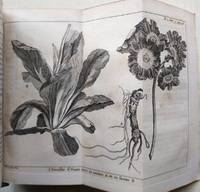
Pluche (Abbe Noel-Antoine).
Le Spectacle de la Nature ou entretiens sur les particularites de l'histoire naturelle. Tome Second Premiere Partie - Contenat ce qui regarde le dehors & l'interieeur de la terre
Autrecht: Etienne Neaulme 1735. Illustrated with an engraved frontispiece 17 charming engraved plates a vignette title page printed in red and black 12mo pp xviii 214 a little age-toned and a few blemished internall;y but otherwise in good condition contemporary panelled sprinkled calf sympathetically re-backed with a recent spine. A multi-volume work of which this is devoted to various garden plants and garden plans. An attractive copy with the armorial bookplate of Lord Viscount Montague. Full Leather. Very Good. Etienne Neaulme Hardcover
书商的参考编号 : 020847
|
|
|
PLUM DOROTHY A.
Adirondack bibliography. A list of books pamphlets and periodical articles published through the year 1955
Gabriels NY: Adirondack Mountain Club 1958. First edition; 8vo; pp. xviii 354; frontispiece map pictorial endpapers; near fine in original green cloth lettered in gilt on spine. <br/><br/> Adirondack Mountain Club hardcover books
书商的参考编号 : 28683
|
|
|
PLUM, DOROTHY A
Adirondack bibliography. A list of books pamphlets and periodical articles published through the year 1955
Gabriels NY: Adirondack Mountain Club 1958. First edition; 8vo; pp. xviii 354; frontispiece map pictorial endpapers; near fine in original green cloth lettered in gilt on spine. Adirondack Mountain Club unknown
书商的参考编号 : 28683

|
|
|
Plunkett, Edward John Moreton Drax, Lord Dunsany ( 1878 - 1957); S H Sime Plates
The Gods Of Pegana Third Edition Signed In Dust Jacket
London: Elkin Mathews 1919. Third Edition stated . Cloth/Boards. Very Good/Very Good DJ. 94 Pp.Beige Cloth Over Tan Boards Lettered In Brown. Stated Third Edition Actually A Third Printing In Modern Terminology. A Near Fine Book Trace Of Rubbing At Tips Pages Partly Unopened Still Attached Along Top Edge. Full Page Inscription " For --- Since First I Brought To Birth These Dreams Of A Strange God Have We Not Seen Our Earth Grow Near As Odd Dunsany May 17 1948." . Foxing To Front And Rear Free Endpapers From Chemical Reaction With Binder's Glue1" Crack Near Center Of Gutter Between Endpapers. Pink Dj With Light Wear At Corners 1/8" Loss At Lower Right Corner Of Spine 1/2" Almost Closed Tear At Lower Left Corner Of Spine With Minute Loss Spine And Edges Slightly Browned To Pinkish-Beige Black Lettering All Strong No Creases. <br/> <br/> Elkin Mathews hardcover
书商的参考编号 : 032176

|
|
|
PLUTARCH
Plutarch's lives. The translation called Dryden's. Corrected from the Greek and revised by A. H. Clough. . With Dr. William Smith's historical notes.
New York: Bigelow Brown and Co. n.d. 1920. 5 volumes 8vo 30 plates; contemporary quarter green levant gilt-lettered direct on gilt-decorated spines t.e.g.; spines faded to brown else near fine. Bigelow, Brown and Co., n.d. unknown
书商的参考编号 : 29793
|
|
|
PLUTARCH
Plutarch's lives. The translation called Dryden's. Corrected from the Greek and revised by A. H. Clough. . With Dr. William Smith's historical notes.
New York: Bigelow Brown and Co. n.d. 1920. 5 volumes 8vo 30 plates; contemporary quarter green levant gilt-lettered direct on gilt-decorated spines t.e.g.; spines faded to brown else near fine. <br/><br/> Bigelow, Brown and Co., n.d. unknown books
书商的参考编号 : 29793
|
|
|
Plutarch, Translated By Philemon Holland; Design By Bruce Rogers
A Consolatorie Letter Or Discourse Sent By Plutarch Of Chaeronea Unto His Own Wife As Touching The Death Of Her And His Daughter With Original Four Page Prospectus For The Book
New York: Houghton Mifflin And Company 1905. First Edition Thus . Hardcover. Near Fine/Slipcase. 11 1/4" Tall. 32 Pp. 8 1/8" Tall Maroon Cloth Over Purplish-Brown Boards Deckled Edges Paper Spine Label Brown Slipcase With Larger Paper Spine Label Design By Bruce Rogers And An Extra Large Paper Label Tipped In At Rear Of Book. Title Page Printed In Red And Black. This Example Also With The Rare Prospectus For The Book Single Large Sheet Folded Into Four Pages Reproducing The Title Page Of The Book And Two Pages Of Description And Introduction With Publisher's Price Of $3.00 Mentioned At End. #176 Of 375 Copies Of A Deluxe Limited Edition Using The Text Of The Revised 1657 Edition Of Holland's 1603 Original. A Beautifully Made Book. The Book Is Near Fine Points Of Rubbing At Tips Only No Stains No Marks But Has A Personal Bookplate Illustrated With A ParrotOn The Front Pastedown; Slipcase With Just A Touch Of Wear But Top Panel Lacking And 1/3 Of Bottom Panel Has Chipped Away Remainder Clean Unfaded And Intact. Prospectus With Slight Wear Along Lower Edge Of Rear Leaf. Exhibition Quality Except Slipcase Of Course. <br/> <br/> Houghton Mifflin And Company hardcover
书商的参考编号 : 028601

|
|
|
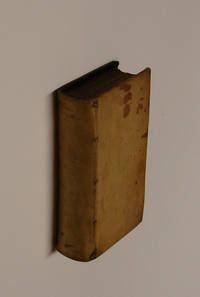
PLUTARCHUS
Eenige morale of zedige werken van Plutarchus. Vertaalt door R. T.
Amsterdam Voor Hendrik Maneke 1634. 12mo. VIII4773 blank p. frontispiece. Vellum 12.5 cm Ref: Geerebaert 698; Geerebaert gives as date 1644; OiN 307 Details: 5 thongs laced through the joints. Engraved frontispiece depicting a writer/philosopher and the Greek god Hermes standing beneath a bust of Plutarch The frontispiece bears the impressum 'Amsterdam 1643' Condition: Vellum slightly soiled and spotted. Front hinge cracking frontispiece loosening. Right margin of first gatherings somewhat thumbed. Very tiny and almost invisible pinpoint wormholes in the left lower corner never coming near any text Note: This is a translation into Dutch of 10 treatises of Plutarch's Moralia: 'Van d'opvoedingh der Kinderen. Hoe en met wat inzicht de Ionghelinghen de Poeeten leezen moeten. Hoe men hooren moet. Van de zeedelijkcke duechd. Van de zonde en van de duechd. Dat men de duechd kan leeren. Hoe men de vleider en pluim-strijcker van de vriend onderscheiden kan. Van de langhmoedichheyd. Van de Nieus-gierichheydt. Van de veelheit der Vrienden'. The Greek philosopher historian and educator Plutarchus of Chaeroneia was born before 50 A.D. and died after A.D. 120. He is our most important witness of the spiritual climate of the first and second century A.D. He wrote numerous short treatises of popular moral philosophy which go under the general name of the Moralia. They include debating themes works in the form of question and answer and serious discussions of philosophical topics. His warm and sympathetic personality can be traced in many treatises which contain also a great deal of antiquarian knowledge picked up by Plutarchus in the course of his wide reading. H.J. Rose A Handbook of Greek literature London 1965 p. 408. The Moralia were very influential in the Renaissance. 'It is no exaggeration to say that Renaissance and early modern Europe discovered Greece and Rome through Plutarch's eyes'. The Classical Tradition Cambr. Mass. 2010 p. 748. § The 10 treatises were translated by one 'R.T.' Van Doorninck and STCN declare that this is Reinier Telle 1558/59-1618. He was rector of the Schola Latina of Zierikzee his hometown from 1604-1610. He translated several works from Latin and Italian. According to De la Fontaine Verwey he was also a worthy satirical poet. Interesting as this may be this cannot be correct for the translation is preceded by a dedication to 'Franciscus Heermans' signed by R.T. The writer of this dedication tells that the publication of the 'gulde spreuken' of Heermans inspired him to translate a number of golden treatises of Plutarch as well. Now Franciscus Heermans or Franciscus Heerman who lived from 1610 till after 1670 published his 'Toneel der deughdt ofte guldene annotatien' only in 1631 13 years after the death of Reinier Telle. Heermans was only 10 when Telle died. Heermans book was very successful about 30 editions appeared during the next hundred years. See for Heermans or Heerman Van der Aa 8382/83; see for Telle preferably 'Biografisch lexicon voor de geschiedenis van het Nederlands Protestantisme' volume 1375/6 Provenance: On the front pastedown a nice small paper label 'M.M. Couvée Lange Pooten 41 La Haye'. M.M. Couvée ran a posh bookshop and publishing firm in The Hague from 1859 till 1885. Members of the Royal family were among his clients Collation: A-8 A - V-8 V7 verso & V8 blank Photographs on request hardcover
书商的参考编号 : 120155
|
|
|
PLUTARCHUS
Les vies des hommes illustres grecs et romains comparées l'une avec l'autre par Plutarque de Chaeronée. Translatées par M. Iacques Amyot Conseiller du Roy & par luy reveuës & corrigées. Avec les vies d'Annibal & de Scipion l'Africain traduites de Latin en François par Charles de l'Écluse. Plus les vies d'Epaminondas de Philippus de Macedoine de Dionysius l'aisné tyran de Sicile d'Auguste Caesar de Plutarque & de Senecque. Item les vies des excellens Chefs de guerre escrites par Aemilius Probus. Amples sommaires sur chacune vie: annotations morales en marge chronologie divers indices & les vives effigies des hommes illustres. Le tout recueilly & disposé par S.G. S.
Paris A Paris Chez Jean du-Carroy 1612. 8vo. 2 volumes: XXXII118147 index;129434 index p. New vellum. 18.5 cm Ref: cf. Hoffmann 3214 Details: Small woodcut portrait of Plutarch on both titles. Every 'Vita' is preceded by a coinlike woodcut portrait Condition: The first letter of several lines on both titles disappears in the left margin because of new endpapers which have been attached to a small paper repair in the gutter. Edges of both titles thumbed. Some stains on the front edge of vol. I. Outer margin of the title and the first gathering of the first volume stained. Paper slightly yellowing Note: The 'Vitae Parallelae' or 'Parallel Lives' form a collection of biographies of ancient historical figures. There are 23 pairs 19 of them with a comparison attached to it. The object of Plutarch was not to write history but to exemplify private virtue and vice in the careers of great men. Hence his careful treatment of education and character and his love for anecdotes. 'Tantalizing and treacherous to the historian Plutarch has won the affection of the many generations to whom he has been a main source of understanding of the ancient world by his unerring choice of detail his vivid and memorable narrative and his flexible and controlled style varying in complexity and richness'. OCD 2nd. ed. p. 849 The 'Lives' in Greek Latin and other translations were for centuries compulsory classic reading for educated people. Many authors playwrights painters drank from this source. § The French humanist Jacques Amyot 1513-1593 was one of the most famous and influential translators of the Renaissance. Allthough the son of poor parents he was appointed professor of Greek and Latin at the University of Bourges. He even became bishop of Auxerre. He first translated into French the romance of Heliodorus 1547. In 1554 his translation of the historian Diodorus Siculus was published and in 1559 the 'Daphnis and Chloë' of Longus. From 1559 till 1565 he worked on his famous translation 'Vies Parallèles des Hommes Illustres' of the Greek historian/philosopher Plutarch ca. 50 - ca. 120 A.D. For his translations he visited the Bibliotheca Vaticana and the libraries of Venice to study Greek codices. The translation of the 'Vitae Parallelae' is Amyot's greatest success and ranks among the most admired works of the French Renaissance both for its new standards of scholarship and for the perceived elegance of its style. The list of reissues and reprints seems endless. His translation was again translated into Dutch and English. Especially the English translation by Thomas North 1535-1604 was influential because it formed the source from which Shakespeare drew the material for his Julius Caesar Coriolanus and Antony and Cleopatra. It is in the last-named play that he follows the Lives most closely whole speeches being taken directly from North. § An expanded edition of Amyot's French translation was published in 1587 by one S.G.S. He added translations of the 'vitae' of Hannibal and Scipio Africanus in the 16th century believed to be the work of Plutarch himself but written by the 15th century imitator of Plutarch Donato Acciaiuoli 1470 and translated into French by the Dutch botanist Carolus Clusius in French Charles de l'Écluse 1561. This S.G.S. is the French calvinist minister Simon Goulard Senlisien born in 1543 in Senlis Oise. See www.idref.fr/026898411 Goulard also 'produced comparisons where these were missing in Plutarch as well as new Lives of Epaminondas and Philip Dionysius and Augustus Caesar and Plutarch and Seneca'. F. Manzini 'Stendhal's Parallel Lives' Oxford etc. 2004 p. 37/38 § This French edition of 'Vies des hommes illustres' of 1612 is a page-for-page reissue of the edition of 1594 which was published in Geneva by Jacq. Stoer Collation: â8 ê8; A-4G8 4H8 minus leaf 4H7 & 4H8; A-4O8 Photographs on request Heavy book may require extra shipping costs hardcover
书商的参考编号 : 130135
|
|
|
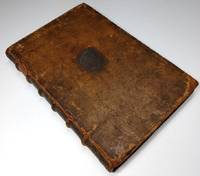
PLUTARCHUS
Opuscula Plutarchi Chaeronei sedulo undequaque collecta & diligenter recognita ac in unam faciem bellatule coimpressa quorum ante praefationem patebit & numerus & series praemisso quam amplissimo & rerum & verborum indice. Addita autem sunt nuper opuscula haec duo De cohibenda iracundia & curiositate.
N.pl. Paris Vaenundantur in Officina Ascensiana 1526. Colophon at the end: 'Sub prelo Ascensiano ad Nonas Febru. 1526' Small folio. XIV191 leaves. Contemporary leather. 31 cm Ref: BP16_104378; Renouard Badius Ascensius 3 p. 175 no. 9; Hoffmann 3198/99; cf Schweiger 1264 ed. Paris Asc. 1521; Graesse 5362 Graesse forgot to mention the year 1526; Pettegree/Walsby 83345 Details: Spine with 6 raised bands. Gilt floral motives in the compartments. Ascensius's woodcut printer's device with the date 1520 on the title-page surrounded by broad woodcut borders with some allegorical scenes. The short preface of Iodocus Badius Ascensius' is dated 1521. Ca. 60 big woodcut initials Condition: Cover grazed scuffed & soiled. Foot of the spine chafed. Red morocco shield in the second compartment partly gone. Gilt stamp in the centre of both boards erased and made unrecognizable probably with sandpaper. Two old and faint ownership entries on the title. Below the printer's mark a small name has been erased resulting in a tiny hole in the paper. Lower margin of the second half waterstained. Big stain on one leaf. Foxing near the end. Lacking the last blank leaf. Some old ink underlinings and notes Note: The Greek philosopher historian and educator Plutarchus of Chaeroneia was born before 50 A.D. and died after A.D. 120. He is our most important witness of the spiritual climate of the first and second century A.D. He wrote numerous short treatises of popular moral philosophy which go under the general name of 'Moralia'. They include debating themes works in the form of question and answer and serious discussions of philosophical topics. His warm and sympathetic personality can be traced in many treatises which contain also a great deal of antiquarian knowledge picked up by Plutarchus in the course of his wide reading. H.J. Rose A Handbook of Greek literature London 1965 p. 408 The Moralia were very influential in the Renaissance. 'It is no exaggeration to say that Renaissance and early modern Europe discovered Greece and Rome through Plutarch's eyes'. The Classical Tradition Cambr. Mass. 2010 p. 748. Hoffmann mentions a great number of Greek Greek/Latin editions and Latin translations of part of the Moralia which were produced during the first half of the 16th century. The French publisher of Flemish origin Badius Ascensius 1462-1535 who was himself an accomplished Greek scholar produced between 1503 and 1526 9 different editions of treatises of the Moralia with translations of Erasmus and Guillaume Budé. The last one this edition of 1526 has Latin translations made by Erasmus Budaeus Melanchthon et alii. It copies the preceding edition of 1521 but adds at the end 8 leaves with 2 new treatises 'De cohibenda iracundia' & 'De curiositate' both translated by Erasmus. The edition contains also short introductions to several treatises written by the leading scholars of that period Provenance: 2 faint and illegible names on the title one word recognizable as 'Anthonii' Collation: â8 ê6 a-z8 A8 minus A8 a blank leaf Photographs on request hardcover
书商的参考编号 : 140127
|
|
|
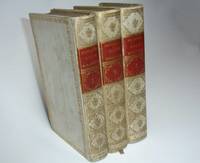
PLUTARCHUS
Ploutarchou tou Chairôneôs Parallêla ê Bioi parallêloi. Plutarchi Chaeronensis Parallela seu Vitae parallelae id est Vitae illustrium virorum quos binos quasi paria composuit.
Geneve Henricus Stephanus 1572 8vo. 3 volumes: vol. 1: II5791 blank; vol. 2: 2 = p. 581/82 p. 583-12133 blank = p. 1214/16; vol. 3: p. 2 = p. 1217/181219-19231 blank. 19th century vellum. 18 cm Ref: GLN-2438; Renouard 134/35; Brunet 4733; Hoffmann 3171; Schweiger 2258/9; Dibdin 2336/7; Moss 2507; Ebert 17406; Not in Graesse Details: These three volumes are the volumes 4 5 & 6 of the 13 volume set 'Plutarchi Chaeronensis quae extant opera' which is the first edition of the complete works of Plutarch published by Henri Estienne in Geneva in 1572. The 3 volumes contain the complete Greek text of 'Ploutarchou tou Chairôneôs Parallêla ê bioi parallêloi. Plutarchi Chaeronensis Parallela seu vitae parallela' being tomus primus secundus and tertius. § Backs gilt with floral motives in 4 compartments. Red morocco shield on the backs. Boards with gilt borders that consist of a long floral wreath of wine leaves. Board edges decoratively gilt with complementary inside inner dentelles. Edges gilt. Marbled endpapers Condition: Bindings slightly soiled and very slightly scratched. Bookplate on the front endpaper of the first volume. Faint and small library stamp on the titles Note: The Greek philosophic stylist Plutarchus of Chaeroneia ca. 46-120 A.D. wrote numerous short treatises on ethics and philosophy. He is however best known as historian and biographer. Plutarch composed with his famous 'Vitae' or Parallel Lives written ca. 100-120 A.D. a work of timeless quality. His aim was not writing history but biography so his chief interest was in the characters of the heroes and villains he portrayed never avoiding a good story. Plutarch exercised a very profound influence on Western civilisation. His collection of 'Vitae' has been one of the most frequently and continuously read books of the Western tradition. Treacherous to the historian Plutarch has won however since the Renaissance the affection of the many generations to whom he has been a main source of understanding of the ancient world that is early modern Europe discovered the ancient world through Plutarch's eyes. The Lives could gain an enormous impact by providing later biographers and literary authors an outstanding model. Authors like Montaigne Corneille Racine Rousseau Schiller and Shakespeare heavily drew upon the Lives. Until the 19th century the Lives were invoked as models of totalitarism anticlericalism by supporters and opponents. 'The founders of American democracy were avid readers of Plutarch as well and some laced their prose with evidence of that fact. Franklin and Hamilton in particular proclaimed their admiration for the Lives'. The Classical Tradition Cambr. Mass. 2010 p. 749 The first complete edition of Plutarch was published by the French humanist scholar/printer Henri Estienne Henricus Stephanus 1531-1598 who contributed greatly in the field of classical philology. He produced 58 Latin and 74 Greek editions of ancient authors of which 18 were 'editiones principes'. He is still famous for his huge 'Thesaurus Graecae Linguae' of 1572 his Plutarch edition of the same year and his 3 volume Plato edition of 1578. Scholars today still refer to the works of Plato and Plutarch by their Stephanus pagination Provenance: Bookplate of 'docteur Paul Lecène'. It depicts a faun who is sitting on a book while playing a flute. Around him a motto in Greek: 'GÊRASKÔ D'AEI POLLA DIDASKOMENOS'. A famous text of the Greek philosopher Solon one of the Seven Wise. It means 'I grow old forever learning many things'. Monsieur Lecène 1878-1929 was a wellknown French surgeon. He has his own street 'La rue du Docteur-Lecène' in the 13th arrondissement of Paris. § The round stamp on the title is rather vague it seems to read: 'BIBLIOTHECA DUACENA'. This set must once have belonged to the University Library of Douai in the North of France. In 1793 during the French Revolution this Catholic bulwark against protestantism which was founded in 1560 by the Spanish king Philipp II was closed down and its library was incorporated in the 'Bibliothèque Municipale'. This library numbered 115000 works when it burned down by a bombardment on the 11th of August 1944. Nine tenth of the books were destroyed but the core of the collection manuscripts and 8 000 old books among which 450 incunables were saved. How this set of Plutarch escaped the confiscation and fire we do not know. See Wikipedia French: 'Universités de Douai' Collation: 1: pi1 a-z8 A-M8 N10 N10 verso blank. 2: pi1 a6 b8 Cc-Zz8 aA-rR8 leaf rR7 verso and rR8 blank. 3: Aa-Zz8 Aaa-Vvv8 Xxx10 leaf Xxx10 verso blank Photographs on request Heavy set may require extra shipping costs hardcover
书商的参考编号 : 130371
|
|
|
PLUTARCHUS & ISOCRATES
Plutarchi Chaeronensis peri PAIDÔN AGÔGÊS seu De puerorum educatione libellus. Analysi grammatica interpretatione simplici ad textum graecum & paraphrasi perspicua ad modum Iohannis Minellii illustratus studio M. Christiani Iunckeri Dresd. Ill. Gymnas. Sax. Henneb. quod Schleusingae est Conr. Bound with: Isocratis Attici rhetoris Orationes tres. I. ad Demonicum. II. ad Nicoclem. III. quae inscribitur Nicocles. Analysi grammatica interpretatione simplici ad textum graecum & paraphrasi perspicua ad modum Iohannis Minellii illustratae studio M. Christiani Iunckeri Dresd. Ill. Gymnas. Sax. Henneb. quod Schleusingae est Conr.
Leipzig Lipsiae Apud Maurit. Georg. Weidmannum 1719. 8vo. Two parts in 1 volume: XIV3813 stocklist p. Vellum 17 cm Ref: VD18 10402462; Ad 1: Hoffmann 3185; Ad 2: Hoffmann 2478 Details: Two title-pages both printed in red & black. On the left pages printed in two columns the Greek text and a parallel literal word for word translation into Latin; on the right page a polished translation on the lower half of the right pages notes in Latin Condition: Vellum soiled and spotted. Paper foxed and browning Note: The Greek philosopher historian and educator Plutarchus of Chaeroneia was born before 50 A.D. and died after A.D. 120. He is our most important witness of the spiritual climate of the first and second century A.D. He wrote numerous short treatises of popular moral philosophy which go under the general name of Moralia. They include debating themes works in the form of question and answer and serious discussions of philosophical topics. 'It is no exaggeration to say that Renaissance and early modern Europe discovered Greece and Rome through Plutarch's eyes'. The Classical Tradition Cambr. Mass. 2010 p. 748 The treatise 'de puerorum educatione' is the first treatise of the 'Moralia' No. 1 1a-14c. Since Wyttenbach's 'Moralia' edition 1795-1810 Animadvers. I 29-156 it is generally assumed on stylistic and grammatical grounds that this treatise cannot have been written by Plutarchus. Therefore it is very remarkable that a not genuine essay has such a strong influence on European intellectual and cultural life. 'The essay however is interesting in itself since it reflect in many ways the educational conditions of its time. Frankly recognizing the difference in natural endowments the author insists on the great benefits which inevitably come from training. Physical training is of course required and military training is held to be most important for preparing men to win in battle. A knowledge of philosophy is the final goal of education'. Plutarch 'Moralia' with English translation by F.C. Babbitt LCL 197 p. 3 § In the first half of the 18th century alone German scholars published editions in 1705 1719 1738 1744 1745 1749 1750. In 1738 and 1754 German translations appeared. There was evidently much demand for Plutarchus' treatise on the education of children in Germany in the 18th century. § The German historian and schoolmaster Christian Juncker born 1668 became Conrector in 1695 of the 'Hennebergisches Gymnasium Schleusingen'. In 1713 he was appointed Rector of the Gymnasium of Altenburg where he died in 1714. Juncker produced for the Leipzig publisher Weidmann a whole series of Latin school editions in the same manner as this Plutarch/ Isocrates edition of Sallustius Terentius Florus Horatius Vergilius & Suetonius. Weidmann reissued them for decades. They were made in the manner of the popular 'Latin made easy method' of the Dutch schoolmaster Johannes Minellius. The Greek ones first published in 1704 Juncker made as a next step for schoolboys who had already mastered the Greek of the New Testament. p. 2 verso Provenance: On front flyleaf in ink 'Weidlich 1793' Collation: 8 minus leaf 8; A - 2A-8 Photographs on request hardcover
书商的参考编号 : 120393
|
|
|
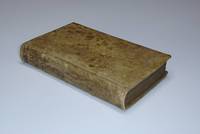
PLUTARCHUS
Plutarchi Cheronaei Philosophi et Historici Vitae comparatae illustrium virorum graecorum & romanorum ita digestae ut temporum ordo seriesque constet. Hermanno Cruserio I.C. interprete. Cum indice verborum & rerum locupletissimo & fidelissimo. Tomus Secundus.
Lyon Lugduni Apud Antonium Gryphium 1566. 16mo. 87660 index p. 18th century red morocco. 12 cm Volume 2 of 3 only Ref: Hoffmann 3198; Brunet 4737; Graesse 5361 Details: Back gilt with floral motives boards with gilt wavelike borders. Marbled endpapers. Woodcut printer's mark on the title depicting a griffin which mythological animal symbolizes courage diligence watchfulness and rapidity of execution used as a pun of the family name Gryph or Greif of German origin. The motto is 'Virtute duce / comite fortuna' 'Virtue thy leader fortune thy comrade' a quote from a letter of Cicero to Plancus. Ep. ad Familiares liber X3 This second volume contains the Lives of Aristides/Cato Maior Agis & Cleomenes/Tiber. & C. Gracchi Pyrrhus/Marius Lysander/Sulla Eumenes/Sertorius Cimon/Lucullus Nicias/Crassus Agesilaus/Pompeius Phocion/Cato Minor Condition: Binding scuffed especially at the extremities. Corners bumped. Superficial damage to both boards. The turn-in of the upper board partly and of the lower board almost completely gone. Edges partly faintly stained. Faint name on the title. The words 'Tomus Secundus' have been erased resulting in a small hole in the title Note: The Greek philosophic stylist Plutarchus of Chaeroneia ca. 46-120 A.D. wrote numerous short treatises on ethics and philosophy. He is however best known as historian and biographer. Plutarch composed with his famous 'Vitae' or Parallel Lives written ca. 100-120 A.D. a work of timeless quality. His aim was not writing history but biography so his chief interest was in the characters of the heroes and villains he portrayed never avoiding a good story. Plutarch exercised a very profound influence on Western civilisation. His 'Vitae' has been one of the most frequently and continuously read books of the Werstern tradition. The Classical Tradition Cambr. Mass. 2010 p. 747. Treacherous to the historian Plutarch has won however since the Renaissance the affection of the many generations to whom he has been a main source of understanding of the ancient world that is early modern Europe discovered the ancient world through Plutarch's eyes. The Lives could gain an enormous impact by providing later biographers and literary authors an outstanding model. It is very well known for example that authors like Montaigne Corneille Racine Rousseau Schiller and Shakespeare heavily drew upon the Lives. Until the 19th century the Lives were invoked as models of totalitarism anticlericalism by supporters and opponents. 'The founders of American democracy were avid readers of Plutarch as well and some laced their prose with evidence of that fact. Franklin and Hamilton in particular proclaimed their admiration for the Lives' The Classical Tradition Cambr. Mass. 2010 p. 749 § This Latin translation of 1566 was made by the Dutch humanist Herman Cruyser or Crüser in Latin Cruserius born in 1510 in the Dutch city of Kampen. He was a jurist and diplomat for the duchess of Guelderland and for the duchess of Cleve Jülich & Berg. In his sparetime he translated some treatises of Galenus and the 'Vitae' of Plutarch. His translation of the 'Vitae' was first published in Basel in 1564 in folio. On the title of that edition he is described as 'Ducis Clivensis & Iuliaensis consilarius interpres elegantissimus ac fidelissimus'. Our edition of Gryphius of 1566 in smaller format and cheaper is a reissue of that expensive folio edition of 1564. Hoffmann writes that the translation of Cruyser first appeared in 1561 but it seems that no one has ever seen a copy of that edition. Cruyser died in 1575. 'Als Wilhelms Wilhelm duke of Cleve and Jülich älteste Tochter Maria Eleonore 1573 den geisteskranken Herzog Albrecht Friedrich von Preußen heiratete begleitete Crüser sie als Gesandter und persönlicher Ratgeber und blieb bis zu seinem Tode bei ihr in Königsberg'. NDB 3 1957 p. 430 Provenance: On the title the name of 'François Lamb' Collation: Aa8 B-3M8 3N4 Photographs on request hardcover
书商的参考编号 : 120298
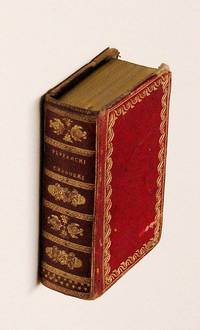
|
|
|
PLUTARCHUS
T'Leven der doorluchtige Griecken ende Romeynen tegen elck anderen vergeleken door Plutarchus van Chaeronea. Wt de Griecsche sprake overgeset door M. Iaques Amyot Abt van Bellozane ende Raedt des Coninckx van Franckrijck by hem overzien ende verbetert. Mitsgaders het leven van Hannibal Scipio den Africaen uyt het Latyn verfranscht by Carolus Clusius. Voorder het Leven van Epaminondas Philippus van Macedonien Dionysius den Ouden Tyran van Sicilien Augustus Cesar Plutarchus ende Seneca ende noch het Leven vande negen treffelijcke krijgs-oversten beschreven door Aemylius Probus. Met een cort begrijp op elcx leven Leeringen op de kant Chronijck ende Leer-registers alles versamelt ende uytgegeven by Simon Goulart Senlisien. Tesamen van nieus tot gemeen nut verduyscht door A. Van Zuylen Van Nieuvelt ende ten deele by eenen anderen beminder.
Delft Tot Delft Utrecht Tot Wtrecht By Adriaen Gerritsen van Beyeren ende Felix van Sambrix sic & By David van Hoogenhuysen 1644. Folio. VI5484 leaves. Calf 32 cm Ref: STCN 141469102; Geerebaert 693 records this second edition of the first complete Dutch translation of 1603; OiN 310; Hoffmann 3227; Graesse 5365/66; Ebert 17507 Details: Back gilt & with 6 raised bands. Unsigned engraved architectural frontispiece depicting a chapel in a temple in the niches of which stand 4 statues one of them is Mercurius. The chapel is flanked by Romulus and Theseus the founders of Rome and Athens; in the dome of the chapel is a portrait of Plutarchus. Woodcut printer's mark on the title depicting a three-master on a rough sea motto: 'Durate'. Woodcut initials at the beginning of a 'vita'. To some copies has been added after the title page 1 leaf with a dedication 'Aende Hoogh-Moghende Heeren de Staten Generael' to the States General of the Dutch Republic. This copy doesnot have that dedication Condition: Head & foot of the spine partly worn away. Old leather repairs to the upper part of both joints. Upper joint and hinge cracking but still strong. Leather repairs to 3 corners. 1 bumped corner grazed. Small hole in the leather of the lower board. Front endpapers renewed. Original front flyleaf preserved but worn & with a fold. Margins of the frontispiece thumbed & slightly frayed. Some faint & small waterstains on the lower margin of ca. hundred leaves Note: This translation of 1644 is reissue of the first complete Dutch translation originally published in 1603. § The Greek philosophic stylist Plutarchus of Chaeroneia ca. 46-120 A.D. wrote numerous short treatises on ethics and philosophy. He is however best known as historian and biographer. Plutarch composed with his famous 'Vitae' or Parallel Lives written ca. 100-120 A.D. a work of timeless quality. His aim was not writing history but biography so his chief interest was in the characters of the heroes and villains he portrayed never avoiding a good story. Plutarch exercised a very profound influence on Western civilisation. His 'Vitae' has been one of the most frequently and continuously read books of the Western tradition. The Classical Tradition Cambr. Mass. 2010 p. 747. Treacherous to the historian Plutarch has won however since the Renaissance the affection of the many generations to whom he has been a main source of understanding of the ancient world that is early modern Europe discovered the ancient world for a great part through Plutarch's eyes. The Lives could gain an enormous impact by providing later biographers and literary authors an outstanding model. It is very well known for example that authors like Montaigne Corneille Racine Rousseau Schiller and Shakespeare heavily drew upon the Lives. Until the 19th century the Lives were invoked as models of totalitarism anticlericalism by supporters and opponents. 'The founders of American democracy were avid readers of Plutarch as well and some laced their prose with evidence of that fact. Franklin and Hamilton in particular proclaimed their admiration for the Lives' Idem p. 749 § On the continent the 'Lives' were widely read in the French translation of the French humanist Jacques Amyot 1513-1593 who was one of the most famous and influential translators of the Renaissance. Although the son of poor parents he was appointed professor of Greek and Latin at the University of Bourges. He even became bishop of Auxerre. From 1559 till 1565 he worked on his famous translation of the 'Vies Parallèles des Hommes Illustres'. For his translations he visited the 'Bibliotheca Vaticana' and the libraries of Venice to study Greek codices. His translation was considered by some to be so excellent that it even excelled the original Greek. 'Maer sal tot besluyt ghenoech sijn alleen aen te roere hoe dat M. Iacques Amyot s'conincx Raedt in dit groote werck sijnen swaren arbeyt zoo heeft besteedt ende de oversettinge zoo wel getroffen dat veele cloecke mannen meenen dat deselve den Griecxen text in cierlijckheydt overtreffet.' Leaf 3 verso of the preface § This Dutch translation was based on the French text which was reedited by the French calvinist minister author and translator S.G.S. i.e. Simon Goulard Silvanectinus from Senlis 1547-1628. Goulard published an expanded edition of Amyot's French translation in 1587. He added translations of the 'vitae' of Hannibal and Scipio Africanus in the 16th century believed to be the work of Plutarch himself but written by the 15th century imitator of Plutarch Donato Acciaiuoli 1470 and translated into French by the Dutch botanist Carolus Clusius in French Charles de l'Écluse 1561. Goulard also 'produced comparisons where these were missing in Plutarch as well as new Lives of Epaminondas and Philip Dionysius and Augustus Caesar and Plutarch and Seneca'. F. Manzini 'Stendhal's Parallel Lives' Oxford etc. 2004 p. 37/38 § The title of this Dutch translation is more or less an adaptation of the French title page of the edition Paris 1592. The Dutch translation was made the preface reveals by A.V.Z.V. Nieuvelt that is Adam van Zuylen van Nieuvelt and was first published. posthumely in 1603. This edition of 1644 is a line for line reedition of that translation. Van Zuylen van Nieuvelt also translated the 'Cyropaedia' of Xenophon published in 1592. He is a fine example of the Renaissance soldier. He fought in the Eighty Years' War the Dutch war of Independence 1568-1648 against the Spaniards. In 1583 he was for a year baljuw bailiff of Schoonhoven a small city just east of Rotterdam. Later he was captain of an infantery regiment of the son in law of William of Orange Philips of Hohenlohe fighting against the Spaniards in the East of the Netherlands. In 1580 Adam van Zuylen was wounded in the lost and forgotten battle of Hardenberg where the troops of the young republic lost 1500 man. See: members.home.nl/m.tettero/Watergeuzen/Hardenberg.htm Later Van Zuylen campaigned in the province of Friesland and in 1596 he took part in the defence of Hulst a fortified city in Zeeland. There he was taken prisoner by the Spaniards. He died that same year. Still this soldier found time to translate 'Vies Parallèles des Hommes Illustres' of Amyot and Machiavelli's 'Discorsi' and 'Il Principe' also from the French. After his death the manuscript with the translation of Amyot's Plutarch came into the possession of the Leiden publishers Paedts and Bouwens who decided to enlarge this work and to adopt it to the highly successfull French Amyot edition produced by Simon Goulart which contained not only useful notes and some commentary but also a kind of continuation consisting of the biographies of a number of ancient generals and kings. These new additions were translated by an anonymous man of letters. 'Maer alle de voorverhaelde nieuwe byvoegselen van Simon Goulart sijn ten jongsten verduytscht zoo in gedicht als anders by eenen anderen wesende een liefhebber sijner moeder tale'. Leaf. 3 verso of the preface Van der Aa 13393 Collation: 6 A-4Z6 leaf 4Z6 verso blank Photographs on request Heavy book may require extra shipping costs hardcover
书商的参考编号 : 151922
|
|
|
PLUTARCHUS
Traitté de la superstition composé par Plutarque & traduit par Mr. Le Fevre. Avec un Entretien sur la vie de Romulus.
Saumur Par Jean Lesnier Marchand Libraire 1666. 12mo. 521173 p. Calf 15 cm Ref: Hoffmann 3217; Graesse 5369 Details: Back with 4 raised bands; back and borders of the boards ruled blind. Woodcut printer's mark on the title of Jean Lesnier it depicts an eagle that soars above a city; in its beak a banner with the motto 'movendo'. Woodcut headpieces and initials. Paper of excellent quality Condition: Binding a bit chafed and slightly worn at the extremities. Tear in leaf A4 Note: The Greek philosopher historian and educator Plutarchus of Chaeroneia was born before 50 A.D. and died after A.D. 120. He is our most important witness of the spiritual climate of the first and second century A.D. He wrote numerous short treatises of popular moral philosophy which go under the general name of the Moralia. They include debating themes works in the form of question and answer and serious discussions of philosophical topics. His warm and sympathetic personality can be traced in many treatises which contain also a great deal of antiquarian knowledge picked up by Plutarchus in the course of his wide reading. H.J. Rose A Handbook of Greek literature London 1965 p. 408. The Moralia were very influential in the Renaissance. 'It is no exaggeration to say that Renaissance and early modern Europe discovered Greece and Rome through Plutarch's eyes'. The Classical Tradition Cambr. Mass. 2010 p. 748. § Since the Plutarch edition of 1572 of Henri Estienne Henricus Stephanus the 76 treatises of the Moralia are divided into 14 books and the Latin titles he gave to the treatises are still in use today. Our book is a translation into French of the 14th treatise Plutarch's essay on Superstition 'De Superstitione' 'e desdaµa' Moralia Book 2 164E-171F. It is an attempt to prove that superstition is a dangerous venom and far worse than atheism. Plutarch argues that the 'atheist when he is ill takes into account and calls to mind the times when he has eaten too much or drunk too much wine also irregularities in his daily life or instances of over-fatigue or unaccustomed changes of air or locality; and again when he has given offence in administering office and has encountered disrepute with the masses or calumny with a ruler he looks to find the reason in himself and his own surroundings: Where did I err and what have I done What duty of mine was neglected But in the estimation of the superstitious man every indisposition of his body loss of property deaths of children or mishaps and failures in public life are classed as 'afflictions of God' or 'attacks of an evil spirit'. For this reason he has no heart to relieve the situation or undo its effects or to find some remedy for it or to take a strong stand against it lest he seem to fight against God and to rebel at his punishment; but when he is ill the physician is ejected from the house and when he is in grief the door is shut on the philosopher who would advise and comfort him'. Babbit's translation of 168B-C in the Loeb Classical Library edition of the Moralia 1928 § The treatise which Faber calls 'un des plus excellens traittés qui'ait iamais fait Plutarque' Préface p. 22 was translated by the French scholar Tanneguy Le Fèvre latinized as Tanaquil Faber 1615-1672 who was from 1665 'professeur de grec de l'Académie protestante de Saumur'. Faber was a diligent editor of Greek and Latin texts. He opposed contemporary superstition which he calls 'une maladie de l'ame'. Préface p. 19 He considered atheists 'irreligieux' . gens sans religion'. Idem p. 35. Faber is famous because of his daughter Anne who married in 1664 the learned printer Jean de Lesnier 1639-1675 when she was seventeen years old. So De Lesnier who was printer for the protestant academy of Saumur printed and published this translation for his father in law. After the publisher's early death in 1675 Anne widowed at the age of 28 married in 1683 André Dacier pupil of her father and became a respected classical philologist herself under the name of 'Madame Dacier'. The work seems to be rare; we found in KVK only a few copies Collation: -212 32 A-E12 Photographs on request hardcover
书商的参考编号 : 120297
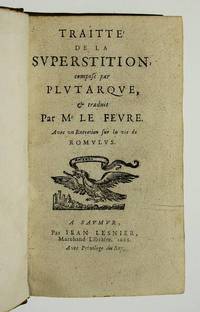
|
|
|
PLUTARQUE
Epitome vitarum Plutarchi
Cenomanis Le Mans Le Mans: Apud Hyeronimum Olivier 1608. Fine. Apud Hyeronimum Olivier Cenomanis Le Mans Le Mans 1608 S.d. 7.4 x 12.5 cm relié New edition the first of which appears to have been published in 1541 in Basel. It was produced by Dario Tiberti. Contemporary limp vellum binding. Smooth spine with author in pen. Vellum yellowed and showing rubbing. From its first appearances this edition was highly successful and was reprinted many times. In our era where the tendency is toward complete and unabridged works one may question the importance of a condensed version of an edition of Plutarch's lives but it must be acknowledged that this abridgment or condensation was remarkably popular undoubtedly with a broader and less erudite public. Apud Hyeronimum Olivier hardcover
书商的参考编号 : 63593
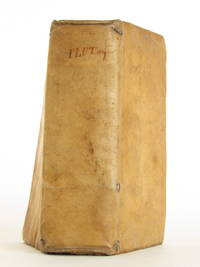
|
|
|
PLUTARQUE
Ploutarhou tou Haironeos Ethika suggrammata en 'ois muria sfalmata katorthotai. Plutarchi chaeronei moralia opuscula multis mendarum milibus expurgata
Basilae Basel Bâle Basel: Per Hier. Frobeniumet Nic. Episcopium 1542. Fine. Per Hier. Frobenium et Nic. Episcopium Basilae Basel Bâle Basel 1542 20 x 30 cm relié Rare Greek edition of the Moralia moral and miscellaneous works published by editor Hieronymus Froben and his brother-in-law Nicolaus Episcopius who continued the work of their father Johann Froben making Basel an important center of printing. Fine publisher's device on title page and a woodcut headpiece at the beginning of the first treatise. Text entirely in Greek on 47 lines. Seventeenth-century manuscript annotations on the title page. Modern speckled paper boards binding smooth spine printed label; joint slightly cracked at head very solid binding. Corner dampstain and tiny lack on title page several other more extensive but faint dampstains on the last ten leaves of the volume. Lacking 3 pages at the end after the complete text with the printer's device. A copy with fine margins. Per Hier. Frobeniumet Nic. Episcopium hardcover
书商的参考编号 : 45064
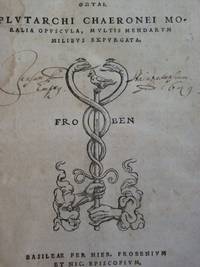
|
|
|
PLUTARQUE - Jacques AMYOT (trans)
Oeuvres morales et meslees. Translatées de grec en français reveues & corrigées en plusieurs passages par le translateur
à Cologni Cologne: Pour Samuel Crespin 1614. Fine. Pour Samuel Crespin à Cologni Cologne 1614 38 x 25 cm relié The first edition of Amyot's translation dates from 1572 published by Michel de Vascosan in Paris. Contemporary full calf binding spine with six raised bands 6 fleurons double fillet frame on boards. Jacques Amyot 1513-1594 was tutor to the sons of Henri II future Charles IX and Henri III he was also professor at the University of Bourges and became grand almoner of France and bishop of Auxerre which he made an important center of humanism. It was on the recommendation of François I that he translated Plutarch's Lives of Illustrious Men. This work and subsequently the moral works had and would have considerable impact not only for the rediscovery of antiquity which thus had greater resonance than for a few scholars and of Plutarch but for the French language itself. Montaigne wrote: 'We others ignorant were lost if this book had not lifted us from the mire. It is our breviary'. But not only a skilled translator concerned with accuracy he is also a very able popularizer rather than a scholar for he wrote for a broad public and not for the learned thus he explains comments on what needs to be clarified he seeks a pure French removed from Hellenisms and pedantic turns a French that would be praised by all specialists of the French language in the 17th century such as Vaugelas. Finally he brought translation into a new era. Brunet IV 738. Skillful restorations to corners headcaps and edges. Pour Samuel Crespin hardcover
书商的参考编号 : 8875
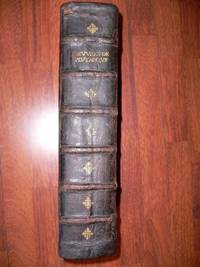
|
|

 ?????????
 ?????PDF???
 RSS feed
 ??
??


