|
Victor HUGO
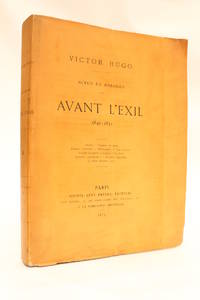
Actes et paroles - Avant l'exil 1841-1851
Paris: Michel Lévy frères 1875. Fine. Michel Lévy frères Paris 1875 19.50 x 25 cm broché First edition one of 20 numbered copies on China paper deluxe copy Four minute marginal lacks and small corner tears to the covers. Handsome full-margined copy as issued. Michel Lévy frères unknown
書籍販売業者の参照番号
: 72975
|
|
|
Victor HUGO
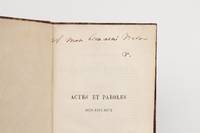
Actes et paroles 1870 - 1871 - 1872
Paris: Michel Lévy frères 1872. Fine. Michel Lévy frères Paris 1872 11.50 x 18 cm relié First edition on current paper it was printed 100 copies on Holland paper in large papers. Binding half shagreen red back with four purposes nerves set with golden dots adorned with gilded fleurons and nets cold patches of marbled paper guards and contreplats of handmade paper speckled slices Contemporary binding signed Derveaux son. Rare foxing mainly affecting the margins of some leaves. Exceptional autograph signed by Victor Hugo to his son François-Victor on the fake title page: ""To my beloved Victor. V. » In 1872 only two of the five children that Victor Hugo had with his wife Adèle Foucher are still alive: François-Victor whom he calls simply Victor and on whom he defers his affection and Adèle walled in madness who has just been interned on his return from Barbaspine. Hugo notes in his notebooks: ""Just a year ago I was leaving for Bordeaux with Charles his other son who was not going back alive. Today I see Adele again. What shagreen! But the tragedies will continue to strike the old writer: the ""beloved"" Francis Victor will succumb the following year in 1873 tuberculosis. François-Victor Hugo is the author of a monumental translation of the complete works of William Shakespeare the first respectful of the language of the English playwright: ""For those who in Shakespeare want all Shakespeare this translation was missing"" wrote with emotion Hugo in the preface. Nice copy enriched with a very moving dedication of Victor Hugo to his son. Michel Lévy frères unknown
書籍販売業者の参照番号
: 58439
|
|
|
Victor HUGO
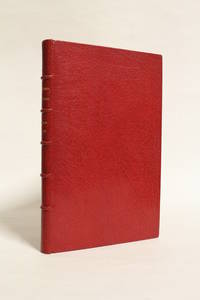
Angelo tyran de Padoue
Paris: Eugène Renduel 1835. Fine. Eugène Renduel Paris 1835 14 x 22 cm relié First edition published in the author's complete works. Our copy exceptionally contains two engraved portraits one serving as frontispiece. Full red morocco binding spine with five raised bands marbled paper boards marbled endpapers and pastedowns decorative gilt board-edges with gilt dentelle all edges gilt double gilt fillets on leading edges very elegant signed binding by Cuzin. Very fine copy without statement of edition perfectly established in full Cuzin binding. Eugène Renduel hardcover
書籍販売業者の参照番号
: 69343
|
|
|
Victor HUGO - Auguste RODIN - Eugene CARRIERE
Cinq poèmes. Booz endormi - Bivar - O soldats de l'an deux ! - Après la bataille - Les pauvres gens
Paris: Edouard Pelletan 1902. Fine. Edouard Pelletan Paris 1902 19 x 27 cm relié Edition illustrated with 35 original compositions by Auguste Rodin Eugène Carrière Adolphe Willette Daniel Vierge Louis Dunki and Théophile-Alexandre Steinlen one of 10 numbered copies on China. A pleasant copy. Binding in full long-grain red morocco spine decorated with triple gilt fillets and black typographical motifs gilt roll tooling on the spine-ends frame of quadruple gilt fillets adorned with gilt and black fleurons in the corner pieces of the boards marbled endpapers frame of gilt lace tooling on the pastedown endpapers covers and spine preserved gilt fillets on the leading edges top edge gilt. A very beautiful perfectly set copy of this work published in honour of the one hundredth anniversary of the birth of Victor Hugo. Edouard Pelletan hardcover
書籍販売業者の参照番号
: 68765

|
|
|
Victor HUGO
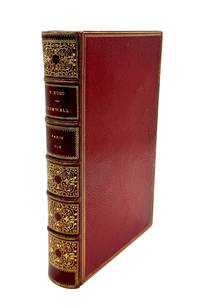
Cromwell
Paris: Ambroise Dupont & Cie 1828. Fine. Ambroise Dupont & Cie Paris 1828 13 x 21 cm relié First edition enhanced with 5 engravings from the 1840 collected edition by Furne by Camille Rogier and Tony Johannot. The print run as specified by Clouzot Guide du bibliophile français was 1075 copies on laid paper and some copies on rather fine vellum with a question mark. This copy is part of the special printing on vellum of which the number of copies is unknown but it is necessarily from a small print run. Full morocco binding ca 1860 signed Amand at top of endpaper. Spine with raised bands richly decorated triple ruled frame on boards. Wide interior border. Edges gilt. Traces of rubbing on bands joints and corners. Narrow split in leather at beginning of lower joint at head. Paper perfectly fresh with occasionally tiny spots in margin. Fine copy of the rare printing on fine vellum. Hugo's play of unusual length at 6920 verses was reputed unperformable notably due to its numerous scene changes. It definitively breaks with classical theater. The famous preface to the play will remain as a manifesto of romantic theater. Ambroise Dupont & Cie hardcover
書籍販売業者の参照番号
: 87473
|
|
|
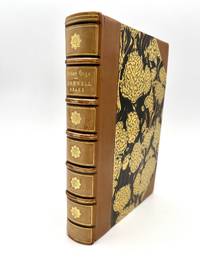
Victor HUGO
Cromwell
Paris: Ambroise Dupont 1828. Fine. Ambroise Dupont Paris 1828 13 x 19.50 cm relié First edition. Edition of 1075 copies according to Clouzot. Half-calf binding with lavallière corners from the early 20th century signed Lavaux at the top of the first endpaper. Smooth spine decorated with 5 tools gilt and blind fillets. Red edges. Spine uniformly faded. Foxing on the first 4 leaves and in the notes and some scattered foxing throughout. Handsome copy. Hugo's play of unusual length at 6920 verses was reputed to be unplayable notably due to its numerous changes of scenery. It breaks definitively with classical theater. The famous preface to the play would remain as a manifesto of romantic theater. Ambroise Dupont unknown
書籍販売業者の参照番号
: 79581
|
|
|
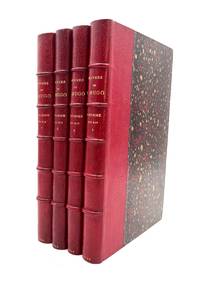
Victor HUGO
L'homme qui rit
Paris Bruxelles Brussels: Librairie internationale Lacroix Verboeckhoven & Cie 1869. Fine. Librairie internationale Lacroix Verboeckhoven & Cie Paris Bruxelles Brussels 1869 15 x 23.60 cm 4 volumes reliés First edition without statement of edition. All half-titles present. Contemporary bindings in red opera half morocco Jansenist spine with raised bands author title volume number and date in gilt top edge gilt. Quality binding. Some scattered foxing. Uncut set. Fine copy without statement of edition in good contemporary binding. Armorial bookplate of the library of Emile Mancel engraved by Trouchou le Gavre; a second with his monogram. Naval Commissioner at Dunkirk 1886 then General Commissioner at Le Havre 1888 he wrote numerous articles on naval history particularly on Jean Bart. His library was sold in 1896. Certainly Hugo's masterpiece in the novelistic domain baroque and dark where the poetic style evolving through antitheses and oxymorons is pushed to its extreme limits and in which the Surrealists would recognize themselves. Librairie internationale Lacroix, Verboeckhoven & Cie hardcover
書籍販売業者の参照番号
: 81738
|
|
|
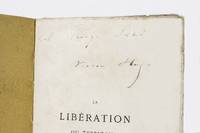
Victor HUGO
La libération du territoire
Paris: Michel Lévy frères 1873. Fine. Michel Lévy frères Paris 1873 15.50 x 24 cm broché sous chemise et étui First edition mention of second edition. Our copy is presented in a case and shirt with a green canvas back and marbled paper boards. We enclose the cover of the catalog of the sale of the library of George and Maurice Sand in 1890 on which was pasted the descriptive sheet of our copy with its hammer price in pencil. Exceptional autograph shipment signed by Victor Hugo to Georges Sand. ""But what did they think of each other these two outstanding personalities of literary life in the 19th century Because they never met these two yet they were perfectly contemporary: Victor Hugo 1802-1885 George Sand 1804-1876. Certainly there were the ups and downs of life: George Sand did not really publish until 1832 at a time when Victor Hugo was already aware of his glory; and then there was the exile of Victor Hugo from 1851 to 1870 but that does not explain everything! At the beginning they are not really part of the same coterie: Victor Hugo Pair of France support of Louis-Philippe on one side George Sand socialist on the other. They do not really appreciate each other even if George Sand has a certain annoyed admiration for Victor Hugo called grandiloquent: ""the most talkative of sublime poets"" while Hugo him finds bluntly that ""Sand does not know how to write""! Then with the coup d'etat of Napoleon III Victor Hugo evolves politically; he quickly overflows George Sand on his left goes into exile while George Sand accommodates internal exile. Their relationship heats up only very very weakly: ""George Sand has talent that's all"". In exile Victor Hugo publishes ""Les Châtiments"" a very critical work which is obviously prohibited in France. George Sand would like Victor Hugo to be less intransigent in his writings so as to be published. The publication of ""Contemplations"" in 1856 much less controversial is welcomed by George Sand and marks a new phase in their relations. In fact their first letter contact does not concern literary life. Nini the little girl of George Sand dies in 1855 Victor Hugo still very marked by the death of his daughter Léopoldine sympathizes; the loss of a loved one brings them together. Here they are friends George Sand becomes a ""genius"" she will often be invited to Guernsey . without further action their relationship will never be familiar. Victor Hugo supports him during the publication of the Beaux Messieurs de Bois Doré 1858 but George Sand gets angry when he refuses the amnesty of 1859 while on her side she seeks to soften the situation of the proscribed. When Les Misérables was published 1862 Victor Hugo sought the support of George Sand but this support was lacking. Victor Hugo is saddened George Sand will say that he prefers the poetry of Victor Hugo to his prose work. On the return from exile with the Commune here is a new misunderstanding; Victor Hugo argues George Sand is horrified: legalist and shocked by the violence she condemns in extremely harsh terms this Paris Commune. Nevertheless from there these two support and defend themselves as soon as one or the other is attacked. In 1876 it was Victor Hugo who delivered the famous funeral praise of George Sand: ""I mourn a dead woman I salute an immortal ."" The relationships of George Sand and Victor Hugo have therefore evolved a great deal during their lives. It is undoubtedly a reflection of their personal development but perhaps their entourage political ideas or the opinion that the other had of his own work also interfered with literary criticism; even our great personalities are under influence! ""Victor Hugo and George Sand what if they had met"" »This is a fictional play by Danièle Gasiglia. But maybe as Danièle Bahiaoui suggests: Both of them in the same room it's one too many! »» Blog ""We in Boischaut Sud"" conference by Danielle Bahiaoui Arnaud Laster and Danielle Gasaglia Provenance: Maurice Sand Venet Ferrou Michel Lévy frères hardcover
書籍販売業者の参照番号
: 69841
|
|
|
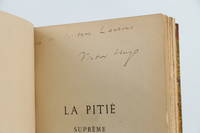
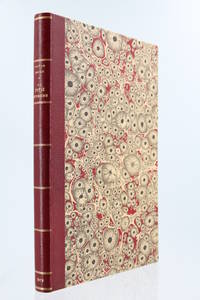
Victor HUGO
La Pitié suprême
Paris: Calmann Lévy 1879. Fine. Calmann Lévy Paris 1879 15 x 23.50 cm relié First edition. Half caramel morocco with small corners spine with four raised bands decorated with black fillets marbled paper boards marbled endpapers and pastedowns bookplate pasted on one pastedown top edge gilt covers and spine sunned and with some lacks preserved. Discreet restorations to joints. Fine copy handsomely bound. Precious autograph inscription signed by Victor Hugo to Constant Laurent. Calmann Lévy hardcover
書籍販売業者の参照番号
: 77555
|
|
|
Victor HUGO
La Pitié suprême
Paris: Calmann Lévy 1879. Fine. Calmann Lévy Paris 1879 15.50 x 25.50 cm relié First edition one of 40 numbered copies on Holland paper the only deluxe copies after 1 vellum 5 chine 9 japan and 15 whatman according to Clouzot. Half red long-grain morocco binding smooth spine decorated with double gilt fillets gilt date at foot pebbled paper boards marbled paper endpapers and pastedowns original wrappers preserved binding signed by Goy et Vilaine. Handsome copy handsomely bound. Calmann Lévy hardcover
書籍販売業者の参照番号
: 77929
|
|
|
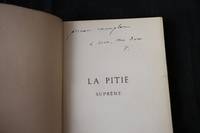
Victor HUGO
La pitié suprême The Supreme Compassion
Paris: Calmann Lévy 1879. Fine. ""for you my lady"" - Juliette Drouet's personal copy Calmann Lévy Paris 1879 15 x 24 cm relié HUGO Victor La Pitié suprême The Supreme Compassion Calmann Lévy Paris 1879 150 x 240 mm 5 15/16 x 9 7/16 half shagreen First edition. Elegant half dark blue shagreen over marbled paper boards by René Aussourd spine in four compartments with gilt dots and double gilt compartments containing horizontal arabesques and gilt stars date and ex. de J. Drouet in gilt at foot marbled endpapers and pastedowns covers and spine preserved marginal repairs to covers top edge gilt ex-libris of Pierre Duché on one endpaper. An exceptional presentation copy inscribed by Victor Hugo to Juliette Drouet the love of his life: The first copy for you my lady. V. Premier exemplaire à vous ma dame. V. Written in 1857 this long philosophical poem on the Revolution was originally meant to conclude the ""Légende des Siècles"". Victor Hugo eventually published it in 1879 when he took a stand on behalf of the Communards. Pleading for the abolition of the death penalty La Pitié suprême highlights one of the first and most heartfelt of Hugo's political struggles which he carried on till the very end of his eighties: if my name stands for anything in these deadly times in which we live it stands for Amnesty ""Letter to the citizens of Lyon"" 1873. Comparing Hugo and Machiavelli J. C. Fizaine underlines the intellectual rigor of the poet who put himself at the service of a humanism elevated into a universal principle: Machiavelli writes for those who wanted to become princes. Hugo writes first and foremost for the people who have known tyranny. It is ""La Pitié suprême"" that defines what will remain immutably sacrosanct human life without hate resentment and the memory of past suffering being justifications for the transgression of its sanctity; and the danger of such transgression is the impossibility of establishing any kind of political system and falling back into a pre-civilized state. Victor Hugo penseur de la laïcité Le clerc le prêtre et le citoyen He waged this final struggle alonside Juliette Drouet. Published in February 1879 not long after they had settled in the avenue d'Eylau La Pitié suprême seems to be a political echo of the newfound legitimacy of the two old lovers after fifty years of clandestine relations. Hugo's last fight for amnesty and pardon reverberated in his emotional life like with the poem he wrote on the death of Juliette in 1883: On my grave they'll write as a great victory The cherished deep embattled memory of a love that was not sanctioned but grew virtuous. A fine copy in a handsome binding and with an extraordinary provenance the most desirable one could wish for. Calmann Lévy hardcover
書籍販売業者の参照番号
: 45162
|
|
|
Victor HUGO - (inscribed to Alphonse DAUDET)
La pitié suprême - Exemplaire d'Alphonse Daudet The Supreme Pity
Paris: Michel Lévy 1879. Fine. Michel Lévy Paris 1879 15.50 x 23.50 cm relié Original edition. Binding half old red grief with some discreet restorations back with five nerves when tail paper plates to the tank and contreplats combed guards lined paper preserved covers red head contemporary binding. Precious autograph signed by Victor Hugo Alphonse Daudet. Buffer library of Madame Daudet on the first guard. Victor Hugo is for Alphonse Daudet like other writers of his generation the undisputed master of arts Hall of Fame. His father figure sprinkles the works of Daudet commonly called alongside those of Rousseau Byron Sand and Delacroix. If during childhood and youth Daudet Hugo exiled giant on his island of Guernsey remains an unattainable ideal ""almost beyond humanity"" Back in France allows him to meet him someday. Around 1875 shortly after the publication of his first works Alphonse Daudet and Julia are well received in Hugo who now lives with Juliette Drouet. They therefore become intimate of the house until the poet's death. Victor Hugo is involved in the education of the young Léon Daudet best friend grand-son of Hugo George and later husband of Jeanne ephemeral. In his Memories of a literary circle Julia Daudet evokes friendship of ten years with the ""idol of all France poetic"" ""I see the great Victor Hugo end of his table; the old master a bit isolated a little deaf sits with God silences absences of a genius on the brink of immortality. The white hair colored head and this eye old lion that develops side with power ferocity; he listens to my husband and Catullus Mendes between which is very lively discussion about youth and celebrity known men and their attractiveness to women. . During the debate we went to the salon Victor Hugo dream by the fire and famous universal and demigod regret perhaps his youth while Mrs Drouet sleeping quietly. » The friendship between the last great romantic writer and one of the masters of the early naturalist school reflects the sharpness of Victor Hugo who at the height of his fame and retains a special kind attention for the remote yet modern literature Hugo's lyricism. This dedication Hugo Daudet on a skilled with The Pope and Religions and Religion of ""philosophical testament"" by Henri Guillemin symbolically resonates as a legacy by a devout follower of the political and moral responsibility of the writer. Provenance: Alphonse Daudet sales Sickles 1990 IV No. 1200 and Philippe Zoummeroff sale 2 April 2001. Gift extract of a literary circle by Julia Daudet: ""How can we forget that first visit home rue de Clichy in the modest apartment so disproportionate to his glory the idea we had of the glory that had filled palaces: He gets up the seat he occupied the fire in front of Madame Drouet his old friend . I am amazed at its size but soon when it will meet me and talk to me I would find it very big very intimidating. And this I felt so shy I always try them in front of Victor Hugo the result of this great admiration respect it as an absent god my parents instilled in me the genius of a poet. I will overcome never that trembling voice every time I answer his kind words and I say astonish for nearly years to hear women admitted to him maintain their inner and their usual trivia. That night when he had made me quite confused Mrs Drouet she said with a charming good grace - Here is the corner of the old and you are too young for us. But Victor Hugo will introduce you to his daughter Mrs. Lockroy; alone has standing to that. And I was driving on the other side of the room moderately large though but that was as divided in two by a table topped with a bronze elephant very majestic Japanese or Chinese I think. It was enough to make two very distinct small groups that communicate easily but without merging. At the time of his return Victor Hugo was dazzling wit many memories and told with an inexhaustible verve when the policy is not too Michel Lévy unknown
書籍販売業者の参照番号
: 46925

|
|
|
Victor HUGO
La République des Lettres. Deuxième Série. Volume II. Sixième livraison. 5 novembre 1876
Paris: Richard Lesclide 1876. Fine. Richard Lesclide Paris 5 novembre 1876 17 x 25 cm broché First edition. In blue paper wrappers printed in red and black. Contributions by: Victor Hugo: ""La sieste de Jeanne"" Alphonse Daudet: ""Moeurs provinciales. I- Le cercle"" Théodore de Banville: ""Homère"" Léon Cladel: ""Bêtes et gens"" Léon Dierx: ""Croisée ouverte"" Victor Hugo: ""La sieste de Jeanne autographe"" François Coppée: ""Fin d'année"" Ernest d'Hervilly: ""Il faut des époux assortis"" Sully-Prudhomme: ""Les Infidèles"" Jean Richepin: ""Le Lâche"" Adelphe Froger: ""La Fleur divine"" Henry Laujol: ""Les Abeilles"" Catulle Mendès: ""Le mauvais guide"". Pre-original publication of the poem ""La sieste de Jeanne"" by Victor Hugo which would later appear in the collection ""L'art d'être grand-père"" published by Calmann-Lévy in 1877. The poem was entrusted to the review at the request of its director Catulle Mendès as Hugo's contribution to a fundraising effort for an impecunious artist. A handsome copy. Richard Lesclide unknown
書籍販売業者の参照番号
: 27904

|
|
|
Victor HUGO - Maurice BOUCHOR
La République des Lettres. Revue littéraire et politique. Deuxième Série. Volume III. Dixième Livraison. 25 février 1877
Paris 1877. Fine. Paris 25 février 1877 17 x 25 cm broché First edition. In blue paper wrappers printed in red and black. Contributions by: Victor Hugo: ""La légende des siècles fragments"" Maurice Bouchor: ""Le Shakespearomane"" Camille Pelletan: ""Les Masques politiques: IV. L'évêque d'Orléans"" Léon Dierx: ""Le Talisman"" Léon Cladel: ""Le Tombeau des Lutteurs suite"" Octave Fouque: ""Musique: Le timbre d'argent"" G.D. J.P. K.H. L.P. M.S.: ""La Semaine"". Copy enhanced with a pen and ink drawing by Rodolphe Julian. Pre-original edition of two poems from La Légende des Siècles a new series of which was about to be published by Calmann-Lévy. Some minor marginal foxing spots otherwise a handsome copy. unknown
書籍販売業者の参照番号
: 27920

|
|
|
Victor HUGO - COLLECTIF
La République des Lettres. Deuxième Série. Volume II. Cinquième Livraison. 29 octobre 1876
Paris: Richard Lesclide 1876. Fine. Richard Lesclide Paris 29 octobre 1876 17 x 25 cm broché First edition. In blue paper wrappers printed in red and black. Contributions by: Victor Hugo: ""Une réponse"" Théodore de Banville: ""Le Rendez-Vous"" Armand Silvestre: ""Intermède païen"" Emile Zola: ""L'Assommoir"" Second part IV-continued Léon Valade: ""Le premier baiser"" Alex Pothey: ""Nostalgie"" Catulle Mendès: ""Siméon Charlerie continued and end"" Jean Prouvaire: ""La semaine parisienne"". Richard Lesclide unknown
書籍販売業者の参照番号
: 27903

|
|
|
Victor HUGO - COLLECTIF
Le Château du diable in La nouvelle revue française N°306 de la vingt-septième année
Paris: Nrf 1939. Fine. Nrf Paris 1er mars 1939 14 x 23 cm broché First edition and pre-first edition for le château du diable by Victor Hugo. Numerous contributions including those by P.Claudel le pape Pie XI J.Benda Songe d'Eleuthère I J.Guéhenno journal de vacances F-P.Alibert O fraternel amants Kierkegaard le penseur subjectif J.Giraudoux choix des élues fin V.Hugo le chateau du diable. Some foxing to the cover otherwise a handsome copy. Nrf unknown
書籍販売業者の参照番号
: 32715

|
|
|
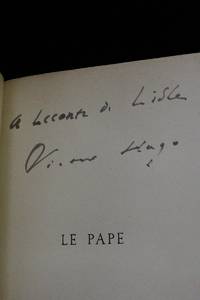
Victor HUGO
Le Pape
Paris: Calmann-Lévy 1878. Fine. Calmann-Lévy Paris 1878 15 x 23.50 cm relié First edition one of 15 copies on Whathman paper Contemporary Bradel binding by Paul Vié in red cloth gilt fleuron to spine midnight blue morocco titlepiece double fillet and date at foot of spine Handsome autograph inscription from Victor Hugo to Leconte de Lisle poet and head of the Parnassianist movement who would go on to take over Hugo's chair at the Académie Française. Calmann-Lévy hardcover
書籍販売業者の参照番号
: 48336
|
|
|
Victor HUGO
Le Rhin
Paris: Jules Renouard & Cie 1845. Fine. Jules Renouard & Cie Paris 1845 14 x 23 cm 4 volumes brochés Edition with some parts in first edition as 14 letters appear here for the first time. Lacks at foot of spines of first second and fourth volumes one tear to joint of fourth volume some light foxing. Jules Renouard & Cie unknown
書籍販売業者の参照番号
: 60222

|
|
|
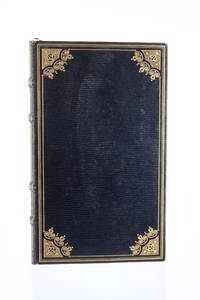
Victor HUGO - Tony JOHANNOT
Le roi s'amuse
Paris: Eugène Renduel 1832. Fine. Eugène Renduel Paris 1832 14.50 x 23.50 cm relié First edition illustrated with a frontispiece by Tony Johannot engraved by Andrew Leloir and Best and mounted on China paper. Full dark blue Russian morocco binding spine with four raised bands set with gilt garlands spine also decorated with triple gilt compartments and ornamented with gilt typographical motifs gilt friezes at head and foot gilt date at foot gilt roulettes on headcaps triple gilt fillet frame on covers enhanced at corners with gilt typographical motifs raspberry watered silk endpapers and pastedowns seven-fold gilt fillet frame on pastedowns following endpapers of pebbled paper bookplate pasted on an endpaper gilt fillets on leading edges superb romantic pastiche binding signed Noulhac. Some foxing. Copy magnificently bound in Noulhac's romantic pastiche binding. Eugène Renduel hardcover
書籍販売業者の参照番号
: 77275
|
|
|
Victor HUGO
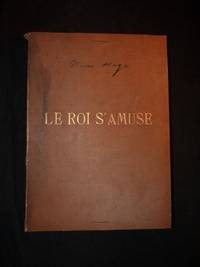
Le Roi s'amuse
Paris: Société de publications périodiques 1883. Fine. Société de publications périodiques Paris 1883 23 x 32 cm broché sous chemise Edition limited to 250 copies ours being one of the numbered copies on Holland paper no. 6 printed for the library of M. Cros-Bonnel. Slipcase rubbed in full brown percaline gilt title and author's name stamped in blind on spine decoration in the same style on front cover. Our edition features 23 plates hors-texte sometimes in colors including several proofs before letters of the headpieces. Some foxing and binding slightly detached. Société de publications périodiques unknown
書籍販売業者の参照番号
: 39217
|
|
|
Victor HUGO
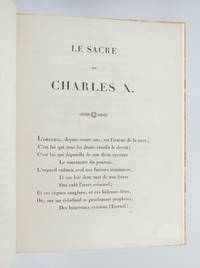
Le Sacre de Charles X Ode
Paris: Imprimerie Royale 1828. Fine. Imprimerie Royale Paris 1828 20.50 x 27 cm relié Second edition published the same year as the first printed by the royal printing house in 500 copies. Two leaves browned. Bradel binding in full marbled paper smooth spine decorated with a black morocco label title lengthwise binding signed Thomas Boichot. Imprimerie Royale unknown
書籍販売業者の参照番号
: 75956
|
|
|
Victor HUGO - Stephane MALLARME - Charles CROS
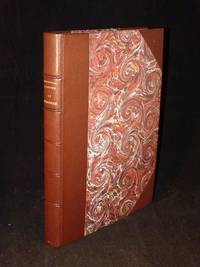
Le tombeau de Théophile Gautier The Tomb of Théophile Gautier
Paris: Alphonse Lemerre 1873. Fine. Alphonse Lemerre Paris 1873 19.50 x 27 cm relié First edition one of 10 numbered copies on Whatman paper initialled by the publisher deluxe issue. Half chocolate morocco binding with corners spine with five raised bands date gilt at foot marbled paper boards hand-marbled endpapers and pastedowns original delicate parchment wrappers preserved with discreet and skillful restorations gilt edges binding signed Goy & Vilaine. Contributions by Victor Hugo Stéphane Mallarmé Charles Cros Frédéric Mistral Paul Arène Théodore de Banville Léon Cladel Jules Claretie François Coppée Léon Dierx Anatole France Albert Glatigny José-Maria de Heredia Arsène Houssaye Jules Janin Charles Leconte de Lisle Catulle Mendès Albert Mérat Sully Prudhomme. Frontispiece portrait of Théophile Gautier by Bracquemond. Final endpaper partially creased. A very handsome copy uncut beautifully bound. Alphonse Lemerre hardcover
書籍販売業者の参照番号
: 38302
|
|
|
Victor HUGO
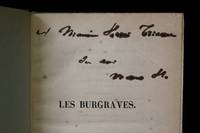
Les Burgraves
Paris: E. Michaud 1843. Fine. E. Michaud Paris 1843 14.50 x 23.50 cm relié First edition. Half blue-grey cloth Bradel binding over marbled paper boards by Champs spine with gilt stylized floral motif date and double gilt fillet to foot navy blue shagreen title-piece with a small angular lack to top covers preserved. Autograph inscription signed by Victor Hugo to his friend the literary critic Henri Trianon. Small manuscript correction to the first page of the introduction a few small wormtracks to the title and half-title. Provenance : Morizet collection collection of Raymond Boueil with his engraved ex libris Maurice Escoffier Le mouvement romantique N°1557 Robert Schumann manuscript initials 1965 N°207 and Philippe Zoummerouff 2001 N°62. E. Michaud hardcover
書籍販売業者の参照番号
: 48262
|
|
|
Victor HUGO
Les chants du crépuscule Songs of Twilight
Paris: Eugène Renduel 1835. Fine. Eugène Renduel Paris 1835 14 x 21.50 cm relié First edition.Bound in red half Russia with corners spine with four raised bands gilt-ruled and decorated with double gilt panels date in gilt at foot within a compartment marbled endpapers and pastedowns rare wrappers and spine preserved top edge gilt uncut binding signed by Bernasconi.The catalogue leaf of Victor Hugos works is present. A few folding creases to some leaves. Mounted opposite the definitive version printed on p. 223 is a precious autograph poem by Victor Hugo entitled La pauvre fleur disait au papillon céleste on two folded leaves mounted on a stub. This is a first version consisting of four quatrains. These verses were reworked by Hugo with some variants in the definitive version augmented with four additional quatrains. The poem was composed by Hugo for his mistress Juliette Drouet whom he had met two years earlier. It symbolizes the nature of their relationshipthe poet bound by his marital and literary life the young woman condemned to wait for himand played a central role in their shared imagination: Juliette Drouet frequently quoted the line Et moi je reste seule à voir tourner mon ombre / À mes pieds ! in her love letters to Victor Hugo. The double motif of the flower and the butterfly alongside their entwined initials also appears in the painted decoration of the Chinese salon from Hauteville Fairy Juliette Drouets residence in Guernsey a décor conceived by Hugo himself and now preserved at the Maison Victor Hugo in Paris. A fine uncut copy in a charming signed binding enriched with a very rare autograph poem by Victor Hugo written for Juliette Drouet. Eugène Renduel hardcover
書籍販売業者の参照番号
: 56714

|
|
|
Victor HUGO
Les Misérables
Bruxelles Brussels: A. Lacroix Verboeckhoven & Cie 1862. Fine. A. Lacroix Verboeckhoven & Cie Bruxelles Brussels 1862 14.50 x 22 cm 10 volumes reliés Victor HUGO Les Misérables A. Lacroix & Verboeckhoven & Cie Bruxelles 1862 145x22cm 10 bound volumes. First edition without statement published concomitantly with the Pagnerre's Paris edition. Bound in half blue sheepskin spine in four compartments decorated with double gilt fillets blue paper plates marbled paste-down and endpapers mottled edges English bindings of the time. Scattered foxings title page of the third volume slightly and marginally soiled paper plates a little rubbed and a few tears on some edges some joints repaired. The first edition of Les Misérables was legally created by three different publishers Pagnerre in France Lacroix in Belgium and Steinacker in Germany under the aegis of the official publisher A. Lacroix Verboeckhoven & Cie. The question of the prevalence of one edition over the other has long stirred the bibliophilic world and bibliographers remain divided on this thorny issue. Carteret and Vicaire for example ensured that the Paris edition should be preferred whereas Vanderem and Clouzot placed the Belgian edition first. More than just a matter of chronology this bibliographical dispute reveals the complexity of the concept of the first edition and the symbolic importance its holds for literary history and in particular for this masterful work which is among the most important in world literature. Strangely without this question really being settled the Brussels edition is commonly described as pre-Paris whereas the Leipzig edition is simply ignored. Les Misérables would therefore be published on 30 or 31 March with Lacroix and 3 April with Pagnerre. The arguments of this Belgian precedence are however all refutable and from 1936 Georges Blaizot had demonstrated its fragility. The first argument is based on a letter by Victor Hugo addressed to Lacroix from 1865 and in which the poet himself called the Belgian edition princeps first: Typographiquement il faut se régler en tout sur l'édition belge princeps des Misérables en dilatant plutôt qu'en resserrant Typographically it is necessary to be totally attuned with the first Belgian edition of Les Misérables expanding rather than tightening he wrote on the subject of the Travailleurs de la mer which will be published in 1866. Yet Hugo's designation is by no means a bibliographical indication as Georges Blaizot explains denouncing the abusive interpretation of P. de Lacretelle and Dr Michaux: Le poète précise un point un seul très simple très clair très précis : l'édition belge princeps c'est-à-dire la première parue des éditions belges doit servir de type aux éditions futures. Il dit cela il dit bien cela il ne dit que cela. The poet specifies one point one very simple very clear very precise: the first Belgian edition i.e. the first published of the Belgian editions must serve as a type for future editions. He says that he says that clearly he says only that. Georges Blaizot in Le Bulletin du bibliophile et du bibliothécaire 1936. Indeed a more modern in-12 edition will follow the famous in-8 edition in October of the same year. The second argument is more significant. It is based on a letter by Adèle Hugo to her husband recounting the extraordinary affair of the French publication four days before the scheduled date. This letter will be partially reproduced in 1904 in the complete works published by Meurice and Simon with the supposed date of 31 March 1862. In it Adèle recounts the reasons for the French publishing haste: Auguste Vacquerie nous apprend que Les Misérables paraissent sous trois jours. Étonnement mêlé de satisfaction. Auguste me raconte qu'ils comptaient faire paraître Les Misérables le 7 avril ; que le matin Noël Parfait était accouru effaré chez Paul Meurice lui dire qu'il sortait de voir aux mains de Paul Siraudin un exemplaire des Misérables qu'i A. Lacroix, Verboeckhoven & Cie unknown
書籍販売業者の参照番号
: 77887

|
|
|
Victor HUGO
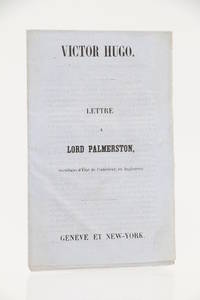
Lettre à Lord Palmerston secrétaire d'état de l'intérieur en Angleterre
Genève Geneva & New York Jersey New York: S.n. Imprimerie universelle 1854. Fine. S.n. Imprimerie universelle Genève Geneva & New York Jersey New York 1854 7 x 11 cm une feuille rempliée First edition printed on blue paper. One crease mark in left margin of leaf otherwise a rare and handsome copy. S.n. [Imprimerie universelle] unknown
書籍販売業者の参照番号
: 86486
|
|
|
Victor HUGO
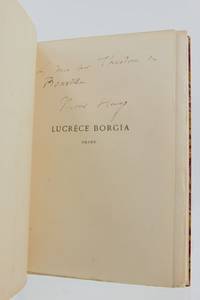
Lucrèce Borgia
Paris: Calmann Lévy 1881. Fine. Calmann Lévy Paris 1881 14 x 19.50 cm relié New edition one of 40 numbered copies on Whatman the only deluxe copies announced. Half red morocco binding spine with five raised bands date at foot marbled paper boards marbled endpapers and pastedowns original wrappers preserved top edge gilt on deckled edges binding signed by P. Goy & C. Vilaine. Precious signed autograph inscription from Victor Hugo: ""A mon cher Théodore de Banville. Victor Hugo."" ""To my dear Théodore de Banville. Victor Hugo."" Precious inscription from the master to one of the pillars of the Parnassian school. Calmann Lévy hardcover
書籍販売業者の参照番号
: 75902
|
|
|
Victor HUGO
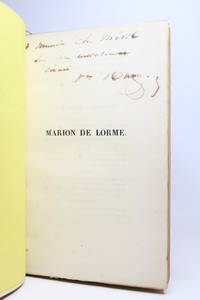
Marion de Lorme
Paris: Eugène Renduel 1831. Fine. Eugène Renduel Paris 1831 14 x 22.50 cm relié First edition rare copy with no statement of print. Full blue morocco binding spine with raised bands in the Jansenist style endpapers and pastedowns of combed marbled paper gilt dentelle framing the pastedowns double gilt fillets and gilt tooling to headcaps and board edges top edge gilt with untrimmed margins preserved original front wrapper bound in binding signed by Marius Michel. Monogrammed bookplate mounted on the verso of the first endpaper. This copy is enriched with four hors-texte plates by Louis Boulanger and Alfred Johannot. Signed autograph inscription by Victor Hugo on the half-title: « À Monsieur Charles Mévil son bien cordialement dévoué Victor Hugo. » Valuable and intriguing presentation inscription to the administrator and principal shareholder of the highly influential Revue de Paris publisher of Balzac whom the young Hugo was likely hoping to win over. It was only in 1834 two years after the success of Notre-Dame de Paris that Hugo would publish a text in the Revue Claude Gueux alongside his prolific rivals Le Père Goriot. Presentation copies of this title by Victor Hugo are exceedingly rare. In his Chronologie des livres imprimés de Victor Hugo published in 2013 Éric Bertin records only nine such inscriptions in this edition: to Sainte-Beuve Taylor Paul Lacroix Charles Mévil this copy Charles Nodier Loève-Veimars Armand Bertin H. Romand and the faithful Paul Meurice. The work also notes that this copy appeared in the Latour sale 1885 and more significantly the Noilly sale 1886. Magnificent copy bound by Marius Michel enriched with engravings and a signed autograph inscription by the author. Eugène Renduel hardcover
書籍販売業者の参照番号
: 73562
|
|
|
Victor HUGO - Tony JOHANNOT
Notre-Dame de Paris The Hunchback of Notre-Dame
Paris: Charles Gosselin 1831. Fine. Charles Gosselin Paris 1831 13.60 x 21 cm 2 volumes reliés First edition limited to 1100 copies divided into four fictitious editions within the same year in order to create the illusion of commercial success. These were subsequently reissued with a new title-page bearing an edition statement and the authors name together with a volume designation on the half-titles cf. Clouzot. Our copy carries the designation third edition. Contemporary bookplate traces on the upper pastedowns. Expert restorations to headcaps and joints with a tiny loss at the foot of the lower joint of vol. I. A clean copy entirely free of foxing. Contemporary half chocolate calf bindings smooth spines decorated with gilt fillets and romantic fleurons with gilt Gothic motifs marbled paper boards pebbled paper endpapers and pastedowns marbled edges strictly contemporary bindings. The title-pages are illustrated with two wood-engraved vignettes after Tony Johannot by Poiret showing Esmeralda offering water to Quasimodo vol. I and LAmende honorable vol. II. A fine copy in handsome period bindings and entirely without foxing a state of preservation very seldom encountered. This first edition in fine condition is the rarest of all the authors works; it enjoyed worldwide renown and is among the most difficult to obtain from the Romantic period Carteret. Charles Gosselin hardcover
書籍販売業者の参照番号
: 88279
|
|
|
Victor HUGO
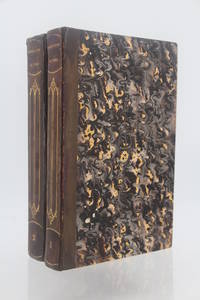
Notre-Dame de Paris
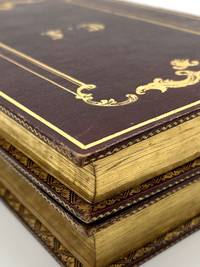
Paris: Furne 1840. Fine. Furne Paris 1840 14.50 x 23 cm 2 tomes en 2 volumes reliés Reprint of the so-called Keepsake edition published by Renduel in 1836. Furne had bought out the Renduel bookshop and quickly exploited its stock. The illustration contains a portrait of Victor Hugo as frontispiece 2 title vignettes these illustrations are new and 11 steel engravings printed on strong paper by Johannot Boulanger Raffet Rogier & Rouargue engraved by Finden Staines. It is well printed in airy typography with large margins and close to the original published in 1831. These two volumes that could be purchased separately formed the head of collection of the new collected edition at Furne which explains the presence of Victor Hugo's portrait. Half-title before the titles but which do not display as for most copies of 1840: Oeuvres complètes de Victor Hugo. Full straight-grained wine-colored morocco binding of the period with the cipher C.F. stamped in blind on the covers. Smooth spine decorated with long rococo tools and fillets. Gilt title and volume number. Covers with a wide border with fillets and rococo tools and the central cipher C. F. Wave fillet on the leading edges interior frieze. White moiré endpapers. Edges gilt. Pale and yellow foxing scattered on paper that has remained white. The engravings are browned by the framing of the tissue guards which are themselves browned. Spines have become uniformly blond. Traces of rubbing. Fine copy. Notre-Dame de Paris moreover like all the great novels of the period is very rare in full contemporary binding especially in straight-grained morocco. Furne unknown
書籍販売業者の参照番号
: 77615
|
|
|
Victor HUGO
Quatorze discours
Paris: La librairie nouvelle 1851. Fine. Precious inscribed copy signed by Victor Hugo to Juliette Drouet: «à mon pauvre doux ange aimé. V.» La librairie nouvelle Paris 1851 16.50 x 25 cm broché Partly first edition gathering the most famous speeches by Victor Hugo including some of his most memorable addresses delivered at the tribune of the Legislative Assemblymost notably the speech on constitutional revision and the powerful plea he gave at the trial of his son on 11 June 1851 before the Cour d'assises of the Seine in defense of the inviolability of human life. Spurious mention of eighth edition. Complete with the rare portrait of the author by Masson printed on China paper as frontispiece. Scattered occasional foxing. Precious inscribed copy signed by Victor Hugo to Juliette Drouet: «à mon pauvre doux ange aimé. V.» A treasured copy belonging to Victor Hugos muse and mistress. This moving and remorseful dedication is Hugos response to the tragedy Juliette endured that same year having just discovered he had been unfaithful for seven years with Léonie Biard. In June 1851 Biard sent Juliette the letters Victor had written to her. In July Hugo swore eternal fidelity to Juliette and in August inscribed this plea for a more compassionate justice to her. In the autumn Juliette demanded that Hugo meet Madame Biard to formally end the affaira meeting she choreographed in every detail and to which Hugo complied. Provenance: libraries of Pierre Duché 1972 no. 75 and Philippe Zoummeroff 2001 no. 71. La librairie nouvelle unknown
書籍販売業者の参照番号
: 53579

|
|
|
Victor HUGO
Religions et religion Religion and Religions
Paris: Calmann Lévy 1880. Fine. Juliette Drouet's copy Calmann Lévy Paris 1880 15.50 x 24 cm relié First edition. Black half morocco binding spine with four raised bands adorned with gilt dotted fillets and double gilt compartments decorated at the corners gilt date and the inscription ""Ex. de J. Drouet"" at the tail marbled paper boards and endpapers preserved covers and spine top edge gilt binding signed by René Aussourd. Some minor foxing mainly at the beginning and end of the volume. Precious signed and inscribed copy by Victor Hugo to Juliette Drouet the great love of his life: To you my lady. Humble homage. V.' This copy comes from the library of Pierre Duché who acquired Juliette Drouet's entire library and commissioned René Aussourd to bind the volumes uniformly marking each with an identifying inscription at the foot of the spine. Bookplates pasted on a pastedown and a flyleaf. In late 1878 after more than forty years together Victor Hugo and Juliette Drouet finally moved in together at Avenue d'Eylau in the small town house where the poet would spend his final years. ""From that moment on Juliette's life became little more than an unbroken sorrow a servitude of every hour. She herself suffered from stomach cancer knowing she was condemnedto die of hunger!"" Louis Guimbaud Victor Hugo et Juliette Drouet Paris 1927. Despite her illness and severe physical weakness she remained devotedly at Hugo's side as his caregiver. It was during this time that Bastien Lepage painted a strikingly realistic portrait of her: ""From her goddess-like face once serene and noble the relentless illness had made a frail human visage drawn and hollowed furrowed with wrinkleseach one telling a story of pain."" ibid. Religions et religions was published two years before Juliette's death; is was one of the last books Hugo dedicated to the unwavering love of his life. In a final tribute to her lifelong devotion he later offered her a photograph inscribed: ""Fifty yearsthat is the most beautiful marriage."" Copy from the most intimate source. Calmann Lévy hardcover
書籍販売業者の参照番号
: 60981

|
|
|
Victor HUGO - (inscribed to Alphonse DAUDET)
Religions et religion - Exemplaire d'Alphonse Daudet Religions and Religion Alphonse Daudets copy
Paris: Michel Lévy 1880. Fine. Michel Lévy Paris 1880 15.50 x 23.50 cm relié First edition. Contemporary half red shagreen over marbled paper boards a few discreet repairs spine in six compartments date to foot marbled paper-lined endpapers and pastedowns covers preserved top edge red. A very handsome autograph inscription signed by Victor Hugo to Alphonse Daudet. Mrs. Daudet's collection stamp to first endpaper. Victor Hugo represented for Alphonse Daudet as for the other writers of his generation the incontestable master of the Pantheon of the arts. His benevolent attention runs through Daudet's work often listed side by side with Rousseau Byron Sand and Delacroix. If during Daudet's childhood and youth Hugo an exile of enormous stature in Guernsey remained a distant ideal ""almost above humanity"" his return to France allowed him finally to meet the master. Around 1875 just after his first works appeared Alphonse and Julia Daudet were thus invited to Hugo's house; Hugo was living with Juliette Drouet at the time. From then on they become frequent visitors to the house right up to the poet's death. Hugo helped with the young Léon Daudet's education his grandson Georges' best friend and later for a short while Jeanne's husband. In her Souvenirs d'un cercle littéraire Memories of a Literary Circle Julia Daudet talks of their friendship of ten years with ""the idol of lyric France"": ""I can see Victor Hugo at the end of his great table: the aged master a little cut off a little deaf presiding with god-like silence the little absences of a genius on the verge of immortality. His hair all white his face colorful and his eyes like an old lion's that would occasionally flash with ferocious bursts of force. He is listening to my husband and Catulle Mendès between whom there is a very animated discussion on the subject of the youth and celebrity of famous men and their charm for women.During the debate we moved through to the salon with Hugo musing beside the fire famous omni-present and a demi-god but perhaps still missing his youth a little as Mme Drouet sleeps softly."" The friendship between this great Romantic writer and one of the masters of the nascent naturalist school is testimony to Hugo's sharpness who even during his glory days preserved a special and benevolent attention for modern literature no matter how far removed it was from his own lyricism. This inscription from Hugo to Daudet on a work considered - along with Le Pape The Pope and La Pitié suprême The Supreme Compassion - a ""philosophical testament"" by Henri Guillemin resonates strongly the passing of the writer's political and moral responsibilities to a devoted disciple. Provenance: Alphonse Daudet his sale at Sicklès 1990 IV n°1200 then Philippe Zoummeroff's sale 2 Avril 2001. An extract from Memories of a Literary Circle by Julia Daudet : ""How could I forget that first visit to his in the rue de Clichy in a modest apartment so out of proportion to his glory to the image of his glory that we had which would have filled entire palaces. He got up out of his chair beside the fire opposite Madame Drouet his old friend.I was shocked by how small he was but soon after he had greeted me and begun talking to me I felt him very big indeed very intimidating. And this timidity that I felt then I would always feel towards him the result of my great admiration and respect something akin to that for an absent god that my parents had inculcated within me for inspired poets. I could never overcome that wobble in my voice whenever I would reply to his kind words and I was shocked to hear women over the course of almost ten years when admitted to his presence regale him with their personal matters and their everyday chatter. That evening when he had introduced me all in a flutter to Madame Drouet she said to me with her most charming grace: 'This is the old people's bit you know and you're far too young for us. But Mon Michel Lévy hardcover
書籍販売業者の参照番号
: 47658

|
|
|
Victor HUGO
Réponse de M. Victor Hugo au discours de M. Sainte-Beuve prononcé dans la séance du 27 février 1845
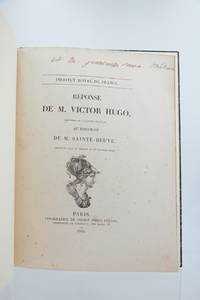
Paris: Typographie de Firmin Didot frères 1845. Fine. Typographie de Firmin Didot frères Paris 1845 20.50 x 27 cm relié First edition. Autograph inscription from Victor Hugo to Mélanie Foucher: ""à ma précieuse soeur Mélanie"" ""to my precious sister Mélanie"" Bradel binding in full paste paper smooth spine decorated with a black morocco label title lengthwise binding signed Thomas Boichot. Inscription slightly trimmed. Some very minor worming. Typographie de Firmin Didot frères unknown
書籍販売業者の参照番号
: 75954
|
|
|
Victor HUGO
Réponse de M. Victor Hugo au discours de M. Saint-Marc Girardin prononcé dans la séance du 16 janvier 1845
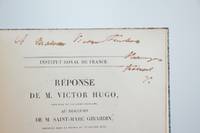
Paris: Typographie de Firmin Didot frères 1845. Fine. Typographie de Firmin Didot frères Paris 1845 20.50 x 27 cm relié First edition. Signed autograph inscription from Victor Hugo to Mélanie Foucher: ""A Madame Victor Foucher Hommages V."" ""To Madame Victor Foucher Respects V."" Bradel binding in full pebbled paper smooth spine decorated with a burgundy morocco label title lengthwise binding signed Thomas Boichot. Some very minor worming. Handsome copy. Typographie de Firmin Didot frères unknown
書籍販売業者の参照番号
: 75953
|
|
|
Victor HUGO
Torquemada
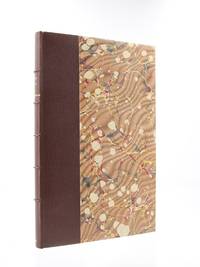
Paris: Calmann Lévy 1882. Fine. Calmann Lévy Paris 1882 15 x 25 cm relié First edition one of 10 numbered copies on Japan paper deluxe copy. Contrary to what bibliographers indicate Clouzot Carteret and Vicaire the print run on this paper does not appear to be 15 copies but indeed 10 as mentioned on the justification page. This paper was moreover upon publication at 40 francs the most expensive China paper being only 20 francs and Holland 15. Half chocolate brown morocco binding spine with five raised bands gilt date at foot pebbled paper boards combed paper endpapers and pastedowns bookplate pasted on a pastedown original wrappers preserved top edge gilt binding signed P. Goy & C. Vilaine. Handsome copy. Calmann Lévy hardcover
書籍販売業者の参照番号
: 76750
|
|
|
Victor HUGO
Toute la lyre
Paris: Jules Hetzel & CieMaison Quantin 1888. Fine. Jules Hetzel & Cie Maison Quantin Paris 1888-1893 14 x 23 cm 3 volumes reliés First edition. Half red shagreen bindings spines with five raised bands set with black fillets and decorated with gilt fleurons marbled paper boards endpapers and pastedowns of marbled paper one corner slightly bumped minor traces of rubbing on bottom edges contemporary bindings. Some occasional light foxing. Provenance: from the library of Jules Félix Louis Gastinger with his bookplates pasted on the pastedowns. Handsome copy attractively established in uniform contemporary binding. Jules Hetzel & CieMaison Quantin hardcover
書籍販売業者の参照番号
: 49333

|
|
|
Victor HUGO - (Leon RICHER)
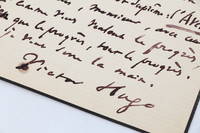
« Pour qu'enfin justice soit rendue à la femme » Signed autograph letter addressed to Léon Richer : « So that justice finally be done for women »
1871. Fine. « So that justice finally be done for women » Mardi 7 novembre 1871 13.30 x 20.80 cm 2 pages sur un feuillet double Autograph letter signed by Victor Hugo to Léon Richer two pages in black ink on a double sheet framed in black. Crosswise folds inherent to envelope inserting. A central tear at the junction of the two sheets. Published in uvres complètes de Victor Hugo Ollendorff 1905. Manuscript housed in a blue half morocco chemise and slipcase marbled paper boards marbled paper slipcase signed Boichot. A magnificent and important letter to Léon Richer one of the first male feminist activists considered by Hubertine Auclert as the ""father of feminism"" and later regarded by Simone de Beauvoir as its ""true founder"". This deeply humanist text is a compendium of Victor Hugo's campaign for the abolition of capital punishment and the female attainment of social equality and civil rights. « Mardi 7 novembre 1871 Monsieur on m'a demandé d'urgence mon intervention pour les condamnés à mort. L'accomplissement de ce devoir a retardé ma réponse à votre excellente lettre. Vous avez raison de compter sur moi pour affirmer l'avenir de la femme. Dès 1849 dans l'Assemblée nationale je faisais éclater de rire la majorité réactionnaire en déclarant que le droit de l'homme avait pour corollaires le droit de la femme et le droit de l'enfant. En 1853 à Jersey dans l'exil j'ai fait la même déclaration sur la tombe d'une proscrite Louise Julien mais cette fois on n'a pas ri on a pleuré. Cet effort pour qu'enfin justice soit rendue à la femme je l'ai renouvelé dans les Misérables je l'ai renouvelé dans le Congrès de Lausanne et je viens de le renouveler encore dans ma lettre au Rappel que vous voulez bien me citer. J'ajoute que tout mon théâtre tend à la dignification de la femme. Mon plaidoyer pour la femme est vous le voyez ancien et persévérant et n'a pas eu de solution de continuité. L'équilibre entre le droit de l'homme et le droit de la femme est une des conditions de la stabilité sociale. Cet équilibre se fera. Vous avez donc bien fait de vous mettre sous la protection de ce mot suprême : l'Avenir. Je suis Monsieur avec ceux qui comme vous veulent le progrès rien que le progrès tout le progrès. Je vous serre la main. Victor Hugo » ""Tuesday november 7 1871 Sir I have been urgently asked to intervene on behalf of those sentenced to death. The fulfillment of this duty has delayed my reply to your excellent letter. You are right to count on me to defend the future of women. As early as 1849 in the National Assembly I made the reactionary majority burst into laughter by declaring the rights of man as natural counterparts to the rights of woman and the rights of children. In 1853 in my Jersey exile I made the same declaration on the grave of an outlaw Louise Julien but this time people didn't laugh they wept. I renewed this effort to finally do justice to women in Les Misérables I renewed it in the Congrès de Lausanne and I've just renewed it again in my letter to Le Rappel which you are kind enough to publish. I would add that every single one of my theatrical works aims to dignify women. As you can see my plea for women is long-standing and persevering and no other has ventured to continue with this endeavor. Balance between men's rights and women's rights is one of the conditions of social stability. This balance will be achieved. I commend you for placing yourself under the protection of this supreme word: the Future. I am Sir with those who like you want progress nothing but progress the whole of progress. I shake your hand. Victor H Although this letter focuses primarily on advocating for women's rights it begins with the death penalty: I have been urgently asked to intervene on behalf of those sentenced to death. The fulfillment of this duty has delayed my reply to your excellent letter. Shortly after the Paris Commune the October 1871 pages of Hugo's diary la hardcover
書籍販売業者の参照番号
: 83318
|
|
|
Victor HUNGER - G POSTEL
. - Un épisode de l'histoire de Tombelaine au temps de Henri IV. - Lettre de M. de Cussy à Edouard Lambert sur le Missorium de Saint-Exupère. - Le château des Forbannis à Corneville-sur-Risle Eure. - Deux touristes à Strasbourg Janvier 1792 - Septembre 1801. - Une voie gallo-romaine dans la vallée de l'Ubaye et passage d'Annibal dans les Alpes. - Un épisode de l'histoire de Montauban. -
Paris & Digne & Montauban: Administration de la Revue alsacienne fifth bookletF. Giraud sixth bookletS. n. fourth bookletImp. Champon & Pailhé first 3 booklets 1889. Fine. Administration de la Revue alsacienne fifth booklet F. Giraud sixth booklet S. n. fourth booklet Imp. Champon & Pailhé first 3 booklets Paris & Digne & Montauban 1889 & 1890 & 1900 & 1908 & 1910 16 x 25 cm 8 fascicules reliés en 1 volume First editions for each of the eight fascicles. Half burgundy cardboard binding smooth spine showing traces of rubbing decorated with blind fillets marbled paper boards. Autograph inscriptions from the authors on four of the pamphlets to the same dedicatee. Also bound at the end of the volume are two other small texts: ""Le port de Caen : son passé - le trafic actuel - les travaux projetés - ce qui en résultera"" published in 1905 by an unknown author; and finally ""Les rois d'Yvetot"" by Maurice rancès published in Yvetot by A. Bretteville printing house in 1900. Rare collection of these texts dealing for the most part with the history of Normandy. Some minor foxing of no consequence. Administration de la Revue alsacienne (fifth booklet)F. Giraud (sixth booklet)S. n. (fourth booklet)Imp. Champon & Pailhé (firs hardcover
書籍販売業者の参照番号
: 34475
|
|
|
Victor JOZE
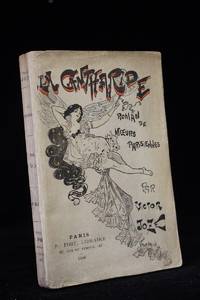
La cantharide. Roman de moeurs parisiennes
Paris: P. Fort 1898. Fine. P. Fort Paris 1898 12 x 19 cm relié New edition statement of 6th thousand. Attractive illustrated cover by Jack Abeille. Spine slightly split at head. Rare. P. Fort unknown
書籍販売業者の参照番号
: 47578
|
|
|
Victor LENEPVEU - (Joseph REINACH)
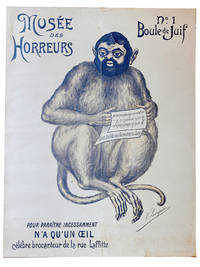
AFFAIRE DREYFUS Musée des horreurs - Affiche originale lithographiée en couleurs - n°1 ""Boule de Juif"" Original colour lithographed poster
Paris: Imprimerie Lenepveu 1899. Fine. Imprimerie Lenepveu Paris s. d. 1er octobre 1899 49.80 x 65.20 cm une affiche Musée des horreurs Original colour lithographed poster n° 1 Boule de Juif Imprimerie Lenepveu Paris 1st october 1899 498 x 652 cm one poster Original colour lithographed poster depicting Joseph Reinach as a monkey. Here is the description given to this first poster announced in the press through L'Intransigeant: Issue number 1 of the series depicts Boule-de-Juif as a hamadryas. The resemblance between the hideous Yousouf and the guest of the great coconut trees is so perfect that it would not even need a caption since the same exclamation came to all lips. Perhaps the only criticism is that this resemblance is not flattering for the hamadryas. Transverse folds some minor marginal tears and a tiny hole under the monkey's tail. The poster was professionally reinforced on the verso with strips of filmoplast and in the lower margin with discreet strips of paper. Circulated between October 1899 and December 1900 in a France set ablaze by the Dreyfus Affair these immense colour portraits are the work of Victor Lenepveu who announced the publication of 150 and then 200 drawings before finally producing only around fifty. Despite the 1881 law on the freedom of press allowing the dissemination of a politically subversive image the publication of this nightmarish pantheon was interrupted by order of the Ministry of the Interior. The fragility of the paper and the imposing size of these very violent posters as well as their almost immediate seizure by the police contributed to the disappearance of these caricatures which strongly left a mark on public opinion. These horreurs were widely promoted by anti-Semitic newspapers that announced a fantasised print of 300000 copies thus insinuating the success of anti-Semitic ideas in the population. On 1st October 1899 L'Intransigeant announced the publication of the Musée des horreurs in its columns: Un dessinateur de beaucoup d'esprit au coup de crayon d'un comique intense M. V. Lenepveu a eu l'heureuse idée d'inaugurer une série de portraits des vendus les plus célèbres de la tourbe dreyfusarde. Le titre de cette série « Musée des Horreurs » est suffisamment suggestif et indique bien ce qu'il promet. . C'est la maison Hayard qui mettra en vente à partir d'aujourd'hui le numéro 1 de cette désopilante série. An artist of great spirit with an intense comical pencil stroke M. V. Lenepveu had the happy idea of inaugurating a series of portraits of the most famous sellouts of the Dreyfusard rabble. The title of this series Musée des Horreurs is sufficiently suggestive and is a good indicator of what it promises. . It is Maison Hayard that will put up for sale from today issue number 1 of this hilarious series. First a peddler then a bookseller-publisher Napoléon Hayard known as Léon Hayard specialised in the marketing of anti-Dreyfusard and anti-Semitic ephemera and advertisements. Today however copies in good condition of these pamphlet caricatures which contributed to the social and political divide of France are very rare. Published in the booming written press - at the same time as Émile Zola's famous J'accuse ! - these propaganda materials had a significant impact on the younger generations and preceded the ideological violence of the 20th century. Imprimerie Lenepveu unknown
書籍販売業者の参照番号
: 80224
|
|
|
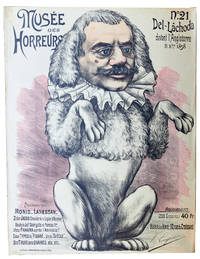
Victor LENEPVEU - (Theophile DELCASSE)
AFFAIRE DREYFUS Musée des horreurs - Affiche originale lithographiée en couleurs - n°21 ""Del-Lâchoda devant l'Angleterre 11xbre 1898""
Paris: Imprimerie Lenepveu 1900. Fine. Imprimerie Lenepveu Paris s. d. mars 1900 49.80 x 65.20 cm une affiche Original lithographed color poster depicting Théophile Delcassé as a circus poodle. Transverse folds and minor marginal tears without loss. Distributed between October 1899 and December 1900 in a France inflamed by the Dreyfus Affair these immense color caricature portraits are the work of Victor Lenepveu who announced the publication of 150 then 200 drawings and ultimately produced only about fifty. Despite the 1881 press freedom law allowing the distribution of politically subversive imagery the publication of this nightmarish pantheon was interrupted by order of the Ministry of the Interior. The fragility of the paper and the imposing format of these extremely violent posters as well as their almost immediate seizure by the police contributed to the disappearance of these caricatures which nevertheless strongly marked public opinion. These horrors benefited from wide promotion by antisemitic newspapers which announced a fantasized print run of 300000 copies thus insinuating the success of antisemitic ideas among the population. On October 1 1899 L'Intransigeant announced the publication of the Musée des horreurs in its columns: ""A very witty artist whose pencil stroke is intensely comic M. V. Lenepveu had the happy idea of inaugurating a series of portraits of the most famous sellouts of the Dreyfusard rabble. The title of this series 'Musée des Horreurs' is sufficiently suggestive and clearly indicates what it promises. . It is the Hayard house that will put on sale starting today number 1 of this hilarious series."" First a street vendor then a bookseller-publisher Napoléon Hayard known as Léon Hayard specialized in the commercialization of anti-Dreyfusard and antisemitic ephemera and placards. However only very rare examples in fine condition of these pamphlet caricatures that participated in the social and political fracture of France survive today. Published during the full expansion of the written press - at the same time as Émile Zola's famous ""J'accuse.!"" - these propaganda documents had a significant impact particularly on young generations and prefigure the ideological violence of the 20th century. Imprimerie Lenepveu unknown
書籍販売業者の参照番号
: 80338
|
|
|
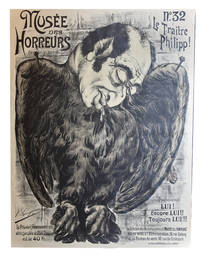
Victor LENEPVEU - (Jude PHILIPP)
AFFAIRE DREYFUS Musée des horreurs - Affiche originale lithographiée en couleurs - n°32 ""Le Traître Philipp""
Paris: Imprimerie Lenepveu 1900. Fine. Imprimerie Lenepveu Paris s. d. mai 1900 49.80 x 65.20 cm une affiche Original color lithographed poster depicting Jude Philipp in the guise of a vulture nailed to a wall. Transverse folds and minute marginal tears without loss. Distributed between October 1899 and December 1900 in a France inflamed by the Dreyfus Affair these immense satirical color portraits are the work of Victor Lenepveu who announced the publication of 150 then 200 drawings and ultimately produced only about fifty. Despite the 1881 press freedom law allowing the distribution of politically subversive imagery the publication of this nightmarish pantheon was interrupted by order of the Ministry of the Interior. The fragility of the paper and the imposing format of these highly violent posters as well as their almost immediate seizure by the police contributed to the disappearance of these caricatures which nevertheless strongly marked public opinion. These horrors benefited from extensive promotion by antisemitic newspapers which announced a fantasy print run of 300000 copies thus insinuating the success of antisemitic ideas among the population. On October 1 1899 L'Intransigeant announced the publication of the Musée des horreurs in its columns: « A draughtsman of great wit with a pencil stroke of intense comic effect M. V. Lenepveu had the happy idea of inaugurating a series of portraits of the most famous sellouts of the Dreyfusard rabble. The title of this series « Musée des Horreurs » is sufficiently suggestive and clearly indicates what it promises. . It is the Hayard house that will put on sale starting today number 1 of this hilarious series. » First a street vendor then a bookseller-publisher Napoléon Hayard known as Léon Hayard indeed specialized in the marketing of ephemera and anti-Dreyfusard and antisemitic broadsides. However today only very rare copies in fine condition survive of these pamphlet-like caricatures which participated in the social and political fracture of France. Published during the height of the written press boom - at the same time as the famous « J'accuse ! » by Émile Zola - these propaganda documents had a significant impact particularly on younger generations and prefigure the ideological violence of the 20th century. Imprimerie Lenepveu unknown
書籍販売業者の参照番号
: 80342
|
|
|
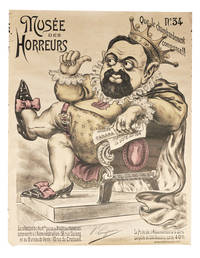
Victor LENEPVEU - (Joseph REINACH)
AFFAIRE DREYFUS Musée des horreurs - Affiche originale lithographiée en couleurs - n°34 ""Que le chambardement commence !""
Paris: Imprimerie Lenepveu 1900. Fine. Imprimerie Lenepveu Paris s. d. juin 1900 49.80 x 65.20 cm une affiche Original color lithographed poster depicting Joseph Reinach in the guise of a king slumped on his throne. Transverse folds and minute marginal tears without loss. Distributed between October 1899 and December 1900 in a France inflamed by the Dreyfus Affair these immense satirical color portraits are the work of Victor Lenepveu who announced the publication of 150 then 200 drawings and ultimately produced only about fifty. Despite the 1881 press freedom law allowing the distribution of politically subversive imagery the publication of this nightmarish pantheon was interrupted by order of the Ministry of the Interior. The fragility of the paper and the imposing format of these highly violent posters as well as their almost immediate seizure by the police contributed to the disappearance of these caricatures which nevertheless strongly marked public opinion. These horrors benefited from extensive promotion by antisemitic newspapers which announced a fantasy print run of 300000 copies thus insinuating the success of antisemitic ideas among the population. On October 1 1899 L'Intransigeant announced the publication of the Musée des horreurs in its columns: « A draughtsman of great wit with a pencil stroke of intense comic effect M. V. Lenepveu had the happy idea of inaugurating a series of portraits of the most famous sellouts of the Dreyfusard rabble. The title of this series « Musée des Horreurs » is sufficiently suggestive and clearly indicates what it promises. . It is the Hayard house that will put on sale starting today number 1 of this hilarious series. » First a street vendor then a bookseller-publisher Napoléon Hayard known as Léon Hayard indeed specialized in the marketing of ephemera and anti-Dreyfusard and antisemitic broadsides. However today only very rare copies in fine condition survive of these pamphlet-like caricatures which participated in the social and political fracture of France. Published during the height of the written press boom - at the same time as the famous « J'accuse.! » by Émile Zola - these propaganda documents had a significant impact particularly on younger generations and prefigure the ideological violence of the 20th century. Imprimerie Lenepveu unknown
書籍販売業者の参照番号
: 80341
|
|
|
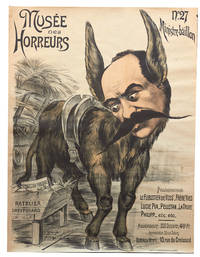
Victor LENEPVEU - (Georges LEYGUES)
AFFAIRE DREYFUS Musée des horreurs - Affiche originale lithographiée en couleurs - n°27 ""Ministre-bâillon""
Paris: Imprimerie Lenepveu 1900. Fine. Imprimerie Lenepveu Paris s. d. avril/mai 1900 49.80 x 65.20 cm une affiche Original color lithographed poster depicting Georges Leygues as a donkey. Transverse folds and minute marginal tears without loss. Distributed between October 1899 and December 1900 in a France inflamed by the Dreyfus Affair these immense satirical color portraits are the work of Victor Lenepveu who announced the publication of 150 then 200 drawings and ultimately produced only about fifty. Despite the 1881 press freedom law allowing the distribution of politically subversive imagery the publication of this nightmarish pantheon was interrupted by order of the Ministry of the Interior. The fragility of the paper and the imposing format of these extremely violent posters as well as their almost immediate seizure by the police contributed to the disappearance of these caricatures which nevertheless strongly marked public opinion. These horrors benefited from extensive promotion by antisemitic newspapers which announced a fantasized print run of 300000 copies thus insinuating the success of antisemitic ideas among the population. On October 1st 1899 L'Intransigeant announced the publication of the Musée des horreurs in its columns: ""A draftsman of great wit with a pencil stroke of intense comic effect M. V. Lenepveu has had the happy idea of inaugurating a series of portraits of the most famous sellouts from the Dreyfusard rabble. The title of this series 'Musée des Horreurs' is sufficiently suggestive and clearly indicates what it promises. . It is the Hayard house that will put on sale starting today number 1 of this hilarious series."" First a street peddler then a bookseller-publisher Napoléon Hayard known as Léon Hayard specialized in the commercialization of ephemera and anti-Dreyfusard and antisemitic posters. However only very rare copies in fine condition of these pamphleteering caricatures that participated in the social and political fracture of France survive today. Published during the boom of the written press - at the same time as Émile Zola's famous ""J'accuse.!"" - these propaganda documents had a significant impact particularly on younger generations and prefigured the ideological violence of the 20th century. Imprimerie Lenepveu unknown
書籍販売業者の参照番号
: 80339
|
|
|
Victor LENEPVEU - (Louis LUCIPIA)
AFFAIRE DREYFUS Musée des horreurs - Affiche originale lithographiée en couleurs - n°28 ""Luci-pouah !""
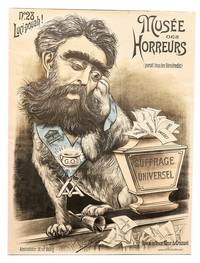
Paris: Imprimerie Lenepveu 1900. Fine. Imprimerie Lenepveu Paris s. d. mai 1900 49.80 x 65.20 cm une affiche Original color lithographed poster depicting Louis Lucipia as a dog wearing a masonic sash. Transverse folds and minute marginal tears without loss. Distributed between October 1899 and December 1900 in a France inflamed by the Dreyfus Affair these immense satirical color portraits are the work of Victor Lenepveu who announced the publication of 150 then 200 drawings and ultimately produced only about fifty. Despite the 1881 press freedom law allowing the distribution of politically subversive imagery the publication of this nightmarish pantheon was interrupted by order of the Ministry of the Interior. The fragility of the paper and the imposing format of these extremely violent posters as well as their almost immediate seizure by the police contributed to the disappearance of these caricatures which nevertheless strongly marked public opinion. These horrors benefited from extensive promotion by antisemitic newspapers which announced a fantasized print run of 300000 copies thus insinuating the success of antisemitic ideas among the population. On October 1st 1899 L'Intransigeant announced the publication of the Musée des horreurs in its columns: ""A draftsman of great wit with a pencil stroke of intense comic effect M. V. Lenepveu has had the happy idea of inaugurating a series of portraits of the most famous sellouts from the Dreyfusard rabble. The title of this series 'Musée des Horreurs' is sufficiently suggestive and clearly indicates what it promises. . It is the Hayard house that will put on sale starting today number 1 of this hilarious series."" First a street peddler then a bookseller-publisher Napoléon Hayard known as Léon Hayard specialized in the commercialization of ephemera and anti-Dreyfusard and antisemitic posters. However only very rare copies in fine condition of these pamphleteering caricatures that participated in the social and political fracture of France survive today. Published during the boom of the written press - at the same time as Émile Zola's famous ""J'accuse.!"" - these propaganda documents had a significant impact particularly on younger generations and prefigured the ideological violence of the 20th century. Imprimerie Lenepveu unknown
書籍販売業者の参照番号
: 80340
|
|
|
Victor LENEPVEU - (Alfred DREYFUS)
AFFAIRE DREYFUS Musée des horreurs - Affiche originale lithographiée en couleurs - n°6 ""Le Traître"" Original colour lithographed poster
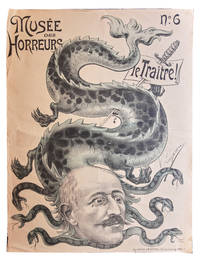
Paris: Imprimerie Lenepveu 1899. Fine. Imprimerie Lenepveu Paris s. d. novembre 1899 49.80 x 65.20 cm une affiche Musée des horreurs Original colour lithographed poster n° 6 Le Traître Imprimerie Lenepveu Paris Novembre 1899 498 x 652 cm one poster Original colour lithographed poster depicting Alfred Dreyfus as a Gorgonian headed hydra pierced by a military sword. Far from the classic zoomorphic codes usually used by caricaturists Alfred Dreyfus is associated here with the hydra a mythical creature emblematic of evil. Beyond this symbolism the choice of a monster with sprawling and perpetually regenerating heads gives the image a strong anti-Semitic charge exceeding that of the Dreyfus Affair. Ironically it is the term hydra that will be used after the Second World War to describe the anti-Semitic resurgence of our modern society. Transverse folds some marginal foxing not affecting the image. Circulated between October 1899 and December 1900 in a France set ablaze by the Dreyfus Affair these immense colour portraits are the work of Victor Lenepveu who announced the publication of 150 and then 200 drawings before finally producing only around fifty. Despite the 1881 law on the freedom of press allowing the dissemination of a politically subversive image the publication of this nightmarish pantheon was interrupted by order of the Ministry of the Interior. The fragility of the paper and the imposing size of these very violent posters as well as their almost immediate seizure by the police contributed to the disappearance of these caricatures which strongly left a mark on public opinion. These horreurs were widely promoted by anti-Semitic newspapers that announced a fantasised print of 300000 copies thus insinuating the success of anti-Semitic ideas in the population. On 1st October 1899 L'Intransigeant announced the publication of the Musée des horreurs in its columns: Un dessinateur de beaucoup d'esprit au coup de crayon d'un comique intense M. V. Lenepveu a eu l'heureuse idée d'inaugurer une série de portraits des vendus les plus célèbres de la tourbe dreyfusarde. Le titre de cette série « Musée des Horreurs » est suffisamment suggestif et indique bien ce qu'il promet. . C'est la maison Hayard qui mettra en vente à partir d'aujourd'hui le numéro 1 de cette désopilante série. An artist of great spirit with an intense comical pencil stroke M. V. Lenepveu had the happy idea of inaugurating a series of portraits of the most famous sellouts of the Dreyfusard rabble. The title of this series Musée des Horreurs is sufficiently suggestive and is a good indicator of what it promises. . It is Maison Hayard that will put up for sale from today issue number 1 of this hilarious series. First a peddler then a bookseller-publisher Napoléon Hayard known as Léon Hayard specialised in the marketing of anti-Dreyfusard and anti-Semitic ephemera and advertisements. Today however copies in good condition of these pamphlet caricatures which contributed to the social and political divide of France are very rare. Published in the booming written press - at the same time as Émile Zola's famous J'accuse ! - these propaganda materials had a significant impact on the younger generations and preceded the ideological violence of the 20th century. Imprimerie Lenepveu unknown
書籍販売業者の参照番号
: 80332
|
|
|
Victor LENEPVEU - (Emile ZOLA) - (Alfred DREYFUS)
AFFAIRE DREYFUS Musée des horreurs - Affiche originale lithographiée en couleurs - n°26 exceptionnel ""Un bal à l'Elysée"" Original colour lithographed poster
Paris: Imprimerie Lenepveu 1900. Fine. Imprimerie Lenepveu Paris s. d. mai 1900 49.80 x 65.20 cm une affiche Musée des horreurs Original colour lithographed poster n° 26 exceptionnel Un bal à l'Elysée Imprimerie Lenepveu Paris May 1900 498 x 652 cm one poster Original colour lithographed poster depicting Émile Loubet as a bear holding a tambourine marked Panama Émile Zola as a pig Dreyfus as a hydra Joseph Reinach as a monkey the rabbi Kadoc Kahn as a donkey and Georges Picquart as a dromedary. This imposing poster featuring several people already caricatured in the previous issues is a direct reference to the Panama Scandal. This large-scale corruption affair which saw the resignation of Émile Loubet then Minister of Finance is re-referred to here because of the Judaism of some of is protagonists. It is Drumont through his magazine La Libre Parole who revealed the Panama Scandal denouncing the alleged alliance between the secular Republic and the Jewish high bank and thus contributing to the strengthening of the stereotype of the Jew eager for money: The deputy Joseph Reinach cousin and son-in-law of the baron Jacques de Reinach compromised in the scandal focuses the hatred of the polemicist. A republican close to the business world a free thinker Reinach is undoubtedly with Alphonse de Rothschild the man most attacked by the anti-Semites of the time. His wealth the vast networks of influence available to him his early involvement with Gambetta the memory of his campaigns against Boulangism and his equivocal role in the Panama affair make him the man to slaughter in order to return France to the French. Grégoire Kauffmann Rothschild & Cie. La bourgeoisie juive vue par Édouard Drumont in Archives Juives 2009 As for Émile Zola his novel L'Argent published in 1891 denounces the misappropriation of this financial scandal but his support for Alfred Dreyfus earned him his place in this nightmarish animal circle. Circulated between October 1899 and December 1900 in a France set ablaze by the Dreyfus Affair these immense colour portraits are the work of Victor Lenepveu who announced the publication of 150 and then 200 drawings before finally producing only around fifty. Despite the 1881 law on the freedom of press allowing the dissemination of a politically subversive image the publication of this nightmarish pantheon was interrupted by order of the Ministry of the Interior. The fragility of the paper and the imposing size of these very violent posters as well as their almost immediate seizure by the police contributed to the disappearance of these caricatures which strongly left a mark on public opinion. These horreurs were widely promoted by anti-Semitic newspapers that announced a fantasised print of 300000 copies thus insinuating the success of anti-Semitic ideas in the population. On 1st October 1899 L'Intransigeant announced the publication of the Musée des horreurs in its columns: Un dessinateur de beaucoup d'esprit au coup de crayon d'un comique intense M. V. Lenepveu a eu l'heureuse idée d'inaugurer une série de portraits des vendus les plus célèbres de la tourbe dreyfusarde. Le titre de cette série « Musée des Horreurs » est suffisamment suggestif et indique bien ce qu'il promet. . C'est la maison Hayard qui mettra en vente à partir d'aujourd'hui le numéro 1 de cette désopilante série. An artist of great spirit with an intense comical pencil stroke M. V. Lenepveu had the happy idea of inaugurating a series of portraits of the most famous sellouts of the Dreyfusard rabble. The title of this series Musée des Horreurs is sufficiently suggestive and is a good indicator of what it promises. . It is Maison Hayard that will put up for sale from today issue number 1 of this hilarious series. First a peddler then a bookseller-publisher Napoléon Hayard known as Léon Hayard specialised in the marketing of anti-Dreyfusard and anti-Semitic ephemera and advertisem Imprimerie Lenepveu unknown
書籍販売業者の参照番号
: 80343
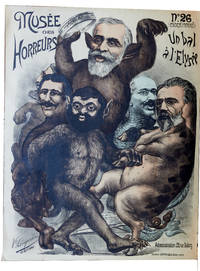
|
|
|
Victor LENEPVEU - (Jean JAURES)
AFFAIRE DREYFUS Musée des horreurs - Affiche originale lithographiée en couleurs - n°14 ""L'Eléphant du Jourdain"" Original colour lithographed poster
Paris: Imprimerie Lenepveu 1900. Fine. Imprimerie Lenepveu Paris s. d. janvier 1900 49.80 x 65.20 cm une affiche Original colour lithographed poster depicting Jean Jaurès as an elephant sitting on a chair and holding a bottle of water from the Jordan. Until then portrayed as a dog caricaturists mocking his aggressiveness Jean Jaurès is here for the first time represented as an elephant. It is a question here of highlighting his potbelly and his pachyderm silhouette but we can nevertheless highlight the great dignity of this massive personality with a high gaze. The water from the Jordan is held on one of his hoofs and alludes to the rumour that he had his son baptised in the scared river thus acting against his anticlerical policy. Despite the caricaturist's desire to ridicule Jean Jaurès the choice of the elephant a symbol of strength prosperity and wisdom is ultimately positive. Transverse folds and tiny minor marginal tears. Circulated between October 1899 and December 1900 in a France set ablaze by the Dreyfus Affair these immense colour portraits are the work of Victor Lenepveu who announced the publication of 150 and then 200 drawings before finally producing only around fifty. Despite the 1881 law on the freedom of press allowing the dissemination of a politically subversive image the publication of this nightmarish pantheon was interrupted by order of the Ministry of the Interior. The fragility of the paper and the imposing size of these very violent posters as well as their almost immediate seizure by the police contributed to the disappearance of these caricatures which strongly left a mark on public opinion. These horreurs were widely promoted by anti-Semitic newspapers that announced a fantasised print of 300000 copies thus insinuating the success of anti-Semitic ideas in the population. On 1st October 1899 L'Intransigeant announced the publication of the Musée des horreurs in its columns: Un dessinateur de beaucoup d'esprit au coup de crayon d'un comique intense M. V. Lenepveu a eu l'heureuse idée d'inaugurer une série de portraits des vendus les plus célèbres de la tourbe dreyfusarde. Le titre de cette série « Musée des Horreurs » est suffisamment suggestif et indique bien ce qu'il promet. . C'est la maison Hayard qui mettra en vente à partir d'aujourd'hui le numéro 1 de cette désopilante série. An artist of great spirit with an intense comical pencil stroke M. V. Lenepveu had the happy idea of inaugurating a series of portraits of the most famous sellouts of the Dreyfusard rabble. The title of this series Musée des Horreurs is sufficiently suggestive and is a good indicator of what it promises. . It is Maison Hayard that will put up for sale from today issue number 1 of this hilarious series. First a peddler then a bookseller-publisher Napoléon Hayard known as Léon Hayard specialised in the marketing of anti-Dreyfusard and anti-Semitic ephemera and advertisements. Today however copies in good condition of these pamphlet caricatures which contributed to the social and political divide of France are very rare. Published in the booming written press - at the same time as Émile Zola's famous J'accuse ! - these propaganda materials had a significant impact on the younger generations and preceded the ideological violence of the 20th century. Imprimerie Lenepveu unknown
書籍販売業者の参照番号
: 80337
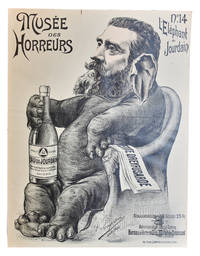
|
|
|
Victor LENEPVEU - (Emile ZOLA)
AFFAIRE DREYFUS Musée des horreurs - Affiche originale lithographiée en couleurs - n°4 ""Le Roi des Porcs"" Original colour lithographed poster
Paris: Imprimerie Lenepveu 1899. Fine. Imprimerie Lenepveu Paris s. d. novembre 1899 49.80 x 65.20 cm une affiche Musée des horreurs Original colour lithographed poster n° 4 Le Roi des Porcs Imprimerie Lenepveu Paris November 1898 498 x 652 cm one poster Original colour lithographed poster depicting Émile Zola in the shape of a pig sitting on a tub containing his fictional works and smearing international poop on the map of France. Transverse folds some tiny tears two small holes above Zola's head without affecting the image. The representation of Émile Zola as a pig does not date back to Lenepveu as Guillaume Doizy highlights in his article dedicated to pig caricatures Le porc dans la caricature politique 1870-1914: une polysémie contradictoire in Sociétés & Représentations n°27 2009: For the end of the 19th century we also think of the many caricatures of which Zola was the victim and which associate excrement symbols of naturalism with pigs. Dozens of images could be mentioned. In the 1880s Sapeck imagined the naturalist naked a vine leaf hiding his genitals a veiled reference to the supposed pornography of his writings sitting astride a pig feeding on his excrement a long-lasting symbol called to stigmatise the new literary school. In a caricature dated 1898 Alfred Le Petit shows a Zola-pig defecating on the tricolore flag. Barely a month after the publication of his famous J'accuse the writer defending the Dreyfusard cause is accused of defiling France and especially its Army by defending the traitor Dreyfus and Prussia considered the eternal enemy. The pig is dirty but above all it dirties defiles by the effect of its harmful will. The same year Caran d'Ache portrayed the weapons of the Dreyfusard press as a big pig sprawled in muck and covered with mud. . In his series Le Musée des horreurs the very right-handed Lenepveu violently attacks Zola. The writer is depicted as a piglet sitting on a box of waste containing his own works the fruit of his defecations prominently including La Terre and Nana. He soils a map of France with his international poop contained in a chamber pot that he spreads with a small brush. The artist is of course aiming at the Dreyfus defender through his famous J'accuse and Jewish cosmopolitanism smearing France with his support for treason. The soiling-pig association seems obvious and primordial. As for Napoleon III the pig's dirt reinforced here by the visible excrement stigmatises the target's political choices. Lenepveu defines Zola's ideas as works of unworthiness intestinal and dripping products. Although this is not the first porcine representation of Émile Zola the one that features prominently in Lenepveu's Musée is undeniably by its realism the most violent. Circulated between October 1899 and December 1900 in a France set ablaze by the Dreyfus Affair these immense colour portraits are the work of Victor Lenepveu who announced the publication of 150 and then 200 drawings before finally producing only around fifty. Despite the 1881 law on the freedom of press allowing the dissemination of a politically subversive image the publication of this nightmarish pantheon was interrupted by order of the Ministry of the Interior. The fragility of the paper and the imposing size of these very violent posters as well as their almost immediate seizure by the police contributed to the disappearance of these caricatures which strongly left a mark on public opinion. These horreurs were widely promoted by anti-Semitic newspapers that announced a fantasised print of 300000 copies thus insinuating the success of anti-Semitic ideas in the population. On 1st October 1899 L'Intransigeant announced the publication of the Musée des horreurs in its columns: Un dessinateur de beaucoup d'esprit au coup de crayon d'un comique intense M. V. Lenepveu a eu l'heureuse idée d'inaugurer une série de portraits des vendus les plus célèbres de la tourbe Imprimerie Lenepveu unknown
書籍販売業者の参照番号
: 80330
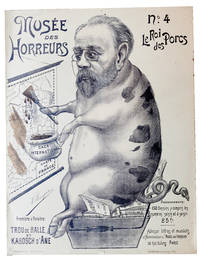
|
|

 検索結果のメールを受信する
 PDFファイルの検索結果をダウンロード
 RSSフィード
 パーマネントリンク


