|
BRUCKE,E
Grundzüge der Physiologie und Systematik der Sprachlaute für Linguisten und Taubstummenlehrer.
Wien Gerold 1856. V134 p. 1 folding lithographed table. Paper wrapper gone. 20 cm Small bookplate of Robert Washington Oates on the verso of the title; See for Oates Wikipedia; see also Wikipedia for the importance of Ernst Wilhelm von Brücke; first edition of this classic on phonetics unknown
Ссылка продавца : 160032
|
|
|
MODDERMAN,ANTONIUS
Mijn bede aan Apollo. Voorgelezen in de vergadering van het departement Groningen tot Nut van 't Algemeen den 11 January 1832 door Mr. A. Modderman. Fragment.
Groningen 1832 Manuscript of a poem recited on January 11 1832 at a meeting of the Groningen branch of the 'Maatschappij tot Nut van 't Algemeen' Society for Public Welfare. It is written on the first 9 pages of a small 16 page notebook. It has a plain paper cover is pamphlet stitch bound and measures 16x10 cm. § The poem numbers 29 quatrains each stanza numbering 4 eight-syllable lines in trochaic metre. In light verse the jurist Modderman a member of the local elite describes meetings of the Groningen branch of the 'Maatschappij tot Nut van 't Algemeen' during which people drink coffee and smoke a pipe or a cigar and listen to all kinds of edifying lectures. § Antonius Modderman born in Groningen in 1793 was a Dutch jurist and a conservative politician. He studied medicine and law at the University of Groningen obtaining his doctorate in law in 1817 with his dissertation 'de pauperibus'. He established himself as a lawyer in the same year in Hoogezand and then as a solicitor in 1833 in Groningen where he started also his political career. He was elected a member of the 'Provinciale Staten' of Groningen and in the revolutionary year of 1848 the year of the revision of the Constitution of the Kingdom of the Netherlands he also became an extraordinary member of the House of Representatives of the States General for a short period. He was a lifelong active member of the Groningen branch of the 'Maatschappij tot Nut van 't Algemeen' for he held several lectures there. Five of them he published in 1852 as 'Bijdrage tot de Huishoudkunde voorlezingen meerendeels zamengesteld uit spreuken spreekwijzen en spreekwoorden'. This collection was well received and proves that his prose was better than his poetry. Modderman also published in 1858 a history of the Groningen branch: 'Bijdrage tot de kennis van het departement Groningen der .Maatschappij tot Nut van 't Algemeen'. See for a painted group portrait with Modderman: genealogieonline.nl/groningse-doopsgezinden/I35718.php and for a photograph of him wikiwand.com/nl/Antonius_Modderman § De Maatschappij tot Nut van het Algemeen 'is a non-profit organization in the Netherlands founded in 1784 with the purpose of developing individuals and society primarily through education. It had great influence in improving public education through better textbooks model schools and teacher's training. The society continues to be involved in extracurricular education'. source for this society Wikipedia § The Groningen branch of this society established in 1791 still exists. It nowadays organizes for its members cultural and social activities in the form of lectures performances and excursions. Photographs on request unknown
Ссылка продавца : 160006
|
|
|
Jones, Herschel V & Helen Fogg & Wilberforce Eames
Adventures in Americana 1492-1897: The Romance of Voyage and Discovery from Spain to the Indies etc. to Alaska. A Selection of Books from the Library of Herschel V. Jones Minneapolis Minnesota. And Americana Collection of Herschel V. Jones: A Checklist 1473-1926 Three Volumes.
New York: Cooper Square Publishers 1964. Hardcover. Fine. Preface in Volume I by Wilberforce Eames who also wrote Volume III Checklist Three fine volumes in heavy-weight paper with illustration of each in volumes I and II. Brown cloth gold title on red box on spine Heavy set: No priority or international shipping. <br/><br/> Cooper Square Publishers hardcover
Ссылка продавца : 18335
|
|
|
SALMASIUS,C
Claudii Salmasii Ad Johannem Miltonum responsio opus posthumum.
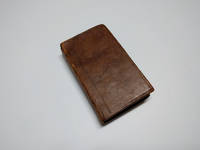
London Londoni Typis Tho. Roycroft Impensis Jo. Martin etc. 1660. 12mo. IV3044 blank p. Contemporary calf. 16 cm Ref: ESTC Citation No. R203484; Wing 2nd ed. S736; Ebert 14095 Details: Double blind fillet on back and boards. Red shield with gilt lettering in the second 'compartment' Condition: Binding scuffedPhotographs on request . Head of the spine damaged. First pastedown detached pastedown at the end removed Note: The English Civil War 1642-1651 was a series of armed conflicts between Parliamentarians and Royalists who supported King Charles I. The war ended with a Parliamentarian victory in 1651. The climax of the Civil War was the trial and execution of King Charles I on January 30 1649. The monarchy was replaced with a Republic form of government first the Commonwealth of England 1649-1653 and then the Protectorate under the rule of the dictator Oliver Cromwell who died in 1658 and his son 1653-1659. Charles II son of Charles I went in exile. Cromwell's death in 1658 resulted in a political crisis which led to the restoration of the monarchy when the English Parliament resolved to invite the son of Charles I to return. He was proclaimed King in May 1660. § In November 1649 10 months after the beheading of Charles I the French classical scholar Claudius Salmasius Claude Saumaise 1588-1653 who was professor at the University of Leiden published at the request of the 19 years old king in exile Charles II a 'Defensio Regia pro Carolo I' In defence of King Charles I. On the title page Charles II is called 'heredem et successorem legitimum'. It was brought on the market anonymously and 'sumptibus regiis' by Elsevier at Leiden. The exiled King paid for the printing and rewarded Salmasius with £ 100. It is a defence of absolute monarchy and a fierce condemnation of the English Parliamentary system. § The 'Defensio Regia pro Carolo I' came as a bombshell and provoked in 1651 a scathing reply from the English poet and polemist John Milton 'Pro Populo Anglicano Defensio' A Defense of the People of England. Milton who was appointed under Cromwell 'Secretary for Foreign Tongues' in 1649 was responsible for the Republic's foreign correspondence in Latin but it was also his task to produce propaganda for the new regime. Milton was ordered by the Council of State to write the 'Defence of the English People' to establish its legitimacy. In this work full of learned vituperation Milton alludes to Salmasius' effeminacy comparing him with the Greek mythological Hermaphrodite Salmacis and he also attacks his wife Anne Mercier who wore that was true the trousers. The pure Latin prose and the evident learning made Milton's name in Europe. The English philosopher Thomas Hobbes a contemporary observes concerning both 'Defences': 'They are very good Latin both and hardly to be judged which is better; and both very ill reasoning hardly to be judged which is worse; like two declamations 'pro' and 'con' made for exercise only in a rhetoric school by one and the same man'. Hobbes Behemoth Dialogue IV Hobbes' opinion of this learned controversy is devastating: 'Where Europe thought it had witnessed the sharpest possible contest of principle between an opponent of regicide on one side and a defender of it on the other Hobbes saw unwitting collusion between twin offpspring of the Reformation. . Nor is the remark about the excellence of their Latin offered in mitigation. On the contrary it is intended to aggravate their offence. . Milton and Salmasius are condemned for exhibiting the . lethal combination of attributes: eloquence and ill reasoning'. M. Dzelzainis 'Milton's classical republicanism' in 'Milton and Republicanism' Cambridge 1995 p. 7 § Salmasius prepared a reply responsio to Milton but he did not live to finish it. It was published posthumously by his son at Dijon in 1660 a few months after the restoriation of Charles II and reissued at London in September of the same year Collation: A-N12 leaves N11 & N12 blank Photographs on request hardcover
Ссылка продавца : 155426
|
|
|
TACITUS
C. Cornelius Tacitus Jaarboeken en Historien ook zyn Germanië en 't leeven van J. Agricola in 't Hollandsch vertaalt door den Heer Pieter Corneliszoon Hooft.
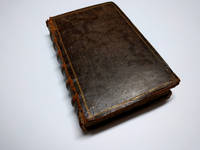
Amsterdam By Hendrik Boom en de Weduwe van Dirk Boom 1684. Folio. XL528411;72 p. 14 engraved portraits & 8 folding historical plates. Calf 33 cm Ref: STCN ppn 171376293; Geerebaert 1375II; OiN p. 359; Schweiger 21028 Details: Back gilt and with 6 raised bands. Boards with double fillet gilt borders. Title in red & black. Woodcut printer's mark on the title depicting Ceres and Flora under a palmtree Boom means tree; the banner at their feet reads: I.V.S. A.W. H.D.B. which means: 'Johannes Van Someren Abraham Wolfgangk Hendrik en Dirk Boom'. Woodcut initials. 14 magnificent full-page portraits of Roman emperors engraved by A. Vaillandt and 8 double-page battle and rural scenes engraved by I. Mulder Condition: Binding scuffed and scratched. Back rubbed and damaged at the head and tail. Corners bumped. Front pastedown stained slightly damaged and with a bookplate. Faint name on the front flyleaf small hole in somewhat soiled front flyleaf. Interior fine Note: The Dutch Renaissancist poet playwright and historian Pieter Corneliszoon Hooft 1581-1647 may be considered the founder of the literature of Holland's Golden Age. His style is not easily accessible and often shows a sentence structure derived from Latin. Around 1630 he started with his translation into Dutch of the works of the Roman historian Tacitus 56-117 A.D. These translations of the 'Annales' 'Historiae' 'Germania' and the 'Agricola' were posthumely published in 1684 by his able biographer Geeraert Brandt 1626-1685. Hooft in who the genius of Tacitus had arisen according to Brandt was not satisfied with the previously published translations and decided to make a translation of his own which suited the style of the Roman historian better. Hooft however never found time to publish his translation. In the preface Brandt tells that the manuscript with the translations came into his hands by chance long after the death of Hooft. He then decided to rescue them from oblivion and to publish them more than 50 years after Hooft had begun to translate Tacitus. In the same year the firm of Boom brought also a cheaper and smaller quarto-edition on the market. According to Geerebaert this folio-edition was printed first Provenance: On the front pastedown a woodcut bookplate of J.J.A. Poley and F. Poley-Scheele made by the Dutch graphic artist Johan Melse See: Johan Schwencke in 'Den Gulden Winckel 31 1932 p. 29-30 Johannes Adriaan Poleij 1889-1951 married Francina Scheele born 1891 in 1915 in the Dutch city of Goes Collation: a-c4 d-g2; A-3N-4 3O-6 3P-3S4 3T6 3V-3X4; A-S2 leaf S2 verso blank Photographs on request Heavy book may require extra shipping costs hardcover
Ссылка продавца : 155667
|
|
|
ADAGIA
PAROIMIAI HELLÊNIKAI. Adagia sive proverbia Graecorum ex Zenobio seu Zenodoto Diogeniano & Suidae collectaneis. Partim edita nunc primum partim latine reddita scholiisque parallelis illustrata ab Andrea Schotto Antverpiano Soc. Iesu presbytero.
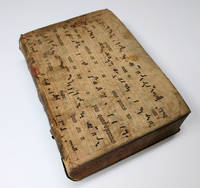
Antwerpen Antverpiae Ex officina Plantiniana apud viduam & filios Ioannis Moreti. 1612. 4to. XX7021 printers' device1 blank p. Vellum. 25 cm Ref: stcv: 6633561; Brunet 145; Graesse 117: 'Édition excellente des anciens parémiographes avec des notes très utiles'; Ebert 87; Smitskamp 'The Scaliger Collection' 172 Details: The vellum the binder used was once a manuscript leaf with 10 lines black text in Latin from different Psalms and with black quadratic musical notation on red staves of five lines for the Gregorian chant. The leaf must have measured ca. 30x40 cm. The neums look rather cursive. The height of the letters is between 0.5 and 0.7 cm; it has 4 capitals surrounded and filled with penwork they measure ca. 2 cm. The texts seems to contain 4 antiphons 43/2 53/26 39/2-4. The last one is an antiphon 'Cum sanctificatus fuero in vobis etc.' to be sung on the wednesday feria iiii after the 4th sunday in Lent. The letters are too small for a choir. So it is not an antiphonarium leaf. Perhaps it was used for mass. The letter is the gothic 'textura' used for liturgical texts in the 14th & 15th century. It was written probably in Central Europe. This kind of letter was the example for the first printer's typeface. See for the origin of this vellum leaf the provenance below. § Plantin's engraved printer's device on title: 'constantia et labore'; on the last but one page is another bigger version of that printer's mark. Condition: Binding soiled. Vellum on the back blackening cracked and partly damaged a small piece of vellum at the foot of the back has gone. Front hinge cracking but strong. The front flyleaf has gone. Old ownership entry in ink on the title. Paper yellowing some gatherings are browning; 2 leaves of the introduction are loosening Note: This title consists of 5 parts 'Proverbia Zenobii ex Tarrhaeo ac Didymo' p. 1/168 followed by the 'editio princeps' of 'Diogeniani vulgaria proverbia graece nunc primum eruta latine reddita ac scholiis illustrata ab Andreae Schotto' p. 169/257 then 'Proverbiorum graecorum e Vaticana Bibliotheca Appendix' p. 258/324 and 'Proverbia ex Suidae collectaneis Andreae Schotti Societatis Iesu scholiis explicata' p. 325/579 and finally J.J. Scaliger's 'Stromateus proverbialium versuum' with Schottus' Latin translation and notes p.581/644. § The first to write about proverbs in Greek 'paroimiai' was the Greek philosopher Aristotle in his 'Paroimiai'. He considered them remnants of ancient wisdom early forms of philosophical statements that were concise and easy to remember. In Alexandrian times proverbs were no longer exclusively subject to philosophical exegesis and became a literary genre. The Alexandrian philologist Didymus amassed a collection of proverbs in 13 books from which Lucillus of Tarrha made a compilation of 3 books in the first century A.D. During the reign of the Roman emperor Hadrian the Greek sophist Zenobius excerpted from the collections of Didymus and Lucillus of Tarrha 3 books of proverbs. Ca. 900 a new corpus of proverbs was formed consisting of an excerpt from the collection of Zenobius together with a collection ascribed to Plutarchus and a collection of proverbs that went under the name of the Greek grammarian Diogenianus who lived in the second century A.D. N.P. 9351/52 § The collections of Zenobius and Diogenianus were edited translated into Latin and annotated by the Dutch Jesuit scholar Andreas Schott latinized as Andreas Schottus 1552-1629 who was professor of Latin in Louvain Toledo and Saragossa. He edited also Aurelius Victor Pomponius Mela and Seneca Rhetor. His thorough knowledge of Greek is attested by the edition of the 'Bibliotheca' of Photius 1606 and the Chresomathy of Proclus 1615. He was the first to edit the Proverbs of Diogenianus in 1612. Nowadays it is doubted whether Diogenianus really was the author of this Byzantine collection of proverbs. Sandys 2305; NP 3 605/6 Schottus added also proverbs he excerpted from the Suda a Byzantine encyclopedic lexicon dating from the 10th century. Schottus adopted also a collection of proverbs called 'Stromateus' which had been compiled and translated into classical Greek verse by the French classical scholar J.J. Scaliger 1540-1609. This collection was first published in Paris in 1594. § Collections of proverbs and commonplaces formed during the Renaissance and later part of the intellectual initiation of every schoolboy. They were of prime importance for the humanistic education. Aristotle was right the rôle of proverbs as the vehicle of classic learning and wisdom of generations is evident up to this day Provenance: Prague two times. On title in ink: 'Conventus S. Michaelis Ordinis Servorum B. V. Vetero Pragae'. B.V. means Beatae Virginis The convent of the archangel Michael of the Servite Order of the Holy Virgin Mary belonged to the church of Saint Michael in the Old City of Prague. The Order was founded in 1233 and had in the 14th century already more than a hundred convents in Central Europe. The music and the Gregorian Chant of this convent were well known. In the 'Historia et Origo Ecclesiae et Conventus s. Michaelis Archangelis Servorum Mariae Vetero Pragae' it is stated: 'Musica semper nobis celebris erat' and told that there were big choirs. The convent had also a school. In 1786 the church and monastery of Saint Michael were dissolved by degree of the government and its belongings sold. svatymichael.cz/historie.php The vellum used for the binding probably comes from this convent or its church § On the verso of the title and on p. 645 the last page before the index a small oval armorial stamp of the Lobkowicz family one of the oldest Bohemian noble families with 'an infant of Prague' crown on top; the oval escutcheon is divided in 4 2 of which show an eagle; the legend reads 'Bibliotheca P.D.L.; See Wikipedia 'Lobkowicz'; this family owned one of the most famous humanist collections of Europe; their library is since 1928 part of the National Library of Czechia; the name of a branch of this noble family is 'Popel de Lobkowicz'; so the legend very likely means 'Bibliotheca Popel De Lobkowicz'; See 'Slavica saeculi XVI Bibliothecae Universitatis Bratislavensis' 1981 p. 169 Collation: 4 26 A-Z4 Aa-Zz4; aa-tt4 Photographs on request hardcover
Ссылка продавца : 140043
|
|
|
AESCHYLUS
AISCHULOU PROMETHEUS DESMÔTÊS HEPTA EPI THÊBAIS PERSAI AGAMEMNÔN EUMENIDES HIKETIDES.
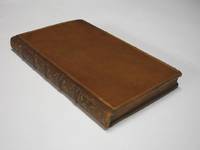
Paris Parisiis Ex officina Adriani Turnebi Typographi Regij 1552. 12mo. VIII1-2111 p. 18th century calf 16.5 cm Ref: Wartelle p. 2. Hoffmann I32: 'Eine schöne und seltene Ausgabe'. Dibdin 1237: 'beautifully printed'. Moss 17: 'a beautiful edition'. Brunet I 77. Graesse 129. Ebert 180. Gruys p. 31/46; Mund-Dopchie p. 45/83 Details: Back with 5 raised bands the compartments with gilt floral motives. Red morocco shield in the second compartment. Triple fillet gilt borders on both boards. Gilt inside dentelles. Bookblock with gilt edges. Marbled endpapers. Woodcut printer's mark on the title Condition: Some wear to the extremes of the binding. Some foxing. Marginal repairs in 3 leaves Note: The Greek tragedian Aeschylus 525/4-456 B.C. is the earliest of the surviving tragic playwrights. He 'can be considered the 'inventor' of tragedy as we understand it'. The Classical Tradition N.Y. 2010 p. 10 He became an instant classic in his time. In Byzantine times seven of his plays the so called heptas continued to be copied and studied but in the West he was forgotten for almost one and a half thousand years. In the Renaissance he was revived with the arrival of Greek manuscripts in the West and by the printing press. The oldest of the more than 100 surviving Aeschylean manuscripts dates from ca. 1000 and was written in Constantinople. It was brought to Florence by the Italian humanist G. Ausrispa. Aeschylus was published by Aldus in Venice in 1513. It was only in the late 18th century that Aeschylus was translated into French and German. 'From that time forward interest in Aeschylus blossomed. The character of his language and thought . formerly a stumbling block became a virtue for the new Romantic sensibility aided perhaps by the fact that the Age of Revolution saw the Aeschylean Prometheus as the archetypal hero of defiance. In this regard the 'continuation' of Prometheus Bound by Herder Der entfesselte Prometheus 1802; choruses set to music by Liszt 1850-1855 and Shelley Prometheus Unbound 1820 are of particular importance'. Op. cit. In the play Zeus is represented as a harsh and unjust tyrant. Aeschylus' authorship of the Prometheus is however disputed on metrical and stylistic ground and with respect to the content. § The French eminent humanist scholar Adrien Turnebus 1512-1565 'was a specialist in Greek textual criticism. From 1552-1556 he was Director of the Royal Press and in that capacity published a series of Greek texts including Aeschylus 1552 and Sophocles with the scholia of Triclinius 1553'. Sandys 2186 In 1547 Turnebus was appointed Professor Regius at the Collège Royal. 'Turnebus himself says the following on his sources and working method in his Greek foreword of this Aeschylyus edition; after he had started work on this edition he found his task more difficult than he had originally expected on account of the excessive corruption of the text i.e. Aldus; as a good physician he has attempted to heal the patient by both due caution and thoroughness; may the gentle reader sooner be grateful to him for his successes than blame him for his failures. Fortunately he had been given an old ms. of the triad by Aimar de Ranconet so that he had had a sound basis for its emendation but correction of the other tragedies was extremely difficult through the lack of mss.; yet there too he had been able to emend considerably with the aid of the scholia and by conjecture'. Gruys p. 35 Collation: alpha4 A-N8 O2 Photographs on request hardcover
Ссылка продавца : 120201
|
|
|
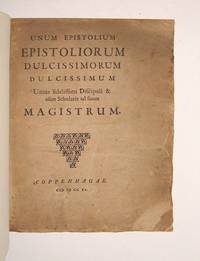
BURMANNUS, PETRUS
Unum epistolium epistoliorum dulcissimorum dulcissimum unius fidelissimi discipuli & olim scholaris ad suum magistrum.
Copenhagen Coppenhagae 1706. 4to. II70 p. Modern boards. 22 cm 'Written cum maxima fractura capitis & labore' Ref: STCN ppn 183625013; Knuttel 15549 Condition: Paper browning. Edges of the title and second leaf chipped Note: The Roman author orator and politician Cicero enjoyed his greatest glory during the Renaissance 'when he became not only a historical figure and a writer but also the object of the literary cult known as Ciceronianism'. The Classical Tradition Cambr. Mass. 2010 p. 195 Petrach established Cicero as a uniquely powerful stylistic source and intellectual resource. 'In the later 15th century Humanists like Angelo Poliziano and Filippo Beroaldo began to widen the range of Latinity: they commented on and sometimes imitated Quintilian Statius Apuleius and others.' Op. cit. p. 196 Thanks to humanistically inclined popes Ciceronianism the endeavour to imitate or even ape the pure Latinity of Cicero won the debate. In 1528 Desiderius Erasmus published his 'Ciceronianus' a treatise that attacked the Ciceronian pedantic Latin written by many scholars during the early 16th century. But 'over time a moderate Ciceronianism generally classical but not extremist became the norm in Protestant 'Gymnasien' in North Germany and the Netherlands Jesuit schools from Paris to Prague and English grammar schools alike. Despite the late 16th century vogue for Tacitus Cicero retained his central position as a school author and a model for good writing of many kinds'. Op. cit. p. 197 In the late 17th and the 18th centuries Cicero's works continued to be committed to memory in schools as an example of good taste. Now having acquired the principal rules and a competent knowledge of the language the student was adviced for his grammatical studies to peruse constantly and carefully the works of Cicero and authors like Terentius and Caesar in order to absorb the structure and idiom of pure Latinity. § The Dutch scholar Pieter Burman or Petrus Burmannus 1668-1741 appointed in 1696 professor of History and of Latin at Utrecht was one of the advocates of an elegant Latin style. In 1706 Burmannus published this satyrical letter supposedly written by one Stephanus Spinaeus to denounce the horrible dog-Latin of some of his colleagues for instance the Dutch scholar Melchior Leidecker 1642-1721 who was professor of Theology since 1678 at the university of Utrecht. Leydecker wrote a kind of barbaric Latin which no one could understand unless he spoke Dutch. Chr. Sepp 'Het godgeleerd onderwijs in Nederland gedurende de 16e en 17e eeuw' Leiden 1873 p. 353 In this letter Burmannus sins against every rule of good taste and style it teems with mistakes barbarisms solecisms and idiomatic constructions in vernacular but translated into Latin. Poking fun at Leydecker Burmannus writes that he wrote the letter 'cum maxima fractura capitis & labore'. This satyrical letter was published anonymously and supposedly in Copenhagen. This is of course a mystification. It was printed in the Netherlands probably Utrecht Collation: pi1 A-I4 minus leaf I4. Leaf I4 was probably used for pi1 the title Photographs on request hardcover
Ссылка продавца : 130028
|
|
|
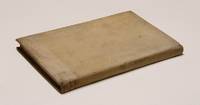
BURMANNUS, PETRUS
Catalogus rarissimorum & praestantissimorum librorum qui in thesauris romano graeco italico & siculo continentur secundum nomina auctorum per alphabeti ordinem digestus.
Leiden Leidae Apud Petrum vander Aa Typographum Academiae 1725. 8vo. VIII88 p. Vellum 20.5 cm Details: Woodcut printer's mark on the title it depicts Athena and Hermes the motto is: 'Hac itur ad astra' borrowed from Seneca's 73th letter. The words that complete this saying are often forgotten: 'hac secundum frugalitatem hac secundum temperantiam hac secundum fortitudinem' Condition: Vellum age-tanned. Some small wormholes in the gutter of the blank upper corner sometimes nibbling at a letter. Pinpoint wormhole in the blank right margin Note: The Dutch classical scholar Pieter Burman latinized as Petrus Burmannus 1668-1741 was professor of History and Eloquence Latin at the University of Utrecht from 1696 and was transferred to Leiden in 1715. As an editor he confined himself to the Latin classics such as Phaedrus Horace Ovid and Lucan. 'His numerous editorial and critical works spread his fame as a scholar throughout Europe and engaged him in many of the stormy disputes which were then so common among men of letters. Burman was rather a compiler of editions than a critic; his commentaries show immense learning and accuracy but are wanting in taste and judgement.' Wikipedia 'Pieter Burman the Elder' The great powers of endurance of this manufacturer of 'Variorum editions' of classical authors and his laborious patience have led to his being described as the 'beast of burden' of classical learning. Sandys vol. 2 p. 445 § This catalogue of 1725 is a proof of Burmannus' great powers of endurance and laborious patience. It is a bibliography offering a list of the authors and works that are mentioned in Jacobus Gronovius' 1645-1716 huge thirteen volume 'Thesaurus Antiquitatum Graecarum' 1697-1702 and Johannes Georgius Graevius' 1632-1703 equally huge twelve volume 'Thesaurus Antiquitatum Romanarum' 1694/99 and Graevius' huge 45 volume 'Thesaurus Antiquitatum et Historiarum Italiae Neapolis Siciliae Sardiniae Corsicae etc.' 1704-1725 which was continued by Burmannus after the death of Graevius. Burmannus produced the catalogue he tells in the preface Lectoribus s.d. Petrus Burmannus because he felt the need having completed the last volume of this third series to which he contributed to produce a supplementary volume which was to create order in the multitude of names and the farrago of titles and to make these huge enterprises accessible. p. 2 recto § At the end of the preface has been printed a small advertisement of the printer/bookseller P. van der Aa offering a complete set of the third Thesaurus for 580 guilders. The pages 84/88 are filled with another advertisement of Van der Aa: 'Catalogue de quelques livres nouveaux & autres que Pierre Vander Aa à Leide a imprimé ou reçu de divers endroits & qui se trouvent dans sa boutique' Collation: 4 A-E-8 F4 Photographs on request hardcover
Ссылка продавца : 130029
|
|
|
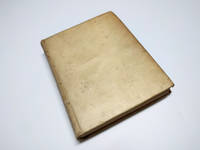
SALMASIUS,C
Claudi Salmasii Viri Ill. Epistolarum liber primus. Accedunt de laudibus et vita ejusdem prolegomena. Accurante Antonio Clementio.
Leiden Lugduni Batavorum Ex typographia Adriani Wyngaerden 1656. 4to. VIII72;2942 privilegium; 673; 773 blank p. Overlapping vellum 24 cm Ref: STCN ppn 840276850; Brunet 618777; Ebert 20119; Graesse 6/1249 Details: Nice and clean copy. Woodcut printer's device on the title depicting a man who tries to clime a tree the motto reads: 'Ardua quae pulchra' a variant of the wellknown Platonic Adagium of Erasmus 'Difficiliora quae pulchra'. Adagia 1012III12 Beautiful engraved portrait of Salmasius executed and engraved by J. Tangena and I. Snijderhoef. Woodcut initials. At the end of p. 294 has been pasted a slip with 15 lines of corrigenda Condition: Vellum age-toned. Back soiled Note: The French scholar Claude de Saumaise latinized Claudius Salmasius 1588-1653 was a prolific author and he distinguished himself in his editions as a textual critic and erudite commentator. He was easy to get along with but murderous on paper. In 1623 he was appointed as the successor of Scaliger at the University of Leiden a city he was going to hate. When his Leiden colleague Daniel Heinsius 1580-1655 published his 'Sacrae Exercitationes ad Novum Testamentum' in 1639 Salmasius saw an opportunity to take 'revenge on the man he viewed as the leader of the coterie opposing him at Leiden'. P.R. Sellin 'Daniel Heinsius and Stuart England' Leiden/Oxford 1968 p. 43 In the preface of his 'De Modo Usurarum' of 1639 Salmasius ridiculed Heinsius' description of the 'koinê' as 'lingua Hellenistica'. A flurry of polemics followed. In this quarrel the printer Maire sided with Salmasius in his attempts to destroy Heinsius' integrity. Idem p. 47 The next step in the ongoing quarrel between Daniel Heinsius once the favourite of Scaliger and Salmasius came in 1643 when Salmasius attacked Heinsius anonymously in his 'Funus linguae Hellenisticae'. And with a still fiercer attack in 'De Hellenistica commentarius controversiam de lingua Hellenistica decidens' published in the same year 1643 Salmasius mounted a full-scale assault on Heinsius' position on the 'koinê'. In it Salmasius contended that the language of the Greek Scriptures was not a separate dialect but the ordinary Greek of his time. Sandys A History of Classical Scholarhip N.Y. 1964 volume 2 284/86 § The letters of Salmasius were collected and edited by the young promising Dutch student theology Anthony Clement Antonius Clementius 1533-1657. NNBW 1606/07 and his article in encyclopedievanzeeland.nl The collection consisting of 125 letters written before 1638 opens with a biographic eulogy and a bibliography of Salmasius of 72 pages. The recipients of the letters are amongst others Johannes Beverovicius Johannes Dallaeus Jacobus Golius J.F. Gronovius H. Grotius I.F. Peireskius P. Puteanus and I.G. Vossius. At the end of the 125th letter p. 294 the editor announces a second volume of letters till 1640. The project was however delayed he tells due to the sudden departure to Germany of the publisher Wyngaerden. Nothing came of it owing to the premature death of the editor. § The editor added after letter 125 two long treatises disguised as letters: Salmasius' 'Epistola de regionibus et ecclesiis suburbicariis' first published in 1619; and 'Claudii Salmasii ad Aegidium Menagium epistola super Herode infanticida V.C. Tragoedia et censura Balsacii'. This second letter is of interest concerning Salmasius controversy with Heinsius. It was first published in Paris in 1644 and is a polemic against Daniel Heinsius' biblical tragedy 'Herodes infanticida' the Massacre of the Innocents a tragedy that he published in Leiden in 1632. This tragedy was attacked in 1636 by the French polemicist poet and literary theoretician J.-L. Guez de Balzac; and in 1642 a French minister Jean de Croï published a reaction on Balzac's fierce attack in defence of Heinsius. Which reaction lead to a long letter written by a raging Salmasius to the French poet and classical scholar Gilles Ménage Aegidius Menagius '. super Herode infanticida V.C. Tragoedia et censura Balsacii' in which he came to the rescue of Balzac and fiercely attacked his enemy Daniel Heinsius Collation: -104 including the portrait; A-2O4 leaf 2O4 verso blank ;a-h4 i2 chi1; A-K4 leaf K4 & K3 verso blank Photographs on request hardcover
Ссылка продавца : 140055
|
|
|
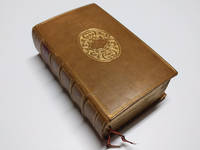
SCALIGER,JC J C
Iulii Caesaris Scaligeri viri clarissimi Poemata in duas partes divisa. Pleraque omnia in publicum iam primum prodeunt; reliqua vero quam ante emendatius edita sunt. Sophoclis Aiax Lorarius stylo Tragico a Josepho Scaligero Iulii F. translatus. Eiusdem epigrammata quaedam tum Graeca tum Latina cum quibusdam e Graeco versis.
N.pl. Geneva Apud Petrum Santandreanum Pierre de Saint-André 1591. 8vo. 3 parts in 1: VIII6631 blank; 336; 701 errata1 blank p. Calf end 19th century. 17 cm Ref: GLN-2264; USTC no. 450529; Smitskamp's 'The Scaliger collection' no. 147; cf. Brunet 5179; cf. Graesse 6/289 & & 6444; cf. Hoffmann 3425; Ebert 20452 Details: Printed in italics. Some signs of censorship in the text. Nice binding. Gilt panelled back with 5 raised bands. Boards with triple fillet gilt borders and an oval gilt ornament. Edges of the boards and the turn-ins gilt. All edges gilt. Marbled endpapers. 'Veritas' woodcut printer's device on the title depicting a woman the naked truth seated on a cubus holding a radiant sun in her right hand. In her left hand she holds an opened book and a palm leaf. Her feet rest on the globe; the garland of fruit which surrounds her shows a motto in Greek: 'Alêtheia Pandamatôr' i.e. 'Allmighty Truth'. 2 red/yellow/blue book ribbons. § Each of the 3 parts has a title-page of its own. Part 1 contains: Apiculae p. 1; Nemesis p. 59; Teretismata Satyra p. 76; Nova Epigrammata p. 113; Farrago p. 150; Thaumantia p. 224; Arae Fracastoreae p. 256; Nymphae indigenae p. 272; Adamantij Catulli tumulus p. 391; Heroes p. 307; Archilochus p. 339; Hipponax p. 385; Sidera p. 458; Lacrymae p. 526; Aenigmata p. 546; Urbes p. 582; Logogriphi p. 614; Manes Catulliani p. 634. Part 2 contains: Ata p. 3; Hymni p. 79; Epidorpidum libri octo p. 98; De Regnorum eversionibus p. 324; Part 3 contains a Latin translation of the Ajax of Sophocles by the son of Julius Caesar Josephus Justus Scaliger and concludes with 20 pages epigrammata composed by junior Condition: Some slight wear to the binding. Oval stamp cut out of the first 2 title-pages but skillfully repaired. In old ink 'Expurgata' written on the title page. Paper yellowing sometimes browning. § Occasionally a word or a line or sometimes a complete poem has been made illegible with ink stripes by a censuring cleric. Scaliger's Poemata figured in the Catholic 'Index librorum prohibitorum'. This 'Index' of forbidden books contained publications that were banned by the Catholic Church because they were deemed heretical anti-clerical or immoral. The censoring sometimes came down to the erasing or cutting out of names or passages or the removal of leaves even complete chapters by catholic librarians. Such a librarian must have written after having completed the job at the foot of the title-page 'Expurgata' Note: The classical scholar Julius Caesar Scaliger Giulio Bordone della Scala 1484-1558 was of Italian origin. In 1524 he moved to France where he became physician to bishop Antonio della Rovere of Agen and where his brilliant son Joseph Juste was born in 1540 the same year in which his 'De causis linguae latinae libri tredecim' was published. This book is among his most important philological works. § Another work of fundamental importance is his 'Poetices libri septem' 1561 a manual for the apprentice poet that became Europe's standard in matters of Neo-Latin poetry for two centuries. § Scaliger published collections of his Neo-Latin poetry in 1533 and 1546. He considered the mastery of Latin composition not as a pastime but as the scholar's most valuable skill. In 1574 his son Joseph Juste Josephus Justus produced a new edition of his father's collected poems during his stay at Geneva where he took refuge because of the French wars of religion and St. Bartholomew's Day Massacre. Here Scaliger jr. delivered public lectures and tutored students and met fellow humanists Beza Henricus Stephanus et alii all interested in or writing Neo-Latin poetry. § This edition of 1591 is a line by line reissue of the edition of 1574. To the edition of his father's poetry the son added a work of himself the translation of Sophocles' Ajax. This translation was first published in 1573 in Paris with a Greek text and the translation on the facing page. The appropriate medium for the translation of the Ajax was in Scaliger's eyes archaic Latin. 'He used as many arcane or distinctively pre-classical words as possible . He dressed ordinary words in primitive spellings . And like the archaic poets he freely coined new compound words'. GraftonA. Joseph Scaliger a study in the history of scholarship' volume 1 Oxford 1983 p. 114/115 After the Ajax Scaliger jr. added 20 pages with epigrammata Greek and Latin also of his own Provenance: Before the title have been bound 2 leaves the first from 1890 the 2nd much older after 1633. The text of the first manuscript leaf: 'Ce volume que j'ai acheté aux libraires Mayer et Muller de Berlin était alors relié avec un exemplaire du Poemata de J. César Scaliger de l'édition rarisssime de 1546. L'un et l'autre ainsi réunis avaient appartenu à une Bibliothèque de Vérone on le voit à la maculature laissée par le timbre en tête de la 2e partie. L'un et l'autre portait les suppressions imposées par l'Index. - Voir à ce sujet la note italienne écrite ci après probablement par un religieux du couvent dont la Bibliothèque possédait ces volumes. Dans l'éd. de 1546 beaucoup des pièces biffées ici n'avaient pas été supprimées. R. Dezeimeris 1890.' § The French historian and politician Reinold Dezeimeris was 'Conservateur' of the 'Bibliothèque municipale' of Bordeaux and a passionate bibliophile but most of all he is remembered for his scholarly activities. He devoted many studies to Renaissance authors from his dear city. He participated in an important edition of the 'Essais' of Montaigne Bordeaux 1870-1873. § This title on offer of father and son Scaliger will have caught his attention because of their connection with Bordeaux. On the authority of Dezeimeris who must have had sharp eyes we assume that the removed stamp from the first 2 title-pages belonged to a library at Verona. In the leaf immediately after the second title the dent of the stamp that was cut out of the title is indeed still visible though hardly legible. See for much more on Dezeimeris: rfhl.org/pages/historique/bibliophiles-bordelais/reinhold-dezeimeris-1835-1913.html and especially a biography at: saint-blaise-cadillac.eklablog.com/reinhold-dezeimeris-a46642037. § Scaliger pretended to be a descendant of the house of La Scala for hundred and fifty years lords of Verona. § Dezeiremis apparantly split up the binding with works of Scaliger that he bought from the famous price-cutting Berlin 'Antiquariat Mayer & Müller'. This fine binding with Scaliger's Poemata of 1591 was probably commissioned by him. § The librarian who wrote 'Expurgata' on the title probably also wrote the text on the leaf bound before the first flyleaf. It is in Italian and refers to the decree of the Church for the prohibition of Scaliger's works dated March 19 1633 Collation: 4 a-z8 A-S8 T4 leaf T4 verso blank; Aa-Xx8; AA-DD8 EE4 leaf EE4 verso blank hardcover
Ссылка продавца : 159151
|
|
|
SCALIGER,JC J C
Iulii Caesaris Scaligeri viri clarissimi Poetices libri septem: I. Historicus II. Hyle III. Idea IIII. Parasceue V. Criticus VI. Hypercriticus. VII. Epinomis. Ad Sylvium filium. Editio secunda.
N.pl. Geneva Apud Petrum Santandreanum Pierre de Saint-André 1581. 8vo. XXIV945 recte 949; p. 1-432 431-462 459-94567 index p. Half calf. 18 cm Ref: GLN-2893; Graesse 6/1289; Ebert 20450 Details: Back gilt and with 4 raised bands. Santandrea's 'Veritas' printer's device on the title: a woman the naked truth seated on a cubus holding a radiant sun in her right hand; in her left hand she holds an opened book and a palm leaf; her feet rest on the globe; the garland of fruit which surrounds her shows a ribbon with the text in Greek: 'Alêtheia Pandamatôr' i.e. 'Allmighty Truth Condition: Small hole at the junction of the spine and the joint near the foot of the spine. Wear to the head and tail of the spine. Edges a bit worn. Marbled paper on the boards wearing away. Right upper corner of the upper board bending. Bookplate on the front pastedown. Endpapers slightly stained. Three small wormholes in the first leaves. Some small wormholes in the blank lower margin in a few places. Paper yellowing Note: The greatest contribution of the classical scholar of Italian origin Julius Caesar Scaliger Giulio Bordone della Scala 1484-1558 to the history of classical scholarship is of course his brilliant son Joseph Justus Scaliger. In 1524 he moved to France where he became physician to bishop Antonio della Rovere of Agen and where his son Joseph Justus was born in 1540 the same year in which his 'De causis linguae latinae libri tredecim' was published. This work is among his most important philological works. § A far more comprehensive work is Scaliger's 'Poetices libri septem' posthumously published at Lyon in 1561 which offers his generically organized classifications of kinds of ancient and modern Latin poems and comparative criticism of ancient and modern poets recognizing the rivalry and imitation in Greek Roman and modern writings. It is 'one of the earliest modern attempts to treat the art of poetry in a systematic manner. Here he deals with the different kinds of poems and the various metres together with figures of speech and turns of phrase criticises all the Latin poets ancient and modern and institutes a detailed comparison between Homer and Virgil to the distinct advantage of Virgil while the epics of Homer are regarded as inferior to the 'Hero and Leander' of Musaeus. He also declares Seneca inferior to none of the Greeks in majesty. He makes all literary creation depend ultimately on judicious imitation'. Sandys 2 p. 178 This Genevan edition of 1581 is a reissue of the edition of 1561. This fundamental work remained the standard in matters of Latin poetry well into the 18th century Provenance: Engraved armorial bookplate of 'Robert Chambre Vaughan Esq. Burlton Hall Co. Salop'. Vaughan Robert-Chambre esq. of Burlton Hall in the County of Salop born in 1796 was a graduate of Brasenose College Oxford. See for him and his ancestors J. Burke 'A Genealogical and Heraldic History of the Commoners of Great Britain and Ireland' London 1835 Volume 2 p. 238/242. In 1818 the degree of Bachelor of Arts was conferred to him. He died in 1876Collation: 8 24 a-z8 A-Z8 Aa-Rr8 Ss4 hardcover
Ссылка продавца : 155424
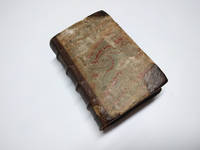
|
|
|
Oliver Brackett / H Clifford Smith (Ed)
English Furniture Illustrated. A Pictorial Review of English Furniture from the Time of Chaucer to Queen Elizabeth
London: Theodore Brun Ltd / Editions de Luxe Ltd / The Collector's Book Club 1950. Vellum. Good/No Jacket. 10" x 12.5. 300 pages. A revised de-luxe limited edition this is number 18 of 75. Signed by H Clifford Smith. Some wear to the vellum covered boards and a previous owner's book plate on the half title page. Full page monochrome plates of furniture. Some reading wear but still a tidy copy. All orders processed promptly and shipped from the UK. For non-UK destinations please do not select then economy shipping service at checkout. Please email with any queries. <br/> <br/> Theodore Brun Ltd / Editions de Luxe Ltd / The Collector's Book Club hardcover
Ссылка продавца : 027677
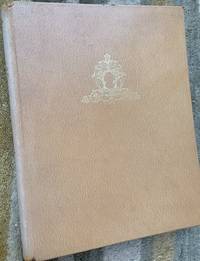
|
|
|
SUETONIUS
C. Suetonius Tranquillus ex recensione Joannis Georgii Graevii cum ejusdem animadversionibus ut et commentario integro Laevini Torrentii Isaaci Casauboni & Theodori Marcilii et cum notis ac numismatibus quibus illustratus est a Carolo Patino. Accedunt notae selectiores aliorum. Editio tertia auctior & emendatior.
Utrecht Trajecti ad Rhenum Apud Guilielmum à Poolsum 1708. 4to. 2 parts in 1: XVI829 recte 8071 blank; 794 index1 blank; 110153 index1 blank p. Frontispiece. Vellum. 24 cm 'Prize copy with the manuscript prize' Ref: STCN ppn 203443551; Schweiger 2979; Ebert 21933; cf. Moss 2631; cf. Dibdin 2441; cf. Fabricius/Ernesti 2458/59; Brunet 5582; Spoelder p. 711 IJsselstein 2 Details: Back with 5 raised bands. Binding gilt and with the gilt coat of arms of IJsselstein on the boards. Including the prize. The frontispiece dated 1703 depicts Suetonius at work at a desk in what looks like the Pantheon. Woodcut ornament on the title-page. Numerous woodcut illustrations of medals and coins in the text Condition: Vellum soiled and age-toned. All 4 decorative silk fastening ribbons worn away. Paper yellowing Note: The editor of the Suetonius edition is Johann Georg Graeve or in Latin Johannes Georgius Graevius 1632-1703. He was professor of Eloquence at Duisburg from 1657 at Deventer and from 1661 at Utrecht where he lived and worked for the last 40 years of his life. He limited his attention mainly to writers of Latin prose Cicero Suetonius Caesar Justinus Florus. This scholar of international stature is remembered above all for his 'Inscriptiones antiquae' long time a standard edition. He is also famous for his three 'Thesauri' in which important works of previous leading scholars were collected and reprinted the 'Thesaurus eruditionis scholasticae' the 12 folio volumes of the 'Thesaurus antiquitatum Romanarum' and the 9 volumes 'Thesaurus antiquitatum et historiarum Italiae'. § Graevius produced 3 Suetonius editions the first appeared in 1672 his second in 1691 and finally a third in 1703. This title on offer of 1708 is a reissue of the edition of 1703. Van Poolsum apparantly acquired the unsold copies of the 1703 edition replaced only the first 2 leaves and brought it again on the market under his own name. § The text of Suetonius the 'Vitae' 'De illustribus grammaticis liber' and 'De claris rhetoribus liber' is followed by 14 pages and 2 folding tables with inscriptions to illustrate the 'Lives' and 54 pages with the commentary of Graevius; then follows the commentary of 79 pages by Carolus Patinus with nice illustrations of coins. This is followed by a 70 p. commentary of the Dutch scholar Theodorus Marcilius on Suetonius' biography of Vespasian. This is again followed by a small section with the prefaces to Suetonius by Politianus and Casaubon and Vossius' article on Suetonius from 'De historicis Latinis'. Included is also the text of the 'Monumentum Ancyranum' with Isaac Casaubon's commentary; at the end a 153 page index compiled by Matthias Berneccerus § Graevius inserted as mentioned above the entire commentary of Carolus Patinus or Charles Patin 1633-1693. In 1676 this Frenchman was appointed professor of philosophy at the university of Padua and later of medicin and surgery. He made his fame however with his books on numismatics and became a well known authority upon the subject of coins and medals. He published on Roman families and emperors on coins and medals. He possessed a collection of his own because in Amsterdam in 1672 was published on his own expense his 'Thesaurus numismatum e Museo Caroli Patini'. Handbuch Gelehrtenkultur der frühen Neuzeit Berlin 2004 vol. 1 p. 497/8 Patin must also have been a wealthy man because his own Suetonius edition of 1675 Basel which seems to be a 'spin off' of his great knowledge of imperial coins was also printed on his own expense. § The Roman historian Suetonius born c. 69 A.D is the most influential and best known biographer in the Latin language. He was appointed secretary to the emperor Hadrian a job that gave him access to the imperial records and archive. He made good use of his sources writing the Lives of the XII Caesars or 'De vita Caesarum'. The collection consists of the biographies of 12 emperors from Caesar the founder of the imperial line to Domitian. 'Suetonius like Plutarch believed that a person's character could be revealed in small and insignificant details'. He 'organized his Lives by topics per species rather than chronologically'. The Classical Tradition Cambr. Mass. 2010 p. 912/13 Beyond simplicity and clearness he has no stylistic pretentions. He quotes verbatim from documents he knew and shows critical ability. 'The great number of scurrilous anecdotes in most of the lives may be due to the nature of his sources'. OCD 2nd ed. p. 1020/1 Of another of his works 'De viris illustribus' a collection biographies of famous Roman authors the lives of Lucan Horace Vergil and Terence have survived and his 'Liber de illustribus grammaticis' and his 'De claris rhetoribus liber'. Suetonius was read in the Middle Ages. The Frank Einhard wrote a biography of Charlemagne along the lines of a Life of Suetonius. § From the Renaissance onward Suetonius was neglected. Pioneering work was done by the French scholar Isaac Casaubon who produced an excellent text and a valuable commentary. Geneva 1595/1615 This work was continued by the Dutch scholar Graevius with his great Suetonius edition of 1672. This edition became with her numerous reissues and revisions the foundation for the widespread study of Suetonius in the Netherlands and in England and in the next 18th century the scholarly interest in Suetonius has been greater than ever before or since. This edition of 1708 is a reissue of the 3rd augmented and corrected edition. It contains the entire commentaries of Torrentius Casaubon with the notes of the Dutch scholar Theodorus Marcilius Arnheimensis and other leading scholars. § Gibbon praised Suetonius for his strict dedication to historical truth. Nowadays 'historians of Rome take him more seriously than do literary critics'. The Classical Tradition Cambr. Mass. 2010 p. 913 Provenance: The prize was awarded to the 15 years old Barend van Lockhorst for his diligence and his progress in Latin. The prize dated 'Die ante cal. Mart. 1786' is signed by 3 curators the alderman Johan Franco Beijen See his Wikipedia article 'Johan Franco Beijen II P. van der Meulen and the mayor of IJsselstein Johannes Tra Kranen and the the rector W.H. Oevering. § Barend van Lockhorst van Bonlez 1771-1831 born in Rotterdam later became a wealthy landowner with land in Holland Limburg and Brabant. He was a member of the 'Departement van de Monden van de Maas' and member of the city council of Rotterdam Collation: -24 A-5I4; chi1 2A-K4 2L2 leaf 2L2 verso blank; 6A-7K4 leaf 7K4 verso blank. 2 folding tables after p. 774 Error in pagination: it jumps at p. 352 to 355 and from p. 730 to 751. Nothing is missing all is complete Photographs on request Heavy book may require extra shipping costs hardcover
Ссылка продавца : 159116
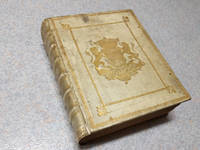
|
|
|
ERIZZO,S
Discorso di M. Sebastiano Erizzo sopra le Medaglie degli Antichi. Con la dichiaratione delle Monete Consulari & delle Medaglie de gli Imperadori Romani. Nel'a qual si contiene una piena & varia cognitione del'Istoria di quei tempi. Di nuovo in questa quarta editione dall'istesto authore revisto & ampliato.
Venice In Vinegia Appresso Gio. Varisco & Paganino Paganini n.d. ca. 1584. 8vo. 4to. 2 parts in 1: XVI572;282 p. numerous woodcut illustrations. Modern 20th century vellum. 22 cm Ref: Edit16 CNCE 18279: 'non prima del 1584'; Graesse 2498; Ebert 6901; Brunet 21047 Details: Modern vellum in antique style. Back with 3 raised bands. Boards panelled. Title within woodcut symmetric architectural borders. The printer's mark is a crowned double-tailed Sirene Sirena bicaudata who holds the end of her tails in her hand. This creature from medieval mythology was chosen in 1971 as logo of Starbucks. The poor creature has been revised several times to simplify it and remove any obvious nudity Numerous woodcut illustrations in the text of coins and medals Condition: Upper half of first 180 pages waterstained; margins of the title thumbed Note: The The Italian Renaissance scholar 'Messer' Sebastiano Erizzo was born in 1525 in an illustrious Venetian noble family. He received a thorough humanistic education and achieved full mastery of Latin and an excellent knowledge of Greek language and literature. He became a member of the Venetian Council of Ten. The reputation of his remarkable coin collection brought many visitors to Venice. He became an expert in the field and a master of the science of numismatics which was still in an embryonic state. In 1559 he published his first edition of 'Discorsi' on the coins and medals of the ancients. Accompanied by numerous engravings this work aims at presenting a history of Roman coinage of the Republican and Imperial period extending until the age of Probus. The display of religious and military insignia architecture ceremonies gestures faces hierarchies tools weapons animals garments sacrifices constitute a very effective source of information on Roman antiquity he argued. He died in Venice 1585. Dizionario Biografico degli Italiani 1993 Erizzo is also known for his his novel 'Sei Giornate' Six Days published in 1567. It consists of 6 'Giornate' of 6 stories each. The narrators are students of the University of Padua who meet in a delightful garden on 6 successive Wednesdays in the months June and July 1542. The stories are moralizing in character and there is an almost total absence of amorous themes Collation: Quarto in 8 leaves. a8 A-2N8 minus leaf 2N7 & 2N8; A-S8 leaf S6 blank; minus leaves S7 & S8 Photographs on request hardcover
Ссылка продавца : 130354
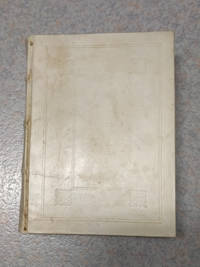
|
|
|
HORATIUS
Quintus Horatius Flaccus. Accedunt nunc Danielis Heinsii De Satyra Horatiana libri duo in quibus totum poëtae institutum & genius expenditur. Cum ejusdem in omnia poëtae animadversionibus longe auctioribus.
Leiden Lugd. Batav. Ex Officina Elzeviriana 1629. 12mo. 3 volumes in 1: XXXII2391 blank; 2504 blank; 296 recte 286 p. Modern calf 13.5 cm The best and most complete Horace edition of Heinsius Ref: Willems 314: 'cette édition d'Horace est jolie et les exemplaires bien conservés se vendent assez cher'; Schweiger 2403: 'Beste Ausgabe von Heinsius. Sehr sauber in vollständigen Exx. höchst selten'; cf. Dibdin 297/98; Berghman 2069: 'Édition jolie et recherchée'; Rahir 285; Copinger 2396; Graesse 3353; Ebert 10179 Details: Modern calf back with 4 raised bands; with engraved main title and 2 separate titles the first bearing the date 1628 the second 1629 both bearing identical woodcut printer's marks. The marks depict an old man who stands in the shade of a vine-entwined elmtree thus symbolising the symbiotic relationship between scholar and publisher. The motto is Non solus not alone. Our copy matches the copy of Willems except that the last blank leaf is lacking Condition: 2 small annotations in red ink probably feltpen on 2 pages Note: The works of the Roman poet Quintus Horatius Flaccus 65-8 B.C. have enjoyed a continuous presence in European culture. His memorable phrases made him the most quoted ancient author. Till well into the 20th century he stood central in school curricula. Earlier in the Middle Ages he was next to Vergil the most important school author. Horace is transmitted in around 300 medieval manuscripts. The Renaissance saw the beginning of a flood of editions. 'For Neo-latin poetry until modern times and for all the vernacular literature of Europe from the 16th through the 18th centuries Horace provided the dominant model both for private lyrics celebrating wine and love and for public lyrics celebrating affairs of state'. Young poets used Horace to learn the trade. 'Horace's elegant rationalism and moral wisdom and also his disabused and tolerant tone made his poems favorite reading during the Enlightenment'. The Classical Tradition Cambr. Mass. 2010 p. 454/60 § The famous Dutch scholar and poet Daniel Heinsius 1580-1655 was born in Ghent. He studied in Leyden and became there the favourite pupil of the genius J.J. Scaliger whom he succeeded as professor of Greek after Scaliger's death in 1609. Sandys calls Heinsius' work on Greek authors such as Hesiod and Aristotle better than his work on Latin authors. 'Nevertheless his criticisms were highly praised by his contemporaries and by his immediate successors'. Sandys History of Classical scholarship p. 314 Heinsius published his first edition of Horace with his notes in Leiden in 1612. It became a standard and was influencial in Holland France and Britain. This 3 volume set of 1629 is most sought after because of the clear typography of the Elzevier brothers Heinsius useful animadversiones and his masterpiece de satira Horatiana libri duoCollation: -28 A-P8 leaf P8 verso blank; A-P8 Q8 leaves Q6 Q7 & Q8 blank; a-r8 s8 minus the blank leaf s8 Photographs on request hardcover
Ссылка продавца : 120469
|
|
|
VONDEL,J VAN DEN
J. v. Vondels Palamedes of vermoorde Onnozelheit. Treurspel met aenteekeningen uit 's Dichters mondt opgeschreven. Den derden druk merkelyk vermeerdert. Bound with: J. van Vondels Hekeldigten met aenteekeningen uit 's Dichters mondt opgeschreven thans merkelijk vermeerdert. Verciert met koperen platen.
Amersfoort 't Amersfoort By Pieter Brakman 1736. 4to. 2 volumes in 1: IVXVI82;21795 p. Frontispiece and plates see description below. Early 20th century half cloth. 19 cm Ref: STCN ppn 271408340; Schuytvlot 471; Unger 18143 Details: 'Pieter Brakman' was a pseudonym of the bookseller Pieter van der Veer in Rotterdam. See: Ton Jongenelen. 'De Keurdigten. Het levenswerk van Pieter van der Goes boekverkooper.' In: Mededelingen van de Stichting Jacob Campo Weyerman. 27 2004 p. 57-67. Online at the site of DBNL. § Volume 1 opens with a portrait of the author engraved by P. van Gunst; immediately followed by a frontispiece signed 'F Ble' possibly Frans van Bleyswyck it depicts the stoning of Palamedes by the Greeks before the walls of Troy as told by the Greek poet Apollodorus. Bound before the first page of the play we find an engraving of a proud poet laureate Vondel in the role of Wibberley's 'Mouse That Roared' standing amids ferocious animals that want to devour him. In this volume at page 58 also a folding plate depicting the beheading of J. van Oldenbarnevelt Palamedes on the 13th of May 1619 on the 'Binnenhof' in The Hague. This folding plate has 2 small moveable overlays i.e. a small slip of paper both depicting parts of a building; the first overlay hides a small portrait of Oldenbarnevelt the other overlay depicts the 'ridderzaal' and covers the scene with the arrest of Van Oldenbarnevelt. § Volume two has 8 plus 1 plates of which 1 is folding. Plate 1 an engraving of the famous 'scale scene' where Prince Maurits puts his sword on the scale in favour of strict Calvinist Gomarus p. 4; plate 2 portrait of J. van Oldenbarnevelt engraved by P. van Gunst p. 40; plate 3 the famous Rotterdam statue of Erasmus p. 114; plate 4 a portrait of Hugo de Groot engraved by P. van Gunst p. 124; plate 5 a folding plate showing the burial of the dog of Schout bayliff Bond made after a painting of Jan Miense Molenaer p. 130; plate 6 portrait of prince William II who Vondel attacked for his infamous assault on Amsterdam in 1650 p. 156; plate 7 portrait of Cornelis de Wit engraved by P. van Gunst p. 164; plate 8 portrait of his brother Johan de Wit also engraved by P. van Gunst P. 164; between plate 2 and 3 has been added an engraving of an allegoric triumph held by Prince Frederik Hendrik of Orange protector of the Dutch republic and its freedom p. 65. This plate is not mentioned in the list of plates on the last but one page Condition: Gilt short title on the back Note: The playwright and poet Joost van den Vondel1587-1679 who is considered the most prominent author of the Golden Age of the Dutch Republic published his tragedy 'Palamedes oft vermoorde onnooselheit' in 1625. In 1652 he published a second edition with drastic alterations. This edition of 1736 is based on that revised edition. Vondel expressed in the Palamedes his political views accusing under a thinly veiled disguise of an oscure Greek allegoric story the strict Calvinist Contra-Remonstrants and Prince Maurits of Orange of a political murder the beheading in 1619 of the 'Land's Advocate of Holland for the States of Holland' Jan van Oldenbarnvelt who had been the virtual 'Prime Minister' of the Dutch republic for 32 years. The unlawful killing of Palamedes on the ground of false accusations by the Greeks stood for the execution of this Dutch statesman. The harsh and tyrannical villain Agememnon was clearly intended to portray Maurits stadtholder of the Dutch Republic. Vondel stood for civil liberty especially in religious matters. Vondel opposed with this 'J'accuse'-like play any form of tyranny of the church and of the government. § The second title in this binding contains Vondel's satires Hekeldichten. He began to publish them shocked by the execution of Oldenbarnevelt in 1619. One of the first is 'Geuzenvesper' Geuse Vesper a satire against the strict Calvinists and the judges who had condemed Van Oldenbarnevelt. The most famous satire is his 'Roskam' in which he attacked corrupt regents and 'Harpoen' against the view of the strict protestant Contra-Reformists who found that their authority should also apply outside the church Provenance: On the front flyleaf in ink: 'Mijn besten vriend J.D. Peesee ter herinnering aan 1 Januari 1921' Collation: Volume 1: pi4 including frontispiece and a portrait of Vondel -24 A-K4 L1 Leaf L1 missigned F1. Volume 2: pi1 A4 minus leaf A4 B-V4 W4 X-Y4 Z2. This volume contains a rarity: after gathering 'v' it continues with a gathering signed 'w' Photographs on request hardcover
Ссылка продавца : 151885
|
|
|
AESCHINES SOCRATICUS
AISCHINOU TOU SÔKRATIKOU DIALOGOI TREIS. Aeschinis Socratici Dialogi tres. De novo recensuit vertit et animadversionibus suis auxit Petrus Horreus G.F. Accedunt ad calcem Fragmenta & Indices copiosi.
Leeuwarden Leovardiae Excudit Franciscus Halma Ordinum Frisiae Typographus 1718. 8vo. XVI18166 indices1 blank p. Vellum. 21 cm Ref: STCN ppn 15718997X; Hoffmann 129: 'der Herausg. besserte zwar vieles war aber nicht sorgsam genug in Benutzung der früheren Ausgg.'; Dibdin 1234; Brunet 175; Ebert 177; Schweiger 16: 'Selten'; Graesse 128 Details: 6 thongs laced through the joints. Title in red & black. Woodcut printer's mark on the title in its center a medallion of Constantine the Great the motto reads: 'In hoc signo' short for 'in hoc signo vinces'; In a vision Constantine the Great heard these words and saw in the sky a Cross or the Greek letters Chi and Rho before his conversion to Christianity and the battle of Milvian Bridge in 312 AD; the cross in the sky is also depicted on the printer's mark. Greek text with parallel Latin translation commentary in 2 columns below the text. Thick paper of good quality Condition: Vellum slightly soiled and spotted. Small name on the front pastedown. Old calligraphed Latin inscription entitled 'De Aeschine vel eius Dialogis' on a leaf inserted before the front flylaef. On the front flyleaf an old ownership inscription in ink Note: Aeschines was born ca. 430/20 B.C. and died after 375/6. He was a pupil of the Athenian philosopher Socrates and was present at his famous deathbed. He wrote 7 dialogues with Socrates as the main speaker all of which have been lost. Presented here are three dialogues which already in antiquity were ascribed to him: 'De virtute an doceri possit' 'Eryxias sive de divitiis' and 'Antiochus sive de morte'. They were first published in the Plato edition of Aldus Manutius in 1513 and repeated in the Stephanus edition of Plato of 1578. Le Clerc was the first to publish the 3 dialogues separately under the name of Socrates Scholasticus Amsterdam 1711. Brunet considers the edition of Le Clerc to be inferior to that of Horreus 'ou sont des notes meilleurs et plus concises'. Since Bekker Heidelberg 1810 they are considered to be spurious again and nowadays they are numbered among the spurious works of Plato. The genuine but lost dialogues seem to have been full of Socratic irony. Hermogenes 'Peri Ideon' considers Aeschines as superior to Xenophon in elegance and purity of style. Aeschines must have been much like his master. Ancient authors tell about him that he had his character and that his dialogues are true accounts of the Socratic dialogues. NP 1346/7 § Petrus Horreus 1695-1772 of Frisian birth stayed close to home and began his studies at the University of Franeker. In 1718 when still a student he published these 3 'spurious' dialogues of Aeschines. In the praefatio Horreus explains that his Praeceptor Lambertus Bos professor Greek since 1704 encouraged him to publish Aeschines Socraticus. Later in life while a minister of the protestant church he published his 'Observationes criticae' Leeuwarden 1735 and 3 years later 'Miscellanorum criticorum libri duo'. Leeuwarden/Harlingen 1738 NNBW 8849 Provenance: Frisian provenance. On the front flyleaf: 'Dono mihi dedit huncce librum vir Amplissimus ac gravissimus Hobbe Baerd â Sminia Supremae Frisiae Curiae Senator Primarius Ao 1718'. The donator of this book is Hobbe Baerdt van Sminia member of a Frisian noble family. Hobbe 1655-1721 was President Councillor at the Court of Justice of Frisia at Leeuwarden i.e. 'Consiliarius Primarius' or 'Senator Primarius' of the 'Suprema Frisiae Curia'. NNBW 10939 § He gave this book in the year it was published to one ' Reinalda D:M: op '. The Reinalda family also belonged to the Frisian elite. § On the front pastedown in ink: 'G.C. Gonggrijp 1760'. Not much is known of this member of the Frisian family Gonggrijp. Mr. G.C. Gonggrijp was a jurist. He died before 1809 and was once the owner of real estate in Bakkeveen and in Leeuwarden. He made also the calligraphed inscription on the front flyleaf Collation: 8 A-M8 N-R4 S8 leaf S8 verso blank Photographs on request hardcover
Ссылка продавца : 153438
|
|
|
HORATIUS
Q. Horatius Flaccus ex recensione & cum notis atque emendationibus Richardi Bentleii. Editio altera.
Amsterdam Amstelaedami Apud Rod. & Gerh. Wetstenios Hff 1713. 4to. 2 parts in 1: XXIV7171 errata; 2391 blank p. frontispiece. Vellum. 26 cm <Prize copy Oldenzaal with the manuscript school prize> Ref: STCN 186707010; Schweiger 2406; Riedel Horatiana p. 42/43; Brunet 3318/19: ' L'ouvrage parut d'abord à Cambridge 1711 mais on préfère l'édition d'Amsterdam 1713'; Dibdin 2101/05; Moss 221; Graesse 3354; Ebert 10194 Details: Back with 6 raised bands. Both boards gilt. Frontispiece designed by J. Goeree and executed by Bernards depicting a monument for Horace in a bucolic scene with his bust on top; the god Apollo holds a laurel wreath above the poet's head; in the foreground an old satyr; a Muse probably Thalia wraps a garland around the pedestal. Engraved printer's mark of the Wetstein family on the title-page a burin being sharpened on a whetstone Wetstein! around it the device: 'Terar dum prosim'. Title-page printed in red and black. § The commentary is printed in 2 columns below the text Condition: Vellum age-tanned somewhat scratched and slighty soiled. The 4 decorative silk fastening ribbons at the outer edges of the boards worn away. Bookplate pasted on the front pastedown. Old names on the front flyleaf Note: Richard Bentley 1662-1742 from 1700 Master of Trinity College Cambridge was doubtless one of the greatest names among classical scholars of Europe in the 18th century. He is most famous for his 'Dissertation on the Epistles of Phalaris' London 1697/99 a work that according to Sandys 'marks an epoch in the History of scholarship'. He made significant advances in the study and textual criticism of Horace. In 1711 he published an edition of Horace 'in which the traditional text is altered in more than 700 passages a masterly work which however does more credit to the logical force of his intellect than to his poetic taste. It is here that we find his celebrated dictum: 'nobis et ratio et res ipsa centum codicibus potiores sunt'. Sandys 2406 This citation is however not complete. The wise words which follow after the comma potiores sunt are mostly omitted: 'praesertim accedente Vaticani veteris suffragio'. Some of his 700/800 emendations have been accepted but the majority was rejected by the early 20th century as unnecessary § The works of the Roman poet Quintus Horatius Flaccus 65-8 B.C. have enjoyed a continuous presence in European culture. Till well into the 20th century he stood central in school curricula. Earlier in the Middle Ages he was next to Vergil the most important school author. Horace is transmitted in around 300 medieval manuscripts. The Renaissance saw the beginning of a flood of editions. 'For Neo-latin poetry until modern times and for all the vernacular literature of Europe from the 16th through the 18th centuries Horace provided the dominant model both for private lyrics celebrating wine and love and for public lyrics celebrating affairs of state'. The Classical Tradition Cambr. Mass. 2010 p. 454/60 Provenance: The school prize was awarded to Henricus Johannes Pötken on the occasion of his promotion from the first class to the university date 'VI Iduum Quintilis' 1777. The prize is signed by 2 curators and the rector of the 'Gymnasii Oldensaliensis' J.G. Schultz'. In the 'Maendelyke uittreksels of de Boekzael der geleerde werrelt' Volume 60 Amsterdam 1774 p. 98 we found the report of a promotion ceremony at the gymnasium of Oldenzaal in which a boy H.J. Potken participated. Members of the Potken family lived in the Dutch city of Oldenzaal from the 17th century. § On the front pastedown an engraved bookplate 'Ex libris John Chipman Gray'. See for this American scholar of property law and professor at Harvard Law School 1839-1915 his article in Wikpedia. His father's name was Horace. He graduated from Boston Latin School went on to Harvard University where he earned his Bachelor of Arts degree in 1859 and Harvard Law School where he earned his law degree in 1861. § On the flyleaf: 'Russel Gray from Anna Lyman Gray January 1916'. John Chipman Gray was married to Anna Lyman Mason Gray. She apparantly donated this book a year after the death of her husband to a relative Russell Gray. She died in 1932. § On the flyleaf also in green ballpoint Augustine H. Gray. He was born in 1888 in Massachusetts and died in 1981. He fought in two world wars. He later became Rear Admiral. Collation: pi2 2 first leaf signed 3 2-34; A-2X4 2Y2 2Z-4X4 4Y1 4Y1 verso: errata; a-2g4 leaf 2g4 verso blank The first leaves pi2 and 2 have been described erroneously by STCN as 'pi1 pi2 2'. This cannot be correct for the first 2 leaves pi2 form a conjugate pair shown by the watermark. The leaves of 2 form also a conjugate pair also shown by the watermark Photographs on request Heavy book may require extra shipping costs paperback
Ссылка продавца : 159117
|
|
|
HORATIUS
Q. Horatius Flaccus ex recensione & cum notis atque emendationibus Richardi Bentleii. Editio altera.
Amsterdam Amstelaedami Apud Rod. & Gerh. Wetstenios Hff 1713. 4to. 2 parts in 1: XXIV7171 errata; 2391 blank p. frontispiece. Half goatskin. 27.5 cm < Deventer provenance > Ref: STCN ppn 186707010; Schweiger 2406; Riedel Horatiana p. 42/43; Brunet 3318/19: ' L'ouvrage parut d'abord à Cambridge 1711 mais on préfère l'édition d'Amsterdam 1713'; Dibdin 2101/05; Moss 221; Graesse 3354; Ebert 10194 Details: Wide margins. Back with 5 raised bands and traces of a gilt short title in the second compartment. Frontispiece designed by J. Goeree and executed by Bernards depicting a monument for Horace in a bucolic scene with his bust on top; the god Apollo holds an laurel wreath above the poet's head; in the foreground an old satyr; a Muse probably Thalia wraps a garland around the pedestal. Engraved printer's mark of the Wetstein family on the title page. Title printed in red and black. Margins uncut. § The commentary is printed in 2 columns below the text Condition: Back very worn and scuffed and with 3 small holes because of wear. Marbled paper on the frontcover wearing away severely. Paper on the lower board partly gone. Hinges cracking. Front pastedown inscribed. 4 gatherings browned Note: Richard Bentley 1662-1742 from 1700 Master of Trinity College Cambridge was doubtless one of the greatest names among classical scholars of Europe in the 18th century. He is most famous for his 'Dissertation on the Epistles of Phalaris' London 1697/99 a work that according to Sandys 'marks an epoch in the History of scholarship'. He made significant advances in the study and textual criticism of Horace. In 1711 he published an edition of Horace 'in which the traditional text is altered in more than 700 passages a masterly work which however does more credit to the logical force of his intellect than to his poetic taste. It is here that we find his celebrated dictum: 'nobis et ratio et res ipsa centum codicibus potiores sunt'. Sandys 2406 This citation is however not complete. The wise words which follow after the comma potiores sunt are mostly omitted: 'praesertim accedente Vaticani veteris suffragio'. Some of his 700/800 emendations have been accepted but the majority was rejected by the early 20th century as unnecessary Provenance: The inscription on the front pastedown reads: 'Jord Bouw Coen Weerts' and 'Bergsma'. Four of these names refer to names of families of the Deventer city elite 'Jord' is Jordens 'Bouw' is Bouwer 'Coen' is Coenen 'Weerts' is Weerts. 'Bergsma' seems to originate from elsewhere. § Two ownership entries on front pastedown: the oldest reads: 'J. Weerts 1786'. The jurist Johan Weerts was born in Deventer on January 17 1769 and died in Utrecht the 15th of May 1842. He attended the Athenaeum at Deventer and studied law in Leiden. He was a lawyer in his hometown from 1791 till 1799 from 1802 Councillor at the 'Hof van Gelderland' Mayor of Arnhem from 1824 till 1842. From 1826 till 1842 he was a member of both Chambers of the Parliament. § Added are 4 pieces of scrap paper with texts written by J. Weerts 2 with annotations in Latin & Dutch and 2 with Latin prose compositions with at the end the marks a 7 and a 71/2 given him by his teacher. They were made when he was a boy at the Athenaeum of Deventer. He was 17 when he received this book probably at the end of his school career. § The second ownership inscription below the name of Weerts is in pencil the name 'Steenbach 1886' or 'Steendach 1886' Collation: pi2 2 first leaf signed 3 2-34; chi1 half title of the second part erroneously bound here after the preliminary pages in fact this chi is the last leaf 4Y2 and should have been placed after leaf 3K3 p. 443 the beginning of the second part; A-2X4 2Y2 2Z-4X4 4Y1 4Y1 verso: errata; a-2g4 leaf 2g4 verso blank The first leaves pi2 and 2 have been described erroneously by STCN as 'pi1 pi2 2'. This cannot be correct for the first 2 leaves pi2 form a conjugate pair shown by the watermark. The leaves of 2 form also a conjugate pair also shown by the watermarkGatherings 3N 3O 3V & 3X browned Photographs on request Heavy book may require extra shipping costs paperback
Ссылка продавца : 140166
|
|
|
SOPHOCLES
Edipus koning van Thebe; treurspel: het oirsprongklijk van Sofokles nagevolgd. Waar bij gevoegd is eene voorafspraak over het toneelspel der Ouden en Hedendaagschen benevens aanteekeningen dit treurspel betreffende. Door Willem Bilderdijk. Bound with: Brief van den navolger van Sophokles Edipus. &: De dood van Edipus treurspel: Het oorsprongklijk van Sofokles nagevolgd door Mr. Willem Bilderdijk.
Ad 1 & 2: Amsterdam Bij A. Van der Kroe 1779 - 1789. Ad 3: Amsterdam Bij Pieter Johannes Uylenbroek 1789. 8vo. 3 volumes in 1: IV156; 231 blank; XVI1011 blank p. Half cloth. 21.5 cm Ref: Ad 1: STCN ppn 17136905X; Geereb. 796; OiN p. 346; Ad 2: STCN ppn 171373804; Ad 3: STCN ppn 235187895; Geerebaert 797; OiN 346 Details: Engraved portrait of Sophocles on the 2 title pages Condition: Binding scuffed. Front joint cracking but strong. Joint of the lower board split at the head of the spine. 3 leaves loose. Small pencil marks and notes Note: The Dutch jurist and poet Willem Bilderdijk 1756-1831 has translated much prose and poetry throughout his life. His translations clearly shows the traces of his wayward personality. He rarely shrank from poetic liberties and he did not hesitate to provide a critical commentary on the works he translated . His love for classical authors manifested itself at an early age. Bilderdijk produced also numerous translations and 'imitations' of Greek and Latin poets including Pindarus Homer Anacreon Sophocles Callimachus Horace and Ovid. § 'Edipus koning van Thebe' a translation of Sophocles' 'Oedipus Rex' is his first translation of a classical author. It is followed in this binding by Bilderdijk's critical discussion of the translation and by the next piece of Sophocles he translated 'De dood van Edipus' Oedipus Coloneus published in 1789. Later in life he translated various edifying and theological studies including the sermons of the Church Father Chrysostomus Collation: Ad 1: pi2 A-H8 I8 leaf I3 plus leaf chi1 K6. Ad 2: A8 B4 leaf B4 verso blank. Ad 3: 8 A-F8 G4 leaf G3 verso blank. Lacking the last blank leaf G4 hardcover
Ссылка продавца : 157775
|
|
|
CASSIUS DIO
Cassii Dionis Cocceiani Historiae Romanae quae supersunt. . Cum annotationibus maxime Henrici Valesii . Ioannis Alberti Fabricii ac paucis aliorum. Graeca ex codicibus MSS. et fragmentis supplevit emendavit Latinam versionem Xylandro-Leunclavianam limavit varias lectiones notas doctorum et suas cum apparatu et indicibus adjecit Hermannus Samuel Reimarus. .
Hamburg Hamburgi Sumtibus Christiani Heroldi 1750 - 1752. Colophon at the end of vol. 1: Hamburgi Typis Joannis Georgii Piscatoris & Filii 1749 Folio. 2 volumes: IV including portrait XXIX17681 blank p.; VIII including portrait p. 769-1708 recte 1716 ; 2 portraits of Fabricius & Reimarus; 1 plate. Contemporary gilt calf. 42 cm Ref: Hoffmann 1549; Brunet 2712: 'Édit. la plus belle la plus complète et la meilleure'; Moss 1405/06: 'One of the most correct and valuable Greek works ever printed. The notes contain a treasure of erudition'; Dibdin 1506/07; Ebert 6143; Graesse 2393; Not yet in VD18 Details: Back elaborately gilt and with 7 raised bands. Red morocco shield in the second compartment. Boards with gilt borders and 2 gilt rectangles. Title printed in red and black. Beautiful full-page portrait of Fabricius after the first half title engraved by Gustav Andreas Wolfgang 1749. Big headpiece of 1/2 a page at the beginning of the dedication designed and engraved by Christ. Fritzsch showing a portrait of the dedicatee Cardinal Angelo Maria Quirini. Full-page portrait of Reimarus at the beginning of volume 2 also designed and engraved by Christ Fritzsch 1751. Facsimile of a leaf from a Vatican Codex after leaf 5E4 Condition: Bindings slightly scuffed. Head of the first volume somewhat chafed. Corners slightly bumped. The leather enclosed by the sides of the inner rectangle on the boards is affected by a colouring agent Note: Dio Cassius Cocceianus of Nicaea in Asia Minor was born ca. 164 A.D. He held several high state offices twice consul. He wrote in Greek a Roman history Rhômaikê Historia in 80 books from the founding of the city of Rome till 229 A.D the year of his own second consulate. His work 'appears to be based on republican annalistic tradition Livy or Livy's sources . imperial annalistic tradition and for contemporary events' the time of Marcus Aurelius and the Severian dynasty 'his own high authority. Unreliably about republican institutions and conditions from Caesar onwards he used his constitutional experience at first colouring events with his ideas of imperial absolutism . but later handling his material with full knowledge. Annalistic in arrangement . his narration concentrated on political aspects in the manner of Thucydides giving a rhetorical narrative in Atticist style'. OCD 2nd ed. p. 345 § The 'editio princeps' of Cassius Dio was published in 1548 by Robertus Stephanus. The first Latin translation appeared ten years later in Basel and was made by the German scholar Xylander in German Wilhelm Holzman professor of Greek at the University of Heidelberg. His gifted pupil Johannes Leunclavius or Hans Loewenclau revised and augmented Xylander's translation and had it published in 1592. Leunclavius added also a collection of critical notes of his own. This edition of 1750/1752 is the next important edition. It was begun by the German bibliographer and classical scholar Johannes Albertus Fabricius 1668- 1736 whose notes cover the books 35/60. On his death his son-in-law Hermann Samuel Reimar 1694-1768 professor of philosophy at Hamburg completed the edition. Reimar carefully inspected all earlier editions and consulted and collated some excellent manuscripts and he incorporated the entire notes of the earlier commentators in it. The fragments of Dio Cassius were adopted from the 'Excerpta Peiresciana' collected and published by the French scholar Henri de Valois 1634. The first volume also contains the surviving fragments of the epitome of Dio that was compiled by the 11th century byzantine scholar Joannes Xiphilinus. The second volume contains the prefaces and observations of Robertus and Henricus Stephanus Xylander Sylburg and Leunclavius. Here we find also the critical and explanatory notes of Dutch professors Lambertus Bos Tiberius Hemsterhuis and Peter Wesseling and of other leading scholars Provenance: Bookplate of A. Pitlo on the verso of the half title with a riddle. On the foreground an opened book and in the background a fuming volcano in between the motto 'Del pasat la remembransa e la fe de l'an que ven'. The Dutch jurist Adriaan Pitlo 1901-1987 was for 30 years professor of private and notarial law. At the beginning of the thirties of the 20th century he spent 3 years with his wife in Naples. Of this time the said later: 'Ik geef het U ook te doen om met uitzicht op de Vesuvius het Juristenblad te raadplegen!' It is tough job to consult the Jurist Journal while enjoying the view of the Vesuvius' The bookplate obviously illustrates this anecdote full of melancholy. In the background we see the ever-fuming Vesuvius and in front the opened Journal. The motto seems to reflect this mood See the site "Resources Huygens ING" Collation: Volume 1: a-d4 portrait after a1; leaf a4 signed a3; A-5D4 leaf 5D4 verso blank. Volume 2: pi4 portrait after leaf pi1; minus blank leaf p4; A-4F4 4G4 between leaf 4G2 and 4G3 an extra leaf also signed 4G3 on which leaf the 'Apparatus ad Cassium Dionem' begins 4H4-5E4 Extra leaf not signed not paginated with a specimen of a Vatican Codex after 5E4 5F-5P4 5P4 5Q-6B4 6C2 leaf 6C2 blank Heavy set may require extra shipping costs Photograph on request hardcover
Ссылка продавца : 11136
|
|
|
DRACO STRATONICENSIS
Draconis Stratonicensis Liber de metris poeticis. Ioannis Tzetzae Exegesis in Homeri Iliadem. Primum edidit et indices addidit Godofredus Hermannus. Bound with: Appendix ad Draconem Stratonicensem complectens Trichae Eliae Monachi et Herodiani Tractatus de metris. Ex Codd. Mss. edidit Franciscus de Furia.
Leipzig Lipsiae Sumptibus Io. Aug. Gottl. Weigelii 1812 - 1814. 8vo. 2 volumes in 1: XXIX1 blank168196; VI88 p. Half morocco. 23.5 cm Details: Back gilt and with 5 raised bands. Marbled boards ruled gilt. Marbled endpapers. Upper edge gilt. Fore- and lower edge uncut Condition: Some wear to the extremes of the binding. Head of the spine a bit frayed. Slightly foxed heavier so at the first and last leaves. Armorial bookplate on the front pastedown Note: This binding contains 2 volumes with important texts on ancient Greek metrics. The first volume consist of 2 parts the first p. 1/168 is an edition of the 'Liber de metris poeticis' ascribed to the Greek grammarian Draco from Stratonikeia probably 2nd century A.D. and the second p. 1/169 is the 'editio princeps' of the 'Exegesis in Homeri Iliadem of the Byzantine scholar Johannes Tzetzes including also his 'Scholia ad exegesin in Iliadem'. Both works were edited by the great German classical scholar Gottfried Hermann 1772-1848. § The second volume the 'Appendix' is the work of the Italian scholar and librarian of the Biblioteca Marucelliana in Florence Francesco del Furia 1771/1856 and it contains the 'editio princeps' of Herodianus' short treatise 'Peri lexeôs tôn stichôn' No. 49 of Herodianus' works in Berkowitz and Squitier mentioning still this edition of 1814 and 2 tracts of the obscure metrici Tricha 'Tractatus de metris' and 'De diversis metris' of 'Aelius' or 'Elias Monachus'. § Draco of Stratonikeia wrote according to the Suda works on technical-grammatical metrical and philological-critical questions primarily with reference to lyric poetry. § The 'Liber de metris poeticis' which was until Karl Lehrs ascribed to Draco is actually a 'creditable' fake compiled by the Greek refugee scholar Jakobos Diassorinos born ca. 1520 in Rhodes who moved to Italy after 1541. The German scholar Lehrs proved in the 19th century that it was a forgery. As he showed the work of the Draco is partly taken from Herodian's 'peri dichronôn' the 'Etymologicum Magnum' the Lexicon of Phavorinus Camers 2nd edition Basel 1538 a tract of Isaac Monachus 'peri metrôn poiêtikôn' and from the 'editio princeps' of Hephaestion published in Florence in 1526 terminus post quem for the creation of this text. § The 'Exegesis in Homeri Iliadem' composed in approximately 1140 by one of the most prominent Byzantine scholars John Tzetzes consists of a introduction and a commentary organized in lemmata on the entire first book of the Iliad. The introduction is accompanied by scholia also made by Tzetzes. § Draco and Tzetzes were edited by Gottfried Hermann like Tzetzes most conspicuous for his work on ancient Greek metre and Homer Provenance: On the front pastedown the armorial bookplate of the English classical scholar J.E.B Mayor with the motto 'Mea anchora Christus'. John Eyton Bikcersteth Mayor 1825/1910 is famous for his commentary on Juvenal the work on which his reputation as a Latin scholar rests. Mayor 'entered St John's in 1844 graduated third classic in 1848 and became a Fellow in 1849. For four years he was a master at Marlborough College during which time he prepared the work on which his scholarly reputation rests his edition of Juvenal's Satires. Unhappy at Marlborough he returned to St John's in 1853 and remained there for the rest of his life. Here he devoted himself to his literary antiquarian and classical interests and in particular to the study of Cambridge history. He served as University Librarian from 1864 to 1866 and as Professor of Latin from 1872 until his death. § Mayor amassed an enormous library which was originally stored in his College rooms and later transferred to a small house for its accommodation. When sold in Cambridge after his death it totalled 18000 volumes'. See the site of the Special Collections Library of St John's Cambridge Collation: a-b8 minus blank leaf b8 A-K8 L4; A-M8N2; pi4 minus blank leaf pi4 A-E8F4 hardcover
Ссылка продавца : 159636
|
|
|
LIPSIUS,J
Iusti Lipsii opera quae velut in partes ante sparsa nunc in certas classes digesta; nunc in gratiam & utilitatem legentium in novum corpus redacta & II Tomis comprehensa. . Accuratae inspectionis & novae formae editio; nec non ad mentem autoris typosque figurarum elengantia omni perpolita. Cum privilegio Regis.
Lyon Apud Horatium Cardon 1613. Folio. 2 volumes: XII848882 recte 8842 blank; XII8991 blank p. engraved title portrait illustrations. Calf. 36 cm 'The First Opera Omnia edition' Ref: Bibliotheca Lipsiana Bruxellensis p. 96 no.66 Details: Backs with 5 raised bands. Boards decorated with rows of blind-stamped rolls comprising floral motives. The somptuous architectural title to the first volume was engraved by Jacques de Fornazeris. It depicts a kind of triumphal arch overloaded with symbols of power abundance and wisdom; left and right of the way through stands between pillars a statue of the goddess Roma and a woman personifying Greece and Athens; on top of the arch a scene that looks like the 'deification' of 'the book'. De Fornazeris also engraved a full-page portrait of Lipsius. The title of volume 2 shows Cardon's printer's mark also by De Fornazeris. Many engravings and woodcut illustrations in the text Condition: Bindings scuffed. Heads of the spines chafed. Joints of the first volume splitting at the head of the spine. Boards scratched corners bumped. Some remnants of the original 4 green ties. As pastedowns have been used 4 leaves from an incunable of the 'Speculum Iudiciale' of the French bishop of Mendo Guillaume Durand William Durand. Both front flyleaves are worn Note: Justus Lipsius 1547-1606 was the greatest Latin scholar of his time in the Low Countries. In 1579 he came to the recently founded University of Leiden 1575 to teach Latin. He resided there with great distinction as honorary Professor of History from 1579 till 1591. These twelve years were the period of his greatest productivity. It was during this time that he prepared his Seneca and perfected in successive editions his Tacitus and brought out a series of other works. Some were pure scholarship some were collections from classical authors and others were of general interest. Lipsius' greatest strength lay in textual criticism and exegesis. 'His masterpiece in this respect was his Tacitus of which two editions appeared in his life-time 1574 1600' J.E. Sandys History of Classical Scholarship N.Y. 1964 vol. 2 p. 303 Lipsius left the Dutch republic converted to Catholicism and finally settled in Leuven to teach as professor of Latin in the 'Collegium Buslidianum'. § In an autobiographical letter to his pupil Johannes Woverius dated 1 Oct. 1600 Lipsius presents himself 'as a true humanist whose uneventful life is filled by reading teaching and writing. His life he tells was not to be compared to that of real great men whose political or military deeds res gestae merit description. He kept away from politics depicting his scholarly career as a succession of political innocent travels to interesting places like Italy Vienna and Jena and then returning to his beloved fatherland for which he had really longed for all this time. His long stay at Leiden University he portrayed as a period spent in refuge while the civil war was raging in the Netherlands. In the end he felt forced to return to his native country the Southern Netherlands. He tells us in the autobiographical letter that this decision was mainly inspired by the religious condition of the rebellious provinces and by the attacks he had to suffer on his reputation Religio et Fama'. N. Mout 'Justus Lipsius between war and peace' in 'Public Opinion and Changing Identities in the Early Modern Netherlands' Leiden/Boston 2007 p. 150 Lipsius lived in turbulent times. He wrote a number of works which were to revive the philosophy of ancient Stoicism in a form that was acceptable to Christianity. The earliest and most famous of these is 'De Constantia in publicis malis' 'On constancy in times of public calamity' first published Leiden/Antwerpen 1584 § The appearance of the 'Opera Omnia' of Lipsius in Lyon took the Antwerp publisher's firm of Plantin/Moretus that had published nearly all works of Lipsius by surprise. There existed a great demand for Lipsius' works after his death but the firm was reluctant to publish the complete works because it still had great quantities of separate titles of Lipsius in stock. Furthermore the firm believed that his works were protected from competition of other publishers by their 'privilegium'. Plantin/Moretus' counter offensive came a year later with a quarto edition of the 'Opera Omnia' in 5 parts. In it the firm simply swept together the old separate titles and added a new title page dated 1614. 'Lipsius en Leuven' Leuven 1997 p. 317/18 Provenance: On the flyleaves: 'Godfi. Bosvile 1681'. This must be one Godfrey Geoffrey Bosvile a member of the noble Bosvile family who owned between the 16th and 19th centuries Ravenfield Park Ulverscroft Leicestershire Thorpe Hall Lincolnshire and other estates. Godfrey bought this book in 1681 for 1 pound and 5 shillings. § On the front flyleaf in ballpoint the name of 'Lennart Hakanson' 1939-1987 professor of Latin at the university of Uppsala Collation: Volume 1: 6 Portrait on leaf 6 verso; â6 ê6 î6 ô6 û6 ââ6 êê6 îî4; A-3P6 3Q4 leaf 3Q4 blank is not included in the page numbering 3R-4D6 4E8 leaf 48 blank. Volume 2: 6 A-4F6 leaf 4G6 verso blank Heavy set may require extra shipping costs hardcover
Ссылка продавца : 11182
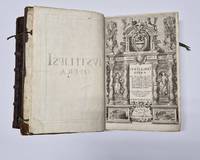
|
|
|
ARISTOTELES
ARISTOTELOUS PERI POIÊTIKÊS. Aristotelis De poetica liber. Ex versione Theodori Goulstoni perpetuis notis analyticis illustrata. Accedunt integrae notae Frid. Sylburgii & Dan. Heinsii necnon selectae aliorum. And: Aristotelis De poetica liber latine conversus et analytica methodo illustratus per Theodorum Goulstonum.
Cambridge Cantabrigiae Apud Johannem Hayes Celeberrimae Academiae Typographum Sumptibus Thomae Dawson Bibliopolae Cantabrigensis 1696. 8vo. 2 parts in 1: XX101310412 index errata p. folding table. Half vellum. 17 cm Ref: Hoffmann 1283; Cooper/Gudeman 44 & 174; Schrier p. 36; Brunet 1477; Moss 1122; Graesse 1214; Ebert 1191; ESTC R14743 Details: The work consists of two parts each with its own title page; the first contains the Greek text and commentary the second the Latin translation and analytical notes. Short title in ink on the back. The folding plate shows a 'Synopsis libri Poeticae' Condition: Binding somewhat used. Vellum age-tanned. Vellum on the back slightly soiled. Front flyleaf removed Note: 'The influence of Aristotle 384-322 BC on Western intellectual life is immense so much so that once one begins to track it no field of inquiry can be identified that it would be safe to overlook. Aristotle laid the foundations for not one but two sciences logic and biology an achievement unmatched by any thinker before or since'. The Classical Tradition Cambr. Mass. 2010 p. 70 For centuries his authority guided the further development of some of the sciences. From the 16th century to the age of Romanticism Aristotle's views developped in his 'De arte poetica' played a dominant role in the theory and practice of European literature especially of drama. And with Jacob Bernay's 'Grundzüge der verlorenen Abhandlung des Aristoteles über Wirkung der Tragödie' 1857 who rejected the moral Lessing and aesthetic Goethe tradition of 'catharsis' and who introduced the concept of the intentional arousal and discharge of emotions to the discussion Aristotle's description of the effect of tragedy as a 'catharsis' cleansing or purgation of tragic emotions pity and fear 'became the focus of a debate on the purposes of literature which attracts contributors up to the present day'. O.J. Schrier 'The Poetics of Aristotle and the Tractatus Coislinianus a Bibliography from about 900 till 1996' Leiden 1998 p. 1 Nietzsche Freud Wagner Wilamowitz-Moellendorff et 'multi alii' followed. Aristotle's 'De poetica liber' is 'the only piece of technical writing from antiquity that still plays a role in scholarly discourse. If Aristotle had confined himself to discussing Greek poetry from the viewpoint of its formal aspects or its historical development his work would still have been of eminent importance but only for classicists and historians of literature. He did more however laying bare what in his view are the fundamentals of poetry giving his criteria for distinguishing literary genres and pointing out along which lines he thought these and the works of individual poets should be evaluated. In pursuing these targets he formulated insights that have been thought to be applicable even to modern narrative genres like the detective story and the film. These aspects of the Poetics make it an interesting starting-point for discussions in wide areas of modern literary theory'. Idem Ibidem § This edition of 1696 is a revision of Goulston's 'De Poetica' edition of 1623. It was edited in 1696 by the English schoolmaster James Upton 1670-1749 once a fellow of King's College at Cambridge. Upton udated the work of 1623 making better use of the 'De Poetica' edition of the Dutch scholar Daniel Heinsius Leiden 1610/11 and 1643 and of the Aristotle edition of the German scholar Friedrich Sylburg who provided not only notes but also the Greek text for this edition Frankfurt 1584/87 volume 2. Upton added he tells in the preface also material he found in various authors among whom Samuel Petit's 'Leges Atticae' Paris 1635 and Daniel Heinsius' 'De tragoediae constitutione' Leiden 1611 and André Dacier's French translation of the Poetics Paris 1692. Upton also consulted Du Val's Aristotle edition Paris 1619 1639. He also revised Goulstons Latin translation § Theodor Goulston 1576-1632 studied in Oxford and was a medical doctor in London. His Poetics edition was reissued in 1696 1728 1731 1745 and 1780. In 1619 Goulston had already published in London 'Versio Latina et Paraphrasis in Aristotelis Rhetoricam' See his Wikipedia article Collation: Ad 1: 2 A-O8 P4 Q2. Folding table after leaf before A1 Photographs on request hardcover
Ссылка продавца : 156854
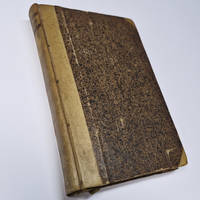
|
|
|
MEURSIUS,J
Ioannis Meursi Regnum Atticum. Sive de regibus Atheniensium eorumque rebus gestis libri III.
Amsterdam Amstelodami Apud Ioannem Iansonium 1633. 4to. 238;25 index1 blank p. Contemporary mottled calf 20 cm Ref: STCN ppn 085747009 Details: Back gilt and with 5 raised bands. Red morocco letterpiece. Woodcut printer's device on the title depicting a farmer with a shovel and a man with a Jacob's staff before his eye between them a celestial sphere above them Fama blowing 2 trumpets motto: 'Vivitur ingenio' short for 'Vivitur ingenio caetera mortis erunt'. Edges dyed red Condition: Upper margin of the title dustsoiled and with some minute tears. Armorial bookplate on the front pastedown Note: The Dutch classicist and historian Johannes Meursius Johannes van Meurs 1579-1639 was professor of History and Greek in the university of Leiden from 1610 till 1620. He studied under the genius J.J. Scaliger and is best known for the 'editiones principes' of a number of Byzantine authors that he produced and the 'editio princeps' of the 'Elementa Harmonica' of Aristoxenus 1616. He edited also the 'Timaeus' of Plato with the commentary and translation of Chalcidius 1617. Meursius' indefatigable labours concerned also the history of ancient Greece and especially Eleusis and the antiquities of Athens and Attica. His work was widely used as source by later ancient historians. Nothing that related to the history of Athens he left untouched law government festivals institutions manners literature religion etc. The dazzling variety of titles of part of his pioneering work seems almost to exhaust the subject 'ancient Athens': De populis Atticae 1616 Atticarum lectionum libri VI 1617 Aeschylus Sophocles Euripides. Sive de tragoediis eorum 1619 Panathenaea. Sive de Minervae illo gemino festo 1619 Eleusinia. Sive de Cereris Eleusinae sacro ac festo 1619 Fortuna Attica. Sive de Athenarum origine 1622 Archontes Athenienses. Sive de ijs qui Athenis summum istum magistratum obierunt 1622 Cecropia. Sive de Athenarum arce & ejusdem antiquitatibus 1622 De ludis Graecorum 1622 Pisistratus. Sive de ejus vita & tyrannide 1623 Athenae Atticae. Sive de praecipuis Athenarum antiquitatibus 1624 Areopagus. Sive de senatu areopagitico 1624 Regnum Atticum. Sive de regibus Atheniensium 1633 Reliqua Attica; sive ad librum De populis Atticae paralipomena 1684 Theseus sive de ejus vita rebusque gestis 1684 Themis Attica sive De legibus Atticis 1685 It is manifest that Meursius with these works laid the foundations of much later learning. § This title of 1633 was incorporated in Jacobus Gronovius' 'Thesaurus Graecarum antiquitatum' Lugduni Batavorum 1697-1702 vol. IV col. 1021-1140 Provenance: Bookplate of 'William Markham Esq. Becca Lodge Yorkshire'. In the 'History Directory and Gazetteer of the County York' London 1823 p. 643 in a chapter 'Seat of the nobility and Gentry of the West Riding of Yorkshire' a William Markham Esq. who lived at Becca Lodge 1 mile North of Aberbord is mentioned. In 1804 he was a member of the Grand Jury of York. He was the eldest son of William Markham Archbishop of York who died in 1807. He was born on 5th of April 1760. He 'was private secretary to Warren Hastings and subsequently resident for some time at Benares India. Eventually returning to Yorkshire he seated himself at Becca Hall. He married 20 Aug. 1795 Elizabeth dau. of the late Oldfied Bowles Esq. of North Aston and died 1841'. B. Burke 'Genealogical and Heraldic History of the Landed Gentry of Great Britain & Irland' London 1871 Volume 2 p. 885 Collation: A-2K4 leaf 2K4 verso blank Photographs on request hardcover
Ссылка продавца : 130259
|
|
|
THEOPHRASTUS- MEURSIUS,J
Ioannis Meursii Theophrastus. Sive de illius libris qui injuria temporis interciderunt liber singularis. Accedit Theophrastarum lectionum libellus.
Leiden Lugduni Batavorum Ex officina Elseviriana 1640. 12mo. 1115 index1033 blank p. Modern boards. 13.5 cm Ref: STCN ppn 061216267; Willems 504; Rahir 499; Berghman 1285; Hoffmann 537/38 Details: Elsevier's woodcut printer's mark on the title depicting an old man standing in the shade of a vine-entwined elmtree symbolising the symbiotic relationship between scholar and publisher. The motto is: 'Non solus'. After the index at the end we find: 'Adolphi Vorstii Epistola de obitu V.Cl. Ioannis Meursii ad filium ejus Joannem iuvenem praestantissimum' followed by a short 'epitaphium' for Meursius by his friend A. Buchellius and an elegiac couplet of Nicolaus Heinsius Condition: Title page soiled and a small piece removed from the tip of its right lower corner. Small stamp on the title. 3rd leaf slightly soiled Note: The Greek scholar Theophrastus ca. 370-287 B.C. was a pupil collaborator and successor of Aristotle. He was a scientific researcher rather than a speculative philosophers. Only a small part of Theophrastus' output has been preserved or as Meursius observes at the beginning of this 'liber singularis' of 1640: 'paucis conservatis pleraque interciderunt' 'few works have been saved most have perished'. p. 5 The importance of classification runs through all his extant works including even the brochure known as the Characters' Charaktêres. This collection of 30 descriptive sketches of types of people exhibiting deviations from proper norms of behaviour is nowadays his most famous and most imitated work. § This title of 1640 is the only edition of the last work of the Dutch classicist and historian Johannes Meursius Johannes van Meurs 1579-1639. It consists of 2 parts the first of which p. 1/82 is on the lost works of Theophrastus. Meursius list here 234 works with sources and testimonia. The second part p. 83/111 contains notes and emendations by Meursius on a number of Theophrastus' extant works 'Ioannis Meursii Lectiones Theophrasteae in quibus eorum librorum qui supersunt loca aliquot emendantur'. § Meursius was professor of History and Greek in the university of Leiden from 1610 till 1620. He studied under the genius J.J. Scaliger and is best known for the 'editiones principes' of a number of Byzantine authors that he produced. Meursius' indefatigable labours concerned also the history of ancient Greece and especially Eleusis and the antiquities of Athens and Attica. Meursius laid with his works the foundations of much later learning Provenance: The stamp on the title is a crown with 7 pearls of a Dutch/German/Austrian baron Beneath the crown 2 intertwined initials 'C.C'. or 'C.D' Collation: A-E12 F6 leaf F5 verso and F6 blank Photographs on request hardcover
Ссылка продавца : 154217
|
|
|
ARNOBIUS- MEURSIUS,J
Ioannis Meursii Criticus Arnobianus tributus in libros septem. Item Hypocriticus Minutianus & Excerpta MS. Regii Parisiensis. Editio altera & melior.
Leiden Lugduni Batavorum Ex officina Ludovici Elzevirii 1599. 8vo. XX167231 blank 18th century half calf 17.3 cm Ref: STCN ppn 119504200; Dibdin 1215: 'an indispensable work to peruse for those who are curious in the learning of the author'. Willems 44; Rahir 26; Berghman 1283; Schoenemann 1166/67 Details: Back gilt and with 5 raised bands. Red shield in second compartment. Colophon at the end: 'Lugduni Batavorum Excudebat Ioannes Balduini. Anno 1599 mense Julio' Condition: Binding worn at the extremes. Joints split but still tight. Small piece at the head of the spine gone. Ownership inscription on the front flyleaf. Stamp on the title. Foxed Note: Arnobius a teacher of rhetoric at Sicca Veneria in Numidia 'was suddenly converted to Christianity ca. A.D. 295 and a year or 2 later at the instance of his bishop wrote seven books 'Adversus Nationes' Against the Pagans. His work throws light on the Christian-pagan debate immediately before the Great Persecution while the venom of his attack on traditional Roman paganism shows that this was by no means dead'. OCD 2nd edition p. 122 His style is easy-flowing. Arnobius makes little use of the New and none of the Old Testament. His view of God is platonic. The unintended side effect of the efforts Arnobius and other Church Fathers to ridicule or crush paganism was that their writings form an archive which preserves knowledge and practices of polytheism in the years of its decline in late antiquity. Just as the early christians bolstered their piety by contrasting it with the demonic foulness of pagan religion so the protestants of the 16th century used their knowledge of pagan idolatry to scourge their catholic adversaries. Critics of Catholicism like Calvin compared catholic mass e.g. with the bloody rituals of the pagans and used the sacrifices of the ancients to score theological points against their opponents. 'Protestants detected in the Catholic cult of images the pagan idols so well described by late antique critics like Arnobius'. The Classical Tradition Cambr. Mass. 2010 p. 678 s.v. Paganism The work of Arnobius was first published in Rome in1542 although the preface is dated 1543 containing as Book Eight the 'Octavius' of Minucius Felix. Other editions followed in 1546 1560 1580 1582 1583 & 1586. § Joannes Meursius or in Dutch 'Jan de Meurs' 1579-1639 was only 19 years old when he published the first edition of this celebrated 'Criticus Arnobianus' in Leyden in 1598. He was a pupil of the genius J.J. Scaliger who helped him to publish it. It was a work of philology and not of theology and it enjoyed a mixed reception. Schoeneman observes that the book showed indeed the 'acumen' of the author's genius but that it is more on others classical authors than on Arnobius and Minucius Felix. Meursius offers for the greater part animadversions critical notes conjectures and emendations. He did not consult manuscripts but used his 'ingenium'. The next year 1599 Elsevier published this second improved edition of the 'Criticus Arnobianus'. It was not 'augmented' as is usual with second editions on the contrary Meursius wisely cut a number of his rash suggestions. In 1610 Meursius became professor of Greek in his own university. There in Leyden he produced the 'editiones principes' of a number of Byzantine authors the 'editio princeps' of the 'Elementa Harmonica' of Aristoxenus 1616 and edited the 'Timaeus' of Plato with the commentary and translation of Chalcidius 1617. He wrote much on the antiquities of Athens and Attica. J.E. Sandys 'A history of classical scholarship' 1964 p. 311 Provenance: In ink on the front flyleaf: 'Robinson Ellis from I. Bywater Oct. 1887'. Robinson Ellis 1834-1913 is a crucial figure in the history of textual and literary criticism of Catullus. He was elected to a fellowship at Trinity College Oxford in 1858 appointed professor of Latin at Univerisity College London 1870-1876. In 1893 he succeeded Henry Nettleship as Corpus Professor of Latin. DBC 1285 See for a charming portrait of Ellis his Wikipedia lemma. § Ingram Bywater 1840-1914 succeeded in Oxford Benjamin Jowett as Regius professor of Greek in 1893. He was a noted bibliophile whose collection now rests in the Bodleian Library. He 'occupies an important place in the modern history of ancient philosophy in Britain. . He is best known for his contribution to Aristotelian studies. His text of the Nicomachean Ethics 1890 was used as a model for the series Oxford Classical Texts inaugurated in 1898'. DBC 1.145 § On the front flyleaf also in ink: 'Ex libris Gal. Barrovi 18o mensis Iunii 1948'. This is probably Walter Barrow 1867-1954 Pro-chancellor 1933-1939 of the University of Birmingham Collation: 10 A-M8 leaf M8 verso blank Photographs on request hardcover
Ссылка продавца : 151893
|
|
|
BRUCKERUS,J
Iacobi Bruckeri . Institutiones Historiae Philosophicae usui Academicae iuventutis adornatae. Editio secunda auctior et emendatior.
Leipzig Lipsiae Impensis Bernh. Christoph. Breitkopfii 1756. 8vo. XVI & IV88416 index p. Calf. 20.5 cm Ref: VD18 11185910; Brunet 11284 Details: Back ruled gilt and with 5 raised bands. Red shield in the second compartment. Marbled endpapers. Edges dyed red. Programmatic woodcut on the title depicting a bear that emerges from the cavern where he has been hibernating; he sucks his own left paw; motto: 'ipse alimenta sibi': 'he himself is his own nourisment' or in German: 'Er ist selber seine eigene Speise' which means: philosophy does not need input from elsewhere no previous learning or art but is selfsufficient i.e. philosophy originates from itself. This motto summarizes Brucker's ideas on philosophy. The emerging bear was also printed on the title of Brucker's 'Magnum Opus' 'Historia critica philosophiae a mundi incunabulis ad nostram usque aetatem deducta' 1742-1744 Condition: Back scuffed corners bumped. Front joint beginning to crack. Bookplate on the front pastedown. Small stamp on the title. Small name cut out off the fyleaf. Good quality paper Note: The importance of the German philosopher Jacob Brucker 1696-1770 for the historiography of philosophy can hardly be overestimated. In his work the philosophical views of the Enlightenment are clearly expressed. Best known is his 'Historia critica philosophiae a mundi incunabilis ad nostram usque aetatem deducta' 5 volumes 1742/44; second edition in 6 vols. 1766/67 and his 'Institutiones historiae philosophicae usui academicae juventutis adornatae' first published in 1747 second augmented edition in 1756. The 'Historia critica' is a Latin translation of Brucker's 'Kurze Fragen aus der philosophischen Historie' 1731/36. The 'Institutiones historiae philosophicae' is a summary for students of his 'Magnum Opus'. It was even translated into English Enfield 1791 2 vols. The French encyclopaedist Denys Diderot who wrote most of the articles on the history of philosophy in the 'Encyclopédie' translated only passages from the work of Brucker. Goethe Kant Hegel and Schopenhauer studied Brucker. And Brucker is frequently cited and translated by Jean Jacques Barthelemy in his imaginary travel journal and one of the first historical novels 'Les Voyages du jeune Anacharsis en Grèce' 1788. That Brucker is no longer consulted is partly due to his writing in Latin. Source: 'Vorlesungen von Franz M. Wimmer Universität Wien. Philosophiehistorie in der Aufklärung' On the site of the University of Vienna Provenance: Woodcut bookplate dating before WW II: 'Ex libris meis Eduard Winter' motto: 'Deo Veritatis'; the woodcut is signed ES. § In pencil on front flyleaf: 'Dr. E. Winter'. Eduard Winter born in Bohemia in 1896 studied theology at the University of Innsbruck and the 'Deutsche Universität' in Prague. In 1919 he was ordained priest. In 1934 he was appointed professor of Church History and Patristics in Prague. He joined the NSDAP in 1939 and was excommunicated the next year. During the war he became a member of the SS and worked for the SD. After the war he joined the communists and was elected to the chair of History of Eastern Europe at the Martin-Luther-Universität Halle-Wittenberg in the DDR. From 1951 he lectured at the 'Humboldt-Universität' at Berlin and was director of the 'Institut für Geschichte der Völker der UdSSR'. He died in Berlin in 1982. Source wikipedia § The motto probably refers to Thomas Aquinas' Quaestio 89 articulus 1: 'Sed ille qui per Deum iurat aliquid Deo reddit dicitur enim Matth. V reddes domino iuramenta tua; et Augustinus dicit quod iurare est ius veritatis Deo reddere. Ergo iurare non est Deum testem invocare'. § On the title a small stamp: 'G.W.B.D' for 'Gräfliche Waldbott-Bassenheim'sche Dominalverwaltung' See the site buxheimlibrary.org. Waldbott von Bassenheim is the name of a German Rhenish noble family first documented in 1136. Hugo Philipp Graf Waldbott von Bassenheim 1820-1895 was the sole heir to a large family fortune and led a lavish lifestyle. He squandered his ancestors' fortune and ended up bankrupt. From 1852 till 1887 he was forced to sell his estates castles an abbey a monastery. In 1887 the Count sold the holdings and furnishings of the library of Buxheim Abbey. A once very wealthy family of the German high nobility had become destitute within a generation Collation: 8 22 A03K8 3L4 gathering 22 erroneously bound between 3L1 and 3L2 Photographs on request hardcover
Ссылка продавца : 130210
|
|
|
MEURSIUS,J
Ioannis Meursii Glossarium Graeco-Barbarum. In quo praeter vocabula quinque millia quadringenta Officia atque Dignitates Imperii Constantinop. tam in Palatio quam Ecclesia aut Militia explicantur & illustrantur. Editio altera emendata & circiter MDCCC vocabulis aucta.
Leiden Lugduni Batavorum Apud Ludovicum Elzevirium 1614. 4to. XVI672 recte 6742 blank p. Calf . 24 cm <The first important dictionary of medieval and modern Greek> Ref: STCN ppn 832945064; Willems 91; Rahir 72; Berghman 710; Graesse 4510; Ebert 13952; Brunet 31684 Details: Back gilt and with 5 raised bands. Red morocco lettring label. Marbled endpapers. Title page printed in red and black. Woodcut of Elsevier's first printer's mark on the title depicting an aegle that holds a bundle of 7 arrows in its beak the bird is surrounded by the motto: 'A. 1595 Concordia Res Parvae crescunt'; the seven arrows represent the union of the Seven Provinces of the Dutch republic. Engraved on the verso of the title page the wellknown portrait of Meursius. Printed in 2 columns Condition: Binding scuffed especially at the extremes. Corner of the letterpiece on the back gone. Name on the front flyleaf and on the verso of the title. Small underlinings and marginal notes in ink. Paper slightly foxed yellowing and sometimes slightly browning Note: The Dutch classicist and historian Johannes Meursius Johannes van Meurs 1579-1639 was professor of History and Greek in the university of Leiden from 1610 till 1620. He studied under the genius J.J. Scaliger and is best known for the 'editiones principes' of a number of Byzantine authors that he produced his lexicographical works and the 'editio princeps' of the 'Elementa Harmonica' of Aristoxenus 1616. He edited also the 'Timaeus' of Plato with the commentary and translation of Chalcidius 1617. Meursius' indefatigable labours concerned also the history of ancient Greece and especially Eleusis and the antiquities of Athens and Attica and of Sparta. His work was widely used as source by later ancient historians. Nothing that related to the history of Athens he left untouched law government festivals institutions manners literature religion etc. The dazzling variety of titles of part of his pioneering work seems almost to exhaust the subject 'ancient Athens'. Meursius' work was widely used as source by later ancient historians and they laid the foundations of much later learning. Meursius work was incorporated in Jacobus Gronovius' 'Thesaurus Graecarum antiquitatum' Leiden 1697-1702. § The first edition of Meursius' lexicographic work 'Glossarium Graeco-Barbarum' was published by Elsevier at Leiden in 1610. This second augmented edition of 1614 contains more than 5400 words arranged in alphabetical order with a translation explanation and elucidation in Latin. Meursius compiled the glossarium from the works of hitherto published works of Byzantine authors and from a number of manuscripts of the Library of the Leiden University. The greater part of the 'Glossarium' was later incorporated in the still indespensable 'Glossarium ad scriptores mediae et infimae Graecitatis' Paris 1688 of the famous French Charles philologist and historian of Byzantium and the Middle Ages Charles du Fresne sieur du Cange Provenance: On the front flyleaf: 'Jo. Aug. Henr. Tittmanni Dr. P.'. The German theologian and philosopher Johann August Heinrich Tittmann 1773-1831 was appointed after his 'Habilitation' in 1793 professor of philosophy 1796 and theology 1800 at the University of Leipzig and became known as a writer of numerous philosophical and theological works. See his Wikipedia article § On the blank margin below Meursius' portrait the name: 'M. Joh. Frider. Fischerus Coburgensis a C.N. 1751'. This is the philosopher and classical scholar Johann Friedrich Fischer born at Coburg in 1726. He died in Leipzig in 1799. Fischer was from 1751 'Konrektor' and from 1767 till 1799 Rektor of the 'Thomasschule' at Leipzig and he was from 1762 also professor of classics at the University of Leipzig. He produced several editions of classical authors and wrote works on Biblical criticism.See his Wikipedia article Collation: -24 A-4P4 4P4 blank The pagination jumps between the gathering 4C and 4D from 576 to 579. Otherwise nothing irregular the catchword connects and the text continues as it should Photographs on request hardcover
Ссылка продавца : 156318
|
|
|
ARISTOTELES
Aristoteles. De mundo Graece: Cum duplici interpretatione Latinâ priore quidem L. Apuleii; alterâ verò Guilielmi Budaei. Cum scholiis & castigionibus Bonaventurae Vulcanii tam in Aristotelem quam in utrunque eius interpretem. Accessit seorsim Gregorii Cyprii Encomium Maris Graece numquam antea excusum. Et Pauli Silentiarii Iambica.
Leiden Lugduni Batavorum Ex Officina Plantiniana Apud Franciscum Raphelengium 1591. 8vo. 2 parts in 1: XVI2977 index; 231 blank p. Modern half calf. 16 cm Ref: STCN ppn 840465076; Cranz Bibliotheca Bibliographica Aureliana 108.713; Schwab 1520; Hoffmann 1285; Schweiger 153; Brunet 1464; Graesse 1213; Ebert 1137 Details: Restored half calf antique style with some gilding on the back and a red shield. Marbled boards. Plantin's woodcut printer's mark on the title motto: 'Labore et Constantia'. The first part p. 1-297 contains 'De Mundo'; the Greek text is divided in paragraphs and each paragraph is followed by 2 Latin translations of Apuleius and of Guillaume Budé and by explanatory notes scholia of Vulcanius. The second part which is often lacking in other copies has a title page of its own; it contains the 'editio princeps' of the Greek text of Gregorius Cyprius' 'Praise of the Sea' and reissue of Paulus Silentiarius' poem on the hotsprings Therma in Bithynia Condition: Paper yellowing. 2 names on the title. Right edge of the first leaves slightly thumbed the right lower corner of the first leaves somewhat dog-eared Note: The Greek scholar/philosopher Aristotle 384-322 B.C. is one of the foremost names in the history of thought and perhaps the most influential of all who have ever written. His influence on Western science and culture is immense. His boundless industry extended to most branches of higher learning. 74 treatises genuine and spurious have come down to us under his name. § One such work that has no claim to be genuine is the once popular philosophic treatise 'De Mundo' or 'On the Universe'. Edition Bekker 391-401 In it cosmological and meterological subjects are treated. The work was once ascribed to Aristotle but ever since the German scholar Wilhelm Capelle traced most of its doctrines to the Greek Stoic philosopher Posidonius of Apameia ca. 135 - ca. 51 B.C. the author is known as Pseudo-Aristotle. Neue Jahrbücher XV 1905 p. 529/68 Capelle dates the treatise in the first half of the second century A.D. It was translated into Latin in the second century A.D. by the Roman rhetorician and platonic philosopher Apuleius Madaurensis who is best known for his famous picaresque novel 'Metamorphoses' also known as 'The Golden Ass'. In 1533 the French classical scholar Guillaume Budé Guilielmus Budaeus published in Basel an edition of 'De Mundo' with a Latin translation of his own. This translation and the one of Apuleius was adopted in this Leiden edition of 1591 edited by the Flemish scholar Bonaventura Vulcanius De Smet in Flemish 1539-1614 from 1581 professor of Greek and Latin Letters at the recently founded University of Leiden. It is Vulcanius second edition of 'De Mundo' for in 1587 he had published the first edition. § In the short preface Vulcanius observes that he has restored 'De Mundo' to its original splendor emendating the manuscript and editions he used e.g. 'vetus codex meus habet' and 'In Aldina legitur' at quite a number of places and that he has cleansed Apuleius' translation from many horrific mistakes. 'In Aristotele itaque emendavi non pauca ab Apuleio innumera mendarum portenta profligavi totamque hanc Aristotelici pariter & Apuleiani Mundi fabricam pristinae suae quoad eius fieri potuit integritati restitui' p. 3 verso Vulcanius elucidated 'illustravi' 'De Mundo' also with a load of annotations that he hoped were useful for future philologists and even philosophers. In his annotations he examined how faithful to the Greek the Latin versions of Apuleius and Budaeus were and the 'emendations Vulcanius supplied were nearly all accepted by later editors of 'De Mundo' notably Bekker 1831 and Lorimer 1938'. H. Cazes ed. 'Bonaventura Vulcanius Works and Networks: Bruges 1538 - Leiden 1614' Leiden 2010 p. 346 3 years after this edition of 'De Mundo' Vulcanius produced for the same publisher an 'Opera Omnia' edition of Apuleius. § After 'De Mundo' Vulcanius has added in this edition of 1591 a separate volume containing 2 short Greek texts the 'editio princeps' of a prose work of Gregorius Cyprius 1241-1290 Patriarch of Constantinople the 'Encomium Maris' or the 'Praise of the Sea' p. 3/12 and a iambic poem of 189 verses composed by Paulus Silentiarius during the reign of Justinian 'Eis ta en Pythois Therma' on the hotsprings in Bithynia in Asia Minor p. 13/23 including Vulcanius' notes. It was Vulcanius explains in the 1 page introduction to this poem shoddily presented in the 'Anthologia Epigrammatum Graecorum' of Henri Estienne of 1566. He therefore decided to deliver a correct and sound text with his annotations. p. 13 These 2 small works were probably added by Vulcanius because they go well with and illustrate the passages in 'De Mundo' on the element water i.e. rivers seas oceans etc. p. 44/62 Provenance: On the title the name of 'Henricus Gesselius'. This might be the Dutchman Henricus Gesselius a 'Medicinae Doctor' who published in 1640 a 'Disputationum medicarum quinta de febre hectica & malignis' and 'Disputationum medicarum de febribus septima'. § If this is correct the other name 'Ioan. Cor. Gess.' might well be Johannes Cornelius Gesselius ca. 1550-1627 who was from 1574 rector of the Gymnasium of Amersfoort. He was fired in 1619 because he refused to renounce his catholic faith. NNBW 6 p. 579/80 Collation: 8 A-T8; a8 b4 leaf b4 verso blank Photographs on request hardcover
Ссылка продавца : 153420
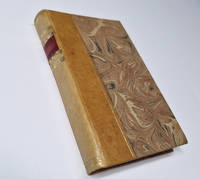
|
|
|
Analog (William F Dawson & Ben Bova; Frank Herbert; Hank Dempsey; James H Schmitz; Richard Grey Sipes; Christopher Anivl; John T
ANALOG Science Fiction/ Science Fact: January Jan. 1965 "The Prophet of Dune"; "A Nice Day for Screaming"
NY: Conde Nast Publications 1965. Magazine. Very Good to Near Fine. Wraps. Vol. LXXIV 74 No. 5. Bedsheet-sized. Edited by John W. Campbell. Cover art by John Schoenherr for "The Prophet of Dune" Pt. 1 of 5 by Frank herbert. Includes "Science Fact: It's Done With Mirrors" by William F. Dawson & Ben Bova; "A Matter of Timing" novelette by Hank Dempsey; "A Nice Day for Screaming" by James H. Schmitz; "Final Report" by Richard Grey Sipes; "The New Boccaccio" by Christopher Anivl; "Finnegan's Knack" by John T. Phillifent. Readers' Departments: "Brass Tacks"; "The Editor's Page: Race Riots"; "The Analytical Laboratory"; "In Times to Come"; "The Reference Library" by P. Schuyler Miller. Illustrated by John Schoenherr Robert Swanson and Kelly Freas. Front cover upper foredge corner crease echoed on first page; pencil marks on first page; mild tanning. Conde Nast Publications Paperback
Ссылка продавца : PT60
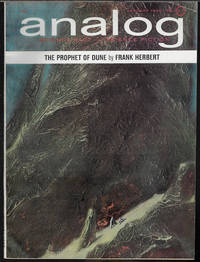
|
|
|
Catalogue of the Early English Pottery and Wedgwood Ware the Property of the Late Mr. Thomas Boynton F.S.A. of Norman House Bridlington.
Stokr-on-Trent: Messrs Charles Butters & Sons. 1920. Hardcover. Good/No Jacket. 8.5" x 11.5. 49 page illustrated auction catalogue for the Boynton collection of ceramics / keramics. 569 lots. Illustrated with tissue-guarded monochrome photographs. This is copy 76 of a limited run. In clean and sound condition there are some light foxing spots. This catalogue appears to have been in the collection of the potter William Moorcroft. There is his book-plate inside the front board and a signature of "William M 19-3-20" on the frontis verso. Some hammer prices have been annotated in the margins and these appearm to be in the same ink as the signature. All orders processed promptly and shipped from the UK. Non-UK customers please only select the fast / expedited shipping service at checkout. <br/> <br/> Messrs Charles Butters & Sons. hardcover
Ссылка продавца : 029098
|
|
|
OVIDIUS
P. Ovidii Nasonis Opera. Petrus Burmannus ad fidem veterum exemplarium castigavit.
Amsterdam Amstaelodami Apud Rod. & Gerh. Wetstenios 1713 - 1714. 12mo. 3 volumes: LXII302; 340XVII index3 blank;370 p. portrait and frontispiece. Vellum 14 cm Ref: Schweiger 2631: 'Heinsius Text liegt zum Grunde ist aber nach Handschriften verbessert. Sehr correct'; Graesse 570; Ebert 15370; Brunet 4273 Details: Portrait of Ovid by the French engraver Bernard Picart: Ovid's medallion portrait is surrounded by laurel branches beneath Ovid sits Amor on the globe. The frontispiece also by Picart depicts a bucolic scene: the poet sits at the border of a pond flanked by the Muse Erato who holds a laurel wreath above his head and a crowned female figure who has a long trumpet in her right hand. Fama Above them hovers Amor who just has wounded the poet with two arrows right in his chest Condition: Vellum age-toned and soiled backs stained. Endpapers detached. The frontispiece modestly and tastefully adorned with some water colours. What is worse a name has been cut out of all three titles Note: The Roman poet Ovid 43 B.C. - 17 A.D 'is perhaps the most consistently influential and popular writer of the classical tradition. His central position is suggested by the many surviving manuscripts of his works and their early publication in printed editions. . Most would agree that it is his Metamorphoses that has had the greatest influence but his other major poems the Heroides Tristia Fasti and particularly his racier works the Amores Ars amatoria and Remedia amoris have played their part in maintaining his reputation as a writer of enduring importance and appeal.' The Classical Tradition Cambr. Mass. 2010 p. 667 Ovid was widely read in antiquity and remained to be read at the Carolingian court in the Middle Ages. The 12th/13th centuries are even called the 'aetas Ovidiana' for Ovid's love elegy was one of the mainsprings of the phaenomenon of courtly love and its literary expression. His 'Ars amatoria' and the 'Remedia' became even part of the school curriculum. Ovid became also the favourite poet of the Renaissance. Boccaccio and Petrarca were influenced by him. Shakespeare was inspired more by Ovid than by Vergil. Neue Pauly 9110/119 The huge number of editions and translations suggests that Ovid's appeal lies also beyond the bounderies of the scholarly and literary world. The site 'Ovid Illustrated' by D. Kinney and E. Styron offers a large collection of engravings that were made by 16th/17th and 18th century artists for the Metamorphoses. The last fourty years have seen a huge increase in attention to Ovids poetry. § This is the first edition of the works of Ovid produced by the Dutch classical schollar Pieter Burman in Latin Petrus Burmannus 1668-1741. He tells in the preface to this edition leaf 8 that he follows the 'editionum emendatissimam' Elsevier edition of Nicolaas Heinsius of 1658-1661. He found it however necessary to restore the text where Heinsius's conjectures were groundless and too bold. In the preface he also announces a more ambitious edition of Ovid 'quae brevi sequetur' with notes of him and of other learned predecessors. This augmented and corrected four volume edition which long remained the standard edition was published fourteen year later by Burmannus in 1727. Petrus Burmannus was professor of Eloquence Latin at the University of Utrecht from 1696 and was transferred to Leiden in 1715. As an editor he confined himself to the Latin classics such as Phaedrus Horace Claudian Ovid and Lucan. 'His numerous editorial and critical works spread his fame as a scholar throughout Europe and engaged him in many of the stormy disputes which were then so common among men of letters. Burman was rather a compiler than a critic; his commentaries show immense learning and accuracy but are wanting in taste and judgment'. Wikipedia 'Pieter Burman the Elder' Collation: Ad 1: pi1 -212 36 minus the blank leaf 36 A - M-12 N-8 minus leaf N8. Ad 2: A-O12 P12 leaf P11 verso & leaf P12 blank. Ad 3: a-p-12 q6 minus leaf q6 Photographs on request hardcover
Ссылка продавца : 120113
|
|
|
PINDARUS
Pindari carmina cum lectionis varietate curavit Christian Gottlob Heyne.
Göttingen Gottingae Apud Iohannem Christianum Dieterich 1773. XVI379 recte 3811 blank p. Contemporary boards. 21 cm Ref: VD18 10529713; Hoffmann 3100; Dibdin 2290/92; Moss 2411/12; Brunet 4660; Ebert 16871; Graesse 5295 Details: Engraved bust of Pindar on the title. A 14 p. introduction and the Greek text with on the lower part of the page Heyne's selection of variant readings. This is volume one only of a two volume set Condition: Binding scuffed. Paper on the back abraded. Name on the front flyleaf the title and the verso of the title. Paper yellowing and slightly foxed. Volume 1 of a two volume set Note: The first Pindar edition of the celebrated German classical scholar Christian Gottlob Heyne 1729-1812 'was highly treasured by the learned world. The great judgment displayed in the choice of the text and its punctuation the various readings and the care with which all former editions appear to have been consulted render it a performance far exceeding all previous publications'. Dibdin This volume is the first of a 2 volume set. It 'contains the Greek text which is preceded by a learned and useful preface. At the bottom of the page are printed Heyne's selections of readings chosen with great judgment. The lacking second volume contains a bibliography of the manuscripts and editions and a Latin translation Provenance: On the front flyleaf in ink 'E.O. Richter 1896' and in pencil 'J. de Roos. 1964'. On the title 'Eich' and 'Nodrach'. On the verso of the title page 'Eich 1845' probably a German called Eich from Nodrach a community in the Black Forest in Baden-Württemberg Collation: -24 chi1 A-3B blank leaf 3B4 removed hardcover
Ссылка продавца : 157924
|
|
|
The Oskamp Nolting Co
The Great American Catalog 1932 - The Oskamp Nolting Company
N. P.: N. P. 1932. Hardcover. Fair/No Jacket. 4to - over 9¾ - 12" tall. Quarto. 672 pages indexed. Hardcover in yellow cloth. The binding is worn and soiled and has a water ring mark on front cover. The corners are bumped Text is toned has occasional foxing. Illustrations throughout with some black and white and some in color. A sound copy. <br/> <br/> N. P. hardcover
Ссылка продавца : 056319
|
|
|
Cheever, Byron (Intro)
Ward Bros. Signed L. T. Ward & Bro. Wildfowl Counterfeiters
Heber City UT: North American Decoys. Very Good with no dust jacket. First Edition. Hardcover. Covers are a little faded and there is a smudge inside the front cover. Inscribed by both Lemuel & Stephen inside the front cover. ; Small 4to 9" - 11" tall; Signed by Biographee . North American Decoys hardcover
Ссылка продавца : 29111
|
|
|
SUETONIUS
C. Suetonius Tranquillus ex recensione Joannis Georgii Graevii cum ejusdem animadversionibus ut et commentario integro Laevini Torrentii Isaaci Casauboni & Theodori Marcilii nec non selectis aliorum. Editio secunda auctior & emendatior.
The Hague Hagae-Comitis Apud Johannem a Velsen; Utrecht Trajecti ad Rhenum Typis Rudolphi a Zyll & Anthonii Schouten 1691. 4to. 2 parts in 1: XVI822 recte 800; 110153 index1 blank p. frontispiece 12 full-page engraved portraits of emperors 1 folding plate showing an inscription. Half calf. 24.5 cm Ref: STCN ppn 852709684; Schweiger 2978; Ebert 21931; Moss 2631; Dibdin 2441; Brunet 5582 Details: Back gilt and with a red morocco shield. Boards marbled. Frontispiece depicting Suetonius at work at a desk in the Pantheon. Woodcut printers' mark on the title depicting 'Minerva Traiectina' who rests under an olive tree; a ribbon in the tree bears the motto: 'Pax artium altrix'. Each biography of a Roman emperor is preceded by an engraved portrait made after a Roman coin. § The text of Suetonius the 'Vitae' 'De illustribus grammaticis liber' and 'De claris rhetoribus liber' is followed by 14 pages with inscriptions to illustrate the 'Lives' and 47 pages with the commentary of Graevius; added is a 70 p. commentary of the Dutch scholar Theodorus Marcilius on Suetonius' biography of Vespasian. After this a small section with the prefaces to Suetonius by Politianus and Casaubon and Vossius' article on Suetonius from 'De historicis Latinis'. Included is also the text of the 'Monumentum Ancyranum' with Isaac Casaubon's commentary; at the end a 153 page index compiled by Matthias Berneccerus Condition: Wear to the extremities of the boards. A few small pieces of the marbled paper on both boards are gone. Front flyleaf removed. Small inscription on the front pastedown. Some slight foxing Note: The Roman historian Suetonius born c. 69 A.D is the most influential and best known biographer in the Latin language. He was appointed secretary to the emperor Hadrian a job that gave him access to the imperial records and archive. He made good use of his sources writing the Lives of the XII Caesars or 'De vita Caesarum'. The collection consists of the biographies of 12 emperors from Caesar the founder of the imperial line to Domitian. 'Suetonius like Plutarch believed that a person's character could be revealed in small and insignificant details'. He 'organized his Lives by topics per species rather than chronologically'. The Classical Tradition Cambr. Mass. 2010 p. 912/13 Beyond simplicity and clearness he has no stylistic pretentions. He quotes verbatim from documents he knew and shows critical ability. 'The great number of scurrilous anecdotes in most of the lives may be due to the nature of his sources'. OCD 2nd ed. p. 1020/1 Of another of his works 'De viris illustribus' a collection biographies of famous Roman authors the lives of Lucan Horace Vergil and Terence have survived and his 'Liber de illustribus grammaticis' and his 'De claris rhetoribus liber'. Suetonius was read in the Middle Ages. The Frank Einhard wrote a biography of Charlemagne along the lines of a Life of Suetonius. § From the Renaissance onward Suetonius was neglected. Pioneering work was done by the French scholar Isaac Casaubon who produced an excellent text and a valuable commentary. Geneva 1595/1615 This work was continued by the Dutch scholar Graevius with his great Suetonius edition of 1672. This edition became with her numerous reissues and revisions the foundation for the widespread study of Suetonius in the Netherlands and in England and in the next 18th century the scholarly interest in Suetonius has been greater than ever before or since. This edition of 1691 is the first reissue and contains the entire commentaries of Torrentius Casaubon with the notes of the Dutch scholar Theodorus Marcilius Arnheimensis and Jacobus Gronovius and the Portugese humanist Achilles Statius or Aquiles Estaço. § Gibbon praised Suetonius for his strict dedication to historical truth. Nowadays 'historians of Rome take him more seriously than do literary critics'. The Classical Tradition Cambr. Mass. 2010 p. 913 § Johann Georg Graeve or in Latin Johannes Georgius Graevius 1632-1703 was of German descent. He was professor of Eloquence at Duisburg from 1657 at Deventer and from 1661 at Utrecht where he lived and worked for the last 40 years of his life. He limited his attention mainly to writers of Latin prose Cicero Suetonius Caesar Justinus Florus. This scholar of international stature is remembered for his 'Inscriptiones antiquae' long time a standard edition. He is also famous for his three 'Thesauri' in which important works of previous leading scholars were collected and reprinted the 'Thesaurus eruditionis scholasticae' the 12 folio volumes of the 'Thesaurus antiquitatum Romanarum' and the 9 volumes 'Thesaurus antiquitatum et historiarum Italiae' Provenance: On the front pastedown in ink in Dutch 'Geschenk aan de bibliotheek van A.M.A. Meyer' Collation: -24; A-5H4; 6A-7K4 leaf 7K4 verso blank; plates after 24 110 294 366. 432 492 562 567 600 619 649 660 folding plate after 762. Error in pagination: it jumps at 351 on the recto to 354 on the verso and from 731 on the recto to 752 on the verso Photographs on request Heavy book may require extra shipping costs hardcover
Ссылка продавца : 140009
|
|
|
HESIODUS
De Werken en Dagen van Hesiodus. Naar het Grieksch in Nederduitsche verzen gevolgd door D.J. van Lennep. Tweede druk.
Amsterdam Bij P. Meijer Warnars 1834. 8vo. XX recte XXII; 622 blank p. 1 plate. Contemporary boards. 20 cm Ref: Geerebaert 452; OiN p. 199 Details: Fine copy. Title page completely engraved by the Dutch artist Philippus Velijn. The introduction numbers 20 pages the Dutch translation in iambic verser 40 pages; notes on pages 41/62 Collation: 2 chi 1 the title inserted between leaf 1 and 2 28 1-4/8 the last leaf leaf 4/8 blank Photographs on request hardcover
Ссылка продавца : 154228
|
|
|
BARTHELEMY,JJ J J
Voyage du jeune Anacharsis en Grèce dans le milieu du quatrième siècle avant l'ère vulgaire. 3e édition.
Paris Chez De Bure l'aîné 1790. 8vo. 7 volumes: 1 XVI248 p. 4 maps; 2 IV350 p. 13 maps & plates; 3 VIII332 p. 5 maps & plates; 4 VI339 p. 6 maps & plates; 5 VI336 p. 1 plate; 6 VI313 p. 1 map & 1 plate; 7 II782LXIVCXXXIX p. In all 4 & 27 folding plates & maps. Contemporary boards. 19.5 cm Ref: Graesse 1300; Brunet 1674 Details: Without the Atlas volume. Bindings in marbled paper. All spines ruled gilt and with a light brown title label and a dark blue small oval volume label. Small paper library label at the foot of the spines. Maps engraved by the French cartographer Jean Denis Barbié du Bocage 1760-1825 who was a friend of the author Barthélemy. At this time he was attached like Barthélemy to the cabinet of medals from the Library of King. Condition: Bindings scuffed. Corners slightly bumped. Some scattered and insignificant ink and rust spots. Faint traces of a bookplate being removed on the front pastedowns Note: The Frenchman Jean Jacques Barthélemy 1716-1795 was a cleric and keeper of the royal cabinet of medals in Paris. His fame rests on his 'Voyage du jeune Anacharsis' or 'Travels of Anacharsis the younger in Greece in the middle of the 4thy century B.C' which was published in 1788 and illustrated with maps by the cartographer Jean Denis Barbié du Bocage. The 'Voyage' was longtime held in wide esteem as a popular account of the antiquities manners customs and governments of ancient Greece. Barthélemy's aim was not scholarship or to write a history of Greece. His intention was to provide his countrymen in an entertaining form with some knowledge of Greek civilization and to popularize the results of modern research. A road trip when 'tout est en action' is an excellent vehicle for telling 'des détails interdits à l'historien'. Vol. 1 Avertissement p. VI Nevertheless in volume 1 Barthélemy gives a copious introduction which supplies whatever may be wanting in respect to historical details. The first person narrator of the story Anacharsis is a young Scythian a descendent of the famous philosopher Anacharsis of whom he complains that he is 'si célèbre parmi les Grecs et si indignement traité chez les Scythes'. vol. 2 p. 1 Our fictional hero leaves for Athens for instruction in the spring of 363 B.C a few years before the birth of Alexander the Great. He makes a tour through the regions of Greece and visits islands 'observant par-tout les moers et les usages des peuples assisant à leurs fêtes étudiant la nature de leur gouvernemens'. p. Vol. 1 p. V. He meets Epaminondas Phocion Xenophon Plato Aristotle Demosthenes and others. In 337 soon after the battle of Chaeroneia when he sees that Greece is enslaved by Philippus the father of Alexander he returns to his native country to write an account of his road trip Provenance: On the flyleaf of the first 2 volumes the name 'v.Graevenig' Collation: 1: pi8 A-P8 Q4; 2: pi4 minus blank leaf pi4; A-X8 Y8 minus blank leaf Y8; 3: pi4 A-V8 X6; 4: pi4 minus blank leaf pi4 A-X8 Y2; 5: pi4 minus blank leaf pi4 A-X8; 6: pi4 minus blank leaf pi4 A-T8 V6 minus blank leaf V6. 7: pi2 minus blank leaf pi2 A-E-8 a-d8 a8 b4 c-i8 k2; 1 maps I-IV; 2 plates 1/13; 3 plates 14/18; 4 plates 19/23 & plate 27 last one; 5 plate 24; 6 plates 25 & 26 Photographs on request Heavy book may require extra shipping costs hardcover
Ссылка продавца : 130228
|
|
|
OVIDIUS
Alle de werken van Publ. Ovidius Naso. Het derde deel: bestaande in Klaag-brieven Brieven uit Pontus Almanak Vloek tegen Ibis Nooteboom Troost-dicht aan Livia 't Blanketsel. In de Nederlandse taale overgebracht door Abraham Valentyn. Met verklaaringen en uitleggingen verrijkt door Lud. Smids M.D.
Amsterdam t'Amsteldam By Pieter Mortier Boekverkooper 1701. 4to. VIII33440 index p. frontispiece; 26 engraved plates. Vellum. 29 cm Ref: STCN ppn 843242159; Schweiger 2685; Geerebaert 12226b; OiN 273 Details: Large paper copy. Third volume of 3 only. Back with seven raised bands. Boards blind stamped. The frontispiece made by J. Goeree and J. van Vianen depicts Ovid in despair being sent into exile by the emperor Augustus. Engraved plates of gods & goddesses and the like in the translation of the Fasti. Condition: Vellum age-toned soiled & spotted. Paper partly yellowing. 3rd and last volume only Note: This third volume of a set of three contains a Dutch prose translation of part of the works of the Roman poet Ovid 43 B.C. - 17 A.D. It contains a translation of the 'Tristia' 'Epistulae ex Ponto' 'Fasti' 'Ibis' 'Nux' 'Consolatio ad Liviam Elegiae' 'Medicamina Faciei Femineae'. § Ovidius 'is perhaps the most consistently influential and popular writer of the classical tradition. His central position is suggested by the many surviving manuscripts of his works and their early publication in printed editions. . Most would agree that it is his Metamorphoses that has had the greatest influence but his other major poems the Heroides Tristia Fasti and particularly his racier works the Amores Ars amatoria and Remedia amoris have played their part in maintaining his reputation as a writer of enduring importance and appeal.' The Classical Tradition Cambr. Mass. 2010 p. 667 The huge number of editions and translations suggests that Ovid's appeal lies also beyond the bounderies of the scholarly world. The editor and annotator of this work Ludolf Smids confesses in the preface of the first volume that he thinks that his readers probably know little Latin. In the preface of the 2nd volume the Metamorphoses he is more precise about his public. There he states that everyone has read this 'weergaloos Konstwerk' inimitable work of art thoroughly. Painters sculptors and engravers draw on this famous source for inspiration. 'Want wie buiten de Letterkundige beroemd sich niet de Metamorphosis door en door geleesen te hebben aangesien sy is de rijke schatkamer en het volgepropte wapenhuys van Schilders Beeldhouwers en Graveerders die niet ontkennen hunne Ifigeniaas Medeaas Nioben Altheën en andere wonderstukken deselve ontleend te hebben'. In the preface to this last volume Smids declares once more that he did not publish the translation and did not write his annotations for scholars and the like but for painters sculptors engravers and draughtsmen and for young students jonge Leerlingen van Taalen en Weetenschappen. § The dates of the translator Abraham Valentijn are unknown. He was living in the Dutch town of Dordrecht at least from 1666 where he first was praeceptor teacher of classical languages of the local 'Schola Latina' and later Conrector. His Ovid translation was first published in Leiden 1678 and was reprinted twice. He also published a prose translation of Juvenal which had some success for it was reprinted several times. Van der Aa 1924 § More is known about the editor and annotator of this translation Ludolf Smids 1649-1720. He came to Leiden where he became Doctor of Medicine in 1673. He went to live in Amsterdam where he spent more time on the study of history antiquities poetry and numismatics than as medical practioner. He wrote plays poetry and several books on numismatics. He also translated the 'Mostellaria' of Plautus into Dutch. Van der Aa 17/2 760 Provenance: On the front pastedown in ink: 'J.H. Verheijen'. This is the Dutch painter and draughtsman Jan Hendrik Verheijen 1778-1846. See his Wikipedia article Collation: pi2 including frontispiece 2 A - Z4 Aa - Zz4 Aaa4 leaf Aaa4 blank 26 plates at page 146 154 157 160 164 177 179 181 198 215 220 223 227 241 243 261 262 264 268 278 281 283 285 296 305 & 307 Photographs on request hardcover
Ссылка продавца : 156230
|
|
|
OVIDIUS
P. Ovidius Nasoos Feestdagen in Hollandts dicht vertaalt door Arnold Hoogvliet.
Delft en Rotterdam By Adriaan en Jan Daniel Beman 1719. 4to. 22 leaves;2261 errata p. Vellum. 21 cm Ref: STCN ppn 141532653; Geerebaert 12236; OiN 276; Van der Aa 8/2 1175/9 Details: Blind tooled back and boards. 6 thongs laced through the joints. A fine frontispiece engraved by J. Goeree which depicts Ovid kneeling before a statue of Janusand asking him for inspiration. The text facing the frontispiece explains this allegorical scene and is the work of his Goeree's friend the poet Tielman van Bracht. An allegorical vignette also engraved by Goeree on the title it depicts 4 putti amusing themselves; between them an incensory on a pedestal on which a text that often accompanies incensory pictures: 'dum placeam peream' 'Provided I please let me perish' Condition: Vellum slightly soiled. Both pastedowns detached. Tiny wormhole in the front pastedown and flyleaf. Very small tear in the upper margin of the title-page Note: Nice and clean copy of the first edition of the translation by Arnold Hoogvliet 1687-1763 of Ovid's Fasti. In a long preface Hoogvliet explains why and how he has translated this poem. Although the translation was greeted with enthousiasm by his contemporaries he had to promise his dying father that he would write after this work full of heathen worship a work full of christian virtues. This promise 'Abraham de Aartsvader' was published in 1728 and made his name. He was considered one of the great Dutch poets of his age. Van der Aa 82 p. 1175/9 § The Roman poet Ovid 43 B.C. - 17 A.D 'is perhaps the most consistently influential and popular writer of the classical tradition. His central position is suggested by the many surviving manuscripts of his works and their early publication in printed editions. . Most would agree that it is his Metamorphoses that has had the greatest influence but his other major poems the Heroides Tristia Fasti and particularly his racier works the Amores Ars amatoria and Remedia amoris have played their part in maintaining his reputation as a writer of enduring importance and appeal'. The Classical Tradition Cambr. Mass. 2010 p. 667 § Ovid was widely read in antiquity and remained to be read at the Carolingian court in the Middle Ages. The 12th/13th centuries are even called the 'aetas Ovidiana' for Ovid's love elegy was one of the mainsprings of the phaenomenon of courtly love and its literary expression. His 'Ars amatoria' and the 'Remedia' became even part of the school curriculum. Ovid became also the favourite poet of the Renaissance. Boccaccio and Petrarca were influenced by him. Shakespeare was inspired more by Ovid than by Vergil. Neue Pauly 9110/119 The huge number of editions and translations suggests that Ovid's appeal lies also beyond the bounderies of the scholarly and literary world. The last fourty years have seen a huge increase in attention to Ovids poetry. § Towards the end of his life while in exile Ovid began to revise a not yet published poem the 'Fasti'. Death overtook him and the poem remained half-finished. It is a versified Roman calender for the first 6 months of the year and contains much important antiquarian information regarding Roman history rites and customs dug up from ancient records 'annalibus eruta priscis'. Fasti 17 'Ik zal het Roomsche jaar en zyn' getyden dichten/ En 't op en ondergaan der heldre hemellichten'. Fasti 1 1/2 and ''Hier ziet ge 't kerkgebaar en godsdienst afgemaalt/ En hunnen oorspronk uit de aloudtheit opgehaalt'. Fasti 16/7 Collation: 4 2-32 4-64 72; A-2E42F2 leaf 2F2 verso blank Photographs on request hardcover
Ссылка продавца : 154218
|
|
|
LUCANUS
M. Annaei Lucani Cordubensis Pharsalia sive belli civilis libri decem. Cum scholiaste hucusque inedito et notis integris Henrici Glareani Jacobi Micylli Joachimi Camerarii Hugonis Grotii &c. Et excerptis . aliorumque observationibus. Curante Francisco Oudendorpio qui suas etiam adnotationes & copiosos indices adjecit.
Leiden Lugduni Batavorum Apud Samuelem Luchtmans 1728. 4to. 2 volumes: LXXIV966 recte 968;CIVC indices p.; folding map. Vellum 26 cm 'A valuable edition containing the ancient scholia select notes of ancient and modern editors' Ref: STCN ppn 238571637; Schweiger 2564; Dibdin 2186; Moss 2242; Fabricius/Ernesti 2146/47; Brunet 31200; Graesse 4273; Ebert 12349 Details: Backs with 5 raised bands. Boards blind tooled. Title in red and black. Luchtman's woodcut printer's mark on the title it depicts Pallas Athena leaning on her shield the aegis; the motto: 'Tuta sub Aegide Pallas'. Folding map of the ancient world. 3 engraved text illustrations Condition: Vellum somewhat soiled. The front joint of volume 1 has a crack of 4 cm. Ownership's inscription on the title. Bookplate removed from the front pastedown. Some slight foxing. Frontispiece removed Note: When the first three books of the only surving work of the Roman poet Marcus Annaeus Lucanus 39-65 A.D. the epic 'Bellum Civile' or 'Pharsalia' were published in 62 or 63 the emperor Nero was not amused because it was great poetry and because it contained eloquent denunciations of tyranny. The epic was on the civil war between Caesar and Pompeius a war that ended the Roman republic. Lucan soon joined the conspiracy of Piso against the emperor Nero and was forced to commit suicide on its disclosure spring 65. The remaining books of the 'Pharsalia' the last book 7 being unfinished were published posthumously after the death of Nero. 'Beginning with the causes of the war between Caesar and Pompey it carries the story beyond the death of Pompey until it breaks off with Caesar's occupation of Pharos in Egypt. The battle of Pharsalos is related in book 7. . All the resources of rhetoric are enlisted to impress the reader; vehement declamation and brilliant epigrammatic utterances sententiae are everywhere in evidence. There are numerous digressions many of them making a display of curious learning'. OCD 2nd ed. p. 620 Lucan made Pompey a tragic hero and evoked sympathy for him and his lost republican cause. The climax of the story is the battle at Pharsalos. According to Rose the 'Pharsalia' contains 'some of the finest rhetoric ever written in verse'. H.J. Rose A handbook of Latin literature London 1967 p. 380 The philosophy of the Pharsalia is Stoic. § Lucan was during the Middle Ages a popular school-author he survives in ca. 300 manuscripts. His afterlife is interesting. At the beginning of the Renaissance he was placed by Dante alongside Homer Horace and Ovid. 'For the Renaissance Lucan provided an important precedent for composing epics about comparatively recent historical events and more remarkably . for epics whose sympathies favor the losing side'. Lucan's republicanism made him in the 17th century unsuitable for incorporation in the series 'editions for the Dauphin' the crown prince of France while on the other hand the poet was admired by Voltaire for his libertas. § This edition of 1728 was produced by the Dutch classical scholar Franciscus Oudendorp 1696-1761 who was according to Sandys the last of the great latinists of his age. For the last 20 years of his life he was professor of Eloquence and History at the University of Leiden. He consulted for his edition 17 manuscripts and also old editions adding his own remarks and annotations and he published the very useful old scholiasts of Lucanus the 'Adnotationes super Lucanum' a series of short notes on Lucan's Pharsalia dating from the Middle Ages here for the first time. Oudendorp restored many places with the help of the 'Adnotationes' often offering them as his own ideas and conjectures 'mori aetatis suae indulgens'. Adnotationes super Lucanum edidit I. Weber Leipzig 1909 p. V Nevertheless the English scholar A.E Housman observed in the introduction to his Lucan edition of 1926 that Oudendorp's edition is the most solid and valuable though not in all respects the most important. He was according to Housman 'in common sense sobriety of judgment and fairness of temper . the best of Lucan's annotators' Provenance: On the title in ink: 'Bibliothecae FF Min. Hib. Conventus Pontanensis 1895'. This book once belonged to the library of the monastery of the Fratres Minores Friars Minor in the Irish city of Drogheda. See for the long and turbulent history of this monastery highlanes.ie/Content.aspxPageID=71. There we read that a new friary residence was opened on St. Laurence Street in 1840. At that time the Franciscan community consisted of four priests assisted by two tertiaries. The conventus of the friars became in 1860 a Noviciate that is a training school or university for members of religious orders and remained so until 1877. The scholarly interest of the friars did not wane as is shown by the entry of this book in 1895 Collation: Volume 1: 6 minus leaf 6 2-34; -64 folding map A-3R4 3S4 after leaf 3S1 leaf chi1 the half title of the second volume 3T-6E4 6F4 minus blank leaf 6F4; a-2a4 2b2 minus blank leaf 2b2 Photographs on request Heavy book may require extra shipping costs hardcover
Ссылка продавца : 140090
|
|
|
SECUNDUS, JANUS
Iohannis Secundi Opera. Accurate recognita ex museo P. Scriverii.
Leiden Lugduni Batavorum Apud Franciscum Hegerum 1631. Colophon at the end: 'Impressa Lugduni Batavorum in nova officina typographica Wilhelmi Christiani 1631' 12mo. XXVIII384 recte 3821 colophon1 blank p. Vellum. 13.5 cm 'The kissing poet' Ref: STCN ppn 833698613; Brunet 5257; Willems 1669; Graesse 6339; Ebert 20786 Details: 5 thongs laced through the joints. Short title in ink on the back. Engraved title with the portrait of the first love of the neolatin poet Janus Secundus Julia locked within a kind of medallion and surrounded by 2 cornucopiae; the text reads: 'Vatis amatoris Iulia sculpta manu' i.e. 'a portrait sculped by the hand of the author'. On p. 10 verso an almost full-page engraved portrait of Janus Secundus himself holding in his hand the medal or medallion he made with the portrait of Julia; underneath the portrait a 4 line poem by his brother Hadrianus Marius Condition: Vellum age-tanned. Front pastedown detached. Some irregular pagination Note: The Dutch neolatin poet Janus Secundus Nicolai Hagiensis was born on the 15th of november 1511 the day of the martyr Secundus in The Hague. He died very young in 1536. In 1528 he moved to Mechelen where his father was appointed president of the 'High Council'. This town was the residence of the Austrian vicequeen Margaretha of Parma. The southern part of the Netherlands was in this time the center of a florishing urban civilization. In May 1530 Secundus met a young prostitute from Mechelen called Julia and fell in love with her. Julia became the subject of his first book of elegies his 'Julia Monobiblos' in which he tells how he won and lost his love. During his studies in Bourges under the famous jurist Alciati he wrote his first 'Basia'. Alciati introduced Secundus there also to the newest Italian poetry. A humanist poet often started his career with erotic poetry like Piccolomini and Beza. Secundus' 'kiss-poems' are a variation on two 'kiss-poems' of the Latin poet Catullus ca. 84-54 B.C who became during the Renaissance a model for love-poetry. Secundus wrote in his short live 6835 lines of poetry of which only 425 lines were printed during his lifetime. He wrote 'with equal fluency all kinds of lyrical heroic and elegiac verse. Down to the present day Secundus lives in literary history as the kissing poet' . 'Until far in the 18th century Secundus is mentioned as one of the classics of love poetry' IJsewijn Companion to Neo-Latin studies I Leuven 1990 p. 152 The first edition of his collected works was posthumously published in 1541 in Utrecht and was edited by Secundus brother Marius. All later editions are based on this edition. The manuscript with the collected works used for this edition came later in the possession of the Dutch classicist Petrus Scriverius 1576-1660. He produced a new edition in 1612 in which he also incorporated poems of Secundus which had been omitted in the 1541 edition because they were thought to be disagreeable to the French and English king. In this second edition of 1631 Scriverius incorporated more material from other sources and manuscripts. Best source for Secundus is J.P. Guépin 'De kunst van Janus Secundus' Amst. 1991. It opens with 18 page with 'testimoni'a and 'iudicia' on Secundus. After the poems of Secundus Scriverius added some poems of his brother Marius: 'Cymba amoris et alia poemata'. p. 249/266 This is followed by Secundus' prose letters though with some poetry that he wrote during his 3 voyages through France and his trip to Spain. p. 269/345 At the end have been added some letters and a treatise on the family of Secundus 'De Nicolao Patre & gente Nicolaia' Collation: 8between leaf 4 and 5 have been inserted the leaves pi5 and pi6 4; A-Q12 Between the gatherings C and D the pagination of 72/79 is skipped.Leaf H11 p. 195/96 misnumbered 159/196 is a cancel. Leaves K11 & K12 have also irregular pagination the numbers of the pages 244/45 are doubly used. Leaf L8 is a blank leaf. Leaf Q12 verso blank Photographs on request hardcover
Ссылка продавца : 159134
|
|
|
POMEY,F
Pantheum mythicum seu fabulosa deorum historia hoc epitomes eruditionis volumine breviter dilucideque comprehensa. Auctore P. Francisco Pomey e Societate Jesu. Editio septima denuo recensita a quamplurimis erroribus repurgata & aeneis figuris ornata.
Utrecht Ultrajecti Apud Guilielmum vande Water 1717. 8vo. XVI29814 p. frontispiece & 26 engraved plates. Calf. 16 cm 'Prize copy including the manuscript prize' Ref: STCN ppn 20819178X; Brunet 4793; Michaud 34 p. 12: 'la meilleure édition est celle qu'a publiée Sam. Pitiscus'; Spoelder p. 635 Maastricht 3 Details: Prize copy with the prize. 5 thongs laced through the joints. Boards with gilt borders corner pieces and the gilt coat of arms of the city of Maastricht. Title-page printed in red & black. Woodcut printer's mark on the title. Engraved frontispiece depicting a number of deities. 26 engraved plates with mythological scenes Condition: Vellum age-tanned. Gilt slightly fading. All 4 decorative silk fastening ribbons at the rims of the boards worn away. Library stamp on the front pastedown. Paper yellowing Note: This is the 7th edition of the most popular and authoritative mythology manual of the 17th and 18th century. It was first published in Lyon in 1659. There are more than 40 editions and it was translated into English French Spanish and Polish. The manual was produced by the French Jesuit schoolmaster François Antoine Pomey 1618-1673 who lectured humanities and rhetoric at several colleges. He is also the author of a number of schoolbooks and dictionaries. His 'Pantheum Mythicum' became to be regarded as an essential work which provided the indispensable ornaments of formal discussion. It was also popular as a schoolbook for the stories formed a body of moral precepts hidden under the mask of agreable fiction. 'Perinde quasi alius esse debeat cum omnibus tum mihi maxime ac studium & propagatio Divinae gloriae'; In the praefatio to this 7th edition the Dutch classicist of German origin Samuel Pitiscus Samuel Petiski 1636-1727 tells the reader that the publisher had sold within 4 years 1300 copies of the 5th edition of 1697. To surpass this tremendous success he asked him to produce a new edition purged from all erroneous inventions and extensions of later editors and mistakes of ignorant printers. Pitiscus really was the expert for the job. He produced editions of several Roman historians and did also lexicographic work. He was well acquainted with the 'Romanae Antiquitates' of Rosinus and Dempster and in 1713 he published an encyclopaedic 'Lexicon Antiquitatum Romanarum' Provenance: The prize was awarded for his diligence to Matt. Brull by the curators of the Maastricht Protestant Gymnasium Reformatae religionis Trajecti ad Mosam on August 13 1726. It is signed by the curators P. Hermes H. Pesters and Ghijsen and the rector Jan Jacob Levericksvelt. § On the internet we found a Matthaeus Brull who was from 1708 until 1763 notary at Maastricht. Perhaps the father of our Matthaeus One Matthijs Brull was ca. 1756 drossaerd bailiff van Pais en Nederein probably a village near Beek in Limburg. § On the pastedown the stamp: 'Bibliotheca C.SS.R Trudonopoli Armarium'. This book once was property of the Seminary Library of the Roman Catholic Congregation of the Most Holy Redeemer Congregatio Sanctissimi Redemptoris; CSSR also known as the Redemptorists of Sint Truiden in the Belgian province Limburg not far from Maastricht. An 'armarium' is a book chest. The Congregations established itself in Sint Truiden in 1833 and organised an Seminary for the education of future priests. § On the pastedown also in ink 'ex lib. .T. van Brienen' Collation: 8 A-T8 V4 Photographs on request hardcover
Ссылка продавца : 159127
|
|
|
STRATENUS, PETRUS
Petri Stratini Iuris Cti Venus Zeelanda et alia ejus poëmata. C. Boyus I.C. collegit & edidit.
The Hague Hagae-Comitis Ex officina Theodori Maire 1641. 12mo. XX2182 blank p. Vellum 15 cm Ref: STCN ppn 85221460X; Oberlé no. 495; IJsewijn p. 152; Graesse 6509; Brunet Supplément 2699: 'Poésies fort rares' Details: 6 thongs laced through the joints. Frontispiece depicting the personification of the Dutch province of Zeeland a half naked Venus Zeelanda who floats in a boatlike shell; in her hands she holds a burning heart and an arrow; in the background the skyline of Goes the birthplace of Stratenus; in the sky a soaring Amor Venus' companion who holds in each hand a medallion with a portrait of a young woman called Chloe and Blonda. § Engraved portrait of Petrus Stratenus with a 3 elegiac couplets by the editor C. Boyus; the portrait is probably engraved by Cornelis van Dalen who made the frontispiece. rijksmuseum.nl/nl/zoekenq=%22cornelis%20van%20dalen%22&v=&s=&ondisplay=False&ii=0&p=1 § Woodcut printer's mark of Maire on the title depicting a farmer who stamps a shovel into the ground above the head of the farmer the motto: 'fac et spera' and the divine tetragrammaton a four-letter Hebrew word the name Jahweh the biblical God of Israel Condition: Binding spotted and age-toned. Edges of the first gathering thumbed. Small paper repair at the blank right margin of the frontispiece. Name on the title page. Pastedown of the lower board detached. Waterstained Note: The neolatin poet Petrus Stratenus in Dutch Pieter van der Straeten or van der Straten 1616-1640 was born in Goes in the province Zeeland. He died at the age of 24. To study law he went in 1633 to Leiden where he met Cornelis Boy who became his soul mate. After obtaining his doctorate in law Stratenus traveled through France and England and was appointed immediately after his return Secretary Civitati Goesanae a Secretis et Legationibus of his hometown Goes. On the 27th of October 1640 he died only twenty-four years old in The Hague where he was managing affairs on behalf of Goes. The death of this promising young man appears to have made in Goes a deep impression and the city council decided to pay the doctor's bill and to convey his body to Goes at her expense. A year after his death Boy published the collected Latin poems of his friend: 'Venus Zeelanda et alia ejus poemata' 1641 which collection he arranged in seven parts. The first part 'Venus Zeelanda sive Amores Chloes et Blondae Petri van der Straten et Cornelii Boyi' from which the book takes its general title consists of thirty elegies alternately addressed to Boyus by Stratenus and by Boyus to Stratenus in which the young men sing their love for their girlfriends Chloe and Blonda. The poems follow the model of the Roman elegies of the first century A.D. but they are situated in 17th century Zeeland. The worship of Stratenus and Boyus was however fiction because when Stratenus traveled through France Boyus wrote him that he had exchanged his imaginary love for a real one and he advised his friend to follow his example. The other 6 parts of the collection consist of a book of 14 Elegies Liber Elegiarum Basia Kisses Epigrammata a 'Sylvarum Liber' among which poems for Hugo Grotius Prince Frederik Hendrik J.F. Gronovius and Daniel Heinsius. A Latin translation of Anacreontic songs Anacreon Latinus seu Opera Anacreontis versibus elegiacis latine expressa testifies of his interest in Greek literature. In the style of Anacreon at the end also the long poem 'Praelium rosarum inter Nymphas et Cupidinem'. P.J. Meertens 'Letterkundig leven in Zeeland in de zestiende en de eerste helft der zeventiende eeuw' Amsterdam 1943 p. 45/46 'Verhandelingen der Nederlandsche Akademie van Wetenschappen Afd. Letterkunde Nieuwe Reeks XLVIII No. 1 The friend and editor Cornelis Boey also Boy Boyus Boius was born in Zeeland in the city of Zierikzee in 1611. After his studies he became a civil servant and man of letters. His poetry was praised by Huygens and Barlaeus but ridiculed by Heinsius and Gronovius Provenance: On the front flyleaf the name of 'A.P. Stratenus 1842'. We found a A.P. Stratenus who received a certificate of mathematics and geography in the 6th lowest grade of the Gymnasium of The Hague in 1837. 5 years later he must have been able to read Latin poems. In 1840 was awarded a certificate of his progress in German. § Below this name the name A. Snethlage. § On the title 'S: de Bvcqvoy'. In 1695 the Frisian jurist Tobias Gutberleth dedicated his dissertation 'de mysteriis deorum cabirorum' to his 'cognato suo' Suffridus de Bucquoy. Sjoerd Suffridus de Bucquoy 1665-1725 got his doctorate in law in 1685. On the title of his own dissertation he presents himself as 'Frisius'. And in 1697 he wrote a congratulary poem in Dutch to a publication of Gutberleth signed as 'S: de Bucquoy'. At the end of the 16th century quite a number of 'Bucquoy's' emigrated from the North of France to the Netherlands. See also at16home.demon.nl/BEKOOY.htm and boekgeschiedenis.be/kroniek/kron89.html Collation: 10 A-I12 K2 leaf K2 blank Photographs on request hardcover
Ссылка продавца : 159078
|
|
|
NEPOS
Cornelii Nepotis Vitae excellentium imperatorum cum integris notis Jani Gebhardi Henr. Ernestii & Jo. Andreae Bosii. Et selectis Andreae Schotti Dionysii Lambini Gilberti Longolii Hieronymi Magii Jo. Savaronis aliorumque Doctorum; necnon Excerptis P. Danielis. Hisce accedit locupletissimus omnium vocabulorum index studio & opera Jo. Andr. Bosii confectus curante Augustino Van Staveren qui & suas notas addidit.
Leiden Lugduni Batavorum Apud Samuelem Luchtmans 1734. XVI including frontispiece765187 p. Vellum. 21 cm 'Prize copy with the prize' Ref: STCN ppn 189887893; Schweiger 2300/1; Dibdin 2246; Moss 2320; Ernesti/Fabricius I107: 'Optima hodie et nitidissima est'; Graesse 2271; Brunet 2289; Spoelder p. 570 Gouda 4 Details: 6 thongs laced through both joints. Back ruled gilt. Boards with double fillet gilt borders and the gilt coat of arms of Gouda. Frontispiece executed by J. Visscher depicting Clio with a pen in her hand receiving advice from Kronos scythe at hand Fama blows her trumpet. Title-page in red and black. Printer's mark on the title depicting Athena motto: 'Tuta sub Aegide Pallas'. Small engravings of portraits and objects in the text on 11 pages Condition: Vellum age-toned. All 4 decorative silk fastening ribbon at the outer edge of the boards worn away. Paper yellowing and occasionally browning Note: This is an edition with commentary of the only surviving complete work of the Roman historian Cornelius Nepos ca. 100-24 B.C. 'De excellentibus ducibus exterrarum gentium'. He is the author of the first surviving ancient collection of biographies. 'De excellentibus etc.' contains the lives of 20 Greek generals and the Carthaginians Hamilkar and Hannibal. Nepos corresponded with Cicero and was close with Cicero's friend Atticus. The collection served probably as a model for Plutarch's Vitae Parallelae. In his own days and in late antiquity Nepos was considered to be a source of importance. The churchfather Hieronymus included him in his 'De viris illustribus' 392 A.D. in his list of great authors and historians. Already in late antiquity this collection was ascribed to the grammarian Aemilius Probus and the 'editio princeps' of 1471 bears his name. The simple style of writing of Nepos has made him a standard choice for schools. The biographies provided the pupils also models of behaviour. Schweiger mentions numerous editions. This edition is a socalled Variorum edition an edition which contained everthing a student required. Such an edition offers the 'textus receptus' which is widely accepted accompanied with the commentary and the annotations of specialists taken from earlier useful normative or renewing editions. Editions like these 'cum notis Variorum' were useful but never broke new ground. The production of this kind of editions was the specialty of Dutch scholars of the 17th and 18th century. The compilers seldom were great scholars but often hard working schoolmasters. The Dutch schoolmaster who skillfully excerpted compared and contrasted the material of brighter minds is Augstinus van Staveren 1704-1772. He was rector of the schola latina at Leiden since 1750. He is known for this edition of Nepos which saw several later editions and his 'Auctores Mythographi Latini' which was published in 1742. The frontispiece or rather the copper plate for this frontispiece and the text engravings which belong to this edition have a long history. The same plates were used for almost 150 years by different publishing firms. The plates were first used for by Hackius edition of 1658 and then the reissue of 1675. The next users were the Blaeu brothers in 1687 thereupon probably Mortier in 1704 not seen by us then Janssonius van Waesberge in 1705 and then by Samuel Luchtmans who seems the last owner in 1728. Luchtmans used the plates in 1734 again for his new edition of Van Staveren next for the second edition of 1773 and finally for the 'editio minor' of Van Staveren which was published in 1793 Provenance: This prize copy was given to Bartholomaeus de Moor van Immerzeel on the occasion of his promotion from the 4th to the 3rd grade for his progress and 'virtus'. It is dated December 1738 and is signed by 2 curators and the Rector of the Gymnasium of Gouda Otto Arntzenius. Bartholomaeus was from 1767 mayor of Gouda. He was a friend of the Dutch female author Betje Wolff. He had a mansion in Alphen aan de Rijn that had a neat and well-chosen library enriched by the finest editions of the best writers in precious volumes. He was more interested in science and literature than his official offices. Mayor De Moor van Immerzeel was in regular correspondence with Pieter Burman Secundus without doubt the most famous Dutch Neo-Latin poet of that time. He died in October 1779 Collation: - 28 A-3N8 3O4 Photographs on request hardcover
Ссылка продавца : 159122
|
|
|
LONGINUS
Dionysius Longinus De Sublimitate ex recensione Zachariae Pearcii. Animadversiones interpretum excerpsit suas et novam versionem adiecit Sam. Fr. Nathan. Morus Philos. Professor Lips.
Leipzig Lipsiae Sumt. Hered. Weidmann et Reichii 1769. 8vo. IIXXXIV28836 index p. Half calf. 21 cm Ref: VD18 10363009; D. St. Marin no. 50 citing De Tipaldo: 'This edition has also the Latin version which is rightly considered a masterpiece' . An elegant and useful edition superior to all earlier ones'; Hoffmann 2527; Schweiger 1190; Moss 2226/227; Brunet 31152; Graesse 4252; Ebert 12214: 'The notes partly critical are short but valuable and the translation is very succesful'; Dibdin 2178/79 Details: Backstrip gone. The engraved frontispiece depicts an orator lecturing in a library to students. Greek text with parallel Latin translation notes at the bottom of the page Condition: Back gone. Upper board worn and detached. Both boards scuffed. Paper foxed and yellowing Note: The literary treatise 'On the sublime' Peri Hupsous of which 2/3 survives and is ascribed by the medieval tradition to Dionysius Longinus was written some time in the first century A.D. 'As a stimulus to critical thought and to the understanding of ancient literature he the author has permanent value'. OCD 2nd ed. p. 619. 'Longinus was ably edited by Zachary Pearce 1690-1774 Fellow of Trinity and ultimately bishop of Rochester'. Sandys II412. It was a new recension and had a new translation and was published in London in 1724. Pearce revised the text for this second edition and added new notes. Of this second edition published in 1732 reissues have been published in London in 1743 1753 and 1773. St.Marin no. 44 the Pearce's 1724 edition: 'This scholar's work turned out to be a fine critical edition and was especially valued for the variants which it offers'' § This edition of 1769 was produced by the German classical scholar and theologian Samuel Friedrich Nathanael Morus 1736-1792. In 1768 he was appointed associate professor of Philosophy at the University of Leipzig. From 1771 he was Professor of Greek and Latin. Four years later in 1773 Morus published in Leipzig a 'Libellus animadversionum ad Longinum' Collation: a-b8 c2; A-V8 X2 Photographs on request hardcover
Ссылка продавца : 157958
|
|
|
DIONYSIUS ALEXANDRINUS & POMPONIUS MELA
Dionysii Alex. et Pomp. Melae Situs orbis descriptio. Aethici Cosmographia. C.I. Soloni Polyistor. In Dionysii poematium commentarii Eustathii; interpretatio eiusdem poematii ad verbum ab Henr. Stephano scripta; necnon annotationes eius in idem & quorundam aliorum. In Melam annotationes Ioannis Olivarii; in Aethicum scholia Iosiae Simleri; in Solinum emendationes Martini Antonii Delrio.
N.pl. Geneva Excudebat Henricus Stephanus 1577. 4to. 3 parts in 1: VIII158 recte 16024471 blank; 152 p. Limp vellum 25 cm Ref: GLN-2627; Hoffmann 1592 Schweiger 2690; Renouard p. 145 & 410; Ebert 6199; Graesse 2401; Brunet 2729 Details: Printer's Olive tree device of the Stephanus family on the title motto: 'Noli altum sapere' short for 'Noli altum sapere sed time' in Greek 'mê hupsêlophronei alla phobou' or in English 'Donot be high-minded but fear'. Epistola Beati Pauli ad Romanos 1120 Condition: Vellum very worn: it is soiled and wrinkled and shows 4 small holes in the upper board. Small piece of the vellum on the right upper corner of the upper board gone. Left upper corner of lower board also gone. Back damaged at the head & the tail of the spine. Old ownership entries on the title. Some faint and small ink curls on the title. Title soiled and thumbed. Corners of first 5 gatherings dog-eared. Paper slightly foxed. Some faint waterstains Note: For this edition of 1577 the publisher the French humanist scholar Henricus Stephanus 1528/31-1598 brought together 3 geographical works of which 2 had been published recently. Part 1 contains Dionysius' 'Periêgêsis' 'orbis descriptio'. Stephanus added to the Greek text his own literal translation into Latin. The text is further accompanied by 2 colums of Greek scholia. At the end of this first part p. 143/58 are Stephanus' notes to the 'orbis descriptio' and to the scholia and the notes of the Byzantine commentator Eusthatius. Part 2 contains a Latin translation of Mela's 'orbis descriptio' now with notes by Petrus Johannes Olivarius. Part 3 contains Gaius Julius Solinus' 'Collectanea rerum memorabilium' in the edition of Martinus Antonius Delrio and Iosias Simler's edition of Aethicus of Istria's 'Cosmographia' together with his notes. § Even today the author and date of the 'Situs orbis descriptio' or 'De situ orbis' also known as 'Orbis descriptio' a didactic poem in Greek of 1187 hexameters which served as a poetic guide of the known world in antiquity periêgêsis tês oikoumenês seems a riddle. See the fuzzy information about Dionysius Alexandrinus in Wikipedia the English article is the worst This riddle was solved already in 1884. 'Much ink was spilt over the question of his Dionysius' age and country until G. Leue Philologus 42 1884 p. 175 ff had the perspicacity to notice that the poem is signed and dated; lines 113-134 Müller and 522-532 are acrostics informing us respectively that the work is 'Dionusiou tôn entos pharou' by 'Dionysios one of those inside Pharos' i.e. in Alexandria and 'epi Hadrianou' 'of the time of Hadrian'. H.J. Rose 'A handbook of Greek literature' London 1965 § The poem opens with an introduction 1-26 then the Ocean is treated 27-169 followed by Africa 170-269 Europe 270-446 the islands 447-619 and Asia 620-1165. The pleasant and clear Callimachean versification and its comprehensibility made it an ideal Byzantine schoolbook. The work was much read in antiquity the Middle Ages and well into the 19th century. It was loosely translated into Latin in the 4th century by Avienus and in the 5th century by the grammarian Priscianus and was commented thoroughly by the Byzantine scholar Eustathius. § The second part of this collection contains the commentary of the Spanish humanist Petrus Johannes Olivarius Olivarez of Valenzia regarding Mela's ancient sources style and methods. His Mela edition together with his commentary was first published in Paris in 1536. § The third part opens with Solinus' 'Collectanea rerum memorabilium' in the edition of the Spanish scholar Martinus Antonius Delrio or Martín Antonio del Rio 1551-1608 Antwerp 1572. It is a geographical summary of parts of the world their origins history and customs. Its sources are Pliny's 'Historiae Naturales' and Pomponius Mela. At the end of this last part we find 'Aethici Cosmographia' probably 8th century. This title was coined by its editor the Swiss theologian historian and classical scholar Josias Simler 1530-1576 in his edition of the 'Cosmographia' Basel 1575. It succinctly describes the Roman world and is divided in 2 parts the first part contains names of seas rivers islands mountains cities peoples etc. the second part contains a description of the 3 parts of the world Asia Europe and Africa. The sources of the further unknown Aethicus Ister are Pliny Mela Pomponius the Bible and Isidorus of Sevilla Provenance: At the upper margin of the title: 'Ex libris Gabr. Bergonhon Can. B. Moz'. Erased have been the name of 2 previous owners. § The Benedictine editor Dionysus Sammarthanus of the second volume of 'Gallia Christiana: in provincias ecclesiasticas distributa' Paris 1720 col. 761 thanks the 'vir optimus Dom Gabriel Bergonhon B. Mariae Aniciensis canonicus & syndicus' for his information concerning the series of the abbotts of the 'Abbatia Sancti Evodii Aniciensis' that is he thanks Gabriel Berghonon canon of the church of 'Beatae Mariae Aniciensis'. This church must be the 'cathédrale Notre-Dame-de-l'Annonciation' at Puy-en-Velay a major monument of christian romanesque art where the famous Black Madonna Maria was venerated. 'Anicium Velavorum' or 'civitas Velavorum' is the Gallo-Roman name of Puy-en-Velay. With this in mind the provenance reads like this: 'from the library of Gabriel Bergonhon 'Canonicus Benedictinus' or 'Canon Bénédictin' of Moz. The end of the last letter z of Moz seems to curl. These 3 letters can only refer to the Benedictine Abbey of Mozac one of the oldest and most important abbeys in the 'Basse-Auvergne'. Bergonhon is a 'famille de robe du Puy' Collation: ¶4 a-v4; ¶-2¶4 index; ¶4 A-2B4 leaf F4 verso blank Error in pagination: p. 136-160 numbered 134-158 Photographs on request hardcover
Ссылка продавца : 140006
|
|
|
KIST,W
Gulielmi Kist Oratio de voluptate animi ex diligenti veterum auctorum lectione capienda. Publice dicta Medioburgi A.D. X Iunii 1789 cum Historiarum et Eloquentiae Professionem in Illustri Athenaeo sollemniter auspicaretur.
Middelburg Medioburgi Apud Petrum Gillissen et filium 1789. 43 p. Sewn in contemporary marbled paper wrapper. 26 cm Ref: STCN ppn 157807282 Condition: Somewhat dog-eared. Frontcover loosening Note: The Dutch author and schoolmaster Willem Gulielmus Kist1758-1841 studied in Leiden Latin and Greek under L.C. Valckenaer and D. Ruhnkenius. In 1779 he was appointed Conrector of the 'Scholae Latinae' in Breda. In 1784 he moved to the city of Middelburg where he became Rector of the local 'Athenaeum Illustre'. His inaugural speech was entitled 'De calamitatibus quae ex neglecta subolis educatione oriuntur et Patriae ruinam minantur'. Medioburgi 1784 Three years later the authorities of Middelburg made him lector of World History. He then delivered his speech: 'De barbariae tenebris per Graecos Romanosque scriptores feliciter depulsis'. Medioburgi 1787 In 1789 he received a call to a professorship at the University of Franeker but he declined. To thank him the government of the city appointed him Professor of History and Eloquence of the 'Athenaeum Illustre' which he accepted with the speech 'De voluptate animi ex diligenti veterum scriptorum lectione capienda'. A Dutch translation was published in the same year: 'Redevoering over de beöeffening der oude schrijvers als een bron van wezenlijk genoegen'. In his sparetime and retirement Kist wrote a number of successful novels and character sketches. One of his best known is 'Ring van Gyges wedergevonden of verzameling van Nederlandsche karakters'. Haarlem 1805 Collation: pi2 A-E4 F2 leaf F2 verso blank Photographs on request unknown
Ссылка продавца : 140029
|
|

 Получить результаты поиска по электронной почте
 Загрузить результаты в формате PDF
  RSS-канал
 Постоянная ссылка


