|
SPIEGHEL,HL H L
H.L. Spieghels Hartspiegel in nieuwer Taal en Dichtmaat overgebracht door Mr. Willem Bilderdijk.
Amsterdam Te Amsterdam By Ten Brink & De Vries 1828. 8vo. II81122 p. Contemporary grey boards. 23 cm Details: Engraving on the title designed by Willem Bilderdijk and executed by Elizabeth Schmetterling; depicted are an ancre a cross and a torch in the center is a mirror with a heart on top the 'hartspiegel' mirror of the heart; a snake coiling around the ancre and going underneath the cross bites in the hilt of the torch; the motto placed left and right of the mirror reads 'elk . hem zelf' where the mirror stands also for the verb 'mirror'; the meaning of this constellation is explained by Bilderdijk at the end of the preface where he ends: 'Ik sluit met de spreuk onzes Zeeuwschen Hoofddichters Jacob Cats 1577-1660 'Elk spiegele hem-zelven'; Bilderdijk refers here to the motto on the title page of Cat's collection of Dutch proverbs 'Spiegel van den ouden ende nieuwen tijdt' The Hague 1632. Is this snake the snake of paradise trying to steal the torch but being crushed by the Cross Condition: Binding worn at the extremes. Back dustsoiled Note: Hendrik Laurenszoon Spieghel or Spiegel 1549-1612 is one of the most important writers and thinkers in the Dutch Republic during the turn of the 16th and 17th century. He is seen as a forerunner to the Dutch Golden Age with giants as Vondel Hooft and Huygens. Spieghel's principal work is the Hart-spiegel or Hertspieghel Mirror of the Heart published posthumously in 1614. In this didactic and moralistic poetic work Spieghel expounds his views on the human condition and how to lead a virtuous life. The essential idea of the Hertspiehel is that virtue makes a man happy and that this is in itself a reward. To accomplish this the author submits the inner life of man himself to a precise reflection. Spieghel upholds the freedom of will. Self-knowledge is the foundation of self-development and the starting point for achieving virtue. § Spieghel is a difficult poet who loves to use archaic words and invent neologisms and who is difficult reading for those who are not familiar with the Bible classical antiquity and ancient literature. His style is obscure complex and concise and sometimes lacks clarity. But once the reader has grown accustomed to Spieghel's style and views it is clear that the Hertspieghel which voices opinions of the pre 1600 generation is one of the first modern Dutch poems. For this work Spieghel asked the usual approbation of the Roman Catholic Church and for this purpose he sent the manuscript to Louvain but it was returned without the necessary approbation with the remark that the work was incomprehensible. Still it found readers who were interested in Spieghels ethics. In 1615 a second edition was published. § The Dutch historian and poet Willem Bilderdijk 1756-1831 published in 1828 a new version or rather adaptation of the 'Hartspiegel'. In the preface he informs the reader that he left out almost a quarter of the verses omitting Spieghel's repetitions his words of praise of heathen philosophers and the passages he deemed vulgar. He boasts finally that nothing essential was lost in his version. Voorrede p./ 7/8 Collation: pi6 A-G8 H6 leaf H6 blank Photographs on request hardcover
Ссылка продавца : 155274
|
|
|
LAMPREDI,GM G M
Saggio sopra la filosofia degli antichi Etruschi. Dissertazione istorico-critica di Gio. Maria Lampredi.
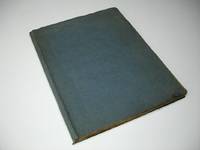
Firenze Appresso Andrea Bonducci con licenza de Superiori 1756. 4to. 831 blank p. Old plain grey paper wrapper. 24 cm Ref: Details: Title printed in red & black. Engraved coat of arms of the cavaliere Gaetano Antinori the dedicatee on the title. Uncut and with broad margins Condition: Title spotted and yellowing; a small paper repair in the upper margin of the second leaf Note: Etruscomania or 'etruscheria' was an 18th century cultural movement. An obsessive curiosity about the origins language art and customs of the Etruscans swept all over Europe especially Italy at the beginning of that century. It exploded with the publication of 'De Etruria Regali Libri Septem' 'Seven Books about Royal Etruria' of the Scottish historian Thomas Dempster 1579-1625. It was the first detailed study of every aspect of Etruscan civilisation and was first published one century after his death in Florence in 1723/24. The 'Accademia Etrusca' was then established at Cortona in 1726. This Academy produced papers and reports on Etruscan culture religion architecture antiquities and their language. One of the leading exponents of this etruscomania was the Italian scholar of Florentine origin Giovanni Maria Lampredi 1731-1793. His 'Saggio sopra la filosofia degli antichi Etruschi' is considered an important contribution to Etruscology. See Italian version of Wikipedia 'Etruscologia' The treatise is about the natural theology cosmogony botany medicin politics of the Etruscans. There even is a section on 'keraunoskopia' the Etruscan theory of thunder. Lampredi argued that the Etruscans had an 'emanative system' for the cosmos tied to Pythagoreanism and Stoicism. Lampredi dedicated this work to the Head of the 'Accademia Etrusca di Cortona' Gaetano Antinori. The erudite fervor of the 'etruscheria' came to an end thanks to the work of the German scholars Winckelmann and Karl Otfried Müller. The 20th century Italian ancient historian Arnaldo Momigliano who was also an important historian of ancient historiography wrote that the Etruscan frenzy was for a century a disintegrating force in Italy a real illness of Italian culture because it got bogged down in a one-sided patriotic and uncritical position of a parochial type on the history of civilization Rome Etruscans and Italy. It's positive side-effects were the foundation of collections musea and it broadened the view concerning the history of ancient Italy and the art and archaeology of the pre-roman peoples Collation: A-I4 K6 leaf K6 verso blank Photographs on request unknown
Ссылка продавца : 140028
|
|
|
PROPERTIUS
Sex. Aurelii Propertii Elegiarum libri quatuor. Ad fidem veterum membranarum curis secundis Jani Broukhusii sedulo castigati. Accedunt terni indices quorum primus omnes voces Propertianas complectitur.
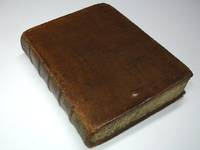
Amsterdam Amstelaedami Apud Rod. & Gerh. Wetstenios 1727. 4to. XXXII including the frontispiece 4891109 indices1 blank p. Contemporary calf. 24 cm Ref: STCN ppn 18661859X; Schweiger 2830; Dibdin 1384: 'very valuable'; Moss 1274: 'A good edition containing a valuable and useful commentary'; Graesse 5460: 'belle édition'; Ebert 18028; Brunet 4904/05: 'Édition assez recherchée'; Fabricius/Ernesti 1435 Details: Back gilt and with 5 raised bands. Brown morocco shield in the second compartment. Frontispiece designed and executed by J. Mulder it depicts a Roman Emperor in a chariot; he is leading a triumph; in front of him the wives of his conquered ennemies with their hands bound behind their backs; in the background a triumphal arch and the monumental grave of Augustus. Title printed in red & black. On it the engraved printer's device it depicts a burin being sharpened on a whetstone Wetstein! around it the device: 'Terar dum prosim'. At the beginning of the 'dedicatio' the engraved coat of arms of Stephanus Hurgronje Condition: Some slight wear to the extremities of the binding. First gathering slightly yellowing Note: The young equestrian Sextus Propertius born ca. 50 B.C. is one of the most fascinating Roman love poets. His surviving work consists of four books of 'Elegiae' containing 4046 lines of elegiac verse. His poetry at times obscure learned and eccentric can be witty shows dramatic power and combines polish and refinement. § From the Renaissance onward Propertius formed part of a triumvirate of Latin erotic poets together with Catullus and Tibullus. They were already united in one edition published in Venice in 1472. The list of combined editions of these 3 is huge. A fashion for imitating them arose. Many humanist elegiac poets produced poems addressed to some alluring girl as Propertius had done for his Cynthia. Propertius influenced among others the Dutch erotic poet Janus Secundus the English poet John Donne and the German author Goethe. Wellknown is Ezra Pound's 'Homage to Sextus Propertius' 1917. § This 1727 edition of Propertius is a revised edition of the edition of 1702. The first edition was produced by the Dutch scholar/soldier Joan van Broekhuizen Janus Broukhusius 1649-1707 who during an adventurous life pursued his classical studies and poetry at leisure. As a neolatin poet he is known as the 'Propertius of Holland'. Sandys 2329 In 1684 he published his 'Carmina' a collection of his Neolatin poetry. Utrecht 1684 His editions of Propertius 1702 and Tibullus 1707 laid the foundation for his reputation as a classical scholar. He was admired as a latinist for his taste and for his erudition. NNBW 4309/12 This second edition was produced by the Dutch scholar and minor poet Pieter Vlaming 1686-1733. In the preface L.B. Lectori Benevolo Vlaming tells us that he once bought at the auction of the library of the Dutch classical scholar and schoolmaster David Hoogstraten a 'codex' manuscript filled with annotations from the hand of Broukhusius which he apparantly had been collecting for a projected second edition of Propertius. Nothing came however of such an edition. Hoogstraten died 1724 Now at the request of the publishers Wetstein Vlaming produced a new revised and augmented edition of Propertius. 'Nihil dedimus nisi mere Broukhusianum'. p. 3 recto One year later in 1728 and 21 years of the death of Broukhusius Vlaming published also Broukhusius' edition of the 'Opera omnia' of the Italian neolatin poet Sannazarius/Sannazaro Provenance: On the front flyleaf 2 small names: ''Margadant 1912' and 'F.J. Brevet 1914'. § The first name must be of the Dutch man of letters Steven Willem Floris Margadant born in The Hague in 1887; he died in 1946. In 1929 he published 'De psychologie van het Grieksche werkwoord'. 'Persoonlijkheden in het Koninkrijk der Nederlanden in woord en beeld' Amsterdam 1938 p. 979 § The next owner the jurist Frederik Jacobus Brevet 1893-1983 was a businessman and also a man of letters. In 1958 he published a translation of 16 odes and an epode of Horace. In 1966 followed a more varied collection 'Mozaïek' which contained besides more translations of Horace also Catullus a number of poems from the 'Carmina Burana' and from Greek poet Meleager and poetry of his own. In 1978 appeared a translation of all 103 odes of Horace. From 1952 till the end his life he contributed a great many articles on classical culture to the periodical Hermeneus of the Dutch Classical Society NKV. He bought this book at the age of 21 when he was studying law in Leiden resources.huygens.knaw.nl/bwn1880-2000/lemmata/bwn3/brevet Collation: -44; A-4F4 leaf 2F4 verso blank Photographs on request hardcover
Ссылка продавца : 140037
|
|
|
CEBES- SPIEGHEL,HL H L
H.L. Spieghels Hertspieghel en andere Zedeschriften met verscheidene nooit gedrukte stukken verrijkt en door aenteekeningen opgeheldert door P. Vlaming. Met nieuwe figuren.
Amsterdam t'Amsterdam By Andries van Damme 1723 8vo. LXVIII564 p. Frontispiece 1 portrait 2 folding plates 8 full page engravings 2 folding tables and 4 poems embedded in full page engravings. Calf. 19.5 cm Ref: STCN ppn 17136984X; OiN p. 138; Geerebaert XXIV7 Details: Back and boards gilt with floral motives. Frontispiece by J. Goeree C. van Haarlem A van Buysen it depicts Arion on the back of a huge dolphin playing his lyre while the storm rages. Title printed in red and black. Engraved printer's device designed and engraved by J. Goeree on the title depicting 3 bucolic musicians motto: 'Altro diletto ch' imparar non provo' 'I feel no greater delight than to learn'. After the preface follows a biography of Spieghel 'testimonia' concerning him and a bibliography. The biography is preceded by a portrait beautifully engraved by P. van Gunst. In the third book of the Hertspieghel which deals with the famous allegoric 'Cave of Plato' a folding plate has been inserted depicting the Cave where most people live in darkness and where a small number of philosophers percieves the true form of reality. This fine engraving is made after the wellknown engraving of the cave of Plato by Jan Pietersz Saenredam 1604. Each of the seven books of the Hertspieghel is preceded by an engraved headpiece. After the Hertspieghel a short section 'Hieroglifica' offers 8 moralistic poems of 8 lines with an opposing full page emblematic engraving. Then follow four 4 line poems embedded in an engraving of J. Goeree. They offer and illustrate eternal truths like 'Wel leven menschen wys in hutten/ Als Timmerkoorts den zotten plaegt/ 't Onnut gebouw dat kou zou schutten/ Praelbouwers vaek in armoê jaegt.' After a long section with occasional and moralistic poems and letters the book ends with a Dutch translation of the dialogue 'Cebetis Tabula' the table of Cebes made by Pieter Vlaming. This dialogue dates from the first century A.D. it was attributed to the philosopher Cebes a student of the Athenian Socrates. In it an ancient temple painting which caught the attention of two visitors is explained by an old man. It is an allegorical picture on which the dangers and temptations of human life are symbolically represented. It shows that happiness can only be reached by proper education and a virtuous life. This once popular ethical work is now almost forgotten. But in the 16th 17th and 18th century it was widely read especially by clerics and schoolboys. The accompanying folding plate 25x14.5 cm is an artist's impression of the 'Tabula Cebetis'. It shows the many ways leading to vice and the only straight and narrow path to virtue: we see a garden with 2 concentric walls filled with a host of allegorical figures. At the Entrance to life sits 'Seductio' Temptation offering a youth a drink from a goblet. In the foreground also the philosopher Cebes explaining to a bunch of young children the dangers and temptations which lie ahead. Most people within the first wall among them kings and bishops are busy gambling fighting drinking. Within the second wall we see philosophers and scholars. In the background is a high hill with a temple on top a destination which is reached by only a few. This engraving is a minimized version of Goltzius' engraving of the 'Tabula' of Cebes of 1592 Condition: Back severely damaged partly gone and loose along the front joint. Boards worn some small damages to the edges of the boards Note: Hendrik Laurenszoon Spieghel or Spiegel 1549-1612 is one of the most important writers and thinkers in the Dutch Republic during the turn of the 16th and 17th century. He is seen as a forerunner to the Dutch Golden Age with giants as Vondel Hooft and Huygens. Spieghel's principal work is the Hart-spiegel or Hertspieghel Mirror of the Heart published posthumously in 1614. In this didactic and moralistic poetic work Spieghel expounds his views on the human condition and how to lead a virtuous life. The essential idea of the Hertspieghel is that virtue makes a man happy and that this is in itself a reward. To accomplish this the author submits the inner life of man himself to a precise reflection. Spieghel upholds the freedom of will. Self-knowledge is the foundation of self-development and the starting point for achieving virtue. § Spieghel is a difficult poet who loves to use archaic words and invent neologisms and who is difficult reading for those who are not familiar with the Bible classical antiquity and ancient literature. His style is obscure complex and concise and sometimes lacks clarity. But once the reader has grown accustomed to Spieghel's style and views it is clear that the Hertspieghel which voices opinions of the pre 1600 generation is one of the first modern Dutch poems. For this work Spieghel asked the usual approbation of the Roman Catholic Church and for this purpose he sent the manuscript to Louvain but it was returned without the necessary approbation with the remark that the work was incomprehensible. Still it found readers who were interested in Spieghels ethics. In 1615 a second edition was published. The third printed by Hendrik Wetstein in 1694 is enlarged with other writings and poems by Spieghel. This edition of 1723 the most complete and the best was edited by the Dutch author Pieter Vlaming1686-1733 who has enriched it with several new pieces and with his notes Collation: -48 52 leaves 7 & 8 of the first gathering are cancels; A-Y8 Z4 Aa2 folding plates at p. 49 and 237 12 plates between p. 161 and 175 Photographs on request hardcover
Ссылка продавца : 130377
|
|
|
PINDARUS
PINDAROU PERIODOS. Pindari Olympia Pythia Nemea Isthmia. Johannes Benedictus medicinae doctor & in Salmuriensi Academia Regia linguae Graecae Professor ad metri rationem variorum exemplarium fidem scholiastae ad verisimiles coniecturas directionem totum authorem innumeris mendis repurgavit. Metaphrasi recognita latina paraphrasi addita poeticis & obscuris phrasibus graeca prosa declaratis; denique adiectis rerum & verborum brevibus & sufficientibus commentariis arduum eiusdem sensum explanavit. Editio purissma cum indice locupletissimo.
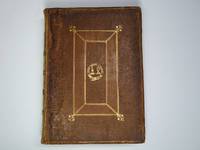
Saumur Salmurii Ex typis Petri Piededii 1620. 4to. XVI756recte 75056 index p. Calf 24 cm Ref: Gerber p. 5; Rico p. 13; Hoffmann 399; Schweiger 1235; Dibdin 2288; Moss 2410: 'a very good and critical edition'; Brunet 4659; Graesse 5294; Ebert 16864 Details: The Greek text is accompanied by a Latin paraphrasis on the left and a Latin translation on the right. Back with 5 raised bands elaborately gilt & expertly rebacked in antique style in the 19th century. Boards with gilt fillet borders having also 2 double fillet gilt rectangles and a gilt coat of arms in the center. 19th century marbled endpapers. Woodcut ornament on the title. Edges dyed red Condition: Binding worn at the extremes. Edges of the boards chafed. Corners bumped. Leather on the boards crackled. Strip of 1 cm cut from upper margin of the title and repaired with a new strip. A few old ink marginalia Note: A quarter of the works of the Greek poet Pindar ca. 518-438 B.C. survives his four books of 'epinicia' named after the Great Games the Olympian Pythian Nemean and Isthmian. Pindar wrote eulogistic hymns to celebrate a victory in athletics boxing and horse racing. Praised in a magnificent way are the victor his family the native city. 'Each ode draws from a variety of historical cultural and mythological sources. The highly allusive manner by which this material is presented is complemented by an equally rich repertoire of metrical patterns from epic Doric and Aeolic systems'. The Classical tradition Cambridge Mass. 2010 p. 729 'Extended similes and difficult metaphors intricate syntax and rapid narration far-reaching digressions and bold disruptions' result in grandiose but also obscure enigmatic and sometimes seemingly awkward poetry. Already in antiquity the comic playwright Aristophanes presented in the 'Aves' Pindaric poetry as foolish pretentious and embarrassing. The Hellenistic poets Callimachus and Theocritus wrote poetry under his influence. The Roman poet Horace thought him grandiose and sublime. § Pindar's influence on European literature is great. The great number of editions in Greek and Latin translations of Pindar's odes that were printed in the 16th century are an indication of a continuous and widespread humanist interest. Pindar was with the Roman poet Horace the chief classical model for modern formal lyric poetry. The lyric poets of the Renaissance borrowed first of all thematic material from Pindar. It brought a nobler and graver spirit. 'They enriched their language on the model of Pindar's and Horace's odes taking it father away from plain prose and from conventional folk-song phraseology. And in their eagerness to rival the classics they made their own lyrics more dignified less colloquial and song-like . more ceremonial and hymn-like'. G. Highet 'The classical tradition' Oxford 1978 p. 230 The 'loudest and boldest answer to the challenge of Pindar's style and reputation came from France' beginning with Pierre de Ronsard born 1524. Ronsard wanted to be the French Pindar introducing the Pindaric ode into the vernacular literature of France. He together with his poetic friends 'were the energy and the material of the group of poets who rebelled against the traditional standards of French poetry and proclaimed revolution in ideals and techniques. They called themselves the Pléiade after the group of seven stars which join their light into a single glow'. Op. cit. Highet p. 231 Their work amounted to a closer synthesis between French and Greco-Latin literature and was the annunciation of a new trend in French and European literature. § Many of Pindar's gnomic maximes and punctuated statements containing elements of traditional wisdom were collected in Renaissance anthologies of 'sententiae' for example in Erasmus's Adagia. Already the first full Latin translation of Pindar 1528 indexed all the gnomes according to moral lessons. 'The sententious Pindar . provided the Humanists of the Reformation with pithy statements of moral instruction and wordly advice which ensured the poet's place in pedagogical circles. Moreover as a source of proverbial wisdom Pindar was elevated nearly to the status of biblical Salomon. . The sheer variety of Pindarically influenced traditions -the political ode and the personal the religious hymn and the song of genius the freely aimless and the rigorously concise- all serve as a testament not only to Pindar's versatility but also to his rich potential to inspire'. The Classical tradition Cambridge Mass. 2010 p. 729/30 For Filelfo Pontano Cowley Dryden Pindar was a model for political encomium and there are quite a number of imitators of Pindar in European literature. The French author Voltaire made the witty remark that Pindar wrote verses that no one understood and everyone had to admire. § This Pindar edition of 1620 produced by the scholar Jean Benoist or Johannes Benedictus died 1664 is based on the edition of Wittenberg of 1616 by the German scholar Erasmus Schmiedt or Schmidius 1570-1637 who was the first truly important Pindaric scholar and according to Dibdin the 'eruditorum Pindari facile princeps'. Benoist was a doctor of medecin and it is said of German origin. He was appointed on the recommandation of the great Greek scholar Isaac Casaubon the King's professor of Greek at the protestant Academy of Saumur. A year before Benoist had published in Saumur an edition of Lucian also with his Latin translation. His Latin translations leaves however according to Hutton much to be desired. J. Hutton 'The Greek Anthology in France' Ithaca N.Y. 1946 p.176/77 The commentary of Benoist on the other hand is excellent for many philological historical and mythological problems are explained in a sagacious manner. The text also contains many valuable readings from other earlier works and there are excerpts of scholia. 'Benedictus contributed 23 emendations 4 of which are printed and 2 mentioned in the Snell-Maehler Teubner edition on 1980'. GerberD.E. 'Emendations in the Odes of Pindar' in 'Pindar' Entretien sur l'Antiquité Classique XXXI' p. 9 Provenance: On the boards the gilt coat of arms of John Henry Gurney. This might be John Henry Gurney Sr. 1819-1890 who was an English banker amateur ornithologist and Liberal Party politician or his son John Henry Gurney Jr. 1848-1922 who was an ornithologist. See for them Wikipedia Collation: a4 e4 A-5I4 5K2 minus the blank leaves 2H2 p. 243/44 minus leaf 3P3 p. 485/86 and minus leaf 4N3 p. 653/54; the pagination seems irregular owing to the removal of these 3 blank leaves Photographs on request hardcover
Ссылка продавца : 140034
|
|
|
MELA POMPONIUS
Pomponii Melae De situ orbis libri III. Cum notis integris Hermolai Barbari Petri Joannis Olivarii Fredenandi Nonii Pintiani Petri Ciacconii Andreae Schotti Isaci Vossii & Jacobi Gronovii. Accedunt Julii Honorii oratoris Excerpta Cosmographiae. Cosmographia falso Aethicum auctorem praeferens cum variis lectionibus ex MS. Ravennatis Anonymi Geographia ex MS. Leidensis suppleta curante Abrahamo Gronovio.
Leiden Lugduni Batavorum Ex officina Samuelis Luchtmans 1722. 8vo. LXXX81136 index1 blank p. frontispiece folding map. Vellum 21 cm Prize copy Ref: STCN ppn 238632024; Schweiger 2611; Brunet 4801; Dibdin 2356; Graesse 5402/403; Ebert 13632; Spoelder p. 683 Utrecht 3 Details: Prize copy of the 'Gymnasium Hieronymianum' at Utrecht without the prize. Gilt coat of arms of Utrecht within gilt borders on both boards. 6 thongs laced through the joints. The frontispiece designed by H. van der My and etched by F. Bleyswyck depicts a cartographer drawing a map of the world in the foreground 2 women one is a cartographer inspecting a map with rule and compass the other is an archaeologist busy inspecting ancient treasures. Title printed in red and black. The folding map of the earth according to Mela at the beginning of the text is by 'P. Bertius christianissimi regis geographus'. Engraved text illustrations of coins. 1 full page illustration of 2 sculptured scenes from reliefs 'in hortis Mattheis' p. 117 The first 304 pages contain the text and commentary. The rest of the book is filled with the annotations of earlier important scholars especially Isaac Vossius. His observationes fill the pages 316-606. At the end we find Julius Honorius' 'Excerpta quae ad Cosmographiam pertinent' p. 685-702 the 'Cosmographia antehac temere Aetico adscripta' p. 703-733 and the 'Ravennatis Anonymi Geographiae libri quinque' 737-811 Condition: Binding slightly soiled. Prize gone. All four ties gone. Name on the front flyleaf. Prize removed Note: Pomponius Mela a geographer from the South of Spain wrote in 43/44 under Claudius the first surviving work on geography in Latin. Pomponius is foremost a writer: distances directions and other useful information for sailors or travellers is lacking. His work was meant for the educated and curious Roman public. The work was known in the Middle Ages and in the following centuries he was read at school. § The Dutch classical scholar Abraham Gronovius 1695-1775 acted as librarian at Leyden University from 1741 until his death. He edited editions of the 'Historiae Philippicae' of Justinus and two editions of Aelianus. He showed interest in geographical matters and published at Leiden in 1739 his 'Varia Geographica'. He based this new 'Variorum' edition of the geographer Mela Pomponius on an edition which was previously published in 1696 by his father Jacobus Gronovius 1645-1716 who was professor Greek of the University of Leiden Provenance: On the front flyleaf in ink: 'Ex praemiis P.G. v. Poolsum 1731'. We found a Petrus Georgius van Poolsum born in Utrecht in 1718 who became minister of the protestant church of Doorn in 1741. He died in 1772. Does the inscription mean that young Van Poolsum age 13 received this prize in 1731 This seems possible for he has the right age and was from Utrecht. Spoelder signals 3 copies of prizes with this type of coat of arms; they were awarded between 1689 and 1711 Collation: pi1 -58; A-3G8 leaf 3G8 verso blank Photographs on request hardcover
Ссылка продавца : 130360
|
|
|
FESTUS & M VERRIUS FLACCUS
Sex. Pompeii Festi et Mar. Verrii Flacci De verborum significatione lib. XX. Notis et emendationibus illustravit Andreas Dacerius in usum Delphini. Accedunt in hac nova editione notae integrae Josephi Scaligeri Fulvii Ursini & Antonii Augustini cum fragmentis & schedis atque indice novo.
Amsterdam Amstelodami Sumptibus Huguetanorum 1700. 4to. 32 including frontispiece59649624 index p. Vellum 25 cm Ref: STCN ppn 844243612; Schweiger 2355; Brunet 4798; Graesse 2574; Ebert 7501; Spoelder p. 491: Amsterdam 10 Details: Prize copy without the prize. Back gilt and with 5 raised bands. On both boards the gilt coat of arms of Amsterdam within 2 gilt borders which consist of a repetition of floral motifs and the city's coat of arms. Frontispiece showing the jump of Arion from his ship while playing the lyre and being watched by the dolphin that would save him; between Arion and the dolphin on a banner 'Trahitur dulcedine cantus'; at the bottom of the plate a portrait of Festus flanked by sea deities; at the top 2 angels present the coat of arms of the Dauphin the heir to the throne of France. Title in red & black and with the engraved coat of arms of the Dauphin Condition: Vellum soiled; small hole in the first compartment of the back. Front joint starting to split. Vellum on the upper board slightly damaged. All 4 ties gone. The prize was removed Note: Festus is a 2nd century abbreviator of a lexicographic work in 80 books by Marcus Verrius Flaccus that dates from the first century B.C. § This Festus of 1700 is a revised and augmented edition of a work which appeared previously in the 'Ad usum Delphini' series. It was first published in Paris in 1681 and produced for the education of the Dauphin in usum Delphini the young crown prince of France Louis of France who was born in 1661 as the eldest son of Louis XIV King of France. His title was as the heir apparent to the throne Dauphin Delphinus. Since he died before his father he never became king. Great care was bestowed on the editing and printing of the series. 39 editions of Latin authors from Cicero to Ausonius also difficult ones like Manilius and this Festus were published by leading or promising French scholars. The series was also meant for a broader public des honnêtes gens and offered introductions reliable and readable texts easy interpretations and philological educational and historical notes without too much philological niceties or textual criticism. The series was a huge success. § The edition of Festus and its accompanying commentary is the starting point of the career of the French classical scholar André Dacier 1651-1722. He follows the texts proposed by Agustin and Scaliger and aimed at presenting a clear and educationally useful text. In the preface also adopted in this edition of 1700 Dacier tells that he wants to present the prince useful information about Roman law ancient treaties foundations of power the royal laws of Rome etc. Its interest lies in the realia not in its literary worth. Dacier was the first to publish a readable text of Festus. See 'La collection Ad usum Delphini' Grenoble 2000/5 volume 2 p. 263-72 Dacier's Festus was repeated in 1692 and reissued in 1699 and in 1700 with additions of great scholars like Scaliger. Brunet calls this Amsterdam edition 'recherchée' Collation: pi1 4 minus leaf 4 2-44; A-4X4 Photographs on request hardcover
Ссылка продавца : 140074
|
|
|
WILLINK,D
Daniël Willinks Amsterdamsche Tempe of de Nieuwe Plantagie. Begrepen in twee boeken. Nevens den Amstelstroom. Met kopere platen. De tweede druk.
Amsterdam Te Amsterdam By Andries van Damme Boekverkoper op 't Rokin bezuyden de Beurs 1721. 8vo. XL1271 blankXII36 p. frontispiece 3 engraved plates and 2 text engravings. Vellum 19 cm Ref: STCN p.p. 171375564 Details: Nice copy; 5 thongs laced through both joints. Frontispiece designed executed and explained by J. Goeree; it shows several allegorical figures in a bucolic landscape de Nieuwe Plantage; in the foreground sits 'Dichtkonst' Poetry listening to 'Zeede-leer' Ethica a woman who holds a bridled lion: 'Die Wyze Leermeestres die Leeuwen fel en wreedt / Door haare lessen temt en zacht te leyden weet / En hunnen woesten aart voorzigtig in kan tomen'; p. A1 verso on a pedestal in the center of the frontispiece rests the rivergod Amstel surrounded by a host of merry putti; in the distance we get a glimpse of the Muiderpoort. The other 3 plates are designed by A. Houbraken. The first shows the personification of wealthy Amsterdam steedemaagd in the background again the Plantage and the Muiderpoort. The second plate depicts 'Dichtkonst' and some putti. The third is an engraving of the rivergod Amstel in a bucolic polder-scene south of the city. After the title page there is a 3 page dedication with the engraved coat of arms of the Mayor of Amsterdam Mr. Jan de Witt. At the beginning of the second work the 'Amstelstroom' one finds the coat of arms of Willem Noltenius. On the title a printer's mark engraved by J. Goeree it depicts putti playing a game of checkers the motto reads: 'Let eerje zet' Condition: Vellum age-toned. Small bookplate on the front pastedown. Paper slightly yellowing Note: The Amsterdam wine merchant Daniël Willink 1676 - 1722 was in his sparetime a local historian and poet. He became a member of the Poetry Society 'Constantia et Labore'. A great poet he was not and he is only remembered for his poetry on the city of Amsterdam in which he praises its beauty. These poems based on his historical investigations are still of interest. His oldest poem is the 'Amstelstroom' which was first published in 1708. Its second revised and augmented 1/3 edition was combined with the first edition of 'Amsterdamsche Tempe of Nieuwe Plantagie' of 1712 of which this book of 1721 is a reissue. Willink's best known poem 'Amsterdamsch Buitensingel' was published posthumely in 1723. His interesting historical investigations appeared under the title 'Amstellandsche Arkadia' only in 1737. The history of Amsterdam and its surroundings is told here as a kind of travel story. NNBW 41463/65 § The 'Amsterdamsche Tempe' sings the praises of a so-called 'locus amoenus' in this case the 'Planatagie' which is presented as an idealized place of safety and comfort. There are trees schoon bosschaadge there is grass lustprieël and water zilvren vliet. It is a place of refuge that highlights the differences between urban and rural life. 'Zo even doet ook de Ambachtsman/ Die hier komt treeden zonder kommer/ Daar ieder 't zweet opdroogen kan/ Gedekt door deeze groene lommer/ Waar onder hy het zuur vergeet/ Der weeken waar in hy moet werken / En troost zich hier in dat men weet/ Dat Godt den arbeid kan versterken'. p. 9 The prose preface to 'Amsterdamsche Tempe' opens thus: 'De Nieuwe Plantagie een wellustige streek lands in den omkring der wydberoemde Stad Amsterdam geleegen in het Jaar 1682. begonnen aangelegt bebouwt bepoot en beplant te worden sedert krachtig toegenoomen in allerlei soorten van in- en uitheemsche boom-bloem-en plantgewassen koomt u hier bescheiden Leezer in twee boeken verdeelt te vooren; waar van het eerste eene beschryvinge der plaatse zelve met haare rondomleggende gezigten bevat en het tweede 't geene nut en sierlyk binnen de hoven gevonden wordt nevens het zoet vermaak en de aangenaame tydkortinge van ieder jaarsaizoen'. p. 5 verso § The 'Plantagebuurt' Plantage-district a polder which came within the walls of Amsterdam with the city expansion of 1682/83 was created a park because it turned out to be impossible to find buyers who wanted to build their houses there. For two centuries this park or 'plantage' served as an entertainment district for the bourgeoisie. It included the city's 'Hortus Botanicus' and from 1838 the Zoo commonly called 'Artis'. From 1860 onward the park was transformed into a housing-area an area which still is green and still popular among the bourgeois. It attracts tourists from all over the world to visit the Hortus and the Zoo Collation: -28 including frontispiece 34; A-H8 leaf H8 verso blank; 2A-C8 Plates before the leaves A1 E1 and 2A1 Photographs on request hardcover
Ссылка продавца : 130460
|
|
|
EWALD,JL J L
Godsdienstig Handboek voor Christen-vrouwen en dochters door Joan Lodewijk Ewald. Uit het Hoogduitsch.
Amsterdam Bij Johannes van der Hey 1809. 8vo. XII4711 p. Half calf 23 cm. Details: Nice copy. Back ruled gilt. Red gilt shield in the 'second compartment'. Marbled boards. Engraving of a devotional scene on the title engraved by J.E. Marcus it depicts 2 women in a wreath of clouds; one of them points with her right finger to heaven; on her girdle in Greek the first 3 letters 'THEO' the rest of the text disappears in her dress. She is probably the personification of THEOLOGIA. To complete it as THEOTOKOS an epithet of Maria is of course impossible in a book on female protestant virtue. Next to this woman stands a young woman who has veiled her hair and humbly looks downward Condition: Endpapers somewhat foxed. Edges slightly foxed. Ownership inscription on the front flyleaf Note: The German protestant pedagogue and theologian Johann Ludwig Ewald 1747-1822 held various positions as preacher. He was appointed professor 'der Moral' at Heidelberg. Toward the end of his life he was counselor Kirchen- und Ministerialrath to the government of Baden. He was a liberal protestant and a moderate supporter of contemporary 'Rationalismus' which caused him trouble with the orthodox clergy. He always kept far from orthodoxy adhered to biblical positivism and concentrated on paedagogy. He was a voluminous writer his subjects were theology exegesis ethics but especially paedagogy. He had great talent for popularizing theology mixed with philosophy literature and aesthetics. The lightness of his touch and the freshness of his writings brought him many readers. Allgemeine Deutsche Biographie 6 p. 444/46 We quote from a review of this book from 1810. 'Niemand laat zich door het woord 'godsdienstig' afschrikken. De Schrijver behoort niet onder die strenge of laat ons liever zeggen eigenzinnige stugge en wrevelige zedeleeraars welke de minste onschuldige vrolijkheid niet verdragen kunnen en overal even streng zijn. Bij hem verschijnt de godsdienst in een bekoorlijk licht geschikt om alle onze genoegens te veredelen te vergrooten en de waarneming der pligten welke toch elke vrouw en jonge dochter heeft gemakkelijker te maken'. 'Bijdragen ter bevordering van het onderwijs en de opvoeding voornamelijk met betrekking tot de Lagere Scholen in Holland' Deel 1 2nd part: 'Boekbeoordelingen' Leiden 1810 p. 97 Provenance: On the front flyleaf: 'E.C.W. heeft dit gekregen van hare Moeder C.E.W . die het als souvenir gekregen had van A.C.A. de haan Hugenholtz' Photographs on request hardcover
Ссылка продавца : 130458
|
|
|
(MAAS,JF) J F
Manuel militaire ou cayers détachés sur toutes les différentes parties de l'art de la guerre. Cayer I. sur les convois.
Copenhagen Copenhague Leiden Leide Chez Elie Luzac 1761. 8vo. XII11-1144 p. 2 folding engraved tables. Calf 20.5 cm Ref: M. van Vliet 'Elie Luzac 1721-1796' Nijmegen 2005 p. 153-54 & 571 Details: Back gilt and with 5 raised bands. Brown morocco shield in the second compartment. Edges of the boards gilt edges of the book dyed red. Marbled endpapers. Title in red and black. 2 folding maps depicting an imaginary landscape with 1 47x24 cm 'Plan de la marche d'un convoy' and 2 35x24 'Plan de l'attaque d'un convoy' Condition: Boards somewhat scratched and stained. Wee wormhole at the bottom of the back. Both pastdownes detached. Red ink stain on the front flyleaf. Edges of the first table thumbed it also suffers from 3 tears of 6 cm on the folds Note: KVK The Karlsruher Virtueller Katalog presents only a small number of copies of this title. Most copies are catalogued anonymously. The Staatsbibliothek Berlin records a copy and attributes it to one 'Johann Friedrich Maas'. The 'Kongelige Bibliotek Dänemark' calls the author 'Maasev.d.' Worldcat. records 9 copies 7 anonymous and 2 ascribed to one 'v.d. Maase'. A passage in a letter of the Danish publisher J.F. Hansen to the German author Heinrich Wilhelm Gerstenberg dated 'Slesvig d. 27 Jul. 1763' sheds light on this matter: 'Bei dem Manuale ist mir beigefallen ob Ew. Hochwolgeb. es nicht für ratsam schicklich u. fast für notwendig erkenen dass ich das teutsche Msct. H.M. v. Maas vorher praesentire u. gleichsam seine Genehmigung zum Druck bei ihm suche. Sie wird mir nicht entgehen: eine Folge aber welche bei H. Major zwar nicht eintreffen aber bei dergleichen sonst gar leicht sich begeben kan ist: dass der Autor wenn sein Werk ohne sein Vorwissen veranstaltet wird einige Veränderungen mit demselben entweder vornemen oder Zusätze dazu macht u. alsdenn zieht der gleichsam stillschweigende Verleger den kürtzern ja irre ich mich nicht so deucht mir mal gehört zu haben dass H.M. bei einer etwarigen Übersetzung noch einige Anmerckungen demselben beifügen wollte. Desto besser!' The note which accompanies this passage reveals more: 'Wie bisher unbekannt war scheint Gerstenberg eine Übersetzung folgenden Werks geplant zu haben: 'Manuel militaire. Ou cayers détachés sur toutes les différentes parties de l'art de guerre. Cayer 1-2'. Verfasser war Johan Frederik Maas 1713-1790 seit 1759 dänischer Major'. R. Whittmann 'Zur Verlegertypologie der Goethezeit. Unveröffentlichte Verlegerbriefe an Heinrich Wilhelm Gerstenberg' in 'Jahrbuch für internationale Germanistik' 8/1 1976 p. 99-130 § His plan is the author of the 'Manuel militaire' tells us in the preface 'de donner sur toutes les Opérations militaires de petits volumes détachés' to produce small volumes. He plans to produce slim and handy volumes not only 'pour la commodité des Acheteurs' but also because the art of warefare reaches more perfection every day and every now and then new discoveries influence warefare. He begins the series with the 'Convoy': 'la manière de les conduire de les assûrer de les attaquer & de les défendre'. This is explained in theory and in practice. Maas describes e.g. elaborately the skirmishes around the Dutch town of Bergen op Zoom between the French troops and the Dutch forces at the end of the War of Austrian succession in 1747 and 1748. See Wikipedia s.v. Het beleg van Bergen op Zoom The author is full of optimism about his project 'S'il est gouté les autres le suivront de près'. p. IX & X. A second volume 'sur les fourrages' followed in 1763. Then it stops. The series did not catch on and a German translation of the first part was never published. This translation would probably have been published by the Leiden publisher Elie Luzac in cooperation with the firm of Weidmann. Nothing came of it. To confuse matters M. van Vliet refers in her dissertation on Elie Luzac to 'Johann Friedrich Maas' not as an officer but as a Copenhagen publisher. Luzac had certainly as Maas high expectations concerning the Manual. From an auction list of 1801 Luzac died in 1796 we learn that there were still 586 with tables and 599 copies without tables available and 112 copies of volume 2 of the series were still gathering dust. Vliet M. van 'Elie Luzac 1721-1796 Boekverkoper van de Verlichting' Nijmegen 2005 p. 153/4 and p. 571 This huge number contrasts sharply with the small number of copies on library shelves. The lot probably did not find a buyer and the remainder must have been destroyed. We found an advertisement for this book in the 'Rotterdamsche Courant' of the first of january 1785 and repeated on the 8th. Luzac announces that it might be wise considering the turbulent times naval war with the English an immanent war with Prusia and domestic troubles violent riots between the patriot militias and the orangist mobs for officers and those interested in the military to buy this book. The price is 1 guilder and 15 stuivers. As we saw it was of no avail Collation: A-8 A5 plus A6 ; B-G8 H2; A second leaf A6 has been inserted after the preliminary pages between the regular A5 and the not signed A6; this inserted A6 gives on the recto side a list of authors and on the verso the table of contents and a list corrigenda; most copies we saw had the second leaf A6 which is not paginated at the end after H-2 Photographs on request hardcover
Ссылка продавца : 130444
|
|
|
MEERMAN,J
Josia Antoninus Pius en Hendrik IV met elkander vergeleeken. Eene verhandeling voorgeleezen in de Maatschappij van Natuur- en Letterkunde onder de Zinspreuk: Diligentia in 's Graavenhaage op Dingsdag den 13 en 20 January 1807 door Mr. Johan Meerman Heer van Dalem en Vuren.
The Hague In 'sGraavenhaage By de gebroeders Van Cleef boekverkoopers des Konings en der Koninklyke Bibliotheek 1807. 8vo. IV1262 stocklist p. Half calf 20 cm Ref: Details: Back gilt and with 5 raised bands. Red morocco letter label Condition: Binding slightly worn at the extremes. The small piece of leather which should protect the right lower corner of the upper board has gone. Some small damage to the leather along the joint of the upper board Note: The Dutch Republic was between 1588 and 1795 a Confederation of the Seven United Provinces. This period ended with the French occupation in 1795. In this year the French established a vassal state called the Batavian Republic which lasted till 1806. On May 24 1806 the French introduced in the Netherlands a hereditary monarchy. The first constitutional king of the newly created Kingdom of Holland was Louis Napoleon the younger brother of Napoleon. The Dutch soon accepted the inevitable and the not unsympathetic Louis Napoleon became even popular too popular perhaps. Louis promoted in the eyes of Napoleon the Dutch interests too well and consequently he dethroned his brother in 1810 when the Kingdom was incorporated into the French Empire. This annexation lasted till 1813. § The career of the Dutch politician author and book collector Johan Meerman 'Heer van Dalem en Vuren' 1753-1815 flourished under the domination of the French. From 1802 till 1807 he was a member of the 'Departementaal Bestuur van Holland'. From 8 april 1806 to 1 september 1809 he was Chamberlain of King Louis Napoleon and from 1807 he was responsible for Education and Science in the kingdom director of the Dutch Royal Library and chief of Royal Museums. After the annexation in 1810 he was appointed a member of the 'Sénat Conservateur' of Napoleon. After Napoleon's abdication in 1813 he returned to the Netherlands. § As a member of the 'Maatschappij van Natuur- en Letterkunde' a 'Society of Arts and Sciences' and as Chamberlain of King Louis Napoleon Meerman published in 1807 a historical treatise 'Josia Antoninus Pius en Hendrik IV met elkander vergeleeken' in which he compared the lives of 3 great royals the biblical Joshua King of Juda the Roman Emperor Antoninus Pius and the French King Henry IV. A contemporary reviewer wondered what the heck these three royals had in common. 'Vaderlandsche letteroefeningen' Jaargang 1807 p. 441-444 The parallels which Meerman sketched seemed too far fetched. This reviewer is probably right. Meerman had possibly another purpose. Though he wanted his readers to believe that he wrote a historical work in the tradition of Plutarch's 'Vitae Comparatae' the work is seems however to serve two goals. First it seems propaganda for the establishment of a monarchy. After a time of discord revolts and the collapse of the republic it is time for the stability which a heriditary monarchy can offer. Why should not the country prosper under the guidance of wise kings Meerman rhetorically askes. 'En waaröm zouden wij onder eene reeks van wijze en het geluk des Volks bedoelende Koningen bij de Goddelijke medewerking niet op vernieuwden voorspoed kunnen hoopen' p. 3 The work might also be a kind of Mirror of Princes Speculum Principii through which Meerman Chamberlain of the King hoped to inspire Louis Napoleon to be a good king and instruct him on aspects of rule and behaviour. Mirrors for Princes aimed at creating images of kings for imitation. Louis Napoleon tried indeed to be a responsible and independent ruler he even tried to learn Dutch Collation: pi-2 A - H-8 Photographs on request hardcover
Ссылка продавца : 130457
|
|
|
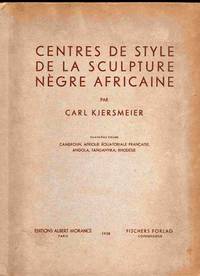
Carl Kjersmeier
Centres De Style de la Sculpture Negre Africaine. Quatrieme Volume: Cameroun Afrique Equatoriale Francaise Angola Tanganyika Rhodesie
Paris / Copenhague: Albert Morance / Fischers Forlag 1938. Hardcover. Good/No Jacket. 9" X 11.5. 86pp. Full page monochrome plates of Africa sculpture with supporting text. Volume / Tome 4 only. Some wear / handling to the boards. no dust wrapper. There is a gifting dedication dated 1939 signed by the author on the front free end paper. All orders processed promptly and shipped from the UK. The text is in French. This book can only be shipped outside the UK if ordered with the fast / air shipping service. Please email with queries. 9"x11.5 <br/> <br/> Albert Morance / Fischers Forlag hardcover
Ссылка продавца : 025538
|
|
|
AUGUSTINUS
Sancti Augustini Episcopi Hipponensis & Ecclesiae Doctoris opuscula quaedam selecta. . Editio quarta.
Brussels Bruxellae E typographia Francisci Vivien 1662. 12mo. XXIV5142 blank p. Vellum 12 cm Ref: STCV:12911771; Bib. catholica Neerlandica impressa 11822 Details: 5 thongs laced through the joints. Short title in ink on the back. Marbled endpapers. Lacking the frontispiece Condition: Frontispiece removed. Paper yellowing Note: Aurelius Augustinus 354-430 AD bishop of Hippo is undoubtedly the greatest and the most influential of the Church Fathers. He was trained in classical rhetoric and ancient philosophy and 'left his distinctive mark on most aspects of western Christianity'. . Augustine's major works are landmarks in the abandonment of classical ideals. OCD 2nd ed. p. 148 § The 'Opuscula Selecta' are: 'Epistola S. Augustini CV ad Sixtum presbyterum postea Pontificem Rom p. 1/45; Epistola CVI ad Bonifacium vel ut alii ad Paulinum p. 46/88; Epistola CVII ad Vitalem Carthaginensem. p. 89/119; Liber S. Augustini de Gratia & Libero Arbitrio ad Valentium & cum illo Monachos p. 121/203; Liber de Correptione & Gratia ad eosdem p. 205/284; Duae Epistolae una D. Prosperi altera Hilarii ad Augustinum p. 285/319; Libri duo S. Augustini quibus respondet duabus Epistolis D. Prosperi & Hilarii quorum prior est de praedestinatione Sanctorum; posterior de Bono perseverantia p. 321/514. § The Brussels printer François Vivien published this 'opuscula selecta' edition for the first time in 1654 and reissued it in 1656 and 1658 and for the fourth time in 1662 Collation: 12 minus leaf 1 the missing frontispiece A-X12 Y6 leaf Y6 blank Photographs on request hardcover
Ссылка продавца : 153440
|
|
|
MINUCIUS FELIX
M. Minucii Felicis Octavius. Cum integris omnium notis ac commentariis novaque recensione Jacobi Ouzeli. Cujus & accedunt animadversiones. Insuper Johannis Meursii notae. Et liber Julii Firmici Materni V.C. De errore profanarum religionum.
Leiden Lugduni Batavorum Ex Officina Hackiana 1672. 8vo. XLVIII3526429 index1 blank p. frontispiece. Half calf frontcover detached. 19.5 cm Ref: STCN ppn 063021110; Schoenemann I72; Graesse 4534; Ebert 14107 Details: Back with 4 raised bands. Marbled boards. Frontispiece engraved by G. Appelmans depicting 3 men Octavius Minucius and Octavius Januarius discussing in the shadow of a tree which grows on the border of a river behind them a statue of a naked male figure a statue of Serapis in the distance the city. This is an illustration of the crucial scene as told by Minucius at the end of the second chapter where Minucius tells how his friend Caecilius as heathens used to do threw a kiss to the statue. Octavius then criticizes Minucius for letting his friend walk 'in hac inperitiae vulgaris caecitate' the blindness of vulgar heathen ignorance and to let him greet anointed stones lapides which are adorned with a laurel wreath unctos et coronatos Condition: Binding scuffed. Upper board detached. Rear joint cracking but still firm. Flyleaves gone. Blank upper margin of the frontispiece chipping and soiled. Some small inkstains. Bookplate on the front pastedown. Small name on the title Note: The Octavius is a dialogue in defence of the christian religion and perhaps the oldest literary work of christian Latin. It was written by Minucius Felix who lived in the second or third cent. A.D. In it he tries to prove that christian principles were not contrary to pagan culture and that the Greek and Roman philosophers paved the path for christianity. The inspiration seems to come from Cicero's dialogue 'De Oratore'. The dialogue starts with Minucius recollections of the friendship he had with the recently deceased christian advocate Octavius. The setting is Ostia2. Minucius Octavius Januarius and the heathen Caecilius have come there to enjoy their holiday free from 'iudicariam curam'. Caecilius then launches a vehement attack upon the christians and their doctrines. It is the opinion of Octavius that no honorable Roman should leave a friend in the darkness of ignorance. He ridicules the folly of heathen fables and proves the existence of providence and of God. Octavius warmly praises the purity courage and other virtues of the christians. At the end Caecilius acknowleges himself vanquished and converted. § Jacobus Ouzelius Oiselius 1631-1686 born as Jacques Oisel Oesel in Dantzig was only 21 when he edited this book. Although destined for a commercial career he chose to study classical literature in Leyden. Later he switched to law and became professor of law in Groningen. He also edited Gaius and Gellius. Van der Aa vol. 14 p. 59 Ouzelius says in the 'praefatio' that he hopes that the reader will forgive him any mistakes without 'livor' and 'maledicentia'. He dedicates the book to Queen Christina of Sweden. Well if we may believe Schoenemann Christina had reason for complaint. Schoenemann is very critical about Ouzelius. He calls him a 'futilissimus commentator'. 'Omnia apta inepta incredibile stupore et imprudentia corrosa sunt'. The value of this edition lies Schoenemann insists in the printed commentaries of previous commentators. The reader should skip the notes of Ouzelius and consult the presented notes of greater scholars as Nicolaas Rigaltius or Desiderius Heraldus or Elmenhorst or Wouwer.§ At the end has been added 'De errore profanarum religionum' by Julius Firmicus Maternus edited by Wowerius with his commentary. § Firmicus lived in the 4th century A.D. In it Firmicus urges the emperors Constans and Constantius both sons of Constantine the Great the man who in 313 A.D. had declared christianity to be the state religion to take the next step and abolish paganism. § This edition of 1672 is a reissue of the edition Leiden 1652. Schoenemann tells that the publisher increased the usefulness of the book by printing the notes of the commentators below the text. In the edition of 1652 all the notes of those scholars were printed separately at the end of the dialogue Provenance: name of one 'John Bayly' on the title. The owner of this apologetic dialogue might well be the Irish clergyman John Bayly who was Dean of Lismore from 1828 until 1831. He was educated at Trinity College Dublin. He was Chaplain to Henry Paget 1st Marquess of Anglesey. He served as Dean of Killaloe from 1808 to 1828 when he was appointed Dean of Lismore. He died on 24 June 1831. Source Wikipedia § On the front pastedown tha armoral bookplate of one 'R.W.B.' The arms consist of a bar from which emerge 2 spread wings; they enclose a big heart which is pierced or pinned down by a sword Collation: -38 A-Y8 Aa-Ff8 minus leaf Ff8 leaf Ff7 verso blank Photographs on request hardcover
Ссылка продавца : 130428
|
|
|
PLAUTUS
Pseudolus ein Lustspiel des Plautus in alten Sylbenmaassen verdeutscht. Zur Anhörung feyerlicher Reden bey der öffentlichen Entlassung einiger Schüler von der Thomasschule auf die Universität am 17. April 1823 früh um 9 Uhr laded die hohen Patrone und theilnehmenden Freunde der Schule gehorsamst und ergebenst ein Prof. Friedrich Wilhelm Ehrenfried Rost Rector.
Leipzig Gedruckt bey Wilhelm Staritz 1823. 60 p. Plain wrappers 21.5 cm On the last 3 pages: 'Kurze Nachrichten zur Geschichte der Thomasschule'. Cover worn. Frontcover faded and with some small spots. Title dustsoiled The Thomasschule the 'Schola Thomana Lipsiensis' is a public boarding school in Leipzig Saxony. It was founded in 1212 and is one of the oldest schools in the world. Cultivating classical languages is an old tradition at St. Thomas School. See Wikipedia: 'Thomasschule zu Leipzig' unknown
Ссылка продавца : 154798
|
|
|
VALCKENAER,LC L C
Ludovici Caspari Valckenaer Oratio de sacra Novi Foederis critice a literatoribus quos vocant non exercenda. Habita Kalendis Iuniis 1745 quum abiret Magistratu Academico.
Franeker Franequerae Excudit Gulielmus Coulon Illust. Frisiae Ordd. atque Eorumd. Academ. Typogr. Ord. 1745. 4to. II60X p. Plain modern cloth 26 cm Ref: STCN ppn 151528659; Gerretzen p. 208/09 Details: Woodcut of the coat of arms of the province Frisia Friesland on the title. At the end a long laudatory poem of Johannes Daniel van Lennep a student of Valckenaer in Greek and by Ernst Willem Higt who studied theology in Franeker in Dutch Condition: The lower margin of last pages slightly stained. Lower margin of last leaf frayed. Last leaf soiled Note: The Frisian scholar Lodewijk Caspar Valckenaer 1715-1785 was a pupil of his fellow Frisian Tiberius Hemsterhuis and after him the greatest Dutch classical scholar of the 18th century. Hemsterhuis 1685-1766 advised his students in Franeker and later in Leiden to use especially the lexica of the ancient lexicographers. These works could be of great use for the understanding of textual problems and for the amending of texts of classical authors and they were of great help to gain a profound knowledge of the Greek language and its vocabulary. For his first fruits Valckenaer chose an unpublished work of the Greek grammarian Ammonius who lived probably in the first or second century A.D. This edition the 'editio princeps' of 'De adfinium vocabulorum differentia' made his name. It resulted in his appointment as professor of Greek at the University of Franeker in 1741 succeeding his teacher Tiberius Hemsterhuis who made a career move to the university of Leiden. Gerretzen Schola Hemsterhusiana 1940 p. 205/6 § Hemsterhuis was professor of Greek at the University of Franeker from 1717 till 1740 and from 1740 till 1765 at the University of Leiden. He was the founder of a Dutch school of criticism the so-called 'Schola Hemsterhusiana' which had in Valckenaer its best known disciple. In 1765 Valckenaer left for Leiden once again as successor of his beloved teacher Hemsterhuis. Both created a golden age of Greek studies in the Netherlands. In Franeker Valckenaer produced a revised and augmented edition of Fulvio Orsini's 'Virgilius illustratus' Leeuwarden 1747. This title is important for the history of scholarship for its inclusion of the text of the 22nd book of the Iliad of Homer accompanied by an introduction 'variae lectiones' and the 'editio princeps' of scholia of Porphyrius and other hellenistic and byzantine scholars. In 1755 Valckenaer published his edition of Euripides' play 'Phoenissae' with his rich commentary. Among his best works are two other Euripides editions 'Diatribe in Euripidis perditorum dramatum reliquias' Leiden 1767 and 'Euripidis tragoedia Hippolytus' Leiden 1768. Valckenaer also produced editions of the Idylls of Theocritus Leiden 1773 and an edition with the complete works of the bucolic poets Theocritus Bion and Moschus Leiden & Kampen 1779. His Callimachus was published posthumously by J. Luzac 'Callimachi elegiarum fragmenta' Leiden 1799. § In his first speech as Rector of the University a masterpiece of ironic rhetoric Valckenaer made a stand against the literalists in the ongoing theological conflict between the orthodox and liberal ministers of the protestant church in the Netherlands. He will speak about the things a critic or a man of letters should avoid in order to live peacefully i.e. 'corrigere Novum Testamentum'. Critics and freethinkers will have to wait for better times he concludes when textual criticism and theology may combine forces solving biblical text problems in a fearless study of the New Testament. Valckenaer knew what he was talking about. From 1625 to 1815 it was one of the tasks of a professor Greek 'to teach New Testament Greek for undergraduates of the Faculty of Divinity.' H.J. de Jonge 'Jeremias Hoelzlin: editor of the 'Textus Receptus' printed by the Elzeviers Leiden 1633' in 'Miscellanea Neotestamentica' Volume I Leiden 1978 p. 112 Collation: pi1; A-H4; I4 minus blank leaf I4 Photographs on request hardcover
Ссылка продавца : 140053
|
|
|
LAGOMARSINI, HIERONYMUS & JOSEPHUS IGNATIUS CHIABERGE
Hieronymi Lagomarsini e Societate Jesu Orationes publice dictae Florentiae ab ipso auctore studiorum ibidem Praefecto. And: Orationes P. Josephi Ignatii Chiaberge Societatis Jesu addito Trivolsiensium litteratorum judicio. Editio novissima
Augsburg Innsbruck Augustae Vindelicorum & Oeniponti Sumptibus Josephi Wolff 1763. 4to. 2 parts in 1: 255 p. Calf 21 cm Ref: Not yet in VD18; cf. VD18 14485788 for the 1752 edition of the first part; Backer Sommervogel 41367 & 21120 Details: Binding elaborately and richly blind stamped with floral ornaments oriental style. All edges gilt. Part 1: Lagomarsini p. 1-128 part 2: Chiaberge p. 129-255. The parts with the orations of Chiaberge opens with a half title Condition: Binding worn at the extremities especially at the foot of the spine. A few small hardly visible wormholes in the foot of the spine not affecting the bookblock. Both free endpapers gone. Lightly foxed Note: This collection of orations of two famous Italian orators delivered on solemn occasions in Italian and papal history is a reissue of 2 works the were previously published separately by Joseph Wolff in 1752. It contains Lagomarsini: 'Oratio in adventu Francisci III . ad Florentinos 1739. Oratio coram Fabritio Serbellonio Romani Pontificis ad Magnum Etruriae ducem legato 1734. Pro grammaticis Italiae scholis 1735. Oratio pro lingua latina 1736. Pro scholis publicis oratio I & II' 1737 & 1738. Chiaberge: 'Clementi XI. Pontifici Maximo Oratio panegyrica 1703. Innocentii XII. Pontificis Maximi providentia Oratio funebris 1700. Gregorius XIII. Pontifex Maximus saeculorum felicitas Oratio funebris 1700. Ludovici XIV regis christiani Oratio funebris 1716. Mariae Joannae Baptistae ducissae Sabaudiae Pedemontium principis Cypri Reginae etc. Oratio funebris' 1724. § The Italian Jesuit Girolamo Hieronymus Lagomarsini 1698-1773 is among classicist especially known for his contribrution to the constitution of the text of De Oratore of Cicero. He devoted himself to the accumulation of critical material for a new and complete edition of Cicero. 'Al progetto destinato a naufragare' because he collected far more than he could chew. The Jesuit College at Rome still holds his notes on more than 700 manuscripts some of which are now lost. The discovery of his collations by Ellendt was at the time a most valuable contribution to the improvement of the text. 'De Oratore Libri Tres. With introduction and notes by A.S. WILKINS' Hildesheim 1965 p. 67 From 1733 till 1744 he taught in Florence and from 1751 he was professor of Greek in Roma at the papal 'Universitas Gregoriana'. See for Lagomarsini 'Dizionario Biografico degli Italiani' - Volume 63 2004. § Giuseppe Ignazio Josephus Ignatius Chiaberge 1670-1748 was in his time also a famous Jesuit orator. His orations are preceded by a 'judicium' judgment on him and his work by the 'litteratores Trivolsienses' published 'mense Julio 1725 p. 1325 articulo LXIII'. This is a reference to the 'Journal de Trévoux' formally the 'Mémoires pour l'Histoire des Sciences & des beaux-Arts' but often called the 'Mémoires de Trévoux' an influential academic journal that appeared monthly in France between January 1701 and December 1782. The journal published critical reviews of contemporary books and papers. Most of the authors were Jesuits. Source Wikipedia: 'Journal de Trévoux' No wonder the orations of Chiaberge are recommended in the 'judicium'. His 'ars mira' is praised and his 'concinnitas' and his 'iisdem mutuo nectendis evolvendisque solertia'. 'Subtilis est & splendidus Orationis ornatus. . Stylus sententiarum ponderi par integer robustus varius ad proborum exemplarium normam efformatus'. p. 137 Collation: A-2I4 Photographs on request unknown
Ссылка продавца : 130218
|
|
|
ERASMUS
MÔRIAS EGKÔMION. Id est Stultitiae laus. Erasmi Roterodami declamatio. Ad fidem editionis antiquae Frobenii figuris Holbenianis ornata. Cum duabus Erasmi epistolis ad Martinum Dorpium et ad Thomam Morum. Accessit dialogus Epicureus.
Leiden Lugduni Batavorum Apud D. Noothoven van Goor 1851. XL233 p.; illustrations in the text 2 portraits. Half calf. 24 cm Details: Rebound in antique style. Back with 5 raised bands. Portrait of Erasmus lithographed by H.J. Backer after H. Holbein bound before the title and a lithographed portrait of Hans Holbein at the end of the preliminary pages Note: This edition of 1851 is a reissue of an edition which was published earlier in the Dutch town of Hoorn in 1839. The sale of that edition apparantly fell short of expectation. The remainder was sold and was republished in Leiden in 1851. Only the title was renewed. The edition was produced by the Dutch schoolmaster Cornelis Alard Abbing 1800-1872 who was from 1826 Rector of the 'Schola Latina' of Hoorn. NNBW 4 col. 5/6 It contains Erasmus' satirical attack on superstitions 'Laus Stultitiae' Praise of Folly which follows Erasmus' own copy of the Basel edition of 1515 that was illustrated for him with pen and ink drawings by Hans Holbein Junior. Abbing also added a letter that Erasmus wrote to his friend the Louvain theologian Martinus Dorpius Maarten van Dorp who instigated by enemies of Erasmus had attacked his 'Laus Stultitiae'. Erasmus' letter was so convincing that Dorpius admitted his mistake. Added is also the text of a letter that Erasmus wrote in 1520 to his friend the English scholar Thomas Morus to whom he had dedicated his 'Laus Stultitiae'. At the end we find one of Erasmus' Colloquia Familiaria' called 'Epicureus' which is on 'voluptas' hardcover
Ссылка продавца : 140041
|
|
|
LUCIANUS
LOUKIANOU SAMOSATEÔS HAPANTA. Luciani Samosatensis Opera. Cum nova versione Tiber. Hemsterhusii & Io. Matthiae Gesneri graecis scholiis ac notis omnium proximae editionis commentatorum additis Io.Brodaei Io. Iensii Lud. Kusteri Lamb. Bosii Hor. Vitringae Ioan. de la Faye Ed. Leedes aliisque ineditis ac praecipue Mosis Solani & I.M. Gesneri. Cujus priorem partem summo studio curavit & illustravit Tiberius Hemsterhusius. Ceteras inde partes ordinavit notasque suas adjecit Ioannes Fredericus Reitzius. And: Tib. Hemsterhusii Animadversionum in Lucianum Appendix. Ex schedis MSS. in Bibl. Lugd. Bat. servatis collegit disposuit et edidit Jacobus Geel.
Amsterdam Amstelodami Sumptibus Jacobi Wetstenii 1743. And: Leiden Lugduni Batavorum Apud S. et J. Luchtmans Academiae Typographos 1824. 4to. 3 volumes plus 1 additional volume: 1: XII including title and frontispieceLXXII882 p. 1 plate. 2: IV9531blank p. 3: IV860 p. 4: IV5003 errata1 blank p. Vellum. 26.5 cm Ref: STCN ppn 175754950; Hoffmann 2537/8; Dibdin 2193/4; Moss 2 263: 'A very elegant and excellent edition carefully compiled by 3 scholars whose abilities are well known'; Brunet 31207: 'Édition la plus estimée de cet auteur'; Graesse 4278; Ebert 12385 Details: 4 uniform volumes. Backs with 5 raised bands. Boards with blindstamped ornament within double fillet borders. Title pages printed in red and black. The frontispiece is produced by P. Tanjé and shows scenes from the work of Lucianus. An engraved printer's mark on the title depicting 2 sphinxes and 2 putti around a burin being sharpened on a whetstone Wetstein! around it the device: 'Terar dum prosim'. § Without the 'Lexicon Lucianeum' of Reitzius Utrecht 1743 often considered as a kind of 4th volume but with a supplementary 4th volume which contains Hemsterhuis' posthumously collected observations on Lucianus Condition: Vellum age-tanned. Boards slightly curved. Old references in ink on the front flyleaf of the first volume. Some marginal pencil annotations. Paper occasionally yellowing Note: 'This is not only the most beautiful but the most accurate and complete edition of Lucian'. Dibdin § The Greek author of Syrian descent Lucianus born ca. 120 A.D. in Samosata on the Euphrate and still alive in 180 was trained as a rhetorician won wealth and fame but nevertheless abandoned rhetoric and turned to philosophy. He then learned to contempt the philosophers of his time and pursued later in life a career as civil servant in Alexandria. His surviving works show that he was a witty and intelligent author who knew how to entertain his public. He amused his readers with his witty disgust for all forms of supernaturalism superstition and vanity. He is best known for his works on literary subjects such as 'How to write history' and for his romances 'A true story' and 'Lucius or the Ass' for his satirical dialogues and his quasi-philosophical treatises such as 'Dialogues of the Dead' which are 'curious and grimly funny little sketches the moral of which is usually the vanity of human pride and wealth'. H.J. Rose A handbook of Greek literature' London 1967 p. 419. § Renaissance enthusiasm revived Lucian. He was admired by humanist scholars for his supple style and his pure Attic vocabulary. 'Students of Greek found his colloquial style congenial and Renaissance wits strove to imitate his humorous vision of the world'. The Classical Tradition N.Y. 2010 p. 544 In the early 16th century the Dutch scholar Erasmus 'praised Lucian as a relentless persecutor of all superstition and many of his Latin Colloquia such as Charon 1529 draw inspiration from Lucianic dialogue'. op. cit. 545 Thomas More's Utopia 1515 is also indebted to the fantastic voyage in Lucian's 'True Story'. 'The Lucianic quest culminated in the philosophical 'conte' of the Enlightenment of which Voltaire's Candide 1759 is the most celebrated and influential example'. op. cit. 545 § The honour of reviving the study of Greek in the Netherlands belongs to the Dutch classical scholar Tiberius Hemsterhuis 1685-1766 who became professor Mathematics and Philosophy at the Athenaeum of Amsterdam at the age of 19. His great example was the English classical scholar Richard Bentley 1662-1742 Master of Trinity College Cambridge with whom he corresponded early in his career. In 1705 Hemsterhuis was promoted to a professorship in Harderwijk and in 1717 he was appointed professor of Greek at the University of Franeker. In 1740 he was finally called to Leiden. He produced an edition of Pollux 1706 'Luciani colloquia et Timon' 1708 the complete works of Lucianus 1743 and of the Plutus of Aristophanes 1744 a work which Gudeman calls 'epochemachend'. He contributed also notes to the editions of many other scholars. Sandys observes that 'the work of a Hemsterhuis was worth whole bundles of the mechanically manufactured products of a Burman'. Sandys 2451 Hemsterhuis was the founder of a Dutch school of criticism the so-called 'Schola Hemsterhusiana' which had disciples in Valckenaer Jacob van Lennep and David Ruhnken. The last one was the most famous of his pupils. 'Hemsterhuis has had the supreme felicity of being immortalised by 'laudator eloquentissimus' Ruhnken. The 'Elogium T. Hemsterhusii' delivered in 1768 by his pupil Ruhnken on resigning the office of Rector is one of the Classics in the History of Scholarship. It presents us with the living picture of the perfect critic'. Idem ibidem § This perfect critic produced the greater part of the first volume. It contains according to Dibdin a rich fund of the most curious and profound criticism relating to Lucian. The second and third volume was produced by the classical scholar of German origin Johann Friedrich Reitz 1695-1778 who had studied at Utrecht became conrector/rector of the local Schola Latina and was for the last 30 years of his life professor of History and Eloquence in the University of Utrecht. His younger brother Karel Koenraad Reitz then Rector of the Schola Latina of Gorcum compiled the erudite 'Lexicon Lucianeum' Utrecht 1746 which is often added as 4th volume to the 3 volumes Lucianus editions. The Latin translation of the German scholar Johann Matthias Gesner 1691-1761 is according to Sandys admirable He contributed also excellent notes and emendations. Sandys 3 p. 5 § Instead of the 'Lexicon Lucianeum' another 4th volume has been added to our set consisting of an Appendix of Hemsterhuis' notes and annotations. It was compiled by the Dutch classical scholar and librarian of the University of Leiden Jacob Geel 1789-1862. In the preface to the Appendix Geel explains that he collected and edited important observations that he found in Hemsterhuis' papers his correspondence and in the margins of his books residing in the University's library collections. He also thanks the firm of Luchtmans that they took the trouble to produce an edition similiar in appearance to the 'Lexicon Lucianeum' so that it may be considered a matching supplement to the edition of 1743/46. Praefatio leaf pi2 Collation: 1: pi4 -94 102; A-5S4 5T2 minus blank leaf 5T2 plate after p. LXII. 2: pi2 A-6D4 minus blank leaf 6B4 6E2 leaf 6E2 verso blank. 3: pi2 A-5Q4 minus blank leaves 5Q3 & 5Q4 4: pi2 A-6L2 Photographs on request Heavy set may require extra shipping costs hardcover
Ссылка продавца : 156880
|
|
|
ZOSIMUS
Zôsimou Komêtos kai Apophiskosunêgorou Historia Nea. Zosimi Comitis ex Advocato Fisci Historia Nova. Ex recensione Friderici Sylburgii cum latina interpretatione Ioannis Leunclavii et Notis Variorum accurante Christophoro Cellario. Editio tertia.
Jena Ienae Sumtu Io. Felic. Bielkii 1729. 8vo. XXXVIII67034 index p. Calf. 18 cm Ref: Not yet in VD18; Hoffmann 3625; Brunet 51542: 'texte . amélioré et accompagné de bonnes notes'; Ebert cf. 24268: an edition 'welche sich durch theilweise Verbesserung des Textes durch Abtheilung in Capitel und durch gute Auswahl der frühern Noten empfiehlt'; Graesse 6/2519 Details: Back with 5 raised bands. Title in red & black. Printed in 2 columns Greek text with parallel Latin translation notes at the bottom of the page Condition: Binding scuffed. Small ink inscription on the front endpapers. Paper of half of the gatherings browning. 1 name and 1 small reference on the title. Small hole in leaf 5 with the loss of some text. We could not find out if this edition had a frontispiece or not Note: Zosimus second half fifth century wrote a Roman history in 6 books up to 410 AD. He used good sources and showed historical insight. The fall of Rome was caused he thinks by the neglect of the pagan gods. § The first Latin translation of Zosimus made by the German classical scholar and orientalist Johannes Loewenklau Leunclavius 1541-1594 was published in Basel in 1576. The edition contained also Leunclavius' 'Apologia pro Zosimo adversus Evagrii Nicephori Callisti et aliorum acerbas criminationes'. The translation was published even before the French printer/scholar Henricus Stephanus published for the first time a Greek text of the first 2 books of Zosimus' 'Nova Historia in his edition of Herodian Paris 1581. The first complete Greek text was produced after 2 manuscripts by the German classical scholar Friedrich Sylburg a friend of Leunclavius accompanied by Leunclavius' Latin translation Frankfurt 1590. Sandys holds Sylburg in high esteem: 'a thorough knowledge of Greek considerable critical acumen and an intelligent application of great powers of work were the characteristics of F. Sylburg'. Every one of his editions is distinguished by important corrections of the text. Sandys 2270 § The German scholar Christoph Cellarius or Christoph Keller 1638-1707 who was from 1693 Professor of Rhetoric and History at the newly established 'Friedrichs-Universität' at Halle is best known for his works on grammar and style on ancient history and the geography of the ancient world. Sandys 2369 In his edition of Zosimus with usefull historical and geographical notes he adopted also Leunclavius' 'Apologia pro Zosimo'. Leaf 6-34 in this edition of 1729 Cellarius' Zosimus edition was first published in 1679 at Jena by the printer Bielkius who also took care of a second reissue in 1713 and this 3rd reissue of 1729. A peculiar feature of this 3rd edition is that the gatherings A till O p. 1-224 are exactly the same as the second edition; the rest of this book was apparantly typeset anew and printed on better quality paper Provenance: On the title: 'Vollebregt 8 Oct. 1925'. This is J.C. Vollebregt who published in Amsterdam in 1929 a dissertation 'Symbola in novam Eunapii Vitarum editionem'. The Greek historian Eunapius was a contemporary of Zosimus. Vollebregt may have used this Zosimus for his dissertation. He was from 1943 till 1956 teacher the the Gymnasium Haganum in The Hague Collation: -28 minus blank leaf 8 34; A-O8 P4 Q-2X8 2Y6 minus blank leaf 2Y6 Photographs on request hardcover
Ссылка продавца : 156228
|
|
|
TERENTIUS
Publii Terentii Carthaginiensis Afri Comoediae N. VI. Et in eas: Aelii Donati VC. oratoris Urbis Romae et Eugraphii Veteris Scholiastae commentaria. Frid. Lindenbrogius collatis MSS. veteribusque exemplaribus recensuit auxit & observationibus inlustravit adiecto indice uberrimo.
Frankfurt Francofurti In Bibliopolio Heringiano 1623. 4to. XX666 recte 664 p. Modern plain and tasteless boards. 22 cm Ref: VD17 1:043236K; Graesse 6/2 58/59; Ebert 22504; Schweiger 21064; Fabricius/Ernesti 158: 'editio insignis atque reliquis praeferenda' Details: Title printed in red & black. An engraved portrait of Terentius on the title. Bookblock in good condition Condition: Binding plain and very shabby. Bookblock loose in the binding. Front flyleaf loose front pastedown gone. Title dustsoiled. Paper yellowing Note: The 6 plays of the Roman playwright Publius Terentius Afer ca. 190-159 B.C remained from antiquity through the Middle Ages and in later centuries an example of style and a rich source for moral sentences. In the 15th and 17th century his plays were frequently staged in schools. He was born in the Roman province Africa and came as a slave in the houshold of the senator Terentius Lucanus. He adopted his name when he was manumitted. Terentius is the author of 'fabulae palliatae' which means 'plays in Greek cloths'. He adapted Greek plays especially those of the Greek playwright Menander to the taste of the Romans. Six of his comedies have survived. For later generations he became a model for elegant Latin. His style was closer to everyday conversation than Plautus an earlier contemporary comic playwright whose style was more extravagant. He was quoted by Cicero Horace Persius and the Church Fathers. Ever since antiquity he lived also a long and influential life in schools as a model for Latin language and rhetoric. In the Middle Ages Terentius was read for his moral sentences. He was imitated by the German abbess Hrotsvitha of Gandersheim ca. 935 - ca. 973 in her 'Dramenbuch' with which she wanted to create a Christian alternative for the pagan comedies. With the coming of humanism Terentius enjoyed a renaissance in the classroom and on stage. Scholars rejected the 'barbaries' of Medieval Latin and chose the elegance of Cicero and Terentius as their model. In his 'De ratione studii' 1511 the Dutch humanist Desiderius Erasmus 1466-1536 encouraged the study of Terentius whom he thought congenial to youth. Thus they could master a pure Latin style and learn at the same time good morals. Erasmus seems to have learned the whole of Terentius by heart in his youth. He admired the author for his 'latinitas' and his civilized humor. His ideal as a humanist and pedagogue was the creation of better men with the help of the classics. § Erasmus held the opinion that schoolboys should read the edifying comedies of Terentius over and over again. So did also the Dutch Jewish philosopher Spinoza. He must have studied his Terentius very thoroughly. In his work hundreds of quotations and borrowings from Terentius can be traced. Spinoza used them to define and illustrate human feelings weaknesses and passions. F. Akkerman Spinoza's tekort aan woorden Leiden 1977 p. 3 § This Frankfurt edition of 1623 is a revised edition of the edition Paris 1602 which was produced by the German scholar Heinrich Lindenbrog 1570-1642. He added to the text the commentaries of the Roman grammarian and rhetorician Aelius Donatus 4th century AD and the 6th century AD grammarian Eugraphius. The last commentary deals especially with the rhetorical aspects of the comedies. § Lindenbrogius studied classics in Leiden under the famous J.J. Scaliger. After his studies he made a tour which brought him and his friend Johannes van Wouweren to France to the monastery of St. Victor. It was told that they stole there with the help of a monk 16 manuscripts. They became known as 'Les Corsaires de Hamburg'. He was arrested but came free with the help of the French scholar Pierre Dupuy Puteanus 1582-1651 the son of the humanist and famous bibliophile Claude Dupuy who was a great collector of manuscripts. Little is known of the rest of his life. From 1610 onward till his death Lindenbrog was the librarian of the Duke Johann Adolf von Holstein who had assembled in Gottorp a great collection of books. ADB 18693 In the preface Lindenbrogius confesses that he also was imbibed with Terentius as a schoolboy. 'Quem Terentium enim pueri amavimus eiusdem amoenitate ac venere vel hac quoque aetate nos capi non erubescimus'. Lectori p. a2 recto Collation: a-b4 c2 A-4O4. Pagination skips at 584 2 numbers Photographs on request hardcover
Ссылка продавца : 140051
|
|
|
EUTROPIUS
Eutropii Historiae Romanae Breviarium ab Urbe condita usque ad Valentinianum et Valentem Augustos notis et emendationibus illustravit Anna Tanaquilli Fabri filia jussu christianissimi regis in usum Serenissimi Delphini.
Paris Parisiis Apud Viduam Antonii Cellier 1683. 4to. XIV1833 blank p. recte 1813 blank p. Calf 24 cm Ref: Schweiger 2346; Moss 1436: 'edited by the celebrated Madame Dacier'; Brunet 21115; Fabricius/Ernesti 3136; Graesse 2529; Ebert 7181; La collection Ad Usum Delphini 2 304/12 Details: Back gilt & with 5 raised bands; brown shield in second compartment. Some woodcut initials headpieces and cul-de-lampes. Engraved coat of arms of the Dauphin at the beginning of the dedication Condition: Binding rubbed & worn at extremities. Corners bumped. The title leaf has been strengthened in the inner margin with a very small strip of paper. A tear in the outer margin has been repaired skillfully. Note: The minor Roman historian Eutropius probably from Gaul took part in the campaign of the emperor Julian against the Persians A.D. 363 and later was 'magister memoriae' of the emperor Valens. He wrote at the request of Valens a survey in 10 books the 'Breviarium ab urbe condita' of Roman history down to the death of the emperor Jovian in 364 A.D. Eutropius wrote in a clear and simple style. The work is short and well balanced showing good judgement and impartiality. This short history of Rome has however little historical value but it is occasionally useful where sources are lost. Eutropius was consulted by later christian writers. OCD 2nd ed. p. 424/5 § This Eutropius edition of 1683 was published for the education of the Dauphin in usum Delphini the young crown prince of France Louis of France who was born in 1661 as the eldest son of Louis XIV King of France. His title was as the heir apparent to the throne Dauphin Delphinus. As he died before his father he never became king Great care was bestowed on the editing and printing of the series. 39 editions of Latin authors from Cicero to Ausonius also difficult ones like Festus and Manilius were published by leading or promising French scholars. The series was also meant for a broader public des honnêtes gens and offered introductions reliable and readable texts easy interpretations and philological educational and historical notes without too much philological niceties or textual criticism. The series was a huge success. § The editor of this Eutropius edition is Anne Lefèvre 1654-1720 the daughter of the French classical scholar Tanneguy Lefèvre Tanaquillus Faber who was professor at the protestant Academy at Saumur. After his death in 1672 she moved to Paris where she began a career by publishing editions of classical authors. In 1683 she married André Dacier a former pupil of her father and so became the famous Madame Dacier. Together with her husband she abjured her Protestant faith in 1685. She produced 3 other editions in the 'Ad usum Delphini' series Florus 1674 Dictys Cretensis 1680 and Aurelius Victor 1681. In the 'praefatio' Anne Lefèvre stresses that Eutropius wrote in a clear and simple style and that he was very fit for schoolboys. 'Eutropius reliquis historicis praestantior teneraeque puerorum aetati convenientior: nam praeterquam stilo plano est & facili etsi quandoque minus puro tempora omnia accurate ponit .'. Praefatio p. ê recto She did not consult manuscripts or older editions but based her edition on that of her father which was published in 1672. 'En revanche les notes d'érudition abondent'. La collection Ad Usum Delphini 2308 The editor/commentator gives much information on geography history chronology and often rectifies errors of Eutropius. Much attention is paid to Roman civilization in the notes such as Roman games the toga triumphus Ides adoption the Roman army. The edition of 1683 was a great success for most 18th century shool editions of Eutropius were based on Anne Lefèvre's work Collation: â4 minus blank eaf â4 ê4 A-Z4 leaf Z4 blank Photographs on request hardcover
Ссылка продавца : 140048
|
|
|
STATIUS
Publii Papinii Statii Sylvarum lib. V Thebaidos lib. XII Achilleidos lib. II. Notis selectissimis in Sylvarum libros Domitii Morelli Bernartii Gevartii Crucei Barthii J.F. Gronovii Diatribe. In Thebaidos praeterea Placidi Lactantii Bernartii etc. quibus in Achilleidos accedunt Maturantii Britannici accuratissime illustrati a Joanne Veenhusen.
Leiden Lugd. Batav. Ex officina Hackiana 1671. 8vo. XXXII including frontispiece88230 index p. Modern vellum. 21 cm Ref: STCN ppn 840093780; Schweiger p. 965: 'Saubrer Abdr. des Gronovsch. Textes; mit guten Auszügen aus den Anmerkgg. früheren Erklärer auch aus Gronov's diatribe. Ziemlich seltne Ausg.'; Dibdin 2425: 'It is not only beautifully printed ex offic. Hackiana but is a very scarce accurate and valuable production'; Fabricius/Ernesti 2/336; Moss 2613 praises its accuracy and its intrinsic merit; Brunet 5512: 'assez recherchée'; Graesse 6/1481; Ebert 21685 Details: The frontispiece is engraved by P. Appelmans it depicts the laureated poet writing his Thebaid; in the background battle and murder scenes from this poem. Woodcut printer's mark on the title its depicts a soaring eagle motto 'movendo'. Poems printed in italics commentary in Roman type and printed in 2 colums at the lower half of the pages. Edges dyed red. Condition: The vellum has been cleansed resulting in a slightly rough surface. Some slight and faint foxing Note: His fluent and highly polished verse brought the Roman poet Publius Papinius Statius ca. A.D. 45-96 to the court of the Roman emperor Domitianus. He is best known for his epic the 'Thebaid' which tells the story of the civil war between the sons of Oedipus Eteocles and Polynices contesting power over the city of Thebes. The 'Achilleid' tells the story of the education of Achilles. Statius' 'Silvae' is a collection of 32 occasional poems addressed to his friends celebrating their marriages etc. 'The various episodes highly coloured and rhetorical though they be are generally successful regarded as separate wholes the descriptive passages striking and the narrative lively'. OCD 2nd edition p. 1011/12 § The 'Thebaid' enjoyed widespread medieval interest. There are more than hundred manuscripts extant. 'Survival of the 'Silvae' has been more precarious apparantly dependent at one point on a single manuscript; the collection was rediscovered by Poggio Bracciolini on one of his book-hunting expeditions in 1417. Some poems in the collection have nevertheless enjoyed a vigorous afterlife - especially 1.2 an epithalamium that outdoes its Catullan precedent with a florid and floral extravagance that sets a new standard for the genre. . It provided a template for a wide tradition of wedding poems in the 16th and 17th centuries. The name of the collection also captured the early modern imagination as we see for instance with Milton's 'Sylvarum liber' 1645 a selection of his Latin poems. When Ben Jonson included in his Works 1616 a collection of 15 poems named 'The Forest' he was bringing Statius' title into English'. The Classical Tradition Cambridge Massachusetts 2010 p. 908 § In this 'Variorum' edition of Statius the German classical scholar Johannes Veenhusen of Bremen 1643-1675 skillfully compared and contrasted the excerpted material of brighter minds. Such editions were very popular and reissued more than once because they contained everthing a student required. It offered the 'textus receptus' which was widely accepted accompanied with the commentary and the annotations of specialists taken from earlier useful normative or renewing editions. Editions like these 'cum notis Variorum' were useful but never broke new ground. Veenhusen based his edition upon the best available edition that of Johannes Friedrich Gronovius of 1653 Amsterdam. Gronovius' text and the essential substance of his commentary was adopted by Veenhusen and became through this 1671 edition the undisputed foundation of all later editions of Statius well into the first half of the 19th century Collation: -2-8 including frontispiece; A-3L8 Photographs on request hardcover
Ссылка продавца : 152701
|
|
|
SUETONIUS
Histoire des douze Césars de Suétone traduite par Henri Ophellot de la Pause. Avec des Mêlanges philosophiques & des notes.
Paris Chez Saillant & Nyon Libraires 1771. 8vo. 4 volumes: CXXI1 blank3904; VIII522; IV528; VIII3831 blank 862 blank p. Half calf. 22 cm Ref: Schweiger 2984/85; Moss 2638; Brunet 5584; Graesse 6/1525; Ebert 21957; Cioranescu 22813 Details: Back with 5 raised bands. Title pages in red and black. Latin text with parallel French translation with notes and 'mélanges philosophique' Condition: Bindings scuffed. Backs rubbed and slightly damaged at the head and foot of the spine. Shields on the backs partly gone. Boards scratches. Tiny wormhole in the blank lower margin of the first 140 pages of the second volume only Note: The Roman historian Suetonius born c. 69 A.D is the most influential and best known biographer in the Latin language. He was appointed under the emperors Hadrian and Trajan to the secretarial posts of 'a studiis' 'a bibliothecis' and 'ab epistulis' of the palace administration jobs that gave him access to the imperial archives. His Lives of the Emperors 'De vita Caesarum' gives the biographies of 12 emperors from Caesar the founder of the imperial line to Domitian. 'Suetonius like Plutarch believed that a person's character could be revealed in small and insignificant details'. The Classical Tradition Cambr. Mass. 2010 p. 912/13 Beyond simplicity he has no stylistic pretentions. He quotes verbatim from documents he knew and shows critical ability. 'The great number of scurrilous anecdotes in most of the lives may be due to the nature of his sources'. OCD 2nd ed. p. 1020/1 § Suetonius was read in the Middle Ages. Einhard wrote a biography of Charlemagne along the lines of a Life of Suetonius. From the Renaissance onward he was neglected until the edition of the French scholar Isaac Casaubon Geneva 1595 who did pioneering work on the text of Suetonius. The great edition of 1672 of the Dutch scholar J.G. Graevius and its later revisions became the foundation for the widespread interest and study of Suetonius in the 18th century. Important for the reception of Suetonius is the article that the French philosopher Pierre Bayle wrote about him in his 'Dictionnaire Historique et Critique'. 'Bayle adopted a view of Suetonius that became commonplace in subsequent decades. He presented Suetonius as a model of candor sincerity and impartiality. Suetonius reports without judgment he tells what he knows without fear and he flatters no one'. G.W. Bowersock 'From Gibbon to Auden: Essays on the Classical Tradition' Oxford 2009 p. 55 § The English historian Gibbon also praised the Roman historian for his strict dedication to historical truth and for composing the 'Lives' truthfully without or prejudice. This view of Suetonius was also dominant in 18th century France. Apart from the scholarly works two translations appeared in that century one made by De la Harpe in 1770 and one in 1771 translated under the pseudonym Henri Ophellot de la Pause an alias of the writer and philosopher of the Enlightenment Jean-Baptiste-Claude Delisle de Sales 1741-1816. He is best known for his 'De la Philosophie de la Nature' of 1770 which caused a scandal for professing atheism. 'Beginning in 1776 a faction in the French court began a campaign against De Sales as a way of attacking the French philosophical movement more generally. Voltaire championed his defense but De Sales was imprisoned in March 1777 for publishing a book deemed to be anti-royalist an event that brought his works out of obscurity'. Wikipedia Delisle de Sales The trial became a cause célébre in Europe and made him an international celebrity. § The apparant parallel between the Roman and French court may explain De Sales' interest in the biographer Suetonius who did not shrink from recording the dark sides and sordid details in the lives of the royals Collation: pi2 a-g8ch2; A-2A8 2B6 minus blank leaf 2B6; pi4 A-2G8 2H4 2I-2K82L1; pi2 A-2F8 2G4 2H-2K8 2L4; pi4 A-2A8 leaf 2A8 verso blank A-E8 2F4 leaf 2F4 blank Photographs on request hardcover
Ссылка продавца : 156287
|
|
|
MERULA,P
Pauli G.F.P.N. Merulae J.C. . Opera varia posthuma De sacrificiis Romanorum De sacerdotibus Romanorum De legibus Romanorum De comitiis Romanorum De Praemiis etc. Romanorum. Juxta autographum cum amplissimo indice edita & recensita.
Leiden Lugd. Batavorum Ex officina Petri à Meersche Joannis de Vivié 1684. 4to. XV1 blank1444 index11 blank; 551 blank1 index3 blank; 491 blank3 index1 blank; 2884 index p. frontispiece portrait. Vellum 21 cm Ref: STCN ppn 066935423; Graesse 4501; Sandys 2306 Details: 6 thongs laced through the joints. Frontispiece by A. de Blois it depicts an allegorical scene: in the centre a monument for Paullus Merula featuring a small bust of him surrounded by a laurel border; a winged Fama hovers on top blowing her trumpet; left of the monument probably Rome a woman in royal robe crown on her head & scepter in her right hand; at the left a priestress a full moon on her breast behind her an elephant; in the background several scenes and statues. § Engraved printer's device of Du Vivié on the title-page showing a radiant sun above a Dutch landscape motto: 'Ab Uno vita'. There are also copies that have a printer's mark with the motto 'Laurea Vincenti'. § A fresh and beautiful folding portrait of 44 year old Merula by the Dutch engraver Jacob Maetham 1571-1631; he is also known as Jacob Matham; the portait shows Merula three quarters within an oval frame; at the bottom of the frame the date of the engraving: `1602 mens. octobr.'; above his head the adagium: 'Vincenti Laurus' 'the wreath of laurels for the winner'; this was according to Johannes Meursius in his famous 'Athenae Batavae' the motto of Merula. Athenae Batavae Leiden 1625 volume 1 p. 159 The motto is without doubt a reference to Matthew 2413: 'Qui autem perseveraverit usque in finem hic salvus erit'. On the pedestal below the portrait 4 lines of verse by the Dutch classical scholar and neolatin poet Daniël Heinsius: Hospes Batavi Merulae Vultum vides / Qui sceptra Leidae sacra Musarum gerit. / Orbem dat Orbi; restat Externis nihil. / Terram Batavi fabricant subdunt Mare. The plate with portrait measures 209x145 cm the whole leaf is 245x18. A digital copy may be found on 'rijksmuseum.nl/nl/collectie/RP-P-OB-27.285X '. § Maetham was an apprentice of the famous engraver Goltzing who married Jacob's mother Condition: Cover somewhat soiled. Else a good copy in a good condition Note: The Dutch historian and classical scholar Paullus Merula 1558-1607 the Latin form of Van Merle or Maarle was born in the city Dordrecht. In 1593 he was appointed professor of History at the university of Leiden. His colleague there was the famous scholar Joseph Justus Scaliger 1540-1609. His opinion of Merula: Cest un pauvre esprit et jugement comme tous ces Hollandais au reste bon homme. Several of Merula's works were published after his death. This edition of 1684 contains Merula's treatises: 'De sacrificiis Romanorum De sacerdotibus Romanorum De legibus Romanorum De comitiis Romanorum' and 'De praemiis'. They were collected and edited by C.A. Maersche J.C. This is probably the jurist Cornelis van der Maerschen ca. 1652-1721. See for good information about Merula ' regionaalarchiefdordrecht.nl/biografisch-woordenboek/paullus-merula/ ' § On the title page of Merula's edition of Ennius' Annals of 1595 as on this title of 1684 the initials G.F.P.N. pop up between the Christian name and surname. In several 'Alba Amicorum' Merula signed as 'Paullus G.F.P.N. Merula' i.e. 'Guilielmi Filius Paulli Nepos Merula' Provenance: Label on front pastedown: 'Ex libris Edm. De Deijn Ninove'. In ink on flyleaf an old price: Constat 50 assi. Edmond De Deyn was mayor of the Flamish city of Ninove from 1895 till 1911. See Wikipedia s.v. Ninove He was interested in the history and archaeology of Flanders. He was a member of the 'Oudheidkundige Kring'. He bequaethed his collection of archaeological finds and objects to the Stedelijk Museum Oud-Hospitaal Aalst Collation: -24 portrait after leaf 4; A-S4 T2; chi1 2A-G4 leaf 2G4 verso blank 2H2 leaf 2H1 verso blank leaf 2H2 blank; 2chi1; 3A-F4 3G1 3O2; 4A-2N4 4O2 The third part mentioned on the title 'De comitiis' was bound after the treatise 'De legibus' which is last mentioned Photographs on request hardcover
Ссылка продавца : 130325
|
|
|
ATHENAEUM ILLUSTRE-
A collection of dissertations: 1 Petrus Nieuwland: Dissertatio philosophico-critica De Musonio Rufo philosopho stoico. Praeside D. Wyttenbachio 1783 Bound with: 2 B.P. Van Wesele Scholten: Dissertatio philosophico-critica De Philosophiae Ciceronianae loco qui est De Divina Natura. Praeside D. Wyttenbachio 1783 &: 3 B.P. Van Wesele Scholten: Dissertatio juridica De foedere Madritano quod Franciscus I. Rex cum Carolo V. Imp. captivus fecit. Praeside H.C. Cras 1784 &: 4 Benjamin Petrus van Wesele Scholten: Dissertatio juridica inauguralis Ad fragmentum Scaevolae quod exstat in Leg. CII Princ. Dig. de Solut. et Liberat. Praeside D.G. van der Keessel 1785 &: 5 David Jacobus Van Lennep: Disputatio juris sive ethico-juridica De loco Ciceronis qui est De Finibus Bonorum et Malorum. Praeside H.C. Cras 1793 &: 6 E.C. d'Engelbronner: Disputatio juris De loco Ciceronis qui est De Legibus. Praeside H.C. Cras 1802 &; 7 Jo. Conr. d'Engelbronner: Disputat
Ad 1-3 5-7: Amsterdam Amstelaedami Apud Petrum den Hengst et filium 1783 - 1804; Ad 4: Leiden Lugduni Batavorum Apud Henricum Mostert 1785; Ad 8: Zaltbommel Bomliae Apud J. Noman civitatis typographum 1806. 4to. 8 volumes in 1: 8502;4804;4621 corrigenda; 4564; 4906; 8937;8845; 4401 p. together 629 p. Half calf 25 cm Ref: Ad 1: STCN 229913989; Ad 2: STCN 176943927; ad 3: STCN 176577432; Ad 4: STCN 238552810; Ad 5: STCN 182890422 Details: A nice copy. Back ruled gilt and with a red title label Condition: The leatherlike cloth on both boards has been renewed somewhere in the 20th century. Table of contents in ink on the front flyleaf Note: Collection of 7 dissertations defended at the 'Athenaeum Illustre' at Amsterdam. The eighth title in this convolute is the inaugural lecture held by Elias Carolus d'Engelbronner. § Petrus Nieuwland born in a village near Amsterdam studied in Amsterdam at the 'Athenaeum Illustre' and at the University of Leiden. In 1793 he was appointed professor of mathematics physics and astronomy at the University of Leiden. He was also a minor poet. He died 1827. § Nieuwland was a friend of Benjamin Petrus van Wesele Scholten born in 1762 in Amsterdam. He studied law at the local 'Athenaeum Illustre' and was from 1811 till 1813 'conseiller Impériale en Hollande' and from 1813 till his death in 1829 first councilor then president of the High Court. § David Jacob van Lennep born in Amsterdam in 1774 studied from 1790 at the 'Athenaeum Illustre' then studied law at Leiden. In 1799 he succeeded Daniel Wyttenbach as professor of Greek Latin History Rhetoric and Antiquities. He was also a neolatin poet. He died in 1853. He spoke at the funeral of Nieuwland. § Elias Carel d'Engelbronner born in 1779 in Amsterdam studied law at the 'Athenaeum Illustre'. In 1805 he was nominated rector of the 'Schola Latina' at Zaltbommel and in 1809 of the school at Middelburg. He translated the Code Napoléon into Dutch Amsterdam 1810. Later he became prosecutor at Goes. There he became involved in the forgery of signatures 'valsche handtekeningen onder een onderhandsche geschrift'. In 1817 he was sentenced to imprisonment in a house of detention at Gouda for defalcation and committing forgery. He died in 1832. § Johannes Conrad d'Engelbronner or Jan Coenrad d'Engelbronner 1782-1819 was his brother. He was a student of David Jacob van Lennep and finished his studies as 'juris utriusque doctor'. He moved to Zaltbommel apparantly together with his brother the rector. In the 'Gepreviligeerde Zalt-Boemelsche kantoor- en schrijf-almanak' of 1811 Mr. Jan Coenrad d'Engelbronner appears as 'praktizeerend advocaat'. He died young in the nearby city Tiel as clerk. § The contributors of this convolute were all from Amsterdam studied law at the 'Athenaeum Illustre' and probably knew each other Collation: 1: 4 A-F4 G2; 2: 2 A-I4 K6 leaf K5 verso & K6 verso blank; 3: 2 A-G4 H6 minus leaf H6; H5 verso blank; 4: pi2 A-G4 H2; 5: pi2 A-M4 leaf M4 verso blank; 6: 4 A-M4 N2; 7: 4 A-K4 L6 minus leaf L6; L5 verso blank; 8: pi2 A-D4 E6 minus leaf F6 F5 verso blank Photographs on request hardcover
Ссылка продавца : 140002
|
|
|
VALERIUS MAXIMUS
Valerii Maximi Libri novem Factorum Dictorumque Memorabilium; cum notis integris Henrici Loriti Glareani Stephani Pighii Justi Lipsii Christophori Coleri et Johannis Vorstii; necnon selectis aliorum observationibus; quibus accedunt emendationes ineditae Casparis Barthii Francisci Guyeti et Marquardi Gudii. Item notae & observationes perpetuae Jacobi Perizonii ut et Antonii Schultingii JCti & Antecessoris Exercitatio ad Val. Max. lib. VII. cap. VII. De testamentis rescissis. Ad plurimorum MSS fidem opus recensuit & notas adjecit Abrahamus Torrenius.
Leiden Leidae Apud Samuelem Luchtmans 1726. 4to. XLIV914 recte 9161831 blank p. Frontispiece. 19th century vellum. 26 cm Ref: STCN ppn 240849671; Schweiger 21111; Brunet 51050: 'bonne édition'; Dibdin 2522/23: 'one of the most valuable and best edited of the Dutch classics'; Moss 2702; Graesse 62/245; Ebert 23333; Fabricius/Ernesti 261: 'Omnium optima' Details: The frontispiece designed and engraved by Jan Wandelaar is difficult to interpret; on the upper part we see a scene in heaven where a man with a club is crowned by an female angel; cudling up against him is a woman who holds a ring in her left hand a dog rests in her arms; right of them kneels an offering woman who seems to be distracted by this couple; on the lower part of the frontispiece we see a man with an owl at his feet; he is flocking a crowned man and a woman with peacock feathers on her head to drive them into a hole in the ground from which they probably emerged. The title is printed in red & black. The edges of the book-block are dyed red Condition: Paper slightly yellowing Note: The Roman historian Valerius Maximus who lived during the reign of the emperor Tiberius composed a manual of illustrative examples for rhetoricians the 'Factorum ac dictorum memorabilium libri IX'. 'The subject-matter of the nine books has no clearly defined plan but is divided under headings mostly moral or philosophical in character e.g. Moderation Gratitude Chastity Cruelty which are usually illustrated by Roman domestica and foreign externa examples. . The work is shallow sententious and bombastic full of the boldest metaphor and rhetorical artifices of the Silver Age. . Yet the variety and convenience of the compilation ensured some measure of success in antiquity and considerably more in the Middle Ages'. OCD 2nd ed. 1106 Medieval education drew heavily from classical authors for pagan learning was necessary for understanding the Scripture. The focus often was on memorizing 'sententiae' and offering 'exempla' and anecdotes that exemplified virtues. The critical and historical approach of the Renaissance to the school curriculum eliminated most post-classical authors in favor of Cicero for rhetoric Virgil for poetry and Caesar Valerius Maximus or Sallust for history on the argument that antiquity provided the best models for understanding people and their place in society'. The Classical Tradition Cambr. Mass. 2010 p. 294 § Not much is known about the Dutch editor of this excellent Valerius Maximus of 1726 Abraham Torrenius. From 1704 till 1717 he was praeceptor of the 'Schola Latina' at Rotterdam and after that he became Rector of the Gymnasium of Leiden. He died there in 1739. In that year Luchtmans auctioned the 'Bibliotheca Torrentiana' of this 'dum in vivis esset Rector Gymnasii Leidensis vigilantissimus'. He indeed was a very a sharp-eyed and stern teacher for one of his pupils Henricus Hoogeveen 1712-1791 who shivered in his presence was very much afraid of the dark sarcasm of this 'Brick in the wall'. 'Alles was er vom frühen Morgen an bis zur Schulzeit mit vielem Ueberdruss und der grössten Mühe gelernet hatte gieng ihm sobald er seinen strengen Lehrmeister zu Gesichte bekam nicht anders als mit Zittern aus dem Munde. Daher war kein Mangel an Schelten und . dadurch war sein Verstand als betäubet'. 'Das neue gelehrte Europa' Wolfenbüttel 1757 12. Theil caput XIX p. 1043. Hoogeveen became later a famous Greek linguist who earned fame with his Vigerus editions and especially his 'magnum opus' 'Doctrina particularum linguae graecae' 1769. § Nevertheless all bibliographers agree Torrenius produced a superb Valerius Maximus edition. He skillfully excerpted compared and contrasted his sources and offered a 'textus receptus' accompanied with the commentary and the annotations of specialists taken from earlier useful normative or renewing editions cum notis Variorum Provenance: Name in ballpoint on front flyleaf of professor Lennart Hakanson 1939-1987 professor of Latin at the university of Uppsala Collation: pi1 frontispiece -24 31 -34 42; A-3T4 chi1 signed 3V1 3V-6Y4 6Z1 leaf 6Z1 verso blank. The catchword on leaf 3verso is 'VA-' which doesnot connect with the next leaf 1; With this leaf 1 begins the section with prefaces and dedications; only after leaf 42 the last leaf of the preliminaries and at leaf A the beginning of the text we find the word that is to be connected with 'Va' i.e. 'Valerius'. The dedications on the - gatherings have apparantly been inserted afterwards Photographs on request Heavy book may require extra shipping costs hardcover
Ссылка продавца : 140059
|
|
|
OVIDIUS
P. Ovidii Nasonis Opera omnia in tres tomos divisa cum integris notis Nicolai Heinsii D.F. lectissimisque Variorum notis. Quibus non pauca ad suos quaeque antiquitatis fontes diligenti comparatione reducta accesserunt studio Borchardi Cnippingii. Volumen 1
Amsterdam Amstelodami Ex typographia Blauiana Sumptibus Societatis 1683. 8vo. XVI83214 index2 blank p. One portrait of Ovid. Vellum. 20 cm Volume 1 of 3 Ref: STCN ppn 852573480; Schweiger 2631: 'Bloss Wiederholung der Ausgabe von 1670'; Brunet 4/272: 'Cette édition est belle et les notes en sont plus et mieux choisies'; Dibdin 2267/8: 'Yet of the Variorum editions that of 1683 is perhaps the general favourite'; Graesse 570; Ebert 15368; Rahir 2784 'Annexes de la Collection Elzevirienne' Details: Volume 1 of 3 only. One engraved portrait of Ovid. Engraved frontispiece depicting the Judgment of Paris; in the foreground Amor and a peacock in the background Troy. This volume contains the Latin text with extensive commentary of the 'Heroides' p. 1/308 'Amores' p. 309/510 'Ars Amatoria' p. 511/680 'Remedia Amoris' p. 681/738 the fragment 'Medicamina Faciei' p. 738/748 'Halieuticon' p. 749/760 'Consolatio ad Liviam' p. 761/793 and 'Nux' p. 793/806; at the end have been printed 3 verse epistles each written in the person of a legendary woman to her absent lover forged by the Italian humanist and impersonator of Ovid Angelo Sabino or Angelus Sabinus floruit 1460/1480. The 3 hoax poems were for a long time attributed to Aulus Sabinus a friend of Ovidius Condition: Binding age-tanned. Upper corner of back cover damaged. This is volume 1 of 3 only Note: The Roman poet Ovid 43 B.C. - 17 A.D 'is perhaps the most consistently influential and popular writer of the classical tradition. His central position is suggested by the many surviving manuscripts of his works and their early publication in printed editions. . Most would agree that it is his Metamorphoses that has had the greatest influence but his other major poems the Heroides Tristia Fasti and particularly his racier works the Amores Ars amatoria and Remedia amoris have played their part in maintaining his reputation as a writer of enduring importance and appeal'. The Classical Tradition Cambr. Mass. 2010 p. 667 § Ovid was widely read in antiquity and remained to be read at the Carolingian court in the Middle Ages. Ovid became also the favourite poet of the Renaissance. Boccaccio and Petrarca were influenced by him. Shakespeare was inspired more by Ovid than by Vergil. Neue Pauly 9110/119 The huge number of editions and translations suggests that Ovid's appeal lies also beyond the bounderies of the scholarly and literary world. § A new age 1658-1837 dawns in the textual history of Ovid's poems with the work of the famous Dutch scholar neolatin poet and diplomat Nicolaas Heinsius 1620-1681 'who after 345 year remains the central figure in any account of the editing of Ovid. No modern editor will fail to mention his name in the preface as the 'sospitator Ovidii; no 'apparatus criticus' will fail to cite his numerous contributions to the improvement of the text'. P.E. Knox ed. 'A companion to Ovid' Chichester 2013 online version Heinsius' editions of Ovid offer texts that are based on an extensive first hand knowledge of the manuscripts and that are supplemented with a full textual commentary which records and discusses 'variae lectiones' and notes alterations of the vulgate text. Sandys 2323/6 § Our edition of 1683 is a reissue an an edition of 1670 published in Leiden. It is a so-called 'Variorum' edition. Such an edition generally offers a 'textus receptus' which is widely accepted accompanied with the commentary and the annotations of various specialists taken or excerpted from earlier useful normative or renewing editions. Editions like these were useful but never broke new ground. This Variorum edition was produced by the Dutch classical scholar of German descent Bochardus Cnippingius 1623/24-1674. At the age of 23 or 24 he was appointed Rector of the Schola Latina at Culemborg. He gave up this position and moved to Leiden to teach classics at the local 'Schola Latina' later he became Conrector. Cnippingius' edition was the main source for the Ovid translation of the English poet John Dryden. J.A. van der Welle 'Dryden and Holland' Groningen 1962 p. 122/24 Collation: 8 A-3G8 leaf 3G8 blank Photographs available on request hardcover
Ссылка продавца : 156283
|
|
|
SALLUSTIUS
Caii Crispi Sallustii Quae exstant item epistolae de republica ordinanda declamatio in Ciceronem et Pseudo-Ciceronis in Sallustium necnon Jul. Exsuperantius de bellis civilibus ac Porcius Latro in Catilinam. Recensuit diligentissime et adnotationibus illustravit Gottlieb Cortius. Accedunt fragmenta veterum historicorum Constantius Felicius Durantinus de Conjuratione Catilinae et index necessarius.
Venice Venetiis Excudit Jo. Baptista Paschalius 1737. 4to. XVI948150 p. Vellum 27 cm. An admirable edition Ref: Leeman 235; Schweiger 2881: 'schöner Nachdr. von Corte's Ausgabe'; Brunet 586; Dibdin 385/86; Moss 2560; Fabricius/Ernesti 1244/45: 'textus sine dubio optimus'; Graesse 6/1241; Ebert 20030 Details: Back with 6 raised bands. Short title in the second compartment. Blind tooled boards. Title in red and black on it a baroque printer's mark engraved by 'Ant. Visentini j.' it depicts Apollo standing in glory as he leans on his shield and holding an open book in his right hand; the scene is placed in cartouche; above Apollo Pasquali's motto 'Litterarum Felicitas'. 2 engraved headpieces Condition: A not very objectionable tear of 3 cm on the joint at the head of the spine. Bound somewhat too tightly Note: This Venetian edition of Sallust of 1737 is a reissue of the Leipzig edition of the German classical scholar Gottlieb Cortius or Corte or Kortte which was published in Leipzig in 1724. Cortius born in 1698 made his name producing editions of Latin authors so-called 'Variorum editions'. These productions provided very extensive commentaries in the manner of the Dutch scholar Petrus Burmannus. From 1726 till his death in 1731 Cortius was professor of law at the University of Leipzig. His most important contribution to classical scholarship is his edition of Sallust of 1724. It is an elaborate and critical edition meant for those who wish to enter minutely into all the niceties of grammatical construction and historical illustration. For the text Cortius consulted 30 manuscripts and a lot of important earlier editions 'with an accuracy and precision that reflects distinguished credit on the editor'. Dibdin Cortius was furthermore the first editor to bring the fragments in a more or less chronological order. After the works of Sallust Cortius added 'De bellis Civilibus' of the late antique historian Julius Exsuperantius a treatise that was found at the end of Sallust in an old manuscript 'ex bibliotheca Pithoeana'. p. 913 It is in fact a rhetorical 'breviarium' of Sallust's 'Historiae'. This 'breviarium' is followed by a 'Declamatio contra Lucium Sergium Catilinam' which we now ascribe to the Roman rhetorician Marcus Porcius Latro died 4 B.C. Some assume that Porcius Latro is also the author of the Orations of Sallust against Cicero and of Cicero against Sallust. § 'One of the most widely read and influential of Roman historians along with Caesar Livy and Tacitus Sallust 86-34 BC has been studied quoted and imitated not only as a historian but also as a moral philosopher political thinker and stylist'. Sallust was used in the 16th and 17th century to support absolute theories of government. But on the other hand Sallust was also portrayed as a republican and ennemy of tyrants. § Yet Sallustius preached party politics under a cloak of grave and philosophic impartiality. This edition of 1737 contains an influential monograph of the Italian humanist Constanzo Felice of Castel Durante first published in Rome in 1518 which questioned this impartiality. In his 'Historia conjurationis Catilinariae non pauca a Sallustio praetermissa continens' part 2 p. 73/106 in this edition he stands up against Catilina and Caesar in defence of Cicero. Despite his appeals to principles of historical objectivity however Constantius Felicius who was a product of the Renaissance Ciceronian movement was chiefly concerned with enhancing Cicero's role in the events during the 'Coniuratio Catilinae' promoting his superior rhetoric. This monograph influenced in the 19th century German historians like Theodor Mommsen and Eduard Schwartz who launched an attack on Sallust's credibility as an historian. Felicius' monograph on the 'Coniuratio Catilinae' was long time seen as an apology for Caesar and the work of a political pamphleteer written in support of a conservative ideology. See for this monograph: Patricia J. Osmond and Robert W. Ulery Jr. 'Constantius Felicius Durantinus and the Renaissance Origins of Anti-Sallustian Criticism' in International Journal of the Classical Tradition Vol. 1 No. 3 Winter 1995 p. 29-56 Collation: pi2; -24 -24; A-5G4 chi1 5H-6C4 2chi2 a-t4 leaf t4 blank Photographs on request Heavy book may require extra shipping costs hardcover
Ссылка продавца : 140040
|
|
|
TACITUS
C. Cornelii Taciti Opera quae exstant integris Beati Rhenani Fulvii Ursini M. Antonii Mureti Josiae Merceri Justi Lipsii Valentis Acidalii Curtii Pichenae Jani Gruteri Hugonis Grotii Joannis Freinshemii Joannis Frederici Gronovii & selectis aliorum commentariis illustrata. Ex recensione & cum notis Jacobi Gronovii.
Utrecht Trajecti ad Rhenum Apud Jacobum a Poolsum & Johannem Visch 1721. 4to. 2 volumes. Frontispiece XXXVI756 recte 764;578158 index p. Vellum 26 cm Ref: STCN ppn 198473214; Schweiger 21003/04; Dibdin 2454: 'A very ample and excellent edition; containing the notes and observations of almost all the old and best editors'; Moss 2644/45; Brunet 5 635; 398/99; Graesse 6/2 p. 9/10; Ebert 22169; Fabricius/Ernesti 2398/99 Details: Backs with 6 raised bands. Short title in ink in the second compartment. Boards with blindstamped double fillet borders enclosing another blindstamped rectangle and ornament. Frontispiece designed and engraved by J. Goeree the upperpart of which shows 2 women crowning a bust of Agricola in the foreground stands a royal woman with a crown Roma on her head; she points at a big engraving in the middle of a Caesar which is being engraved by winged woman a Muse. Title printed in red & black. Engraved printer's device on the first title showing a scholar in his study he is flanked by statues of Athena and Artemis; the motto is: 'Ingenio stat sine morte decus'. Propertius III226 On the second title page we find a portrait of Tacitus engraved by Goeree; Tacitus is flanked there by Athena an eagle & 2 putti Condition: Vellum age-tanned and slightly soiled. The boards are rather curved and outstanding Note: The Roman historian Publius Cornelius Tacitus offered ammunition for many intellectual and political battles in 16th and 17th century Europe. The turmoil caused by the emerging new monarchies in England France en Spain civil and religious wars in Italy and Germany and the plague made Tacitus' account of the state of the early Roman Empire increasingly topical and relevant. The debate Tacitus provoked in intellectual circles was of course on Roman history but also on literary style in Latin and the vernacular but more so on historical and political thought. Tacitus ideas were not original but he brought them in a forceful lapidary way oneliners ready for the use in debate. Tacitus became in a corrupted world 'the one true guide for those involved in the awful revolution of modern times' he 'teaches well the mode of life under tyrants just as he teaches tyrants how to establish tyranny''. 'The Classical Tradition' Cambr. Mass. 2010 p. 921 The French humanist scholar Muretus Marc Antoine Muret 1526-1585 declared that 'Tacitus' descriptions of lost liberty failed revolutions vicious civil wars and mad emperors amounted to a theater of our time'. Op. cit. ibid. § The Flemish latinist Justus Lipsius 1547-1606 one of the most learned men of his day praised Tacitus as a teacher of vital political lessons. Students and men of letters busied themselves in what they called the study of 'politics' summarizing in pointed abrupt witty Latin theses the Tacitean lessons about politics. By reading Tacitus' Annals and Histories the student could learn what constructive role the members of the social elite could play in the creation of a political and military system. Students in the Netherlands found ammunition especially in Tacitus' Germania a detailed description of the peoples in Germany and the Low Countries. To show that the new Dutch Republic founded in 1588 'rested on solid historical foundations they turned to Tacitus who made clear that their ancestors the Batavi had resisted the tyranny of Rome just as the modern citizens of Holland and Zeeland resisted that of Spain'. Op.cit. 923 § This Tacitus edition of 1721 is based on the edition of 1672 of the Dutch scholar of German origin Johannes Fredericus Gronovius 1611-1671 who was professor of Greek at the University of Leiden. That edition of 1672 appeared one year after his death and was posthumously produced by his son Jacobus Jakob Gronovius 1645-1716 who was also professor of classics at Leiden. This edition of 1721 was produced by the next Gronovius in line a son of Jacobus Gronovius the classical scholar Abraham Gronovius 1695-1775 who became librarian at Leyden University from 1741 until his death. § This copious and excellent Tacitus edition of 1721 is a so-called 'Variorum' edition. It offers a 'textus receptus' which is widely accepted accompanied with the commentary and the annotations of various specialists taken or excerpted from earlier useful normative or renewing editions. Editions like these 'cum notis Variorum' were useful but never broke new ground. Their production was the specialty of Dutch scholars of the 17th and 18th century Collation: pi2 frontispiece & title -44 A-5C4 5D2; A-4Z4 Photographs on request Heavy set may require extra shipping costs hardcover
Ссылка продавца : 140049
|
|
|
SENECA
L. Annaei Senecae Tragoediae cum notis integris Johannis Frederici Gronovii et selectis Justi Lipsii M. Antonii Delrii Jani Gruteri H. Commelini Josephi Scaligeri Danielis et Nicolai Heinsiorum Thomae Farnabii aliorumque itemque observationibus nonnullis Hugonis Grotii. Omnia recensuit notas animadversiones atque indicem novum locupletissimumque adjecit; ipsum vero auctoris syntagma cum MS. codice contulit Joannes Casparus Schröderus.
Delft Delphis Apud Adrianum Beman 1728. 4to. XXIV including frontispiece98802214 index p. Vellum 27 cm Ref: STCN ppn 14155522X; Schweiger 2941; Dibdin 2399: 'a very elaborate and celebrated edition'; Fabricius/Ernesti 2136/37; Brunet 5286; Moss 579/80: 'its merits are highly and justly appreciated'; Graesse 6/1359; Ebert 20942; Ter Meulen/Diermanse 540 Details: Back with 6 raised bands. Boards with blind double fillet borders and a blind stamped oval ornament in the center. Frontispiece designed by L.F. Dudourg and executed by F. Ottens and B. Bernarts depicting some scenes from the tragedies. Title printed in red & black. Upper part of the page has the Latin text the lower part the commentary Condition: Vellum soiled. Back cracked and damaged partly discoloured; its head repaired with chemical glue. Both joints are split but strong. Paper partly foxed yellowing and browning. Bookplate on the front pastedown Note: There is 'widespread agreement that Seneca's tragedies are important dramas and that the question whether they were composed for recitation or for performance is largely irrelevant. . Modern opinion is divided over the extent of Stoic doctrine in them; the majority incline toward judging them solely as dramas. Knowledge of the tragedies was spotty in late antiquity; . The earliest complete manuscript is the Codex Etruscus from Italy in the 11th century. It was read by Poliziano and was the basis of the edition of J.F. Gronovius Amsterdam 1661 the first reliable printed text. The 'editio princeps' was printed at Ferrara in 1484; the first edition with a critical text and commentary of any value was that of Jodocus Badius Paris 1514 which included the conjectures of Erasmus. . Seneca was by far the most important classical model for Renaissance tragedy at a time when Greek tragedy was hardly known. . There is philosophical reflection especially in the choruses but that is not their main purpose and there is psychological subtlety despite the rhetoric. . Julius Caesar Scaliger in his 'Poetices' maintained that Seneca surpassed the Greek tragedians in dignity 'maiestas' and had greater polish and brilliance 'cultus ac nitor' than Euripides. The Classical Tradition Cambridge Mass. 2010 p. 876 § This 1728 edition of the tragedies of Seneca is based on the Amsterdam edition of Gronovius of 1682. It offers the entire notes of the Dutch scholar of German origin Johannes Friedrich Gronovius 1611-1671 who was professor of Greek at the University of Leiden and the selected notes of Lipsius and of many other scholars among whom Hugo Grotius. Seneca owes more to Gronovius than to all the preceding editors. His edition marked the beginning of a new age in Senecan scholarship. His commentary is superb and he greatly amended the text. § This so-called 'Variorum' edition of 1728 was produced by the Dutch schoolmaster Johannes Casparus Schröderus who was Rector of the 'Schola Latina' at Delft. He added also notes of his own which are according to Dibdin 'frequent and judicious' but according to Schweiger 'weder zahlreich noch besonders werthvol'. A 'Variorum' edition offers a 'textus receptus' which is widely accepted accompanied with the commentary and the annotations of various specialists taken or excerpted from earlier useful normative or renewing editions. Editions like these 'cum notis Variorum' were useful but never broke new ground. The production was the specialty of Dutch scholars of the 17th and 18th century. Provenance: Engraved bookplate on the front pastdown of 'R.N. Cresswell' above the name a squirrel cracking a nut. This might well be the member of the landed gentry and member of the English bar R.N. Cresswell Esq. Barrister-at-Law once in 1844 working at the Insolvent Court London. The squirrel figures in the coat of arms of that family. § On the front flyleaf in pencil 'L.H. Cooley from Rev. C. Dea.' Collation: pi1 -34; a-m4 n1; A-6M Photographs on request Heavy book may require extra shipping costs hardcover
Ссылка продавца : 140045
|
|
|
PERSIUS
Auli Persii Flacci Satirarum liber. Isaacus Casaubonus recensuit & commentario libro illustravit. Ad virum amplisissmum D. Achillem Harlaeum senatus principem. Volume 2: Isaaci Casauboni in Persii Satiras Liber commentarius. Eiusdem Persiana Horatii imitatio
Paris Parisiis Apud Ambroisum et Hieronymum Drouart sub scuto Solari via Iacobaea 1605. 8vo. 2 volumes in 1: XVI4341 blank; XXXII5582 blank26 index1 errata1 blank p. Modern calf antique style. 18 cm Ref: Schweiger 2710; Graesse 5212; Ebert 16282; cf. Smitskamp 'The Scaliger collection' no. 116; Fabricius/Ernesti 2165/66: 'eruditissimus atque divinus commentarius' Details: Back with 5 raised bands and gilt lettering. 2 title pages the first shows an oval engraving of a 'thiasos': a drunken Bacchus is carried by a bunch of satyrs accompanied by some revellers. The second title has an oval woodcut printer's mark; it depicts a thisle flanked by the initials A and D of Ambrosius Ambroise Drouart; there are 2 appropriate mottoes: 'Nul ne s'y frote' let no one meddle and 'patere aut abstine' bear or forebear. The first volume contains a preface the Latin text of the Satires and 18 pages with 'Glossae veteres in Persium'. The second volume contains the commentary of Casaubon Condition: Endpapers renewed. The slightly thumbed first title has been repaired expertly in the gutter. Small oval library stamp on the title. Old and small marginal ink notes and underlinings on 2 pages Note: The well-born and well-to-do Roman poet Aulus Persius Flaccus 34-62 A.D. produced during his short life one book libellus with 6 satires together 650 hexameters. 'They are well described as Horatian diatribes transformed by Stoic rhetoric'. OCD 2nd ed. p. 805 The first is 'on the decay of literary taste in his own time and the neglect of the manly Republican authors the second on vanity of wealth and luxury the third on idleness the fourth on self-knowledge the fifth on true liberty the sixth on the proper use of riches'. H.J. Rose 'A History of Latin Literature' London 1967 p. 377 The style is obscure contorted and crammed with allusions to Horace and Lucilius. He was much read in antiquity and admired as a moralist in the Middle Ages but now he is found dull too difficult cryptic too far fetched and too complicated. 'So fühlte sich zumal das 19. Jh. von seinem vielschichtigen Stil abgestossen während sich erst neuerdings eine gerechtere Würdigung durchsetzen beginnt'. Neue Pauly 9 619 A specimen of this new appraisal is the following quote: 'The elements of composition in Persius' satires - words and ideas images steps in the argument registers of speech and literary style speeches in dramatic dialogue- are abruptly or peculiarly even bizarrely combined. One is faced by an unpredictable surprising series of conceptions; continuous attention is necessary if one is to understand. However the surprises and incongruities are often observably intelligent apt and curiously artistic. From a literary point of view the quality of continual surprise in Persius' style makes the Satires amusing to read'. J.R. Bond 'Persius the Satires' Warminster 1980 p. 5 § 1605 saw the start of modern Persian philology with Isaac Casaubon's edition of the Satires his 'Prolegomena in Persium' and his commentary. The Latin text of this edition was based on the edition that was edited by the French scholar Pithou in Paris in 1585. The edition and its extensive commentary were produced by the French protestant scholar Isaac Casaubon 1559-1614 who is the first critical commentator of Persius. He deemed Persius the best of the Roman satirists. His preface is a vigorous defense of Persius' Stoic earnestness and philosophic constancy.'The ethical interest is strong in his Persius 1605 on which he had lectured at Geneva and Montpellier and his commentary on the Stoic satirist of which Scaliger said that the sauce was better than the meat was reprinted in Germany as late as 1833 and has been ultimately merged in Conington's edition' of 1872 Sandys 2209 Provenance: Stamp on the title of 'Repton School Library'. Repton School was founded in 1577 and is still thriving. The school stands on the site of a 12th century Priory founded by Augustinian Canons and adapted in Tudor times for use as a school. The beautiful Cloister Garth still forms the heart of this school Collation: a8 A-C8 leaf C8 verso blank â8 ê8 A-2N8 2O6 leaf 2O6 verso blank Photographs on request hardcover
Ссылка продавца : 152715
|
|
|
PERSIUS
Auli Persii Flacci Satirarum liber cum ejus vita vetere scholiaste & Isaaci Casauboni notis qui eum recensuit & commentario libro illustravit una cum ejusdem Persiana Horatii imitatione. Editio novissima auctior & emendatior ex ipsius auctoris codice; cura & opera Merici Casauboni. Accessit & Graecorum ubi opus erat interpretatio item index auctorum rerum verborum locupletissimus.
Leiden Lugduni Batavorum Excudit Petrus vander Aa 1695. 4to. XVI including a portrait of Persius21416 index p. 2 engraved plates. Vellum 25 cm Ref: STCN ppn 83225780X; Schweiger 2711; Brunet 4521; Dibdin 2155; Fabricius/Ernesti 2361/62; Ebert 11246; Graesse 3520 Details: 6 thongs laced through the joints. Portrait of Persius engraved after a relief once owned by Fulvius Ursinus. Title printed in red & black. Engraved printer's device on the title which shows a resting Athena in the background a statue of Hercules; the motto is: 'Studio et Vigilantia'. 1 plate depicts a statuette of the god of silence and secrets 'Harpocrates Bullatus et Bulla' the other shows a 'thiasos' of a drunken Bacchus carried by a bunch of satyrs and accompanied by some revellers Iaspis chorum Bacchi et originem satyrici poematis exhibens. Condition: Vellum a bit age-toned and very slightly scratched and spotted Note: The well-born and well-to-do Roman poet Aulus Persius Flaccus 34-62 A.D. produced during his short life one book libellus with 6 satires together 650 hexameters. 'They are well described as Horatian diatribes transformed by Stoic rhetoric'. OCD 2nd ed. p. 805 The first is 'on the decay of literary taste in his own time and the neglect of the manly Republican authors the second on vanity of wealth and luxury the third on idleness the fourth on self-knowledge the fifth on true liberty the sixth on the proper use of riches'. H.J. Rose 'A History of Latin Literature' London 1967 p. 377 The style is obscure contorted and crammed with allusions to Horace and Lucilius. He was much read in antiquity and admired as a moralist in the Middle Ages but now he is found dull too difficult cryptic too far fetched and too complicated. 'So fühlte sich zumal das 19. Jh. von seinem vielschichtigen Stil abgestossen während sich erst neuerdings eine gerechtere Würdigung durchsetzen beginnt'. Neue Pauly 9 619 A specimen of this new appraisal is the following quote: 'The elements of composition in Persius' satires - words and ideas images steps in the argument registers of speech and literary style speeches in dramatic dialogue- are abruptly or peculiarly even bizarrely combined. One is faced by an unpredictable surprising series of conceptions; continuous attention is necessary if one is to understand. However the surprises and incongruities are often observably intelligent apt and curiously artistic. From a literary point of view the quality of continual surprise in Persius' style makes the Satires amusing to read'. J.R. Bond 'Persius the Satires' Warminster 1980 p. 5 § The year 1605 saw the start of modern Persian philology with Isaac Casaubon's edition of the Satires his 'Prolegomena in Persium' and his commentary. The edition and its extensive commentary were produced by the French protestant scholar Isaac Casaubon 1559-1614 who is the first critical commentator of Persius. He deemed Persius the best of the Roman satirists. His preface also adopted in this edition of 1695 is a vigorous defence of Persius' Stoic earnestness and philosophic constancy. A reissue of the first edition appeared in Paris in 1615. Casaubon's commentary on this Stoic satirist of which Scaliger said that the sauce was better than the meat was reprinted in Germany as late as 1833 and has been ultimately merged in Conington's edition of 1872 Sandys 2209. The English classical scholar of French origin Meric Méric Casaubon 1599-1671 son of Isaac Casaubon who took his refuge in England after the asassination of Henry IV by a Catholic fanatic in 1610 published a revised and enlarged third edition of his father's Persius in London in 1647. The Leiden edition of 1695 is a reissue of that edition. It is found usually in one binding with the Juvenal edition of Henninius of 1695 but it was also published separately Collation: pi2 portrait & title 2 24; A-V4 X3 minus blank leaf X4 catchword on leaf X3 and pagination correct Y-2F4 Photographs on request hardcover
Ссылка продавца : 140050
|
|
|
SUETONIUS
C. Suetonius Tranquillus cum notis integris Jo. Bapt. Egnatii Henrici Glareani Laevini Torrentii Fulvii Ursini Isacii Casauboni Jani Gruteri Theod. Marcilii Joannis Georgii Graevii Caroli Patini qui ex numismatibus illustravit & selectis aliorum curante Petro Burmanno qui & suas adnotationes adjecit.
Amsterdam Amstelaedami Apud Janssonio-Waesbergios 1736. 4to. 2 volumes: IV frontispiece & titleXX808;420234 plates2025 index numismaticum in Caroli Patini figuris & notis1 blank p.; p. 421-492;204 indices13 blank p. Brown morocco. 27 cm Ref: STCN ppn 183108442; Schweiger 2979/80; Dibdin 2442/43: 'a very valuable edition'; Moss 2632; Fabricius/Ernesti 2459; Brunet 5583; Graesse 6/1523; Ebert 21937 Details: Backs gilt and with 4 raised bands. Boards with gilt quadruple fillets. Marbled endpapers and edges. Frontispiece produced by W. Jong it depicts Father Time unveiling a monument for Suetonius in the middle of a kind of Pantheon; in the foreground sits a crowned woman writing a book; at her feet the spoils won in battles. Title printed in red and black. Engraved printer's mark on the title depicting a mole flanked by Athena and Hermes; the motto reads: 'Vulgo caeca vocor video sed acutius ipso'. Occasional small engraved illustrations in the text Condition: Joint of the lower board of volume 1 starting to split. The back of volume 2 has been expertly repaired and laid down on brown cloth a small piece of the leather is gone. The endpapers of the second volume have been renewed with new marbled endpapers. Some slight foxing Note: The Roman historian Suetonius born c. 69 A.D is the most influential and best known biographer in the Latin language. He was appointed secretary to the emperor Hadrian a job that gave him access to the imperial records and archive. He made good use of his sources writing the Lives of the XII Caesars or 'De vita Caesarum'. The collection consists of the biographies of 12 emperors from Caesar the founder of the imperial line to Domitian. 'Suetonius like Plutarch believed that a person's character could be revealed in small and insignificant details'. He 'organized his Lives by topics per species rather than chronologically'. The Classical Tradition Cambr. Mass. 2010 p. 912/13 Beyond simplicity and clearness he has no stylistic pretentions. He quotes verbatim from documents he knew and shows critical ability. 'The great number of scurrilous anecdotes in most of the lives may be due to the nature of his sources'. OCD 2nd ed. p. 1020/1 Of another of his works 'De viris illustribus' a collection biographies of famous Roman authors the lives of Lucan Horace Vergil and Terence have survived and his 'Liber de illustribus grammaticis' and his 'De claris rhetoribus liber'. Suetonius was read in the Middle Ages. The Frank Einhard wrote a biography of Charlemagne along the lines of a Live of Suetonius. § From the Renaissance onward Suetonius was neglected. Pioneering work was done by the French scholar Isaac Casaubon who produced an excellent text and a valuable commentary. Geneva 1595/1615 This work was continued by the Dutch scholar Johann Georg Graeve or in Latin Johannes Georgius Graevius 1632-1703 with his great Suetonius edition of 1672. This edition became with her numerous reissues and revisions the foundation for the widespread study of Suetonius in the Netherlands and in England and in the next 18th century the scholarly interest in Suetonius has been greater than ever before or since. § Gibbon praised Suetonius for his strict dedication to historical truth. Nowadays 'historians of Rome take him more seriously than do literary critics'. The Classical Tradition Cambr. Mass. 2010 p. 913 § This copious and excellent Suetonius edition of 1736 is a so-called 'Variorum' edition. It offers a 'textus receptus' which is widely accepted accompanied with the commentary and the annotations of various specialists taken or excerpted from earlier useful normative or renewing editions. Editions like these 'cum notis Variorum' were useful but never broke new ground. Their production was the specialty of Dutch scholars of the 17th and 18th century. § The Dutch latinist Petrus Burmannus based his edition on that of Graevius of 1672. It contains the complete notes of the best commentators such as Egnatius Glareanus Torrentius Casaubon and Gruter and selections and excerpts from others. Burmannus added also many excellent notes of his own. Petrus Burmannus 1668-1741 was professor of Latin at the University of Utrecht from 1696 and at Leiden from 1715. As an editor Burmannus was an industrious manufacturer of 'Variorum' Editions. He confined himself to the Latin classics. He edited Phaedrus Horace Claudian Ovid Lucan and the Poetae Latini Minores Petronius Quintilian and Suetonius. Sandys 2 p. 343/5 Provenance: On the front flyleaf in ballpoint the name of 'Lennart Hakanson' 1939-1987 professor of Latin at the university of Uppsala Collation: Volume 1: pi2 -24 32; A-5I4. Volume 2: A-3F4 3G2 chi1; 34 plates A- 2C4 verso leaf 2C4 blank; 3H2 3H-4S4; chi2 chi1 recto: binder's instruction; leaf chi1 verso and chi2 blank Photographs on request Heavy set may require extra shipping costs hardcover
Ссылка продавца : 140047
|
|
|
SCALIGER,JC J C
Iulii Caesaris Scaligeri viri clarissimi Poemata in duas partes divisa. Pleraque omnia in publicum iam primum prodeunt; reliqua vero quam ante emendatius edita sunt. Sophoclis Aiax Lorarius stylo Tragico a Josepho Scaligero Iulii F. translatus. Eiusdem epigrammata quaedam tum Graeca tum Latina cum quibusdam e Graeco versis. Volume I
N.pl. Geneva Jacob Stoer for Gaspard de Hus 1574. 8vo. IV6631 blank p. Vellum. 18 cm Ref: GLN-2523; USTC 450676; cf. Smitskamp's 'The Scaliger collection' no. 146; Brunet 5179; Graesse 6/289; Ebert 20452 Details: Back with 4 raised bands. Woodcut printer's mark on the title depicting two men who are planting and watering young trees; above them in a cloud the divine Tetragrammaton a 4-letter Hebrew word the name of the biblical God of Israel Yahweh. § Printed in italics. Volume 1 only containing the poetry of Julius Caesar Scaliger: 'Apiculae p. 1; Nemesis p. 59; Teretismata ubi Satyrae p. 76; Nova Epigrammata p. 113; Farrago p. 150; Thaumantia p. 224; Arae Fracastoreae p. 256; Nymphae indigenae p. 272; Adamantij Catulli tumulus p. 391; Heroes p. 307; Archilochus p. 329; Hipponax p. 385; Sidera p. 458; Lacrymae p. 526; Aenigmata p. 546; Urbes p. 582; Logogriphi p. 614; Manes Catulliani p. 634. § Lacking the second volume with poetry of his son Josephus Justus Scaliger Condition: Vellum soiled and age-toned. Owner's inscription on the front flyleaf. Old stamp on the title depicting the Holy Cross on which rests the Crown of thornes; the monogram C.S. is written across its standard. § A name erased on the title. Paper yellowing. On page 578 has been erased with black ink a 6 lines poem called 'Fratres monachi iterum' 3 elegiac couplets directed against monks who are compared to pigs. § Volume 1 only containing the poetry of Julius Caesar Scaliger only and lacking the second volume with poetry of his son Josephus Justus Scaliger Note: The greatest contribution of the classical scholar of Italian origin Julius Caesar Scaliger Giulio Bordone della Scala 1484-1558 to the history of classical scholarship is his brilliant son Josephus Justus Scaliger. In 1524 Julius Caesar Scaliger moved to France where he became physician to bishop Antonio della Rovere of Agen and where his son Joseph Justus was born in 1540 the same year in which his 'De causis linguae latinae libri tredecim' was published. This book is among his most important philological works. § Scaliger published collections of his Neo-Latin poetry in 1533 and 1546. He considered the mastery of Latin composition not as a pastime but as the scholar's most valuable skill. In 1574 his son Josephus Justus produced a new edition of his father's collected poetry during his stay at Geneva where he took refuge because of the French wars of religion and St. Bartholomew's Day Massacre 1572. Here he delivered public lectures and tutored students and met fellow humanists Beza Henricus Stephanus et alii all interested in or writing Neo-Latin poetry. Provenance: On the front flyleaf: 'Ad usum D. Romanus Merighij Camald.sis'. This is Don Romanus Merighius Romano Merighi born near Imola in 1658 head procurator generalis of the Camaldolese Order the 'Ordo Camaldulensium' a monastic community that traces its lineage to a monastic movement begun by Saint Romuald. Their name is derived from the Holy Hermitage Sacro Eremo Camaldoli near Arezzo. Because of the colour of their habit they are called 'White Benedictines'. Romanus was a theologian but he also earned fame as a prominent vernacular poet. He is known for the Idyll in Toscan 'Nesso e Logilde'. He died in 1737. His portrait can be found via Google search for "Porträtsammlung" and "ÖNB" then Schnellsuche: "Merighi". A useful article on Merighi in 'Centifolium Camaldulense Sive Notatia Scriptorum Camaldulensium' by M. Ziegelbaur Venice 1750 p. 69/71 Collation: 4 a-z8 A-S8 T4 leaf T4 verso blank hardcover
Ссылка продавца : 159076
|
|
|
STEPHANUS BYZANTINUS
Stephanou Buzantiou Ethnika kat' epitomên. Stephani Byzantini Gentilia per epitomen antehac Peri Poleôn De urbibus inscripta. Quae ex Mss Codicibus Palatinis ab Cl. Salmasio quondam collatis & Ms. Vossiano restituit supplevit ac Latina versione & integro commentario illustravit Abrahamus Berkelius. Accedunt collectae ab Jacobo Gronovio variae lectiones ex codice Ms. Perusino & admixtae ejusdem notae.
Leiden Lugduni Batavorum Apud Danielem Gaesbeeck 1688. Colophon at the end: Ex typographia Danielis à Gaesbeeck Folio. XVIII77216 index. VIII271 blank p. Contemporary marbled calf. 37 cm Ref: STCN ppn 83342419X; Hoffmann 3441; Brunet 5531; Graesse 6/1 492; Ebert 21740 Details: Back gilt and with 6 raised bands gilt letter shield. Boards with gilt broad borders and rectangle. Marbled endpapers. 2 title pages both printed in red and black. Woodcut printer's mark on both titles depicting the entrance of a safe harbour; in the foreground a big wooden semaphore the entrance is between 2 rocks on which 2 columns stand the columns of Hercules; in the distance 2 ships ready to enter; the motto reads: 'Intelligentibus' for those who understand for initiated. Printed in 2 columns Greek text with parallel Latin translation with on the lower half of the page the commentary Condition: Binding scuffed and scratched. Small piece gone at the head & tail of the spine. Joints split. Corners bumped. Upper margin partly and slightly waterstained. Title page yellowing Note: The Greek grammarian Stephanus Byzantinus who lived at Constantinople after the time of the Roman emperors Honorius and Arcadius end 4th century is the author of a well-known geographic lexicon called 'Ethnika' of which work we only possess an epitome kat' epitomên. The 'Ethnika' which is lost consisted of between 50 and 60 books and listed in alphabetical order place-names with the adjectives derived from them. It offered information on foundation legends etymologies historical anecdotes proverbs etc. The lexicon was epitomized ca. 530 A.D. by a certain Hermolaus who dedicated his abridgement to the emperor Justinian. Stephanus Byzantinus was originally interested not so much in geography or history but in grammar and etymology i.e. the correct formation of ethnic adjectives derived from the names of places islands regions and countries in the ancient world. Stephanus Byzantinus' sources were Herodianus Dionysius Periegetes Strabo Hecataeus Pausanias Polybius and many other now lost grammarians and historians. The value of this compilation lies in the preservation of material from works otherwise lost. The title of the 'Ethnika' has been a matter of dispute ever since the Aldine 'editio princeps' of 1502 where it is entitled 'Peri Poleôn'. The Florentine Iunta edition of 1521 went 'Peri Poleôn kai Dêmôn' or 'de Urbibus et Populis' with which title Berkelius also headed his text. p.1 Thomas de Pinedo a Spanish Jew 1614-1679 who was obliged to leave his native country and seek a refuge in Amsterdam from inquisitorial persecution was the first to add a Latin translation to an edition of 'De Urbibus' Amsterdam 1678. This edition of 1688 was edited by the Dutch scholar Abraham Berkelius in Dutch Van Berckel or Van Berkel together with his commentary and Latin translation. He adopted collations made by the French scholar Claudius Salmasius 1588-1653 from manuscripts of the 'Bibliotheca Palatina' during his stay at Heidelberg and notes and 'various readings' collected by the Dutch professor of Greek Jacobus Gronovius 1645-1716 from the 'Codex Perusinus'. Berkelius 1639/40-1686 studied Greek under Gronovius and was appointed Rector of the 'Schola Latina' at Delft. Stephanus Byzantinus was not new to Berkelius. He had published earlier at the same publisher Van Gaesbeek in 1674 an edition that contained fragments of Stephanus Byzantinus' 'Ethnika' the 'Genuina Stephani Byzantini de Urbibus et Populis fragmenta' a small work of 25 pages. The involvement in the edition of 1688 of his master Gronovius also does not come as a surprise for he published for Van Gaesbeek in 1681 a fragment of Stephanus Byzantinus on the Greek oracle at Dodona with 3 Latin translations and a commentary Collation: Part 1: a4 b-c2 d1; A-5D4 5E2; 6A2-6D2. Part 2: A-I2 leaf I2 verso blank Heavy book may require extra shipping costs Photographs on request hardcover
Ссылка продавца : 11424
|
|
|
TERENTIUS
P. Terentii Afri Comoediae sex ad fidem duodecim amplius Msstorum codicum et pluscularum optimae notae editionum recensitae et commentario perpetuo illustratae. Accedunt interpretes vetustiores Aelius Donatus Eugraphius Calphurnius .; additis observationibus . Porro Frid. Lindenbruchii observationes . et Ael Donati Commentarium . Curavit Arn. Henr. Westerhovius.
The Hague Hagae-Comitum Apud Thomam Johnsonium 1726. 4to. 2 volumes: XIILXXXIX5; 1240; 244 379 index1 blank p.; 2 frontispieces portrait of Terentius. Vellum. 26.5 cm Ref: STCN ppn 310362857; Cupaiuolo 'Bibliografia Terenziana' no. 863; Schweiger 21068; Dibdin 2475: 'A sumptuous and valuable edition'; Moss 2 673/74: 'the best edition which has yet been published'; Brunet 5717: 'Édition fort recherchée à cause des commentaires et du bon index'; Fabricius/Ernesti 162; Graesse 6/260; Ebert 22519 Details: Backs with 6 raised bands. Boards blind tooled. The 2 frontispieces are the same they are made by P. van Cuyk; they depict a kneeling poet Terentius who offers a scroll to a seated Apollo who offers him in return a laurel wreath; up in the sky hovers Fama blowing her horn. Terentius' full page portrait is engraved after a portrait from the so-called 9th century Vatican Terence Terentius Vaticanus or Codex Vaticanus Latinus 3868 Condition: Bindings age-tanned and somewhat soiled. Vellum damaged at the lower edge of the upper board of the 2nd volume. Endpapers detached. Tiny wormhole at the upper margin of the last 2/3 of the first volume sometimes nibbling at a letter. The paper of 13 gatherings more than 100 pages in the index is browning Note: The late antique grammarian Aelius Donatus 4th century A.D wrote a short biography of the Roman playwright Publius Terentius Afer ca. 190-159 B.C in which he tells that Terentius was born in the Roman province Africa and that he came as a slave in the houshold of the senator Terentius Lucanus. He adopted his name when he was manumitted. Terentius is the author of 'fabulae palliatae' which means plays in Greek cloths. He adapted Greek plays especially those of the Greek playwright Menander to the taste of the Romans. Six of his comedies have survived. For later generations he became a model for elegant Latin. His style was closer to everyday conversation than Plautus' an earlier contemporary comic playwright whose style was more extravagant. He was quoted by Cicero Horace Persius and the Church Fathers. § Ever since antiquity Terentius lived also a long and influential life in schools as a model for Latin language and rhetoric. In the Middle Ages he was read for his moral sentences. He was imitated by the German abbess Hrotsvitha of Gandersheim ca. 935 - ca. 973 in her 'Dramenbuch' with which she wanted to create a Christian alternative for the pagan comedies. With the coming of humanism Terentius enjoyed a renaissance on stage and in the classroom as textbook. He was studied enthousiastically by scholars students and schoolboys. Scholars rejected the 'barbaries' of Medieval Latin and chose the elegance of Cicero and Terentius as their model. § In his 'De ratione studii' 1511 the Dutch humanist Desiderius Erasmus encouraged the study of Terentius for his language and moral utility. 'Among Latin writers who is more valuable as a standard of language than Terence He is pure concise and closer to everyday speech and by the very nature of his subject matter is also congenial to youth'. The Classical Tradition 2010 p. 930 Erasmus seems to have learned the whole of Terentius by heart in his youth. He admired the author for his 'latinitas' and his civilized humor. His ideal as a humanist and pedagogue was the creation of better men with the help of the classics. He held the opinion that schoolboys should read Terentius over and over again. Thus they could master a pure Latin style and learn at the same time good morals. From the 15th till the 17th century Terentius' plays were frequently staged in schools. § The German scholar Arnold Heinrich Westerhoff latinized as Arnoldus Henricus Westerhovius ca.1677-1738 was rector of the Schola Latina of the Dutch city Gouda from 1711. In 1726 he published in two fat quarto volumes this sumptuous and very scholarly edition with a copious index. It remained popular throughout the 18th century. It should be admired according to Dibdin more 'for elaborate care and research than for exhibiting any critical niceties of construction of the text'. The edition contains the commentary of the 4th century A.D. Roman grammarian and teacher of rhetoric Aelius Donatus the observations from the commentary of the 6th century grammarian Eugraphius and the learned notes the German scholar Heinrich Lindenbrog 1570-1642. § Lindenbrogius also named Lindenbruchius studied classics in Leiden under the famous J.J. Scaliger. After his studies he made a tour which brought him and his friend Johannes van Wouweren to France to the monastery of St. Victor. It was told that they stole there with the help of a monk 16 manuscripts. They became known as 'Les Corsaires de Hamburg'. He was arrested but came free with the help of the French scholar Pierre Dupuy Puteanus the son of the humanist and famous bibliophile Claude Dupuy who was a great collector of manuscripts. Little is known of the rest of his life. From 1610 onward till his death Lindenbrog was the librarian of the Duke Johann Adolf von Holstein who had assembled in Gottorp a great collection of books. ADB 18693 In the preface to his Terentius edition of Frankfurt 1623 Lindenbrogius confesses that he also was imbibed with Terentius as a schoolboy and still loved to read him. 'Quem Terentium enim pueri amavimus eiusdem amoenitate ac venere vel hac quoque aetate nos capi non erubescimus'. Edition 1623: Lectori p. a2 recto Collation: pi2 dagger4 -124 minus blank leaf 124; A-5P4 5Q2 verso leaf 5Q2 blank; 2pi2 5R-7R4 7S2; A-2G4 2H2; a-3a4 3b2 leaf 3b verso blank Photographs on request Heavy book extra postage may be needed hardcover
Ссылка продавца : 155619
|
|
|
TACITUS
C. Cornelius Tacitus ex I. Lipsii accuratissima editione.
Leiden Lugduni Batavorum Ex officina Elzeviriana 1634. 12mo. XX78629 index1 blank p. engraved title 1 plate with 3 portraits. Overlapping vellum 13 cm Ref: STCN ppn 833597485; Willems 415: 'l'édition est fort belle et très recherchée'. Berghman 2145; Rahir 403; Copinger 4630; Schweiger 21001/1002: 'Sehr niedlicher Abdruck des Textes nach Lipsius'; Moss 2643; Brunet 5634; Graesse 6/2 9: 'Édition très jolie'; Ebert 22157 Details: 5 thongs laced through the joints. Nice title engraved by C.C. Duysent depicting the river god Tiberinus who sits at the border of the Tiber and holds in his arms a big jar from which water flows and a cornucopia; behind him stands a woman who has a mirror in her hand. At the end of the preliminary pages a plate also engraved by Duysent showing within an oval frame 3 portraits of Tiberius Augustus and his wife Livia. Clear typography. Latin text only no commentary or notes Condition: Vellum age-tanned a bit soiled and slightly scuffed. Occasionally a small number has been written in ink in the margins Note: The Roman historian Publius Cornelius Tacitus offered ammunition for many intellectual and political battles in 16th and 17th century Europe. The turmoil caused by the emerging new monarchies in England France en Spain civil and religious wars in Italy and Germany and the plague made Tacitus' account of the state of the early Roman Empire increasingly topical and relevant. The debate Tacitus provoked in intellectual circles was of course on Roman history but also on literary style in Latin and the vernacular but more so on historical and political thought. Tacitus ideas were not original but he brought them in a forceful lapidary way oneliners ready for the use in debate. Tacitus became in a corrupted world 'the one true guide for those involved in the awful revolution of modern times: he 'teaches well the mode of life under tyrants just as he teaches tyrants how to establish tyranny''. 'The Classical Tradition' Cambr. Mass. 2010 p. 921 The French humanist scholar Muretus Marc Antoine Muret 1526-1585 declared that 'Tacitus' descriptions of lost liberty failed revolutions vicious civil wars and mad emperors amounted to a theater of our time'. Op. cit. ibid. § The Flemish latinist Justus Lipsius 1547-1606 one of the most learned men of his day was invited in 1579 to come to Leiden to the recently founded university as a Honorary Professor of History. At that date he already had produced his great Tacitus-edition published by Plantin a work that placed and still places him in the front rank of classical scholarship. Antwerp 1574 His main strength lay in textual criticsm and in exegesis. His emendations are considered to be very clever and his commentary rich. Plantin published a second edition in 1581 with new emendations and variae lectiones. Lipsius's third edition Antwerp 1585 offered a new recension. The fourth edition was published by the son in law of Plantin Franciscus Raphelengius in Leiden in 1588. Lipsius remained in Leiden for 11 years a period of his greatest productivity. Lipsius praised Tacitus as a teacher of vital political lessons. In his 'Politics' 'Politicorum sive Civilis doctrinae libri sex' 1589 'a brilliant textbook in mosaic form composed of passages from the ancients far more of them taken from Tacitus than from any other source- Lipsius showed how to make a version of Tacitus' analysis of empire fit the practical needs of the modern governing classes'. Op. cit. ibid. At the University of Leiden the intellectual powerhouse of the new Dutch Republic 'dozens of young intellectuals busied themselves in what they called the study of 'politics'. They studied and summarized in pointed abrupt witty Latin theses the Tacitean lessons about absolute monarchy'. Op. cit. 922 By reading Tacitus' 'Annals' and 'Histories' the student could learn what constructive role the members of the social elite could play in the creation of a political and military system. Dutch students found ammunition especially in Tacitus' 'Germania' a detailed description of the peoples in Germany and the Low Countries. To show that the new Dutch Republic founded in 1588 'rested on solid historical foundations they turned to Tacitus who made clear that their ancestors the Batavi had resisted the tyranny of Rome just as the modern citizens of Holland and Zeeland resisted that of Spain'. Op.cit. 923 Collation: 10 A-2L12 leaf 2L12 verso blank Photographs on request hardcover
Ссылка продавца : 157780
|
|
|
HEINSIUS,D
Danielis Heinsii Poematum editio nova. Accedunt praeter alia libri 'De Contemptu Mortis' antehac una non editi
Ad 1: Leiden Lugduni Batavorum Sumptibus Elzeviriorum et Ioannis Mairii 1621 Ad 2: Leiden Lugd. Batavorum Ex Officina Elzeviriana 1621. 8vo. 2 volumes in 1: VIII474 recte 4782 blank; VI167 recte 16519 index p. Red morocco. 14 cm Ref: STCN ppn 832974838; Willems 187; according to Willems 'on lit sur le dern. f.: Lugduni Batavorum typis Isaaci Elsevirii iurati Academiae typographi 1622; our copy has 1621. A mistake of Willems; Berghman 862 & 863; Rahir 158 & 159; Breugelmans p. 180 1621:3; Brunet 383; Ebert 9378 Details: Charming copy. Back with 5 raised bands and ruled gilt. Boards with gilt borders and edges. Inside gilt dentelles. Edges of the bookblock gilt. Marbled endpapers. The title-page of the first volume is lacking and has been replaced by the title-page of the second volume. This title-page is printed in red and black. Elsevier's woodcut printer's mark on the title depicting an old man standing in the shade of a vine-entwined elmtree symbolising the symbiotic relationship between scholar and publisher. The motto is: 'Non solus'. Engraved portrait of Homer on p. 264 of the first volume Condition: Title-page of the first volume is lacking and has been replaced by the title-page of the second volume. Some wear to the extremes Note: The Dutch classical scholar of Flemish origin Daniel Heinsius 1580-1655 who enjoyed international fame as an editor of classical texts theorist of literary criticism historian and neolatin poet was professor of Poetics at the University of Leiden since 1603 extraordinarius Greek since 1605. After the death of J.J. Scaliger to whose inner circle he belonged he held the chair of Greek from 1609 till 1647. He is best known for his edition of Aristotle's treatise on poetry 1611 which he studied in connexion with the 'Ars Poetica' of Horace. . In his pamphlet 'De tragoediae Constitutione' published in the same year 1611 he deals with all the essential points in Aristotle's treatise giving proof that he has thoroughly imbibed the author's spirit. . It was through this work that he became a centre of Aristotelian influence in Holland. His influence extended in France to Chaplain and Balzac to Racine and Corneille; in Germany to Opitz; and in England to Ben Jonson .'. J.E. Sandys 'A history of classical scholarship N.Y. 1964 vol. 2 p. 314 Heinsius was a representative of the great age of Neo-Latin in the Low Countries which encompasses the 16th century and a good part of the 17th century. Here the Anacreontic-Petrarcan love poetry in Latin was kept alive. J. IJsewijn 'Companion to Neo-Latin studies' vol. 1 Leuven 1990 p. 154. The first part of this collection of Heinsius' poetry opens with early work the 3 books of Sylvae followed by Hipponax 3 books of Elegiae and Monobiblos. Then Heinsius' Epigrams and some occasional poetry; 125 pages with Greek poems inspired by Theocritus and the Anthologia Graeca. The part with Greek poems starts with 'Peplus' Gown a series of epigrams which Heinsius composed on Greek authors and philosophers. This part is followed by 40 p. of Greek poetry in Latin translation 'Elegiarum iuvenilium reliquiae' and is concluded with the 'Liber adoptivus'. The second volume contains Heinsius' last long Latin poem 'De contemptu mortis' 1621. It is a didactic poem the finest of its time in 4 books wherein arguments Platonic Stoic and Christian are set forth which explain why man should not fear death Collation: Pagination sometimes confusing. 1 title-page of volume 2 4 minus leaf 1 the title-page of volume 1 A-2G8 Gathering P begins with p. 223 in stead of 225 i.e. doubling p. 223 & 224; gathering Q begins with 237 in stead of 239 i.e. doubling 237 & 238. 4 minus leaf 1 which replaces the title-page of volume 1 A-L8 M4 In gathering I the pagination 129 & 130 is skipped Photographs on request hardcover
Ссылка продавца : 159135
|
|
|
TERENTIUS
Publii Terentii Comoediae sex ad optimas editiones nunc demum emendatae. Accedunt notae Joh. Min-Ellii et index absolutissimus.
Amsterdam Amstelaedami Apud R. & G. Wetstenios 1721. 12mo. XVI including frontispiece54042 index2 blank p. Vellum. 14.5 cm Ref: STCN ppn 30413497X; Schweiger 21067; Graesse 6/259 Details: Five thongs laced through both joints. The frontispiece depicts a scene from one of the plays the return of an abandoned child. Printer's device on the title: a burin being sharpened on a whetstone around it the motto: 'Terar dum prosim' Condition: Terentius written in ink on both boards and on the spine. Some small and faint ink annotations 18th century Note: The late antique grammarian Aelius Donatus 4th century A.D wrote not only a commentary on the plays of the Roman playwright Publius Terentius Afer ca. 190-159 B.C. but also a short biography in which he tells that Terentius was born in the Roman province Africa and that he came as a slave in the houshold of the senator Terentius Lucanus. He adopted his name when he was manumitted. Terentius is the author of 'fabulae palliatae' which means 'plays in Greek cloths'. He adapted Greek plays especially those of the Greek playwright Menander to the taste of the Romans. Six of his comedies have survived. For later generations he became a model for elegant Latin. His style was closer to everyday conversation than Plautus' an earlier contemporary comic playwright whose style was more extravagant. He was quoted by Cicero Horace Persius and the Church Fathers. § Ever since antiquity Terentius lived also a long and influential life in schools as a model for Latin language and rhetoric. In the Middle Ages he was read for his moral sentences. He was imitated by the German abbess Hrotsvitha of Gandersheim ca. 935 - ca. 973 in her 'Dramenbuch' with which she wanted to create a Christian alternative for the pagan comedies. With the coming of humanism Terentius enjoyed a renaissance in the classroom and on stage. Scholars rejected the 'barbaries' of Medieval Latin and chose the elegance of Cicero and Terentius as their model. They admired Terentius for his 'latinitas' and his civilized humour. In his 'De ratione studi'i 1511 the Dutch humanist Desiderius Erasmus 1466-1536 encouraged the study of Terentius for his language and moral utility. 'Among Latin writers who is more valuable as a standard of language than Terence He is pure concise and closer to everyday speech and by the very nature of his subject matter is also congenial to youth'. The Classical Tradition 2010 p. 930. Erasmus' ideal as a humanist and pedagogue was the creation of better men with the help of the classics. He held the opinion that schoolboys should read Terentius over and over again. Thus they could master a pure Latin style and learn at the same time good morals. § One of the several 'Terentius for beginners' and a popular one too was produced by the Dutch schoolmaster Johannes Min-Ellius ca. 1625-1670. He was educated at the Erasmianum at Rotterdam and was until his death a Praeceptor at the same school. Minellius or Min-ellius produced several school editions of classical authors such as Horace Florus Vergil and Ovid with ample annotations in easy Latin. His first school text of Terentius with his numerous notes and commentary was first published in 1670 in his hometown Rotterdam. At the end of the 17th and in the 18th century reissues of his Tererentius' schoolbook were widely used not only on Dutch grammar schools but also on German English and Danish schools. Schweiger records editions in 1680 Rotterdam 1691 Hamburg 1691 Cambridge 1708 London 1710 Leiden 1721 Leiden & Amsterdam 1726 Leipzig 1730 London 1735 Leipzig 1741 Copenhagen 1757 London 1758 London 1771 Copenhagen 1775 Madrid. There must be more unrecorded editions Collation: pi1 frontispiece 8 minus blank leaf 8; A-2A12 2B4 leaf 2B4 blank hardcover
Ссылка продавца : 120372
|
|
|
HORATIUS- WAGNER,H
Q. Horatii Flacci Carmina collatione scriptorum graecorum illustrata ab Henrico Wagnero. Praefatus est Christ. Adolphus Klotzius.
Halle Halae Magdeburgicae Impensis Orphanotrophei 1770. 8vo. VIIIXXII136 p. Contemporary boards 20 cm Ref: not yet in VD18; Schweiger 2461; Ebert 10280; Brunet 6 no. 12507 Details: Woodcut printer's mark on the title Condition: Binding scuffed and spotted. Owner's inscriptions written on the front endpapers. First and last leaves browning the rest is yellowing Note: The works of the Roman poet Quintus Horatius Flaccus 65-8 B.C. have enjoyed a continuous presence in European culture. His memorable phrases made him the most quoted ancient author. Till well into the 20th century he stood central in school curricula. Earlier in the Middle Ages he was next to Vergil the most important school author. Horace is transmitted in around 300 medieval manuscripts. The Renaissance saw the beginning of a flood of editions. 'For Neo-latin poetry until modern times and for all the vernacular literature of Europe from the 16th through the 18th centuries Horace provided the dominant model both for private lyrics celebrating wine and love and for public lyrics celebrating affairs of state'. Young poets used Horace to learn the trade. 'Horace's elegant rationalism and moral wisdom and also his disabused and tolerant tone made his poems favorite reading during the Enlightenment'. The Classical Tradition Cambr. Mass. 2010 p. 454/60 § The style of many of Horace's poems displays polished techniques derived from Hellenistic Greek poetry. In his odes Horace claims the early Greek lyric poets Sappho and Alcaeus as his models and to have introduced into Latin poetry their style and rythms. The German jurist Heinrich Wagner Henricus Wagnerus 1747-1814 tried in his 'Horatii Flacci Carmina collatione' to locate the Greek sources of Horace's poetry. For Wagner see 'Killy Literaturlexikon' 2nd edition 2011 vol. 12 p. 73/74 Provenance: On the front pastedown: 'Schol. Gustrov. acc. 1816'. This school is the 'Domschule' at Güstrow in Northern Germany a 'schola latina' founded in 1552 and later transformed into a Gymnasium. In 1942 the school was merged with the local Realgymnasium. Its new name was 'Vereinigte John-Brinckman-Schule und Domschule'. Nowadays it is called the 'John-Brinckman-Gymnasium'. § On the flyleaf: 'No. 58 May 1788'. § On the same leaf in a different hand: first an erased name and then: 'Hic liber a Professore nostro viro generosissmo XIVa Cal. Mart. 1802 mihi est datus'. Car. Piper' Collation: 4 -28 -H8 I4 Photographs on request hardcover
Ссылка продавца : 130083

|
|
|
FLORUS
L.A. Florus cum notis integris Cl. Salmasii et selectissimis Variorum accurante S.M.D.C. Additus etiam L. Ampelius ex Bibliotheca Cl. Salmasii.
Amsterdam Amstelodami Ex officina Elzeviriana 1674. 8vo. XVI588108 index462 blank p. Overlapping vellum 20.5 cm Ref: STCN ppn 842457577; Willems 1490; Berghman 2064; Rahir 1598; Schweiger 2361; Ebert 7683. Spoelder p. 613 Hoorn 2 Details: Prize copy without the prize. 6 thongs laced through both joints. Blind stamped fleurs de lis on the back. Boards with blind double fillet borders in the center of them the coat of arms of the city of Hoorn. Engraved title depicting a throned goddess Roma on a pedestal allegorical figures representing Europe Asia and Africa offer her their treasures; in the foreground Tibur and little Romulus and Remus and their shewolf Condition: Prize gone. vellum age-toned slightly soiled and scratched. All 4 textile fastening ties gone. Front flyleaf gone. Title slightly worn. Name on the front pastedown Note: 'Favourite school-book in the 17th century'. This is the chief work of the Roman historian Lucius Annaeus Florus who lived at the beginning 2nd century AD. It is an abridgement of Roman history with special reference to the wars waged up to the age of Augustus. Florus 'shows a certain literary gift marred however by a strong tendency to rhetoric. His brevity often entails obscurity though he sometimes produces a felicitous epigram. . As an historian he is often inaccurate in both chronology and geography but the work as a whole achieves a limited success as a rapid sketch of Roman military history. It was a favourite school-book in the 17th century'. OCD 2nd ed. p. 442 § This edition is a socalled 'Variorum edition'. It offers a 'textus receptus' which is widely accepted accompanied with the commentary and the annotations of various specialists taken or excerpted from earlier useful normative or renewing editions. Editions like these 'cum notis Variorum' were useful but never broke new ground. The production of these sometimes overloaded editions was the specialty of Dutch scholars of the 17th and 18th century. The compilers seldom were great scholars but often hard working schoolmasters. Their involvement in publishing a new edition was limited to the necessary but ungrateful task of the beast of burden. § This Variorum edition was produced by so the title says S.M.D.C that is by Cornelis Schrevelius who took his doctoral degree in Paris as a Doctor of Medicine in 1627. Hence S.M.D.C. that is Schrevelius Medicus Doctor Cornelis. He taught classics at the Schola Latina at Leiden where he had been raised himself. In 1642 he succeeded his father Theodorus Schrevelius as the rector Moderator of the school. He died in 1664 a few days after having completed an edition of Claudian. He raised at least 11 kids and fell victim to the plague. A.M. Coebergh van den Braak Meer dan zes eeuwen Leids Gymnasium Leiden 1988 p. 47/55 § This edition of 1674 is a reissue of the Elzevier edition of 1660. The commentary of the French scholar Claude Saumaise latinized as Claudius Salmasius 1588-1653 was adopted from the Elzevier edition of 1638 which edition included also the 'editio princeps' of the 'Liber Memorialis' of Lucius Ampelius. Salmamius was since 1631 professor at the University of Leiden Provenance: On the front pastedown in ballpoint: 'Lennart Hakanson' 1939-1987 professor of Latin at the university of Uppsala Collation: 8 AQ-2Z8 3A4 leaf 3A4 blank Photographs on request hardcover
Ссылка продавца : 130055
|
|
|
FLODER,J
Johannis Floderi in Athenaeo Upsaliensi olim Graecar. Litterar. Professoris et Reg. Acad. Litt. Hum. Stockh. membri Opuscula oratoria et poëtica.
Uppsala Upsaliae Typis viduae directoris Joh. Edman 1791. VIII419121 blank p. Contemporary wrappers 21 cm Note: The historian of classical philology John Edwin Sandys did not think much of Swedish philology up to 1800. Not a few of the Swedish scholars 'were in the habit of writing Greek compositions either in prose or in elegiac or in hexameter verse but they very rarely produced any editions of Greek authors and such authors as they happened to edit were seldom of special importance'. They only deserve credit for continuing to tend and cultivate 'in that northern clime the exotic plant of Greek learning'. Sandys 3348 One of the few scholars Sandys mentions is Johannes Floderus 1721-1789 'who was also an able Latin orator who took a prominent part in no less than 108 Latin disputations and left behind him a large number of 'Opuscula oratoria et poetica' posthumously published in 1791'. Floderus was professor of Greek at the University of Uppsala from 1762. The 'Conspectus voluminis' offers the following parts: 1 Oratio Inaug. ad Prof. Gr. L. 1762; 2 Oratiuncula primae lect. publ. praemissa 1762; 3 Elogium funebre Divo Adolpho Friderico 1771; 4 Parentalia N. Rosén a Rosenstein facta 1775. 5 Officium Parent. J. Ihre praestitum 1781; 6 Oratio Parent. in memor. C. Aurivilii 1786; 7 Laudatio Funebris C.F. Mennander 1787; 8 Oratio quum Rect. Acad. deponeret 1770; 9 Oration quum Rect. Acad. se abdicaret 1778; 10 Oratio in Promot. Philosoph. 1785; 11 Programmata; 12 Carminum libri duo 98 p.; 13 Index 158 Dissertationum auctoris. At the end is a 11 page list of subscribers Collation: pi4 A-2D8 2D8 verso blank Photographs on request unknown
Ссылка продавца : 130058
|
|
|
HEMSTERHUIS,T & D RUHNKEN- LINDEMANN,F
Vitae duumvirorum Tiberii Hemsterhusii et Davidis Ruhnkenii. Altera ab eodem Ruhnkenio altera a Dan. Wyttenbachio scripta. Olim in Germania iunctim repetitae nunc iterum editae. Accessit Elogium Ioannis Meermanni auctore Constantino Cras. Curavit Fridericus Lindemann.
Leipzig Lipsiae In Libraria Hinrichsiana 1822. 8vo. 284 p. Contemporary dull stiff wrappers 22 cm Ref: Graesse 6/1191; Ebert 19587; Brunet 41457 Details: Margins uncut Condition: Spine covered with a strip of brown paper. Boards worn. Paper yellowing and foxed Note: The honour of reviving the study of Greek in the Netherlands belongs to the Dutch classical scholar Tiberius Hemsterhuis 1685-1766 who became professor Mathematics and Philosophy at the Athenaeum of Amsterdam at the age of 19. His great example was the English classical scholar Richard Bentley 1662-1742 with whom he corresponded early in his career. In 1705 Hemsterhuis was promoted to a professorship in Harderwijk and in 1717 he was appointed professor of Greek at the University of Franeker. In 1740 he was finally called to Leiden. He produced an edition of Pollux 1706 'Luciani colloquia et Timon' 1708 the complete works of Lucianus 1743 and of the Plutus of Aristophanes 1744 a work which Gudeman calls 'epochemachend'. He contributed also notes to the editions of many other scholars. Sandys observes that 'the work of a Hemsterhuis was worth whole bundles of the mechanically manufactured products of a Burman'. Sandys 2451 Hemsterhuis was the founder of a Dutch school of criticism the so-called 'Schola Hemsterhusiana' which had disciples in Valckenaer Jacob van Lennep and David Ruhnken. The last one was the most famous of his pupils. 'Hemsterhuis has had the supreme felicity of being immortalised by a 'laudator eloquentissimus'. The 'Elogium' delivered in 1768 by his devoted pupil Ruhnken on resigning the office of Rector is one of the Classics in the History of Scholarship. It presents us with the living picture of the perfect critic'. Idem ibidem § The Dutch scholar of German origin David Ruhnken or Ruhnkenius 1723-1798 was born in Pommern and was sent by his parents in 1737 to the Friedrichscollegium in Königsberg where he read Latin authors together with his friend Immanuel Kant. To finish his studies he went in 1744 to Leiden to study Greek under Tiberius Hemsterhuis whom he admired. He later told his biographer Wyttenbach that he found in his teacher the combined gems of Leiden classical scholarship Scaliger and Salmasius in one person. Hemsterhuis wanted to create a worthy successor and appointed him to assist him as Reader in Greek. In 1761 Ruhnken succeeded the Latin chair vacated by Oudendorp. He became one of the leading scholars of his days. 'Die Führerstellung der Philologie erbte . von Hemsterhuys der Pommer David Ruhnken der ganz zum Holländer ward und die vornehme und behäbige Würde eines Princeps criticorum zu wahren wusste. Als solchem hat ihm Fr.A. Wolf die Prolegomena gewidmet. . Musterhaftes Latein galt ihm soviel wie Wissenschaft. Aber als Lehrer muss er glänzend gewesen sein. . Alles was Ruhnken veröffentlicht hat ist in seinen Grenzen tadellos'. U. von Wilamowitz-Moellendorff Geschichte der Philologie Lpz./Bln. 1921 p. 39/40 § Ruhnken was immortalized by Daniel Wyttenbach 1746-1820 born at Bern in Switzerland who came to Holland in 1770 to stay there like Ruhnken before him. 'In the next 28 years he held professorships at Amsterdam 1771-99 and then returned to Leyden as Ruhnken's successor for 17 years 1799-1816'. Sandys 2463 He published an edition of the complete Moralia of Plutarchus with Latin translation 1795-1806 a work of permanent value. On the death of Runken he became the most influential classical scholar in the Netherlands. 'The highest praise must be assigned to his 'Life of Ruhnken' a work of absorbing interest to his scholarly contemporaries which still retains its importance as a comprehensive picture of the Scholarship of the Netherlands and not of the Netherlands alone in the age of Ruhnken'. Idem 2/465 § The third biography in this convolute concerns the Dutch politician author and bibliophile Johannes Meerman 1753-1815. The eulogy was first published in Amsterdam/The Hague in 1817. Lindemann was aware that Meerman was not a classical scholar and that he in no way equalled Hemsterhuis and Ruhnken in scholarship and style yet he added the Life because he derived much pleasure from reading it he tells in the preface and hoped that it would stimulate young students 'iuvenes ad meliora eninentes et litterarum studia penitus amplecti cupientes'. Praefatio editionis secundae p. X Meerman who received private tuition from Ruhnken p. 232 is best known as a bibliophile. The Museum Meermanno House of the Book Huis van het boek in The Hague formerly called Museum Meermanno-Westreenianum was named after him and holds part of his huge collection of rare books and manuscripts. The museum focuses on the written and printed book in all forms Collation: pi6 minus blank leaf pi6 A-R8 S6 signature of gathering S irregular Photographs on request hardcover
Ссылка продавца : 130076
|
|
|
DECLARATIO ORDINUM HOLLANDIAE WEST-FRISIAEQUE,
Declaratio Ordinum Hollandiae West-Frisiaeque ex ipsis fundamentis Regiminis Belgici desumpta qua jus & potestas singularum Provinciarum cum externis Princibus contrahendi & de quibuscunq: negotiis constituendi proponitur nisi quid foedere unionis An. 1579 Ultrajecti composito aut speciatim Foederatorum Procerum conventui delatum fuerit. Qua legitima & justa esse ostenditur concessio instrumenti seclusionis Principis Auriaci sicut a Nobil. & Potentibus Ordin. Hollandiae West-Frisiaeque anno 1654 IV Maii decretum fuit; . Versum Exemplar ex Belgico quod impressum est Hagae-comitis a Typographo Nob. & Potent. Ord. Hollandiae West-Frisiaeque cum privilegio.
Leiden Amsterdam Lugduni Batavorum Amstelrodami Apud Joannem Maire et . apud Ludovicum Elzevirium 1654. 4to. 196 recte 192 p. 18th century boards. 19 cm Ref: Willems 1172; Berghman 302; Not in Rahir; Breugelmans p. 688 1654:3 Details: Printer's device on the title: a shoveling farmer above his head the motto 'fac & spera' Condition: Cover scuffed especially on the joints. 2 small library stamps on the title Note: In May 1654 the Dutch Prime Minister Raadspensionaris of the Republic of the United Provinces of the Netherlands Johan de Witt 1625-1672 brought about peace with England after the First Anglo-Dutch War a naval conflict over trade which had begun in 1652. The peace treaty called the Treaty of Westminster had a secret annex the Act of Seclusion in which the Republic promised to appoint never again as stadholder offspring of the prince of Orange stadholder William II who had died in 1650 the offspring being the not yet four year old infant William III born after the death of his father. His mother was Maria Henriëtte Stuart the oldest daughter of the English King Charles I. This annex had been attached on the instigation of the dictator Lord Protector Oliver Cromwell who felt that since William III was a grandson of the executed Charles I it was not in the interests of his own republican regime to see William or a Stuart ever gain political power. The republican Johan de Witt kept the annex secret from fear that some of the provinces where the House of Orange had much influence wouldnot sign the peace treaty. Soon the annex got leaked out and De Witt was blamed for excluding the House of Orange from power. With a speech called the 'deductie ofte declaratie van de Staten van Hollandt ende West-Vrieslandt' De Witt succeeded in convincing the other provinces. The speech brought about much political turmoil. The speech 'Deductie ofte declaratie van de Staten van Hollandt ende West-Vrieslandt : behelsende een waerachtich ende grondich bericht van de fondamenten der regieringe vande vrye Vereenichde Nederlanden . ingestelt ende dienende tot justificatie van 't verleenen van seeckere Acte van Seclusie raeckende 't employ vanden Heere Prince van Oraigne . op den vierden Mey 1654 ghepasseert' was published in The Hague the same year 1654. Later that year the speech was translated into Latin and published by Maire and Elsevier. § William III got his revenge in the Disaster Year Rampjaar 1672 when the Dutch republic was attacked from all sides simultaneously by England France and the prince-bishops of Münster and Cologne who quickly defeated the Dutch States Army and conquered part of the Republic. Orangists then took power by force and deposed de Witt who recovering from an earlier Orangist attempt on his life in June was lynched by an organized Orangist mob. William greatly rewarded the assassins of his greatest political opponent. In 1688 William III invaded England deposed King James and became together with his wife Mary the daughter of his maternal uncle James Duke of York joint sovereigns of England Ireland and Scotland Provenance: Small stamp of the Dutch 'Koninklijke Bibliotheek' Royal Library and a smaller withdrawal stamp on the title Collation: A-E4 F2 G-2A4 2B2Photographs on request hardcover
Ссылка продавца : 130049
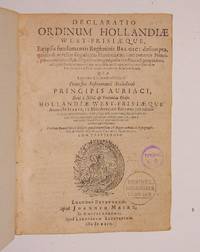
|
|
|
LUCANUS & PETRONIUS
Marci Annaei Lucani Pharsalia eiusdem ad Calpurnium Pisonem poemation. Praemittitur notitia literaria studiis Societatis Bipontinae. Editio secunda auctior et emendatior. Bound with: T. Petronii Arbitri Equitis Romani Satiricon cum supplementis Nodotianis. Accedunt veterum poetarum catalecta. Praemittitur notitia literaria studiis Societatis Bipontiae. Editio accurata.
Ad 1: Zweibrücken Biponti Ex typographia Societatis 1807. Ad 2: Zweibrücken Biponti Ex typographia Societatis 1790. 8vo. 2 volumes in 1: XLVIII2771 blank; XXXVI252 p. Half calf 21 cm Ref: Ad 1: Burkard p. 91/93; Schweiger 2566; Dibdin 2188: 'elegantly executed book'; Moss 2243: 'a very neat and correct edition'; Ebert 12355; Graesse 4274; Ad 2: VD18 11361557; Burkard 125/27; Schweiger 2725; Dibdin 2278: 'neat edition and useful for presenting us with a valuable Notitia literaria'; Ebert 16527; Graesse 5240 Details: Back ruled gilt and with a red morocco shield. Ad 1: The preliminary pages contain a 2 short biographies of Lucanus p. I-IX and a 'notitia literaria including a long and up to date critical bibliography of editions and translations the 'index editionum' p. X-XLVIII; the Pharsalia take up p. 1-265 followed by the 1st century A.D. Latin verse panegyric in praise of a member of the Piso family 'Laus Pisonis' p. 267-277. This panegyric has been attributed to Lucan but also to Ovid Bassus and Statius. Ad 2: The preliminaries contain a 'Live' of Petronius p. III-VIII followed by a 'Notitia Literaria' or a critical bibliography of important editions p. X-XXXVI. The Satiricon fills the p. 1-214 the 'Petronii fragmenta' p. 215-225. At the end a collection of fragments of ancient Latin poets the 'Veterum poetarum catalecta' p. 227/52. An engraved vignette adorns the title depicting a man and woman on a 'chaise longue' and a girl and boy standing beside them Condition: Binding slightly scuffedPhotographs on request unknown
Ссылка продавца : 153306
|
|
|
LHOMOND,ChF h F
Élémens de la grammaire latine à l'usage des colléges. Par Lhomond professeur émérite en la ci-devant Université de Paris. 16e édition.
Paris De l'Imprimerie de J.-P. Jacob à la librairie Économique rue de la Harpe ancien Collége d'Harcourt no. 94 1807. 12mo. 2164 p. Vellum over boards. 17 cm Details: The binder has covered the boards of this book with two strips of vellum of an old contract or charter. The handwriting on it is cursive and illegible for a layman but 6 signatures are clearly visible 2 first names are legible of one 'Charles' and 'Jacques' Condition: After the titlepage and before the beginning of the first chapter 4 pages are missing. Probably a praefatio or perhaps the 4 pages which have been bound at the end of the book. These 4 pages contain a stocklist of the titles available at the 'Librarie économique'. Vellum soiled. Well read. On some pages marginal numbers in pencil. Paper yellowing Note: Numerous editions of this Latin grammar were published in France during the 19th century. The 'abbé' Charles-François Lhomond 1727-1794 was 20 years 'régent de sixième' at the College of Cardinal Lemoine. After his retirement he dedicated himself to the writing of schoolbooks. His 'Élémens de la grammaire latine' was first published in 1780. Since 1789 he is one of the most reprinted and revised school authors in France. There are 166 plus one more at least editions of his Latin works. A. Chopin 'Les manuels scolaires en France de 1789 à nos jours 3: Les manuels de latin' Paris 1988 We found no copy of this 1807 edition in Chopin nor did we find one in KVK Karlsruher Virtueller Katalog. So this schoolbook must be rare Photographs on request hardcover
Ссылка продавца : 120102
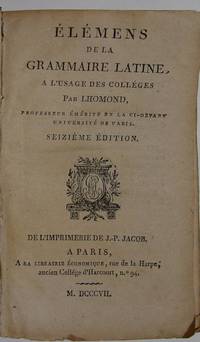
|
|
|
LIBANIUS
Libaniou Sophistou Epistolai. Libanii Sophistae epistolae. Quas nunc primum maximam partem e variis codicibus manu exaratis edidit latine convertit & notis illustravit Joannes Christophorus Wolfius. Accedunt in calce ejusdem Libanii epistolae a Francisco Zambicario olim Latine conversae & Cracoviae primum editae heic autem integra propemodum centuria ex MS auctae.
Amsterdam Amstelaedami Apud Janssonio-Waesbergios 1738. Folio: XX8651 blank p. Vellum 42x27 cm 'The first comprehensive edition of the letters of Libanius accompanied by a Latin translation' Ref: STCN ppn 183220943; Brunet 31050; Hoffmann 2522; Graesse 4195; Ebert 11937 Details: Back with 7 raised band. Boards blind tooled. Broad margins. Title in red and black. Engraved printer's mark on the title depicting a mole flanked by a seating Hermes and Athena; the motto is: 'vulgo caeca vocor video sed acutius ipso' 'By the crowd I am called blind; but I see better than itself'. Printed in 2 columns Greek text with parallel Latin translation. Notes at the bottom of the page. A good copy inside fine Condition: Binding soiled and scuffed. Front hinge splitting but still tight. Small tear in the vellum on the back. Both pastedowns worn. Turn-in of the lower board loosening. Paper yellowing Note: The German christian Hebraist and classical scholar Johannes Christoph Wolf 1683-1739 is best known for his path-breaking 'Bibliotheca Hebraea' Hamburg 1715-1733 which remained long the most cited source for bibliographic information on Hebrew books and the background of their authors and which bore witness to christian interest in Jewish literature and realia. Wolf especially occupied himself with the study of Oriental languages and literature of which he became professor at the Hamburg gymnasium in 1712. There he compiled the 'Bibliotheca Hebraea'. Among classicists Wolf is known for the edition of his 'Anecdota Graeca sacra et profana' Hamburg 1722-1724 and this edition of 1738 of the letters of the Greek rhetorician and philosopher Libanius ca. 314-392/93 A.D. who was one of the most influential authors of late antiquity. It is the first comprehensive edition of the letters of Libanius accompanied by a Latin translation. § Libanius 'embodied in his work many of the ideals and aspirations of the pagan Greek urban upper classes of late antiquity'. OCD 2nd ed. p. 605 In 354 he was appointed to the official chair of rhetoric at Antioch. His pupils include pagans and christians e.g. Johannes Chrysostomos Basilius Magnus Gregorius Nazianzenus. As a literary figure of renown he corresponded with many leading figures in the Greek world among whom the Emperor and philosopher/scholar Julian Julianus Apostata who was much admired by him. In this edition of Wolf 1605 letters have been collected p. 1/728. At the end of these genuine letters Wolf added a reissue of a collection of 476 letters in Latin translation of Libanius which was first published in the Polish city Cracow in 1504 by one Johann Sommerfeldt who had got a mutilated manuscript depravatissimum exemplar with these translated letters from a local 'bibliopola'. p. 729 Well into the 19th century these Cracovian Latin letters were considered authentic works of Libanius. Now we know that they are forgeries by the Italian humanist Francesco Zambeccari ca. 1443 - after 1475 Hoffmann 2528. Zambeccari was unmasked in 1878 by R. Foerster in his 'Francesco Zambeccari und die Briefe des Libanios'. Stuttgart 1878 Collation: pi2 2 -32 A-5L4 5M-5Y2 last leaf 5Y2 blank Photographs on request hardcover
Ссылка продавца : 16567
|
|
|
CYRILLUS HIEROSOLYMITANUS
Tou en hagiois Patros hêmôn Kyrillou hierosolumôn Archiepiskopou Ta heuriskomena panta. S. Cyrilli Archiepiscopi Hierosolymitani Opera quae exstant omnia et ejus nomine circumferuntur ad Manuscriptos codices nec-non ad superiores editiones castigata dissertationibus & notis illustrata cum nova interpretatione & copiosis indicibus. Cura & studio Domni Antonii-Augustini Touttée Presbyteri & Monachi Benedictini e Congregatione S. Mauri.
Paris Parisiis Typis Jacobi Vincent 1720. Folio. XVIII p. CCL columns p. CCLI-CCLXVIII; 416 p. columns 417-426 p. 426-472; 22 blank p. Calf 41.5 cm. 'A fundamental edition of one of the most precious treasures of Christian antiquity' Ref: Brunet 2462/63; Hoffmann 1495; Graesse 2317; Ebert 5602. Quasten 3 p. 366 Details: Back with 6 raised bands and a black gilt shield in the second compartment. Woodcut printer's mark on the title depicting within a baroque framework 2 griffins 2 putti and 2 piles of spoils. Some woodcut headpieces. At the beginning of Cyrillus' text a big engraving made by J.B. Scotin depicting an emperor presiding over an assembly. Printed in 2 columns Greek text with parallel Latin translation Condition: Binding scuffed and scratched. Leather on the boards renewed long ago. Front hinge slightly cracking. Paper of 2 pages 'g2 verso' and 'h1 recto' soiled. Some superficial damage by insects to the right lower corner of the lower board. Bookplate on the front pastedown. First leaves thumbed. Occasional old ink underlinings and marginalia. Last blank leaf pasted to the flyleaf Note: Cyril of Jerusalem or Cyrillus Hierosolymitanus born ca. 315 at Jerusalem became in 350 bishop of his hometown which thanked its centrality as a Christian metropolis to its biblical past and an increasing number of holy sites. The bishop of Jerusalem was together with the bishops of Rome Antioch and Alexandria a person of great authority within Christendom. Cyrillus was a defender of the Holy Trinity of the Nicene creed maintaining the doctrinal formula for the 'homoousios'. Cyrillus died in 381. The Roman Catholics venerate him as a Saint so do the Eastern Orthodox Church and the Anglican Church. A series of 24 catechetical lectures catecheses most of which he delivered in the Church of the Holy Sepulchre survive and they are among the most precious treasures of early Christian literature though they also betray Cyrillus' anti-Jewish sentiment. § The works of Cyrillus in this edition of 1720 were edited by the Benedictine of the Maurist Congregation Dom Antoine-Augustin Touttée 1677-1718 and published posthumously. They are preceded by his extensive and learned dissertations on the life writings and doctrine of the bishop of Jerusalem. Touttée's studies covering circa 140 pages are the first important studies on Cyrillus they consist of 1: 'De vita et rebus gestis S. Cyrilli Hierosolymitani'; 2: 'De scriptis S. Cyrilli ac potissimum Catechesibus'; 3: 'De variis Cyrillianae doctrinae capitibus'. § The collection opens with Cyrillus' 19 i.e 1 18 lectures/catecheses addressed to the candidates looking forward to baptism at the coming Easter p. 1/302 the first of which is the 'Procatechesis' an introductory catechesis p. 1/14. In it Cyrillus greets the neophytes 'you who are to be enlightened' in compassionate manner: 'Vos iam adstat beatitudinis odor o illuminandi' p. 1. He then stresses the gravity of the step which they are about to take and the need for repentance and preparation. The first of the next 18 lectures deals 'with the temper of mind requisite for baptism. It urges us to lay aside all mundane concern forgive personal enemies . and feed the soul by reading the Bible'. Quasten 3364 The second catechesis treats penitence and temptations the 3rd baptism and salvation. The 4th is a summary of the Christian doctrine the 5th treats the nature and origin of faith. The other lectures contain 'expositions of the successive articles of the Jerusalem Creed of which the most important was the baptismal formula used by those who were baptized to confess their faith publicly: 'Credo in Patrem et in Filium et in Sanctum Spiritum et in unum Baptisma poenitentiae' or 'I believe in the Father and in the Son and in the Holy Ghost and in one Baptism of repentance' Catechesis 19 cap. 9. page 309. After these 19 lectures follow 5 so-called 'Mystagogical Catecheses' which were directed to the newly baptized during Easter week. p. 303/332 The first 3 deal with baptism and chrismation confirmation the 4th with the eucharistic doctrine and the 5th with the eucharistic liturgy. The mystagogical lectures are followed by Cyrillus' only surviving homily 'Homilia in paralyticum ad piscinam probaticam jacentem' a sermon on chapter 5 of the gospel of John a story about the paralyzed man at the Pool of Bethesda who was healed by Jesus on a sabbath p. 333/344. A letter of Cyrillus to the emperor Constantius 317-361 A.D. 'De viso Hierosolymis lucidae crucis signo' survives too. p. 345/356. In this letter Cyrillus 'reports about about the miraculous apparition of a great cross of light that was seen from Jerusalem on May 7 351'. Quasten 3367 After this letter are printed some spurious works of Cyrillus 'De occursu Domini' some spurious letters one to and one from Augustinus p. 357/388 and also 'variantes lectiones' and 'praefationes' of earlier editions and the 'praefatio' of bishop Thomas Milles to his Cyrillus edition of 1703 together with his commentary p. 389/416. At the very end a 5 page description of the Church of the Holy Sepulchre at Jerusalem together with an engraved table Provenance: A linoleum cut bookplate of 'P.A. Kasteel'. Petrus Albertus Kasteel 1901-2003 was a wellknown Dutch journalist civil servant and diplomat. He wrote his name also on the front flyleaf. Collation: pi2 a-e4 f-2k2 2l1; A-3F4 3G-3V2 leaf 3V2 blank Photographs on request Heavy book may require extra shipping costs hardcover
Ссылка продавца : 105600
|
|
|
HESIODUS
HÊSIODOU ASKRAIOU ta heuriskomena. Hesiodi Ascraei quae extant. Daniel Heinsius interpretationem infinitis locis emendavit. Introductionem in Opera & Dies in qua Hesiodi philosophia nunc primum exponitur item notas addidit.
Leiden Lugduni Batavorum Ex Officina Ioannis Patij Iurati & Ordinarii Academiae Typographi Prostant in Bibliopolio Commeliniano 1613. 8vo. 2 parts in 1. XXXVIII2 blank1-2042 second title205-31233 blank p. Vellum 18.5 cm Ref: STCN ppn 059312521; Hoffmann 2249; Graesse 3263; Ebert 9599 Details: 6 thongs laced through both joints. First title in red and black. Woodcut printer's mark on the title it depicts Pallas Athena standing in an archway at her feet the coat of arms of Leiden. Greek text with opposing Latin translation. The second part contains Heinsius' 'Introductio' and his 'notae emendationes & observationes in Hesiodum' Condition: Vellum soiled and scratched. Small wormhole in lower margin not affecting the text. Paper yellowing Note: Hesiodus from Askra a small town in Boiotia born ca. 775 BC is one of Greek's oldest poets. His poems are in Homeric hexameters and show his interest in ethics and systematization. His work was known throughout antiquity to rhapsodes scholars and schoolboys. The Byzantines compiled scholia from ancient commentaries for elucidation. The Renaissance did not quite appreciate him. Until 1667 ca. 18 editions of his 'opera omnia' were published not much. Hesiod's reception chiefly concerns myths and the motifs that he provides and these motifs certainly appealed to mythographers historians of religion poets and painters. 'Hesiodic details of myth saturate European epic and mythopoeic writings perhaps most spectacular in Dante Milton Blake . who make much of Hesiod's infernal regions his Titans and primordial monsters his giant battles'. The Classical Tradition N.Y 2010 p. 435 Of Hesiod survives his 'Theogonia' or 'Theogony' which 'deals with the origin and genealogy of the gods . and the events that led to the kingship of Zeus: the castration of Uranos by Kronos and the overthrow of Kronos and the Titans by the Olympians' OCD 2nd ed. p. 510 The 'Works and Days' or 'Erga kai Hêmerai' of Hesiod which was always most read has been called a 'gospel of labour'. The poet recommends the hard and honest life of a farmer. He 'inveighs against dishonesty and idleness by turns using myth . parable allegory and threads of divine anger. . The poem as a whole is a unique source for social conditions in early archaic Greece.' OCD 2nd ed. p. 511 The third poem that has survived is the 'Shield' or 'Aspis' a short narrative poem on Heracles' fight with Cycnus a bloodthirsty son of the god Ares. It derives its name from the long description of Heracles' shield. 'Artists have never abandoned a fascination with Hesiod on the Muses. In the 19th century the artist Gustave Moreau created many visual representations of their initiation of the poet. Both Rubens and Goya painted famous and harrowing pictures of Kronos Saturn devouring one of his children a motif from the Theogony; William Blake engraved a series after drawings by his friend John Flaxman . Georges Braque chose the 'Theogony' as the subject of 20 etchings'. The Classical Tradition N.Y. 2010 p. 436 § This edition of Hesiod is a kind of 'editio minor' of the 'editio maior' that was produced by the Dutch classical scholar of Flemish origin Daniel Heinsius 1580-1655 and which was published ten years earlier in 1603. For this edition in a smaller form he left out the Byzantine scholia sine veterum interpretatione and made some corrections in the text and the translation. 'The text is not formed altogether on the preceding editions: where it differs from them the reason of such difference is given in the notes'. Dibdin 233 § Heinsius who enjoyed an international reputation as an editor of classical texts theorist of literary criticism historian and neolatin poet was professor of Poetics at the University of Leiden from 1603 extraordinarius Greek since 1605. After the death of J.J. Scaliger to whose inner circle he belonged he held the chair of Greek from 1609 till 1647. His activities have been obscured to later generations by the very bulk and variety of his activities. He is still remembered for his neolatin poetry and for his edition of Aristotle's treatise on poetry 1610 which he studied in connection with the Ars Poetica of Horace. In his pamphlet De tragoediae Constitutione published in 1611 he deals with all the essential points in Aristotle's treatise giving proof that he has thoroughly imbibed the author's spirit'. J.E. Sandys 'A history of classical scholarship N.Y. 1964 vol. 2 p. 314 Provenance: On the front pastedown in pencil: '25 maart 1958' written by the Flemish linguist Walter Couvreur 1914-1996 who was an Orientalist and professor of Indoeuropean linguistics at the University of Gent. It indicates the date of aquisition. The place of acquisition he wrote on the flyleaf at the end: 'Leipzig Deutsche Buch Export und Import' Collation: : - 2:8 3:4 leaf 3: blank; A-V8 leaf V8 blank Photographs on request hardcover
Ссылка продавца : 130078
|
|

 Получить результаты поиска по электронной почте
 Загрузить результаты в формате PDF
  RSS-канал
 Постоянная ссылка


