|
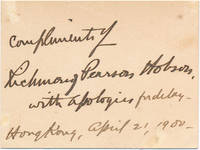
HOBSON, Richmond Pearson (1870-1937)
Signature and Inscription
This American naval commander awarded the Congressional Medal of Honor in 1933 gained fame in 1898 when he sunk the "Merrimac" during a naval maneuver in a channel at Santiago Cuba; from 1907 to 1915 he served as a representative from Alabama. Exceptionally bold and attractive "Compliments of / Richmond Pearson Hobson / with apologies for delay -- / Hong Kong April 21 1900" in brown ink heavy stock 3½" X 2½" card. Very good. Mild age toning; faint mounting traces at a couple corners. A choice example signed near the height of his fame. With original envelope cancelled in the Philippines on 22 May 1900. unknown
Referenz des Buchhändlers : 26947
|
|
|
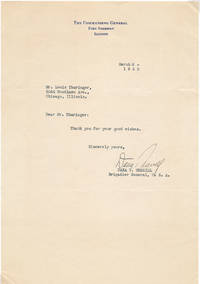
MERRILL, Dana T (?-?)
Typed Note Signed
This career Army officer joined the Maine Volunteer Infantry at the outbreak of the Spanish-American War and was active with the 4th Army Corps in World War One; in 1935 he was promoted to brigadier general. TNS1p 7¼" X 10½" Fort Sheridan IL 1935 March 5. Addressed to Louis Thuringer. Near fine. On letterhead of "The Commanding General" Merrill offers a taut "Thank you for your good wishes" and signs boldly in full -- no doubt he was congratulated on his new rank of brigadier general. unknown
Referenz des Buchhändlers : 31368
|
|
|
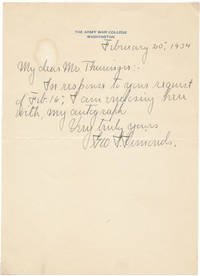
SIMONDS, George S (1874-1938)
Autograph Note Signed
After distinguished World War One service this U.S. Army general served as Chief of the War Plans Division of the War Department 1927-31 then in 1932 was named head of the Army War College; served as Deputy Chief of Staff at the War Department 1935-36 and commander of the Fourth Army and IX Corps 1936-38. ANS 1p 7" X 9 3/4" Washington DC 1934 February 20. Addressed to Mr. Thuringer. Very good. Single water spot over several letters though no blurring; else fine clean and attractive. Gracious reply to an autograph request penned large and bold and signed in full on "The Army War College" letterhead. unknown
Referenz des Buchhändlers : 31411
|
|
|
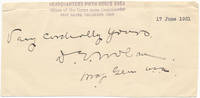
NOLAN, Dennis E (1872-1956)
Signature and Inscription
This Military Intelligence Hall of Fame inductee was an Army general who served throughout the Spanish-American War Philippine Insurrection and World War One before being chosen by Pershing to oversee the American Expeditionary Force's intelligence operations -- making him America's first G2; he helped organize the Corps of Intelligence Police the army's first counterintelligence organization. Large bold and sloppy "Very cordially yours / D.E. Nolan. / Maj Gen U.S.A." 5½" X 2 3/4" Columbus OH 1931 June 17. Very good. Name/address of Nolan's command from 1927 to 1931 Headquarters Fifth Corps Area purple inkstamped at top edge along with typed date. Autograph material of this military intelligence pioneer is uncommon. unknown
Referenz des Buchhändlers : 31407
|
|
|
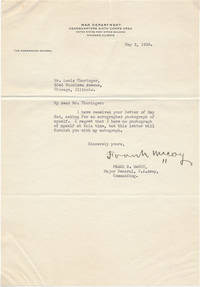
McCOY, Frank R (1874-1954)
Typed Note Signed
This 2nd lieutenant with the 10th Cavalry the famed "Buffalo Soldier's" participated in the charge up San Juan Hill during the Spanish-American War and was wounded; he also served as aide to General Wood in Cuba and the Philippines and then to Major General Theodore Roosevelt; in 1917 he was named member of the General Staff of the American Expeditionary Forces and commanded the 63rd Infantry Brigade. TNS 1p 7¼" X 10½" Chicago IL 1935 Mat 2. Addressed to Louis Thuringer. Very good. Some mild wrinkling. On letterhead of "War Department / Headquarters Sixth Corps Area" McCoy regrets he hasn't a photograph to send but hopes "this letter will furnish you with my autograph." Boldly signed in full in black ink. unknown
Referenz des Buchhändlers : 31420
|
|
|
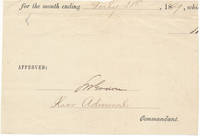
GODON, Sylvanus W (1809-79)
Signature
This U.S. naval officer distinguished himself in the Mexican-American War commanding the bomb vessel "Vesuvius" in 1847; a captain in the Civil War he participated in the attack on Port Royal; named commodore in 1863 he commanded a portion of Admiral Porter's fleet in the bombardment of Fort Fisher; as rear admiral he served as commandant of the Brooklyn Navy Yard from 1868 to 1870. Signature on portion of a Printed Document 6" X 4" n.p. Brooklyn 1869 July 31. Near fine. Printed portion along top reads "for the month ending. 18. which" with printed "APPROVED:" at center left and printed "Commandant" at lower right. Godon signs boldly near the center while the date and his title "Rear Admiral" have been penned in another hand. Nice example signed while commandant of the Brooklyn Navy Yard. unknown
Referenz des Buchhändlers : 31652
|
|
|
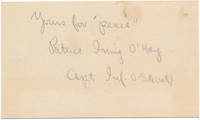
O'HAY, Patrick Irving (1870-1944)
Signature and Inscription
This Irish soldier of fortune fought under General Gomez in Cuba in 1897 in the Spanish-American War as one of Roosevelt's "Rough Riders" in a Canadian cavalry regiment in the South African War in the Balkans in 1903 with the Princess Pat regiment in 1914 with the United States Army in 1917 and elsewhere; he called himself an "apostle of discontent" complaining it was hard to feed himself between wars; he tried his hand at acting in later years and even became a race horse trainer; at his death he owned a filling station in Taos New Mexico. Boldly pencilled "Yours for 'peace' / Patrick Irving O'Hay / Capt Inf. U.S.A ret" heavy stock 5" X 3" card n.p. n.y. Very good. Faintly age toned; minor mounting traces on verso which bears printed text of a poem "Worcester Town". Nice example. unknown
Referenz des Buchhändlers : 31732
|
|
|
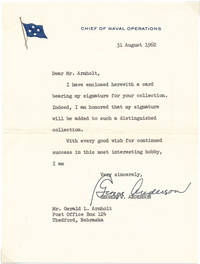
ANDERSON, George W (1907-92)
Typed Note Signed
This U.S. Navy admiral was Chief of Naval Operations in charge of the U.S. blockade of Cuba during the Soviet missile crisis in 1962; denied appointment as Chairman of the Joint Chiefs of Staff because of friction with Secretary of Defense McNamara he was named U.S. Ambassador to Portugal. TNS 1p 5 3/4" X 7 3/4" n.p. 1962 August 31. Addressed to Gerald L. Arnholt. Near fine. Single faint horizontal fold. On "Chief of Naval Operations" letterhead featuring a 4-star blue flag the admiral complies with an autograph request. "I am honored that my signature will be added to such a distinguished collection." Bold full signature. unknown
Referenz des Buchhändlers : 27398
|
|
|
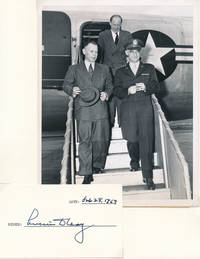
CLAY, Lucius D (1897-1978)
Signature / Unsigned Photograph
As commander of U.S. forces in Germany 1947-49 Clay was in charge of the 1948 Berlin Airlift. Bold signature and date 1969 February 28 in black fineline on a special heavy stock 5" X 3" card n.p. New York NY. Fine. With original envelope. Accompanied by an unusual and scarce 6½" X 8½" news agency photograph of 1947 showing Clay disembarking an airplane with U.S. ambassador to Russia Bedell Smith to "discuss means of combatting the Soviet move to block the Marshall Plan." A superb image seldom seen. unknown
Referenz des Buchhändlers : 25086
|
|
|
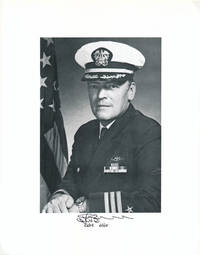
BUCHER, Lloyd M (1927-2004)
Photograph Signed
American naval commander whose ill-fated vessel the USS "Pueblo" was captured off the coast of North Korea in 1968 with he and his crew imprisoned and tortured for many months. PS 8" X 10¼" n.p. n.d. Fine. Handsome formal portrait of Bucher in dress uniform boldly signed on the blank lower margin; below his signature he adds rank "CDR USN". A choice example. unknown
Referenz des Buchhändlers : 14194
|
|
|
DAVIES, Henry E (1836-94)
Signature
This New York attorney became major general of volunteers in the Civil War serving as "a cavalryman by instinct" from 1861-65. Small clipped signature 2" X ½" n.p. n.y. Near fine. Bold quick and typical "HE Davies." Most likely from a legal document of some sort for Davies literally "signs on the dotted line. unknown
Referenz des Buchhändlers : 20978
|
|
|
BARONDESS, Benjamin (1891-1960)
Typed Note Signed / Unsigned Typescript
This prominent New York attorney was a noted Lincoln scholar author of the 1954 "Three Lincoln Masterpieces"; charter member and vice president of the noted Civil War Round Table of New York and namesake of the prestigious Benjamin Barondess Award for new Civil War titles. TNS 1p 8½" X 11" New York NY 1951 November 20. Addressed to CARL HAVERLIN 1899-1985 noted Lincoln and Civil War scholar radio pioneer and president of Broadcast Music Inc. BMI. Near fine. Referencing a Civil War Round Table event of the previous day Barondess jokes "Did you think you were going to escape thanks for your invitation to me to be one of the panel at the Gettysburg Address Seminar last night If so the error was profound." Boldly signed. Haverlin has scrawled the draft of a brief reply in bold pencil at upper left as was his custom. Accompanied by a carbon copy typescript of the very talk Barondess had given at that seminar 10pp rectos only 8½" X 11" n.p. 1951 November 19. Very good. Titled simply "BENJAMIN BARONDESS'S TALK" this double-spaced typescript on thin onion skin paper presents his overview of Lincoln's speech its preparation and reception. The following year an article by Barondess titled "The Gettysburg Address: Revealing facts about one of the 'Supreme Masterpieces of the English language'" was published in the Spring 1952 issue of "Autograph Collectors' Journal" and this is presumably the precursor of that article. An interesting and unusual pair for the Lincoln specialist. From the collection of noted Lincoln/Civil War scholar ARNOLD F. GATES 1914-93. unknown
Referenz des Buchhändlers : 28310

|
|
|
Ellis, Harry E
Dr. Pepper King of Beverages
Taylor Publishing Company 1979. Faux embossed leather with color pictorial pastedown of a reclining lion on front cover. 268pp. Extensively illustrated in color and black and white. First edition. Small round blindstamp of former owver on corner of title-page. No writing no marking etc. A history of the soft drink and the company which bears its name from 1885. A fine copy of a handsome book. First Edition. Hardcover. Fine/Not Issued. 8vo - over 7¾" - 9¾" tall. Taylor Publishing Company Hardcover
Referenz des Buchhändlers : 004413
|
|
|
Hugelshofer, Walter, et al
Die Lithographie in Der Schweiz. Festschrift Zum 50jahrigen Bestehen Des Vereins Schweizerischer Lithographiebesitzer 1894-1944
Verein Schweizerischer Lithographiebesitzer Bern 1944. Edition Unstated. Softcover. Good/No Dust Jacket. Size: 4to. Original decorated brown paper over cardboard a very thick 4to 8.5 x 11.75 in. 356 pages plus numerous inserted plates and facsimiles including some folding and in color text in German. Text traces history and technology of lithography with examples. Paper is torn with pieces missing so that cardboard is exposed at corners along some edges and along spine; paper missing at top of spine for about 2" covers soiled moderately back cover lightly. Interior is basically clean and tight with only an occasional fingerprint smudge in a blank margin; plates maps etc. all in excellent condition. This is a heavy book which may require extra postage. Quantity Available: 1. Shipped Weight: 6 lbs 0 oz. Category: Art & Design; Books; Pictures of this item not already displayed here available upon request. Inventory No: 002014. . This is a heavy book and may involve extra shipping charges. Verein Schweizerischer Lithographiebesitzer paperback
Referenz des Buchhändlers : 002014
|
|
|
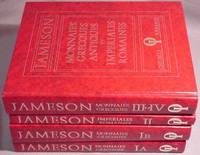
Jameson, R
Monnaies Grecques Antiques: Description et Planches. Vol. IA IB II & III - IV
Kalamai Chicago 1980. Reprint Edition. Hardcover. Near Fine/No Jacket. Size: 4to - over 9¾" - 12" tall. Text is in French. Text body is clean and free from previous owner annotation underlining and highlighting. Binding is tight covers and spine fully intact. Red gilt stamped leatherette a reprint of the 1913-1932 edition illustrated with b & plates. Bottom of spine vol. IA is bumped and there is a 4" slit in the middle of the front cover not terribly noticeable and not very deep; Vol. III-IV has minor bumping at top corners. Otherwise all volumes are clean and tight and quite a handsome set. This is a heavy set and will require extra shipping. Quantity Available: 1. Shipped Weight: 13 lbs 0 oz. Category: Coins Money; French Language; Books; ISBN: 0916710653. Pictures of this item not already displayed here available upon request. Inventory No: 004012. . This is a SET of books therefore heavier than a standard volume and will require extra shipping charges. Kalamai hardcover
Referenz des Buchhändlers : 004012 ISBN : 0916710653 9780916710651
|
|
|
Askew, Gilbert
A Catalogue of Roman Coins
B. A. Seaby Ltd London 1948. Second Edition. Hardcover. Fair/No Jacket. Size: Octavo standard book size. Text body is clean and free from previous owner annotation underlining and highlighting. Exterior is not in great shape but interior is clean. Green cloth 126 pages 2 5 plates 4 Gold Coins listing; illustrated in text as well as the five b & w plates. Spine badly faded wear all along spine corners and edges of boards scuffed and soiled; interior pages are clean with some toning along top & bottom edges. Quantity Available: 1. Shipped Weight: 1 lb 10 oz. Category: Antiques & Collectibles; Books; Pictures of this item not already displayed here available upon request. Inventory No: 004344. . B. A. Seaby Ltd hardcover
Referenz des Buchhändlers : 004344
|
|
|
Various / Unstated
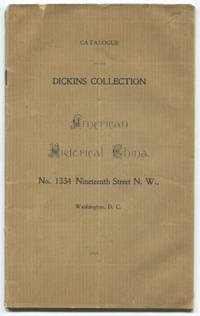
Catalogue of the Dickins Collection of American Historical China
No Publisher Stated Washington D. C 1898. Edition Unstated. Softcover. Good/No Dust Jacket. Size: Octavo standard book size. Text body is clean and free from previous owner annotation underlining and highlighting. Stapled printed paper wraps no publisher listed and the only date is on the front cover 1898; 30 pages no photographs last page is bound in but is on a thin paper and appears to have been typewritten. Vertical fold down center of wraps and through all pages wraps moderately soiled some minor chipping on back top edge small chip out of front top edge first page is very lightly foxed or tiny stains can't tell which first six pages have a short little tear at top edge. Quantity Available: 1. Shipped Weight: 1 lb 0 oz. Category: Antiques & Collectibles; Books; Pictures of this item not already displayed here available upon request. Inventory No: 005259. . No Publisher Stated paperback
Referenz des Buchhändlers : 005259
|
|
|
JM (or GEORGE) WEATHER and SAMUEL BENN J M
c1904 THREE 3 ORIGINAL HANDWRITTEN FIELD BOOKS OF THE EXTENSIVE DETAILED AND PLANNED WORK REQUIRED TO REBUILD THE TOWN OF ABERDEEN WASHINGTON AFTER IT HAD BURNT TO THE GROUND A YEAR EARLIER
ABERDEEN WASHINGTON WA. Good. 1904. On offer are three 3 original field books most probably written in 1904 and detailing the rebuilding of the city of Aberdeen Washington after a raging fire destroyed the town. On October 16 1903 a raging fire destroyed 140 buildings in the center of Aberdeen Washington. A city constructed primarily of wood including sidewalks Aberdeen had little chance of stopping the fire once it began to spread. Obviously the city needed to rebuild its streets after the fire. Two people one by the name of Weatherwax and the other by the name of Benn seem to have been hired to do the task. Weatherwax is most probably J.M. Weatherwax or George Weatherwax two men who owned a large lumber company in Aberdeen and Benn is most probably Samuel Benn. The three books are labelled P-138 book 44 P-214 book 105 and P-215 book 106. Each book contains an index at the beginning which lays out what streets in the city are written about. For example book P-215 deals with information on old planks new elevations storm sewers street levels and more on the 20 different street including Michigan Ave Jefferson St. Washington St. and more. The books are excellent artifacts of city construction from the early 20th century containing dozens of pages of detailed schematics drawings charts and figures for the city of Aberdeen in the wake of its destruction. There are approximately 450 handwritten pages over the three books. The books each measure 7 ¼ by 4 ¼ inches. All three show sustained use and strong wear. For the most part the structural integrity is still there however the last book P-215 shows the most wear with parts of the book disconnected from the binding. Two of the books shows evidence of taping to the spine and boards. These books are a fascinating look at the intricacies and details of rebuilding a city after its destruction and an intimate part at the history of Aberdeen Washington a place that Kurt Cobain would eventually call home. Background: On October 16 1903 a fire destroys 140 buildings in the center of Aberdeen. Fed by wood-frame structures wooden sidewalks and sawdust fill the fire rages unchecked until some 20 acres have burned. The fire will spur the city leaders to enact a more stringent fire code. On the morning of October 16 1903 a resident of the Arctic Hotel began making breakfast in his room. An accidental fire started and the room was quickly engulfed in flames killing the lone occupant. Within minutes the three-story frame structure was ablaze and the fire spread to adjoining buildings including the fire station and jail.; Manuscript; 8vo - over 7¾" - 9¾" tall; KEYWORDS: HISTORY OF ABERDEEN WASHINGTON FIELD BOOKS TURN OF THE 20TH CENTURY 1903 ABERDEEN FIRE MILL TOWNS J.M. WEATHERWAX GEORGE WEATHERWAX SAMUEL BENN FIELD BOOKS TOWN REBUILDING FIELD BOOKS SURVEY NOTEBOOKS HAND DRAWN AMERICANA HANDWRITTEN MANUSCRIPT DOCUMENT LETTER AUTOGRAPH WRITER HAND WRITTEN DOCUMENTS SIGNED LETTERS MANUSCRIPTS HISTORICAL HOLOGRAPH KEEPSAKE WRITERS AUTOGRAPHS PERSONAL MEMOIR MEMORIAL ARCHIVE DIARY DIARIES JOURNAL LOG ANTIQUITÉ CONTRAT VÉLIN DOCUMENT MANUSCRIT PAPIER ANTIKE BRIEF PERGAMENT DOKUMENT MANUSKRIPT PAPIER OGGETTO DANTIQUARIATO ATTO VELINA DOCUMENTO MANUSCRITTO CARTA ANTIGÜEDAD HECHO VITELA DOCUMENTO MANUSCRITO PAPEL . hardcover
Referenz des Buchhändlers : 0009174
|
|
|
Riall, Richard
A New Bibliography of Arthur Rackham
Ross Press Bath 1994 A new copy of this excellent Rackham bibliography. Blue cloth-covered boards gilt spine lettering gilt front board illustration 11 3/4 x 7 3/4 inches 245 pp. index numerous b/w illustrations and several color plates. Mylar dustcover from the publisher. Laid in is a flyer for The Arthur Rackham Society. 1722RO121. 1st Edition. Hardcover. New/No Jacket. Ross Press, Bath hardcover
Referenz des Buchhändlers : 3514 ISBN : 0952335301 9780952335306
|
|
|
Fraxi, Pisanus; Legman G (introduction by)
Bibliography of Prohibited Books 3 Volumes; one of 1000 copies of the Edition De Luxe
Jack Brussel New York 1962 First edition thus. Three volumes in a very good green paper-covered slipcase with mild edgewear and rubbing. The three volumes are Index Librorum Prohibitoru 542 pp. Centuria Librorum Absconditorum 591 pp. and Catena Librorum Tacendorum 593 pp. All have tan cloth-covered boards7 1/4 x 5 1/2 inches gilt spine lettering bright and a yellow ribbon marker. Partially unopened. Fine neat signature of previous owner on the front free endpaper of Volume I and Volume II; mild sunning spines. 1722RO003. 1st Edition. Hardcover. Fine. Jack Brussel, New York hardcover
Referenz des Buchhändlers : 3667
|
|
|
Lowman, Al
Printing Arts in Texas
Roger Beacham 1975 This is an extraordinary copy of the first edition one of 395 copies SIGNED by the author AL LOWMAN the renowned artist JOSE CISNEROS the designer and typographer WILLIAM R. HOLMAN the printer DAVID HOLMAN and the illustrator BARBARA HOLMAN. Mustard-colored cloth-cevered boards printed paper labels on spine and front board 13 7/8 x 9 3/4 inches 107 pp. Printed on laid paper molded by L. Guarro Casas of Barcelona. Fine in a mylar jacket. Includes an entry for Bateman Ed: The Instinct Never Dies pp.26-27 & 62 with reference to the famous Bateman letter written to Dudley Dobie. See my listing for The Instinct Never Dies which includes the letter. 1722RO070. Signed by Authors. 1st Edition. Hardcover. Fine. Roger Beacham hardcover
Referenz des Buchhändlers : 3551
|
|
|
KATHERINE NEARY JOHNSON
1938 - 1939 ORIGINAL MANUSCRIPT DIARY HANDWRITTEN BY A HARD DRIVING WESTERN NEW YORK WOMAN TRYING TO WORK HER WAY OUT OF THE DEPRESSION
HORNELL NEW YORK WESTERN NEW YORK. Good. 1938. On offer is a unique little journal written by a woman in upstate New York immediately before the outbreak of WWII. Measuring 6 inches by 3.5 inches this journal has 72 pages and is 100% complete. There is evidence of pages having been torn out at some time in the past. The handwriting is in pencil and although faint can be read. The cover is in very good condition and all pages are intact. Although the name on the cover is Emmett Johnson 1914-1992 context suggests that this 1938 diary was written by his mother Katherine Neary Johnson. She refers to family members by the initial of their first name and 'E' and 'J' crop up repeatedly. The 'E' likely stands for Emmett and the 'J' for her husband John. They lived around Hornell in upstate New York in what is known as the 'Southern Tier' - the mountainous western part of New York state that borders Pennsylvania. These were the last years of the Great Depression and life was not easy here. The pages are un-numbered and undated. She simply writes through from one month to the next. In her journal Johnson recounts daily chores and events that matter to her family their farm and their circle of friends. "Nice day John went to the city to sell his veal. I just done my housework."Feb 4 1938; "I went to Canisteo with the grist. Fixed the fence in the P.M." Apr 25 1938; "J went to church. Raymond and children brought him home. E and C came stayed for supper came with cow and took the veal calves." June 5 1938. Life wasn't easy and events could turn one's work upside down very quickly: "Blacksmith came and shod the team. came and helped. Barn burned."Aug 6 1938. The rest of her entries are in this vein. They paint the picture of a hardworking woman living in a poorer area of rural America. Yet despite the continual hard work there is a sense of quiet confidence and pleasure with her life. A student of Womens' Studies would find this an excellent window into the life of so many American women living at that time; Manuscript; 16mo - over 5¾" - 6¾" tall; KEYWORDS: HISTORY OF UNITED STATES; MID-20TH CENTURY; 1930S; KATHERINE NEARY JOHNSON; EMMETT JOHNSON; HORNELL NY; STEUBEN COUNTY; NEW YORK; THE GREAT DEPRESSION; 'SOUTHERN TIER'; AMERICAN FARMERS IN THE LATE 1930S; LIFE ON FARMS IN DURING THE GREAT DEPRESSION; WOMEN'S LIFE IN RURAL WESTERN NEW YORK; BUFFALO AREA RURAL AMERICA IN THE MID-20TH CENTURY; FARMING OPERATIONS; AMERICANA HANDWRITTEN MANUSCRIPT DOCUMENT LETTER AUTOGRAPH WRITER HAND WRITTEN DOCUMENTS SIGNED LETTERS MANUSCRIPTS DIARY DIARIES JOURNALS PERSONAL HISTORY SOCIAL HISTORY HISTORICAL HOLOGRAPH WRITERS AUTOGRAPHS PERSONAL MEMOIR MEMORIAL ANTIQUITÉ CONTRAT VÉLIN DOCUMENT MANUSCRIT PAPIER ANTIKE BRIEF PERGAMENT DOKUMENT MANUSKRIPT PAPIER OGGETTO D'ANTIQUARIATO ATTO VELINA DOCUMENTO MANOSCRITTO CARTA ANTIGÜEDAD HECHO VITELA DOCUMENTO MANUSCRITO PAPEL . unknown
Referenz des Buchhändlers : 0008141
|
|
|
SAMUEL PEYTON
1929 UNUSUAL ORIGINAL MANUSCRIPT DIARY HAND WRITTEN BY A DESTITUTE PERHAPS DELUSIONAL STRUGGLING TO SURVIVE LIVING ROUGH SOUTH DAKOTA MAN HIS MOTHER AND A HORSE NAMED GOLDY
PIEDMONT SOUTH DAKOTA. Good. 1929. On offer is a first-hand account of a man struggling at the onset of the Great Depression. His handwritten journal measures 6.25 inches by 4.5 inches on a landscape layout. It contains 70 pages. It is about 50% complete. The stiff cardboard cover and pages are secured by a ribbon tie. The journal is in good shape. The entries are made on un-numbered and undated pages in pencil and the handwriting is legible. Samuel E. Peyton lived in the Black Hills just east of Piedmont SD. We do not know his age. To say that he is poor would be a huge understatement. Peyton was destitute. He lives in a cabin above the village of Piedmont with his mother and they barely subsist. His other companions are a horse named Goldy a cat named Dit and a dog. He has a car that is not running and that the seller is trying to repossess. The cabin seems to be inside the Black Hills National Forest. This didn't endear him to park rangers who drop by to see if he has moved on. He spends his days chopping wood and going down into Piedmont to check his mail. He has applied for an unspecified pension and is hoping for a positive answer. His mother is a painter and has sold some art and is awaiting payment. His entries contain a number of wry observations of the people he encounters - whether his friend Jim or the woman who runs the general store. He wrestles with the idea of taking a job cutting wood but fears it will impede his ambition to become an aviator! He sees Jim most days when he goes into town. Jim and presumably his wife Mama own a house where they rent some rooms. When they decide to move out of Piedmont they offer it to Samuel and his mother and let them keep the rent as well. The following entries will give a flavour of this interesting journal: ".We have been broke since Christmas and have been living on spuds and onions mostly. Duhamel's were to pay us $30 for pictures the first of January but didn't. They haven't payed us yet. We are hoping to get our pension as usual. Also the Forest Service is trying to kick us off as usual. Mr. Oliver seems to be our only friend. He is a good one though." Jan 23; ". Went to Piedmont today. Haven't heard from pension yet or Duhamel's either. It was 21 degrees below this morning in Piedmont. Mrs. Priest wants her store bill paid. Well we have only 2 cents in cash. I owe Mrs. M. M. Couper 5 cents for a post. I owe 25 cents for box rent so if they declare me bankrupt they will only get about 1 cent on every $10." Jan 26; "Cold and foggy with snow falling. There is frost all over the bushes and trees. Winter has set in again and our hope of having some nice weather is gone. I wonder when it will warm up. Spent most of day reading and sitting around but spent a couple of hours getting wood. Forest supervisor Duthie and forest ranger Hickel came over to see if we had vacated the place yet. Well we haven't and won't until we are ready." Feb 5 ". I went to Piedmont today and brought home some groceries from mama's. I beat Jim 2 games of chess out of 3. We got a letter from the pension bureau which turned down our pension. It was turned down by Ward C. Finney the same man who has ignored our requests for a mineral examination on our claims. He is assistant secretary of inteior. He is a hand and glove in with the Forest Service trying to get us off our place. He absolutely ignored our evidence for our pension alone. I shall always remember Edward C. Finney also Forest supervisor Duthie."Feb 18; ". I went to P. today and got some more flour and a can of salmon. Mrs. M. M. Couper pounced on me and demanded her two nickles for the Posts. I told her that the publishers were asking us for the $2 for it and she admitted she had gotten her money back from them. She sure must have felt like a nickle. She talked for 15 minutes to save her face. Mrs. Couper is Scotch and so she can't let any money get away from her if she can help it. Well I bet she won't be so quick to bum some one the next time." Feb 15; ". I don't know what to do. If I get a job from the Hornstake I will be here working all summer and if I don't we won't have anything to live on. We haven't any money to go away on or any job to go to so we are up in the air. Mother has $50 coming from Mr. Over of the State University William H. Over was a collector and curator of the Museum of Natural and Cultural History of South Dakota for an Indian Painting also $30 from Duhamel's. If we get this we may go."Feb 23; ". I don't see what we can do for ourselves by staying here but I don't see where we can go with our any money. We can't stay here and live off the folks however so we must go somewhere or else must get a job around here. I do not want to get a job here because it will make me give up any idea of getting into aviation which is my ambition
. " Feb 25; ". I went to town today. Mama said that she and Jim were going away and that she would like to have us stay in her house and look after the school teachers. She said we could have the $20 a month rent too. I don't like the idea vary well but I guess it is that or nothing."Mar 9. He notes the Cristero War or Cristero Rebellion that was ravaging in Mexico at the time Mar.18. His last entry is in early April: ". We got our pension. The $20 a month one with $197 back."Apr1. We hear no more from Samuel Peyton. This is a fascinating look into the life of a very ordinary person trying to make ends meet at the outset of the worst financial crisis that America had ever faced. For a social historian it provides a glimpse into the daily hardships of grinding poverty that confronted many ordinary Americans.; Manuscript; 32mo - over 4" - 5" tall; KEYWORDS: HISTORY OF; 20TH CENTURY; 1920s; SAMUEL PEYTON; UNITED STATES PIEDMONT; SD; SOUTH DAKOTA; MEADE COUNTY; BLACK HILLS; GREAT PLAINS; RAPID CITY; MIDWESTERN UNITED STATES THE GREAT DEPRESSION RURAL MIDWEST IN THE LATE 1920S; POVERTY IN THE 1920S UNITED STATES; BLACK HILLS NATIONAL FOREST; FOREST RANGERS IN SOUTH DAKOTA; ; DUHAMEL; W.H.OVER; EDWARD C. FINNEY; GEORGE A. DUTHIE SUPERVISOR OF THE BLACK HILLS FOREST; CRISTERO REBELLION; AGRICULTURAL DEPRESSION OF 1920s ON THE GREAT PLAINS LIFE IN BLACK HILLS FOREST IN 1920s AMERICANA HANDWRITTEN MANUSCRIPT DOCUMENT LETTER AUTOGRAPH WRITER HAND WRITTEN DOCUMENTS SIGNED LETTERS MANUSCRIPTS DIARY DIARIES JOURNALS PERSONAL HISTORY SOCIAL HISTORY HISTORICAL HOLOGRAPH WRITERS AUTOGRAPHS PERSONAL MEMOIR MEMORIAL ANTIQUITÉ CONTRAT VÉLIN DOCUMENT MANUSCRIT PAPIER ANTIKE BRIEF PERGAMENT DOKUMENT MANUSKRIPT PAPIER OGGETTO D'ANTIQUARIATO ATTO VELINA DOCUMENTO MANOSCRITTO CARTA ANTIGÜEDAD HECHO VITELA DOCUMENTO MANUSCRITO PAPEL . unknown
Referenz des Buchhändlers : 0008137
|
|
|
UNIDENTIFED
1918 ORIGINAL NORTH-WEST OREGON MANUSCRIPT DIARY HANDWRITTEN BY A CHARMING WOMAN WHO MANAGES TO KEEP A SENSE OF GRACE AND HUMOUR WHILE SHE AND HER SISTER DEAL WITH HARDSCRAP LIVES AND THE DARK BACKDROP OF A TERRIBLE WAR
MCMINNVILLE OREGON. Good. 1918. On offer is a delightful diary dating to WWI. Coming from the American west this diary measures 5.75 inches by 4 inches and contains 365 pages. It is 90% complete. The cover and the pages are in good condition and all pages are intact. The back cover and the spine have separated from the binding but the front cover remains attached. The handwriting is legible. Also included with the diary are three black and white photographs. They depict 2 couples and a single picture of a woman. There is no annotation or identification with them. The diary is written by an unknown woman from the area around McMinnville Oregon. She is never identified. However she does live with another woman Anna who appears to be her sister. References crop up about someone named Peter and context would suggest that he is a boy although the relationship is never explained. This is a story of these two single women living in a small community in 1918 as WWI is coming to an end. Rationing is something they live with daily and their financial circumstances are tight. Anna in particular is continually looking for work. Jobs are hard to come by and often short-lived. But they manage. There are some entries that talk about selling personal items to raise some money. In April our author falls and suffers a serious leg fracture ending up in the hospital. Despite a long recovery she is remarkably cheerful and a warm quiet humour comes through in some of her entries. "The dickens of a day! I did a washing but did not hang out the clothes for it was stormy and cold. Anna went to work for Sealy; but don't know how long it will last. Bernard was in in the evening. The typewriter came up and I copied several recipes." Mar 4; ". had dinner upstairs to save wood . but . proved not good as it was burnt. Crisco for butter canned and a wonderful pudding made of coco flour and water. War menu! The conservation people can't teach us anything." Feb 15; ". We read and knit all day except long enough to get dinner and eat it. Things taste much alike though I don't know just why. Lack of milk meat butter and sugar I suppose. We truly are doing our share toward food conservation. In the evening Anna wrote to Ida and I made a valentine for Peter to give to Mrs. Ball." Feb 10; "Did about the usual things. Ruth was over in the evening to show us Nell's pictures. Finished Esther's little dress. The Ball children & their chums had a great deal of fun throwing ashes and mud and rocks on to our front porch and writing with soap on our front windows such remarks as "Wanted -a man". Helen is such a fool for a 17 yr. girl and Frances is growing to be a rowdy but as Mrs. Ward says "What can you expect when you consider their mother" Oct 31. You can almost hear the exuberance in her entry for Nov 11th: "Peace! Peace! Peace! The news came about midnight ."Nov 11. Notwithstanding a year filled with a bad accident financial worries and daily hard work her last entry for the year is really inspiring: ".This year has been good to us in many ways. We are all in usual health none of us missing our soldiers are well and safe and the world at peace and in spite of my accident I can walk." Dec 31. This is a delightful diary to read. It gives a very intimate look at the day to day struggles of two women in fairly difficult economic times. Notwithstanding their challenges they get on with their daily lives with determination and good humour. For a social historian it is an excellent look into the daily lives of very ordinary people struggling with the circumstances thrust on them by the demands of a wartime economy; Manuscript; 24mo - over 5" - 5¾" tall; KEYWORDS: HISTORY OF 20TH CENTURY 1910s MCMINNVILLE OR; YAMHILL COUNTY OREGON UNITED STATES WWI; RATIONING; FIRST WORLD WAR AMERICAN WEST EARLY 20TH CENTURY BLACK AND WHITE PHOTOS; AMERICAN WOMEN IN THE EARLY 20TH CENTURY ; WORKING WOMEN IN THE EARLY 20TH CENTURY; AMERICAN DIETARY PATTERNS AT THE BEGINNING OF THE 20TH CENTURY; "HOOVERIZING"; FOOD CONSERVATION EFFORTS DURING WW1; WARTIME MENU; LIFE IN AMERICA DURING THE WW1; WARTIME ECONOMY; AMERICANA HANDWRITTEN MANUSCRIPT DOCUMENT LETTER AUTOGRAPH WRITER HAND WRITTEN DOCUMENTS SIGNED LETTERS MANUSCRIPTS DIARY DIARIES JOURNALS PERSONAL HISTORY SOCIAL HISTORY HISTORICAL HOLOGRAPH WRITERS AUTOGRAPHS PERSONAL MEMOIR MEMORIAL ANTIQUITÉ CONTRAT VÉLIN DOCUMENT MANUSCRIT PAPIER ANTIKE BRIEF PERGAMENT DOKUMENT MANUSKRIPT PAPIER OGGETTO D'ANTIQUARIATO ATTO VELINA DOCUMENTO MANOSCRITTO CARTA ANTIGÜEDAD HECHO VITELA DOCUMENTO MANUSCRITO PAPEL . hardcover
Referenz des Buchhändlers : 0008140
|
|
|
WILLIAM LECH AND SONS
1910 - 1911 ORIGINAL MANUSCRIPT LEDGER BOOK OF A PRE CONFEDERATION 146 YEAR OLD FAMILY BUSINESS IN PETERBOROUGH ONTARIO DETAILING A CLASSIC CANADIAN AND FOUNDATIONAL BUSINESS
PETERBOROUGH ONTARIO. Good. 1910. On offer is an excellent ledger book from the early 1900's of century old Canadian firm. Measuring approximately 12 inches by 7.5 inches it contains 100 pages and is 100% complete. The hard cover and pages within are all in very good condition and the handwriting is quite legible. William Lech and Sons was a furrier business that operated in Peterborough ON for 146 years. The business was established in 1861 by William Lech an immigrant from Prussia and son of a Prussian soldier. The Lech family came from Bremen in the Kingdom of Prussia. William Lech's father was a Prussian soldier who fought in the Napoleonic Wars. After France's defeat of Prussia he served in Napoleon's Prussian contingent and was present for the Retreat from Moscow and the Battle of Waterloo and the Siege of Paris. Lech left Bremen in 1854 and emigrated to New York City. After sending for his wife they made their way to Montreal. A furrier by training he worked in Montreal for some six years. He left Montreal and came to Peterborough where he opened his own furrier business - William Lech and Sons. The business was very successful. They operated from the same address for their entire existence and the building was purpose-built for the fur trade including the processing of pelts into manufactured goods for both wholesale and retail trade. They had an attractive retail store in front and processing refrigeration facilities in back and apartments upstairs in their 3-story building. Their business was a local landmark in downtown Peterborough for well over a century. The ledger book covers the period June 2nd 1910 to May 4th 1911. It served as an account book aide memoire and record book. Its entries list many of the residents of Peterborough noting the amounts they paid on their accounts. Many of those names could be recognized from businesses operating today while others are of long-standing families of the community. As an aide memoire he notes phone calls to be made shipments sent and received and duties paid. He record expenses large and small and the record book contains details of local furs being purchased and paid for: "$ 1.25 Miss M. Crossley $45.00 F.H. Gardener $ 2.00 Minnie Coughlan $ 2.00 Mrs. Catherine O'Leary" Dec 3 1910; "63 Fox $358.75 9 fisher $83.25 2 fox $2.75 4 coon racoons $8.25 5 sk skunk $5.00 6 martin $36.00 18 weasel $1.90" Nov 18 1911 Business wasn't just confined to Peterborough. He did business throughout the area as far away as Toronto and Montreal as well as having business connections into the United States and Europe. "New England Supplier "All Saints" - $25.00" Jan 18 1911; "Germany Bal. Duty Ck $25.00 / Cash $0.20 . " Apr 6 1911. He did business with expensive fashion retailers and other prominent organizations: "Holt Ren Renfrew - $20.00 Holt Renfrew Co. $7.89 $0.55 = $8.44" Dec 31 1910; "Sick Children's Hospital - $1.00" Dec 15 1910. This is an excellent snapshop into the day-to-day operations of a very successful Canadian family business at the turn of the 20th century. For a historian it offers a detailed picture of the income and expenses and expense items involved with the firms operations as well as its scope of operations. For a genealogist it is an excellent record of families living in and around the Peterborough area at this time.; Manuscript; 4to - over 9¾" - 12" tall; KEYWORDS: HISTORY OF CANADA; ONTARIO; EARLY 20TH CENTURY; 1910s; WILLIAM LECH AND SONS; LECH FURRIERS; PETERBOROUGH ON; PRUSSIA; SICK CHILDREN'S HOSPITAL; HOLT RENFREW; CANADIAN BUSINESSES OF THE 19TH AND THE EARLY 20TH CENTURY; PRUSSIAN IMMIGRANTS IN CANADA; FURRIER BUSINESSES IN ONTARIO; FUR TRADE IN ONTARIO; PETERBOROUGH BUSINESSES IN THE EARLY 20TH CENTURY; FURRIER BUSINESS OPERATIONS; PETERBOROUGH GENEALOGY; ONTARIO ECONOMY IN THE EARLY 20TH CENTURY; CANADIANA HANDWRITTEN MANUSCRIPT DOCUMENT LETTER AUTOGRAPH WRITER HAND WRITTEN DOCUMENTS SIGNED LETTERS MANUSCRIPTS DIARY DIARIES JOURNALS PERSONAL HISTORY SOCIAL HISTORY HISTORICAL HOLOGRAPH WRITERS AUTOGRAPHS PERSONAL MEMOIR MEMORIAL ANTIQUITÉ CONTRAT VÉLIN DOCUMENT MANUSCRIT PAPIER ANTIKE BRIEF PERGAMENT DOKUMENT MANUSKRIPT PAPIER OGGETTO D'ANTIQUARIATO ATTO VELINA DOCUMENTO MANOSCRITTO CARTA ANTIGÜEDAD HECHO VITELA DOCUMENTO MANUSCRITO PAPEL . hardcover
Referenz des Buchhändlers : 0008139
|
|
|
JOHN BARTLETT MESERVE
1930s ORIGINAL MANUSCRIPT HISTORY OF NATIVE INDIANS OF THE SOUTH EASTERN USA WRITTEN BY A NOTED HISTORIAN AND JURIST OF OKLAHOMA
TULSA OKLAHOMA SOUTH WEST USA. Good. 1935. On offer is a rare and fascinating manuscript by a noted lawyer judge and historian in the United States. Dating from the 1930s this outstanding manuscript is typed on 8.5 inch by 11 inch pages and bound in a 3 inch 3-ring binder. It contains approximately 250 sheets of paper; 3 ring punched typed 1 side only. Included in the manuscript are 39 black and white illustrations. The binder is in good condition and the pages are all intact save for the title page which is loose. The manuscript is typed with handwritten editing changes noted on various pages. John Bartlett Meserve was a noted American lawyer. He was a member American and Oklahoma State bar associations the Oklahoma Society S.A.R. state president 1928 the Oklahoma State History Society director and the N.H. State History Society. Later in his career he was a judge serving in Tulsa Oklahoma. Outside of his distinguished legal career Meserve was a recognized historian who made significant contributions to the study of the history of the native people of southeastern United States - the Cherokee Creek Chickasaw Choctaw and Seminole peoples. His was a regular contributing author to the Chronicles of Oklahoma the official journal of the Oklahoma Historical Society. His is also a published author with a number of credits to his name - all revolving around the history of the "Five Tribes" of the U.S. southeast. This manuscript is a biography of notable leaders of the Cherokee and Creek people. It is organized into 19 separate chapters. His goals are laid out in the Foreword: The life stories of such Indian Chieftains are of historical significance; some of them were calm thoughtful and discerning leaders possessing an intelligence equal to if not above that of many of their white oppressors and rendered a service of sterling worth; some were indifferent; some were bad . Biography is said to be the alphabet of history. With that thought in mind a portrayal of the lives of these Indian leaders in the historic background in which they moved should mirror the emotions of these simple people. Their history becomes fossilized in the cold narration of facts. Foreword The first two chapters entitled Early Controversy and Lawless Days in the Indian Territory set the historical stage. Pagination of this manuscript restarts with each chapter. Once the stage is set he begins with 17 individual biographies of men whom he considers significant leaders within these two nations. Included in his list are Sequoyah John Ross William Potter Hoas Lewis Downing Charles Thompson Dennis Wolfe Bushyhead Joel Bryan Mayes Colonel Johnson Harris Samuel Houston Mayes Thomas Mitchell Buffington William Charles Rogers Opothleyahola The McIntosh Dynasty Samuel Chicote The Perrymans Iaparhecher and Pleasant Porter . The anglicized names reflect the long interaction between the Cherokee and Creek people and very early colonists and explorers. These men are very much full members of their respective Indian nations. Some of the Chapters were separately published as stand-alone articles in the Chronicles of Oklahoma. The chapters contain photographs of the subject of that chapter original buildings drawings and maps. There are 39 in total. There are many editing changes and notations. For a historian this is an absolute treasure trove. Meserve is a meticulous researcher bringing a trained legal eye for details to a task that he is obviously passionate about. Researchers keen to understand the history of these peoples will find a wealth of details within the manuscript which will shed light on a tumultuous time in the growth of the United States. It will certainly shed light on the foundations of issues that are of significant national interest to this day.; Manuscript; 4to - over 9¾" - 12" tall; KEYWORDS: HISTORY OF COLONIAL CANADA BATTLE OF THE PLAINS OF ABRAHAM; SEVEN YEARS WAR; FRENCH INDIAN WARS; ELIPHELET COFFIN; GENERAL JAMES WOLFE; VICE-ADMIRAL CHARLES SAUNDERS; LOUIS-JOSEPH DE MONTCALM UPPER CANADA LOWER CANADA PRE REVOLUTIONARY WARS FRANCE VERSUS ENGLAND NORTH AMERICA PRE CONFEDERATION CANADIANA QUEBEC AMERICANA HANDWRITTEN MANUSCRIPT DOCUMENT LETTER AUTOGRAPH WRITER HAND WRITTEN DOCUMENTS SIGNED LETTERS MANUSCRIPTS DIARY DIARIES JOURNALS PERSONAL HISTORY SOCIAL HISTORY HISTORICAL HOLOGRAPH WRITERS AUTOGRAPHS PERSONAL MEMOIR MEMORIAL ANTIQUITÉ CONTRAT VÉLIN DOCUMENT MANUSCRIT PAPIER ANTIKE BRIEF PERGAMENT DOKUMENT MANUSKRIPT PAPIER OGGETTO D'ANTIQUARIATO ATTO VELINA DOCUMENTO MANOSCRITTO CARTA ANTIGÜEDAD HECHO VITELA DOCUMENTO MANUSCRITO PAPEL . unknown
Referenz des Buchhändlers : 0007026
|
|
|
ODESSA McCLISTER (nee ARNOLD)
1944 ORIGINAL MANUSCRIPT WORLD WAR II MID WEST DIARY HANDWRITTEN BY HARD WORKING AKRON HOME MAKER ALL THE WHILE WITH THE DARK BACKDROP OF THE WAR
AKRON OHIO. Good. 1944. On offer is an interesting diary of a homemaker during the last years of WWII The diary measures 7.5 inches by 5 inches. It contains 365 pages plus additional 16 pages of supplementary information. It is about 75% complete. The front cover has separated from the spine but otherwise the covers and pages are all in good condition. The handwriting is clear and legible. The context suggests that the author belonged to the Arnold family and casual research suggests most likely written by Mrs. Odessa McClister nee Arnold wife of Virgil McClister in the early 1920s they graduated from the Palmer School and shortly worked as chiropractors McClister was member of the city council and had state government jobs. At the time the diary was written Odessa was a president of South High Home and School League. Living in Akron OH she is managing the household for her elderly father and much younger sister. Her mother who would have been 83 that year has passed away. She mentions her sister Nola Craig her brother Elton D. Arnold who had passed away 11 years previously at age 35 Nov 19 and his wife Esther Arnold whose son Dale was a P-40 pilot during the WW2 and was lost in action in the South Pacific. Context suggests that she is 49 years old from a birthday reference on Dec. 29. She lives with her father and her 15 year old daughter Pat Patricia McClister who is still in high school. Later Patricia would study at the Kent State University and work as a teacher. This is a thoroughly delightful recounting of daily life in middle America during the war. The entries are full of the daily tasks that she sets out to accomplish: "Washed solarium windows in and out. Nice weather so I can easily do them on the outside. Also scrubbed the side porch window sills sure so dirty. Feel pretty good I hope" Jan 20. "Had a big wash. Did some cleaning in the basement again. If I do a little at a time then maybe sometime I'll get there. Feel pretty good. Hope I continue" Mar 27. "Had a tremendous ironing. Pat makes quite a lot of washing when she goes to summer school. And it's been so hot everything gets so sweated up. . It was 96o today." July 11. Her daughter Pat is a typical teenager. School homework and exams concern her. She has a busy teenage social life and her mother's entries reflect parties dances and outings with friends and several boyfriends: "Pat went to the Firestone Dance at Summit Beach with Kenny. ." June 23. That was a large dance party organized by the Firestone Rubber and Tire Company. "Pat went with Harry to the De Molay Initiation. Was so happy they went together. She said she had a nice time." Oct 10. "Pat to Rainbow Initiation tonight. . Pat is all excited about the game tomorrow. Sure hope she has a nice Thanksgiving and I think she will." Nov 22. She is active in her church community and takes a regular part in Parent - Teachers Meeting going as far as to attend a PTA conference out of town. "To Toledo PTA Convention. Up at 4 o'clock to bus terminal at 5 o'clock. . out to Macomber Auditorium in evening for meeting. . Like Mrs. my room mate quite well." Oct 10. Although not referred to frequently the war is definitely a background presence: ". Nola called and said she had a letter from Esther that Dale is missing in action in New Guinea. I wonder what will become of us if this war lasts much longer. He has been missing since Apr 7th" Apr 25. ". Quite an exciting day. We invaded the continent today. Pres. Roosevelt spoke over radio tonight in fact it was a prayer for our boys over there. . " June 4 . "Boy. What a day. Had the Craigs in for a picnic in honor of our soldiers Bud Eddie and Donald. ." June 30; ". out to Camp Perry was very interesting to see the German prisoners sure wasn't working very hard." Aug 23. This diary is an excellent window into daily life in urban America during WWII. It is a terrific resource for a social historian looking at that time period. A researcher or student of Women's Studies would find this a wonderfully detailed look at the role of an urban American mother during the war.; Manuscript; 12mo - over 6¾" - 7¾" tall; KEYWORDS: HISTORY OF; 20TH CENTURY WW2; 1940S; AKRON OH; SUMMIT COUNTY; OHIO; DE MOLAY; ORDER OF RAINBOW; CAMP PERRY; FRANKLIN ROOSEVELT; AKRON POLITICIANS OF THE EARLY 20TH CENTURY; AKRON CITY COUNCILMEN; MCCLISTER FAMILY; ARNOLD FAMILY; PATRICIA MCCLISTER; ODESSA V.A. MCCLISTER; ODESSA ARNOLD; WOMEN'S SOCIAL LIFE IN THE MID-20TH CENTURY AMERICA; SECOND WORLD WAR AND AMERICAN MIDWEST; YOUNG WOMEN SOCIAL LIFE IN WARTIME AMERICA; KENT STATE UNIVERSITY ALUMNAE; PATRICIA OSELAND; GERMAN PRISONERS OF WAR IN CAMP PERRY; PTA CONVENTION IN 1944; AMERICANA HANDWRITTEN MANUSCRIPT DOCUMENT LETTER AUTOGRAPH WRITER HAND WRITTEN DOCUMENTS SIGNED LETTERS MANUSCRIPTS DIARY DIARIES JOURNALS PERSONAL HISTORY SOCIAL HISTORY HISTORICAL HOLOGRAPH WRITERS AUTOGRAPHS PERSONAL MEMOIR MEMORIAL ANTIQUITÉ CONTRAT VÉLIN DOCUMENT MANUSCRIT PAPIER ANTIKE BRIEF PERGAMENT DOKUMENT MANUSKRIPT PAPIER OGGETTO D'ANTIQUARIATO ATTO VELINA DOCUMENTO MANOSCRITTO CARTA ANTIGÜEDAD HECHO VITELA DOCUMENTO MANUSCRITO PAPEL . unknown
Referenz des Buchhändlers : 0008144
|
|
|
HR HOBSON, LT [JG] H R
c1917 ORIGINAL WORLD WAR I NOTEBOOK DETAILING THE NEVER ENDING WORK OF A SHIP'S ENGINEER
U.S. Navy. Fair. 1917. On offer is a fascinating U.S. Navy notebook dating from WWI. The hardbound notebook measures 6.75 inches by 4.25 inches and contains 146 pages. It is about a quarter complete. The cover has the seal of the United States navy embossed on its cover. At some point in the past a number of pages were torn out of the notebook. The handwriting is legible. Interestingly the notebook serves as a record of work on 2 US Navy ships each record beginning from one of the covers. The author of this notebook is Lt JG H.R. Hobson UNSRF United States Naval Reserve Force. He served on 2 ships in WWI - USS Agamemnon and USS Cape Romain. The notebook is a 'Work Book' detailing a variety of maintenance tasks carried out by the Engineering Department of which he was the 1st Assistant Engineer. The USS Agememnon started life as the SS Kaiser Wilhelm II named for the German Emperor. She was a 19361 gross ton passenger ship completed in the spring of 1903. She was designed as a high-speed luxury cruiser for the German shipping firm Norddeutsher Lloyd. In June of 1914 she collided with another ship in British waters and was repaired in Southampton. After she left Southampton war was declared and she had to evade British navy patrols eventually arriving in New York City. When the United States declared war in April 1917 she was in New York and was seized by the US Government. She was repaired from a failed sabotage attempt and returned to service as a troop ship under the name USS Agamemnon. She served until the end of the war when she was decommissioned. Transferred to the US War Department as an army transport vessel she was renamed USAT Monticello. Eventually she was scrapped in 1940. USS Cape Romain was a cargo ship built in 1918 by Bethlehem Steel for the Unites States Shipping Board. She was assigned to the Naval Overseas Transportation Service. She was used as a supply ship making trips between US ports and South America before finishing the war carrying supplies to the US Army of Occupation in Europe. She was decommissioned in 1919. She was sold and spent the next 36 years working as a cargo ship for various owners. She foundered in 1956 and sank in the Aegean Sea. Hobson's notes list numerous engineering tasks. This sample from May 27 hints at the on-going nature of his job: "Pack Boiler Stop #16 Clear #16 Safety Valve Drain Plug pin-hole in lower end #10 Port W.C. fitting Tag W.C steam pipes on #11 and #14 Boilers Overhaul Hand Gear #3 Bunker Doors Overhaul #2 Ash Hauler Slick Valve & Cock on lower end; Straighten Siphon Suction Valve Stem #2 Pump Room". On the Cape Romain he was engaged in similar work. His notes include some drawings for various fittings. This is an excellent example of the type of daily work that consumed naval engineers on the steam-powered vessels of WWI. Naval historians or Engineers would find that it offers a wealth of detail about the day-to-day operations of the engineering department at that time.; Manuscript; 16mo - over 5¾" - 6¾" tall; KEYWORDS: HISTORY OF; UNITED STATES; 20TH CENTURY; 1910S; WW1; FIRST WORLD WAR; GREAT WAR; US NAVY; H.R. HOBSON; UNITED STATES NAVAL RESERVE FORCE; SS KAISER WILHELM II; SS INCEMORE; USS AGAMEMNON; USN MARINE NAVAL WAR AT SEA NAVAL COMBAT USAT MONTICELLO; USS CAPE ROMAIN; NORDDEUTSHER LLOYD; HAPAG LLOYD BETHLEHEM STEEL; SHIP MAINTENANCE DURING WW1; ENGINEERING TASKS IN THE NAVY; US NAVAL HISTORY; US NAVY ASSISTANT ENGINEER; STEAM-POWERED VESSELS IN THE EARLY 20TH CENTURY; AMERICANA HANDWRITTEN MANUSCRIPT DOCUMENT LETTER AUTOGRAPH WRITER HAND WRITTEN DOCUMENTS SIGNED LETTERS MANUSCRIPTS DIARY DIARIES JOURNALS PERSONAL HISTORY SOCIAL HISTORY HISTORICAL HOLOGRAPH WRITERS AUTOGRAPHS PERSONAL MEMOIR MEMORIAL ANTIQUITÉ CONTRAT VÉLIN DOCUMENT MANUSCRIT PAPIER ANTIKE BRIEF PERGAMENT DOKUMENT MANUSKRIPT PAPIER OGGETTO D'ANTIQUARIATO ATTO VELINA DOCUMENTO MANOSCRITTO CARTA ANTIGÜEDAD HECHO VITELA DOCUMENTO MANUSCRITO PAPEL . hardcover
Referenz des Buchhändlers : 0008146
|
|
|
MARGARET (MARDI) BURNHAM
1931 - 1935 ORIGINAL MANUSCRIPT DIARY HANDWRITTEN BY A YOUNG ILLINOIS WOMAN GRAND DAUGHTER OF AMERICA'S MOST PROMINENT ARCHITECT AND AFFLUENT MEMBER OF CHICAGO'S CULTURAL AND BUSINESS ELITE UNAFFECTED BY THE GRINDING YEARS OF THE GREAT DEPRESSION
EVANSTON IL. Good. 1931. On offer is an original fascinating and rather chatty diary of the granddaughter of the most prominent architect in the United States at the beginning of the 20th Century. Measuring 5.5 inches by 3.75 inches this 5-year diary contains 365 pages. It is essentially 100% complete. The leatherette cover is in good condition with a slight water stain on the back cover. All pages are intact. The handwriting is legible. Margaret Burnham was born in 1914 and grew up in Evanston IL. Her diary covers the years 1932 through 1936. Her father Hubert Burnham was the oldest son of Daniel H. Burnham the most prominent architect in the United States during his professional career 1872-1912. The impact that Daniel Burnham had on cityscapes across America and overseas cannot by overstated. Burnham essentially created the profession of Urban Planner and brought architecture from a drafting job to a fully-recognized profession. He was a member of the "Chicago School" of architecture. Together with his partner John Root they built the largest architectural firm in the world. His buildings include the first skyscraper - the Montauk Block in Chicago. Other famous buildings followed including such as the Masonic Temple the Rookery Building and the Field Museum Chicago Ellicott Square Buffalo Union Station Washington DC Selfridges London and the famous triangular-shaped Flatiron Building in New York City. He was appointed Director of Works for the World's Columbian Exposition of 1893. Chicago World's Fair Burnham had responsibility for overseeing and completing construction for some 150 buildings on more than 600 acres 240 hectares of land. In little more than two years Burnham created America's most spectacular world's fair of the 19th century. He led a workforce numbering as many as 10000 reviewed guidelines for the many state buildings and supervised the fair's infrastructure including transportation sewage and clean water delivery systems. Nicknamed the "White City" the fair's grand Neoclassical buildings were planned as a cohesive whole in a landscaped setting; they made a lasting impression on millions of visitors. Often noted as the inspiration for the City Beautiful movement the fair was a turning point both for Burnham and for the development of the modern American city. Margaret's father Hubert studied at the U.S. Naval Academy earning a degree in Science. He served in WWI and was in charge of construction of naval bases in France. Prior to the war he worked alongside his brother Daniel Jr. in their fathers firm as architects. After their father's death they left and set up their own architectural firm - Burnham Brothers. This was the creative and dynamic family that Margaret grew up in and where she enjoyed a life of affluence. She attended boarding schools in Switzerland and Paris and made her debut in Chicago in the late 1920s. She then moved to New York City where she became a model She later married Neil Williams had two sons and moved to Palm Springs California. She was divorced and later married Peter Legrow. Margaret Burnham passed away in 2009 at the age of 95. This diary covers her life from age 18-22. Her diary begins in 1932 with her enjoying activities with her family and friends: "Church A.M. and again to a mystery play at St. Lukes. Enjoyed New York Symphony concert - Horowitz playing Rachmaninoff symphony." Jan 3 1932. "School reopened. Errand in town - to mama's for dinner - to mass meeting at Stadium on tax situation" Jan 4 1932. "Downtown A.M on errands. Home rest of day listening to music etc. Gordon John Suite" Mar 26 1932. "Went to board room with Miss Haff for our checks. With Matie this evening." June 25 1932. In the summer of 1933 she and a group of friends took a trip 6 week from Evanston IL down into the deep South. She makes a number of observations in her daily entries: "Left La Grange GA early. Negro women with baskets of laundry on heads walking roads. West Point GA for breakfast. Through Alabama plantations - negros & watermelons - unpainted cabins and crepe Visited Montgomery home of Jeff Davis Jefferson Davis was the first and only President of the Confederacy. Sat afternoon negro market - rickety" July 22 1933. The entries continue in this vein over the entire 5 years. She has a busy social life as a result of her family's business success. In addition to her active social life she records her interests as well as various family doings. A social historian would see this as an excellent window into the world of the affluent professional/business class in America during the grinding years of the Great Depression. There are many specific references to cultural activities such as concerts plays literature and social events which give an insight into how people who had the money could add to the quality of their lives. There are many names mentioned which can assist in making links across the social web in Chicago during this time.; Manuscript; 24mo - over 5" - 5¾" tall; KEYWORDS: HISTORY OF; UNITED STATES; MID-20TH CENTURY; 1930s; GREAT DEPRESSION; MARGARET MARDI BURNHAM; DANIEL H. BURNHAM; HUBERT BURNHAM; BURNHAM AND ROOT; DH BURNHAM AND COMPANY; WORLD'S COLUMBIAN EXPOSITION FLATIRON BUILDING MARSHALL FIELD AND COMPANY; SELFRIDGES; PLAN OF CHICAGO; CITY BEAUTIFUL MOVEMENT; EVANSTON; IL; ILLINOIS; COOK COUNTY; CHICAGO IN THE EARLY AND MID-1930s; CULTURAL LIFE IN CHICAGO IN THE 1930s; FINANCIAL CRISIS OF THE EARLY 1932; AMERICAN SOUTH IN THE EARLY 1930S; AMERICAN ECONOMY IN THE EARLY 1930s; LIFE DURING THE GREAT DEPRESSION; MASS MEETING OF THE CHICAGO TEACHER'S FEDERATION IN 1932; POLITICAL ACTIVITY OF WOMEN IN ILLINOIS AFRICAN AMERICANS AND THE GREAT DEPRESSION; AMERICAN WOMEN IN 1930s; YOUNG WOMEN AND LEISURE IN 1930s; SOCIAL LIFE OF WOMEN IN 1930s; AMERICANA HANDWRITTEN MANUSCRIPT DOCUMENT LETTER AUTOGRAPH WRITER HAND WRITTEN DOCUMENTS SIGNED LETTERS MANUSCRIPTS DIARY DIARIES JOURNALS PERSONAL HISTORY SOCIAL HISTORY HISTORICAL HOLOGRAPH WRITERS AUTOGRAPHS PERSONAL MEMOIR MEMORIAL ANTIQUITÉ CONTRAT VÉLIN DOCUMENT MANUSCRIT PAPIER ANTIKE BRIEF PERGAMENT DOKUMENT MANUSKRIPT PAPIER OGGETTO D'ANTIQUARIATO ATTO VELINA DOCUMENTO MANOSCRITTO CARTA ANTIGÜEDAD HECHO VITELA DOCUMENTO MANUSCRITO PAPEL . hardcover
Referenz des Buchhändlers : 0008147
|
|
|
MILTON DILTZ HOLTON
1909 ORIGINAL MODEST GROUP OF LETTERS AND MANUSCRIPT DIARY HAND WRITTEN BY A KENTUCKY MAN WORKING IN THE MINING TOWNS AND CAMPS OF THE NEVADA - CALIFORNIA MOUNTAINS
SWEETWATER NEVADA. Good. 1909. On offer is a very unique collection of diary and papers from store keeper in the American west at the turn of the last century. The collection consists of a small diary and a collection of ephemera. The diary measures 4 inches by 2.75 inches. It is leather bound. It contains 365 pages plus memoranda and is about 60% complete. The cover is in good condition and all of the pages are intact. The handwriting is legible. The ephemera consists of 3 letters a photograph/portrait newspaper clippings and receipts. Milton Diltz Holton a member of a noted Kentucky family was born in Mount Sterling Montgomery County KY in 1869. He came to Murray at the end of the 19th century was a second Mayor of Murray and a Master Commissioner of the Calloway county in the early 1900s. He studied law changed several jobs but since 1905 was mainly working in the insurance business. He was married and he refers to 3 children in his letters home. He passed away in 1948 at the age of 78. His wife Juliet lived her life in Murray KY. She was born in 1877 and passed away in 1960 at 82 years of age. Some time around the turn of the century Holton left his home and travelled to Dawson Springs KY. Later he became interested in a mining proposition in Sweetwater Nevada where it appears that he while looking after it worked in a General Store then he worked for a Travel Insurance Company near Chicago. His diary is dated 1909. The ephemera contains letters dated as early as 1904 Dawson Springs and 1908 and 1909 from Sweetwater. NV. These along with U.S. Postal Money Order receipts would suggest that he has been seeking work to support his family. The Sweetwater Range was the scene of a great deal of prospecting and mining. It was not as productive a region as nearby Brodie Aurora or Masonic regions the latter mentioned several times in the diary. ". not much business. Dave Leroy came down on his stage - which came down from D.O. Moodies camp and staid all night says he has a contract for 50 feet." Feb 8. ". Stage business is good. Not much in store." Mar 8 ". Groves over. Buck Top Conway and Gord's partner left for Brodie this A.M. Cohn left this morning. Davis said he was going to Yenington also Brodie and Mono Lake ." May 9. The work is hard and business is fairly slow. He recounts the comings and going of men working in fairly isolated communities in the Sweetwater mountain range. Both his diary and the money order receipts show that he continually sent money east to his wife. One of the 3 letters is a beautiful note from his wife: ". You mustn't forget Dily a little momma who is playing the best little mother she knows how to your children and remember she needs all the assistance i you can give her. You'll be a better happier man to know you are doing all in your power to help your own. With Love and best wishes . your wife Julie Ann." Letter dated Mar 28 1909. Also included is a black and white portrait of Holton taken in St Louis MO. At some point in time Holton returned home to his family. A fourth child was born. He resumed the life insurance business and over a long career became very successful in that industry. He is buried with his wife in Murray KY. This is an outstanding personal collection illustrating the struggles and efforts of a man to support his family at the turn of the 20th century. His diary provides a fascinating glimpse into the way of life in the small villages and camps of Nevada that are now long gone ghost towns. This would be quite helpful to genealogists as he mentions many names in the sparsely-populated Nevada - California mountain region around Sweetwater as well as the names and descendents noted in the obituary.; Manuscript; 48mo - over 3" - 4" tall; KEYWORDS: HISTORY OF UNITED STATES EARLY 20TH CENTURY; 1910S; PROGRESSIVE ERA; MILTON DILTZ HOLTON; SWEETWATER RANGE; CALIFORNIA GOLD RUSH; SWEETWATER USMC; BRODIE NV; MASONIC GULCH NV; MURRAY KY SWEETWATER NEVADA; LYON COUNTY; MURRAY KY; CALLOWAY COUNTY KY GENEALOGY; KENTUCKY; DAWSON SPRING KY; MINING IN NEVADA IN THE 1900s; PROSPECTING IN NEVADA; INSURANCE BUSINESSES IN KENTUCKY AMERICAN WEST; MURRAY MAYORS IN THE EARLY 1900S; KENTUCKY POLITICIANS IN THE EARLY 20TH CENTURY; INSURANCE BUSINESSES OF CALLOWAY COUNTY; KENTUCKY BUSINESSMEN OF THE EARLY 20TH CENTURY NEVADA ECONOMY OF THE EARLY 20TH CENTURY; AMERICANA HANDWRITTEN MANUSCRIPT DOCUMENT LETTER AUTOGRAPH WRITER HAND WRITTEN DOCUMENTS SIGNED LETTERS MANUSCRIPTS DIARY DIARIES JOURNALS PERSONAL HISTORY SOCIAL HISTORY HISTORICAL HOLOGRAPH WRITERS AUTOGRAPHS PERSONAL MEMOIR MEMORIAL ANTIQUITÉ CONTRAT VÉLIN DOCUMENT MANUSCRIT PAPIER ANTIKE BRIEF PERGAMENT DOKUMENT MANUSKRIPT PAPIER OGGETTO D'ANTIQUARIATO ATTO VELINA DOCUMENTO MANOSCRITTO CARTA ANTIGÜEDAD HECHO VITELA DOCUMENTO MANUSCRITO PAPEL . hardcover
Referenz des Buchhändlers : 0008143
|
|
|
JOHN CLARK
1861 ORIGINAL CIVIL WAR ERA DIARY HANDWRITTEN BY A NOTED MERCHANT AND JUSTICE OF THE PEACE IN CENTRAL NEW YORK STATE NEAR FORT EDWARD
ARGYLE NY FORT EDWARD. Good. 1861. On hand is a rare original handwritten diary dating from the American Civil War. Measuring 4.5 inches by 2.75 inches it contains 122 pages plus memoranda. The cover and pages are in good condition and the binding is intact. The handwriting is dense but legible. In 1861 John Clark is living in Argyle a village in central New York state. He was born in Hebron NY in 1805. He spent most of his adult life working as a merchant. He also farmed in the area. He moved to nearby Fort Edward where he served as Justice of the Peace. His diary reflects some of that work. 1861 was also a time of political crisis with the United States on the verge of civil war. He references this as well in his entries. ". at trial of $1000 notes said to be forged . " Jan 31; ". Went to Argyle to attend the drawing of a jury for the next session ." Feb 16. ". the papers are full of exciting news from the South. With all that can be possibly be conceded I feel civil war will be the result. Things look very for peace. . It will be a fearful hazard . extirpating the curse of slavery from the bounds of this great nation ." Jan 9; ". Country still in commotion. Some for peace many others for war. ." Jan24; ". Read a good deal the news of our country is very interesting - the breaking up of our government is no trifling thing ." Jan 25; ". the affairs of our country are very dark indeed" Jan 26. Other entries refer to his business and his farming: ". business has been good today ship eggs potatoes and boots ." Apr 12. In fact the Civil War began on this date. ". sold a good many boots the news for the war is ." July 13. In 1864 John Clark did in fact end up enlisting in the U.S. 7th Cavalry. In the several memoranda pages he keeps track of some expenditures giving some sense of the costs of various items at that time. For a historian studying the days and months leading up to the beginning of the American civil war this is an outstanding journal. Even in a small isolated rural community the news travelled quickly and was obviously hotly debated. A social historian would find the daily recounting of events and tasks paints a very good picture of life in rural upstate New York at the time of the Civil War.; Manuscript; 32mo - over 4" - 5" tall; KEYWORDS: HISTORY OF 19TH CENTURY 1860S MID-NINETEENTH CENTURY IN AMERICA JOHN CLARK; WASHINGTON COUNTY NY; AMERICAN CIVIL WAR; U.S. 7TH CAVALRY ARGYLE NY; JUSTICE OF PEACE WASHINGTON COUNTY NY; ANTEBELLUM ERA UNION ARMY ANTI-SLAVERY SENTIMENT IN THE NORTHERN STATES; POPULAR MOOD IN THE PRE-CIVIL WAR AMERICAN NORTH; FARMERS IN UPSTATE NEW YORK IN THE MID-19TH CENTURY; FARMING; PRICES IN THE EARLY 1860S IN THE UNITED STATES; UPSTATE NEW YORK; RURAL LIFE BEFORE THE CIVIL WAR; AMERICANA HANDWRITTEN MANUSCRIPT DOCUMENT LETTER AUTOGRAPH WRITER HAND WRITTEN DOCUMENTS SIGNED LETTERS MANUSCRIPTS DIARY DIARIES JOURNALS PERSONAL HISTORY SOCIAL HISTORY HISTORICAL HOLOGRAPH WRITERS AUTOGRAPHS PERSONAL MEMOIR MEMORIAL ANTIQUITÉ CONTRAT VÉLIN DOCUMENT MANUSCRIT PAPIER ANTIKE BRIEF PERGAMENT DOKUMENT MANUSKRIPT PAPIER OGGETTO D'ANTIQUARIATO ATTO VELINA DOCUMENTO MANOSCRITTO CARTA ANTIGÜEDAD HECHO VITELA DOCUMENTO MANUSCRITO PAPEL . unknown
Referenz des Buchhändlers : 0008142
|
|
|
RITA ZUCCA aka AXIS SALLY
1940s SUPER GROUP OF ORIGINAL MANUSCRIPT DOCUMENTS LETTERS AND EPHEMERA RELATING TO THE HIGH CRIMES AND TREASON OF THE NOTORIOUS PROPAGANDA TOOL OF THE ITALIAN DICTATORSHIP 'AXIS SALLY'
ROME ITALY. Good. 1945. On offer is an absolutely fascinating significant extensive group of historic documents and correspondence all related to the arrest and trial of the infamous propagandist tool of the Italian government run by the dictator Mussolini Rita Zucca 1912-1998 an Italian-American singer and radio announcer whose vile propaganda broadcasts from Rome to Allied soldiers in North Africa Sicily and Italy garnered her the nickname "Axis Sally" but who Allied courts were unable to try for treason due to her Italian citizenship. The group includes a typed document 5pp. 4to. Rome Aug. 24 1946 a legal brief submitted to the Allied Command in Italy in Zucca's defense by her attorney Ottavio Libotte. The document gives a thorough overview of the Zucca's current status and the circumstances by which she came to be appear in anti-Allied propaganda broadcasts in small part: ". On June 5th 1945 the Counter Intelligence Corps proceeded to arrest Rita Zucca in Turin as responsible for Radio Propaganda held in Italy in the interest of the Italo-German Axis after Sept. 8th 1943. at the hearing of Sept. 29th 1945 she was sentenced to four years and five months imprisonment as responsible of the above stated offense. ''For having in Rome. maintained intelligence with the enemy with the aim of favoring their military operations by means of radio transmissions especially directed to the American forces and tending to demoralize said Armed Forces and to instigate the members of said Forces to desert or in any way cease fighting.'' Rita Zucca appealed against the above sentence. and at the hearing of March 8th 1946. the sentence. was cancelled without recourse and it was ordered the transmission of the acts to the Attorney General of the Court of Appeal of Rome. On August 19th 1946 the trial took place and the prosecutor could ask an acquittal. inasmuch as it was a political offense committed at the detriment of the Italian State and not the detriment of the Allied Armed Forces. Now before the Allied Command take any action toward he fate I invoke this Allied Command to release her completely for the following reasons. Rita Zucca is not a person dangerous to the interests of the Allied Armed Forces in Italy. On January 2nd 1940 she arrived in Italy. on June 10th 1940 with the advent of the declaration of war by Italy to France and England and inasmuch as all sailings form Italy to the United States ceased she was compelled to remain in Italy. on June 6th 1941. Rita Zucca had renounced her American citizenship and regained her Italian Nationality. She came to this decision. presuming probable a war between Italy and the United States. Thus to avoid as an enemy alien a possible confinement to a concentration camp and or the possible confiscation of her father's properties. The State of War between Italy and the United States. put her in a difficult financial condition which condition grew worse on account of a love relation contracted around December 1941 with a certain Siro Mariottini who exploited her compelling her to sacrifice all her savings and a few personal valuable objects she had with her. she was compelled to accept a position as typist with the office of ''Viticoltura''. In March 1942 she was discharged after being caught copying an anti-fascist magazine. in February 1943 she accepted a position as announcer for English language broadcasts offered to her by the Radio Section of the Ministry of Popular Culture. She was then taking part in the ''Sally and Peter Program'' which provided news broadcasts to the Allied English American Forces in Tunisia. On September 8th 1943 the Rome Radio stopped functioning and again she was discharged so she found herself again in serious financial difficulties. on January 28th 1944 Rita Zucca received an invitation to resume her work at the Rome Radio then under German Control. Destitute full of debts she accepted. She took part in the program called ''Jerry's Front Calling'' produced and directed by the German Karl Goedel always taking a very secondary part in the dialogue of said program. Her participation in the above program was merely material she was only giving her voice in the reading in English of dialogues prepared by Goedel. She never participated in the composition of said dialogues. She never had in her soul neither the will nor the conscience to give aid to the Germans or to damage to interests of the Allied Forces." Libotte goes on to introduce several affidavits made by close friends with Zucca as well as that of an American sergeant who was sent to work at the radio station with Zucca as a prisoner of war unfortunately not present here all stating that Zucca never wrote any of the programs in which she performed never broadcast any news on the movements of American troops had no interest in politics always had secondary roles in the dialogues and was emotional and easily influenced. Several copies of this document in both Italian and English are presented here. Three pieces of correspondence from Rita Zucca herself all in Italian are also present. These include: A.N.S. "Tucci" 1p. 12mo. n.p. n.d. a note to her father Constantino presumably written while under arrest; a partly-printed L.S. 2pp. 8vo. n.p. March 21 1945 to her lover Siro Mariottini executed on a Red Cross message form; and an unsigned typed letter possibly a contemporary copy 3pp. 4to. n.p. April 12 1944 again to Mariottini informing him of her bad health during her pregnancy and lamenting his inattention to her and his dalliances with another woman. Two retained copies of typed news briefs regarding the case are also present: the first 1p. 4to. n.p. n.d. states that attorney Max Spelke has been retained in regards to the case. He releases a statement: ". no charges of treason or any other offense are pending in the Department of Justice against Rita Louise Zucca. Miss Zucca has been in Italy and away from this country for over six years and she is an Italian subject. " The second release 1p. 4to. Milan June 8 1945 by Overseas News Agency correspondent June Frank who had covered Zucca''s activities prior to her arrest. Frank laments being unable to secure an interview with Zucca and relating many of the facts of her case in small part: ". Rita Zucca alias Axis Sally is not an American. The point is of major importance since were she to be tried for treason as a United States citizen she would be subject to capital sentence. In 1941 she regained her Italian citizenship. She fell deeply in love the next year with one Siro Mariottini. Early in 1944 she found herself destitute and to add to her troubles pregnant. Siro had deserted her and she was apparently forced to accept a position as an announcer over the Nazi radio in Italy. the Germans told her bluntly ''announce programs on the radio for us or go to a concentration camp''. She retreated north with the Nazi's radio crew in a state that was the equivalent of a nervous breakdown. From her private diary it is plain that she suffered at the hands of the Germans. After the birth of her son she begged to be dismissed from her radio duties. That permission was refused and the Nazis also refused to pay her salary while she was ill. She came to know another form of German slavery. She was arrested with her baby and seemed unafraid although surprised. She insisted on taking the baby into custody with her. She offered no defense for her acts. ''I don't feel guilty'' she told American authorities. ''I was only an announcer.''" The collection also features eight typed letters some signed some with retained copies in Italian dated between Sep. 24 1945 and March 3 1946 from attorney Ottavio Libotte to Rita Zucca's father Constantino in New York mostly providing updates on his daughter''s case and apprising him of his legal fees. Further present are three A.L.S.''s each 2pp. 4to. dated between March 20 and July 12 1945 to Constantino Zucca from Rita's erstwhile lover Siro Mariottini. These letters untranslated presumably request money as also present are a mail transfer receipt and a letter from the National City Bank of New York dated April 20 and November 16 1945 confirming that Constantino Zucca has sent $501.50 and $500 respectively to Siro Mariottini. The collection is rounded out by approx. 20 telegrams regarding the case all in Italian between Constantino Zucca and his brother Louis in the United States and Siro Mariottini and Ottavio Libotte in Italy as well as a typed list of goods sent to Rita in prison and a large collection of newspaper clippings related to the case. The majority of the Italian items present here are untranslated by us and are certainly worthy of further research. Zucca was in reality one of two propagandists to receive the "Axis Sally" moniker the other being Maine-born Mildred Gillars who broadcast out of Berlin and was successfully convicted of treason being sentenced to ten to thirty years. Zucca was sentenced to 4 and years for collaboration by an Italian military tribunal but was released after nine months. She was barred from returning to the United States and died in obscurity in 1998.; Manuscript; 4to - over 9¾" - 12" tall; KEYWORDS: HISTORY OF; RITA ZUCCA AXIS SALLY PROPAGANDA PROPAGANDIST PROPAGANDA WAR FAKE NEWS TREASON LORD HAHA ITALY ITALIAN PROPAGANDA OTTAVIO LIBOTTE MILDRED GILLARS WWII WW2 WORLD WAR II AMERICANA HANDWRITTEN MANUSCRIPT DOCUMENT LETTER AUTOGRAPH WRITER HAND WRITTEN DOCUMENTS SIGNED LETTERS MANUSCRIPTS DIARY DIARIES JOURNALS PERSONAL HISTORY SOCIAL HISTORY HISTORICAL HOLOGRAPH WRITERS AUTOGRAPHS PERSONAL MEMOIR MEMORIAL ANTIQUITÉ CONTRAT VÉLIN DOCUMENT MANUSCRIT PAPIER ANTIKE BRIEF PERGAMENT DOKUMENT MANUSKRIPT PAPIER OGGETTO D'ANTIQUARIATO ATTO VELINA DOCUMENTO MANOSCRITTO CARTA ANTIGÜEDAD HECHO VITELA DOCUMENTO MANUSCRITO PAPEL . unknown
Referenz des Buchhändlers : 0007027
|
|
|
GEORGE A KIMBALL
1876 1878 1880 ORIGINAL GROUP OF THREE 3 MANUSCRIPT DIARIES HAND WRITTEN BY A CITY ENGINEER BUILDING ABOVE AND BELOW THE GROUND IN THE HISTORIC CITY JUST NORTH OF BOSTON KNOWN AS THE 'CHICAGO OF NEW ENGLAND'
SOMMERVILLE MASSACHUSETTS. Good. 1876. On offer are a group of three 3 original detailed manuscript diaries handwritten by the City Engineer of what was known as the Chicago of New England. The diaries were written in 1876 1878 and 1880. In 1876 George Kimball was the City Engineer of the city of Somerville MA. Just north of Boston Somerville was the scene of significant events in the Revolutionary War. Now it was going through a rapid industrialization that would see its population mushroom from 15000 to 90000. The meatpacking industry was so large that Somerville was dubbed 'The Chicago of New England'. Brick-making was the second largest industry. All of this growth put significant strains on the city's infrastructure and Kimball played a very important role in seeing projects advance. He works tirelessly and his diary reflects the many meetings he attended or participated in: At stable at 7. Then to Cutter St. CB City Hall at 8AM Located drinking fountain at Davis Sq at 9am at bridge with giving grades for wall for 10-11 then to Packer St 3d at the work on drinking fountain Union Sq Dinner at City Hall PM Bd of Health at 4:15 Heywood Hartness called At City Hall to meet Cmtee on Bridges at 8 PM no quorum Aug 21 A stable at 7:15 Dane St sewer City Hall at 7:45 Vine St. Sewer at Dane & Vine 8-9 to City Hall to Summit St to Bow St met with LL Towes and Dr. White and talked about nuisance on Towes land. City Hall Vine St. 11:30 Dane St noon Dinner At City Hall in PM cal. no. Bricks on W Lane sewer At 5PM visited Mr. Towes land on Prospect St with Dr. White to Newton to see Aunt Supper At 7:30 met Dr. White & Mr. Towes at Dr. Whites house. We agreed to put off the case until Monday provided he would fire up immediately Sept 20 At St sewer Linden St catch basin visited Allen St. With Bennett at 9:30 to locate CB City Hall Central St sewer Dinner City Hall in PM At Central St sewer at 3 Meeting of Mayor and Aldermen in evening also Sewer Cmtee Nov 12 He makes reference to dropping by the FRR offices Sept 16 1876. FRR or the Fitchburg Railroad ran right through the city - it's main line is now part of the Massachusetts Bay Transit Authority. Other businesses are mentioned as well such as Marine Britannic A Parker's Stone Factory and others. There are rarely any references to personal matters. He notes: . Home in evening worked on closet Dec 6 Went to City Hall in AM waiting in lot saw Father Mother and Daniel Dinner our case was reached about 3:30 Mother came Dec 11 The 4 1/2 months recorded in his diary gives and excellent picture of the work he is doing in 1876 and people he is interacting with as they work to build the infrastructure of this fast-growing city. In 1879 the pace continues unabated: To City hall at 1 P.M. State House also called on Ald. Gallinan. on 3 P.M. train on L.R.R. Arranging matters with Assistants etc. Jan 2 1879 In early January he journey to 'the West'. He noted stops in Montreal Toronto Detroit and Chicago before reaching his destination in Galesburg IL. In Galesburg he visited several churches including the "African Church". His entry for Han 13th is quite brief: At Galesburg. Having good time. Jan 13 1879 Returning home he is immediately immersed in the demands of his job: At work on Health Report all day. Meeting of Board of Health. Leave Committee at 7 P.M. Board of Ald at 7:30. Feb 3 1879 At City Hall at 8. Writing Annual Report. . Feb 5 1879 At stable at 7. George St. Sewer at 7:30. City Hall at 8 A.M. To Semple's Nursery with Mayor. Called on Dennis O'Connel left word that contract had been awarded for Park Ave. And Chandler St. sewer E Cambridge. City Hall home to Bell School looking over drainage Ald. Dodge and Mr. Page. . Dinner At City Hall at 2. To cutters land Bdg and Arlington fixing grade of street City Hall at 4:30 Home all evening. Apr 29 1879 1880 saw no change in his pace: City Hall at 8:15. Making a Lithograph and finishing the Rules and Regulations. Dinner 1P.M. To Cedar St. sewer near Hall St. Mike crawled through the sewer and took two bricks from drain out of Hall St. . Feb 14 1880 This is a superb resource for municipal historians. It gives a clear picture of the work of a City Engineer in late 19th century America. The scale and scope of his responsibilities and the demands of his position are very clear. An engineering researcher would be able to read the first hand account of the daily demand's on Kimball's time as he juggles major projects the most important being the sewer system being installed as the city grew. These were massive projects for their time. All of this was occurring at the same time that neighbouring Boston was building its first sewer system. Overall these three diaries give an excellent look inside the urban infrastructure development process at this critical juncture in America's history.; Manuscript; 12mo - over 6¾" - 7¾" tall; KEYWORDS: HISTORY OF; GEORGE A KIMBALL SOMERVILLE MASSACHUSETTS REVOLUTIONARY WAR PROSPECT HILL BOSTON MBTA CONSTRUCTION URBAN DEVELOPMENT URBAN MODERNIZATION SEWERS TUNNELS UNDERGROUND INFRASTRUCTURE BRIDGES BEANTOWN FITCHBURG RAILROAD MASSACHUSETTS BAY TRANSIT AUTHORITY PUBLIC TRANSPORTATION BRICK MAKING INDUSTRIAL CITIES OF NEW ENGLAND MIDDLESEX COUNTY; AMERICAN URBAN HISTORY; URBAN PLANNING; CITY ENGINEERS IN LATE 19TH CENTURY AMERICA; SOMERVILLE MUNICIPALITY; CITY GROWTH IN THE LATE 19TH CENTURYAMERICANA HANDWRITTEN MANUSCRIPT DOCUMENT LETTER AUTOGRAPH WRITER HAND WRITTEN DOCUMENTS SIGNED LETTERS MANUSCRIPTS DIARY DIARIES JOURNALS PERSONAL HISTORY SOCIAL HISTORY HISTORICAL HOLOGRAPH WRITERS AUTOGRAPHS PERSONAL MEMOIR MEMORIAL ANTIQUITÉ CONTRAT VÉLIN DOCUMENT MANUSCRIT PAPIER ANTIKE BRIEF PERGAMENT DOKUMENT MANUSKRIPT PAPIER OGGETTO D'ANTIQUARIATO ATTO VELINA DOCUMENTO MANOSCRITTO CARTA ANTIGÜEDAD HECHO VITELA DOCUMENTO MANUSCRITO PAPEL . unknown
Referenz des Buchhändlers : 0008154
|
|
|
UNKNOWN
1876 ORIGINAL MANUSCRIPT DIARY HANDWRITTEN BY A YOUNG NEAR PHILADELPHIA WOMAN IN THE YEAR OF AMERICA'S CENTENARY
Collegeville Pennsylvania. Good. 1876. On offer is a small diary kept by a teacher in the centennial year of the United States. Measuring 3 1/2 inches by 2 1/2 inches the leather bound diary contains about 400 pages and is about 90% complete. The handwriting is legible and the book is in good condition. The writer is unknown. She is a teacher living away from home. Context clues suggest she lives and works in the area immediately west of Philadelphia PA. quite likely Collegeville PA. ref.: Sept 7. The students few as they are live at the school. Much of her entries make a brief comment on what is happening at her school and the letters she writes or receives. "Took the young ladies to the creek to skate before school. They enjoyed it so much they insisted on going again after dinner. We went down Miss C accompanying us. Feel somewhat the worse for our efforts at skating" Jan 15; ". Was surprised and delighted to receive a lovely letter from my friend Sally to whom I had not written for nearly two years. Sent me a lovely tie she is a dear good girl. Received a letter also from ." Jan 19. Like many small private schools enrolment was always a challenge: "Rained and I was sorry Mary had to go home but there seemed no alternative. Had a note from her saying she was very wet when she reached home. We had several new day scholars added to our slender number" April 3. On May 17th she refers to an opportunity to write a Teacher's Examination which suggests that she is not yet licensed. On June 1st she references a parade that she attended in Philadelphia which helps confirm her location and time: "A most delightful cool day. Had went to the city to witness the parade of the Knights Templar pronounces it the finest sight of its kind ever witnessed Received letter from C saying that the little daughter's name is Mabel Lois. I am greatly pleased. Wrote to Mary C" June 1. This small book is a fine record of the events in the daily life of a young woman at the centennial of the United States. Its details give a very good window into what life was like for a young unattached woman as she was beginning to make her own way in the world. A social historian or researcher into gender studies would find this an excellent reference work.; Manuscript; 48mo - over 3" - 4" tall; KEYWORDS: HISTORY OF; UNITED STATES; 19TH CENTURY; 1870s; GILDED AGE; EDUCATION IN POST CIVIL WAR AMERICA TEACHING IN RURAL PENNSYLVANIA PHILADELPHIA; COLLEGEVILLE PA; MONTGOMERY COUNTY; WOMEN'S EDUCATION IN THE 19TH CENTURY; FEMALE TEACHERS; WOMEN'S EMPLOYMENT IN THE LATE 19TH CENTURY; WOMEN'S SOCIAL LIFE IN THE LATE 19TH CENTURY; WOMEN'S STUDIES; AMERICANA HANDWRITTEN MANUSCRIPT DOCUMENT LETTER AUTOGRAPH WRITER HAND WRITTEN DOCUMENTS SIGNED LETTERS MANUSCRIPTS DIARY DIARIES JOURNALS PERSONAL HISTORY SOCIAL HISTORY HISTORICAL HOLOGRAPH WRITERS AUTOGRAPHS PERSONAL MEMOIR MEMORIAL ANTIQUITÉ CONTRAT VÉLIN DOCUMENT MANUSCRIT PAPIER ANTIKE BRIEF PERGAMENT DOKUMENT MANUSKRIPT PAPIER OGGETTO D'ANTIQUARIATO ATTO VELINA DOCUMENTO MANOSCRITTO CARTA ANTIGÜEDAD HECHO VITELA DOCUMENTO MANUSCRITO PAPEL . hardcover
Referenz des Buchhändlers : 0008152
|
|
|
LUCINDA HARDING
1881 ORIGINAL MANUSCRIPT DIARY HANDWRITTEN BY AN OLD COLONY MASSACHUSETTS MATRIARCH
OLD COLONY PLYMOUTH SOUTHEAST MASSACHUSETTS. Good. 1881. On offer is a detailed diary of a woman living in Massachusetts in 1881. This slim leather book has 137 pages and is about 90% complete. Measuring 6 1/2 inches by 3 inches it is in good condition. The handwriting is legible. Lucinda Harding seems to have lived in a part of Massachusetts that has been referred to as the Old Colony. The term "Old Colony" refers to that area of southeastern Massachusetts that was once contained within the Plymouth Colony. There are references in her entries to communities in that region. Her husband's name is George. The diary is a daily reference to the many tasks that she undertakes to maintain and manage her family: "Snow but not cold. Nelson staid here he went down to the shop got his things gone to Cohasset. I hope he will get a job around here soon I am tired I have mended all day I got two quarts of oil" Jan 6; "Cold and windy I went to my cousins got a bird the boys come upstairs to sleep tonight I made little Willie a pin cushion this evening Hannah Ranell here today Mr. Campbell dead" Apr 5. She notes wider events such as the assassination of US president James Garfield: "Pleasant day President shot . Nelson starts today to go to his work" July 2. She makes reference to the comet designated C/1881 K1 which also became known as the Great Comet of 1881. This was a very brilliant comet and would have traced an easily-visible fiery trail across the skies: "Pleasant the comit was seen Thursday Friday" June 24; "Pleasant girls gone to Providence . Nelson got a barrel of flour" Oct 6; "Pleasant day snow most gone Geo is better I mended Ernest coat Georgia got the Pleurisa in his side I put mustard paste on him ." Nov 24. This diary gives a researcher or historian a very good look at the day-to-day efforts a woman would have to put forth to maintain her family. It is an excellent resource for a regional historian or social historian looking at the life and role of women in late 19th century New England.; Manuscript; 16mo - over 5¾" - 6¾" tall; KEYWORDS: HISTORY OF; LATE 19TH CENTURY; 1880s; GILDED AGE; UNITED STATES; NEW ENGLAND; LUCINDA HARDING GEORGE HARDING; MASSACHUSETTS OLD COLONY PLYMOUTH COLONY; JAMES GARFIELD C/1881 K1 THE GREAT COMET OF 1881; RURAL AMERICA IN THE 19TH CENTURY; FARM LIFE IN THE LATE 19TH CENTURY; WOMEN'S LIFE ON FARMS; WOMEN'S STUDIES; SOCIAL LIFE OF WOMEN IN THE LATE 19TH CENTURY; AMERICANA HANDWRITTEN MANUSCRIPT DOCUMENT LETTER AUTOGRAPH WRITER HAND WRITTEN DOCUMENTS SIGNED LETTERS MANUSCRIPTS DIARY DIARIES JOURNALS PERSONAL HISTORY SOCIAL HISTORY HISTORICAL HOLOGRAPH WRITERS AUTOGRAPHS PERSONAL MEMOIR MEMORIAL ANTIQUITÉ CONTRAT VÉLIN DOCUMENT MANUSCRIT PAPIER ANTIKE BRIEF PERGAMENT DOKUMENT MANUSKRIPT PAPIER OGGETTO D'ANTIQUARIATO ATTO VELINA DOCUMENTO MANOSCRITTO CARTA ANTIGÜEDAD HECHO VITELA DOCUMENTO MANUSCRITO PAPEL . hardcover
Referenz des Buchhändlers : 0008156
|
|
|
HATTIE CARNES
1869 SUPER ORIGINAL MANUSCRIPT EUROPEAN TRAVEL DIARY HANDWRITTEN BY THE EXCEEDINGLY BRIGHT YOUNG GIRL WHO IS THE NIECE AND WARD OF HER FAMOUS AMERICAN ARTIST UNCLE
Italy. Good. 1869. On offer is an original manuscript travel journal of a young woman who is closely related to two of America's significant art figures of the 19th Century. Measuring 6 inches by 3.5 inches the journal contains 60 pages. It is approximately 66 percent complete. The covers and pages are in good condition. However several pages are loose within the journal. The handwriting is legible. The journal is a record of Hattie Carne's trip to Italy in 1869. Hattie Carnes was born in 1858. She and her brother were orphaned after her father died in 1860 and her mother in 1863. She was raised by her uncle and aunt Henry Grant DeForest and his wife Julia. They were a very prosperous New York family. Both her uncle Frederic Edwin Church and de Forest's son Lockwood de Forest were prominent artists. In 1868 de Forest took his family on an extended tour of Europe. On that tour they were frequently joined by Hattie's uncle Frederic Church. Hattie was 11 at the time and has obviously been well-schooled. This is the journal she kept. The journal is chock full of the details of each day's exploring. The diary begins Mar 15th 1869 after they have been in Europe for several months. Keep in mind these are the words and descriptions of an 11 year old. Describing a museum she visited she wrote: ". we went to the room where they keep their most precious things. There were necklaces earrings bracelets and perfume bottles. And beautiful silver mirrors. Ivory images covered with gold and painted. . " Mar 20. As they tour she visits galleries and museums soaking up the aesthetic delights that served her uncle Frederic and her cousin Lockwood so very well. "I think I have seen and done quite enough today. In the morning I stayed at home and in the afternoon I went to the museum with Aunt Julia. We saw the statues and frescoes but it would be impossible to tell about each 1 only. " Mar 22. She then goes on to try to enumerate them in detail. "Went in the morning to church & in the afternoon to the tomb of philopapus" Apr 11. For an art historian this is an excellent view of what were considered 'must see' cultural / artistic exhibits. Considering that she was living in and amongst two of America's great artists this also offers an insight into what was considered important within their artistic circle. A social historian would certainly be able to compare the lifestyle and quality of life of this girl relative to that experienced by the vast majority of girls her age in the United States at this time.; Manuscript; 16mo - over 5¾" - 6¾" tall; KEYWORDS: HISTORY OF; 19TH CENTURY; HATTIE CARNES; HARRIET CARNES; FREDERIC EDWIN CHURCH LOCKWOOD DE FOREST; HENRY GRANT DE FOREST; TRAVEL JOURNALS; TRAVELOGUES; AMERICAN TRAVELERS IN ITALY; ITALY IN THE LATE 19TH CENTURY; YOUNG GIRL'S DIARY; AMERICAN ARTISTS IN THE MID 19TH CENTURY; TRAVEL DIARIES; ITALIAN MUSEUMS; EUROPEAN TRIPS IN 19TH CENTURY; AMERICAN ARTISTS IN EUROPE; EUROPE IN 1860TH; HUDSON RIVER SCJHOOL ARTISTS PERSONAL LIFE; AMERICANA HANDWRITTEN MANUSCRIPT DOCUMENT LETTER AUTOGRAPH WRITER HAND WRITTEN DOCUMENTS SIGNED LETTERS MANUSCRIPTS DIARY DIARIES JOURNALS PERSONAL HISTORY SOCIAL HISTORY HISTORICAL HOLOGRAPH WRITERS AUTOGRAPHS PERSONAL MEMOIR MEMORIAL ANTIQUITÉ CONTRAT VÉLIN DOCUMENT MANUSCRIT PAPIER ANTIKE BRIEF PERGAMENT DOKUMENT MANUSKRIPT PAPIER OGGETTO D'ANTIQUARIATO ATTO VELINA DOCUMENTO MANOSCRITTO CARTA ANTIGÜEDAD HECHO VITELA DOCUMENTO MANUSCRITO PAPEL . unknown
Referenz des Buchhändlers : 0008150
|
|
|
ALICE GOODRICH
1879 ORIGINAL MANUSCRIPT DIARY HANDWRITTEN BY A MAINE WOMAN DETAILING DAILY LIFE IN A SMALL FARMING VILLAGE
BINGHAM MAINE. Good. 1879. On offer is an interesting little diary of a farm wife in rural Maine in mid-19th century America. It measures 4.75 inches by 3.25 inches and contains 60 pages plus memoranda. The binding covers and pages are in good condition. The handwriting is in pencil and although faded somewhat is legible. Also included in the diary are a number of pieces of ephemera. Alice Goodrich was born in 1853 in the village of Bingham ME. She married in 1873 and had 3 children. She passed away in 1908 at the age of 54. Married to Granville Goodrich she lived on a farm near the village. Her household is a busy one. She kept this diary for 1879. In 1878 she had given birth to her first child a son named Claude. The next year she would give birth to the first of two daughters. In addition her husband's parents lived with them. In addition to keeping the home and helping on the farm she also taught school on occasion. The diary is a fine record of the daily events in this woman's life. She spends her days cleaning repapering the rooms in the house knitting spinning wool sewing and cooking. She also notes the comings and goings of her husband family members friends and acquaintances. "Cooling some this morning. Mrs. G and Gran have gone to the village. Gran and I went over to Cooley's
" Feb 15; "Gran has gone to the village on foot. Have been mopping the floor. Charlie sick all night" Apr 19; "Went to Waterville to see Barnum Show. Love went with us. Had a very nice time. Saw the Giant that weighed 620 lbs. the little dwarf that weighed 12 lbs. The sea lion. 10 elephants Hippopotamus Ostrich Camels Bairs & c ." June 25; "Mr. Mrs. gone hunting potato bugs for Verne. Got home eleven o'clock Mrs. G has gone over to Mrs. Redmans this afternoon Mr. G has gone over after her as it is raining have been fixing my plants this afternoon Mrs. Prible sent me the slips" July 19; "Ironed made some fries Mrs. Redman went to the village and gave me a pattern to cut my dress PM Baby sick with cold all night" Sept 3; "Washing Mr. Row came here just before noon went away PM picked some blackberries PM Mr. G went to mill Mrs. G and Mabel went after chock cherries after supper" Aug 25. In the memoranda / accounts section she keeps track of transactions such as maple syrup made and sold. Also included with the diary are some cards and a listing of family deaths. This is a delightful record of daily life in a small farming village in Maine. It is an excellent resource for local historian as she mentions many people by their full name. A genealogist would value the listing of not only the people mentioned but the family history included with the diary. More broadly it paints a very good picture of life in this part of America in the later 19th century.; Manuscript; 32mo - over 4" - 5" tall; KEYWORDS: HISTORY OF; MID-19TH CENTURY; 1870S; ALICE GOODRICH; BINGHAM ME; GRANVILLE GOODRICH; UNITED STATES; SOMERSET COUNTY ME; MAINE; FARM LIFE IN THE LATE 19TH CENTURY; RURAL MAINE; WOMEN'S LIFE ON FARMS; WOMEN'S STUDIES; BARNUM SHOW; BARNUM & BAILEY CIRCUS; RURAL MAINE; SOCIAL LIFE OF WOMEN IN THE LATE 19TH CENTURY; SOMERSET COUNTY GENEALOGY; ENTERTAINMENT IN RURAL AMERICA; FARMING OPERATIONS; AMERICANA HANDWRITTEN MANUSCRIPT DOCUMENT LETTER AUTOGRAPH WRITER HAND WRITTEN DOCUMENTS SIGNED LETTERS MANUSCRIPTS DIARY DIARIES JOURNALS PERSONAL HISTORY SOCIAL HISTORY HISTORICAL HOLOGRAPH WRITERS AUTOGRAPHS PERSONAL MEMOIR MEMORIAL ANTIQUITÉ CONTRAT VÉLIN DOCUMENT MANUSCRIT PAPIER ANTIKE BRIEF PERGAMENT DOKUMENT MANUSKRIPT PAPIER OGGETTO D'ANTIQUARIATO ATTO VELINA DOCUMENTO MANOSCRITTO CARTA ANTIGÜEDAD HECHO VITELA DOCUMENTO MANUSCRITO PAPEL . unknown
Referenz des Buchhändlers : 0008155
|
|
|
SAMUEL EDWARD WARREN
1852 ORIGINAL MANUSCRIPT DIARY HANDWRITTEN BY A NOTED AND RENOWNED MASSACHUSETTS AUTHOR EDUCATOR AND ENGINEER
Massachusetts West Newton Boston. Good. 1852. On offer is an outstanding journal/manuscript written in the mid-19th century by a well-recognized educator. Measuring 8.5 inches by 7 inches the journal contains 235 pages. They are 100% complete with some editing alterations. The volume is in good condition and the handwriting is quite legible. Several pages have been cut out and several others have pieces cut out of them. This is not damage from an external source but rather part of his editing process as this is a draft for a final publication. Samuel Edward Warren was born in West Newton MA in 1831. His father was a physician as well as a farmer and it is little surprise that his son was well educated. Warren was educated at the Massachusetts State Normal School School of Education and Teacher Training and Renssaeler Polytechnic Institute. Established in 1824 Rennssaeler describes itself as the oldest technological university in the English speaking world and focuses on research and applied sciences. He graduated in 1851 and immediately began teaching 'descriptive geometry and drawing'. In 1854 he was promoted to professor of that chair and retained the position until 1872 when he resigned and took up a similar position at the Massachusetts Institute of Technology. He resigned in 1875 to concentrate exclusively on a series of text books that he was writing. Warren passed away in 1909 at the age of 78. The journal is titled Volume 5 and a notation on the inside cover reads: "Thorough revision complete Oct 22nd 1865". The last sentence of an entry in Jan 1852 confirms the author's identity: ". I have been pressed so much about it a piece of overdue writing that I must get off this week the other two on Orphan Asylum and a Temperance movement the later which will be signed S. Edw. Warren" Jan 31 1852. p 26. Entries however date back to 1852 and appear to span that year. There are editorial notes that do date from 1865 on various pages. "On this day of rejoicing it would be a sin to suffer one gloomy note to enter into the chorus of content ." Jan 1 1852. He notes seeking work or engagements and is not above a wry turn of phrase: "I went to Albany this morning and Mr. March the uncivil Resident engineer said there was no business for me. I found that the new division engineer had not come into power and I could not find Vernon the R or Richmond the D nor Prof Mitchell the eng. of the Cincin & St. Louis RR but I am not discouraged yet. I shall ask Mr. Bergher for letters of introduction . and Prof Green for a recommendation to Prof Mitchell ." Jan 31 1852 pp 26-7; Professor Mitchell whom he mentions is probably Ormsby M. Mitchel an astronomer educator and Union army leader during the Civil War who was working at the Cincinnati and St. Lewis railroad at that time and after whom town Mitchell in Illinois was later named. "I got leave to go home from Prof Green found he will engage new Repeaters and have heard from Plympton that Mr. Edely his former partner is so unsettled as to business that it would not be worthwhile to apply to him. On Monday I shall go to Albany to hand my petition to the canal Board and see Mr. McAlpine William Jarvis McAlpine was an American civil engineer and politician from New York he was New York State Engineer and Surveyor from 1852 to 1853 and also some of the city engineers and see if they want to engage an assistant. I have got a no letter from N. York and if I do not get one soon shall write again or advertise in the Tribune for a situation as a teacher of Mathematics and Drawing for to teach such subjects to advanced scholars would be the happiest situation I could have ." Feb 21 1852 p. 38. What is significant is that the above paragraph is starred in the margin with the following note at the bottom of the page: "Here my true calling appears. Oct 15 1865". He relates a visit with his father to Boston and shows him around a number of factories engaged in engineering & manufacturing: ". Mother and Father and I went to Boston Father and I went through the freight house and engine house. I showed him the pump valve. Then we went to Algers and saw the huge shaft of the Hoosac Drill. Then we went to Wilmarths Locomotive works where is one of the finest screws in the world part of an iron planning machine it is 65 ft long and about 5 1/2 inches diam. But was first cast about 6 1/4 in diameter. . Today I wrote a momentous letter to Prof Green about returning to Troy with an increase of duties and pay $125 for a session. . I am getting very fond of Tupper and found some grand hints about teaching children ." Mar 19 1852 pp 53-4. He makes an interesting notation on the number of steam ships plying various waters: "Ocean steamers early '51 from Maine to C Sable 46 in the Gulf 13 on Pacific 37 total 96. Whole number including small steamers 625. Inland steamers on the northern frontier 164 Ohio Basin 348 Mississippi Valley 255 Total 767 which alone exceed the whole steamer tonnage of Great Britain by 60000 tons" Apr 2nd 1852 pp. 63-4. He makes an interesting reference to the American Civil War when he notes the death of one of his former students: "Died of fever in the U.S. War of Civilization" Oct 15th 1865 p. 107. The journal contains a 5-page Index of all entries. In all this outstanding journal offers terrific insights into the early thinking of a man who go on to be a noted educator and author of at least 15 books. It gives an interesting view of the state of engineering in pre-civil war America and hints at the industrial strength of the northern states which would play a crucial role in the North's victory in the American Civil War.; Manuscript; 8vo - over 7¾" - 9¾" tall; KEYWORDS: HISTORY OF MID 19TH CENTURY 1850s; 1960s; UNITED STATES MASSACHUSETTS BOSTON; SAMUEL EDWARD WARREN; MASSACHUSETTS STATE NORMAL SCHOOL; RENSSAELER POLYTECHNIC INSTITUTE; ENGINEERING IN THE MID-19TH CENTURY; STEAM BOATS ON AMERICAN WATERS; AMERICAN CIVIL WAR; MASSACHUSETTS INSTITUTE OF TECHNOLOGY; CINCINCINNATI & ST. LOUIS RAILROAD; WILMARTHS LOCOMOTIVE WORKS; HOOSAC TUNNEL; TECHNOLOGICAL EDUCATION IN THE 19TH CENTURY AMERICA; INDISRIAL DEVELOPMENT IN THE MID 19TH CENTURY; ENGINEERING JOBS IN MASSACHUSETTS IN THE 19TH CENTURY; RAILWAYS AND EMPLOYMENT IN THE MID-19TH CENTURY AMERICA; HISTORY OF RAILROADS IN THE UNITED STATES INDUSTRIALIZATION IN THE NORTHERN STATES; AMERICAN EDUCATORS OF THE MID 19TH CENTURY; BOSTON INDUSTRIES IN 1850s; ORMSBY MCKNIGHT MITCHEL; WILLIAM JARVIS MCALPINE; CYRUS ALGER'S SOUTH BOSTON IRON WORKS; ENGINEERING IN PRE-CIVIL WAR AMERICA; RENNSSAELER ALUMNI AND PROFERSSORS; MASSACHUSETTS INSTITUTE OF TECHNOLOGY PROFESSORS IN THE 19TH CENTURY; AMERICANA HANDWRITTEN MANUSCRIPT DOCUMENT LETTER AUTOGRAPH WRITER HAND WRITTEN DOCUMENTS SIGNED LETTERS MANUSCRIPTS DIARY DIARIES JOURNALS PERSONAL HISTORY SOCIAL HISTORY HISTORICAL HOLOGRAPH WRITERS AUTOGRAPHS PERSONAL MEMOIR MEMORIAL ANTIQUITÉ CONTRAT VÉLIN DOCUMENT MANUSCRIT PAPIER ANTIKE BRIEF PERGAMENT DOKUMENT MANUSKRIPT PAPIER OGGETTO D'ANTIQUARIATO ATTO VELINA DOCUMENTO MANOSCRITTO CARTA ANTIGÜEDAD HECHO VITELA DOCUMENTO MANUSCRITO PAPEL . unknown
Referenz des Buchhändlers : 0008148
|
|
|
NOT IDENTIFIED
1892 ORIGINAL MANUSCRIPT DIARY HANDWRITTEN BY AN ALL AMERICAN TEENAGE BOY DETAILING HIS LIFE AND TIMES AND EVEN GREAT GRADES IN LATE 19th CENTURY CENTRAL MICHIGAN
FLUSHING MICHIGAN FLINT. Good. 1892. On offer is a very interesting diary from 1892 written by teenage boy living in rural America. The diary measures 5" by 3 1/2 inches and is very good condition. There are about 250 pages - 182 actual diary pages and 60 pages Memoranda Cash Accounts etc sections of the book. The diary portion is 100% complete and there are various entries in the Accounts and other memoranda sections Our writer remains unidentified throughout the diary. There is nothing specific enough to identify him. And it is a him - a 15 year old boy at the beginning of the year. He lived on a farm close to town. There are contextual clues that suggest this town is Flint MI as it is mentioned a number of times. He was religious in keeping his diary and through it we can see what life would be like for a mid-teens boy in rural/small town America just prior to the end of the 19th century. As can be expected there is a very predictable routine in his life. He attends school regularly 9th grade and obviously works had at his studies: ". I averaged 79 in Arithmetic 94 in Botany 87 in Grammar 90 in History 93 in Bookkeeping 95 in " June 17. He attends church virtually every Sunday and participates regularly in Sunday School. And through it all he does chores and enjoys the sorts of things a 16 yr old would enjoy. Here is a sampling of entries: "I attended school today. The 10th grade and Claude Ottaway and I of the 9th grade took our first lesson in Botany today. Will McPherson was to our house tonight selling stamps I bought one for $.01 I went skating after school tonight and after supper. ." Jan 5; "I attended school today . I went down town tonight after school and then came back and did my chores and went down to Gus' to supper. We all attended at our church tonight. I sang in the choir" Mar 1; "I went down town this morning and took a livery horse over to Holmes and Hattie to go to Flint with. Fred French rowed me across the river again. I attended school. I wrote a letter to Daisy this morning" June 1; "I cut weeds in the meadow this forenoon. This afternoon I cut weeds and brush. Frank Wilson and I robbed a bumble bee's nest. Mother wrote a letter in the meadow ." Aug 22; "I dug some on a well in the meadow. I got down to quicksand. Holmes and I dug this afternoon. Holmes bought the rocks for the well . Mrs. S. Baker was shot at" Aug3. Looking through the Accounts section one can get a real sense of the costs of everyday items. Here are some examples: "shoe repairs - 25 ¢ stamp - 1¢ hair cut 20¢ lead pencil 3¢ new shoes $3.30". A poignant entry is written in a child's hand on a blank Account page: "daddy died in 1932 He was 56 years old when he died Written by June 11 years old Born 1924". Through these entries a reader can get a glimpse of a lifestyle that is now long gone and has passed into the mythology of a 'golden age' for life in America. This would be an excellent resource for a social or economic historian especially of rural or small town America.; Manuscript; 32mo - over 4" - 5" tall; KEYWORDS: HISTORY OF; LATE 19TH CENTURY; GILDED AGE; BOYS GROWING UP IN RURAL AMERICA ALL AMERICAN BOYS PROGRESSIVE ERA; 1892 FLINT MI; FLUSHING MI; MICHIGAN; GENESEE COUNTY; GROWING UP IN THE 1890s LIFE IN RURAL AMERICA; AMERICAN TEENAGERS AT THE END OF THE 19TH CENTURY; YOUNG PEOPLE IN RURAL AMERICA; GROWING ON A FARM IN THE 19TH CENTURY; RURAL SCHOOLS IN 1890s; EDUCATION IN RURAL AMERICA; SCHOOL CHILDREN IN RURAL MICHIGAN YOUTH SOCIAL LIFE IN THE 1890s; ENTERTAINMENT IN RURAL AMERICA; LIFESTYLE OF THE 19TH CENTURY RURAL MICHIGAN; AMERICANA HANDWRITTEN MANUSCRIPT DOCUMENT LETTER AUTOGRAPH WRITER HAND WRITTEN DOCUMENTS SIGNED LETTERS MANUSCRIPTS DIARY DIARIES JOURNALS PERSONAL HISTORY SOCIAL HISTORY HISTORICAL HOLOGRAPH WRITERS AUTOGRAPHS PERSONAL MEMOIR MEMORIAL ANTIQUITÉ CONTRAT VÉLIN DOCUMENT MANUSCRIT PAPIER ANTIKE BRIEF PERGAMENT DOKUMENT MANUSKRIPT PAPIER OGGETTO D'ANTIQUARIATO ATTO VELINA DOCUMENTO MANOSCRITTO CARTA ANTIGÜEDAD HECHO VITELA DOCUMENTO MANUSCRITO PAPEL . unknown
Referenz des Buchhändlers : 0008158
|
|
|
NOT IDENTIFIED
1883 ORIGINAL MANUSCRIPT BOOK OF THEOLOGY THEOSOPHY PHILOSOPHY AND ESOTERICA HANDWRITTEN BY AN UNKNOWN RECHABITE
NOT IDENTIFIED. Fair. 1883. On offer is a most unusual and unique volume dating from late 19th century England. It measures about 4.5 inches by 3 inches. The volume contains 104 pages plus numerous Memoranda pages. The cover though worn is intact. The spine has broken and the binding is loose. However all pages are intact. Written in English Greek and Hebrew the handwriting is clear and legible. Some letters and words are written in a very decorative manner and an 'Engraver' style of font is used in many places. The author of the volume is unknown. There is a reference much later in the book to a William Green but no connection to the book can be clearly drawn. The book is a printed diary for the year 1884. It was printed in and used in England. However it was used more as a notebook to record prayers reflections and esoteric thoughts than as a daily diary. Entries are dated in 1884 and as late as 1895 without reference to the printed calendar pages in the book. "THOUGHTS Not a thought can I allow to disturb my peaceful brow! But should any such arise I'll conduct it to the Skies There to see that wondrous sight GOD the Everlasting Light" on Week 8. Some pages are written exclusively in Greek and others in Hebrew. One notation following a long entry in Greek reads: "Chemical elements with which on earth have been distinctly traced on the Sun"on Week 11. From context it seems that the writer is investigating aspects of astronomy as relates to his philosophic speculations: "line obtainable when placed at the focus of the telescope entirely hides the disc of the star" on Week 46. Another entry is an acrostic where in the first letter of each line spells out the title of the piece: "MRS TERNOUTH" Week 32. On Week 48 is written out a detailed Certificate of Candidate certifying that a 6 year old boy is healthy and a fit candidate for the Independent Order of Rechabites Tent# 2227. It is signed by a William Green. The Independent Order of Rechabites also known as the Salford Unity of Rechabites was a fraternal or 'friendly' organization founded in England in 1835. It was part of the overall growth of temperance societies that sprang up across England. It spread to Australia and the United States. It is still active today as The Rechabite Friendly Society as a mutual insurance company and financial services organization that specializes in ethical savings and investment products. Undoubtedly the Greek and Hebrew portions of the book would yield even more information. A student of the esoteric or researcher into esoteric philosophy or theosophy would find this an intriguing look into how these thoughts were developed and expressed. Considering that entries span a period of over 10 years this is a fairly consistent thought structure.; Manuscript; 32mo - over 4" - 5" tall; KEYWORDS: HISTORY OF; LATE 19TH CENTURY; 1880s; 1890s; PHILOSOPHY; THEOSOPHY; ESOTERIC WRITING; INTERNATIONAL ORDER OF RECHABITES; IOR; WILLIAM GREEN; SALFORD UNITY OF RECHABITES; 19TH CENTURY THOUGHT; HANDWRITTEN MANUSCRIPT DOCUMENT LETTER AUTOGRAPH WRITER HAND WRITTEN DOCUMENTS SIGNED LETTERS MANUSCRIPTS DIARY DIARIES JOURNALS PERSONAL HISTORY SOCIAL HISTORY HISTORICAL HOLOGRAPH WRITERS AUTOGRAPHS PERSONAL MEMOIR MEMORIAL ANTIQUITÉ CONTRAT VÉLIN DOCUMENT MANUSCRIT PAPIER ANTIKE BRIEF PERGAMENT DOKUMENT MANUSKRIPT PAPIER OGGETTO D'ANTIQUARIATO ATTO VELINA DOCUMENTO MANOSCRITTO CARTA ANTIGÜEDAD HECHO VITELA DOCUMENTO MANUSCRITO PAPEL . unknown
Referenz des Buchhändlers : 0008160
|
|
|
NOT IDENTIFIED
1915 - 1931 ORIGINAL MANUSCRIPT JOURNAL DETAILING A TROVE OF GENEALOGICAL INFORMATION RELATING TO WATERLOO ONTARIO AND LANCASTER PENNSYLVANIA BY A VERY SOCIAL TORONTONIAN
Ontario Canada. Good. 1915. On offer is an interesting little diary/journal date from the turn of the 20th century in Toronto Canada. This paperback volume measures 6.75 inches by 4.25 inches. It contains 52 pages in week-per-page format plus several memoranda pages. The journal is approximately 40% complete. The book is in good condition and all pages are intact. The paper front cover has a small piece cut out of it. The handwriting is legible. The author of this journal is unknown. The journal is a typical week-per-page diary given out by companies to customers and clients. This diary was produced for and given out by McWilliam and Everist - Wholesale Commission Merchants in Toronto Canada. McWilliam and Everist were commission merchants in the wholesale fruit trade. Although the diary is dated 1899 entries were made in it from 1915 until 1931. It was not used as a diary but rather to record two groups of events: guests who visited the writer's home and marriages. The following are typical sample entries of the first group: "Russel Grove Martha Houser and John Dradge brought Annie and Veronica Webber and Nathan Martin & Oziah Berringer from Waterloo for dinner" Dec 24 1915; "Henry Hirsh and wife & Peter Hover and wife & Sidney Martin from Lancaster Co" Aug 14 1928. This would be Lancaster County PA in all likelihood as there is no Lancaster County in Ontario. Of particular interest and value are the second group of entries. These 8 pages contain approximately 50 undated notations about marriages: "Sarah Fretz marr Lawrence Hipple 1796 children Moses Mary Judith Margaret Sarah John Grubb married Mary High of Elgin Co". Elgin County is located in southwestern Ontario. "Esther Fretz daugh of Henry son of Weaver John married Chris Gayman his daugh Barbara married Henry Hinnsburger". For genealogists entries like this can be pure gold. They help connect different people and families and confirm relationships. Working with genealogist records and databases in Ontario it may be possible to draw much more detailed picture of relationships. From context it appears that a number of names are of Jewish or German background. Waterloo ON and Lancaster Co PA were both settled by Mennonites of German extraction and these communities have generally maintained good ancestral records. This volume would certainly be a very valuable reference for a researcher working in this area.; Manuscript; 16mo - over 5¾" - 6¾" tall; KEYWORDS: HISTORY OF; 19TH CENTURY; 1890S; 20TH CENTURY; 1910S; 1920S; 1930S; CANADA; ONTARIO; GENEALOGY; MCWILLIAMS & EVERIST; TORONTO; LANCASTER COUNTY PA; WATERLOO ONTARIO; GERMAN CANADIANS; PENNSYLVANIA GERMANS IN CANADA; MENNONITE SETTLERS IN ONTARIO; ONTARIO GERMANS GENEALOGY; CANADIANA; AMERICANA HANDWRITTEN MANUSCRIPT DOCUMENT LETTER AUTOGRAPH WRITER HAND WRITTEN DOCUMENTS SIGNED LETTERS MANUSCRIPTS DIARY DIARIES JOURNALS PERSONAL HISTORY SOCIAL HISTORY HISTORICAL HOLOGRAPH WRITERS AUTOGRAPHS PERSONAL MEMOIR MEMORIAL ANTIQUITÉ CONTRAT VÉLIN DOCUMENT MANUSCRIT PAPIER ANTIKE BRIEF PERGAMENT DOKUMENT MANUSKRIPT PAPIER OGGETTO D'ANTIQUARIATO ATTO VELINA DOCUMENTO MANOSCRITTO CARTA ANTIGÜEDAD HECHO VITELA DOCUMENTO MANUSCRITO PAPEL . paperback
Referenz des Buchhändlers : 0008159
|
|
|
UNKNOWN
1935 SUPER ORIGINAL SCANDINAVIA THROUGH RUSSIA MANUSCRIPT TRAVEL DIARY HANDWRITTEN BY A KEEN EYED ERUDITE BROOKLYNITE
NORWAY SWEDEN FINLAND RUSSIA SOVIET UNION. Good. 1935. On offer is a super original and unique 1935 travel diary handwritten by an unidentified Brooklyn woman who left New York July 3rd onboard the steamship "Stavaugerfjiord" to Norway Sweden and Russia. The 7 x 5 inch journal has about 100 double sided handwritten pages with entries through Aug 30 1935. She does a wonderful job describing interactions with passengers and crew mentions her state room receiving a welcome and national anthems played landing in Norway than crossing the border from Finland to Russia. She writes about visiting a Lapp Community in Sweden. Some of the most interesting entries are descriptions of Leningrad & Moscow. She visits the hermitage listens to a factory choir of boys and girls takes a sleeper train to Moscow visits a Russian mining town and much more. Here are some snippets: July 4 1935 At sea board the S.S."Stavaugerfjiord" A beautiful bright day the room was trimmed with American flags and bunting we had a fourth of July celebration on deck the tourist and third class people coming for it. We were awakened at eight by the ships orchestra playing patriotic airs. At 10:45 there was a parade on deck led by the band and participated in by all the passengers each of whom had been given an American flag. Them there was the hymn God of our fathers and address by Rev. S.G. Hauge the hymn God bless our native land remarks by the Captain the hauling down of the Norwegian flag and hoisting of the American flag which flew all day a fourth of July speech by Dr. J.N. Brown and the music patriotic airs. Later on there were Olympic games while we were at the dinner table Mr. lars Esmark. Introduced himself to us. July 15 1935 - Norway Left Oslo at 9:10 this morning and went by train to Lillehammer reaching there about one. the ride was through beautiful fertile country hay was drying on the fences women were turning it in the fields flowers were blooming. July 191935 Beautiful day to day clear & sunny we went out on deck all day and were perfectly comfortable with a coat. We sailed by many snow capped mountains first bare 7 barren rocks & everyone in a while we would come to a little settlement the houses nearly always red & the church white. July 27 1935 Costal waters- Norway Today we stopped at Barentsburg on Green or Greenfijord It is a Russian mining town we called at 7:30 had an early breakfast and went ashore. The Dane the Pole the German Mr Falch the Norwegian lady and I. It was raining and everything was very muddy and desolate looking at he wharf. A building with pictures of Lenin and Stalin with red decorations below them greeting us. The houses were well built - better looking than those at Long Year City. Some of the men spoke to us but none of the women did. They were as well dressed as men and emcee in any mining town on a rainy day would be but no one looks happy and smiling. The only women who was dressed in a coat pants going to the mine who stopped for the German to take her picture. Every building that we went in had pictures of Lenin and Stalin. We went to the children's home or day nursery. We saw two women feeding babies at the breast in that little bit of an alcove. In the larger room were little beds children lay in bed or playing on the floor and several attendants. A statue of Lenin stood on the table. These women smiled and spoke to us. We went to the dining hall where men with their hats on and women were eating than into the recreation hall were men were playing billiards with wooden balls about the size of a croquet ball and one man was playing the piano. Then we went o the fire engine house and to see the cows & pigs. A Mr. Felch said the stables and pens were clean nearly white washed the cleanest things we saw. Everywhere we saw pictures of Stalin and Lenin the red flag and pictures of Russian activities. July 20 1935 Finland Beautiful snow capped mountains with green patches and little villages in open spaces the inevitable red houses & white churches. The air was almost balmy to hot in the sun. Five of us two men and three women went ashore we started to see the Meridian Stone The Polish Naval officer had taken the town's taxi to go. We were walking he overtook us all and took us all in. We were a truly International party. Two Americans a Swedish woman three men a Norwegian and German and Pole. Aug 8 1935 Finish/ Russian boarder - Leningrad. Left Helsinki at 11:20 pm in a comfortable sleeper for Leningrad. At 10:30 we reached the last Finish station where we had breakfast. Then we went a short distance till we came to the small station separating Russia & Finland. On the Finish side is a white building on the Russian side a red one. Half of the bridge over the stream is painted white and half red. At the Russian size Russian officials came on & examined our money counted our express checks and gave us a signed paper with our declaration of money. The baggage examination was very simple the train is made up almost entirely of medical people going to Leningrad to the convention. An intertourist girl guide met us and took us to the Moscow Hotel. It apparently had been a fine hotel in former times and is still very elegant in a shabby way. We have very large rooms electric light telephone private bathing furniture which had once been fine although now rather threadbare. The dining room is a magnificent large room with four large glass chandeliers a high vaulted window and alcove with stained glass window and a platform orchestra which played in the evening. The waiters are dressed in white there is a pathetic air of trying to do things in the right way by the people who do not know how. At noon another shabby & wilted bouquet was at the table but in the evening fresh white flowers where there. At 4:30 we took a sight seeing drive we two a chaffer a girl guide in a broken down car. Leningrad must have been a magnificent city with wide streets fine large buildings parks monuments. We saw the fine square on which the Winter Palace now a museum is located. One the opposite side is the large building built by Catherine the Great. We saw Alexander the III monument with the insulting inscription written there by the communist- the statue of Peter the Great placed by Catherine the Great.We visited a beautiful park near the palace where victims of the revolution were buried. Aug 10 1935- Moscow We left Leningrad last night by sleeper for Moscow very comfortable compartment only the two of us. Reached Moscow in the morning and went to Savoy Hotel where we had single rooms took a sight seeing trip around the city a most magnificent city in the afternoon we drove pas the Kremlin but it was closed and we could see it only distance. We saw the coronation church with its golden domes - the church where the Czar worshiped and the church where many czars are buried but we could nor go in. Lenin's tomb was also closed but we saw the great magnificent square where a red funeral was to be held but we could not go we went into a cemetery and saw Stalin's wife's grave. In the evening we went to a great cinema of the great parade held in the square on June 30 celebrating fourteen or seventeen years of physical advancement before going upstairs to cinema we heard a concert given by boys and girl factory workers.; Manuscript; 12mo - over 6¾" - 7¾" tall; KEYWORDS: HISTORY OF; TRAVEL RUSSIA FINLAND NORWAY AMERICAN FEMALE REMOTE RUSSIAN MINNIG CAMP SWEDISH LAPP VILLAGE MOSCOW STAVAUGERFJIORD LAPLAND SCANDINAVIA LENINGRAD GULF OF BOTHNIA BALTIC SEA BARENTSBURG ON GREEN GREENFIJORD INTERTOURIST HANDWRITTEN MANUSCRIPT DOCUMENT LETTER AUTOGRAPH WRITER HAND WRITTEN DOCUMENTS SIGNED LETTERS MANUSCRIPTS DIARY DIARIES JOURNALS PERSONAL HISTORY SOCIAL HISTORY HISTORICAL HOLOGRAPH WRITERS AUTOGRAPHS PERSONAL MEMOIR MEMORIAL ANTIQUITÉ CONTRAT VÉLIN DOCUMENT MANUSCRIT PAPIER ANTIKE BRIEF PERGAMENT DOKUMENT MANUSKRIPT PAPIER OGGETTO D'ANTIQUARIATO ATTO VELINA DOCUMENTO MANOSCRITTO CARTA ANTIGÜEDAD HECHO VITELA DOCUMENTO MANUSCRITO PAPEL . unknown
Referenz des Buchhändlers : 0007028
|
|
|
NOT IDENTIFIED
1928 ORIGINAL FAMILY TRIP DIARY HANDWRITTEN BY A YOUNG WOMAN DESCRIBING AN IDYLLIC TIME OF FUN FRIENDS AND FROLICKING FROM NEW YORK TO SCOTLAND
UNITED STATES - SCOTLAND. Good. 1928. On offer is an interesting collection of loose-leaf notes that describe an Atlantic crossing in the heyday of the Roaring Twenties. This 'journal' consists of 38 handwritten pages on ships stationary. The pages are in good condition and the handwriting is quite legible. In size they measure 7.75 inches by 5.0 inches and are 100% complete. These loose-leaf pages were written by an unknown author. We only know her first name - Sadie. She refers to another woman Frances her father and a young boy/man named Tom Jr. accompanying her. In another place she refers to their group as their family. They are crossing the Atlantic Ocean on board RMS Tuscania. A number of pages carry a date in the month of July and a coloured postcard accompanying the manuscript depicts the Tuscania and carries a post mark dated July 1928. Shipboard life was a constant round of meals games and dancing. Card playing was a very popular way to pass the time: "A little cooler today but sea was very calm and smooth. Boat rides wonderfully - hardly a roll. Family all up for salt baths . Saw two enormous man-eating sharks this A.M. Their heads came out of the water. . " July 16; ". We stay up late at night12 or 1 o'clock have a 9 A.M. breakfast seems early tho in NY one does not think much about it. This is the lazy life. ." July 17; ". The family are all well and enjoying the sports - sleep in deck chairs and general fun. Dancing and cards in the evening. . " July 19. In September they make the return trip from England to the United States - this time on board SS Cameronia. The last 6 pages of her notes deal with that return trip. The last few days have been so full of things that I have not had time to write anything. Fri A.M. we left bridge of Allan for Glasgow. Sadie Frances and I came on 11 o'clock train. Tom Jr. Dad & Jack had come on earlier. ." Sept 8. The journal ends with them setting sail for home: "They put up the gangplank and we walked aboard. - yes - bound for the good old USA and home - one great trip ended. Sadie." This is a delightful description of one family's cross-Atlantic journey. They obviously were reasonably well-off. A social historian looking at how those who were more well-off lived in the days immediately preceding the Great Depression would find this an interesting relic.; Manuscript; 12mo - over 6¾" - 7¾" tall; KEYWORDS: HISTORY OF; 20TH CENTURY; 1920s; 20TH CENTURY; RMS TUSCANIA; SS CAMERONIA; ROARING TWENTIES; CRUISE LINERS; TRAVEL JOURNAL; CRUISE SHIPS; LUXURY CRUISES; CRUISE LINES; OCEAN TRAVEL; SEA TRAVEL; ENTERTAINMENT ON CRUISE SHIPS; TRANSATLANTIC TRIPS; ANCHOR LINE; CUNARD LINE STEAMSHIP COMPANIES IN 1920S; OCEAN LINERS; SOCIAL LIFE IN 1920s AMERICA; MARITIME HISTORY; TRAVEL IN THE EARLY 20TH CENTURY; AMERICANA HANDWRITTEN MANUSCRIPT DOCUMENT LETTER AUTOGRAPH WRITER HAND WRITTEN DOCUMENTS SIGNED LETTERS MANUSCRIPTS DIARY DIARIES JOURNALS PERSONAL HISTORY SOCIAL HISTORY HISTORICAL HOLOGRAPH WRITERS AUTOGRAPHS PERSONAL MEMOIR MEMORIAL ANTIQUITÉ CONTRAT VÉLIN DOCUMENT MANUSCRIT PAPIER ANTIKE BRIEF PERGAMENT DOKUMENT MANUSKRIPT PAPIER OGGETTO D'ANTIQUARIATO ATTO VELINA DOCUMENTO MANOSCRITTO CARTA ANTIGÜEDAD HECHO VITELA DOCUMENTO MANUSCRITO PAPEL . unknown
Referenz des Buchhändlers : 0008165
|
|
|
DR JUDGE A WACHS
1940s SUPER FASCINATING PRE INDEPENDENT STATE OF ISRAEL BRITISH LEGAL VOLUME PROVIDING SIGNIFICANT INSIGHT INTO THE BRITISH IMPLEMENTATION OF THE ENGLISH LEGAL SYSTEM REPLACING THE ELABORATE NOW DEFUNCT OTTOMAN EMPIRE'S LEGAL SYSTEM
BRITISH MANDATED PALESTINE ISRAEL THE HOLY LAND. Good. 1940. On offer is a rare legal work that dates from the British Mandate for Palestine. The hard cover document measures 8.5 inches by 6 inches and contains 210 pages. It is 100% complete. The document is typed and is printed in both English and Hebrew. There are a number of typed inserts at various places in both the English and Hebrew sections. Although there is some staining on the pages the typing is completely legible. All pages are intact with no pages or sections missing. However the numbering begins with page 35. The index begins at page 35 as well. The book was the property of a Jewish judge Dr. A Wachs. The book is entitled Supplementary No. 2 to the Palestine Gazette Extraordinary No. 978 of 15th January 1940. In the opening paragraph titled Court Rules the rationale for the Supplement is laid out: "IN EXERCISE OF THE POWERS VESTED IN HIM BY ARTICLE 19 OF THE PALESTINE ORDER IN COUNCIL 1922 AND SECTION 26 OF THE MAGISTRATES COURTS JURISDICTION ORDINANCE 1939 AND ALL OTHER POWERS ENABLING HIM IN THAT BEHALF THE CHIEF JUSTICE HAS WITH THE CONCURRENCE OF THE HIGH COMMISSIONER MADE THE FOLLOWING RULES OF COURT" p 35. The book then goes on to delineate in great detail the rules to be followed in the Magistrate's Courts in the British Mandate. On a number of pages there are numerous typed notes inserted or attached to specific sections. These are almost exclusively in Hebrew. There are also extensive handwritten notes and marginalia. The civil Mandate administration was formalized at the League of Nations in 1923 under the British Mandate for Palestine. The Palestinian judicial system was unique because Palestine has been occupied and influenced by different powers and rulers for proceeding century. The result was an elaborate legal system. Obviously much came from the now-defunct Ottoman Empire but large amounts were imported from Europe especially the French legal system. On top of this was now added English common law. The British Mandatory administration in keeping with the policy of Great Britain in administering its colonies was anxious to introduce into Palestine the essentials of the English legal system. This volume is one part of that extensive exercise. For a legal historian this is an excellent piece of the legal mosaic that formed the judicial foundation for the Palestine Mandate and the new State of Israel that would come into being in eight short years. Legal scholars may find the added notation by this Judge to be interesting commentaries on the law and its application in this volatile time and place.; Manuscript; 8vo - over 7¾" - 9¾" tall; KEYWORDS: HISTORY OF; ISRAEL; 1940s; 20TH CENTURY; DR. A. WACHS; BRITISH MANDATE FOR PALESTINE; MANDATORY PALESTINE; ISRAELI JUDICIAL SYSTEM; LEAGUE OF NATIONS; PRE-INDEPENDENCE ISRAEL; MAGISTRATE COURTS IN MANDATORY PALESTINE; BRITISH POLICY MAKING IN PALESTINE; LAWS AND LEGISLATION IN MANDATORY PALESTINE; CIVIL MANDATE ADMINISTRATION; BRITISH MANDATORY ADMINISTRATION LEGAL SYSTEM IN MANDATORY PALESTINE; PALESTINE GAZETTE; HANDWRITTEN MANUSCRIPT DOCUMENT LETTER AUTOGRAPH WRITER HAND WRITTEN DOCUMENTS SIGNED LETTERS MANUSCRIPTS DIARY DIARIES JOURNALS PERSONAL HISTORY SOCIAL HISTORY HISTORICAL HOLOGRAPH WRITERS AUTOGRAPHS PERSONAL MEMOIR MEMORIAL ANTIQUITÉ CONTRAT VÉLIN DOCUMENT MANUSCRIT PAPIER ANTIKE BRIEF PERGAMENT DOKUMENT MANUSKRIPT PAPIER OGGETTO D'ANTIQUARIATO ATTO VELINA DOCUMENTO MANOSCRITTO CARTA ANTIGÜEDAD HECHO VITELA DOCUMENTO MANUSCRITO PAPEL . hardcover
Referenz des Buchhändlers : 0008164
|
|
|
NATHANIEL JOHN RUTHERFORD
1914 - 1916 SUPERB ORIGINAL MANUSCRIPT REGIMENTAL RAMC DIARY AND SIGNIFICANT RECORD OF THE 6 DIVISION BRITISH ARMY MEDICAL CORPS' 17 MONTH DAY TO DAY GRIND AT THE FRONT HANDWRITTEN BY AN ENGLISH MAJOR WHO WOULD GO ON THE AUTHOR BOOKS ON HIS SERVICE
BRITAIN. Good. 1914. On offer is a simply outstanding first hand record of life on the front lines of WWI. All units in the British Army were required after 1907 to keep a Unit war diary. This is not a personal record but rather a unit record of information such as orders movements location activities casualties etc which can be used later for training purposes and as a starting point for a review of tactics - successful and otherwise. It also serves to to create a detailed historical record of each Unit for archival purposes. British Army Units have kept these from 1907 right up to the present day. The physical format is standardized. Inside a heavy card stock cover the loose leaf pages are secured with a metal clip. The faded letters of his name Unit RAMC and 6 Div can be read. Each page has a duplicate page that records a carbon copy. When turned in the original 'top' page of each page goes in the case of the British Army to the National Archives. The carbon copy usually stays with the Unit and goes into the Unit's archives. This War Diary was kept by Major Nathaniel John Rutherford a Major with the Royal Army Medical Corps attached to 6 Division British Army. Apparently instead of turning it in he retained it. It measures approximately 14 inches by 8 1/2 inches and its layout is landscape. There are approximately 260 pages - 200 detailing Unit activities and 60 blank. The Diary is in surprisingly good condition considering it was hauled through some of the most ferocious battles in WWI. It covers the time period from October 2nd 1914 when the Division took up positions at Serches France until March 7 1916 when Major Rutherford was transferred out. The Division was mobilized in Cork Ireland August 4th 1914 and within 11 days was embarked to England. After three weeks training they arrived in France. Almost immediately they were moved to the front and in the Battle of Aisne suffered 1482 casualties. Day by day line by line in some 3000 lines of detailed entries Rutherford records what is happening: "Arrived ADMS 3 rd Corps to arrange for encampment of medical officers" Oct 4 1914; " Sick and wounded evacuated to base" Oct 4 1914. Between Oct 13th and 19th the Division fought in the First Battle of Ypres suffering 4696 casualties. In his notes Rutherford records no new cases of Scarlet fever Oct 15th 1914. On the 6th of June 1915 the Division was back at Ypres where they suffered 10 938 casualties including victims of gas attacks. Rutherford refers directly to this: "Visited Fld Amb. 2 nd Army has reported through 6 Div that complete motor ambulance outfit arrives ABBEVILLE this evening. Informed Hd qtrs I want convoy at L' EBE FME and will distribute from there. Small party of chemical experts arrive at 18 Fld Amb tomorrow and will be attached to Infantry Bas for information of men in use of respirators ." June 6 1915. In the 'Remarks' column he records day by day the casualties: "Aug 12 1915 Casualties: Officers 7 4 wounded; OR Other Ranks 149 116 wounded Aug 13 1915 Casualties: Officers 5 2 wounded OR - 89 wounded 35 Aug 14 1915 Casualties: Officers 4 OR 124 wounded 69 Aug 21 1915 Casualties: Officers 1 wounded OR 66 64 sick 3365 Broughton 2/London Rgt TYPHOID FEVER". In the 17 months that Major Rutherford serves on the Western Front he is continually visiting frontline trenches field aid stations and field ambulance units. He is routinely under fire. As can be seen from the Aug 21 entry above in addition to the horrible wounds caused by combat he has to deal with outbreaks of very serious diseases. Untold hours of his time is taken with dealing with the logistics of a medical unit in the field - continual supply of dressing medicines water and chemicals to deal with the deadly gas attacks. His last entry is Mar 7th 1916: ". asked XIV Corp to request if army to delay my departure a few days 2/Army replies that I must proceed quickly". The War Diary does not record where he was transferred but informal research suggests it was to the Greek theatre of war. Nathanel John Crawford Rutherford 1874-1960 was a grandfather of Mike Rutherford a founding member and bass guitarist of Genesis band. He served as a doctor at the RAMS for over three decades and published two books about his war experiences - Soldiering With A Stethoscope an account about of work in a field hospital during Boer War and the First World War and Memories of an Army Surgeon. This is a rare and very valuable find. It is an unfiltered first-hand account of fighting at the front day in and day out for 17 months. Clear and very concisely written within its terse phrases one can hear the fighting and the dying in the 'war to end all wars.; Manuscript; Folio - over 12" - 15" tall; KEYWORDS: HISTORY OF 20TH CENTURY 1910s; WW1; FIRST WORLD WAR; GREAT WAR; EUROPEAN WAR; 1914-1918; BRITISH ARMY IN THE WW1; UNIT WAR DIARY; RAMC; ROYAL ARMY MEDICAL CORPS; 6TH DIVISION OF THE BRITISH ARMY; NATHANIEL JOHN RUTHERFORD RUTHERFORD N. J. C. NATHANIEL JOHN CRAWFORD 1874; BATTLE OF AISNE; GREAT WAR CASUALTIES; MEDICAL CORPS AT THE GREAT WAR; FIRST BATTLE OF YPRES; BATTLE OF YPRES; GAS ATTACKS IN THE WW1; FIELD AMBULANCE UNITS; MILITARY PHYSICIANS; MILITARY MEDICINE; MEDICAL SERVICES IN THE WW!; BATTLEFIELD MEDICINE; BRITISH MILITARY HISTORY; MIKE RUTHERFORD; GENESIS MUSICAL GROUP; HANDWRITTEN MANUSCRIPT DOCUMENT LETTER AUTOGRAPH WRITER HAND WRITTEN DOCUMENTS SIGNED LETTERS MANUSCRIPTS DIARY DIARIES JOURNALS PERSONAL HISTORY SOCIAL HISTORY HISTORICAL HOLOGRAPH WRITERS AUTOGRAPHS PERSONAL MEMOIR MEMORIAL ANTIQUITÉ CONTRAT VÉLIN DOCUMENT MANUSCRIT PAPIER ANTIKE BRIEF PERGAMENT DOKUMENT MANUSKRIPT PAPIER OGGETTO D'ANTIQUARIATO ATTO VELINA DOCUMENTO MANOSCRITTO CARTA ANTIGÜEDAD HECHO VITELA DOCUMENTO MANUSCRITO PAPEL . unknown
Referenz des Buchhändlers : 0008167
|
|
|
DW FARNSWORTH D W
1854 ORIGINAL MANUSCRIPT LOG BOOK HANDWRITTEN BY AN ILL FATED SAILOR ABOARD A TWO MASTED MERCHANT BRIG PLYING ITS TRADE BETWEEN MAINE AND THE CARIBBEAN
NEW ENGLAND - THE CARRIBEAN. Good. 1854. On offer is an interesting original manuscript journal detailing a sailor's voyage from New England to the Caribbean during the heyday of the sailing ships. Measuring 7.5 inches by 6 inches it contains 134 pages and is about 20% complete. The cover binding and pages are in good condition and the handwriting is legible. The first journal belongs to D.W. Farnsworth of Machias ME. Casual research has not turned up any additional biographical information other than the fact that he passed away in April 1855. Farnsworth is a sailor working on board coastal commercial sailing ships - what would be referred to today as bulk carriers. His hometown is one of the many New England seaports. His journal begins on Nov 24th 1854: "My first voyage at sea on board brig State of Maine Capt A. Cates." Nov 24. Her cargo is corn and lumber and she is bound for Barbados. His entries detail shipboard life including ship handling and descriptions of weather: Vivid description of people on the docks in Barbados add colour to his entries: "wind increased shorten sail 10 o'clock squally with gusts of rain gulf stream some heavy squalls" Nov 7; "Wind moderate from N.E. Steering S.E by E made Bermuda at 8 o'clock in A.M. run in within 6 or 7 miles of island ten run south west til clear of reef hauled the brig up the wind S.E by E. Wind increased . " Nov 10; ". made Barbados 11 P.M. ."Nov 21; ". the Capt and I stepped into a Darkey Boat alongside and were rowed ashore by 4 of the Blackest Negroes I ever saw. ." Nov 21. They were unable to get a satisfactory price for their corn so they left for Guadeloupe and St. Thomas. This was not an uncommon experience and it was not uncommon for a ship to have to call at another port to try and sell their cargos for a higher price. The journal ends abruptly on Jan 3rd while en route to Louisiana. In 4 months Farnsworth would be dead. This is an excellent example of the brief simple log-keeping that a sailor on the 2 masted merchant brigs would keep. It provides a concise yet clear record of the work in sailing such a ship. For a historian it is another description of life on board a working brig.; Manuscript; 12mo - over 6¾" - 7¾" tall; KEYWORDS: HISTORY OF; 19TH CENTURY 1850S; UNITED STATES; DW FARNSWORTH; SV STATE OF MAINE; MACHIAS ME; MAINE; BARBADOS; GUADELOUPE; ST. THOMAS; CARIBBEAN; NEW ENGLAND; SAILING SHIPS; SEAPORTS OF NEW ENGLAND; SAILORS; WORK ON SAILING SHIPS; CAPTAIN A. CATES; CARGO SHIPS IN THE MID-19TH CENTURY; MARITIME HISTORY; TRADE WITH THE CARIBBEAN IN THE MID-19TH CENTURY; MERCHANT BRIGS; MARITIME TRADE; AMERICAN SAILORS IN THE 19th CENTURY; SEAFARING; AMERICANA HANDWRITTEN MANUSCRIPT DOCUMENT LETTER AUTOGRAPH WRITER HAND WRITTEN DOCUMENTS SIGNED LETTERS MANUSCRIPTS DIARY DIARIES JOURNALS PERSONAL HISTORY SOCIAL HISTORY HISTORICAL HOLOGRAPH WRITERS AUTOGRAPHS PERSONAL MEMOIR MEMORIAL ANTIQUITÉ CONTRAT VÉLIN DOCUMENT MANUSCRIT PAPIER ANTIKE BRIEF PERGAMENT DOKUMENT MANUSKRIPT PAPIER OGGETTO D'ANTIQUARIATO ATTO VELINA DOCUMENTO MANOSCRITTO CARTA ANTIGÜEDAD HECHO VITELA DOCUMENTO MANUSCRITO PAPEL . unknown
Referenz des Buchhändlers : 0008166
|
|
|
CJ JOHNSTONE C J
1877 ORIGINAL MANUSCRIPT TRAVEL DIARY TITLED 'DIARY OF A GERMAN TOWN' DETAILING THREE ENGLISH JESUS COLLEGE STUDENTS TOURING GERMANY IN AND AROUND BOPPARD
BOPPARD GERMANY. Fair. 1877. On offer is a fascinating travel diary documenting an 1877 European trip by 3 university students. It measures 5.75 inches by 3.5 inches. The hard covers have separated and a number of pages are loose but all are accounted for. With 192 pages the journal is 55% complete. The handwriting is clear and legible. The journal entitled Diary of a German Town is written in 1877 by CJ Johnstone. Casual research has turned up no biographical information about him. Johnstone was one of 3 students at Jesus College Cambridge University - the others were WJ Darch 'Darch' and VB Johnstone 'Van'. He studied on a Rustat scholarship and later was a Master of a preparatory school at Yockleton Hall near Shresbury. On June 22nd 1877 they left London and travelled by ship and by rail to the German town of Boppard where they would stay for several weeks. ". First German meal on board - strange but not bad . Reach Coblenz. Smells worse than Cologne . Find Boppard a beautiful place. Rhine just in front of our hotel ." June 30. Over the ensuing weeks they meet a number of people explore the town and share experiences: "Mr. Boys and I go by train along the banks of the Rhine to Eltville and thence walk about 4 miles to Schlangenbad. . German trains are painfully punctual ." July 13; "Bathe in the morning - after dinner cross the river by the ferry & walk along it to Braubach about 6 miles whence we ascend the Markesburg Castle one of the best preserved in Germany . horrible dungeon ." July 17. He certainly wasn't above stating his opinions bluntly if he felt the need to: ". In we see some of the extremely objectionable German students with their peculiar caps and slashed faces. . these are the 'swells' only wear the caps - are the most conspicuous in duels and drinking bouts . their dress is appalling to the English eye . altogether I should think that a greater set of scum don't exist on the face of the earth. ." July 26 After some 6 weeks in Boppard the group departed to begin their journey home. They travelled to Switzerland visiting Basel and Lucerne. They took sightseeing trips into the mountains and explored the cities: "Which was a fine day we went by steamer to Tells Platte whence we walked on 2 ½ miles by a very unremarkable road. ." Sept 3. Tells Platte refers to the site where according to legend William Tell leapt from the boat of his captors and escaped allowing him to assassinate the tyrant Gessler and begin the rebellion that led to the foundation of the Swiss Confederacy On Sept 6th they left Lucerene bound for Paris and then home. He ends with this boldly underlined remark: ". arrive at crescent Place Brighton about 11 o'clock this concluding my foreign trip for 1877. Sept 8. This is a very well-written journal authored by a man with a good eye for detail and a fine ability to describe what he sees. A geographer particularly an urban geographer would appreciate the detailed descriptions of the various places mentioned. He also records full names of people they met particularly people from England with whom they crossed paths a boon to genealogists.; Manuscript; 24mo - over 5" - 5¾" tall; KEYWORDS: HISTORY OF; 19TH CENTURY; 1870s; EUROPE; GERMANY; BOPPART; BOPPARD UNIVERSITY; DUELLING; JESUS COLLEGE; CAMBRIDGE; MARKESBURG CASTLE; RHINE RIVER; WILLIAM TELL UNIVERSITY STUDENTS IN THE 19TH CENTURY EUROPE; EUROPEAN TIPS IN THE 19TH CENTURY; WILLIAM JAMES DARCH; CHARLES JULIUS JOHNSTONE; TRAIN TRIPS IN THE 19TH CENTURY GERMANY; GERMAN STUDENTS LIFESTYLE IN THE 19TH CENTURY; ENGLISHMEN IN THE 19TH CENTURY GERMANY; ENGLISH TRAVELERS IN SWITZERLAND; RHINE VALLEY; TRAVEL JOURNALS; HANDWRITTEN MANUSCRIPT DOCUMENT LETTER AUTOGRAPH WRITER HAND WRITTEN DOCUMENTS SIGNED LETTERS MANUSCRIPTS DIARY DIARIES JOURNALS PERSONAL HISTORY SOCIAL HISTORY HISTORICAL HOLOGRAPH WRITERS AUTOGRAPHS PERSONAL MEMOIR MEMORIAL ANTIQUITÉ CONTRAT VÉLIN DOCUMENT MANUSCRIT PAPIER ANTIKE BRIEF PERGAMENT DOKUMENT MANUSKRIPT PAPIER OGGETTO D'ANTIQUARIATO ATTO VELINA DOCUMENTO MANOSCRITTO CARTA ANTIGÜEDAD HECHO VITELA DOCUMENTO MANUSCRITO PAPEL . unknown
Referenz des Buchhändlers : 0008170
|
|
|
BETSY ALLEN
1847 ORIGINAL MANUSCRIPT INTRACONTINENTAL TRAVEL DIARY HANDWRITTEN BY A YOUNG WOMAN TRAVELING FROM NORWICH TO NEW YORK TO CLEVELAND TO PHILADELPHIA TO NEW YORK ALL BY THE CANAL NETWORK ESTABLISHED IN THE PRIOR 20 YEARS
NORWICH CONNECTICUT INTRA CONTINENTAL USA. Good. 1847. On offer is a rare handmade travel journal dating from early 19th century America. The paper volume is composed of 16 pages hand stitched inside a heavier paper cover. The small volume is in good condition and all pages are intact. There is some discolouration due to age but it does not affect the handwriting. The volume measures 6.5 inches by 4.25 inches and is approximately 50% complete. The journal is written in 1847 by a woman named Betsy Allen. Her home is recorded as Norwich which could refer to Norwich CT as her journey begins by travelling to New York City. Allen travelled in a great loop from New York City up the Hudson River and into the Erie Canal. She passed through Buffalo and sailed on to Cleveland OH. From Cleveland she travelled south by canal boat to Ellsworth OH arriving on July 22th. She stayed in Ellsworth until Oct 19th. Daily entries often take the form of a single line or comment: "Left Norwich landing for New York sailed all day slow and sure come to New York" July 7; "7 o'clock came to Rochester" July 16; ". went into Capt Allen's boat Buffalo early in morning" July 19; "50¢ sail out for Cleveland" July 20; On Oct 19th she left Ellsworth in the company of her father and 5 other women and began a remarkable trip back to the east coast via the Ohio and Pennsylvania canal systems. This canal route was a complex transportation system that included canals dams locks tow paths aqueducts and viaducts. Construction of this network began in the early 1820's and continued for the next several decades. She travelled through places like Petersburgh Bridgewater and Lowry. Eventually she reached Pittsburgh. From Pittsburgh she followed the canal through places like Johnstown and Holidaysburgh crossing over the Juniata River by means of a rope ferry. She crossed the Susquehanna River by an aqueduct eventually arriving at Philadelphia after passing through Harrisburg. At Philadelphia she boarded a steam ship for New York City and then Norwich on Oct 27th. She offers more details in her comments during this portion of her trip: "Left Ellsworth for home. Got a cup of coffee and dinner at Mr. Speers in Petersburgh . put up early at Mr.Wells four miles from Bridgewater fare not very good" Oct 19; ". passed through 16 locks in the forenoon. Nothing particular this afternoon only the passage through the tunnel this is a piece of art." Oct 21; ". crossed the Juniata while eating by means of a rope ferry" Oct 23. This is an absolutely fascinating journey and her description spare at times provides an excellent catalogue of the canals and locks that she traversed. It is all the more remarkable because this is a woman making the trip and she obviously came from a family with the means to afford such a trip. By 1900 the canals essentially ceased to operate as railroads took over as the preferred way to move people and goods. However the canals played a vital role in opening up the interior to move settlers west and bring raw materials and crops east to the growing cities of New York and Philadelphia. For a historian this is an excellent first-hand account of travel around the entire system.; Manuscript; 16mo - over 5¾" - 6¾" tall; KEYWORDS: HISTORY OF; UNITED STATES; MID-19TH CENTURY; 1840s; BETSY ALLEN; ERIE CANAL PENNSYLVANIA CANAL; OHIO AND ERIE CANAL; DELAWARE CANAL NORWICH TRAVEL IN THE MID-19TH CENTURY AMERICA; HUDSON RIVER; AMERICAN CANAL BOATS; NORTH AMERICAN CANAL AGE; AMERICAN WATERWAYS IN THE EARLY 19TH CENTURY; NEW YORK STATE CANAL SYSTEM; TRAVELING WOMEN IN THE 19TH CENTURY AMERICA; WOMEN'S STUDIES; TRAVEL DIARIES; AMERICANA HANDWRITTEN MANUSCRIPT DOCUMENT LETTER AUTOGRAPH WRITER HAND WRITTEN DOCUMENTS SIGNED LETTERS MANUSCRIPTS DIARY DIARIES JOURNALS PERSONAL HISTORY SOCIAL HISTORY HISTORICAL HOLOGRAPH WRITERS AUTOGRAPHS PERSONAL MEMOIR MEMORIAL ANTIQUITÉ CONTRAT VÉLIN DOCUMENT MANUSCRIT PAPIER ANTIKE BRIEF PERGAMENT DOKUMENT MANUSKRIPT PAPIER OGGETTO D'ANTIQUARIATO ATTO VELINA DOCUMENTO MANOSCRITTO CARTA ANTIGÜEDAD HECHO VITELA DOCUMENTO MANUSCRITO PAPEL . unknown
Referenz des Buchhändlers : 0008168
|
|
|
LEWIS LAWRENCE
1873 & 1877 ORIGINAL PAIR 2 OF MANUSCRIPT DIARIES HAND WRITTEN BY A MANHATTAN MAN DETAILING HIS LIFE AND TIMES
NEW YORK NY. Fair. 1873. On offer is a pair of personal diaries written in the 2nd half of the 19th century in the heart of New York City. The first volume measures 4 inches by 2.5 inches and has 48 undated pages. Each page has 3-4 entries and the pages are 100% complete. The cover is intact as are all the pages. The handwriting is in pencil and some pages are seriously faded. The second volume measures 4.75 inches by 3 inches. The cover binding and pages are in good condition. There are 60 pages and they are 100% complete. The handwriting is in pencil and fairly legible. The author is Lewis Lawrence. The first journal contains entries from 1873 through 1876. The entries take the form of 1-2 line notes with a year jotted at the end of many. Many take the form of letters sent and received: "Sent letter to Mrs. C on 12th Nov 1873"; "353 East 82nd St. Miss Harrison Sent Alcroft & Co Best glove makers in the world"; "10 o' clock Brought the services of Sunday to a close"; "Steamship the Queen arrived at Queenstown Mar 2nd 1876." He also keeps a partial record of his daily expenditures. The 2nd volume is a dated diary for the year 1877. Again many of the entries are brief detailing church meetings he attends letters sent and received and news he has received: "Mrs. L. Received a letter from Uncle H. Wilson & Victoria Connors Township of Reach now part of Durham Region Ontario Ontario Canada" Apr 7 1877; "Best time on record. Steamship Germanic crosses the Atlantic in 7 days 11 hours 37 minutes" Apr 13 1877; "Railroad strike in Baltimore Ohio and Plattsburg ." July 21 1877; ". Wreck of U.S. steamer Huron. Over 100 lives lost" Nov 24 1877. This was the USS Huron a naval gun boat lost off North Carolina. Context suggests he attended the Methodist Church on 61st Street: ". Reception in Parsonage 61st St. MEC . rented Pew No. 41 in 61st St. Church Price $36.00 commencing Nov 1" Oct 22 1877. This diary also contains a partial record of expenses for the years as well as an address list. For a historian they offer a glimpse into the world of one individual living in Manhattan in the later part of the 19th century. His lists of expenditures help build a picture of the cost of living at that time and a genealogist would appreciate the list of names and addresses that he includes of people with whom he is acquainted.; Manuscript; 48mo - over 3" - 4" tall; KEYWORDS: HISTORY OF; 19TH CENTURY; 1870s; GILDED AGE; UNITED STATES; NEW YORK; LEWIS LAWRENCE; 61ST ST METHODIST EPISCOPAL CHURCH; MANHATTAN; BRONX; USS HURON; SS GERMANIC; PRICES IN THE LATE 19TH CENTURY; COST OF LIVING IN THE 1870s; NEW YORK GENEALOGY; AMERICANA HANDWRITTEN MANUSCRIPT DOCUMENT LETTER AUTOGRAPH WRITER HAND WRITTEN DOCUMENTS SIGNED LETTERS MANUSCRIPTS DIARY DIARIES JOURNALS PERSONAL HISTORY SOCIAL HISTORY HISTORICAL HOLOGRAPH WRITERS AUTOGRAPHS PERSONAL MEMOIR MEMORIAL ANTIQUITÉ CONTRAT VÉLIN DOCUMENT MANUSCRIT PAPIER ANTIKE BRIEF PERGAMENT DOKUMENT MANUSKRIPT PAPIER OGGETTO D'ANTIQUARIATO ATTO VELINA DOCUMENTO MANOSCRITTO CARTA ANTIGÜEDAD HECHO VITELA DOCUMENTO MANUSCRITO PAPEL . unknown
Referenz des Buchhändlers : 0008169
|
|
|
CHIEF OFFICER et al
1937 ORIGINAL MANUSCRIPT MERCHANT SHIP'S LOG AND SUPERB RELIC OF MERCHANT MARINE COMMERCE FROM ONE OF THE WORLD'S GREAT SHIPPING COMPANIES
SS PRESIDENT MONROE. Good. 1937. On offer is the log book of the SS President Monroe a small part of the Robert Dollar Company and part of the history of the third largest shipping line today. The log measuring 14.0 inches by 10.5 inches Notwithstanding the cover has separated from the bound volume the volume is in otherwise excellent condition. It contains 68 pages and is approximately 90% complete. The handwriting is clear and legible. The SS President Monroe was a ship in the fleet of the Pacific Mail Company. Organized in 1866 to transport mail for the U.S. government the company's assets were later taken over by the Dollar Shipping Company. Dollar Shipping was founded by Robert Dollar a Scot who came to Canada to make his fortune in the lumber industry. He eventually moved to California where he built his shipping empire. He acquired the Monroe in 1923 and she remained in service with his firm until it went under in 1937. The firm was taken over by the United States Maritime Commission and renamed the American President Line APL. American President Lines Ltd. now simply referred to as APL along with its parent company CMA CGM is the world's third-largest container transportation and shipping company providing more than 80 weekly services S.S. President Monroe was originally named the Panhandle State. She was built for the US Shipping Board. In 1922 she was renamed President Monroe and in 1923 purchased by the Dollar Line. In 1938 she was transferred to the American President Line APL. In 1940 she was renamed the President Buchanan. During WWII in 1944 she was converted to hospital ship and renamed the USAHS Emily H. M. Weder. After the war in 1946 she became the U.S. Army Transport President Buchanan. She was laid up in 1947 and scrapped in 1957. The log book covers the time period July 7th 1937 to August 5th 1937. The ship has sailed from Manila Philippines to Alexandria Egypt in this period of time. The log carefully notes the ships position each day as well as notations regarding course winds barometer readings and state of bilges. Accompanying the notations are daily remarks that reference course changes weather and any other details considered pertinent to record. Each 2-page daily log entry is signed by the Chief Officer and the ship's Master. Immediately before and after leaving dock ship's officers and heads of departments searched ship for stowaways and contraband - none found. Chief Officer prior to leaving harbor inspected all cargo holds ports and . "Vessel's ice boxes were inspected". July 7th ; "4:34 off dock. 4:38 1st line to dock 4:36 All fast port side to . 5:00 Stevedores abd commence rigging gear . ship and shore watchmen about decks and hatches" July 14th; "8:00 - 12:00 watchmen making regular rounds and reports. High rough SW sea and long heavy swell. Vessel pitching and laboring heavily; shipping green seas over focsle head decks and hatches. Inspections of deck and quarters made. All secure" July 27. This is an excellent example of merchant marine log book and a piece of the history of one of the great maritime shipping companies.; Manuscript; Folio - over 12" - 15" tall; KEYWORDS: HISTORY OF; 20TH CENTURY; 1930s; UNITED STATES; AMERICAN SHIPS; AMERICAN VESSELS; SEA TRAVEL; SHIPPING COMPANIES; SS PRESIDENT MONROE; UNITED STATES SHIPPING BOARD; DOLLAR SHIPPING COMPANY; ROBERT DOLLAR; PACIFIC MAIL COMPANY; UNITED STATES MARITIME COMMISSION; U.S. ARMY TRANSPORT PRESIDENT BUCHANAN; AMERICAN PRESIDENT LINE; APL; CMA CGM; USAHS EMILY H. M. WEDER; MARITIME SHIPPING COMPANIES; MARITIME HISTORY; LOG BOOKS; MERCHANT SHIPPING; NAVIGATION IN INDIAN OCEAN INDIAN OCEAN PORTS; PORT PROCEDURES IN 1930S; MANILA PHILIPPINES; ALEXANDRIA EGYPT; AMERICANA HANDWRITTEN MANUSCRIPT DOCUMENT LETTER AUTOGRAPH WRITER HAND WRITTEN DOCUMENTS SIGNED LETTERS MANUSCRIPTS DIARY DIARIES JOURNALS PERSONAL HISTORY SOCIAL HISTORY HISTORICAL HOLOGRAPH WRITERS AUTOGRAPHS PERSONAL MEMOIR MEMORIAL ANTIQUITÉ CONTRAT VÉLIN DOCUMENT MANUSCRIT PAPIER ANTIKE BRIEF PERGAMENT DOKUMENT MANUSKRIPT PAPIER OGGETTO D'ANTIQUARIATO ATTO VELINA DOCUMENTO MANOSCRITTO CARTA ANTIGÜEDAD HECHO VITELA DOCUMENTO MANUSCRITO PAPEL . unknown
Referenz des Buchhändlers : 0008171
|
|

 Per e-mail erhalten
 Als pdf-Dokument herunterladen
 RSS feed
 Permanenter link


