Portal independiente de libreros profesionales

‎Matemáticas‎

Main

Número de resultados : 31.751 (636 Página(s))

Primera página Página anterior 1 ... 30 31 32 [33] 34 35 36 ... 121 206 291 376 461 546 631 ... 636 Página siguiente Ultima página

‎"POINCARÉ, H. [DAVID HILBERT].‎

‎Rapport sur le Prix Bolyai. - [POINCARÉ APPRAISAL OF HILBERT]‎

‎Berlin, G. Reimer, 1912. 4to. Bound in contemporary half cloth with gilt lettering to spine. In ""Acta Mathematica"", Vol, 35, 1912. Entire volume offered. Stamps to title page, otherwise a fine and clean copy. Pp. 1-28. [Entire volume: (4), 398, (1), 27, 19 pp].‎

‎"POINCARÉ, H. [DAVID HILBERT].‎

‎Rapport sur le Prix Bolyai. - [POINCARÉ APPRAISAL OF HILBERT]‎

‎Berlin, G. Reimer, 1912. 4to. Bound in contemporary half cloth with gilt lettering to spine. In ""Acta Mathematica"", Vol, 35, 1912. Entire volume offered. Stamps to title page, otherwise a fine and clean copy. Pp. 1-28. [Entire volume: (4), 398, (1), 27, 19 pp].‎

‎First appearance of Poincaré's report on 1910 Bolyai Prize which was awarded to David Hilbert in recognition of his work in fields of invariant theory, transcendent number (e constant after Lindemann), arithmetic, the (Hilbert-)Waring theorem, geometry, integral equations and the Dirichlet’s principle.In 1910, Hilbert became only the second winner of the Bolyai Prize of the Hungarian Academy of Sciences. It was the recognition of the fact that Hilbert was one of the leading mathematicians of his time. The first winner of the prize in 1905 was Henri Poincare, the most prolific mathematician of the 19th century.Poincaré about the works and achievements of David Hilbert in fields of invariant theory, transcendent number (e constant after Lindemann), arithmetic, the (Hilbert-)Waring theorem, geometry, integral equations and the Dirichlet’s principle.‎

Referencia librero : 49614

Livre Rare Book

Herman H. J. Lynge & Son
Copenhagen Denmark Dinamarca Dinamarca Danemark
[Libros de Herman H. J. Lynge & Son]

€ 241,74 Comprar

‎"POINCARÉ, HENRI (+) FELIX KLEIN.‎

‎Sur les Fonctions Uniformes qui se reproduisent par des Substitutions Linéaires (+) [Klein's introduction to the present paper].‎

‎Leipzig, B.G. Teubner, 1882. 8vo. Original printed wrappers, no backstrip. In ""Mathematische Annalen. Begründet 1882 durch Rudolf Friedrich Alfred Clebsch. XIX. [19] Band. 4. Heft."" Entire issue offered. [Poincaré:] Pp. 553-64. [Entire issue: Pp. 435-594].‎

‎"POINCARÉ, HENRI (+) FELIX KLEIN.‎

‎Sur les Fonctions Uniformes qui se reproduisent par des Substitutions Linéaires (+) [Klein's introduction to the present paper].‎

‎Leipzig, B.G. Teubner, 1882. 8vo. Original printed wrappers, no backstrip. In ""Mathematische Annalen. Begründet 1882 durch Rudolf Friedrich Alfred Clebsch. XIX. [19] Band. 4. Heft."" Entire issue offered. [Poincaré:] Pp. 553-64. [Entire issue: Pp. 435-594].‎

‎First printing of Poincaré's paper on his comprehensive theory of complex-valued functions which remain invariant under the infinite, discontinuous group of linear transformations. In 1881 Poincaré had published a few short papers with some initial work on the topic, and in the 1881, Klein invited Poincaré to write a longer exposition of his results to Mathematische Annalen which became the present paper. This, however, turned out to be an invitation to at mathematical dispute:""Before the article went to press, Klein forewarned Poincaré that he had appended a note to it in which he registered his objections to the terminology employed therein. In particular, Klein disputed Poincaré's decision to name the important class of functions possessing a natural boundary circle after Fuch's, a leading exponent of the Berlin school. The importance he attached to this matter, however, went far beyond the bounds of conventional priority dispute. True, Klein was concerned that his own work received sufficient acclaim, but the overriding issue hinged on whether the mathematical community would regard the burgeoning research in this field as an outgrowth of Weierstrassian analysis or the Riemannian tradition."" Parshall. The Emergence of the American Mathematical Research Community. Pp. 184-5.The issue contains the following important contributions by seminal mathematicians:1. Klein, Felix. Ueber eindeutige Functionen mit linearen Transformationen in sich. Pp. 565-68.2. Picard, Emile. Sur un théorème relatif aux surfaces pour lesquelles les coordnnées d´un point quelconque s´experiment par des fonctions abéliennes de deux paramètres. Pp. 578-87.3. Cantor, Georg. Ueber ein neues und allgemeines Condensationsprincip der Singularitäten von Functionen. Pp. 588-94.‎

Referencia librero : 44432

Livre Rare Book

Herman H. J. Lynge & Son
Copenhagen Denmark Dinamarca Dinamarca Danemark
[Libros de Herman H. J. Lynge & Son]

€ 429,76 Comprar

‎"POINCARÉ, HENRI (+) GEORG CANTOR.‎

‎Sur les Fonctions Uniformes qui se reproduisent par des Substitutions Linéaires (+) Ueber ein neues und allgemeines Condensationsprincip der Singularitäten von Functionen.‎

‎Leipzig, B.G. Teubner, 1882. 8vo. Bound in recent full black cloth with gilt lettering to spine. In ""Mathematische Annalen"", Volume 37, 1890. Entire volume offered. Library label pasted on to pasted down front free end-paper. Small library stamp to lower part of title title page and verso of title page. Fine and clean. Pp. 182-228. [Entire volume: IV, 604 pp.].‎

‎"POINCARÉ, HENRI (+) GEORG CANTOR.‎

‎Sur les Fonctions Uniformes qui se reproduisent par des Substitutions Linéaires (+) Ueber ein neues und allgemeines Condensationsprincip der Singularitäten von Functionen.‎

‎Leipzig, B.G. Teubner, 1882. 8vo. Bound in recent full black cloth with gilt lettering to spine. In ""Mathematische Annalen"", Volume 37, 1890. Entire volume offered. Library label pasted on to pasted down front free end-paper. Small library stamp to lower part of title title page and verso of title page. Fine and clean. Pp. 182-228. [Entire volume: IV, 604 pp.].‎

‎First printing of Poincaré's paper on his comprehensive theory of complex-valued functions which remain invariant under the infinite, discontinuous group of linear transformations. In 1881 Poincaré had published a few short papers with some initial work on the topic, and in the 1881, Klein invited Poincaré to write a longer exposition of his results to Mathematische Annalen which became the present paper. This, however, turned out to be an invitation to at mathematical dispute:""Before the article went to press, Klein forewarned Poincaré that he had appended a note to it in which he registered his objections to the terminology employed therein. In particular, Klein disputed Poincaré's decision to name the important class of functions possessing a natural boundary circle after Fuch's, a leading exponent of the Berlin school. The importance he attached to this matter, however, went far beyond the bounds of conventional priority dispute. True, Klein was concerned that his own work received sufficient acclaim, but the overriding issue hinged on whether the mathematical community would regard the burgeoning research in this field as an outgrowth of Weierstrassian analysis or the Riemannian tradition."" Parshall. The Emergence of the American Mathematical Research Community. Pp. 184-5.The issue contains the following important contributions by seminal mathematicians:1. Klein, Felix. Ueber eindeutige Functionen mit linearen Transformationen in sich. Pp. 565-68.2. Picard, Emile. Sur un théorème relatif aux surfaces pour lesquelles les coordnnées d´un point quelconque s´experiment par des fonctions abéliennes de deux paramètres. Pp. 578-87.‎

Referencia librero : 47185

Livre Rare Book

Herman H. J. Lynge & Son
Copenhagen Denmark Dinamarca Dinamarca Danemark
[Libros de Herman H. J. Lynge & Son]

€ 429,76 Comprar

‎"POINCARÉ, HENRI.‎

‎La Méthode de Neumann et le Probleme de Dirichlet.‎

‎(Berlin, Uppsala & Stockholm, Paris, 1895). 4to. Without wrappers as extracted from ""Acta Mathematica. Hrsg. von G. Mittag-Leffler"", Bd. 20, pp. 59-142.‎

‎"POINCARÉ, HENRI.‎

‎La Méthode de Neumann et le Probleme de Dirichlet.‎

‎(Berlin, Uppsala & Stockholm, Paris, 1895). 4to. Without wrappers as extracted from ""Acta Mathematica. Hrsg. von G. Mittag-Leffler"", Bd. 20, pp. 59-142.‎

‎First edition. In this paper Poincaré succeeded in converting differential equations into integral equations. ""It became a major technique for solving initial-and boundary-value problems of ordinary and partial differential equations and was the strongest impetus for the study of integral equations."" (Morris Kline).‎

Referencia librero : 39131

Livre Rare Book

Herman H. J. Lynge & Son
Copenhagen Denmark Dinamarca Dinamarca Danemark
[Libros de Herman H. J. Lynge & Son]

€ 201,45 Comprar

‎"POINCARÉ, HENRI.‎

‎La méthode de Neumann et le problème de Dirichlet.‎

‎[Berlin, Stockholm, Paris, Beijer, 1897]. 4to. Without wrappers as extracted from ""Acta Mathematica. Hrdg. von G. Mittag-Leffler."", Bd. 20, pp. 59-142.‎

‎"POINCARÉ, HENRI.‎

‎La méthode de Neumann et le problème de Dirichlet.‎

‎[Berlin, Stockholm, Paris, Beijer, 1897]. 4to. Without wrappers as extracted from ""Acta Mathematica. Hrdg. von G. Mittag-Leffler."", Bd. 20, pp. 59-142.‎

‎First printing of Poincaré's paper in which he succeeded in converting differential equations into integral equations. ""It became a major technique for solving initial-and boundary-value problems of ordinary and partial differential equations and was the strongest impetus for the study of integral equations."" (Morris Kline).‎

Referencia librero : 45850

Livre Rare Book

Herman H. J. Lynge & Son
Copenhagen Denmark Dinamarca Dinamarca Danemark
[Libros de Herman H. J. Lynge & Son]

€ 201,45 Comprar

‎"POINCARÉ, HENRI.‎

‎Mémoire sur les Fonctions fuchsiennes.‎

‎[Berlin, Stockholm, Paris, F. & G. Beijer, 1882]. Large4to. As extracted from ""Acta Mathematica"", In ""Acta Mathematica"", volume 1. Clean and fine. Pp. 193-294.‎

‎"POINCARÉ, HENRI.‎

‎Mémoire sur les Fonctions fuchsiennes.‎

‎[Berlin, Stockholm, Paris, F. & G. Beijer, 1882]. Large4to. As extracted from ""Acta Mathematica"", In ""Acta Mathematica"", volume 1. Clean and fine. Pp. 193-294.‎

‎First printing of Poincaré's famous paper which conjectured the uniformization theorem for (the Riemann surfaces of) algebraic curves. It also constitute the second paper in Poincaré's exceedingly important series of six paper's which together represent the discovery of Automorphic Functions. ""Before he was thirty years of age, Poincaré became world famous with his epoch-making discovery of the ""automorphic functions"" of one complex variable (or, as he called them, the ""fuchsian"" and ""kleinean"" functions)."" (DSB).These manuscripts, written between 28 June and 20 December 1880, show in detail how Poincaré exploited a series of insights to arrive at his first major contribution to mathematics: the discovery of the automorphic functions. In particular, the manuscripts corroborate Poincaré's introspective account of this discovery (1908), in which the real key to his discovery is given to be the recognition that the transformations he had used to define Fuchsian functions are identical with those of non-Euclidean geometry.The idea was to come in an indirect way from the work of his doctoral thesis on differential equations. His results applied only to restricted classes of functions and Poincaré wanted to generalize these results but, as a route towards this, he looked for a class functions where solutions did not exist. This led him to functions he named Fuchsian functions after Lazarus Fuchs but were later named automorphic functions. First editions and first publications of these epochmaking papers representing the discovery of ""automorphic functions"", or as Poincaré himself called them, the ""Fuchsian"" and ""Kleinian"" functions.""By 1884 Poincaré published five major papers on automorphic functions in the first five volumes of the new Acta Mathematica. When the first of these was published in the first volume of the new Acta Mathematica, Kronecker warned the editor, Mittag-Leffler, that this immature and obscure article would kill the journal. Guided by the theory of elliptic functions, Poincarë invented a new class of automorphic functions. This class was obtained by considering the inverse function of the ratio of two linear independent solutions of an equation. Thus this entire class of linear diffrential equations is solved by the use of these new transcendental functions of Poincaré."" (Morris Kline).Poincaré explains how he discovered the Automorphic Functions: ""For fifteen days I strove to prove that there could not be any functions like those I have since called Fuchsian functions, I was then very ignorant" every day I seated myself at my work table, stayed an hour or two, tried a great number of combinations and reached no results. One evening, contrary to my custom, I drank black coffee and could not sleep. Ideas rose in crowds I felt them collide until pairs interlocked, so to speak, making a stable combination. By the next morning I had established the existence of a Class of Fuchsian functions, those which come from hypergeometric series" i had only to write out the results, which took but a few hours...the transformations that I had used to define the Fuchsian functions were identical with those of Non-Euclidean geometry...""‎

Referencia librero : 45910

Livre Rare Book

Herman H. J. Lynge & Son
Copenhagen Denmark Dinamarca Dinamarca Danemark
[Libros de Herman H. J. Lynge & Son]

€ 604,35 Comprar

‎"POINCARÉ, HENRI.‎

‎Mémoire sur les fonctions zétafuchsiennes. (In: Acta Mathematica 5, 1884/1885). - [THE DISCOVERY OF AUTOMORPHIC FUNCTIONS]‎

‎Berlin, Stockholm, Paris, F. & G. Beijer, 1884. 4to. In contemporary half cloth. Stamps to title-page and last leaf. In ""Acta Mathematica"", no 5, 1884/1885. Entire issue offered. Pp. 209-278. [Entire issue: (4) 408 pp.].‎

‎First publication of this groundbreaking paper which together with his three other papers on the pubject (not offered here) constitute the discovery of Automorphic Functions. ""Before he was thirty years of age, Poincaré became world famous with his epoch-making discovery of the ""automorphic functions"" of one complex variable (or, as he called them, the ""fuchsian"" and ""kleinean"" functions)."" (DSB).These manuscripts, written between 28 June and 20 December 1880, show in detail how Poincaré exploited a series of insights to arrive at his first major contribution to mathematics: the discovery of the automorphic functions. In particular, the manuscripts corroborate Poincaré's introspective account of this discovery (1908), in which the real key to his discovery is given to be the recognition that the transformations he had used to define Fuchsian functions are identical with those of non-Euclidean geometry. (See Walter, Poincaré, Jules Henri French mathematician and scientist).The idea was to come in an indirect way from the work of his doctoral thesis on differential equations. His results applied only to restricted classes of functions and Poincaré wanted to generalize these results but, as a route towards this, he looked for a class functions where solutions did not exist. This led him to functions he named Fuchsian functions after Lazarus Fuchs but were later named automorphic functions. First editions and first publications of these epochmaking papers representing the discovery of ""automorphic functions"", or as Poincaré himself called them, the ""Fuchsian"" and ""Kleinian"" functions.""By 1884 Poincaré published five major papers on automorphic functions in the first five volumes of the new Acta Mathematica. When the first of these was published in the first volume of the new Acta Mathematica, Kronecker warned the editor, Mittag-Leffler, that this immature and obscure article would kill the journal. Guided by the theory of elliptic functions, Poincarë invented a new class of automorphic functions. This class was obtained by considering the inverse function of the ratio of two linear independent solutions of an equation. Thus this entire class of linear diffrential equations is solved by the use of these new transcendental functions of Poincaré."" (Morris Kline).Poincaré explains how he discovered the Automorphic Functions: ""For fifteen days I strove to prove that there could not be any functions like those I have since called Fuchsian functions, I was then very ignorant" every day I seated myself at my work table, stayed an hour or two, tried a great number of combinations and reached no results. One evening, contrary to my custom, I drank black coffee and could not sleep. Ideas rose in crowds I felt them collide until pairs interlocked, so to speak, making a stable combination. By the next morning I had established the existence of a Class of Fuchsian functions, those which come from hypergeometric series" i had only to write out the results, which took but a few hours...the transformations that I had used to define the Fuchsian functions were identical with those of Non-Euclidean geometry...""‎

Referencia librero : 62251

Livre Rare Book

Herman H. J. Lynge & Son
Copenhagen Denmark Dinamarca Dinamarca Danemark
[Libros de Herman H. J. Lynge & Son]

€ 537,20 Comprar

‎"POINCARÉ, HENRI.‎

‎Sur L'Uniformisation des Fonctions Analytiques. - [THE UNIFORMIZATION PROBLEM SOLVED]‎

‎(Berlin, Stockholm, Paris, Almqvist & Wiksell, 1907). 4to. Without wrappers as extracted from ""Acta Mathematica. Hrsg. von G. Mittag-Leffler"", Bd. 31, pp. 1-63.‎

‎"POINCARÉ, HENRI.‎

‎Sur L'Uniformisation des Fonctions Analytiques. - [THE UNIFORMIZATION PROBLEM SOLVED]‎

‎(Berlin, Stockholm, Paris, Almqvist & Wiksell, 1907). 4to. Without wrappers as extracted from ""Acta Mathematica. Hrsg. von G. Mittag-Leffler"", Bd. 31, pp. 1-63.‎

‎First edition. Clebsch and Riemann tried to solve the problem of the uniformization for curves. ""In 1882 Klein gave a general uniformization theorem, but the proof was not complete. In 1883 Poincaré announced his general uniformization theorem but he too had no complete proof. Both Klein and Poincaré continued to work hard to prove this theorem but no decisive result was obtained for twent-five years. In 1907 Poincare (in the offered paper) and Paul Koebe independently gave a proof of this uniformization theorem...With the theorem on uniformization now rigorously established an improved treatment of algebraic functions and their integrals has become possible."" (Morris Kline).‎

Referencia librero : 39130

Livre Rare Book

Herman H. J. Lynge & Son
Copenhagen Denmark Dinamarca Dinamarca Danemark
[Libros de Herman H. J. Lynge & Son]

€ 241,74 Comprar

‎"POINCARÉ, HENRI.‎

‎Sur la méthode horistique de Gyldén.‎

‎(Berlin, Uppsala & Stockholm, Paris, 1905. 4to. Bound in contemporary half cloth. In ""Acta Mathematica Hrsg. von G. Mittag-Leffler."", Bd. 29. Entires issue offered. Fine and clean. Pp. 235-272. [Entire volume: (4), 433 pp.].‎

‎"POINCARÉ, HENRI.‎

‎Sur la méthode horistique de Gyldén.‎

‎(Berlin, Uppsala & Stockholm, Paris, 1905. 4to. Bound in contemporary half cloth. In ""Acta Mathematica Hrsg. von G. Mittag-Leffler."", Bd. 29. Entires issue offered. Fine and clean. Pp. 235-272. [Entire volume: (4), 433 pp.].‎

‎Second of this paper in which Poincaré comments on the Swedish astronomer work.The offered issue contain many other papers by contemporary mathematicians.‎

Referencia librero : 46288

Livre Rare Book

Herman H. J. Lynge & Son
Copenhagen Denmark Dinamarca Dinamarca Danemark
[Libros de Herman H. J. Lynge & Son]

€ 94,01 Comprar

‎"POINCARÉ, HENRI.‎

‎Sur la Polarisation par Diffraction. (Premier-Secon partie). 2 vols. - [THE POINCARÉ SPHERE]‎

‎(Berlin, Uppsala & Stockholm, Paris, 1892 a. 1897. 4to. Without wrappers as extracted from ""Acta Mathematica Hrsg. von G. Mittag-Leffler."", Bd. 16 and 20, pp. 297-339 and pp. 313-355.‎

‎"POINCARÉ, HENRI.‎

‎Sur la Polarisation par Diffraction. (Premier-Second partie). 2 vols. - [THE POINCARÉ SPHERE]‎

‎(Berlin, Uppsala & Stockholm, Paris, 1892 a. 1897. 4to. Without wrappers as extracted from ""Acta Mathematica Hrsg. von G. Mittag-Leffler."", Bd. 16 and 20. Fine and clean. Pp. 297-339 (+) pp. 313-355.‎

‎"POINCARÉ, HENRI.‎

‎Sur la Polarisation par Diffraction. (Premier-Secon partie). 2 vols. - [THE POINCARÉ SPHERE]‎

‎(Berlin, Uppsala & Stockholm, Paris, 1892 a. 1897. 4to. Without wrappers as extracted from ""Acta Mathematica Hrsg. von G. Mittag-Leffler."", Bd. 16 and 20, pp. 297-339 and pp. 313-355.‎

‎First edition of these importent papers on the polarization of light. The geometrical representation of different states of polarization by points on a sphere are due to Poincare. The method shown to visualize the different states of polarization is given in these two papers and the method is called Poincare's Sphere.‎

Referencia librero : 39133

Livre Rare Book

Herman H. J. Lynge & Son
Copenhagen Denmark Dinamarca Dinamarca Danemark
[Libros de Herman H. J. Lynge & Son]

€ 376,04 Comprar

‎"POINCARÉ, HENRI.‎

‎Sur la Polarisation par Diffraction. (Premier-Second partie). 2 vols. - [THE POINCARÉ SPHERE]‎

‎(Berlin, Uppsala & Stockholm, Paris, 1892 a. 1897. 4to. Without wrappers as extracted from ""Acta Mathematica Hrsg. von G. Mittag-Leffler."", Bd. 16 and 20. Fine and clean. Pp. 297-339 (+) pp. 313-355.‎

‎First edition of these important papers on the polarization of light. The geometrical representation of different states of polarization by points on a sphere is due to Poincare. The method shown to visualize the different states of polarization is given in these two papers and the method is called Poincare's Sphere.‎

Referencia librero : 45849

Livre Rare Book

Herman H. J. Lynge & Son
Copenhagen Denmark Dinamarca Dinamarca Danemark
[Libros de Herman H. J. Lynge & Son]

€ 376,04 Comprar

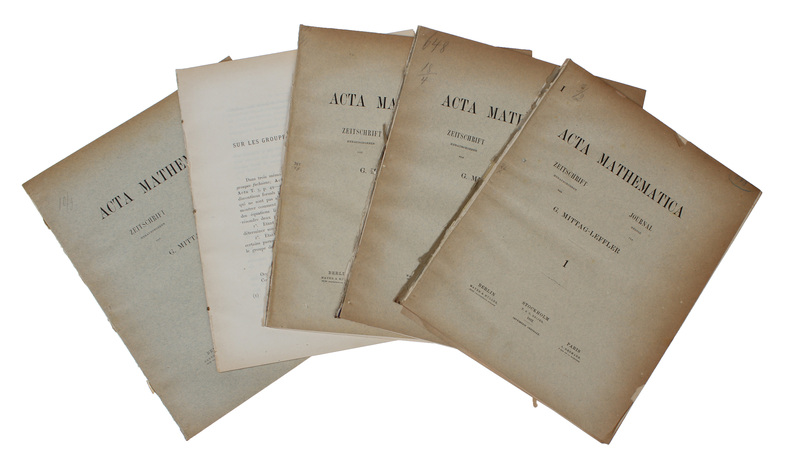
‎"POINCARÉ, HENRI.‎

‎Sur les Groupes des Equations linèaires.‎

‎(Stockholm, F.& G. Beier), 1885. 4to. Orig. printed wrappers (to Acta Mathematica 4:3). Extracted from ""Acta Mathematica"", Vol. 4. Pp. 201-312. Clean and fine.‎

‎"POINCARÉ, HENRI.‎

‎Sur les Groupes des Equations linèaires.‎

‎(Stockholm, F.& G. Beier), 1885. 4to. Orig. printed wrappers (to Acta Mathematica 4:3). Extracted from ""Acta Mathematica"", Vol. 4. Pp. 201-312. Clean and fine.‎

‎First appearance of a major paper on differential equations of the first order""...the whole theory of automorphic functions was from the start guided by the idea of integrating linear differential equations with algebraic coefficients. Poincaré simultaneously investigated the local problem of linear differential equation in the neighborhood of an ""irregular"" singular point, showing for the first time how asymptotic developments could be obtained for the integrals. A little later (1884, the paper offered) he took up the question, also started by I.L. Fuchs, of the determination of all differential equations of the first order (in the complex domain) algebraic in y and y' and having fixed singular points"" his rechearches was to be extended by Picard for equations of the second order, and to lead to the spectacular results of Painlevé and his school at the beginning of the tweentieth century.""(DSB).‎

Referencia librero : 41900

Livre Rare Book

Herman H. J. Lynge & Son
Copenhagen Denmark Dinamarca Dinamarca Danemark
[Libros de Herman H. J. Lynge & Son]

€ 221,59 Comprar

‎"POINCARÉ, HENRI.‎

‎Sur les Intégrales irrégulieres des Equations linéaires. - [THE FORMAL THEORY OF ASYMPTOTIC SERIES]‎

‎(Berlin, Uppsala & Stockholm, Paris, 1886). 4to. Without wrappers as extracted from ""Acta Mathematica. Hrsg. von G. Mittag-Leffler."", Bd. 8, pp. 295-344.‎

‎"POINCARÉ, HENRI.‎

‎Sur les Intégrales irrégulieres des Equations linéaires. - [THE FORMAL THEORY OF ASYMPTOTIC SERIES]‎

‎(Berlin, Uppsala & Stockholm, Paris, 1886). 4to. Without wrappers as extracted from ""Acta Mathematica. Hrsg. von G. Mittag-Leffler."", Bd. 8, pp. 295-344.‎

‎First edition. ""The full recognition of the nature of those divergent series that are useful in the representation and calculation of functions and a formal definition of those series wer achieved by Poincaré and Stieltjes independently in 1886. Poincaré called these series asymptotic while Stieltjes continued to use the term semiconvergent. Poincaré took up the subject in order to further the solution of linear differential equations. Impressed by the usefulness of divergent series in astronomy, he sought to determine which were useful and why. he succededed in islolating and formulating the essential property...Poincaré applied his theory of asymptotic series to diffrential equations, and theree are many such uses in his treatise on celestical mechanics, 'Les Methodes nouvelles de la mechanique céleste"". (Morris Kline).‎

Referencia librero : 39132

Livre Rare Book

Herman H. J. Lynge & Son
Copenhagen Denmark Dinamarca Dinamarca Danemark
[Libros de Herman H. J. Lynge & Son]

€ 872,95 Comprar

‎"POINCARÉ, HENRI.‎

‎Sur les Propriétes du potentiel et sur les Fonctions Abéliennes.‎

‎(Berlin, Uppsala & Stockholm, Paris, Almqvist & Wiksell, 1898). 4to. Without wrappers as extracted from ""Acta Mathematica. Hrsg. von G. Mittag-Leffler."", Bd. 22, pp. 89-178.‎

‎"POINCARÉ, HENRI.‎

‎Sur les Propriétes du potentiel et sur les Fonctions Abéliennes.‎

‎(Berlin, Uppsala & Stockholm, Paris, Almqvist & Wiksell, 1898). 4to. Without wrappers as extracted from ""Acta Mathematica. Hrsg. von G. Mittag-Leffler."", Bd. 22, pp. 89-178.‎

‎First edition. ""As soon as he came into contact with the work of Riemann and Weierstrass on Abelian Functions and algebraic geometry, Poincaré was very much attracted by those fields. His papers on these subjects occupy in his complete works as much space as those on automorphic functions, their dates ranging from 1881 to 1911. One of his main ideas in these papers is that of ""reduction"" of Abelian functions. Generalizing particular cases studied b Jacobi, Weierstrass, and Picard, Poincaré proved the general ""complete reducibility"" theorem...""(DSB).‎

Referencia librero : 39135

Livre Rare Book

Herman H. J. Lynge & Son
Copenhagen Denmark Dinamarca Dinamarca Danemark
[Libros de Herman H. J. Lynge & Son]

€ 241,74 Comprar

‎"POINCARÉ, HENRI.‎

‎Sur une Forme nouvelle des Équations du Probleme des trois Corps. - [THE HAMILTON PRINCIPLE]‎

‎(Berlin, Uppsala & Stockholm, Paris, Almqvist & Wiksell, 1897). 4to. No wrappers as extracted from ""Acta Mathematica. Hrsg. von G. Mittag-Leffler."", Bd. 21, pp. 83-97.‎

‎"POINCARÉ, HENRI.‎

‎Sur une Forme nouvelle des Équations du Probleme des trois Corps. - [THE HAMILTON PRINCIPLE]‎

‎(Berlin, Uppsala & Stockholm, Paris, Almqvist & Wiksell, 1897). 4to. No wrappers as extracted from ""Acta Mathematica. Hrsg. von G. Mittag-Leffler."", Bd. 21, pp. 83-97.‎

‎First edition. In this paper Poincaré arrives at a new theorem about canonical transformation, and in his later ""Methodes Nouvelles"", he proved this theorem using a variiational principle of mechanics, known today as the Hamilton principle.‎

Referencia librero : 39134

Livre Rare Book

Herman H. J. Lynge & Son
Copenhagen Denmark Dinamarca Dinamarca Danemark
[Libros de Herman H. J. Lynge & Son]

€ 241,74 Comprar

‎"POINCARÉ, HENRI.‎

‎Theorie des Groupes fuchsiens (+) Mémoire sur les Fonctions fuchsiennes (+) Sur les Fonctions de deux Variables (+) Mémoire sur les groupes kleinéens (+) Sur les groupes des équations linéaires (+) Mémoire sur les fonctions zétafuchsiennes. - [THE DISCOVERY OF AUTOMORPHIC FUNCTIONS]‎

‎Berlin, Stockholm, Paris, F. & G. Beijer, 1882-84. Large4to. As extracted from ""Acta Mathematica"", no backstrip. With title-page and the original wrappers. (except for paper no. 3 and 5 which only has the title page). In ""Acta Mathematica"", volume 1-5. Title pages with library stamp. Internally clean and fine. Vol. I, pp. 1-62" Pp. 193-294 Vol. II, pp. 97-113 Vol. III. pp. 49-92 Vol. IV pp. 201-312 " Vol. V pp. 209-278.‎

‎"POINCARÉ, HENRI.‎

‎Theorie des Groupes fuchsiens (+) Mémoire sur les Fonctions fuchsiennes (+) Sur les Fonctions de deux Variables (+) Mémoire sur les groupes kleinéens (+) Sur les groupes des équations linéaires (+) Mémoire sur les fonctions zétafuchsiennes. - [THE DISCOVERY OF AUTOMORPHIC FUNCTIONS]‎

‎Berlin, Stockholm, Paris, F. & G. Beijer, 1882-84. Large4to. As extracted from ""Acta Mathematica"", no backstrip. With title-page and the original wrappers. (except for paper no. 3 and 5 which only has the title page). In ""Acta Mathematica"", volume 1-5. Title pages with library stamp. Internally clean and fine. Vol. I, pp. 1-62" Pp. 193-294 Vol. II, pp. 97-113 Vol. III. pp. 49-92 Vol. IV pp. 201-312" Vol. V pp. 209-278.‎

‎First publication of these groundbreaking papers which together constitute the discovery of Automorphic Functions. ""Before he was thirty years of age, Poincaré became world famous with his epoch-making discovery of the ""automorphic functions"" of one complex variable (or, as he called them, the ""fuchsian"" and ""kleinean"" functions)."" (DSB).These manuscripts, written between 28 June and 20 December 1880, show in detail how Poincaré exploited a series of insights to arrive at his first major contribution to mathematics: the discovery of the automorphic functions. In particular, the manuscripts corroborate Poincaré's introspective account of this discovery (1908), in which the real key to his discovery is given to be the recognition that the transformations he had used to define Fuchsian functions are identical with those of non-Euclidean geometry. (See Walter, Poincaré, Jules Henri French mathematician and scientist).The idea was to come in an indirect way from the work of his doctoral thesis on differential equations. His results applied only to restricted classes of functions and Poincaré wanted to generalize these results but, as a route towards this, he looked for a class functions where solutions did not exist. This led him to functions he named Fuchsian functions after Lazarus Fuchs but were later named automorphic functions. First editions and first publications of these epochmaking papers representing the discovery of ""automorphic functions"", or as Poincaré himself called them, the ""Fuchsian"" and ""Kleinian"" functions.""By 1884 Poincaré published five major papers on automorphic functions in the first five volumes of the new Acta Mathematica. When the first of these was published in the first volume of the new Acta Mathematica, Kronecker warned the editor, Mittag-Leffler, that this immature and obscure article would kill the journal. Guided by the theory of elliptic functions, Poincarë invented a new class of automorphic functions. This class was obtained by considering the inverse function of the ratio of two linear independent solutions of an equation. Thus this entire class of linear diffrential equations is solved by the use of these new transcendental functions of Poincaré."" (Morris Kline).Poincaré explains how he discovered the Automorphic Functions: ""For fifteen days I strove to prove that there could not be any functions like those I have since called Fuchsian functions, I was then very ignorant" every day I seated myself at my work table, stayed an hour or two, tried a great number of combinations and reached no results. One evening, contrary to my custom, I drank black coffee and could not sleep. Ideas rose in crowds I felt them collide until pairs interlocked, so to speak, making a stable combination. By the next morning I had established the existence of a Class of Fuchsian functions, those which come from hypergeometric series" i had only to write out the results, which took but a few hours...the transformations that I had used to define the Fuchsian functions were identical with those of Non-Euclidean geometry...""‎

Referencia librero : 45854

Livre Rare Book

Herman H. J. Lynge & Son
Copenhagen Denmark Dinamarca Dinamarca Danemark
[Libros de Herman H. J. Lynge & Son]

€ 2.686,00 Comprar

‎"POINCARÉ, HENRI.‎

‎Theorie des Groupes fuchsiens. - [THE DISCOVERY OF AUTOMORPHIC FUNCTIONS]‎

‎Berlin, Stockholm, Paris, F. & G. Beijer, 1882. Large4to. As extracted from ""Acta Mathematica"", no backstrip. With title-page and front free end-paper. In ""Acta Mathematica"", volume 1. Title pages with library stamp. A fine and clean copy. Pp. (6), 62.‎

‎"POINCARÉ, HENRI.‎

‎Theorie des Groupes fuchsiens. - [THE DISCOVERY OF AUTOMORPHIC FUNCTIONS]‎

‎Berlin, Stockholm, Paris, F. & G. Beijer, 1882. Large4to. As extracted from ""Acta Mathematica"", no backstrip. With title-page and front free end-paper. In ""Acta Mathematica"", volume 1. Title pages with library stamp. A fine and clean copy. Pp. (6), 62.‎

‎First publication of this groundbreaking paper which became Poincaré first paper in his much celebrated and famous six-paper series which together constitute the discovery of Automorphic Functions. ""Before he was thirty years of age, Poincaré became world famous with his epoch-making discovery of the ""automorphic functions"" of one complex variable (or, as he called them, the ""fuchsian"" and ""kleinean"" functions)."" (DSB).These manuscripts, written between 28 June and 20 December 1880, show in detail how Poincaré exploited a series of insights to arrive at his first major contribution to mathematics: the discovery of the automorphic functions. In particular, the manuscripts corroborate Poincaré's introspective account of this discovery (1908), in which the real key to his discovery is given to be the recognition that the transformations he had used to define Fuchsian functions are identical with those of non-Euclidean geometry.The idea was to come in an indirect way from the work of his doctoral thesis on differential equations. His results applied only to restricted classes of functions and Poincaré wanted to generalize these results but, as a route towards this, he looked for a class functions where solutions did not exist. This led him to functions he named Fuchsian functions after Lazarus Fuchs but were later named automorphic functions. First editions and first publications of these epochmaking papers representing the discovery of ""automorphic functions"", or as Poincaré himself called them, the ""Fuchsian"" and ""Kleinian"" functions.""By 1884 Poincaré published five major papers on automorphic functions in the first five volumes of the new Acta Mathematica. When the first of these was published in the first volume of the new Acta Mathematica, Kronecker warned the editor, Mittag-Leffler, that this immature and obscure article would kill the journal. Guided by the theory of elliptic functions, Poincarë invented a new class of automorphic functions. This class was obtained by considering the inverse function of the ratio of two linear independent solutions of an equation. Thus this entire class of linear diffrential equations is solved by the use of these new transcendental functions of Poincaré."" (Morris Kline).Poincaré explains how he discovered the Automorphic Functions: ""For fifteen days I strove to prove that there could not be any functions like those I have since called Fuchsian functions, I was then very ignorant" every day I seated myself at my work table, stayed an hour or two, tried a great number of combinations and reached no results. One evening, contrary to my custom, I drank black coffee and could not sleep. Ideas rose in crowds I felt them collide until pairs interlocked, so to speak, making a stable combination. By the next morning I had established the existence of a Class of Fuchsian functions, those which come from hypergeometric series" i had only to write out the results, which took but a few hours...the transformations that I had used to define the Fuchsian functions were identical with those of Non-Euclidean geometry...""‎

Referencia librero : 46049

Livre Rare Book

Herman H. J. Lynge & Son
Copenhagen Denmark Dinamarca Dinamarca Danemark
[Libros de Herman H. J. Lynge & Son]

€ 537,20 Comprar

‎"POINCARÉ, HENRI. - A FAMOUS PAPER ON CELESTIAL MECHANICS.‎

‎Sur L'Équilibre d'une Masse fluide animée d'un Mouvement de Rotation.‎

‎(Stockholm, F.& G. Beier), 1885. 4to. No wrappers as extracted from ""Acta Mathematica"", Vol. 7. Pp. 259-288. Clean and fine.‎

‎"POINCARÉ, HENRI. - THE DISCOVERY OF AUTOMORPHIC FUNCTIONS‎

‎Theorie des Groupes fuchsiens (+) Mémoire sur les Fonctions fuchsiennes (+) Sur les Fonctions de deux Variables (+) Mémoire sur les groupes kleinéens (+) Sur les groupes des équations linéaires (+) Mémoire sur les fonctions zétafuchsiennes. - [THE DISCOVERY OF AUTOMORPHIC FUNCTIONS]‎

‎Berlin, Stockholm, Paris, F. & G. Beijer, 1882-84. Large4to (272 x 230 mm). Three volumes uniformly bound in contemporary half calf with gilt lettering to spine. In ""Acta Mathematica"", volume 1-5. Light wear to extremities, boards and spines with scratches. Stamp to verso of front board in all volumes. First three leaves in first volume detached, otherwise internally fine and clean. Vol. I, pp. 1-62" Pp. 193-294 Vol. II, pp. 97-113 Vol. III. pp. 49-92 Vol. IV pp. 201-312 " Vol. V pp. 209-278.‎

‎"POISSON, (SIMÉON-DENIS). - COINING THE PHRASE ""LAW OF LARGE NUMBERS""‎

‎Recherches sur la probabilité des jugements, principalement en matière criminelle. (+) Note sur la loi des grands nombres. (+) Note sur le calcul des probabilités. (+) Formules relatives aux probabilités qui dépendent de très grands nombres. (3 papers).‎

‎(Paris, Bachelier), 1835-36. 4to. No wrappers. In: ""Comptes Rendus Hebdomadaires des Séances de L'Academie des Sciences"", Tome 1, Séance du Lundi 14 Décembre 1835 and tome 2, Séance Lundi 11 Avril 1836 + Séance Lundi 27 Juin 1836 + Séance du Lundi 18 Avril 1836. + Pp. (467-) 498, (355-) 386, (387-) 402 a. pp. (601-) 630. (4 entire issues offered. Poisson's papers: pp. 473-495 (1835), pp. 377-380, pp. 395-400 and pp. 603-13. (1836). Clean and fine.‎

‎"POISSON, (SIMÉON-DENIS). - INTRODUCING ""THE LAW OF LARGE NUMBERS""‎

‎Recherches sur la probabilité des jugements, principalement en matière criminelle. (+) Note sur la loi des grands nombres. (2 Papers).‎

‎(Paris, Bachelier), 1835-36. 4to. No wrappers. In: ""Comptes Rendus Hebdomadaires des Séances de L'Academie des Sciences"", Tome 1, Séance du Lundi 14 Décembre 1835 and tome 2, Séance Lundi 11 Avril 1836. Pp. (467-) 498 and (355-) 386. (2 entire issues offered. Poisson's papers: pp. 473-495 (1835) a. pp. 377-380 (1836).‎

‎"POISSON, (SIMÉON-DENIS). - THE PREAMBLE.‎

‎Théorie mathématique de la Chaleur. (Cet article est le préambule d'un ouvrage actuellement sous presse, et qui paraitra incessamment).‎

‎(Berlin, G. Reimer, 1834). 4to. No wrappers. Extracted from ""Journal für die reine und angewandte Mathematik. Hrsg. von A.L. Crelle"", Bd. XII. Pp. 258-262.‎

‎"POISSON, (SIMÉON-DENIS). - THE PREAMBLE.‎

‎Théorie mathématique de la Chaleur. (Cet article est le préambule d'un ouvrage actuellement sous presse, et qui paraitra incessamment).‎

‎(Berlin, G. Reimer, 1834). 4to. No wrappers. Extracted from ""Journal für die reine und angewandte Mathematik. Hrsg. von A.L. Crelle"", Bd. XII. Pp. 258-262.‎

‎First apperance of Poisson's preamble to his famous work ""Théorie mathématique de la Chaleur"", published 1835. “Poisson scored a point in this work by demonstrating how the conductibility of heat in the interior of bodies, far from being contained in the notion of flux as Fourier had held, must be derived from an absorption coefficient that restores a neglected functional dimension. It was in this area that … Poisson’s mechanical model for conduction of heat was the most fruitful. That conception enabled Poisson to understand on the molecular scale the complete and correct equation for radiation of heat” (DSB)‎

Referencia librero : 47207

Livre Rare Book

Herman H. J. Lynge & Son
Copenhagen Denmark Dinamarca Dinamarca Danemark
[Libros de Herman H. J. Lynge & Son]

€ 134,30 Comprar

‎"POISSON, SIMEON PIERRE.‎

‎Recherches sur le Mouvement des Projectiles dans L'Air, et ayant égard a leur Figure et leur Rotation, et a L'Influence du Mouvement diurne de la Terre.‎

‎Paris, Bachelier, 1839. 4to. Contemporary hcalf, gilt spine with gilt lettering. A paperlabel pasted on spine. Stamps on titlepage. VIII,226,(1) pp. Broadmargined on good paper. Light scattered brownspots.‎

‎"POISSON, SIMEON PIERRE.‎

‎Recherches sur le Mouvement des Projectiles dans L'Air, et ayant égard a leur Figure et leur Rotation, et a L'Influence du Mouvement diurne de la Terre.‎

‎Paris, Bachelier, 1839. 4to. Contemporary hcalf, gilt spine with gilt lettering. A paperlabel pasted on spine. Stamps on titlepage. VIII,226,(1) pp. Broadmargined on good paper. Light scattered brownspots.‎

‎First edition. Poisson made importent contribution to many categories in mathematics and mathematical physics, ""Poisson'sTheorem"", the mathematical treatment of attractive forces etc.. ""The Recherches sur le Mouvement...projectiles (the item offered) is the first workto deal with the subject by taking into account the rotation of the earth and the complementary acceleration resulting from the motion of the system of reference. A decade after its publication it inspired Focault's famous experiment demonstrating the earth's rotation""(Pierre Costabel in DSB). - In this researchhe extended Lapalce's analysis to allow also for the rotation of the projectile in motion, and it helped Léon Foucault to conceive of his pendulum to demonstrate the rotation of the earth. - The work is a collection of memoirs. ""Ce recherches se composent de plusieurs Mémoires lus par l'Auteur à l'Academie des Sciences et insérés dans les XXVIe et XXVIIe cahiers du Journal de l'Ecole Polytechnique."" (From verso of halftitle) - Bibliotheca Mechanica p. 261.‎

Referencia librero : 39951

Livre Rare Book

Herman H. J. Lynge & Son
Copenhagen Denmark Dinamarca Dinamarca Danemark
[Libros de Herman H. J. Lynge & Son]

€ 644,64 Comprar

‎"PONCELET, J. V. [JEAN-VICTOR].‎

‎Application de la méthode des moyennes à la transformation, au calcul numériques et à la détermination des limites du reste des séries.‎

‎Berlin, G. Reimer, 1835. 4to. In ""Journal für die reine und angewandte Mathematik, 13 Band, 1. Heft, 1835"". In the original printed wrappers, without backstrip. Fine and clean. [Poncelet:] 54 pp. [Entire issue: pp. IV, 54 pp.].‎

‎"PONCELET, J. V. [JEAN-VICTOR].‎

‎Application de la méthode des moyennes à la transformation, au calcul numériques et à la détermination des limites du reste des séries.‎

‎Berlin, G. Reimer, 1835. 4to. In ""Journal für die reine und angewandte Mathematik, 13 Band, 1. Heft, 1835"". In the original printed wrappers, without backstrip. Fine and clean. [Poncelet:] 54 pp. [Entire issue: pp. IV, 54 pp.].‎

‎First printing of this extensive paper by the French mathematician on number theory and infinite series. ""Poncelet's years of study led to his personal belief that geometry could be founded on a series of fundamental principles as general as those on which algebra was based. He carried this belief forward by suggesting that since every straight line and plane extend to a point of infinity, then any new points on a line would be the same for specific parallel lines (or planes). At this time in mathematical history, it was accepted that all infinite elements of space were supposed to lie on the infinite plane of space, known as the projective plane.Early on, Poncelet's colleagues were extremely reluctant to accept his ideas and resulting theories. However, as time went on, several prominent German mathematicians not only accepted them but contributed to the emerging new science. Among those who recognized Poncelet's breakthrough in the field were Karl Georg Christian von Staudt, Felix Klein, Georg Cantor, Richard Dedekind, and Moritz Pasch. They were later joined by Otto Stolz of Austria who made his own contributions to the field.He died on December 22, 1867, in Paris without the recognition he deserved for his brilliant contributions to the world of numbers. His Treatise on the Projective Properties of Figures (1822) is still regarded as the pioneer work in the field."" (Schlager, Science and its Times, P. 261).‎

Referencia librero : 45145

Livre Rare Book

Herman H. J. Lynge & Son
Copenhagen Denmark Dinamarca Dinamarca Danemark
[Libros de Herman H. J. Lynge & Son]

€ 201,45 Comprar

‎"PONCELET, J. V. [JEAN-VICTOR].‎

‎Sur la valeur approchée linéaire et rationnelle des radicaux de la forme...‎

‎Berlin, G. Reimer, 1835. 4to. In ""Journal für die reine und angewandte Mathematik, 13 Band, 4. Heft, 1835"". Without backstrip. Fine and clean. [Poncelet:] Pp. 277-291. [Entire issue: pp. IV, 54 pp.].‎

‎"PONCELET, J. V. [JEAN-VICTOR].‎

‎Sur la valeur approchée linéaire et rationnelle des radicaux de la forme...‎

‎Berlin, G. Reimer, 1835. 4to. In ""Journal für die reine und angewandte Mathematik, 13 Band, 4. Heft, 1835"". Without backstrip. Fine and clean. [Poncelet:] Pp. 277-291. [Entire issue: pp. IV, 54 pp.].‎

‎First printing of Poncelet's paper which introduced the fundamentals of approximation theory.‎

Referencia librero : 46014

Livre Rare Book

Herman H. J. Lynge & Son
Copenhagen Denmark Dinamarca Dinamarca Danemark
[Libros de Herman H. J. Lynge & Son]

€ 107,44 Comprar

‎"POST, EMIL LEON.‎

‎Finite Combinatory Processes-Formulation 1. [In: The Journal of Symbolic Logic, Vol. 1, Number 3, Sept. 1936]. - [A SIMULTANEOUS VERSION OF THE ""TURING MACHINE""]‎

‎[No place], 1936. 8vo. Extract, unbound, unstapled. Pp. 103-105.‎

‎"POST, EMIL LEON.‎

‎Finite Combinatory Processes-Formulation 1. [In: The Journal of Symbolic Logic, Vol. 1, Number 3, Sept. 1936]. - [A SIMULTANEOUS VERSION OF THE ""TURING MACHINE""]‎

‎[No place], 1936. 8vo. Extract, unbound, unstapled. Pp. 103-105.‎

‎The uncommon first printing of Post's seminal paper, in which he, simultaneously with but independently of Turing, describes a logic automaton, which very much resembles the Turing machine. The Universal Turing Machine, which is presented for the first time in Turing's seminal paper in the Proceedings of the London Mathematical Society for 1936 (same year as the present paper), is considered one of the most important innovations in the theory of computation and constitutes the most famous theoretical paper in the history of computing. ""Post [in the present paper] suggests a computation scheme by which a ""worker"" can solve all problems in symbolic logic by performing only machinelike ""primitive acts"". Remarkably, the instructions given to the ""worker"" in Post's paper and to a Universal Turing Machine were identical."" (A Computer Perspective, p. 125). ""The Polish-American mathematician Emil Post made notable contributions to the theory of recursive functions. In the 1930s, indepently of Turing, Post came up with the concept of a logic automaton similar to a Turing machine, which he described in the present paper [the paper offered]. Post's paper was intended to fill a conceptual gap in Alonzo Churchs' paper on ""An unsolvable problem of elementary number theory"" (Americ. Journ. of Math. 58, 1936). Church's paper had answered in the negative Hilbert's question as to whether a definite method existed for proving the truth or falsity of any mathematical statement (the Entscheidungsproblem), but failed to provide the assertion that any such definite method could be expressed as a formula in Church's lambda-calculus. Post proposed that a definite method would be written in the form of instructions to a mindless worker operating on an infinite line of ""boxes"" (equivalent to Turing's machine's ""tape""). The worker would be capable only of reading the instructions and performing the following tasks... This range of tasks corresponds exactly to those performed by a Turing machine, and Church, who edited the ""Journal of Symbolic Logic"", felt it necessary to insert an editorial note referring to Turing's ""shortly forthcoming"" paper on computable numbers, and ascertaining that ""the present article... although bearing a later date, was written entirely independently of Turing's"" (p. 103)."" (Origins of Cyberspace, pp. 111-12).Hook & Norman, Origins of Cyberspace, 2002: 355.Charles & Ray Eames, A Computer Perspective, 1973: 125.‎

Referencia librero : 42609

Livre Rare Book

Herman H. J. Lynge & Son
Copenhagen Denmark Dinamarca Dinamarca Danemark
[Libros de Herman H. J. Lynge & Son]

€ 738,65 Comprar

‎"QUINE, W.V. - GILBERT RYLE edt.‎

‎On Frege's Way Out. (In: Mind. A Quarterly Review of Psychology and Philosophy. Vol. LXIV. No. 254. April, 1955).‎

‎Edinburgh & N.Y., Thomas Nelson & Sons, 1955. 8vo. Orig. printed grey wrappers w. small nicks to extremities. Internally mint. Advertisement-leaves laid in loose at front. Pp. 145 - 159 (the rest of the volume: pp. 160 - 288, [4 pp. -advertisements] ).‎

‎"QUINE, WILLARD ORMAN VAN.‎

‎A System of Logistic. - [MAGNIFICENT PRESENTATION-COPY]‎

‎Cambridge, Massachusetts, Harvard University Press, 1934. Original full red cloth with gilt line-borders to boards, original dust-jacket, somewhat worn, with a red label over the price and chips and nicks to extremities. Minor loss to corners of dust-jacket, and a large loss of upper part of spine of dust-jacket (ca. 6 x 2 cm), thus lacking the title to spine of dust-jacket, and leaving the cloth of the same part of the spine sunned and the gilding of the title on spine almost faded off. Some soiling to dust-jacket. Internally nice and clean. X, (2), 204 pp.‎

‎"QUINE, WILLARD ORMAN VAN.‎

‎A System of Logistic. - [MAGNIFICENT PRESENTATION-COPY]‎

‎Cambridge, Massachusetts, Harvard University Press, 1934. Original full red cloth with gilt line-borders to boards, original dust-jacket, somewhat worn, with a red label over the price and chips and nicks to extremities. Minor loss to corners of dust-jacket, and a large loss of upper part of spine of dust-jacket (ca. 6 x 2 cm), thus lacking the title to spine of dust-jacket, and leaving the cloth of the same part of the spine sunned and the gilding of the title on spine almost faded off. Some soiling to dust-jacket. Internally nice and clean. X, (2), 204 pp.‎

‎An excellent presentation copy of this scarce first edition of the great logician's first book, which is the published version of his doctoral thesis, hailed by Whitehead as a landmark in the history of symbolic logic.Inscribed by Quine ""To F. Gomes Cassidy, historian of/ languages, from Van Quine, manu-/ facturer of one. Mathematical/ truth is linguistic convention,/ and logic is the [four Chinese characters]"".Frederic Gomez Cassidy (1907-2000) was a great capacity within wold language scholarship and a close friend of Quine, whom he had known since school and been to Oberlin College with. He was a talented linguist specialized in Early English, Creoles, Lexicography, and American language, who is now primarily famous for his lately begun monumental project, the ""Dictionary of American Regional English"" (known as DARE). Cassisy was born in Jamaica to a Canadian father and a Jamaican mother and grew up hearing their varieties of standard British English as well as the Cleole variety of the Black majority. When Cassidy was eleven years old, the whole family moved to Ohio. ""Here the young Jamaican was introduced to yet another variety of English and was dismayed to learn that it was he who sounded ""funny."" But that distinction was to have a significant benefit. It piqued the curiosity of a classmate who sought to know and befriend the boy who looked, acted, and sounded so different. That classmate was Willard Van Orman (""Van"") Quine, later to become one of America's most distinguished philosophers. The friendship he and Fred began as boys was to last their lifetimes, nourished by shared experiences at Oberlin College, regular correspondence through the decades, and frequent summer hiking trips."" (Memorial Resolution of the Faculty of the University of Wisconsin-Madison on the Death of Professor Emeritus Frederic Gomes Cassidy). The time at Oberlin College was of specific joy to him, and it was here he came to explore his interest in languages, philosophy, and science. He obtained his BA in 1930 and his MA, also at Oberlin, in 1932, and in 1938 he was given his PhD from the University of Michigan. Quine graduated from Oberlin College in 1930. He then won a scholarship to study for his doctorate at Harvard University, where he wrote the important thesis that was to constitute his first book. Quine's supervisor at Harvard was Alfred North Whitehead, who has also written the Foreword to his first book and who introduced him to Bertrand Russell, who visited Harvard during this time. From then on, Quine kept an ongoing correspondence with Russell. Quine finished his doctorate in two years and was awarded his Ph.D. in philosophy from Harvard in 1932. After that he received a travelling fellowship, which he used to travel to Vienna, where he got acquainted with the members of the Vienna Circle. During his travels he also met Gödel and Ayer. In Warsaw he spent six weeks with Tarski, and in Prague he studied under Carnap, who greatly inspired him. After his year of travelling, he returned to Harvard, where he published the present version of his doctoral dissertation, his first book.""In this book Dr. Quine has effected an extension of the scope of Symbolic Logic. The advance is more than an improvement in symbols. It extends to fundamental notions. He has introduced a generality adequate to the complexity of the subject matter"" and the symbolism embodies the generality of its meaning. I have no hesitation in stating by belief that Dr. Quine's book constitutes a landmark in the history of the subject."" So Whitehead writes in his Foreword (p. (IX) ). The logic that Quine takes into consideration is that of Russel and Whitehead's ""Principia Mathematica"", and when Whitehead towards the end of the Foreword states that ""Dr. Quine does not touch upon the relationship of Logic to Metahysics. He keeps strictly within the boundaries of his subject. But - if in conclusion I may venture beyond these limits - the reformation of Logic has an essential reference to Metaphysics. For Logic prescribes the shapes of metaphysical thought"" (p. X), the metaphysics he is talking about is nominalism. For Russell and Whitehead, Quine's work represented an unusual illustration of their own logic.The work was also under much influence of the Polish logicians, and as Whitehead concludes in his Foreword, ""it is interesting to note the influence of of the work of Professor H. M. Scheffer, and of the great school of Polish mathematicians. There is continuity in the progress of ordered knowledge."" (P. X).‎

Referencia librero : 37638

Livre Rare Book

Herman H. J. Lynge & Son
Copenhagen Denmark Dinamarca Dinamarca Danemark
[Libros de Herman H. J. Lynge & Son]

€ 6.446,40 Comprar

Número de resultados : 31.751 (636 Página(s))

Primera página Página anterior 1 ... 30 31 32 [33] 34 35 36 ... 121 206 291 376 461 546 631 ... 636 Página siguiente Ultima página