Professional bookseller's independent website

‎Economics‎

Main

Parent topics

‎Social sciences‎
Number of results : 21,124 (423 Page(s))

First page Previous page 1 ... 11 12 13 [14] 15 16 17 ... 74 131 188 245 302 359 416 ... 423 Next page Last page

‎"SMITH, ADAM.‎

‎Teoriia nravstvennykh chuvstv [...] S pis'mami M. Kondorse k Kabanisu o simpatii. [i.e. Russian ""Theory of Moral Sentiments""]. - [FIRST RUSSIAN TRANSLATION OF ""THE THEORY OF MORAL SENTIMENTS""]‎

‎St Petersburg, I. I. Glazunov, 1868. 8vo. In contemporary half calf with with embossed boards. Three raised bands and gilt lettering to spine. Spine with wear. Small label pasted on to top left corner of pasted down front free end-paper. Removed stamp to half-title and title-page with stamp and a a few number written to top of title-page. A few light occassional underlining in pencil, otherwise internally fine and clean. (1)-515, (1), IV pp.‎

‎Rare first Russian translation of Adam Smith's 'The Theory of Moral Sentiments'.The translator, Pavel Bibikov (1831-1875), also translated the 'Wealth of Nations' in 1866, both being part of his series the Library of Classical European Writers. Bibikov regarded the two works as complementing each other, as he remarks in his preface to this translation, ""the works reinforce each other. That is why, having published in Russian Adam Smith's great work of political economy, I decided to translate and publish his other work, which is no less remarkable, and yet known even less to Russian society than the first"" (p. 5). ""Bibikov's translation, probably done via French, remained the only Russian version available until 1997"". (National Library of Scotland).Adam Smith developed a comprehensive and unusual version of moral sentimentalism in his Theory of Moral Sentiments (1759, TMS). He did not expressly lay out a political philosophy in similar detail, but a distinctive set of views on politics can be extrapolated from elements of both TMS and his Wealth of Nations. Although these economic doctrines had not been unheard of in Russia prior to the rise of Anglophile feelings at the beginning of the nineteenth century, ""it was not until interest and admiration for things British was firmly rooted that classical economics could secure its ground in Russia"" (Tanaka, The Controversies Concerning Russian Capitalism - An Analysis of the Views of Plekhanov and Lenin), this processes coincided with the present publication which became important in the spreading of Adam Smith's economic principles in Russia. OCLC only locates three copies.‎

Bookseller reference : 56148

Livre Rare Book

Herman H. J. Lynge & Son
Copenhagen Denmark Dinamarca Dinamarca Danemark
[Books from Herman H. J. Lynge & Son]

€8,058.00 Buy

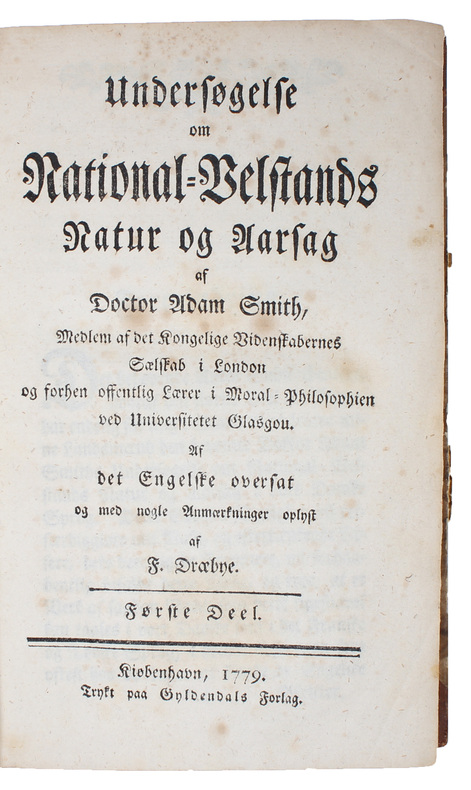
‎"SMITH, ADAM.‎

‎Undersøgelse om National-Velstands Natur og Aarsag. Af det Engelske oversat og med nogle Anmærkninger oplyst af Dræbye. 2 Deele. [Anden Deel:] Hertil er føiet Gourvenør Pownals Brev til Forfatteren i hvilket nogle af de i dette Værk fremsatte Læresætn... - [FIRST DANISH EDITION OF ""THE WEALTH OF NATIONS""]‎

‎Kiøbenhavn [Copenhagen], 1779-80. 8vo. Two very nice contemporary brown half calf bindings with raised bands, gilt ornamentations and gilt leather title- and tome-labels. Volume two with a bit of wear to upper capital. Corners slightly bumped. Pencil annotations to verso of title-page in volume one" title-page in volume two mounted to cover up a small hole caused by the removal of an old owner's name. Internally very clean and bright. All in all a very nice, clean, fresh, and tight copy. Engraved (by Weise, 1784) armorial book plate to inside of front boards (Gregorius Christianus Comes ab Haxthausen). (12), 575 " (8), 775, (3, - errata) pp.‎

‎"SMITH, ADAM.‎

‎Undersøgelse om National-Velstands Natur og Aarsag. Af det Engelske oversat og med nogle Anmærkninger oplyst af Dræbye. 2 Deele. [Anden Deel:] Hertil er føiet Gourvenør Pownals Brev til Forfatteren i hvilket nogle af de i dette Værk fremsatte Læresætn... - [FIRST DANISH EDITION OF ""THE WEALTH OF NATIONS""]‎

‎Kiøbenhavn [Copenhagen], 1779-80. 8vo. Two nice contemporary half calf bindings with four raised bands and gilt leather title label to spines. Volume one lacking one cm of upper part of spine. Volume two with a small tear to lower part of spine. Both volumes with light brown spotting throughout, however, mainly affecting first and last five leaves of both volumes. A fine set. (12), 575" " (8), 775, (3, - errata) pp.‎

‎"SMITH, ADAM.‎

‎Undersøgelse om National-Velstands Natur og Aarsag. Af det Engelske oversat og med nogle Anmærkninger oplyst af Dræbye. 2 Deele. [Anden Deel:] Hertil er føiet Gourvenør Pownals Brev til Forfatteren i hvilket nogle af de i dette Værk fremsatte Læresætn... - [FIRST DANISH EDITION OF ""THE WEALTH OF NATIONS""]‎

‎Kiøbenhavn [Copenhagen], 1779-80. 8vo. Two very nice contemporary brown half calf bindings with raised bands, gilt ornamentations and gilt leather title- and tome-labels. Volume two with a bit of wear to upper capital. Corners slightly bumped. Pencil annotations to verso of title-page in volume one" title-page in volume two mounted to cover up a small hole caused by the removal of an old owner's name. Internally very clean and bright. All in all a very nice, clean, fresh, and tight copy. Engraved (by Weise, 1784) armorial book plate to inside of front boards (Gregorius Christianus Comes ab Haxthausen). (12), 575" (8), 775, (3, - errata) pp.‎

‎The extremely scarce first Danish edition of Adam Smith's seminal main work, ""the first and greatest classic of modern economic thought"" (PMM 221), the main foundational work of the era of liberal free trade. This publication constitutes the first Danish work worth mentioning in the history of economic thought - in spite of the great interest in political economy that dominated Danish political thought in the last quarter of the 18th century. The value of Smith's work was not immediately recognized in Denmark at the time of its appearance and a quarter of a century had to go by for its importance to be acknowledged and for Danish political economy to adapt the revolutionizing theories of Adam Smith. Few copies of the translation were published and sold, and the book is now a great scarcity. As opposed to for instance the German translation of the work, Smith concerned himself a great deal with this Danish translation. As is evident from preserved correspondence about it, he reacted passionately to it and was deeply concerned with the reaction to his work in Scandinavia (see ""Correspondence of Adam Smith"", Oxford University Press, 1977).- As an example, Smith writes in a letter to Andreas Holt on Oct. 26th, 1780: ""It gives me the greatest pleasure to hear that Mr. Dreby has done me the distinguished honour of translating my Book into the Danish language. I beg you will present to him my most sincere thanks and most respectful Compliments. I am much concerned that I cannot have the pleasure of reading it in his translation, as I am so unfortunate as not to understand the Danish language."" The translation was made by Frants Dræby (1740-1814), the son a whiskey distiller in Copenhagen, who mastered as a theologian and was then hired by the great Norwegian merchant James Collett as tutor to his son. There can be no doubt that Dræbye's relation to the Collett house had a great impact upon his interest in economics. In the middle of the 1770'ies, Dræbye accompanied Collett's son on travels throughout Europe, which took them to England in the year 1776, the same year that the ""Wealth of Nations"" was published for the first time. Through the Colletts, Dræbye was introduced to the mercantile environment in England and here became thoroughly acquainted with English economics and politics at the time. It is presumably here that he gets acquainted with Adam Smith's freshly published revolutionary work. When Dræbye returned to Denmark at the end of 1776, he was appointed chief of the Norwegian secretariat of the Board of Economics and Trade. He began the translation of the ""Wealth of Nations"" that he brought back with him from England immediately after his return.""WN [i.e. Wealth of Nations] was translated into Danish by Frants Dræbye and published in 1779 (three years after the first English edition). The translation was initiated by Andreas Holt and Peter Anker, who were acquainted with Smith. Dræbye was a Dane who lived mainly in Norway, reflecting the fact that Norway was much more British-oriented than Denmark proper (Denmark and Norway were united until 1814, when Sweden took Norway away from the Danes"" in 1905 Norway became an independent state). Norwegian merchants lived from exporting timber to Britain and tended on the whole to be adherents of a liberal economic policy, whereas the absolutist government in Copenhagen was more German-oriented and had economic views similar to those in contemporary Prussia."" (Cheng-chung Lai (edt.): ""Adam Smith Across Nations"", p. (37)). The last quarter of the eighteenth century in Denmark was dominated by a lively discussion of monetary policy and the institutional framework best suited to realize that policy. There was a vital interest in questions of economic concern, and contemporary Danish sources refer to the period as ""this economic age"" and state things such as ""never was the world more economically minded"" (both from ""Denmark and Norway's Economic Magazine""). During this period, Smith's revolutionary ideas did not play a major role, however, and only at the beginning of the 19th century did Danish politicians and economists come to realize the meaning of Smith's views. ""Without exaggeration it can essentially be said that a quarter of a century was to pass from the time of the publication of the book in Denmark before Danish political economy fully made Adam Smith's theories and points of view its own. It took so long a time because the economic conditions as a whole in the years from 1780-1800 did not make desirable or necessary the changing of their concepts. That glorious commercial period had to pass before it was understood that we had altogether too little help in our own natural resources and that a different course was, therefore, necessary. Only when one had come so far could the new thinking find a nourishing soil so that it could develop strength with which to push aside the old ideas.""(Hans Degen: ""On the Danish Translation of Adam Smith and Contemporary Opinion Concerning It."" Translated by Henrietta M. Larson. In: Adam Smith Across Nations, p. 51). This first Danish translation is one of the very earliest translations of ""Wealth of Nations"""" it is only preceded by the German (1776-78) and the extremely scarce French (1778-79). As a comparison, the Italian translation does not appear until 1790-91, the Spanish 1792, the Swedish 1800-1804, the Russian 1802, etc.Adam Smith Across Nations: A4 - nr. 1. ""All five books were translated"" appears to be a complete translation. The long letter from Governor Pownall to Adam Smith (25 Sept. 1776) is added as the Appendix (vol. 2, pp. 683 ff.).""(PMM 221 - first edition)‎

Bookseller reference : 47455

Livre Rare Book

Herman H. J. Lynge & Son
Copenhagen Denmark Dinamarca Dinamarca Danemark
[Books from Herman H. J. Lynge & Son]

€8,729.50 Buy

‎"SMITH, ADAM.‎

‎Undersøgelse om National-Velstands Natur og Aarsag. Af det Engelske oversat og med nogle Anmærkninger oplyst af Dræbye. 2 Deele. [Anden Deel:] Hertil er føiet Gourvenør Pownals Brev til Forfatteren i hvilket nogle af de i dette Værk fremsatte Læresætn... - [FIRST DANISH EDITION OF ""THE WEALTH OF NATIONS""]‎

‎Kiøbenhavn [Copenhagen], 1779-80. 8vo. Two nice contemporary half calf bindings with four raised bands and gilt leather title label to spines. Volume one lacking one cm of upper part of spine. Volume two with a small tear to lower part of spine. Both volumes with light brown spotting throughout, however, mainly affecting first and last five leaves of both volumes. A fine set. (12), 575"" (8), 775, (3, - errata) pp.‎

‎The extremely scarce first Danish edition of Adam Smith's seminal main work, ""the first and greatest classic of modern economic thought"" (PMM 221), the main foundational work of the era of liberal free trade. This publication constitutes the first Danish work worth mentioning in the history of economic thought - in spite of the great interest in political economy that dominated Danish political thought in the last quarter of the 18th century. The value of Smith's work was not immediately recognized in Denmark at the time of its appearance and a quarter of a century had to go by for its importance to be acknowledged and for Danish political economy to adapt the revolutionizing theories of Adam Smith. Few copies of the translation were published and sold, and the book is now a great scarcity. As opposed to for instance the German translation of the work, Smith concerned himself a great deal with this Danish translation. As is evident from preserved correspondence about it, he reacted passionately to it and was deeply concerned with the reaction to his work in Scandinavia (see ""Correspondence of Adam Smith"", Oxford University Press, 1977).- As an example, Smith writes in a letter to Andreas Holt on Oct. 26th, 1780: ""It gives me the greatest pleasure to hear that Mr. Dreby has done me the distinguished honour of translating my Book into the Danish language. I beg you will present to him my most sincere thanks and most respectful Compliments. I am much concerned that I cannot have the pleasure of reading it in his translation, as I am so unfortunate as not to understand the Danish language."" The translation was made by Frants Dræby (1740-1814), the son a whiskey distiller in Copenhagen, who mastered as a theologian and was then hired by the great Norwegian merchant James Collett as tutor to his son. There can be no doubt that Dræbye's relation to the Collett house had a great impact upon his interest in economics. In the middle of the 1770'ies, Dræbye accompanied Collett's son on travels throughout Europe, which took them to England in the year 1776, the same year that the ""Wealth of Nations"" was published for the first time. Through the Colletts, Dræbye was introduced to the mercantile environment in England and here became thoroughly acquainted with English economics and politics at the time. It is presumably here that he gets acquainted with Adam Smith's freshly published revolutionary work. When Dræbye returned to Denmark at the end of 1776, he was appointed chief of the Norwegian secretariat of the Board of Economics and Trade. He began the translation of the ""Wealth of Nations"" that he brought back with him from England immediately after his return.""WN [i.e. Wealth of Nations] was translated into Danish by Frants Dræbye and published in 1779 (three years after the first English edition). The translation was initiated by Andreas Holt and Peter Anker, who were acquainted with Smith. Dræbye was a Dane who lived mainly in Norway, reflecting the fact that Norway was much more British-oriented than Denmark proper (Denmark and Norway were united until 1814, when Sweden took Norway away from the Danes"" in 1905 Norway became an independent state). Norwegian merchants lived from exporting timber to Britain and tended on the whole to be adherents of a liberal economic policy, whereas the absolutist government in Copenhagen was more German-oriented and had economic views similar to those in contemporary Prussia."" (Cheng-chung Lai (edt.): ""Adam Smith Across Nations"", p. (37)). The last quarter of the eighteenth century in Denmark was dominated by a lively discussion of monetary policy and the institutional framework best suited to realize that policy. There was a vital interest in questions of economic concern, and contemporary Danish sources refer to the period as ""this economic age"" and state things such as ""never was the world more economically minded"" (both from ""Denmark and Norway's Economic Magazine""). During this period, Smith's revolutionary ideas did not play a major role, however, and only at the beginning of the 19th century did Danish politicians and economists come to realize the meaning of Smith's views. ""Without exaggeration it can essentially be said that a quarter of a century was to pass from the time of the publication of the book in Denmark before Danish political economy fully made Adam Smith's theories and points of view its own. It took so long a time because the economic conditions as a whole in the years from 1780-1800 did not make desirable or necessary the changing of their concepts. That glorious commercial period had to pass before it was understood that we had altogether too little help in our own natural resources and that a different course was, therefore, necessary. Only when one had come so far could the new thinking find a nourishing soil so that it could develop strength with which to push aside the old ideas.""(Hans Degen: ""On the Danish Translation of Adam Smith and Contemporary Opinion Concerning It."" Translated by Henrietta M. Larson. In: Adam Smith Across Nations, p. 51). This first Danish translation is one of the very earliest translations of ""Wealth of Nations"""" it is only preceded by the German (1776-78) and the extremely scarce French (1778-79). As a comparison, the Italian translation does not appear until 1790-91, the Spanish 1792, the Swedish 1800-1804, the Russian 1802, etc.Adam Smith Across Nations: A4 - nr. 1. ""All five books were translated"" appears to be a complete translation. The long letter from Governor Pownall to Adam Smith (25 Sept. 1776) is added as the Appendix (vol. 2, pp. 683 ff.).""‎

Bookseller reference : 50523

Livre Rare Book

Herman H. J. Lynge & Son
Copenhagen Denmark Dinamarca Dinamarca Danemark
[Books from Herman H. J. Lynge & Son]

€8,058.00 Buy

‎"SMITH, ADAM.‎

‎Untersuchung der Natur und Ursachen von Nationalreichthümern, Aus dem Englischen. 2 Bände. - [THE SEMINAL FIRST TRANSLATION OF 'WEALTH OF NATIONS']‎

‎Leipzig, Weidmann, 1776-78. 8vo. Bound in two nice uniform contemporary half calf bindings with five raised bands and gilt lettering to spine. Ex-libris pasted on to pasted down front free end-papers and a small embossed stamp to front free end paper on volume 1 (""Buchhändler u. Antiquar Carl Helf""). Stamp to p. 1 of both volumes. Spines with light soiling and capital on volume 1 lacking a small part of the leather. A few light brown spots throught. A fine set. VIII, 632 pp" " XII, 740 pp.‎

‎"SMITH, ADAM.‎

‎Untersuchung der Natur und Ursachen von Nationalreichthümern, Aus dem Englischen. 2 Bände. - [THE SEMINAL FIRST TRANSLATION OF 'WEALTH OF NATIONS']‎

‎Leipzig, Weidmann, 1776-78. 8vo. Bound in two nice uniform contemporary half calf bindings with five raised bands and gilt lettering to spine. Ex-libris pasted on to pasted down front free end-papers and a small embossed stamp to front free end paper on volume 1 (""Buchhändler u. Antiquar Carl Helf""). Stamp to p. 1 of both volumes. Spines with light soiling and capital on volume 1 lacking a small part of the leather. A few light brown spots throught. A fine set. VIII, 632 pp"" XII, 740 pp.‎

‎First German edition, also being the very first overall translation, of Adam Smith's ground-breaking main work, the ""Inquiry into the Nature and Causes of the Wealth of Nations"". This seminal first translation of the work was undertaken by J.F. Schiller, who finished the first part of the translation in time for it to appear as soon as 1776, the same year as the original English edition. The second part appeared in 1778, the same year as the exceedingly scarce first French translation. This first German translation has been of the utmost importance to the spreading of Smith's ideas throughout Europe, and, after the true first, this must count as the most important edition of the work.""The influence of the Wealth of Nations [...] in Germany [...] was so great that 'the whole of political economy might be divided into two parts - before and since Adam Smith"" the first part being a prelude, and the second a sequel."" (Backhouse, Roger E., The Methodology of Economics: Nineteenth-Century British Contributions, Routledge, 1997.)""The first review of the translation, which appeared in the Göttingische gelehrte Anzeigen for March 10, 1777, by J. G. H. Feder, professor of Philosophy at the University of Göttingen, was very favorable. In the words of the reviewer: ""It is a classic"" very estimable both for its thorough, not too limited, often far-sighted political philosophy, and for the numerous, frequently discursive historical notes,"" but the exposition suffers from too much repetition."" (Lai, Cheng-chung. Adam Smith Across Nations: Translations and Receptions of The Wealth of Nations, Clarendon Press, UK, 2000).Until 1797, [...], the work of Adam Smith received scant attention in Germany. While Frederick II was living, Cameralism held undisputed sway in Prussia, and the economic change which began with the outbreak of the French Revolution had still not gained sufficient momentum to awake the economic theorists from their dogmatic slumber."" (Lai, Cheng-chung. Adam Smith Across Nations: Translations and Receptions of The Wealth of Nations, Clarendon Press, UK, 2000).Various German economist read the german translations and was inspired by it.""Christian Garve, [...], must be considered as among the important contributors to the spread of Smith's views. Himself a popularizer of philosophical doctrines, he was early attracted by the Scotch writers and became one of their foremost exponents in Germany."" In 1791 Garve began a second translation of the Smith's work and in the introduction to the the translation he wrote: ""It (Smith's work) attracted me as only few books have in the course of my studies through the number of new views which it gave me not only concerning the actual abject of his investigations, but concerning all related material from the philosophy of civil and social life"". Georg Sartorius, August Ferdinand Lueder and, perhaps the most important economist of the period, Christian Jacob Kraus, were all important figures in the spread of Smith's thought. ""The most significant of Kraus' works and that also which shows his conception of economic science most clearly is the five-volume work entitled State Economy. The first four volumes of this work are little more than a free paraphrase of the Wealth of Nations"". Kraus was: ""to a large extent responsible for the economic changes which took place in Prussia after 1807, in so far as they can be ascribed to Smithan influence."" (Lai, Cheng-chung. Adam Smith Across Nations: Translations and Receptions of The Wealth of Nations, Clarendon Press, UK, 2000).Kraus wrote of the present volume: ""[T]he world has seen no more important book than that of Adam Smith.... [C]ertainly since the times of the New Testament no writing has had more beneficial results than this will have.... [Smith's doctrines form] the only true, great, beautiful, just and beneficial system."" (Fleischacker, Samuel , A Third Concept of Liberty, Princeton University Press, 1999.)_____________Hailed as the ""first and greatest classic of modern thought"" (PMM 221), Adam Smith's tremendously influential main work has had a profound impact on thought and politics, and is considered the main foundation of the era of liberal free trade that dominated the nineteenth century. Adam Smith (1723-1790) is considered the founder of Political Economy in Britain, mainly due to his groundbreaking work, the ""Wealth of Nations"" from 1776. The work took him 12 years to write and was probably in contemplation 12 years before that. It was originally published in two volumes in 4to, and was published later the same year in Dublin in three volumes in 8vo. The book sold well, and the first edition, the number of which is unknown, sold out within six months, which came as a surprise to the publisher, and probably also to Smith himself, partly because the work ""requires much thought and reflection (qualities that do not abound among modern readers) to peruse to any purpose."" (Letter from David Hume, In: Rae, Life of Adam Smith, 1895, p. 286), partly because it was hardly reviewed or noticed by magazines or annuals. In spite of this, it did evoke immense interest in the learned and the political world, and Buckle's words that the work is ""in its ultimate results probably the most important book that has ever been written"", and that it has ""done more towards the happiness of man than has been effected by the united abilities of all the statesmen and legislators of whom history has preserved an authentic account"" (History of Civilisation, 1869, I:214) well describes the opinion of a great part of important thinkers then as well as now. Kress S. 2567Goldsmith 11394Menger 521Not in Einaudi‎

Bookseller reference : 48982

Livre Rare Book

Herman H. J. Lynge & Son
Copenhagen Denmark Dinamarca Dinamarca Danemark
[Books from Herman H. J. Lynge & Son]

€7,386.50 Buy

‎"SOETBEER, ADOLF.‎

‎Edelmetall-Produktion und Wertverhältniss zwischen Gold und Silber seit der Entdeckung Amerika's bis zur gegenwart. Mit drei Tafeln graphischer Darstellungen.‎

‎Gotha, Julius Perthes, 1879. 4to. No wrappers. ((4),142 pp. and 3 large folded plates.‎

‎"SOETBEER, ADOLF.‎

‎Edelmetall-Produktion und Wertverhältniss zwischen Gold und Silber seit der Entdeckung Amerika's bis zur gegenwart. Mit drei Tafeln graphischer Darstellungen.‎

‎Gotha, Julius Perthes, 1879. 4to. No wrappers. ((4),142 pp. and 3 large folded plates.‎

‎(Petermann's ""Geographischen Mittheilungen"", Ergänzungsheft No 57).‎

Bookseller reference : 46764

Livre Rare Book

Herman H. J. Lynge & Son
Copenhagen Denmark Dinamarca Dinamarca Danemark
[Books from Herman H. J. Lynge & Son]

€67.15 Buy

‎"STIGLITZ, J. E. (+) A. K. DIXIT.‎

‎Monopolistic Competition and Optimum Product Diversity - [""TRANSFORMED INTERNATIONAL TRADE THEORY"" - THE DIXIT-STIGLITZ MODEL]‎

‎Nashville, American Economic Association, 1977. Lex8vo. In the original printed wrappers. In ""The American Economic Review, June 1977"". Entire issue offered. A very fine and clean copy. Pp. 297-308. [Entire volume: Pp. (4), 261-535, (25)].‎

‎"STIGLITZ, J. E. (+) A. K. DIXIT.‎

‎Monopolistic Competition and Optimum Product Diversity - [""TRANSFORMED INTERNATIONAL TRADE THEORY"" - THE DIXIT-STIGLITZ MODEL]‎

‎Nashville, American Economic Association, 1977. Lex8vo. In the original printed wrappers. In ""The American Economic Review, June 1977"". Entire issue offered. A very fine and clean copy. Pp. 297-308. [Entire volume: Pp. (4), 261-535, (25)].‎

‎First printing of this groundbraking paper in which the Dixit-Stiglitz model was presented for the first time. The famous and exceedingly influential model of monopolistic competition: ""transformed international trade theory, as it did other fields of economics, and provided one of the key building blocks for the new economic geography literature that developed in the 1990s."" (Venables, Inequalities in Developing Countries). Joseph Eugene Stiglitz an American economist and a professor at Columbia University, recipient of the Nobel Memorial Prize in Economic Sciences in 2001), former Senior Vice President and Chief Economist of the World Bank. He is known for his critical view of the management ofglobalization, free-market economists, whom he calls ""free market fundamentalists"", and some international institutions like theInternational Monetary Fund and the World Bank. Stiglitz is one of the most frequently cited economists in the world. Stiglitz has to a large extent been influenced Keynes and has himself influenced famous and influential economist such as Paul Krugman, Jason Furman and Stephany Griffith-Jones.‎

Bookseller reference : 46502

Livre Rare Book

Herman H. J. Lynge & Son
Copenhagen Denmark Dinamarca Dinamarca Danemark
[Books from Herman H. J. Lynge & Son]

€470.05 Buy

‎"STRACCHA, BENUENUTI. [BENVENUTO STRACCA].‎

‎De mercatura, seu Mercatore tractatus. - [INTRODUCING MARITIME AND COMMERCIAL LAW]‎

‎Venetiis [Venice], Cum Preivilegio [Paolo Manuzio], 1553. 8vo. In a contemporary unrestored vellum binding with three raised bands. Later paper labels pasted on to upper and lower part of spine. ""Stracc. / de /Mercat."" written in contemporary hand to spine. Upper and lower part of front hinge slightly cracked. ""sum Marii D'Abbatis"" written in contemporary hand to pasted down front free end-paper. Early oval stamp on verso of title-page with monogram. Aldine woodcut device to title-page (Ahmanson-Murphy device no: B2). Occasional marginal annotations and very light occasional marginal water-staining. Tiny wormhole in blank outer margin not affecting text. A very nice, clean, and completely unrestored copy. (40), 287, (1) ff. (with the four blanks 5+6-8 and 2N8). As usual with the typopgraphical errors: ""63 '64', 85 '87', 87 '85', 102 '106', 165 '167', 174 '176', 176 '178'"". These errors are to be found in all published copies.‎

‎"STRACCHA, BENUENUTI. [BENVENUTO STRACCA].‎

‎De mercatura, seu Mercatore tractatus. - [INTRODUCING MARITIME AND COMMERCIAL LAW]‎

‎Venetiis [Venice], Cum Preivilegio [Paolo Manuzio], 1553. 8vo. In a contemporary unrestored vellum binding with three raised bands. Later paper labels pasted on to upper and lower part of spine. ""Stracc. / de /Mercat."" written in contemporary hand to spine. Upper and lower part of front hinge slightly cracked. ""sum Marii D'Abbatis"" written in contemporary hand to pasted down front free end-paper. Early oval stamp on verso of title-page with monogram. Aldine woodcut device to title-page (Ahmanson-Murphy device no: B2). Occasional marginal annotations and very light occasional marginal water-staining. Tiny wormhole in blank outer margin not affecting text. A very nice, clean, and completely unrestored copy. (40), 287, (1) ff. (with the four blanks 5+6-8 and 2N8). As usual with the typopgraphical errors: ""63 '64', 85 '87', 87 '85', 102 '106', 165 '167', 174 '176', 176 '178'"". These errors are to be found in all published copies.‎

‎Exceedingly rare first edition of Stracca's highly important work on merchant-, economic insurance-, and insurance-law. With the present work, Stracca provided the first systematic exposition of commercial law, in particular maritime law, which he was the first to view as distinct from civil law. He was furthermore the first to consider these aspects of the law from a practical point of view, thereby breaking with the late Medieval scholastic law-tradition. Maritime law, often referred to as admiralty law, was developed in Venice in the middle of the 13th century, prompted by the extensive Mediterranean sea trade in which the republic engaged. Legal agreements concluded between consortiums were ad hoc and even though by the time of Straccha, the practice was both well-established and quite refined when one compares to the rest of Europe, no full and systematic exposition of the subject had been published, until Straccha wrote his influential treatise. The work was extremely influential and extremely popular with eight reprints in the 17th century (after the present first edition from 1553: 1555, 1556, 1558, 1575, 1576, 1595, 1599). Numerous reprints in the course of the 17th century bear witness to its longstanding influence. ""In the sixteenth and seventeenth centuries, continental jurists began to regard the affairs of merchants as matter of sufficient interest to warrant special attention and separate treatment in legal writing. Beginning with Benvenuto Straccha's De Mercatura, seu Mercatore Tractatus published in Venice in 1553, a substantial literature on commercial law developed."" (Rogers, The Early History of the Law of Bills and Notes, p. 151)Stracca's work deals with the merchant class and commerce in general"" mercantile contracts, maritime law, and how to deal with bankruptcy. ""His work contains information of interest to economists. He shows the usefulness of trade and navigation"" discusses the restrictions on certain branches of trade, and expresses comparatively moderate opinions on the theory of usury."" (Palgrave).The aspect of insurance was particularly important to Venetian traders, for whom the loss of a single ship could mean bankruptcy. Initially, smaller companies went into coorporation with other smaller companies and created consortiums in order to spread out the risk. Eventually, the practice of insuring oneself through such consortiums became commercialized which lead to the emergence of companies that profited from this line of business: ""A separate sector in which there were many opportunities for making profit from money was insurance. In this sector the damnum emergens [ensuing expense] had a purely hypothetical basis, not a real one. Certainly the element of risk played a plausible role in the case of transport by sea: a subject that was particularly dear to the Ancona jurist Benvenuto Stracca, author of one of the first treatises on trade law and editor of a large collection of writings on mercantile doctrine and jurisprudence."" (Palgrave).Not in BM STC Renouard 156:6. ""Ce volume imprimé en petites lettres rondes est rare."" Einaudi 5491. Kress 69. Goldsmiths 52. Adams S.1911.Ahmanson-Murphy 444Houkes p. 237‎

Bookseller reference : 50627

Livre Rare Book

Herman H. J. Lynge & Son
Copenhagen Denmark Dinamarca Dinamarca Danemark
[Books from Herman H. J. Lynge & Son]

€16,787.50 Buy

‎"TETENS, J.N. (JOHANN NICOLAI).‎

‎Efterretning om Tilstanden af den almindelige Enke=Kasse i Kjøbenhavn ved Slutningen af Aaret 1797, samt almindelige Anmærkninger over Forsikrings=Anstalter i Livs= og Døds= Tilfælde i Almindelighed. Oversat af N. Søndergaard.‎

‎Kiøbenhavn, C.G. Prost/ B.K. Horrebow, 1802. Lille 8vo. Smukt samtidigt helldrbd. med rig rygforgyldning, forgyldte borter på permer (gevebindsudstyr). 125,(1) pp. samt 3 store foldetabeller. ren og frisk, trykt på skrivepapir.‎

‎"TETENS, J.N. (JOHANN NICOLAI).‎

‎Efterretning om Tilstanden af den almindelige Enke=Kasse i Kjøbenhavn ved Slutningen af Aaret 1797, samt almindelige Anmærkninger over Forsikrings=Anstalter i Livs= og Døds= Tilfælde i Almindelighed. Oversat af N. Søndergaard.‎

‎Kiøbenhavn, C.G. Prost/ B.K. Horrebow, 1802. Lille 8vo. Smukt samtidigt helldrbd. med rig rygforgyldning, forgyldte borter på permer (gevebindsudstyr). 125,(1) pp. samt 3 store foldetabeller. ren og frisk, trykt på skrivepapir.‎

‎Scarce first edition of Teten's work on the ""Widow Pension Fund"" (Wittwen-Casse), a pension- and insurance institution for which he was director. His work ""Einleitung zur Berechnung der Leibrenten und Anwartschaften, published in Leipzig in 1785 a.1786 was a landmark of actuarial science. It is recognized by actuaries for featuring the first risk measure ever (the Risico der Casse). In the offered book he applies his skills in actuarial mathematics.After his years as professor in Philosophy at the Kiel University,Tetens begun another career as a high ranking Danish civil servant: member of the Finanzcollegium in Copenhagen, then (1791) counselor of state, and (1803) co-director of the state bank and director of the widow pension funds. By this time, he was interested in pure mathematics as well as in applications. Tetens was professor of Philosophy at the University of Kiel from 1776-89. He was one of the first to discuss David Hume at lenght on the continent (he was called the German Hume). His ""Philosophische Versuche über die menschliche Natur und ihre Entwicklung"", 1777 exerted a tremendous influence on Kant while he was writing the Critique of Pure Reason, and the many similarities between their doctrines are evident. Tetens's doctrines may be compared to Kant's even in their speculative power and importance.Bibl. Danica II:773. The book was first published in Danish (the offered item) and a year later , 1803 in German with the title ""Nachricht von dem Zustande der allgemeinen Wittwen-Casse zu Copenhagen am Schluss des Jahres 1797, mit einigen Bemerkungen über Versicherungs-Anstalten auf Lebens- und Sterbens-Fälle, und die Art sie zu prüffen.""‎

Bookseller reference : 47484

Livre Rare Book

Herman H. J. Lynge & Son
Copenhagen Denmark Dinamarca Dinamarca Danemark
[Books from Herman H. J. Lynge & Son]

€604.35 Buy

‎"TOBIN, JAMES.‎

‎Estimation of Relationships for Limited Dependent Variables. - [FIRST PUBLICATION OF THE TOBIT MODEL]‎

‎(Chicago, The Econometric Society. 1958). Large8vo. Bound without wrappers in light green full cloth with gilt lettering to spine. In ""Econometrica, Journal of the Econometric Society, Volume 26, 1958"". Library label pasted on to pasted down front free end-paper and library stamp to front free end-paper. Frontispiece of Wassily Leontief (President of the Econometric Society, 1954). Minor miscolouring to title page, otherwise a fine and clean copy. [Tobin:] Pp. 24-36. [Entire issue: VIII, 641 pp. + 1 page of advertising + frontispiece).‎

‎"TOBIN, JAMES.‎

‎Estimation of Relationships for Limited Dependent Variables. - [FIRST PUBLICATION OF THE TOBIT MODEL]‎

‎(Chicago, The Econometric Society. 1958). Large8vo. Bound without wrappers in light green full cloth with gilt lettering to spine. In ""Econometrica, Journal of the Econometric Society, Volume 26, 1958"". Library label pasted on to pasted down front free end-paper and library stamp to front free end-paper. Frontispiece of Wassily Leontief (President of the Econometric Society, 1954). Minor miscolouring to title page, otherwise a fine and clean copy. [Tobin:] Pp. 24-36. [Entire issue: VIII, 641 pp. + 1 page of advertising + frontispiece).‎

‎First publication of economist James Tobin exceedingly influential Tobit model, ""a seminal contribution to the estimation and testing of multiple"". (Buiter, James Tobin - An appreciation of his contribution to economics, P. 18). The Tobit model is today a standard economic technique within econometrics. The Tobit model regression models with limited dependent variables statistical model to describe the relationship between a non-negative dependent variable.James Tobin (1918-2002) was a highly influential economist within Keynesian Economics in the 20th century. His academic work included pioneering contributions to the study of investment, fiscal and monetary policy and financial markets. He received the Nobel Memorial Prize in Economic Sciences in 1981.Outside of academia, Tobin was widely known for his suggestion of a tax on foreign exchange transactions, now known as the ""Tobin tax"". This was designed to reduce speculation in the international currency markets, which he saw as dangerous and unproductive. He suggested that the proceeds of the tax could be used to fund projects for the benefit of Third World countries, or to support the United Nations.The issue contain the following papers of interest:1. Deberu, Gerad. Stochastic Choice and Cardinal Utility, Pp. 440-44.1. Luce, R. Duncan. A Probabilistic Theory of Utility, P. 196-224.‎

Bookseller reference : 44995

Livre Rare Book

Herman H. J. Lynge & Son
Copenhagen Denmark Dinamarca Dinamarca Danemark
[Books from Herman H. J. Lynge & Son]

€241.74 Buy

‎"TOBIN, JAMES.‎

‎The New Economics One Decade Older. - [TOBIN-TAX]‎

‎Princeton, Princeton University Press, 1974. 8vo. In publisher's original full cloth with gilt lettering to spine in the original (price-clipped) dust-jacket. Vague stamp (""$5.45"") to half title. A very fine and clean copy. (10), 105, (1) pp.‎

‎"TOBIN, JAMES.‎

‎The New Economics One Decade Older. - [TOBIN-TAX]‎

‎Princeton, Princeton University Press, 1974. 8vo. In publisher's original full cloth with gilt lettering to spine in the original (price-clipped) dust-jacket. Vague stamp (""$5.45"") to half title. A very fine and clean copy. (10), 105, (1) pp.‎

‎First edition of perhaps the most controversial and debated treatise on taxation in the 20th century: The Tobin-Tax, a tax on all spot conversions of one currency into another designed to reduce speculation in the international currency markets, which he saw as dangerous and unproductive.In August 2009 in a roundtable interview in Prospect magazine, Adair Turner supported the idea of new global taxes on financial transactions, warning that the ""swollen"" financial sector paying excessive salaries had grown too big for society. Lord Turner's suggestion that a ""Tobin tax"" - named after James Tobin - should be considered for financial transactions made headlines around the world.In 1981 was awarded to James Tobin ""for his analysis of financial markets and their relations to expenditure decisions, employment, production and prices"".In honor of Eliot Janeway's contributions as an economic historian, Princeton University endowed the Eliot Janeway lectures on historical economics. The present lecture was given in 1972 but was not published until 1974.‎

Bookseller reference : 53281

Livre Rare Book

Herman H. J. Lynge & Son
Copenhagen Denmark Dinamarca Dinamarca Danemark
[Books from Herman H. J. Lynge & Son]

€564.06 Buy

‎"TURNER, THOMAS.‎

‎An Epitome of Book-Keeping by Double Entry: Delineated on a Scale Suited to the Faculties and Comprehension of Senior School Boys and Youth, Designed for the Mercantile Line, Comprising Systematic and Unerring Rules for the Forming Monthly Statements ... - [ONE OF THE EARLIEST WORK ON BOOKKEEPING PRINTED IN AMERICA]‎

‎Portland, Jenks & Shirley, 1804. 8vo. In contemporary full calf with gilt lettering to spine. Extremities with wear and hindges a bit weak. Previous owners names to front free end-paper. Title-page missing missing lower outer corner, not affecting text. Internally with light occassional brownspotting. (2 blank leaves), 148, (2), (3 blank leaves) pp.‎

‎"TURNER, THOMAS.‎

‎An Epitome of Book-Keeping by Double Entry: Delineated on a Scale Suited to the Faculties and Comprehension of Senior School Boys and Youth, Designed for the Mercantile Line, Comprising Systematic and Unerring Rules for the Forming Monthly Statements ... - [ONE OF THE EARLIEST WORK ON BOOKKEEPING PRINTED IN AMERICA]‎

‎Portland, Jenks & Shirley, 1804. 8vo. In contemporary full calf with gilt lettering to spine. Extremities with wear, upper and lower part of spine missing and back board partly detached. Previous owner's name to front free end-paper. Internally with occassional soiling. (2 blank leaves), 148, (2), (3 blank leaves) pp.‎

‎"TURNER, THOMAS.‎

‎An Epitome of Book-Keeping by Double Entry: Delineated on a Scale Suited to the Faculties and Comprehension of Senior School Boys and Youth, Designed for the Mercantile Line, Comprising Systematic and Unerring Rules for the Forming Monthly Statements ... - [ONE OF THE EARLIEST WORK ON BOOKKEEPING PRINTED IN AMERICA]‎

‎Portland, Jenks & Shirley, 1804. 8vo. In contemporary full calf with gilt lettering to spine. Extremities with wear and hindges a bit weak. Previous owners names to front free end-paper. Title-page missing missing lower outer corner, not affecting text. Internally with light occassional brownspotting. (2 blank leaves), 148, (2), (3 blank leaves) pp.‎

‎Rare first edition of Turner's work on double-entry bookkeeping constituting one of the earliest work on bookkeeping printed in America (The earliest being from 1789)""It is singular that this little work should have been suffered to sink into oblivion. It contains much new and useful information"" it is written with clearness and precision, and better adapted to the purposs of instruction than any similar work which have appeared in the United States since 1800. The modern practice of double entry is clearly exemplified by Turner, and a very trifling revision would render [the present work] one of best elementary treatises on merchants accounts extant"" (Foster, The Origin and Progress of Book-keeping).‎

Bookseller reference : 58459

Livre Rare Book

Herman H. J. Lynge & Son
Copenhagen Denmark Dinamarca Dinamarca Danemark
[Books from Herman H. J. Lynge & Son]

€1,678.75 Buy

‎"TURNER, THOMAS.‎

‎An Epitome of Book-Keeping by Double Entry: Delineated on a Scale Suited to the Faculties and Comprehension of Senior School Boys and Youth, Designed for the Mercantile Line, Comprising Systematic and Unerring Rules for the Forming Monthly Statements ... - [ONE OF THE EARLIEST WORK ON BOOKKEEPING PRINTED IN AMERICA]‎

‎Portland, Jenks & Shirley, 1804. 8vo. In contemporary full calf with gilt lettering to spine. Extremities with wear, upper and lower part of spine missing and back board partly detached. Previous owner's name to front free end-paper. Internally with occassional soiling. (2 blank leaves), 148, (2), (3 blank leaves) pp.‎

‎Rare first edition of Turner's work on double-entry bookkeeping constituting one of the earliest work on bookkeeping printed in America (The earliest being from 1789)""It is singular that this little work should have been suffered to sink into oblivion. It contains much new and useful information"" it is written with clearness and precision, and better adapted to the purposs of instruction than any similar work which have appeared in the United States since 1800. The modern practice of double entry is clearly exemplified by Turner, and a very trifling revision would render [the present work] one of best elementary treatises on merchants accounts extant"" (Foster, The Origin and Progress of Book-keeping).‎

Bookseller reference : 59867

Livre Rare Book

Herman H. J. Lynge & Son
Copenhagen Denmark Dinamarca Dinamarca Danemark
[Books from Herman H. J. Lynge & Son]

€1,275.85 Buy

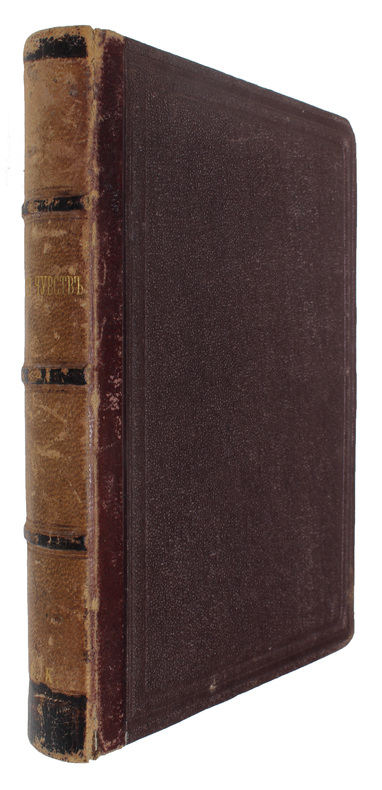
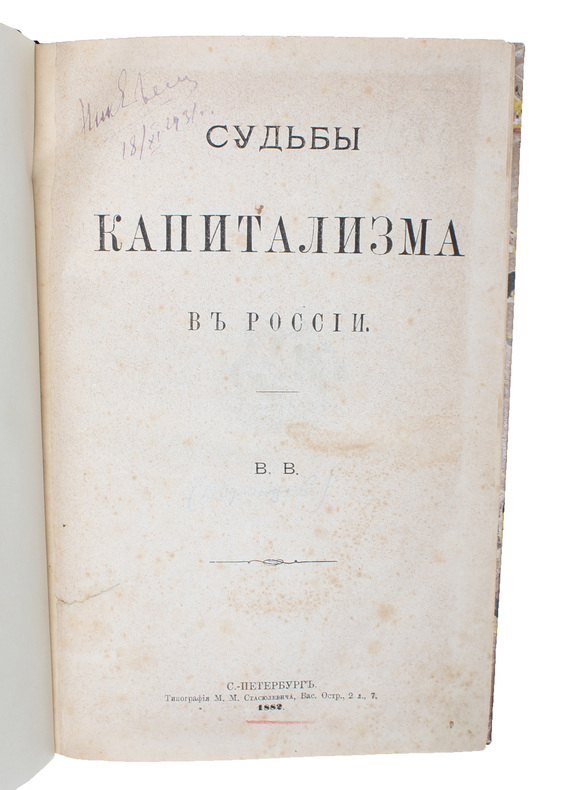
‎"V.V. [VASILY VORONTSOV].‎

‎Sud'by kapitalizma v Rossii. [i.e.: The fate of capitalism in Russia]. - [THE EPITOME OF NARODNIK ECONOMICS AND THE FIRST SERIOUS ATTEMPT AT ANALYZING RUSSIAN CAPITALISM]‎

‎S.-Peterburg, Typografiya M.M. Ctasiulevitsa, 1882. 8vo. Bound in an elegant recent red half calf binding, in pastiche, with five raised bands and gilt lettering to spine. Heavily underlined thoughout in blue and red. Title-page repaired at inner hinge, far from affecting text. No stamps. (4), 312 pp.‎

‎"V.V. [VASILY VORONTSOV].‎

‎Sud'by kapitalizma v Rossii. [i.e.: The fate of capitalism in Russia]. - [THE EPITOME OF NARODNIK ECONOMICS AND THE FIRST SERIOUS ATTEMPT AT ANALYZING RUSSIAN CAPITALISM]‎

‎S.-Peterburg, Typografiya M.M. Ctasiulevitsa, 1882. 8vo. Bound in an elegant recent red half calf binding, in pastiche, with five raised bands and gilt lettering to spine. Heavily underlined thoughout in blue and red. Title-page repaired at inner hinge, far from affecting text. No stamps. (4), 312 pp.‎

‎The exceedingly scarce first edition of this landmark work of Russian economics, being Vorontsov's seminal pre-revolutionary book ""The Fate of Capitalism in Russia"", which constitutes, not only the first serious attempt at analyzing Russian capitalism, but also one of the earliest (and the first Russian) theoretical statements of the assumption of economic development along non-capitalist lines. Vorontsov, together with Danielson - who was greatly inspired by the present work - is considered the major exponent of Narodnik (and pre-revolutionary) economics, of which the present work is essentially the epitome. ""In the 1880's, after the revolutionaries had clearly abandoned their indifferences to political forms, legal Populism became a distinctly separate movement with its own ideology. The common denominator linking the often very different members of this movement was the postulate of noncapitalist industrialization to be initiated and directed by the state, which would safeguard the interests of the small producers. The leading and most characteristic representative of this trend was V. P. Vorontsov (1847 - 1918). His book [the present] was the first ambitious attempt to analyze the specific features of Russian capitalism"" at the same time, it was an original statement of the theoretical assumptions of economic development along noncapitalist lines."" (Walicki, A History of Russian Thought)Vorontsov argues that that Russia's lack of an adequate internal market and the continued vitality of the peasant commune in Russia precluded any possibility that capitalism could ever supplant the agrarian economy that existed there"" the process of industrialization had been initiated in Russia but the backwardness compared to the rest of Europe meant that the industrialized mode of production would be kept in Europe, meaning Russia would have to import instead of export goods and thereby be kept on a comparatively low industrialization level due to the lack of internal market. Vorontsov, however, saw this as a not necessarily negative development. He wrote: ""The countries which are latecomers to the avenue of history have a great privilege in comparison with their foregoers, a privilege consisting in the fact that the accumulated historical experience of other countries enables them to work out a relatively true image of their next step and to strive for what others have already achieved not instinctively but consciously, not groping in the dark but knowing what should be avoided on the way."" [From the present work].Vorontsov was one of the first Russian economists to study the works of Karl Marx, the historical materialism of whom he was strongly influenced by. Vorontsov, inspired by Marx, maintained that crises are caused by production of surplus value, which becomes the real purpose of the economy under capitalist relations. The ""problem of the home market"" and the excess of production over consumption are manifestations of the fact that the capitalist class is not in a position to consume the entire surplus value produced. Vorontsov had therefore worked out a Marxist version of the underconsumption approach, which converged with the one first introduced by Malthus: Crises emanate from ""over-saving,"" or, in Marxist terms, from the inability of the capitalists to consume surplus value.""The views of the other Marxist theoreticians of the Narodnik current, first and foremost Nikolai Danielson, who in 1891 presented his theses in comprehensive form in his ""Outlines of our Social Economy after the Reform"" converged with the basic conclusions of Vorontsov's analysis: inability of the economy to absorb the product generated owing to capitalism's inherent tendency to increase production beyond society's ability to consume. Within this framework, Danielson is nevertheless to be distinguished from Vorontsov as regards the factors that cause underconsumption: contraction in the purchasing power of the popular masses (and not the inability of capitalists to consume the surplus value)."" (MILIOS, Tugan-Baranowsky and Effective Demand)The present work had a profound influence upon the Narodnik movement and is considered the movements economic background. It is commonly rendered as ""populism"" or ""peopleism"", an ideology which took ""peasant collectivism as a vehicle for non-capitalist development in Russia. The Narodnik movement developed along two paths: The intellectual, media based approach (The most influential and to which Vorontsov belonged) and the revolutionary agitation against the Tsardom. Though their movement achieved little in its own time, the Narodniks were in many ways the intellectual and political forebearers of the socialist revolutionaries, who went on to greatly influence Russian history in the 20th century.‎

Bookseller reference : 48766

Livre Rare Book

Herman H. J. Lynge & Son
Copenhagen Denmark Dinamarca Dinamarca Danemark
[Books from Herman H. J. Lynge & Son]

€5,372.00 Buy

‎"VAUBAN, SEBASTIEN LE PRESTRE.‎

‎Projet d'une dixme royale. Qui supprimant la taille, Les Aydes, les Doüanes d'une Province à l'autre (...). - [""UNSURPASSED, BEFORE OR AFTER""]‎

‎(No place, nor printer), 1707. 8vo. In contemporary full calf with five raised bands and richly gilt spine. Edges of boards gilt. Title-label is either missing or have never been added. Small paper-label pasted on to top of spine. Stains and scratches to boards. Corners bumped. Internally nice and clean. VIII, 268 pp. + 3 folded tables.‎

‎One of the at least seven different issues of the 12mo edition, published same year as the first edition (in 4to), in which Vauban proposed a comprehensive tax reform plan for France. The central idea was to replace the existing tax system, which heavily burdened the lower classes while exempting the nobility and clergy, with a single tax on income and property that would be fairly distributed among all citizens, regardless of social status. Schumpeter called the work 'unsurpassed, before or after, in the neatness and cogency of the argument. Purposeful marshalling of all the available data was the essence of his analysis. Nobody ever understood better the true relation between facts and argument. It is this that makes him an economic classic in the eulogistic sense of the work, and a forerunner of modern tendencies' (Schumpeter, History of Economic analysis, p. 204). 'an erudite economic work much in advance of its time, and distinguished both by accuracy of method and breadth of view' (Palgrave), 'creditable alike to the heart and the head of its illustrious author' (McCulloch). 'Though the book was published anonymously, and only a few copies issued (for circulation among friends), Vauban had to submit to the mortification of seeing it 'pilloried' by the parliament, while he himself incurred the displeasure of the king (Louis XIV).' (Palgrave).‎

Bookseller reference : 60967

Livre Rare Book

Herman H. J. Lynge & Son
Copenhagen Denmark Dinamarca Dinamarca Danemark
[Books from Herman H. J. Lynge & Son]

€604.35 Buy

‎"VEBLEN, THORSTEIN.‎

‎On the Nature of Capital (+) On the Nature of Capital: Investment, Intangible Assets, and the Pecuniary Magnate.‎

‎(Boston, Stanford University Press), 1908. 8vo. Two offprints in the original printed wrappers. Offprints from ""Quarterly Journal of Economics"", Vol. XXII, August & Vol. XXIII, November 1908. Vol. XXII: Backwrapper detached, a few small nicks to extremities. Vol. XXIII: Front wrapper detached. Fine and clean. Pp. 517-42" " Pp. 103-136.‎

‎"VEBLEN, THORSTEIN.‎

‎On the Nature of Capital (+) On the Nature of Capital: Investment, Intangible Assets, and the Pecuniary Magnate.‎

‎(Boston, Stanford University Press), 1908. 8vo. Two offprints in the original printed wrappers. Offprints from ""Quarterly Journal of Economics"", Vol. XXII, August & Vol. XXIII, November 1908. Vol. XXII: Backwrapper detached, a few small nicks to extremities. Vol. XXIII: Front wrapper detached. Fine and clean. Pp. 517-42"" Pp. 103-136.‎

‎Two scarce offprints of Veblen's important publications on the theory of capital. Here Veblen broadens the concept of capital to include the capital of knowledge. Thus, Veblen's theory laid ""the foundation for a system of property rights created to enable individuals to productively utilize knowledge that resides within the community as a whole"" (Niman, Henry George and the Development of Thorstein Veblen's Theory of Capital). ""The foundation of Veblen's theory of capital is rooted in the special position knowledge holds in society. Knowledge forms the basis for the productive use of natural resources and is a community asset that, at its most fundamental level, is not owned by a single individual. Thus, Veblen's theory begins by laying the foundation for a system of property rights created to enable individuals to productively utilize knowledge that resides within the community as a whole. These property rights make it possible for the creation and ownership of capital in the form of industrial equipment. With growth in the scale and scope of the community comes the ability to monopolize a portion of the community's asset for pecuniary gain. Monopolization then leads to a form of economic servitude that is similar to slavery."" (Niman, Henry George and the Development of Thorstein Veblen's Theory of Capital).In contrast to conventional theories of capital that are founded on the productive labor of workers and described in individualistic terms, Veblen believed that the history of humanity is not the story of a collection of independent individuals, but, rather, is based on the collective contribution of the group. The group plays an important role because it is the group that forms the entity where knowledge iscaptured and stored.""Thorstein Veblen's theory of capital as an important element in developing an evolutionary economics warrants a closer investigation into the origins of the concept. In his essay outlining the basic theory of capital, Veblen (1908) makes explicit reference to the single taxers, and to the relationship between land as an unearned source of rent and the returns associated with capital.If one considers Veblen's anthropological approach to economics, then it becomes easier to see how, as society develops, capital in the form of community-based knowledge takes on the fundamental role previously played in an earlier era by land. Veblen's theory of capital does not invalidate the earlier focus on land, but, rather, is one step further down the path of economic development."" (Niman, Henry George and the Development of Thorstein Veblen's Theory of Capital).Thorstein Bunde Veblen was an American economist and sociologist, and regarded as being the founding figure of the institutional economics movement. ""He studied economics under John Bates Clark, a leading neoclassical economist, but rejected his ideas. He did his graduate work at Johns Hopkins University under Charles Sanders Peirce, the founder of the pragmatist school in philosophy, and at Yale University under laissez-faire proponent William Graham Sumner. He repudiated their views as well. Veblen did not reject economists' answers to the questions they posed"" he simply thought their questions were too narrow. Veblen wanted economists to try to understand the social and cultural causes and effects of economic changes."" (The Concise Encyclopedia of Economics).‎

Bookseller reference : 48625

Livre Rare Book

Herman H. J. Lynge & Son
Copenhagen Denmark Dinamarca Dinamarca Danemark
[Books from Herman H. J. Lynge & Son]

€1,275.85 Buy

‎"WHATELY, THOMAS.‎

‎Considerations on the Trade and Finances of this Kingdom and on the Measures of Administration with Respect to those great National Objects since the Conclusion of the Peace. - [""IMPORTANT AND EXTREMELY RARE"" WORK ON BRITISH TRADE AND FINANCE]‎

‎London, J. Wilkie, 1766. 4to. In the original printed wrappers. Lacking backstrip and with a small stain to back wrapper, otherwise a very fine and clean copy. 119 pp.‎

‎"WHATELY, THOMAS.‎

‎Considerations on the Trade and Finances of this Kingdom and on the Measures of Administration with Respect to those great National Objects since the Conclusion of the Peace. - [""IMPORTANT AND EXTREMELY RARE"" WORK ON BRITISH TRADE AND FINANCE]‎

‎London, J. Wilkie, 1766. 4to. In the original printed wrappers. Lacking backstrip and with a small stain to back wrapper, otherwise a very fine and clean copy. 119 pp.‎

‎First edition of Thomas Whately's ""important and extremely rare"" (Higgs) work on British trade and finance primarily in the New World. This is the first thorough and first full description and defense of the the first direct tax ever levied by Parliament upon the colonies. The implementation of this tax resulted in the Boston Massacre and the formation of the Boston Tea Party and, eventually, in the expulsion of the British in 1776. By publishing the present defense, Thomas Whately earned himself a prominent place in the events that led to the American Revolution.""Thomas Whately, the most influential British official in colonial policy in his time, published a work on British trade and finances in 1766 [the present work] with this as his opening sentence: ""That the wealth and power of Great-Britain depend upon its trade is a proposition, which it would be equally absurd in these times to dispute or prove"". In the same year, Edmund Burke asserted that ""liberty and commerce"" were ""the true basis of its [Britain's] power."" (Draper, A Struggle for Power: The American Revolution].This policy eventually became fatal: In 1765 the Stamp Act was the first direct tax ever levied by Parliament upon the colonies. All newspapers, almanacs, pamphlets and official documents had to have the stamps. All 13 colonies protested heavily, as popular leaders like Henry in Virginia and Otis in Massachusetts rallied the people in opposition. Thomas Whately (1726-1772), an English politician and writer, was a Member of Parliament, who served as Commissioner on the Board of Trade, as Secretary to the Treasury under Lord Grenville, and as Under- secretary of State under Lord North. ""Important and extremely rare. Reprinted in ""Scarce Tracts"", 1787, and there attributed to T. Whately."" (Higgs)Higgs 3757Goldsmith 10157Sabin 103122 Hollander 1987Kress 2489 (erroneously ascribed to William Knox)‎

Bookseller reference : 50411

Livre Rare Book

Herman H. J. Lynge & Son
Copenhagen Denmark Dinamarca Dinamarca Danemark
[Books from Herman H. J. Lynge & Son]

€2,417.40 Buy

‎"WICKSELL, KNUT.‎

‎Allianser mellan Arbetare och Arbetsgifvare. En ny företeelse på det socialpolitiska området. [Studenterföreningen Verdandis Småskrifter. 109.].‎

‎Stockholm, (1902). 8vo. Original printed orange wrappers. Wrappers fully intact but loosened from book block. Internally very fresh and clean. Uncut. 30 pp.‎

‎"WICKSELL, KNUT.‎

‎Allianser mellan Arbetare och Arbetsgifvare. En ny företeelse på det socialpolitiska området. [Studenterföreningen Verdandis Småskrifter. 109.].‎

‎Stockholm, (1902). 8vo. Original printed orange wrappers. Wrappers fully intact but loosened from book block. Internally very fresh and clean. Uncut. 30 pp.‎

‎First edition, third thousand. Wicksell contributed to a number of different economic disciplines, including his groundbreaking work in monetary theory. ""The standard view of the quantity theory before Wicksell was that increases in the money supply have a direct effect on prices - more money chasing the same amount of goods. Wicksell focused on the indirect effect. In elaborating this effect, Wicksell distinguished between the real rate of return on new capital (Wicksell called this the 'natural rate of interest') and the actual market rate of interest. He argued that if the banks reduced the rate of interest below the real rate of return on capital, the amount of loan capital demanded would increase and the amount of saving supplied would fall. Investment, which equaled saving before the interest rate fell, would exceed saving at the lower rate. The increase in investment would increase overall spending, thus driving up prices. This cumulative process of inflation would stop only when the banks’ reserves had fallen to their legal or desired limit, whichever was higher.In laying out this theory, Wicksell began the conversion of the old quantity theory into a full-blown theory of prices. The Stockholm school, of which Wicksell was the father figure, ran with this insight and developed its own version of macroeconomics. In some ways this version resembled later Keynesian economics. Among the young Swedish economists who learned from Wicksell were Bertil Ohlin, Gunnar Myrdal, and Dag Hammarskjöld, later secretary general of the United Nations."" (Tthe Library of Economics and Liberty).‎

Bookseller reference : 42272

Livre Rare Book

Herman H. J. Lynge & Son
Copenhagen Denmark Dinamarca Dinamarca Danemark
[Books from Herman H. J. Lynge & Son]

€188.02 Buy

‎"WICKSTEED, PHILIP H.‎

‎The Alphabet of Economic Science. Part one (all that appeared). Elements of the Theory of Value or Worth. - [ECONOMICS BASED ON MATHEMATICAL METHOD]‎

‎London & Naw York, Macmillan and Co, 1888. Small 8vo. Orig. olive full cloth. Spine worn, otherwise fine. Hinges a bit weak. XIII, (3), 142, (2, -advertisements) pp. + 10 folded plates.‎

‎"WICKSTEED, PHILIP H.‎

‎The Alphabet of Economic Science. Part one (all that appeared). Elements of the Theory of Value or Worth. - [ECONOMICS BASED ON MATHEMATICAL METHOD]‎

‎London & Naw York, Macmillan and Co, 1888. Small 8vo. Orig. olive full cloth. Spine worn, otherwise fine. Hinges a bit weak. XIII, (3), 142, (2, -advertisements) pp. + 10 folded plates.‎

‎The rare first edition of this important work on mathematical economics, one of Wicksteed's main works, in which he sets out to solve ""some of the most crucial problems of Political Economy on which the foremost Economists have disputed unavailingly for generations for lack of applying the mathematical method. A glance at the ""Index of Illustrations"" will show that my object is to bring Economics down from the clouds and make the study throw light on our daily doings and experiences, as well as on the great commercial and industrial machinery of the world."" (Preface, p. X).Philip Henry Wicksteed (1844-1927) was en English theologian, classicist and medievalist now primarily famous for his contributions to economics. He studied classics at University College in London and Manchester New College and later on became interested in Economics, primarily in an attempt to resolve social problems with the aid of economic theories. He was one of the fist disciples of Jevons and continued his ideas of marginal utility theory. Though not highly influential in his own time, Wicksteed came to influence many great economists of the later generation, e.g. Ludwig von Mises and the ""Austrians"" of that generation. ""I wish that space permitted me to do justice to the personality of Philip Henry Wicksteed (1844-1927) as it radiated upon me, in 1906, during and hour's chat on the lawn in front of his house at Wantage - his repose that owed nothing to callousness, his benevolence that was not weakness, his simplicity that went so well with his refinement, his unassuming modesty that did not lack dignity. As it is, I can merely record that this theologian, who was a lecturer on Dante, stood somewhat outside of the economic profession - one of the reasons why his work, particularly excellent on the pedagogical side, did not leave a more discernible mark."" (Schumpeter, History of Economic Analysis, p. 831). His books did sell very poorly at the time of their appearance, which is why several of the early ones on economics are now so rare.He did, however, publish significant economic works, which, though to a large extent based on Jevons' theories, came to stand out as valuable and interesting in themselves. ""The general complexion of his system is Jevonian -he was in fact the only Jevonian theorist of note- but he shook off so many old things that still stuck to Jevons' exposition and added so many corrections and developments -partly under Austrian influence- that he may be said to have worked out something that, though of course a revision of the marginal utility system, was his own."" (Schumpeter, History of Economic Analysis, p. 832).It was due to his concern for ethics and the ideologies behind the modern commercial society that this excellent theologian turned to economics and tried to make comprehendible the inequalities of wealth and income. He became a lecturer on economics at the University of London in a program intended to teach adults who had not been able to go to university.In this fairly small but important work, Wicksteed aims ""at giving what theologians might call a ""saving"" knowledge of the fundamental proposition of the Theory of Value"" for this, but no more than this, is necessary as the first step towards mastering the ""alphabet of Economic Science"". (Chapter I, p. (1)).‎

Bookseller reference : 38100

Livre Rare Book

Herman H. J. Lynge & Son
Copenhagen Denmark Dinamarca Dinamarca Danemark
[Books from Herman H. J. Lynge & Son]

€1,477.30 Buy

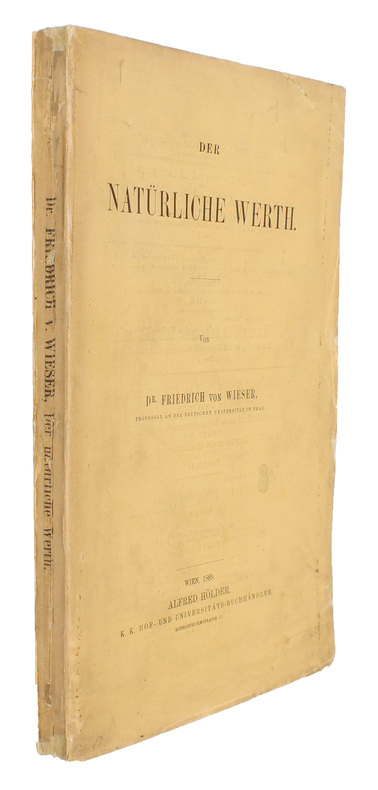
‎"WIESER, FRIEDRICH VON.‎

‎Der Natürliche Werth. - [THE FIRST FULLY DEVELOPED THEORY OF VALUE]‎

‎Wien, Alfred Hölder, 1889. 8vo. Uncut in the original printed yellow wrappers. Light soiling and a few minor nicks to extremities. A very fine and clean copy. XVI, 239 pp.‎

‎"WIESER, FRIEDRICH VON.‎

‎Der Natürliche Werth. - [THE FIRST FULLY DEVELOPED THEORY OF VALUE - COINING ""IMPUTATION""]‎

‎Wien, Alfred Hölder, 1889. 8vo. Uncut in the original printed yellow wrappers. Light soiling and a few minor nicks to extremities. A very fine and clean copy. XVI, 239 pp.‎

‎First edition, rarely seen in the original wrappers, of this important work in which Wieser attempts to apply marginal utility analysis to the determination of cost, thus for the first time fully developing a theory of value. The work ""ranks high as an original achievement"" and is one of the very earliest to realize the information value of prizes. It is furthermore here that the term ""imputation"" is coined.""It was only with Friedrich von Wieser's book [the present] that an attempt was made to fill the lacuna left by Menger and Böhm-Bawerk. Wieser makes it clear that without a solution to the problem of 'imputation' the new theory would remain incomplete and would be subjected to the widespread criticism that it cannot deal with production. The problem is posed as follows"" 'The statement that the productive goods receive their value from the value of their produce suffices only to evaluate [schätzen] the collaborating factors of production as a whole, but not separately. In order to be able to do also this, a rule is needed which allows one to apportion the total produce in detail.'(Wieser, 1889)."" (Steedman, Socialism & Marginalism in Economics 1870 - 1930). ""[H]e continued to work on the same problems and also on what he regarded merely as a first step toward a theory of value that was to be fully developed in [the present work]. He employed the expository device of studying value in a centrally directed economy and suggested possible applications of utility theory to public finance. The book gained him almost immediate acclaim, and it was soon translated into English"" (Frederich von Hayek in IESS).""[In the present work he] worked out the Austrian theories of cost and distribution (he coined the phrase 'Zurechnung', imputation), which Menger had not more than sketched, and this work must in spite of the latter fact and also in spite of glaring faults of technique, rank high as an original achievement. (Schumpeter, History of Economic Analysis)""In this work he applied the marginal utility theory not only horizontally, i.e. to trading and exchange, but also vertically, i.e. to production processes. He defined the value of higher goods produced alongside them, thus developing his imputation theory. Wieser, who possessed a certain ""obsession with compulsive computability"" is recognized as one of the first economist to realize the information value of prices."" (Schulak, the Austrian School of Economics). Masui p. 909Menger col. 395.‎

Bookseller reference : 50373

Livre Rare Book

Herman H. J. Lynge & Son
Copenhagen Denmark Dinamarca Dinamarca Danemark
[Books from Herman H. J. Lynge & Son]

€4,297.60 Buy

‎"WILLIAMSON, OLIVER.‎

‎Franchise Bidding for Natural Monopoly. - [NOBEL PRIZE IN ECONOMICS 2009 - INITIATING ""TRANSACTIONS-COST ECONOMICS""]‎

‎Worcester MA, The Heffernan Press, 1976. Royal8vo. In the original blue printed wrappers. In ""The Bell Journal of Economics"": Vol. 7, No. 1, Spring 1976. Entire volume offered. Very light wear to extremities otherwise a very fine and crisp copy (not ex-library). Pp. 73-104. [Entire volume: 353 pp.].‎

‎"WILLIAMSON, OLIVER.‎

‎Franchise Bidding for Natural Monopoly. - [NOBEL PRIZE IN ECONOMICS 2009 - INITIATING ""TRANSACTIONS-COST ECONOMICS""]‎

‎Worcester MA, The Heffernan Press, 1976. Royal8vo. In the original blue printed wrappers. In ""The Bell Journal of Economics"": Vol. 7, No. 1, Spring 1976. Entire volume offered. Very light wear to extremities otherwise a very fine and crisp copy (not ex-library). Pp. 73-104. [Entire volume: 353 pp.].‎

‎First printing of Williamson's seminal paper - one of the most influential in economics of regulation - in which he argued that in the presence of uncertainty about future demand or costconditions, the transactions costs of writing a complete contract, contingent on all future outcomes is prohibitively costly. The paper initiated together with Goldberg's paper published the same year the new field of ""transactions-cost economics"".The paper was a contributing factor in Williamson being awarded the Nobel prize in Economics in 2009 for his "" work in economic governance.""In the paper he states that: ""A once-for-all auction for the provision of a natural monopoly service is, in practice, totally impractical. On the other hand, periodic re-tendering introduces its own problems. Most public utility industries require substantial sunk, long-lived investment - whether in distribution wires, rail lines, or telecommunications conduits. Where the life of this investment exceeds the life of the franchise, contractual arrangements must ensure continued investment and maintenance of the sunk asset. It may be difficult to verify the quality of the maintenance of the asset ex post. This is particularly the case where the quality dimension includes maintaining the human capital of the staff required to ensure the continued operation of the asset. In addition, the incumbent provider of the service is likely to have better quality information about the likely cost and demand characteristicsof the service, providing an informational advantage over potential rival bidders.To illustrate these ideas, Williamson used a case study based on the experience of tendering cable television franchises in Oakland, California. He concludes: That franchise bidding for cable television has superior properties to regulation is not transparent - Not only is simple franchise bidding - beset with numerous transactional difficulties, but the institutional infrastructure that predictably develops to check dysfunctional or monopoloid outcomes has many of the earmarks of regulation. Using modern language, Williamson highlights and emphasises the importance of transactions costs. Williamson introduced for the first time the notion that natural monopoly regulation can be viewed as a form of long-term contracting. That long-term contract incorporates mechanisms to allow for adjustment to changes in the environment: At the risk of over-simplification, regulation may be described contractually as a highlyincomplete form of long-term contracting in which (1) the regulatee is assured an overall fair rate of return, in exchange for which (2) adaptations to changing circumstances are successively introduced without the costly haggling that attends such changes when parties to the contract enjoy greater autonomy'.""‎

Bookseller reference : 50115

Livre Rare Book

Herman H. J. Lynge & Son
Copenhagen Denmark Dinamarca Dinamarca Danemark
[Books from Herman H. J. Lynge & Son]

€671.50 Buy

‎( Various )‎

‎Biblioteca Scientifico-Politecnica Internazionale‎

‎528pp G/none PB bross. editoriale logora e con piccoli strappi e mancanze sul dorso, copertina sciolta da sistemare, timbro biblioteca in copertina, all'occhiello e titolo, scritta sbiadita proprietario ed alone di umidita' in copertina anteriore, carta lievemente ingiallita, internamente buono. Bibliografia delle piu' importanti opere italiane e straniere sulle scienze esatte e dell'ingegnere arti applicate - tecnologie scienze agrarie ed economiche pubblicate dal 1926 al 1931.‎

MareMagnum

Science Books
London, GB
[Books from Science Books]

€10.00 Buy

‎( Various )‎

‎Cronache Padovane di Vita Economica‎

‎188pp + 9 coloured plates VG/none rilegatura tutta tela editoriale con lievi tracce di polvere e leggermente brunita al dorso, con scritte dorate e tasselli al dorso, tasselli al dorso ed scritte ed effige in rosso ed oro sul piatto anteriore, nel complesso in condizioni piu' che buone. Con numerose illustrazioni in b/n e nove tavole a colori f.t. applicate.‎

MareMagnum

Science Books
London, GB
[Books from Science Books]

€18.00 Buy

‎( WPA). ASCH, Berta & A R MANGUS‎

‎FARMERS ON RELIEF AND REHABILITATION.‎

‎Washington: GPO 1937. First edition. Hardcover. Fine . charts graphs. Tall 8vo; xx 226 pages blue patterned cloth <br/><br/>An integral report for the Roosevelt Administration during the Great Depression. "It is an analysis of the social and economic characteristics of farm operators and farm laborers receiving assistance under the general relief and rural rehabilitation programs. . The report emphasizes the fact that the depression in agriculture began long before 1929 and that the distress of the early 1930's merely accentuated farm problems of long standing." Includes eight photographs by WPA photographers including Carl Mydans Dorothea Lange Theodor Jung Arthur Rothstein etc. GPO hardcover‎

Bookseller reference : DEMO015157I

Biblio.com

Thomas J. Joyce And Company
United States Estados Unidos Estados Unidos États-Unis
[Books from Thomas J. Joyce And Company]

€42.31 Buy

‎(Amsinck, Wilhelm)‎

‎Leben, Geist und Character meines verewigten Bruders, Johann Arnold Amsinck, B. R. Lt., Professors der practischen Philosophie am hiesigen Gymnasium.‎

‎Hamburg, 1783. Gestoch. Frontisp. Gestoch. Titel-, Kopf- u. Schlussvign. (v. Geyser). 2 Bl., 100 S. Pp. d. Zt. m. schw. RSch. u. RVergold.‎

‎ANGEBUNDEN: (Derselbe): Materialien zur richtigen Beurtheilung der wesentlichsten Rechtsverhältnisse zwischen Hamburg und Frankreich. Hamburgs gerechte Erwartungen überhaupt, und Frankreichs unstreitige Verpflichtung zum Ersatz der Bank insbesondere, betreffend. Von einem Freunde der Wahrheit und des Rechts. Geschrieben im Januar 1815. Hbg., Nemnich, (1815). Tit., 103 S. 2 Tle. - ad 1) nicht bei Holzm.-Boh., nicht bei Rapp. Schröder 73,3: "Nur für Freunde gedruckt". - ad 2) Holzm. Boh. 3956. Schröder 73, 6. Nicht bei Rapp. - W. Amsinck (1752 - 1831) Richter am Niedergericht, später Bürgermeister Hamburgs. - J. A. Amsinck (1750 - 1782), Studium der Rechte, Prof. d. prakt. Philosophie. - Wenig beriebn. Gutes Exemplar.‎

Bookseller reference : 1454

‎(ANGOT-DESROTOURS, N.F.M.)‎

‎Observations sur la déclaration du 30 Octobre 1785, et l'augmentation progressive du prix des matières d'or & d'argent, depuis le premier janvier 1726. Par D.P.C.D.M. (Desrotours Premier Commis des Monnaies).‎

‎No place, 1787. (2), 81, (1) pp. 8vo. Modern boards. Kress B.1152; Goldsmiths 12464 (anonymous citation); Stourm, p. 43; INED 58; Einaudi 126. First edition. Discusses the reasons and arguments of the decision to recast the species. - Name stamp on title.‎

Bookseller reference : 18131

Livre Rare Book

A. Gerits & Son b.v. - Antiquarian booksellers
La Diemen Netherlands Países Bajos Holanda Pays-Bas
[Books from A. Gerits & Son b.v. - Antiquarian booksellers]

€225.00 Buy

‎(ARNOUX.)‎

‎Explications du Maire de Toulouse, au sujet des incidens relatifs à l'introduction de l'éclairage au gaz dans la ville. (Drop-head title.) (At end:) Toulouse, Imprimerie d'Auguste Henault, 1838. - (Followed by:) (LONGHENA, J.) Compagnie lyonnaise. Notes sur l'opposition relative à l'établissement de son usine à gaz. (At end:)‎

‎(Toulouse) Imprimerie de Lavergne, 1839. 2 parts. 45, (1 blank) & (2), 29, (1 blank) pp. 4to. Disbound. First work: Arnoux, Maire de Toulouse, justifies in this text the actions taken by him and his municipal council with regard to the public lightning of the city, negocations with various compagnies interested in the assignment (Compagnie Europeenne, Compagnie de Seynes, Compagnie Lyonnaise) and reveals the various contracts and decisions. The mayor was accused of improper behaviour and having concealed his interests in the compagnie Europeenne, dissatisfied with the results of the deliberations. Second work: The drop-head title on page 1 reads: Notes sur les Faits et Moyens libellés dans l'opposition de quelques habitants du quartier Lafayette, contre l'établissement de l'atelier pour la fabrication du gaz de la Compagnie Lyonnaise. At the end is a "Résumé" by the representative of the Compagnie Lyonnaise, J. Longhena, Avril 1839.The work contains the texts of the opponents of the establishment of the factory, with the remarks and refutations by Longhena, thus allowing the reader to follow the fears and grievances of the opponents and the arguments and refutations of the company.‎

Bookseller reference : 25931

Livre Rare Book

A. Gerits & Son b.v. - Antiquarian booksellers
La Diemen Netherlands Países Bajos Holanda Pays-Bas
[Books from A. Gerits & Son b.v. - Antiquarian booksellers]

€150.00 Buy

‎(Atkinson, William).‎

‎CORRECT LIST OF THE NAMES OF AND MONEY SUBSCRIBED BY ALL THE MEMBERS AND OFFICERS OF THE BRIDGE STREET INQUISITION. Sixth Edition.‎

‎16 p. 8vo. Disbound. William, Atkinson (1758-1846), was ordained priest in 1782, and in 1784 was appointed lecturer at the parish church of Bradford, Yorkshire. At Bradford he was embroiled in various controversies, poetical and political. He kept a printing press in his home and often issued pamphlets of his own on ecclesiastical and political topics under the name of the Old Inquirer. Between 1794 and 1829 he published a further twenty-five pamphlets, all of which took an increasingly reactionary approach to a variety of political, religious, and economic subjects. A consistent target was dissent; at one time he brought out a small serial called The Looking Glass, in which he bitterly expressed his views on this topic. He engaged in a short pamphlet war with `Vindex' (Edward Parsons) on the loyalty of dissenters. Atkinson was described as a `man of rare scholarly attainment, but of somewhat eccentric character' (Venn, Alum. Cant.). He was said to have been of Herculean build. We suspect that the subscribers' list here and the large sums pledged may be fictitious, and part of Atkinson's pamphlet war with a supposed 'Constitutional Association, for Suppressing Seditious Publications'. This pamphlet is VERY SCARCE. **PRICE JUST REDUCED! ENGLAND BOX 5‎

‎(AUGEARD, J.M.)‎

‎Oeufs rouges. Première partie. Sorhouet mourant à M. de Maupeou, Chancelier de France. Du 25 Avril 1772. (Drop-head title.) No place, (1772). With 3 engravings (2 folding). - (Followed by:) SUPPLEMENT à la Gazette de France. De Paris, le Vendredi 6 Mars. (no. 5.) (Drop-head title). No place, no date. - (Followed by:) L'AUTEUR du quatrième Supplément à M. de Maupeou, Chancelier de France. De Paris, ce lundi 6 Avril 1772. (Drop-head title). No place, no date. - (Followed by:) LE POINT de vue, ou Lettres de M. le Prés. . . . à M. le Duc de N. . . . No place, 1772. - (Followed by:) (MORIZOT, M.) Inauguration de Pharamond; ou Exposition des lox fondamentales de la monarchie Françoise: avec les preuves de leur execution, Perpétuées sous les trois Races de nos Rois. No place, 1772. With one engraved plate. - (Followed by:) (PIDANSAT DE MAIROBERT, M. F.) Lettre de M. Terray, Ex-Contrôleur général, à M. Turgot, Ministre des Finances. Pour Servir de Supplément à la Correspondance entre le Sieur Sorhevet & M. de Maupeou. (Drop-head title).‎

‎No place, no date (1774). Six works bound in one volume. 64 pp.; 21, (1) pp.; 12 pp.; 68 pp.; (6), 152 pp.; 43, (1) pp. Small 8vo. Contemporary catspaw calf, spine gilt in compartments, compartments with floral ornaments, triple fillet on sides, marbled edges, a bit rubbed, small damage to head of spine, corners lightly bumped. First work: Conlon 72:539.First edition.According to Conlon this work has also been attributed to M. F. Pidansat de Mairobert. It is a satyrical piece against Maupeou and his politics, and it contains an explication of the two folding allegorical plates. The third engraving shows a man handing over manuscripts to an ill man in his bed, with the text below "L'Editeur de la Correspondance reçoit des mains de l'Auteur les Oeufs rouges de Monseigneur." Third work: Conlon 72:72.First edition.This work is possibly also by J.M. Augeard: Conlon states that the BL has classified it under his name. Fourth work: Conlon 72:389.First edition.Fifth work: Conlon 72:1076First edition.Sixth work: Conlon 74:1383; INED 4292; not in Kress; not in Goldsmiths; not in Higgs.First edition.'Apocryphe. .... Pour servir de suite à la Correspondance secrète et familière de M. de Maupeou avec M. de Sor***, par Pidansat de Mairobert. Lettre apocryphe attaquant Maupeou et la politique financière de Turgot. Allusion à un mémoire sur l'emploi des biens ecclésiastiques suivant le voeu de l'Église primitive' (INED). The attribution is based on the Conlon entry.‎

Bookseller reference : 26133

Livre Rare Book

A. Gerits & Son b.v. - Antiquarian booksellers
La Diemen Netherlands Países Bajos Holanda Pays-Bas
[Books from A. Gerits & Son b.v. - Antiquarian booksellers]

€600.00 Buy

‎(AUGER.)‎

‎Mémoires pour servir à l'histoire du droit public de la France en matière d'impôts, ou Recueil de ce qui s'est passé de plus intéressant à la Cour des Aides, depuis 1756 jusqu'au mois de Juin 1775; Avec une Table générale des Matières.‎

‎A Bruxelles, 1779. xiv, 776, (2, errata, blank), 10 pp. 4to. Contemporary calf, spine gilt with raised bands, red label with gilt lettering, marbled edges, some minor blemishes to binding. Kress B.175; Goldsmiths 11860; Einaudi 207; INED 137; Quérard, La France Littéraire, i, p. 126; Dupin/Camus 954bis, pointing to the fact that this work is only complete with the 10 pages supplement, as is the case here; Le Bucher bibliographique, 114. Very rare only edition and suppressed by the Cour des Aides in February 1779 because it was considered contrary to the authority of the Court, it lacked respect for its decisions and it violated the confidentiality of the decisions. This precious and scarce volume, which was not available on the market and which was suppressed in 1779, contains the work of Malesherbes during his tenure in office at the Cour des Aides, that is, the work of 25 years: the reports of the sessions of the Cour des Aides and the remonstrances. It was published with tacit permission and did not contain, in the first instance, those pleas in which Malerherbes addressed the king in quite frank language. These withheld texts were shortly thereafter nevertheless printed and inserted and they form the indispensible 10 page supplement at the end of the volume.The Court des Aides was suppressed, together with the Parliaments, by Maupeou in his attempt at reform; it played, under Malesherbes, a significient role of opposition to what the Court considered to be "royal arbitrariness" and basically shared the "constitutionalist" ideology common to most members of the Grande Robe. The Court was suppressed in 1771 and re-instated in 1774: Malesherbes was recalled to Paris with the reconstituted Cour des Aides on the accession of Louis XVI; it was at this point that he spearheaded the famous 1775 Remontrances of the cour des aides, which detailed the problems facing the regime and envisioned a total overhaul of fiscal policy. Louis XVI was so impressed with the plan -and fearful for the future of his government- that Malesherbes was appointed minister of the maison du roi in 1775. He held office as a royal minister only nine months; the Court proved intransigent in its opposition to his proposals for fiscal restraint and other reforms, including curtailing the arbitrary issuance of lettres de cachet, and he soon found himself bereft of political support. He resigned together with Turgot in 1776.- Pages 71-72 bound between pages 66-67, and with the pages 71-72 bis present, 457-8 omitted in numbering, numbers 465-66 used twice, but text complete.‎

Bookseller reference : 27210

Livre Rare Book

A. Gerits & Son b.v. - Antiquarian booksellers
La Diemen Netherlands Países Bajos Holanda Pays-Bas
[Books from A. Gerits & Son b.v. - Antiquarian booksellers]

€1,850.00 Buy

‎(BARBEU-DUBOURG, J.)‎

‎Petit Code de la Raison Humaine, ou Exposition succinte de ce que dicte à tous les hommes, Pour éclairer leur conduite & assurer leur bonheur. Par M.B.D.‎

‎(Paris), 1789. (iii)-xxii (misnumbered xxiv), 112 (misnumbered 114) pp. 12mo. Modern half calf, marbled boards, spine gilt in compartments, gilt lettering. Echeverria & Wilkie 789/7; INED 218; no edition in Kress; no edition in Goldsmiths; no edition in Einaudi; not in Sabin. Final edition of this little collection of 102 maxims and reflections forming a perfect abridged statement of the philosophy of the Enlightenment.'Both signatures a and b have had the first leaf of each cancelled; no located copy still has them present' (Echeverria & Wilkie). After the half-title and title the numbering of the prelims is: vii-ix, verso of ix an unnumbered blank page, ix again, verso numbered xii, xv-xxiv. This is a copy with a5r numbered ix (see Echeverria & Wilkie). The dedication is 'A Monsieur B.F. (i.e. Benjamin Franklin). The first edition was published in 1774 and a second one was printed in 1782 in Paris on the press of Benjamin Franklin. Livingston (19) writes: 'It was again printed in 1789, a close copy, typographically, of Franklin's Passy press edition, and this is the only edition recorded in the Catalogue of the Bibliothèque Nationale (1914).' According to Quérard (I, 175), this edition 'est plus complète que les autres', and he adds 'ce petit traité renferme beaucoup d'idées sur le commerce maritime.' 'Éloge de la famille et du mariage, du travail, de la tolérance. Défense du droit de propriété et de l'impôt foncier. Idées agrariennes sur la population et l'agriculture' (INED). On page 87 these lines on the USA: 'La Pensylvanie est le premier pays policé de l'univers où la tolérance réciproque de tous les cultes religieux ait été garantie par une loi authentique.'The pages 89-90 are omitted in the numbering, page (91)-end contains notes to the various maxims. Jacques Barbeu-Dubourg (1709-1779) was doctor, professor, journalist and businessman: he was Diderot's doctor untill Barbeu died, and he created various commercial companies with the aim to help the American revolutionaries. - Small tear in outer blank margin of the title-page and a few unobtrusive spots, verso title-page and recto last page with strengthened inner margin.‎

Bookseller reference : 25843

Livre Rare Book

A. Gerits & Son b.v. - Antiquarian booksellers
La Diemen Netherlands Países Bajos Holanda Pays-Bas
[Books from A. Gerits & Son b.v. - Antiquarian booksellers]

€800.00 Buy

‎(Beardslee, George W; Wilson, James G; and Gibson, John). Cagger, P; and Newton, CW C W‎

‎IN THE UNITED STATES CIRCUIT COURT FOR THE NORTHERN DISTRICT OF NEW YORK. JAMES G. WILSON AND JOHN GIBSON VS. GEORGE W. BEARDSLEE. Affidavits on the part of the Defendant to oppose Application for Injunction. P. Cagger Solicitor for Defendant. C.W. Newton Solicitor for Complainants.‎

‎<p>Albany: Joel Munsell Law Printer 1851. 1851. Good. - Octavo 8-7/8 inches high by 5-3/4 inches wide. Softcover pamphlet bound in self-wraps titled in black on the cover page. The covers are creased and the edges are foxed and darkened with some staining or soiling to the front cover leaf. 41 pages plus an addenda leaf tipped-in at the front. The corners of several pages are creased and there is some minor foxing to the top edge of a few pages. Good.</p><p>John Gibson was an early member of the syndicate which had initially purchased a large share of the patent rights to William Woodworth's Planing Machine. His co-complainant James G. Wilson was a speculator who later invested in the rights to the Woodworth Planing Machine and who over 24 years earned more than 2 million dollars in royalties from his stake in the patent.</p><p>The cash cow which Woodworth's Planing Machine represented was threatened by George W. Beardslee's design of his Beardslee Patent Fixed-Knife Planing Machine in 1851. From Buffalo New York Beardslee immediately found himself named as one of four defendants in a lawsuit which the holders of Woodworth's patent brought to court even though his fixed-knife planer was totally different than Woodworth's cylindrical-head design. Indeed much of the pamphlet at hand compares the 2 planers elaborating on their differences.</p><p>An article titled "Beardslee's Planing Machine" published in the October 16 1852 issue of "Scientific American" states that "In the city of Albany Ahijah Jones has invested a large amount of capital in dressing lumber and has three of the Beardslee machines in active operation each of which as we learn by the Albany Argus dresses 4000 boards or planks in ten hours including all stoppages. One of these machines has planed stuff for Messrs. Boardman Gray of Albany -- the famous pianoforte makers -- which always was planed by hand heretofore no power planing machine being able to do the work. The stuff was for the 'Tuning Boards' of pianos." "Scientific American" goes on to praise the machine and in an article titled "The Beardslee Planing Machine Case" published in the November 20 1852 issue states that "The Planing Machine controversy which has been so long pending between Wilson and Gibson complainants and George W. Beardslee defendant and in relation to which a mass of testimony some 400 pages has been taken before a United States Judge has finally been adjusted the testimony adduced by the defendants being so conclusive that the application for an injunction fo restrain the use of Beardslee's machines had been abandoned."</p><p>RARE.</p> Albany: Joel Munsell, Law Printer, 1851. paperback‎

Bookseller reference : 96281

Biblio.com

Blue Mountain Books & Manuscripts, Ltd.
United States Estados Unidos Estados Unidos États-Unis
[Books from Blue Mountain Books & Manuscripts, Ltd.]

€232.68 Buy

‎(BENEKENDORF, Karl Friedrich von)‎

‎Oeconomia forensis oder kurzer Inbegriff derjenigen Landwirthschaftlichen Wahrheiten, welche allen sowohl hohen als niedrigen Gerichts-Personen zu wissen noethig. (Band 1 in 2. Auflage). Band 1-6 u. 8 (von 8) in 7 Bänden.‎

‎Berlin, Pauli, 1776-84. 4to. Pappbände d. Zeit mit 4 (von 7) Rückenschildern (fleckig, berieben u. bestoßen, Vorsatzpapier meist von den Deckeln gelöst, Band 8 mit Wasserschaden, Vorderdeckelbezug fehlt). [2 Warenabbildungen]‎

‎Benekendorf war Herausgeber der "Berliner Beiträge zur Landwirthschaftswissenschaft" (1771-85). Band 4 u. 8 mit umfangreichem Register. - Kress 7151; Humpert 3023. - Gebräunt, Band 8 wasser- u. moderfleckig.‎

Bookseller reference : 269431

Number of results : 21,124 (423 Page(s))

First page Previous page 1 ... 11 12 13 [14] 15 16 17 ... 74 131 188 245 302 359 416 ... 423 Next page Last page