|
|
|
Caminade (Pierre)
Le don de merci.
français Signé par l'auteur In-12 de 230 pp.; cartonné blanc de l'éditeur. Envoi autographe signé de l'auteur dédicacé à Geneviève et Maurice de Gandillac.
|
|
|
Camo (Pierre)
Heptaméron poétique.
français Paris, Garnier frères, 1932. In-8 de frontispice., 72 pp.; broché, couverture imprimée. Edition limitée à six cents exemplaires numérotés et tirés sur papier vergé Alfa. Celui-ci n° 394, en très bon état. Envoi signé de l'auteur.
|
|
|
Camo (Pierre)
Livret de poésie.
français Paris, Albert Messein, 1937. In-8 de 62 pp.; broché, couverture imprimée. Bon état. Envoi signé de l'auteur.
|
|
|
CAMO, Pierre
Heptaméron poétique. Poèmes de Pierre Camo [ Edition originale - Livre dédicacé par l'auteur ]
Un des 600 exemplaires sur papier vergé alfa numérotés (n°357), après 10 exemplaires sur pur fil, 1 vol. grand in-12 br., La Muse Française, Garnier Editeur, Paris, 1932, 72 pp. Etat très satisfaisant (petit mq. au dos en queue, très bon état par ailleurs). Français

|
|
|
CAMPAGNE (Jean-Marc).
CARZOU.
Paris, Flammarion, 1981. Petit in-4 (21 x 28 cm), cartonnage bradel, 96 pp. Carzou écrit en rouge sur le premier plat et le dos. Photographie en frontispice, (portrait de Carzou). Bibliographie, liste des livres illustrés et table des illustrations. Bibliographie, liste des livres illustrés et table des illustrations. (62 planches en noir en couleurs hors-texte). Exemplaire enrichi d'un envoi autographe de Carzou.
|
|
|
Campanari, Leandro, Geiger, Dirigent, Komponist und Musiklehrer (1859-1939).
Eigenh. Brief mit U. Cincinnati, Ohio, 9. XI. 1891.
2 SS. (Qu.)-8vo. In italienischer Sprache an den Maler Camillo Rapetti über Portraits seiner Eltern, die er eigentlich nicht haben wolle: "Sono in America [...] occupatissime sempre come tutti gli americani - ecco la razione che non ti ho scritto né riposto alla tue lettera [...] Ora parliamo dei ritratti ad oglio che tu mi faresti, intendo, dei miei genitori. Li dó e fó di spiegazione. Il papá me ha [...] scritto - ringraziandome del mio desiderio d'aver i loro ritratti - ma che non desidero. Amore [...] sarò di ritorno nella nostra bella Italia [...]". - Auf Briefpapier des College of Music, Cincinnati.
|
|
|
CAMPBELL, MARTIN & BOSWELL
Manuscript - Solicitors' Letter Book - 170 Draft Documents Pertaining to Dalquharran Castle and Kennedy Estate, Foreign Investments in Australia and a Fascinating Link to Poet Robert Burns
Edinburgh, 1893. Letter Book Archive of draft documents made by the law firm Campbell, Martin & Boswell, for private estates and business agreements, neatly preserved in a custom binding, featuring little known details relating to the Dalquharran Castle and Kennedy estate, Scottish investments and links to Australia, and a fascinating connection to the renowned poet Robert Burns by way of a lease made with his descendent for a mansion estate which he, too, had personally visited. 8vo. Approximately 170 documents, most in manuscript and some in typescript, 1166 pages combined, with a scant few integral blanks, plus unpaginated manuscript index listed alphabetically by document type. Very large volume measuring 23 x 35 x 9 cm (WxHxD) and weighing 10 pounds. Quarter calf over brown cloth boards labelled in gilt to spine, original marbled endpapers. Bookbinder's label to front pastedown (Caldwell Brothers of Edinburgh). Very good condition, an excellent depository volume of legal and historical interest. The firm Campbell, Martin & Boswell, consisted of three solicitors, each with the title and privileges of "Writers to the Signet", John Douglas Boswell, W.S.; Patrick William Campbell, W.S.; and Francis John Martin, W.S., the latter of whom became a Fellow of the Royal Society of Edinburgh in 1892. Their office was at 1 North Charlotte Street in Edinburgh, which was the same address as the Royal Bank of Scotland, and situated very near to Charlotte Square. Scots law and legal proceedings of the late nineteenth century, much of which differ today, are well illustrated in this archive of original working documents executed by accomplished patrician lawyers representing some discriminating and aristocratic clients. Many of the documents deal with property conveyance and estate matters, and represent traditions no longer observed, including the obsolete " Trust Disposition and Settlement" procedure for claiming an inheritance. Other documents include assignations, land conveyances, bond and disposition in security, deeds of assumption and discharges, estate inventories, a search for deeds with the Register of Sasines, leases, loan proposals for purchasing commercial space in Edinburgh, records of monetary investments in Highland Railway (HR), Jamaican plantations, property to let in Scotland, Australian banks, and so forth. So exclusive and intertwined were the upper class and wealthy, perhaps not large in number, but surely powerful in society, some interesting genealogical and business connections can be made from examining these papers. Many clients are also relations to the solicitors who often acted as trustees. In one case, we find a multi-generational connection between the Campbell and Burns families, beginning with the Jamaica sugar plantation owner Patrick Douglas and Scotland's celebrated national poet Robert Burns (1759-1796). In addition, these documents shed light on the leasing history of the Dalquharran Castle in South Ayrshire, which included hunting rights for at least one resident, as well as the Kennedy family's monetary investments in Australia. Interesting to note, one of the lawyers from this firm, Mr. Campbell, is related through marriage to the castle's then most recent owner, Mr. Francis Thomas Romilly Kennedy (died in 1892). Some items of special interest: • A twenty page lease agreement was issued to a Glasgow coalmaster named Robert Burns (1844-1896), who was the great-great-grandson and namesake of the famous poet and lyricist Robert Burns (1759-1796) - who had visited the very same Mansion House of Garrallan in his day, being a friend of its proprietor at the time, Dr. Patrick Douglas. A fascinating and detailed document, the lessors were concerned with mining royalties, minerals specifically deemed as belonging to the Marquis of Bute, and minerals raised at the mansion house. [Garrallan was owned by the Campbell family until 1676. The Douglas family followed but it became extinct in the male line. Dr. Patrick Douglas, who died 1819, also owned property in Jamaica and in 1786 he offered Robert Burns a position as a bookkeeper in Port Antonio, but the poet declined. Burns was a visitor at Garrallan. Jane Douglas married Hamilton Boswell and this family retained it until 1914 when it was sold to the Stevenson family of Changue, who still own the property.] • Another fascinating document is headed "Notes on Titles of Charlotte Square," now a World Heritage Site situated in Edinburgh. In this we find reference to feudal tenancy and particulars of construction. Excerpts from the document: "Charter by the Magistrates & Town Council of Edinburgh in favour of Alexander Stevens dated 1st June 1803... no buildings are to be erected... on the foresaid back ground... that the area of the square within the line of the street ways was to become a common property for the accommodation pleasure health or other convenience of the several feuars round said square... For the lot of ground in Charlotte Square X the sum of £6. 18/4 3/12 and further paying the sum of £14. 18/4 3/12 upon the entry of each heir and singular successor or disponee to said Lot Houses or Tenements built thereon... For the foresaid piece of ground on Young Street the sum... Disposition of Sir George Hope to Margaret Kyle of Binghill dated 2nd April 1818. Disposition & assignation of the said Rev'd Dr. James Kyle in favour of Alexander Russell dated 8th January 1868. Disposition Settlement by the said George Bruce [Factor and Law Agent, W.S.] dated 10th July 1891 & recorded in the Books of Council Session 27th July 1892." • At least 8-10 documents pertain to Francis Thomas Romilly Kennedy (1842-1892) and the Dalquharran Castle which he inherited in 1879 and immediately expanded. The castle, which was built for his grandfather and featured a round bastion tower with a drawing room, piano nobile, and a library above, and an exquisite top-lit spiral central staircase, was extended from 1880-81 by Francis Thomas Romilly Kennedy, to accommodate his wife and bedrooms for their nine children. The work was completed at great expense, leaving the Kennedy family almost bankrupt. The family is known to have left Dalquharran for alternative lodgings, and by 1890 they had leased the castle and its lands as a hunting and fishing estate, as seen in this volume. Examples of the papers found herein include: An Agreement of Lease of the Dalquharran Castle as a furnished residence, "excepting the Strong Room retained by the proprietor", to James Paterson of Milton Lockhart, and includes surrounding lands with permission for shooting small game in accordance with the Ground Game Act of 1880. On 24 July 1893, the Scottish Union & National Insurance Company confirming notice of an "assignation" which transfers the estate of Francis Thomas Romilly Kennedy, to his second son "John Campbell Kennedy of the Royal Navy." A two page document which itemizes and places monetary value on the "Additional Inventory of the Personal Estate... of the late Mr. Kennedy", including the surrender value of a life insurance of sorts, from which are deducted debts and funeral expenses. A list of debentures, borrowed from institutions in Australia, Canada, and Oregon, also documents relating to his investments with the British and Australasian Trust and Loan Company. Matters concerning his executrix and widow Eliza Barbara Colina (née Campbell) Kennedy. • An agreement permitting a John Ernest Orr to manufacture and sell a certain steam trap which was patented in 1892 by a millwright named John Mackie. As members of the elite society of Scottish solicitors, the Writers to the Signet, and thus holding special signing authorities and privileges, the firm of three attracted some notable clients, some of which were long-standing clients from generations past. A cursory gander through the volume finds these examples: • William Jardine Herries Maxwell (1852-1933), a Liberal Unionist politician in Scotland. Maxwell was elected at the 1892 general election as the Member of Parliament (MP) for Dumfriesshire in 1895, but lost it very narrowly when his Liberal Party opponent had a majority of only 13 votes. He regained his seat in 1900, but stood down at the 1906 general election. • William Caven Lockhart-Mure of Livingston in the Stewartry of Kirkcudbright, Lieutenant in the 4th Bombay Cavalry (Poona Horse), Indian Army, who later rose to the rank of Major, and died in died in 1913. [With a lease herein the lieutenant agreed to a term of five years, letting and maintaining the Livingstone House, gamekeeper's house, garden and orchard in Kirkcudbright. It was owned by Colonel John Stewart (died 1726), a Scottish professional soldier who served in the Scottish Army and, after the Union with England, in the British Army, who also held a seat in the House of Commons of Great Britain from 1708 to 1715, and who had inherited the property from his father. • James Oswald (1779-1853), an influential merchant and Member of Parliament (MP) for Glasgow from 1832 to 1837 , who inherited the estate of his cousin Richard Alexander Oswald (1771-1841), a Scottish Liberal Party politician who sat in the House of Commons from 1832 to 1835. [Again a family connection, his son, also named Richard, married Lady Mary Kennedy.] • Alexander Oswald (1811-1868), a Conservative Party politician and Member of Parliament (MP) for Ayrshire from 1843 to 1852, as well as his father Richard Alexander Oswald, a Glasgow merchant. • Robert Haldane Scott, a Scottish attorney in Jamaica who filed returns for slaves by plantation owners in Trelawny, and his daughter Eliza Scott who married Reverend Edward Holland of New South Wales and died intestate June 1890. [A detailed document assigns a woman named Margaret Jane Wakeford, resident of Falmouth, Jamaica, as Power of Attorney for the estate of the late Eliza Scott.] • William Hume, technical chemist and innovative instrument maker, who was very active in the 1880s and 1890s designing and manufacturing magic lanterns, glass lantern slides, oxy-hydrogen lime-light apparatuses, a cantilever enlarging apparatus, a half-plate camera, rapid rectilinear lenses, and other photographic equipment, from his shop at 1 Lothian Street in Edinburgh. [A loan proposal herein indicates that he also purchased the property of 31 Lothian Street.] • Annabella Alexandrina Campbell Boswell (1826-1914), gentlewoman, born at Yarrows, Bathurst Plains, New South Wales, having a maternal lineage linked to the Campbells. She was a prolific diarist, horsewoman, skilled watercolourist and pianist. In 1849 Annabella met Patrick Charles Douglas Boswell, a free settler from Ayrshire, Scotland, accountant for the Bank of New South Wales (later becoming manager), who was related to James Boswell the biographer, and presumably also Mr. Boswell of this firm. Together Annabella and Patrick returned to Scotland in 1865, where Patrick had inherited the family estate in Ayrshire. • The only actual "will" recorded here is that of Bengal Army Major General Robert Farquhar Webster's widow, Janetta Annan Webster (née Dewar), which bequeaths the estate to her son, and permits the trustee to invest funds and heritable securities into in stocks of Great Britain, any British Colony or Dependency, until such time as he reaches the age of maturity. [Her husband was educated at the Edinburgh Academy before joining the British Army in India in 1843. He retired in 1878 as a Major General in the Bengal Staff Corps.] • Major Archibald Hume of Auchendolly and Spitalside, born 27 Dec 1843, and recognized by the Society of Antiquaries of Scotland for having presented the museum with a bronze enamelled harness ornament of British Celtic origin. • William Fullarton of Fullarton (1754-1808), a Scottish soldier in the Bengal Staff Corps who participated in the Second Anglo-Mysore War, a statesman, agriculturalist, author, and son of a wealthy Ayrshire gentleman for whom he was named - William Fullarton of Fullarton. • Reverend Samuel Smith, attached to the church and parish of Borgue in the Stewartry of Kirkcudbright. • Lieutenant General Sir Thomas Maitland (176-1824), a British soldier who served in St. Domingue, and colonial Governor of British Ceylon. Historical Scottish minutiae through and through, with over 170 documents to explore, the opportunity of finding little-known information or unravelling early questions of lineage and heritable rights is indeed great! Dalquharran Castle: In the spring of 1819 Thomas Francis Kennedy (1788-1879) of Dalquharran Castle and Dunure, Ayr, (Whig aristocrat and commissioner of woods, forests, land revenues, works and buildings), succeeded his estranged father to the encumbered Ayrshire estates. The principal properties were the Dalquharran Castle near Dailly, and the coastal estate of Dunure, situated between Dalquharran and Ayr. He died at Dalquharran in 1879 and was succeeded by his only child, Francis Thomas Romilly Kennedy (1842-1892). At great expense Francis Thomas Romilly Kennedy made expansions to the mansion, leaving the Kennedy family almost bankrupt. Recent studies suggest that external construction work was finally finished in the summer of 1890, relating this to a note made by Kennedy on documents bearing this date, and existing records regarding the exterior paving and roofing work being completed. The family is known to have left Dalquharran for alternative lodgings, and by 1890 they had leased the castle and its lands as a hunting and fishing estate. The castle had several tenants over the next 45 years, whilst staying in the hands of the Kennedy family. Eventually, the castle and the estate were put up for auction. It was bought by a Timber Merchant from Troon, who set about stripping the timber from the estate and who leased the castle to the Scottish Youth Hostel Association. Dalquharran remained a youth hostel until the Second World War, when the Langside School for the Deaf, evacuated from Glasgow, moved in. During the war, the Castle and lands were sold to one John Stewart, a produce merchant from Girvan, who later moved into Dalquharran with his family, and farmed the estate. The Stewart family co-habited the house with friends, but still the house proved too large and expensive to maintain, and was abandoned. The castle was inhabited as recently as 1967, but was unroofed to allow the then owners to avoid payment of high tax rates. It is now a ruin, with only the masonry shell remaining intact. The Society of Writers to Her Majesty’s Signet is a private society of Scottish solicitors, dating back to 1594 and part of the College of Justice. Writers to the Signet originally had special privileges in relation to the drawing up of documents which required to be signeted, but these have since disappeared and the Society is now an independent, non-regulatory association of solicitors. The Society maintains the Category A listed Signet Library, part of the Parliament House complex in Edinburgh, and members of the Society are entitled to the postnominal letters, WS. Wills/Testaments and Inheritance (Scotland): Heritable property, also known as immoveable or 'heritage' property and real estate, included land and buildings. Up to 1868 real estate was automatically inherited by the eldest son (the law of primogeniture) or daughter if there was no son unless there had been a specific disposition or bequest. The law of primogeniture applied to heritage until 1964. This meant that an eldest son might not appear named in the will. Likewise, a wife, who would automatically get the widow's part, may not be mentioned. The right to inherit was established by Retours of Services of Heirs or by a Trust Disposition and Settlement ('deed of settlement'). The actual register of the transfer or other change in ownership was recorded in Sasines. Manuscript
|
|
|
Campbell, Thomas E.
Typed Letter signed to John L. MacVicar, thanking him for the copy of Arthur Nash's "The Golden Rule in Business"
1 p. Very good condition
|
|
|
Campbell, Thomas, poète écossais (1777-1844).
6 vers autographes signés. S. l. n. d.
1 p In-8. Papier contenant six vers de "Hallowed Ground", vers qui sont restés célèbres (avec une légère différence par rapport au texte original): "Strew ye his ashes to the wind / Whose sword or voice has serv'd mankind / And is he dead whose glorious mind / Lifts thine on high / To live in hearts we leave behind / Is not to die". - Joint un petit papier pour demander un manuscrit, ici Maturin's Universe c'est-à-dire "The Universe" (1821) de Charles Robert Maturin. 19 octobre 1831. - Beaux autographes, rare. Ancienne collection de Foville.

|
|
|
Campe, Joachim Heinrich, Pädagoge, Sprachforscher, Satiriker und Jugendschriftsteller (1746-1818).
Eigenh. Brief mit U. Braunschweig, 29. XII. 1795.
1 S. auf Doppelblatt. Gr.-8vo. An einen namentlich nicht genannten Mitarbeiter in Sachen eines von Campe herausgegebenen Periodikums, wohl die "Beiträge zur Beförderung der fortschreitenden Ausbildung der deutschen Sprache" (Braunschweig 1795-97): "Ew. Wohlgebohren muß ich, in Bezug auf mein neuliches Antwortschreiben, mit Bedauern mittheilen, daß die deutsche Schriftsteller- u. Lesewelt fortfährt, unsere Bemühungen um die weitere Ausbildung der d. Sprache ihrer Bemerkung unwerth zu finden. Da nun die Verlagshandlung es nicht rathsam fand, ein Werk fortzuführen, bei dem ihr nicht einmahl ihre baare Auslage für Papier u. Druck, geschweige denn die übrigen Verlagskosten, ersetzt werden, und da es auch meiner Art zu denken u. zu handeln nicht gemäß ist, den Leuten etwas aufzudringen, was sie nicht zu haben wünschen: so wurde beschlossen, die Beiträge mit dem 3. St. zu schließen. Allein, da die würdigen Verfasser derselben hierauf erklärten, daß sie in Betracht des Nutzens, den dies Werk zu haben scheine, bereit wären, künftig unentgeldlich [!] etwa zu arbeiten, wenn die Verlagshandlung es unter dieser Bedingung fortsetzen könnte: so habe ich diese dazu vermocht, ungeachtet sie auch so noch einigen Schaden dabei leiden wird. Das Werk wird also nun, aber nur um Gotteswillen, fortgesetzt werden. – Unwissend, ob auch Sie in einer Lage sich befinden, die Ihnen erlaube, um Gotteswillen zu arbeiten, habe ich geglaubt sie hievon benachrichtigen zu müssen, bevor Sie Ihren Vorsatz, uns mit Beiträgen zu diesem Werk zu unterstützen, in Erfüllung brächten [...]“. - Leicht gebräunt, sonst sehr wohlerhalten.

|
|
|
Camphausen, Ludolf, Bankier und Politiker (1803-1890).
Eigenh. Brief mit U. Rüngsdorf, ["vor dem Aufbruch"], o. D.
½ S. auf doppelt gefalt. Bogen. Gr.-4to. An einen nicht namentlich genannten Freund: "Hiebei das Ocularprisma; ich seh noch einmal hindurch, aber selbst in Lorionis sehr wenig; es ist wohl wenig brauchbar, vielleicht brauchbarer für kleine Instrumente als für größere." - Als gemäßigter Pol unter den führenden Liberalen der preußischen Rheinprovinz im Vormärz wurde Camphausen in der Revolutionszeit von März bis Juli 1848 Ministerpräsident der preußischen Märzregierung. Ab 1868 zog sich Camphausen von geschäftlichen Tätigkeiten zurück und widmete sich in erster Linie seiner Familie und als Privatgelehrter seinen ambitionierten naturwissenschaftlichen Studien. Sein Interesse galt insbesondere der Astronomie. Camphausen besaß in Rüngsdorf (heute Stadt Bonn) einen Landsitz, wo er sich eine eigene Sternwarte einrichten ließ, und entwickelte dort eine neue Methode zur Ortsbestimmung. Aufgrund seiner wissenschaftlichen Arbeiten wurde Camphausen schon 1860 anlässlich des fünfzigjährigen Jubiläums der Universität Berlin die Ehrendoktorwürde verliehen. - Gefalt. Bogen verso etwas angestaubt.
|
|
|
Camphausen, Wilhelm, Maler (1818-1885).
Eigenh. Widmung mit U. Düsseldorf, November 1879.
1 S. 8vo. "Rast' ich, so rost' ich". - Bekannt wurde der in Düsseldorf geborene Maler durch "genrehafte [...] Darstellungen aus dem Reiterleben, an denen die Zeitgenossen vor allem die Realistik der Detailbehandlung bewunderten" (Thieme/Becker V, 464). Ende der 50er Jahre wandte er sich fast ausschließlich Darstellungen der vaterländischen Geschichte zu. "Die größte Popularität aber sicherten ihm jene im Format mächtigen Reiterporträts des 'Alten Fritz', Kaiser Wilhelms [...], des Gr. Kurfürsten usw. [...]" (ebd. 465).

|
|
|
Camphausen, Wilhelm, Maler und Zeichner (1818-1885)
Eigenh. Albumblatt mit U.
o.J. Düsseldorf, 14. VII. 1875, Kl.-8°. 2 1/2 Seiten.
书商的参考编号 : 39891
|
|
|
CAMPOS SALDANA, Mario Javier
Lesiones por Cuerno de Toro. Tesis que para obtener el titulo de medico cirujano. Universidad autonoma del Estado de Mexico. Toluca, Mexico, Junio 1981
1 vol. in-8 br., Mexico, 1981, 178 pp. Envoi de l'auteur, le Docteur Mario Campos Licastro Saldana. Etat satisfaisant (deux passages découpés en couverture et page de titre, très bon état par ailleurs). Ouvrage de tauromachie peu commun. Prix en l'état. Espagnol

|
|
|
CAMPRODÓN, Francisco.
Juan Lanas. Zarzuela en un acto y en verso.
Madrid, Imprenta de José Rodríguez, 1857. 4to. menor; 31 pp. Ejemplar con dedicatoria autógrafa de Camprodón. Cubiertas mudas en cartulina.

|
|
|
CAMUS Albert
Actuelles. Chroniques 1944-1948
- Gallimard, Paris 1950, 12x19cm, broché sous chemise et étui. - First edition, falsely stated the second edition. Autograph inscription signed by Albert Camus to Bernard Gaux. [FRENCH VERSION FOLLOWS] Edition originale, fausse mention de deuxième édition. Envoi autographe signé d'Albert Camus à Bernard Gaux.

|
|
|
CAMUS Albert
L'envers et l'endroit
- Gallimard, Paris 1958, 11,5x18cm, reliure de l'éditeur. - Later edition of 550 numbered copies on vélin labeur paper. Publisher's paper boards with an original design by Paul Bonet. Precious and beautiful inscription from Albert Camus to René Char : " à vous cher René, ces confidences, et une amitié du même cur, fraternellement. / Albert Camus. / Juin 59" Very nice copy of exceptional provenance. The friendship between Albert Camus and René Char is among the most touching and most fruitful in French literature. There was nothing obvious to bring together the Algerian journalist and author and the Provencal poet, much less to suggest a mutual affinity. Camus had not come across Char's poetry and Char had no taste for novels, apart from those of Maurice Blanchot. Nonetheless, it is through their respective works that the two artists found out about each other and developed a mutual respect. So - before Camus and Char actually met - they had met through Caligula and Hypnos - both illustrating the poet's responsibility in the face of the violent world. "So in our darkness Beauty has no given space. All that space is for Beauty" (Char, Feuillets d'Hypnos). It is this mutual need for Beauty as a political response to the outrageousness of ideologies that united the two artists at the end of the war. Catalyst to their friendship, this first "acknowledgment" inaugurated a twelve-year correspondence, during the course of which their mutual affection grew and revealed an artistic convergence: "I believe that our brotherhood - on all levels - goes even deeper than we think and feel" (Char to Camus, 3 November 1951). "What a great and profound thing it is to detach oneself bit by bit from all that and all those who are worth nothing and to find little by little over the years and across borders a community of spirit. Like with many of us, who all at once feel ourselves finally becoming of 'the few'" (Camus to Char, 26 February 1950). These 'few' are a reference to a quotation from Gide: "I believe in the virtue of small numbers; the world will be saved by a few," whom Char and Camus tried to bring together in establishing the Empédocle review: "It is perhaps time that 'the few' Gide talked about came together," as Camus wrote to Guilloux in January 1949. They published writing by Gracq, Melville, Grenier, Guilloux, Blanchot, Ponge, Rilke, Kafka, and so on. However, internal dissension soon engulfed the review and they abandoned the project together. Their friendship, however, remained unblemished. The two men met regularly in Provence, where Char was from and - thanks to him - Camus' adopted home. They showed each other their manuscripts and confided in each other with their doubts: "The more I produce the less sure I become. Night falls ever thicker on the artist's path, his way. Eventually, he dies completely blind. My only hope is that there is still light inside, somewhere, and though he cannot see it, it continues to shine nonetheless. But how can one be sure? That is why one must rely on a friend, one who knows and understands, one who is walking that same path." They inscribed works to each other (the reprints of Feuillets d'Hypnos and Actuelles) and in each new copy wrote inscriptions in which they both reinforced their comradeship in arms and in spirit. "to René Char who helps me live, awaiting our kingdom, his friend and brother in hope," (manuscript of The Plague). "For Albert Camus, one of the very rare men I admire and love and whose work is the honor of our times. René Char," (Fureur et mystère) "[to RENÉ CHAR], fellow traveler, this guidebook to a mutual voyage into the time of men, waiting for noon. Affectionately, Albert Camus," (Actuelles I) "For Albert Camus, whose friendship and work form a Presence that illuminates and fortifies the eyes," (Art bref). "Oh if only poets would agree to become again what they were before: seers who speak to us of all that is possible...If they only gave us a foretaste o

|
|
|
CAMUS Albert
L'été
- Gallimard, Paris 1954, 12x18,5cm, broché. - Edition de l'année de l'originale. Petites restaurations sur le dos. Bel envoi autographe signé d'Albert Camus à Irma Antonetto : "... pour lui rappeler nos promenades d'hiver et la fidèle pensée d'Albert Camus..." [ENGLISH DESCRIPTION ON DEMAND]

|
|
|
CAMUS Albert
Pièce autographe signée d'Albert Camus "J'en suis bien content du moins"
- s.d. [1944], 21x26,7cm, une feuille. - Autograph document signed by Albert Camus: "J'en suis bien content, du moins" N. d. [1944], 21 x 26,7 cm, loose leaf An autograph document signed by Albert Camus, one leaf in black ink. Albert Camus, questioned on his work by Henri Corbière, writes three answers that are as concise as they are intriguing, revealing his sharp quick-wittedness. Suspicious of attempts to intrude into his life, whether it be private or literary, Camus points out ironies to cause a detour and avoid answering questions, one of the author's stylistic traits: "Vos débuts littéraires furent-ils heureux ou difficiles ? J'en suis bien content, du moins," "Were your literary beginnings happy or difficult? I am, at least, satisfied with it." Beneath the brief responses, the inextricable link that unites journalism and literature within Camus' writing stands out, contesting the validity of the distinction established by his interlocutor. "Des moyens d'existence [...] vous permirent-ils de vous faire un nom dans les lettres ou ne vécûtes-vous que de votre plume ? Je suis journaliste de métier," "Did the livelihoods [...] allow you to make a name for yourself in the letters or did you only make a living from your pen? I am a journalist by trade." Already the author of two literary masterpieces, L'étranger and Le Mythe de Sisyphe, Camus remains cautious when it comes to his posterity "J'ai publié trop peu de livres pour répondre à cette question," "I have published too few books to answer that question." Protecting the background of his work, Camus remains faithful to his own formula: "Il n'est pas de vraie création sans secret," "There is no true creation without a secret" (Le Mythe de Sisyphe). [FRENCH VERSION FOLLOWS] Pièce autographe signée d'Albert Camus, une feuille à l'encre noire. Albert Camus, interrogé sur son uvre par Henri Corbière, laisse ici trois réponses aussi concises qu'intrigantes, révélatrices de son sens aigu de la répartie. Méfiant des tentatives d'intrusion dans sa vie, qu'elle soit privée ou littéraire, Camus élude les questions par des détours où pointe l'ironie, l'un des piliers stylistiques de l'auteur : « Vos débuts littéraires furent-ils heureux ou difficiles ? J'en suis bien content, du moins. » Sous le laconisme des réponses se distingue le lien inextricable qui unit le journalisme et la littérature au sein de l'écriture de Camus, contestant le bien-fondé de la distinction qu'établit son interlocuteur : « Des moyens d'existence [...] vous permirent-ils de vous faire un nom dans les lettres ou ne vécûtes-vous que de votre plume ? Je suis journaliste de métier ». Déjà auteur de deux monuments littéraires, L'Etranger et le Mythe de Sisyphe, Camus reste prudent quant à sa postérité « J'ai publié trop peu de livres pour répondre à cette question ». Dérobant aux regards les coulisses de son uvre, Camus demeure fidèle à sa propre formule : « Il n'est pas de vraie création sans secret » (Le Mythe de Sisyphe)

|
|
|
CAMUS Marie-Hélène
Lune de miel chez Fidel Castro
- Fayard, Paris 1960, 14,5x20cm, broché. - Edition originale pour laquelle il n'a pas été tiré de grands papiers, un des exemplaires du service de presse. Précieux envoi autographe signé de Marie-Hélène Camus à Maurice Blanchot. Photographies de Daniel Camus. Agréable exemplaire. [ENGLISH DESCRIPTION ON DEMAND]

|
|
|
Camus, Albert, French writer, philosopher and Nobel laureate (1913-1960).
Autograph letter signed and typed letter signed. Paris and no place, 7 December 1956 and no date.
(Oblong) 8vo. Together (1+1=) 2 pp. Both letters to the writer Georges Adam. - The handwritten letter concerns a work of Adam's (either "L'Épée dans les reins" [1947] or "Le Sang de César" [1956], both published by Gallimard) that Camus has read: "J'ai aimé votre livre, comme vous avez la gentillesse de le souhaiter, et je l'ai aimé en manuscrit puisque je suis un de ceux qui l'ont fait prendre par Gallimard [...]" (no place or date). In the typed letter, Camus thanks Adam for participating in an event, probably in connection with the Hungarian Revolution. On 3 November a Hungarian delegation had been invited to attend negotiations on Soviet withdrawal at the Soviet Military Command at Tököl, near Budapest. Around midnight that evening, General Ivan Serov, Chief of the Soviet Security Police, ordered the arrest of the Hungarian delegation, and the following day the Soviet army attacked Budapest: "Si dure que soit l'idée de la solitude où nous avons laissé mourir les combattants hongrois, le regroupement qui s'est fait en Europe donne cependant une sorte de sens à leur combat désespéré. Il faut simplement aider la nation hongroise à vivre libre sans avoir à consentir de nouveaux et sanglants sacrifices [...]" (Paris, 7 Dec. 1956). Before writing this letter Camus had already expressed his concerns twice, first by responding to Imre Nagy's radio appeal to writers around the world on the day of the invasion, and a second time during a speech on 23 November. - Typed letter on stationery with printed letterhead of the "Librairie Gallimard".
|
|
|
Camus, Albert, French writer, philosopher and Nobel laureate (1913-1960).
Autograph letter signed. [Paris], 9. IV. 1952.
8vo. 1 p. To his friend, the philosopher and essayist Brice Parain (1897-1971), asking him to send him a manuscript by the philosopher Yvon Belaval (1908-88): "[...] envoyez moi le manuscrit de Belaval, qui m'intéresse. J'ai beaucoup d'estime pour ce que fait Belaval. Mais il est vrai qu'il m'a toujours marqué, à cause de ses qualités mêmes, d'une sorte de tranchant. Il reste trop souvent dans la bonne compagnie. Mais il se décidera peut être et alors, ce sera de premier ordre [...]". - Slightly browned. On stationery with printed letterhead of the Nouvelle Revue Française.
|
|
|
Camus, Albert, French writer, philosopher and Nobel laureate (1913-1960).
Typed letter signed. In French. Paris, 2 Sept. [1955].
8vo. 1 p. To the German-American romanist Konrad Ferdinand Bieber (1916-2006), thanking him for an article that Camus will "send to [his] editor" as they are starting a "revision of the translation", in all likelihood of the 1954 English edition of "The Rebel". Camus also expresses his regret that he failed to meet Bieber in Paris during the summer because he "quits Paris more and more often to be able to work" and asks him to announce his next visit in advance so they can arrange a meeting. In a short postscript, Camus informs Bieber that his preface to Bieber's book "has led to a brief polemic" that he will send him in order to give him an idea "of the pleasures of being a French writer". - Although Camus does not name any of the texts referenced in the letter, they are easily identified. In May 1955, Bieber published his article "The Translator - Friend or foe?" on the mixed reception of Camus's "The Rebel" in Anthony Bower's translation. Bieber's book "L'Allemagne vue par les écrivains de la Résistance française" with a preface by Camus was published in Geneva and Lille in 1954. - On stationery of Camus's publisher "Librairie Gallimard". The year "55" marked in ballpoint, probably by the recipient. Well preserved. Cf. K. F. Bieber, The Translator - Friend or foe?, in: The French Review, vol. 28, no. 6 (May, 1955), pp. 493-497.
|
|
|
CAMÓN AZNAR, José (1898-1978).
Habla el Águila. Versión poemática del Apocalipsis.
Madrid, Biblioteca de Autores Cristianos, 1974. 8vo.; VII + 184 pp., 1 h. Ejemplar con dedicatoria del autor a Luis Monreal. Encuadernación original en piel.

|
|
|
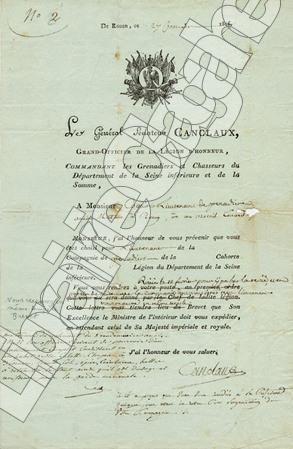
Canclaux (Jean-Baptiste-Camille), comte :
2 pièces signées,
in-folio.1- Le Général divisionnaire Conclaux, inspecteur général des troupes de l’Armée des Grisons [...], du 24 nivose an 9 (accompagné de 2 reçus)2- Le Général sénateur Conclaux commandant des grenadiers et chasseurs du département de la Seine Inférieure (nomination d’un officier).
书商的参考编号 : 10040
|
|
|
CANTACUZENE (Charles-Adolphe).
Apothéoses de météores.
Paris Perrin 1913 1 vol. broché in-12, broché, IX + 219 pp. Edition originale de ce recueil poétique avec un envoi de l'auteur à Ernest La Jeunesse qui l'a lui-même offert, partiellement non coupé, à Charles de Richter avec un amusant ex-dono. Petits manques de papier au dos et au plat supérieur de la couverture.
书商的参考编号 : 54689
|
|
|
CANTACUZENE (Charles-Adolphe).
Apothéoses de météores.
Paris Perrin 1913 1 vol. broché in-12, broché, IX + 219 pp. Edition originale de ce recueil poétique avec un envoi de l'auteur à Ernest La Jeunesse qui l'a lui-même offert, partiellement non coupé, à Charles de Richter avec un amusant ex-dono. Petits manques de papier au dos et au plat supérieur de la couverture.
书商的参考编号 : 54689
|
|
|
CANONICA D.:
Carte des vins. Buffet (Cornavin) Genève.
Genève, Buffet Cornavin, [1924]. In-4 de [4]-XVI-73 pages reliées sur 3 aneaux, pleine percaline bordeau, titre doré au premier plat, coins renforcés de métal, 4 pastilles métalliques à chacun des deux plats.
书商的参考编号 : 12767
|
|
|
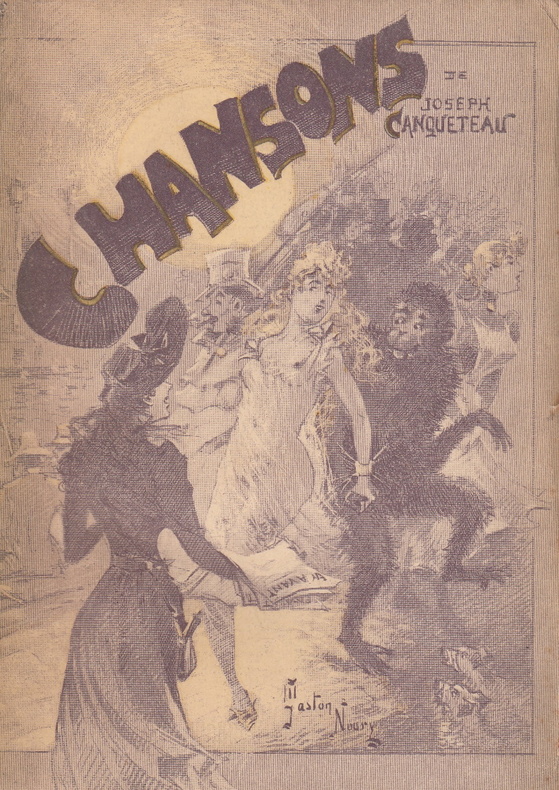
CANQUETEAU (Joseph).
Chansons.
Paris Annexe à la Bibliothèque de La Plume 1893 1 vol. broché in-12, broché, couverture illustrée en couleurs, 64 pp. Edition originale avec une "préface-télégramme" d'Aurélien Scholl. Le recueil est orné d'un portrait du chansonnier par B. Fau, d'une belle couverture en couleurs et de 3 compositions hors-texte par Gaston Noury, ainsi que d'une affiche in-texte par Léon Lebègue. Exemplaire sur vergé chiffon avec un amusant envoi de l'auteur.
书商的参考编号 : 55318
|
|
|
CANQUETEAU (Joseph).
Chansons.
Paris Annexe à la Bibliothèque de La Plume 1893 1 vol. broché in-12, broché, couverture illustrée en couleurs, 64 pp. Edition originale avec une "préface-télégramme" d'Aurélien Scholl. Le recueil est orné d'un portrait du chansonnier par B. Fau, d'une belle couverture en couleurs et de 3 compositions hors-texte par Gaston Noury, ainsi que d'une affiche in-texte par Léon Lebègue. Exemplaire sur vergé chiffon avec un amusant envoi de l'auteur.
书商的参考编号 : 55318
|
|
|
CANTACUZENE (Charles-Adolphe).
Hypotyposes. Aléas et alinéas.
Paris Perrin 1916 1 vol. broché in-12, broché, 157 pp. Edition originale. Exemplaire enrichi d'un envoi de l'auteur à Emile Bergerat. Fortes rousseurs à la couverture. Sinon état convenable.
书商的参考编号 : 55319
|
|
|
CANTACUZENE (Charles-Adolphe).
Hypotyposes. Aléas et alinéas.
Paris Perrin 1916 1 vol. broché in-12, broché, 157 pp. Edition originale. Exemplaire enrichi d'un envoi de l'auteur à Emile Bergerat. Fortes rousseurs à la couverture. Sinon état convenable.
书商的参考编号 : 55319
|
|
|
CANNY Xavier
KYRNOS poèmes alpestres.
Paris Bibliothèque Générale d'Edition 1907. In-12 159pp. Demi basane acajou, dos lisse orné de filets dorés, plats de la couverture conservés, reliure de l'époque. Edition originale dont il n'existe pas de grands papiers. Exemplaire en bon état et complet, reliure sobre de bonne qualité. Bel envoi de l'Auteur à un "cher compatriote". Fiori II page 322. Belle évocation poétique de la Corse. (4477)
书商的参考编号 : GITh016
|
|
|
CANUDO Ricciotto
L'Autre aile. Synthèse romanesque de la vie et de la mort ailées.
Paris Fasquelle 1922 In-12 Broché, couverture illustrée
书商的参考编号 : 014883
|
|
|
CANROBERT (François-Antoine-Certain de)
L.A.S.
Paris, 23 novembre 1874 in-12, 1 feuillet.
书商的参考编号 : 219565
|
|
|
CANTREL Emile; HOUSSAYE Arsène (intr.):
Nouvelles à la main sur la comtesse du Barry trouvées dans les papiers du comte de *** revues et commentées.
Paris, Henri Plon, 1861. In-8 de [4]-IV-441 pages, demi-chagrin brun, dos (un peu passé) à 5 nerfs orné d'encadrements et du titre dorés, tranches mouchetées. Dos un peu frotté, rares rousseurs, numéro à la plume sur garde.
书商的参考编号 : 9910
|
|
|
CANTALOUBE C.
Saint-Baudile martyr et patron de Nimes.
1948 Nimes, éditions Notre-Dame, sans date ( vers 1948) brochure in-8° agrafée, couverture beige imprimée en brun-rouge; 48pp.
书商的参考编号 : 9612
|
|
|
Canaday, John, Schriftsteller und Kunsthistoriker (1907-1985)
Masch. Brief mit eigenh. U.
o.J. New York, 7. XI. 1970, Qu.-4°. 1 Seite. Briefkopf "The New York Times".
书商的参考编号 : 45411
|
|
|
Canal, Gilbert von, Austrian painter (1849-1927).
Autograph signature. Munich, 15. III. 1911.
Oblong 8vo (postcard). 1 page. Inscribed to the German dermatologist Alwin Scharlau. - Trained at the Vienna Academy of Arts, Canal lived in Düsseldorf between 1878 and 1895, was a member of the local artists' association "Malkasten", and specialized in landscape and marine painting, creating atmospheric views of historical towns, villages, castles and mills, as well as riverscapes and coastal scenery. - Corners a little creased; traces of a postmark. Self-addressed by the collector on the reverse. The Mecklenburg physician Scharlau (b. 1888) assembled a collection of artists' autographs by personal application.
|
|
|
Canal, Gilbert von, Maler (1849-1927)
Eigenh. Briefkarte mit U.
o.J. München, 30. II. 1912, Qu.-Kl.-8°. 2 Seiten. Mit Umschlag.
书商的参考编号 : 39137
|
|
|
Canal, Gilbert von, Maler (1849-1927).
Eigenh. Albumblatt mit U. München, 1. II. 1905.
1 S. Qu.-schmal4to. "Die Niederlande 'Tiefstes Land, höchste Kunst!" - Mit einer alt montierten, den Künstler in seinem Atelier abbildenden Photographie. - Gilbert von Canal studierte in Wien bei Eduard Peithner Ritter von Lichtenfels und war später in Düsseldorf und München tätig; mit seinem Werk - "seine an den holländischen Meistern orientierten Bilder zeigen neben Architektur zumeist landschaftliche Motive" (DBE) - war er auf Kunstausstellungen in München, Berlin und Düsseldorf vertreten.

|
|
|
Candolle, Alphonse Pyrame de, Swiss botanist (1806-1893).
Autograph letter signed. Geneva, 30 June 1876.
8vo. 1½ pp. on bifolium. In French, to the botanist Ferdinand Julius Cohn (1828-98), whom he thanks for sending him his work on insectivorous plants. He encloses a brochure by his son, the botanist Casimir Pyramus de Candolle, on the same subject, and notes that both Cohn and Casimir appear to agree on not considering the absorption of the insects a proof of real digestion by the plants: "Je vous suis fort obligé de l'envoi de votre opuscule sur les plantes insectivores. Vous trouverez ci-joint une brochure de mon fils, Casimir, sur le méme sujet, où il me semble que vous êtes d'accord à ne pas considérer l'absorption comme une preuve de véritable digestion [...]".
|
|
|
CANEROT, Joseph
Les Pyrénées. Histoire géologique. Itinéraires de découverte [ Livre dédicacé par l'auteur ].
2 vol. in-8 br. sous étui commun illustré, Atlantica, BRGM Editions, 2008 Exemplaire complet des 2 volumes et de l'encart en couleurs (avec les périodes géologiques). Bon état pour cet exemplaire dédicacé par l'auteur (étui un peu pincé, bon exemplaire par ailleurs). Français

|
|
|
Canetti, Elias, German language author and Nobel laureate (1905-1994).
Autograph letter signed. [Zurich], 10 Aug. 1990.
Large 8vo. 1 page. To the German writer Hans Bender, thanking for birthday greetings.

|
|
|
Canetti, Elias, Schriftsteller und Nobelpreisträger (1905-1994).
Ms. Brief mit eigenh. U. London, 29. VII. 1969.
1 S. 4to. Mit ms. adr. Kuvert. An die Lektorin und Übersetzerin Elfriede Wagner, der er bei der Suche nach einer Stelle als Lektorin behilflich war: "[...] Ich bin erst im Herbst wieder in Deutschland und werde dann natürlich die Augen offenhalten, vielleicht begegne ich jemandem dem ich von Ihnen erzählen könnte. Glückliche Zufälle gibt es immer. Ich möchte nur nicht, dass sie sicher mit einem Erfolg rechnen. Es wäre das eine unverantwortliche Irreführung; vorläufig ist mir noch niemand eingefallen, an den ich mich in dieser Sache wenden könnte. Aber das wird sich wohl ändern, wenn ich ein wenig Zeit zum Nachdenken habe. Ihr Lektoratsbericht über die 'Blendung' ist sehr eindrucksvoll und an ihm lag es bestimmt nicht, dass ich nicht bei Desch herauskam; allerdings war das dann doch ein Glück für mich, denn Hanser ist der richtige Verlag; ihm danke ich es, dass ich in Deutschland endlich gelesen werde [...]".

|
|
|
Canina, Luigi de, Archäologe und Architekt (1795-1856).
Eigenh. Brief mit U. Terracino, 14. V. 1845.
1 S. 4to. In italienischer Sprache an einen namentlich nicht genannten "amico".

|
|
|
Canning, George, homme politique britannique, ministre, adversaire de la traite des noirs (1770-1827).
2 signatures autographes découpées. S. l. n. d.
Une avec une tache d'encre. - Peu courant Ancienne collection de Foville.

|
|
|
Cannstatt, Oscar, Reisender und Pionier der Darstellung Brasiliens in Deutschland (1842-1912).
Eigenh. Brief mit U. Colmar, 2. VIII. 1874.
1 S. auf Doppelblatt. 8vo. An einen Bekannten über eine dringend benötigte Karte des brasilianischen Bundesstaates Rio Grande do Sul: "Da ich der mit meinem Schreiben vom 12 Dez. 1873 Ihnen übermittelten Karte vom Rio Grande do Sul eben sehr benöthigt bin, so erlaube ich mir mein letztes Schreiben vom 16 Juni [...] ganz ergebenst mit dem Bemerken in freundliche Erinnerung zu bringen, daß ich mir [...] nach gemachtem Gebrauch ein Vergnügen daraus machen werde Ihnen die Karte, falls sie dort von Nutzen ist, zurückzusenden [...]". - Mit Empfangsvermerk.
|
|
|
CANO, José Luis.
[Nicasio Álvarez de] Cienfuegos durante la invasión francesa.
Paris, Institut d'Études Hispaniques, 1966 [Extrait des "Mélanges à la mémoire de Jean Sarrailh"]. 4to. alargado; 10 pp. Ejemplar con envío autógrafo de José Luis Cano. Cubiertas originales.

|
|
|
Canon, Hans, Maler (1829-1885).
Eigenh. Albumblatt mit U. ("Canon"). O. O. u. D.
Qu.-4to. Auf einem gedruckten Fragebogen mit mehreren Fragen zu diversen Vorlieben "Ich wüst' [!] auf solche Fragen, | Nicht eine Antwort klar; | Und würd ich auch was sagen, | So wär' es doch nicht wahr". - Gering angestaubt und mit einer horizontalen Knickfalte.
|
|
|

 ?????????
 ?????PDF???
 RSS feed
 ??
??


