Site indépendant de libraires professionnels

‎Autographes‎

Main

Nombre de résultats : 66,542 (1331 Page(s))

Première page Page précédente 1 ... 493 494 495 [496] 497 498 499 ... 617 735 853 971 1089 1207 1325 ... 1331 Page suivante Dernière page

‎Georges Duhamel‎

‎VUE DE LA TERRE PROMISE‎

‎bel envoi de l'auteur à Yves Gandon 1934 vol broché, 180x120, bon état, petites usures de la couverture, 316pp Paris Mercure de France 1934 Yves Gandon, né à Blois en 1899 et mort à Paris en 1975, est un écrivain français, lauréat du Grand prix du roman de l'Académie française en 1948. ref/143‎

Référence libraire : CZC-6479

Livre Rare Book

Livres anciens & Autographes
La Madeleine France Francia França France
[Livres de Livres anciens & Autographes]

€ 65.00 Acheter

‎Geodakian, G[eorgii] Sh[mavonovich].‎

‎Aram Khachaturian. Erevan, Arvesti Institut / Akademiia nauk Armianskoi SSR. Institut iskusstv, 1972.‎

‎265, (3) SS. Mit gedr. Portraitfrontispiz, darunter 4zlg. eigenh. Widmung Chatschaturjans, sowie 40 gedr. Tafeln und zahlr. Notenbeispielen im Text. Weißer Ganzleinenband der Zeit mit goldgepr. Deckel- und Rückentitel und blindgepr. Deckelfileten. Mit bedr. Schutzumschlag. 4to. Einzige Ausgabe. - Exemplar mit eigenh. Widmung des sowjetisch-armenischen Komponisten Aram Iljitsch Chatschaturjan (1903-1978). OCLC 6770336.‎

MareMagnum

Inlibris
Wien, AT
[Livres de Inlibris]

€ 850.00 Acheter

‎Georg der Bärtige, Herzog von Sachsen (1471-1539).‎

‎Ausschnitt mit eigenh. U. Dresden, 18. XII. 1535.‎

‎4 Zeilen. Ca. 310:96 mm. Auf Karton montierte Titulatur, Datierung, Unterschrift und papiergedecktes Siegel eines Briefes des kunstsinnigen Herzogs. - Leicht angeschmutzt. Mit Sammlernotiz in Bleistift.‎

MareMagnum

Inlibris
Wien, AT
[Livres de Inlibris]

€ 850.00 Acheter

‎Georg I., der Fromme, Landgraf von Hessen-Darmstadt (1547-1596).‎

‎Dokument mit eigenh. U. Darmstadt, 1. I. 1583.‎

‎2¼ SS. auf Doppelblatt. Folio. Mit papiergedecktem Siegel (Faltbrief). Bestallungsurkunde für Johann von Windhausen als "Diener von Haus aus" mit detaillierten Pflichtenregelungen: "Wir George vonn Gotts Gnadenn Lanndtgrave zu Hessenn, Grave zu Catzenelnbogenn, Dietz, Ziegennhainn unnd Nidda etc., thun kundt, hieran offenntlich bekennende, das wir dem vestenn unnserenn liebenn getrewenn, Johann vonn Windthausenn, zu unnserm Dienner von Haus aus, bestelt, uff- und angenommen habenn. Bestellenn, unnd nehmenn ihnenn auch dartzu uff unnd an, jegenwertiglich, in unnd mit Crafft dieses briefes, also unnd dergestalt, das er Unnser bestelter Diener vonn Haus aus- unnd Unns gewertig seinn, auch uff unnser erfordern es sei gleich anhero zu Unnser Hoffhaltung, oder wohinn wir seiner sonnstenn bedurftig, mit dreienn Pferdenn gehorsamblich erscheinen, Sich forters zu alle demjenigenn, darzu wir seiner vonnöthenn habenn, unnd er qualificirt ist, gebrauchenn lassenn, unnd dasselbe seines bestenn verstandes und vermögenns verrichtenn soll [...]". - Mit minimalen Wasserflecken. Leicht brüchig im Falz.‎

MareMagnum

Inlibris
Wien, AT
[Livres de Inlibris]

€ 2,500.00 Acheter

‎Georg II., der Gelehrte, Landgraf von Hessen-Darmstadt (1605-1661).‎

‎Dekret mit eigenh. U. Kranichstein, 15. IX. 1660.‎

‎½ S. Folio. Mit Lacksiegel. Zur Zollbefreiung einer Weinlieferung an Graf Johann Martin zu Stolberg: "Nachdem von Gottens gnaden uns Georgen Landgrafen zu Hessen, Fürsten zu Hersfeld, Grafen zu Cazenelnbogen [...] etc., der Wohlgeborne, unser lieber Neve und besonder, Hanß Marttin Graf zu Stolberg etc. zu erkennen gegeben, welchermaßen Er zu behuef seiner Hofhaltung, in Franckhen, dreyßig fuder wein erhandeln lassen, und dieselbe nacher Stolberg uberbringen zu lassen, Verordnung getan hatte, und uns deshalben umb Zollbefreyung ersucht, welche wir dann gewilliget. So befehlen wir allen und ieden Unseren Zöllnern so hiermit belangt werden, daß Sie bemelte Anzahl gemeine dreyßig fuder wein zu unseren Antheil allenthalben Zoll- und Licentenfrey durch und vorüber Paßiren lassen [...]". - An den Rändern minimal angeschmutzt. Wohlerhalten.‎

MareMagnum

Inlibris
Wien, AT
[Livres de Inlibris]

€ 2,500.00 Acheter

‎Georg II., Herzog von Sachsen-Meiningen (1826-1914).‎

‎Eigenh. Brief mit U. Liebenstein, 16. X. 1879.‎

‎2½ SS. auf Doppelblatt. 8vo. An einen k. k. Staatsminister in Wien mit einer Empfehlung des Wiener Gastspiels des berühmten Meininger Hoftheaterensembles und seines Intendanten Ludwig Chronegk: "Ich kann unmöglich die 'Meininger' in Wien wissen, ohne von Seinem fürnehmsten Kunstmäcen ein gütiges Interesse für dieselben zu erbitten und den Director Chronegk seiner Gnade zu empfehlen. Es würde mir eine ganz besondere Freude sein zu hören, daß Euer Excellenz eine oder die andere Vorstellung mit ihrem Besuche ausgezeichnet hätten! Gleichzeitig wiederhole ich meinen verbindlichsten Dank für die so wirksame Unterstützung, welche Sie meinem Ersuchen, die Bluthochzeit für Prag zu gestatten, angedeihen ließen. [...]". - Der liberale Herzog Georg II. von Sachsen-Meiningen ging nicht zuletzt als Theatermäzen und Reformer in die Geschichte ein. Gemeinsam mit dem Regisseur und Intendanten des Meininger Hoftheaters Ludwig Chronegk arbeitete er die sogenannten Meininger Prinzipien aus, die Generationen von Theatermachern beeinflussen sollten. Durch zahllose Tourneen des Meininger Hoftheaters mit 81 Gastspielen in 39 Städten von 1874 bis 1890 verbreiteten sich die Reformideen des Herzogs in ganz Europa, und die "Meininger" feierten große Erfolge. - Leicht braunfleckig bzw. angestaubt. Schönes Zeugnis der Theaterbegeisterung Georgs II.‎

MareMagnum

Inlibris
Wien, AT
[Livres de Inlibris]

€ 450.00 Acheter

‎Georg IV., König des Vereinigten Königreichs von Großbritannien und Irland und König von Hannover (1762-1830).‎

‎Briefausschnitt mit eigenh. U. ("George R"). O. O. u. D.‎

‎1 S. Qu.-32mo. Alt auf Trägerpapier montiert.‎

MareMagnum

Inlibris
Wien, AT
[Livres de Inlibris]

€ 120.00 Acheter

‎Georg Wilhelm, Fürst von Schaumburg-Lippe (1784-1860).‎

‎Eigenh. Brief mit U. Nachod, 2. X. 1857.‎

‎1½ SS. auf Doppelblatt. Gr.-4to. An einen Feldzeugmeister in Wien mit der Empfehlung seines Sohnes Wilhelm für den Eintritt in das Regiment von Oberst Hugo von Weckbecker als Oberleutnant, unter besonderer Hervorhebung von Wilhelms Erfahrungen, Kenntnissen und Dienstwünschen sowie mit der Bitte um Instruktion, wie diese Karriere einzuleiten wäre: "Er wünscht in den drei Waffengattungen zu dienen und möchte zuerst etwa Ein Jahr bei den Jägern eintreten [...] Wilhelm wird [...] eine kurze Reise nach Ungarn machen, vielleicht auch über Wien reisen und in diesem Falle die Gelegenheit benutzen sich Ew. Excellenz vorzustellen [...]". - Im selben Jahr übertrug Georg Wilhelm seinem Sohn die Herrschaft Nachod als Sekundogenitur. Sohn Wilhelm trat zwei Jahre später in die österreichische Armee ein, beendete die im vorliegenden Schreiben angestrebte Militärlaufbahn jedoch bereits 1861, um sich der Bewirtschaftung seiner Güter zu widmen. - Leicht braunfleckig.‎

MareMagnum

Inlibris
Wien, AT
[Livres de Inlibris]

€ 350.00 Acheter

‎Georg Wilhelm, Herzog zu Braunschweig-Lüneburg (1624-1705).‎

‎Gedr. Mandat mit eigenh. U. Hannover, 9. IX. 1658.‎

‎¾ S. auf Doppelblatt (Faltbrief). Mit hs. Adresse und papiergedecktem Siegel. An Johann Hildebrandt und die Ständevertreter der Stadt Gladebeck zur Einberufung einer Ständeversammlung: "Demnach wir eine notwendigkeit zu seyn erachtet Uns mit unser getrewen Landschafft über verschiedene wichtige angelegenheiten in gnaden zu vernemen und dahero entschlossen auff den Mittwochen nach Francisci, ist der 6. Monahtstag Octobris, derobehueff einen offenen Landtag auszuschreiben und zuhalten. So begehren wir in euch hiermit gnediglich Ihr wolltet Dienstags zuvorhero gegend Abend in Person allhie einkommen und darauff folgenden Tages an dem Ort welchen Wir darzu werden ernennen lassen nebst andern erforderten Landständen, die alsdan abgehende proposition mit anhören, darauff den vorgehenden deliberationibus mit beywohnen und dabey ewer unterthäniges votum und gutachten als getrewe patrioten eröffnen [...]". - Brüchig entlang der Faltlinien.‎

MareMagnum

Inlibris
Wien, AT
[Livres de Inlibris]

€ 850.00 Acheter

‎Georg, Manfred, Schriftsteller und Journalist (1893-1965).‎

‎Ms. Sentenz mit eigenh. U. und eh. ausgefülltem Formularteil. Berlin, 22. IX. 1928.‎

‎1 S. Folio (223:282 mm). Albumblatt mit gedruckter dreiseitiger Bordüre, gedr. Fußzeile "Beitrag zum Selbstschriftenalbum 'Deutschlands Zukunft'" und gedr. Formular für biograph. Daten, aufgezogen auf einen Bogen Pergamentpapier (ca. 330:344 mm). Die eh. U. und eh. Daten in Bleistift. "Deutschlands Zukunft liegt in der Abkehr von jeder Phrase. Und in der Erkenntnis, dass der Unterschied von arm und reich, also der Klassengegensatz, nicht zu verleugnen oder ideologisch zu verkleistern ist, sondern zur Grundlage einer Sozialpolitik gemacht werden muss, die altes Unrecht mit neuem Recht heilt [...]". Geschrieben als Beitrag für die von Friedrich Koslowsky im Berliner Eigenbrödler-Verlag herausgegebene Faksimile-Anthologie "Deutschlands Köpfe der Gegenwart über Deutschlands Zukunft" (1928). - Manfred Georg war Pazifist, Zionist, Mitglied der "Deutschen Liga für Menschenrechte", der "Nie-wieder-Krieg-Bewegung" und Mitbegründer der Republikanischen Partei. Er arbeitete als liberaler Journalist, Korrespondent und Redaktionsleiter für unterschiedliche Formate wie den Ullstein und Mosse Verlag sowie für die "Berliner Morgenpost" u. a. m. - Das Albumblatt am oberen Rand beschnitten. Koslowsky 304.‎

MareMagnum

Inlibris
Wien, AT
[Livres de Inlibris]

€ 350.00 Acheter

‎Georg, Rita, Sängerin (1900-1973).‎

‎Albumblatt mit eigenh. U. O. O., 28. IV. 1932.‎

‎½ S. Qu.-8vo. Auf etwas größerem Trägerpapier montiert. In Bleistift. Rita Georg, als junge Sängerin von dem Komponisten Franz Lehár entdeckt und gefördert, hatte ihre erste Filmrolle in dem Stummfilm "Das Gebot der Liebe" (1919). Sie war 1926 am Wiener Burgtheater in Karl Farkas' Revue "Journal der Liebe" und als erste Sonja an der Seite von Richard Tauber in Lehárs 1927 uraufgeführtem "Zarewitsch" zu sehen. Größere Bekanntheit erlangte sie als Mary in Emmerich Kálmáns "Die Herzogin von Chicago" im Theater an der Wien. Ab 1933 verlegte sie ihre Wirkungsstätte nach Frankreich und später in die Niederlande.‎

MareMagnum

Inlibris
Wien, AT
[Livres de Inlibris]

€ 20.00 Acheter

‎Georg,, Großherzog von Mecklenburg-Strelitz (1779-1860)‎

‎Brief mit eigenh. Grußformel und U.‎

‎o.J. Neustrelitz, 16. VI. 1851, Fol. 1 Seite. Doppelblatt.‎

‎Kalligraphischer Glückwunschbrief an Ferdinand II. Karl (1810-1859), König beider Sizilien, zur Geburt seines Sohnes Vincenzo Maria, Herzog von Melazzo (1851-1854). - Unterschrieben "le très desavoué Frère et Serviteur | George GDdM [Grandduke de Mecklenbourg]", gegengezeichnet "vBernstorff". - In Georgs Regierungszeit fielen unter anderem die Renovierung der Residenz, die Verbesserung des Volksschulwesens und die Aufhebung der Leibeigenschaft. Als Schöngeist verkehrte oder korrespondierte Georg mit Berühmtheiten der Literatur- und Kunstwelt seiner Zeit, zum Beispiel mit Goethe. Politisch verfolgte er zunehmend reaktionäre Ziele. Er war ein entschiedener Gegner jeglicher liberaler Entwicklungen in Mecklenburg in der 1848-er Revolution, verhinderte den Übergang von Mecklenburg zu einem modernen Verfassungsstaat und brachte durch den Freienwalder Schiedsspruch die im Schweriner Landesteil ab 1848/49 eingeleiteten Reformen zu Fall. - Knickfalte.‎

Référence libraire : 36259

‎George II, Duke of Saxe-Meiningen (1826-1914).‎

‎6 ALS. Meiningen, 1862-67.‎

‎8vo. Altogether 8 pp. Four letters to Mr. Foerster, one to his wife, and one letter of recommendation to the administration of Saalfeld Castle, concerning Foerster's search for antiques. - George II was well-known for his efforts in building the so-called Meiningen Court Theater and the Meiningen acting group. Together with his third wife, the actress and later Baroness of Heldburg, Ellen Franz (1839-1923), he laid the foundations for the early splendor of this renowned acting troupe. He was also close to musicians and painters such as Wilhelm von Kaulbach and Julius Schnorr von Carolsfeld.‎

MareMagnum

Inlibris
Wien, AT
[Livres de Inlibris]

€ 950.00 Acheter

‎George II, King of Great Britain (1683-1760).‎

‎Autograph signature (cropped). No place or date.‎

‎Oblong 8vo (220 x 60 mm). 1 p. The clipped ending of a letter: "freundwilliger Vetter / George R." - Traces of former mounting.‎

MareMagnum

Inlibris
Wien, AT
[Livres de Inlibris]

€ 300.00 Acheter

‎George IV, King of Hanover and the United Kingdom of Great Britain and Ireland (1762-1830).‎

‎Autograph document signed ("GeorgeR"). "Carlton House" (London), 23 June 1825.‎

‎Oblong folio. 1 p. on vellum, with papered seal. Promotiing Thomas Le Marchant Saumarez to the rank of an ensign of the "Seventy first (Highland) Regiment of Foot". - With two counter-signatures. Slightly stained and dusty; traces of another seal.‎

MareMagnum

Inlibris
Wien, AT
[Livres de Inlibris]

€ 800.00 Acheter

‎George SAND‎

‎"Je suis bien d'âge à être votre mère car j'ai 55 ans et j'ai de bonnes mains bien adroites mais pas belles du tout."" • Signed autograph letter addressed to Ernest Feydeau‎

‎Nohant Nohant-Vic 1859. Fine. Nohant Nohant-Vic 16 août 1859 13.50 x 20.90 cm 4 pages sur un double feuillet Autograph letter signed by George Sand addressed to Ernest Feydeau. Four pages written in blue ink on a double sheet bearing at the head of the first page the sender's blind stamp. This letter was published in the complete correspondence of George Sand established by Georges Lubin. Fine and lengthy letter discussing literature and friendship between writers. Initially a stockbroker and specialist in Antiquity Ernest Feydeau launched himself late into fiction. Anxious to occupy a literary space in which he did not feel justly appreciated he used his connections and maintained a regular epistolary relationship with illustrious correspondents such as Gustave Flaubert Sainte-Beuve and George Sand to whom he sent drafts of his novels and whose opinions he sought. This letter forms Sand's response after having just finished reading Daniel Feydeau's second novel. George Sand then at the height of her literary career describes herself thus: ""I am quite old enough to be your mother for I am 55 years old and I have good hands quite skillful but not beautiful at all. I have earned the right to no longer be coquettish I have been quite reproached for never having been so. I will tell you anything about myself that you wish."" As was her habit much solicited by her peers she delivers a very detailed critique of the text her colleague submits to her: ""I am not against sentences that jar where they need to jar but I am not for harmony being sacrificed to rhythm. Nor am I for the contrary. Understand me well I only blame what is too noticeable what reveals the technique. Do not touch the passages you speak of they are excellent. And in sum I will not insist furiously on the question of form in style seeing that if the qualities of yours should disappear with what sometimes seems to me a flaw I would be in despair at having pointed out the flaw."" Herself very close to Flaubert whom she nicknamed her ""leaden bottom"" Sand seems delighted that the two men know each other: ""I do not have time. But I will have time to receive you when you are free you must come with Flaubert who also has in me an enchanted reader and a wholehearted literary friend. I did not know he was your friend and I am pleased that he is."" The friendship goes so far that Sand soon brings the two writers together placing them on complete equal footing: ""It is no misfortune for you any more than for Flaubert to belong to the race of seers."" A form of solidarity then establishes itself in the face of critical adversity: ""All this is felt better than it can be said and that is why criticism loses its reason three-quarters of the time."" For criticism has had the misfortune of labeling Feydeau as it did with Flaubert a realist: ""People have taken it upon themselves to baptize your manner and his as realism. I do not know why; unless realism is something entirely different from what the first adherents attempted to explain to us. I suspect indeed that there is a way of envisaging the reality of things and beings which is great progress and you bring triumphant proof of it. But the name realism does not suit because art is a multiple infinite interpretation. It is the artist who creates reality within himself his own reality and not that of another. Two painters paint the portrait of the same person. Both create a work that represents the person if they are both masters. And yet the two paintings do not resemble each other. What has become of reality"" This long diatribe - a true manifesto - forms a powerful testimony to the repulsion of George Sand and Flaubert for theorists obsessed with the idea of classifying literature according to a ""system that . blinds"". unknown‎

Référence libraire : 76839

‎George SAND‎

‎"Je suis toujours enfermée pour écrire ou sortir pour me promener."" • Signed autograph letter addressed to Léon Curmer‎

‎Paris 1840. Fine. Paris jeudi 7 mai 1840 13.60 x 20.90 cm une page sur un double feuillet Autograph letter signed by George Sand addressed to publisher Léon Curmer. One page written in black ink on a double sheet. This letter was published in the complete correspondence compiled by Georges Lubin. ""Monsieur J'ai parcouru votre recueil avec beaucoup d'intérêt et j'accepte la collaboration que vous m'avez offerte mais je ne pourrais m'occuper de vous satisfaire que dans six semaines ou deux mois. Si cette époque vous convient veuillez bien me le faire savoir ainsi que les conditions de la rédaction."" ""Sir I have perused your collection with great interest and I accept the collaboration you have offered me but I could not undertake to satisfy you for six weeks or two months. If this timing suits you please let me know as well as the conditions of the writing."" The ""recueil"" ""collection"" in question here is none other than Les Français peints par eux-mêmes. Sand would not however collaborate on this monumental compendium of types preferring instead several years later Le Diable à Paris published under the direction of her close friend publisher Hetzel. unknown‎

Référence libraire : 77244

‎George SAND - (to Gustave FLAUBERT)‎

‎"Je t'écris en courant ce matin ."" • Signed autograph letter addressed to Gustave Flaubert‎

‎Nohant Nohant-Vic 1876. Fine. Nohant Nohant-Vic 6 mars 1876 13.20 x 20.70 cm deux pages sur un feuillet remplié Autograph letter signed by George Sand addressed to Gustave Flaubert. Two pages written in black ink on a double sheet bearing at the head of the first page the sender's dry stamp. This letter was published in the complete correspondence of George Sand established by Georges Lubin. Fine letter written by George Sand a few months before her death and addressed to her lifelong friend Gustave Flaubert. The writer wishes to offer her friend a seat so he may attend the revival of her play Le Mariage de Victorine : ""Je t'écris en courant ce matin parce que je viens de recevoir de Mr Perrin avis de la 1ère représentation de la reprise du Mariage de Victorine une pièce de moi au théâtre français. Je n'ai ni le temps d'y aller ni l'envie de partir comme cela au pied levé mais j'aurais voulu y envoyer quelques amis et il ne m'offre pas une seule place. Je lui écris une lettre qu'il recevra demain et je le prie de t'envoyer au moins un orchestre."" ""I'm writing to you hurriedly this morning because I've just received notice from Mr Perrin of the first performance of the revival of Le Mariage de Victorine a play of mine at the Théâtre Français. I have neither the time to go nor the desire to leave like that at a moment's notice but I would have liked to send some friends and he doesn't offer me a single seat. I'm writing him a letter which he will receive tomorrow and I ask him to send you at least an orchestra seat."" Letters from the correspondence between George Sand and Gustave Flaubert are renowned and highly sought after. unknown‎

Référence libraire : 76872

‎George SAND‎

‎"On n'est jamais plus heureux et inspiré que quand on croit n'avoir pas le temps de l'être."" • Signed autograph letter addressed to René Biémont‎

‎Nohant Nohant-Vic 1863. Fine. Nohant Nohant-Vic 14 mars 1863 13.40 x 20.60 cm 3 pages sur un double feuillet Autograph letter signed by George Sand addressed to René Biémont. Three pages written in blue ink on a double sheet bearing at the head of the first page the blind stamp of Sand's initials. Envelope included. Folds inherent to mailing. This letter was published in the complete correspondence of George Sand established by Georges Lubin. Fine letter of congratulations addressed to René Biémont after sending his work Le Petit Fils d'Obermann: ""Your little book is very original and you show qualities of talent that will develop if you look ahead."" As an attentive reader much solicited by her young peers Sand develops her literary criticism: ""Obermann and his grandson the monk belong to the past. They are true and the timid Jean is well drawn. There is grandeur and truth in this exceptional type. But Constant d'Heurs is too passive to events. He should react against this powerless man and cure him or pity him more ."" Sententiously she thus concludes her letter: ""Do not complain of thankless work and accept it as a good thing three-quarters of life sacrificed to some duty makes the last quarter very strong and very alive. It is very good to be attached to poetry and thwarted in the possession of a beautiful dream. As soon as one can savor it without respite it fades or becomes troubled. I speak to you from experience. One is never happier and more inspired than when one believes one does not have time to be so."" Very fine testimony to the leading role that George Sand played on the literary scene of the Second Empire. unknown‎

Référence libraire : 76837

‎George SAND‎

‎Lettre autographe signée adressée à Stéphanie Geoffroy-Saint-Hilaire : de l'émancipation féminine par l'éducation : ""Ç'a été pour moi une éducation à part que celle de cet enfant de 18 ans qui n'en avait que 2 il y a six mois et qui a maintenant son âge avec toute la candeur de l'enfance conservée."" • Autograph letter signed addressed to Stéphanie Geoffroy-Saint-Hilaire: on women’s emancipation through education: “It has been for me a separate kind of education that of this child of 18 who was only 2 six months ago and who now has her age with all the candour of childhood preserved‎

‎Nohant Nohant-Vic 1858. Fine. Nohant Nohant-Vic 3 juin 1858 13.40 x 20.90 cm 4 pages sur un feuillet remplié Autograph letter signed by George Sand addressed to her friend Stéphanie Bourjot daughter of Étienne Geoffroy-Saint-Hilaire. Four pages written in blue ink on a folded bifolium bearing George Sand’s monogram. Fold marks as usual.   This letter was partially published in Correspondance vol. XIV no. 7846. A beautiful and partly unpublished letter in which George Sand discusses Marie Pape-Carpantier’s book and the education of her young maid Marie Caillaud: «It is an excellent book which I use to teach my young maid to read. She is extraordinarily intelligent and this book opens her mind to all sorts of sound ideas. Educating this 18-year-old child—who six months ago was only two in terms of knowledge—has been a unique experience. She now seems her age yet retains all the innocence of childhood. So every evening we read Marie Carpentier’s little stories and I enjoy them just as much as my pupil does.»   Marie Caillaud was only eleven years old when George Sand hired her to wash dishes and tend to the chicken coop a task that earned her the nickname “Marie des poules.” But the writer soon recognized the young peasant girl’s intelligence appointed her as housekeeper and by 1856 included her in the performances of the Nohant theatre. Her education is first mentioned in early 1858 notably in a letter from George Sand to her friend Charles Duvernet: «During my winter evenings I took on the education of little Marie the one who acted with us. From a dish washer I immediately raised her to the rank of housekeeper a role for which her excellent mind makes her perfectly suited. The greatest obstacle was that she couldn't read. That obstacle no longer exists. In thirty half-hour lessons—fifteen hours in a month—she mastered all the difficulties of the language slowly but perfectly. This miracle is due to the admirable Laffore method which I applied with the utmost gentleness to a perfectly lucid mind.» 16 February 1858   Marie Caillaud would go on to become a notable actress at Nohant and move in the circles of George Sand’s illustrious guests: Delacroix Gautier Dumas Prince Jérôme Bonaparte… But Marie was not George Sand’s first pupil. All her life Sand was deeply interested in pedagogy and taught not only her children and grandchildren but also members of her household staff and local peasants.   This letter is a remarkable testament to her hands-on approach as a teacher always seeking new and effective ways to impart knowledge: «What is lacking—or at least what I haven’t found—is a true reading method. I’ve devised one for my own use never written down based on Laffore’s and adapted to my own ideas. But what I haven’t found in primers for children or public school manuals is a well-crafted exercise book that teaches reading logically while also making sense of spelling. Does such a book exist» Far from a casual activity education was central to George Sand’s worldview. As Georges Lubin noted her aim was not merely to teach literacy. Taught to write by her own mother at the age of five Sand understood from an early age that the only path to equality lay through intellectual emancipation: «She understood very early on that the only road to equality was intellectual emancipation. The ignorance imposed upon women was the root of their servitude. The ignorance imposed upon the working classes underpinned class inequality. Education was the key to opening locked doors.» «George Sand et l'éducation» in Nineteenth-Century French Studies 1976 A beautiful and important testimony to George Sand’s tireless struggle for the emancipation of women through education. unknown‎

Référence libraire : 76111

‎George SAND‎

‎Lettre autographe signée adressée à Alphonse Peyrat‎

‎1868. Fine. s. d. mai 1868 13.50 x 20.70 cm 2 pages sur un double feuillet Autograph letter signed by George Sand addressed to Alphonse Peyrat two pages written in black ink on a double sheet. Transverse folds inherent to mailing. Interesting letter evoking one of her faithful friends: Jean Patureau-Francoeur. George Sand had published a long obituary article in tribute to this close friend in L'Avenir national on May 2 1868. She described her late friend with great tenderness: ""C'était un simple paysan un vigneron des faubourgs de Châteauroux. Il avait appris tout seul à écrire et il écrivait très remarquablement avec ces naïves incorrections qui sont presque des grâces dans un style rustique et spontané. . Ce petit homme robuste à grosse tête ronde au teint coloré à l'œil bleu étincelant et doux était doué d'une façon supérieure. Il voyait la nature il l'observait il l'aimait et il la savait. . Son existence parmi nous fut pénible agitée méritante. Naturellement un esprit aussi complet que le sien devait se passionner pour les idées de progrès et de civilisation. Il fut avant la Révolution le représentant populaire des aspirations de son milieu et il travailla à les diriger vers un idéal de justice et d'humanité. ."" ""He was a simple peasant a wine-grower from the suburbs of Châteauroux. He had taught himself to write and he wrote remarkably well with those naive incorrections that are almost graces in a rustic and spontaneous style. . This sturdy little man with his large round head his ruddy complexion his sparkling and gentle blue eyes was gifted in a superior way. He saw nature observed it loved it and understood it. . His existence among us was painful agitated meritorious. Naturally a mind as complete as his had to be passionate about ideas of progress and civilization. He was before the Revolution the popular representative of his milieu's aspirations and he worked to direct them toward an ideal of justice and humanity. ."" In 1848 Patureau was elected mayor of Châteauroux and became the spokesman for the workers of his commune. ""Au moment du coup d'État il fut poursuivi mais il se cacha dans des familles amies et échappa à la police. George Sand obtint difficilement sa grâce ce qui lui permit de regagner Châteauroux. Il fut arrêté en janvier 1858 à la suite de la loi de sûreté générale."" ""At the time of the coup d'état he was pursued but he hid with friendly families and escaped the police. George Sand obtained with difficulty his pardon which allowed him to return to Châteauroux. He was arrested in January 1858 following the general security law."" ""Il resta un mois au cachot sur la paille en plein hiver. Quand on le mit dans la voiture cellulaire qui le dirigeait vers l'Afrique il était presque aveugle et depuis il a toujours souffert cruellement des yeux"" ""He remained a month in the dungeon on straw in the middle of winter. When they put him in the prison van that was taking him to Africa he was almost blind and since then he has always suffered cruelly with his eyes"" George Sand. In September 1858 following an intervention by George Sand with her friend Jérôme-Napoléon Napoleon III's cousin he was released but remained under surveillance. He settled in Algeria after obtaining permission to come to Châteauroux to sell his house and vineyard and to fetch his family. In Algeria he lived by his trade as a wine-grower was part of the Agricultural Society of Philippeville and wrote a treatise on viticulture."" Maintron ""À présent je viens vous demander de me payer ce petit article le plus cher que vous pouvez et d'envoyer le prix directement à Joseph Patureau rue de cluis n°7 à Châteauroux. Indre. Et cela le plus tôt possible."" ""Now I come to ask you to pay me for this little article as dearly as you can and to send the payment directly to Joseph Patureau rue de cluis n°7 à Châteauroux. Indre. And this as soon as possible."" Jos unknown‎

Référence libraire : 78482

‎George SAND‎

‎Lettre autographe signée adressée à un correspondant inconnu‎

‎Paris 1864. Fine. Paris s. d. entre 1864 et 1868 13.40 x 20.70 cm 2 pages sur un double feuillet Autograph letter signed addressed to an unknown correspondent written in black ink on a double leaf with dry stamp bearing the writer's initials. This letter probably unpublished was written on ""November 11th"" between 1864 and 1868 according to the address at the bottom: ""rue des feuillantines 97"". ""Une amie commune et pleine de confiance en votre bonté me fait espérer monsieur que vous m'accorderez un peu de sympathie. Si je suis indiscrète d'y croire ne vous en prenez qu'à elle comme elle est de ces personnes à qui l'on ne peut en vouloir je ne crains pas de vous la dénoncer. Vous pouvez vendre un immense service au fils de mon ami d'enfance. Le voudrez-vous quelque difficile que la chose puisse être Elle ne l'est peut-être pas je ne sais pas. Mais si elle l'est j'espère quand même depuis ce que Madame de Voisins me dit de vous. ."" ""A mutual friend full of confidence in your kindness gives me hope sir that you will grant me some sympathy. If I am indiscreet to believe it blame only her as she is one of those persons one cannot hold a grudge against I do not fear to denounce her to you. You can render an immense service to the son of my childhood friend. Will you do so however difficult the matter may be Perhaps it is not difficult I do not know. But if it is I still hope so from what Madame de Voisins tells me about you. ."" unknown‎

Référence libraire : 78465

‎George SAND - (Maurice SAND)‎

‎Manuscrit autographe signé à propos du ""Coq aux cheveux d'or"" de Maurice Sand‎

‎Nohant Nohant-Vic 1872. Fine. Nohant Nohant-Vic 19 semptembre 1872 13.20 x 20.60 cm 20 pages 1/2 sur 21 feuillets Autograph manuscript signed by George Sand written in black ink on 21 leaves of white paper. Deletions and corrections. One page of the manuscript appears to have been lost. The final version of this chronicle whose text conforms to the manuscript we offer was published in Impressions et souvenirs Paris M. Lévy 1873. George Sand would devote another article to her son's novel in Questions d'art et de littérature in 1878. The first edition of Maurice Sand's Coq aux cheveux d'or was published by Lacroix and Verboeckhoven in 1867. unknown‎

Référence libraire : 75733

‎George, Heinrich, Schauspieler (1893-1946).‎

‎Portraitphotographie mit eigenh. Widmung und U. Berlin, Mai 1934.‎

‎293:233 mm. Gewidmet dem Oldenburger Theaterkritiker Erich Schiff: "Herzlichst zur Erinnerung an das Gastspiel 'Mensch aus Erde gemacht' und den schönen Abend in Ihrem Heim! | Berlin-Wannsee Mai 34. | Heinrich George". - Das vorliegende Photo von Metro-Goldwyn-Mayer stammt aus Georges kurzer Zeit in Hollywood. Anfang 1931 stand er dort für mehrere Monate für MGM vor der Kamera ("Menschen hinter Gittern", die deutsche Fassung von "The Big House"), entschied sich dann aber für eine Rückkehr in die deutsche Heimat und bezog im Herbst 1932 mit seiner frisch angetrauten Gattin Berta Drews seine Villa am Kleinen Wannsee, wo er Erich Schiff dieses Foto widmete. - Erich Schiff (1882-1970) war ein bekannter Oldenburger Jurist, Theaterkritiker und -autor. Unter der NS-Diktatur war er als "Halbjude" zahlreichen Repressalien ausgesetzt: er mußte seine Tätigkeit als Feuilletonist und Theater-Syndikus von Oldenburg einstellen und wurde in ein Arbeitslager deportiert. Seine Bühnenwerke "De lüttje Wippsteert" und "Lögen hefft korte Been" zählen noch heute zu den Klassikern des niederdeutschen Theaters. - Schiffs Gemahlin war die Theater- und Film-Schauspielerin Maria Martinsen (1901-1992), die u. a. 1929 als Spelunken-Jenny in der berühmt gewordenen Oldenburger Inszenierung der Brechtschen "Dreigroschenoper" brillierte. - Wenige winzige weiße Flecken im Bildbereich (laborbedingt), rückseitig Montagespuren, minimale Knickspuren.‎

MareMagnum

Inlibris
Wien, AT
[Livres de Inlibris]

€ 450.00 Acheter

‎George, Manfred, Schriftsteller (1893-1965)‎

‎Eigenh. Brief mit U.‎

‎o.J. New York, 15. VI. 1954, Fol. 1 Seite. "Air letter".‎

‎An Friedrich Luft, Redakteur der Neuen Zeitung in Berlin: "[...] ist es Ihnen recht, wenn ich einen Artikel über Oscar Maria Graf anlässlich seines 60. Geburtstags (am 22. Juli) schreibe? Das Thema ist bunt, abenteuerlich und in seiner amerikanischen Phase überraschend [...]" - Manfred George (Manfred Georg Cohn, Manfred Georg) war von 1939 an bis zu seinem Tode Chefredakteur der deutsch-jüdischen Exilzeitung "Aufbau" in New York.‎

Référence libraire : 44922

‎GEORGE-DAY ; [DEBEAUVAIS, Yvonne ]‎

‎Lettre autographe signée de l'écrivain George-Day‎

‎1 L.A.S. sur carte de visite, adressée à l'écrivain et érudit bordelais Armand Got L.A.S. de la femme de lettres d'origine bordelais Yvonne Debeauvais, plus connue sous son pseudonyme de George-Day Français‎

‎George-Hainl, François, French cellist and conductor (1807-1873).‎

‎2 autograph letters signed. No place or date.‎

‎8vo. Together (1+1½ =) 2½ pp. With autogr. address. Both letters to the Comtesse de Beauregard (the wife Charles de Beauregard, editor of "La Gazette de France") discussing various matters and common friends: "Il m'été impossible de répéter avec Mlle Dietz [...]". In the second letter, he regrets being unable to attend an event due to his mother's illness: "une lettre que je reçois et qui m'apprend la maladie de ma mère me fait à partir immédiatement pour Lyon [...]". - One letter with traces of folding and a small tear in the inside crease.‎

MareMagnum

Inlibris
Wien, AT
[Livres de Inlibris]

€ 600.00 Acheter

‎Georges AURIC‎

‎"Alchimistes Rimbaud ! Eclair ouvre le ciel de mon adolescence ! Je me sens poète et c'est bien le moment de m'arrêter !"" • Signed autograph letter addressed to Bolette Natanson‎

‎s. l. 1916. Fine. s. l. s. d. vers 1916-1918 12.40 x 17 cm 2 pages sur un feuillet remplié Autograph letter signed by Georges Auric addressed to Bolette Natanson. Two pages written in black ink on a folded sheet. Folds inherent to mailing. Beautiful poetic letter with Rimbaldian influences: ""Alchimistes Rimbaud ! Eclair ouvre le ciel de mon adolescence ! Je me sens poète et c'est bien le moment de m'arrêter !"" ""Alchemists Rimbaud! Lightning opens the sky of my adolescence! I feel like a poet and this is the right moment to stop!"" Auric mentions a concert he must give at Mme Japy de Beaucourt's who held a salon in honor of the review directed by Ricciotto Canudo Montjoie ! : ""Je dois jouer - encore ! vendredi chez Mme J. de B. non point n'est ce pas Mme Jean de B mais Mme Canudo de Beaucourt"" ""I must play - again! Friday at Mme J. de B.'s not isn't it Mme Jean de B but Mme Canudo de Beaucourt"". He adds: ""Montjoie et Canudo gras et bête italboche."" ""Montjoie and Canudo fat and stupid Italian."" Having moved in artistic circles since her earliest childhood - she was the daughter of Alexandre and niece of Thadée Natanson creators of the famous Revue Blanche - Bolette Natanson 1892-1936 became friends with Jean Cocteau Raymond Radiguet Georges Auric Jean Hugo and Colette. Passionate about fashion she left Paris for the United States with Misia Sert close friend of Coco Chanel and was hired at Goodman. With her husband Jean-Charles Moreux they created the gallery Les Cadres on boulevard Saint-Honoré in 1929 and frequented numerous artists and intellectuals. Their success was immediate and they multiplied projects: creating the fireplace for Winnaretta de Polignac decorating the château de Maulny designing Baron de Rothschild's private mansion creating frames for industrialist Bernard Reichenbach and finally creating the storefront for Colette's beauty institute in 1932. Bolette Natanson also framed works by her prestigious painter friends: Bonnard Braque Picasso Vuillard Man Ray André Dunoyer de Segonzac etc. Despite this meteoric rise she took her own life in December 1936 a few months after her father's death. unknown‎

Référence libraire : 75947

‎Georges AURIC‎

‎"Car plus que jamais les gens me dégoûtent sauf vous naturellement. Je voudrais appuyer sur un bouton et détruire l'Humanité."" • Signed autograph letter addressed to Bolette Natanson‎

‎s. l. 1916. Fine. s. l. s. d. vers 1916-1918 12.40 x 17 cm 2 pages sur un feuillet remplié Signed autograph letter from Georges Auric addressed to Bolette Natanson. Two pages written in black ink on a folded sheet. Deletions and underlinings. Fold marks inherent to mailing. Very fine letter in which the composer dissertates on friendship: ""I simply wanted to tell you this important thing. I recommend that you not invite Florent Schmitt nor any 'artist'. Otherwise I declare myself incapable of resisting the vision of these evil geniuses. For more than ever people disgust me except you naturally. I would like to press a button and destroy Humanity. Then we will be at peace and I will tell you the truth about Art and the truth about all the things in which you have faith."" Auric also evokes music in this letter: ""Only Ravel's waltzes are noble and sentimental."" Having evolved from her earliest childhood in artistic circles - she is the daughter of Alexandre and the niece of Thadée Natanson the creators of the famous Revue Blanche - Bolette Natanson 1892-1936 befriended Jean Cocteau Raymond Radiguet Georges Auric Jean Hugo and Colette. Passionate about couture she left Paris for the United States with Misia Sert great friend of Coco Chanel and was hired at Goodman. With her husband Jean-Charles Moreux they created in 1929 the gallery Les Cadres on boulevard Saint-Honoré and frequented numerous artists and intellectuals. Their success was immediate and they multiplied projects: the creation of Winnaretta de Polignac's fireplace the decoration of the château de Maulny the layout of baron de Rothschild's private mansion the creation of frames for industrialist Bernard Reichenbach and finally the realization of Colette's beauty institute storefront in 1932. Bolette Natanson also framed the works of her prestigious painter friends: Bonnard Braque Picasso Vuillard Man Ray André Dunoyer de Segonzac etc. Despite this meteoric rise she took her own life in December 1936 a few months after her father's death. unknown‎

Référence libraire : 75943

‎Georges AURIC‎

‎Lettre autographe signée adressée à son ami Carlo Rim à propos notamment de la reprise d'Iphigénie en Tauride de Christoph Willibald Gluck‎

‎Paris: S. n. 1965. Fine. S. n. Paris 17 octobre 1965 14 x 19.50 cm une feuille Autograph letter dated and signed by Georges Auric addressed to his friend Carlo Rim 23 lines in blue ink on letterhead of the Réunion des théâtres lyriques nationaux et du théâtre de l'Opéra de Paris in which he asks for his friend's indulgence as he is overwhelmed with work: ""Pardonne-moi si je ne t'ai pas répondu encore : tu peux imaginer sans trop de peine ce qu'est devenue mon existence ! . je viens d'avoir à préparer la reprise d'Iphigénie en Tauride - opéra des plus nobles et que ""notre"" public n'avait pas eu l'occasion d'écouter depuis 1931 "" ""Forgive me if I haven't answered you yet: you can imagine without too much trouble what my existence has become! . I have just had to prepare the revival of Iphigénie en Tauride - one of the noblest operas and one that ""our"" public has not had the opportunity to hear since 1931""; a revival in which Georges Auric places great hope: "". En tout cas je veux espérer que nous dépasserons les deux répétitions de 1931. "". In any case I want to hope that we will exceed the two performances of 1931."" He also rejoices in the diversity of projects that occupy him thus transcending styles and periods: ""Glück Iphigénie : nous sommes fichtrement loin de Vincent Scotto. Mais je franchis allégrement siècles et styles pour te dire combien je suis heureux de me trouver dans ce ""comité d'honneur"" associé aux respectables et déjà vieux amis dont tu connais les noms ! "" ""Gluck Iphigénie: we are damn far from Vincent Scotto. But I cheerfully leap across centuries and styles to tell you how happy I am to find myself in this 'honorary committee' associated with the respectable and already old friends whose names you know!"" Folds inherent to mailing. Carlo Rim was a Provençal writer author notably of ""Ma belle Marseille"" a caricaturist a filmmaker: ""Justin de Marseille"" ""L'armoire volante"" ""La maison Bonnadieu"" and was notably the friend of Fernandel Raimu and Marcel Pagnol but also of Max Jacob and André Salmon whom he met in Sanary. S. n. unknown‎

Référence libraire : 83133

‎Georges CLEMENCEAU‎

‎Lettre autographe signée adressée à un ami‎

‎Mont-Dore-Les-Bains Le Mont-Dore 1909. Fine. Mont-Dore-Les-Bains Le Mont-Dore 29 août 1909 13.60 x 21 cm 1 page sur un double feuillet Signed autograph letter from Georges Clémenceau addressed to a friend. One page written in black ink on a double sheet with letterhead from the International Palace of Mont-Dore-Les-Bains. Central fold inherent to mailing. Clemenceau then taking the thermal cure at Mont-Dore-les-Bains writes: ""All is well. It is agreed for October 9th. I am truly embarrassed to have brought this disruption to your plans."" unknown‎

Référence libraire : 76082

‎Georges CLEMENCEAU‎

‎Lettre autographe signée adressée à un ami‎

‎Mont-Dore-Les-Bains Le Mont-Dore 1909. Fine. Mont-Dore-Les-Bains Le Mont-Dore 29 août 1909 13.60 x 21 cm 1 page sur un double feuillet Autograph letter signed by Georges Clémenceau addressed to a friend. One and a quarter pages written in black ink on a double sheet with letterhead from the International Palace of Mont-Dore-Les-Bains dated August 25 1909. Folds inherent to mailing. Clemenceau then taking thermal baths at Mont-Dore-les-Bains writes: ""Quand votre aimable invitation m'est arrivée à Carlsbad j'avais un engagement déjà pris."" ""When your kind invitation reached me in Carlsbad I already had a prior engagement."" Charming and very aesthetic missive. unknown‎

Référence libraire : 77465

‎Georges DUHAMEL‎

‎Carte de visite autographe à en-tête de la l'Académie française‎

‎Paris 1955. Fine. Paris 6 Janvier 1955 13.50 x 10.50 cm une carte de visite Printed calling card of academician Georges Duhamel on which he has added on the front these few words for a certain Peillard notably about his health problems: ""Mon cher Peillard Je vous renvoie sans attendre les épreuve reçues au dernier courrier. Je viens de passer dans mon lit presque tout le temps des fêtes. J'ai beaucoup souffert d'une de ces crises de rhumatisme qui m'empêchent pour l'instant de poser le pied par terre et même de goûter le repos du lit. Je me relève depuis hier ; mais je ne sortirai pas avant la semaine prochaine. Trouvez ici mes voeux les plus cordiaux pour madame Peillard et vous-même. Ma femme me dit de joindre ses voeux aux miens. Je le fais. A bientôt ! A vous de grand coeur. GDuhamel."" ""My dear Peillard I return without delay the proofs received in the last post. I have just spent almost all the holiday time in my bed. I have suffered greatly from one of those rheumatic attacks that prevent me at the moment from setting foot on the ground and even from enjoying the rest of bed. I am getting up since yesterday; but I will not go out before next week. Please find here my most cordial wishes for Madame Peillard and yourself. My wife tells me to join her wishes to mine. I do so. See you soon! Yours wholeheartedly. GDuhamel."" Light worming without consequence at the head of the front of the card. unknown‎

Référence libraire : 86656

‎Georges FOUREST‎

‎". Ah les délicieux moments que je vous dois ! Après vous avoir suivi aux sommets alpestres après avoir vibré à vos fiers poëmes de guerre quelle joie de savourer vos poëmes à forme fixe !"" • Laudative signed autograph letter addressed to a fellow writer whose poems he has just devoured‎

‎Paris: S. n. 1924. Fine. S. n. Paris 14 Mai 1924 13 x 18 cm deux pages sur un double feuillet Autograph letter signed by Georges Fourest 31 lines in black ink addressed to a fellow writer. Fold mark inherent to envelope insertion marginal stains affecting some word beginnings. Georges Fourest praises the quality of his correspondent's work: ""Que les superstitieux viennent encore nous représenter le 13 comme un jour néfaste ! Pour moi je sais bien que je marque d'un caillou blanc le 13 Mai 1924 puisque le matin de ce jour-là je reçus votre exquis volume. . je pus consacrer mon après-midi à vous lire bien installé au Parc Monceaux."" Let the superstitious still tell us that the 13th is an unlucky day! For my part I know well that I mark May 13 1924 with a white stone since on the morning of that day I received your exquisite volume. . I was able to devote my afternoon to reading you comfortably installed in Parc Monceau. and compares the quality of his verse to his illustrious predecessor Clément Marot: "". quant à vos acrostiches je ne connaissais qu'un chef-d'oeuvre en ce genre celui de Clément Marot par Glatignyet voilà que vous nous en donnez sept et qui laissent de loin l'autre derrière eux."" . as for your acrostics I knew only one masterpiece in this genre that of Clément Marot by Glatigny and here you give us seven which leave the other far behind. at the risk of being considered a base flatterer: "". je ne me doutais guère qu'un poëte venait de m'exaucer et avec quelle maîtrise ! Mais si je vous disais tout ce que je pense vous me prendriez pour un flagorneur."" . I hardly suspected that a poet had just answered my prayers and with what mastery! But if I told you everything I think you would take me for a flatterer. S. n. unknown‎

Référence libraire : 85171

‎Georges FOUREST‎

‎Bristol autographe signé adressé à un confrère écrivain le remerciant pour son ""indulgence excessive"" regradant sa nouvelle publiée dans la Revue contemporaine‎

‎Paris: S. n. 1920. Fine. S. n. Paris 1er Juillet 1920 11.50 x 9 cm deux pages sur un double feuillet Autograph letter signed by Georges Fourest 15 lines in black ink addressed to a fellow writer. Light foxing on the bristol. Georges Fourest thanks his correspondent: ""Je viens de lire la Revue contemporaie et tout de suite je veux vous remercier de la façon si charmante encore que d'une indulgence excessive dont vous avez signalé ma courte nouvelle ""Le loup garou"". Ai-je besoin de vous dire combien me touchent de si délicats éloges venant de l'artiste que vous êtes Encore merci et croyez moi bien sympathiquement vôtre. Georges Fourest 24 rue de Milan IXe arr. Paris le 1er juillet 1920"" ""I have just read the Revue contemporaine and immediately want to thank you for the charming way albeit with excessive indulgence in which you mentioned my short story 'Le loup garou'. Need I tell you how touched I am by such delicate praise coming from the artist that you are Thanks again and believe me most sympathetically yours. Georges Fourest 24 rue de Milan IXe arr. Paris July 1st 1920"". S. n. unknown‎

Référence libraire : 85206

‎Georges SADOUL‎

‎Carte postale moscovite autographe signée adressée à Carlo Rim‎

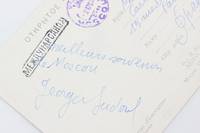
‎Moscou Moscow: S. n. 1952. Fine. S. n. Moscou Moscow 2 décembre 1952 15 x 10.50 cm une carte postale Autograph postcard signed by Georges Sadoul sent from Moscow to his friend Carlo Rim: ""Meilleurs souvenirs de Moscou. Georges Sadoul"" ""Best regards from Moscow. Georges Sadoul"" The postcard shows on the front a colored view of the Moscow metro. Carlo Rim was a Provençal writer author notably of Ma belle Marseille a caricaturist a filmmaker: Justin de Marseille L'armoire volante La maison Bonnadieu and was notably the friend of Fernandel Raimu and Marcel Pagnol but also of Max Jacob and André Salmon whom he met in Sanary. S. n. unknown‎

Référence libraire : 83934

‎GEORGES, Alexandre (1850-1938)‎

‎Autograph Letter Signed‎

‎French opera composer. Brief ALS in French 1p 6" X 4½" n.p. Paris France 1921 June 17. Addressed to A. Dandeld. Very good. Writing on an aerogramme Georges asks about a Sonia Herma as a possible singer for three fall concerts; complains about the difficulty of finding good singers. unknown‎

Référence libraire : 27448

Biblio.com

Main Street Fine Books & Manuscripts, ABAA
United States Estados Unidos Estados Unidos États-Unis
[Livres de Main Street Fine Books & Manuscripts, ABAA]

€ 164.99 Acheter

‎Georges, Alexandre, French organist and composer (1850-1938).‎

‎Autograph letter signed. No place, "Mardi".‎

‎8vo. 2½ pp. on bifolium. To his friend, the cellist and conductor Achille Kerrion (1868-1939), whom he congratulates on his appointment as director of the orchestra of the "Opéra Populaire", of which he had learned from the composer Henri Büsser (1872-1973), with thanks to him and his sister, the singer Stéphanie Kerrion, for giving their little girls some sweets, also apologizing for not writing sooner, as he has just returned from a concert in Angers: "Pardon de ne pas vous avoir remercié des bonbons que vous avez eu la gentillesse de nous offrir pour nos fillettes par l'intermédiaire de votre si aimable soeur. Ce sont mes multiples occupations qui sont la cause de ce silence. Je suis arrivé d'Angers hier soir, où j'avais Concert Dimance et aussitôt rentré. Je vous envoie avec tous mes remerciements, toutes mes félicitations pour votre nomination de chef d'orchestre au pupitre de l'opéra populaire. Büsser m'avait annoncé la nouvelle avant que vous ne l'appreniez. Bravo! J'en ai été très heureux [...]". - Slightly brownstained; a few tiny marginal flaws. A strip of paper mounted on verso.‎

MareMagnum

Inlibris
Wien, AT
[Livres de Inlibris]

€ 240.00 Acheter

‎GEORGES, Docteur Jean-Marie‎

‎Contribution à l'étude de la Chirurgie complémentaire dans les cancers du col de l'utérus aux stades I et II [ Livre dédicacé par l'auteur ]‎

‎1 vol. in-8 br., Imprimerie Péchade, Bordeaux, 1954, 90 pp. Rare exemplaire de cette thèse, enrichie d'une belle dédicace de l'auteur. Français‎

‎Georges, Marguerite-Joséphine, French actress (1787-1867).‎

‎Autograph letter signed. No place, 28. IX. 1847.‎

‎8vo. 1 page. Probably to a member of the Bapst family, French jewellers, about valuable buttons that she owns, mentioning that she feels slightly unwell, which is why she has asked her sister to come and see him: "Monsieur, étant un peu indisposée je charge ma soeur de vous remettre la reconnaissance de mes boutons. Si vous le désirez, elle ira même avec vous, dégager ces boutons. Je vous remercie mille fois du Service que vous me rendez [...]". - With the former collector's number "108" in pencil. Traces of former mounting on reverse; two small tears in lower margin.‎

MareMagnum

Inlibris
Wien, AT
[Livres de Inlibris]

€ 240.00 Acheter

‎Georgi, Friedrich von, Verteidigungsminister und Generaloberst (1852-1926).‎

‎Dankeskarte mit eigenh. Widmung und U. Wien, 14. III. 1909.‎

‎1 S. Qu.-12mo. An einen namentlich nicht genannten Adressaten: "Für die mir zugekommenen freundlichen Glückwünsche bitte ich den aufrichtigsten Dank entgegen zu nehmen [dies gedruckt]. Mit achtungsvollen Empfehlungen [...]". - Auf Kartonträger montiert (Qu.-8vo).‎

MareMagnum

Inlibris
Wien, AT
[Livres de Inlibris]

€ 150.00 Acheter

‎Georgi, Otto Robert, Politiker (geb. 1831).‎

‎Eigenh. Albumblatt mit U. Leipzig, [29. IX. 1915].‎

‎2 Zeilen. Qu.-8vo. Mit Lochspuren alter Heftung, Rundstempel und Inventarnummern "1833" der Handschriftensammlung J. K. Riess. Beiliegend der Ausschnitt eines kl. Zeitschriften-Portraits (38:58 mm). Etwas fleckig.‎

MareMagnum

Inlibris
Wien, AT
[Livres de Inlibris]

€ 80.00 Acheter

‎Georgi, Otto, erster Oberbürgermeister von Leipzig (1831-1918).‎

‎2 (davon 1 eigenh.) Briefe mit eh. U. Leipzig, 1875 und 1880.‎

‎Zusammen (1½+ 2=) 3½ SS. auf 3 Bll. Folio und gr.-8vo. Der vom 9. März 1875 datierende Brief an Hugo Scharf betr. der Vertretung des Bezirkssteuerinspektors, der andere an einen namentlich nicht genannten Adressaten: "Mit aufrichtiger Theilnahme habe ich von Ihrer Erkrankung gehört, und habe sogar gestern Abend bereits vor Empfang Ihres gef. Schreibens bei Prof. Hübner dahin zu wirken gesucht, daß er Sie sobald als möglich von hier fortschickt. Zu meiner Freude erfuhr ich von ihm, daß er völlige Schonung vorausgesetzt doch eine baldige und gänzliche Wiederherstellung erhofft [...]" (31. März 1880). - Teils etwas fleckig.‎

MareMagnum

Inlibris
Wien, AT
[Livres de Inlibris]

€ 250.00 Acheter

‎Georgi, Walter, German painter and illustrator (1871-1924).‎

‎Autograph postcard signed. Holzhausen, 27. XI. 1921.‎

‎Oblong 8vo (postcard). ½ page. Inscribed to the German dermatologist Alwin Scharlau: "Mit bestem Gruß [...]". - Working as an illustrator for the journals "Die Jugend" and "Simplicissimus" from 1896, Georgi co-founded the artists' association "Die Scholle" in 1899 and settled in Holzhausen am Ammersee in Bavaria, where an artists' colony was established shortly afterwards. - Some small ink spots. Self-addressed by the collector on the reverse. The Mecklenburg physician Scharlau (b. 1888) assembled a collection of artists' autographs by personal application.‎

MareMagnum

Inlibris
Wien, AT
[Livres de Inlibris]

€ 180.00 Acheter

‎GEORGIADES, Nicolas‎

‎La Pharmacie en Egypte [ Edition originale - Livre dédicacé par l'auteur ]‎

‎1 vol. in-8 br., F. Diemer Editeur, Le Caire, 1906, 240 pp. avec 47 planches hors texte Bel envoi de l'auteur "à Monsieur le Professeur P. Vergely, faible témoignage d'un coeur reconnaissant au maître qui l'a toujours comblé de ses bienfaits". Très rare exemplaire de cet ouvrage, le premier consacré à l'histoire de la pharmacie en Egypte à l'époque moderne selon l'auteur : "Dans un pays comme l'Egypte, qui compte 10 millions d'habitants et 300 pharmacies, sans compter les drogueries et les pharmacies-cliniques, aucun ouvrage n'a encore paru sur cette matière, si bien que le pharmacien récemment sorti de l'Ecole, ou nouvellement arrivé de l'étranger, ne trouve aucun recueil pouvant lui servir de guide. La profession elle-même n'a commencé à être réglementée que depuis 1904, les règlements antérieurs ne méritant pas ce nom". Etat très satisfaisant (couv. lég. frottée avec petits mq.,) pour ce rare exemplaire, dédicacé par l'auteur. Scarce copy, signed by the author. Very rare copy of this book, written in french, the first devoted to the history of pharmacy in Egypt in modern times according to the author: "In a country like Egypt, which counts 10 millions inhabitants and 300 pharmacies, without to count drugstores and pharmacies-clinics, no work has yet appeared on this subject, so that the pharmacist recently out of school, or newly arrived from abroad, can find no compendium that can serve as a guide. The profession itself began to be regulated only since 1904, previous regulations not deserving that name. " Français‎

‎Georgii, Theodor, Bildhauer (1883-1963)‎

‎Eigenh. Brief mit U.‎

‎o.J. München, 6. II. 1961, 4°. 1 Seite.‎

‎An einen Stuttgarter Galeristen, Dank für Beileidsbekundungen zum Tod seiner Ehefrau Irene Georgii, auf der Rückseite der gedruckten Danksagung: "[...] Du erkennst richtig, dass die Trennung von meiner Frau einen ganz grosssen Verlust bedeutet. Umsomehr habe ich Grund zur Dankbarkeit dass Gott sie mir in fast 54 Jahre währender Ehe geschenkt und erhalten hat [...]". - Georgii studierte an der Akademie der bildenden Künste in Stuttgart und seit 1905 in München bei Adolf von Hildebrand, dessen Tochter er 1907 heiratete. Er wurde Mitglied der Münchener Sezession.‎

Référence libraire : 50037

‎GERARD (Francis).‎

‎1 L.A.S. et 1 C.A.S. au "Poète délicat" [Pierre ANDRÉ-MAY]. S.d. (probablement 1921), 6 p. in-12.‎

‎Très intéressante lettre. Il semble que Pierre André-May, - ami de Gérard Rosenthal (Francis Gérard en littérature), ils s'étaient connus au lycée Carnot, - l'ai sollicité pour ses projets de revue. Ce dernier étant lui-même fondateur avec Jean-Pierre Lafargue et Jean Albert-Weil [qui signait aussi sous le pseudonyme de Maurice David] de la revue L'Oeuf dur qui eut quelques succès. "Réfléchis y, tendre poète, et si ton projet grandiose - que je te souhaite - était trop beau étant donné les exigences coupables des imprimeurs, viens sans faute parmi nos chansons..." Dans un style assez fantaisiste il raconte ses vacances et la liste de ses lectures de l'été: "Je lis à peu près parmi les mêmes poètes et prosateurs : Gide et la Porte trop Étroite, Giraudoux et la Clio trop Adorable, Morand et les Stocks trop Tendres. J'y joins les tout-délireux Chevaux de Diomède de Rémy de Gourmont et les admirables Alcools d'Apollinaire. Puis Rimbaud". Dans la carte il dit "sur les conseils de Max Jacob" ne plus écrire. A noter que l'on retrouvera aux sommaires d'Intentions Maurice David (c.a.d. J. Albert-Weil) ou Georges Duvau (autre collaborateur de l'Oeuf dur) mais point Francis Gérard...‎

Référence libraire : 13003

‎GERVAIS (Alfred).‎

‎2 lettres autographes, 3 pages + 3 cartes de visite. Enveloppes timbrées jointes.‎

‎Format 11 X 17 cm, lettres signées et datées 21 juin 1890 et Cherbourg 2 décembre 91.‎

‎Alfred Gervais (1837-1921) amiral et diplomate français, se rendit notamment célèbre en rendant visite en 1893 avec son escadre à la flotte impériale russe. Reçu par le Tsar Alexandre III, celui-ci fit jouer « La Marseillaise » en l’honneur de la France, hymne jusqu’alors interdit en Russie, car considéré comme révolutionnaire.‎

Référence libraire : 17232

Livre Rare Book

Librairie Jeanne Laffitte
Marseille France Francia França France
[Livres de Librairie Jeanne Laffitte]

€ 80.00 Acheter

‎GERALDY Paul - (1885 - 1983) - Ecrivain français‎

‎3 Lettres Autographes Signées à Pierre Béarn - 1954 - 3 pages in8 - + carte de visite avec quelques mots autographes + 2 poèmes dactylographiés -‎

‎Il envoie son chèque pour le "mandat des poètes" et vote pour Vincent Muselli - Lettre de voeux -‎

‎[En tant que bien culturel de catégorie 8, (décret no 93-124 du 29 janvier 1993), cet article ne peut être vendu sans formalité que dans la Communauté Européenne ]-‎

Référence libraire : GF23028

Livre Rare Book

Galerie Fert
Nyons France Francia França France
[Livres de Galerie Fert]

€ 100.00 Acheter

‎GERALDY, Paul‎

‎[ Recueil de 2 titres dédicacés : ] Le Grand-Père. Poème dit par M. de Féraudy à la Comédie-Française [ Edition originale - Livre dédicacé par l'auteur à Lucien Descaves ] [Suivi de : ] Les grands Garçons. Comédie en un acte [ Edition originale - Livre dédicacé par l'auteur à Georges Courteline ]‎

‎1 vol. in-12 reliure bradel demi-toile verte, couvertures du premier titre conservée, Le Grand-Père. Poème dit par M. de Féraudy à la Comédie-Française, Librairie Armand Colin, Paris, s.d.[ 1915 ], 11 pp. [Suivi de : ] Les grands Garçons. Comédie en un acte représentée pour la première fois sur la scène de la Comédie-Française le 18 Novembre 1922, Librairie Stock, Paris, s.d., 48 pp.‎

‎Très intéressant volume réunissant deux titres dédicacés par Paul Géraldy, le second "au grand Courteline, son respectueux ami", et le premier ainsi rédigé : "Lucien Descaves. C'est un triste et plat caporal qui vous envoie ces vers - Un caporal de l'arrière ! qui ne court pour le moment d'autres dangers que de recevoir un porte-plume dans l'oeil. Comment allez-vous ? Moi e lis vos articles et je suis votre affectueux [Caporal ] Paul Géraldy Le Mans Août 1915 [Gare de Maroc ]". L'immense succès populaire de "Toi et Moi" paru en 1912 avait déjà rendu célèbre Paul Géraldy lorsqu'il dédicacé ses deux ouvrages. Bon état (petit mq. de papier au premier plat, très bon état par ailleurs).‎

Référence libraire : 68400

Livre Rare Book

SARL Librairie du Cardinal
Gradignan France Francia França France
[Livres de SARL Librairie du Cardinal]

€ 95.00 Acheter

Nombre de résultats : 66,542 (1331 Page(s))

Première page Page précédente 1 ... 493 494 495 [496] 497 498 499 ... 617 735 853 971 1089 1207 1325 ... 1331 Page suivante Dernière page