|
|
|
Anne Philipe
Un été prés de la mer ( envoi autographe signé )
Paris Nrf Gallimard 1977 In12 - broché - 201 pages - Exemplaire du Service de Presse - Envoi autographe signé en page de faux titre .
書籍販売業者の参照番号
: 144Dt
|
|
|
Anne Robert Jacques TURGOT - [Paris 1727 - 1781] - Homme politique et économiste français
Lettre autographe signée à Mr Desmioges (?) à Douzenat - Paris le 22 juillet 1764 -
1 page petit in4 - Très bon état malgré un petit manque en angle de la marge haute -
書籍販売業者の参照番号
: 33261
|
|
|
Anne, Königin von Großbritannien (1665-1714).
Schriftstück mit eigenh. U. Windsor, 6. XI. 1712.
1 S. Qu.-Folio. Pergament. Mit papiergedecktem Siegel und Stempelmarken. Urkunde über die Ernennung von William Brooks zum Kornett im Königlichen Regiment der Dragoner: "To Our Trusty and Welbeloved William Brooks Gent. Greeting: We do by these presents constitute and appoint you to be Cornet of that Troop whereof the Colonel himself is Captain in Our own Royal Regiment of Dragoons. Commanded by Our Right Trusty and Right Welbeloved Cousin and Councillor Thomas Earl of Strafford. You are therefore carefully and diligently to discharge the Duty of Cornet [...]". - Mit eh. Gegenzeichnung durch Staatssekretär Henry St. John, 1st Viscount Bolingbroke, und zwei weiteren Beamten. Mit zwei Stempelmarken zu "II Shillings VI Pence", Dorsalvermerk, Spuren alter Faltung und kl. monogr. Sammlermarke verso.
|
|
|
ANNER, Emil:
Brief des Aargauer Malers Emil Anner (1870 - 1925) an eine nicht namentlich genannte Person in Zürich betreffend Aquarelle oder Radierungen und deren Reproduktion. Anner gibt auch einen kurzen Lebenslauf an: Geboren in Baden, Kunstgewerbeschule in Zürich und Akademie in München, geschrieben in Baden 1898, schöne Schrift, gedr. Briefkopf des Schlosses Schartenfels, Baden.
in-8vo Einzelblatt
書籍販売業者の参照番号
: 1562.1aaf
|
|
|
ANNESLEY, François-Henri-Arthur de Scy-Chazelles (Moselle), Elève de l'Ecole du Service de Santé Militaire
Essai sur la Gravelle. Thèse présentée à la Faculté de Médecine de Strasbourg, soutenue le 22 décembre 1868 [ Edition originale - Livre dédicacé par l'auteur ]
1 vol. in-4 br., Imprimerie d'Ad. Christophe, Strasbourg, 1868, 31 pp. "L'absence presque complète de cette maladie dans les cliniques de l'hôpital a rendu ma tâche plus difficile ; c'est ce qui me fait espérer que mes juges voudront bien m'accorder toute leur bienveillance". Très bon état. Envoi de l'auteur "à un des mes meilleurs amis et collègue le Docteur Ducourneau". L'Ecole Impériale du Service de Santé Militaire de Strasbourg fut instituée 1856 par Napoléon III et formera près de 1054 médecins pendant ses 14 années de fonctionnement. Français

|
|
|
ANNESLEY, François-Henri-Arthur de Scy-Chazelles (Moselle), Elève de l'Ecole du Service de Santé Militaire
Essai sur la Gravelle. Thèse présentée à la Faculté de Médecine de Strasbourg, soutenue le 22 décembre 1868 [ Edition originale - Livre dédicacé par l'auteur ]
1 vol. in-4 br., Imprimerie d'Ad. Christophe, Strasbourg, 1868, 31 pp.
書籍販売業者の参照番号
: 48787

|
|
|
ANNET (Gouveneur E.R. Armand).
Je suis Gouverneur d'Outre-Mer.
Paris,Editions du Conquistador,1957 ; in-8°,broché,couverture illustrée du portrait de l’auteur ; 143pages;exemplaire non coupé.
書籍販売業者の参照番号
: cROU-1577
|
|
|
Annette Vaillant
Le pain polka
Paris Mercure de France 1974 Grand In8 - broché - 216 pages - Envoi autographe signé de l'auteure a la journaliste et éditrice Germaine Beaumont . Annette Vaillant raconte son enfance avec le tout Paris Littéraire et Artistique .
書籍販売業者の参照番号
: Zh234
|
|
|
Annette Vaillant
Le pain polka
Paris Mercure de France 1974 Grand In8 - broché - 216 pages - Envoi autographe signé de l'auteure a la journaliste et éditrice Germaine Beaumont . Annette Vaillant raconte son enfance avec le tout Paris Littéraire et Artistique .
書籍販売業者の参照番号
: Zh234
|
|
|
Annette Vaillant
Les cavaliers de Mai
Paris Editions de Flore 1949 In8 - broché - non coupé - 239 pages - Envoi autographe signé de l'auteur à l'écrivaine et journaliste Germaine Beaumont .
書籍販売業者の参照番号
: 75Bl

|
|
|
Annette Vaillant
Les cavaliers de Mai
Paris Editions de Flore 1949 In8 - broché - non coupé - 239 pages - Envoi autographe signé de l'auteur à l'écrivaine et journaliste Germaine Beaumont .
書籍販売業者の参照番号
: 75Bl
|
|
|
Annibal de Monchanut
Vieil hypocras au vin de Beaune
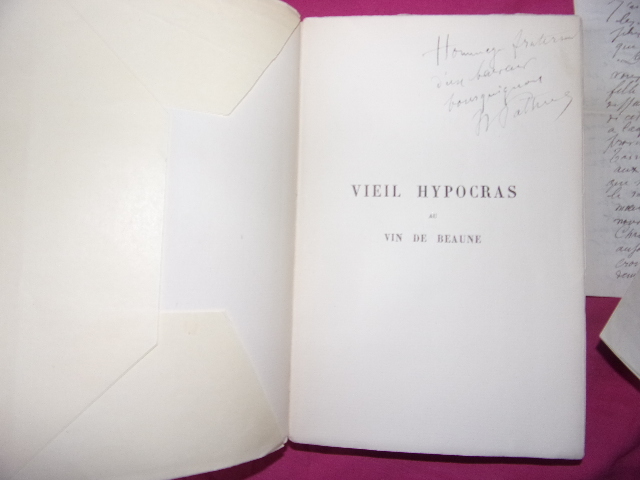
prologue - terroir - Quelques traits d'Arbalète - Les soirs mélancoliques et funèbres - Les réconforts. bel exemplaire broché, 19x13, très bel état, 259pp. Paris Georges Crès, 1912. Envoi autographe " hommage fraternel d'un buveur Bourguignon" . Joint deux lettres autographes, probablement amis de l'auteur dont les signatures sont indiquées mais à identifier, on y lit: Duttraz (?) en date du 24 septembre 1936 et Camille Poffin (?) en date du 2 mai 1940. ref/6
書籍販売業者の参照番号
: CZC-8379
|
|
|
Annibal de Monchanut
Vieil hypocras au vin de Beaune
prologue - terroir - Quelques traits d'Arbalète - Les soirs mélancoliques et funèbres - Les réconforts. bel exemplaire broché, 19x13, très bel état, 259pp. Paris Georges Crès, 1912. Envoi autographe " hommage fraternel d'un buveur Bourguignon" . Joint deux lettres autographes, probablement amis de l'auteur dont les signatures sont indiquées mais à identifier, on y lit: Duttraz (?) en date du 24 septembre 1936 et Camille Poffin (?) en date du 2 mai 1940. ref/6
書籍販売業者の参照番号
: CZC-8379
|
|
|
Annie ERNAUX
Carte postale autographe adressée à son amie Christiane Baroche : "J'aime ce que tu aimes, je m'interroge sur les mêmes choses que toi, la folie, la création, dans tous les sens..."
s. n. | 1984 | 15 x 10.6 cm | Une carte postale
書籍販売業者の参照番号
: 91928
|
|
|
Annie ERNAUX - (à Christiane BAROCHE)
Bristol autographe signé et adressé à son amie Christiane Baroche à propos de son livre "L'Hiver de Beauté récemment paru : "Tu as réussi un très beau livre dans une langue que je trouve de plus en plus rigoureuse..."
s. n. | s. l. 25 avril 1987 | 15.5 x 11 cm | Une feuille + une enveloppe
書籍販売業者の参照番号
: 91929
|
|
|
Annie ERNAUX - (à Christiane BAROCHE)
Bristol autographe signé et adressé à son amie Christiane Baroche pour son aimable critique de ses oeuvres "car les moments de "gloire" sont aussi ceux qu'on a envie de traverser avec les gens qu'on aime bien..."
s. n. | s. l. 18 novembre 1984 | 12.8 x 8.2 cm | Une feuille + une enveloppe
書籍販売業者の参照番号
: 91998
|
|
|
Annie Guehenno
L'épreuve
Paris Grasset 1968 In8 - broché - non coupé - 297 pages - Édition originale sur Alfa , un des seul 28 exemplaires - Envoi autographe signé de A. Guehenno à Françoise Verny célèbre éditrice . L'épreuve raconte les faits de résistance de la jeune Annie Guéhenno (née Anne Marie Rospabé 1916/2006 ) qui épousa l'écrivain Jean Guehenno . Rare et précieux exemplaire .
書籍販売業者の参照番号
: 57Bl

|
|
|
Annie Guehenno
L'épreuve
Paris Grasset 1968 In8 - broché - non coupé - 297 pages - Édition originale sur Alfa , un des seul 28 exemplaires - Envoi autographe signé de A. Guehenno à Françoise Verny célèbre éditrice . L'épreuve raconte les faits de résistance de la jeune Annie Guéhenno (née Anne Marie Rospabé 1916/2006 ) qui épousa l'écrivain Jean Guehenno . Rare et précieux exemplaire .
書籍販売業者の参照番号
: 57Bl
|
|
|
Annie Jeanneret Guidi
Venise
Bel envoi à " Pierre Maurois qui sait au delà de la politique etre aussi un humaniste et un amateur d'art éclairé. Avec toutes nos amitiés ". Préface d'Anne Meyer (une page) 32 poèmes d'Annie Jeanneret et 43 dessins en noir et blanc de Guidi Tirage limité et numéroté 475/1000 sur Sulfure et Balkis blanche des papeteries Montévrain Exemplaire en feuilles sous chemise rempliée, non paginé, 25 x 33 cm, bel exemplaire à l'état neuf Imprimerie I. S. O., à Fitz-James, Collection Arts et Voyages, 1985
書籍販売業者の参照番号
: CZC-13509

|
|
|
Annie Jeanneret Guidi
Venise
Bel envoi à " Pierre Maurois qui sait au delà de la politique etre aussi un humaniste et un amateur d'art éclairé. Avec toutes nos amitiés ". Préface d'Anne Meyer (une page) 32 poèmes d'Annie Jeanneret et 43 dessins en noir et blanc de Guidi Tirage limité et numéroté 475/1000 sur Sulfure et Balkis blanche des papeteries Montévrain Exemplaire en feuilles sous chemise rempliée, non paginé, 25 x 33 cm, bel exemplaire à l'état neuf Imprimerie I. S. O., à Fitz-James, Collection Arts et Voyages, 1985
書籍販売業者の参照番号
: CZC-13509
|
|
|
ANNUNZIO Gabriele d'
La figlia di iorio
- Presso i fratelli Treves, Milano 1904, 11,5x18,5cm, relié. - Edition de l'année de l'originale. Reliure en plein cartonnage façon vélin, dos lisse, pièce de titre de chagrin marron, plats frappés en leurs centres des armes dorées du comte Paul Biver, gardes et contreplats de papier à la cuve, couvertures et dos conservés, tête dorée, reliure de l'époque. Ouvrage illustré de 21 bois et de 143 lettrines d'Adolfo de Carolis. Bel exemplaire joliment établi aux armes estampées à l'or de Paul Biver. Envoi autographe daté et signé de Gabriele d'Annunzio au comte Paul Biver. [ENGLISH DESCRIPTION ON DEMAND]

|
|
|
ANNUNZIO Gabriele d'
Lettre autographe signée de deux pages
- S.n., s.l. 25 Décembre 1913, 17,5x23cm, une feuille avec enveloppe. - Lettre autographe datée du 25 Décembre (1913, le cachet de la poste faisant foi) et signée de deux pages de Gabriele d'Annunzio remerciant sa correspondante madame L. Boulenger du présent qu'elle lui a fait parvenir et louant sa générosité. "Chère madame, j'ai reçu le tube avant votre billet, mais j'ai deviné sans hésitation que le cadeau me venait de vous. Je connais votre délicate bonté : elle me touche profondément, encore une fois. Merci. Je penserai à vous, là-bas, dans la lande, en réchauffant mes mains glacées, pendant mes promenades matinales. Au revoir, à dimanche prochain. Agréez mes souhaits les plus affectueux, chère madame, et croyez à mon dévouement profond. Gabriele d'Annunzio. Ce 25 Décembre." Enveloppe jointe. [ENGLISH DESCRIPTION ON DEMAND]

|
|
|
Annunzio, Gabriele d', Italian writer (1863-1938).
Autograph letter signed Apparently Gardone Riviera, 28 June 1926.
Folio. 2 pp. on 2 ff. According to a previous owner, the letter was written to Madame Nain, the wife of the French shipowner Raymond Nain, inviting her to his cruiser Puglia: "[...] J'aurais aimé vous faire entendre, cet après-midi, à bord de mon cuirassé, un concert de mon Qua-tuor à cordes. Donna Maria vous prie de venir déjeuner à notre table franciscaine demain mardi, à une heure. J'en-verrai une voiture vous prendre à l'Hotel. / Mes félicitations à l'Epoux heureux […]". - In 1923, d'Annunzio had beun to exhibit military equipment in his villa on Lake Garda. - On headed paper "Memento Audere Semper". - Slightly spotty.
|
|
|
Annunzio, Gabriele d', Italian writer, poet, journalist (1863-1938).
Autograph letter signed. No place, 6. XI. [post 1918].
Folio. 1 page. With autogr. envelope. To Commandante Giovanni Rizzo in a press affair: "[...] anche una volta mi raccomando a te poiché tu impedisca che le mie parole - riprodotte direttamente! - siano falsate ingoffate appesantite dalle gazzette. Il mio 'spirito' nun può essere toccato da mani maldestre e da interpreti frettolosi [...]". - With letterhead of the "Squadra di San Marco".
|
|
|
Annunzio, Gabriele d', Schriftsteller (1863-1938)
Più che l'amore. Tragedia moderna. Undicesimo migliaio.
o.J. Milano, Fratelli Treves, 1914, 8°. 2 Bl., LV, 300 S. Mod. Rotes Leder mit Rtit. und eingeb. Orig.-Vorderumschlag.
書籍販売業者の参照番号
: 61354
|
|
|
Anon
Rare Japanese Manuscript: [Kaei Ni-nen Tori-uru Shi-gatsu: Angeria-sen Toraiki. "Record of the Arrival of a Ship from Anglia, Fourth Month of 1849"]
Manuscript record of the unexpected arrival of the British HMS Mariner led by Commander Charles Mitchell Mathison in Japan, in 1849, with interest in making surveys around Edo (Tokyo), four years prior to Commodore Perry's arrival, and during Japan's period of isolation (Sakoku) during which most foreigners were prohibited entry in to the country and locals prohibited exit; containing also a description of Japanese castaway Otokichi who was on the British vessel, disguised as a Chinese to evade capital punishment, who later assisted Admiral James Stirling in establishing the 1854 Anglo-Japanese Friendship Treaty. Text is in Japanese. 8vo. 44 pages in manuscript, plus title page, on 23 unpaginated double leaves. Traditional karitoji binding ("semi-bound" meaning title page and contents without a book cover) string-stitched at spine, fukurotoji style ("bound-pocket" with folded leafs bound into spine), and opening from left to right. Complete in a single volume, measuring approximately 24 x 17 cm. A scant few ink marks to rear leaf margin, indication of some burrowing, unobtrusive to legibility, otherwise in very good condition, beautifully preserved, clean and bright, an exceedingly scarce work. Certainly an assertive manoeuvre, for the British to show up unannounced in the harbour of Edo, Japan was in the state of Sakoku ("locked country"), the isolationist foreign policy of the Tokugawa shogunate under which relations and trade between Japan and other countries were severely limited, and nearly all foreign nationals were barred from entering Japan, while common Japanese people were kept from leaving the country. The long-standing policy had been in place for over two centuries, since 1603, and would last a few more years after the departure of HMS Mariner. It was Commodore Perry in 1853, and his equally brazen arrival with his American Black Ships, that would force the opening of Japan to American trade through a series of treaties called the Convention of Kanagawa, ultimately ending the island's declaration of Sakoku, and facilitating other trade relations with Western nations. On 14 October, 1854, the first limited Anglo-Japanese Friendship Treaty was signed by Admiral Sir James Stirling and representatives of the Tokugawa shogunate (Bakufu). Yamamoto Otokichi (1818-1867), who was onboard HMS Mariner disguised as a Chinese interpreter during the ship's attempted entry in Japan, later played an instrumental role in establishing this treaty, providing Stirling with intel on language and culture during the negotiations. On 26 August 1858, the Anglo-Japanese Treaty of Amity and Commerce was signed by the Scotsman Lord Elgin and representatives of the Tokugawa shogunate for Japan, after the Harris Treaty was concluded. Britain obtained extraterritorial rights on Japanese with the British Supreme Court for China and Japan, in Shanghai. A British iron paddle schooner named Enpiroru was presented to the Tokugawa administration by Bruce as a present for the Emperor from Queen Victoria. A scarce compilation of records from the Japanese perspective on a pre-Perry interaction between Bakufu authorities and a British ship, with references to Otokichi. This manuscript collates four Japanese reports of the British ship the HMS Mariner, which arrived in Japan from Shanghai in May of 1849 to make a topographical survey of the area around Edo (modern-day Tokyo), led by Commander Charles Mitchell Mathison, who had entered the Royal Navy on 5 August 1819. The event marks a very early British appearance at Japan, also pre-dating by four years the imposing arrival of Commodore Perry and his American Black ships also intent on making surveys. The first record briefly describes the layout of the Mariner and the aim of its visit to Japan. It also mentions the considerable Japanese language abilities of the Chinese interpreter on board who explained things in a way that is easy to understand, he in fact being the Japanese castaway Yamamoto Otokichi (1818-1867). The second section records foreign ship sightings from daimyo with guardhouses on the Miura Peninsula. [daimto were the most powerful landholding magnates holding the largest sections of land] The third report describes the meeting of Commander Mathison and the Bakufu intendant Egawa Tarozaemon (1801-1855), a dispute over a map of Japan, and Japanese observations of the ship and the crew. The last report is a copy of Isenokami Abe's (Masahiro Abe: 1819-1857) message to the bugyo (magistrates) and metsuke (censors/inspectors) in which, with HMS Mariner in mind, he expresses concern about the increase in the number of foreign ship arrivals in recent years and the abandoning of the Edict to Repel Foreign Ships. Abe notes that if the edict is enforced again, while there is no illegality on the part of the foreign ships, a dispute could arise, thus cautioning the noble families on the coast to prepare defenses. [Only a few years after the arrival of HMS Mariner, Isenokami would play a major role in the signing of the Convention of Kanagawa, as a result of pressure from the Perry Expedition.]
|
|
|
Anon
Rare Slavery Document: Wisselbrief [Bill of Exchange, Promissory Note].
A numbered (278) and printed document granting financial compensation to a slave owner in Suriname, by the Dutch government, signed in the original by numerous parties including the Gouverneur de Kolonie Suriname [Governor of Suriname] Van Lansberge, the Administrateur van Financienvan Het Ministerie van Kolonien te s-Gravenhague [Finance Administrator for the Ministry of the Colonies, at The Hague], and the recipient of the funds who is not only a slave owner but well-known chirurgeon A.D. Charlouis. Text is in Dutch. With steel engraved colonial coat of arms, official ink stamps, the embossed stamp of the "Klein Kolonie Suriname" government. Single leaf measuring approximately 26,5 x 13 cm. Very good condition, beautifully preserved, a scarce and historical slavery document with notable signature. The present document is interesting, as is was made almost two years after the official abolition of slave ownership in Suriname, which reveals the lengthy time period over which this process was stretched. The government's primary concern was not the freedom of the enslaved people; it was the preservation of the plantation economy, lest there be a mass exodus of workers leaving the plantations. The latter was cited as the reason and justification for the mandatory employment contract which accompanied 'free status' of a slave. Chirurgeon Andries Daniel Charlouis (Emden, Lower Saxony 1820 - Paramaribo, Suriname 1880) is the recipient of this compensation. Historical evidence reveals that he had more slaves than what is represented with this document, and that he released them gradually. He was well-known in the field of medical science, particularly for his studies on medicinal matters and the indigenous people of South America; his name appears in numerous medical journals of the period. Reinhart Frans Cornelius van Lansberge (1804-1873), whose signature authorizes this document, was the Governor-General of Suriname from 1 August 1859 to 29 June 1867. Slavery was abolished in the Dutch West Indies during his governorship. Previous to this post, he was Governor of Curacao from 1855 to 1859, and formerly Dutch Consul-General Venezuela. Doctor Charlouis, whose original signature is found to verso, received 1935 guilders with this promissory note effective 15 August 1865. This figure represents the release of approximately 6 slaves. A manuscript annotation to upper left margin, penned in a West Germanic language, refers to the abolition act: "Opheffing der slavernij... 1863" [Elimination of slavery... 1863]. Red ink annotations reveal that this document was registered on 16 September 1865, and signed by a Geregistreerde referendaris J.C. Jaunen [registered secretary]. Additional annotations to the upper margin suggest that the funds were cashed in on 16 October 1865 "Betaalbaar te Amsterdam" [paybale to Amsterdam]. Also interesting to note, two of the signed annotations to verso, those of Charlouis and a witness, make reference to German plantation owner, banker Wilhelm Eduard Ruhmann at Paramaribo. As such, this transaction was most likely transacted at Surinaamsche Bank which had been founded earlier the same year, and the funds dispatched from there to the Dutch government in The Netherlands. The Netherlands abolished the Atlantic slave-trade in 1814. However, localized slavery continued for over half a decade. Slavery was finally abolished in Suriname and the Dutch West Antilles on 1 July 1863 with the Emancipation Act. On that day, about 35,000 slaves in Suriname and 12,000 slaves on the Dutch islands in the Caribbean were given their freedom, or rather a modified version of freedom. Freed men in Suriname come under state supervision for ten years with a mandatory employment contract on the plantations. The slave owners received financial compensation from the government upon releasing their slaves to this system. The Dutch government paid 300 guilders per slave to the owner for the "lost property". (In the Dutch East Indies, payments were far lower, 50 to 350 guilders depending on the age of the slave). The abolition of slavery was referred to as 'emancipation'. Parties were organized in which King William III was presented as a key figure and benefactor of the freed slaves.
|
|
|
Anon.
Illustrated Latin Manuscript Leaf, Hand Painted With Symbolism of Anti-Slavery, Introducing an Early Work of Translation by a Franciscan Friar of the Third Order.
Manuscript leaf introducing an early work of translation by a Franciscan Friar of the Third Order, hand painted in full colour and featuring fascinating symbolism. Text is in Latin. Leaf measures approximately 34 x 49 cm. One soft fold, minor age-toning, otherwise in very good condition, a beautifully preserved hand painted document made at the turn of the 18th century. The present document suggests that as membership of the Franciscan Third Order grew rapidly, and no formal papal education was being received by those preaching in the streets, there was a need for some form of instruction or guidance. As such, some of the key and simple canonical documents began being written for the laymen/women to understand the principles. The symbolism features intimation of anti-slavery. Purposed with works of teaching the gospel, providing charity, and social well-being for the public, early members of the Franciscan Third Order were a community focused on truth and humility, striving to emulate Christ and model a pure life. The symbolism in the manuscript illustration of the present document is fascinating and enlightening, in particular the focal image top and center. This is an armorial motif depicting slavery, rather the Catholic church's purported desire to slavery. Unlike the standard Moor's head seen in the papal coat of arms seen since early days, the imagery here features an African tribal warrior chief, all seen but his legs, with a confident stance and holding a spear up high in declaration; this is drawn inside of a gold shield topped with the pope's mitre simplex headdress. As a whole, this could be interpreted as the Franciscan Third Order's support to abolish slavery. Some of the more common instances of symbolism are the red ribbons to signify the Blood which Christ, and the laurel leafs in a circular placement as in the ancient Greek custom of symbolising victory, honor, and peace, in this case being victory over sin, honor to the Holy one, and peace on earth. There are also two large gilt fleur-de-lis, which is often said to from 1244 in the arms of the Kings of France, although clearly used earlier as this document precedes the latter event by 40 years. In early Catholic-based examples such as the present leaf, the fleur-de-lis is believed to represent either the Trinity, or the lancehead of a spear such as which would have pierced the side of Jesus on the Cross. Manuscript
|
|
|
Anon.
Japanese Manuscript Account, with Large Ink Drawing, Regarding the Great Consternation Among the Japanese Civilians on the Arrival of Commodore Perry's Ships at Uraga in July 1853.
Manuscript document together with linen backed drawings. Document is 11 pages written recto and verso to six folded leaves string-tied at margin, measuring approximately 28,5 x 18,5 cm. Drawings are folded leaf measuring approximately 64 x 43 cm, accompanied by a related diagram on a single leaf measuring approximately 27 x 40 cm. The manuscript document describes the great consternation among the Japanese civilians, upon the arrival of Commodore Perry's four American ships at Uraga in July 1853, and the warlords' immediate action to guard the coast. Together with a large manuscript ink drawing depicting the "black ships", and an accompanying drawing of a barrel transport method. All text is in Japanese. Minor creasing and age-toning, otherwise items are in very good condition, beautifully preserved contemporary documentation by a Japanese civilian observing the events as they unfolded. A contemporary advisory of utmost urgency alerting Japanese civilians of the arrival of four formidable American vessels and the immediately appointment of warlords to protect the nation from invasion. The manuscript begins by reporting the arrival at Uraga in Edo Bay [Tokyo Bay] on 8 July 1853 of Commodore Perry and his four "Black Ships" [war steamships Susquehanna and Mississippi, sailing sloops Plymouth and Saratoga]. Details of the ships are given, including size, one estimated at 45 ken [approximately 82 metres], number of masts, firing canons, and so forth. The writer describes the ensuing panic among Japanese civilians, at Uraga and as far as Shinagawa, which is now part of Tokyo. [The news was travelling fast by word of mouth along the coast and trade routes, and began being illustrated with the "kawaraban" - broadsides with woodblock prints - for distribution. Naturally, Edo commoners were curious to learn about the imposing vessels that suddenly appeared within sight of their city.] He goes on to further explain that the Feudal Lords feared of an imminent and much larger attack by a foreign power, and the final section includes a list of warlords assigned to the vital responsibility of coastal guard duty. [The Japanese had no navy with which to defend themselves. The Americans were there to impose a trade agreement, and the opening of Japanese ports to U.S. merchant ships. This was the era when all Western powers were seeking to open new markets for their manufactured goods abroad, as well as finding more raw materials for their growing industries. Perry's small squadron itself was not enough to force the massive changes that subsequently took place in Japan, but the Japanese knew that his ships were just the beginning of Western interest in their islands. Russia, Britain, France, and Holland indeed followed Perry's example and used their fleets to influence Japan into signing treaties granting regular relations and trade. [Perry's vessels imposingly sailed into Edo Bay and his crew began surveying the surrounding area. The Japanese were shaken by this unprecedented and brazen conduct. After Perry's departure, an extensive debate ensued within the Shogunal court on how to respond to the American's implied threats. Shogun Tokugawa Ieyoshi died within a few short days, and was succeeded by his sickly young son, Tokugawa Iesada, leaving effective administration in the hands of the Council of Elders (roju) led by Abe Masahiro. Abe felt that at the time it was impossible for Japan to resist the American demands by military force, so he polled all of the daimyos (magnates and feudal lords) for their opinions. Of the 61 known responses, 19 were in favor of accepting the American demands, 19 were equally opposed, 14 gave vague responses expressing concern of possible war, 7 suggested making temporary concessions, and 2advised that they would simply go along with whatever was decided. The only universal recommendation was that steps be taken immediately to bolster Japan's coastal defenses. As revealed in the present document, one of the earliest steps was to assign the feudal lords to coastal defense. Fortifications were hurriedly built close to current day Odaiba in order to protect Edo from a subsequent American naval incursion. The Japanese ultimately agreed to the demands. Although many leaders wanted the foreigners expelled from the country, in 1854 a treaty was signed between the United States and Japan which, allowed trade at two ports.]
|
|
|
Anon.
Manuscript Court Documents Pertaining to an American Merchant Ship Captured in 1801 by a Spanish Privateer and Recaptured Again by the American Crew.
Four manuscript court documents pertaining to an American merchant ship captured in 1801 by a Spanish Privateer while on a voyage to Barcelona and Malaga with valuable cargo, the subsequent recapture by the American crew, and claim for compensation from the salvage of her cargo. Three folio, one octavo, all single-leafs. Two documents are split at folds, one of which has very minor loss to text, otherwise the lot in very good condition, clean and legible, a most interesting record of the event and proceedings in the Admiralty Court. The American Brig Eliza, formerly Schooner Maria, whose homeport was Charleston and master was Captain Joseph Michael, was destined for Barcelona and Malaga in June 1801, with a cargo belonging to an American merchant named John Seamy. Near Tarifa, in Cádiz Province, on 10 July she was seized by Spanish privateers and ordered to the Port of Algeciras. While at anchor there, Captain Michael, with the help of his crew, in particular a Benjamin Hubble, managed to re-take the ship from the Spanish. They immediately proceeded across the Bay to Gibraltar with the intention of selling the ship and cargo for personal gain. Refusal to acquiesce to the Spanish privateers would have resulted in extreme retribution for the American captain and crew if they had not succeeded in their escape, as mentioned in the documents as a reason to disallow the captain of any monetary gains for the recovered vessel. There was also intense fighting around Gibraltar, involving the French, Spanish, and British, therefore the Spanish were well-positioned and well-armed. It was the Battle of Algeciras Bay taking place, having begun only 4 days earlier on 6 July 1801. (It would end on the 12th). Adding to the eminent danger for the Americans, when the United States had declared independence, British diplomats were quick to inform the Barbary States that U.S. ships were open to attack. In May 1801, some 6 weeks before the incident described in the present documents, the First Barbary War had begun, a war between the alliance of the United States and several European countries, against the Northwest African Muslim states known collectively as the Barbary States. Prior to independence, American colonists had enjoyed the protection of the British Navy. The British no longer offered protection. The Mediterranean Sea was now a precarious place for Americans to sail. On 4 December 1801, four members of the crew, Benjamin Huddle, Robert Sherington, Thomas William, William Sesten, engaged a proctor to recover the ship and her cargo. His compensation would be half of the value of the salvage. Following the recovery voyage, accusations flowed freely and, a few months later, in December 1801, a trial in the Admiralty Court ensued. The proctor presented his case for the claimants. The result of the trial is not identified herein, but can be assumed in favour of the claimants, based on the final document, which is a "release of all claims" by the ship's new captain, Nathan Ells, who was a mate under Captain Michael, employed on the ship during the event in question.
|
|
|
Anon.
Manuscript Watercolour Map Illustrating the Village of Ashinazawa Tamayamababa and Its Environs, Depicting Japanese Samurai Horse Breeding Grounds
Large manuscript watercoloured map to illustrate the village of Ashinazawa Tamayamababa and its environs (in present-day Morioka, Iwate Prefecture), showing lands used by samurai of the ruling Nanbu Clan for raising and breeding horses, also highlighting three mountains in relief by way of tipped-in folding cutouts. Place names and text is in Japanese. Signed in manuscript by a Samurai named Sakura Baba, as well as three other notable officials. Map measures approximately 135 x 82 cm. Some creasing, otherwise in very good condition, a very unique manuscript painted map from the feudal Morioka Domain. The village shown is Ashinazawa Tamayamababa, situated within 30 km from Morioka, which was then the Morioka Domain (Morioka-han), a tozama feudal domain of Edo period, under the rule of the Nanbu Clan (Nanbu-shi) of samurai whose territory spanned most of northeastern Honshu in the Tohoku region. [Today, Morioka (Morioka-shi) is the capital city of Iwate Prefecture located in the Tohoku region of northern Japan. Ashinazawa is considered part of the Morioka district.] Ashinazawa Tamayamababa is also near, only 90 km, from Kakunodate (in present-day Akita Prefecture), also a former castle town and samurai stronghold. While Kakunodate Castle no longer remains, the town is famous for its samurai tradition and its hundreds of weeping cherry trees (shidarezakura). Apart from the loss of its castle, Kakunodate remains remarkably unchanged since its founding in 1620. The town was built with two distinct areas, the samurai district and the merchant district. Once home to 80 families, the samurai district still has some of the best examples of samurai architecture in all of Japan. Among the hills and near the village, some rather expansive horse-breeding fields are drawn on the map, presumably belonging to or at least managed by the Nanbu-shi samurai who signed the document. The horses would have been used by samurai warriors for military equestrianism, including bajutsu (a distinct form of martial art), for yabusame (mounted archery), and other practices of skilled battle on horse-back. Three mountains illustrated two-dimentionally, are all stratovolcanos forming part of the Ou Mountain range in the Tohoku region of northern Honshu. They appear to be illustrating Mount Iwate - the active volcano situated only 22 km from Ashinazawa, Mount Hachimantai - the highest peak in the Ou Mountains and only 46 km from Ashinazawa, and the active stratovolcano Akita-Komagatake located some 70 km from Ashinazawa. In red paint, several roadways are delineated, one of them reaching and following the summit line of one of the mountains. At the head of one of these roads, is a drawing of a cherry blossom trees, and an inscription which likely reads 'sakura', the term for of a group of cherry blossom trees, collectively. The flow of the Kakkonda and Shizukuishi rivers into the Kitakami is traced from the hills. In the distance, on the opposite side of the mountain ranges, a larger river is drawn, depicting the wider Tama River, which would eventually lead to Lake Tazawa. The Akita-Komagatake region is exceptionally lush, with several hundred species of alpine flora and would surely be an excellent place for horses to graze. Mount Hachimantai is especially characterized with hot springs, possibly being used as a source of warm water for cleaning or healing. In general, the vast region would be superb as a horse breeding ground. Horsemanship was an important duty and respected skill of the samurai. There were two classes of Samurai, and only upper-class samurai were allowed horses, although the lower class samurai who could find a way to possess their own horse, did so, with the belief that every samurai should have the honour and the benefit. Being on horse-back aided in part to best perform archery, spearmanship, and swordsmanship in battle. Horse-mounted samurai often fought by charging their horses at their opponent, in some cases causing a collision that would unbalance or even injure the other's steed.
|
|
|
Anon.
Spoof Decree of a Criminal Prosecution for Drunkenness in the Form an Exorbitant Monetary Fine Payable to the Deliverer of the Document - COMPLETED IN MANUSCRIPT.
8vo. 1 page, printed document completed in manuscript including date, name of recipient/delinquent, amount of the fine, name and signature of the messenger/collector of funds. With a partial manuscript message to inner page of leaf. Double leaf measuring approximately 17 x 21 cm in its folded state, watermarked with the year 1822. Signed in ink in an original hand, "Jno. Rd. Carter," as the messenger. Very good and original condition, an amusing document, seldom seen completed in manuscript. Roughly designed after an authentic court document, the heading bears the abbreviations "G.R. IV" signifying the reign of King George IV and features an engraved representation of the Royal Coat of Arms of the British monarch. Dated 31 January 1826 in manuscript, charges are laid upon a Mr. David Crossby of Gosberton [South Holland district, Lincolnshire], who is guilty of the crime of "the wicked and abominable sin of drunkenness, by frequently swallowing large quantities of Beer, Ale, Porter, and all other Malt Liquors, (Small Beer excepted) Brandy, Rum...", his fine being 50 pounds of good and lawful Money of Great Britain, payable within 24 hours to the deliverer of the said notice. Fifty pounds sterling was a very large sum of money at the time, £50 then being equivalent to approximately £4,450 today, although substantially more impactful when we consider that the average income from 1800 to 1825 was less than £20 a year. As such, the fine here would represent approximately 3 years wages to the poor bloke who was "convicted" of simply consuming alcohol.
|
|
|
Anon.
Two Signed Membership Documents Pertaining to the Acceptance of Monica Mary Cole, an English Geographer, into Two Scientific Societies.
Two signed membership documents formally accepting English geographer Monica Mary Cole into two scientific societies for the learned, the Royal Geographical Society and the Geologists' Association, respectively. 8vo. Two separate printed documents, three leafs combined, each document completed, signed and dated by the respective society's secretary. Leafs measure approximately 20,5 x 26 cm. Creasing to one document, otherwise in very good condition. Monica Mary Cole (1922-1994) was an English geographer, lecturer, and author, an intellectual woman and polyglot, whose legacy has been described by her colleagues as "a leader in her chosen field of academic research" who "scaled the heights of a profession that, even today, finds too few women as the incumbents of chairs." She left the Royal Geographical Society £10,000 for it to establish a research travel grant for young female physical geographists. The Archives of the Royal Holloway, University of London holds a collection of papers relating to Cole. They include her personal papers and objects connected to her career as a geographer between 1967 and 1970. During her distinguished career she produced pioneering works in the fields of biogeography and geobotany, remote sensing and terrain analysis, and mineral exploration. Her research spanned Central and Southern Africa, Brazil, Venezuela, Australia, China and Finland. Cole was not the archetypal quiet and contemplative academic. She was a larger-than-life character, and people loved to be around her. She was elected as a Fellow in the Royal geographical Society on 22 June 1942. The following year, on 6 December 1943, she also became an elected member of the Geologists' Association of London. The present documents are her official membership declaration papers from each of these societies. In 1947, Miss Cole was appointed geography lecturer under Bill Talbot at the University of Cape Town. She conducted a detailed land utilisation survey on the soils and crop yield affected by climate anomalies in Elgin, Western Cape, which was called "one of the most thorough and useful land utilization surveys carried out anywhere in South Africa" by Stanley Jackson, in The Geographical Journal.
|
|
|
Anonym
Taschen-Kalender für das Jahr 1854.
o.J. Wien, Leopold Grund, (1853), 8,5 x 5,5 cm. 32 S. (A-D) sowie Durchschußblätter. Halbseide d. Zt. in Pp.-Schuber (etw. lädiert).
書籍販売業者の参照番号
: 50109
|
|
|
Anonyma
"Meine Palästinareise vom 30. Juli - 1. Sept. 1930." Deutsche Handschrift auf Papier. Lateinische Schrift.
o.J. Ohne Ort (Karlsruhe), am Schluß datiert 26. III. 1931, 8°. 91 nn. Seiten, einige lose Blätter. Roter Strukturleinenband mit Deckelprägung "Poesie" und Messingschließe.
書籍販売業者の参照番号
: 53084
|
|
|
ANONYME
(Prostitution) Brevet d'invention - Caisse d'Horloge
- Paris s.d. (circa 1800), 23,5x18,3cm, une feuille. - Brevet d'invention - Caisse d'Horloge [Patent of Invention - Clock Case] Paris [ca 1800] | 23.5 x 18.3 cm | single sheet A curious manuscript comprising fifteen or so lines in pencil on lined paper, bearing the title «Brevet d'invention - Caisse d'Horloge». «A noted physiognomist tells us that women of ill repute have the mark of their behavior on their faces. In giving over their bodies to a shameful use, the blood changes and becomes watery, decomposition begins and colors fade. The skin grows wrinkled, dark rings appear under the eyes, and the blood as changed by vice has no more of a sex than the case of a clok (sic). It is for this reason that an Association has been formed against the corruption of morals, which leads to the degeneration of the human race. It marks the easy of virtue with a clok case [sic] so that they will be exposed to public vilification. They can be recognized by their unusual toilet, the product of their criminal behavior and the shame of honest girls. The Repairer of Morals is dispatched by the Association, whose seat is in Paris.» A very rare manuscript document. [FRENCH VERSION FOLLOWS] Curieux manuscrit d'une quinzaine de lignes sur une feuille lignée au crayon de papier, portant le titre "Brevet d'invention - Caisse d'Horloge". "Un Physionomiste célèbre a constaté que les Filles de mauvaise Vie avaient le cachet de leur inconduite sur leurs Figures. En livrant leur corps a une exploitation honteuse, le sang s'altere il devient aqueux, la décomposition arrive et les couleurs disparaissent. La peau se ride, les yeux deviennent Cernés, le sang altéré par le vice n'a pas plus de sexe qu'une Caisse d'Hologe (sic). Pourquoi une Société s'est Formée contre la Corruption des Murs cause de la dégénérescense de l'espèce humaine et qualifie les impudiques de Caisse d'Hologe (sic) afin qu'elles soient vouées à l'exécration publique. Par leurs toilettes excentriques, produit de leur conduite Criminelle, elles se font reconnaitre et font la honte des honnetes filles. Le réparateur des murs envoyé par la Société dont le siège est à Paris." Très rare document manuscrit.

|
|
|
ANONYME
(Prostitution) Brevet d'invention - Caisse d'Horloge
Paris s. d. [circa 1800] | 23.50 x 18.30 cm | une feuille
書籍販売業者の参照番号
: 68537
|
|
|
Anonyme
[ Manuscrit ] Catéchisme historique qui enseigne familièrement à connoitre notre Seigneur Jésus-Christ dans les Saintes Ecritures de l'Ancien et du Nouveau Testament.
Troisième édition Revuë, corrigée et augmentée par l'Auteur, 1 vol. in-8 carré relié pleine basane marbrée, dos à 5 nerfs ornés, Chez Pierre Rouzeau, Orléans, 1698, 95 ff. manuscrits bien calligraphiés Joli manuscrit bien calligraphié, copie d'une édition d'un rare catéchisme historique, par question réponse, publié à Orléans en 1698. Une annotation en garde précise : "Ce manuscrit, très bien conservé, a été achaté le 5 Vendémiaire an 6 de la République française, par Moureau, vu qu'il date de 100 ans, et qu'il est historique, et de la 3ème édition corrigée et augmentée". Un billet ms. (début XXe) rapporté en garde précise que l'auteur "n'est pas le moins du monde ultramontain", et le credo évoque l'Eglise une, sainte, catholique et apostolique mais citer l'adjectif "romaine" (coupes frottées, fente à un mors en tête, anc. restauration en tête). Français

|
|
|
ANONYME
[ALBUM D'AQUARELLES ORIGINALES] Souvenir du Tonkin. Suite de 49 aquarelles représentant, pour la plupart, des scènes de la vie rurale au Tonkin
s. n. | Sans lieu d'édition s. d. [1885] | 23 x 32.5 cm | Relié
書籍販売業者の参照番号
: 89859
|
|
|
ANONYME
[CONSTANTINOPLE] Exceptionnel Album de 54 caricatures originales
Sans nom d'éditeur | Sans lieu d'édition s. d. [1870] | 40.5 x 27.9 cm | Relié
書籍販売業者の参照番号
: 89636
|
|
|
ANONYME
[MARINE - MANUSCRIT] Extraits des ordres du Roy et Dépêches du Conseil de Marine, depuis le mois de septembre 1715 jusqu'au mois de mars 1723
s. n. | s. l. s. d. [1750] | 20.5 x 31 cm | Relié
書籍販売業者の参照番号
: 90724
|
|
|
ANONYME
[MARINE] Manuscrit de 25 pages : "Précis des ordonnances de la Marine, concernant les troupes"
s. n. | s. l. s. d. [1760] | 23.4 x 34 cm | Broché
書籍販売業者の参照番号
: 90721
|
|
|
ANONYME
[VAR] Manuscrit : Plan du terrein compris entre le village de La Garde, partie de la hauteur du Thouar, celle de Sainte-Margeurite, et depuis le cha[tea]u de ce nom jusqu'à la plage de la Garonne
s. n. | s. l. 1770 | 57 x 67 cm | Une feuille rempliée
書籍販売業者の参照番号
: 90717
|
|
|
ANONYME
[VAR] Manuscrit du "Plan du terrein comprenant le village de La Valette, la hauteur de Coudon, le cha[tea]u de Baudouvin et la hauteur de La Bigoye"
s. n. | s. l. s. d. [1770] | 42 x 54 cm | Une feuille rempliée
書籍販売業者の参照番号
: 90716
|
|
|
Anonyme
Cahier de recettes et conseils ménagers manuscrits
1 cahier in-8 reliure demi-percaline à coins bleue, s.d. [ vers 1928 ], 118 pp. Intéressant recueil de recettes et conseils ménagers, de provenance non identifié, probablement du Sud-Ouest (probablement du Périgord, provenance de l'ensemble, ou de Prayssas, dans le Lot-et-Garonne, citée dans le manuscrit). Parmi les nombreuses recettes et conseils : liqueur de Fenouil ; Gras double à la Lyonnaise ; Colin et Lotte ; Moules ; Rillettes ; Lait de Poule ; Pudding de Cabinet ; Potage julienne d'hiver ; Madeleines au miel ; Dinde rôtie et truffée ; Soufflé au jambon, etc... Une table des matières très complète conclut l'ouvrage. Etat très satisfaisant (cartonnage un peu frotté, bon état par ailleurs) Français

|
|
|
Anonyme
Cahier de recettes et conseils ménagers manuscrits
1 cahier in-8 reliure demi-percaline à coins rouge, s.d. [ vers 1928 ], 117 pp. Intéressant recueil de recettes et conseils ménagers, de provenance non identifié, probablement du Sud-Ouest (probablement du Périgord, provenance de l'ensemble, ou de Prayssas, dans le Lot-et-Garonne, citée dans un manuscrit comparable). Parmi les nombreuses recettes et conseils : Soupe à la Flamande ; dégraissage des fourrures ; pâté d'alouettes ; Siamoise en choucroute à l'Alsacienne ; Escargots ; Chatchouka ; Vinaigre de Sureau pour toilette ; cirage chaussures jaunes ; entretien du mica ; polycopie ; Perdrix au chou ; etc... Une table des matières très complète conclut l'ouvrage. Etat très satisfaisant (cartonnage un peu frotté, bon état par ailleurs) Français

|
|
|
ANONYME
Carnet d'autographes
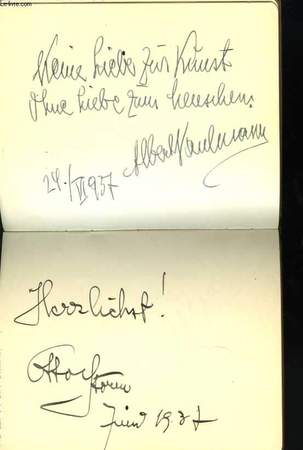
Non Renseigné. 1937. In-12. Relié. Bon état, Couv. convenable, Dos satisfaisant, Intérieur frais. Carnet de 84 signatures autographes de célébrités allemandes, dans la période 1937 - Carnet en toile, tranches dorées. . . . Classification Dewey : 929.88-Autographes
書籍販売業者の参照番号
: ROD0002207
|
|
|
Anonyme
Carnet de Chansons et de Monologues [ Manuscrit commencé le 8 Février 1919 ] Lune Jolie - Martha - Pupée Jolie - L'Embuscade - La Terre Nationale - Le Carreau de Papier - V'la les Croquants - J'ai bon Caractère - Elle m'aime pas - Le Poilu Infirmier - Le Poilu repopulateur - La Sabotière - La Madelon - Dans la Musette - La Tyrolienne des Pyrénées - La Vache et le Pompier - Le Sermon interrompu - Deux claques pour mille francs - Pour retrouver vingt francs - J'suis pas pressé - La Barbe volée - Les agents n'en faut plus - Les auvergnats réformateurs - Un marché dans une baleine - Un moyen de payer ses dettes - Les deux cuisses de faisan - La femme & le Chameau - Le garçon d'honneur - La mort de Bismarck - Ne rendez pas les hommes fous - J'suis malade - Avec mes cinquante deux francs - La Madelon de la Victoire - La Marseillaise - Face à face - La Somnambule - La Riviera - Le Vieux Ménage - Un Ami commerçant - J'ai un' auto - Elle bavardait chez la concierge - Coeur de Marsouin - L'article 214 - La p'tite dame des PTT - Le Carillonneur - Le Jouet
1 carnet à petit carreau, format in-16, recueillant d'une écriture très lisible 46 chants et chansons de l'époque, 162 pp. : liste des titres : Lune Jolie - Martha - Pupée Jolie - L'Embuscade - La Terre Nationale - Le Carreau de Papier - V'la les Croquants - J'ai bon Caractère - Elle m'aime pas - Le Poilu Infirmier - Le Poilu repopulateur - La Sabotière - La Madelon - Dans la Musette - La Tyrolienne des Pyrénées - La Vache et le Pompier - Le Sermon interrompu - Deux claques pour mille francs - Pour retrouver vingt francs - J'suis pas pressé - La Barbe volée - Les agents n'en faut plus - Les auvergnats réformateurs - Un marché dans une baleine - Un moyen de payer ses dettes - Les deux cuisses de faisan - La femme & le Chameau - Le garçon d'honneur - La mort de Bismarck - Ne rendez pas les hommes fous - J'suis malade - Avec mes cinquante deux francs - La Madelon de la Victoire - La Marseillaise - Face à face - La Somnambule - La Riviera - Le Vieux Ménage - Un Ami commerçant - J'ai un' auto - Elle bavardait chez la concierge - Coeur de Marsouin - L'article 214 - La p'tite dame des PTT - Le Carillonneur - Le Jouet Très intéressant manuscrit, rédigé en 1919-1920, et recueillant 46 chants, chansons et monologues, et précisant le plus souvent le nom des auteurs, créateurs et compositeurs. Certaines chansons ont été barrée d'un trait au crayon, ce qui ne gêne guère la lecture. Etat très satisfaisant (un feuillet inséré, couv frottée) pour ce rare document. Français

|
|
|
Anonyme
Carnet de Chansons et de Monologues [ Manuscrit commencé le 8 Février 1919 ] Lune Jolie - Martha - Pupée Jolie - L'Embuscade - La Terre Nationale - Le Carreau de Papier - V'la les Croquants - J'ai bon Caractère - Elle m'aime pas - Le Poilu Infirmier - Le Poilu repopulateur - La Sabotière - La Madelon - Dans la Musette - La Tyrolienne des Pyrénées - La Vache et le Pompier - Le Sermon interrompu - Deux claques pour mille francs - Pour retrouver vingt francs - J'suis pas pressé - La Barbe volée - Les agents n'en faut plus - Les auvergnats réformateurs - Un marché dans une baleine - Un moyen de payer ses dettes - Les deux cuisses de faisan - La femme & le Chameau - Le garçon d'honneur - La mort de Bismarck - Ne rendez pas les hommes fous - J'suis malade - Avec mes cinquante deux francs - La Madelon de la Victoire - La Marseillaise - Face à face - La Somnambule - La Riviera - Le Vieux Ménage - Un Ami commerçant - J'ai un' auto - Elle bavardait chez la concierge - Coeur de Marsouin - L'article 214 - La p'tite dame des PTT - Le Carillonneur - Le Jouet
1 carnet à petit carreau, format in-16, recueillant d'une écriture très lisible 46 chants et chansons de l'époque, 162 pp. : liste des titres : Lune Jolie - Martha - Pupée Jolie - L'Embuscade - La Terre Nationale - Le Carreau de Papier - V'la les Croquants - J'ai bon Caractère - Elle m'aime pas - Le Poilu Infirmier - Le Poilu repopulateur - La Sabotière - La Madelon - Dans la Musette - La Tyrolienne des Pyrénées - La Vache et le Pompier - Le Sermon interrompu - Deux claques pour mille francs - Pour retrouver vingt francs - J'suis pas pressé - La Barbe volée - Les agents n'en faut plus - Les auvergnats réformateurs - Un marché dans une baleine - Un moyen de payer ses dettes - Les deux cuisses de faisan - La femme & le Chameau - Le garçon d'honneur - La mort de Bismarck - Ne rendez pas les hommes fous - J'suis malade - Avec mes cinquante deux francs - La Madelon de la Victoire - La Marseillaise - Face à face - La Somnambule - La Riviera - Le Vieux Ménage - Un Ami commerçant - J'ai un' auto - Elle bavardait chez la concierge - Coeur de Marsouin - L'article 214 - La p'tite dame des PTT - Le Carillonneur - Le Jouet
書籍販売業者の参照番号
: 31236

|
|
|
Anonyme
Catalogue D'une Belle Collection De Lettres Autographes De Personnages Illustres Depuis Le XVe Siècle Jusqu'a Nos Jours Composant Le Cabinet De M. Le Dr Fr. Egide Succi De Bologne
Paris Charavay 1863 In8 Vente du Mardi 7 avril 1863 et les 7 jours suivants - broché - non coupé - 138 pages - bon etat
書籍販売業者の参照番号
: 60Ab
|
|
|

 検索結果のメールを受信する
 PDFファイルの検索結果をダウンロード
 RSSフィード
 パーマネントリンク


