|
|
|
Mraczek, Joseph Gustav, Komponist und Dirigent (1878-1944)
Eigenh. Brief mit U.
o.J. Brünn / Brno, 26. XII. 1917, Gr.-8° (23 x 14,5 cm). 3 Seiten. Doppelblatt. Mit Absenderstempel. Gelocht.
Référence libraire : 55055
|
|
|
Mrasek, Karl Norbert, Schriftsteller (1895-1985).
Sammlung von 2 eigenh. Briefen sowie 7 eigenh. Postkarten mit U. und 3 Ausgaben Mraseks "Barocke Sonette" mit eigenh. Widmung und U. Darmstadt, Eberschwang, Flieden und Wels, 1945-1956.
Postkarten: 10 SS. Qu.-8vo. Briefe: 4 SS. 8vo. Mit 5 eigenh. beschr. Kuverts. Barocke Sonette: 3 SS. Qu.-8vo. Portrait mit Widmung an Rückseite. Neben Dankesworten Mraseks ob Weselys Geburtstagswünschen finden sich durchwegs sehr vertraute und amikale Zeilen. Mrasek wurde als Sudetendeutscher vertrieben und musste seine Habe zurücklassen. Besonders bedauert er den Verlust seiner Bücher und bittet Josef Wesely um Übersendung einiger Bücher. - Der limitierte Siebdruck stammt von K. H. Wagner mit der Numerierung "300/100". Ebenso selten sind die Privatdrucke "Barocke Sonette" mit 5 Sonetten von Mrasek.
|
|
|
Mrasek, Karl Norbert, Schriftsteller (geb. 1892).
2 (davon 1 eigenh. und 1 ms.) (Bild-)Postkarten mit eh. U. Flieden und Darmstadt, 1948 und 1963.
Zusammen 2 SS. Qu.-8vo. Dankt Josef Wesely für ihm übersandte Wünsche zum Geburtstag und zu Neujahr: “Inzwischen ist hier ein Privatdruck meiner neuen ‘Barocken Sonette’ erschienen, doch kann ich Ihnen diesen leider nicht übersenden, da die Versendung von Druckschriften nach Österreich leider noch immer nicht erlaubt ist [...]” (Karte v. 21. V. 1948). - Der aus Brünn stammende Schriftsteller, nach dem Zweiten Weltkrieg als Direktionsrat in Flieden bei Fulda ansässig, schrieb Romane, Novellen und Erzählungen. Vgl. Kosch X, 1385f.

|
|
|
Mrasek, Karl Norbert, Schriftsteller (geb. 1892).
Eigenh. Portraitpostkarte mit U. Darmstadt, 16. V. 1970.
1 S. Qu.-8vo. Mit eh. Adresse. An Josef Wesely: "Vielen herzlichen Dank für die lieben Geburtstagswünsche! […]". - Der aus Brünn stammende Schriftsteller, der nach dem 2. Weltkrieg u.a. als Direktionsrat in Flieden bei Fulda ansässig war, schrieb Romane, Novellen und Erzählungen. - Mit Adreßstempel.
|
|
|
MROSEK, Gust (?-?)
Photograph Signed
American maker of miniatures. PS 5¼" X 3½" n.p. 1933 September 12. Near fine. Handsome black and white picture postcard captioned "Ulm Cathedral / Miniature Model / Hall of Religion - A Century of Progress - Chicago." Card was neither stamped nor canceled; address portion is blank. A description at the top of the message portion tells Mrosek's tale. After giving some details on the famous cathedral in Wuertenberg Germany it gives the vital stats of Mrosek's creation: It "is hand carved from maple and holly wood. It contains 4300 pieces fitted together. It is 9 feet high 8 feet long 40 inches wide equipped with lights art glass windows and chimes. Seven years of painstaking labor were devoted." Below this Mrosek signs and dates it. A superb example of the miniature maker's art and an unusual Century of Progress artifact. unknown
Référence libraire : 21788

|
|
|
Mucchi, Gabriele und Sabina Grzimek
Kunstpostkarte mit Bildnis Sabine Grzimek mit eigenhändigen Unterschriften. 1.7.1990.
1990. DIN A 6. (guter Zustand).
Référence libraire : 307945AB

|
|
|
Mucha, Alfons, Maler, Graphiker und Plakatkünstler (1860-1939).
Eigenh. Brief mit U. Piestany, 5. VIII. 1930.
3 SS. auf Doppelblatt. Kl.-4to. Schöner Brief in tschechischer Sprache an den befreundeten Maler und Bildhauer Jakub Obrovsky mit Dank für die Teilnahme an der Feier zu seinem 70. Geburtstag: "Mein teurer Freund! Wie soll ich Dir nur für Dein liebes Schreiben danken? Ich danke Dir allem voran für Deine liebe Anteilnahme an meinem 70er. Ich habe ihn gar nicht bemerkt, als er sich mir auf den Rücken gesetzt hat, und so merke ich ihn auch bisher nicht. Aber wofür ich Dir besonders danke, sind Deine gesunden Worte, die eben das widerspiegelten, was ich mir selbst gedacht habe: dass nämlich nun wieder ein Kapitel abgeschlossen ist. Das erste waren die Plakate. Das zweite: das dekorative Suchen und der Abbruch der alten Formen; das dritte die Konzentration im eigenen Ich und das Anerkennen der Notwendigkeit von Hilfe nach meinen bescheidenen [Versuchen?], und nichts ist ein besserer Lebensratgeber als die herausgerutschten Worte des Hasses der Feinde. Ich bin diesen zu vielem Dank verpflichtet!, und in der angenehm wärmenden Badeanstalt suche ich schon die kalte Dusche, um mir daraus einen richtigen Maßstab [bzw. Thermometer] zu machen. Wie du selbst sagst, erwarte ich mir niemals etwas von irgendwem, niemals will oder fordere ich etwas von anderen, um niemals Entäuschungen fürchten zu müssen, welcher Art auch immer. Mein Grundsatz ist: Erkenne deine Aufgabe, versuche sie ehrlich nach besten Kräften zu erfüllen, und kümmere dich nicht um den Rest. Darüber ließe sich noch lang schreiben. Aber lassen wir das; ich weiß, dass Du das so gut verstehst wie ich! So grüße ich Dich einstweilen von Herzen, küsse die Hand der gnädigen Frau und bin Dir wie stets freundschaftlichst ergebenster Kamerad […]" (Übs.). - Verfasst im Kurhaus Thermia Palace im slowakischen Piešt'any (auch Pistyan oder Pistian), wo Mucha öfters zur Kur war. Für das Kurhaus fertigte er aus Dankbarkeit ein Ölgemälde für den Speisesaal an, das oberhalb der Eingangstür angebracht und am 15. Mai 1932 enthüllt wurde. Das Gemälde mit dem Namen "Bleib gesund, gesegnete Quelle der Gesundheit" hat eine unkonventionelle fünfeckige Form.
|
|
|
MUCHART (Henry).
Le Miel sauvage. Poèmes.
Paris Perrin, Editions de la "Revue des Poètes" 1926 1 vol. broché in-8, broché, 172 pp. Edition originale de ce recueil de poèmes apicoles. Envoi de l'auteur. Bon état.
Référence libraire : 53432
|
|
|
MUCHART (Henry).
Le Miel sauvage. Poèmes.
Paris Perrin, Editions de la "Revue des Poètes" 1926 1 vol. broché in-8, broché, 172 pp. Edition originale de ce recueil de poèmes apicoles. Envoi de l'auteur. Bon état.
Référence libraire : 53432
|
|
|
Muche, Georg
Eigenhändig geschriebener Brief mit eigenhändiger Unterschrift. 19.5.80.
1980. DINA 5. (guter Zustand).
Référence libraire : 307946AB

|
|
|
Muck, Karl, Dirigent (1859-1940)
Eigenh. musikalisches Albumblatt mit U. sowie Porträtpostkarte (Emil Schwalb, Berlin) mit eigenh. Datierung und U. auf der Bildseite.
o.J. München, 12. VIII. 1920, 15 x 11 cm bzw. 13,5 x 85 cm.
Référence libraire : 58449
|
|
|
Muel, Léon
Précis historique des assemblées parlementaires et des hautes cours de justice en France, de 1789 à 1895, d'après les documents officiels,
Paris : Guillaumin, 1896,In-8,broché, VII-231 p.envoi autographe auteur,bon etat
Référence libraire : 9303
|
|
|
MUEL-DREYFUS (Francine).
Vichy et l'Eternel Féminin. Contribution à une sociologie politique de l'ordre des corps.
Paris Seuil, coll. "XXe siècle" 1996 1 vol. broché in-8, broché, 384 pp., quelques photos en noir, index. Edition originale avec un envoi autographe signé de l'auteur. Très bon état.
Référence libraire : 114429
|
|
|
MUEL-DREYFUS (Francine).
Vichy et l'Eternel Féminin. Contribution à une sociologie politique de l'ordre des corps.
Paris Seuil, coll. "XXe siècle" 1996 1 vol. broché in-8, broché, 384 pp., quelques photos en noir, index. Edition originale avec un envoi autographe signé de l'auteur. Très bon état.
Référence libraire : 114429
|
|
|
Mueller-Otfried, Paula, Sozialpolitikerin (1865-1946).
Eigenhändige Sentenz mit U., eh. ausgefülltem Formularteil und eh. Namenszug. Hannover, o. D.
1 S. Folio (223:282 mm). Albumblatt mit gedruckter Bordüre, gedr. Fußzeile "Beitrag zum Selbstschriftenalbum 'Deutschlands Zukunft'" und gedr. Formular für biograph. Daten, aufgezogen auf einen Bogen Pergamentpapier (ca. 330:344 mm). "Weil ich eine innere u. äussere Erstarkung Deutschlands ersehne, arbeite ich mit aller Kraft für die religiös-sittliche Erneuerung meines Volkes [...]". Geschrieben als Beitrag für die von Friedrich Koslowsky im Berliner Eigenbrödler-Verlag herausgegebene Faksimile-Anthologie "Deutschlands Köpfe der Gegenwart über Deutschlands Zukunft" (1928). Koslowsky 240.
|
|
|
Muhammad Saïd al-Ashmawy.
L'islamisme contre l'Islam.
Editions La Découverte, coll. "Textes à l'appui" 1971 1 vol. broché Attention : quelques passages soulignés au crayon. Exemplaire du philosophe Bernard Sichère, avec son tampon d'ex-libris. In-8, broché, 106 pp. Envoi de l'auteur.
Référence libraire : 86617
|
|
|
Muhammad Saïd al-Ashmawy.
L'islamisme contre l'Islam.
Editions La Découverte, coll. "Textes à l'appui" 1971 1 vol. broché Attention : quelques passages soulignés au crayon. Exemplaire du philosophe Bernard Sichère, avec son tampon d'ex-libris. In-8, broché, 106 pp. Envoi de l'auteur.
Référence libraire : 86617
|
|
|
Muhammad Scharif Pascha, ägyptischer Politiker und Premierminister (1826-1887)
Eigenh. Brief mit U. "Chérif".
o.J. , Ohne Ort und Jahr, Gr.-8°. 1 Seite. Doppelblatt.
Référence libraire : 54763
|
|
|
MUHTAR HALID, (Late period Ottoman / Turkish typographer, the elder brother of the famous typographer of Ahmed Ihsan Tokgöz, and the owner of 'Muhtar Halid Kitabhanesi', (19th-20th century).
[TURKISH LETTER REVOLUTION - NEW ALPHABET PRINTING IN THE EARLY REPUBLICAN TURKEY] Autograph letter / document signed 'Muhtar Halid' to the presidency of the Republican Party of Turkey.
Very Good Turkish, Ottoman (1500-1928) Original manuscript autograph letter/document signed by Muhtar Halid sent to the presidency of the Republican Party of Turkey in Ankara. 20,5x13,5 cm. In Ottoman script. Dated September, 23, [1]928. Six lines. Two punching holes out of text on the paper. The document says that 26.000 alphabets, 57.000 brochures and pamphlets, and 100.000 (?) are printed and will be sent to the 'Cumhuriyet Halk Firkasi' [i.e. Republican Party] (CHF - CHP) in Ankara city. This rare autograph documents how widespread and comprehensive work was done to switch from Arabic letters to Latin letters during the Letter Revolution in 1928. "Muhtar Halid Kitabhanesi [i.e. Printing House of Muhtar Halid] was located on Bâb-i Alî [i.e. The Sublime Port] main street, number 17; a place where is located old Izmir Terzihanesi [i.e. Old Smyrna Taylor Shop]. Muhtar Halid was the Late period Ottoman / Turkish typographer, the elder brother of the famous Turkish typographer and translator of Ahmed Ihsan Tokgöz, (1868-1942), and the owner of 'Muhtar Halid Kitabhanesi'. He worked together with his brother's printing and publishing house, especially when he was publishing 'Servet-i Fün'un' periodicals. Servet-i Fünûn [i.e. The Wealth of Knowledge] was a long-running and an avant-garde literary and sometimes political periodical, and, journal or magazine. It's published to support the Ittihat ve Terakki Cemiyeti [i.e. The Union and Progress Society, later, Party] initially by Ahmed Ihsan Tokgöz. (Source: Tanzimat'tan Cumhuriyet'e Tarihi Kentsel Çevrede Mekânlar Üzerinden Bir Semt Okumasi: Cagaloglu Semti Örnegi, by Melek Yalvaç (Ph.D. Thesis)).
|
|
|
MUHTEREM NUR, (Turkish film actress and pop music singer), (1932-2020).
Original photograph signed and inscribed 'M. Nur'.
Very Good Turkish Original b/w portrait photograph signed and inscribed by Muhterem Nur as 'Sükür Hanim'a iyi dileklerimle'. 14x9 cm. In Turkish. Muhterem Nur [Aysel Muhterem Kisa] was a Turkish film actress and pop music singer. She was born as Aysel Kisa on December 31, 1932, in Bitola (Turkish: Manastir), Vardar Banovina, Kingdom of Yugoslavia. She lost her 16-year-old mother at her birth and never knew her father. She was raised by her maternal aunt, whom she called "mother". She was renamed "Olga" as a result of the Yugoslavian regime's assimilation campaign. All ethnic Turks and other Muslims in Yugoslavia were forced to adopt Christian names and renounce all Muslim customs. She debuted in cinema as a background actress in the 1951 movie, Yildizlar Revüsü ("Revue of Stars"). She continued to play in movies as an extra, earning five times more than she received in the factory. She played as a supporting actress in more than twenty movies before she got a lead role in the 1958 movie, Üç Arkadas, in which she portrayed a blind girl. In the film directed by Memduh Ün, which became very successful, she shared the lead role with Fikret Hakan (born 1934). Thanks to her baby-like face and naive acting artistry, she was rooted suddenly in the hearts of cinema fans and climbed up the ladders very quickly. Despite rising up to main actress roles in a very short time and playing in many movies, Muhterem Nur had difficulties continuing in cinema due to change of the era in movie themes during the period between 1965 and 1967. From 1965 on, she vocationally performed dancing and, from 1967, took the stage as a singer in low-priced music halls. In 1967, she was jailed for ten days because of unpaid bills. She confessed that once, in 1972, she was so destitute, she was unable to even buy a simit, Turkish bagel. Muhterem Nur returned to the cinema and starred sparsely in movies until 2002. Muhterem Nur is considered by the Turkish audience the first real star of Turkish cinema. She portrayed the ignored and discriminated-against woman, digressing from the role of the bourgeoisie woman. She was known as the Yesilçam's most weepy actress, who at the same time drew tears and made spectators tear handkerchiefs. Even though it is not documented, she is one of the most important female figures of Turkish cinema due to the box office record of her films shot in the 1950s and 1960s. (Wikipedia).
|
|
|
Muliar, Fritz, Schauspieler, Kabarettist und Regisseur (1919-2009).
Portraitphotographie mit eigenh. Widmung und U. O. O. u. D.
120:170 mm.
|
|
|
Muliar, Fritz, Schauspieler, Regisseur und Schriftsteller (1919-2009).
6 eigenh. Bildpostkarten mit Paraphe und 1 Originalphotographie mit eh. Widmung und Paraphe. Verschiedene Orte, 1980er Jahre.
Zusammen 6 SS. auf 6 Bll. (Qu.-)8vo. Tls. mit eh. Adresse. Mit zwei Beilagen (s. u.). Reisegrüße an den Theaterdirektor Franz Paul. - Die S/W-Aufnahme zeigt den Schauspieler im Rollenkostüm des Knieriem in Nestroys "Der böse Geist Lumpazivagabundus" in einer Aufführung des Wiener Burgtheaters a. d. J. 1986. - Das "Kleine Haus" in der Liliengasse, dem Franz Paul als Direktor vorstand, war von 1946 bis 1950 vom Theater in der Josefstadt als Studiobühne genutzt worden. - Beiliegend eine Originalaufnahme von Curd Jürgens als Jedermann und Fritz Muliar als Dicker Vetter in Hofmannsthals "Jedermann" in einer Inszenierung von Ernst Haeusserman im Rahmen der Salzburger Festspiele (1973-77) sowie ein ms. Briefdurchschlag von Franz Paul an Fritz Muliar.
|
|
|
Muliar, Fritz, Schauspieler, Regisseur und Schriftsteller (1919-2009).
Portraitpostkarte mit eigenh. U. O. O. u. D.
1 S. 8vo. Für Victor Juza. - Hübsche Aufnahme des Schauspielers im Halbprofil mit Hund.
|
|
|
Mullach, Friedrich Wilhelm August, klassischer Philologe (1807-1882).
Eigenh. Brief mit U. Berlin, 31. III. 1882.
1½ SS. 8vo. An den Pariser Verlag Didot über den vierten Band seiner "Fragmenta philosophorum Graecorum" (1860-81), für den er die Transkription eines Traktats des Alexander von Aphrodisias mit der Ankündigung übersendet, in Bälde weitere Manuskripte für Druckfahnen zu liefern, und über seinen Umzug im vergangenen September: "C'est conformément à notre convention au sujet du quatrième volume des Fragments des Philosophes Grecs, que je prends la liberté de vous envoyer maintenant le commencement de la copie, contenant le traité d'Alexandre d'Aphrodise [...] livre important pour la philosophie ancienne (page 1-96). Je vous adresserai à l'avenir régulièrement la continuation des manuscrits qui se rapportent au quatrième volume. Si vous le jugez à propos vous pouvez bientôt en faire composer quelques placards. Notre demeure ayant été trop éloignée de l'université, nous avions depuis long-temps résolu de changer de logis. Ce déménagement a eu lieu au mois de Septembre de l'année passée [...]". - Die Fragmentsammlung erschien zwischen 1860 und 1881 in drei Bänden. Mullach verstarb, bevor er den hier angesprochenen vierten Band fertigstellen konnte.
|
|
|
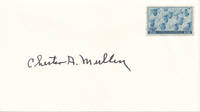
MULLEN, Chester A (?-?)
Signed Postal Cover
This American sailor who served during World War Two lays claim to fame as being one of very few living persons ever pictured on a U.S. stamp -- his smiling visage appears among a group of swabbies pictured on the U.S. three-cent stamp issued in 1945 titled "U.S. Navy" Signed Postal Cover 6½" X 3½" n.p. n.y. Fine. NOT a First Day Cover but simply an envelope bearing a mint copy of this stamp neither addressed nor mailed. Across the center large and bold Mullen signs in black medium-point marker. Original transmittal envelope cancelled in Des Moines Iowa on 13 February 1976 also present -- as is a small article from a philatelic newspaper undated but circa 1976 picturing this stamp and a "To the Editor" letter from three of Mullen's grandchildren pointing out that the Iwo Jima flagraisers were not the only living persons pictured on a U.S. stamp. Mullen appears at the upper right corner of the group of sailors captured on this stamp his cap cocked jauntily. Highly unusual -- a fun little piece of philatelic history. unknown
Référence libraire : 22981
|
|
|
MULLER Henry - (1902-1980) - Ecrivain français
Lettre Autographe Signée à Paul Guth - le 8 juin 1976 -
2 pages in4 + enveloppe - petit manque de papier en marge haute sans atteinte au texte -
Référence libraire : GF16174
|
|
|
Muller, Eugène, French author (1826-1913).
Autograph note signed. N. p. o. d.
8vo. 4 lines. Quatrain offering his daughter a thousand francs that he won as a literary prize: "Mille francs un beau numeraire / Ma grande fille, les veux-tu? / Prends les et d'un prix littéraire / Tu feras un prix de vertu [...]". - With collector's note. Minimal foxing.
|
|
|
MULLIKEN, Robert S (1896-1986)
Signature
American physicist and chemist whose research on molecular orbital theory -- what holds molecules together -- earned him the 1966 Nobel Prize in chemistry. Bold signature and date 1967 December 16 on a heavy stock 6" X 4" card n.p. n.y. pencilled date on verso 10 August 1983. Fine. Rather uncommon. unknown
Référence libraire : 41474
|
|
|
Mulliken, Robert S., Physiker, Physikochemiker und Nobelpreisträger (1896-1986)
Karte mit eigenh. U.
o.J. (Chicago, 8. II. 1978, Poststempel), 15 x 8 cm. 1 Seite. In eigenh. adressiertem Umschlag.
Référence libraire : 50633
|
|
|
Multio, Hercole Isidoro, (D. n. b.).
Eigenh. Brief mit U. Mailand, 14. IX. 1653.
1 S. auf Doppelblatt. Gr.-4to. In italienischer Sprache an Conrado di Novara (?).

|
|
|
Multiple Autographs - BOINAC, CARAYON, DOMPMARTIN, BARON DE BERNOU, BAUREPAIN,ST GENEST, MORISSET,VERNOIS)
1856 LARGE ARCHIVE OF FIFTEEN 15 HANDWRITTEN MANUSCRIPT LETTERS ADDRESSED TO THE MARQUIS DE BEAUMONT
France 1856. Large archive of handwritten letters dates ranging from 1848 to 1869 but most in the mid-50s addressed to important French nobleman the Marquis de Beaumont. Most are of a personal nature intimate nature: Leopold de Carayon writes with humour: "If you are lying I will catch you my old friend.and this Pauline who supposedly is holding you back from coming I will make her pay!.Come see me soon." Beaumont's godson writes other nobility and there is one letter of condolence regarding the Marquis' mother's death. A certain concierge in Paris also writes of some intrigue. Very very interesting archive showing an intimate glimpse of French nobility. Autograph. Manuscript. Very Good. 4to - over 9¾" - 12" tall. Paperback
Référence libraire : 00JT68
|
|
|
Multiple Autographs Including LALOUETTE
ARCHIVE LOT OF FOUR 4 HANDWRITTEN MANUSCRIPT SIGNED LETTERS ADDRESSED TO PROFESSOR FRANCOIS CHOPART ROYAL MEMBER OF THE ROYAL ACADEMY OF SURGEONS IN PARIS
Paris 1789. Four very warm letters from patients obviously post-operative all declaring the utmost respect and thanks to Professor Chopart. One letter is clearly signed Lalouette and the first of March 1789. Biographical Notes: SIR THOMAS PHILLIPPS 1792-1872. Born in 1792 Sir Thomas Phillipps from childhood was obsessed with the idea of obtaining virtually anything written or printed on paper including cartloads of documents from wastepaper merchants and the entire inventories of booksellers. "I wish to have one copy of every book in the world" he declared to a friend. He very nearly succeeded. His collection ultimately grew to more than 100000 books and at least 60000 manuscripts. As a result of his extravagant purchases Sir Thomas was permanently on the verge of bankruptcy and was constantly pursued by creditors. So many books arrived at his house that it was impossible to unpack his acquisitions much less keep pace with them. Visiting scholars driven to distraction would spend days hunting for an elusive text in the dusty heaps that filled every room. Because Sir Thomas has a morbid dread of fire most of his collection was housed in coffinlike boxes that could be carted away quickly. Visitors to Middle Hill were struck too by the presence of numerous logs a ploy he used to lure beetles away from his books. As Sir Thomas relentlessly pursued his passion the house itself began to crumble and its floors started to sag under the cast weight of hundreds of tons of paper. His neglect of Middle Hill was partly deliberate however. Sir Thomas's chief enemy in life James Halliwell had married his daughter against his wishes. It appears that Halliwell was in Sir Thomas' eyes the worst kind of criminal a book thief who had stolen valuable works from university libraries and even from his father-in-law. Having no sons Sir Thomas was unable to prevent Halliwell from inheriting his estate. To ensure that his detested heir would never receive anything of value Sir Thomas's solution was to allow Middle Hill to fall unto complete disrepair. He even went so far as to chop down and sell for lumber the centuries-old oak trees that lined the majestic mile-long drive to his home. In 1863 Sir Thomas decided to move - in order to accommodate his books. With the aid of 160 men 103 wagonloads of books and papers drawn by 230 horses the books were lumbered from Middle Hill top their new estate in nearby Cheltenham. It is said that for years afterwards the countryside was littered with the remains of carts that had collapsed under the sheer weight of the Phillipps collection. Sir Thomas continues to add to his library until his death in 1872. After Sir Thomas's death his immediate family had no room for his collection. So vast was the library that although individual items and large sections were sold privately or through numerous auction sales the Phillipps collection is still being sold more than a century after the death of its owner. In the course of its sales many treasures have come to light. As late as 1964 part of the long-lost and unique medieval manuscript of the Roman poet Ovid's Metamorphoses appeared and was subsequently reunited with its other half at Magdalen College Oxford. Once destined for destruction as worthless wastepaper this and many other priceless works were saved by the single-minded obsession of the greatest bibliomaniac of all time. Autograph. Manuscript. Very Fine. 8vo - over 7¾" - 9¾" tall. Paperback
Référence libraire : 0TP107
|
|
|
MULTIPLE AUTOGRAPHS OF THE FRENCH STAGE AND MUSIC HALLS
ARCHIVE LOT OF EIGHTEEN 18 TLS TYPED LETTERS SIGNED BY A VARIETY OF PARISIAN ARTISTS TO SAVE THE OLYMPIA MUSIC HALL
Paris: None 1970. Rare archive lot of 18 typed letters signed dated Paris 17th of March 1970 all identical save for the signatures and in most cases handwritten names that grace these petitions to save the Olympia Music Hall in Paris. Artists names include; Sabrina Guegan Pierre Bacmialoni Michele Sennet Nicole Villano Maurice C'eutat Trebier Jean Pierre Delhomme Berr Marcel Hrasko Icardi Sylvie Vartan Raymond Gimenes Joullie Brigitte Armand Cavallaro Amador Heliose Charles Verstraete and Emile Vilain. Autograph. Manuscript. Very Good. 8vo - over 7¾" - 9¾" tall. None Paperback
Référence libraire : 00JT65
|
|
|
Multiple Contributors
John Barsby High School Yearbook 1977-78
156 pages. Light wear. Many autographs. Binding tight and square. Blue cloth-covered boards. Nice copy. Book
|
|
|
Multiple Contributors
The Chinook 1939-1940: Yearbook of the Calgary Normal School *SIGNED BY PRINCIPAL DR. E.W. COFFIN*
96 pages. Principal's handwritten signature beneath his full-page photo. Also autographed by the following teachers: Arthur Hutton, George Sheane, A.L. Doucette, C.I. Giles, W.D. McDougall. Numerous female students have signed beside their pictures. Sadly, beside the photo of a young man, R. Burton, is written "Killed in action - 1940." Prior owner's name (Ruth Godwin) atop front free endpaper. Somewhat above-average wear. Binding intact. Sound copy of this very nostalgic work. Book

|
|
|
Mumm, Reinhard, Theologe und Politiker (1873-1932).
Eigenhändige Sentenz mit U., eh. ausgefülltem Formularteil und eh. Namenszug. Charlottenburg, o. D.
1 S. Folio (223:282 mm). Albumblatt mit gedruckter Bordüre, gedr. Fußzeile "Beitrag zum Selbstschriftenalbum 'Deutschlands Zukunft'" und gedr. Formular für biograph. Daten, aufgezogen auf einen Bogen Pergamentpapier (ca. 330:344 mm). "Die Einigung unseres Volkes aus der gegenwärtigen Zerrissenheit heraus kann auf der politischen Linie nur Fortschritte machen, wenn die tragenden Kräfte, die in den Standesbewegungen liegen, über das Gegeneinander und den Klassenkampf das Miteinander und das Füreinander stellen, und wenn wir wieder eine einheitliche kulturelle Grundlage als tragende Kraft des Volksgeistes gewinnen. Für alles dies liegt die Kraft im christlich-sozialen Geist [...]". - Geschrieben als Beitrag für die von Friedrich Koslowsky im Berliner Eigenbrödler-Verlag herausgegebene Faksimile-Anthologie "Deutschlands Köpfe der Gegenwart über Deutschlands Zukunft" (1928). Die Sentenz bei Veröffentlichung in Druckschrift wiedergegeben. - Reinhard Mumm wurde 1927 Vorsitzender der "Evangelischen Hauptstelle gegen Schmutz und Schund". - Mit feinen Einschnitten im Formularteil. Koslowsky 196.
|
|
|
Mun, Adrien Albert Marie comte de, French politician (1841-1914).
2 autograph letters signed and 1 calling card with autograph note. Paris and n. p., 2 Dec. 1898, 13 Jan. 1912 and n. d.
12mo. Altogether 4 pp. and 1 line. In the letter dated 2 December 1898 Mun congratulates a friend on a lecture given at the Académie Française and expresses his gratitude to be associated with his cause: "La nomination chez la [...] Commission d'Entrepreneurs m'a empêché, hier, d'aller à l'Académie où j'aurais voulu vous dire combien la note que vous avez mise à la première page de votre belle Confèrence m'avait touché. Je vous prie de trouver ici l'expression de ma gratitude: c'est un grand bonheur pour moi d'être ainsi associé à la grand cause que vous poursuivez avec tant d'éclat [...]". - The second letter was written ahead of a reception of the symbolist poet Henri de Régnier (1864-1936) at the Académie Française by Mun on 18 January 1912. Mun thanks the recipient for an article and his support in a campaign and announces that on the day of the reception he will for the first time wear on his chest a medal in commemoration of the Franco-Prussian war: "Votre témoignage, comme votre article, me sont de précieux encouragements dans la campagne d'opinion que je voudrais ardemment mener avec tous les bons Français. Jeudi, en recevant à l'Académie M. de Regnier, j'aurai, sur la poitrine, pour la première fois, la Medaille 'Couleur de deuil et d'espérance!' Puisse t-elle devenir un signe de ralliement [...]" (13 Jan. 1912). Adrien Albert de Mun's reception speach is notorious for his vehement criticism of Régnier's work. - The undated calling card was presented with a note of thanks: "avec tous mes remerciments". - Both letters on cards with lithographed letterheads. The earlier letter and the visiting card with mourning border. All items with traces of former mounting.
|
|
|
Mun, Adrien Albert Marie de, Politiker (1841-1914).
Eigenh. Brief mit U. ("A. de Mun"). Paris, 12. VI. 1877.
2/3 S. auf Doppelblatt. Gr.-8vo. An einen namentlich nicht genannten Adressaten, den er zu einer politischen Aussprache mit Monsieur La Tour du Pin einlädt. - Albert Comte de Mun war ein bedeutender Vertreter des politischen Katholizismus und einer der Führer der paternalistischen christlich-sozialen Bewegung in Frankreich. "Die Erfahrungen der Pariser Kommune, an der er selbst aktiv teilnimmt, machen Mun die große Kluft zwischen der französischen Arbeiterschicht und der katholischen Bourgeoisie bewußt. Von der Notwendigkeit eines Zusammenschlusses von Unternehmern und Arbeitern überzeugt, gründet er im Jahre 1871 zusammen mit La Tour du Pin die ‚Cercles catholiques d'ouvriers'. Auch die Gründungen der ‚Action libérale populaire' und der ‚Jeunesse catholique' gehen auf Mun zurück" (BBKL XVIII, 951). Als Abgeordneter in der Bretagne versuchte Mun vergeblich eine katholische Partei ins Leben zu rufen, "kämpft gegen die antiklerikale Politik der dritten Republik und setzt sich weiter für die Rechte der Arbeiter ein. 1891 beteiligt er sich an der Ausarbeitung der Encyklika Léons XIII. ‚Rerum novarum'. Im Jahre 1897 wird er zum Mitglied der Académie française gewählt" (ebd.). - Auf Briefpapier mit gedr. Briefkopf "Oeuvre des Cercles Catholiques d'Ouvriers" und Monogramm am linken unteren Blattrand der Recto-Seite von Bl. 1.

|
|
|
MUN, Gabriel de (1883-1952), comte puis marquis, archiviste-paléographe, bibliophile, secrétaire interallié de la Commission des réparations. président de la Croix-Rouge française.
Lettre autographe signée.
29 mai 1923 1 page in-8, 210 x 135
Référence libraire : 941

|
|
|
Munarini, Giacomo, foreign minister of the Duchy of Modena (b. 1763).
Autograph letter signed. Modena, 17. I. 1817.
4to. 1 p. on bifolium. In Italian. Confidential letter to an Italian nobleman, asking him to investigate why a personal letter of Francis IV to an unnamed souvereign, possibly Louis XVIII, has not been answered. Munarini asks the recipient for absolute confidentialty before recounting the matter: "You will remember that I was very concerned last year for fear that a letter might have been mislaid which His Royal Highness wrote to His Majesty, the King in his own hand. After much research, you came to discover that this letter was still in this Ministry of Foreign Affairs. I hoped that it had been given course; but I see with no less surprise than regret how vain my hopes were. I fear there is some mystery hidden in this affair; and we wish for someone who, with all dexterity, and without compromising my good Prince, will try to investigate why His Majesty did not reply to HRH. Was it lacking in some point in etiquette? Could that court perhaps be dissatisfied with ours? The affair, as you see, is delicate; and I desire that you commit nothing to writing, unless it be directed to me. If I have ever wished that the affairs of my sovereign be supported by you, it is in this circumstance, as I am in need of a person of experienced prudence [...] and of sincere and loyal attachment to the excellent Archduke Francesco IV" (transl.). - Marquess Giacomo Munarini served as foreign minister to Francis IV, Duke of Modena from 1814 to 1820. - Well preserved. With minor browning to the margins and two pinholes.
|
|
|
Munarini, Giacomo, foreign minister of the Duchy of Modena (b. 1763).
Autograph letter signed. Modena, 22. IX. 1815.
4to. 1¼ pp. on bifolium. With autograph address and seal. Interesting letter to the Franco-Italian banker Jacques-Gabriel Caccia (d. 1838) in Paris, asking him to send him two French journals covering the August 1815 French legislative election, the first that followed Napoleon's Hundred Days. Munarini recounts that he received, "although with much irregularity", the "Moniteur" and the "Jounal des Debats" before "Napoleon's invasion that entailed such terrible consequences" (transl.). Apparently, no French papers reached Modena in 1815, and Munarini, who was eager to "discover the public opinion, at least so far as it can be discovered through journals", therefore asks Caccia to send him two "public papers" of his choice "without delay". He also requests that the journals do not "imitate the example of the English, some writing in favour of the minister, some against", but rather wishes for "texts by reasonable writers but of different opinion". - Marquess Giacomo Munarini served as foreign minister to Francis IV, Duke of Modena from 1814 to 1820. - Traces of folds. With a minor tear slightly affecting the text and a tear from breaking the seal. Some browning.
|
|
|
Munch, Edvard, Norwegian painter (1863-1944).
2 autograph letters signed. In Norwegian. [Opdal and Gothenburg, 1930s].
8vo. Together 4 pp. To his lawyer Johannes Roede (1875-1958), brother of the pianist and collector Halfdan Nobel Roede, concerning Munch's financial problems and poor reputation. In the letter on stationery from a hotel in Opdal, Munch complains about his financial difficulties despite his owning several apartments. He contemplates renting or selling his properties in order to be able to afford moving. - The letter on Gothenburg hotel stationery is no less pessimistic. Munch explains that his property in Ekely, which he bought in 1916 for 55,000 crowns, had been overpriced, as his childhood friend, the architect Henrik Bull, estimates that it is worth hardly more than 60,000 crowns so many years later. In addition, Munch relays a conversation with Jens Thiis, the director of the National Gallery in Oslo, centered around his poor reputation. Apparently, Munch was perceived as primarily concerned with letting his properties, while supposedly neglecting his paintings, which he is said to keep in bad condition. - On stationery of the "Opdal Turisthotel" and the "Grand Hôtel Haglund" in Gotheburg. Traces of folds and buckles. The letter from Gothenburg with minor tears to the upper margin. Includes an autograph envelope by Johannes Roede's wife Ellen.
|
|
|
Munch, Edvard, Norwegian painter (1863-1944).
Autograph calling card signed ("EM"). N. p. o. d.
Calling card format. 1 p. To his relative, the Norwegian painter Ludvig Orning Ravensberg (1871-1958), who also helped Munch with some of his exhibitions.

|
|
|
Munch, Edvard, Norwegian painter (1863-1944).
Autograph letter signed. Ekely near Oslo, 27 Dec. 1931.
4to. 1 page. In Norwegian, to Kaare Mathisen, the gardener and chauffeur whom Much employed at Ekely. - Marginal tape marks from an old mount, old folds. EMunch Archive PN 838.
|
|
|
Munch, Edvard, Norwegian painter (1863-1944).
Autograph letter signed. Moss (Norway), [ca. 1910].
8vo. 4 pp. on bifolium. In flawed German to the painter Heinrich Eduard Linde-Walther (1868-1939) about the schism in the Berlin Secession and his decision to leave the association, emphasizing that he had come to this conclusion years earlier, citing his wish not to be tied to an institution, his poor health, his distance from Berlin, and his opposition to a jury system as reasons for not participating in the upcoming exhibition, and announcing to enclose a letter to the art dealer Paul Cassirer (1871-1926): "Haben Sie vielen Dank für Ihren freundlichen Brief. Ich lege im Couvert ein Brief ein welchen ich for über etwa 2½ Monaten an Hr. Cassirer alz President geschrieben ist. Daher [?] denn keine Ahnung um Spaltung der Secession. Mein Beschluss aus Secession auszutreten liegt schon vor mehreren Jahren zurück. Es hat nicht mit den Ereignissen der Secession zu thun obwohl ich öfter mit den verschiedenen Bestimmungen welche vorgekommen sind sehr misvergnügt war. Ich bin von der Überzeugung das ich nicht gebunden werden muzs und habe deswegen auch Theilnahme hiesiger Secession verweigert. Meine schwache Gesundheit und die Fernheit der Ereignisse in Berlin macht es ganz unmöglich. Ich bin auch gegen Jury und habe deswegen nie zu Jury Gemälde hingeschickt [...]." - Munch concludes with a comment on delaying his letter to the Secession to avoid the impression that his decision to leave the association was motivated by the schism or that he wished to make a statement: "Ich habe das Brief an Berliner Secession fertig zu abschicken liegend alz ich die Nachricht um Spaltung der Secession bekommen habe. Um nicht gerade nach die Spaltung auszutreten habe ich bis jetzt mit Abschicken des Brief gewartet. Ich mochte gar nicht Eindruck geben, das ich demonstrieren wollte [...]". - Traces of original folds. Slightly brownstained in places. The letter to Cassirer not present.
|
|
|
Munch, Edvard, Norwegian painter (1863-1944).
Autograph letter signed. N. p. o. d.
½ p. on bifolium. 8vo. To an unidentified recipient, in idiosyncratic German, announcing an illness requiring total rest: "Ich bin krank und muss vorlaufig vollstandich ruhe haben - Schreibe baldigst / Herzlichsten Gruss / Edvard Munch". - Munch's intensely evocative treatment of psychological themes built upon some of the main tenets of late 19th-century Symbolism and greatly influenced German Expressionism in the early 20th century. One of his best-known works is "The Scream" (1893).
|
|
|
Munch, Edvard, Norwegian painter (1863-1944).
Autograph letter signed. Skoyen near Oslo, 6 Jan. 1928.
Small 4to. 1½ pp. on bifolium. To the German art historian Hans Secker, head of the Wallraf-Richartz-Museum, thanking in a slightly uneven German for a publication which Secker had sent him, expressing his interest for the museum's activities and his admiration for Cologne especially since the Sonderbund exhibition: "Mein herzlichsten Dank für Ihr schones Werk: Die Galerie der Neuzeit im Museum Wallraf-Richartz[.] Es hat mich sehr intresiert wie es mir in Herbst sehr intresiert hat das Museum durch wandern. Hoffentlich werde ich wieder eine Reise nach Kolm [d. i. Köln]-Paris machen und ich werde dann Ihnen aussuchen[.] Nach de mutige Sonderausstellung so was ahnliches ist uberhaupt nicht gemacht - habe ich ein besondes Liebe fur Kolm [...]". - Die Sonderbund-Ausstellung von 1912 "supplied a breathtaking review of early modern art: Vincent van Gogh, Paul Cézanne, Paul Gauguin, Pablo Picasso and the neo-impressionists Henri-Edmond Cross and Paul Signac, the first generation was set in context to more recent efforts all around Europe, with a special focus on Edvard Munch" (Wikipedia). - Left margin with punched holes (no loss to text), upper right corner with pinhead-sized holes.
|
|
|
Munch, Edvard, Norwegian painter (1863-1944).
Autograph picture postcard signed ("EM"). [Milano], 10. VI. 1922.
Oblong 8vo. 1 p. Addenda. To Ludvig Orning Ravensberg (1871-1958), Norwegian painter and a relative of Munch, who also helped Munch with some of his exhibitions. Munch's picture postcard was written in Milano and shows the Piazza del Duomo. - Accompanied by two cards by Munch's cousin Edvard Kristoffer Munch to Sophie Diriks (dated 1918 and 1921) and another two cards (from R. Munch and E. S. Munch) are written to Henrietta Diriks (called "Jette"), one dated 1891. A small photograph might depict Edvard Kristoffer Munch.

|
|
|
Munch, Edvard, Norwegian painter (1863-1944).
Collection of 4 autograph letters and 2 autogr. postcards, all signed. Kristiania (Oslo), Paris and undated, 1894-1926.
Various formats. Altogether 14 pp. Some minor wearing to the letters after being folded. Together with the calling card of Mengelberg, inscribed on reverse by him "Edvard Munch Kragerö in Norwegen". 7 items. To the German businessman and art collector Richard Mengelberg. 2 letters dated Kristiania (Oslo, undated and 10 June 1897), 2 dated Paris 10 January and 17 March 1897. The postcards dated Kristiania (Oslo) 29 July 1894 and undated but poststamped Oslo 24 May 1926. - Letter 1 (undated) deals with family matters and that everyone misses him. Munch adds that he regrets having been unable to paint Mengelberg's feverish dreams while in Stockholm. - Letter 2 (10 June 1897): Munch writes he wanted to send birthday greetings, but when he left Hamburg he was without money, unable even to afford a postcard. He has sent a lithograph, mentions that Hamsun and Ibsen just passed by his window, and adds he wishes to travel to Paris in the spring. - Letter 3 (10 Jan. 1897): mentions the artist Paul Durand-Ruel, stating that all he exhibits is not symbolic. He also plans to publish an album of lithographs, provided he managed to find more subscribers. - Letter 4 (17 March 1897): some chat on the spring; mentions an exhibition in Dresden. - Postcards: complaints that Mengelberg is a poor correspondent. - Richard Mengelberg (1853-1932) wrote, in 1894, an article on Munch's works for the Frankfurter Zeitung. He was father of Nora Mengelberg, whose portrait Munch painted in 1894. He also made an etching of Richard Mengelberg the same year, his first work as an graphic artist.

|
|
|
Muncker, Franz, Literaturhistoriker (1855-1926)
Eigenh. Brief mit U.
o.J. München, 21. III. 1882, 8°. 1 1/2 Seiten. Doppelblatt.
Référence libraire : 37762
|
|
|

 Recevoir par e-mail
 Télécharger en PDF
 Flux RSS
 Lien permanent


