|
Louis-Ferdinand CELINE
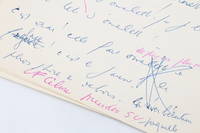
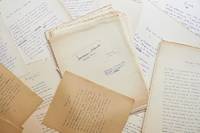
Manuscrits autographes signés inédits de deux importantes parties de Normance Féérie pour une autre fois II Two unpublished autograph manuscripts signed by Louis-Ferdinand Celine in blue and red ballpoint pen: the first contains 9 pages numbered in the left-hand corner from 1480 to 1488; the second contains 7 pages numbered from 1498 to 1504. Each text is signed by Celine in red ink at the bottom margin with the words ""Meudon 54"" also in his hand ff. 1485 and 1505. There are numerous variants lines and words crossed out modified and repeated.
Meudon 1954. Fine. ""What is Normance "" Meudon 1954 20 x 27 cm 16 feuillets 9 pour le premier manuscrit 7 pour le second Two unpublished autograph manuscripts signed by Louis-Ferdinand Céline in blue and red ballpoint pen: the first contains 9 pages numbered in the left-hand corner from 1480 to 1488; the second contains 7 pages numbered from 1498 to 1504. Each text is signed by Céline in red ink at the bottom margin with the words ""Meudon 54"" also in his hand ff. 1485 and 1505. There are numerous variants lines and words crossed out modified and repeated. Traces of pinholes in the upper left-hand margin of every sheet as Céline organized his manuscripts in ""bundles"". Normance was published in 1954 as a sequel to 'Fable for Another Time' published two years earlier. Both parts were written during Céline's years of exile and imprisonment in Denmark. Upon his return to France in 1951 Céline began ""polishing"" his writings and published these two monumental texts initially envisaged as a single book. ""Céline while he was working on it thought of this novel as a second Journey to the End of the Night' twenty years later capable to astonish the public as much as the 1932 novel"" Henri Godard. This set of manuscript pages corresponds to two passages from the second half of the novel Romans Pléiade IV p. 371 to 375 significantly different from the published text. This is an earlier version unknown to scholar Henri Godard as evidenced by a note in the Pléiade edition where he explains the difficulties encountered by Céline's secretary Marie Canavaggia when translating the word ""planqaouzeuze"" - appearing here on one of the manuscript leaves. Her transcription ""plaquouseuze"" eventually remained in the published text. Godard further stated he had no knowledge of this part of the manuscript i.e. our manuscript not appearing in the intermediate versions transcribed and published in the Pléiade edition. The first of the manuscripts recounts the ransacking and looting of psychic Armelle's apartment: ""How many decks did Armelle have Her fortune-telling cards were taking the air! . Ah seeress! Something she hadn't guessed was how her trembles would be tarred! They'd rip open her armchairs crush her fine hiding places! ah Pythonisse! ah the quilt now! the inside of the pillows flies! flies away!"" Céline also evokes Madame Toiselle the building's concierge: ""- It's a mess Madame Toiselle. I yell it at her. she was a maniac! . moron! she's looking now! she's looking good! ah I see her consternation.she's there in front of me on all fours. I can see her head! Her hoe! - Omelette head!"" I shout to her Omelette head'! The second focuses on Raymond in the grip of a delirious crisis thinking he's a donkey: ""Raymond Raymond! but it's your wife you're looking for! it's true he was looking for his wife.! well maybe five minutes ago he was looking for his wife! Denise! . now he's looking for himself. . - Hiian! hiiian! he answers me! There's also a comical settling of scores between Mimi and Rodolphe: ""There goes Mimi then there goes Rodolphe! Rodolphe! they're coming! and how they're treating each other! where were they on the threshold the two of them! they're taking advantage of the lull in the bombs! - Pig! Pimp! - Cabotine! coureuse! and they attack their costumes. "" Remarkable manuscripts bearing witness to Céline's tireless pursuit in finding the right word and his willingness to place himself as a direct witness to events both historical and autobiographical. These unpublished manuscript lines are typical of the Celinian style of this ambitious novel: ""The story style and tone of Normance set it apart from the rest. It is nothing more than the long account of a night of bombing in Montmartre told in his own way by Céline who had been deeply impressed by the spectacle of the bombing of the Renault automobile factories in Boulogne-Billancourt which he had witnessed from the windows of his apart unknown
Référence libraire : 83744
|
|
|
Jean COCTEAU
"Ensuite détente et fatigue - car la fatigue ne se manifeste que dans le repos."" Autograph letter signed to his English translator Marie Hoeck
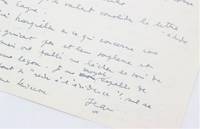
s. l. 1950. Fine. s. l. 4 février 1950 21 x 27 cm une page sur un feuillet Autograph letter signed ""Jean"" and with a small star addressed to his English translator Marie Hoeck one page in blue ink on a sheet of fine white paper. Transverse folds inherent to posting. On the verso notes by the translator in ballpoint pen. Jean Cocteau is overworked by several projects: ""I have finished the mixtures of sounds and music for Orphée. I will probably finish the images for Les Enfants Terribles next week. . I do not speak to you of Léone because I look at her feel her steep myself in her - but alas my English allows me nothing more than to breathe in her light ink."" He shares with his translator his great fatigue: ""Then relaxation and fatigue - for fatigue only manifests itself in rest. . I am quite at ease concerning your springs. They do not creak and their flexibility is perfect. Mine nearly gave way on me the evening in Brussels. It is a lesson. I thought myself capable of the impossible. One must ""face the facts"" no one can do it."" unknown
Référence libraire : 83936
|
|
|
Louis-Ferdinand CELINE
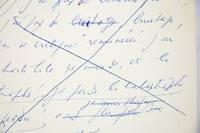
"j'ai pas de cinéma personnel j'ai pas de bruitage j'ai pas de critiques ""rémunérés"" j'ai que l'hostilité du monde et la catastrophe !"" A handwritten autograph sheet for Normance Féérie pour une autre fois II
Meudon 1954. Fine. Meudon 1954 20.70 x 26.80 cm une page sur un feuillet Autograph manuscript signed by Louis-Ferdinand Céline written in blue and pink ballpoint pens on a white paper sheet numbered 507 in the left corner. One transverse fold. Some pin holes in the upper margin stigmata of the organization of Céline manuscripts in ""bundles"". « j'ai pas de cinéma personnel j'ai pas de bruitage j'ai pas de critiques ""rémunérés"" j'ai que l'hostilité du monde et la catastrophe ! je perds la catastrophe je suis perdu ! . chienlit ! charlatan ! barbeau mou ! Comme ça vous m'intitulez si vous me trouvez pas dans la loge en plein enragement d'éléments ! je veux pas que vous. » The passage in our sheet presents some variations from the published version. Published in 1954 Normance is a direct sequel to Féérie pour une autre fois published two years earlier. Both parts were written during Céline's years of exile and imprisonment in Denmark. Upon his return to France in 1951 Céline undertook a work of ""polishing"" and published independently these two titanic texts originally envisioned as one. ""Céline while working on it thought of this novel as a second Voyage au bout de la nuit capable twenty years later of astonishing the public as much as the 1932 novel."" Henri Godard unknown
Référence libraire : 84027
|
|
|
Louis-Ferdinand CELINE
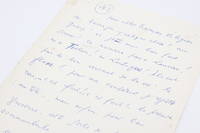
Un feuillet autographe manuscrit pour Normance Féérie pour une autre fois II : ""ça arrivera pas à Lauriac ! ni à Tartron ! ni Larengue !. Ils ont pris le bon versant de la vie : le flan !""
Meudon 1954. Fine. Meudon 1954 21.20 x 26.10 cm une page sur un feuillet Autograph manuscript signed by Louis-Ferdinand Céline written in blue ballpoint pen on a sheet of white paper numbered 243 in the left corner. Some stains as well as a central fold of no consequence. A tiny lack of paper at the lower right margin of the sheet. Some pinholes in the upper margin evidence of the organization of Céline's manuscripts in ""bundles"". ""pour aller traverser les lignes des barrages quelque chose !. au galop ! et je me suis bien fait sonner ! ça arrivera pas à Lauriac ! ni à Tartron ! ni Larengue !. Ils ont pris le bon versant de la vie : le flan !. pour ma concerne je regrette rien . c'est fait ! c'est fait ! la preuve ma tête. mais enfin pour la griserie cette sorte de bravoure somnambule j'admire les doués. je les respecte. j'arrive moi que par le stoïcisme le sang froid là ! hop !"" ""to go cross the lines barricades something!. at a gallop! and I really got myself beaten up! that won't happen to Lauriac! nor to Tartron! nor Larengue!. They took the right side of life: the flank!. as for me I regret nothing. it's done! it's done! the proof my head. but finally for the intoxication this sort of sleepwalking bravery I admire the gifted ones. I respect them. I only achieve it through stoicism cold blood there! hop!"" The passage from our sheet referring to Mauriac Sartre and Aragon conforms to the published version. Published in 1954 Normance is a direct sequel to Féérie pour une autre fois published two years earlier. The two parts were written during Céline's years of exile and imprisonment in Denmark. Upon his return to France in 1951 Céline undertook a work of ""polishing"" and published these two titanic texts independently originally conceived as one. ""Céline while working on it thought of this novel as a second Voyage au bout de la nuit capable twenty years later of astonishing the public as much as the 1932 novel."" Henri Godard unknown
Référence libraire : 83969
|
|
|
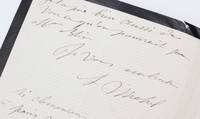
Louise MICHEL
"Voyez ce qu'on pourrait faire vous savez tous les services qu'ils ont rendus en 70-71."" Signed autograph letter addressed to Lucien Barrois
s. l. Paris 1885. Fine. s. l. Paris 15 août 1885 13.40 x 21.10 cm 1 page 1/2 sur un bifeuillet Autograph letter signed by Louise Michel addressed to Lucien Barrois; one and a half pages written in black ink on a bifolium of white paper with black border. Transverse folds inherent to mailing. Tears to lower margin without loss at the fold. Louise Michel requests help for one of her friends: ""Vous savez que le père Blin ne peut plus travailler depuis deux mois passés voici maintenant la mère Blin qui vient de tomber très malade. Voyez ce qu'on pourrait faire vous savez tous les services qu'ils ont rendus en 70-71. Mon petit cousin . aidera le père Blin à tenir son kioske sic mais cela ne donne pas de secours à la maladie de Mme Blin. Mme Barrois devait revenir demain samedi ici qu'elle ne l'oublie pas mais je la prie bien aussi de voir ce qu'on pourrait pour Mme Blin."" ""You know that father Blin has been unable to work for the past two months and now mother Blin has just fallen very ill. See what could be done you know all the services they rendered in 70-71. My little cousin . will help father Blin run his kiosk but that doesn't provide relief for Mme Blin's illness. Mme Barrois was supposed to return here tomorrow Saturday may she not forget it but I also earnestly ask her to see what could be done for Mme Blin."" Mme Blin actively participated in the Paris Commune alongside Louise Michel; with other Parisian women they created the Women's Vigilance Committee and asked Louise Michel to take charge of it. Moving letter testimony to the unfailing devotion of the former Communard. unknown
Référence libraire : 83961
|
|
|
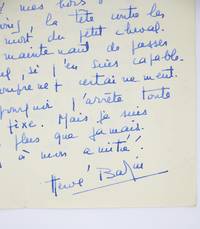
Herve BAZIN
". je suis inquiet de voir se transformer peu à peu l'anti stalinisme en anti marxisme."" Dated and signed political autograph letter to Georges Altmann
Villenauxe-la-Grande Aube: S. n. 1950. Fine. S. n. Villenauxe-la-Grande Aube 1950 13.50 x 20.50 cm une feuille Autograph letter dated and signed by Hervé Bazin 49 lines in blue ink from his home in Aube La belle Angerie in Villenauxe-la-Grande in which he apologizes for his late reply: "". vous devez me trouver bien silencieux et m'en vouloir quelque peu."" ""you must find me very silent and hold it against me somewhat."" Hervé Bazin confides his apprehensions and psychological torments related to the political climate tinted with anti-communism : "" Depuis des semaines je traverse une sorte de crise assez pénible. je suis inquiet de voir se transformer peu à peu l'anti stalinisme et anti marxisme."" ""For weeks I have been going through a kind of crisis quite painful. I am worried to see the gradual transformation of anti-Stalinism and anti-Marxism."" and remains lucid about the minimal impact of his journalistic interventions : ""ma voix est mince mal assurée inefficiente."" ""my voice is thin unsteady ineffective."" preferring what his talent is recognized for : ""mieux vaut pour elle cet autre genre d'éloquence où je suis plus à l'aise : le roman."" ""better for it this other kind of eloquence where I am more at ease: the novel."" This is why he prefers to devote himself solely to writing his novels and suspends his collaboration with Georges Altmann to whom he had been providing some articles on current political events which he judges insufficient and too concise to express all that he would like to develop further: ""Pour tout vous dire je me lance dans un grand travail. qui m'oblige à quitter le forum. Il s'agit maintetant de passer à l'essentiel. C'est pourquoi j'arrête toute chronique fixe. Mais je suis avec vous plus que jamais."" ""To tell you everything I am embarking on a great work. which obliges me to leave the forum. It is now a matter of moving on to the essential. This is why I am stopping all regular chronicles. But I am with you more than ever."" Fold marks inherent to mailing. Georges Altmann began his great career as a journalist in 1922 at L'Humanité then directed by Henri Barbusse who entrusted him in 1927 with the La vie littéraire section. He was dismissed the following year from the communist daily while continuing to collaborate with Henri Barbusse on the review Monde. In 1932 he joined the Parisian editorial staff of Le Progrès de Lyon through which he made contact with the Resistance group Franc-Tireur. In March 1942 he went underground and became one of the principal editors of the review Franc-Tireur. He was arrested by the Germans in July 1944 then freed on August 18 the day before the Parisian insurrection. After the war he was involved in various journalistic and editorial activities. He then managed the press service of culture minister André Malraux. S. n. unknown
Référence libraire : 84016
|
|
|
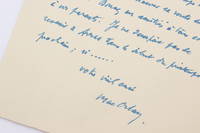
Pierre MAC ORLAN
Lettre autographe datée et signée au jeune poète artésien Roger Valuet l'encourageant à lui adresser ses poèmes
Saint-Cyr-sur-Morin: S. n. 1947. Fine. S. n. Saint-Cyr-sur-Morin 20 Décembre 1947 13.50 x 21.50 cm une feuille Autograph letter dated and signed by Pierre Mac Orlan 15 lines in turquoise ink to the budding poet Roger Valuet. Fold marks inherent to postal envelope. He urges his young colleague to send him his latest writings: ""Bien sûr ! Envoyez-moi vos poèmes dès que vous les aurez réunis. Je les lirai et vous répondrai à ce sujet."" ""Of course! Send me your poems as soon as you have gathered them together. I will read them and respond to you on the subject."" and hopes to return to the North to see him again: ""Je ne désespère pas de revenir à Arras dans le début de printemps prochain si. Votre vieil ami."" ""I do not despair of returning to Arras at the beginning of next spring if. Your old friend."" Originally from Arras Roger Valuet is a popular writer who signed under the pseudonym Roger Vilard numerous detective and spy novels. At the beginning of his career he was helped by Pierre Mac Orlan who wrote the preface to his first collection of poems. S. n. unknown
Référence libraire : 84007
|
|
|
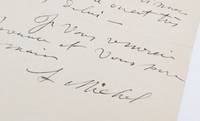
Louise MICHEL
« Il faut avant de rentrer en cage . que je vous demande le grand service de faire entrer à l'hospice mon cousin le petit Dacheux à qui vous avez bien voulu faire avoir sa dispense d'âge. » Signed autograph letter addressed to Georges Clemenceau
s. l. Paris 1886. Fine. Letter to the Tiger: ""Before returning to the cage"" s. l. Paris 7 août 1886 13.20 x 19.20 cm 3 pages sur un bifeuillet Autograph signed letter from Louise Michel addressed to Georges Clemenceau; three pages written in black ink on a bifolium of white paper. Transverse creases inherent to posting. Fine letter from Louise Michel to Clemenceau one of her most important supporters before yet another incarceration: « Il faut avant de rentrer en cage . que je vous demande le grand service de faire entrer à l'hospice mon cousin le petit Dacheux à qui vous avez bien voulu faire avoir sa dispense d'âge. » ""Before returning to the cage . I must ask you the great favor of having my cousin little Dacheux admitted to the hospice for whom you were kind enough to obtain his age exemption."" The former communard has indeed just been sentenced to four months in prison for having given a speech in favor of the Decazeville miners alongside Jules Guesde Paul Lafargue and Étienne Susini. But for now it is the condition of her cousin Lucien Dacheux that concerns her: « Son genou étant de plus en plus malade on l'envoie en congé de deux mois mais il faut qu'il entre à l'hospice s'il ne veut pas rester estropié. De plus on n'a pu lui donner une mécanique pour son genou et en même temps le médecin lui disait que c'était indispensable - peut-être pourra-t-il en avoir une au Val de Grâce - je le recommande bien à vous et au citoyen Lafont - J'irai vous voir pour cela et une autre chose du même genre avant le 12 mais s'il était possible de faire entrer avant à l'hospice le petit Lucien Dacheux je serais bien heureuse car il sera tout à fait estropié et incapable de continuer son service où on est très content de lui. » ""His knee being increasingly ill they are sending him on two months' leave but he must be admitted to the hospice if he doesn't want to remain crippled. Moreover they couldn't give him a mechanism for his knee while at the same time the doctor told him it was indispensable - perhaps he could get one at Val de Grâce - I recommend him highly to you and to citizen Lafont - I will come to see you about this and another matter of the same kind before the 12th but if it were possible to have little Lucien Dacheux admitted to the hospice beforehand I would be very happy because he will be completely crippled and unable to continue his service where they are very pleased with him."" Louise Michel met Clemenceau in October 1870 when he was mayor of Montmartre and she was assistant schoolmistress. From their first meeting was born a strong friendship that lasted until Louise Michel's death. Clemenceau never ceased to support her particularly during her banishment to Nouméa and they maintained an extensive correspondence. A moving letter testimony to the unwavering devotion of the former communard and to the great friendship that united Louise Michel to Georges Clemenceau. unknown
Référence libraire : 83952
|
|
|
Louise MICHEL
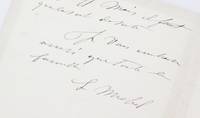
"Chauvière et d'autres amis communs vous prient bien de tâcher que Clemenceau recommande au professeur qui a la chaire de Russe au Collège de France et à la Sorbonne notre ami Gregorieff comme aide."" Signed autograph letter addressed to Lucien Barrois
s. l. Paris 1887. Fine. s. l. Paris 19 novembre 1887 11.30 x 17.70 cm 1 pages 1/2 sur un bifeuillet Autograph letter signed by Louise Michel addressed to Lucien Barrois; one and a half pages written in black ink on a bifolium of white paper with black border. Transverse folds inherent to mailing. ""Chauvière et d'autres amis communs vous prient bien de tâcher que Clemenceau recommande au professeur qui a la chaire de Russe au Collège de France et à la Sorbonne notre ami Gregorieff comme aide. Il paraît qu'avec un mot de Rochefort et de Clemenceau il serait immédiatement accepté ."" ""Chauvière and other mutual friends earnestly ask you to try to have Clemenceau recommend our friend Gregorieff as assistant to the professor who holds the Russian chair at the Collège de France and at the Sorbonne. It appears that with a word from Rochefort and Clemenceau he would be immediately accepted ."" The novelist P. Gregorieff had given some Russian lessons to Louise Michel. Moving letter testimony to the unfailing devotion of the former Communard. unknown
Référence libraire : 83960
|
|
|
Louise MICHEL
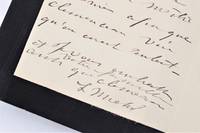
"je n'ai pas trop compris la lettre du petit parce qu'il en est resté une bonne partie dans l'encrier"" Signed autograph letter addressed to Lucien Barrois
s. l. Paris 1885. Fine. s. l. Paris 20 avril 1885 11 x 17.70 cm 2 pages sur un bifeuillet et un feuillet encollé sur la 3e page Autograph letter signed by Louise Michel addressed to Lucien Barrois; two pages written in black ink on a white paper bifolium with black border. One sheet in the hand of a naval adjutant from Brest pasted on the third page. Transverse folds inherent to postal delivery. Louise Michel asks the recipient of this letter for advice regarding her young cousin: ""Ignorant si Clémenceau aurait le temps d'écrire un mot de recommandation pour quelques leçons à mon petit cousin Dacheux je vous le dis d'abord afin que vous preniez un moment où ce sera possible pour le dire à Clemenceau. Je vous avoue que je n'ai pas trop compris la lettre du petit parce qu'il en est resté une bonne partie dans l'encrier il écrit si mal."" ""Not knowing if Clémenceau would have time to write a word of recommendation for some lessons for my young cousin Dacheux I tell you first so that you may find a moment when it would be possible to mention it to Clémenceau. I confess that I did not quite understand the boy's letter because a good part of it remained in the inkwellhe writes so poorly."" Moving letter testimony to the unwavering devotion of the former Communard. unknown
Référence libraire : 83956
|
|
|
Georges SADOUL
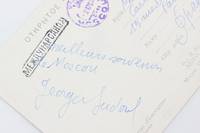
Carte postale moscovite autographe signée adressée à Carlo Rim
Moscou Moscow: S. n. 1952. Fine. S. n. Moscou Moscow 2 décembre 1952 15 x 10.50 cm une carte postale Autograph postcard signed by Georges Sadoul sent from Moscow to his friend Carlo Rim: ""Meilleurs souvenirs de Moscou. Georges Sadoul"" ""Best regards from Moscow. Georges Sadoul"" The postcard shows on the front a colored view of the Moscow metro. Carlo Rim was a Provençal writer author notably of Ma belle Marseille a caricaturist a filmmaker: Justin de Marseille L'armoire volante La maison Bonnadieu and was notably the friend of Fernandel Raimu and Marcel Pagnol but also of Max Jacob and André Salmon whom he met in Sanary. S. n. unknown
Référence libraire : 83934
|
|
|
Andre MALRAUX
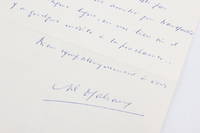
". je ne sais pas entreprendre l'analyse d'une analyse qui a dû être un sacré boulot !"" Autograph letter dated and signed to André Parinaud thanking him for his favourable review
Boulogne-sur-Seine Boulogne-Billancourt: S. n. 1954. Fine. S. n. Boulogne-sur-Seine Boulogne-Billancourt 28 Décembre 1954 13.50 x 21 cm une feuille Autograph letter signed and dated by André Malraux 20 lines in blue ballpoint pen from his Boulogne home on avenue Victor Hugo thanking him for his favorable review either of Des bas-reliefs aux grottes sacrées or of Le Monde chrétien both published in 1954. He apologizes for not being able to respond quickly to his laudatory article before thanking him: "". it is certain that by emphasizing both the technical aspect and the other underlined words you render the book a great service and take the animal by the right end."" he also acknowledges the clairvoyance and pertinence of his article despite the difficulty of properly apprehending the work: "". for these essays are not conceivable within traditional art criticism."" while praising the attachment that binds them: "". this attitude which is the only just one did it not necessarily imply a friendship that shows through each line in a place where there is some merit in proclaiming it."" Fold mark inherent to the mailing process. Resistance fighter and participant in Combat André Parinaud is a journalist columnist art critic and writer. From 1959 to 1967 he held the position of editor-in-chief of the important weekly Arts bringing together the elite of French creation in all artistic fields: literature painting theater cinema. He then conducted more than 1000 radio interviews with the greatest writers and artists including Salvador Dali Louis-Ferdinand Céline Colette Paul Léautaud André Breton Georges Simenon and André Malraux. While continuing to work at O.R.T.F. and radio he founded several festivals or artistic events such as The International Art Film Festival the National Academy of Street Arts. S. n. unknown
Référence libraire : 84002
|
|
|
Jean COCTEAU
Appogiatures - Manuscrit autographe d'une version primitive en partie inédite Appogiatures - Autograph manuscript of an early version partly unpublished
Saint-Jean-Cap-Ferrat 1952. Fine. Saint-Jean-Cap-Ferrat août 1952 20.80 x 34 cm 52 pages Autograph manuscript by Jean Cocteau early version of the poetry collection Appogiatures - published in 1953 by Éditions du Rocher in Monaco - comprising 47 leaves of thick paper taken from a large drawing pad and 5 smaller leaves of thin paper written in blue ink and blue ballpoint pen. Numerous deletions and corrections. The leaves are numbered up to 25 including one number 8 bis and most bear a small cross or the mythical Cocteau star. The last leaf containing the poem titled ""Lettre"" is dated in the poet's hand August 15 1952. Also in Cocteau's hand the first leaf bears the final title above which is crossed out the initially envisaged title - Soucoupes volantes - the date 1952 and the place - St Jean Cap Ferrat; it also features a crossed-out dedication: ""À la mémoire de Baudelaire et de Max Jacob qui nous apprirent ces exercices de style."" While the collection clearly shows the influence of Baudelaire's Petits Poèmes en prose and Max Jacob's Le Cornet à dés this tribute was not retained in the published version and was replaced by a dedication to the publisher Henri Parisot. An exceptional ensemble containing 33 of the 51 published poems 11 texts rejected on the advice of publisher Henri Parisot and published in ""En marge d'Appogiatures"" uvres poétiques complètes de la Pléiade pp. 818-831 and 6 unpublished texts. David Gullentops in the edition of Jean Cocteau's uvres poétiques complètes in the Pléiade notes the existence of a second set of manuscripts and typescripts preserved at the Bibliothèque Historique de la Ville de Paris BHVP. He further indicates that he had access to no manuscript of the poem ""Lanterne sourde."" Yet this poem is indeed part of our ensemble which would thus be the first version of the collection envisioned by Cocteau. Jean Cocteau began writing this collection of poems in verse and prose commissioned by his friend the publisher Henri Parisot at the end of July 1952 while staying at Saint-Jean-Cap-Ferrat in Francine Weisweiller's Villa Santo-Sospir. The first version of the collection was completed in mid-August as attested by the two dates on our manuscript ""août 1952"" and ""15 août 1952"" and this entry in Cocteau's diary: ""J'ai terminé la mise au point des courts poèmes en prose pour Parisot. Il y en aura vingt-six à moins que le mécanisme continue ce que je ne souhaite pas car à la longue ces exercices d'écriture illustrés par Baudelaire et Max Jacob fatiguent."" Le Passé défini Tome 1 1951-1952 August 14 1952. Our ensemble would thus be a mixture of the first poems sent to Henri Parisot written with a pen and several added texts written with a ballpoint pen. This hypothesis is supported by the writing of the final title Appogiatures on the title page of our manuscript; Cocteau relates this change again in his diary dated August 29 1952: ""Ai . classé les poèmes pour Parisot sous le titre : Appogiatures."" Our early manuscript version contains significant variants concerning the titles of the poems; thus the poem ""Livre de bord"" was initially titled ""Le Spectacle"" likewise for ""Au poil"" for which Cocteau had previously chosen ""La langue française"" or ""Le tableau noir"" originally titled ""Le lièvre et la tortue."" The order of the poems was also considerably modified for printing: our ensemble shows that Cocteau wished to begin the collection with ""Le voyageur"" which would finally be replaced by ""Seul"" and moved to second position. Also noteworthy in our dossier is the presence of eight poems entirely in verse: these would be removed Appogiatures becoming a collection exclusively in prose. The ensemble heavily deleted and corrected also presents long passages suppressed in the published version for example this very beautiful extract from the poem ""Scène de ménage"" evoking the ""countess"" Francine Weisweiller: ""Et les larmes de la comtesse se disaient : nous sommes la mer. Et la mer se unknown
Référence libraire : 83726
|
|
|
Honore de BALZAC
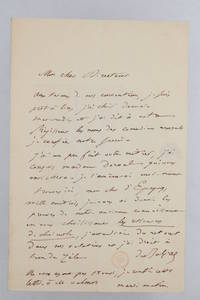
Lettre autographe signée adressée à Jean-Baptiste Violet d'Epagny directeur du théâtre de l'Odéon à propos des Ressources de Quinola Autograph letter signed by Honore de Balzac to Jean-Baptiste Violet d'Epagny director of the Odeon theater
s. l. Passy Paris 1841. Fine. s. l. Passy Paris « mardi matin » 28 décembre 1841 13.50 x 21.60 cm une page sur un double feuillet enveloppe jointe Autograph letter signed by Honoré de Balzac to Jean-Baptiste Violet d'Epagny director of the Odéon theater. One page in black ink on a double sheet. Enclosed and pasted on the second page is the envelope of this letter written in Balzac's hand.""My dear director under the terms of our agreements I am ready to read I have chosen tomorrow Wednesday and I have told your stage manager the names of the actors to whom I entrust our play. I've done a bit of your job I've conquered Madame Dorval who will make you rich I'll bring her myself. Find here my dear d'Épagny a thousand regards I have given you proof of our old acquaintance by choosing you for Les Ressources de Quinola I shall expect a return in our relations and I am entitled to a great deal of zeal."" Les Ressources de Quinola is both in the spirit Les Fourberies de Scapin and Les Noces de Figaro. From the 1840s until his death Balzac's ambition was to achieve a reputation comparable to his illustrious predecessors Molière and Beaumarchais. Although this proved to be a hope as vain as it was determined Balzac never doubted failure after failure that his success was imminent. On July 15 1841 d'Épagny was appointed director of the Odéon . as any theater director would have done in his place he spent summer vacations organizing his winter programme. He asked Balzac for a play and Balzac complied choosing Les Ressources de Quinola. . We all know what a fuss was made about Balzac's play and how childishly naive the author was in filling the room with the highest Parisian society and foreign elite in order to make snobs want to join such a brilliant assembly. . Madame Dorval more astute than the author refused the role intended for her as soon as Balzac read . She did well for one never saw a more complete failure"" L'Amateur d'autographes mai 1911 Interesting letter revealing the beginnings of the creation of Les Ressources de Quinola and the author's habit of reading his play for the actors who then voted to accept or reject it. Provenance: Arthur Meyer collection then ""AGR"" stamp on letter and envelope. unknown
Référence libraire : 83639
|
|
|
Louise MICHEL
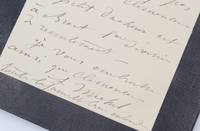
"Clemenceau serait en droit de dire que je suis bien ennuyeuse mais montrez lui la lettre du petit si on pouvait obtenir qu'il ait un peu d'instruction."" Signed autograph letter addressed to Lucien Barrois
s. l. Paris 1885. Fine. s. l. Paris 6 février 1885 11.10 x 17.60 cm 1 page 1/2 sur un bifeuillet Autograph letter signed by Louise Michel addressed to Lucien Barrois; one and a half pages written in black ink on a bifolium of white paper with black border. Transverse folds inherent to mailing. A trace of glue on the second sheet where Louise Michel had probably pasted a letter from her cousin. News of Louise Michel's little cousin Lucien Dacheux: ""Je reçois une lettre de mon petit cousin Dacheux qui me demande de remercier encore pour lui Clemenceau et lui. Je le fais moi-même de tout coeur. N'oubliez pas de le dire à Clemenceau. Le petit Dacheux est à Brest 1ère division de recrutement. . Clemenceau serait en droit de dire que je suis bien ennuyeuse mais montrez lui la lettre du petit si on pouvait obtenir qu'il ait un peu d'instruction. Je ne sais pas s'ils peuvent avoir des leçons. Y a-t-il une école je ne sais rien de tout cela dans la division où il est."" ""I receive a letter from my little cousin Dacheux who asks me to thank Clemenceau and him again on his behalf. I do so myself wholeheartedly. Don't forget to tell Clemenceau. Little Dacheux is in Brest 1st recruitment division. . Clemenceau would have the right to say that I am quite bothersome but show him the little one's letter if we could obtain that he have a little education. I don't know if they can have lessons. Is there a school I know nothing of all that in the division where he is."" Moving letter testimony to the unfailing devotion of the former communard. unknown
Référence libraire : 83964
|
|
|
Louis-Ferdinand CELINE
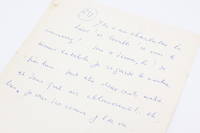
"Y'en a un charlatant là-haut ! et terrible ! et vous le connaissez !."" A handwritten autograph sheet for Normance Féérie pour une autre fois II
Meudon 1954. Fine. Meudon 1954 21.20 x 26.10 cm une page sur un feuillet Autograph manuscript signed by Louis-Ferdinand Céline written in blue ballpoint pen on a sheet of white paper numbered 237 in the left corner. Some stains as well as a central fold of no consequence. Some pinholes in the upper margin evidence of the organization of Céline's manuscripts in ""bundles"". ""Y'en a un charlatant là-haut ! et terrible ! et vous le connaissez !. donc de dessous là ! de dessous la table je regarde le moulin. pas loin. peut-être deux cents mètres. et dans quel air éblouissant !. eh bien je vous dis comme je l'ai vu."" ""There's a charlatan up there! and terrible! and you know him!. so from underneath there! from under the table I look at the windmill. not far. maybe two hundred meters. and in what dazzling air!. well I tell you as I saw it."" The passage from our sheet conforms to the published version. Published in 1954 Normance is a direct sequel to Féérie pour une autre fois published two years earlier. The two parts were written during Céline's years of exile and imprisonment in Denmark. Upon his return to France in 1951 Céline undertook a work of ""polishing"" and published these two titanic texts independently originally conceived as one. ""Céline while working on it thought of this novel as a second Voyage au bout de la nuit capable twenty years later of astonishing the public as much as the 1932 novel."" Henri Godard unknown
Référence libraire : 83967
|
|
|
Andre MALRAUX
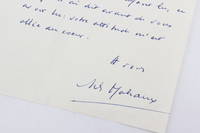
" vous ayant lu. votre attitude m'est allée au coeur."" Autograph letter dated and signed to André Parinaud thanking him for his favourable review
Boulogne-sur-Seine Boulogne-Billancourt: S. n. 1954. Fine. S. n. Boulogne-sur-Seine Boulogne-Billancourt 17 Mars 1954 13 x 21 cm une feuille une enveloppe Autograph letter dated and signed by André Malraux 14 lines in blue ballpoint pen from his Boulogne home on avenue Victor Hugo confirming a scheduled appointment. He thanks him for his ever-benevolent friendship: ""J'ai trouvé la Parisienne à mon retour. Je vous écris vous ayant lu ce que je vous ai dit avant de vous avoir lu : votre attitude m'est allée au coeur."" ""I found la Parisienne upon my return. I am writing to you having read you what I told you before having read you: your attitude touched my heart."" Fold mark from mailing envelope included. Resistance fighter participating in Combat André Parinaud is a journalist columnist art critic and writer. From 1959 to 1967 he held the position of editor-in-chief of the important weekly Arts bringing together the elite of French creation in all artistic fields: literature painting theater cinema. He would then conduct more than 1000 radio interviews with the greatest writers and artists including Salvador Dali Louis-Ferdinand Céline Colette Paul Léautaud André Breton Georges Simenon and André Malraux. While continuing to work at O.R.T.F. and radio he founded several festivals or artistic events such as Le Festival international du film d'art l'Académie nationale des arts de la rue. S. n. unknown
Référence libraire : 84014
|
|
|
Guillaume APOLLINAIRE
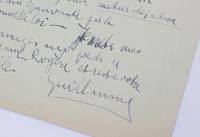
"Vous avez senti mon âme comme personne."" Unpublished signed autograph letter addressed to Jean Royère after the release of Alcools
s. l. Paris 1913. Fine. ""I will come to see you to speak to you about naturalization I am appalled by the new law"" s. l. Paris s. d. ca. juin 1913 15.70 x 24.50 cm une page sur un feuillet Unpublished autograph letter signed by Guillaume Apollinaire addressed to Jean Royère one page written in black ink on a sheet. Transverse folds inherent to posting. Very fine letter of thanks from poet to poet. ""I thank you for the admirable article you devoted to me. You have felt my soul like no one else."" Jean Royère had indeed written a laudatory article upon the publication of Alcools in the June 20 1913 issue of La Phalange: ""Here gathered in an 18mo of barely two hundred pages is almost the entire poetic work of Apollinaire. Fifteen years of poetry rest in this small volume. I therefore do not open it without almost a preconceived admiration. In poetry abundance means sterility and one only writes three volumes in a year through inability to devote one's life to a book. Apollinaire evidently will leave only one book of verse like Baudelaire and Mallarmé like Rimbaud: this is a considerable chance of immortality for the true poet is one who has this too rare gift of condensation."" "". I will come to see you in the coming days to thank you first and also to speak to you about naturalization I am appalled by the new law."" The poet here alludes to the Three Year Law dubbed the Barthou Law increasing the duration of military service from two to three years in view of preparing the French army for a possible war with Germany. If Apollinaire's biography prefers to focus on the publication of his works in this year 1913 the letters his mother addresses to her son show that the latter moves heaven and earth to avoid military service and be naturalized as quickly as possible: ""For your papers an Italian colonel attached to the ministry of war who was witness for your act of recognition had written to me once to give me the steps to follow so that you would be exempted from military service in Italy and for your French naturalization. I am going to write to him moreover to ask him to see to the Town Hall."" letter from Angelika Kostrowicka of July 12 1913. War would come soon and on August 3 1914 the day after mobilization the stateless poet would file a request for voluntary enlistment accompanied by a naturalization request. The latter would only be granted to him in 1916. An interesting letter written at the dawn of the Great War bearing witness to Guillaume Apollinaire's two passions: poetry and France. unknown
Référence libraire : 83938
|
|
|
Louise MICHEL
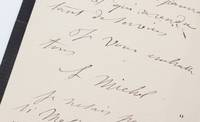
" Il faut enfin que ce soit vous qui rappeliez cette pauvre femme qui a rendu tant de services."" Signed autograph letter addressed to Lucien Barrois
s. l. Paris 1885. Fine. s. l. Paris 12 juin 1885 11 x 16.90 cm 2 pages 1/2 sur un bifeuillet Autograph letter signed by Louise Michel addressed to Lucien Barrois; two and a half pages written in black ink on a white paper bifolium with black border. Transverse folds inherent to postal delivery. Louise Michel requests help for one of her acquaintances: ""Madame Maron à qui Lafont ou Clémenceau avait fait avoir promesse à la mairie d'un terme de son loyer elle en doit trois n'a plus entendu parler de rien et il faut qu'elle déménage pour aller en face où elle paiera moins. Sa propriétaire l'aurait attendue avec un terme payé sur les trois. Il faut enfin que ce soit vous qui rappeliez cette pauvre femme qui a rendu tant de services."" ""Madam Maron for whom Lafont or Clémenceau had secured a promise from the town hall for one term of her rent she owes three has heard nothing more and must move across the street where she will pay less. Her landlady would have waited for her with one term paid out of the three. You must finally be the one to remind them of this poor woman who has rendered so many services."" Moving letter testimony to the unwavering devotion of the former Communard. unknown
Référence libraire : 83957
|
|
|
Andre MALRAUX
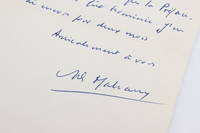
" . le voyage tout seul est trop mince on me demanderait trop de travail pour ne plus l'être."" Autograph letter dated and signed to André Parinaud about his work on the production of his work Des bas-reliefs aux grottes sacrées
Boulogne-sur-Seine Boulogne-Billancourt: S. n. 1953. Fine. S. n. Boulogne-sur-Seine Boulogne-Billancourt 5 Septembre 1953 11.50 x 18 cm une feuille une enveloppe Autograph letter dated and signed by André Malraux 14 lines in blue ballpoint pen from his Boulogne home on avenue Victor Hugo discussing his workload related to the preparation and delayed publication of the work Des bas-reliefs aux grottes sacrées for which André Parinaud is sending him documentation. André Malraux is not yet ready to send his work to the publisher: "". le livre ne parait pas cette année. Peut-être en mars 54. Et pour savoir où nous allons il faudrait que la préface au moins fût terminée. J'en ai encore pour deux mois."" "". the book is not coming out this year. Perhaps in March 54. And to know where we are going at least the preface would need to be finished. I still have two months of work ahead."" Fold mark from mailing envelope included. Resistance fighter participating in Combat André Parinaud is a journalist columnist art critic and writer. From 1959 to 1967 he held the position of editor-in-chief of the important weekly Arts bringing together the elite of French creation in all artistic fields: literature painting theater cinema. He would then conduct more than 1000 radio interviews with the greatest writers and artists including Salvador Dali Louis-Ferdinand Céline Colette Paul Léautaud André Breton Georges Simenon and André Malraux. While continuing to work at O.R.T.F. and radio he founded several festivals or artistic events such as Le Festival international du film d'art l'Académie nationale des arts de la rue. S. n. unknown
Référence libraire : 84015
|
|
|
Louise MICHEL
"elle sort le mois prochain et elle le mérite bien elle vous est bien reconnaissante."" Signed autograph letter addressed to Lucien Barrois
s. l. Paris 1885. Fine. s. l. Paris 16 juillet s. d. ca 1885 13.40 x 21.10 cm 1 page 1/2 sur un bifeuillet Autograph letter signed by Louise Michel addressed to Lucien Barrois; one and a half pages written in black ink on a bifolium of white paper with black border. Transverse folds inherent to posting. Mrs. Vernier will be released from prison thanks to Louise Michel's assistance: ""elle sort le mois prochain et elle le mérite bien elle vous est bien reconnaissante. Remerciez Clémenceau Lafont et Clovis Hugues avec Laguerre peut-être tous les quatre qui ont apostillé la demande."" ""she is released next month and she well deserves it she is very grateful to you. Thank Clémenceau Lafont and Clovis Hugues with Laguerre perhaps all four who endorsed the request."" A moving letter testimony to the unwavering devotion of the former Communard. unknown
Référence libraire : 83963
|
|
|
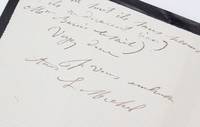
Victor SCHOELCHER
Lettre autographe signée à Alfred Boucher-Cadart
1879. Fine. 12 mars 1879 10.20 x 13.30 cm une page sur un bifeuillet et une enveloppe Autograph letter signed by Victor Schoelcher one page written in black ink on a bifolium of blue paper bearing the monogram and address of the politician addressed to minister Alfred Boucher-Cadart director of the general security service at the Ministry of the Interior. The envelope containing this letter has been pasted onto the second leaf. Central fold inherent to the mailing. ""There is nothing more to be done for the worker Cauchare. He was forced to serve his 10 days in prison while the Ministry of Justice was changing his sentence. I nonetheless thank you for your goodwill toward the poor man and I ask you to accept the assurance of my highest consideration."" unknown
Référence libraire : 84164
|
|
|
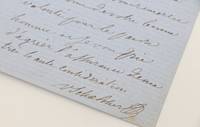
Jacques CHARDONNE
"Il est l'hygiène et la sagesse incarnées dans sa personne. Mais il a encanaillé par son oeuvre la jeunesse qui venait après lui. C'est lui qui a failli tuer Sagan. C'est Morand qui achetait les terribles voitures de Sagan. Mais lui sait conduire."" Autograph letter dated and signed addressed to his friend Roger Nimier evoking the talent of Paul Morand and the very recent car accident of Françoise Sagan
Paris 1957. Fine. Paris 29 Avril 1957 21 x 27 cm une feuille une enveloppe Autograph letter dated and signed by Jacques Chardonne addressed to his friend Roger Nimier 54 lines in blue ink regarding Paul Morand's style spiritual father of the Hussards Roger Nimier and Antoine Blondin being considered much against their will as leaders of this literary movement. Fold marks inherent to the letter's mailing envelope included. Jacques Chardonne intends to challenge two false ideas concerning Paul Morand the first being stylistic in nature: ""There is a double misunderstanding regarding Morand. He has been seen as a 'modern'. but he is essentially a 'naturalist'; his artistic doctrine is exactly that of Maupassant and Flaubert."" holding the latter as a major writer: ""But he has infinitely more talent and intelligence than the writers of the naturalist school."" ; the second of a psychological nature: ""He is hygiene and wisdom incarnate in his person. But through his work he has debased the youth who came after him. It is he who nearly killed Sagan."" Jacques Chardonne then ironizes about Françoise Sagan's talents while exalting the predominance and mastery of his friend Paul Morand in everything he undertakes: ""It is Morand who bought Sagan's terrible cars. But he knows how to drive."" while recalling the cautious advice that Bernard Frank gave to the author of Bonjour tristesse : ""Bernard Frank says: your car doesn't hold the road. Sagan vexed accelerates. And everything capsizes."" As a literary elder brother Jacques Chardonne reassures Roger Nimier about his own talent: ""Morand is very pleased with you. I say that Gaston Gallimard seems to have much friendship for you."" and congratulates his correspondent on the quality of Artaban a review to which Roger Nimier contributes Jacques Chardonne being honored in a recent issue: "". surprised to see myself on the front page; the text fills me with pride. I have scorned honors in order to be honored. I could not have been better served than in this little text."" and attributes the authorship of the text concerning him to one of his Hussard disciples: "". I tell myself: it's Nimier or Hecquet or Milliau. Truth be told I don't know. And I thank the Lord."" Overwhelmed by so many tributes paid to him Jacques Chardonne lucid prefers to avoid being too much in the spotlight: ""That is why I no longer want to publish anything. As soon as one applauds you you must leave."" Very handsome letter from Jacques Chardonne praising his friend Paul Morand spiritual father of the Hussards and evoking Françoise Sagan's terrible car accident in an Aston Martin on April 13 1957. A premonitory evocation: Roger Nimier would kill himself five years later on the western highway on September 28 1962 also at the wheel of an Aston Martin. unknown
Référence libraire : 84396
|
|
|
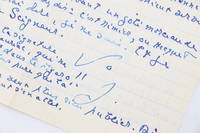
Julien GRACQ
". ma seule objection étant l'adjectif à la mode prégnant qui me paraît à proscrire absolument dès qu'il ne s'agit plus de femmes enceintes"". Autograph postcard signed by Julien Gracq addressed to his close friend and monographer Ariel Denis
Sion-sur-l'Océan Sion-sur-l'Océan 1995. Fine. Sion-sur-l'Océan Sion-sur-l'Océan s. d. circa 1995 15 x 10.50 cm une carte postale Autograph postcard signed by Julien Gracq of 20 lines addressed to his friend and biographer Ariel Denis written in black felt-tip pen on the verso of a photograph representing the castle of la Flocellière in Vendée not far from his apartment in Sion-sur-l'Océan. Julien Gracq congratulates Ariel Denis on the accuracy of his latest article: "". I find your review excellent and particularly understanding."" although he offers a slight and humorous caveat: "". my only objection being the fashionable adjective pregnant word underlined which seems to me to be absolutely proscribed as soon as it no longer concerns pregnant women"". The author of ""Au château d'Argol"" shows confidence in his friend's future: "". Perhaps reviews of this quality will open access to a door at éditions du Sorbier for you"" while remaining cautious and modest about his own: "".I refuse to hope too much. finally some positive turn of events will occur one day in this quest! "" Finally Julien Gracq evokes the holiday period and concludes his missive with a question mocking the postcard's subtitle ""Seminary of Elder Vocations east facade"": ""this card is also a riddle: what is a seminary of Elder vocations"" unknown
Référence libraire : 84395
|
|
|
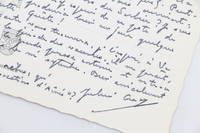
Raymond QUENEAU
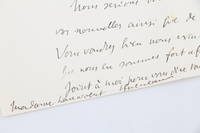
"Nous ne serons pas en état de faire le voyage en mai."" Autograph letter signed to a couple of friends apologizing for not being able to visit them in the spring
Paris 1972. Fine. Paris 26 Avril 1972 21 x 27 cm une page Autograph letter dated and signed by Raymond Queneau 17 lines in black ink addressed to Monsieur Lauwaert. Raymond Queneau and his wife Janine are sorry they cannot spend a few days with their friends: "" Ma femme doit entrer en clinique ces jours-ci pour un traitement de radiothérapie souffrant d'une sciatique aiguë"" ""My wife must enter the clinic these days for radiotherapy treatment suffering from acute sciatica"" hoping this is only a postponement: "". nous espérons bien venir en septembre et pouvoir récupérer longuement une meilleure santé car la meilleure non plus n'a pas été brillante cet hiver."" "". we very much hope to come in September and be able to recover better health for a long time as mine hasn't been brilliant this winter either."" A touching letter from Raymond Queneau about his wife's fragile health she being destined to pass away a few months later on July 18 1972. unknown
Référence libraire : 84434
|
|
|
Jean GIONO
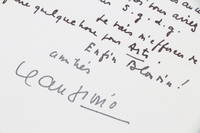
" Enfin Blondin ! "" Signed autograph letter addressed to Roger Nimier
1955. Fine. s. d. circa 1955 13.50 x 21 cm une feuille Autograph letter signed by Jean Giono addressed to Roger Nimier 11 lines in black ink in which he justifies his delay in responding to a request for an article submitted to him by the author of Hussard Bleu. Trace of fold inherent to envelope insertion. ""Pour Mars ça me paraît difficile. Au surplus je n'ai pas le texte et j'ai oublié mes anciennes lectures."" ""For March that seems difficult to me. Moreover I don't have the text and I have forgotten my previous readings"" but Jean Giono does not give up on all production: "". je vais m'efforcer de faire quelque chose pour Arts."" "". I will endeavor to do something for Arts."" He also rejoices at the publication of a new work by Antoine Blondin great friend of Roger Nimier probably the bookstore release of L'humeur vagabonde in 1955 or Un singe en hiver in 1959 with a thunderous: ""Enfin Blondin ! "" ""Finally Blondin!"" unknown
Référence libraire : 84422
|
|
|
Alphonse DAUDET
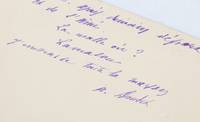
". j'ai retrouvé mon émotion d'il y a vingt-sept ans dans le salon de Lépine."" Signed autograph business card addressed to journalist and librettist Philippe Gille
s. l.: S. n. 1889. Fine. S. n. s. l. 5 Mai 1889 10.50 x 6 cm une feuille une enveloppe Autograph signed carte de visite from Alphonse Daudet 13 lines written in blue ink addressed to journalist and librettist Philippe Gille sending his thanks and congratulations for a recent performance. Envelope included. S. n. unknown
Référence libraire : 84470
|
|
|
Julien GRACQ
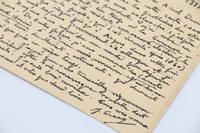
"je vous enverrai les Carnets du grand chemin"" Autograph postcard signed by Julien Gracq addressed to his close friend and monographer Ariel Denis
Saint-Florent le Vieil Saint-Florent-le-Vieil 1991. Fine. Saint-Florent le Vieil Saint-Florent-le-Vieil 31 Décembre 1991 14 x 9.50 cm une carte postale une enveloppe Autograph postcard signed by Julien Gracq comprising 21 lines addressed to his friend and monographer Ariel Denis written in black felt-tip pen from his Vendée home in Saint Florent le Vieil on the verso of a photographic reproduction showing the Benedictine abbey of Mont-Glonne in 1830. Envelope included. Julien Gracq knows his friend Ariel Denis is a skiing enthusiast: ""I'm not quite sure where this card will reach you: no doubt you are grappling with cross-country skiing problems in this season prone to avalanches: I do hope nonetheless that you are being careful."" He promises him his next work: "". In any case I will send you Les Carnets du grand chemin in about a month"" and encourages his friend: ""I hope you are working vigorously to clear the ground on that new novelistic life you told me about. I am quite curious about it."" Finally the Vendée hermit extends his wishes for the coming year. unknown
Référence libraire : 84488
|
|
|
Jean PAULHAN
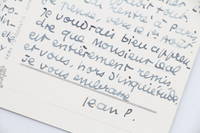
"Il fait ici une chaleur inhumaine. De plus il y a trop de gens très riches."" Signed autograph postcard addressed from Capri to Felia Leal
Capri 1955. Fine. Capri s. d. circa 1955 15 x 10.50 cm une carte postale Autograph postcard signed by Jean Paulhan 30 lines written in blue ink on the verso of a photographic reproduction showing a view of Capri addressed to publisher Felia Leal notably of the work ""Paroles transparentes"" a work by Jean Paulhan illustrated by Georges Braque. She also wrote children's tales. Jean Paulhan shares his mixed impressions of Italy its landscapes and monuments: ""Il faut renoncer aux paysages trop beaux.Pour les églises et les monuments la meilleure solution je crois serait d'y jeter un coup d'oeil de bien recevoir le choc et puis s'en aller. L'attention affaiblit tout."" ""One must give up landscapes that are too beautiful.For churches and monuments the best solution I believe would be to glance at them receive the shock properly and then leave. Attention weakens everything."" unknown
Référence libraire : 84466
|
|
|
Alphonse de CHATEAUBRIANT
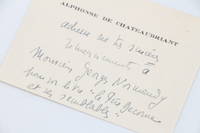
Carte de visite autographe signée adressée à Georges Normandy
s. l.: S. n. 1941. Fine. S. n. s. l. s. d. 1941 9.50 x 7.50 cm une feuille Autograph signed carte de visite by Alphonse de Chateaubriant 5 lines written in blue ink addressed to Georges Normandy thanking him for having sent him his work ""Le père Decorne et ses semblables"" recently published. A small black ink stain in the upper right margin of the card thin adhesive strips in the right and left margins of the verso of the card. S. n. unknown
Référence libraire : 84462
|
|
|
Pierre LOTI
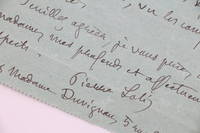
Billet autographe signé de Pierre Loti adressé à Julia Daudet
Paris 1908. Fine. Paris 1er Juillet 1908 11.50 x 14 cm une feuille Autograph signed note by Pierre Loti signed and addressed to Julia Daudet wife of Alphonse 12 lines in black ink on a pneumatic card Inherent fold mark a date has been inscribed in pencil probably that of the note's receipt. Pierre Loti wishes to meet Julia Daudet and asks about her availability: ""Are you still in Paris"" ""You would be infinitely kind to indicate one or two hours for an appointment given the complications of my life."" unknown
Référence libraire : 84543
|
|
|
Julien GRACQ
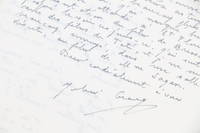
"J'ai surtout revu des films de Tati et je me suis beaucoup ennuyé dans une salle déserte au film de Mme Sagan."" Important autograph letter signed by Julien Gracq addressed to his close friend and monographer Ariel Denis offering him to be the author of his biography in Seghers' collection Poètes d'aujourd'hui and on the films he has recently seen
Paris 1978. Fine. Paris s. d. 1978 14.50 x 20.50 cm une feuille Important autograph letter signed by Julien Gracq 53 lines in black ink addressed to his close friend and monographer Ariel Denis establishing him as his biographer. Julien Gracq expresses his regret that his friend Ariel Denis was not selected despite his intervention by the Berlin Academy to teach: ""Je vous avais recommandé de mon mieux mais je doute que cela ait été en Allemagne d'une grande efficacité. Je sais d'ailleurs que comme vous le pressentiez les concurents étaient en nombre."" ""I recommended you as best I could but I doubt that was very effective in Germany. I know moreover that as you suspected there were many competitors."" To help his friend the author of Rivage des Syrtes suggested to publisher Seghers who wanted to publish a work about him in his famous ""Poètes d'aujourd'hui"" collection the name of Ariel Denis having had no news from the first biographer considered for this publication: ""Ils me demandent de leur suggérer un nom. J'ai indiqué celui de Lautrat. Et j'ai indiqué le vôtre ne sachant bien sûr aucunement si un travail de ce genre pourrait vous plaire. Il va de soi que si Seghers s'adressait à vous vous devez être absolument libre d'accepter ou de refuser."" ""They ask me to suggest a name. I indicated Lautrat's. And I indicated yours not knowing of course at all whether work of this kind might please you. It goes without saying that if Seghers approached you you must be absolutely free to accept or refuse."" He also hopes to see his friend again soon before the summer holidays: "". si je ne vous revois pas avant juillet je vous souhiate des vacances à la fois paisibles et laborieuses en comptant vous revoir d'ici l'automne."" "".if I don't see you again before July I wish you holidays that are both peaceful and productive counting on seeing you again by autumn."" He concludes his letter with his judgments as an informed cinephile: ""J'ai surtout revu des films de Tati et je me suis beaucoup ennuyé dans une salle déserte au film de Mme Sagan."" ""I mainly rewatched Tati films and I was very bored in a deserted theater by Mme Sagan's film."" At Julien Gracq's instigation Ariel Denis would indeed accept Seghers' proposal to publish a volume in his ""Poètes d'aujourd'hui"" collection about the author of Au château d'Argol thereby becoming one of his best and most remarkable biographers. unknown
Référence libraire : 84596
|
|
|
Jean COCTEAU - (to Jean MARAIS)
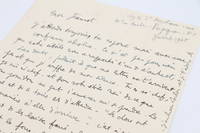
"Ce n'est pas pour rien que notre étoile nous a rapprochés l'un de l'autre"" Autograph letter addressed to his great love Jean Marais
Perpignan 1940. Fine. Perpignan juillet 1940 21 x 27 cm deux pages sur un feuillet Autograph letter by Jean Cocteau signed with his famous star addressed to his great love the actor Jean Marais. Dated by the author July 1940. One and a half pages in black ink on a sheet. Two small marginal tears not affecting the text. Traces of transverse folds inherent to posting. Magnificent love letter from Cocteau to Marais who formed one of the most legendary artistic couples of the 20th century. Against the backdrop of defeat and German Occupation their unbreakable bond is embodied in this letter from the writer with its desperate accents. Published in the Lettres à Jean Marais 1987 p. 157. This missive from a love-stricken Cocteau was written shortly after the Armistice of June 22 1940 marking the end of the French defeat. Marais mobilized had joined the front in May 1940 while Cocteau had taken refuge in Perpignan. Communication in these troubled times proved difficult: ""Mon Jeannot j'attends toujours ta réponse mais avec une confiance absolue. Ce n'est pas pour rien que notre étoile nous a rapprochés l'un de l'autre et sans doute fallait-il que mes lettres ne t'arrivent pas et que je souffre de mon silence"" ""My Jeannot I am still waiting for your response but with absolute confidence. It is not for nothing that our star brought us closer to one another and no doubt it was necessary that my letters not reach you and that I suffer from my silence"" ""Tu es né chef je suis né chef. Et sous notre étoile rien de ce que nous . ne peut s'annexer ni se perdre. Le principal est de se taire et d'attendre. entre guillemets : les choses ont une manière à elles d'arriver."" C'est à nous de le savoir et de les laisser faire ."" ""You were born a leader I was born a leader. And under our star nothing of what we . can be annexed or lost. The main thing is to remain silent and wait. in quotation marks: things have their own way of happening."" It is up to us to know this and let them do so ."" The Cocteau - Marais partnership would soon return to Paris and endure the torments of the German occupation which would ban the revival of their scandalous play Les Parents terribles which had enjoyed great success in 1939. unknown
Référence libraire : 84633
|
|
|
Jacques MESRINE
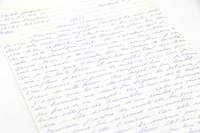
"Tu sais j'ai bien réfléchi pour le bouquin. il doit y avoir veto quelque part. car s'il était publié cela retarderait mes procès ou un truc dans ce genre."" Autograph letter signed by Jacques Mesrine written from the prison of Fleury-Mérogis on the evening of New Year's Eve on December 31 1976 addressed to his companion Jeanne Schneider whom he nicknamed Nanou d'amour in connection with the publication of his book L'Instinct de mort
Fleury-Mérogis 1976. Fine. Fleury-Mérogis 31 Décembre 1976 21 x 29.50 cm une page recto verso Autograph letter dated and signed by Jacques Mesrine dated Friday December 31st 1976 approximately 70 lines in blue ink on one recto verso page addressed to his love of the time Jeanne Schneider thanks to whom the manuscript of Instinct de mort was discreetly smuggled out of prison. Jacques Mesrine then incarcerated at Fleury-Mérogis prison wondered about the difficulties he might encounter if his Instinct de mort were to appear soon and with which sufficiently courageous publisher it could be edited: ""Je vais voir avec mon avocate pour les ""presses de la cité"" car je crois que l'on peut tirer un trait sur Simone. De toute façon il sera publié par celui acceptera d'en courir le risque"" ""I'm going to see with my lawyer about the ""presses de la cité"" because I think we can draw a line under Simone. In any case it will be published by whoever will accept to run the risk"" He also advised his beloved on her working conditions: ""Au sujet de ton boulot. j'espère que tu as discuté avec ta patronne car les horaires ne sont pas légaux. ne te laisse pas faire à ce sujet. Vis à vis du procureur tu es obligé de travailler. cela ne veut pas dire être esclave au boulot."" ""About your job. I hope you discussed with your boss because the hours are not legal. don't let yourself be taken advantage of on this subject. With regard to the prosecutor you are obliged to work. that doesn't mean being a slave at work."" and worried about the future of his daughter Sabrina: ""Demain j'espère la visite de la puce. je vais avoir une très sérieuse conversation avec elle au sujet de l'avenir. Car elle ne fait rien en classe. donc le mieux pour elle est de travailler pour obtenir un CAP en quelque chose. Elle veut jouer les adultes. alors il va falloir qu'elle se conduise en adulte."" ""Tomorrow I hope for a visit from the little one. I'm going to have a very serious conversation with her about the future. Because she does nothing in class. so the best thing for her is to work to get a vocational certificate in something. She wants to play at being an adult. so she'll have to behave like an adult."" Public enemy No. 1 evoked the coming new year: "".l'année nouvelle qui s'annonce. que nous réservera-t-elle. je l'ignore mais rien de bon si la logique se fait loi. cela ne m'empêchera pas de garder mon moral."" "".the new year that is coming. what will it hold for us. I don't know but nothing good if logic becomes law. that won't stop me from keeping my morale up."" Jacques Mesrine alone in his cell on the evening of December 31st New Year's Eve ended this beautiful letter with affectionate thoughts for Jeanne Schneider: ""Ce soir j'ai la tête un peu vide. tu comprends mais j'ai le coeur plein de toi et c'est cela qui compte. je vais me mettre dans les draps et penser à toi. Ton vieux voyou pose de tendres bécots sur tout ce qui est toi. Bonne nuit chaton. Te quiero."" ""Tonight my head is a bit empty. you understand but my heart is full of you and that's what counts. I'm going to get into the sheets and think of you. Your old rogue places tender kisses on everything that is you. Good night kitten. Te quiero."" and with this humorous note: "".tu connais cette blague : c'est une femme condamnée à mort. arrivée devant la guillotine elle embrasse le verre que l'on vient de lui servir. Le procureur demande : ""elle est folle que fait-elle"". L'avocat lui répond ""elle embrasse son dernier rhum"" Pas mal hein. un petit sourire ma puce."" "".do you know this joke: it's a woman condemned to death. arrived in front of the guillotine she kisses the glass that has just been served to her. The prosecutor asks: ""is she crazy what is she doing"". The lawyer replies ""she's kissing her last rum"" Not bad eh. a little smile my darling."" Rare and very beautiful letter from Jacques Mesrine in which we see him preoccupied with his daughter's future where he sho unknown
Référence libraire : 84696
|
|
|
Jacques MESRINE
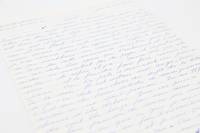
"Je ne veux plus te voir en prison car toi dehors c'est un peu de moi même qui sera libre. Tu donnes une parole pour cette liberté. prouve que nous autres la tenons toujours en bien comme en mal. C'est ce qui nous unit le plus ; voyous dangereux . mais droits"" Autograph letter dated and signed by Jacques Mesrine written from the prison of Fleury-Mérogis addressed to his companion Jeanne Schneider who was then incarcerated and who could soon be released
Fleury-Mérogis 1976. Fine. Fleury-Mérogis 21 Octobre 1976 21 x 29.50 cm une page recto verso Autograph letter signed and dated by Jacques Mesrine dated Thursday October 21 1976 70 lines in blue ink on one recto-verso page addressed to his lover at the time Jeanne Schneider thanks to whom the manuscript of Instinct de mort was discreetly smuggled out of prison. Jacques Mesrine then incarcerated at Fleury-Mérogis prison rejoices at having been able to speak with his beloved in the visiting room who was also imprisoned: ""What a very pleasant visit you were moreover very feminine in that outfit which is very much in your style as a woman. even worth double the price because I like it"" and attempts to reassure her so that she does not lose all fight against the prison system that crushes inmates: ""But if by misfortune a new refusal should affect you do not have that bad reaction you told me about because those who surround you and have helped you do not deserve to pay for the injustice of others. You will have to face it as always. Because the doors will open one day and you know it."" As a protective patriarch Jacques Mesrine worries about the despair that could strike her and her daughter Murielle placed with social services: ""But I worry enormously about you because you have a limit. and I believe you have reached it! or almost. Regarding Mury and that bogus judge. we will see about removing her from social services. I prefer to pay for her studies and Mrs. Chevallier and all her upkeep if necessary. If you get out! Tell me. so many women to support. I'd better work overtime sic"" Public enemy No. 1 evokes Jeanne Schneider's upcoming freedom while ordering her not to fall back into criminality: "".If you get out formal prohibition from getting involved with me on a level that we both understand very well. I don't want to see you in prison anymore because you outside is a little bit of myself that will be free. You give your word for this freedom. prove that we others always keep it in good times as in bad"" Jacques Mesrine praises his companion's integrity the keystone of their strong union through the deprivation of freedom: ""This is what unites us most; criminals dangerous. but honest. This is what makes me love you with you no unpleasant surprises; you are 'white-blue' and for me you have the value of a diamond. It is the only stone that is harder than steel sic. but less hard than me resic"" He ends this missive with this humorous note reflecting the terrible intrusive reality of the penitentiary system: ""And if my Christmas package is prepared by you. the administration will X-ray it"" but also with these tender words: ""Sweet kisses rest on your lips. gesture of love that has united us always and for a long time. EL VIEJO Bandido!"" Rare and very beautiful letter from Jacques Mesrine in which we discover him protective and eager for freedom for his companion and for whom honesty must be erected as a rule of life. unknown
Référence libraire : 84739
|
|
|
Jacques MESRINE
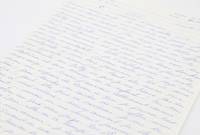
"J'ai reçu une lettre de Betty qui me remercie car je lui ai offerte une mobylette. Pourquoi me diras-tu Tout simplement parce que j'aime voir les enfants heureux et je crois que leur bonheur m'est nécessaire. Cette môme me plaît de par sa mentalité."""" Autograph letter written from the Santé prison dated and signed by Jacques Mesrine addressed to his companion Jeanne Schneider whom he nicknamed Nanou d'amour
Paris 1976. Fine. Paris 11 Octobre 1976 21 x 29.50 cm une page recto verso Autograph letter dated and signed by Jacques Mesrine dated Monday October 11 1976 70 lines in blue ink on one recto-verso page addressed to his love of the time Jeanne Schneider thanks to whom the manuscript of Instinct de mort was discreetly smuggled out of prison. Jacques Mesrine then incarcerated at La Santé showers with gifts the people he loves because he wants their happiness: ""Comme cela j'ai payé une mobylette à mes trois gamines. Toi ce sera une quatre roues sic."" ""Like this I paid for a moped for my three girls. For you it will be four wheels sic."" He shows all his affection for a young girl named Betty whom he seems to cherish more than his own daughter Sabrina: ""Peut-être que je recherche en Betty ce que je ne trouve pas en Sabrina et que Mury m'a refusé ! Tu sais mon ange ; à 15 ans j'aurais tellement aimé avoir un copain de 40 ans à qui je puisse tout dire qui sache m'aider ou m'offrir mon rêve. Peut-être que ce cadeau je me le fais à moi-même."" ""Maybe I'm looking for in Betty what I don't find in Sabrina and what Mury refused me! You know my angel; at 15 I would have loved so much to have a 40-year-old friend to whom I could tell everything who would know how to help me or offer me my dream. Maybe this gift I'm giving it to myself."" for whom he has no more confidence feeling betrayed: ""Mais on ne devient jamais l'ami de quelqu'un qui vous juge. Pas plus que pour Sabrina ! qui elle m'a trompé dans ma confiance donc dans mon amour. Quand on use les sentiments ils ne redeviennent jamais les mêmes."" ""But one never becomes the friend of someone who judges you. No more than with Sabrina! who deceived my trust and therefore my love. When feelings are worn out they never become the same again."" Public enemy No. 1 takes great pride in his relationship with Jeanne Schneider based on honesty: ""C'est peut-être pour cela que je me suis toujours refusé à te mentir - quitte à te faire souffir. Je n'ai aucun passé.mais un seul présent ""Toi"". C'est peut-être cela qui fait que notre amour dure depuis 10 ans "" ""Maybe that's why I've always refused to lie to you - even if it means making you suffer. I have no past.but only one present 'You'. Maybe that's what makes our love last for 10 years "" Jacques Mesrine then turns to material considerations so important for a prisoner: ""J'ai reçu ton linge. Je ne risque pas d'avoir froid cet hiver. Le polo est très bien."" ""I received your clothes. I won't risk being cold this winter. The polo shirt is very good."" before castigating the inhumanity of the prison system and its indifference to suffering: ""Mais nous n'avons rien à attendre des juges et si ma lettre au président a été ferme c'est le genre de lettre qu'il comprendra mieux que le style ventre à terre."" ""But we have nothing to expect from judges and if my letter to the president was firm it's the kind of letter he will understand better than the groveling style."" As an eternally untamed man Jacques Mesrine never ceases to advocate fighting against the prison administration: ""On ne se défend pas en mettant sa tête dans le sable comme l'autruche ! Dès l'instant où l'on prend une arme dans la main. il faut s'attendre à payer ! que Michou le comprenne ce n'est pas le moment d'être ""bébé"" mais celui d'être femme."" ""You don't defend yourself by putting your head in the sand like an ostrich! From the moment you take a weapon in your hand. you must expect to pay! let Michou understand this is not the time to be a 'baby' but to be a woman."" Jacques Mesrine ends this beautiful letter with a moving declaration of love full of optimistic humor: ""Ton vieux tigre pose de doux bécots sur tout ce qui est toi. Bonne nuit chaton et un moral d'acier est de rigueur ok. Je t'adore chanceuse & Ton mystère Jacques !! ""Te adoro A toi seule."" ""Your old tiger puts gentle kisses on everything that is you. Good night kitten and a steel hardcover
Référence libraire : 84675
|
|
|
Jacques MESRINE
"Il n'y a pas de cause perdue d'avance. Dans la vie il faut se battre jusqu'au bout. tu sais pourtant ce que cela représente. Tu vois moi je vais au maximum ! et pourtant je vais me défendre toutes dents dehors. Car ma liberté il faudra me la prendre. Je ne la donnerai pas faute de combat ! "" Autograph letter written from the Santé prison dated and signed by Jacques Mesrine addressed to his companion Jeanne Schneider whom he nicknamed Nanou d'amour
Paris 1976. Fine. Paris 12 Octobre 1976 21 x 29.50 cm une page recto verso Autograph letter dated and signed by Jacques Mesrine dated Tuesday October 12 1976 70 lines in blue ink on one recto-verso page addressed to his love of the time Jeanne Schneider thanks to whom the manuscript of Instinct de mort was discreetly smuggled out of prison. Jacques Mesrine then incarcerated at La Santé shows great tenderness and reveals himself in another light that of the affectionate and attentive lover: ""Bonsoir petite fille. tu aimes bien jouer ""au St Bernard"" tu ne changeras jamais à ce sujet. C'est toi qui a 7 ans 1/2 de taule et tu dois remonter le moral des ""gamines"" qui ont joué du calibre !"" ""Good evening little girl. you like to play 'the St Bernard' you'll never change about that. You're the one who has 7 and a half years of jail and you have to cheer up the 'girls' who played with guns!"" He praises and is somewhat amazed by his companion's devotion to a couple of young criminals: ""Tu me parles d'une sentence de 20 ans pour elle ! tu rigoles ou quoi. elle ne peut pas prendre plus de 8 ans je la vois plutôt avec 5 ou 6 si les choses s'arrangent. Son mari avec 20 ans au maximum."" ""You talk to me about a 20-year sentence for her! are you kidding or what. she can't get more than 8 years I see her more with 5 or 6 if things work out. Her husband with 20 years maximum."" and tries to transmit all his optimism his pugnacity and to cheer her up: ""Tu sais ma puce; quand tu m'écris que la cause de Michou est une cause perdue d'avance je ne te comprends plus. Il n'y a pas de cause perdue d'avance. Dans la vie il faut se battre jusqu'au bout. tu sais pourtant ce que cela représente. Tu vois moi je vais au maximum ! et pourtant je vais me défendre toutes dents dehors. Car ma liberté il faudra me la prendre. Je ne la donnerai pas faute de combat !"" ""You know my darling; when you write to me that Michou's cause is a lost cause from the start I don't understand you anymore. There is no lost cause from the start. In life you have to fight to the end. you know what that represents though. You see I'm going for the maximum! and yet I'm going to defend myself tooth and nail. Because my freedom will have to be taken from me. I won't give it up for lack of fighting!"" Jacques Mesrine also evokes his love of horse racing while boasting of being a betting specialist: ""Oui j'avais joué ""Dernier tango"" mais seulement à la place. J'avais 2000frs dessus je gagne donc 6000frs. Ce n'est pas de la chance mais un savant calcul. Il m'arrive de perdre mais avec ma méthode je suis obligé d'être gagnant. Forécement pour la suivre il faut un certain capital. J'ai mis plus d'un an à faire tous les calculs de probabilité. Cela doit me rapporter à peu près 7000frs par mois. Net d'impots sic."" ""Yes I had bet on 'Dernier tango' but only for place. I had 2000frs on it so I win 6000frs. It's not luck but a scientific calculation. I sometimes lose but with my method I have to be a winner. Obviously to follow it you need a certain capital. I spent more than a year doing all the probability calculations. It should bring me about 7000frs per month. Net of taxes sic."" He ironizes about his situation as a prisoner having plenty of time to devise his financial gain strategies: ""J'ai aussi mis au point une méthode pour le jeu de baccara. Que veux-tu. j'ai le temps de calculer un tac de choses sic ! Tu me comprends . L'administration aussi ! resic. "" ""I also developed a method for baccarat. What do you want. I have time to calculate a bunch of things sic! You understand me . The administration too! resic."" but deplores his impossibility to continue writing Instinct de mort: "". je suis actuellement incapable d'écrire une page de mon bouquin. je ne sais pas comment tourner ce passage-là. enfin je vais bien trouver la solution."" "". I am currently unable to write a page of my book. I don't know how to phrase this passag unknown
Référence libraire : 84669
|
|
|
Jacques PERRET
Lettre autographe adressée à Roger Nimier
s. l. 1960. Fine. s. l. s. d. ca 1960 13.50 x 18 cm une page Autograph letter signed by Jacques Perret 33 lines in black ink addressed to a colleague probably Roger Nimier apologizing for being unable to attend a meeting organized by the review Arts. Fold marks inherent to posting. For lack of time Jacques Perret was unable to honor his promise to write a preface requested by his correspondent: "". if you are pressed for time and you have a replacement preface writer at hand have no scruples of course as I will not be able to deliver proper work before my return."" Jacques Perret then evokes his passion for rugby: ""On Rancoule's repositioning three-quarter wing of Stade Toulousain whom he later joined on the staff. I therefore had the joy of outflanking the Cardinal's defense and going for the try. It remains for me to convert it by going to embrace my dear Raoul in that army of Princes from whom we still await wonders."" Jacques Perret royalist writer fierce partisan of French Algeria and virulently anti-Gaullist was stripped of his civil rights then in 1963 struck from the military medal roll despite protests from some of his fellow writers suspects that his political positions do not favor honorary decorations: ""I think we were made to sign a manifesto manifestly designed to torpedo my ribbon."" unknown
Référence libraire : 84817
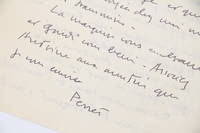
|
|
|
Alphonse de LAMARTINE
"Bonne chance ! Nous vous suivons du coeur. J'applaudirai de loin."" Autograph letter dated and signed about a journalist friend with whom he is happy to work
Mâcon 1846. Fine. Mâcon 26 Décembre 1846 13.50 x 20.50 cm une page sur un feuillet Autograph letter dated and signed by Alphonse de Lamartine; one page with his monogram blind-stamped in the upper left corner and written in black ink on one leaf 15 lines. Folds inherent to mailing. In this letter Lamartine shows his happiness to collaborate with their mutual friend's journal and confirms a financial agreement. unknown
Référence libraire : 84820
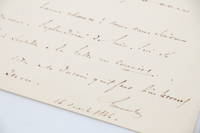
|
|
|
Jean-Baptiste CHARCOT
Lettre autographe datée et signée à propos d'une croisière tributaire des caprices de la météorologie Autograph letter dated and signed concerning a cruise subject to the whims of the weather
Pantelleria 1923. Fine. Pantelleria 22 Juin 1923 21 x 27 cm deux pages sur un feuillet Autograph letter dated and signed by Jean-Baptiste Charcot known as Commandant Charcot on Pourquoi pas letterhead 56 lines written in blue ink on a single leaf recto-verso addressed to his friend Raymond Hovasse. Folds from mailing ink faded. Adverse weather conditions prolonged a Mediterranean cruise that was initially meant to last only four days: ""Mais comme la caractérisation de cette croisière depuis que nous avons quitté la Provence est le coup de vent qui dure trois jours puis 1 jour de calme et de nouveau 3 jours de vent nous travaillons 1 jour et tachons de nous abriter qq. part pendant les 3 mauvais. Et cela peut durer longtemps ainsi."" The explorer nevertheless found some interest in this navigation disrupted and made difficult by the weather: ""Par ailleurs notre tournée n'a pas manqué de charme l'Orient en a toujours mais ce sale temps l'a empêché probablement d'être aussi fructueuse qu'elle aurait pu l'être le temps parce qu'il va falloir songer au retour."" This voyage also gave Jean-Baptiste Charcot the opportunity to become better acquainted with his friend and his family: ""J'ai été tout particulièrement enchanté d'avoir l'honneur et le plaisir d'être présenté à votre femme et de connaître vos gosses et d'entrer ainsi un peu dans votre vie familiale j'ai été également très heureux de vous avoir pendant qq heures à bord de nouveau."" which he hoped to repeat if the sea deities remained favorable: "". si le bateau reste jeune. si tous les maîtres de la mer me permettent de continuer."" Upon his return to Paris the navigator promised to intercede on his behalf and was confident that his efforts would be rewarded: "". je serais bien étonné si je n'obtenais pas satisfaction."" unknown
Référence libraire : 84822
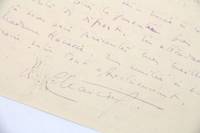
|
|
|
Renee GUILLOUX
"bien qu'il n'y ait pas de paroles écrites entre nous votre amitié m'apportait toujours sa même force et sa même joie."" A touching autograph letter signed about the friendship that Renée and Louis Guilloux still convalescent have for their correspondent
Angers 1929. Fine. Angers 25 Septembre 1929 13.50 x 20.50 cm quatre pages sur un feuillet double Autograph letter dated and signed by Renée Guilloux about friendship that transcends and sublimes human relationships 80 lines written in black ink on four pages. Folds inherent to mailing small tears at foot without any damage to the text. For Renée Guilloux the friendship she feels for her correspondent dominates distance and silence: "". est-ce que les mots ont su dire la joie des coeurs."" ""have words been able to express the joy of hearts."" and momentary disagreements: ""Mais tous ces mois toutes ces années nous pesaient douloureusement. J'avais l'impression que vous vous étiez mis d'un seul coup à parler très vite avec beaucoup d'agitation dans une langue qui m'était étrangère. mais je savais que ce n'était qu'un moment et qu'après nous reprendrions notre conversation rentable."" ""But all these months all these years weighed on us painfully. I had the impression that you had suddenly started speaking very quickly with great agitation in a language that was foreign to me. but I knew it was only a moment and that afterwards we would resume our profitable conversation."" Despite life's vicissitudes Louis Guilloux and his wife have always shown confidence in the brotherhood that unites them above all: ""J'attendais votre retour dans la certitude dans la paix et bien qu'il n'y ait pas de paroles écrites entre nous votre amitié m'apportait toujours sa même force et sa même joie."" ""I awaited your return with certainty in peace and although there were no written words between us your friendship always brought me the same strength and the same joy."" and in the serenity acquired after so many ordeals endured: ""Vous nous avez trouvés transformés dites-vous grandis. cette paix c'est notre conquête la plus belle. après les inquiétudes et les souffrances."" ""You found us transformed you say grown. this peace is our most beautiful conquest. after the anxieties and sufferings."" Renée Guilloux praises this radiating peace that she shares with her friend: ""Cette paix qui est en nous elle est aussi vôtre cher ami et vous avez grandi comme nous. je pense au rêve de Don Quichotte aux paroles qu'il echange avec Dulcinée. Elles sont pleines de cette lumière."" ""This peace that is in us it is also yours dear friend and you have grown like us. I think of Don Quixote's dream of the words he exchanges with Dulcinea. They are full of this light."" Finally she is reassured by her husband's health which is improving and which allows him to return to his writing work. unknown
Référence libraire : 84821
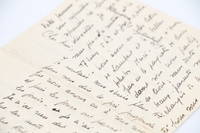
|
|
|
Jules BARBEY D'AUREVILLY
"Vous savez que je vous appartiens tête coeur et main & que toutes les différences d'opinion rendent l'amitié plus vive comme les contrastes passionnent l'amour."" Autograph letter dated and signed addressed to his friend Jean-Marie Dargaud
s. l. 1852. Fine. s. l. 22 Mars 1852 13.50 x 20.50 cm une feuille Fine autograph letter dated and signed by Jules Barbey d'Aurevilly addressed to historian Jean-Marie Dargaud 13 lines in black ink. Creases inherent to folding for posting. Jules Barbey d'Aurevilly shows great tact towards his friend also expressing all his affection: ""Je veux vous épargner en allant sous peu de jours vous voir chez vous une course longue et peut-être inutile. On ne me voit que le matin et encore les trois premiers jours de la semaine. J'irai donc vous voir."" ""I want to spare you by going to see you at your home in a few days a long and perhaps unnecessary journey. I can only be seen in the morning and only on the first three days of the week. I will therefore come to see you."" unknown
Référence libraire : 84884
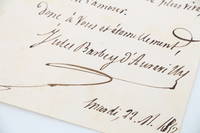
|
|
|
Jacques MESRINE
"j'ai eu la visite du juge Madre. Tu aurais rigolé car il a eu droit à tout mon vocabulaire."" Beautiful autograph letter dated and signed of revolt from Jacques Mesrine written from the prison of Fleury-Mérogis addressed to his companion Jeanne Schneider
Fleury-Mérogis 1976. Fine. ""Le pire que l'on puisse faire à un juge c'est lui enlever toute autorité devant les autres et crois moi il l'a bien compris"" ""The worst thing you can do to a judge is to remove all his authority in front of others and believe me he understood it well"" Fleury-Mérogis 2 Décembre1976 21 x 29.50 cm une page recto verso Autograph letter dated and signed by Jacques Mesrine dated Thursday December 2 1976 65 lines in blue ink on one recto-verso page addressed to his love at the time Jeanne Schneider thanks to whom the manuscript of Instinct de mort was discreetly smuggled out of prison. Jacques Mesrine then incarcerated at Fleury-Mérogis prison feels unwell and helpless far from his companion and from all human warmth: ""Ce soir je suis très mal foutu. il est 19 heures et je me couche juste après la fin de ta lettre. de rien de grave. juste une grande fatigue à rien faire"" ""Tonight I feel really awful. it's 7 PM and I'm going to bed just after finishing your letter. nothing serious. just very tired from doing nothing"" As a good father Jacques Mesrine rejoices in his daughter's happiness: ""Je suis heureux que sa veste lui plaise. de plus c'est la mode. son Loïc chéri ne va plus la reconnaître."" ""I'm happy that she likes her jacket. plus it's fashionable. her dear Loïc won't recognize her anymore."" and shows himself neither surprised nor more than amused that his daughter wants to embrace the Jewish religion: ""Comme cela la puce veut prendre la religion juive. encore une idée à elle. oui je sais elle a fait croire à ses copains qu'elle était juive. car eux l'étaient.si cela l'amuse je la laisse libre. mais ça démontre aussi un dédoublement de personnalité."" ""So the little one wants to take up the Jewish religion. another one of her ideas. yes I know she made her friends believe she was Jewish. because they were. if it amuses her I leave her free. but it also shows a split personality."" Public enemy No. 1 evokes with a certain pride his latest confrontation with his judge a fierce revenge of the insubordinate against the penitentiary universe that crushes men: ""Aujourd'hui j'ai eu la visite du juge Madre. Tu aurais rigolé car il a eu droit à tout mon vocabulaire. il en perdait la parole j'ai pris mon pied sic A un moment il me dit ""mais c'est quand même moi qui commande. Réponse de ton bibi : ""Ici pédé"" c'est moi ton patron"". Il était vert et les flics se marraient comme des perdus."" ""Today I had a visit from Judge Madre. You would have laughed because he got my full vocabulary. he was speechless I had a ball At one point he tells me 'but I'm still the one in charge. Your boy's response: 'Here faggot I'm your boss.' He was green and the cops were laughing like crazy."" and against all submission to any form of power or violence: ""Le pire que l'on puisse faire à un juge c'est lui enlever toute autorité devant les autres et crois moi il l'a bien compris. Il était venu avec 5 anti-commandos. L'un avait la bombe de gaz à la main. au cas où Loin d'être impressionné. cela me rend con."" ""The worst thing you can do to a judge is to remove all his authority in front of others and believe me he understood it well. He had come with 5 anti-commandos. One had the gas canister in his hand. just in case Far from being impressed. it makes me crazy."" The eternal rebel ends his letter with a beautiful testimony of tenderness for his beloved: ""Là ma puce je vais prendre mon lit en marche.Ton vieux voyou pose ses lèvres sur le tiennes en une douce caresse d'amour. je t'adore petite fille. car nous sommes réellement le ""couple"" et plus encore. Bonne nuit chaton."" ""There my little one I'm going to take to my bed. Your old rogue places his lips on yours in a sweet caress of love. I adore you little girl. because we are truly the 'couple' and even more. Good night kitten."" Rare and very fine letter by Jacques Mesrin unknown
Référence libraire : 84900
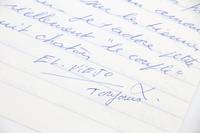
|
|
|
Marcel PROUST - (a Rene PETER)
"je leur souhaite toutes les voluptés depuis les plus hautes jusqu'aux plus grossières"" Signed autograph letter addressed to René Peter
s. l. 1904. Fine. Because I also want success I am extremely material in my wishes for those I love and I wish them every pleasure from the highest to the crudest. s. l. mardi 25 octobre 1904 12.60 x 20.40 cm 12 pages sur 3 bifeuillets Autograph letter signed by Marcel Proust addressed to René Peter. Twelve pages written in black ink on three bifolia framed in black. Tears at the ends along the folds of the bifolia not affecting the text. Published in Kolb IV n°168. A very long letter from Proust full of innuendo to the playwright René Peter. Praising Peter's success Proust confesses to his own vanity as a writer and his literary ambitions. He subtly lets his jealousy for Peter's mistress shine through and declares his absolute devotion to Reynaldo Hahn. This is one of the first letters he sends to his childhood friend after recently reconnecting with him. Proust eternally plagued by ailments remains a recluse and apologizes for missing the rehearsal of Peter's new play Le Chiffon. Peter's three-act comedy with music by Reynaldo Hahn premiered at the Athénée the following month and was a huge success with around sixty performances before the end of the year. The young Proust relies on the glowing opinion of Hahn who had attended the rehearsals and the missive becomes a love letter for the composer and his impeccable judgement: ""Reynaldo told me that your play was delightful and ravishing which is not quite the same thing that he laughed and cried in it as he never laughs or cries in the theater and that the language was exquisite. Of that I was certain. But knowing nothing about you I couldn't know if you had dramatic genius. I am certain of it now because even if I do not know a judge as severe as ridiculously severe as Reynaldo I also do not know one who has more taste giving his enthusiasm very great value in my eyes. In a characteristic tangle of confession and denial Proust barely hides his ambitions and his quest for recognition. He hopes and prays for the same laurels he places on Peter's head: your poor and charming mother who like all those who love and who have lived life bruising all our tenderness has suffered so much is witnessing this great happiness these first rays of glory on your charming forehead which Vauvenargues says softer as the rising sun. I only speak of them in quotations having never known them myself! He will even end up instilling his own literary vocation into the fictional life of the narrator of In Search of Lost Time although the narrator's journey as a man of letters is more marked by disappointments than rays of glory so long awaited by Proust himself. However it culminates in Time Regained with an epiphany: the narrator now knows what to write and above all how to write it. The letter marks the beginnings of the Proust-Peter-Hahn trio whose complicity was such that they formed a special vocabulary of which only they had the secret. The river of words in this letter perfectly illustrates the undeniable link between desire and intellectual admiration: Because I also want success I am extremely material in my wishes for those I love and I wish them every pleasure from the highest to the crudest. Despite these displays of generosity the writer cannot however mask a certain jealousy towards Robert Danceny the fictional co-author of Le Chiffon who was none other than Peter's mistress Mme Dansaërt. Proust elegantly but explicitly refers to her: It makes me happy to think that the charming woman who I am assured is hiding under the male name of your collaborator shares half of your work. I am not talking about your success because whether she worked with you or not she would always have shared your success with her heart having I believe a deep friendship for you. Typical of a Proust transposing his desires through fiction the writer will form various dramatic and morbid scenarios between Peter and this young woman in the following years: I unknown
Référence libraire : 84876
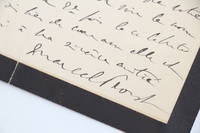
|
|
|
Pierre BENOIT
Lettre autographe signée à propos de son voyage en Orient et rédigée lors de son escale de Saïgon
Saïgon Hu Ngha 1961. Fine. Saïgon Hu Ngha 28 Février 1961 13.50 x 21 cm deux pages sur un double feuillet Autograph letter signed by Pierre Benoit on Messageries Maritimes letterhead 21 lines in black ink on tracing paper regarding his cruise in the Orient. Central fold marks perforations due to filing in a binder having caused the absence of the first letter of Paris on the fourth line of the letter. Pierre Benoit rejoices in his Oriental journey and the welcome he received; stopping in Saigon he prepares to sail toward Japan: ""ce qui nous assure là-bas un programme tout à fait au point."" ""which ensures us a perfectly organized program there"" unknown
Référence libraire : 84910
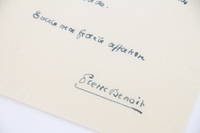
|
|
|
Pierre BENOIT
Lettre autographe datée et signée remerciant son correspondant
Ciboure 1961. Fine. Ciboure 28 Février 1961 13.50 x 20 cm une page Autograph letter signed by Pierre Benoit on letterhead from his property in Ciboure 14 lines in black ink. Central fold marks perforations due to filing in a binder having caused the absence of the first letter of Paris on the fourth line of the letter. Pierre Benoit recalls the recent passing of his wife Marcelle died on May 28 1960: ""Il y a neuf mois aujourd'hui que la pauvre Marcelle s'en est allée"" ""It has been nine months today since poor Marcelle passed away"" and hopes to meet his friend during his next visit to Paris in March. unknown
Référence libraire : 84909
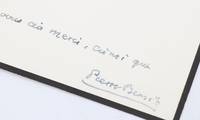
|
|
|
Maurice BARRES
Lettre autographe signée adressée à une amie
s. l.: S. n. 1890. Fine. S. n. s. l. s. d. ca 1890 11.50 x 17.50 cm un feuillet Autograph letter signed by Maurice Barrès on Chamber of Deputies letterhead 11 lines in black ink. Fold marks from original mailing. ""Madame et amie à la suite de la réunion j'ai compris qu'on vous y avait pas fait place. C'est strictemetn régulier. Mais c'est absolument peu courtois et par là bien injuste. Je vous exprime mes regrets et vais chercher un arrangement. Respect de votre ami Barrès. Vendredi soir"" Madam and friend / Following the meeting I understood that no place was made for you there. This is strictly regular. But it is absolutely discourteous and thereby quite unjust. I express my regrets and will seek an arrangement. Respectfully your friend Barrès. Friday evening S. n. unknown
Référence libraire : 85069
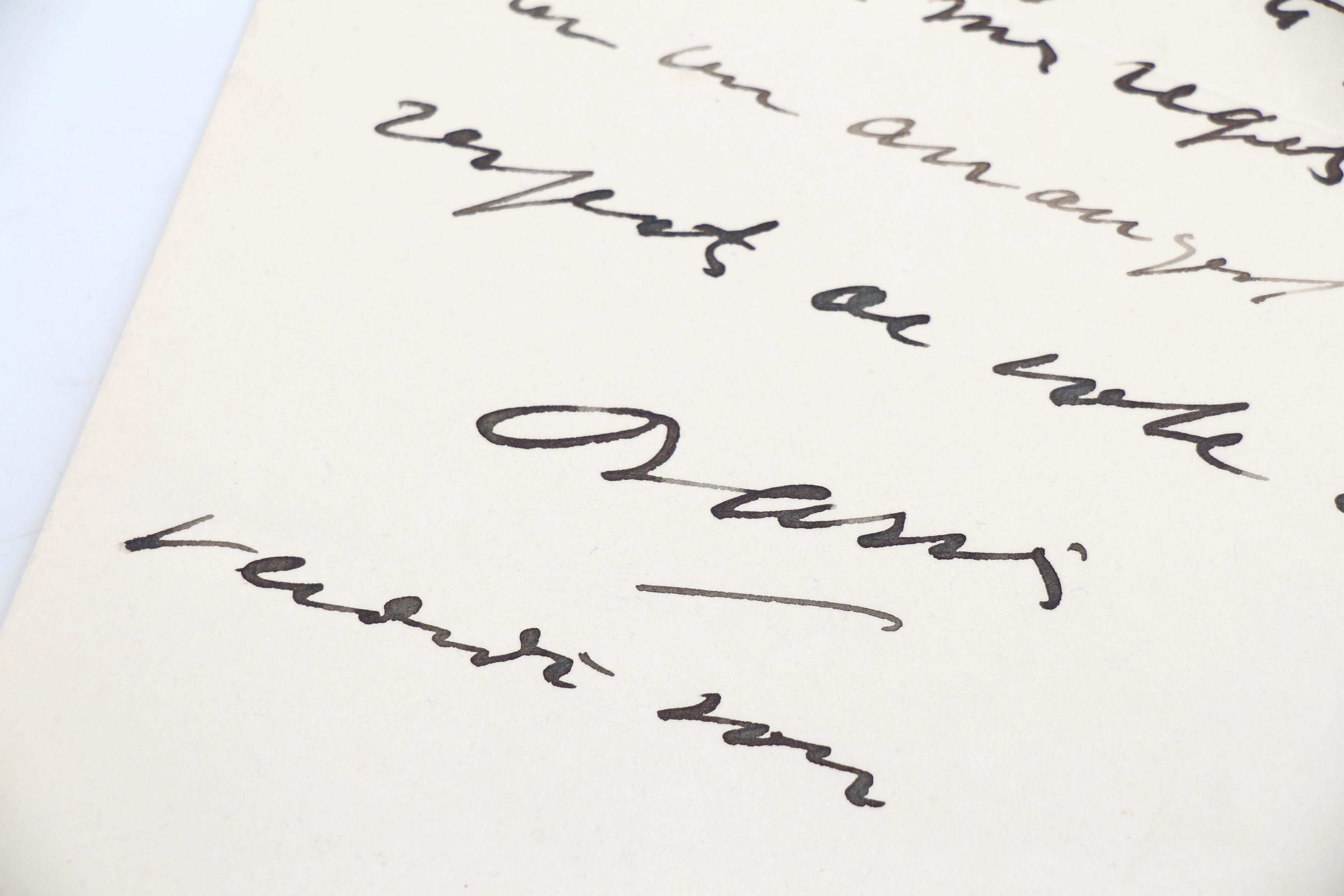
|
|
|
Henry MURGER
Lettre autographe signée à un éditeur
1850. Fine. circa 1850 15.50 x 20 cm une page Autograph letter signed by Henry Murger 5 lines in black ink to a publisher apologizing for a delay beyond his control. Some foxing. Traces of postal stamp in upper portion of the sheet. ""Comme on est venu chercher ma copie un peu tard . insistez je vous prie pour qu'il me les fasse adresser"" As they came to collect my copy rather late . please insist that he have them sent to me unknown
Référence libraire : 85080
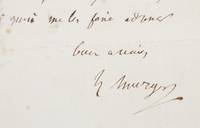
|
|
|
Jean GIONO
"Voulez-vous quelque chose pour Opéra de qualité d'assez sensationnel et qui fuisse faire sept à huit numéros."" Signed autograph letter addressed to Roland Laudenbach about a text he is to give to the magazine Opéra also directed by Roger Nimier
s. l. 1952. Fine. s. l. ca 1952 21 x 27 cm une feuille Autograph letter signed by Jean Giono 14 lines in black ink addressed to Roland Laudenbach who jointly ran the magazine Opéra with his friend Roger Nimier. Fold marks inherent to the mailing. ""Cher Roland j'y pense : Voulez-vous quelque chose pour Opéra de qualité d'assez sensationnel et qui fuisse faire sept à huit numéros peut-être plus à votre gré Le Journal. Le Journal de 1936 à 1949. Si cela vous plait parlez en avec Nimier pensez à un chiffre proposez le moi ça ira sûrement et c'est d'accord. Il y en a déjà pas mal de tapé ! Tout le journal l'être dans un mois. On pense à votre venue et on vous embrasse tous. Jean Giono."" Dear Roland I'm thinking: Would you like something for Opéra Something quality rather sensational that could run for seven to eight issues perhaps more as you wish The Journal. The Journal from 1936 to 1949. If this appeals to you discuss it with Nimier think of a figure propose it to me it will surely work out and we're in agreement. Quite a bit of it is already typed! The entire journal will be ready in a month. We're thinking of your visit and we all embrace you. Jean Giono. A very visual letter bearing Jean Giono's handsome signature. unknown
Référence libraire : 84966
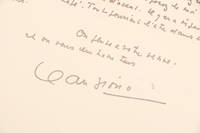
|
|
|
Remy de GOURMONT
"Si Paupe réclame de l'or c'est du brigandage. Il doit avoir une escopette sous le manteau."" Funny signed autograph note mocking his publisher
s. l. 1900. Fine. s. l. s. d. ca 1900 8.50 x 11.50 cm une page sur un feuillet double Autograph letter signed by Remy de Gourmont addressed to a writer with whom he collaborates 1 page on a double sheet 14 lines in black ink regarding a sum owed to a publisher: ""On lui doit 3 fr versables quand Ducoté aura donné les fonds du mois de juillet."" ""We owe him 3 francs payable when Ducoté has provided the funds for the month of July."" Two small stains on the verso of the autograph letter. unknown
Référence libraire : 84926
|
|

 Recevoir par e-mail
 Télécharger en PDF
 Flux RSS
 Lien permanent


