|
Roger CAILLOIS
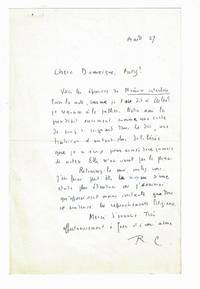
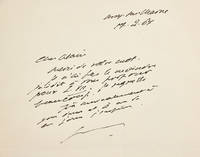
Lettre autographe signée adressée à Dominique Aury
Paris 1968. Fine. Paris Mardi 27 février 1968 13.50 x 20.90 cm une page sur un feuillet Autograph letter signed by Roger Caillois addressed to Dominique Aury; one page on a leaf written in blue ballpoint pen. Interesting letter concerning the article ""Mémoire interlope"" which would appear in issue 185 of the sixteenth year May 1968 of the Nouvelle Revue Française. At this time Marcel Arland and Jean Paulhan were both directors of the review which they had revived from its ashes in 1953. Roger Caillois's correspondent Dominique Aury also known under the pseudonym Pauline Réage sat on the Reading Committee of the famous Revue. This letter concerns a ""note"" that Roger Caillois asks Dominique Aury not to publish: ""Pour la note comme je l'avais dit à Arland je renonce à la publier. Notre ami la prendrait surement comme une sorte de coup de poignard dans le dos une trahison d'autant plus délibérée que je n'écris pour ainsi dire jamais de note. Elle n'en vaut pas la peine."" ""Regarding the note as I had told Arland I'm giving up publishing it. Our friend would surely take it as a sort of stab in the back a betrayal all the more deliberate since I practically never write notes. It's not worth it."" We could find no trace of this enigmatic note which Roger Caillois is impatient to recover: ""Retournez-la moi voulez-vous. J'en ferai peut-être le noyau d'une étude plus étendue où j'essaierai qu'apparaissent moins irritants que dans ce condensé les rapprochements litigieux."" ""Return it to me would you. I might perhaps make it the core of a more extended study where I will try to make the contentious connections appear less irritating than in this condensed version."" unknown
Referentie van de boekhandelaar : 75105
|
|
|
Jean COCTEAU
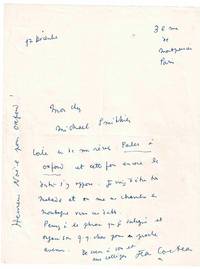
Lettre autographe signée à Michael Smithies : ""Voilà un de mes rêves : parler à Oxford et cette fois encore le destin s'y oppose.""
Paris 1955. Fine. Paris s. d. 17 décembre 1955 20.80 x 26.80 cm une page sur un feuillet Autograph letter signed by Jean Cocteau addressed to Michael Smithies. One page written in blue ballpoint pen. Two transverse folds inherent to the mailing. Interesting letter filled with disappointment: ""Here is one of my dreams: to speak at Oxford and once again fate opposes it. I have just been very ill."" One easily understands Cocteau's state of health following the sentence very confused: ""on me me chambre la montagne vers ces dates"". ""Think of the sentence I underline and let us organize something for the near future."" The poet's dream would be fulfilled the following year; promoted to the rank of doctor of letters honoris causa by Oxford University on June 12 1956 he would deliver the Discours d'Oxford on the 14th. unknown
Referentie van de boekhandelaar : 75873
|
|
|
Robert de MONTESQUIOU
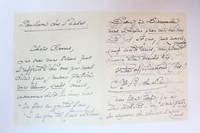
"Réglons-nous sur Sarah ! "" Autograph letter signed by Robert de Montesquiou signifying the joy he will have to meet his friends Lapauze despite the presence of a third and importunate person from their entourage
s. l.: S. n. 1905. Fine. S. n. s. l. s. d. circa 1905 15 x 19 cm trois pages sur une double feuille Autograph letter signed by the dandy count three pages 27 lines written in black ink to his friends the Lapauzes that he is delighted to see them again soon even if they impose upon him the presence of a certain Sarah who is not among the people the poet seems to appreciate: ""Dear friends I will not do you the affront of not telling you that I would have preferred just the two of you alone"" words underlined but as the beautiful verse says: You do what you do / What you do is right."" For this meeting arranged at the Petit Palais of which Henry Lapauze becomes curator in 1905 after having been assistant director for the four preceding years Robert de Montesquiou ""a late riser who has the cowardice - or if you prefer the wisdom to choose the afternoon"" timidly expresses in a surge of wounded pride and revenge that he already regrets the possibility of his absence: "".only a throat irritation carelessly treated and unexpectedly could keep me away at the last moment. But I don't want to believe it. Let us arrange ourselves around Sarah!"" Henry Lapauze 1867-1925 was a journalist art critic then in 1905 curator of the Petit Palais converted four years earlier into a museum and whose collections he considerably enriched by acquiring notably the Courbet Henner Falguière collections with at the twilight of his life a marked predilection for the Decorative Arts of which he was one of the ardent promoters. S. n. unknown
Referentie van de boekhandelaar : 74262
|
|
|
Guillaume APOLLINAIRE - (to Max JACOB)
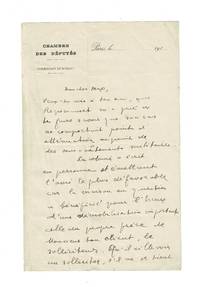
"Viens tout de même me voir dirait le père Janvier qui doit pour le moins parler aussi bien que le père de Victor Hugo"" Unpublished signed autograph letter addressed to Max Jacob
Paris 1918. Fine. Paris s. d. ca 1918 13.30 x 21 cm 2 pages sur un feuillet Unpublished autograph letter signed by Guillaume Apollinaire addressed to Max Jacob. Two pages written in black ink on a sheet with the letterhead of the Chamber of Deputies. Folds inherent to mailing. Unpublished letter concerning the deputy Charles Régismanset then Director at the Ministry of Colonies: ""Veux-tu dire à ton ami que Régismanset m'a prié de te faire savoir que son cas ne comportait point d'atténuation au point de vue des sous-vêtements militaires."" ""La colonie a écrit en personne et émettant l'avis le plus défavorable car la maison en question a bénéficié pour l'heure d'une démobilisation importante."" ""These 'colonies' are hardly distant. He is seconded to Rue Oudinot to the office of Minister Henri Simon who was pleased to be able to assist a poet he had long admired. His duties are rather vague. Assigned to the Press Service he oversees the Bulletin d'Informations coloniales et étrangères occasionally contributing discreetly a task that leaves him sufficient freedom for his own work. His direct superior Charles Régismanset himself a writer calls upon him whenever a 'bushman' passing through might provide information on Bambara customs or Guinean witch doctors."" Pierre-Marcel Adéma Guillaume Apollinaire ""Viens tout de même me voir dirait le père Janvier qui doit pour le moins parler aussi bien que le père de Victor Hugo surtout viens avant janvier et toujours plus haut Excelsior viens j'ai quelque chose d'éditorial à te dire."" unknown
Referentie van de boekhandelaar : 75931
|
|
|
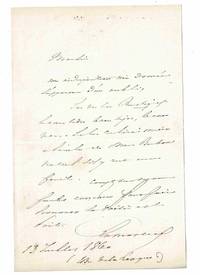
David d' ANGERS
Lettre autographe signée au peintre Armand-Tranquille Vastine
Paris 1850. Fine. Paris 23 décembre 1850 11 x 16.80 cm une page sur un double feuillet Autograph letter signed by David d'Angers to the painter Armand-Tranquille Vastine one page written in black ink on a double sheet. Transverse folds inherent to mailing. ""Je ne puis résister au plaisir de vous dire que je viens de voir votre tableau à l'exposition et que la puissante impression qu'il avait produit sur moi lorsque je l'ai vu dans votre atelier n'a fait que s'accroître j'espère bien qu'il sera remarqué comme il le mérite et qu'il vous ouvrira un avenir heureux et brillant."" ""I cannot resist the pleasure of telling you that I have just seen your painting at the exhibition and that the powerful impression it made on me when I saw it in your studio has only grown stronger I do hope it will be noticed as it deserves and that it will open a happy and brilliant future for you."" Armand Vastine was a student of Paul Delaroche. unknown
Referentie van de boekhandelaar : 75710
|
|
|
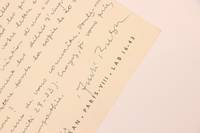
Andre BRETON - (Sarane ALEXANDRIAN)
Lettre autographe signée inédite adressée à Sarane Alexandrian
Paris 1947. Fine. Paris mercredi 12 mars 1947 20.80 x 27 cm 1 page sur un feuillet enveloppe jointe Unpublished autograph letter signed addressed to Sarane Alexandrian one page written in blue ink on a sheet with the letterhead of the 1947 International Exhibition of Surrealism. Envelope enclosed. This letter is a response to a letter sent the day before by Sarane Alexandrian partially accessible on the Breton Archives website. Born in Baghdad and engaged in the Resistance in the Limousin it was during this period that Sarane Alexandrian discovered Dadaism. At twenty years old he became André Breton's right-hand man and was entrusted by the latter with directing the secretariat of Cause in order to respond to applications from numerous young artists from around the world wishing to join the Surrealist movement. In October 1948 he broke with the pope of Surrealism while maintaining his esteem and admiration for him: ""Near him one learned the savoir-vivre of poets whose essential article is a savoir-aimer. We admired him for the dignity of his behavior as a writer thinking neither of prizes nor decorations nor academies"" Alexandrian André Breton par lui-même 1971. The letter we offer marks the beginnings of this ephemeral but important relationship between the two writers. André Breton twenty years Sarane Alexandrian's senior seems to place great hopes in this young theorist who takes interest in his writings: ""Max-Pol Fouchet has not yet had me read 'Poetry and Objectivity' but your letter tells me enough for me to believe in a profound accord between us an accord based less on the reception you give to what my message has been able to be until now than on the very nature of your personal project which largely coincides with mine."" As for ""Poetry and Objectivity"" he adds: ""I would see the greatest interest in publishing in the catalog of the Surrealist exhibition some pages by you in which the principal ideas expressed in your letter would need to be barely transposed and especially those which touch upon the creation of an 'erotic mystique'."" This publication taking the form of a manifesto would indeed see the light of day and appear in the review Fontaine produced for the occasion of the 1947 International Exhibition of Surrealism at the Galerie Maeght. The text would earn great success for young Alexandrian who would henceforth be considered by his peers as the number two theorist of Surrealism. A very fine letter marking the beginning of the important but ephemeral relationship between the two master thinkers of Surrealism. unknown
Referentie van de boekhandelaar : 74239
|
|
|
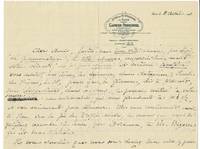
Robert de MONTESQUIOU
"Il me semble que vous me deviez bien cela pour ma peine."" Autograph letter dated and signed by Robert de Montesquiou to a friend Henry Lapauze inviting him to an Easter lunch
s. l.: S. n. 1911. Fine. S. n. s. l. 8 Avril 1911 27 x 21.50 cm deux pages sur une feuille Autograph letter dated April 8 1911 and signed by the dandy count of two pages on one recto-verso sheet 19 lines written in black ink inviting his friend Henri Lapauze and his wife for an Easter luncheon on the 18th of the current month at his property in the Landes near Vic-Bigorre. Robert de Montesquiou in order to secure his invited friend's decision and to facilitate his travel offers to put a vehicle at his disposal. But before this proposed Easter meal the poet plans to visit his friend very soon. Henry Lapauze 1867-1925 was a journalist art critic then in 1905 curator of the Petit Palais converted four years earlier into a museum and whose collections he considerably enriched by acquiring notably the Courbet Henner Falguière collections with at the twilight of his life a clear predilection for the Decorative Arts of which he was one of the ardent promoters. S. n. unknown
Referentie van de boekhandelaar : 74318
|
|
|
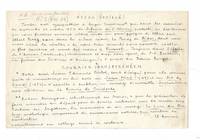
Andre BRETON
Manuscrit autographe de deux chroniques intitulées ""Assez souillé !"" et ""Courrier transpyrénéen""
1952. Fine. novembre 1952 20.90 x 13.40 cm une feuille André Breton autograph manuscript comprising two short texts titled ""Assez souillé !"" and ""Courrier transpyrénéen"" written for issue no. 1 of November 1952 of the journal Médium. 18 lines written in black ink in a careful hand on a white sheet. A tiny pinhole in the upper right margin of the sheet. ""Assez souillé !"" ""Enough soiled!"" recounts the reception given by the journal Médium to Céline's panegyric by Albert Paraz. The chronicle titled ""Courrier transpyrénéen"" ""Trans-Pyrenean Mail"" announces the publication of the latest work by critic Juan Eduardo Cirlot titled Surrealismo. Breton also mentions Robert Benayoun's work Le Livre du Non-Sens which would ultimately bear the title Anthologie du non-sens and appear in 1957 published by J.- J. Pauvert. unknown
Referentie van de boekhandelaar : 75167
|
|
|
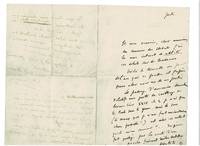
Gustave FLAUBERT
Lettre autographe signée adressée à l'archéologue Charles-Ernest Beulé
s. l. Paris 1860. Fine. s. l. Paris s. d. 5 ou 12 janvier 1860 13.60 x 21 cm deux pages sur un feuillet remplié Autograph letter signed by Gustave Flaubert addressed to the archaeologist Charles-Ernest Beulé. Two pages written in black ink on a folded sheet. The recipient of this letter added nine handwritten lines a draft of his future response following Flaubert's letter. This letter has been transcribed and reproduced on the website of the Flaubert Centre at the University of Rouen. The transcriber of this missive notes: ""Are the lines written under the signature by Beulé or by Flaubert himself The handwriting resembles his. Stéphanie Dord-Crouslé suggests that Flaubert may have gone to see Beulé and written these elements under his dictation in response to the questions posed."" This hypothesis seems unlikely to us given that we know Charles-Ernest Beulé's response to this letter itself digitized by the Flaubert Centre and dated February 10 1860. This response does not seem to us to suggest a visit by Flaubert to Beulé. It seems more likely to us that Beulé inscribed under Flaubert's letter a draft of his future response of February 10 1860 which would only be an elegant reformulation of his notes. Handsome and important testimony to the colossal research that Flaubert undertook for the writing of Salammbô. ""Begun in 1857 the novel appeared in 1862 a period when Antiquity was coming back into fashion and when Carthage was 'au goût du jour' ""in vogue"" thanks to the recent excavations by Charles-Etienne Beulé at Byrsa 1859 and in the Punic ports."" Vanessa Padioleau ""Flaubert et Carthage : Salammbô roman polymorphe"" ""Flaubert and Carthage: Salammbô polymorphic novel"" in Revue Flaubert n° 9 2009 It is therefore to one of the specialists on the subject that Flaubert addresses his questions commenting on his recent reading of Ammianus Marcellinus: ""J'ai appris dans ce même Ammien que les Carthaginois ont pris Thèbes en Egypte . Qu'est-ce que cela veut dire Ce passage est je crois peu connu "" ""I learned in this same Ammianus that the Carthaginians took Thebes in Egypt . What does this mean This passage is I believe little known"" Flaubert's task is no small one: at the time nothing or almost nothing was known about the period of the Mercenary Revolt which extended over two years from 240 to 238 BC. He then begins painstaking work basing his research on the texts of the great historians of Antiquity which he reads in Latin in the original. The letter we offer shows his great mastery of it: ""J'ai appris dans ce même Ammien que les Carthaginois ont pris Thèbes en Egypte livre xvii ch. iv. 'Hanc inter exordia pandentis se late Carthaginis improviso excursu duces oppressere Poenorum'"" ""I learned in this same Ammianus that the Carthaginians took Thebes in Egypt book xvii ch. iv. 'At the time when Carthage was beginning its wide expansion the generals of the Phoenicians conquered it by a surprise attack'"". Despite this most thorough research the gate of Carthage would receive only a very brief description in the final version of Salammbô. unknown
Referentie van de boekhandelaar : 75622
|
|
|
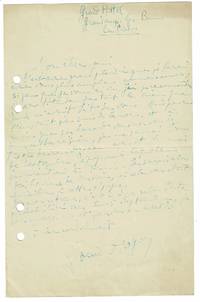
Louis ARAGON
Lettre autographe signée
Grandcamp-les-Bains Grandcamp-Maisy 1914. Fine. Grandcamp-les-Bains Grandcamp-Maisy s. d. ca 1914-1920 13.50 x 21 cm une page sur un feuillet remplié Autograph letter signed addressed to a correspondent whom we have not been able to identify. Written from the Grand Hôtel de Grandcamp-les-Bains Calvados in blue ink on a folded sheet of white paper. A transverse fold inherent to the posting of the letter and four small perforations affecting the text but not impeding its reading. The mention of Grandcamp-les-Bains - where Aragon seems to have been only once during the summer of his seventeenth year - and the signature - of an early form - lead us to think that the letter could have been written in the summer of 1914. Philippe Forest in his biography of Aragon confirms that it was indeed at Grandcamp-les-Bains where his family had rented fifty rooms in a large seaside hotel to accommodate family and friends that the future poet learned the news of mobilization. The handwriting less rounded than on manuscripts prior to the 1920s however seems to us later and we are therefore not in a position to confirm the date of 1914. unknown
Referentie van de boekhandelaar : 75566
|
|
|
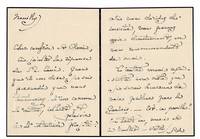
Robert de MONTESQUIOU
Lettre autographe signée de Robert de Montesquiou à son ami Henry Lapauze alors journaliste au Gaulois à propos de deux articles qu'il veut y voir publier
s. l.: S. n. 1895. Fine. S. n. s. l. s. d. circa 1895 12.50 x 17 cm deux pages et demie sur une feuille rempliée Autograph letter signed by the dandy count of two and a half pages 27 lines written in black ink insisting to his friend Henry Lapauze then journalist at Le Gaulois to see published a note he had sent him as well as the project of an interview with a certain Monsieur Lavé and the related arrangements: "". je suis persuadé que vous trouverez l'un comme l'autre intérêt et plaisir à l'entretien projeté. Vous pouvez agir directement en vous recommandant de moi."" "". I am persuaded that you will both find interest and pleasure in the projected interview. You can act directly recommending yourself through me."" Finally Robert de Montesquiou wishes to discuss with Madame Lapauze: "". un bien précieux recueil dont je veux lui parler comme il le mérite à savoir posément et passionnément."" "". a very precious collection of which I want to speak to her as it deserves that is to say calmly and passionately."" that she had sent him. Henry Lapauze 1867-1925 was a journalist art critic then in 1905 curator of the Petit Palais converted four years earlier into a museum and whose collections he considerably enriched by acquiring notably the Courbet Henner Falguière collections with at the twilight of his life a clear predilection for the Decorative Arts of which he was an ardent promoter. S. n. unknown
Referentie van de boekhandelaar : 74321
|
|
|
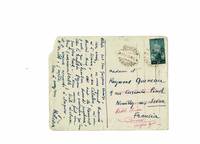
Jean HELION
Carte postale autographe signée adressée à Raymond Queneau
Venise Venice 1949. Fine. Venise Venice 13 septembre 1949 17.40 x 13.80 cm une carte postale Autograph postcard signed by Jean Hélion addressed to Raymond Queneau written in blue ink on the verso of a color reproduction of an old engraving depicting the Palio race on the Piazza del Campo in Siena. Marginal lacks and creases. ""Ne vous ayant trouvés ni à Sienna ni en Calabre ni au Harris-Bar ce sont les Rousset je crois que je ramène samedi prochain ! . Nous avons fait un tour invraisemblable Sicile incluse et je reviens remonté à claquer."" ""Not having found you either in Siena nor in Calabria nor at the Harris-Bar I think it's the Roussets that I'm bringing back next Saturday! . We took an incredible trip Sicily included and I'm coming back bursting with energy."" unknown
Referentie van de boekhandelaar : 75708
|
|
|
Samuel BECKETT - (to Alain BOSQUET)
Lettre autographe signée adressée à Alain Bosquet Handwritten signed letter addressed to Alain Bosquet
n. l.: s. n. 1967. Fine. s. n. n. l. 17 février 1967 21.50 x 27 cm une page sur un feuillet Handwritten letter signed by Samuel Beckett addressed to Alain Bosquet. Some lines written in black ink on watermarked paper. I do not have the slightest novelty to offer you . I very much regret. s. n. unknown
Referentie van de boekhandelaar : 75618
|
|
|
Jules ROMAINS
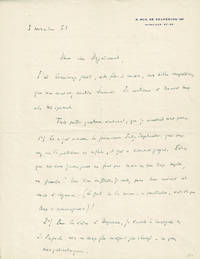
Lettre autographe signée adressée à André Dignimont
Paris 1951. Fine. Paris 3 novembre 1951 21 x 27.10 cm 2 pages sur un feuillet Autograph letter signed by Jules Romains to André Dignimont two pages penned in black ink on a sheet of his personal letterhead. Folding marks from mailing. An engaging letter in which Jules Romains corresponds with the painter Dignimont about the forthcoming illustrated edition of his sweeping novel cycle Hommes de bonne volonté: ""J'ai beaucoup pensé cette fois-ci encore aux belles compositions que vous nous avez montrées samedi. Je continue à trouver tout cela très important."" Romains' remarks are revealing as they highlight the divergence between how he envisioned his characters and how his friend interpreted them: ""Est-ce que nos deux jeunes gens ne font pas encore un peu trop rupin. . Je verrais de Marquis de St Papoul avec un visage plus maigre et plus allongé un peu donquichottesque."" He concludes with an apology for his demands: ""Hélas ! Je suis embêtant. Mais j'aime tellement vos compositions que je me permets d'y rêver comme si je les avais faites moi-même."" The illustrated edition would be published in 1954 by Flammarion marking the sole collaboration between the Académie Française member and the Montmartre painter. unknown
Referentie van de boekhandelaar : 75101
|
|
|
Gerard de NERVAL - Theophile GAUTIER - ANONYME
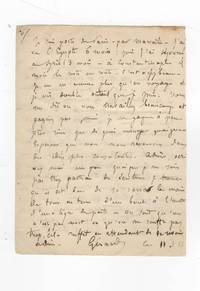
« Quelle tristesse que Paris quand on revient des pays éclairés du soleil. Bruxelles est encore plus noir pauvre garçon ! » Three autograph letters signed by Gérard de Nerval Théophile Gautier and a third writer addressed to Louis Desessart
Paris 1844. Fine. Paris 11 février 1844 10.40 x 13.60 cm quatre pages sur deux feuillets Three autograph letters signed by Gérard de Nerval 2 pages signed «Gérard» Théophile Gautier 1 page and a third unsigned letter 1 page penned by a certain «Robert» cf. Nerval's letter Louis Desessart Théophile Gautier's appointed publisher co-published Nervals play Léo Burckart with Barba in 1839. Following financial difficulties he was forced to take refuge «in that sad and charming city of Brussels». The three friends wrote this letter from Paris where they had reunited following Nervals long journey to the East: «I spent six months in Egypt; then three months in Syria four months in Constantinople and the rest en route. Its quite beautiful. I only enjoy myself while traveling and try to live twice as much as I can.» This journey deeply impressed Théophile Gautier who would only travel to Turkey and Egypt years later: «I am in Paris and wish I were in Cairo from where Gérard is returning.» The exoticism of distant lands starkly contrasts with the melancholy and severity of Europe: «How sad Paris is when one returns from sunlit countries.» Nerval And in Paris far from dreams of escape life means toil and melancholy: «We are like sick people who are never comfortable anywhere. I think the good times are gone and the golden hours of the past when we spoke such wise follies will never return. Whats the point of living if we must work and cannot see our friends or write to them or do anything we would like» Gautier The two writers express great compassion for their friends Belgian exile with Brussels appearing as the capital of spleen: «What! Youre still in that sad and charming city of Brussels! . Brussels is even darker poor fellow!» Nerval This joint letter was in fact initiated by «Robert»: «Isnt it true my dear friend that Im quite skilled at making you forget my faults . as a way of making it up to you Im sending you the autographs of two of your . comrades your fondest memories two men of fame who despite all their affection and friendship for you would never have written a word had I not trimmed their quills and handed them paper like sulky children and told them: write at once at once to the exile you love most.» unknown
Referentie van de boekhandelaar : 75148
|
|
|
Andre BRETON
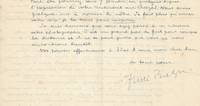
« Mais il faut continuer à vivre et pour cela se réserver une part de solitude qu'avec angoisse aussi je vois diminuer chaque jour. » Unpublished signed autograph letter addressed to Gaston Puel
Antibes 1948. Fine. Antibes 9 mars 1948 21.80 x 27 cm 2 pages sur un feuillet Unpublished autograph letter signed by André Breton addressed to Gaston Puel; two pages on one leaf written in blue ink with fine and careful handwriting numerous underlinings. Foxing and marginal adhesive traces. A very fine letter imbued with benevolence in which the Pope of Surrealism shares his numerous and time-consuming occupations with his young correspondent while reassuring him about his talent and future. Gaston Puel began corresponding with André Breton at the Liberation. They had never met at the time of this letter written four years later: « Je suis heureux que vous ayez pensé à m'adresser votre photographie. C'est un grand pas de fait pour rompre la distance et il ne se peut guère que nous ne nous rencontrions bientôt. » ""I am happy that you thought to send me your photograph. It is a great step towards breaking the distance and it can hardly be that we will not meet soon."" The two writers seem very close as evidenced by Breton's paternal and reassuring tone: « Ne parlez pas comme à regret de ceux qui avancent : vous en êtes et j'en sais bien peu qui soient si loin que vous déjà. Ce que vous m'écrivez - pas seulement cette fois - est toujours pour moi de haute importance. » ""Do not speak regretfully of those who advance: you are among them and I know very few who are already as far along as you. What you write to me - not just this time - is always of great importance to me."" A tireless worker Breton here shares his frustration and weariness with Puel: « Mais il faut continuer à vivre et pour cela se réserver une part de solitude qu'avec angoisse aussi je vois diminuer chaque jour. » ""But one must continue to live and for that reserve a share of solitude which I also see diminishing each day with anguish."" Gaston Puel then 24 years old had been participating for some time in the activities of the surrealist group around Joë Bousquet André Breton and René Char. His mentor here predicts a clear future for him: « Mon cher Ami je souhaite très vivement que vous preniez une part active à la rédaction de « Néon ». Il suffirait d'une très légère transposition de ton pour que les pages que vous m'adressez puissent y trouver place et en constituer un des éléments primordiaux. Il en va naturellement de même pour « Supérieur inconnu » si cette revue peut voir le jour. » ""My dear Friend I very much wish that you would take an active part in the editing of 'Néon'. It would only require a very slight transposition of tone for the pages you send me to find their place there and form one of its primordial elements. The same goes naturally for 'Supérieur inconnu' if this magazine can see the light of day."" This latter review meant to reconcile and unite the conservatives and innovators of surrealism would only come to light forty-eight years later under the impetus of Sarane Alexandrian. Gaston Puel would indeed join the editorial team of Néon but would eventually turn away from the surrealists - while maintaining his friendship with Breton - in 1950. unknown
Referentie van de boekhandelaar : 75175
|
|
|
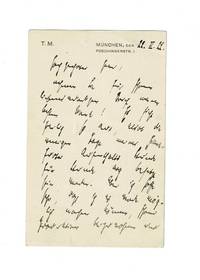
Thomas MANN
Carte postale autographe signée à Friedrich Karl Roedemeyer Signed autograph postcard to Friedrich Karl Roedemeyer
Munich 1922. Fine. Munich 22 février 1922 8.70 x 13.70 cm une carte postale Signed autograph postcard from Thomas Mann addressed to Friedrich Karl Roedemeyer written on both sides in black ink. Professor Friedrich Karl Roedemeyer 1894-1947 taught linguistics at Frankfurt University where he invited Thomas Mann for the Goethe Festival. This is a letter of apology from the writer announcing that he will unfortunately not be able to give the lecture he was supposed to deliver. unknown
Referentie van de boekhandelaar : 75905
|
|
|
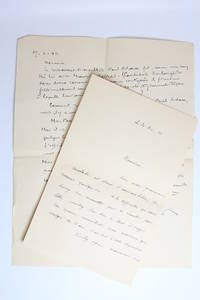
Felix FENEON
"Le romancier et occultiste Paul Adam fut comme vous savez très lié à Maurice Barrès."" Autograph letter signed by Félix Fénéon addressed to Gabriel Mourey
s. l. 1942. Fine. s. l. 17 février 1942 21 x 27 cm 2 feuilles Autograph letter signed by Félix Fénéon to Gabriel Mourey 18 lines in black ink folds from mailing. A key witness and actor of his time the art critic and collector Félix Fénéon assists the writer Gabriel Mourey in his search for the correspondence between Paul Adam and Maurice Barrès: ""Le romancier et occultiste Paul Adam fut comme vous savez très lié à Maurice Barrès. Candidats boulangistes dans deux circonscriptions lorraines contiguës il firent fraternellement une campagne électorale et journalistique à laquelle leur amitié ne survécut guère. Comment retrouver tous les papiers de Paul Adam mort il y a une vingtaine d'années Mme Paul Adam vit-elle encore. - je n'en sais rien. Mais il est probable que vive une de ses soeurs veuve depuis quelques trois ans de ce L. Cappiello auteur de tant d'affiches - peintre elle aussi et de plus fort sourde. Leur demeure était 8 rue Lechatelier XVIIe. Par Mme L. Cappiello vous retrouverez peut-être des papiers barrésiens laissés par Paul Adam. Pour le cas où vous chercheriez dans cette direction je note que que j'ai été en excellents termes avec toute la famille et que vous pouvez donc user de mon nom à votre gré."" A leading figure of the avant-garde Fénéon possessed a singular gift for discovering major artists. A deliberately discreet and eccentric dandy he devoted himself almost religiously to all that contributed to a new artistic sensibility. A staunch defender of the Neo-Impressionists Seurat and Signac and a friend of Mallarmé Camille Pissarro Paul Adam and Gustave Kahn Fénéon was successively an anarchist and a communist and directed a dozen small reviews. He published groundbreaking works such as Rimbauds Illuminations André Gides Paludes and James Joyces Dedalus. A prolific journalist he wrote for numerous publications often unsigned or under fanciful pseudonyms such as Gil de Bache Porphyre Kalouguine and even Thérèse or Louise. A rare letter from Félix Fénéon discussing his contemporaries. Also included is an autograph letter signed by Fanny Fénéon wife of Félix Fénéon dated 30 December 1941 written while her husband was ill and bedridden; 10 lines in black ink with folds from mailing. ""Mon mari gravement malade est dans l'impossibilité de recevoir quelqu'un. Si la difficulté que vous désirez lui remettre peut se résoudre par lettre veuillez lui dire ce dont il s'agit. Une réponse immédiate vous montrera que malgré ses 80 ans il est tout à votre disposition. ."" unknown
Referentie van de boekhandelaar : 73853
|
|
|
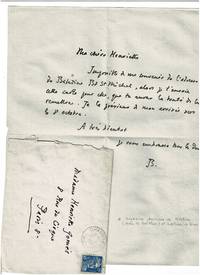
BALTHUS
Lettre autographe signée adressée à Henriette Gomès
Chaumard 1953. Fine. Chaumard juillet 1953 21.80 x 27.90 cm une page sur un feuillet Signed autograph letter from Balthus addressed to gallerist Henriette Gomès. One page written in black ink on a sheet envelope attached. Transverse fold marks inherent to mailing. ""Impossible to remember Baladine's address on Bd St Michel."" Baladine is the nickname of Merline Klossowska Balthus's mother who was also Rilke's mistress. ""During the summer of 1952 Balthus found a château in the Nièvre between Autun and Avallon which he decided to rent and where he settled in the spring of the following year. The means were provided by his dealers Henriette Gomès Pierre Matisse and with them a collective of collectors including Maurice Rheims Alix de Rotschild and Claude Hersent. They paid him a pension in exchange for his latest paintings which they distributed among themselves. The château was severely deteriorated and Balthus lived there modestly in a continual renovation site. He had for company to help him settle in and ensure a presence when he went to Paris the poet Léna Leclercq met through Giacometti. The latter remained until spring 1955. Meanwhile Balthus had begun a romantic relationship with his niece by marriage Frédérique Tison daughter of a previous union of his brother Pierre's wife."" Fondation Balthus unknown
Referentie van de boekhandelaar : 75938
|
|
|
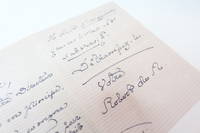
Robert de MONTESQUIOU
"Votre intervention pour faire est déterminante."" Autograph letter signed by Robert de Montesquiou to Henry Lapauze then a journalist at Le Gaulois
s. l.: S. n. 1895. Fine. S. n. s. l. s. d. circa 1895 12.50 x 17 cm une page et demie sur une feuille Autograph letter signed by the dandy count of a page and a half 13 lines written in black ink to his friend the journalist from Le Gaulois Henry Lapauze so that he might use his decisive influence in the publication of a text: ""Il doit s'imaginer que ce texte est subversif. Détrompez-le."" ""He must imagine that this text is subversive. Disabuse him of this notion."" initially validated by Arthur Meyer but which Robert de Montesquiou wants to ensure through his friend will indeed be printed: ""J'ai vu votre directeur qui accepte en principe. Cependant comme votre intervention pour faire est déterminante j'insiste auprès de vous."" ""I have seen your director who accepts in principle. However as your intervention to make it happen is decisive I insist upon you."" Henry Lapauze 1867-1925 was a journalist art critic then in 1905 curator of the Petit Palais converted four years earlier into a museum and whose collections he considerably enriched by acquiring notably the Courbet Henner Falguière collections with in the twilight of his life a marked predilection for the Decorative Arts of which he was one of the ardent promoters. S. n. unknown
Referentie van de boekhandelaar : 74263
|
|
|
Robert de MONTESQUIOU
". les circonstances rapides au milieu des autres occupations ne m'ont pas permis de consulter."" Autograph letter signed by Robert de Montesquiou to his friend Henry Lapauze thanking him for sending a document of which he has not yet read
s. l.: S. n. 1895. Fine. S. n. s. l. s. d. circa 1895 12.50 x 20 cm quatre pages sur une feuille rempliée Autograph letter signed by the dandy count four pages 43 lines written in black ink thanking his friend Henry Lapauze and one of his acquaintances for having procured for him: ""l'intéressant document"" ""the interesting document"" which his overwhelming activity has not yet allowed him to read: "". avec autant d'application que je l'aurais voulu."" "". with as much attention as I would have wished."" Robert de Montesquiou therefore relies on his friend's indulgence also transmitting his apologies and gratitude to the unknown person who helped him through Henri Lapauze: "". je compte sur votre obligeance et celle de votre ami pour me permettre une autre fois de compléter cette lecture. veuillez bien lui transmettre ma gratitude en même temps que le surplus de mon désir."" "". I count on your kindness and that of your friend to allow me another time to complete this reading. please convey to him my gratitude along with the remainder of my desire."" A small brown stain at the top of one page a light crease at the foot of another without significance. Henry Lapauze 1867-1925 was a journalist and art critic who became in 1905 curator of the Petit Palais converted four years earlier into a museum and whose collections he considerably enriched by acquiring notably the Courbet Henner and Falguière collections with at the twilight of his life a marked preference for the Decorative Arts of which he was an ardent promoter. S. n. unknown
Referentie van de boekhandelaar : 74355
|
|
|
Andre BRETON - (Albert CAMUS)
"Allons ce n'est pas encore cette fois que dans la révolte je parviendrai à introduire la ""mesure"" que nous prêche aimablement M. Camus."" Unpublished signed autograph letter addressed to the critic Charles Estienne
Paris 1953. Fine. Paris 8 janvier 1953 21 x 27 cm 1 pages et quelques lignes sur un feuillet Unpublished handwritten signed letter from André Breton addressed to critic Charles Estienne; one page and a few lines in black ink on a paper from the à l'étoile scellée gallery. Two transverse folds from having been sent a small corner missing in the upper right margin. Very beautiful letter giving an account of the death of one of André Breton's dearest friends and of his quarrel with Albert Camus. Breton tells his friend about the death of the Surrealist Czech artist Jindich Heisler: Your letter spoke of those days where it seemed that there was only just enough fire to live: on Monday there was far from enough fire when it reached me: one of my two or three best friends Heisler taken suddenly unwell on his way to mine on Saturday had to be hospitalised urgently and I had just received the pneumatic from Bichat telling me of his death. The event no less inconceivable than accomplished left me distraught for a long time: there was no-one more exquisite than he putting more warmth into everything he did the most constant of which was to lighten and embellish those whom he loved. The two poets were indeed very close: Heisler participated alongside Breton in the launch of Néon in 1948 and supported him during a period of depression accompanying him with other friends to the Île de Sein. The beginning of 1953 was overshadowed by the death of Jindich Heisler 4 January. Loyal among the faithful he lived entirely for Surrealism according to Breton who pays tribute to his activity as a leader: This is how he was between 1948 and 1950 the soul of Néon and until his last moments the greatest bearer of projects that as if by magic his talent gave him the means to achieve. Henri Béhar André Breton In this letter laden with pain Breton suddenly makes reference to L'Homme révolté by Albert Camus published two years earlier: Come on it is not yet the time in the rebellion that I will succeed in introducing the measure that M. Camus kindly preaches to us. The two writers met in New York at the end of March 1946 when Camus was invited to the United States for a conference tour as a representative of Combat. The two agree on the best way to preserve the testimony of certain men free from ideological distortions. They dream of a kind of pact by which people of their calibre would commit to not join any political party to fight against the death penalty to never claim any credit whatsoever. ibid. With other intellectuals they founded the Rassemblement démocratique révolutionnaire RDR in 1948; but the idyll ended a couple of years later in the autumn of 1951 when Camus published Lautréamont et la banalité an extract from his Homme révolté which was published later. Breton was extremely hurt and responded to him in an article entitled Sucre jaune in Arts: This article . testifies to the part of Camus for the first time for an indefensible moral and intellectual position. . He only wants to see a guilty adolescent in Lautréamont whom he - in his capacity as an adult - must discipline. He goes as far as to find him in the second part of his work: Poésies a deserved punishment. According to Camus Poésies would be but a mass of laborious banalities . It could still be worse if the destitution of these views did not intend to promote the most suspect thesis in the world which is that absolute revolt can generate only the taste for intellectual enslavement. This is a completely gratuitous ultra-defeatist statement which must incur even more contempt than its false demonstration. Thus two years later Breton still holds out against Camus' crime of lese-majesty towards that which Breton constructed as the father of surrealism but even more this allusion to Camus' pacifist philosophy bearing witness to the incompatibility between a thought of moderation and a poetry of revol unknown
Referentie van de boekhandelaar : 75729
|
|
|
Violette LEDUC
Lettre autographe signée adressée à Adriana Salem
1963. Fine. 9 10 et 16 janvier 1963 16.60 x 21.90 cm 3 pages sur 2 feuillets Autograph letter signed by Violette Leduc addressed to Adriana Salem written in three stages in blue ink on two sheets detached from a schoolchild's notebook. The three stages of this letter concern the regretted purchase of a record player that Violette Leduc wishes to exchange for a transistor radio. unknown
Referentie van de boekhandelaar : 75707
|
|
|
Andre BRETON
Manuscrit autographe intitulé ""Un peu jaguar.""
1953. Fine. mai 1953 21 x 27 cm une feuille André Breton autograph manuscript titled ""Un peu jaguar."" written for issue no. 7 of May 1953 of the journal Médium. 12 lines written in black ink in a careful hand on a white sheet. Two transverse folds of no consequence. This is the final version of the text; an intermediate version of this article is visible on the Archives Breton website. An interesting chronicle concerning the Swedish painter Max Walter Svanberg: ""De Malmö Suède notre très admiré ami Max Walter Svanberg nous écrit pour protester contre la manière dont ont été récemment présentées ses toiles à Paris."" ""From Malmö Sweden our much admired friend Max Walter Svanberg writes to us to protest the manner in which his paintings were recently presented in Paris."" ""It was in 1953 that Breton and his friends discovered Svanberg's work. In 1954 he illustrated the entirety of issue 3 of the surrealist journal Médium and in 1955 Breton wrote the preface for his first solo exhibition in Paris at the ""À l'étoile scellée"" gallery."" Archives Breton unknown
Referentie van de boekhandelaar : 75166
|
|
|
JOB
Lettre autographe signée adressée à H. Simonis Empis
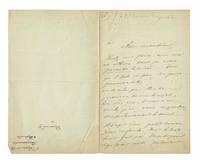
1902. Fine. s. d. ca 1902 11.20 x 17.80 cm 2 pages 1/2 sur un double feuillet Autograph letter signed by Job addressed to publisher H. Simonis Empis. Two and a half pages on a double sheet. Fold inherent to mailing. Interesting letter in which the illustrator proposes to the publisher to publish ""an album whose success he guarantees"": ""It concerns a small novel for children whose text would be done by Montorgueil and which would be as thrilling as possible . All the characters would be penny toys."" This refers to Liline et Frérot : au pays des joujoux which would finally be published by Boivin & Cie. unknown
Referentie van de boekhandelaar : 76128
|
|
|
Lucien DAUDET
"Quelquefois je m'imagine ce que devrait être l'Académie Goncourt."" Signed autograph letter addressed to Lucien Descaves
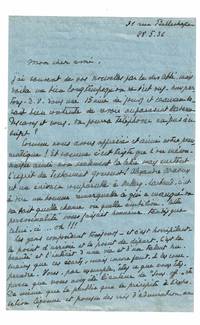
Paris 1936. Fine. Paris 28 mai 1936 13.40 x 21 cm 2 pages sur un feuillet Autograph letter signed by Lucien Daudet addressed to Lucien Descaves; two pages written in black ink on a sheet of blue paper. Folds inherent to mailing. Fine letter discussing Alexandre Arnoux talent and the Prix Goncourt: ""Alexandre Arnoux est un écrivain comparable a Vallery sic Larbaud c'est-à-dire un homme remarquable à qui a manqué on ne sait quelle chance ou quelle ambition. . Quelquefois je m'imagine ce que devrait être l'Académie Goncourt dans son véritable esprit Goncourt et son prestige ici et en Europe si les Dix étaient vous mon frère Claudel Gide Max Jacob Cendrars Malraux Neveux etc."" ""Alexandre Arnoux is a writer comparable to Vallery sic Larbaud that is to say a remarkable man who lacked we know not what chance or what ambition. . Sometimes I imagine what the Goncourt Academy should be in its true Goncourt spirit and its prestige here and in Europe if the Ten were you my brother Claudel Gide Max Jacob Cendrars Malraux Neveux etc.""Alphonse Daudet Lucien's father was the first president of the Goncourt Academy in 1897. unknown
Referentie van de boekhandelaar : 76136
|
|
|
AMAN-JEAN
Lettre autographe signée
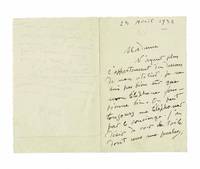
s. l. 1933. Fine. s. l. 1933 10.40 x 16.20 cm 2 pages sur un double feuillet Autograph letter signed by Edmond Aman-Jean; two pages written in black ink on a double sheet with the painter's monogram. Fold inherent to mailing. ""No longer having the apartment below my studio I am not quite sure that my telephone is working properly. One can always call me through the concierge. I have the desire to see the canvas you mention to me."" unknown
Referentie van de boekhandelaar : 76130
|
|
|
Lucien DAUDET
"Vous moi quelques uns avons aimé Céline quand il avait un grand talent"" Unpublished signed autograph letter addressed to Lucien Descaves
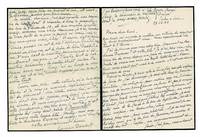
Paris 1942. Fine. Paris 29 décembre 1942 13.60 x 17.90 cm 6 pages sur un double feuillet et un feuillet simple Autograph letter signed by Lucien Daudet addressed to Lucien Descaves; six pages written in black ink on a double sheet and a single sheet. Creases inherent to the mailing. Fine and long unpublished letter addressed to Lucien Descaves to whom Daudet had not given news for two years. He outlines broadly the tragic events that occurred since: ""Since that time I remained in Paris I witnessed the days of June 40 . I undertook to forget my life to write a life of my father . Then in August I understood that I was very ill . I was operated on reoperated on in November I was dying I knew nothing anymore then a phlebitis. . A month later I learned of my brother's death."" All these sad misadventures do not prevent him from thinking about the Goncourt Academy which he evokes at length in this missive. Indeed his brother Léon Daudet having died a few months earlier the academicians are seeking a successor and Lucien's name figures among the favorites: ""As soon as the newspapers mentioned my name for the Goncourt Academy I was very embarrassed."" He nevertheless states the reasons why he does not wish to join the ten: ""Because I could not appear my brother being dead to say 'my turn' . And finally it is difficult to write when one is the son of Alphonse Daudet but when in addition one is the brother of Léon Daudet . the game was lost in advance for me."" It is finally La Varende who will be elected on the recommendation of René Benjamin and Sacha Guitry and despite his certainties ""I would present myself one day or another to the Academy"" Lucien Daudet will never join the prestigious jury. Lucien has attached to his first letter another sheet in which he comments on Germaine Beaumont's latest novel: ""One must not have the slightest idea of what a novel is a true novel to not have understood that for years no one had written a novel of such density."" This literary consideration is the occasion for Daudet to address the Céline case who - still in France at this time - has just published his third pamphlet Les Beaux Draps: ""You I a few others loved Céline when he had great talent. And then all the imbeciles discovered him when he imitated himself and it was no longer anything but the waffle iron."" unknown
Referentie van de boekhandelaar : 76137
|
|
|
Georges CLEMENCEAU
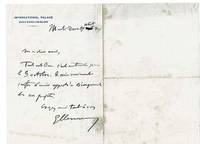
Lettre autographe signée adressée à un ami
Mont-Dore-Les-Bains Le Mont-Dore 1909. Fine. Mont-Dore-Les-Bains Le Mont-Dore 29 août 1909 13.60 x 21 cm 1 page sur un double feuillet Signed autograph letter from Georges Clémenceau addressed to a friend. One page written in black ink on a double sheet with letterhead from the International Palace of Mont-Dore-Les-Bains. Central fold inherent to mailing. Clemenceau then taking the thermal cure at Mont-Dore-les-Bains writes: ""All is well. It is agreed for October 9th. I am truly embarrassed to have brought this disruption to your plans."" unknown
Referentie van de boekhandelaar : 76082
|
|
|
George SAND
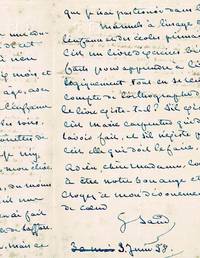
Lettre autographe signée adressée à Stéphanie Geoffroy-Saint-Hilaire : de l'émancipation féminine par l'éducation : ""Ç'a été pour moi une éducation à part que celle de cet enfant de 18 ans qui n'en avait que 2 il y a six mois et qui a maintenant son âge avec toute la candeur de l'enfance conservée."" Autograph letter signed addressed to Stéphanie Geoffroy-Saint-Hilaire: on womens emancipation through education: It has been for me a separate kind of education that of this child of 18 who was only 2 six months ago and who now has her age with all the candour of childhood preserved
Nohant Nohant-Vic 1858. Fine. Nohant Nohant-Vic 3 juin 1858 13.40 x 20.90 cm 4 pages sur un feuillet remplié Autograph letter signed by George Sand addressed to her friend Stéphanie Bourjot daughter of Étienne Geoffroy-Saint-Hilaire. Four pages written in blue ink on a folded bifolium bearing George Sands monogram. Fold marks as usual. This letter was partially published in Correspondance vol. XIV no. 7846. A beautiful and partly unpublished letter in which George Sand discusses Marie Pape-Carpantiers book and the education of her young maid Marie Caillaud: «It is an excellent book which I use to teach my young maid to read. She is extraordinarily intelligent and this book opens her mind to all sorts of sound ideas. Educating this 18-year-old childwho six months ago was only two in terms of knowledgehas been a unique experience. She now seems her age yet retains all the innocence of childhood. So every evening we read Marie Carpentiers little stories and I enjoy them just as much as my pupil does.» Marie Caillaud was only eleven years old when George Sand hired her to wash dishes and tend to the chicken coop a task that earned her the nickname Marie des poules. But the writer soon recognized the young peasant girls intelligence appointed her as housekeeper and by 1856 included her in the performances of the Nohant theatre. Her education is first mentioned in early 1858 notably in a letter from George Sand to her friend Charles Duvernet: «During my winter evenings I took on the education of little Marie the one who acted with us. From a dish washer I immediately raised her to the rank of housekeeper a role for which her excellent mind makes her perfectly suited. The greatest obstacle was that she couldn't read. That obstacle no longer exists. In thirty half-hour lessonsfifteen hours in a monthshe mastered all the difficulties of the language slowly but perfectly. This miracle is due to the admirable Laffore method which I applied with the utmost gentleness to a perfectly lucid mind.» 16 February 1858 Marie Caillaud would go on to become a notable actress at Nohant and move in the circles of George Sands illustrious guests: Delacroix Gautier Dumas Prince Jérôme Bonaparte
But Marie was not George Sands first pupil. All her life Sand was deeply interested in pedagogy and taught not only her children and grandchildren but also members of her household staff and local peasants. This letter is a remarkable testament to her hands-on approach as a teacher always seeking new and effective ways to impart knowledge: «What is lackingor at least what I havent foundis a true reading method. Ive devised one for my own use never written down based on Laffores and adapted to my own ideas. But what I havent found in primers for children or public school manuals is a well-crafted exercise book that teaches reading logically while also making sense of spelling. Does such a book exist» Far from a casual activity education was central to George Sands worldview. As Georges Lubin noted her aim was not merely to teach literacy. Taught to write by her own mother at the age of five Sand understood from an early age that the only path to equality lay through intellectual emancipation: «She understood very early on that the only road to equality was intellectual emancipation. The ignorance imposed upon women was the root of their servitude. The ignorance imposed upon the working classes underpinned class inequality. Education was the key to opening locked doors.» «George Sand et l'éducation» in Nineteenth-Century French Studies 1976 A beautiful and important testimony to George Sands tireless struggle for the emancipation of women through education. unknown
Referentie van de boekhandelaar : 76111
|
|
|
Stephane MALLARME
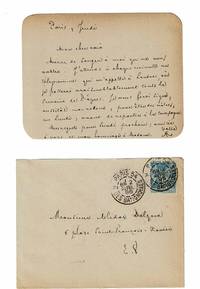
"J'attends à chaque minute un télégramme qui m'appelle à Londres."" Signed autograph card addressed to Alidor Delzant
Paris 1896. Fine. Paris 2 avril 1896 11.40 x 8.80 cm une carte et une enveloppe Signed autograph card from Stéphane Mallarmé addressed to Alidor Delzant written on the recto in black ink. Envelope included. Alidor Delzant was a lawyer collector and bibliophile. Friend of the Goncourts he devoted a work to them and was Edmond's secretary and testamentary legatee. ""Merci de songer à moi qui ne vous oublie. J'attends à chaque minute un télégramme qui m'appelle à Londres où je passerai vraisemblablement toute la semaine de Pâques."" ""Thank you for thinking of me who does not forget you. I am expecting at any moment a telegram calling me to London where I will most likely spend the entire Easter week."" unknown
Referentie van de boekhandelaar : 76347
|
|
|
Stephane MALLARME
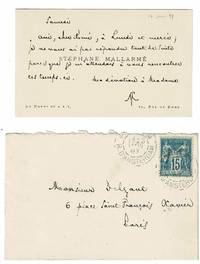
"Ami cher ami à lundi et merci."" Autograph business card addressed to Alidor Delzant
Paris: S. n. 1897. Fine. S. n. Paris 23 janvier 1897 10.20 x 6.30 cm une carte de visite et son enveloppe Signed autograph visiting card from Stéphane Mallarmé addressed to Alidor Delzant. Envelope included. Alidor Delzant was a lawyer collector and bibliophile. Friend of the Goncourts he devoted a work to them and was Edmond's secretary and testamentary legatee. ""Ami cher ami à lundi et merci ; je ne vous ai pas répondu tout de suite parce que je m'attendais à vous rencontrer ces temps-ci."" ""Friend dear friend until Monday and thank you; I did not answer you right away because I expected to meet you these days."" S. n. unknown
Referentie van de boekhandelaar : 76333
|
|
|
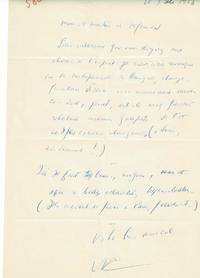
Louis-Ferdinand CELINE
"Il paraît qu'il est question de me poursuivre à nouveau d'après Les Beaux Draps. "" Signed autograph letter addressed to Master Thorvald Mikkelsen
s. l. Klarskovgaard 1950. Fine. s. l. Klarskovgaard 7 octobre 1950 21 x 34 cm 2 pages sur 2 feuillets Partly unpublished autograph letter signed by Louis-Ferdinand Céline addressed to his ""dear Master and defender"" Maître Thorvald Mikkelsen. Two pages written in blue ink on two large sheets of white paper; numbers ""580"" and ""581"" in Céline's hand in the upper left corner in red pencil. Transverse folds inherent to the mailing. This letter was very partially transcribed in the Année Céline 2005. Autograph letter signed by Louis-Ferdinand Céline addressed to his ""dear Master and defender"" Maître Thorvald Mikkelsen. Two pages written in blue ink on two large sheets of white paper; numbers ""580"" and ""581"" in Céline's hand in the upper left corner in red pencil. Transverse folds inherent to the mailing. Céline sends Mikkelsen an article: ""Pour intéressé que vous soyez aux choses de l'esprit je crois avoir remarqué que les turlupinades des banques changes fricoteries diverses vous amusaient aussi. Ci-donc joint article assez farceur relatant certaines galipettes de l'or et ses escrocs changeurs à Paris évidemment !"" ""However interested you may be in matters of the mind I believe I have noticed that the buffooneries of banks exchanges and various swindles also amuse you. Here therefore attached is a rather farcical article relating certain antics of gold and its swindling money-changers in Paris obviously!"" The writer attached to his letter another sheet whose numerous underlinings bear witness to the persecution he felt victim to: ""Maintenant qu'on remonte la Ligne Maginot qu'on recrée une Légion Anti Bolchéviques une armée franco-allemande il paraît qu'il est question de me poursuivre à nouveau d'après les Beaux Draps mais cette fois pour antigermanisme et sabotage de l'Europe Nouvelle et irrespect pour Hitler ! Oh je n'en mène pas large !"" ""Now that they're rebuilding the Maginot Line recreating an Anti-Bolshevik Legion a Franco-German army it seems they're planning to prosecute me again based on Les Beaux Draps but this time for anti-Germanism and sabotage of the New Europe and disrespect for Hitler! Oh I'm not feeling very confident!"" In 1947 Céline pursued by French justice for his collaborationist involvement was confined in Denmark. It was in May 1948 accompanied by Lucette and Bébert that he arrived at his lawyer Maître Thorvald Mikkelsen's home in Klarskovgaard. The latter owned a large property by the Baltic Sea and invited the exile to stay there. On February 21 1950 as part of the purge the writer was definitively condemned in absentia by the civic chamber of the Paris Court of Justice for collaboration to one year of imprisonment which he had already served in Denmark. The Swedish Consul General in Paris Raoul Nordling intervened on his behalf with Gustav Rasmussen the Danish Foreign Minister and managed to delay his extradition. On April 20 1951 Jean-Louis Tixier-Vignancour his lawyer since 1948 obtained Céline's amnesty as a ""severely disabled veteran of the Great War"" by presenting his file under the name of Louis-Ferdinand Destouches without any magistrate making the connection. Céline would leave Denmark the following summer after three years spent at his lawyer's home. In 1947 Céline pursued by French justice for his collaborationist involvement was confined in Denmark. It was in May 1948 accompanied by Lucette and Bébert that he arrived at his lawyer Maître Thorvald Mikkelsen's home in Klarskovgaard. The latter owned a large property by the Baltic Sea and invited the exile to stay there. On February 21 1950 as part of the purge the writer was definitively condemned in absentia by the civic chamber of the Paris Court of Justice for collaboration to one year of imprisonment which he had already served in Denmark. The Swedish Consul General in Paris Raoul Nordling intervened on his behalf with Gustav Rasmussen the Danish Foreign Minister and managed to delay his extradition. On unknown
Referentie van de boekhandelaar : 76186
|
|
|
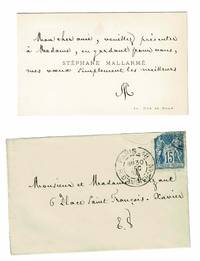
Stephane MALLARME
"Mon cher ami veuillez présenter à Madame en gardant pour vous mes voeux simplement les meilleurs."" Autograph business card addressed to Alidor Delzant
Paris: S. n. 1892. Fine. S. n. Paris 30 décembre 1892 10.40 x 6.30 cm une carte de visite et son enveloppe Signed autograph visiting card from Stéphane Mallarmé addressed to Alidor Delzant. Envelope included. Alidor Delzant was a lawyer collector and bibliophile. Friend of the Goncourts he devoted a work to them and was Edmond's secretary and testamentary legatee. ""Mon cher ami veuillez présenter à Madame en gardant pour vous mes voeux simplement les meilleurs."" ""My dear friend please present to Madame while keeping for yourself my simply best wishes."" S. n. unknown
Referentie van de boekhandelaar : 76335
|
|
|
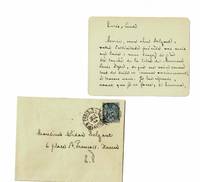
Stephane MALLARME
".vous songez si j'ai été touché de la lettre de Monsieur Louis Dyer."" Signed autograph card addressed to Alidor Delzant
Paris 1894. Fine. Paris 12 février 1894 11.40 x 8.80 cm une carte recto-verso et une enveloppe Autograph letter signed by Stéphane Mallarmé addressed to Alidor Delzant written on both sides in black ink. With envelope. Alidor Delzant was a lawyer collector and bibliophile. A friend of the Goncourts he devoted a work to them and served as secretary and testamentary legatee to Edmond. Mallarmé mentions a future stay in Oxford and thanks Delzant for having recommended him to a friend: "".vous songez si j'ai été touché de la lettre de Monsieur Louis Dyer de qui me voici connu tout de suite et comme anciennement à travers vous. Je lui réponds avant que je ne fasse si heureux sa connaissance. Hôte je ne pourrai l'être M. Powell qui a eu l'initiative de ma conférence m'ayant de longue date offert son toit pendant mon bref séjour à Oxford."" "".you can imagine how touched I was by the letter from Monsieur Louis Dyer through whom I find myself known immediately and as if from long ago through you. I am writing back to him before I have the pleasure of making his acquaintance. I will not be able to be a host as M. Powell who initiated my lecture has long since offered me his roof during my brief stay in Oxford."" Mallarmé would indeed give a lecture on aesthetics on March 1st 1894 at Oxford the text of which was published in 1895 under the title Oxford Cambridge. La musique et les lettres. unknown
Referentie van de boekhandelaar : 76272
|
|
|
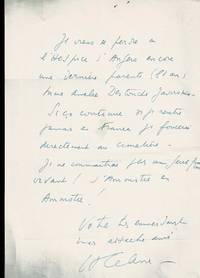
Louis-Ferdinand CELINE
"Je viens de perdre à l'hospice d'Angers encore une dernière parente"" Signed autograph letter addressed to Master Thorvald Mikkelsen
s. l. Klarskovgaard 1950. Fine. s. l. Klarskovgaard 8 décembre 1950 21 x 34 cm 2 pages sur un feuillet Autograph letter signed partly unpublished by Louis-Ferdinand Céline addressed to his lawyer Maître Thorvald Mikkelsen. Two pages written in blue ink on a large sheet of white paper; numbered 575 in Célines hand in red pencil at the top left corner. Fold marks from mailing. This letter was only partially transcribed in Année Céline 2005 p. 64. A moving and bitter letter by Céline who had just lost his aunt Amélie the Aunt Hélène of Death on Credit and witnesses the slow disappearance of the world he once knew. The writer finds solace in the memoirs of Élisabeth de Gramont another witness to a bygone era. From his Danish exile Céline learns with sorrow of the death of his Aunt Amélie the last surviving member of the Destouches family: Je viens de perdre à l'hospice d'Angers encore une dernière parente. Although he had not spared his alter ego in Death on Creditthe scandalous Aunt Hélène meets a shameful end trailed by suitors lovers or clientshe recalls: À Saint-Pétersbourg elle est devenue grue. . Elle est venue nous voir au Passage deux fois de suite frusquée superbe comme une princesse et heureuse et tout. Elle a terminé très tragiquement sous les balles dun officier. The real Aunt Amélie had settled in Romania married to a diplomat Zenon Zawirski. Unfortunately reality caught up with fiction: she returned to Paris in utter destitution at the age of 80. Céline arranged for her transfer from the hospice of the Little Sisters of the Poor in Breteuil to the hospital in Angers where she died in December 1950 Que la pauvre femme meure gentiment. Assez de fins tragiques dans la famille ! he had written to Dr. Camus on 11 July 1949. His secretary Marie Canavaggia met her before her arrival in Angers: elle avait par moments des gestes et des expressions qui en éclairs me rappelaient son neveu 13 July 1949. With the last of his family gone Céline reflects on his own end: si ça continue si je rentre jamais en France je foncerai directement au cimetière. Devouring the books his lawyer sent to ease the burden of exile Céline describes his current readings: Le Temps des équipages by Élisabeth de Gramont est un des livres fameux parus vers 1920 ! Lun des « Guides des Snobs » les mieux réussis de lÉpoque. It is striking to imagine Céline delighting in this aristocrats social chronicle so alien to his world: Javais un ami Carré de Rennes étudiant en droit qui lavait appris par cur ! . il sen est établi marchand de tableaux. As a young medical student Céline had indeed crossed paths with Louis Carré later a successful Parisian art dealer who exhibited Paul Klee Juan Gris Le Corbusier and Picasso: il y a fait 10 fois fortune ! Preuve que tous les livres ne sont pas déprimants ! In 1947 pursued by French justice for his collaborationist stance Céline took refuge in Denmark. In May 1948 accompanied by Lucette and Bébert he arrived at the home of his lawyer Maître Thorvald Mikkelsen in Klarskovgaard. Mikkelsen owned a large estate on the Baltic Sea and welcomed the exiled writer to stay. On 21 February 1950 as part of the post-war purge Céline was definitively sentenced in absentia by the Civic Chamber of the Paris Court of Justice to one year in prison for collaboration a sentence already served in Denmark. Raoul Nordling the Swedish consul general in Paris intervened on his behalf with Gustav Rasmussen the Danish Foreign Minister successfully delaying his extradition. On 20 April 1951 Jean-Louis Tixier-Vignancour his lawyer since 1948 obtained Célines amnesty as a severely disabled veteran of the Great War submitting the case under the name Louis-Ferdinand Destouches without the magistrates making the connection. Céline left Denmark that summer after three years spent in his lawyers home. unknown
Referentie van de boekhandelaar : 76172
|
|
|
Andre BRETON
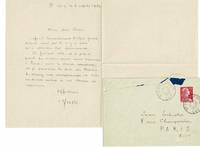
"Enfin ! Considérant l'objet fermé disons-nous qu'il n'y a plus qu'à attendre les événements."" Unpublished signed autograph letter addressed to Jean Schuster
Saint-Cirq-Lapopie 1956. Fine. Saint-Cirq-Lapopie 9 octobre 1956 13.50 x 18 cm 1 page sur un double feuillet et une enveloppe Autograph letter signed by André Breton addressed to Jean Schuster; one page written in black ink on a double sheet of white paper. Envelope included. The writing of this letter coincides with the publication date of the very first issue of the journal Le Surréalisme même: ""At last! Considering the closed object let us say that there is nothing left but to await events."" Breton then at his house in Saint-Cirq-Lapopie plans to return to Paris for this occasion: ""This was necessary - and the great cold of the morning - to bring us back to Paris: we will be there Friday and I will stop by the Musset in the evening."" Jean Schuster 1929-1995 joined the Surrealist group in 1947. Close to Benjamin Péret and André Breton he would become the latter's literary executor. unknown
Referentie van de boekhandelaar : 76379
|
|
|
Stephane MALLARME
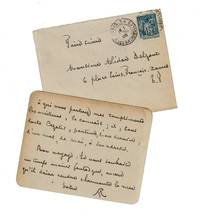
"Je vous souhaite un temps moins fantasque encore qu'il doive rendre charmante la mer."" Signed autograph card addressed to Alidor Delzant
Paris 1895. Fine. Paris 31 mars 1895 11.40 x 8.80 cm une carte recto-verso et une enveloppe Autograph card signed by Stéphane Mallarmé addressed to Alidor Delzant written on both sides in black ink. Envelope enclosed. Alidor Delzant was a lawyer collector and bibliophile. A friend of the Goncourt brothers he devoted a book to them and served as Edmonds secretary and executor. ""Je ne sais plus personne à Londres envers qui je fus si infidèle ; mais pour Oxford voici ma carte avec un mot à l'adresse de mon hôte et ami M. York Powell. M. Louis Dyer à qui vous porterez mes compliments les meilleurs le connaît ; et sans doute Cazalis porteur l'an dernier d'un mot de moi à son adresse. Je vous souhaite un temps moins fantasque encore qu'il doive rendre charmante la mer."" Mallarmé was well acquainted with Oxford where he had given a lecture the previous year under the auspices of Frederick York Powell professor of history. Louis Dyer a friend of Delzants was an Oxford alumnus and then professor of Greek at Harvard. Through Delzants mediation he had offered Mallarmé his hospitality. unknown
Referentie van de boekhandelaar : 76327
|
|
|
Andre BRETON
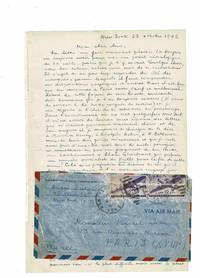
"Je suis de nouveau en mauvais termes avec Max Ernst Masson devenu gaulliste est parti hier pour Paris."" Unpublished signed autograph letter addressed to Marcel Jean
New York 1945. Fine. New York 23 octobre 1945 17.10 x 25.40 cm 2 pages sur un feuillet et une enveloppe Unpublished autograph letter signed by André Breton addressed to Marcel Jean two pages written in blue ink on a sheet. ""Air mail"" envelope enclosed. Creases inherent to mailing. This letter is mentioned and very briefly quoted in Marcel Jean's autobiography Au galop dans le vent. Important and lengthy letter sent from New York when Breton in exile since 1943 as he was considered a ""dangerous anarchist"" by the Pétainist government was forced - like many intellectuals - to leave France in order to continue working. He shares with his friend the ""overwhelming despair"" ""l'accablement"" that the city brings him and one still senses his eagerness to return to his homeland. Painter draftsman and decorator Marcel Jean joined the Surrealist group in 1933 and became one of the movement's first chroniclers. One can sense all his emotion upon receiving this letter which he discusses at length in his autobiography: ""October 1945 I write to André Breton in New York. In response two densely written pages of fine calligraphy. My letter whose tone must have pleased him gave him ""real pleasure"" ""vraiment plaisir"". He finds me ""healthy safe and by no means lacking in that lucid smiling very human way of seeing"" ""sain sauf et nullement dénué de cette façon de voir lucide souriante très humaine"" that he has always known in me ""I just thought ""Je viens de penser"" he says of your firm handshake ""à ta rude poignée de main""."". I had mentioned to him the study on Lautréamont whose elements I am gathering he encourages me to give extracts of it for a Surrealist issue being prepared for the magazine Vrille ""this without prejudice to a drawing by you that Vrille should reproduce"" ""cela sans préjudice de dessin de toi que Vrille devrait reproduire"" and for the same magazine to submit ""a certain number of recent works to an in-depth analytical and critical commentary"" ""un certain nombre d'ouvrages récents à un commentaire analytique et critique approfondi"". This is followed by advice and encouragement regarding a work of literary criticism he would like to see me undertake. Then some news from America and our friends: Max Ernst Tanguy Péret who is bored in Mexico Matta who ""paints large panels in a new genre sadistic figurative much remarked upon."" ""peint de grands panneaux dans un nouveau genre figuratif sadique très remarqués."". And the vigorous signature. Breton's letters their contrast between the text with extremely regular handwriting and the flourish hurried and in both scripts something controlled have always given me the impression that in writing to me he was doing me the favor of an autograph. His message outlined for me a program as chronicler in view of his return to Paris in the spring but I had in mind something other than commenting on the commentaries of critics whose interest he pointed out to me - Maurice Blanchot or Léon-Pierre Quint. My projects concerned the study of Lautréamont and then - or at the same time: to paint and to draw."" unknown
Referentie van de boekhandelaar : 76388
|
|
|
Stephane MALLARME
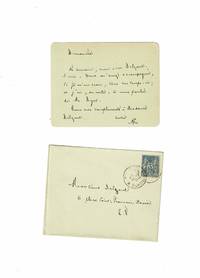
".j'ai du reste à vous parler de M. Dyer."" Signed autograph card addressed to Alidor Delzant
Paris 1894. Fine. Paris 11 mars 1894 11.40 x 8.80 cm une carte recto et une enveloppe Autograph card signed by Stéphane Mallarmé addressed to Alidor Delzant written on the recto in black ink. Envelope attached. Alidor Delzant was a lawyer collector and bibliophile. Friend of the Goncourts he devoted a work to them and was the secretary and testamentary legatee of Edmond. Card written upon return from a trip to Oxford during which Mallarmé gave a lecture on aesthetics: "".j'ai du reste à vous parler de M. Dyer."" "".I have moreover to speak to you about M. Dyer."" Louis Dyer friend of Delzant is an Oxford alumnus and was then professor of Greek at Harvard. Through Delzant's intermediary he had offered hospitality to Mallarmé who did not know him before his lecture but this card attests that the two men finally met. unknown
Referentie van de boekhandelaar : 76276
|
|
|
Stephane MALLARME
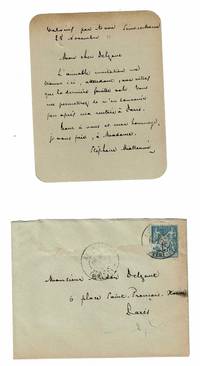
"L'aimable invitation me trouve ici attendant aux vitres que la dernière feuille vole."" Signed autograph card addressed to Alidor Delzant
Valvins 1896. Fine. Valvins 25 novembre 1896 11.40 x 8.80 cm une carte recto-verso et une enveloppe Autograph card signed by Stéphane Mallarmé addressed to Alidor Delzant written on both sides in black ink. Envelope included. Alidor Delzant was a lawyer collector and bibliophile. Friend of the Goncourts he devoted a work to them and was secretary and testamentary legatee of Edmond. ""L'aimable invitation me trouve ici attendant aux vitres que la dernière feuille vole. Vous me permettrez de m'en souvenir peu après ma rentrée à Paris."" ""The kind invitation finds me here waiting at the windows for the last leaf to fly away. You will allow me to remember it shortly after my return to Paris."" unknown
Referentie van de boekhandelaar : 76336
|
|
|
ANONYME
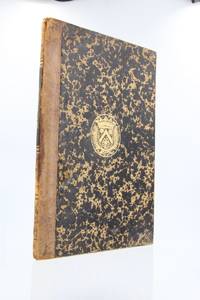
Manuscrit autographe intitulé ""Requeste singulière de Nosseigneurs les Ducs et Pairs et de Mesdames les Duchesses au Régent""
1716. Fine. 1716 17 x 27 cm 6 pages reliées Autograph manuscript titled Requeste singulière de Nosseigneurs les Ducs et Pairs et de Mesdames les Duchesses au Régent - L'an 1716 ""Singular Request from My Lords the Dukes and Peers and from My Ladies the Duchesses to the Regent - The year 1716"". Six pages written in black ink without erasures or corrections. 19th-century binding in half marbled sheep smooth rubbed spine decorated with gilt and blind fillets title label along the spine paste-paper boards stamped at their center with the arms of Adélaïde Édouard Lelièvre de la Grange marquis de la Grange and de Fourilles information kindly provided by M. Jérôme-Paul Carré pebbled paper endpapers and pastedowns De Broglie-Dampmartin bookplate pasted on front pastedown. Headcaps absent. This burlesque petition was transcribed in Les Ruelles du XVIIIème siècle by Labessade in 1879. hardcover
Referentie van de boekhandelaar : 76350
|
|
|
Stephane MALLARME
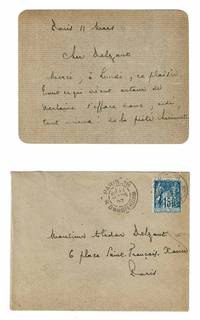
"Tout ce qui vécut autour de Verlaine s'efface donc."" Signed autograph card addressed to Alidor Delzant
Paris 1897. Fine. Paris 11 mars 1897 11.40 x 8.80 cm une carte recto-verso et une enveloppe Autograph postcard signed by Stéphane Mallarmé addressed to Alidor Delzant written on both sides in black ink. Envelope enclosed. Alidor Delzant was a lawyer collector and bibliophile. Friend of the Goncourts he devoted a work to them and was secretary and testamentary legatee of Edmond. ""Tout ce qui vécut autour de Verlaine s'efface donc aidé tant mieux ! de la piété charmante et tendre de Madame Delzant. La gloire du Poëte se fait toujours solitaire."" ""Everything that lived around Verlaine thus fades away helped so much the better! by the charming and tender piety of Madame Delzant. The Poet's glory always stands alone."" Delzant had announced to Mallarmé the death of Eugénie Krantz Verlaine's last mistress. Delzant's wife had frequented her during visits to the sick at Bonsecours hospital in Montrouge. unknown
Referentie van de boekhandelaar : 76330
|
|
|
Stephane MALLARME
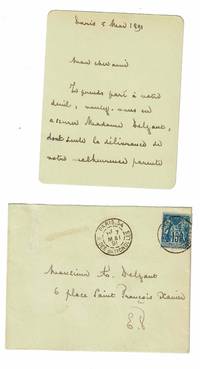
"Heureusement vous êtes un de ceux avec qui l'on se sent partout et même loin."" Signed autograph card addressed to Alidor Delzant
Paris 1891. Fine. Paris 5 mai 1891 11.40 x 8.80 cm une carte recto-verso et une enveloppe Signed autograph card from Stéphane Mallarmé addressed to Alidor Delzant written on both sides in black ink. Envelope included. Alidor Delzant was a lawyer collector and bibliophile. Friend of the Goncourts he devoted a work to them and was Edmond's secretary and testamentary legatee. ""Je prends part à votre deuil voulez-vous en assurer Madame Delzant dont seule la délivrance de votre malheureuse parente par elle entourée de soins peut adoucir le chagrin. . Heureusement vous êtes un de ceux avec qui l'on se sent partout et même loin."" ""I share in your grief would you please assure Madame Delzant of this for whom only the deliverance of your unfortunate relative surrounded by her care can soften the sorrow. . Fortunately you are one of those with whom one feels comfortable everywhere and even from afar."" unknown
Referentie van de boekhandelaar : 76346
|
|
|
Stephane MALLARME
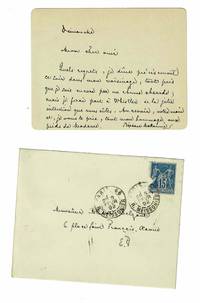
".je ferai part à Whistler de la jolie intention que vous eûtes."" Signed autograph card addressed to Alidor Delzant
Paris 1892. Fine. Paris 7 février 1892 11.40 x 8.80 cm une carte et une enveloppe Autograph letter signed by Stéphane Mallarmé addressed to Alidor Delzant written on the recto in black ink. Envelope included. Alidor Delzant was a lawyer collector and bibliophile. Friend of the Goncourts he devoted a work to them and was Edmond's secretary and testamentary legatee. ""Quels regrets je dîne précisément ce soir dans mon voisinage tout pris que je sois encore par un rhume absurde ; mais je ferai part à Whistler de la jolie intention que vous eûtes."" ""What regrets I am dining precisely this evening in my neighborhood taken as I still am by an absurd cold; but I will inform Whistler of the lovely intention you had."" unknown
Referentie van de boekhandelaar : 76345
|
|
|
Stephane MALLARME
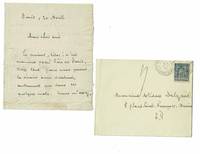
"Je reviens hélas ! d'un moment passé hors de Paris."" Signed autograph letter addressed to Alidor Delzant
Paris 1894. Fine. Paris 30 avril 1894 11 x 13.20 cm 3 pages sur un double feuillet et une enveloppe Autograph letter signed by Stéphane Mallarmé to Alidor Delzant; three pages written in black ink on a bifolium. With the original envelope. Alidor Delzant was a lawyer collector and bibliophile. A friend of the Goncourt brothers he devoted a book to them and served as Edmonds secretary and executor. A cordial letter in which the poet offers his condolences to his friend following his fathers death: ""Vous m'avez au hasard de nos rencontres amicales plusieurs fois parlé de votre père de façon à ce que je devinasse bon haut et délicat et que cette tardive mais prompte séparation à un âge qui donne une illusion chère de continuelle durée soit pour moi comme pour ceux qui vous aiment un deuil."" unknown
Referentie van de boekhandelaar : 76269
|
|
|
Stephane MALLARME
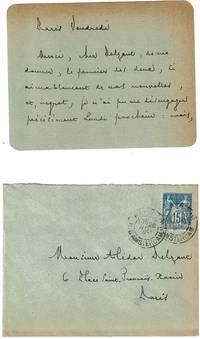
"Merci cher Delzant de me donner le premier des deux si aimablement de vos nouvelles."" Signed autograph card addressed to Alidor Delzant
Paris 1897. Fine. Paris 26 novembre 1897 11.40 x 8.80 cm une carte recto-verso et une enveloppe Autograph signed postcard by Stéphane Mallarmé addressed to Alidor Delzant written on both sides in black ink. Envelope included. Alidor Delzant was a lawyer collector and bibliophile. Friend of the Goncourts he devoted a work to them and was secretary and testamentary legatee of Edmond. ""Merci cher Delzant de me donner le premier des deux si aimablement de vos nouvelles ; et ingrat je n'ai pu me désengager précisément lundi prochain : mais ici je mets les pieds dans le plat que diriez vous du suivant 6 décembre où je serais des vôtres "" ""Thank you dear Delzant for giving me first of the two so kindly your news; and ungrateful as I am I could not free myself precisely next Monday: but here I put my foot in it what would you say to the following December 6th when I could join you"" unknown
Referentie van de boekhandelaar : 76331
|
|
|
Boris VIAN
"Le Cow-boy de Normandie"" tapuscrit complet et signé de ce scénario de western parodique
Paris 1953. Fine. Paris 23 octobre 1953 21 x 27 cm 14 pages tapuscrites sous chemise 1 enveloppe Complete typescript of a draft film script entitled Le Cow-boy de Normandie. Fourteen typed pages bound in a squared paper cover inscribed in Boris Vians hand: Projet de scénario Boris Vian 6 bis Cité Véron Paris 18e. Accompanied by the original envelope from the S.A.C.D. This script was later reproduced in the collection Rue des ravissantes and adapted as a short film by Clémence Madeleine-Perdrillat in 2015. This parody of a western tells the story of Jim Lacy a disillusioned cowboy who leaves Nevada in search of a more genuine land: Fleurville in Normandy. Provenance: Fondation Vian. unknown
Referentie van de boekhandelaar : 76370
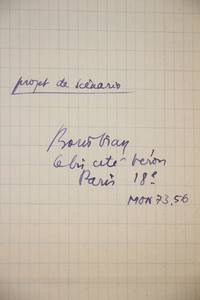
|
|
|
Boris VIAN - (Samuel BECKETT)
" Et ce n'est pas un hasard si En attendant Godot la pièce étonnante de Samuel Beckett est une entrée de clowns qui dure deux heures ne traite de rien en particulier pose tous les problèmes arrache le rire au moment où l'on devrait s'épouvanter "" Article on the cabaret - Autograph manuscript partly unpublished
Paris: s. n. 1953. Fine. s. n. Paris s. d. ca 1953 21 x 27 cm 11 feuillets rédigés au recto Manuscript partly unpublished of an article on cabaret nine pages plus two additional pages written in purple ink on perforated squared paper sheets. Numerous deletions and corrections as well as several additions. The sheets are numbered in the upper right margin from 1 to 9 then 12 and 13. The first nine sheets of this text which was never published during Boris Vian's lifetime were transcribed in Les Vies posthumes de Boris Vian by Michel Fauré 1975. The text was erroneously dated 1948 by Fauré: the mention of Samuel Beckett's En attendant Godot whose premiere took place in 1953 makes this dating impossible. An interesting text evoking cabarets and the ""troglodytes"" a fine echo to the famous Manuel de Saint-Germain-des-Prés 1951: ""Let us give back to Saint-Germain-des-Prés what rightfully belongs to it: besides a certain tonnage provided to journalists short of copy this much-decried district - by those who precisely only knew it in its journalistic aspect - is at the origin of the profound transformation of cabaret. Yes there was indeed a reason why intelligent people like Sartre Prévert Camus Merleau-Ponty etc. in short all those who today count in literature or the arts followed with such attention the great movement of the cellars despite the turbulence of the troglodytes and the incongruity of the photographer monkeys despite the muddled activity of a generation of illiterate and boorish journalists despite the vacant curiosity of the gawker and the bitter resentment of the chamber pot emptiers of rue Dauphine."" After briefly evoking jazz a subject on which he is usually dithyrambic Boris Vian devotes the greater part of his text to theater: ""Jazz on one side carved out with great trumpet blows a place in the shade on the engine room side; that is its true environment: a smoky cellar a back room a dark laboratory where the faithful gather. . The musicians finally relaxed. But for their part the actors did not remain inactive."" Visionary Vian senses ""in the air a scent of renewal"" understanding the importance that cabaret theater would assume in the years to come. Two sheets not transcribed in Fauré's work evoke the theatrical avant-garde of the early 1950s: ""And it is no accident if En attendant Godot Samuel Beckett's astonishing play is a clown entrance that lasts two hours deals with nothing in particular poses all problems wrests laughter at the moment when one should be terrified . And it is no accident if the principal interpreter of Beckett's work this pillar of avant-garde theater is a cabaret veteran."" s. n. unknown
Referentie van de boekhandelaar : 76377
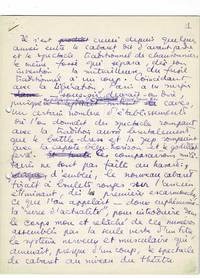
|
|
|
Stephane MALLARME
"Je le craignais que vous n'eussiez pas rencontré M. York Powell en le voyant l'autre soir apparaître rue de Rome."" Signed autograph card addressed to Alidor Delzant
Paris 1895. Fine. Paris 26 avril 1895 11.40 x 8.80 cm une carte recto-verso et une enveloppe Autograph letter signed by Stéphane Mallarmé addressed to Alidor Delzant written on both sides in black ink. Envelope included. Alidor Delzant was a lawyer collector and bibliophile. A friend of the Goncourts he devoted a work to them and was Edmond's secretary and testamentary legatee. ""Je le craignais que vous n'eussiez pas rencontré M. York Powell en le voyant l'autre soir apparaître rue de Rome. Encore rapportez-vous du merveilleux Oxford un souvenir."" ""I feared as much that you had not met M. York Powell seeing him the other evening appear on rue de Rome. Still you bring back from wonderful Oxford a memory."" Mallarmé had recommended his friend Frederick York Powell professor of history to Delzant who was to travel to Oxford in March 1895. It appears from this letter that the two men had not met previously. unknown
Referentie van de boekhandelaar : 76349
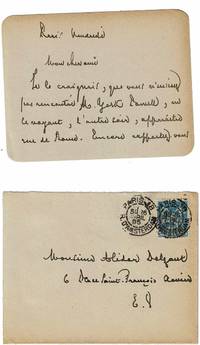
|
|

 De zoekresultaten per email ontvangen
 Zoekresultaten downloaden als PDF
 RSS feed
 Permanente link


