|
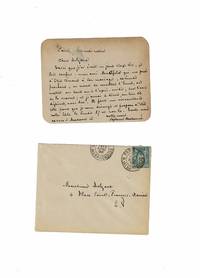
Stephane MALLARME
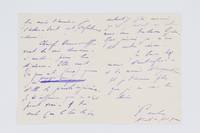
".mon ami Muhlfeld . me prie d'être témoin à son mariage"" Signed autograph card addressed to Alidor Delzant
Paris 1896. Fine. Paris 15 avril 1896 11.40 x 8.80 cm une carte recto et une enveloppe Signed autograph card from Stéphane Mallarmé addressed to Alidor Delzant written on the recto in black ink. Envelope included. A small water stain affecting the beginning of the card without hindering readability. Alidor Delzant was a lawyer collector and bibliophile. Friend of the Goncourts he devoted a work to them and was Edmond's secretary and testamentary legatee. ""Voici que j'écris un jour trop tôt je suis confus : mon ami Muhlfeld qui me prie d'être témoin à son mariage ce lundi prochain."" ""Here I am writing a day too early I am confused: my friend Muhlfeld who asks me to be witness at his wedding this coming Monday."" ""On the 20th of this month also spring-like he signs the municipal register as witness at the wedding of Lucien Muhlfeld one of the leading figures of La Revue blanche and all this fine company dines in evening dress at La Tour d'Argent enlivened by the laughter of Misia and the Natanson brothers."" Jean-Luc Steinmetz unknown
書籍販売業者の参照番号
: 76279
|
|
|
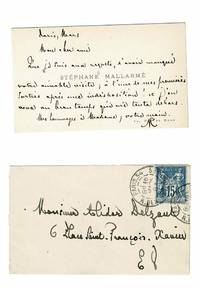
Stephane MALLARME
"Que je suis aux regrets d'avoir manqué votre aimable visite."" Autograph business card addressed to Alidor Delzant
Paris: S. n. 1893. Fine. S. n. Paris 16 mars 1893 10.40 x 6.30 cm une carte de visite et son enveloppe Visiting card with autograph signature by Stéphane Mallarmé addressed to Alidor Delzant. With envelope. Alidor Delzant was a lawyer collector and bibliophile. Friend of the Goncourts he devoted a work to them and was Edmond's secretary and testamentary legatee. ""Que je suis aux regrets d'avoir manqué votre aimable visite ; à l'une de mes premières sorties après une indisposition ! et j'en veux au beau temps qui me tenta dehors."" ""How I regret having missed your kind visit; during one of my first outings after an indisposition! and I blame the fine weather that tempted me outside."" S. n. unknown
書籍販売業者の参照番号
: 76340
|
|
|
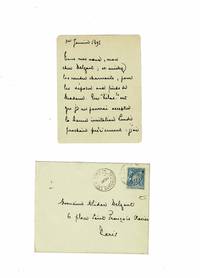
Stephane MALLARME
"Tous mes voeux mon cher Delzant."" Signed autograph card addressed to Alidor Delzant
Paris 1892. Fine. Paris 1er janvier 1892 8.80 x 11.40 cm une carte recto-verso et une enveloppe Autograph letter signed by Stéphane Mallarmé addressed to Alidor Delzant written on both sides in black ink. With envelope. Alidor Delzant was a lawyer collector and bibliophile. A friend of the Goncourts he devoted a work to them and served as secretary and testamentary legatee to Edmond. Charming letter in which the poet sends his wishes to his friend for the new year: ""Tous mes voeux mon cher Delzant ; et veuillez les rendre charmants pour les déposer aux pieds de Madame."" ""All my wishes my dear Delzant; and please make them charming to lay them at Madame's feet."" unknown
書籍販売業者の参照番号
: 76270
|
|
|
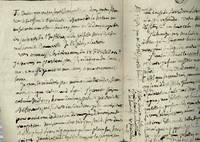
Nicolas-Edme RESTIF DE LA BRETONNE
Lettre autographe signée adressée à la citoyenne Fontaine
1797. Fine. An exceedingly rare letter from Restif: « Les événemens du 18 fructidor' m'ont rendu la vie . en affligeant mon cur » 30 fructidor 1797 An V 16 septembre 1897 18.50 x 21.30 cm 3 pages sur un double feuillet Extremely rare autograph letter signed « Restif Labretone » addressed to Citoyenne Fontaine. Three pages written in black ink on a double sheet of laid paper. Remains of a wax seal folds inherent to mailing. This letter was published with some inaccuracies in Lettres inédites de Restif de Labretone by V. Forest and É. Grimaud 1883. The Fontaine couple are merchants from Grenoble and Restif de la Bretonne began corresponding with them on March 15 1797. Important letter testifying to the completion of the publication of Restif's great autobiographical work: Monsieur Nicolas ou les Ressorts du Cur Humain dévoilé. « I will have completed the Cur humain Dévoilé within 15 days I will prepare your package immediately to have it ready. » The first eight volumes of this great autobiographical work printed by Restif himself a typesetter by trade in his residence at 11 rue de la Bûcherie were entrusted to the « dishonest » bookseller Nicolas Bonneville who did not honor his debts to the writer. Besides health issues « I exchange my illnesses and do not cure them » Restif also shares with his correspondent his literary setbacks: « The Author of Nature will preserve a sincere friend for me to compensate for the scoundrels of the Institute and the perfidious Mercier ». Indeed the previous year the author learned with bitterness that he was not admitted to the National Institute and Louis-Sébastien Mercier who had praised him in his Tableau de Paris and supported his candidacy then turned away from him. To this sum of misfortunes financial difficulties are added. Penniless and living on meager state pensions he maintains all his support for the Republic: « By what fatality do I never see the views of the rulers who welcome me; or how do they not see at once that I am attached to the Revolution to the point that I still love it even when it beats me. » Restif profoundly anti-royalist wrote several pamphlets to this effect and had just added to the end of Monsieur Nicolas an apology for the coup d'état of 18 Fructidor Year V. However this date marks the end of the allowance granted to him by Lazare Carnot after his failure at the Institute: « You know the events of 18 Fructidor; I will not speak to you about them. They have given me back my life; but by afflicting both my heart and my gratitude. » But Restif's great sorrow is the loss of his daughter Filette born from his adventure with Louise Allan whose paternity was revealed to him only late: « I am writing to you from bed weeping over my Filette who died 11 months and ten days ago . Filette was my daughter and Louise's whose soul and beauty she had. » Autograph letters signed by Restif de La Bretonne that have survived to this day are extremely rare. unknown
書籍販売業者の参照番号
: 76173
|
|
|
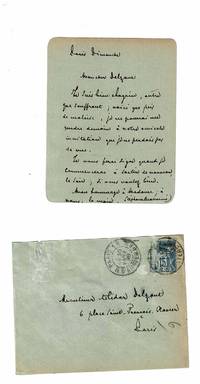
Stephane MALLARME
"Je suis bien chagrin outre que souffrant."" Signed autograph card addressed to Alidor Delzant
Paris 1898. Fine. Paris 30 janvier 1898 11.40 x 8.80 cm une carte recto et une enveloppe Autograph postcard signed by Stéphane Mallarmé addressed to Alidor Delzant written on the front in black ink. Envelope enclosed. Alidor Delzant was a lawyer collector and bibliophile. Friend of the Goncourts he devoted a work to them and was secretary and testamentary legatee of Edmond. ""Je suis bien chagrin outre que souffrant ; voici que pris de malaise je ne pourrai me rendre demain à votre amicale invitation que je ne perdais pas de vue. Je vous ferai signe quand je commencerai à sortir de nouveau le soir ; si vous voulez bien."" ""I am quite grieved besides being unwell; here I am taken with malaise I will not be able to respond tomorrow to your friendly invitation which I had not lost sight of. I will give you a sign when I begin to go out again in the evening; if you would like."" unknown
書籍販売業者の参照番号
: 76329
|
|
|
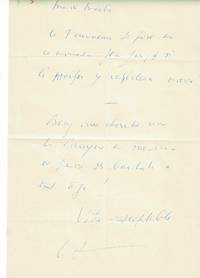
Louis-Ferdinand CELINE
"on passe des bachots à tout âge !"" Signed autograph letter addressed to Master Thorvald Mikkelsen
s. l. Klarskovgaard 1950. Fine. s. l. Klarskovgaard 28 octobre 1950 21 x 34 cm 1 pages sur un feuillet Partly unpublished autograph letter signed by ""your touchy LF"" Louis-Ferdinand Céline addressed to his lawyer Maître Thorvald Mikkelsen. One page written in blue ink on a large sheet of white paper; number ""563"" in Céline's hand in the upper left corner in red pencil. Transverse folds inherent to the mailing. This letter was very partially transcribed in the Année Céline 2005. Céline after days of suffering from the cold is delighted to announce to his friend that he has received heating: ""Le fourneau se pose en ce moment. Je ne sais pas si la maison y résistera l'on verra !"" ""The stove is being installed right now. I don't know if the house will withstand it we shall see!"" This letter also mentions his Swedish friend Ernst Bendz like him a doctor and writer: ""Benz sic vous cherche un La Bruyère en suédois - on passe des bachots à tout âge !"" ""Bendz is looking for a La Bruyère in Swedish for you - one takes exams at any age!"" In 1947 Céline pursued by French justice for his collaborationist involvement was confined in Denmark. It was in May 1948 accompanied by Lucette and Bébert that he arrived at his lawyer Maître Thorvald Mikkelsen's home in Klarskovgaard. The latter owned a large property by the Baltic Sea and invited the exile to stay there. On February 21 1950 as part of the purge the writer was definitively condemned in absentia by the civic chamber of the Paris Court of Justice for collaboration to one year of imprisonment which he had already served in Denmark. The Swedish Consul General in Paris Raoul Nordling intervened on his behalf with Gustav Rasmussen the Danish Foreign Minister and managed to delay his extradition. On April 20 1951 Jean-Louis Tixier-Vignancour his lawyer since 1948 obtained Céline's amnesty as a ""severely disabled veteran of the Great War"" by presenting his file under the name of Louis-Ferdinand Destouches without any magistrate making the connection. Céline would leave Denmark the following summer after three years spent at his lawyer's home. unknown
書籍販売業者の参照番号
: 76185
|
|
|
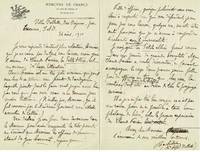
RACHILDE
"Je ne veux pas du tout vous laisser croire que l'oeuvre de Claude Farrère les Petites Alliées est un ouvrage de basse littérature"" Autograph letter signed about Claude Farrère
Bas-Vignons 1910. Fine. Bas-Vignons 24 août 1910 13.70 x 21 cm 2 pages sur un double feuillet Unpublished autograph letter signed by Rachilde two pages written in black ink on a double sheet with Mercure de France letterhead. Interesting letter addressed to an unknown recipient perhaps a ""naval officer"". Rachilde defends Les Petites Alliées by Claude Farrère and his style in general: ""Je ne veux pas du tout vous laisser croire que l'oeuvre de Claude Farrère les Petites Alliées est un ouvrage de basse littérature . Claude Farrère est un très joli écrivain qui joint aux becs de sa plume une pointe de dandysme laquelle pointe peut le faire mal juger aussi bien par vous que par moi mais n'en demeure pas moins littéraire."" ""I do not want you to believe at all that Claude Farrère's work les Petites Alliées is a work of low literature . Claude Farrère is a very fine writer who adds to his pen's nibs a touch of dandyism which touch may make him badly judged by you as well as by me but nonetheless remains literary."" This ""touch of dandyism"" led to an amusing misunderstanding as highlighted by Henri Troyat Farrère's successor at the French Academy in his reception speech: ""As for the feminist Rachilde deceived by the first name Claude she had led a fierce campaign for Farrère taking him for a fellow woman writer."" unknown
書籍販売業者の参照番号
: 76250
|
|
|
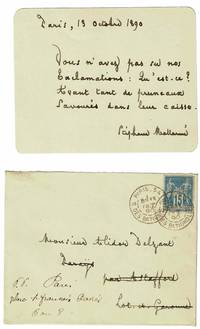
Stephane MALLARME
Quatrain autographe signé adressé à Alidor Delzant
Valvins 1890. Fine. Valvins 13 octobre 1890 11.40 x 8.80 cm une carte recto et une enveloppe Autograph quatrain signed by Stéphane Mallarmé addressed to Alidor Delzant written in black ink on the verso of a card. Envelope included. Alidor Delzant was a lawyer collector and bibliophile. Friend of the Goncourts he devoted a work to them and was Edmond's secretary and testamentary legatee. ""Vous n'avez pas su nos / Exclamations : Qu'est-ce / Avant tant de pruneaux / Savourés dans leur caisse"" ""You did not know our / Exclamations: What is this / Before so many prunes / Savored in their box"" Amusing stanza of thanks for the sending of prunes. unknown
書籍販売業者の参照番号
: 76344
|
|
|
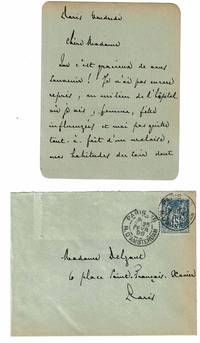
Stephane MALLARME
"Que c'est gracieux de vous souvenir !"" Signed autograph card addressed to Gabrielle Delzant
Paris 1898. Fine. Paris 25 février 1898 11.40 x 8.80 cm une carte recto-verso et une enveloppe Autograph signed postcard by Stéphane Mallarmé addressed to Gabrielle Delzant wife of his friend Alidor written on both sides in black ink. Envelope included. Alidor Delzant was a lawyer collector and bibliophile. Friend of the Goncourts he devoted a work to them and was secretary and testamentary legatee of Edmond. ""Que c'est gracieux de vous souvenir ! Je n'ai pas encore repris au milieu de l'hôpital où je vis femme fille influenzées et moi pas quitte tout-à-fait d'un malaise mes habitudes du soir."" ""How gracious of you to remember! I have not yet resumed in the midst of the hospital where I live with wife and daughter suffering from influenza and myself not entirely free of discomfort my evening habits."" unknown
書籍販売業者の参照番号
: 76332
|
|
|
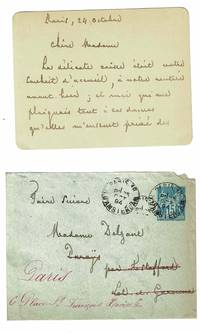
Stephane MALLARME
"La délicate caisse était votre souhait d'accueil."" Signed autograph card addressed to Gabrielle Delzant
Paris 1894. Fine. Paris 24 octobre 1894 11.40 x 8.80 cm une carte recto-verso et une enveloppe Autograph letter signed by Stéphane Mallarmé addressed to Gabrielle Delzant wife of his friend Alidor written on both sides in black ink. Envelope included. Alidor Delzant was a lawyer collector and bibliophile. A friend of the Goncourts he devoted a work to them and was Edmond's secretary and testamentary legatee. ""La délicate caisse était votre souhait d'accueil à notre rentrée avant-hier ; et moi qui me plaignais tant à ces dames qu'elles m'eussent privé des toutes dernières feuilles mortes voici qu'à un point de vue poétique différent ces pruneaux les remplacèrent aussitôt."" ""The delicate box was your welcoming wish upon our return the day before yesterday; and I who complained so much to these ladies that they had deprived me of the very last dead leaves here from a different poetic point of view these prunes replaced them at once."" unknown
書籍販売業者の参照番号
: 76348
|
|
|
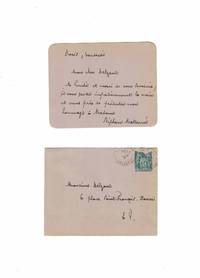
Stephane MALLARME
Carte autographe signée adressée à Alidor Delzant : ""A lundi.""
Paris 1895. Fine. Paris 22 novembre 1895 11.40 x 8.80 cm une carte recto et une enveloppe Signed autograph card from Stéphane Mallarmé addressed to Alidor Delzant written on the recto in black ink. Envelope included. Alidor Delzant was a lawyer collector and bibliophile. Friend of the Goncourts he devoted a work to them and was Edmond's secretary and testamentary legatee. ""A lundi et merci de vous souvenir ; je vous presse impatiemment la main et vous prie de présenter mon hommage à Madame."" ""Until Monday and thank you for remembering; I impatiently press your hand and ask you to present my respects to Madame."" unknown
書籍販売業者の参照番号
: 76277
|
|
|
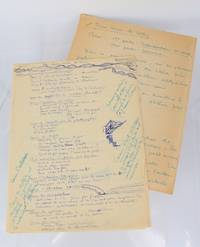
Boris VIAN
Manuscrit autographe inédit d'un projet de sketch de Boris Vian intitulé ""Deux heures de colles"" Unpublished autograph manuscript of a sketch project by Boris Vian entitled ""Deux heures de colles""
1950. Fine. s. d. circa 1950 21 x 27 cm 8 pages sur 8 feuillets & 10 pages sur 10 feuillets Complete unpublished autograph manuscript of a sketch project by Boris Vian entitled ""Deux heures de colles"". Each bundle containing eight and ten sheets respectively is held together with a staple. The first written in different colored inks and featuring numerous crossings-out additions and small marginal drawings comprises two sheets of ideas for the sketch outline one sheet describing its structure and five sheets of text and stage directions. The second less corrected and entirely written in green ink is a final version of the text incorporating the structure and ideas from the first draft without preserving them in their entirety. In these notes never published nor performed the sketch takes place in a classroom where different teachers take turns delivering lessons in each of their subjects. The audience is supposed to form an assembly of unruly pupils and actively participate in the various activities imagined by Vian. The shameless teachers mistreat the pupils: ""vous êtes des khons de lamentables ratés . quelques interrogations auxquelles je vais procéder maintenant vont vous démontrer mieux qu'un long discours à quel point vous être abrutis."" ""you are fools pathetic failures . a few questions which I shall now proceed with will demonstrate to you better than a long speech just how stupid you are."" The text very humorous and remarkably modern recalls the genre of current ""talk shows"" and their cascades of gags and games. We thus find a large number of fanciful subjects designed to structure the different interventions: ""cours du supporter de match"" ""sports fan class"" ""cours de digest"" ""digest class"" ""cours d'optimisme bourgeois"" ""bourgeois optimism class"" ""cours de liberté"" ""freedom class"" ""cours de diffamation"" ""defamation class"" ""cours d'exploitation de psychanalyse"" ""psychoanalysis exploitation class"" etc. We perceive Vian's nostalgia for the past and his fascination with the future: ""Vous voyez 1900 avec 50 ans de recul avec vos yeux de 1950 mais pour les gens de l'an 2000 1950 sera aussi charmant que 1900 pour nous. Apprenez à voir votre époque avec les yeux de l'an 2000."" ""You see 1900 with 50 years' hindsight with your 1950 eyes but for people in the year 2000 1950 will be as charming as 1900 is for us. Learn to see your era through the eyes of the year 2000."" His love of cars also shows through in the staging of a ""type qui rentre par le fond de la scène dans un bruit effrayant avec sa traction une calandre ou un moteur sous le bras ."" ""fellow who enters from the back of the stage with a frightening noise with his Citroën a grille or engine under his arm ."" Visionary Vian This text is in any case imbued with ecological awareness: ""Le professeur insiste sur le gâchis qui caractérise la société actuelle et l'intérêt par conséquent d'un cours de récupération des produits inutilisés."" ""The teacher insists on the waste that characterizes current society and the interest consequently of a class on recovering unused products."" The brilliant inventor in any case envisages presenting a recycling ""machine"" ""machine"" to his audience. He also denounces under cover of humor the shortage of Parisian housing and its poor layout: ""on ne trouvait pas d'appartement à cause des collectionneurs d'appartements . Ce qui est difficile c'est de vivre dans les appartements qu'on vous propose ; mais quelques-uns de nos anciens élèves qui ont eu la chance de faire un stage dans un immeuble d'essai construit par Le Cornemusier vont vous faire une démonstration. . façon de vivre en rampant en rampant dans les appartements extrêmement bas de plafond."" ""you couldn't find an apartment because of apartment collectors . What's difficult is living in the apartments they offer you; but some of our former students who had the chance to do an internship in a test building con unknown
書籍販売業者の参照番号
: 76267
|
|
|
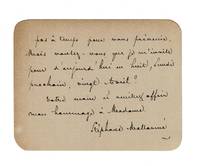
Stephane MALLARME
"Mais voulez-vous que je m'invite pour aujourd'hui en huit."" Signed autograph card addressed to Alidor Delzant
Paris 1896. Fine. Paris 12 avril 1896 11.40 x 8.80 cm une carte recto-verso et une enveloppe Autograph postcard signed by Stéphane Mallarmé addressed to Alidor Delzant written on both sides in black ink. Envelope included. Alidor Delzant was a lawyer collector and bibliophile. Friend of the Goncourts he devoted a work to them and was Edmond's secretary and testamentary legatee. ""Here I am not having gone to London warned late that the reason for my journey was no longer necessary: I replaced this with a trip to the countryside from which I do not return in time to warn you. But would you like me to invite myself for today in eight . "" unknown
書籍販売業者の参照番号
: 76326
|
|
|
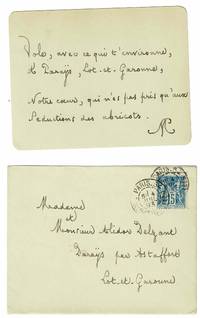
Stephane MALLARME
Quatrain autographe signé adressé à Alidor Delzant
Valvins 1893. Fine. Valvins 4 juillet 1893 11.40 x 8.80 cm une carte recto et une enveloppe Autograph quatrain signed by Stéphane Mallarmé addressed to Alidor Delzant written in black ink on the verso of a card. With envelope. Alidor Delzant was a lawyer collector and bibliophile. Friend of the Goncourts he devoted a work to them and was Edmond's secretary and testamentary legatee. ""Vole avec ce qui t'environne / A Paraÿs Lot-et-Garonne / Notre coeur qui n'es pas pris qu'aux / Séductions des abricots"" ""Fly with all that surrounds you / To Paraÿs Lot-et-Garonne / Our heart which is not taken only by / The seductions of apricots"" Amusing stanza of thanks for sending apricots. unknown
書籍販売業者の参照番号
: 76341
|
|
|
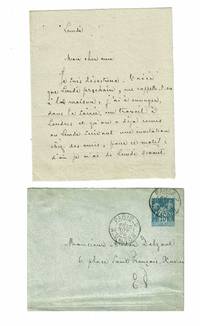
Stephane MALLARME
"Je suis désastreux."" Signed autograph letter addressed to Alidor Delzant
Paris 1892. Fine. Paris 21 novembre 1892 11.20 x 134 cm 2 pages sur un double feuillet et une enveloppe Autograph letter signed by Stéphane Mallarmé addressed to Alidor Delzant; two pages written in black ink on a double sheet. Envelope included. Alidor Delzant was a lawyer collector and bibliophile. Friend of the Goncourts he devoted a work to them and was secretary and testamentary legatee of Edmond. ""Je suis désastreux. Voici que lundi prochain me rappelle-t-on à la maison j'ai du envoyer dans la soirée un travail à Londres et qu'on a déjà remis au lundi suivant une invitation chez des amis pour ce motif."" ""I am disastrous. Here it is that next Monday I am reminded at home I have to send in the evening some work to London and that an invitation from friends has already been postponed to the following Monday for this reason."" The ""work"" mentioned in this letter is the article entitled ""Théodore de Banville"" which would appear in the National Observer of December 17 1892. unknown
書籍販売業者の参照番号
: 76338
|
|
|
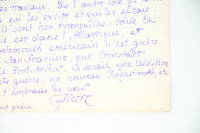
Pierre LOUS
"Mon souhait ce serait que nous choisissions deux petites maisons contigües près de Paris. "" Signed autograph letter addressed to Georges Louis
Tamaris Tamaris-sur-mer 1907. Fine. Tamaris Tamaris-sur-mer 19 juin 1907 13.50 x 20.50 cm 4 pages sur un double feuillet Autograph letter signed by Pierre Louÿs addressed to Georges Louis. Four pages written in purple ink on a double sheet. Envelope included. Fine letter addressed to his brother Georges Louis with whom Pierre Louÿs maintained a very intimate relationship and whom he considered as his own father. The question of Pierre Louÿs's real paternal identity still fascinates biographers today: ""His father Pierre Philippe Louis . had married in 1842 Jeanne Constance Blanchin who died ten years later after giving him two children Lucie and Georges. In 1855 he remarried Claire Céline Maldan and from this union was born in 1857 a son Paul; then in 1870 our writer who received the first names Pierre Félix. This late birth the differences in character between father and son the first's disaffection toward the second the profound intimacy that always reigned between Louÿs and his brother Georges all this has led certain biographers and critics to suspect that the latter was in reality the writer's father. The exceptionally intimate and constant relationship that Pierre and Georges maintained between them throughout their lives could be an argument in this sense. Of course no irrefutable proof has been discovered and none will probably ever be discovered. Nevertheless certain letters . are quite troubling. In 1895 for example Louÿs writes seriously to his brother that he knows the answer to 'the most poignant question' he could ask him a question he has had 'on his lips for ten years.' The following year in the midst of Aphrodite's triumph he thanks Georges effusively and ends his letter with this sentence: 'Not one of my friends has a FATHER who is to him what you are to me.' Arguing from the close intimacy of Georges and Claire Céline during the year 1870 and from the jealousy that the father never ceased to show toward his younger son Claude Farrère did not hesitate to conclude in favor of Georges Louis. And what to think of this dedication by Louÿs to his brother on a Japan paper copy of the first edition of Pausole: To Georges his eldest son / Pierre."" Jean-Paul Goujon Pierre Louÿs Written from Tamaris where the writer is on vacation and attempting to buy Psyché this fine letter forms a veritable ode to literature and bibliophilia. Louÿs ""fills two pages of letter on this question"" and indeed writes: ""When I leave I always lock everything up so that my maids don't browse through my books in my absence which would be disastrous. I unfortunately have book titles that could sometimes tempt them. . What to do Leave you the keys I would certainly do so if I were leaving for six months but for a short absence. . I don't have duplicates and . the key to my study locks up my desk which is the soul of the house."" Georges very quickly transmitted to his brother the love of books and texts and the latter recalls here this profound spiritual communion: ""When I look at my library I constantly regret that you don't benefit from it more. I would always like to unite it with yours and that the day when your life is free you would only have to leave your bedroom to take from my place what you desire."" Although happy to take some leave he misses his brother: ""That's somewhat what prevents me from loving Biarritz it's that I see there a threat of such complete separation for us both. . I couldn't follow you there and I would only see you one or two months a year; that frightens me. My wish would be that we choose two small adjoining houses near Paris. . But it's not time to speak of it."" This sentimental reverie of a future together quickly gives way to a long passage concerning international politics and the game of European alliances. Georges is then Director of Political Affairs at the Quai d'Orsay and the two brothers naturally discuss this subject: ""The circle of alliances built in recent unknown
書籍販売業者の参照番号
: 77513
|
|
|
Pierre LOUS
Lettre autographe signée adressée à Georges Louis
Paris 1916. Fine. Paris 15 mai 1916 11 x 16 cm 6 pages sur un double feuillet et un feuillet simple Autograph letter from Pierre Louÿs signed with his initial addressed to Georges Louis. Six pages written in violet ink on a double leaf and a single leaf. Central creases inherent to posting. Very fine letter addressed to his brother Georges Louis with whom Pierre Louÿs maintained a very intimate relationship and whom he considered as his own father. The question of the real identity of Pierre Louÿs's father still fascinates biographers today: ""His father Pierre Philippe Louis . had married in 1842 Jeanne Constance Blanchin who died ten years later after giving him two children Lucie and Georges. In 1855 he remarried Claire Céline Maldan and from this union was born in 1857 a son Paul; then in 1870 our writer who received the first names Pierre Félix. This late birth the differences in character between father and son the former's disaffection toward the latter the profound intimacy that always reigned between Louÿs and his brother Georges all this has led certain biographers and critics to suspect that the latter was in reality the writer's father. The exceptionally intimate and constant relationship that Pierre and Georges maintained between themselves all their lives could be an argument in this sense. Of course no irrefutable proof has been discovered and none will probably ever be discovered. Nevertheless certain letters . are quite disturbing. In 1895 for example Louÿs writes seriously to his brother that he knows the answer to ""the most poignant question"" he could ask him a question he has had ""on his lips for ten years."" The following year in the full triumph of Aphrodite he thanks Georges effusively and ends his letter with this sentence: ""Not one of my friends has a FATHER who is to him what you are to me."" Arguing from the close intimacy of Georges and Claire Céline during the year 1870 and the jealousy that the father never ceased to show toward his younger son Claude Farrère did not hesitate to conclude in favor of Georges Louis. And what to think of this dedication by Louÿs to his brother on a deluxe paper copy of the first edition of Pausole: For Georges his eldest son / Pierre."" Jean-Paul Goujon Pierre Louÿs A true reflection on literature and the choice of words this letter was written while Pierre Louÿs was working on a work that would appear the following year: Poëtique. ""Louÿs decides . to write a Poëtique which will be like the testament of his work as well as a message to young writers. He had always reflected on poetic art and accumulated dozens of notes both on poets and on poetry itself."" Ibid. To reflect on poetic art is precisely what he does in this fine letter: ""Regarding negation I wondered why the principle I tried to establish nuance ruse or error was not classical. I believe the answer is: Chimène. - We take the word as a text to teach high school students that negation is an additional force. - Ex. ""Je ne te hais point"" ""I do not hate you"" more expressive than ""Je t'aime"" ""I love you"". But no. Rodrigue has just said: ""Votre haine"" ""Your hatred"". It is Rodrigue who imprints the image. The response ""Je ne te hais point"" ""I do not hate you"" is the passage from shadow to light: it is to speak the nuance. . It is terribly delicate to write ""ne pas"" ""not""."" Then in a period of great trouble and isolation the poet is touched by Paul Valéry's support: ""The other day I had written a long letter to Valéry about my ""Poëtique."" - He answered me immediately a letter where he began by thanking me for all that he had felt of affection for him in the very fact that I had spent part of my evening with him without his being there. I answer him in turn - as much as I remember - ""It is so rare friends who suspect affection beneath something. There are hardly more than two kinds of people: those who do not lift the stone because they are certain there is not unknown
書籍販売業者の参照番号
: 77521
|
|
|
Pierre LOUS
"Sais-tu qu'avant quinze jours je serai auprès de toi . Puis-je espérer que d'ici là tu auras repris un peu de forces "" Autograph letter from his youth one of the last addressed to his father Pierre-Philippe Louis
Paris 1889. Fine. Paris jeudi 4 avril 1889 12.50 x 20 cm 4 pages sur un double feuillet Autograph letter signed by Pierre Louÿs addressed to his father four pages written in black ink on a double sheet of white paper. Transverse folds inherent to folding for mailing. This letter was sent by the young Pierre Louÿs while he was studying at the Janson-de-Sailly lycée Paris - 16th arrondissement. This is very likely one of Pierre Louÿs's last letters to his father ten days before the latter's death: ""Do you know that in less than two weeks I will be beside you . May I hope that by then you will have regained some strength"" The question of Pierre Louÿs's real paternal identity still fascinates biographers today: ""His father Pierre Philippe Louis . had married in 1842 Jeanne Constance Blanchin who died ten years later after giving him two children Lucie and Georges. In 1855 he remarried Claire Céline Maldan and from this union was born in 1857 a son Paul; then in 1870 our writer who received the first names Pierre Félix. This late birth the differences in character between father and son the first's disaffection toward the second the profound intimacy that always reigned between Louÿs and his brother Georges all this has led certain biographers and critics to suspect that the latter was in reality the writer's father. The exceptionally intimate and constant relationship that Pierre and Georges maintained between them throughout their lives could be an argument in this sense. Of course no irrefutable proof has been discovered and none will probably ever be discovered. Nevertheless certain letters . are quite troubling. In 1895 for example Louÿs writes seriously to his brother that he knows the answer to 'the most poignant question' he could ask him a question he has had 'on his lips for ten years.' The following year in the midst of Aphrodite's triumph he thanks Georges effusively and ends his letter with this sentence: 'Not one of my friends has a FATHER who is to him what you are to me.' Arguing from the close intimacy of Georges and Claire Céline during the year 1870 and from the jealousy that the father never ceased to show toward his younger son Claude Farrère did not hesitate to conclude in favor of Georges Louis. And what to think of this dedication by Louÿs to his brother on a Japan paper copy of the first edition of Pausole: To Georges his eldest son / Pierre."" Jean-Paul Goujon Pierre Louÿs Pierre Louÿs was only nine years old when his mother died suddenly. The father from then on entrusted his education to his brother Georges twenty years his senior and Pierre then joined him in Paris where he attended the École Alsacienne then the Janson-de-Sailly lycée. Despite the little affection shown to him the young man writes every week to his ""dear papa"" residing at Dizy-Magenta near Épernay. The young man inquires about his poor health: ""May I hope that by then you will have regained some strength No doubt. Your eczema we hope will not have worsened; and the green leaves that are beginning to appear will perhaps give you hope yourself for improvement next summer."" The ""improvement"" would sadly never come and Pierre Philippe Louis would breathe his last on April 14 1889. In the meantime Pierre Louÿs gives family news more precisely about Germaine his sister Lucie's daughter: ""Today I went to rue de la Santé to get news of Germaine. I found the little one who had been operated on in very good condition very cheerful and in good health. She was up and playing on the floor. . Finally I ended my day by going to my aunt Marie's and to Elisabeth's. Everyone is well in both houses."" As usual always anxious not to disappoint his father he finally transmits his school results: ""I return to the lycée tomorrow did Georges tell you that I was second in English"" unknown
書籍販売業者の参照番号
: 77511
|
|
|
Pierre PUVIS DE CHAVANNES
Carte autographe signée
Paris 1883. Fine. Paris 23 avril 1883 11.70 x 8.90 cm une carte autographe Autograph card signed by Pierre Puvis de Chavannes addressed to an unknown recipient written in black ink with the painter's monogram and address at the head. Some minor soiling and traces of glue on the verso. One perforation on the monogram. ""Madame j'accepte avec infiniment de reconnaissance et de plaisir votre si aimable invitation pour mercredi et vous prie d'agréer l'hommage de mes sentiments respectueux et dévoués."" ""Madam I accept with infinite gratitude and pleasure your kind invitation for Wednesday and beg you to accept the tribute of my respectful and devoted sentiments."" unknown
書籍販売業者の参照番号
: 78143
|
|
|
Pierre LOUS
"Aujourd'hui après une journée qui a déjà duré 11 h je n'ai fumé qu'un demi paquet de cigarettes."" Signed autograph card addressed to Georges Louis
Paris 1897. Fine. Paris s. d. après 1897 13.80 x 9 cm une carte autographe recto et verso Autograph card by Pierre Louÿs signed with his initial addressed to Georges Louis and written in violet ink on both sides. Note addressed to his brother Georges Louis with whom Pierre Louÿs maintained a very intimate relationship and whom he considered as his own father. The question of Pierre Louÿs's real paternal identity still fascinates biographers today: ""His father Pierre Philippe Louis . had married in 1842 Jeanne Constance Blanchin who died ten years later after giving him two children Lucie and Georges. In 1855 he remarried Claire Céline Maldan and from this union was born in 1857 a son Paul; then in 1870 our writer who received the given names Pierre Félix. This late birth the differences in character between father and son the former's disaffection toward the latter the profound intimacy that always reigned between Louÿs and his brother Georges all this has led certain biographers and critics to suspect that the latter was in reality the writer's father. The exceptionally intimate and constant relationship that Pierre and Georges maintained between themselves throughout their lives could be an argument in this direction. Of course no irrefutable proof has been discovered and probably never will be. Nevertheless certain letters . are quite troubling. In 1895 for example Louÿs writes seriously to his brother that he knows the answer to 'the most poignant question' he could ask him a question he has had 'on his lips for ten years.' The following year in the full triumph of Aphrodite he thanks Georges effusively and ends his letter with this sentence: 'Not one of my friends has a FATHER who is for him what you are for me.' Arguing from the close intimacy of Georges and Claire Céline during the year 1870 and the jealousy that the father never ceased to show toward his younger son Claude Farrère did not hesitate to conclude in favor of Georges Louis. And what to think of this dedication by Louÿs to his brother on a Japan paper copy of the first edition of Pausole: To Georges his eldest son / Pierre."" Jean-Paul Goujon Pierre Louÿs Pierre Louÿs revolutionizes his living conditions: ""I am taking serious care of myself. For two days now I have been going to bed at half past midnight to wake up between 9 and 10. Today after a day that has already lasted 11 hours I have only smoked half a pack of cigarettes. That's a quarter of my usual consumption during the same time. Moreover I walked more than a league on foot I took the air as much as I could.Well with all that I feel quite unwell or rather as if I were the day after a long and serious illness. Neither strength nor nerves. I have trouble listening speaking following an idea. Should this be attributed to my cigarette rationing It's possible. But honestly I don't think I have felt so low since '97 since the month when you came to see me in Algiers."" Amusing note from the most tobacco-addicted of writers nearly 60 cigarettes per day.! who wrote in Une volupté nouvelle: ""One night as I found myself there in silent conversation with two blue porcelain cats crouched on a white table I hesitated to choose between two pastimes of solitude: write a regular sonnet while smoking cigarettes or smoke cigarettes while looking at the ceiling carpet. The important thing is to always have a cigarette in hand; one must envelop objects in a celestial and fine cloud that bathes lights and shadows erases material angles and by a perfumed spell imposes on the agitated mind a variable balance from which it can fall into reverie."" unknown
書籍販売業者の参照番号
: 78160
|
|
|
Pierre LOUS
"Il est excellent le projet d'ouvrir le Panthéon aux héros qui ont tout offert à la Patrie jusqu'à perdre leur nom pour elle."" Signed autograph letter addressed to Georges Louis
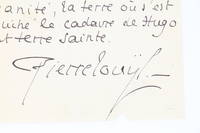
Paris 1920. Fine. Paris s. d. novembre 1920 13.50 x 18 cm 4 pages sur 4 feuillets Autograph letter signed by Pierre Louÿs addressed to Georges Louis. Four pages written in blue ink on four sheets. Handsome letter addressed to his brother Georges Louis with whom Pierre Louÿs maintained a very intimate relationship and whom he considered as his own father. The question of Pierre Louÿs's real father's identity still fascinates biographers today: ""His father Pierre Philippe Louis . had married in 1842 Jeanne Constance Blanchin who died ten years later after having given him two children Lucie and Georges. In 1855 he remarried Claire Céline Maldan and from this union was born in 1857 a son Paul; then in 1870 our writer who received the first names Pierre Félix. This late birth the differences in character between father and son the former's disaffection toward the latter the profound intimacy that always reigned between Louÿs and his brother Georges all this has led certain biographers and critics to suspect that the latter was in reality the writer's father. The exceptionally intimate and constant relationship that Pierre and Georges maintained between them throughout their lives could be an argument in this sense. Of course no irrefutable proof has been discovered and probably never will be. Nevertheless certain letters . are quite troubling. In 1895 for example Louÿs writes gravely to his brother that he knows the answer to 'the most poignant question' he could ask him a question he has had 'on his lips for ten years.' The following year at the height of Aphrodite's triumph he thanks Georges effusively and ends his letter with this sentence: 'Not one of my friends has a FATHER who is to him what you are to me.' Arguing from the close intimacy between Georges and Claire Céline during the year 1870 and from the jealousy that the father never ceased to show toward his younger son Claude Farrère did not hesitate to conclude in favor of Georges Louis. And what to think of this dedication by Louÿs to his brother on a deluxe copy of the first edition of Pausole: To Georges his eldest son / Pierre."" Jean-Paul Goujon Pierre Louÿs This letter was written after the First World War: ""The project to open the Panthéon to heroes who offered everything to the Fatherland even losing their name for her is excellent. And it would be for the archbishopric of Paris an unhoped-for opportunity to spontaneously render to our great dead of the crypt the respects that it alone in the world denies them. It would thus repair an error that has lasted too long for its glory. Cemeteries are deconsecrated. No theological reason can attribute to them a more religious character than to the basement of a monument surmounted by a colossal cross and sanctified by ashes."" Indeed in November 1920 Charles Dumont the general budget reporter expressed his wish to bring the unknown soldier into the Panthéon. Finally only the ceremony took place there and the remains of the most famous of the combatants remained as everyone knows under the Arc de Triomphe. The only soldier to join the Panthéon Maurice Genevoix would not enter until a hundred years later on November 11 2020. Louÿs concludes his letter with a very handsome tribute to the writer he has always admired: ""One is ill-advised to forbid the faithful such a pilgrimage. They do it. For immense humanity the earth where Hugo's corpse lay down is holy ground."" unknown
書籍販売業者の参照番号
: 78161
|
|
|
George SAND
Lettre autographe signée adressée à Alphonse Peyrat
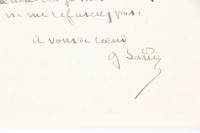
1868. Fine. s. d. mai 1868 13.50 x 20.70 cm 2 pages sur un double feuillet Autograph letter signed by George Sand addressed to Alphonse Peyrat two pages written in black ink on a double sheet. Transverse folds inherent to mailing. Interesting letter evoking one of her faithful friends: Jean Patureau-Francoeur. George Sand had published a long obituary article in tribute to this close friend in L'Avenir national on May 2 1868. She described her late friend with great tenderness: ""C'était un simple paysan un vigneron des faubourgs de Châteauroux. Il avait appris tout seul à écrire et il écrivait très remarquablement avec ces naïves incorrections qui sont presque des grâces dans un style rustique et spontané. . Ce petit homme robuste à grosse tête ronde au teint coloré à l'il bleu étincelant et doux était doué d'une façon supérieure. Il voyait la nature il l'observait il l'aimait et il la savait. . Son existence parmi nous fut pénible agitée méritante. Naturellement un esprit aussi complet que le sien devait se passionner pour les idées de progrès et de civilisation. Il fut avant la Révolution le représentant populaire des aspirations de son milieu et il travailla à les diriger vers un idéal de justice et d'humanité. ."" ""He was a simple peasant a wine-grower from the suburbs of Châteauroux. He had taught himself to write and he wrote remarkably well with those naive incorrections that are almost graces in a rustic and spontaneous style. . This sturdy little man with his large round head his ruddy complexion his sparkling and gentle blue eyes was gifted in a superior way. He saw nature observed it loved it and understood it. . His existence among us was painful agitated meritorious. Naturally a mind as complete as his had to be passionate about ideas of progress and civilization. He was before the Revolution the popular representative of his milieu's aspirations and he worked to direct them toward an ideal of justice and humanity. ."" In 1848 Patureau was elected mayor of Châteauroux and became the spokesman for the workers of his commune. ""Au moment du coup d'État il fut poursuivi mais il se cacha dans des familles amies et échappa à la police. George Sand obtint difficilement sa grâce ce qui lui permit de regagner Châteauroux. Il fut arrêté en janvier 1858 à la suite de la loi de sûreté générale."" ""At the time of the coup d'état he was pursued but he hid with friendly families and escaped the police. George Sand obtained with difficulty his pardon which allowed him to return to Châteauroux. He was arrested in January 1858 following the general security law."" ""Il resta un mois au cachot sur la paille en plein hiver. Quand on le mit dans la voiture cellulaire qui le dirigeait vers l'Afrique il était presque aveugle et depuis il a toujours souffert cruellement des yeux"" ""He remained a month in the dungeon on straw in the middle of winter. When they put him in the prison van that was taking him to Africa he was almost blind and since then he has always suffered cruelly with his eyes"" George Sand. In September 1858 following an intervention by George Sand with her friend Jérôme-Napoléon Napoleon III's cousin he was released but remained under surveillance. He settled in Algeria after obtaining permission to come to Châteauroux to sell his house and vineyard and to fetch his family. In Algeria he lived by his trade as a wine-grower was part of the Agricultural Society of Philippeville and wrote a treatise on viticulture."" Maintron ""À présent je viens vous demander de me payer ce petit article le plus cher que vous pouvez et d'envoyer le prix directement à Joseph Patureau rue de cluis n°7 à Châteauroux. Indre. Et cela le plus tôt possible."" ""Now I come to ask you to pay me for this little article as dearly as you can and to send the payment directly to Joseph Patureau rue de cluis n°7 à Châteauroux. Indre. And this as soon as possible."" Jos unknown
書籍販売業者の参照番号
: 78482
|
|
|
Julien GRACQ
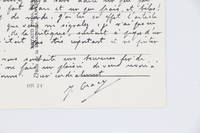
"Je suis à Sion que vous connaissez déjà sans doute un peu par Lettrines 2 ; il y fait beau et un peu frais et hélas ! il y a beaucoup de monde"" Autograph postcard signed by Julien Gracq addressed to his close friend and monographer Ariel Denis
Sion-sur-l'Océan Sion-sur-l'Océan 1995. Fine. Sion-sur-l'Océan Sion-sur-l'Océan s. d. circa 1995 15 x 10.50 cm une carte postale Autograph signed postcard from Julien Gracq with 16 lines addressed to his friend and monographer Ariel Denis written in black felt-tip pen on the reverse of a photograph showing the beach of Saint-Hilaire-de-Riez in Vendée not far from his apartment in Sion-sur-l'Océan. Julien Gracq thanks Ariel Denis for the news he sent him from Constantinople : "". je suis heureux que votre voyage se soit terminé sans hostilités."" "". I am happy that your journey ended without hostilities."" while lamenting the August crowds disturbing his peaceful retreat in Vendée: "". Je suis à Sion.et hélas ! il y a beaucoup de monde"" "". I am in Sion. and alas! there are many people"". Then the author of ""Le Rivage des Syrtes"" celebrates the critics' benevolence toward him with his characteristic modesty : "". j'ai lu en effet l'article de France soir que vous me signalez : je n'ai pas eu à me plaindre de la critique surtout à propos d'un ouvrage qui n'était pas très important et qui ne prétendait pas l'être."" "". I did indeed read the France Soir article you pointed out to me: I have not had cause to complain about the critics especially regarding a work that was not very important and did not claim to be."" unknown
書籍販売業者の参照番号
: 78741
|
|
|
Renee VIVIEN
"Je t'écris ce mot dans le train tu t'en apercevras vite en observant l'irrégularité de mon écriture."" Autograph Letter to Natalie Clifford Barney
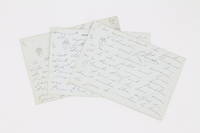
s. l. 1900. Fine. s. l. Vendredi soir printemps 1900 12.50 x 8.40 cm 6 pages sur 3 cartes Handwritten letter addressed to Natalie Clifford Barney: Je t'écris ce mot dans le train tu t'en apercevras vite en observant l'irrégularité de mon écriture. I write this to you on the train you will quickly notice that by observing the irregularity of my handwriting. s.l Friday evening Spring 1900 12.5 x 8.4 cm 6 pages on 3 cards Handwritten letter from Renée Vivien written in pencil on three blue cards with the poet's monogram. This letter has been published in Renée Vivien et ses masques in A l'Encart n°2 April 1980 A very beautiful letter written on a train: Je t'écris ce mot dans le train tu t'en apercevras vite en observant l'irrégularité de mon écriture. I write this to you on the train you will quickly notice that by observing the irregularity of my handwriting. Renée had just left her cher petit amour dear little love for a short stay outside of Paris: Quelle folie de me séparer de toi même pour deux jours et comme je le regrette amèrement maintenant : - Seulement j'étais inquiète tu sais une fois rassurée j'aurai l'esprit tranquille désormais et je pensais goûter un bonheur absolu et parfait dans ton ombre tout près de toi. Comment ai-je pu être assez stupide et assez folle pour m'en aller ! Deux jours c'est si long ! C'est deux éternités de joie dont je me prive par ma bête faute ! - Vois-tu je t'aime à ne pouvoir vivre sans toi. Ne plus te voir est une souffrance accablante. Pense à moi Lys blanc - Lys blanc aime-moi car je suis triste ce soir. What madness to separate myself from you even for two days and as I bitterly regret it now: - Only I was worried you know once reassured I will have peace of mind from now on and I thought I would taste absolute and perfect happiness in your shadow very close to you. How could I be stupid enough and crazy enough to go away! Two days is so long! It is two eternities of joy that I deprive myself of by my own stupid fault! - You see I love you and cannot live without you. Not seeing you again is an overwhelming suffering. Think of me White Lilly - White Lilly love me because I am sad this evening. In this letter we encounter Vivien's obsession with flowers: J'ai reçu avant de partir l'adorable petit bouquet de violettes blanches que tu m'as si tendrement envoyé et le cher petit mot qui m'a touchée comme une plainte d'enfant triste. Before leaving I received the adorable little bouquet of white violets that you so tenderly sent and the dear little note that touched me like a sad child's complaint. It is at the end of 1899 and through Violette Shillito that Renée Vivien - then Pauline Tarn - met Natalie Clifford Barney cette Américaine plus souple qu'une écharpe dont l'étincelant visage brille de cheveux d'or de prunelles bleu de mer de dents implacables this American woman softer than a scarf whose sparkling face shines with golden hair sea blue eyes never-ending teeth Colette Claudine à Paris. Natalie who had just experienced a summer romance with the scandalous Liane de Pougy who introduced her to sapphism paid little attention to this new acquaintance. Renée on the other hand was totally captivated by the young American woman and describes this love at first sight in her autobiographical novel Une Femme m'apparut: J'évoquai l'heure déjà lointaine où je la vis pour la première fois et le frisson qui me parcourut lorsque mes yeux rencontrèrent ses yeux d'acier mortel ses yeux aigus et bleus comme une lame. J'eus l'obscur prescience que cette femme m'intimait l'ordre du destin que son visage était le visage redouté de mon avenir. Je sentis près d'elle les vertiges lumineux qui montent de l'abîme et l'appel de l'eau très profonde. Le charme du péril émanait d'elle et m'attirait inexorablement. Je n'essayai point de la fuir car j'aurais échappé plus aisément à la mort. I lived again the hour already well past when I saw unknown
書籍販売業者の参照番号
: 78850
|
|
|
Renee VIVIEN
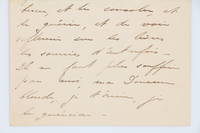
"Il ne faut plus souffrir pour moi ma Douceur blonde je t'aime je te guérirai."" Autograph Love Letter to Natalie Clifford Barney
s. l. Paris 1904. Fine. s. l. Paris s. d. ca. 1904 11.50 x 15.90 cm 4 pages sur un double feuillet Autograph letter from Renée Vivien addressed to Natalie Clifford Barney and written in black ink on a double sheet bordered with a violet trim. Transverse fold inherent to mailing. A beautiful love letter marking the reconciliation of the Muse of Violets and the Amazon after a two-year separation: ""Your letter was cruelly sweet to me I wept reading it and something within me rejoiced despite everything to think that between us the bond was so powerful and subtle that only death could entirely untie it if death is definitive."" Weary and very jealous of Natalie's infidelities Renée had made the radical decision to leave her. The Amazon had then by every means attempted to win her back sending emissaries as well as numerous letters: ""My tears have flowed over all the letters you have sent me since the silence that had settled between us."" Renée seems this time to have broken her promise never to see Natalie again and addresses this beautiful declaration to her full of hope for the future: ""Forget you! But my lips which are the soul of my soul have kept your reflection and your imprint. . Something in me has been broken since then from having loved too blindly. But if it is true that there remain within us unknown tenderness and ignored sweetness that we can still lavish upon each other in a better future let us not hesitate to discover them in the depths of our souls. I would like to take you in my arms my Little One like a sick child and rock you and console you and heal you and see the smiles of yesteryear bloom again on your lips. You must no longer suffer for me my Blonde Sweetness I love you I will heal you."" These reunions would not last however: torn between Baroness Hélène de Zuylen and Natalie Renée would embark on a series of travels; in turn to Holland Germany Switzerland and Venice she would confide her hesitations to Kérimé Turkhan-Pacha her epistolary companion from the Bosphorus whom she would meet in the summer of 1905 during her last journey with Natalie Clifford Barney to Mytilene. A moving letter from Renée Vivien addressed to the great love of her life. It was at the end of 1899 and through Violette Shillito that Renée Vivien - then Pauline Tarn - made the acquaintance of Natalie Clifford Barney ""cette Américaine plus souple qu'une écharpe dont l'étincelant visage brille de cheveux d'or de prunelles bleu de mer de dents implacables"" ""this American more supple than a scarf whose sparkling face shines with golden hair sea-blue eyes implacable teeth"" Colette Claudine à Paris. Natalie who had just experienced a summer idyll with the scandalous Liane de Pougy who had initiated her into sapphism paid only discreet attention to this new acquaintance. Renée on the other hand was completely captivated by the young American and would relate this love at first sight in her autobiographical novel Une Femme m'apparut: « J'évoquai l'heure déjà lointaine où je la vis pour la première fois et le frisson qui me parcourut lorsque mes yeux rencontrèrent ses yeux d'acier mortel ses yeux aigus et bleus comme une lame. J'eus l'obscur prescience que cette femme m'intimait l'ordre du destin que son visage était le visage redouté de mon avenir. Je sentis près d'elle les vertiges lumineux qui montent de l'abîme et l'appel de l'eau très profonde. Le charme du péril émanait d'elle et m'attirait inexorablement. Je n'essayai point de la fuir car j'aurais échappé plus aisément à la mort. » ""I evoked the already distant hour when I saw her for the first time and the shiver that ran through me when my eyes met her mortal steel eyes her sharp blue eyes like a blade. I had the obscure prescience that this woman was giving me fate's order that her face was the dreaded face of my future. I felt near her the luminous vertigo that rises from the abyss and the call of very deep water. The charm of peril emanat unknown
書籍販売業者の参照番号
: 78907
|
|
|
Renee VIVIEN
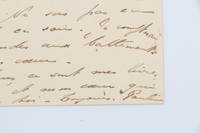
"Je compterai les secondes aux battements de mon coeur."" Signed autograph card addressed to Natalie Clifford Barney
s. l. Paris 1900. Fine. s. l. Paris s. d. ca 1900 9.50 x 5.60 cm une carte rédigée des deux côtés Autograph manuscript card signed ""Pauline"" and addressed to Natalie Clifford Barney written in black ink on both sides. Two small pinholes at the top of this card which accompanied a bouquet: ""Méchante d'être partie si vite ! - voici des orchidées blanches - elles te défendront contre les doutes et les pensées tristes. Elles te protègeront et t'assureront de ma profonde et éternelle tendresse. Ne sois pas en retard ce soir. Je compterai les secondes aux battements de mon coeur. Ces fleurs ce sont mes lèvres mon âme et mon coeur qui vont vers toi - Toujours."" ""Naughty to have left so quickly! - here are white orchids - they will defend you against doubts and sad thoughts. They will protect you and assure you of my deep and eternal tenderness. Don't be late tonight. I will count the seconds to the beating of my heart. These flowers are my lips my soul and my heart going towards you - Always."" It was at the end of 1899 and through the intermediary of Violette Shillito that Renée Vivien - then Pauline Tarn - made the acquaintance of Natalie Clifford Barney ""cette Américaine plus souple qu'une écharpe dont l'étincelant visage brille de cheveux d'or de prunelles bleu de mer de dents implacables"" ""this American more supple than a scarf whose sparkling face shines with golden hair sea-blue eyes and implacable teeth"" Colette Claudine à Paris. Natalie who had just experienced a summer idyll with the scandalous Liane de Pougy who had initiated her into sapphism paid only discreet attention to this new acquaintance. Renée however was completely captivated by the young American and would relate this love at first sight in her autobiographical novel Une Femme m'apparut: ""J'évoquai l'heure déjà lointaine où je la vis pour la première fois et le frisson qui me parcourut lorsque mes yeux rencontrèrent ses yeux d'acier mortel ses yeux aigus et bleus comme une lame. J'eus l'obscur prescience que cette femme m'intimait l'ordre du destin que son visage était le visage redouté de mon avenir. Je sentis près d'elle les vertiges lumineux qui montent de l'abîme et l'appel de l'eau très profonde. Le charme du péril émanait d'elle et m'attirait inexorablement. Je n'essayai point de la fuir car j'aurais échappé plus aisément à la mort."" ""I evoked the already distant hour when I saw her for the first time and the shiver that ran through me when my eyes met her eyes of mortal steel her eyes sharp and blue like a blade. I had the obscure presentiment that this woman was giving me destiny's order that her face was the dreaded face of my future. I felt near her the luminous vertigo that rises from the abyss and the call of very deep water. The charm of peril emanated from her and attracted me inexorably. I did not try to flee her for I would have escaped death more easily."" ""Hiver 1899-1900. Débuts de l'idylle. Un soir Vivien est invitée par sa nouvelle amie dans l'atelier de Mme Barney mère de Natalie 153 avenue Victor-Hugo à l'angle de la rue de Longchamp. Natalie s'enhardit à lire des vers de sa composition. Comme Vivien lui dit aimer ces vers elle lui répond qu'il vaut mieux aimer le poète. Réponse bien digne de l'Amazone."" ""Winter 1899-1900. Beginning of the idyll. One evening Vivien is invited by her new friend to Mme Barney's studio Natalie's mother 153 avenue Victor-Hugo at the corner of rue de Longchamp. Natalie ventures to read verses of her composition. When Vivien tells her she loves these verses she replies that it is better to love the poet. A response quite worthy of the Amazon."" J.-P. Goujon Tes blessures sont plus douces que leurs caresses Two years of unequal happiness followed punctuated by Natalie's recurring infidelities and Renée's pathological jealousy whose letters oscillated between impassioned declarations and painful mea culpas. ""Renée Vivien c'est la fille de Sappho et de Baudelaire c'est la f unknown
書籍販売業者の参照番号
: 78897
|
|
|
Renee VIVIEN
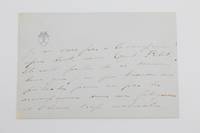
"J'aime tes jolies fleurs elles sont charmantes - j'ai porté une de tes roses hier au soir."" Signed autograph card addressed to Natalie Clifford Barney
s. l. Paris 1900. Fine. s. l. Paris s. d. ca 1900 12.50 x 8.40 cm une carte rédigée des deux côtés Autograph letter signed ""Paul"" and addressed to Natalie Clifford Barney written in black ink on both sides. Silver monogram of the poetess in the upper left corner of the recto. ""Je ne vais pas à la campagne après tout mon Tout-Petit. Ils sont partis de si bonne heure que j'ai pu trouver un prétexte pour ne pas les accompagner dans ma fatigue et l'heure trop matinale. Quand veux-tu que je vienne te chercher et où irons-nous Je serai prête à l'heure où tu voudras. J'aime tes jolies fleurs elles sont charmantes - j'ai porté une de tes roses hier au soir. A tout à l'heure mignon Tout-Petit - Paul"" ""I'm not going to the countryside after all my Little One. They left so early that I was able to find an excuse not to accompany them in my fatigue and the too early hour. When do you want me to come get you and where shall we go I'll be ready whenever you want. I love your pretty flowers they are charming - I wore one of your roses last evening. See you soon sweet Little One - Paul"" It was at the end of 1899 and through Violette Shillito that Renée Vivien - then Pauline Tarn - made the acquaintance of Natalie Clifford Barney ""this American more supple than a scarf whose sparkling face shines with golden hair sea-blue eyes implacable teeth"" Colette Claudine à Paris. Natalie who had just experienced a summer idyll with the sulfurous Liane de Pougy who had initiated her into sapphism paid only discreet attention to this new acquaintance. Renée however was completely captivated by the young American and would recount this coup de foudre in her autobiographical novel Une Femme m'apparut: ""J'évoquai l'heure déjà lointaine où je la vis pour la première fois et le frisson qui me parcourut lorsque mes yeux rencontrèrent ses yeux d'acier mortel ses yeux aigus et bleus comme une lame. J'eus l'obscur prescience que cette femme m'intimait l'ordre du destin que son visage était le visage redouté de mon avenir. Je sentis près d'elle les vertiges lumineux qui montent de l'abîme et l'appel de l'eau très profonde. Le charme du péril émanait d'elle et m'attirait inexorablement. Je n'essayai point de la fuir car j'aurais échappé plus aisément à la mort."" ""I recalled the already distant hour when I saw her for the first time and the shiver that ran through me when my eyes met her deadly steel eyes her sharp and blue eyes like a blade. I had the dark prescience that this woman was commanding me to destiny that her face was the dreaded face of my future. I felt near her the luminous vertigo that rises from the abyss and the call of very deep water. The charm of peril emanated from her and attracted me inexorably. I did not try to flee from her for I would have escaped death more easily."" ""Winter 1899-1900. Beginning of the idyll. One evening Vivien is invited by her new friend to the studio of Mrs. Barney Natalie's mother 153 avenue Victor-Hugo at the corner of rue de Longchamp. Natalie ventures to read verses of her composition. When Vivien tells her she loves these verses she replies that it is better to love the poet. An answer quite worthy of the Amazon."" J.-P. Goujon Tes blessures sont plus douces que leurs caresses There followed two years of unequal happiness punctuated by Natalie's recurring infidelities and Renée's morbid jealousy whose letters oscillated between impassioned declarations and painful mea culpas. ""Renée Vivien is the daughter of Sappho and Baudelaire she is the flower of evil 1900 with fevers broken flights sad voluptuousness."" Jean Chalon Portrait d'une séductrice In 1901 came an important break that would last almost two years; Renée despite Natalie's solicitations and the intermediaries she sent to win her back resisted. ""The two friends met again and it was in August 1905 the pilgrimage to Lesbos which constituted a disappointment for Natalie Barney and remained without sequel. . unknown
書籍販売業者の参照番号
: 79011
|
|
|
Renee VIVIEN
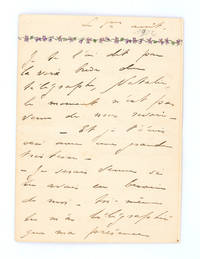
"Je te l'ai dit par la voix brute du télégraphe Natalie le moment n'est pas venu de nous revoir. "" Signed autograph letter addressed to Natalie Clifford Barney
s. l. Paris 1902. Fine. s. l. Paris Le 1er avril 1902 11.50 x 15.90 cm 7 pages 1/2 sur deux doubles feuillets Handwritten signed letter addressed to Natalie Clifford Barney: I told you by the raw voice of the telegraph Natalie the time has not come for us to see each other again. Paris 1st April 1902 11.5 x 15.9 cm 7 pages 1/2 on two double leavesHandwritten letter signed Pauline from Renée Vivien addressed to Natalie Clifford Barney and written in black ink on two double leaves edged with violettes. Transverse folds from having been sent. Interesting letter mentioning Brumes de fjords and Freddy Manners-Sutton. Tu te trompes en croyant retrouver dans Brumes de fjords un reflet de femme ou l'influence d'une pensée de poète norvégien. Je les ai faites d'un souvenir très lointain de ce pays mystique et de quelques rêves lourds de nostalgies. You are mistaken when you think that you find a reflection of a woman or the influence of a Norwegian poet's thinking in Brumes de fjords. I wrote them as a very distant memory of this mystical country and of some dreams heavy with nostalgia. Brumes de fjords is the first collection of prose poetry by Renée Vivien to be published in June 1902. Natalie and Renée were then separated but this letter shows that the Muse aux violettes continued to send her texts to the Amazone despite the physical and sentimental distance that separated them. Car j'ai dans ma vie une tendresse que je crois sincère quoi qu'il me soit difficile aujourd'hui de croire à la sincérité même lorsqu'elle me montre ses larmes. Since I have a tenderness in my life which I believe to be sincere - though it is difficult for me today to believe in sincerity even when it shows me its tears. This letter was indeed sent to Natalie Clifford Barney while she was in the United States: Je serais venue si tu avais eu besoin de moi. Toi-même tu m'as télégraphiée que ma présence était inutile. lorsque ton temps était pris par un flirt Freddy Manners-Sutton qui sait et qu'importe Il est trop tard maintenant. Je ne viens pas t'amuser ni remplacer une distraction absente. Si tu viens à Paris cet hiver je te verrai une ou deux fois comme on revoit le visage lointain de son passé sans colère sans haine mais aussi sans amour. I would have come if you needed me. You yourself telegraphed me that my presence was useless. when your time was taken by a flirt Freddy Manners-Sutton Who knows And what does it matter It's too late now. I don't come to amuse you or replace an absent distraction. If you come to Paris this winter I will see you once or twice - as you see the distant face of your past - without anger without hatred but also without love. Here Renée gives free reign to her jealousy mentioning Freddy Manners-Sutton Natalie's friend: En réalité Vivien ne pouvait supporter Manners-Sutton. Dans Une femme m'apparut elle l'appellera tout simplement Le Prostitué et dira de lui : Il est banal comme l'adultère. Cette antipathie se transformera en une haine féroce lorsqu'un peu plus tard Vivien apprendra que cet homme se faisait passer pour le fiancé de Natalie Barney. Sacrilège suprême. ! Mais Vivien ne savait pas ou bien voulait ignorer que cette rumeur était en fait propagée par Natalie Barney elle-même afin de donner le change à ses parents. Non pensait-elle ce personnage au-dessous de toute insulte veut tout simplement capter la fortune de Natalie ! In reality Vivien could not bear Manners-Sutton. In Une femme m'apparut she will very simply call him Le Prostitué and will say of him: He is common like adultery. This antipathy will turn into a fierce hatred when a little later Vivien learns that this man pretends to be Natalie Barney's fiancé. Supreme sacrilege.! But Vivien did not know - or even wanted to ignore - that this rumour was actually spread by Natalie Barney herself in order to pull the wool over her parent's eyes. No she thought this below any insult character simply wan unknown
書籍販売業者の参照番号
: 78981
|
|
|
Renee VIVIEN
"Tu as oublié que tu voulais te tuer pour moi. A part ce léger détail tu as été parfaite."" Autograph Love Letter to Natalie Clifford Barney
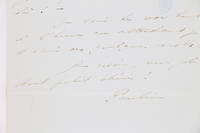
Paris 1906. Fine. Paris 3 mars 1906 12.40 x 16.80 cm 3 pages 1/2 sur un double feuillet Autograph letter signed ""Paule"" from Renée Vivien addressed to Natalie Clifford Barney and written in purple ink on a double sheet with violet letterhead and address of 23 avenue du Bois de Boulogne. Transverse folds inherent to posting. Charming letter allowing hope for an appeasement in Renée Vivien's amorous ubiquity who seems to have finally chosen Hélène de Zuylen: ""Je t'envoie des vers. Les aimes-tu Ils ne me plaisent qu'à moitié c'est déjà beaucoup ! Tu as oublié que tu voulais te tuer pour moi. A part ce léger détail tu as été parfaite Mon amie t'aime je t'adore tout est parfaitement ordonné . N'est-ce pas que mon amie est parfaitement bonne et charmante Je l'aime tant d'une façon si poignante si simple et si bête. ce qui est après tout la meilleure façon d'aimer !"" ""I am sending you verses. Do you love them They only half please me that's already a lot! You have forgotten that you wanted to kill yourself for me. Apart from this slight detail you have been perfect My friend loves you I adore you everything is perfectly ordered . Is it not true that my friend is perfectly good and charming I love her so much in such a poignant simple and silly way. which is after all the best way to love!"" One senses here however a still very deep attachment of the Muse of violets to the Amazon: ""Je baise tes mains d'autrefois et tes mains d'aujourd'hui Et je t'aime plus que je ne sais le dire."" ""I kiss your hands of yesteryear and your hands of today And I love you more than I know how to say."" It was at the end of 1899 and through the intermediary of Violette Shillito that Renée Vivien - then Pauline Tarn - made the acquaintance of Natalie Clifford Barney ""cette Américaine plus souple qu'une écharpe dont l'étincelant visage brille de cheveux d'or de prunelles bleu de mer de dents implacables"" ""this American more supple than a scarf whose sparkling face shines with golden hair sea-blue pupils implacable teeth"" Colette Claudine à Paris. Natalie who had just lived a summer idyll with the scandalous Liane de Pougy who had initiated her into sapphism paid only discrete attention to this new acquaintance. Renée however was totally captivated by the young American and would relate this thunderbolt in her autobiographical novel Une Femme m'apparut: ""J'évoquai l'heure déjà lointaine où je la vis pour la première fois et le frisson qui me parcourut lorsque mes yeux rencontrèrent ses yeux d'acier mortel ses yeux aigus et bleus comme une lame. J'eus l'obscur prescience que cette femme m'intimait l'ordre du destin que son visage était le visage redouté de mon avenir. Je sentis près d'elle les vertiges lumineux qui montent de l'abîme et l'appel de l'eau très profonde. Le charme du péril émanait d'elle et m'attirait inexorablement. Je n'essayai point de la fuir car j'aurais échappé plus aisément à la mort."" ""I evoked the already distant hour when I saw her for the first time and the shiver that ran through me when my eyes met her eyes of mortal steel her sharp blue eyes like a blade. I had the obscure presentiment that this woman was giving me destiny's order that her face was the dreaded face of my future. I felt near her the luminous vertigos that rise from the abyss and the call of very deep water. The charm of peril emanated from her and attracted me inexorably. I did not try to flee from her for I would have escaped death more easily."" ""Hiver 1899-1900. Débuts de l'idylle. Un soir Vivien est invitée par sa nouvelle amie dans l'atelier de Mme Barney mère de Natalie 153 avenue Victor-Hugo à l'angle de la rue de Longchamp. Natalie s'enhardit à lire des vers de sa composition. Comme Vivien lui dit aimer ces vers elle lui répond qu'il vaut mieux aimer le poète. Réponse bien digne de l'Amazone."" ""Winter 1899-1900. Beginning of the idyll. One evening Vivien i unknown
書籍販売業者の参照番号
: 79020
|
|
|
Renee VIVIEN
"Tout-Petit que j'aime je t'envoie des pensées toutes blanches. Garde-les dans ta chambre auprès de toi où sont mes vraies pensées tu le sais."" Signed autograph letter addressed to Natalie Clifford Barney
s. l. Paris 1900. Fine. s. l. Paris s. d. ca. 1900 12.30 x 16.50 cm 1 page1/2 sur un double feuillet Autograph manuscript letter by Renée Vivien signed ""Pauline"" addressed to Natalie Clifford Barney and written in black ink on a double sheet with the poetess's silver monogram letterhead. A very charming letter evoking the flowers so dear to Renée ""Tout-Petit que j'aime je t'envoie des pensées toutes blanches. Garde-les dans ta chambre auprès de toi où sont mes vraies pensées tu le sais."" ""Little one I love I send you pansies all white. Keep them in your room near you where my true thoughts are you know."" as well as a gift from her ""tout petit chéri"" ""dear little one"": ""J'adore mes tablettes tu te rappelles les tablettes des deux petites joueuses de flûte - seulement elles les ont perdues et moi je ne veux pas perdre les miennes. J'ai écrit dessus en grec J'aime Natalie ! Cela m'a fait tant de plaisir ! - quelle bonne et jolie pensée tu as eue là ! -"" ""I adore my tablets do you remember the tablets of the two little flute players - only they lost them and I don't want to lose mine. I wrote on them in Greek I love Natalie! It gave me such pleasure! - what a good and lovely thought you had there! -"" Renée Vivien's Hellenist passion was born from her encounter with Eva Palmer during their stay in the United States where she accompanied Natalie Clifford Barney. This beautiful twenty-six-year-old redhead who it is said had translated all of Plato's Symposium with the Amazon gave Renée her first lessons in ancient Greek and awakened in her the passion for the poetess Sappho that never left her thereafter. It was at the end of 1899 and through Violette Shillito that Renée Vivien - then Pauline Tarn - made the acquaintance of Natalie Clifford Barney ""this American more supple than a scarf whose sparkling face shines with golden hair sea-blue eyes and implacable teeth"" Colette Claudine à Paris. Natalie who had just lived a summer idyll with the sulfurous Liane de Pougy who had initiated her into sapphism paid only discreet attention to this new acquaintance. Renée however was totally captivated by the young American and would relate this love at first sight in her autobiographical novel Une Femme m'apparut: ""I evoked the already distant hour when I saw her for the first time and the shiver that ran through me when my eyes met her eyes of mortal steel her sharp blue eyes like a blade. I had the obscure presentiment that this woman was giving me destiny's order that her face was the dreaded face of my future. I felt near her the luminous vertigo that rises from the abyss and the call of very deep water. The charm of peril emanated from her and attracted me inexorably. I did not try to flee her for I would have escaped death more easily."" ""Winter 1899-1900. Beginning of the idyll. One evening Vivien is invited by her new friend to Mme Barney's studio Natalie's mother 153 avenue Victor-Hugo at the corner of rue de Longchamp. Natalie ventures to read verses of her own composition. When Vivien tells her she loves these verses she replies that it is better to love the poet. A response quite worthy of the Amazon."" J.-P. Goujon Tes blessures sont plus douces que leurs caresses Two years of unequal happiness followed punctuated by Natalie's recurring infidelities and Renée's pathological jealousy whose letters oscillated between passionate declarations and painful mea culpa. ""Renée Vivien is the daughter of Sappho and Baudelaire she is the flower of evil 1900 with fevers broken flights sad voluptuousness."" Jean Chalon Portrait d'une séductrice In 1901 came an important rupture that would last almost two years; Renée despite Natalie's solicitations and the intermediaries she sends to win her back resists. ""The two friends saw each other again and it was in August 1905 the pilgrimage to Lesbos which constituted a disappointment for Natalie Barney and remained without consequence. . unknown
書籍販売業者の参照番号
: 78899
|
|
|
Renee VIVIEN
"Les docteurs disent tous qu'il n'y a plus d'espoir."" Signed autograph letter addressed to Natalie Clifford Barney
s. l. Londres London 1900. Fine. s. l. Londres London Le 16 octobre 1900 11.30 x 17.50 cm 10 pages sur 2 doubles feuillets et 1 feuillet simple Very long autograph manuscript letter by Renée Vivien signed ""Ton fervent Paul"" written in black ink on two double sheets and one single sheet. Transverse creases inherent to the mailing envelope included. Moving letter recounting Renée Vivien's first encounters with suffering and death. Having returned to her family in London the Violet Muse watches over her dying cousin : ""Mon pauvre cousin va de plus en plus mal. Je crains horriblement que ce ne soit la fin. Il est la plupart du temps en proie à la fièvre et au délire. Ou bien il dort d'un mauvais sommeil de prostration et de faiblesse à la suite des piqûres de morphine. . Cela me fait mal de voir le pauvre squelette qui me sourit si faiblement ce visage est marqué déjà par la mort il y a la trace de sa serre qui ne relâche pas."" ""My poor cousin is getting worse and worse. I am horribly afraid this may be the end. He is most of the time prey to fever and delirium. Or else he sleeps a bad sleep of prostration and weakness following morphine injections. . It pains me to see the poor skeleton who smiles at me so weakly this face is already marked by death there is the trace of its grip that does not let go."" Pain is omnipresent in this letter-torrent: ""J'ai vu une chose horrible aujourd'hui à l'hôpital en allant voir mon cousin. On a apporté sur un brancard une chose épouvantable - un corps couvert d'un drap et une tête d'homme aux joues brûlées - et de cela sortait des gémissements et des hurlements et des râles. Il me semble que je ne pourrai jamais oublier l'affreuse chose inerte qui m'a frôlée de si près cette après-midi. Il paraît que c'était un ouvrier terriblement blessé par une explosion de gaz qui a eu lieu dans une fabrique à une heure cette après-midi. Ah ! la sinistre chose qu'on portait là-bas ! On entend parler d'accidents et de blessures et de mort et on n'y fait pas attention jusqu'à ce qu'on voie ce que c'est. L'horreur de tout cela m'obsède ce soir et s'ajoute à mon abattement et à ma mélancolie."" ""I saw a horrible thing today at the hospital while going to see my cousin. They brought on a stretcher a dreadful thing - a body covered with a sheet and a man's head with burned cheeks - and from this came moans and howls and death rattles. It seems to me I will never be able to forget the awful inert thing that brushed so close to me this afternoon. It appears it was a worker terribly injured by a gas explosion that occurred in a factory at one o'clock this afternoon. Ah! the sinister thing they were carrying there! One hears talk of accidents and injuries and death and pays no attention to it until one sees what it is. The horror of all this obsesses me tonight and adds to my dejection and my melancholy."" At this time Renée Vivien had not yet published anything and even devalued her verses in favor of those of the Amazon: ""Ce matin Chère la joie que m'a causée ta lettre et l'émotion profonde de ton beau sonnet - ce vers « Is there no touch beyond the touch of hands » et ces deux autres : « Is there no love that burns an unseen fire » « Beyond the finish of expressed desire » sont de toute splendeur poétique. . C'est toi qui portes au front la grande lumière c'est dans ton cur que chante la musique sublime parler de mes vers à moi Ils sont pauvres à faire pleurer."" ""This morning Dear the joy your letter caused me and the profound emotion of your beautiful sonnet - this verse 'Is there no touch beyond the touch of hands' and these two others: 'Is there no love that burns an unseen fire' 'Beyond the finish of expressed desire' are of all poetic splendor. . It is you who bears the great light on your brow it is in your heart that the sublime music sings speak of my verses me They are poor enough to make one weep."" Written in a period preceding the sentimental storms this ve unknown
書籍販売業者の参照番号
: 78982
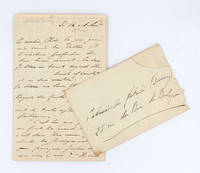
|
|
|
Renee VIVIEN - (to Natalie Clifford BARNEY)
Lettre d'amour autographe signée adressée à Natalie Clifford Barney : ""J'ai laissé mon cur sur tes lèvres il y frémira quand tu me diras : Je t'aime !"" Autograph love letter signed and addressed to Natalie Clifford Barney: ""I left my heart upon your lips it will tremble there when you say to me: I love you!""
s. l. Londres London 1900. Fine. s. l. Londres London Le 18 mars 1900 9.90 x 15.20 cm 14 pages sur 3 doubles feuillets et 1 feuillet simple Very long autograph letter handwritten by Renée Vivien signed Pauline written in black ink on three bifolia with letterhead from 24 Hyde Park Street and one single leaf. Horizontal folds inherent to mailing. A beautiful love letter sent from London while Renée was staying with her family: « Quand je pense qu'un télégramme va banalement et brutalement t'apprendre que je reste encore une semaine à Londres j'ai envie de pleurer. Et pourtant il ne faut pas que je pleure cela m'affaiblirait trop et j'ai besoin de toutes mes forces et de mon courage. » This painful separation is in the young womans eyes a necessary evil the promise of a radiant future: « Si je te fais ce chagrin mon amie c'est pour que nous soyons plus heureuses après. . Ne m'en veux pas de te faire attendre je souffre plus que toi ; et si je t'impose en me l'imposant moi-même cette souffrance du désappointement c'est afin de mériter mieux l'amour que tu m'accordes et le bonheur que tu me donnes par la douleur et par le sacrifice. Je serai ainsi plus digne de toi et tu m'aimeras mieux pour les larmes que j'ai offertes à notre amour. » Only a few months had passed since Renée and Natalie had begun seeing each other and one can already sense here the importance of this bond for the Muse of Violets and her insatiable need to be loved: « Tu me pardonnes dis Tu me souris toujours Je t'en prie envoie-moi ton pardon afin que je le sente comme une rosée sur mon front. Dis-moi de loin que tu m'aimes toujours et je t'entendrai à travers tout l'espace qui nous sépare. . Je t'aime à en mourir enfant chérie qui es le beau sourire blond de ma vie. Tout ce que je te dis et sic sincère. Crois-moi. Aime-moi. » Idealizing this relationship she launches into a magnificent litany: « Te faire souffrir toi qui m'as donné la joie rayonnante de mon existence ! Toi qui m'as fait aimer la vie ! - Toi qui m'as mis tant de beaux rêves dans l'âme tant de bonheur et tant de chaleur au cur ! - Toi qui es ma consolation mon espérance mon extase la merveille et le miracle de ma vie ! - Toi qui m'as donné l'amour qui me l'as révélé qui me l'as fait sentir et comprendre ! - Toi que j'aime ! » A superb letter-river imbued with the consuming passion of the Muse of Violets for her Amazon. At the end of 1899 through Violette Shillito Renée Vivienthen Pauline Tarnmet Natalie Clifford Barney cette Américaine plus souple qu'une écharpe dont l'étincelant visage brille de cheveux d'or de prunelles bleu de mer de dents implacables Colette Claudine à Paris. Natalie fresh from a summer romance with the scandalous Liane de Pougy who had introduced her to sapphism paid little heed to this new acquaintance. Renée on the other hand was utterly captivated by the young American and would recount this coup de foudre in her autobiographical novel Une Femme m'apparut: J'évoquai l'heure déjà lointaine où je la vis pour la première fois et le frisson qui me parcourut lorsque mes yeux rencontrèrent ses yeux d'acier mortel ses yeux aigus et bleus comme une lame. J'eus l'obscur prescience que cette femme m'intimait l'ordre du destin que son visage était le visage redouté de mon avenir. Je sentis près d'elle les vertiges lumineux qui montent de l'abîme et l'appel de l'eau très profonde. Le charme du péril émanait d'elle et m'attirait inexorablement. Je n'essayai point de la fuir car j'aurais échappé plus aisément à la mort. Winter 18991900. The beginnings of the idyll. One evening Vivien is invited by her new friend to the studio of Mme Barney Natalies mother 153 avenue Victor-Hugo at the corner of rue de Longchamp. Natalie dares to read aloud her own verses. When Vivien tells her she admires them she replies that it is better to love the poet. A response truly worthy of the Amazon. J.-P. Goujon Tes blessures sont plu unknown
書籍販売業者の参照番号
: 79028
|
|
|
Emile ZOLA
"Je me suis exténué à faire sortir cette vérité de mon livre si l'on ne m'a pas compris la faute en est sans doute à moi."" Signed autograph letter addressed to Henry Fouquier about La Terre
Paris 1888. Fine. Paris 11 février 1888 13.20 x 20.50 cm 2 pages sur un double feuillet Autograph letter signed by Emile Zola addressed to Henry Fouquier written in black ink on a bifolium. Usual folds from mailing. This letter was transcribed in the complete correspondence of Emile Zola published by the CNRS and the Presses de l'Université de Montréal. A fine letter evoking La Terre and Tolstoy's The Power of Darkness. Henry Fouquier 1838-1900 was a literary critic and columnist for numerous newspapers. A close friend of Guy de Maupassant he supported Emile Zolas candidacy for the Académie française. This letter was written to him the day after the performance of Tolstoy's The Power of Darkness at the Théâtre-Libre. We have not found evidence of an article in which the journalist explicitly drew a parallel between the Russian drama and Zolas La Terre but Zola here addresses his thanks: « Merci mon cher Fouquier de ce que vous voulez bien dire de « la Terre » si attaquée. J'en suis touché vivement et croyez à toute ma gratitude. » It must be said that the fifteenth volume of the Rougon-Macquart cycle was harshly received unleashing passions from the moment of its serial publication in Gil Blas. On 18 August 1887 even before the conclusion of the novel was revealed to the public Le Figaro published the Manifeste des Cinq written by Paul Bonnetain J.-H. Rosny Lucien Descaves Paul Margueritte and Gustave Guiches. These young authors issued a severe verdict: « La Terre a paru. La déception a été profonde et douloureuse. Non seulement l'observation est superficielle les trucs démodés la narration commune et dépourvue de caractéristiques mais la note ordurière est exacerbée encore descendue à des saletés si basses que par instants on se croirait devant un recueil de scatologie : le Maître est descendu au fond de l'immondice. . Nous répudions ces bonshommes de rhétorique zoliste ces silhouettes énormes surhumaines et biscornues dénuées de complication jetées brutalement en masses lourdes dans des milieux aperçus au hasard des portières d'express. De cette dernière uvre du grand cerveau qui lança L'Assommoir sur le monde de cette Terre bâtarde nous nous éloignons résolument mais non sans tristesse. Il nous poigne de repousser l'homme que nous avons trop fervemment aimé. » Zola who had been developing the idea of a peasant novel for a decade was deeply affected. Though he never responded publicly to these accusations his correspondence is strewn with clarifications about the work whose sheer brutality alone seemed to occupy readers minds: « Mais vous ajoutez que notre thèse à Tolstoï et à moi est la même et peut se résumer en ceci : le travail de la terre est corrupteur. Tolstoï il me semble protesterait bien haut et quant à moi je vous affirme que je n'ai jamais voulu prouver une telle chose radicalement fausse à mon avis. Ce que je pense c'est que la petite propriété telle qu'elle existe chez nous c'est que la suite de faits sociaux qui ont abouti à notre forme sociale nous ont donné notre paysan d'aujourd'hui avec ses qualités et ses vices. Notre paysan est le prisonnier de sa terre et non l'homme libre qu'il devrait être. Comment voulez-vous qu'il n'y étouffe pas dans son ignorance et sa passion unique Labourer est très sain mais à la condition qu'on sera le maître de son champ au lieu d'en être le forçat. Je me suis exténué à faire sortir cette vérité de mon livre si l'on ne m'a pas compris la faute en est sans doute à moi. » A remarkable letter from the master of Naturalism shedding new light on one of the most brutal volumes of the Rougon-Macquart series. unknown
書籍販売業者の参照番号
: 79098
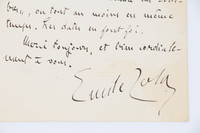
|
|
|
Emile ZOLA
"Vous avez eu l'obligeance de me donner certains détails sur l'inventaire. Vous m'avez dit qu'on choisissait le premier dimanche d'août qu'on fermait les portes et que tous les employés s'y mettaient."" Autograph letter signed unpublished addressed to Léon Carbonnaux head of department at Le Bon Marché and advice for the writing of Au bonheur des Dames
Médan 1882. Fine. Médan 16 novembre 1882 13.60 x 21.40 cm 2 pages sur un double feuillet - enveloppe jointe Autograph letter signed by Emile Zola - apparently unpublished - addressed to Léon Carbonnaux written in black ink on a double sheet. Folds inherent to mailing. Envelope included. Important testimony to the colossal documentation work and the capital role of Emile Zola's informants in depicting his immense natural and social fresco. This letter was sent to Léon Carbonnaux department head at Bon Marché who transmitted precious information to Emile Zola for the creation of the eleventh volume of the Rougon-Macquart series: Au Bonheur des Dames. Only two letters from Léon Carbonnaux to Emile Zola are known: they can be consulted in the digitization of the preparatory file for Bonheur des Dames made available online by the Bibliothèque nationale de France. However we know thanks to this same file which contains a long section entitled ""Notes Carbonnaux"" that this department head at Bon Marché provided a significant amount of information to Zola particularly about employee customs and their remuneration. The two men undoubtedly met when Emile Zola eager for information about the functioning of department stores conducted field research in February and March 1882. ""J'ai pris l'inventaire comme cadre à un de mes chapitres. D'ailleurs je n'ai spécialement besoin que du travail dans le rayon des confections et dans le rayon des soieries. Il est inutile de me renseigner sur les autres rayons."" ""I have taken the inventory as the framework for one of my chapters. Moreover I specifically only need the work in the ready-to-wear department and in the silk department. It is unnecessary to inform me about the other departments."" Thanks to this important letter we understand that it was Léon Carbonnaux who provided the essential information to Emile Zola for writing his very beautiful eleventh chapter devoted to the inventory: ""Vous avez eu l'obligeance de me donner certains détails sur l'inventaire. Vous m'avez dit qu'on choisissait le premier dimanche d'août qu'on fermait les portes et que tous les employés s'y mettaient. On vide toutes les cases n'est-ce pas on jette les marchandises sur les comptoirs ou à terre et l'inventaire n'est terminé que lorsqu'il n'y a plus absolument rien en place."" ""You were kind enough to give me certain details about the inventory. You told me that the first Sunday in August was chosen that the doors were closed and all the employees set to work. All the compartments are emptied aren't they The merchandise is thrown onto the counters or on the ground and the inventory is only finished when there is absolutely nothing left in place.""The final version of Bonheur des Dames contains all the precious information provided by the department head of Bon Marché: ""Le premier dimanche d'août on faisait l'inventaire qui devait être terminé le soir même. Dès le matin comme un jour de semaine tous les employés étaient à leur poste et la besogne avait commencé les portes closes dans les magasins vides de clientes. . Neuf heures sonnaient. . Dans le magasin inondé de soleil par les grandes baies ouvertes le personnel enfermé venait de commencer l'inventaire. On avait retiré les boutons des portes des gens s'arrêtaient sur le trottoir regardant par les glaces étonnés de cette fermeture lorsqu'on distinguait à l'intérieur une activité extraordinaire. C'était d'un bout à l'autre des galeries du haut en bas des étages un piétinement d'employés des bras en l'air des paquets volant par-dessus les têtes ; et cela au milieu d'une tempête de cris de chiffres lancés dont la confusion montait et se brisait en un tapage assourdissant. Chacun des trente-neuf rayons faisait sa besogne à part sans s'inquiéter des rayons voisins. D'ailleurs on attaquait à peine les casiers il n'y avait encore par terre que quelques pièces d'étoffe. La machine devait s'échauffer si l'on voulait finir le soir même. unknown
書籍販売業者の参照番号
: 79109
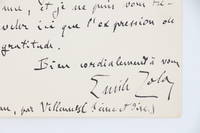
|
|
|
Emile ZOLA
"Comment avez-vous pu vous laisser prendre à la plaisanterie imbécile du Panurge "" Very important autograph letter signed unpublished addressed to Léon Carbonnaux about the false publication of a pre-original of Au bonheur des Dames
Médan 1882. Fine. Médan 1er décembre 1882 13.60 x 21.40 cm 2 pages sur un double feuillet - enveloppe jointe Autograph letter signed by Emile Zola - apparently unpublished - written in black ink on a double sheet and addressed to Léon Carbonnaux department head at Bon Marché. Folds inherent to mailing. Envelope included. Only two letters from Léon Carbonnaux to Emile Zola are known: they can be consulted in the digitized preparatory file for Au bonheur des dames made available online by the Bibliothèque nationale de France. However we know from this same file which contains a long section entitled ""Notes Carbonnaux"" that this department head at Bon Marché provided Zola with a significant amount of information particularly about employee customs their remuneration and especially inventory techniques. The two men probably met when Emile Zola eager for information about the workings of department stores conducted field research in February and March 1882. Very important unpublished letter shedding new light on the pre-original publication of Au bonheur des dames. In his biography of Emile Zola Henri Mitterrand writes: ""Even before the novel was completed Zola gave an extract to Panurge in November; and on November 23 1882 Gil Blas announced its imminent publication in its columns."" Our letter discussing precisely this alleged pre-publication in Panurge attests that it was simply a joke and thus contradicts Henri Mitterrand: ""But your letter surprises and saddens me somewhat. How could you have been taken in by Panurge's stupid joke Did you not notice that the entire issue is a 'farce' Not one of the articles is authentic they are parodies and very poorly done ones at that."" Indeed reading the said extract cannot fool the assiduous reader of Zola despite the introduction that the journalists wrote: ""After Nana and Pot-Bouille those epics of elegant vice and bourgeois vice M. Emile Zola wanted to create one of honesty: Au bonheur des Dames which will appear shortly is a reassuring painting of innocence and virtue; the greatest success is assured for this new work whose characters move in the setting of a large novelty store; Parisian high commerce will not long await its observer and painter. We thank Emile Zola for having kindly cut out especially for Panurge a few pages from his still unpublished work and we are proud to give the public first an extract from this work of such high morality and such powerful interest."" Panurge no. 4 of October 22 1882 The sentences of this false Zolian text are exaggeratedly long and Panurge took the liberty of endowing the novel with a male main character Denis Mouret an amalgam of Denise the true heroine of the book to appear and Octave Mouret. One can think that it is a text composed from elements of Pot-Bouille the previous volume of Rougon Macquart where Octave - future owner of Bonheur des Dames - exercised the function of clerk before his meteoric social rise: ""For already more than two months he had been attached to the 'silks and furs' department; he arrived in the morning at seven o'clock to return home his day finished only at nine o'clock in the evening when all of Paris buzzed strangely with a feverish animation of pleasure and enjoyment and on his way back he followed gawking the great crowded boulevards where blazed the cafés full of girls and where on the asphalt at theater doors the crowd jostled with here and there in the vague rumor of trampling and pressing the roguish intonation of the cries of program vendors and ticket sellers."" Panurge In his letter of November 30 1882 Léon Carbonnaux - reading the extract from Panurge - had reproached Zola for his errors: ""Nowhere except at the Fabriques de France near Les Halles does one arrive at 7 a.m. It's at the earliest 7:30 but more often 8 a.m. and even then. There is no silk and fur counter at the Louvre. . It is so easy for you to be accurate that errors of this kind especially if t unknown
書籍販売業者の参照番号
: 79111
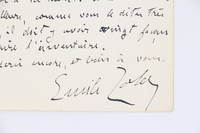
|
|
|
Renee VIVIEN
Poème d'amour autographe inédit à Natalie Clifford Barney ""A l'absente"" Unpublished handwritten poem to Natalie Clifford Barney
s. l. 1900. Fine. s. l. 20 mars 1900 10 x 15.70 cm 2 pages sur un double feuillet Unpublished handwritten poem to Natalie Clifford Barney « à l'absente » 20 March 1900 10 x 157 cm 2 pages on a double leaf Handwritten poem entitled « à l'absente » To the absent one and addressed to Natalie Clifford Barney. Two pages written in black ink on a double leaf headed 24 Hyde Park Street. To our knowledge this three-verse octosyllabic poem is unpublished. It is preceded on the first section of this double leaf by a little handwritten message: These are the verses I have made I would rather say the tears which I have shed for you. Turn the page you will find them there in all their melancholy. Oui c'est toi mon rêve suprême Pendant ces longs ces mornes jours Où je pleure au fond de moi-même L'exil triste de mes amours! . N'as-tu pas entendu ma blonde Le bruit d'un sanglot qui revient Dans le cur de la nuit profonde C'est mon amour qui se souvient. It is at the end of 1899 and through Violette Shillito that Renée Vivien then Pauline Tarn met Natalie Clifford Barney ""this American woman softer than a scarf whose sparkling face shines with golden hair sea blue eyes never-ending teeth"" Colette Claudine à Paris. Natalie who had just experienced a summer romance with the scandalous Liane de Pougy who introduced her to sapphism paid little attention to this new acquaintance. Renée on the other hand was totally captivated by the young American woman and describes this love at first sight in her autobiographical novel Une femme m'apparut: ""I lived again the hour already well past when I saw her for the first time felt the shiver that ran through me when my eyes met the mortal steel of her look those eyes blue and piercing as a blade. I had a dim premonition that this woman would determine the pattern of my fate and that her face was the predestined face of my Future. Near her I felt the luminous dizziness which comes at the edge of an abyss or the attraction of a very deep water. She radiated the charm of danger which drew me to her inexorably."" ""Winter 1899-1900. Beginnings of the idyll. One evening Vivien is invited by her new friend to Mme Barney's studio Natalie's mother 153 avenue Victor-Hugo on the corner of the rue de Longchamp. Natalie finds the courage to read the verses of her composition. As Vivien tells her to love these verses she tells her that it is better to love the poet. A response worthy of the Amazon."" J.-P. Goujon Tes blessures sont plus douces que leurs caresses Two years of unequal happiness will follow punctuated by Natalie's recurring infidelities and Renée's sickly jealousy the letters of which oscillate between inflamed declarations and painful admissions of guilt. ""Renée Vivien is the daughter of Sappho and Baudelaire she is the 1900 flower of evil with fevers broken-up fights sad delights."" Jean Chalon Portrait d'une séductrice In 1901 a major break-up occurred which lasted almost two years; Renée despite requests from Natalie and the others she sent to win her back resisted. ""The two friends saw each other again and in August 1905 went on a pilgrimage to Lesbos which was a disappointment for Natalie Barney and was short-lived. . The spring was broken once and for all. The two former friends stopped seeing each other in 1907 and Vivien died without them seeing each other again."" J.-P. Goujon ibid. unknown
書籍販売業者の参照番号
: 78737
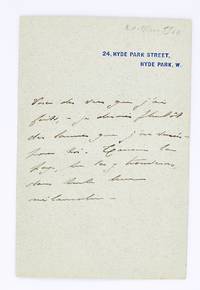
|
|
|
Renee VIVIEN
"je n'ai pas beaucoup d'amis et me soucie peu de distribuer des volumes au hasard"" Signed autograph letter addressed to his publisher Edward Sansot
s. l. Paris 1908. Fine. s. l. Paris 1908 13 x 15 cm 3 pages 1/2 sur un double feuillet Autograph letter signed by Renée Vivien addressed to her publisher Edward Sansot written in black ink on a double sheet of headed paper bearing the poet's monogram and her address at 23 avenue du Bois de Boulogne. Transverse folds inherent to mailing two tiny marginal tears without loss at the fold. Fascinating letter written by the Muse of the violets in the last months of her life: ""J'ai reçu avec une très grande joie les volumes des Flambeaux éteints. Remerciez bien de ma part votre soeur d'avoir fait les corrections et je vous en prie amenez-la moi lorsque vous reviendrez Avenue du Bois. Pour les six exemplaires de Sillages décollés donnez-les - je n'ai pas beaucoup d'amis et me soucie peu de distribuer des volumes au hasard. Maintenant s'il est trop tard lorsque ma lettre vous parviendra et que les exemplaires me parvinssent quand même ne soyez pas désolé - cela m'est indifférent je vous les ferai envoyer. Mes meilleurs sentiments d'amitié littéraire. Renée Vivien. Je vous envoie en même temps sept volumes à distribuer au hasard parmi vos amis littéraires."" ""I received the volumes of Flambeaux éteints with very great joy. Please thank your sister on my behalf for having made the corrections and I beg you bring her to me when you return to Avenue du Bois. For the six unbound copies of Sillages give them away - I do not have many friends and care little about distributing volumes at random. Now if it is too late when my letter reaches you and the copies reach me nonetheless do not be sorry - it is indifferent to me I will have them sent to you. My best feelings of literary friendship. Renée Vivien. I am sending you at the same time seven volumes to distribute at random among your literary friends."" The publication of Flambeaux éteints marks the first collaboration between the poet and her new publisher Edward Sansot. In these last painful years of life Sansot and his friend Charles-Brun are her only two links with the literary world whose critics - once highly laudatory - have finally turned their backs on her. It must be said that Renée Vivien has decided to withdraw all her books from commerce and is gradually sinking into solitude and depression. Handsome letter bearing witness to the last literary years of Sappho 1900. unknown
書籍販売業者の参照番号
: 79911
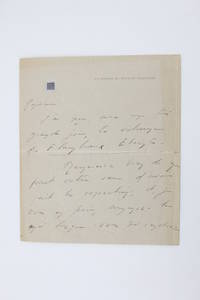
|
|
|
Renee VIVIEN
Lettre autographe signée adressée à Charles Maurras : ""En feuillettant votre si intéressant volume : De l'Avenir de l'Intelligence j'ai relu avec un plaisir ému les pages - trop indulgentes vraiment ! - que vous avez consacré à mes ouvrages.""
s. l. Paris 1906. Fine. s. l. Paris s. d. ca. 1906 11.50 x 16 cm 1 page 1/2 sur un double feuillet Autograph letter signed by Renée Vivien addressed to Charles Maurras written in violet ink on a double leaf of headed paper adorned with a border of violets. Transverse folds inherent to mailing envelope included. Beautiful letter of thanks: ""Monsieur En feuillettant votre si intéressant volume : De l'Avenir de l'Intelligence j'ai relu avec un plaisir ému les pages - trop indulgentes vraiment ! - que vous avez consacré à mes ouvrages. Merci infiniment. Et veuillez agréer mes très reconnaissants sentiments de confraternité littéraire. Renée Vivien"" ""Sir While leafing through your most interesting volume: De l'Avenir de l'Intelligence I reread with moved pleasure the pages - too indulgent really! - that you dedicated to my works. Thank you infinitely. And please accept my most grateful sentiments of literary confraternity. Renée Vivien"" Charles Maurras had indeed devoted a dithyrambic chapter of his work to the Muse of violets whose verses he compared to those of Verlaine: ""Le vieux faune sentimental des Fêtes galantes et de Parallèlement reconnaîtrait chez Renée Vivien beaucoup plus qu'une élève certainement une des Surs une de ces Amies terribles qu'il a chantées. Quant à Baudelaire il lui dirait : ""Ma fille"" aux premiers regards échangés. Baudelairisme profond central générateur."" ""The old sentimental faun of Fêtes galantes and Parallèlement would recognize in Renée Vivien much more than a student certainly one of the Sisters one of those terrible Friends he sang of. As for Baudelaire he would say to her: 'My daughter' at first glance. Deep central generative Baudelairism."" unknown
書籍販売業者の参照番号
: 79816
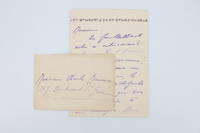
|
|
|
Renee VIVIEN
"J'aurai le plaisir de vous présenter ma soeur et mon beau-frère qui seront à Paris. Vous devinez quelle joie me causera leur présence !"" Signed autograph letter addressed to Marcelle Tinayre
s. l. Paris 1907. Fine. s. l. Paris s. d. ca. 1907-1908 11.50 x 16 cm 2 pages 1/2 sur un double feuillet Autograph letter signed by Renée Vivien addressed to Marcelle Tinayre written in black ink on a double sheet of headed paper decorated with a border of violets. Transverse creases inherent to mailing. Also a writer Marcelle Tinayre was close to Renée Vivien who entrusted her first verses to her to read. Upon Vivien's death Tinayre paid tribute to her through several texts notably a very beautiful tribute article published in the review Schéhérazade in 1910 entitled ""Trois images de Renée Vivien"". ""Chère grande amie Votre si bonne carte de souvenir m'a réjouie et touchée. De tout coeur un remerciement chaleureux. Malgré les inévitables petits malaises que nous inflige ce temps abominable je vais mieux beaucoup mieux. Aussi serais-je très heureuse si vous et Monsieur Tinayre étiez libres le 12 et pouviez venir dîner chez moi. J'aurai le plaisir de vous présenter ma soeur et mon beau-frère qui seront à Paris. Vous devinez quelle joie me causera leur présence ! Croyez à toute mon admiration à toute ma sympthie. Renée Vivien."" ""Dear great friend Your so kind remembrance card delighted and touched me. A warm thank you from the heart. Despite the inevitable small ailments this abominable weather inflicts upon us I am better much better. So I would be very happy if you and Monsieur Tinayre were free on the 12th and could come dine at my home. I will have the pleasure of introducing my sister and brother-in-law who will be in Paris. You can imagine what joy their presence will bring me! Believe in all my admiration all my sympathy. Renée Vivien."" The Muse of violets was indeed very close to Toinette her younger sister who lived in London with her husband Francis. Renée Vivien was moreover the godmother of their son Paul a very rare name then in England in honor of his aunt and in 1911 Toinette would give birth to a daughter whom she would name Renée in tribute to her deceased sister. Very beautiful testimony to the friendship that Renée Vivien bore toward Marcelle Tinayre a writer friend who contributed to perpetuating the memory of Sappho 1900. unknown
書籍販売業者の参照番号
: 79804
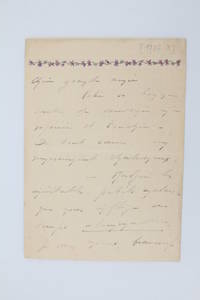
|
|
|
Frederic-Auguste CAZALS
Carte postale autographe signée adressée à Emile Straus
Paris: S. n. 1904. Fine. S. n. Paris 7 avril 1904 14.10 x 9.10 cm une carte postale Autograph postcard signed by Frédéric-Auguste Cazals addressed to Emile Straus: ""Souvenir amical - F. A. Cazals Paris 7/4/04"" ""Friendly remembrance - F. A. Cazals Paris 7/4/04"" Some stains. A great enthusiast of epistolary art Emile Straus founded in 1899 La Carte postale illustrée the newsletter of the association he had just launched the International Poste-Carte Club. S. n. unknown
書籍販売業者の参照番号
: 80519
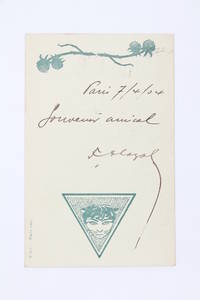
|
|
|
Frederic-Auguste CAZALS
Carte postale autographe signée adressée à Emile Straus
Paris: S. n. 1904. Fine. S. n. Paris 13 août 1904 14.10 x 9.10 cm une carte postale Signed autograph postcard from Frédéric-Auguste Cazals addressed to Emile Straus: ""Amitiés ! F. A. Cazals Paris 13/8/04"" ""Best wishes! F. A. Cazals Paris 13/8/04"" Some staining. A great enthusiast of epistolary art Emile Straus founded in 1899 La Carte postale illustrée the newsletter of the association he had just launched the International Poste-Carte Club. S. n. unknown
書籍販売業者の参照番号
: 80518
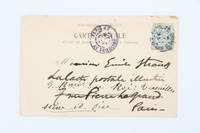
|
|
|
Jules CLARETIE
Carte postale autographe signée adressée à Emile Straus
Paris: S. n. 1904. Fine. S. n. Paris 3 janvier 1904 14 x 9 cm une carte postale Signed autograph postcard from Jules Clarétie addressed to Emile Straus on a postcard reproducing the photograph of his portrait at his work table: ""A M. Emile Straus tous mes souhaits. Jules Claretie."" ""To Mr. Emile Straus all my best wishes. Jules Claretie."" Some staining. A great enthusiast of epistolary art Emile Straus founded in 1899 La Carte postale illustrée the newsletter of the association he had just launched the International Poste-Carte Club. S. n. unknown
書籍販売業者の参照番号
: 80517
|
|
|
Gerard de NERVAL
Billet autographe signé de Gérard de Nerval adressé à Georges Guénot-Lecointe
Paris 1842. Fine. Paris 10 juin 1842 10.60 x 17 cm quelques lignes sur un double feuillet Autograph letter signed ""Gérard"" addressed to Georges Guénot-Lecointe: ""Mon Cher Monsieur Je ne pourrai vous aller voir demain. Je crois que mon affaire se termine au Ministère. A après demain donc."" ""My Dear Sir I will not be able to come see you tomorrow. I believe my business is concluding at the Ministry. Until the day after tomorrow then."" Fold marks inherent to postal use. Trace of wax seal and manuscript address on fourth page. This letter has been transcribed in the correspondence published in the Pléiade volume 1 p. 917. The ""business"" referred to here concerns financial aid of 300 francs that had been granted to Nerval two months earlier by the Minister of Public Instruction Abel Villemin. Georges Guénot-Lecointe was a critic for La Sylphide a review to which Gérard de Nerval also contributed. unknown
書籍販売業者の参照番号
: 80729
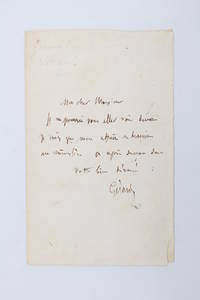
|
|
|
Maurice LEBLANC
"Revue Blanche ne paie pas."" Signed autograph note
Vaucottes Vattetot-sur-mer 1893. Fine. Vaucottes Vattetot-sur-mer 21 septembre 1893 15.60 x 20.10 cm quelques lignes sur un feuillet Autograph letter signed by Maurice Leblanc to an unknown recipient; a few lines written in black ink on a sheet. Transverse folds inherent to mailing. ""Sitôt ton mot retiré de la poste été Etretat. Trop tard. Natanson parti. 28 jours. Ne sera à Paris qu'en novembre. Alors nous verrons. Revue Blanche ne paie pas. Tempête épouvantable - grêle."" ""As soon as your note was collected from the post office went to Etretat. Too late. Natanson left. 28 days. Won't be in Paris until November. Then we'll see. Revue Blanche doesn't pay. Terrible storm - hail."" unknown
書籍販売業者の参照番号
: 80761
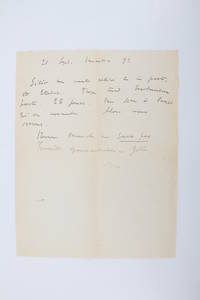
|
|
|
Judith GAUTIER
"Mr Clifton est un très jeune américain tout à fait charmant et qui a l'air d'une demoiselle. Soignez-le bien."" Signed autograph letter addressed to Céleste Chrétien
Alger Algiers 1910. Fine. Alger Algiers s. d. ca 1910 13.70 x 18 cm 4 pages sur un double feuillet Autograph letter signed by Judith Gautier addressed to Céleste Chrétien her housekeeper. Four pages written in black ink on a double sheet. Transverse folds inherent to mailing. Judith Gautier here discusses the visit of her friend the musician Chalmers Clifton - whom she liked to nickname Charmeur - to Dinard: ""Voici les dernières instructions : le voyageur arrivera dimanche soir à 7 heures 20. Il faudra le prendre à la gare vous ou Francis et le conduire tout droit à la maison qu'il ne connait pas. Il apporte des draps au cas où il n'y en aurait pas. Il les donnera pour qu'on fasse le lit et on le conduira tout de suite à Michelet pour dîner il faudra prévenir pour qu'on garde un dîner. . Mr Clifton est un très jeune américain tout à fait charmant et qui a l'air d'une demoiselle. Soignez-le bien."" ""Here are the final instructions: the traveler will arrive Sunday evening at 7:20. You or Francis will need to meet him at the station and take him straight to the house which he doesn't know. He is bringing sheets in case there aren't any. He will give them so the bed can be made and he will be taken immediately to Michelet for dinner you must warn them to save a dinner. . Mr. Clifton is a very young American who is quite charming and looks like a young lady. Take good care of him."" unknown
書籍販売業者の参照番号
: 80835
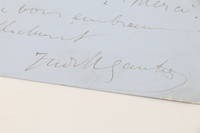
|
|
|
Louis-Ferdinand CELINE
" Et puis aussi gratitudes pour tout le soin qu'elle a pris de Mme Gen Paul !. Laquelle ne donne aucune nouvelle. Quelle vacherie encore . Comme c'est amusant !"" Signed autograph letter addressed to Master Thorvald Mikkelsen
s. l. Klarskovgaard 1950. Fine. s. l. Klarskovgaard 17 novembre 1950 21 x 34 cm 2 pages sur un feuillet Autograph letter signed with the initials of Louis-Ferdinand Céline addressed to his lawyer Master Thorvald Mikkelsen. Two pages written in blue ink on a large sheet of white paper; number ""568"" in Céline's hand in red pencil at the top left. Transversal folds inherent to mailing. This letter was very partially transcribed in Année Céline 2005. Early November 1950 Gaby Paul had come to visit Céline and Lucette at Klarskovgaard: ""Oh mille mercis à Mme Christensen pour son aimable repas qui réchauffé fit nos délices ! Et puis aussi gratitudes pour tout le soin qu'elle a pris de Mme Gen Paul !. Laquelle ne donne aucune nouvelle. Quelle vacherie encore . Comme c'est amusant ! Je crois qu'elle avait des projets ""journalistiques"" mais que mon attitude l'a désenchantée. """"Oh a thousand thanks to Madame Christensen for her kind meal which reheated was our delight! And also gratitude for all the care she took of Mme Gen Paul!. Who gives no news. What nastiness again. How amusing! I believe she had 'journalistic' projects but my attitude disenchanted her."" Céline also mentions the Swedish writer Ernst Bendz one of the few to defend Céline alongside Paraz: ""Une lettre amusante de Bendz ! Bendz appartient vraiment à l'aristocratie des esprits ! La preuve ! La façon qu'il ""m'estime""!!!""""An amusing letter from Bendz! Bendz truly belongs to the aristocracy of minds! The proof! The way he 'esteems me'!!!"" In 1947 Céline pursued by French justice for his collaborationist involvement was confined in Denmark. It was in May 1948 accompanied by Lucette and Bébert that he arrived at his lawyer Master Thorvald Mikkelsen's home at Klarskovgaard. The latter owned a large property by the Baltic Sea and invited the exile to stay there. On February 21 1950 as part of the épuration the writer was definitively sentenced in absentia by the civic chamber of the Paris Court of Justice for collaboration to one year of imprisonment which he had already served in Denmark. The Swedish Consul General in Paris Raoul Nordling intervened on his behalf with Gustav Rasmussen Danish Foreign Minister and managed to delay his extradition. On April 20 1951 Jean-Louis Tixier-Vignancour his lawyer since 1948 obtained Céline's amnesty under the title of ""severely disabled veteran of the Great War"" by presenting his file under the name Louis-Ferdinand Destouches without any magistrate making the connection. Céline would leave Denmark the following summer after three years spent at his lawyer's home. unknown
書籍販売業者の参照番号
: 80910
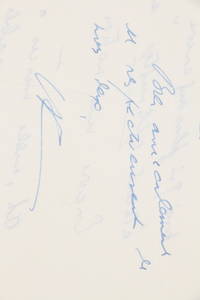
|
|
|
Louis-Ferdinand CELINE
"Je ne sais pas quels crimes j'ai commis mais pour ces fourbes canailles du 18eme Arrt. ma légende de bistrot en bistrot est devenue un Super Niebelung d'horreurs ! C'est rigolo. Au point qu'aucun n'ose me venir voir ici !"" Signed autograph letter addressed to Master Thorvald Mikkelsen
s. l. Klarskovgaard 1950. Fine. s. l. Klarskovgaard 17 novembre 1950 21 x 34 cm 1 page sur un feuillet Autograph letter signed with the paraph of Louis-Ferdinand Céline addressed to his lawyer Master Thorvald Mikkelsen. One page written in blue ink on a large sheet of white paper; number ""566"" in Céline's hand in red pencil at the top left. Transversal folds inherent to mailing. This letter was very partially transcribed in Année Céline 2005. Early November 1950 Gaby Paul had come to visit Céline and Lucette at Klarskovgaard: ""Mme Gen Paul a repris la route de Montmartre toute ravie de votre accueil ! A moi de vous remercier chaleureusement car enfin j'espère que votre généreuse réception me sera comptée ""à indulgence""."" ""Mme Gen Paul has taken the road back to Montmartre delighted with your welcome! It is for me to thank you warmly because I finally hope that your generous reception will be counted in my favor as 'indulgence'."" Through her intermediary Céline evidently received news of his former Montmartre companions: ""Je ne sais pas quels crimes j'ai commis mais pour ces fourbes canailles du 18eme Arrt. ma légende de bistrot en bistrot est devenue un Super Niebelung d'horreurs ! C'est rigolo. Au point qu'aucun n'ose me venir voir ici !"" ""I don't know what crimes I committed but for these deceitful scoundrels of the 18th district my legend from bistro to bistro has become a Super Niebelung of horrors! It's amusing. To the point that none dare come to see me here!"" In 1947 Céline pursued by French justice for his collaborationist involvement was confined in Denmark. It was in May 1948 accompanied by Lucette and Bébert that he arrived at his lawyer Master Thorvald Mikkelsen's home at Klarskovgaard. The latter owned a large property by the Baltic Sea and invited the exile to stay there. On February 21 1950 as part of the épuration the writer was definitively sentenced in absentia by the civic chamber of the Paris Court of Justice for collaboration to one year of imprisonment which he had already served in Denmark. The Swedish Consul General in Paris Raoul Nordling intervened on his behalf with Gustav Rasmussen Danish Foreign Minister and managed to delay his extradition. On April 20 1951 Jean-Louis Tixier-Vignancour his lawyer since 1948 obtained Céline's amnesty under the title of ""severely disabled veteran of the Great War"" by presenting his file under the name Louis-Ferdinand Destouches without any magistrate making the connection. Céline would leave Denmark the following summer after three years spent at his lawyer's home. unknown
書籍販売業者の参照番号
: 80911
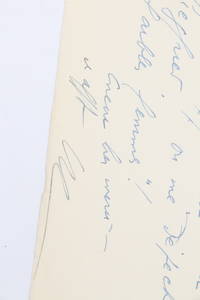
|
|
|
Honore de BALZAC
"j'assiste aujourd'hui à un dîner diplomatique de bons enfants qui veulent rire et boire et comme je suis hébété de travail je n'ai pas le courage de me refuser cette débauche"" Autograph letter signed to Louis Desnoyers
1839. Fine. s. d. ca 1839 13 x 8 cm une feuille Signed handwritten letter to Louis Desnoyers ca 1839 13 x 8 cm one leaf Handwritten letter signed by Honoré de Balzac addressed to Louis Desnoyers written on a white piece of paper in black ink. My dear Mr Desnoyers extraordinarily today I attend a diplomatic dinner of good-natured folk who want to laugh and drink and as I am in a stupor at work I have not had the courage to refuse this debauchery; I will therefore not be at home. Come early Sunday morning. / Yours / de Balzac. Louis Desnoyers plays an important role in the foundation of the Société des gens de lettres which aims to protect literary and artistic property and to create a solidarity fund. Balzac supported the creation of this Society of which Desnoyers was vice-president. Amusing letter testimony of Balzac's love of good food. unknown
書籍販売業者の参照番号
: 80345
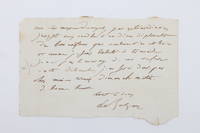
|
|
|
Judith GAUTIER
"Je vous enverrai les 3 mètres de taffetas pour la guipure."" Signed autograph card addressed to Celeste Chrétien
Alger Algiers 1910. Fine. Alger Algiers s. d. ca 1910 13 x 7.20 cm une carte Autograph card signed by Judith Gautier addressed to Céleste Chrétien her maid written on both sides in black ink. Judith Gautier did not only employ Céleste for her domestic tasks but also called upon her talents as a seamstress: ""I will send you the 3 meters of taffeta for the guipure. I am hesitating about the color. The dress fits well I wear it over black taffeta undergarments."" unknown
書籍販売業者の参照番号
: 80815
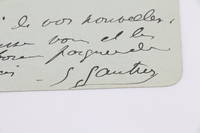
|
|
|
Judith GAUTIER
"Je pensais à la cuisine qui va être très noire et à la fenêtre bouchée"" Signed autograph letter addressed to Francis Chrétien
Alger Algiers 1910. Fine. Alger Algiers s. d. ca 1910 16.30 x 20.90 cm 3 pages sur un double feuillet Autograph letter signed by Judith Gautier addressed to Francis Chrétien the husband of her maid Céleste. Three pages written in violet ink on a double sheet with letterhead from 30 rue Washington. Transverse folds inherent to mailing. Judith Gautier sends Francis some instructions regarding the renovation of her house in Dinard le Pré aux oiseaux: ""Je pensais à la cuisine qui va être très noire et à la fenêtre bouchée qui est du côté du jardin sous la fenêtre de la salle à manger. Il me semble qu'elle rendrait du jour et même du soleil si elle était débouchée et bien disposée."" ""I was thinking about the kitchen which will be very dark and the blocked window which is on the garden side under the dining room window. It seems to me that it would provide light and even sunlight if it were unblocked and well arranged."" unknown
書籍販売業者の参照番号
: 80881
|
|

 検索結果のメールを受信する
 PDFファイルの検索結果をダウンロード
 RSSフィード
 パーマネントリンク


