|
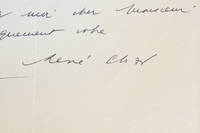
Renee VIVIEN - Helene de ZUYLEN
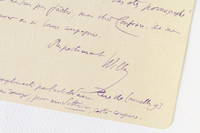
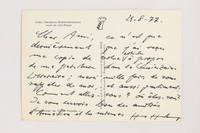
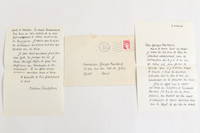
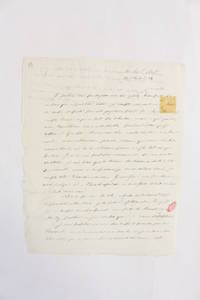
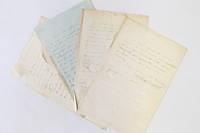
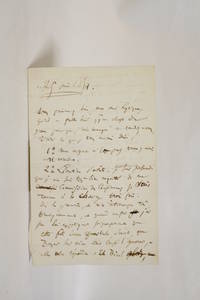
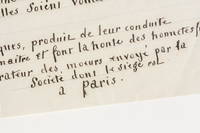
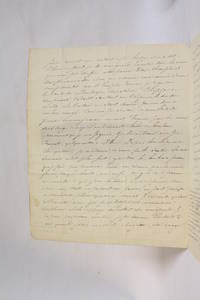
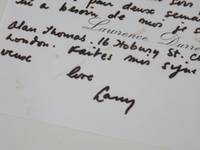
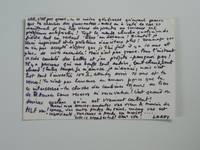
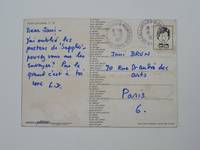
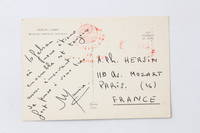
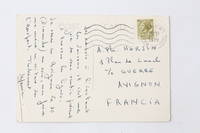
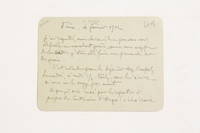
"Dis à tes cheveux que je les aime."" • Autograph letter signed by Renée Vivien and Hélène de Zuylen addressed to Natalie Clifford Barney
s. l. Paris 1906. Fine. s. l. • Paris s. d. ca 1906 11.50 x 15.90 cm 4 pages sur un double feuillet Autograph letter signed ""Paul"" from Renée Vivien addressed to Natalie Clifford Barney and written in black ink on a double sheet bordered with violets. Baroness Hélène de Zuylen has added a small manuscript message signed at the end of the letter: ""Paule a raison vous êtes un être charmant et féerique !"" ""Paule is right you are a charming and fairy-like being!"" Transverse folds inherent to mailing. ""Cher Tout-Petit Ton domestique est venu dire que tu nous rejoindrais au théâtre. Mais il n'y a pas de théâtre ! Peux-tu dîner avec nous jeudi ou vendredi — Si dans la soirée de jeudi tu n'es libre qu'après le dîner viens nous rejoindre à n'importe quelle heure. Donne-moi un petit coup de téléphone pour me dire ce que tu feras — et si je dois te faire chercher et à quelle heure — Dis à tes cheveux que je les aime."" ""Dear Little One Your servant came to say that you would join us at the theater. But there is no theater! Can you dine with us Thursday or Friday — If on Thursday evening you are only free after dinner come join us at any hour. Give me a little telephone call to tell me what you will do — and if I should have you collected and at what time — Tell your hair that I love it."" It was at the end of 1899 and through Violette Shillito that Renée Vivien - then Pauline Tarn - made the acquaintance of Natalie Clifford Barney ""cette Américaine plus souple qu'une écharpe dont l'étincelant visage brille de cheveux d'or de prunelles bleu de mer de dents implacables"" ""this American more supple than a scarf whose sparkling face shines with golden hair sea-blue eyes implacable teeth"" Colette Claudine à Paris. Natalie who had just experienced a summer idyll with the scandalous Liane de Pougy who initiated her into sapphism paid only discreet attention to this new acquaintance. Renée on the other hand was totally captivated by the young American and would relate this coup de foudre in her autobiographical novel Une Femme m'apparut: « J'évoquai l'heure déjà lointaine où je la vis pour la première fois et le frisson qui me parcourut lorsque mes yeux rencontrèrent ses yeux d'acier mortel ses yeux aigus et bleus comme une lame. J'eus l'obscur prescience que cette femme m'intimait l'ordre du destin que son visage était le visage redouté de mon avenir. Je sentis près d'elle les vertiges lumineux qui montent de l'abîme et l'appel de l'eau très profonde. Le charme du péril émanait d'elle et m'attirait inexorablement. Je n'essayai point de la fuir car j'aurais échappé plus aisément à la mort. » ""I evoked that already distant hour when I saw her for the first time and the shiver that ran through me when my eyes met her deadly steel eyes her sharp blue eyes like a blade. I had the obscure prescience that this woman was giving me destiny's order that her face was the dreaded face of my future. I felt near her the luminous vertigo that rises from the abyss and the call of very deep water. The charm of peril emanated from her and attracted me inexorably. I did not try to flee her for I would have escaped death more easily."" « Hiver 1899-1900. Débuts de l'idylle. Un soir Vivien est invitée par sa nouvelle amie dans l'atelier de Mme Barney mère de Natalie 153 avenue Victor-Hugo à l'angle de la rue de Longchamp. Natalie s'enhardit à lire des vers de sa composition. Comme Vivien lui dit aimer ces vers elle lui répond qu'il vaut mieux aimer le poète. Réponse bien digne de l'Amazone. » ""Winter 1899-1900. Beginning of the idyll. One evening Vivien is invited by her new friend to the studio of Mme Barney Natalie's mother 153 avenue Victor-Hugo at the corner of rue de Longchamp. Natalie grows bold enough to read verses of her own composition. When Vivien tells her she loves these verses she replies that it is better to love the poet. A response quite worthy of the Amazon."" J.-P. Goujon Tes blessures sont plus douces qu unknown
Referenz des Buchhändlers : 79017
|
|
|
Renee VIVIEN
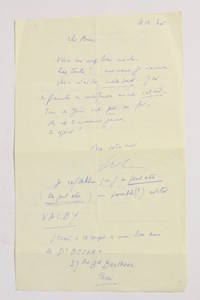
"Je suis en proie à un de mes accès de mélancolie noire et sauvage - je ne peux plus voir personne."" • Signed autograph letter addressed to Natalie Clifford Barney
s. l. Paris 1900. Fine. s. l. • Paris s. d. 1er semestre 1900 12.30 x 16.70 cm 2 pages sur un double feuillet Handwritten signed letter addressed to Natalie Clifford Barney: “I am in the grips of one of my bouts of black and wild melancholy - I can no longer see anyone.” Paris 1st half-year 1900 12.3 x 16.7 cm 2 pages on a double leafHandwritten letter from Renée Vivien signed “Paule” and written in pencil on a double leaf with a silver-coloured heart with the poet's monogram at the top of the first sheet. Transverse fold from having been sent. Beautiful letter of apology after a dispute with the Amazone: “Suis en proie à un de mes accès de mélancolie noire et sauvage – je ne peux plus voir personne. Je m'en vais demain à Fontainebleau pour y rester jusqu'à ce que je sois guérie – je dis: guérie avec intention car c'est une espèce de maladie morale dont je souffre en ce moment. C'est pour cela que j'étais si mauvaise hier – j'aurais dû m'enfermer comme je le fais toujours en pareil cas. Une autre fois je m'en irai à temps pour ne pas te faire du mal – si toutefois tu me permets de dire: une autre fois et si tu ne me renvoies pas à jamais de ta présence. Je n'ai qu'une excuse c'est que je souffre. Je n'ai pas été digne de l'amour que tu m'as si généreusement et si largement donné – je n'ose plus te demander pardon – je t'ai tant de fois offensée!” “I am in the grips of one of my bouts of black and wild melancholy - I can no longer see anyone. Tomorrow I am going to go to Fontainebleau to stay there until I am healed - I say: healed with intent because it is a kind of moral illness from which I suffer at the moment. That's why I was so bad yesterday - I should have locked myself up as I always do in such a case. Another time I will go sooner so as not to cause you harm - if nevertheless you allow me to say: another time and if you do not dismiss me forever from your presence. I only have one excuse that is that I suffer. I have not been worthy of the love that you have so generously and so widely given me - I dare not ask you anymore for forgiveness - I have offended you so many times!” unknown
Referenz des Buchhändlers : 79000
|
|
|
Renee VIVIEN
"Dis à Madame Mardrus pas de ma part de la tienne ! que Doriane c'est elle telle qu'elle s'est révélée à moi un jour — dans l'ardeur et dans la tristesse."" • Autograph Letter to Natalie Clifford Barney
Villa Clos fleuri Nice Nice 1906. Fine. Villa Clos fleuri Nice • Nice 3 mars 1906 12.40 x 16.80 cm 3 pages sur un double feuillet Autograph letter signed ""Pauline"" by Renée Vivien addressed to Natalie Clifford Barney and written in violet ink on a double sheet with violet letterhead the Parisian address on the letterhead crossed out. Transverse folds inherent to mailing. Fine letter evoking Renée Vivien's execration for Nice: ""Ici un soleil insolent — d'ignobles bâtisses — des gens — Je regrette Mytilène — . Mon Dieu entre Nice et Paris il n'y a pas de différence bien marquée quelques oranges de plus ici — des palmiers d'opéra comique - une illusion de chaleur c'est tout."" ""Here an insolent sun — ignoble buildings — people — I miss Mytilene — . My God between Nice and Paris there is no marked difference a few more oranges here — comic opera palm trees — an illusion of warmth that's all."" The evocation of Mytilene where the two lovers had traveled the previous summer continues in this missive: ""Encore une lettre de ce vieux filou de Paradellis — Je l'ai envoyé promener — Il est capable de faire main basse sur tout ce qu'il y a dans la maison —"" ""Another letter from that old rogue Paradellis — I sent him packing — He's capable of making off with everything in the house —"" It was Passagisti Paradellis who rented a villa on site with a two-year lease to Renée and Natalie. ""The villa had been tastefully furnished. Collections of rare porcelain mother-of-pearl inlaid furniture a dining room with high-backed armchairs."" J.-P. Goujon Tes blessures sont plus douces que leurs caresses In this letter the Violet Muse also gives the key to one of the characters in Une femme m'apparut whose revised version had just appeared: ""Dis à Madame Mardrus pas de ma part de la tienne ! que Doriane c'est elle telle qu'elle s'est révélée à moi un jour — dans l'ardeur et dans la tristesse."" ""Tell Madame Mardrus not from me from you! that Doriane is her as she revealed herself to me one day — in ardor and in sadness."" The work whose rewriting had nevertheless tried the poetess is here devalued by the latter: ""En somme — je n'aime pas ce volume ou plutôt il m'est indifférent ce qui est plus triste encore —"" ""In sum — I don't like this volume or rather it is indifferent to me which is even sadder —"" It was at the end of 1899 and through the intermediary of Violette Shillito that Renée Vivien - then Pauline Tarn - made the acquaintance of Natalie Clifford Barney ""cette Américaine plus souple qu'une écharpe dont l'étincelant visage brille de cheveux d'or de prunelles bleu de mer de dents implacables"" Colette Claudine à Paris. Natalie who had just lived through a summer idyll with the scandalous Liane de Pougy who had initiated her into sapphism paid only discreet attention to this new acquaintance. Renée on the other hand was completely captivated by the young American and would relate this love at first sight in her autobiographical novel Une Femme m'apparut: ""J'évoquai l'heure déjà lointaine où je la vis pour la première fois et le frisson qui me parcourut lorsque mes yeux rencontrèrent ses yeux d'acier mortel ses yeux aigus et bleus comme une lame. J'eus l'obscur prescience que cette femme m'intimait l'ordre du destin que son visage était le visage redouté de mon avenir. Je sentis près d'elle les vertiges lumineux qui montent de l'abîme et l'appel de l'eau très profonde. Le charme du péril émanait d'elle et m'attirait inexorablement. Je n'essayai point de la fuir car j'aurais échappé plus aisément à la mort."" ""Winter 1899-1900. Beginning of the idyll. One evening Vivien is invited by her new friend to Mme Barney's studio Natalie's mother 153 avenue Victor-Hugo at the corner of rue de Longchamp. Natalie ventures to read verses of her composition. When Vivien tells her she loves these verses she replies that it is better to love the poet. A response quite worthy of the Amazon."" J.-P. Goujon op. cit. Two ye unknown
Referenz des Buchhändlers : 79014
|
|
|
Renee VIVIEN
"Tu vois bien que mes pensées te reviennent toujours."" • Signed autograph letter addressed to Natalie Clifford Barney
s. l. Paris 1905. Fine. s. l. • Paris 30 mars 1905 11.50 x 15.90 cm 6 pages 1/2 sur deux doubles feuillets Autograph letter signed ""Pauline"" by Renée Vivien addressed to Natalie Clifford Barney and written in violet ink on two double sheets edged with violets. Transverse folds inherent to posting. Very fine love letter evoking the only novel by the Violet Muse Une femme m'apparut. ""Comment aurais-je pu ne point songer à toi Natalie moi qui écrivais « Une femme m'apparut » - qui l'écrivais pour la seconde fois avec mes yeux nouveaux et devenus plus clairs - avec mon cœur plus calme et plus profond "" ""How could I not have thought of you Natalie I who was writing 'Une femme m'apparut' - who was writing it for the second time with my new eyes which had become clearer - with my heart calmer and deeper"" Published in 1904 this novel - the only one of Renée's literary career - tells the love story of the narrator and ""Vally"" Natalie Clifford Barney from their beginning to their tragic end and the ""apparition"" of the savior Hélène de Zuylen. Reconciled with the Amazon Renée undertakes to rewrite the book which will appear at the beginning of 1906: ""Literary and stylistic improvement No. The concern to justify herself anew but this time in the face of Natalie Barney is beyond doubt. Remorse too: now the apparition that gives the book its title is no longer Eva-Hélène de Zuylen but Lorely-Natalie Barney and this from page 2. When we know that during the summer of 1904 unexpected reunions in Bayreuth came to unite Natalie Barney and Vivien we better understand the meaning of this new version of the novel Renée only returns to her amorous past to deliver us a second version revised and corrected. She thus erases the final choice she had suggested in the first version. Complete palinode confirmed by the very text of the letters that Vivien will write to Natalie Barney in 1904 and especially in 1905."" J.-P. Goujon Tes blessures sont plus douces que leurs caresses This confusion of feelings shows through this letter filled with oxymorons: ""je goûte une tristesse charmante à t'évoquer . quand je songe à toi j'évoque ma plus belle douleur"" ""I taste a charming sadness in evoking you . when I think of you I evoke my most beautiful pain"" The sadness - mixed with unconditional love - is here pushed to its paroxysm: ""Ne te laisse pas attrister par ma lettre grise de ce soir. Il y a des heures ternes - ce sont peut-être les meilleures - Dans tous les cas ce sont les plus vraies . Et ceux qui sont comme tu le dis « ingrats et joyeux » sont fort à plaindre."" ""Do not let yourself be saddened by my grey letter this evening. There are dull hours - these are perhaps the best - In any case these are the truest . And those who are as you say 'ungrateful and joyful' are much to be pitied."" Vivien effaces herself completely in favor of her beloved even proposing to live in her place: ""Va - si tu le peux - là où je voudrais être - à Mytilène. Je verrais l'île merveilleuse à travers tes prunelles - tu me ferais respirer tous ses parfums - A dire vrai le courage m'a manqué pour y aller. Je n'avais plus la force ni le désir de partir ainsi."" ""Go - if you can - where I would like to be - to Mytilene. I would see the marvelous island through your eyes - you would make me breathe all its perfumes - To tell the truth I lacked the courage to go there. I no longer had the strength nor the desire to leave thus."" ""Ne peux-tu toi aller à Mytilène et me rapporter des roses de là -bas "" ""Cannot you go to Mytilene and bring me roses from there"" Yet it is together that the two lovers will soon undertake the journey to Lesbos; it will be the last of their story. It was at the end of 1899 and through Violette Shillito that Renée Vivien - then Pauline Tarn - made the acquaintance of Natalie Clifford Barney ""cette Américaine plus souple qu'une écharpe dont l'étincelant visage brille de cheveux d'or de prunelles bleu de mer d unknown
Referenz des Buchhändlers : 78968
|
|
|
Renee VIVIEN
"Méfie-toi de Lottie. Je crois t'avoir dit que la « scène de séduction » chez moi était très savamment préparée et combinée. Lottie a besoin d'argent."" • Autograph Letter to Natalie Clifford Barney
s. l. Paris 1906. Fine. s. l. • Paris s. d. ca 1906 11.50 x 15.90 cm 4 pages sur un double feuillet Autograph letter by Renée Vivien addressed to Natalie Clifford Barney and written in violet ink on a double sheet bordered with violets. Transverse folds inherent to mailing. Interesting letter of warning against the opportunist ""Lottie"": ""Tout-Petit très cher je t'envoie te sachant insouciante autant qu'adorable c'est tout dire ce conseil amical : Méfie-toi de Lottie. Je crois t'avoir dit que la « scène de séduction » chez moi était très savamment préparée et combinée. Lottie a besoin d'argent. Elle en cherche avec âpreté. Elle me demande maintenant une « lettre d'introduction » pour Lugné-Poë. et moi qui ne le connais pas ! Elle « t'embêtera » . c'est le mot cru — le seul qui convient — Elle est exaspérée contre moi parce que je n'ai pas succombé et surtout parce que je ne lui donnerai pas d'argent. Si elle m'en avait demandé loyalement franchement au nom des jours d'autrefois j'aurais cédé mais cette comédie amoureuse me répugne — Je te le répète : Méfie-toi — Ne la vois point si cela t'est possible."" ""Very dear Little One I send you knowing you to be as carefree as you are adorable which says everything this friendly advice: Beware of Lottie. I believe I told you that the 'seduction scene' at my place was very cleverly prepared and planned. Lottie needs money. She seeks it eagerly. She now asks me for a 'letter of introduction' to Lugné-Poë. and I who don't know him! She will 'bother you'. that's the crude word — the only one that fits — She is exasperated with me because I did not succumb and especially because I will not give her money. If she had asked me loyally frankly in the name of days gone by I would have given in but this amorous comedy disgusts me — I repeat: Beware — Do not see her if it is possible for you."" Charlotte ""Lottie"" Stern Countess Venturini was an actress also known by the name of Yorska and a close friend of Sarah Bernhardt. Alice Pike Barney Natalie's mother painted a very beautiful profile of her in pastel entitled ""Vamp of 1900"" and today preserved at the Smithsonian American Art Museum in Washington. The Jacques Doucet library holds eighteen autograph letters that she addressed to Natalie Clifford Barney. It was at the end of 1899 and through the intermediary of Violette Shillito that Renée Vivien - then Pauline Tarn - made the acquaintance of Natalie Clifford Barney ""cette Américaine plus souple qu'une écharpe dont l'étincelant visage brille de cheveux d'or de prunelles bleu de mer de dents implacables"" Colette Claudine à Paris. Natalie who had just lived through a summer idyll with the scandalous Liane de Pougy who had initiated her into sapphism paid only discreet attention to this new acquaintance. Renée on the other hand was completely captivated by the young American and would relate this love at first sight in her autobiographical novel Une Femme m'apparut: ""J'évoquai l'heure déjà lointaine où je la vis pour la première fois et le frisson qui me parcourut lorsque mes yeux rencontrèrent ses yeux d'acier mortel ses yeux aigus et bleus comme une lame. J'eus l'obscur prescience que cette femme m'intimait l'ordre du destin que son visage était le visage redouté de mon avenir. Je sentis près d'elle les vertiges lumineux qui montent de l'abîme et l'appel de l'eau très profonde. Le charme du péril émanait d'elle et m'attirait inexorablement. Je n'essayai point de la fuir car j'aurais échappé plus aisément à la mort."" ""Winter 1899-1900. Beginning of the idyll. One evening Vivien is invited by her new friend to Mme Barney's studio Natalie's mother 153 avenue Victor-Hugo at the corner of rue de Longchamp. Natalie ventures to read verses of her composition. When Vivien tells her she loves these verses she replies that it is better to love the poet. A response quite worthy of the Amazon."" J.-P. Goujon Tes blessures sont plus douces que leurs caresses Two year unknown
Referenz des Buchhändlers : 79012
|
|
|
Renee VIVIEN
"Tes lettres te seront renvoyées sans être lues - ne m'envoie pas de fleurs elles seront refusées."" • Signed autograph letter addressed to Natalie Clifford Barney
s. l. Paris 1905. Fine. s. l. • Paris s. d. 1905-1906 11.50 x 15.90 cm 3 pages sur un double feuillet Autograph letter signed ""Pauline"" by Renée Vivien addressed to Natalie Clifford Barney and written in violet ink on a double sheet bordered with violets. Transverse creases inherent to the mailing. Icy and a fresh attempt at rupture or at the very least a rebuff this letter is completely devoid of courtesy and tenderness: ""Je ne suis pas pareille à toi - j'ai de l'orgueil et de la fierté - cet orgueil tu l'as blessé cette fierté tu l'as froissée - je ne m'exposerai plus à des dégoûts de ce genre. Tes lettres te seront renvoyées sans être lues - ne m'envoie pas de fleurs elles seront refusées. Je vois peu de gens dans l'horreur où je vis des êtres j'en verrai moins encore - cela me procurera peut-être la paix. Je me demande seulement pourquoi tu m'as importunée pour me revoir si ce n'était pour m'humilier et me dégoûter de toi encore davantage. Adieu puisque je ne te reverrai plus de ma vie. Pauline"" ""I am not like you - I have pride and dignity - you have wounded that pride you have bruised that dignity - I will no longer expose myself to such disgust. Your letters will be returned unread - do not send me flowers they will be refused. I see few people in the horror I feel for human beings I will see even fewer - that will perhaps bring me peace. I only wonder why you bothered me to see me again if it was not to humiliate me and disgust me with you even more. Farewell since I will never see you again in my life. Pauline"" Moving letter revealing the suffering and isolation of the Muse of violets sliding inexorably toward her tragic end. It was at the end of 1899 and through the intermediary of Violette Shillito that Renée Vivien - then Pauline Tarn - made the acquaintance of Natalie Clifford Barney ""cette Américaine plus souple qu'une écharpe dont l'étincelant visage brille de cheveux d'or de prunelles bleu de mer de dents implacables"" ""this American more supple than a scarf whose sparkling face shines with golden hair sea-blue eyes implacable teeth"" Colette Claudine à Paris. Natalie who had just experienced a summer idyll with the scandalous Liane de Pougy who had initiated her into Sapphism paid only discrete attention to this new acquaintance. Renée however was completely subjugated by the young American and would relate this coup de foudre in her autobiographical novel Une Femme m'apparut: ""J'évoquai l'heure déjà lointaine où je la vis pour la première fois et le frisson qui me parcourut lorsque mes yeux rencontrèrent ses yeux d'acier mortel ses yeux aigus et bleus comme une lame. J'eus l'obscur prescience que cette femme m'intimait l'ordre du destin que son visage était le visage redouté de mon avenir. Je sentis près d'elle les vertiges lumineux qui montent de l'abîme et l'appel de l'eau très profonde. Le charme du péril émanait d'elle et m'attirait inexorablement. Je n'essayai point de la fuir car j'aurais échappé plus aisément à la mort."" ""I evoked the already distant hour when I saw her for the first time and the shiver that ran through me when my eyes met her mortal steel eyes her sharp blue eyes like a blade. I had the obscure prescience that this woman was giving me destiny's orders that her face was the dreaded face of my future. I felt near her the luminous vertigo that rises from the abyss and the call of very deep water. The charm of peril emanated from her and attracted me inexorably. I did not try to flee her for I would have escaped death more easily."" ""Hiver 1899-1900. Débuts de l'idylle. Un soir Vivien est invitée par sa nouvelle amie dans l'atelier de Mme Barney mère de Natalie 153 avenue Victor-Hugo à l'angle de la rue de Longchamp. Natalie s'enhardit à lire des vers de sa composition. Comme Vivien lui dit aimer ces vers elle lui répond qu'il vaut mieux aimer le poète. Réponse bien digne de l'Amazone."" ""Winter 1899-1900. Beginning of the idyll. One evening Vivie unknown
Referenz des Buchhändlers : 79002
|
|
|
Renee VIVIEN
"Je lirai « Séraphita » pour te retrouver un peu dans ces pages de Balzac."" • Signed Autograph Love Letter to Natalie Clifford Barney
s. l. Londres London 1900. Fine. s. l. • Londres London Le 14 mars 1900 9.90 x 15.20 cm 8 pages sur 2 doubles feuillets Autograph letter signed ""Pauline"" by Renée Vivien written in black ink on two double sheets of letterhead paper from 24 Hyde Park Street. Transverse folds inherent to posting. A very beautiful and poetic letter written from London where the young Renée savors a sweet melancholy: ""Today there was no sun a light fog a dark and sad atmosphere. I was pleased by it — I hate spring when you are no longer here and the sun and soft air hurt me. I love the sadness of the sky and the moon which goes well with my thoughts."" Despite a very busy schedule ""I am very tired this evening — I return from the Alhambra where mama took me to see the military ballet and hear the patriotic songs. . I went skating in the afternoon in the morning I went to see one of my friends here who is very kind although having too much religion for my taste."" the young woman is bored in this city that she profoundly detests ""How can you be jealous you whom I adore of London which I hate — I have been unhappy since I entered this city. It is dark it has a bad influence on my destiny. It brings me misfortune. It will end up killing me if I stay. I am afraid of it I want to leave to join you my darling my spring you who are the being of light and beauty my love my happiness and my consolation."" and finds comfort in the memory of her beloved of whom she thinks every moment: ""You are right to feel my thoughts around you — I desperately throw my soul across space so that it finds you — Your memory is in all my actions all my words — it is you that I see through the things that surround me."" Natalie is everywhere even in her reading: ""I will read 'Séraphita' to find you a little in those pages of Balzac. Everything that reminds me of you everything that has some connection with you even distant is dear to me."" As Jean Chalon shows in his biography of Natalie Clifford Barney Portrait d'une séductrice Séraphita is a founding novel of the Amazon's thought and one of the first books she bought upon her arrival in Europe: ""Natalie had vainly sought this philosophical novel by Balzac in the bookstores of Washington. She would find this book in Europe and push refinement to the point of reading the angelic avatars of Séraphitus-Séraphita in that Norway which forms its setting."" From this underlined passage in her copy one notices that she retains more of its feminism than the concept of intersexuality: ""Would this not be using your rights as a man We must always please you relax you always be cheerful and have only the whims that amuse you. What must I do my friend Do you want me to sing to dance when fatigue takes away the use of my voice and legs Gentlemen even if we were dying we must still smile at you! You call this I believe reigning. Poor women! I pity them."" As evidenced by a letter addressed to her previous lover Liane de Pougy she had already introduced her to this Balzacian heroine: ""You will come to me I will go to you and we will marry our lives. That day you will read me Séraphîta. She will awaken our slumbering souls and you will lend to the sleeping words the beauty of your voice. It will be our litany of love."" It was at the end of 1899 and through Violette Shillito that Renée Vivien - then Pauline Tarn - made the acquaintance of Natalie Clifford Barney ""this American more supple than a scarf whose sparkling face shines with golden hair sea-blue pupils and implacable teeth"" Colette Claudine à Paris. Natalie who had just lived a summer idyll with the sulfurous Liane de Pougy who had initiated her into sapphism paid only discreet attention to this new acquaintance. Renée on the other hand was totally captivated by the young American and would relate this love at first sight in her autobiographical novel Une Femme m'apparut : ""I evoked the already distant hour when I saw her for the first time and t unknown
Referenz des Buchhändlers : 79025
|
|
|
Renee VIVIEN
"Les docteurs disent tous qu'il n'y a plus d'espoir."" • Signed autograph letter addressed to Natalie Clifford Barney
s. l. Londres London 1900. Fine. s. l. • Londres London Le 16 octobre 1900 11.30 x 17.50 cm 10 pages sur 2 doubles feuillets et 1 feuillet simple Very long autograph manuscript letter by Renée Vivien signed ""Ton fervent Paul"" written in black ink on two double sheets and one single sheet. Transverse creases inherent to the mailing envelope included. Moving letter recounting Renée Vivien's first encounters with suffering and death. Having returned to her family in London the Violet Muse watches over her dying cousin : ""Mon pauvre cousin va de plus en plus mal. Je crains horriblement que ce ne soit la fin. Il est la plupart du temps en proie à la fièvre et au délire. Ou bien il dort d'un mauvais sommeil de prostration et de faiblesse à la suite des piqûres de morphine. . Cela me fait mal de voir le pauvre squelette qui me sourit si faiblement ce visage est marqué déjà par la mort il y a la trace de sa serre qui ne relâche pas."" ""My poor cousin is getting worse and worse. I am horribly afraid this may be the end. He is most of the time prey to fever and delirium. Or else he sleeps a bad sleep of prostration and weakness following morphine injections. . It pains me to see the poor skeleton who smiles at me so weakly this face is already marked by death there is the trace of its grip that does not let go."" Pain is omnipresent in this letter-torrent: ""J'ai vu une chose horrible aujourd'hui à l'hôpital en allant voir mon cousin. On a apporté sur un brancard une chose épouvantable - un corps couvert d'un drap et une tête d'homme aux joues brûlées - et de cela sortait des gémissements et des hurlements et des râles. Il me semble que je ne pourrai jamais oublier l'affreuse chose inerte qui m'a frôlée de si près cette après-midi. Il paraît que c'était un ouvrier terriblement blessé par une explosion de gaz qui a eu lieu dans une fabrique à une heure cette après-midi. Ah ! la sinistre chose qu'on portait là -bas ! On entend parler d'accidents et de blessures et de mort et on n'y fait pas attention jusqu'à ce qu'on voie ce que c'est. L'horreur de tout cela m'obsède ce soir et s'ajoute à mon abattement et à ma mélancolie."" ""I saw a horrible thing today at the hospital while going to see my cousin. They brought on a stretcher a dreadful thing - a body covered with a sheet and a man's head with burned cheeks - and from this came moans and howls and death rattles. It seems to me I will never be able to forget the awful inert thing that brushed so close to me this afternoon. It appears it was a worker terribly injured by a gas explosion that occurred in a factory at one o'clock this afternoon. Ah! the sinister thing they were carrying there! One hears talk of accidents and injuries and death and pays no attention to it until one sees what it is. The horror of all this obsesses me tonight and adds to my dejection and my melancholy."" At this time Renée Vivien had not yet published anything and even devalued her verses in favor of those of the Amazon: ""Ce matin Chère la joie que m'a causée ta lettre et l'émotion profonde de ton beau sonnet - ce vers « Is there no touch beyond the touch of hands » et ces deux autres : « Is there no love that burns an unseen fire » « Beyond the finish of expressed desire » sont de toute splendeur poétique. . C'est toi qui portes au front la grande lumière c'est dans ton cœur que chante la musique sublime parler de mes vers à moi Ils sont pauvres à faire pleurer."" ""This morning Dear the joy your letter caused me and the profound emotion of your beautiful sonnet - this verse 'Is there no touch beyond the touch of hands' and these two others: 'Is there no love that burns an unseen fire' 'Beyond the finish of expressed desire' are of all poetic splendor. . It is you who bears the great light on your brow it is in your heart that the sublime music sings speak of my verses me They are poor enough to make one weep."" Written in a period preceding the sentimental storms this ve unknown
Referenz des Buchhändlers : 78982
|
|
|
Renee VIVIEN
"Je te l'ai dit par la voix brute du télégraphe Natalie le moment n'est pas venu de nous revoir. "" • Signed autograph letter addressed to Natalie Clifford Barney
s. l. Paris 1902. Fine. s. l. • Paris Le 1er avril 1902 11.50 x 15.90 cm 7 pages 1/2 sur deux doubles feuillets Handwritten signed letter addressed to Natalie Clifford Barney: “I told you by the raw voice of the telegraph Natalie the time has not come for us to see each other again.” Paris 1st April 1902 11.5 x 15.9 cm 7 pages 1/2 on two double leavesHandwritten letter signed “Pauline” from Renée Vivien addressed to Natalie Clifford Barney and written in black ink on two double leaves edged with violettes. Transverse folds from having been sent. Interesting letter mentioning Brumes de fjords and Freddy Manners-Sutton. “Tu te trompes en croyant retrouver dans Brumes de fjords un reflet de femme ou l'influence d'une pensée de poète norvégien. Je les ai faites d'un souvenir très lointain de ce pays mystique et de quelques rêves lourds de nostalgies.” “You are mistaken when you think that you find a reflection of a woman or the influence of a Norwegian poet's thinking in Brumes de fjords. I wrote them as a very distant memory of this mystical country and of some dreams heavy with nostalgia.” Brumes de fjords is the first collection of prose poetry by Renée Vivien to be published in June 1902. Natalie and Renée were then separated but this letter shows that the Muse aux violettes continued to send her texts to the Amazone despite the physical and sentimental distance that separated them. “Car j'ai dans ma vie une tendresse que je crois sincère – quoi qu'il me soit difficile aujourd'hui de croire à la sincérité même lorsqu'elle me montre ses larmes.” “Since I have a tenderness in my life which I believe to be sincere - though it is difficult for me today to believe in sincerity even when it shows me its tears.” This letter was indeed sent to Natalie Clifford Barney while she was in the United States: “Je serais venue si tu avais eu besoin de moi. Toi-même tu m'as télégraphiée que ma présence était inutile. lorsque ton temps était pris par un flirt Freddy Manners-Sutton qui sait et qu'importe Il est trop tard maintenant. Je ne viens pas t'amuser ni remplacer une distraction absente. Si tu viens à Paris cet hiver je te verrai une ou deux fois – comme on revoit le visage lointain de son passé – sans colère sans haine mais aussi sans amour.” “I would have come if you needed me. You yourself telegraphed me that my presence was useless. when your time was taken by a flirt Freddy Manners-Sutton Who knows And what does it matter It's too late now. I don't come to amuse you or replace an absent distraction. If you come to Paris this winter I will see you once or twice - as you see the distant face of your past - without anger without hatred but also without love.” Here Renée gives free reign to her jealousy mentioning Freddy Manners-Sutton Natalie's friend: “En réalité Vivien ne pouvait supporter Manners-Sutton. Dans Une femme m'apparut elle l'appellera tout simplement Le Prostitué et dira de lui: Il est banal comme l'adultère. Cette antipathie se transformera en une haine féroce lorsqu'un peu plus tard Vivien apprendra que cet homme se faisait passer pour le fiancé de Natalie Barney. Sacrilège suprême.! Mais Vivien ne savait pas – ou bien voulait ignorer – que cette rumeur était en fait propagée par Natalie Barney elle-même afin de donner le change à ses parents. Non pensait-elle ce personnage au-dessous de toute insulte veut tout simplement capter la fortune de Natalie!” “In reality Vivien could not bear Manners-Sutton. In Une femme m'apparut she will very simply call him Le Prostitué and will say of him: He is common like adultery. This antipathy will turn into a fierce hatred when a little later Vivien learns that this man pretends to be Natalie Barney's fiancé. Supreme sacrilege.! But Vivien did not know - or even wanted to ignore - that this rumour was actually spread by Natalie Barney herself in order to pull the wool over her parent's eyes. No she thought this below any insult character simply wan unknown
Referenz des Buchhändlers : 78981
|
|
|
Renee VIVIEN
"J'aime tes jolies fleurs elles sont charmantes - j'ai porté une de tes roses hier au soir."" • Signed autograph card addressed to Natalie Clifford Barney
s. l. Paris 1900. Fine. s. l. • Paris s. d. ca 1900 12.50 x 8.40 cm une carte rédigée des deux côtés Autograph letter signed ""Paul"" and addressed to Natalie Clifford Barney written in black ink on both sides. Silver monogram of the poetess in the upper left corner of the recto. ""Je ne vais pas à la campagne après tout mon Tout-Petit. Ils sont partis de si bonne heure que j'ai pu trouver un prétexte pour ne pas les accompagner dans ma fatigue et l'heure trop matinale. Quand veux-tu que je vienne te chercher et où irons-nous Je serai prête à l'heure où tu voudras. J'aime tes jolies fleurs elles sont charmantes - j'ai porté une de tes roses hier au soir. A tout à l'heure mignon Tout-Petit - Paul"" ""I'm not going to the countryside after all my Little One. They left so early that I was able to find an excuse not to accompany them in my fatigue and the too early hour. When do you want me to come get you and where shall we go I'll be ready whenever you want. I love your pretty flowers they are charming - I wore one of your roses last evening. See you soon sweet Little One - Paul"" It was at the end of 1899 and through Violette Shillito that Renée Vivien - then Pauline Tarn - made the acquaintance of Natalie Clifford Barney ""this American more supple than a scarf whose sparkling face shines with golden hair sea-blue eyes implacable teeth"" Colette Claudine à Paris. Natalie who had just experienced a summer idyll with the sulfurous Liane de Pougy who had initiated her into sapphism paid only discreet attention to this new acquaintance. Renée however was completely captivated by the young American and would recount this coup de foudre in her autobiographical novel Une Femme m'apparut: ""J'évoquai l'heure déjà lointaine où je la vis pour la première fois et le frisson qui me parcourut lorsque mes yeux rencontrèrent ses yeux d'acier mortel ses yeux aigus et bleus comme une lame. J'eus l'obscur prescience que cette femme m'intimait l'ordre du destin que son visage était le visage redouté de mon avenir. Je sentis près d'elle les vertiges lumineux qui montent de l'abîme et l'appel de l'eau très profonde. Le charme du péril émanait d'elle et m'attirait inexorablement. Je n'essayai point de la fuir car j'aurais échappé plus aisément à la mort."" ""I recalled the already distant hour when I saw her for the first time and the shiver that ran through me when my eyes met her deadly steel eyes her sharp and blue eyes like a blade. I had the dark prescience that this woman was commanding me to destiny that her face was the dreaded face of my future. I felt near her the luminous vertigo that rises from the abyss and the call of very deep water. The charm of peril emanated from her and attracted me inexorably. I did not try to flee from her for I would have escaped death more easily."" ""Winter 1899-1900. Beginning of the idyll. One evening Vivien is invited by her new friend to the studio of Mrs. Barney Natalie's mother 153 avenue Victor-Hugo at the corner of rue de Longchamp. Natalie ventures to read verses of her composition. When Vivien tells her she loves these verses she replies that it is better to love the poet. An answer quite worthy of the Amazon."" J.-P. Goujon Tes blessures sont plus douces que leurs caresses There followed two years of unequal happiness punctuated by Natalie's recurring infidelities and Renée's morbid jealousy whose letters oscillated between impassioned declarations and painful mea culpas. ""Renée Vivien is the daughter of Sappho and Baudelaire she is the flower of evil 1900 with fevers broken flights sad voluptuousness."" Jean Chalon Portrait d'une séductrice In 1901 came an important break that would last almost two years; Renée despite Natalie's solicitations and the intermediaries she sent to win her back resisted. ""The two friends met again and it was in August 1905 the pilgrimage to Lesbos which constituted a disappointment for Natalie Barney and remained without sequel. . unknown
Referenz des Buchhändlers : 79011
|
|
|
Renee VIVIEN
"Tu as oublié que tu voulais te tuer pour moi. A part ce léger détail tu as été parfaite."" • Autograph Love Letter to Natalie Clifford Barney
Paris 1906. Fine. Paris 3 mars 1906 12.40 x 16.80 cm 3 pages 1/2 sur un double feuillet Autograph letter signed ""Paule"" from Renée Vivien addressed to Natalie Clifford Barney and written in purple ink on a double sheet with violet letterhead and address of 23 avenue du Bois de Boulogne. Transverse folds inherent to posting. Charming letter allowing hope for an appeasement in Renée Vivien's amorous ubiquity who seems to have finally chosen Hélène de Zuylen: ""Je t'envoie des vers. Les aimes-tu — Ils ne me plaisent qu'à moitié — c'est déjà beaucoup ! — Tu as oublié que tu voulais te tuer pour moi. A part ce léger détail tu as été parfaite — Mon amie t'aime — je t'adore — tout est parfaitement ordonné — . N'est-ce pas que mon amie est parfaitement bonne et charmante — Je l'aime tant d'une façon si poignante si simple et si bête. ce qui est après tout la meilleure façon d'aimer !"" ""I am sending you verses. Do you love them — They only half please me — that's already a lot! — You have forgotten that you wanted to kill yourself for me. Apart from this slight detail you have been perfect — My friend loves you — I adore you — everything is perfectly ordered — . Is it not true that my friend is perfectly good and charming — I love her so much in such a poignant simple and silly way. which is after all the best way to love!"" One senses here however a still very deep attachment of the Muse of violets to the Amazon: ""Je baise tes mains d'autrefois — et tes mains d'aujourd'hui — Et je t'aime plus que je ne sais le dire."" ""I kiss your hands of yesteryear — and your hands of today — And I love you more than I know how to say."" It was at the end of 1899 and through the intermediary of Violette Shillito that Renée Vivien - then Pauline Tarn - made the acquaintance of Natalie Clifford Barney ""cette Américaine plus souple qu'une écharpe dont l'étincelant visage brille de cheveux d'or de prunelles bleu de mer de dents implacables"" ""this American more supple than a scarf whose sparkling face shines with golden hair sea-blue pupils implacable teeth"" Colette Claudine à Paris. Natalie who had just lived a summer idyll with the scandalous Liane de Pougy who had initiated her into sapphism paid only discrete attention to this new acquaintance. Renée however was totally captivated by the young American and would relate this thunderbolt in her autobiographical novel Une Femme m'apparut: ""J'évoquai l'heure déjà lointaine où je la vis pour la première fois et le frisson qui me parcourut lorsque mes yeux rencontrèrent ses yeux d'acier mortel ses yeux aigus et bleus comme une lame. J'eus l'obscur prescience que cette femme m'intimait l'ordre du destin que son visage était le visage redouté de mon avenir. Je sentis près d'elle les vertiges lumineux qui montent de l'abîme et l'appel de l'eau très profonde. Le charme du péril émanait d'elle et m'attirait inexorablement. Je n'essayai point de la fuir car j'aurais échappé plus aisément à la mort."" ""I evoked the already distant hour when I saw her for the first time and the shiver that ran through me when my eyes met her eyes of mortal steel her sharp blue eyes like a blade. I had the obscure presentiment that this woman was giving me destiny's order that her face was the dreaded face of my future. I felt near her the luminous vertigos that rise from the abyss and the call of very deep water. The charm of peril emanated from her and attracted me inexorably. I did not try to flee from her for I would have escaped death more easily."" ""Hiver 1899-1900. Débuts de l'idylle. Un soir Vivien est invitée par sa nouvelle amie dans l'atelier de Mme Barney mère de Natalie 153 avenue Victor-Hugo à l'angle de la rue de Longchamp. Natalie s'enhardit à lire des vers de sa composition. Comme Vivien lui dit aimer ces vers elle lui répond qu'il vaut mieux aimer le poète. Réponse bien digne de l'Amazone."" ""Winter 1899-1900. Beginning of the idyll. One evening Vivien i unknown
Referenz des Buchhändlers : 79020
|
|
|
Renee VIVIEN
"Tout-Petit que j'aime je t'envoie des pensées toutes blanches. Garde-les dans ta chambre auprès de toi où sont mes vraies pensées tu le sais."" • Signed autograph letter addressed to Natalie Clifford Barney
s. l. Paris 1900. Fine. s. l. • Paris s. d. ca. 1900 12.30 x 16.50 cm 1 page1/2 sur un double feuillet Autograph manuscript letter by Renée Vivien signed ""Pauline"" addressed to Natalie Clifford Barney and written in black ink on a double sheet with the poetess's silver monogram letterhead. A very charming letter evoking the flowers so dear to Renée ""Tout-Petit que j'aime je t'envoie des pensées toutes blanches. Garde-les dans ta chambre auprès de toi où sont mes vraies pensées tu le sais."" ""Little one I love I send you pansies all white. Keep them in your room near you where my true thoughts are you know."" as well as a gift from her ""tout petit chéri"" ""dear little one"": ""J'adore mes tablettes tu te rappelles les tablettes des deux petites joueuses de flûte - seulement elles les ont perdues et moi je ne veux pas perdre les miennes. J'ai écrit dessus en grec J'aime Natalie ! Cela m'a fait tant de plaisir ! - quelle bonne et jolie pensée tu as eue là ! -"" ""I adore my tablets do you remember the tablets of the two little flute players - only they lost them and I don't want to lose mine. I wrote on them in Greek I love Natalie! It gave me such pleasure! - what a good and lovely thought you had there! -"" Renée Vivien's Hellenist passion was born from her encounter with Eva Palmer during their stay in the United States where she accompanied Natalie Clifford Barney. This beautiful twenty-six-year-old redhead who it is said had translated all of Plato's Symposium with the Amazon gave Renée her first lessons in ancient Greek and awakened in her the passion for the poetess Sappho that never left her thereafter. It was at the end of 1899 and through Violette Shillito that Renée Vivien - then Pauline Tarn - made the acquaintance of Natalie Clifford Barney ""this American more supple than a scarf whose sparkling face shines with golden hair sea-blue eyes and implacable teeth"" Colette Claudine à Paris. Natalie who had just lived a summer idyll with the sulfurous Liane de Pougy who had initiated her into sapphism paid only discreet attention to this new acquaintance. Renée however was totally captivated by the young American and would relate this love at first sight in her autobiographical novel Une Femme m'apparut: ""I evoked the already distant hour when I saw her for the first time and the shiver that ran through me when my eyes met her eyes of mortal steel her sharp blue eyes like a blade. I had the obscure presentiment that this woman was giving me destiny's order that her face was the dreaded face of my future. I felt near her the luminous vertigo that rises from the abyss and the call of very deep water. The charm of peril emanated from her and attracted me inexorably. I did not try to flee her for I would have escaped death more easily."" ""Winter 1899-1900. Beginning of the idyll. One evening Vivien is invited by her new friend to Mme Barney's studio Natalie's mother 153 avenue Victor-Hugo at the corner of rue de Longchamp. Natalie ventures to read verses of her own composition. When Vivien tells her she loves these verses she replies that it is better to love the poet. A response quite worthy of the Amazon."" J.-P. Goujon Tes blessures sont plus douces que leurs caresses Two years of unequal happiness followed punctuated by Natalie's recurring infidelities and Renée's pathological jealousy whose letters oscillated between passionate declarations and painful mea culpa. ""Renée Vivien is the daughter of Sappho and Baudelaire she is the flower of evil 1900 with fevers broken flights sad voluptuousness."" Jean Chalon Portrait d'une séductrice In 1901 came an important rupture that would last almost two years; Renée despite Natalie's solicitations and the intermediaries she sends to win her back resists. ""The two friends saw each other again and it was in August 1905 the pilgrimage to Lesbos which constituted a disappointment for Natalie Barney and remained without consequence. . unknown
Referenz des Buchhändlers : 78899
|
|
|
Renee VIVIEN - (to Natalie Clifford BARNEY)
Lettre d'amour autographe signée adressée à Natalie Clifford Barney : ""J'ai laissé mon cœur sur tes lèvres il y frémira quand tu me diras : Je t'aime !"" • Autograph love letter signed and addressed to Natalie Clifford Barney: ""I left my heart upon your lips it will tremble there when you say to me: I love you!""
s. l. Londres London: Sans nom d'éditeur 1900. Fine. Sans nom d'éditeur s. l. • Londres London Le 18 mars 1900 9.90 x 15.20 cm 14 pages sur 3 doubles feuillets et 1 feuillet simple Very long autograph letter handwritten by Renée Vivien signed “Pauline” written in black ink on three bifolia with letterhead from 24 Hyde Park Street and one single leaf. Horizontal folds inherent to mailing. A beautiful love letter sent from London while Renée was staying with her family: « Quand je pense qu'un télégramme va banalement et brutalement t'apprendre que je reste encore une semaine à Londres j'ai envie de pleurer. Et pourtant il ne faut pas que je pleure cela m'affaiblirait trop et j'ai besoin de toutes mes forces et de mon courage. » This painful separation is in the young woman’s eyes a necessary evil the promise of a radiant future: « Si je te fais ce chagrin mon amie c'est pour que nous soyons plus heureuses après. . Ne m'en veux pas de te faire attendre je souffre plus que toi ; et si je t'impose en me l'imposant moi-même cette souffrance du désappointement c'est afin de mériter mieux l'amour que tu m'accordes et le bonheur que tu me donnes par la douleur et par le sacrifice. Je serai ainsi plus digne de toi et tu m'aimeras mieux pour les larmes que j'ai offertes à notre amour. » Only a few months had passed since Renée and Natalie had begun seeing each other and one can already sense here the importance of this bond for the Muse of Violets and her insatiable need to be loved: « Tu me pardonnes dis Tu me souris toujours Je t'en prie envoie-moi ton pardon afin que je le sente comme une rosée sur mon front. Dis-moi de loin que tu m'aimes toujours et je t'entendrai à travers tout l'espace qui nous sépare. . Je t'aime à en mourir enfant chérie qui es le beau sourire blond de ma vie. Tout ce que je te dis et sic sincère. Crois-moi. Aime-moi. » Idealizing this relationship she launches into a magnificent litany: « Te faire souffrir toi qui m'as donné la joie rayonnante de mon existence ! Toi qui m'as fait aimer la vie ! - Toi qui m'as mis tant de beaux rêves dans l'âme tant de bonheur et tant de chaleur au cœur ! - Toi qui es ma consolation mon espérance mon extase la merveille et le miracle de ma vie ! - Toi qui m'as donné l'amour qui me l'as révélé qui me l'as fait sentir et comprendre ! - Toi que j'aime ! » A superb letter-river imbued with the consuming passion of the Muse of Violets for her Amazon. At the end of 1899 through Violette Shillito Renée Vivien—then Pauline Tarn—met Natalie Clifford Barney “cette Américaine plus souple qu'une écharpe dont l'étincelant visage brille de cheveux d'or de prunelles bleu de mer de dents implacables” Colette Claudine à Paris. Natalie fresh from a summer romance with the scandalous Liane de Pougy who had introduced her to sapphism paid little heed to this new acquaintance. Renée on the other hand was utterly captivated by the young American and would recount this coup de foudre in her autobiographical novel Une Femme m'apparut: “J'évoquai l'heure déjà lointaine où je la vis pour la première fois et le frisson qui me parcourut lorsque mes yeux rencontrèrent ses yeux d'acier mortel ses yeux aigus et bleus comme une lame. J'eus l'obscur prescience que cette femme m'intimait l'ordre du destin que son visage était le visage redouté de mon avenir. Je sentis près d'elle les vertiges lumineux qui montent de l'abîme et l'appel de l'eau très profonde. Le charme du péril émanait d'elle et m'attirait inexorablement. Je n'essayai point de la fuir car j'aurais échappé plus aisément à la mort.” “Winter 1899–1900. The beginnings of the idyll. One evening Vivien is invited by her new friend to the studio of Mme Barney Natalie’s mother 153 avenue Victor-Hugo at the corner of rue de Longchamp. Natalie dares to read aloud her own verses. When Vivien tells her she admires them she replies that it is better to love the poet. A response truly worthy of the Amazon.” J.-P. Goujon T Sans nom d'éditeur unknown
Referenz des Buchhändlers : 79028
|
|
|
Victor SEGALEN
"Tépéva est mon nom"" • Signed autograph postcard sent from Tahiti and addressed to Emile Mignard
Tahiti Tahiti 1903. Fine. Tahiti Tahiti 4 mars 1903 14 x 9 cm une carte postale ""Tépéva is my name"". Handwritten postcard signed sent from Tahiti and addressed to Émile Mignard Tahiti 4 March 1903 14 x 9 cm one postcard Handwritten signed postcard from Victor Segalen sent from Tahiti and addressed to émile Mignard. A few lines written in black ink around the black and white photographic reproduction of a view of Bora-Bora correspondent's address handwritten on the verso. Some minor stains a cut corner likely due to the removal of the stamp. Doctor Segalen seems to have taken a wife: “A word from my wife to you: written by the hand of said wife iaorana fetii Tepeva te here neivou ia se no te mea e fetii no Tapeva Maraéa Vahine. Written by Segalen again Which means: I greet you friend of Tépéva Tépéva is my name in Tahitian and I love you because you are a friend of Tépéva. signed Maraéa-wife.” Segalen's biography makes no mention of this exotic wife. Emile Mignard 1878-1966 also a doctor and Brest-born was one of Segalen's closest childhood friends whom he met at the Jesuit Notre-Dame-de-Bon-Secours School. The writer interacted with this comrade in an abundant and closely followed correspondence in which he described with humor and intimacy his daily life in all corners of the world. It was at Mignard's wedding on 15 February 1905 that Segalen met his wife Yvonne Hébert. unknown
Referenz des Buchhändlers : 79067
|
|
|
Emile ZOLA
"Je désire simplement toucher au sujet dans mon livre pour le besoin du petit drame commercial qui me sert de fable."" • Autograph letter signed unpublished addressed to Léon Carbonnaux head of department at Le Bon Marché and advice for the writing of Au bonheur des Dames
Médan 1882. Fine. Médan 23 juin 1882 13.40 x 21.60 cm 1 page 1/2 sur un double feuillet - enveloppe jointe Autograph letter signed by Emile Zola - apparently unpublished - addressed to Léon Carbonnaux written in black ink on a double sheet. Folds inherent to mailing. Envelope included. Important testimony to the colossal documentation work and the capital role of Emile Zola's informants in depicting his immense natural and social fresco. This letter was sent to Léon Carbonnaux department head at Bon Marché who transmitted precious information to Emile Zola for the creation of the eleventh volume of the Rougon-Macquart series: Au Bonheur des Dames. Only two letters from Léon Carbonnaux to Emile Zola are known: they can be consulted in the digitization of the preparatory file for Bonheur des Dames made available online by the Bibliothèque nationale de France. However we know thanks to this same file which contains a long section entitled ""Notes Carbonnaux"" that this department head at Bon Marché provided a significant amount of information to Zola particularly about employee customs and their remuneration. The two men undoubtedly met when Emile Zola eager for information about the functioning of department stores conducted field research in February and March 1882. This response would therefore be the very first that the writer addressed to the department head in reply to his letter of June 19 1882. Far from imagining the keen success that this new novel would achieve Zola even seems to take it lightly: ""Je désire simplement toucher au sujet dans mon livre pour le besoin du petit drame commercial qui me sert de fable. Vos notes sont excellentes. . Enfin me voilà au travail. Le sujet est à la fois bien vaste - et bien ingrat pour un roman. On devra me tolérer un peu de fiction car il faut bien que je passionne la matière. Mais je tâche de m'en tenir le plus strictement possible à mes notes."" ""I simply wish to touch on the subject in my book for the needs of the little commercial drama that serves as my fable. Your notes are excellent. . Finally here I am at work. The subject is both very vast - and very thankless for a novel. One will have to tolerate a bit of fiction from me for I must make the material passionate. But I try to stick as strictly as possible to my notes."" It must be said that Carbonnaux takes his role as informant very much to heart and having no doubt about the book's success he writes: ""Dans le bâtiment chez nous d'ailleurs partout on attend votre livre. Les lecteurs ne vous manqueront pas. Soyez-en sûr. Vous n'en êtes plus à compter les succès celui-là s'annonce comme devant dépasser les autres."" letter of June 19 1882 For another work on the same subject has just appeared: ""J'ai lu le volume de Pierre Giffard. Il me paraît comme vous injuste et même faux dans plusieurs parties. C'est bâclé. Il aurait fallu pour un pareil ouvrage de documents purs une entière exactitude. Moi qui écris une œuvre d'imagination je ne me permettrai pas de tels écarts."" ""I have read Pierre Giffard's volume. It seems to me like you unjust and even false in several parts. It is hastily done. For such a work of pure documents complete accuracy would have been necessary. I who write a work of imagination would not allow myself such deviations.""It was Carbonnaux who had pointed out the work to Zola: ""Pierre Giffard du Figaro vient de faire paraître chez Havard un vol de 300 pages intitulé « Les Grands bazars de Paris ». . On sait que le Figaro est inféodé au Louvre magasin concurrent au Bon Marché & on peut assurer que ce livre a été commandé et bâclé dès que votre intention de traiter le même sujet a été connue. . Il fallait déguiser un peu la réclame pour le Louvre."" letter of June 19 1882 We can clearly see here how much department stores fascinate and we understand the immense success that this novel by Zola describing their advent and supremacy would achieve. unknown
Referenz des Buchhändlers : 79108
|
|
|
Emile ZOLA
"Je me suis exténué à faire sortir cette vérité de mon livre si l'on ne m'a pas compris la faute en est sans doute à moi."" • Signed autograph letter addressed to Henry Fouquier about La Terre
Paris 1888. Fine. Paris 11 février 1888 13.20 x 20.50 cm 2 pages sur un double feuillet Autograph letter signed by Emile Zola addressed to Henry Fouquier written in black ink on a bifolium. Usual folds from mailing. This letter was transcribed in the complete correspondence of Emile Zola published by the CNRS and the Presses de l'Université de Montréal. A fine letter evoking La Terre and Tolstoy's The Power of Darkness. Henry Fouquier 1838-1900 was a literary critic and columnist for numerous newspapers. A close friend of Guy de Maupassant he supported Emile Zola’s candidacy for the Académie française. This letter was written to him the day after the performance of Tolstoy's The Power of Darkness at the Théâtre-Libre. We have not found evidence of an article in which the journalist explicitly drew a parallel between the Russian drama and Zola’s La Terre but Zola here addresses his thanks: « Merci mon cher Fouquier de ce que vous voulez bien dire de « la Terre » si attaquée. J'en suis touché vivement et croyez à toute ma gratitude. » It must be said that the fifteenth volume of the Rougon-Macquart cycle was harshly received unleashing passions from the moment of its serial publication in Gil Blas. On 18 August 1887 even before the conclusion of the novel was revealed to the public Le Figaro published the “Manifeste des Cinq” written by Paul Bonnetain J.-H. Rosny Lucien Descaves Paul Margueritte and Gustave Guiches. These young authors issued a severe verdict: « La Terre a paru. La déception a été profonde et douloureuse. Non seulement l'observation est superficielle les trucs démodés la narration commune et dépourvue de caractéristiques mais la note ordurière est exacerbée encore descendue à des saletés si basses que par instants on se croirait devant un recueil de scatologie : le Maître est descendu au fond de l'immondice. . Nous répudions ces bonshommes de rhétorique zoliste ces silhouettes énormes surhumaines et biscornues dénuées de complication jetées brutalement en masses lourdes dans des milieux aperçus au hasard des portières d'express. De cette dernière œuvre du grand cerveau qui lança L'Assommoir sur le monde de cette Terre bâtarde nous nous éloignons résolument mais non sans tristesse. Il nous poigne de repousser l'homme que nous avons trop fervemment aimé. » Zola who had been developing the idea of a peasant novel for a decade was deeply affected. Though he never responded publicly to these accusations his correspondence is strewn with clarifications about the work whose sheer brutality alone seemed to occupy readers’ minds: « Mais vous ajoutez que notre thèse à Tolstoï et à moi est la même et peut se résumer en ceci : le travail de la terre est corrupteur. Tolstoï il me semble protesterait bien haut et quant à moi je vous affirme que je n'ai jamais voulu prouver une telle chose radicalement fausse à mon avis. Ce que je pense c'est que la petite propriété telle qu'elle existe chez nous c'est que la suite de faits sociaux qui ont abouti à notre forme sociale nous ont donné notre paysan d'aujourd'hui avec ses qualités et ses vices. Notre paysan est le prisonnier de sa terre et non l'homme libre qu'il devrait être. Comment voulez-vous qu'il n'y étouffe pas dans son ignorance et sa passion unique Labourer est très sain mais à la condition qu'on sera le maître de son champ au lieu d'en être le forçat. Je me suis exténué à faire sortir cette vérité de mon livre si l'on ne m'a pas compris la faute en est sans doute à moi. » A remarkable letter from the master of Naturalism shedding new light on one of the most brutal volumes of the Rougon-Macquart series. unknown
Referenz des Buchhändlers : 79098
|
|
|
Emile ZOLA
"Vous avez eu l'obligeance de me donner certains détails sur l'inventaire. Vous m'avez dit qu'on choisissait le premier dimanche d'août qu'on fermait les portes et que tous les employés s'y mettaient."" • Autograph letter signed unpublished addressed to Léon Carbonnaux head of department at Le Bon Marché and advice for the writing of Au bonheur des Dames
Médan 1882. Fine. Médan 16 novembre 1882 13.60 x 21.40 cm 2 pages sur un double feuillet - enveloppe jointe Autograph letter signed by Emile Zola - apparently unpublished - addressed to Léon Carbonnaux written in black ink on a double sheet. Folds inherent to mailing. Envelope included. Important testimony to the colossal documentation work and the capital role of Emile Zola's informants in depicting his immense natural and social fresco. This letter was sent to Léon Carbonnaux department head at Bon Marché who transmitted precious information to Emile Zola for the creation of the eleventh volume of the Rougon-Macquart series: Au Bonheur des Dames. Only two letters from Léon Carbonnaux to Emile Zola are known: they can be consulted in the digitization of the preparatory file for Bonheur des Dames made available online by the Bibliothèque nationale de France. However we know thanks to this same file which contains a long section entitled ""Notes Carbonnaux"" that this department head at Bon Marché provided a significant amount of information to Zola particularly about employee customs and their remuneration. The two men undoubtedly met when Emile Zola eager for information about the functioning of department stores conducted field research in February and March 1882. ""J'ai pris l'inventaire comme cadre à un de mes chapitres. D'ailleurs je n'ai spécialement besoin que du travail dans le rayon des confections et dans le rayon des soieries. Il est inutile de me renseigner sur les autres rayons."" ""I have taken the inventory as the framework for one of my chapters. Moreover I specifically only need the work in the ready-to-wear department and in the silk department. It is unnecessary to inform me about the other departments."" Thanks to this important letter we understand that it was Léon Carbonnaux who provided the essential information to Emile Zola for writing his very beautiful eleventh chapter devoted to the inventory: ""Vous avez eu l'obligeance de me donner certains détails sur l'inventaire. Vous m'avez dit qu'on choisissait le premier dimanche d'août qu'on fermait les portes et que tous les employés s'y mettaient. On vide toutes les cases n'est-ce pas on jette les marchandises sur les comptoirs ou à terre et l'inventaire n'est terminé que lorsqu'il n'y a plus absolument rien en place."" ""You were kind enough to give me certain details about the inventory. You told me that the first Sunday in August was chosen that the doors were closed and all the employees set to work. All the compartments are emptied aren't they The merchandise is thrown onto the counters or on the ground and the inventory is only finished when there is absolutely nothing left in place.""The final version of Bonheur des Dames contains all the precious information provided by the department head of Bon Marché: ""Le premier dimanche d'août on faisait l'inventaire qui devait être terminé le soir même. Dès le matin comme un jour de semaine tous les employés étaient à leur poste et la besogne avait commencé les portes closes dans les magasins vides de clientes. . Neuf heures sonnaient. . Dans le magasin inondé de soleil par les grandes baies ouvertes le personnel enfermé venait de commencer l'inventaire. On avait retiré les boutons des portes des gens s'arrêtaient sur le trottoir regardant par les glaces étonnés de cette fermeture lorsqu'on distinguait à l'intérieur une activité extraordinaire. C'était d'un bout à l'autre des galeries du haut en bas des étages un piétinement d'employés des bras en l'air des paquets volant par-dessus les têtes ; et cela au milieu d'une tempête de cris de chiffres lancés dont la confusion montait et se brisait en un tapage assourdissant. Chacun des trente-neuf rayons faisait sa besogne à part sans s'inquiéter des rayons voisins. D'ailleurs on attaquait à peine les casiers il n'y avait encore par terre que quelques pièces d'étoffe. La machine devait s'échauffer si l'on voulait finir le soir même. unknown
Referenz des Buchhändlers : 79109
|
|
|
Emile ZOLA
"Le sieur Grimm de Buda-Pesth est un simple voleur qui fait traduire mes romans au fur et à mesure de leur publication dans les journaux français sans autorisation aucune."" • Signed autograph letter addressed to an unknown correspondent
Bénodet 1883. Fine. Bénodet 10 septembre 1883 13.20 x 20.30 cm 2 pages sur un double feuillet Signed autograph letter by Emile Zola - apparently unpublished - addressed to an unknown correspondent written in black ink on a double sheet. Folds inherent to mailing. Interesting letter relating the translation of Emile Zola's works and the legal disputes inherent to their clandestine distribution. This missive is visibly addressed to a correspondent considered for the German translation of La Joie de vivre: ""I would ask you to give me the promptest possible response regarding the translation of La Joie de vivre; for I am already receiving proposals from Germany and I would like to know where I stand."" In this autumn of 1883 Zola - though vacationing in Brittany - is very occupied with managing the translation of his works which he handles directly with publishers. We see here the determination with which he conducts negotiations: ""I repeat that I will only accept a fixed sum paid in advance. It is simpler and without possible surprises."" But things are not simple and Zola whose works already enjoy great success must fight against the clandestine publication of his novels. Completely overlooked by biographers the disputes with Hungarian publisher Gustav Grimm are nonetheless a leitmotif of Zolian correspondence: ""Monsieur Grimm of Budapest is a simple thief who has my novels translated as they are published in French newspapers without any authorization. Already the Neue Freie Presse of Vienna has sued him in my name. But it appears we have no treaty with Hungary. I await the signing of a treaty which they say is imminent."" Indeed Grimm had already published without Zola's authorization German translations of two novels: Nana 1881 and Pot-Bouille Der häusliche Herd 1882. These illegal publications discouraged German publishers Curt Busch and George Kuhr who very interested in distributing the novel to German-speaking readers declared forfeit. Gustav Grimm who finally agreed to respect commercial treaties won the battle and published the very first German translation of La Joie de vivre in 1889 under the title Die Lebensfreude. The man whom Zola here calls a ""simple thief"" would finally obtain authorization to distribute the German translation of the entirety of the twenty volumes of the Rougon-Macquart between 1892 and 1899. Interesting letter revealing the editorial mechanisms of the Rougon-Macquart and testifying to the ardor with which Zola conducted negotiations inherent to the translation of his great hereditary fresco. unknown
Referenz des Buchhändlers : 79106
|
|
|
Emile ZOLA
"Comment avez-vous pu vous laisser prendre à la plaisanterie imbécile du Panurge "" • Very important autograph letter signed unpublished addressed to Léon Carbonnaux about the false publication of a pre-original of Au bonheur des Dames
Médan 1882. Fine. Médan 1er décembre 1882 13.60 x 21.40 cm 2 pages sur un double feuillet - enveloppe jointe Autograph letter signed by Emile Zola - apparently unpublished - written in black ink on a double sheet and addressed to Léon Carbonnaux department head at Bon Marché. Folds inherent to mailing. Envelope included. Only two letters from Léon Carbonnaux to Emile Zola are known: they can be consulted in the digitized preparatory file for Au bonheur des dames made available online by the Bibliothèque nationale de France. However we know from this same file which contains a long section entitled ""Notes Carbonnaux"" that this department head at Bon Marché provided Zola with a significant amount of information particularly about employee customs their remuneration and especially inventory techniques. The two men probably met when Emile Zola eager for information about the workings of department stores conducted field research in February and March 1882. Very important unpublished letter shedding new light on the pre-original publication of Au bonheur des dames. In his biography of Emile Zola Henri Mitterrand writes: ""Even before the novel was completed Zola gave an extract to Panurge in November; and on November 23 1882 Gil Blas announced its imminent publication in its columns."" Our letter discussing precisely this alleged pre-publication in Panurge attests that it was simply a joke and thus contradicts Henri Mitterrand: ""But your letter surprises and saddens me somewhat. How could you have been taken in by Panurge's stupid joke Did you not notice that the entire issue is a 'farce' Not one of the articles is authentic they are parodies and very poorly done ones at that."" Indeed reading the said extract cannot fool the assiduous reader of Zola despite the introduction that the journalists wrote: ""After Nana and Pot-Bouille those epics of elegant vice and bourgeois vice M. Emile Zola wanted to create one of honesty: Au bonheur des Dames which will appear shortly is a reassuring painting of innocence and virtue; the greatest success is assured for this new work whose characters move in the setting of a large novelty store; Parisian high commerce will not long await its observer and painter. We thank Emile Zola for having kindly cut out especially for Panurge a few pages from his still unpublished work and we are proud to give the public first an extract from this work of such high morality and such powerful interest."" Panurge no. 4 of October 22 1882 The sentences of this false Zolian text are exaggeratedly long and Panurge took the liberty of endowing the novel with a male main character Denis Mouret an amalgam of Denise the true heroine of the book to appear and Octave Mouret. One can think that it is a text composed from elements of Pot-Bouille the previous volume of Rougon Macquart where Octave - future owner of Bonheur des Dames - exercised the function of clerk before his meteoric social rise: ""For already more than two months he had been attached to the 'silks and furs' department; he arrived in the morning at seven o'clock to return home his day finished only at nine o'clock in the evening when all of Paris buzzed strangely with a feverish animation of pleasure and enjoyment and on his way back he followed gawking the great crowded boulevards where blazed the cafés full of girls and where on the asphalt at theater doors the crowd jostled with here and there in the vague rumor of trampling and pressing the roguish intonation of the cries of program vendors and ticket sellers."" Panurge In his letter of November 30 1882 Léon Carbonnaux - reading the extract from Panurge - had reproached Zola for his errors: ""Nowhere except at the Fabriques de France near Les Halles does one arrive at 7 a.m. It's at the earliest 7:30 but more often 8 a.m. and even then. There is no silk and fur counter at the Louvre. . It is so easy for you to be accurate that errors of this kind especially if t unknown
Referenz des Buchhändlers : 79111
|
|
|
Pierre LOUS
"Oh ! En 1930 ce sera bien différent sans doute ; mais j'aurai 60 ans dans quinze ans ; et je m'inquiète d'abord de 1917 ; même de 1916."" • Signed autograph letter addressed to Georges Louis
Paris 1916. Fine. Paris Lundi 11 septembre 1916 13 x 20.50 cm 3 pages sur 2 feuillets Autograph letter signed with initial by Pierre Louÿs addressed to Georges Louis. Two pages written in purple ink on two sheets. Central folds inherent to posting. Fine letter addressed to his brother Georges Louis with whom Pierre Louÿs maintained a very intimate relationship and whom he considered as his own father. The question of Pierre Louÿs' real paternal identity still fascinates biographers today: ""His father Pierre Philippe Louis . had married in 1842 Jeanne Constance Blanchin who died ten years later after giving him two children Lucie and Georges. In 1855 he remarried Claire Céline Maldan and from this union was born in 1857 a son Paul; then in 1870 our writer who received the Christian names Pierre Félix. This late birth the differences in character between father and son the former's disaffection towards the latter the profound intimacy that always reigned between Louÿs and his brother Georges all this has led certain biographers and critics to suspect that the latter was in reality the writer's father. The exceptionally intimate and constant relationship that Pierre and Georges maintained between themselves throughout their lives could be an argument in this direction. Of course no irrefutable proof has been discovered and probably never will be. Nevertheless certain letters . are quite troubling. In 1895 for example Louÿs writes gravely to his brother that he knows the answer to 'the most poignant question' he could ask him a question he has had 'on his lips for ten years'. The following year at the height of Aphrodite's triumph he thanks Georges effusively and ends his letter with this sentence: 'Not one of my friends has a FATHER who is to him what you are to me.' Arguing from the close intimacy between Georges and Claire Céline during the year 1870 and from the jealousy that the father never ceased to show towards his younger son Claude Farrère did not hesitate to conclude in favor of Georges Louis. And what should we think of this dedication by Louÿs to his brother on a Japan paper copy of the first edition of Pausole: To Georges his eldest son / Pierre."" Jean-Paul Goujon Pierre Louÿs In this interesting letter Louÿs discusses at length the difficulty writers face in living by their pen. Titling his missive ""Continuation of our conversation about war and literature"" he first makes a very pessimistic observation: ""In the 16th century It was even worse! In the 16th the independent man of letters did not exist at all - to write one needed an office a benefice - or land and income rare fortune among writers. . It is only in the 19th century that we find a very small number of conscientious writers living by their pen. And even then. Do you want to count them Hugo almost alone succeeds. Lamartine fails and is obliged to beg pitifully at the end of his life. Gautier who had magnificent gifts only subsists by writing in newspapers . you see what I mean: Theatre and Journal."" He continues: ""That works well in peacetime. - In 1890 l'Echo de Paris inserted prose poems in the first column. - In ""date illegible because crossed out ""le Figaro had a literary supplement. . But in wartime in this century and ten twelve or fifteen years after the war we shall go to the woods no more; the laurels are cut down. Oh! In 1930 it will doubtless be very different; but I shall be 60 in fifteen years; and I worry first about 1917; even about 1916."" This very pessimistic letter was written at a period when Louÿs was at his worst ""The man who wrote these pages was a solitary man reclusive sick drugged surrounded by dubious creatures and having as confidant only this adored brother who would die less than a year later."" Ibid. unknown
Referenz des Buchhändlers : 77523
|
|
|
Pierre LOUS
"H.eredia refuse . la dédicace d'Aphr.odite parce qu'il a encore deux filles à marier."" • Signed autograph letter addressed to Georges Louis
Paris 1895. Fine. Paris 12 novembre 1895 12.50 x 20 cm 4 page sur un double feuillet Autograph letter signed by Pierre Louÿs signed with his initial addressed to Georges Louis. Four pages written in blue ink on a double sheet. Envelope enclosed bearing on the verso the intact wax seal with the writer's cipher. Transverse fold inherent to the mailing. Important letter addressed to his brother Georges Louis with whom Pierre Louÿs maintained a very intimate relationship and whom he considered as his own father. The question of the real identity of Pierre Louÿs' father still fascinates biographers today: ""His father Pierre Philippe Louis . had married in 1842 Jeanne Constance Blanchin who died ten years later after giving him two children Lucie and Georges. In 1855 he remarried Claire Céline Maldan and from this union was born in 1857 a son Paul; then in 1870 our writer who received the first names Pierre Félix. This late birth the differences in character between father and son the former's disaffection towards the latter the profound intimacy that always reigned between Louÿs and his brother Georges all this has led certain biographers and critics to suspect that the latter was in reality the father of the writer. The exceptionally intimate and constant relationship that Pierre and Georges maintained between them all their lives could be an argument in this sense. Of course no irrefutable proof has been discovered and probably never will be. Nevertheless certain letters . are quite troubling. In 1895 for example Louÿs writes seriously to his brother that he knows the answer to 'the most poignant question' he could ask him a question he has had 'on his lips for ten years.' The following year in the midst of Aphrodite's triumph he thanks Georges effusively and ends his letter with this sentence: 'Not one of my friends has a FATHER who is for him what you are for me.' Arguing from the close intimacy of Georges and Claire Céline during 1870 and the jealousy that the father never ceased to show towards his younger son Claude Farrère did not hesitate to conclude in favor of Georges Louis. And what to make of this dedication by Louÿs to his brother on a Japan paper copy of the first edition of Pausole: To Georges his eldest son / Pierre."" Jean-Paul Goujon Pierre Louÿs As attested by the enclosed envelope Pierre Louÿs sends this letter to his brother while the latter is exercising the function of France's delegate to the International Commission of Egyptian Debt and is in Cairo. Like a good socialite Pierre tells his brother about his new encounters: ""I met yesterday at a friend's house one of the sons of your minister Marcellin Berthelot. I have known all four of them for a long time but I see little of them. One of them André is a friend of Henri Mougeot with whom he has rented along with two or three other young men a house in Chevreuse and a mistress in Paris. . The other Daniel is a professor at the School of Pharmacy. A remarkable chemist they say. Philippe does nothing special . Finally René the youngest is Blum's oldest friend and his great rival of former times in the general competition. . It is Philippe who formed five or six years ago with Léon Daudet and Georges Hugo such a famous trinity. He is also known for having written a sonnet containing six rhymes in omphe which stupefied Heredia."" But these worldly matters do not distance Pierre Louÿs from literature. Indeed his first novel entitled Aphrodite is about to appear and he wonders to whom he could dedicate it. He first thought of José Maria de Heredia but. ""H. refuses . the dedication of Aphr. because he still has two daughters to marry. I myself had put a thousand reservations in my offer and his response after all is not unobliging. I know on the other hand that he repeats before strangers and indifferent persons everything he told me about the book and in the same hyperbolic terms. Finally he gave me unknown
Referenz des Buchhändlers : 77509
|
|
|
Pierre LOUS - (Stephane MALLARME)
"Mallarmé m'a écrit des choses pompeuses sur Lêda."" • Signed autograph letter
Paris 1893. Fine. Paris 1893 13.50 x 14.50 cm quatre pages sur un feuillet remplié Autograph letter signed by Pierre Louÿs dated Christmas 1893 addressed to Georges Louis. Four pages written in blue ink on a double blue sheet bearing the writer’s initials and headed 49 rue Vineuse. A fine letter addressed to his brother Georges Louis with whom Pierre Louÿs maintained a deeply intimate relationship and whom he regarded as his own father. The question of Pierre Louÿs’s true parentage continues to fascinate biographers: “His father Pierre Philippe Louis . married Jeanne Constance Blanchin in 1842; she died ten years later having borne him two children Lucie and Georges. In 1855 he married Claire Céline Maldan and from this union was born in 1857 a son Paul; then in 1870 our writer who received the given names Pierre Félix. This late birth the differences in temperament between father and son the father’s indifference toward the latter and the profound intimacy that always united Louÿs and his brother Georges—all of this has led some biographers and critics to suspect that Georges was in fact the writer’s father. The exceptionally close and lifelong bond between Pierre and Georges might well support such an argument. Of course no conclusive proof has ever been found and doubtless never will be. Still certain letters . are quite troubling. In 1895 for example Louÿs gravely wrote to his brother that he knew the answer to ‘the most painful question’ he could ever put to him a question that had been ‘on his lips for ten years.’ The following year at the height of Aphrodite’s success he thanked Georges effusively and closed his letter with these words: ‘Pas un de mes amis n'a un PERE qui soit pour lui comme tu es pour moi.’ Arguing from the close relationship between Georges and Claire Céline in 1870 and from the jealousy the father continually displayed toward his younger son Claude Farrère did not hesitate to side with Georges Louis. And what are we to make of this dedication by Louÿs to his brother in a copy on japon of the original Pausole: Pour Georges son fils aîné / Pierre.” Jean-Paul Goujon Pierre Louÿs Pierre Louÿs sent this letter to his brother when the latter had just taken up his post as France’s delegate to the International Commission of the Egyptian Debt and was in Cairo: “La lettre où tu me demandais d'acheter un cadeau de jour de l'an m'est arrivée trop tard vingt quatre heures pour que je puisse l'envoyer à temps. J'espère que tu auras pu trouver quelque chose là -bas.” Lacking a gift Pierre sent his brother a portrait of himself: “En même temps que ma dernière lettre j'ai mis à la poste pour toi une photo du photographe ordinaire de Jane Hading et qui représente un Pierre posthume et sentimental assez ressemblant tout de même. L'épreuve n'était pas très propre mais c'était la seule que j'eusse encore reçue.” Only a handful of photographic portraits of the writer are known today and we have been unable to identify the photograph mentioned here. The year 1893 marked several literary successes for Pierre Louÿs who until then had published only Astarté at his own expense in 1891 and together with his friend from the École Alsacienne André Gide and Paul Valéry had founded La Conque an ‘anthology of the youngest poets’ whose first issue appeared on 15 March 1891. In quick succession came Chrysis ou la cérémonie matinale the translation of the Poésies de Méléagre and finally Lêda ou la louange des bienheureux ténèbres. The latter work is even mentioned in this letter: “Mallarmé m'a écrit des choses pompeuses sur Lêda; mais de sa part cela ne signifie rien.” Louÿs had been acquainted with Mallarmé since the early 1890s and met many leading figures at his celebrated ‘Tuesdays’ among them Henri de Régnier. Deeply admiring the verses of the Symbolist master whom he considered ‘the supreme incarnation of the artist one who has sacrificed everything to his ideal’ Ibid. Louÿs se unknown
Referenz des Buchhändlers : 77475
|
|
|
Pierre LOUS
"Edison est en France."" • Signed autograph letter addressed to Georges Louis
Paris 1911. Fine. Paris Lundi 11 septembre 1911 13.50 x 18 cm 5 pages sur un double feuillet et un feuillet libre Autograph letter signed by Pierre Louÿs addressed to Georges Louis. Five pages written in violet ink on a double leaf and a loose leaf. A press article pasted on the recto of the single leaf. Transverse creases inherent to posting. Fine letter addressed to his brother Georges Louis with whom Pierre Louÿs maintained a very intimate relationship and whom he considered as his own father. The question of the real identity of Pierre Louÿs's father still fascinates biographers today: ""His father Pierre Philippe Louis . had married in 1842 Jeanne Constance Blanchin who died ten years later after giving him two children Lucie and Georges. In 1855 he remarried Claire Céline Maldan and from this union was born in 1857 a son Paul; then in 1870 our writer who received the first names Pierre Félix. This late birth the differences in character between father and son the former's disaffection toward the latter the profound intimacy that always reigned between Louÿs and his brother Georges all this has led certain biographers and critics to suspect that the latter was in reality the writer's father. The exceptionally intimate and constant relationship that Pierre and Georges maintained between themselves all their lives could be an argument in this sense. Of course no irrefutable proof has been discovered and none will probably ever be discovered. Nevertheless certain letters . are quite disturbing. In 1895 for example Louÿs writes seriously to his brother that he knows the answer to ""the most poignant question"" he could ask him a question he has had ""on his lips for ten years."" The following year in the full triumph of Aphrodite he thanks Georges effusively and ends his letter with this sentence: ""Not one of my friends has a FATHER who is to him what you are to me."" Arguing from the close intimacy of Georges and Claire Céline during the year 1870 and the jealousy that the father never ceased to show toward his younger son Claude Farrère did not hesitate to conclude in favor of Georges Louis. And what to think of this dedication by Louÿs to his brother on a deluxe paper copy of the first edition of Pausole: For Georges his eldest son / Pierre."" Jean-Paul Goujon Pierre Louÿs Pierre Louÿs comments in this letter on Thomas Edison's visit to Paris: ""Edison is in France. Toward the end of last month a journalist questioned him. I regret not having kept the article."" The writer then launches into a true dialogue from his memories of said article paraphrasing the inventor in the manner of a witness who himself attended the interview: ""To the simple question ""Are you pleased with your trip"" Edison answered with amiable phrases and immediately on his own he brought the conversation to the subjects: Monoplane. War. He said I only repeat from memory the sense of what I read: He said in substance: ""You are not yet enthusiastic enough about the value of your new weapon: it is formidable. You take aeroplanes for scouts. Say first: combatants. From the heights where the monoplane evolves easily today there is an effective military power but especially an incalculable moral power."" He explained himself thus: ""Give grenades to an aviator who will drop them. Even if they are not very dangerous even if they rarely hit their target the entire enemy army will scatter like a flock of sheep under the flight of the eagle. Five six grenades falling from the sky will provoke panic terror. Nothing is frightening for a crowd like a peril that comes from above."" "" This ""remarkable interview"" related by the writer who finds that ""the theory is correct"" underlines the visionary character of Edison who seems here to relate the facts of the coming First World War. The erudite Pierre Louÿs illuminates this theory of ""Edison the prophet"" with his classical culture: ""It agrees with the old phrases about the limits of b unknown
Referenz des Buchhändlers : 77520
|
|
|
Pierre LOUS
"Mon souhait ce serait que nous choisissions deux petites maisons contigües près de Paris. "" • Signed autograph letter addressed to Georges Louis
Tamaris Tamaris-sur-mer 1907. Fine. Tamaris Tamaris-sur-mer 19 juin 1907 13.50 x 20.50 cm 4 pages sur un double feuillet Autograph letter signed by Pierre Louÿs addressed to Georges Louis. Four pages written in purple ink on a double sheet. Envelope included. Fine letter addressed to his brother Georges Louis with whom Pierre Louÿs maintained a very intimate relationship and whom he considered as his own father. The question of Pierre Louÿs's real paternal identity still fascinates biographers today: ""His father Pierre Philippe Louis . had married in 1842 Jeanne Constance Blanchin who died ten years later after giving him two children Lucie and Georges. In 1855 he remarried Claire Céline Maldan and from this union was born in 1857 a son Paul; then in 1870 our writer who received the first names Pierre Félix. This late birth the differences in character between father and son the first's disaffection toward the second the profound intimacy that always reigned between Louÿs and his brother Georges all this has led certain biographers and critics to suspect that the latter was in reality the writer's father. The exceptionally intimate and constant relationship that Pierre and Georges maintained between them throughout their lives could be an argument in this sense. Of course no irrefutable proof has been discovered and none will probably ever be discovered. Nevertheless certain letters . are quite troubling. In 1895 for example Louÿs writes seriously to his brother that he knows the answer to 'the most poignant question' he could ask him a question he has had 'on his lips for ten years.' The following year in the midst of Aphrodite's triumph he thanks Georges effusively and ends his letter with this sentence: 'Not one of my friends has a FATHER who is to him what you are to me.' Arguing from the close intimacy of Georges and Claire Céline during the year 1870 and from the jealousy that the father never ceased to show toward his younger son Claude Farrère did not hesitate to conclude in favor of Georges Louis. And what to think of this dedication by Louÿs to his brother on a Japan paper copy of the first edition of Pausole: To Georges his eldest son / Pierre."" Jean-Paul Goujon Pierre Louÿs Written from Tamaris where the writer is on vacation and attempting to buy Psyché this fine letter forms a veritable ode to literature and bibliophilia. Louÿs ""fills two pages of letter on this question"" and indeed writes: ""When I leave I always lock everything up so that my maids don't browse through my books in my absence which would be disastrous. I unfortunately have book titles that could sometimes tempt them. . What to do Leave you the keys I would certainly do so if I were leaving for six months but for a short absence. . I don't have duplicates and . the key to my study locks up my desk which is the soul of the house."" Georges very quickly transmitted to his brother the love of books and texts and the latter recalls here this profound spiritual communion: ""When I look at my library I constantly regret that you don't benefit from it more. I would always like to unite it with yours and that the day when your life is free you would only have to leave your bedroom to take from my place what you desire."" Although happy to take some leave he misses his brother: ""That's somewhat what prevents me from loving Biarritz it's that I see there a threat of such complete separation for us both. . I couldn't follow you there and I would only see you one or two months a year; that frightens me. My wish would be that we choose two small adjoining houses near Paris. . But it's not time to speak of it."" This sentimental reverie of a future together quickly gives way to a long passage concerning international politics and the game of European alliances. Georges is then Director of Political Affairs at the Quai d'Orsay and the two brothers naturally discuss this subject: ""The circle of alliances built in recent unknown
Referenz des Buchhändlers : 77513
|
|
|
Pierre LOUS
"Sais-tu qu'avant quinze jours je serai auprès de toi . Puis-je espérer que d'ici là tu auras repris un peu de forces "" • Autograph letter from his youth one of the last addressed to his father Pierre-Philippe Louis
Paris 1889. Fine. Paris jeudi 4 avril 1889 12.50 x 20 cm 4 pages sur un double feuillet Autograph letter signed by Pierre Louÿs addressed to his father four pages written in black ink on a double sheet of white paper. Transverse folds inherent to folding for mailing. This letter was sent by the young Pierre Louÿs while he was studying at the Janson-de-Sailly lycée Paris - 16th arrondissement. This is very likely one of Pierre Louÿs's last letters to his father ten days before the latter's death: ""Do you know that in less than two weeks I will be beside you . May I hope that by then you will have regained some strength"" The question of Pierre Louÿs's real paternal identity still fascinates biographers today: ""His father Pierre Philippe Louis . had married in 1842 Jeanne Constance Blanchin who died ten years later after giving him two children Lucie and Georges. In 1855 he remarried Claire Céline Maldan and from this union was born in 1857 a son Paul; then in 1870 our writer who received the first names Pierre Félix. This late birth the differences in character between father and son the first's disaffection toward the second the profound intimacy that always reigned between Louÿs and his brother Georges all this has led certain biographers and critics to suspect that the latter was in reality the writer's father. The exceptionally intimate and constant relationship that Pierre and Georges maintained between them throughout their lives could be an argument in this sense. Of course no irrefutable proof has been discovered and none will probably ever be discovered. Nevertheless certain letters . are quite troubling. In 1895 for example Louÿs writes seriously to his brother that he knows the answer to 'the most poignant question' he could ask him a question he has had 'on his lips for ten years.' The following year in the midst of Aphrodite's triumph he thanks Georges effusively and ends his letter with this sentence: 'Not one of my friends has a FATHER who is to him what you are to me.' Arguing from the close intimacy of Georges and Claire Céline during the year 1870 and from the jealousy that the father never ceased to show toward his younger son Claude Farrère did not hesitate to conclude in favor of Georges Louis. And what to think of this dedication by Louÿs to his brother on a Japan paper copy of the first edition of Pausole: To Georges his eldest son / Pierre."" Jean-Paul Goujon Pierre Louÿs Pierre Louÿs was only nine years old when his mother died suddenly. The father from then on entrusted his education to his brother Georges twenty years his senior and Pierre then joined him in Paris where he attended the École Alsacienne then the Janson-de-Sailly lycée. Despite the little affection shown to him the young man writes every week to his ""dear papa"" residing at Dizy-Magenta near Épernay. The young man inquires about his poor health: ""May I hope that by then you will have regained some strength No doubt. Your eczema we hope will not have worsened; and the green leaves that are beginning to appear will perhaps give you hope yourself for improvement next summer."" The ""improvement"" would sadly never come and Pierre Philippe Louis would breathe his last on April 14 1889. In the meantime Pierre Louÿs gives family news more precisely about Germaine his sister Lucie's daughter: ""Today I went to rue de la Santé to get news of Germaine. I found the little one who had been operated on in very good condition very cheerful and in good health. She was up and playing on the floor. . Finally I ended my day by going to my aunt Marie's and to Elisabeth's. Everyone is well in both houses."" As usual always anxious not to disappoint his father he finally transmits his school results: ""I return to the lycée tomorrow did Georges tell you that I was second in English"" unknown
Referenz des Buchhändlers : 77511
|
|
|
Pierre LOUS
Lettre autographe signée adressée à Georges Louis
Paris 1916. Fine. Paris 15 mai 1916 11 x 16 cm 6 pages sur un double feuillet et un feuillet simple Autograph letter from Pierre Louÿs signed with his initial addressed to Georges Louis. Six pages written in violet ink on a double leaf and a single leaf. Central creases inherent to posting. Very fine letter addressed to his brother Georges Louis with whom Pierre Louÿs maintained a very intimate relationship and whom he considered as his own father. The question of the real identity of Pierre Louÿs's father still fascinates biographers today: ""His father Pierre Philippe Louis . had married in 1842 Jeanne Constance Blanchin who died ten years later after giving him two children Lucie and Georges. In 1855 he remarried Claire Céline Maldan and from this union was born in 1857 a son Paul; then in 1870 our writer who received the first names Pierre Félix. This late birth the differences in character between father and son the former's disaffection toward the latter the profound intimacy that always reigned between Louÿs and his brother Georges all this has led certain biographers and critics to suspect that the latter was in reality the writer's father. The exceptionally intimate and constant relationship that Pierre and Georges maintained between themselves all their lives could be an argument in this sense. Of course no irrefutable proof has been discovered and none will probably ever be discovered. Nevertheless certain letters . are quite disturbing. In 1895 for example Louÿs writes seriously to his brother that he knows the answer to ""the most poignant question"" he could ask him a question he has had ""on his lips for ten years."" The following year in the full triumph of Aphrodite he thanks Georges effusively and ends his letter with this sentence: ""Not one of my friends has a FATHER who is to him what you are to me."" Arguing from the close intimacy of Georges and Claire Céline during the year 1870 and the jealousy that the father never ceased to show toward his younger son Claude Farrère did not hesitate to conclude in favor of Georges Louis. And what to think of this dedication by Louÿs to his brother on a deluxe paper copy of the first edition of Pausole: For Georges his eldest son / Pierre."" Jean-Paul Goujon Pierre Louÿs A true reflection on literature and the choice of words this letter was written while Pierre Louÿs was working on a work that would appear the following year: Poëtique. ""Louÿs decides . to write a Poëtique which will be like the testament of his work as well as a message to young writers. He had always reflected on poetic art and accumulated dozens of notes both on poets and on poetry itself."" Ibid. To reflect on poetic art is precisely what he does in this fine letter: ""Regarding negation I wondered why the principle I tried to establish nuance ruse or error was not classical. I believe the answer is: Chimène. - We take the word as a text to teach high school students that negation is an additional force. - Ex. ""Je ne te hais point"" ""I do not hate you"" more expressive than ""Je t'aime"" ""I love you"". But no. Rodrigue has just said: ""Votre haine"" ""Your hatred"". It is Rodrigue who imprints the image. The response ""Je ne te hais point"" ""I do not hate you"" is the passage from shadow to light: it is to speak the nuance. . It is terribly delicate to write ""ne pas"" ""not""."" Then in a period of great trouble and isolation the poet is touched by Paul Valéry's support: ""The other day I had written a long letter to Valéry about my ""Poëtique."" - He answered me immediately a letter where he began by thanking me for all that he had felt of affection for him in the very fact that I had spent part of my evening with him without his being there. I answer him in turn - as much as I remember - ""It is so rare friends who suspect affection beneath something. There are hardly more than two kinds of people: those who do not lift the stone because they are certain there is not unknown
Referenz des Buchhändlers : 77521
|
|
|
Pierre LOUS
Lettre autographe signée de 20 pages adressée à Georges Louis : ""Et j'ai une grande nouvelle à t'annoncer qui décidera du bonheur de ma vie : je me marie.""
Dizy Dizy-le-Gros 1888. Fine. Dizy Dizy-le-Gros samedi 15 septembre 1888 13.70 x 21.20 cm 20 pages sur 5 doubles feuillets & une enveloppe Very long autograph letter signed by Pierre Louÿs addressed to Georges Louis. Twenty pages written in blue ink on five double sheets of graph paper. Enclosed is an envelope on which is written in pencil in Pierre Louÿs's hand: ""Letter of 20 pages about my stay in Limé"" Amusing letter addressed to his brother Georges Louis with whom Pierre Louÿs maintained a very intimate relationship and whom he considered as his own father. The question of Pierre Louÿs's real father's identity still fascinates biographers today: ""His father Pierre Philippe Louis . had married in 1842 Jeanne Constance Blanchin who died ten years later after having given him two children Lucie and Georges. In 1855 he remarried Claire Céline Maldan and from this union was born in 1857 a son Paul; then in 1870 our writer who received the first names Pierre Félix. This late birth the differences in character between father and son the former's disaffection toward the latter the profound intimacy that always reigned between Louÿs and his brother Georges all this has led certain biographers and critics to suspect that the latter was in reality the writer's father. The exceptionally intimate and constant relationship that Pierre and Georges maintained between them throughout their lives could be an argument in this sense. Of course no irrefutable proof has been discovered and probably never will be. Nevertheless certain letters . are quite troubling. In 1895 for example Louÿs writes gravely to his brother that he knows the answer to 'the most poignant question' he could ask him a question he has had 'on his lips for ten years.' The following year at the height of Aphrodite's triumph he thanks Georges effusively and ends his letter with this sentence: 'Not one of my friends has a FATHER who is to him what you are to me.' Arguing from the close intimacy between Georges and Claire Céline during the year 1870 and from the jealousy that the father never ceased to show toward his younger son Claude Farrère did not hesitate to conclude in favor of Georges Louis. And what to think of this dedication by Louÿs to his brother on a deluxe copy of the first edition of Pausole: To Georges his eldest son / Pierre."" Jean-Paul Goujon Pierre Louÿs In this titillating letter bearing at the top the mention ""Papa doesn't know I'm writing you this letter"" underlined three times young Pierre Louÿs eighteen years old tells his elder about his vacation in Limé Aisne with the Glatron family. Visibly very excited he announces to his brother after some brief family news: ""And I have great news to announce to you which will decide the happiness of my life: I'm getting married. Don't look for a match for me anymore: I've found one."" In order to keep his reader in suspense he first tells him at length about his stay in Limé and paints a portrait of the Glatron family: ""Here first is the introduction to the little work I'm sending you by way of a letter and which may be very boring. It's the tableau of the Glatron family; it amused me to study them a bit while I was there. I wanted to find for each of them three or four words to paint them completely but I soon realized that I couldn't do so for any of them."" Far from being ""boring"" this very long passage allows Pierre Louÿs to deploy his talents as storyteller and caricaturist. Each member receives a colorful description ""the queen mother"" ""a nonentity"" ""a very special character"" ""petrified phlegm"" ""a repetitive Paulus"" ""the little invalid"". and Louÿs also gives pride of place to dialogues which he deliberately exaggerates: ""'I tell you that you took her by the waist! I saw you! Don't say no I saw you!'"" These humorous observations continue with the quasi-anthropological description of a village festival in Limé: ""I arrived in Limé the day before the patron saint's festival. unknown
Referenz des Buchhändlers : 78162
|
|
|
Pierre PUVIS DE CHAVANNES
Carte autographe signée
Paris 1883. Fine. Paris 23 avril 1883 11.70 x 8.90 cm une carte autographe Autograph card signed by Pierre Puvis de Chavannes addressed to an unknown recipient written in black ink with the painter's monogram and address at the head. Some minor soiling and traces of glue on the verso. One perforation on the monogram. ""Madame j'accepte avec infiniment de reconnaissance et de plaisir votre si aimable invitation pour mercredi et vous prie d'agréer l'hommage de mes sentiments respectueux et dévoués."" ""Madam I accept with infinite gratitude and pleasure your kind invitation for Wednesday and beg you to accept the tribute of my respectful and devoted sentiments."" unknown
Referenz des Buchhändlers : 78143
|
|
|
Pierre LOUS
"Il est excellent le projet d'ouvrir le Panthéon aux héros qui ont tout offert à la Patrie jusqu'à perdre leur nom pour elle."" • Signed autograph letter addressed to Georges Louis
Paris 1920. Fine. Paris s. d. novembre 1920 13.50 x 18 cm 4 pages sur 4 feuillets Autograph letter signed by Pierre Louÿs addressed to Georges Louis. Four pages written in blue ink on four sheets. Handsome letter addressed to his brother Georges Louis with whom Pierre Louÿs maintained a very intimate relationship and whom he considered as his own father. The question of Pierre Louÿs's real father's identity still fascinates biographers today: ""His father Pierre Philippe Louis . had married in 1842 Jeanne Constance Blanchin who died ten years later after having given him two children Lucie and Georges. In 1855 he remarried Claire Céline Maldan and from this union was born in 1857 a son Paul; then in 1870 our writer who received the first names Pierre Félix. This late birth the differences in character between father and son the former's disaffection toward the latter the profound intimacy that always reigned between Louÿs and his brother Georges all this has led certain biographers and critics to suspect that the latter was in reality the writer's father. The exceptionally intimate and constant relationship that Pierre and Georges maintained between them throughout their lives could be an argument in this sense. Of course no irrefutable proof has been discovered and probably never will be. Nevertheless certain letters . are quite troubling. In 1895 for example Louÿs writes gravely to his brother that he knows the answer to 'the most poignant question' he could ask him a question he has had 'on his lips for ten years.' The following year at the height of Aphrodite's triumph he thanks Georges effusively and ends his letter with this sentence: 'Not one of my friends has a FATHER who is to him what you are to me.' Arguing from the close intimacy between Georges and Claire Céline during the year 1870 and from the jealousy that the father never ceased to show toward his younger son Claude Farrère did not hesitate to conclude in favor of Georges Louis. And what to think of this dedication by Louÿs to his brother on a deluxe copy of the first edition of Pausole: To Georges his eldest son / Pierre."" Jean-Paul Goujon Pierre Louÿs This letter was written after the First World War: ""The project to open the Panthéon to heroes who offered everything to the Fatherland even losing their name for her is excellent. And it would be for the archbishopric of Paris an unhoped-for opportunity to spontaneously render to our great dead of the crypt the respects that it alone in the world denies them. It would thus repair an error that has lasted too long for its glory. Cemeteries are deconsecrated. No theological reason can attribute to them a more religious character than to the basement of a monument surmounted by a colossal cross and sanctified by ashes."" Indeed in November 1920 Charles Dumont the general budget reporter expressed his wish to bring the unknown soldier into the Panthéon. Finally only the ceremony took place there and the remains of the most famous of the combatants remained as everyone knows under the Arc de Triomphe. The only soldier to join the Panthéon Maurice Genevoix would not enter until a hundred years later on November 11 2020. Louÿs concludes his letter with a very handsome tribute to the writer he has always admired: ""One is ill-advised to forbid the faithful such a pilgrimage. They do it. For immense humanity the earth where Hugo's corpse lay down is holy ground."" unknown
Referenz des Buchhändlers : 78161
|
|
|
Pierre LOUS
"Aujourd'hui après une journée qui a déjà duré 11 h je n'ai fumé qu'un demi paquet de cigarettes."" • Signed autograph card addressed to Georges Louis
Paris 1897. Fine. Paris s. d. après 1897 13.80 x 9 cm une carte autographe recto et verso Autograph card by Pierre Louÿs signed with his initial addressed to Georges Louis and written in violet ink on both sides. Note addressed to his brother Georges Louis with whom Pierre Louÿs maintained a very intimate relationship and whom he considered as his own father. The question of Pierre Louÿs's real paternal identity still fascinates biographers today: ""His father Pierre Philippe Louis . had married in 1842 Jeanne Constance Blanchin who died ten years later after giving him two children Lucie and Georges. In 1855 he remarried Claire Céline Maldan and from this union was born in 1857 a son Paul; then in 1870 our writer who received the given names Pierre Félix. This late birth the differences in character between father and son the former's disaffection toward the latter the profound intimacy that always reigned between Louÿs and his brother Georges all this has led certain biographers and critics to suspect that the latter was in reality the writer's father. The exceptionally intimate and constant relationship that Pierre and Georges maintained between themselves throughout their lives could be an argument in this direction. Of course no irrefutable proof has been discovered and probably never will be. Nevertheless certain letters . are quite troubling. In 1895 for example Louÿs writes seriously to his brother that he knows the answer to 'the most poignant question' he could ask him a question he has had 'on his lips for ten years.' The following year in the full triumph of Aphrodite he thanks Georges effusively and ends his letter with this sentence: 'Not one of my friends has a FATHER who is for him what you are for me.' Arguing from the close intimacy of Georges and Claire Céline during the year 1870 and the jealousy that the father never ceased to show toward his younger son Claude Farrère did not hesitate to conclude in favor of Georges Louis. And what to think of this dedication by Louÿs to his brother on a Japan paper copy of the first edition of Pausole: To Georges his eldest son / Pierre."" Jean-Paul Goujon Pierre Louÿs Pierre Louÿs revolutionizes his living conditions: ""I am taking serious care of myself. For two days now I have been going to bed at half past midnight to wake up between 9 and 10. Today after a day that has already lasted 11 hours I have only smoked half a pack of cigarettes. That's a quarter of my usual consumption during the same time. Moreover I walked more than a league on foot I took the air as much as I could.Well with all that I feel quite unwell or rather as if I were the day after a long and serious illness. Neither strength nor nerves. I have trouble listening speaking following an idea. Should this be attributed to my cigarette rationing It's possible. But honestly I don't think I have felt so low since '97 since the month when you came to see me in Algiers."" Amusing note from the most tobacco-addicted of writers nearly 60 cigarettes per day.! who wrote in Une volupté nouvelle: ""One night as I found myself there in silent conversation with two blue porcelain cats crouched on a white table I hesitated to choose between two pastimes of solitude: write a regular sonnet while smoking cigarettes or smoke cigarettes while looking at the ceiling carpet. The important thing is to always have a cigarette in hand; one must envelop objects in a celestial and fine cloud that bathes lights and shadows erases material angles and by a perfumed spell imposes on the agitated mind a variable balance from which it can fall into reverie."" unknown
Referenz des Buchhändlers : 78160
|
|
|
George SAND
"Je suis toujours enfermée pour écrire ou sortir pour me promener."" • Signed autograph letter addressed to Léon Curmer
Paris 1840. Fine. Paris jeudi 7 mai 1840 13.60 x 20.90 cm une page sur un double feuillet Autograph letter signed by George Sand addressed to publisher Léon Curmer. One page written in black ink on a double sheet. This letter was published in the complete correspondence compiled by Georges Lubin. ""Monsieur J'ai parcouru votre recueil avec beaucoup d'intérêt et j'accepte la collaboration que vous m'avez offerte mais je ne pourrais m'occuper de vous satisfaire que dans six semaines ou deux mois. Si cette époque vous convient veuillez bien me le faire savoir ainsi que les conditions de la rédaction."" ""Sir I have perused your collection with great interest and I accept the collaboration you have offered me but I could not undertake to satisfy you for six weeks or two months. If this timing suits you please let me know as well as the conditions of the writing."" The ""recueil"" ""collection"" in question here is none other than Les Français peints par eux-mêmes. Sand would not however collaborate on this monumental compendium of types preferring instead several years later Le Diable à Paris published under the direction of her close friend publisher Hetzel. unknown
Referenz des Buchhändlers : 77244
|
|
|
Reynaldo HAHN - (to Dominique ANDRE)
"J'ai trop tardé chère Madame à vous remercier de votre livre et du plaisir qu'il m'a procuré. Plaisir amer et trouble - mais rare."" • Signed autograph note addressed to Dominique André
Paris 1931. Fine. Paris 6 avril 1931 14.60 x 19.30 cm une page sur une carte lettre Signed autograph note by Reynaldo Hahn addressed to Madame Serge André and written on a white paper letter-card in blue ink. Central fold inherent to the mailing. Dominique André is a poetess novelist and playwright. She notably published under the pseudonym Claude Isambert. ""J'ai trop tardé chère Madame à vous remercier de votre livre et du plaisir qu'il m'a procuré. Plaisir amer et trouble - mais rare. Ce qui est particulièrement remarquable en ces pages c'est leur extrême distinction."" ""I have delayed too long dear Madame in thanking you for your book and the pleasure it has given me. Bitter and troubled pleasure - but rare. What is particularly remarkable in these pages is their extreme distinction."" unknown
Referenz des Buchhändlers : 77544
|
|
|
Georges CLEMENCEAU
Lettre autographe signée adressée à un ami
Mont-Dore-Les-Bains Le Mont-Dore 1909. Fine. Mont-Dore-Les-Bains Le Mont-Dore 29 août 1909 13.60 x 21 cm 1 page sur un double feuillet Autograph letter signed by Georges Clémenceau addressed to a friend. One and a quarter pages written in black ink on a double sheet with letterhead from the International Palace of Mont-Dore-Les-Bains dated August 25 1909. Folds inherent to mailing. Clemenceau then taking thermal baths at Mont-Dore-les-Bains writes: ""Quand votre aimable invitation m'est arrivée à Carlsbad j'avais un engagement déjà pris."" ""When your kind invitation reached me in Carlsbad I already had a prior engagement."" Charming and very aesthetic missive. unknown
Referenz des Buchhändlers : 77465
|
|
|
Antoine-Jean GROS
".quand il aura passé quelque temps à copier."" • Autograph letter signed to Jean-Pierre Granger
1826. Fine. 1826 18.50 x 24 cm une feuille rempliée Autograph letter signed addressed to the painter Jean-Pierre Granger and dated April 24 1826 one page written in black ink with the correspondent's address on the verso. 15 lines in a beautiful slanted handwriting on a folded sheet. The celebrated Empire painter recommends to his colleague: ""a young man who seems very interesting to me and too young to enter my studio. Dear Grand Diable please do me the favor of taking good care of him in yours and when he has spent some time copying if it does not inconvenience you I will take him back with pleasure and well on his way."" Jean-Pierre Granger was first a pupil of Jean-Baptiste Regnault before joining Antoine-Jean Gros in Jacques-Louis David's studio. In 1800 he became laureate of the first Rome Prize for history painting with Antiochus renvoie son fils à Scipion Paris École nationale supérieure des beaux-arts while his fellow student Jean-Dominique Ingres received the second prize. unknown
Referenz des Buchhändlers : 77471
|
|
|
Gustave DORE
Lettre autographe signée adressée à Paul Dalloz
1874. Fine. 1874 13.20 x 20.70 cm 4 pages sur un double feuillet Autograph letter signed by Gustave Doré addressed to Paul Dalloz. Four pages written in black ink on a double sheet of white paper with envelope. Fine letter full of torment in which Gustave Doré dreads being supported again for the rank of officer in the Legion of Honor he who was made chevalier in 1861 after the publication of Dante's Inferno and thanks to Paul Dalloz's intervention. Doré thanks him moreover for this past influence: ""Je viens te remercier encore et du plus profond de mon cœur de l'amitié toute dévouée que vous m'avez témoignée dans ces dernières circonstances ; et je t'assure que je te conserve pour ce fait des sentiments aussi reconnaissants que pour le service que tu m'as si spontanément et cordialement rendu il y douze ans."" ""I come to thank you again and from the depths of my heart for the devoted friendship you have shown me in these recent circumstances; and I assure you that I preserve for this fact feelings as grateful as for the service you rendered me so spontaneously and cordially twelve years ago."" He nevertheless asks him not to propose him for the rank of officer: ""Mais je viens réclamer de toi les mêmes amitiés te priant te suppliant même de t'arrêter complétement et absolument ce qui je n'en doute pas te coûtera plus encore qu'autre chose. J'ai beaucoup pensé à tout ce que tu m'as dit hier et je trouve que je me suis trompé tout à fait en te laissant t'engager si obligeamment dans ces démarches."" ""But I come to claim from you the same friendships asking you even begging you to stop completely and absolutely which I do not doubt will cost you more than anything else. I have thought much about everything you told me yesterday and I find that I was quite wrong to let you engage so obligingly in these steps."" Gustave Doré was nevertheless appointed officer of the Legion of Honor on January 15 1879.through Paul Dalloz's intervention. unknown
Referenz des Buchhändlers : 77339
|
|
|
Reynaldo HAHN - (to Dominique ANDRE)
"Est-ce possible chère Madame ! Vous m'invitez à  goûter !"" • Signed autograph note addressed to Dominique André
Paris 1925. Fine. Paris 14 décembre 1925 10.60 x 15.70 cm une page sur une carte lettre Signed autograph note by Reynaldo Hahn addressed to Madame Serge André and written on a white paper letter-card in blue ink. Central fold inherent to the mailing. Dominique André is a poetess novelist and playwright. She notably published under the pseudonym Claude Isambert. Reynaldo Hahn declines an invitation from his friend: ""Est-ce possible chère Madame ! Vous m'invitez à goûter ! Hélas je ne pense pas aller nulle part dans la journée ! Un soir à l'Escargot d'Or on avait projeté de se voir : Lacretelle devait me faire signe - que sais-je "" ""Is it possible dear Madame! You invite me for afternoon tea! Alas I don't think I'm going anywhere during the day! One evening at the Escargot d'Or we had planned to see each other: Lacretelle was supposed to let me know - what do I know"" unknown
Referenz des Buchhändlers : 77543
|
|
|
Reynaldo HAHN - (to Dominique ANDRE)
"Merci chère amie de m'avoir envoyé ce bouquet de fleurs épineuses et embaumées de tant d'arômes divers."" • Signed autograph note addressed to Dominique André
Paris 1933. Fine. Paris 25 novembre 1933 11.40 x 14.50 cm une page sur une carte lettre Autograph letter signed by Reynaldo Hahn addressed to Madame Serge André and written on a blue paper letter-card in blue ink. Central fold inherent to the mailing. Dominique André is a poetess novelist and playwright. She notably published under the pseudonym Claude Isambert. Charming letter of thanks: ""Merci chère amie de m'avoir envoyé ce bouquet de fleurs épineuses et embaumées de tant d'arômes divers."" ""Thank you dear friend for having sent me this bouquet of thorny flowers perfumed with so many diverse aromas."" The composer also mentions the collection of poems Cassandre that his friend published the same year by éditions du Divan: ""Cassandre si elle avait votre clairvoyance n'aurait pas votre philosophie triste et douce - ni votre esprit ! J'ai passé une heure mélancolique et charmante à respirer les émanations de votre pensée."" ""Cassandra if she had your clairvoyance would not have your sad and gentle philosophy - nor your wit! I spent a melancholic and charming hour breathing the emanations of your thought."" unknown
Referenz des Buchhändlers : 77532
|
|
|
Victor HUGO
Lettre autographe signée adressée à Zoé du Vidal de Montferrier
s. l. 1840. Fine. s. l. 1er août 1840 13.40 x 21.40 cm une page sur un double feuillet Autograph letter signed by Victor Hugo to Zoé du Vidal de Montferrier wife of Pierre-Alexandre Louis physician to the Hugo family. One page written in black ink on a bifolium of pale blue paper bearing the blindstamp of the city of Bath. Horizontal folds from mailing a tiny angular loss and two tears along the fold of the second leaf not affecting the text. We have found no record of this letter announcing the appointment of Mr. Bazin as ""professeur titulaire"" in Victor Hugo’s correspondence. unknown
Referenz des Buchhändlers : 76814
|
|
|
Gustave FLAUBERT
Manuscrit intitulé ""De l'état de l'église en Gaule au Ve et VIe siècle""
s. l. 1860. Fine. s. l. s. d. ca 1860 19.60 x 31.70 cm deux pages sur un feuillet Autograph manuscript by Gustave Flaubert entitled ""De l'état de l'église en Gaule au Ve et VIe siècle"" written in black ink on both sides of a sheet. Transverse fold. Extensive manuscript notes probably written in preparation for the writing of La Légende de Saint Julien l'Hospitalier. Precious manuscript evidence of the writer's working method. unknown
Referenz des Buchhändlers : 76834
|
|
|
George SAND
"On n'est jamais plus heureux et inspiré que quand on croit n'avoir pas le temps de l'être."" • Signed autograph letter addressed to René Biémont
Nohant Nohant-Vic 1863. Fine. Nohant Nohant-Vic 14 mars 1863 13.40 x 20.60 cm 3 pages sur un double feuillet Autograph letter signed by George Sand addressed to René Biémont. Three pages written in blue ink on a double sheet bearing at the head of the first page the blind stamp of Sand's initials. Envelope included. Folds inherent to mailing. This letter was published in the complete correspondence of George Sand established by Georges Lubin. Fine letter of congratulations addressed to René Biémont after sending his work Le Petit Fils d'Obermann: ""Your little book is very original and you show qualities of talent that will develop if you look ahead."" As an attentive reader much solicited by her young peers Sand develops her literary criticism: ""Obermann and his grandson the monk belong to the past. They are true and the timid Jean is well drawn. There is grandeur and truth in this exceptional type. But Constant d'Heurs is too passive to events. He should react against this powerless man and cure him or pity him more ."" Sententiously she thus concludes her letter: ""Do not complain of thankless work and accept it as a good thing three-quarters of life sacrificed to some duty makes the last quarter very strong and very alive. It is very good to be attached to poetry and thwarted in the possession of a beautiful dream. As soon as one can savor it without respite it fades or becomes troubled. I speak to you from experience. One is never happier and more inspired than when one believes one does not have time to be so."" Very fine testimony to the leading role that George Sand played on the literary scene of the Second Empire. unknown
Referenz des Buchhändlers : 76837
|
|
|
George SAND - (to Gustave FLAUBERT)
"Je t'écris en courant ce matin ."" • Signed autograph letter addressed to Gustave Flaubert
Nohant Nohant-Vic 1876. Fine. Nohant Nohant-Vic 6 mars 1876 13.20 x 20.70 cm deux pages sur un feuillet remplié Autograph letter signed by George Sand addressed to Gustave Flaubert. Two pages written in black ink on a double sheet bearing at the head of the first page the sender's dry stamp. This letter was published in the complete correspondence of George Sand established by Georges Lubin. Fine letter written by George Sand a few months before her death and addressed to her lifelong friend Gustave Flaubert. The writer wishes to offer her friend a seat so he may attend the revival of her play Le Mariage de Victorine : ""Je t'écris en courant ce matin parce que je viens de recevoir de Mr Perrin avis de la 1ère représentation de la reprise du Mariage de Victorine une pièce de moi au théâtre français. Je n'ai ni le temps d'y aller ni l'envie de partir comme cela au pied levé mais j'aurais voulu y envoyer quelques amis et il ne m'offre pas une seule place. Je lui écris une lettre qu'il recevra demain et je le prie de t'envoyer au moins un orchestre."" ""I'm writing to you hurriedly this morning because I've just received notice from Mr Perrin of the first performance of the revival of Le Mariage de Victorine a play of mine at the Théâtre Français. I have neither the time to go nor the desire to leave like that at a moment's notice but I would have liked to send some friends and he doesn't offer me a single seat. I'm writing him a letter which he will receive tomorrow and I ask him to send you at least an orchestra seat."" Letters from the correspondence between George Sand and Gustave Flaubert are renowned and highly sought after. unknown
Referenz des Buchhändlers : 76872
|
|
|
George SAND
"Je suis bien d'âge à être votre mère car j'ai 55 ans et j'ai de bonnes mains bien adroites mais pas belles du tout."" • Signed autograph letter addressed to Ernest Feydeau
Nohant Nohant-Vic 1859. Fine. Nohant Nohant-Vic 16 août 1859 13.50 x 20.90 cm 4 pages sur un double feuillet Autograph letter signed by George Sand addressed to Ernest Feydeau. Four pages written in blue ink on a double sheet bearing at the head of the first page the sender's blind stamp. This letter was published in the complete correspondence of George Sand established by Georges Lubin. Fine and lengthy letter discussing literature and friendship between writers. Initially a stockbroker and specialist in Antiquity Ernest Feydeau launched himself late into fiction. Anxious to occupy a literary space in which he did not feel justly appreciated he used his connections and maintained a regular epistolary relationship with illustrious correspondents such as Gustave Flaubert Sainte-Beuve and George Sand to whom he sent drafts of his novels and whose opinions he sought. This letter forms Sand's response after having just finished reading Daniel Feydeau's second novel. George Sand then at the height of her literary career describes herself thus: ""I am quite old enough to be your mother for I am 55 years old and I have good hands quite skillful but not beautiful at all. I have earned the right to no longer be coquettish I have been quite reproached for never having been so. I will tell you anything about myself that you wish."" As was her habit much solicited by her peers she delivers a very detailed critique of the text her colleague submits to her: ""I am not against sentences that jar where they need to jar but I am not for harmony being sacrificed to rhythm. Nor am I for the contrary. Understand me well I only blame what is too noticeable what reveals the technique. Do not touch the passages you speak of they are excellent. And in sum I will not insist furiously on the question of form in style seeing that if the qualities of yours should disappear with what sometimes seems to me a flaw I would be in despair at having pointed out the flaw."" Herself very close to Flaubert whom she nicknamed her ""leaden bottom"" Sand seems delighted that the two men know each other: ""I do not have time. But I will have time to receive you when you are free you must come with Flaubert who also has in me an enchanted reader and a wholehearted literary friend. I did not know he was your friend and I am pleased that he is."" The friendship goes so far that Sand soon brings the two writers together placing them on complete equal footing: ""It is no misfortune for you any more than for Flaubert to belong to the race of seers."" A form of solidarity then establishes itself in the face of critical adversity: ""All this is felt better than it can be said and that is why criticism loses its reason three-quarters of the time."" For criticism has had the misfortune of labeling Feydeau as it did with Flaubert a realist: ""People have taken it upon themselves to baptize your manner and his as realism. I do not know why; unless realism is something entirely different from what the first adherents attempted to explain to us. I suspect indeed that there is a way of envisaging the reality of things and beings which is great progress and you bring triumphant proof of it. But the name realism does not suit because art is a multiple infinite interpretation. It is the artist who creates reality within himself his own reality and not that of another. Two painters paint the portrait of the same person. Both create a work that represents the person if they are both masters. And yet the two paintings do not resemble each other. What has become of reality"" This long diatribe - a true manifesto - forms a powerful testimony to the repulsion of George Sand and Flaubert for theorists obsessed with the idea of classifying literature according to a ""system that . blinds"". unknown
Referenz des Buchhändlers : 76839
|
|
|
Charles BAUDELAIRE
Lettre autographe signée adressée à Narcisse Ancelle. ""Je suis très attendu à Paris et à Honfleur"" • Autograph letter signed to Narcisse Ancelle. ""I am eagerly awaited in Paris and in Honfleur""
1865. Fine. 30 mai 1865 13.70 x 21.10 cm une page sur un feuillet Autograph letter signed by Charles Baudelaire to Narcisse Ancelle written in black ink on a sheet of blue paper. Folds from mailing three minute pinholes not affecting the text. This letter was transcribed in the Complete Works volume 11 published in 1949 by L. Conard.  A moving letter from Brussels addressed to the celebrated family notary who became in 1844 Charles's legal guardian charged with managing his annuity and his exponential debts. A complex relationship developed between the poet and his guardian mingling necessity and mistrust yet nonetheless bearing witness to genuine mutual respect between the two men. This correspondence devoid of the emotional quality of his letters to his mother or the circumlocutions in his exchanges with creditors constitutes one of the most precious biographical sources on the poet. Indeed Baudelaire's financial dependence constrained him to great transparency with his guardian and each of his letters to Ancelle admirably summarizes his wanderings.  Thus this letter evokes the terrible mire in which the poet found himself in Belgium and his constantly postponed return to Paris. When he writes Baudelaire is still in Brussels at the Hôtel du Grand Miroir ""28 rue de la Montagne"" but one must not write the hotel's name otherwise letters do not reach him directly where he is dying of boredom illness and resentment toward a country in which he innocently believed he would find glory. This announcement of imminent departure for Paris ""Two or three days after your reply I will leave"" echoes all the similar promises the poet has made for nearly a year to his correspondents. This one will be aborted like all the others for as he confesses to Ancelle a few months earlier Paris fills him with ""a dog's fear."" It is only in August 1865 that he will make a final and brief stay in France before his fatal stroke. His return ""I am eagerly awaited in Paris and in Honfleur"" was nevertheless motivated by a compelling reason: to negotiate with a publisher through Manet's intervention the publication of his collection of reflections on his contemporaries which he had already titled My Heart Laid Bare Mon cœur mis à nu and whose manuscript is partly at his mother's house in Honfleur. Another failure—the work would not appear until 1897 thirty years after Baudelaire's death. But it is undoubtedly the reference to the ""two large paintings he wishes to send to Honfleur"" that gives this letter all its significance. Baudelaire evokes his wish to repatriate paintings from his collection that he left with various lenders or restorers of which he had already sent a list to Ancelle a few months earlier. Among these which ones did he want to bring back to his mother His father's portrait the Boilly the Manet a Constantin Guys There is no mention in other letters of this art shipment and of the ""remainder"" to which the paintings were to be joined. This desire to ""send to Honfleur"" his precious belongings nonetheless testifies to the weakened poet's wish to settle permanently in his mother's ""jewel-house"" in Honfleur an island of serenity where Baudelaire dreamed of a peaceful retreat where all would once again be ""order and beauty luxury calm and voluptuousness."" He would indeed return there paralyzed and mute but for a final year of agony after his syphilitic crisis. The Hôtel du Grand Miroir would remain his last true dwelling as noted on Tuesday April 3 1866 in the register of admissions at the Saint-Jean Clinic: ""Name and first names: Baudelaire Charles. Address: France and 28 rue de la Montagne. Profession: man of letters. Illness: apoplexy.""  A fine letter to the man who was both Baudelaire's persecutor and protector. He accompanied the poet until his death before becoming executor of the family estate. unknown
Referenz des Buchhändlers : 76795
|
|
|
Simone de BEAUVOIR
Lettre autographe signée adressée à Antoinette Boulesteix
1980. Fine. 2 Juillet 1980 14.50 x 20.50 cm 1 page 1 enveloppe Autograph letter signed by Simone de Beauvoir consisting of 9 lines addressed to Antoinette Boulesteix with envelope enclosed. A central fold inherent to the mailing and an envelope mark at the foot of the letter the envelope and letter having been glued together then separated. ""Chère mademoiselle je suis très touchée de cette lettre mais je n'ai pas le temps de rencontrer votre mère. Je quitte Paris pour aller me reposer à la campagne. Dites lui mes regrets et croyez à mes meilleurs sentiments. Simone de Beauvoir."" ""Dear Mademoiselle I am very touched by this letter but I do not have time to meet your mother. I am leaving Paris to go rest in the countryside. Give her my regrets and believe in my best sentiments. Simone de Beauvoir."" unknown
Referenz des Buchhändlers : 77066
|
|
|
Boris VIAN
Faire-part de mariage de Boris Vian et Ursula Kübler joint enveloppe autographe
Paris 1954. Fine. Paris janvier 1954 29.10 x 18.20 cm une carte pliée et une enveloppe Wedding announcement of Boris Vian and Ursula Kübler. On the left panel is mounted a photograph of Vian and his wife in their famous 1911 Brasier Torpedo. Included is the envelope written in Boris Vian's hand in purple ink. Manuscript calculations in green ink on verso. Passionate about mechanics and driving Boris Vian owned numerous car models; his favorite was undoubtedly his 1911 Brasier Torpedo a former Marne taxi which he acquired in spring 1950. The marriage finally took place on February 8 1954 at the town hall of the 18th arrondissement of Paris. unknown
Referenz des Buchhändlers : 76427
|
|
|
Andre BRETON
Lettre autographe signée inédite adressée à Michel Fardoulis-Lagrange : ""Dites-moi : IIIe Convoi ne nous a tout de même pas habitués à cette allure ! ""
Paris 1947. Fine. Paris 16 février 1947 20.80 x 27 cm une page sur un feuillet enveloppe jointe Unpublished autograph letter signed by André Breton addressed to Michel Fardoulis-Lagrange written in black ink on a sheet with letterhead of the International Surrealist Exhibition 1947. Envelope included. Transverse folds inherent to mailing. Interesting letter evoking the review Troisième Convoi founded by Jean Maquet and Michel Fardoulis-Lagrange written shortly before the second surrealist exhibition at the Maeght gallery: ""Dites-moi : IIIe Convoi ne nous a tout de même pas habitués à cette allure ! "" ""Tell me: IIIe Convoi has not exactly accustomed us to this pace!"". The review whose title was inspired by Vases communicants ""Nous voyageurs du second convoi."" ""We travelers of the second convoy"" had five issues between 1945 and 1951. We have found no trace of Breton's collaboration with this review but the letter we offer demonstrates that it may have been discussed: ""Et vous savez que je reste en assez mauvaise condition avec cette séquelle de sinusite. . Il me faudrait aussi être un peu plus éclairé peut-être sur l'axe de votre quatrième numéro pour ne pas partir à côté ou faire malgré moi trop divergent. Ne pensez-vous pas "" ""And you know that I remain in rather poor condition with this sequel of sinusitis. . I would also need to be perhaps a little more enlightened about the direction of your fourth issue so as not to go off track or despite myself be too divergent. Don't you think"" unknown
Referenz des Buchhändlers : 76435
|
|
|
Constantin BRANCUSI
Déclaration autographe signée auprès de Mr. Costadi attaché à la légation roumaine à Paris • Handwritten signed declaration to Mr Costadi attached to the Romanian legation in Paris
Paris 1908. Fine. Paris 17/30 janvier 1908 21 x 35 cm une page sur un feuillet Handwritten signed declaration to Mr Costadi attached to the Romanian legation in Paris Paris 17/30 January 1908 21 x 35 cm one page on a leaf Handwritten declaration dated and signed by Constantin Brâncui to Mr Costadi attached to the Romanian legation in Paris written in black ink on a leaf of white paper. Embossed stamp and a trace of a stamp. Some transverse folds. The declaration is signed with his full name that he will retain from then on: “C. Brâncui” and dated “17/30 January 1908” – the two dates reflect the coexistence of the Gregorian and the Julian calendar in Romanian principalities in the early 20th century. In this declaration written on 30 January 1908 Brâncui addresses the Romanian legation in Paris represented by Mr Costadi. He hereby confirms receipt of the sum 1200 lei and specifies that he will no longer request assistance from the Maison des écoles section of the future Ministry of Education and Culture for the current year. This grant is the last he will be awarded by a Romanian establishment. unknown
Referenz des Buchhändlers : 76381
|
|
|
RAVACHOL
Testament politique autographe signé de Ravachol en grande partie inédit
1892. Fine. 1892 20 x 29.50 cm 4 pages sur un double feuillet Exceptional complete autograph manuscript of Ravachol’s true last testament — largely unpublished — unknown in this form preceding its rewriting by a third party for publication in the press. A unique testimony to the genuine thought of the anarchist icon.  Four-page lined quarto manuscript entirely written in black ink and signed twice “Konigstein Ravachol” at the foot of each sheet. Pencil corrections within the text possibly in the hand of his lawyer. Some horizontal folds and very minor marginal tears without loss. Written in his prison cell during the second Montbrison trial that led to his death sentence this text hastily penned without punctuation or capital letters and in naïve spelling was meant to be delivered orally by Ravachol during the hearing.  “Ravachol was dead set on putting in his two cents for the defence not to defend himself but to explain. No luck dammit! Four words in and the judge cut him off. His statement isn’t lost by Jove!” Émile Pouget in Père Peinard July 3–10 1892. This self-styled Rocambole of anarchism was not allowed to read his statement aloud but he handed it to his lawyer Maître Lagasse and by June 23 the forbidden text appeared in the conservative newspaper Le Temps. This first publication was so faithful to the original that it preserved the author's eccentric spelling — a fidelity that Émile Pouget would ironically criticise in the Père Peinard issue of July 3 1892 one week before Ravachol’s execution: “Le Temps that opportunist bedsheet printed it as is. Like a true Jesuit it even printed it too true. Ravachol had written the thing for himself; he knew how to read it — but there wasn’t a word of correct spelling seeing as he knew about spelling as much as he knew about cabbage farming. Le Temps printed the thing without changing a line so it’s practically unreadable . That’s exactly what the bastards wanted dammit! . I’m reprinting it below without changing a word just fixing the spelling.”  That same July 3 issue of Père Peinard included a corrected version — orthographically — of the statement initially published in Le Temps. This dual publication combined with Ravachol’s defiant bearing before the guillotine had a powerful effect on public opinion. Until then even anarchist publications had kept a certain distance from this provocative criminal suspected of using the anarchist cause for personal gain. But following his execution the testament was quickly reproduced in other newspapers and Ravachol’s final cry of revolt soon became a genuine anarchist anthem among libertarians worldwide. However the version circulated in the press — the only known version until now the original manuscript having disappeared — differs markedly from the manuscript in our possession. Indeed the style was lightly polished several turns of phrase refined and most significantly entire passages were excised including the conclusion paragraph which was fully replaced.  Our manuscript with its crossings-out and revisions is likely the original version of this political testament. Written in a single burst in dense handwriting without punctuation or paragraph breaks it includes two lengthy sections expressing concerns for public health that are entirely absent from the published version. The first is a third of a page-long passage about the “dangerous ingredients” added to bread: “no longer needing money to live there’d be no fear of bakers adding dangerous ingredients to bread to make it look better or heavier since it wouldn’t profit them and they’d have like everyone else and by the same means access to what they needed for their work and existence. There’d be no need to check whether the bread weighs right if the money is counterfeit or if the bill is correct.” The second nearly a full page long concerns the silk-dyeing industry in which Ravachol had worked: “If one reflects atten unknown
Referenz des Buchhändlers : 73438
|
|
|
Eugene DELACROIX
"trompe-moi si tu veux je te croirai je veux tant te croire et j'en ai si besoin"" • Unpublished autograph love letter to ""Julie"" Louise de Pron
1823. Fine. s. d. ca 1823 12 x 18.20 cm Six pages sur deux feuillets rempliés Almost entirely unpublished handwritten letter from the painter Eugène Delacroix to the love of his youth the mysterious “Julie” now identified as being Madame de Pron by her maiden name Louise du Bois des Cours de La Maisonfort wife of Louis-Jules Baron Rossignol de Pron and daughter of the Marquis de La Maisonfort Minister of France in Tuscany patron of Lamartine and friend of Chateaubriand. 90 lines 6 pages on two folded leaves. A few deletions and two bibliographical annotations in pencil on the upper part of the first page “no114”. This letter is one of the last to his lover in private ownership all of Delacroix's correspondence to Madame de Pron being kept at the Getty Research Institute Los Angeles. Only nine of the ninety lines of this unpublished letter were transcribed in the Burlington Magazine in September 2009 alongside the long article by Michèle Hanoosh Bertrand and Lorraine Servois whose research finally revealed the identity of the famous recipient. Sublime love letter from twenty-four-year-old Eugène Delacroix addressed to his lover Madame de Pron twelve years his senior who unleashed the liveliest passion in him. This episode of the painter's youth then considered the rising star of Romanticism for a long time remained a mystery in the biography of Delacroix who was careful to preserve the anonymity of his lover thanks to various pseudonyms: “Cara” “the Lady of the Italians” and even “Julie” as in this letter in reference to the famous epistolary novel Julie ou la Nouvelle Héloïse by Rousseau. For obvious reasons Delacroix did not sign his name on any of the letters in correspondence with the lady. A great figure of the legitimate aristocracy the recipient of this feverish letter is Madame de Pron daughter of the Marquis de La Maisonfort Minister of France in Tuscany patron of Lamartine friend of Chateaubriand. Her beauty was immortalized in 1818 by Élisabeth Vigée-Lebrun who painted her portrait in pastel with an oriental hairstyle. Delacroix and Madame de Pron met in April 1822 when the portrait of the latter's son Adrien was commissioned a pupil at the Lycée Impérial now Lycée Louis-le-Grand. Delacroix had been commissioned for the portrait by his close friend Charles Soulier Madame de Pron's lover who despite himself served as an intermediary for Delacroix. In the absence of Soulier who had gone to Italy the painter and the young women established an intense romantic relationship. The portrait commission became a pretext for their tender meetings in his studio on rue de Grès while no trace of the child's painting has been found to this day. Their adventure lasted a little over a year but it was one of the most intense passions of the artist's life. Our letter undoubtedly corresponds to the last throes of their relationship in the month of November 1823. After one of their visits at the end of a hiatus of several months Delacroix writes to her again under the influence of emotion: “I come home with a shaken heart what a wonderful evening! . Sometimes I say to myself: why did I see her again In the calm sanctuary where I lived even in the middle of the invisible places that I had formed . I managed to silence my heart”. Madame de Pron had indeed decided to bring an end to their intimate relationship see her letter from 10 November 1823: “I want sweet friendship . I do not want to torment you” Getty Research Institute. Losing all discernment and with blind devotion Delacroix attempts to revive their affair: “Make me lie prove to me that your soul is indeed that of the Julie that I once knew since mine has regained its charming emotions and its worries”. But the painter runs into Soulier and General de Coëtlosquet also lovers of Madame de Pron. Delacroix had narrowly avoided a final disagreement with Soulier who had almost seen a letter from Madame de Pron in h unknown
Referenz des Buchhändlers : 75940
|
|
|
Robert de MONTESQUIOU
Ensemble de 620 feuillets autographes composant le manuscrit inédit du recueil ""Le dernier pli des neuf voiles"" véritable testament poétique. • Unpublished autograph manuscript of Le Dernier Pli des neuf voiles a true poetic testament
1920. Fine. s. d. ca 1920 25 x 33 cm en feuilles sous chemises The set of largely unpublished autograph poems by Robert de Montesquiou-Fezensac is brought together by the Count in a collection entitled Le Dernier Pli des neuf voiles whose composition extends from his very first collection Les Chauves-Souris 1892 to his last trilogy Offrandes 1915. Set of 620 autograph leaves. 532 unpublished first draught handwritten on the recto and numbered in pencil preserved in 3 chemises in half red contemporary morocco red morocco labels with gilt author and title; the poems are then placed in the chemises with a handwritten title and a number for publication. According to a note from the author “the differences in ink have no meaning mere change of copy”. Rare pages from the hand of his secretary Henri Pinard: p. 20 of “Huitième voile” and p. 29 of “Neuvième voile”. 23 pages present the printed or typewritten texts of the poems and are enriched with Montesquiou's handwritten corrections. A set of printed proofs are found at the top of the first chemise as well as a pencil tracing after Aubrey Beardsley drawn by the author and accompanied by his handwritten indications. Sublime ode to dandyism to homosexuality and beauty this worldly and poetic promenade by Montesquiou embarks the reader into the decadent fin-de-siècle Paris described in In Search of Lost Time by his friend Marcel Proust. Imbued with his legendary enthusiasm for pictorial decorative theatrical and floral art the collection also delivers hundreds of mournful verses after the disappearance of Montesquiou's lover Gabriel Yturri. Thanks to this collection of poems by Robert de Montesquiou-Fezensac all of which had been lost since 1986 it is now possible to complete the rehabilitation of the aristocratic poet who has long embodied and shaped the Parisian spirit. In May 1920 Montesquiou left handwritten instructions for the posthumous publication of the collection initially announced in two volumes and never produced. On his death a year later the poems were bequeathed to his secretary Henri Pinard who in turn sold them on an unknown date. Auctioned on 24 November 1986 they were mentioned in the LoWire-Littérature colloquium in 1989. This considerable manuscript by Montesquiou forms a veritable “home of poetry” like his famous aesthetic apartments described by Huysmans. The series of Voiles contain dozens of unpublished poems written in parallel with his previous collections. The author himself indicated the kinship of each “voile” with a published set of poems announcing here the total completion of his work by the addition of poems which still lay dormant in his papers. The three thick chemises contain rare and curious treasures sometimes drawn on colored sheets often pasted on larger sheets rigorously ordered while awaiting their publication. The poems are written without crossings-out they are fluid with rounded and precious handwriting and stand alongside other first-draught manuscripts: redactions and corrections also bear witness to the work in progress on the new poems; they were applied in the printed proofs of the work present at the top of the manuscript's first chemise. Some poems are taken as they are from collections already published but are slightly modified according to the explanations given by the author. Montesquiou also adds some handwritten notes detailing his intentions. The manuscript contains a poetic anthology of sacred art of extremely rare flowers and of antique furniture adorning his famous Parisian apartments “around which so many legends were built” Jacques Saint-Cère which fuelled the personalities of Des Esseintes Baron Charlus Dorian Gray and the vain peacock in Edmond Rostand's Chantecler. Moreover Montesquiou was overwhelmed by the features of these famous fictional ghosts of which he was the common denominator and the original matrix. The tastes that forged these characters pushing refinement unknown
Referenz des Buchhändlers : 75933
|
|