|
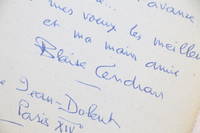
Blaise CENDRARS
". je vais attaquer le paquet par le dernier ""cherchant qui dévorer""."" Autograph letter signed to Luc Estang thanking him for sending his latest works
Paris: S. n. 1950. Fine. S. n. Paris s. d. ca 1950 11.50 x 16 cm une page Autograph letter signed by Blaise Cendrars addressed to Luc Estang 16 lines in blue ink. Fold traces inherent to postal handling. Luc Estang has just sent his latest books to Blaise Cendrars who delights in them in advance and thanks him for this: "". je me réjouis d'avance de vous lire. "" "". I look forward with pleasure to reading you. "" S. n. unknown
Referenz des Buchhändlers : 86569
|
|
|
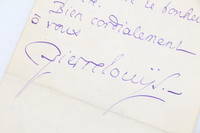
Pierre LOUS
"C'est à cela seul que je dois mon indépendance littéraire et cette inestimable liberté du silence qui n'est pas l'idéal de tous mais qui me paraît être le bonheur du poëte."" Important signed autograph letter addressed to Alfred Vallette about the unexpected success of his Aphrodite
Paris 1896. Fine. Paris 1896 13 x 20.50 cm 3 pages sur un double feuillet Autograph letter signed by Pierre Louÿs addressed to his publisher Alfred Vallette 50 lines written in purple ink on a double sheet. Pierre Louÿs responds to his friend and publisher Alfred Vallette after a controversy launched by a journalist from Comoedia a controversy that could damage their friendship: ""Je ne suis pour rien dans l'écho publié par Comoedia. Mais ce que vous en citez suffit à me montrer que le rédacteur s'est mal informé."" ""I had nothing to do with the piece published by Comoedia. But what you quote from it is enough to show me that the writer was misinformed."" and he intends to remind him that they had not been able to agree on the publishing terms for Aphrodite and that he envisioned only a confidential distribution for his latest book: ""L'histoire de notre édition est très simple. Vous m'avez proposé un traité que je n'ai pas trouvé bon ; j'ai préféré le ""compte d'auteur"" et je ne peux pas vous accuser d'avoir mal prévu le succès du livre puisque moi-même j'avais écrit mon roman pour vingt amis et quelques inconnus."" ""The story of our edition is very simple. You offered me a contract that I did not find good; I preferred the 'author's account' and I cannot accuse you of having poorly predicted the book's success since I myself had written my novel for twenty friends and a few strangers."" This is why the father of Aphrodite is astonished by the triumph achieved by the work: ""Si une diseuse de bonne aventure nous avait prédit alors qu'Aphrodite dépasserait un jour le 300e mille nous l'aurions traitée comme une pauvre folle."" ""If a fortune teller had predicted then that Aphrodite would one day exceed 300000 copies we would have treated her as a poor madwoman.""; the latter consecrating his fame and wealth in the literary world: ""J'ai en outre une seconde raison pour ne pas vous en vouloir du traité que j'ai signé avec vous : c'est qu'en préservant mes droits d'autuer sur ce roman j'ai fait sans le savoir ma fortune. C'est à cela seul que je dois mon indépendance littéraire et cette inestimable liberté du silence qui n'est pas l'idéal de tous mais qui me paraît être le bonheur du poëte."" ""I have furthermore a second reason for not resenting the contract I signed with you: it is that by preserving my author's rights on this novel I made my fortune without knowing it. It is to this alone that I owe my literary independence and this invaluable freedom of silence which is not everyone's ideal but which seems to me to be the poet's happiness."" Very fine autograph on Pierre Louÿs's literary triumph. unknown
Referenz des Buchhändlers : 86610
|
|
|
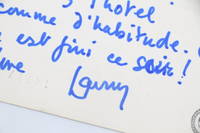
Lawrence DURRELL
"J'arrive à Paris Dimanche 19 pour deux nuits. Sera tu la sic Disponible "" Autograph postcard signed by Lawrence Durrell from Rhodes to Jani Brun
Rhodes 1979. Fine. Rhodes Octobre 1979 21 x 10 cm une carte postale Evocative autograph postcard signed by Lawrence Durrell addressed to Jani Brun written in blue felt-tip pen on the verso of a reproduction of a sculpture depicting a seahorse fountain in Rhodes. Minor angular fold marks on the postcard. ""Rhodes ! J'arrive à Paris Dimanche 19 pour deux nuits. Sera tu la sic Disponible Je decend chez l'hotel Royale comme d'habitude. Le tournage est fini ce soir ! Ouf ! Love. Larry."" ""Rhodes! I'm arriving in Paris Sunday the 19th for two nights. Will you be there Available I'm staying at the Hotel Royale as usual. Filming is finished tonight! Phew! Love. Larry."" After many years spent in Greece Egypt and Rhodes the travelling writer Lawrence Durrell was forced to flee Cyprus following popular uprisings that led the island to independence from the British crown. Rich only with a shirt and a typewriter but crowned with the success of his novel Bitter Lemons of Cyprus he arrived in France in 1956 and settled in the Languedoc village of Sommières. In the ""Tartès house"" his large residence surrounded by trees he wrote the second part of his work his monumental Avignon Quintet devoted himself to painting and received his illustrious friends including the couple Henry Miller and Anaïs Nin the violinist Yehudi Menuhin the London publisher Alan G. Thomas and his two daughters Penelope and Sappho. Among the olive trees and under the Mediterranean sun he met in the mid-1960s the young and vivacious ""Jany"" Janine Brun a woman from Montpellier in her thirties of devastating beauty who worked in the Antiquities department at the Sorbonne in Paris. She was nicknamed ""Buttons"" in memory of their first meeting where the young woman wore a dress covered with buttons. Henry Miller also fell under the charm of ""Buttons"" praising her beauty and eternal youth in exceptional unpublished letters. The three companions spent memorable Parisian evenings of which we retain precious autograph traces through their epistolary exchanges. Recommended by Durrell she made numerous trips particularly to England from where she received extensive correspondence from the writer as well as original works of art signed with his artist pseudonym Oscar Epfs. unknown
Referenz des Buchhändlers : 86609
|
|
|
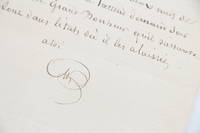
Alexandre DUMAS
"il s'assurera que toutes choses sont dans l'état où il les a laissées"" Autograph letter signed to his lover Marie Richon
1866. Fine. lundi soir 1866 13.30 x 20.90 cm une page sur un bifeuillet Autograph letter signed by Alexandre Dumas to his mistress Marie Richon. 6 lines on one page of a bifolium of laid paper with the writer's crowned initials. « Chère amoi sic Ton ami arrivé moulu brisé de deux nuits de voitures et de chemins de fer. Il t'attend demain soir mardi. Oh ce sera avec grand bonheur qu'il s'assurera que toutes choses sont dans l'état où il les a laissées a toi » Nothing is known of this affair with Marie Richon addressed to this mistress evidently sensitive to literature ""Fais-moi de bons vers pour mon retour"" he requests of her in another note. Actress society woman or woman of learning the mystery remains complete around this character who inspires in the insatiable Dumas a torrid correspondence. He notably arranged meetings with his mysterious conquest at his residence on Boulevard Haussmann where he had settled from 1865 onwards. A sentence from Dumas in another note tells us that she even met Dumas's daughter who lived with her father and endured the visits of his mistresses ""elle t'adore - ou plutôt nous t'adorons"" he would write to her. This missive can probably be situated during 1866 when the writer was preparing the theatrical adaptation of his novel Gabriel Lambert and mentions in a letter a reading of the play created at the Ambigu-Comique on March 16 1866. The last years of his life did not belie his immeasurable love of women; during this period rich in adventures he also shared his nights with the feminist and gerontophile Olympe Audouard as well as the famous Adah Isaacs Menken whose portraits alongside the writer were divulged by their indiscreet photographer. Handsome letter filled with anticipation from the hand of the great writer and addressed to a mysterious mistress still unknown to biographers. unknown
Referenz des Buchhändlers : 86602
|
|
|
Lawrence DURRELL
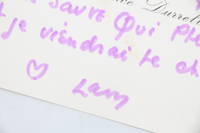
"Oui telephonez moi quand tu es à Sauve-qui-pleut. "" Funny autograph business card signed by Lawrence Durrell addressed to his lover Jani Brun
Rhodes 1980. Fine. Rhodes s. d. ca 1980 13 x 8 cm une carte postale une enveloppe Suggestive autograph carte de visite signed by Lawrence Durrell addressed to Jani Brun written in brown and mauve felt-tip pens with accompanying envelope. ""dear Buttons. Oui telephonez moi quand tu es à Sauve-qui-pleut et je viendrai te chercher un coeur dessiné. Larry."" After many years spent in Greece Egypt and Rhodes the travel writer Lawrence Durrell was forced to flee Cyprus following popular uprisings that led the island to its independence from the British crown. Rich only in a shirt and a typewriter but crowned with the success of his novel Bitter Lemons of Cyprus Les citrons acides he arrived in France in 1956 and settled in the Languedoc village of Sommières. In the ""Tartès house"" his large dwelling surrounded by trees he wrote the second part of his work his monumental Avignon Quintet devoted himself to painting and received his illustrious friends including the couple Henry Miller and Anaïs Nin violinist Yehudi Menuhin London publisher Alan G. Thomas and his two daughters Penelope and Sappho. Among the olive trees and under the Mediterranean sun he met in the mid-1960s the young and vivacious ""Jany"" Janine Brun a thirty-year-old woman from Montpellier of devastating beauty who worked at the Antiquities department of the Sorbonne in Paris. She was nicknamed ""Buttons"" in memory of their first meeting where the young woman wore a dress covered with buttons. Henry Miller also fell under the charm of ""Buttons"" praising her beauty and eternal youth in exceptional unpublished letters. The three companions spent memorable Parisian evenings of which we retain precious autograph traces through their epistolary exchanges. Recommended by Durrell she made numerous trips notably to England from where she received vast correspondence from the writer as well as original works of art signed with his artist pseudonym Oscar Epfs. unknown
Referenz des Buchhändlers : 86623
|
|
|
Edouard PEISSON
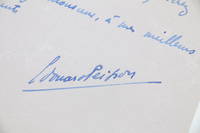
"Mais je vis la plus grande partie de l'année dans le midi."" Autograph letter dated and signed to Noël B. de La Mort who wishes to meet him
Aix-en-Provence 1936. Fine. Aix-en-Provence 2 Avril 1936 13 x 21 cm une page une enveloppe Autograph letter dated and signed addressed to the writer and literary critic Noël B. de La Mort pen name of Noël Bayon 15 lines in blue ink. Crease marks inherent to folding for mailing envelope included. Noël B. de La Mort wishes to meet Edouard Peisson but the latter is seldom in Paris: ""Mais je vis la plus grande partie de l'année dans le midi."" But I live most of the year in the south. but he remains at his correspondent's disposal: ""Je suis disposé toutefois à répondre toutes les questions que vous me poserez par lettre."" I am willing however to answer any questions you may ask me by letter. unknown
Referenz des Buchhändlers : 86641
|
|
|
Georges DUHAMEL
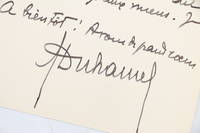
Carte de visite autographe à en-tête de la l'Académie française
Paris 1955. Fine. Paris 6 Janvier 1955 13.50 x 10.50 cm une carte de visite Printed calling card of academician Georges Duhamel on which he has added on the front these few words for a certain Peillard notably about his health problems: ""Mon cher Peillard Je vous renvoie sans attendre les épreuve reçues au dernier courrier. Je viens de passer dans mon lit presque tout le temps des fêtes. J'ai beaucoup souffert d'une de ces crises de rhumatisme qui m'empêchent pour l'instant de poser le pied par terre et même de goûter le repos du lit. Je me relève depuis hier ; mais je ne sortirai pas avant la semaine prochaine. Trouvez ici mes voeux les plus cordiaux pour madame Peillard et vous-même. Ma femme me dit de joindre ses voeux aux miens. Je le fais. A bientôt ! A vous de grand coeur. GDuhamel."" ""My dear Peillard I return without delay the proofs received in the last post. I have just spent almost all the holiday time in my bed. I have suffered greatly from one of those rheumatic attacks that prevent me at the moment from setting foot on the ground and even from enjoying the rest of bed. I am getting up since yesterday; but I will not go out before next week. Please find here my most cordial wishes for Madame Peillard and yourself. My wife tells me to join her wishes to mine. I do so. See you soon! Yours wholeheartedly. GDuhamel."" Light worming without consequence at the head of the front of the card. unknown
Referenz des Buchhändlers : 86656
|
|
|
Alphonse KARR
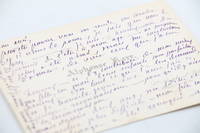
Carte de visite autographe signée au librettiste et journaliste Philipe Gille
s. l. 1884. Fine. s. l. Mai 1884 12.50 x 9 cm une page une enveloppe Autograph signed visiting card by Alphonse Karr on which he has added recto verso a few words for the attention of journalist and librettist Philippe Gille 36 lines in purple ink. Envelope included. Alphonse Karr solicits his friend the journalist Philippe Gille to allow him to deliver a few articles in order to remedy his pecuniary problems and to come to the aid of his family. unknown
Referenz des Buchhändlers : 86671
|
|
|
Liane de POUGY
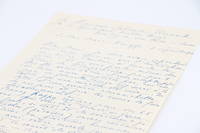
Lettre autographe datée adressée à Salomon Reinach évoquant ses houleuses relations avec l'Amazone Natalie Clifford-Barney : ""J'ai le poil sensible et comme le mousquetaire : bon coeur et mauvais caractère. C'est la 1ère fois que l'amazone m'aura dûrement visée.""
Le Clos-Marie Roscoff Roscoff 1923. Fine. Le Clos-Marie Roscoff Roscoff 2 Septembre 1923 20.50 x 27 cm 1 page recto verso Autograph letter dated from Liane de Pougy to the French archaeologist curator of the Musée de Saint-Germain and professor of art history at the École du Louvre Salomon Reinach 56 lines written in blue ink on one double-sided sheet written from her property at Clos-Marie in Roscoff where the famous courtesan stayed until 1926. A small tear in the right-hand margin of the letter inherent in the enveloping of the missive; another slight tear at the foot without affecting the text. Liane de Pougy marvels at the youthful vigor of Reinach who had just turned 65: ' Many happy returns for your 65 years which find you so young so fresh so green with such playful studious feelings. My friend your youthful morals hold the secret of your physical youth—as Rosa Josepha said one sustains the other one preserves the other—and this seen head-on. ' while magnifying his radiant intelligence: 'To no longer produce but to sit atop the high throne of your trophies formed by all you have wrested from instinct to sacrifice to intellectuality. Why do people always say a well of knowledge instead of a luminous column a sky a sun a star etc.—in short something that makes us lift our heads' She is waiting for her friend and former lover the terrible and unfaithful Natalie Clifford-Barney:  'Natalie plans to come to Clos at the end of September. She has a wound to heal here—time fortunately has already done part of the work! I have sensitive feelings and like a musketeer a good heart but a bad temper. This is the 1st time the amazon has truly aimed at me. Let us speak of it no more'. Liane firmly expresses her wish not to be pitied or consoled for her romantic troubles:  'I have suffered in silence but without resignation. Do not speak of this to Nathanaël. Nathanaël means Philippe Max Jacob claims who lives and works near us in the most fascinating way. '. A beautiful letter by the celebrated courtesan actress and writer Liane de Pougy recounting with restrained candor her romantic disappointments with Natalie Clifford-Barney.  unknown
Referenz des Buchhändlers : 86631
|
|
|
Henri MICHAUX
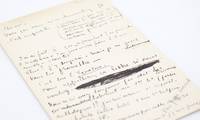
"assez d'y avoir vécu un an et d'en avoir fait un livre"" Autograph letter signed twice and probably addressed to Henri Parisot about an article for his magazine Les quatre vents and concerning the Equator
s. l.: S. n. 1945. Fine. S. n. s. l. s. d. ca 1945 9 x 13.50 cm une page recto verso Autograph letter signed by Henri Michaux in two parts 45 lines in black ink on recto and in pencil on verso written over two days Sunday and Monday on bristol paper. Transverse fold in right margin of the bristol. Deletions and corrections in black ink on the recto of the letter Henri Michaux refuses what is asked of him: ""Now you're asking me for 20"" pages. ""It's impossible. I've done 6 which represent 7 or 8 of your magazine. I can do 2 more it seems to me so 10 More I'll think about it. But I cannot promise them to you at all."" and asks some questions to his correspondent: ""You still haven't told me the writers who are collaborating on the 1st issue anthology section. I'm curious and worried about it."" On the verso the writer has completed his work: ""And well there you have it I have 10 pages. but I can no longer write anything about this country - enough to have lived there a year"" in 1928 ""and to have made a book from it. So don't ask me for more. Just having to transcribe my letter ! gives me a headache. In me it refuses."" S. n. unknown
Referenz des Buchhändlers : 86737
|
|
|
Tancrede de VISAN
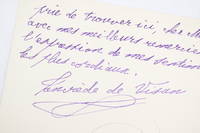
Rien ne pouvait me causer plus de joie que ces trois jacinthes. Bristol signed autograph thanking his pen pal for sending flowers
Lyon 1938. Fine. Lyon 5 Avril 1938 14 x 10.50 cm un bristol recto verso une enveloppe Autograph card dated and signed by Tancrède de Visan 15 lines in violet ink on Nouvelliste de Lyon letterhead recto and verso. Envelope included. Touched by the floral attention shown by his correspondent Tancrède de Visan addresses these few words of gratitude to Joseph Tauran-Lille: ""Nothing could bring me greater joy than these three hyacinths - white pink and violet - whose tender harmonies illuminate my drawing room while perfuming it"". unknown
Referenz des Buchhändlers : 86686
|
|
|
Ernest RENAN
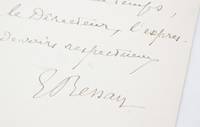
"vous entretenir de quelques affaires très importantes pour le Collège de France et qui sont assez pressées."" Autograph letter dated and signed to Louis Liard concerning the Collège de France
Bellevue Meudon 1884. Fine. Bellevue Meudon 17 Octobre 1884 13 x 20.50 cm une page sur un double feuillet Autograph letter dated and signed by Ernest Renan to Louis Liard then director of higher education at the Ministry of Public Instruction 14 lines in black ink and on letterhead of the Collège de France of which he has been administrator since the previous year. Postal fold mark inherent to mailing a small tear at the head of the letter at the date level. Ernest Renan requests a meeting in order to discuss with his correspondent the future of the Collège de France: ""Oserai-je vous prier de me fixer l'heure et le jour où je pourrai sans vous déranger vous entretenir de quelques affaires très importantes pour le Collège de France et qui sont assez pressées ."" ""Dare I ask you to set the time and day when I could without disturbing you discuss with you some very important matters for the Collège de France which are rather urgent."" Louis Liard noted in pencil in the upper left corner of the letter: La 1ere lettre que j'ai reçu de Renan. The first letter I received from Renan. unknown
Referenz des Buchhändlers : 86688
|
|
|
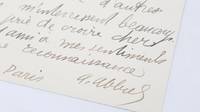
Andre ABBAL
"je suis certain maintenant que mon Tarn et Garonne ne reviendra pas à l'atelier."" Autograph letter signed about one of his works
Paris 1941. Fine. Paris s. d. ca 1941 14 x 15.50 cm une page sur un double feuillet Autograph letter signed by sculptor André Abbal 13 lines in black ink on a double sheet. Traces of folding inherent to postal dispatch. The sculptor discusses his various productions: ""I am now certain that my Tarn et Garonne will not return to the workshop. With peace of mind on this front I will work hard on other things that interest me greatly."" André Abbal student of Alexandre Falguière is renowned for his direct-carved stone sculptures. unknown
Referenz des Buchhändlers : 86762
|
|
|
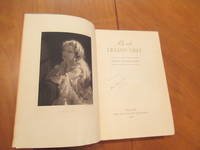
Paine, Albert Bigelow [signed By Author and By Lillian Gish]
Life and Lillian Gish
New York: The Macmillan Company 1932. First Edition . Cloth. Fair/No Dust Jacket. Photographs. 303 Pp. Biography By A Friend And Fan A Writer Noted For His 1912 Biography Of Twain. Signed On Title Page By Lillian Gish And Also By Albert Bigelow Paine; Another Ownership Signature Of A Man With A Connection To Her Sister Dorothy Gish This Being Her Copy Although Not Signed By Her. Covers Quite Worn Frayed At Top And Bottom Of Spine Dampstaining To Covers With A Very Slight Waviness At Bottom Of Last 50 Pages. Lacking The Scarce Dust Jacket. <br/> <br/> The Macmillan Company hardcover
Referenz des Buchhändlers : 057859
|
|
|
Taylor, Samuel (Claude Dauphin Autographed Copy)
The Happy Time A Comedy Of Love Based On The Stories By Robert Fontaine Signed By Claude Dauphin
New York: Random House 1950. First Printing . Turquoise Cloth. Fine/Very Good. 8 1/4" High. 184 Unmarked Pages. Stated First Printing. "'The Happy Time' Was First Presented By Richard Rodgers And Oscar Hammerstein 2Nd At The Plymouth Theatre New York City On January 24 1950 With The Following Cast: Bibi.Johnny Stewart; Papa.Claude Dauphin "Etc. From The Personal Library Of A Hollywood Publicist; Stamp On Ffep. Cover Edges Faded; Paper Label On Spine Clean And Bright. Dj In Brodart; Not Price Clipped ; Chipped Tips Top And Bottom Of Spine. 1/2" Closed Tear Top Edge Rear. Claude Dauphin Signed His Name On Front Of Dj Between " By Samuel Taylor" And :" A Random House Play". <br/> <br/> Random House hardcover
Referenz des Buchhändlers : 058056
|
|
|
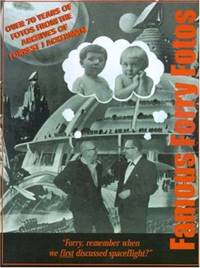
Ackerman, Forrest
Famous Forry Fotos - Over 70 Years of Ackermemories Forrest Ackerman
Rockville: James A Rock & Company / Sense of Wonder Press 2001. First Edition . Illustrated Wrappers. Fine. Photographs Throughout with Captions. 117 Pp. Softcover. As New Signed By Ackerman On The Title Page. <br/> <br/> James A Rock & Company / Sense of Wonder Press unknown
Referenz des Buchhändlers : 058098 ISBN : 0918736323 9780918736321
|
|
|
Jacques MESRINE
".Enfin cela est un gros poids d'enlevé pour toi. Tu te retrouveras chez toi dans un décor que tu as aimé"" Autograph love letter dated and signed by Jacques Mesrine written from the prison of Fleury-Mérogis and addressed to his companion Jeanne Schneider for whom he has just found accommodation after his next release
Fleury-Mérogis 1976. Fine. Fleury-Mérogis 21 Septembre 1976 21 x 29.50 cm une page recto verso Autograph letter dated and signed by Jacques Mesrine dated Tuesday September 21 1976 68 lines in blue ink on one recto-verso page addressed to his lover at the time Jeanne Schneider thanks to whom the manuscript ofInstinct de mort was discreetly smuggled out of prison. A horizontal fold inherent to the envelope placement a small tear in the right margin of the letter at the fold level. Jacques Mesrine then incarcerated at Fleury-Mérogis prison arranged with his mother for her to cede upon her departure from the Paris region her Clichy apartment to Jeanne Schneider after his possible provisional release: ""J'ai eu un très agréable parloir avec maman. J'ai au moins une bonne nouvelle à t'annoncer. Pour Clichy c'est d'accord. Comme elle va vivre presque tout le temps à la montagne tu auras l'appartement pour toi. Je paierai le loyer. Elle a tout de suite dit d'accord après mon explication. . Je me doute de ta joie de savoir que tu pourras vivre à Clichy - si près de notre papy. toujours présent de par l'amour que nous avons pour lui. Je suis certain que cette petite nouvelle te remonte le moral."" I had a very pleasant visit with mama. I have at least one good piece of news to tell you. For Clichy it's agreed. Since she's going to live almost all the time in the mountains you'll have the apartment to yourself. I'll pay the rent. She immediately said yes after my explanation. . I can imagine your joy knowing that you'll be able to live in Clichy - so close to our grandpa. always present through the love we have for him. I'm certain this little news will lift your spirits. His daughter Sabrina worries him and he senses that he will have to be severe regarding her behavioral lapses: ""De Sabrina rien ! Il y a une chance pour qu'actuellement elle me prépare un ""douze"" je ne peux t'en parler sur lettre. mais j'ai l'impression que la puce me ment sur certaines choses. elle prend peut-être une route où il va me falloir la plus grande fermeté. J'ai demandé à maman de vérifier si elle va bien à l'école."" Nothing from Sabrina! There's a chance that currently she's preparing a ""twelve"" for me I can't talk about it in a letter. but I have the impression that the kid is lying to me about certain things. she's perhaps taking a path where I'll need the greatest firmness. I asked mama to check if she's doing well in school. News of his ""godson"" the famous robber Jean-Charles Willoquet with whom he organized his escape from La Santé prison where they had met makes him prouder: ""J'ai reçu la photo du plus jeune détenu de France à savoir mon filleul ""Willy Willoquet"" dans sa cour de promenade. c'est émouvant et triste à la fois !"" I received the photo of the youngest prisoner in France namely my godson ""Willy Willoquet"" in his exercise yard. It's moving and sad at the same time! The situation of his young protégé cut off from all contact with his loved ones and the people who love him reminds him of his own personal situation and the indignities of a prisoner's isolated existence: ""Je me demande comment va réagir Martine quand on va lui enlever Enfin c'est le destin qu'elle a choisi et accepté. Elle paie cher le prix de l'amour. Vous le payez toutes ""très cher""."" I wonder how Martine will react when they take him away from her Well it's the destiny she chose and accepted. She pays dearly the price of love. You all pay it ""very dearly"". In order to quickly erase this morose and implacable truth Jacques Mesrine plunges into schoolboy humor and affectionately mocks his lover's physical flaws: ""J'espère que la bonne nouvelle va te rendre ton sourire. eh ! la mémé. boutons sur la gueule. ou pas ! Je t'adore. il ne fallait pas flirter avec ""voyou"" ! C'est lui qui t'as passé cela sic nanou d'amour ton viejo pirate monte à l'abordage de tes lèvres. et. !! tu coules ! "" I hope the good news will bring back yo unknown
Referenz des Buchhändlers : 87298
|
|
|
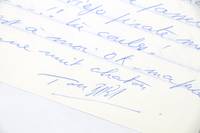
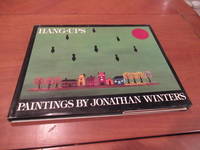
Winters, Jonathan ; Inscribed By Winters To Actress Marie Windsor And Her Husband
Hang-ups
New York: Random House 1988. First Edition . Hardcover. Fine/Very Good Jacket. 9 3/8" Tall x 11 5/8. Jonathan Winters. 116 Pages Green Cloth. First Edition Stated. Fine In Near Fine Dust Jacket Priced $24.95. With A Personal Inscription And Small Drawing Of A Christmas Ornament By The Artist; " To Marie And Jack.A Very Very Merry Christmas From Jonathan.December 1988.P.S.Marie You Should Do A Book-You're So Creative-I Shall Always Cherish That Little Box You Made For Us." This Is Inscribed To The Actress Marie Windsor Film Noir And Her Husband Jack Hupp Dated December 1988 With His Drawing Of A Christmas Ornament And Message "P. S> Marie You Should Do A Book- You're So Ceative- I Shall Always Cherish That Little Box You Made For Ujs.". The Dj Is Not Price Clipped. The Binding Is Tight And Immaculate. The Dj Is Lightly Scuffed With Two Vertical 1/4" Tears At The Top Of The Front Cover. <br/> <br/> Random House hardcover
Referenz des Buchhändlers : 058225
|
|
|
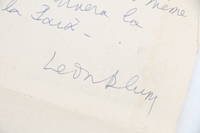
Leon BLUM
"Le pays se sauvera lui-même. Il sauvera la Liberté. Il sauvera la Paix"" Signed autograph manuscript
1948. Fine. « A Londres pour la première fois des possibilités d'accord sont apparues pour les problèmes allemands même sur les Réparations. » In London for the first time possibilities for agreement have appeared on German problems even on Reparations. s. d. 1948 21 x 27 cm quatre feuillets Signed autograph manuscript entitled ""A Compiègne et au Palais Bourbon"" by Léon Blum 3 and a half pages in blue ink on the verso of four sheets with letterhead from the newspaper Le Populaire Central Organ of the Socialist Party S.F.I.O. Numerous passages crossed out and rewritten in black ink. Horizontal fold mark on each sheet notes from a previous bibliographer in pencil at the head of the first sheet. The article appeared in the daily newspaper Le Populaire on March 9 1948. Fine and virulent diatribe by Léon Blum following General De Gaulle's Compiègne speech denouncing his maneuvers toward a ""strong State."" He paints a hopeful picture of German reconciliation European construction as well as the Marshall Plan soon to be ratified - of which he had been the great negotiator. On March 7 1948 the general who had just founded the Rally of the French People was invited by the new mayor Jean Legendre who had rallied to the RPF. At a pivotal moment of international tensions before several tens of thousands of people gathered at the château square De Gaulle called on the French to unite to refound the Fourth Republic and free countries to unite against communism following the ""Prague coup."" Remaining excluded from power he then began his crossing of the desert until his return in 1958 thanks to the Algerian crisis which brought down the weak Fourth Republic. Having established the foundations of this same Republic Blum disapproves in these pages of De Gaulle's challenge to parliamentary institutions - even as his own Gaullists deputies obstruct debates in the assembly. He opposes the general's catastrophist discourse with an optimistic vision of European and international reconstruction convinced of the great resilience of the French nation and confident in its institutions. « Chose curieuse c'est la presse gaulliste qui attendait le discours de Compiègne avec la curiosité et l'impatience la plus marquées. . En fin de compte le discours de Compiègne n'a apporté rien de neuf. Il a fait entendre que toutes ses mesures étaient arrêtées et que sans doute aussi ses hommes étaient choisis. Il a déclaré que la situation était trop critique en France en Europe et dans le monde pour permettre qu'on différât davantage. Mais il a persisté cependant à affirmer - c'est du moins ainsi que j'interprète un texte volontairement obscur biffé : ambigu - qu'il ne gouvernerait pas dans le cadre des institutions présentes biffé : anciennes et qu'il n'accepterait qu'un pouvoir taillé à sa mesure . Rien de bon ne peut en sortir a-t-il conclu ; il n'est que temps de tirer la France de ce marécage pour l'installer sur le sol ferme et salubre de l'Etat fort. Tout cela va fort bien. Seulement à l'heure même où le général prononçait contre les partis et les institutions parlementaires le réquisitoire altier l'Assemblée nationale siégeait au Palais Bourbon. Elle promouvait l'examen des propositions relatives au prélèvement René Mayer. Et là on voyait la coalition du parti gaulliste avec ces mêmes « séparatistes » que le discours de Compiègne dénonçait comme des traîtres s'étaler avec une impudence plus scandaleuse de jamais . Dénoncer l'impuissance parlementaire tout en l'organisant stigmatiser la malfaisance et l'immoralité des partis tout en en fournissant l'exemple éhonté c'est une attitude commode mais qui brave par trop violemment le bon sens et l'honnêteté. . Certes la situation intérieure est sérieuse et la situation internationale ne l'est pas moins. Mais le redoutable hiver s'achève le ravitaillement s'améliore. La tendance s'améliore vers la baisse des produits alimentaires s'accentue et s'acce unknown
Referenz des Buchhändlers : 87358
|
|
|
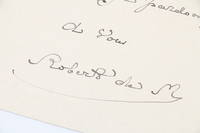
Robert de MONTESQUIOU
"Enfin. je pardonne à vous."" Bristol Signed Autograph Addressed to a Friend
s. l.: S. n. 1910. Fine. S. n. s. l. 1910 18 x 11.50 cm une feuille recto verso Autograph signed card from the dandy count 9 lines written in black ink addressed to a friend on cardboard paper: ""Chère amie C'était donc pour ""Femina ! "" Je devrais vous en vouloir moi qui avais prononcé contre ce lieu les formules exécratoires ! Enfin. je pardonne à vous ! A vous Robert de M. 910."" Dear friend So it was for ""Femina!"" I should hold it against you I who had pronounced execratory formulas against this place! Well. I forgive you! Yours Robert de M. 910. S. n. unknown
Referenz des Buchhändlers : 87879
|
|
|
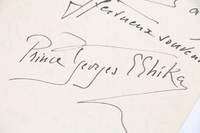
Prince Georges GHIKA - (Isabelle EBERHARDT) - (Rene-Louis DOYON)
"Isabelle Eberhardt ! ah ! l'avons-nous lue et relue."" Autograph letter signed probably addressed to René-Louis Doyon concerning his biography of Isabelle Eberhardt
Paris 1944. Fine. Paris s.d. ca 1944 13.50 x 18 cm deux pages et demi sur un bifeuillet Autograph letter signed by Prince Georges Ghilka 31 lines in black ink on a double sheet with letterhead from the Majestic Hotel in Paris probably addressed to René-Louis Doyon who devoted in 1944 a biography to Isabelle Eberhardt entitled ""Au pays des sables Isabelle Eberhardt"". Fold mark inherent to the mailing. Prince Georges from the House of Ghika a princely family of Romania of Albanian origin married in Paris in 1910 the most famous Amazon of All Paris Liane de Pougy. René-Louis Doyon sent his work to his friend the prince who thanks him for it: ""Nous avons lu votre livre et c'était délicieux comme une causerie avec vous une causerie qui emporte dans ces pays aimés du soleil et d'Isbelle Eberhardt que vous vous plûtes à citer. Merci encore pour ce grand plaisir que vous nous avez donné."" We read your book and it was delightful like a conversation with you a conversation that carries one away to those beloved lands of sun and of Isabelle Eberhardt whom you took pleasure in quoting. Thank you again for this great pleasure you have given us. unknown
Referenz des Buchhändlers : 87922
|
|
|
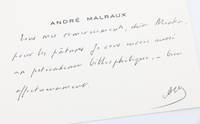
Andre MALRAUX
Carte de visite sur laquelle André Malraux a ajouté quelques mots de remerciements à son amie Minka Strauss
s. l.: s. n. 1973. Fine. s. n. s. l. 1973 13.50 x 9 cm une feuille Printed visiting card signed by André Malraux to which he has added in black ballpoint pen these few words for his friend Minka Strauss: ""All my thanks dear Minka for the pastries. I am also sending you a small bibliophilic gift. Most affectionately."" s. n. unknown
Referenz des Buchhändlers : 87973
|
|
|
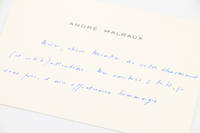
Andre MALRAUX
Carte de visite sur laquelle André Malraux a ajouté quelques mots de remerciements à son amie Minka Strauss
s. l.: s. n. 1973. Fine. s. n. s. l. 1973 13.50 x 9 cm une feuille Printed visiting card on which André Malraux has added in blue ballpoint pen these few words for his friend Minka Strauss: ""Thank you dear Minka for your charming and useful attention. My regards to K.H. I beg you and my affectionate respects."" s. n. unknown
Referenz des Buchhändlers : 87972
|
|
|
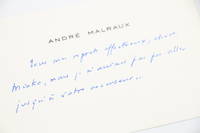
Andre MALRAUX
Carte de visite manuscrite à son amie Minka Strauss
s. l.: s. n. 1974. Fine. s. n. s. l. s.d. ca 1974 13.50 x 8.50 cm une feuille Printed visiting card of André Malraux on which he added these few words for his friend Minka Strauss: ""All my affectionate regrets dear Minka but I could not have made it to your elevator."" Handsome copy. s. n. unknown
Referenz des Buchhändlers : 88006
|
|
|
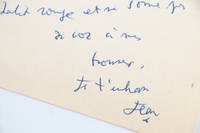
Jean COCTEAU
"J'accepte d'être en secret mis à ma place et publiquement remis à ma place."" Signed autograph letter exceptional prefiguration of his epitaph
Saint-Jean-Cap-Ferrat 1953. Fine. Saint-Jean-Cap-Ferrat 29 Août 1953 21 x 27 cm une page Autograph letter dated and signed by Jean Cocteau 26 lines in blue ink to Olivier Quéant editor of the magazine Plaisir de France sent from villa Santo-Sospir. Fold marks inherent to postal handling. Quéant journalist and notably editor of the magazine Plaisir de France maintained a fine friendly and literary correspondence with the writer. He notably delivered a glowing review of Antigone at its premiere in 1944: ""depuis Racine l'on avait rien écrit d'aussi beau d'aussi grand et d'aussi profondément humain"" since Racine nothing so beautiful so great and so profoundly human had been written L'Illustration. Jean Cocteau at the twilight of his life rebels and complains about his diminished and merely symbolic role in French theater of the 1950s. The second sentence of this letter will be taken up almost word for word in the famous verses of his longest poem Requiem 1962: ""Il est juste qu'on m'envisage / Après m'avoir dévisagé"" It is right that I should be considered / After having been stared at which will also serve as his epitaph. Despite official recognition Cocteau felt until his death ""méconnu inconnu invisible"" misunderstood unknown invisible Jean Cocteau sur le fil du siècle 2003 - a malaise masterfully expressed through these lines. ""Voilà plusieurs années que j'accepte d'être en secret mis à ma place et publiquement remis à ma place. Bref de n'être pas envisagé mais dévisagé. Il est beau de recevoir des lettres ""retournées"" où Anouilh me dit ""Sans vos pièces je n'aurais pas écrit une ligne des miennes"" et Giraudoux ""Rilke avait raison. Nos figures blanches à côté du hâle de tes séjours dans l'antiquité."" Il est beau d'être comme le Pisanelle - enterré sous les roses ."" For several years I have accepted being secretly put in my place and publicly put back in my place. In short not being considered but stared at. It is beautiful to receive ""returned"" letters where Anouilh tells me ""Without your plays I would not have written a line of mine"" and Giraudoux ""Rilke was right. Our pale faces beside the tan of your sojourns in antiquity."" It is beautiful to be like Pisanello - buried under roses . Interesting and touching missive from Cocteau with disordered and furious handwriting twisting and stretching in the manner of a calligram. unknown
Referenz des Buchhändlers : 88024
|
|
|
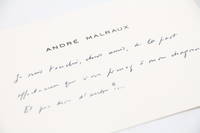
Andre MALRAUX
Carte de visite sur laquelle André Malraux a ajouté quelques mots de remerciements à ses amis Minka et Karl Hans Strauss
s. l.: s. n. 1973. Fine. s. n. s. l. 1973 13.50 x 9 cm une feuille Printed calling card on which André Malraux added in blue ballpoint pen these few words for his friends Minka and Karl Hans Strauss: ""I am touched dear friends by the affectionate part you take in my grief. And what else is there to say.""  s. n. unknown
Referenz des Buchhändlers : 88071
|
|
|
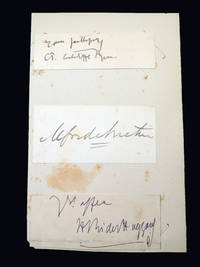
Autographs: H Rider Haggard, C J Cutliffe Hyne & Alfred Austin
Three Author Autographs: Autographs: H Rider Haggard C J Cutliffe Hyne & Alfred Austin
Not published. Soft cover. Good. Here is a collection of three author's signatures. They are clipped from letters and have been pasted down on a sheet which measures approx. 22 × 14cm. 1. C. J. Cutcliffe Hyne 1866-1944 a prolific novelist who also wrote under the name Weatherby Chesney. Perhaps his best known work is the fantasy novel The Lost Continent: The Story of Atlantis 1899. 2. Alfred Austin 1835-1913 an English poet who served as Poet Laureate from 1896. 3. H Rider Haggard 1856-1925. This one appears to be rather a rushed signature but featuring the pen strokes common with his autograph. Condition: There is foxing to the sheet and a little to the signatures but they are otherwise in good condition. <br/> <br/> Not published paperback
Referenz des Buchhändlers : 017053
|
|
|
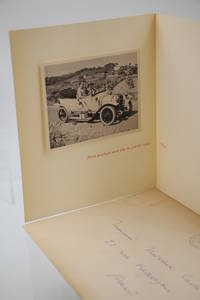
Boris VIAN
Faire-part de mariage de Boris Vian et Ursula Kübler joint enveloppe autographe Wedding announcement of Boris Vian and Ursula Kübler with autograph envelope
Paris 1954. Fine. Paris janvier 1954 29.10 x 18.20 cm une carte pliée et une enveloppe Wedding announcement of Boris Vian and Ursula Kübler. On the left panel is mounted a photograph of Vian and his wife in their famous 1911 Brasier Torpedo. Included is the envelope written in Boris Vian's hand in purple ink. Manuscript calculations in green ink on verso. Passionate about mechanics and driving Boris Vian owned numerous car models; his favorite was undoubtedly his 1911 Brasier Torpedo a former Marne taxi which he acquired in spring 1950. The marriage finally took place on February 8 1954 at the town hall of the 18th arrondissement of Paris. unknown
Referenz des Buchhändlers : 76427
|
|
|
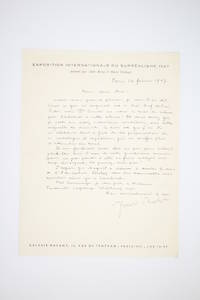
Andre BRETON
Lettre autographe signée inédite adressée à Michel Fardoulis-Lagrange : ""Dites-moi : IIIe Convoi ne nous a tout de même pas habitués à cette allure ! ""
Paris 1947. Fine. Paris 16 février 1947 20.80 x 27 cm une page sur un feuillet enveloppe jointe Unpublished autograph letter signed by André Breton addressed to Michel Fardoulis-Lagrange written in black ink on a sheet with letterhead of the International Surrealist Exhibition 1947. Envelope included. Transverse folds inherent to mailing. Interesting letter evoking the review Troisième Convoi founded by Jean Maquet and Michel Fardoulis-Lagrange written shortly before the second surrealist exhibition at the Maeght gallery: ""Dites-moi : IIIe Convoi ne nous a tout de même pas habitués à cette allure ! "" ""Tell me: IIIe Convoi has not exactly accustomed us to this pace!"". The review whose title was inspired by Vases communicants ""Nous voyageurs du second convoi."" ""We travelers of the second convoy"" had five issues between 1945 and 1951. We have found no trace of Breton's collaboration with this review but the letter we offer demonstrates that it may have been discussed: ""Et vous savez que je reste en assez mauvaise condition avec cette séquelle de sinusite. . Il me faudrait aussi être un peu plus éclairé peut-être sur l'axe de votre quatrième numéro pour ne pas partir à côté ou faire malgré moi trop divergent. Ne pensez-vous pas "" ""And you know that I remain in rather poor condition with this sequel of sinusitis. . I would also need to be perhaps a little more enlightened about the direction of your fourth issue so as not to go off track or despite myself be too divergent. Don't you think"" unknown
Referenz des Buchhändlers : 76435
|
|
|
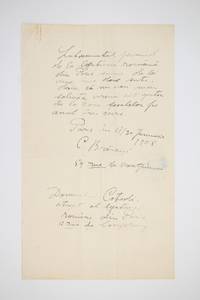
Constantin BRANCUSI
Déclaration autographe signée auprès de Mr. Costadi attaché à la légation roumaine à Paris Handwritten signed declaration to Mr Costadi attached to the Romanian legation in Paris
Paris 1908. Fine. Paris 17/30 janvier 1908 21 x 35 cm une page sur un feuillet Handwritten signed declaration to Mr Costadi attached to the Romanian legation in Paris Paris 17/30 January 1908 21 x 35 cm one page on a leaf Handwritten declaration dated and signed by Constantin Brâncui to Mr Costadi attached to the Romanian legation in Paris written in black ink on a leaf of white paper. Embossed stamp and a trace of a stamp. Some transverse folds. The declaration is signed with his full name that he will retain from then on: C. Brâncui and dated 17/30 January 1908 the two dates reflect the coexistence of the Gregorian and the Julian calendar in Romanian principalities in the early 20th century. In this declaration written on 30 January 1908 Brâncui addresses the Romanian legation in Paris represented by Mr Costadi. He hereby confirms receipt of the sum 1200 lei and specifies that he will no longer request assistance from the Maison des écoles section of the future Ministry of Education and Culture for the current year. This grant is the last he will be awarded by a Romanian establishment. unknown
Referenz des Buchhändlers : 76381
|
|
|
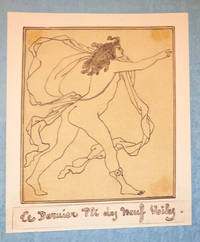
Robert de MONTESQUIOU
Ensemble de 620 feuillets autographes composant le manuscrit inédit du recueil ""Le dernier pli des neuf voiles"" véritable testament poétique. Unpublished autograph manuscript of Le Dernier Pli des neuf voiles a true poetic testament
1920. Fine. A priceless poetic testament from Marcel Proust's mentor hidden away and out of sight since the death of the author. s. d. ca 1920 25 x 33 cm en feuilles sous chemises The set of largely unpublished autograph poems by Robert de Montesquiou-Fezensac is brought together by the Count in a collection entitled Le Dernier Pli des neuf voiles whose composition extends from his very first collection Les Chauves-Souris 1892 to his last trilogy Offrandes 1915. Set of 620 autograph leaves. 532 unpublished first draught handwritten on the recto and numbered in pencil preserved in 3 chemises in half red contemporary morocco red morocco labels with gilt author and title; the poems are then placed in the chemises with a handwritten title and a number for publication. According to a note from the author the differences in ink have no meaning mere change of copy. Rare pages from the hand of his secretary Henri Pinard: p. 20 of Huitième voile and p. 29 of Neuvième voile. 23 pages present the printed or typewritten texts of the poems and are enriched with Montesquiou's handwritten corrections. A set of printed proofs are found at the top of the first chemise as well as a pencil tracing after Aubrey Beardsley drawn by the author and accompanied by his handwritten indications. Sublime ode to dandyism to homosexuality and beauty this worldly and poetic promenade by Montesquiou embarks the reader into the decadent fin-de-siècle Paris described in In Search of Lost Time by his friend Marcel Proust. Imbued with his legendary enthusiasm for pictorial decorative theatrical and floral art the collection also delivers hundreds of mournful verses after the disappearance of Montesquiou's lover Gabriel Yturri. Thanks to this collection of poems by Robert de Montesquiou-Fezensac all of which had been lost since 1986 it is now possible to complete the rehabilitation of the aristocratic poet who has long embodied and shaped the Parisian spirit. In May 1920 Montesquiou left handwritten instructions for the posthumous publication of the collection initially announced in two volumes and never produced. On his death a year later the poems were bequeathed to his secretary Henri Pinard who in turn sold them on an unknown date. Auctioned on 24 November 1986 they were mentioned in the LoWire-Littérature colloquium in 1989. This considerable manuscript by Montesquiou forms a veritable home of poetry like his famous aesthetic apartments described by Huysmans. The series of Voiles contain dozens of unpublished poems written in parallel with his previous collections. The author himself indicated the kinship of each voile with a published set of poems announcing here the total completion of his work by the addition of poems which still lay dormant in his papers. The three thick chemises contain rare and curious treasures sometimes drawn on colored sheets often pasted on larger sheets rigorously ordered while awaiting their publication. The poems are written without crossings-out they are fluid with rounded and precious handwriting and stand alongside other first-draught manuscripts: redactions and corrections also bear witness to the work in progress on the new poems; they were applied in the printed proofs of the work present at the top of the manuscript's first chemise. Some poems are taken as they are from collections already published but are slightly modified according to the explanations given by the author. Montesquiou also adds some handwritten notes detailing his intentions. The manuscript contains a poetic anthology of sacred art of extremely rare flowers and of antique furniture adorning his famous Parisian apartments around which so many legends were built Jacques Saint-Cère which fuelled the personalities of Des Esseintes Baron Charlus Dorian Gray and the vain peacock in Edmond Rostand's Chantecler. Moreover Montesquiou was overwhelmed by the features of these famous fictional ghosts of w unknown
Referenz des Buchhändlers : 75933
|
|
|
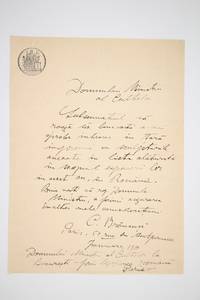
Constantin BRANCUSI
Lettre autographe signée adressée au Ministère roumain des cultes Handwritten signed letter addressed to the Romanian Ministry of Worship
Paris 1914. Fine. Paris janvier 1914 21 x 28.50 cm une page sur un feuillet Handwritten signed letter addressed to the Romanian Ministry of Worship Paris January 1914 21 x 28.5 cm one page on a leaf Very important handwritten letter signed by Constantin Brâncui addressed to the Romanian Ministry of Worship written in black ink on a leaf of white paper. Embossed stamp and a trace of a stamp. Transverse folds from having been sent. In this letter dated January 1914 and addressed to the Ministry of Worship the sculptor requests authorisation to bring some of his sculptures to Romania for the exhibition of the ""Tinerimea Artistica"" company Artistic Youth. Brâncui was then in Paris as evidenced by his address: « 54 rue du Montparnasse ». A list of works was visibly attached to the letter but sadly has disappeared. This letter testifies to the close links maintained between Brâncui and the Romanian artists of the ""Tinerimea Artistica"" who since 1908 organized exhibitions bringing together paintings and sculptures. In March 1914 Brâncui presents six works including La Prière 1907 Le Baiser 1907-08 Mademoiselle Pogany 1913 at the fourteenth exhibition of this important artistic company. He was already a renowned sculptor at that time: the presence of five of his works at the Armory Show in New York 17 February 15 March 1913 where his sculpture Mademoiselle Pogany caused a scandal due it its modernity at the side of Marcel Duchamp's Nu descendant un escalier and allowed him to become one of the major artists of the second decade of the 20th century. unknown
Referenz des Buchhändlers : 76382
|
|
|
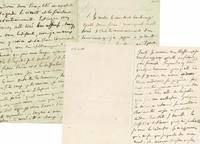
Eugene DELACROIX
"trompe-moi si tu veux je te croirai je veux tant te croire et j'en ai si besoin"" Unpublished autograph love letter to ""Julie"" Louise de Pron
1823. Fine. s. d. ca 1823 12 x 18.20 cm Six pages sur deux feuillets rempliés Almost entirely unpublished handwritten letter from the painter Eugène Delacroix to the love of his youth the mysterious Julie now identified as being Madame de Pron by her maiden name Louise du Bois des Cours de La Maisonfort wife of Louis-Jules Baron Rossignol de Pron and daughter of the Marquis de La Maisonfort Minister of France in Tuscany patron of Lamartine and friend of Chateaubriand. 90 lines 6 pages on two folded leaves. A few deletions and two bibliographical annotations in pencil on the upper part of the first page no114. This letter is one of the last to his lover in private ownership all of Delacroix's correspondence to Madame de Pron being kept at the Getty Research Institute Los Angeles. Only nine of the ninety lines of this unpublished letter were transcribed in the Burlington Magazine in September 2009 alongside the long article by Michèle Hanoosh Bertrand and Lorraine Servois whose research finally revealed the identity of the famous recipient. Sublime love letter from twenty-four-year-old Eugène Delacroix addressed to his lover Madame de Pron twelve years his senior who unleashed the liveliest passion in him. This episode of the painter's youth then considered the rising star of Romanticism for a long time remained a mystery in the biography of Delacroix who was careful to preserve the anonymity of his lover thanks to various pseudonyms: Cara the Lady of the Italians and even Julie as in this letter in reference to the famous epistolary novel Julie ou la Nouvelle Héloïse by Rousseau. For obvious reasons Delacroix did not sign his name on any of the letters in correspondence with the lady. A great figure of the legitimate aristocracy the recipient of this feverish letter is Madame de Pron daughter of the Marquis de La Maisonfort Minister of France in Tuscany patron of Lamartine friend of Chateaubriand. Her beauty was immortalized in 1818 by Élisabeth Vigée-Lebrun who painted her portrait in pastel with an oriental hairstyle. Delacroix and Madame de Pron met in April 1822 when the portrait of the latter's son Adrien was commissioned a pupil at the Lycée Impérial now Lycée Louis-le-Grand. Delacroix had been commissioned for the portrait by his close friend Charles Soulier Madame de Pron's lover who despite himself served as an intermediary for Delacroix. In the absence of Soulier who had gone to Italy the painter and the young women established an intense romantic relationship. The portrait commission became a pretext for their tender meetings in his studio on rue de Grès while no trace of the child's painting has been found to this day. Their adventure lasted a little over a year but it was one of the most intense passions of the artist's life. Our letter undoubtedly corresponds to the last throes of their relationship in the month of November 1823. After one of their visits at the end of a hiatus of several months Delacroix writes to her again under the influence of emotion: I come home with a shaken heart what a wonderful evening! . Sometimes I say to myself: why did I see her again In the calm sanctuary where I lived even in the middle of the invisible places that I had formed . I managed to silence my heart. Madame de Pron had indeed decided to bring an end to their intimate relationship see her letter from 10 November 1823: I want sweet friendship . I do not want to torment you Getty Research Institute. Losing all discernment and with blind devotion Delacroix attempts to revive their affair: Make me lie prove to me that your soul is indeed that of the Julie that I once knew since mine has regained its charming emotions and its worries. But the painter runs into Soulier and General de Coëtlosquet also lovers of Madame de Pron. Delacroix had narrowly avoided a final disagreement with Soulier who had almost seen a letter from Madame de Pron in h unknown
Referenz des Buchhändlers : 75940
|
|
|
RAVACHOL
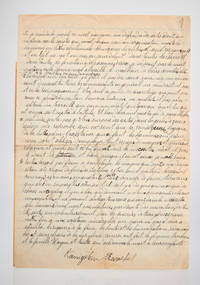
Testament politique autographe signé de Ravachol en grande partie inédit
1892. Fine. 1892 20 x 29.50 cm 4 pages sur un double feuillet Exceptional complete autograph manuscript of Ravachols true last testament largely unpublished unknown in this form preceding its rewriting by a third party for publication in the press. A unique testimony to the genuine thought of the anarchist icon. Four-page lined quarto manuscript entirely written in black ink and signed twice Konigstein Ravachol at the foot of each sheet. Pencil corrections within the text possibly in the hand of his lawyer. Some horizontal folds and very minor marginal tears without loss. Written in his prison cell during the second Montbrison trial that led to his death sentence this text hastily penned without punctuation or capital letters and in naïve spelling was meant to be delivered orally by Ravachol during the hearing. Ravachol was dead set on putting in his two cents for the defence not to defend himself but to explain. No luck dammit! Four words in and the judge cut him off. His statement isnt lost by Jove! Émile Pouget in Père Peinard July 310 1892. This self-styled Rocambole of anarchism was not allowed to read his statement aloud but he handed it to his lawyer Maître Lagasse and by June 23 the forbidden text appeared in the conservative newspaper Le Temps. This first publication was so faithful to the original that it preserved the author's eccentric spelling a fidelity that Émile Pouget would ironically criticise in the Père Peinard issue of July 3 1892 one week before Ravachols execution: Le Temps that opportunist bedsheet printed it as is. Like a true Jesuit it even printed it too true. Ravachol had written the thing for himself; he knew how to read it but there wasnt a word of correct spelling seeing as he knew about spelling as much as he knew about cabbage farming. Le Temps printed the thing without changing a line so its practically unreadable . Thats exactly what the bastards wanted dammit! . Im reprinting it below without changing a word just fixing the spelling. That same July 3 issue of Père Peinard included a corrected version orthographically of the statement initially published in Le Temps. This dual publication combined with Ravachols defiant bearing before the guillotine had a powerful effect on public opinion. Until then even anarchist publications had kept a certain distance from this provocative criminal suspected of using the anarchist cause for personal gain. But following his execution the testament was quickly reproduced in other newspapers and Ravachols final cry of revolt soon became a genuine anarchist anthem among libertarians worldwide. However the version circulated in the press the only known version until now the original manuscript having disappeared differs markedly from the manuscript in our possession. Indeed the style was lightly polished several turns of phrase refined and most significantly entire passages were excised including the conclusion paragraph which was fully replaced. Our manuscript with its crossings-out and revisions is likely the original version of this political testament. Written in a single burst in dense handwriting without punctuation or paragraph breaks it includes two lengthy sections expressing concerns for public health that are entirely absent from the published version. The first is a third of a page-long passage about the dangerous ingredients added to bread: no longer needing money to live thered be no fear of bakers adding dangerous ingredients to bread to make it look better or heavier since it wouldnt profit them and theyd have like everyone else and by the same means access to what they needed for their work and existence. Thered be no need to check whether the bread weighs right if the money is counterfeit or if the bill is correct. The second nearly a full page long concerns the silk-dyeing industry in which Ravachol had worked: If one reflects atten unknown
Referenz des Buchhändlers : 73438
|
|
|
Constantin BRANCUSI
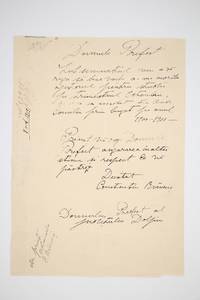
Deux lettres autographes signées adressées au Préfet du département de Dolj Two handwritten signed letters addressed to the Dolj County Prefect
Craïova Roumanie Craiova 1900. Fine. Craïova Roumanie Craiova 9 octobre 1900 14.70 x 22 cm deux feuillets rédigées au recto Two handwritten signed letters addressed to the Dolj County Prefect Craïova Romania 9 October 1900 14.7 x 22 cm & 27 x 19.5 cm two leaves written on the recto Two handwritten letters signed by Constantin Brâncui addressed to the Dolj County Prefect and written in brown and black ink one on a piece of lined paper 14.7 x 22cm and the other on larger size white paper 27 x 195 cm. The first letter is written in ink on a leaf and bears the registration number 12981 followed by the acronym pPG and is signed with the artist's full name: Constantin Brâncu. At the bottom left of the page there is a handwritten note by Brâncui: ""I received the prescription"" followed by his signature ""C. Brâncu"" and not ""Brâncusi"" or ""Brâncusi"" as he signed after his arrival in Paris. The second letter is written in ink on half a sheet of notebook paper and contains the same message the same signature and a similar inventory number. A 10 bani centimes stamp is glued to the top left. The left side below the stamp is cut out as Brâncui used to do: he removed the stamps or erased information that he did not want to keep. These two important letters document a significant chapter of the artist's biography concerning his studies financed in part by the Craiova Department.On 28 September 1898 Brâncui successfully completed his five-year schooling at the Craiova Trade School the capital of his native region and enrolled at the Bucharest School of Fine Arts. He obtained scholarships from the Madonna Dudu church in Craiova which helped him to continue his studies. He was quickly noticed by his teachers in Bucharest who awarded him prizes for making busts such as Laocoon and the antique sculpture Study based on Mars Borghese. In October 1900 Brâncui sent a request for a scholarship to the Prefect of the Dolj County the capital of which is Craiova who helped him to follow ""his studies during the October term"" and specified that this scholarship was granted to him by the County Council 1900-1901 budget. unknown
Referenz des Buchhändlers : 76380
|
|
|
George SAND
"On n'est jamais plus heureux et inspiré que quand on croit n'avoir pas le temps de l'être."" Signed autograph letter addressed to René Biémont
Nohant Nohant-Vic 1863. Fine. Nohant Nohant-Vic 14 mars 1863 13.40 x 20.60 cm 3 pages sur un double feuillet Autograph letter signed by George Sand addressed to René Biémont. Three pages written in blue ink on a double sheet bearing at the head of the first page the blind stamp of Sand's initials. Envelope included. Folds inherent to mailing. This letter was published in the complete correspondence of George Sand established by Georges Lubin. Fine letter of congratulations addressed to René Biémont after sending his work Le Petit Fils d'Obermann: ""Your little book is very original and you show qualities of talent that will develop if you look ahead."" As an attentive reader much solicited by her young peers Sand develops her literary criticism: ""Obermann and his grandson the monk belong to the past. They are true and the timid Jean is well drawn. There is grandeur and truth in this exceptional type. But Constant d'Heurs is too passive to events. He should react against this powerless man and cure him or pity him more ."" Sententiously she thus concludes her letter: ""Do not complain of thankless work and accept it as a good thing three-quarters of life sacrificed to some duty makes the last quarter very strong and very alive. It is very good to be attached to poetry and thwarted in the possession of a beautiful dream. As soon as one can savor it without respite it fades or becomes troubled. I speak to you from experience. One is never happier and more inspired than when one believes one does not have time to be so."" Very fine testimony to the leading role that George Sand played on the literary scene of the Second Empire. unknown
Referenz des Buchhändlers : 76837
|
|
|
Gustave FLAUBERT
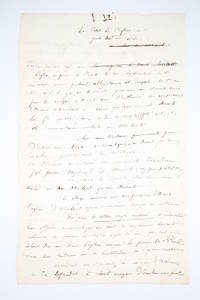
Manuscrit intitulé ""De l'état de l'église en Gaule au Ve et VIe siècle""
s. l. 1860. Fine. s. l. s. d. ca 1860 19.60 x 31.70 cm deux pages sur un feuillet Autograph manuscript by Gustave Flaubert entitled ""De l'état de l'église en Gaule au Ve et VIe siècle"" written in black ink on both sides of a sheet. Transverse fold. Extensive manuscript notes probably written in preparation for the writing of La Légende de Saint Julien l'Hospitalier. Precious manuscript evidence of the writer's working method. unknown
Referenz des Buchhändlers : 76834
|
|
|
George SAND - (to Gustave FLAUBERT)
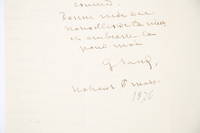
"Je t'écris en courant ce matin ."" Signed autograph letter addressed to Gustave Flaubert
Nohant Nohant-Vic 1876. Fine. Nohant Nohant-Vic 6 mars 1876 13.20 x 20.70 cm deux pages sur un feuillet remplié Autograph letter signed by George Sand addressed to Gustave Flaubert. Two pages written in black ink on a double sheet bearing at the head of the first page the sender's dry stamp. This letter was published in the complete correspondence of George Sand established by Georges Lubin. Fine letter written by George Sand a few months before her death and addressed to her lifelong friend Gustave Flaubert. The writer wishes to offer her friend a seat so he may attend the revival of her play Le Mariage de Victorine : ""Je t'écris en courant ce matin parce que je viens de recevoir de Mr Perrin avis de la 1ère représentation de la reprise du Mariage de Victorine une pièce de moi au théâtre français. Je n'ai ni le temps d'y aller ni l'envie de partir comme cela au pied levé mais j'aurais voulu y envoyer quelques amis et il ne m'offre pas une seule place. Je lui écris une lettre qu'il recevra demain et je le prie de t'envoyer au moins un orchestre."" ""I'm writing to you hurriedly this morning because I've just received notice from Mr Perrin of the first performance of the revival of Le Mariage de Victorine a play of mine at the Théâtre Français. I have neither the time to go nor the desire to leave like that at a moment's notice but I would have liked to send some friends and he doesn't offer me a single seat. I'm writing him a letter which he will receive tomorrow and I ask him to send you at least an orchestra seat."" Letters from the correspondence between George Sand and Gustave Flaubert are renowned and highly sought after. unknown
Referenz des Buchhändlers : 76872
|
|
|
George SAND
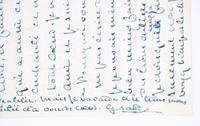
"Je suis bien d'âge à être votre mère car j'ai 55 ans et j'ai de bonnes mains bien adroites mais pas belles du tout."" Signed autograph letter addressed to Ernest Feydeau
Nohant Nohant-Vic 1859. Fine. Nohant Nohant-Vic 16 août 1859 13.50 x 20.90 cm 4 pages sur un double feuillet Autograph letter signed by George Sand addressed to Ernest Feydeau. Four pages written in blue ink on a double sheet bearing at the head of the first page the sender's blind stamp. This letter was published in the complete correspondence of George Sand established by Georges Lubin. Fine and lengthy letter discussing literature and friendship between writers. Initially a stockbroker and specialist in Antiquity Ernest Feydeau launched himself late into fiction. Anxious to occupy a literary space in which he did not feel justly appreciated he used his connections and maintained a regular epistolary relationship with illustrious correspondents such as Gustave Flaubert Sainte-Beuve and George Sand to whom he sent drafts of his novels and whose opinions he sought. This letter forms Sand's response after having just finished reading Daniel Feydeau's second novel. George Sand then at the height of her literary career describes herself thus: ""I am quite old enough to be your mother for I am 55 years old and I have good hands quite skillful but not beautiful at all. I have earned the right to no longer be coquettish I have been quite reproached for never having been so. I will tell you anything about myself that you wish."" As was her habit much solicited by her peers she delivers a very detailed critique of the text her colleague submits to her: ""I am not against sentences that jar where they need to jar but I am not for harmony being sacrificed to rhythm. Nor am I for the contrary. Understand me well I only blame what is too noticeable what reveals the technique. Do not touch the passages you speak of they are excellent. And in sum I will not insist furiously on the question of form in style seeing that if the qualities of yours should disappear with what sometimes seems to me a flaw I would be in despair at having pointed out the flaw."" Herself very close to Flaubert whom she nicknamed her ""leaden bottom"" Sand seems delighted that the two men know each other: ""I do not have time. But I will have time to receive you when you are free you must come with Flaubert who also has in me an enchanted reader and a wholehearted literary friend. I did not know he was your friend and I am pleased that he is."" The friendship goes so far that Sand soon brings the two writers together placing them on complete equal footing: ""It is no misfortune for you any more than for Flaubert to belong to the race of seers."" A form of solidarity then establishes itself in the face of critical adversity: ""All this is felt better than it can be said and that is why criticism loses its reason three-quarters of the time."" For criticism has had the misfortune of labeling Feydeau as it did with Flaubert a realist: ""People have taken it upon themselves to baptize your manner and his as realism. I do not know why; unless realism is something entirely different from what the first adherents attempted to explain to us. I suspect indeed that there is a way of envisaging the reality of things and beings which is great progress and you bring triumphant proof of it. But the name realism does not suit because art is a multiple infinite interpretation. It is the artist who creates reality within himself his own reality and not that of another. Two painters paint the portrait of the same person. Both create a work that represents the person if they are both masters. And yet the two paintings do not resemble each other. What has become of reality"" This long diatribe - a true manifesto - forms a powerful testimony to the repulsion of George Sand and Flaubert for theorists obsessed with the idea of classifying literature according to a ""system that . blinds"". unknown
Referenz des Buchhändlers : 76839
|
|
|
Charles BAUDELAIRE
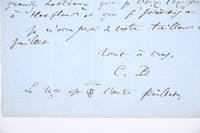
Lettre autographe signée adressée à Narcisse Ancelle. ""Je suis très attendu à Paris et à Honfleur"" Autograph letter signed to Narcisse Ancelle. ""I am eagerly awaited in Paris and in Honfleur""
1865. Fine. 30 mai 1865 13.70 x 21.10 cm une page sur un feuillet Autograph letter signed by Charles Baudelaire to Narcisse Ancelle written in black ink on a sheet of blue paper. Folds from mailing three minute pinholes not affecting the text. This letter was transcribed in the Complete Works volume 11 published in 1949 by L. Conard. A moving letter from Brussels addressed to the celebrated family notary who became in 1844 Charles's legal guardian charged with managing his annuity and his exponential debts. A complex relationship developed between the poet and his guardian mingling necessity and mistrust yet nonetheless bearing witness to genuine mutual respect between the two men. This correspondence devoid of the emotional quality of his letters to his mother or the circumlocutions in his exchanges with creditors constitutes one of the most precious biographical sources on the poet. Indeed Baudelaire's financial dependence constrained him to great transparency with his guardian and each of his letters to Ancelle admirably summarizes his wanderings. Thus this letter evokes the terrible mire in which the poet found himself in Belgium and his constantly postponed return to Paris. When he writes Baudelaire is still in Brussels at the Hôtel du Grand Miroir ""28 rue de la Montagne"" but one must not write the hotel's name otherwise letters do not reach him directly where he is dying of boredom illness and resentment toward a country in which he innocently believed he would find glory. This announcement of imminent departure for Paris ""Two or three days after your reply I will leave"" echoes all the similar promises the poet has made for nearly a year to his correspondents. This one will be aborted like all the others for as he confesses to Ancelle a few months earlier Paris fills him with ""a dog's fear."" It is only in August 1865 that he will make a final and brief stay in France before his fatal stroke. His return ""I am eagerly awaited in Paris and in Honfleur"" was nevertheless motivated by a compelling reason: to negotiate with a publisher through Manet's intervention the publication of his collection of reflections on his contemporaries which he had already titled My Heart Laid Bare Mon cur mis à nu and whose manuscript is partly at his mother's house in Honfleur. Another failurethe work would not appear until 1897 thirty years after Baudelaire's death. But it is undoubtedly the reference to the ""two large paintings he wishes to send to Honfleur"" that gives this letter all its significance. Baudelaire evokes his wish to repatriate paintings from his collection that he left with various lenders or restorers of which he had already sent a list to Ancelle a few months earlier. Among these which ones did he want to bring back to his mother His father's portrait the Boilly the Manet a Constantin Guys There is no mention in other letters of this art shipment and of the ""remainder"" to which the paintings were to be joined. This desire to ""send to Honfleur"" his precious belongings nonetheless testifies to the weakened poet's wish to settle permanently in his mother's ""jewel-house"" in Honfleur an island of serenity where Baudelaire dreamed of a peaceful retreat where all would once again be ""order and beauty luxury calm and voluptuousness."" He would indeed return there paralyzed and mute but for a final year of agony after his syphilitic crisis. The Hôtel du Grand Miroir would remain his last true dwelling as noted on Tuesday April 3 1866 in the register of admissions at the Saint-Jean Clinic: ""Name and first names: Baudelaire Charles. Address: France and 28 rue de la Montagne. Profession: man of letters. Illness: apoplexy."" A fine letter to the man who was both Baudelaire's persecutor and protector. He accompanied the poet until his death before becoming executor of the family estate. unknown
Referenz des Buchhändlers : 76795
|
|
|
Simone de BEAUVOIR
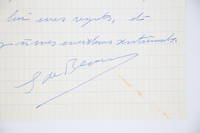
Lettre autographe signée adressée à Antoinette Boulesteix
1980. Fine. 2 Juillet 1980 14.50 x 20.50 cm 1 page 1 enveloppe Autograph letter signed by Simone de Beauvoir consisting of 9 lines addressed to Antoinette Boulesteix with envelope enclosed. A central fold inherent to the mailing and an envelope mark at the foot of the letter the envelope and letter having been glued together then separated. ""Chère mademoiselle je suis très touchée de cette lettre mais je n'ai pas le temps de rencontrer votre mère. Je quitte Paris pour aller me reposer à la campagne. Dites lui mes regrets et croyez à mes meilleurs sentiments. Simone de Beauvoir."" ""Dear Mademoiselle I am very touched by this letter but I do not have time to meet your mother. I am leaving Paris to go rest in the countryside. Give her my regrets and believe in my best sentiments. Simone de Beauvoir."" unknown
Referenz des Buchhändlers : 77066
|
|
|
George SAND
"Je suis toujours enfermée pour écrire ou sortir pour me promener."" Signed autograph letter addressed to Léon Curmer
Paris 1840. Fine. Paris jeudi 7 mai 1840 13.60 x 20.90 cm une page sur un double feuillet Autograph letter signed by George Sand addressed to publisher Léon Curmer. One page written in black ink on a double sheet. This letter was published in the complete correspondence compiled by Georges Lubin. ""Monsieur J'ai parcouru votre recueil avec beaucoup d'intérêt et j'accepte la collaboration que vous m'avez offerte mais je ne pourrais m'occuper de vous satisfaire que dans six semaines ou deux mois. Si cette époque vous convient veuillez bien me le faire savoir ainsi que les conditions de la rédaction."" ""Sir I have perused your collection with great interest and I accept the collaboration you have offered me but I could not undertake to satisfy you for six weeks or two months. If this timing suits you please let me know as well as the conditions of the writing."" The ""recueil"" ""collection"" in question here is none other than Les Français peints par eux-mêmes. Sand would not however collaborate on this monumental compendium of types preferring instead several years later Le Diable à Paris published under the direction of her close friend publisher Hetzel. unknown
Referenz des Buchhändlers : 77244
|
|
|
Reynaldo HAHN - (to Dominique ANDRE)
"J'ai trop tardé chère Madame à vous remercier de votre livre et du plaisir qu'il m'a procuré. Plaisir amer et trouble - mais rare."" Signed autograph note addressed to Dominique André
Paris 1931. Fine. Paris 6 avril 1931 14.60 x 19.30 cm une page sur une carte lettre Signed autograph note by Reynaldo Hahn addressed to Madame Serge André and written on a white paper letter-card in blue ink. Central fold inherent to the mailing. Dominique André is a poetess novelist and playwright. She notably published under the pseudonym Claude Isambert. ""J'ai trop tardé chère Madame à vous remercier de votre livre et du plaisir qu'il m'a procuré. Plaisir amer et trouble - mais rare. Ce qui est particulièrement remarquable en ces pages c'est leur extrême distinction."" ""I have delayed too long dear Madame in thanking you for your book and the pleasure it has given me. Bitter and troubled pleasure - but rare. What is particularly remarkable in these pages is their extreme distinction."" unknown
Referenz des Buchhändlers : 77544
|
|
|
Gustave DORE
Lettre autographe signée adressée à Paul Dalloz
1874. Fine. 1874 13.20 x 20.70 cm 4 pages sur un double feuillet Autograph letter signed by Gustave Doré addressed to Paul Dalloz. Four pages written in black ink on a double sheet of white paper with envelope. Fine letter full of torment in which Gustave Doré dreads being supported again for the rank of officer in the Legion of Honor he who was made chevalier in 1861 after the publication of Dante's Inferno and thanks to Paul Dalloz's intervention. Doré thanks him moreover for this past influence: ""Je viens te remercier encore et du plus profond de mon cur de l'amitié toute dévouée que vous m'avez témoignée dans ces dernières circonstances ; et je t'assure que je te conserve pour ce fait des sentiments aussi reconnaissants que pour le service que tu m'as si spontanément et cordialement rendu il y douze ans."" ""I come to thank you again and from the depths of my heart for the devoted friendship you have shown me in these recent circumstances; and I assure you that I preserve for this fact feelings as grateful as for the service you rendered me so spontaneously and cordially twelve years ago."" He nevertheless asks him not to propose him for the rank of officer: ""Mais je viens réclamer de toi les mêmes amitiés te priant te suppliant même de t'arrêter complétement et absolument ce qui je n'en doute pas te coûtera plus encore qu'autre chose. J'ai beaucoup pensé à tout ce que tu m'as dit hier et je trouve que je me suis trompé tout à fait en te laissant t'engager si obligeamment dans ces démarches."" ""But I come to claim from you the same friendships asking you even begging you to stop completely and absolutely which I do not doubt will cost you more than anything else. I have thought much about everything you told me yesterday and I find that I was quite wrong to let you engage so obligingly in these steps."" Gustave Doré was nevertheless appointed officer of the Legion of Honor on January 15 1879.through Paul Dalloz's intervention. unknown
Referenz des Buchhändlers : 77339
|
|
|
Reynaldo HAHN - (to Dominique ANDRE)
"Est-ce possible chère Madame ! Vous m'invitez à goûter !"" Signed autograph note addressed to Dominique André
Paris 1925. Fine. Paris 14 décembre 1925 10.60 x 15.70 cm une page sur une carte lettre Signed autograph note by Reynaldo Hahn addressed to Madame Serge André and written on a white paper letter-card in blue ink. Central fold inherent to the mailing. Dominique André is a poetess novelist and playwright. She notably published under the pseudonym Claude Isambert. Reynaldo Hahn declines an invitation from his friend: ""Est-ce possible chère Madame ! Vous m'invitez à goûter ! Hélas je ne pense pas aller nulle part dans la journée ! Un soir à l'Escargot d'Or on avait projeté de se voir : Lacretelle devait me faire signe - que sais-je "" ""Is it possible dear Madame! You invite me for afternoon tea! Alas I don't think I'm going anywhere during the day! One evening at the Escargot d'Or we had planned to see each other: Lacretelle was supposed to let me know - what do I know"" unknown
Referenz des Buchhändlers : 77543
|
|
|
Antoine-Jean GROS
".quand il aura passé quelque temps à copier."" Autograph letter signed to Jean-Pierre Granger
1826. Fine. 1826 18.50 x 24 cm une feuille rempliée Autograph letter signed addressed to the painter Jean-Pierre Granger and dated April 24 1826 one page written in black ink with the correspondent's address on the verso. 15 lines in a beautiful slanted handwriting on a folded sheet. The celebrated Empire painter recommends to his colleague: ""a young man who seems very interesting to me and too young to enter my studio. Dear Grand Diable please do me the favor of taking good care of him in yours and when he has spent some time copying if it does not inconvenience you I will take him back with pleasure and well on his way."" Jean-Pierre Granger was first a pupil of Jean-Baptiste Regnault before joining Antoine-Jean Gros in Jacques-Louis David's studio. In 1800 he became laureate of the first Rome Prize for history painting with Antiochus renvoie son fils à Scipion Paris École nationale supérieure des beaux-arts while his fellow student Jean-Dominique Ingres received the second prize. unknown
Referenz des Buchhändlers : 77471
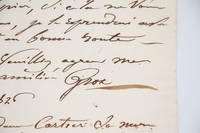
|
|
|
Georges CLEMENCEAU
Lettre autographe signée adressée à un ami
Mont-Dore-Les-Bains Le Mont-Dore 1909. Fine. Mont-Dore-Les-Bains Le Mont-Dore 29 août 1909 13.60 x 21 cm 1 page sur un double feuillet Autograph letter signed by Georges Clémenceau addressed to a friend. One and a quarter pages written in black ink on a double sheet with letterhead from the International Palace of Mont-Dore-Les-Bains dated August 25 1909. Folds inherent to mailing. Clemenceau then taking thermal baths at Mont-Dore-les-Bains writes: ""Quand votre aimable invitation m'est arrivée à Carlsbad j'avais un engagement déjà pris."" ""When your kind invitation reached me in Carlsbad I already had a prior engagement."" Charming and very aesthetic missive. unknown
Referenz des Buchhändlers : 77465
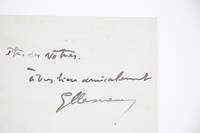
|
|
|
Antoine Augustin PARMENTIER
Lettre autographe signée adressée au citoyen Chely pharmacien
Paris 1795. Fine. Paris 3ème frimaire an 4ème de la République 24 novembre 1795 17.20 x 22.70 cm une page sur un double feuillet Autograph letter signed by Antoine Augustin Parmentier addressed to citizen Chely chief pharmacist of the military hospital of Calais. Transverse folds inherent to the mailing and small paper loss due to the unsealing of the missive. ""Je suis fâché mon cher camarade que le Cen Citoyen Lavoisier m'ait envoyé un pâté sans doute dans l'intention de m'intéresser en faveur de son fils ; mais je dois vous assurer que les présents me tiédissent plutôt encore sur le compte de ceux qui m'en font au reste j'enverrais au jeune homme des livres pour la valeur du pâté ."" ""I am sorry my dear comrade that Citizen Lavoisier sent me a pâté undoubtedly with the intention of interesting me in favor of his son; but I must assure you that gifts rather cool me towards those who give them to me moreover I would send the young man books for the value of the pâté ."" An amusing letter evoking a namesake of the great physicist executed the previous year without having left any descendants. unknown
Referenz des Buchhändlers : 77420
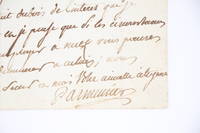
|
|
|
Pierre LOUS
"Oh ! En 1930 ce sera bien différent sans doute ; mais j'aurai 60 ans dans quinze ans ; et je m'inquiète d'abord de 1917 ; même de 1916."" Signed autograph letter addressed to Georges Louis
Paris 1916. Fine. Paris Lundi 11 septembre 1916 13 x 20.50 cm 3 pages sur 2 feuillets Autograph letter signed with initial by Pierre Louÿs addressed to Georges Louis. Two pages written in purple ink on two sheets. Central folds inherent to posting. Fine letter addressed to his brother Georges Louis with whom Pierre Louÿs maintained a very intimate relationship and whom he considered as his own father. The question of Pierre Louÿs' real paternal identity still fascinates biographers today: ""His father Pierre Philippe Louis . had married in 1842 Jeanne Constance Blanchin who died ten years later after giving him two children Lucie and Georges. In 1855 he remarried Claire Céline Maldan and from this union was born in 1857 a son Paul; then in 1870 our writer who received the Christian names Pierre Félix. This late birth the differences in character between father and son the former's disaffection towards the latter the profound intimacy that always reigned between Louÿs and his brother Georges all this has led certain biographers and critics to suspect that the latter was in reality the writer's father. The exceptionally intimate and constant relationship that Pierre and Georges maintained between themselves throughout their lives could be an argument in this direction. Of course no irrefutable proof has been discovered and probably never will be. Nevertheless certain letters . are quite troubling. In 1895 for example Louÿs writes gravely to his brother that he knows the answer to 'the most poignant question' he could ask him a question he has had 'on his lips for ten years'. The following year at the height of Aphrodite's triumph he thanks Georges effusively and ends his letter with this sentence: 'Not one of my friends has a FATHER who is to him what you are to me.' Arguing from the close intimacy between Georges and Claire Céline during the year 1870 and from the jealousy that the father never ceased to show towards his younger son Claude Farrère did not hesitate to conclude in favor of Georges Louis. And what should we think of this dedication by Louÿs to his brother on a Japan paper copy of the first edition of Pausole: To Georges his eldest son / Pierre."" Jean-Paul Goujon Pierre Louÿs In this interesting letter Louÿs discusses at length the difficulty writers face in living by their pen. Titling his missive ""Continuation of our conversation about war and literature"" he first makes a very pessimistic observation: ""In the 16th century It was even worse! In the 16th the independent man of letters did not exist at all - to write one needed an office a benefice - or land and income rare fortune among writers. . It is only in the 19th century that we find a very small number of conscientious writers living by their pen. And even then. Do you want to count them Hugo almost alone succeeds. Lamartine fails and is obliged to beg pitifully at the end of his life. Gautier who had magnificent gifts only subsists by writing in newspapers . you see what I mean: Theatre and Journal."" He continues: ""That works well in peacetime. - In 1890 l'Echo de Paris inserted prose poems in the first column. - In ""date illegible because crossed out ""le Figaro had a literary supplement. . But in wartime in this century and ten twelve or fifteen years after the war we shall go to the woods no more; the laurels are cut down. Oh! In 1930 it will doubtless be very different; but I shall be 60 in fifteen years; and I worry first about 1917; even about 1916."" This very pessimistic letter was written at a period when Louÿs was at his worst ""The man who wrote these pages was a solitary man reclusive sick drugged surrounded by dubious creatures and having as confidant only this adored brother who would die less than a year later."" Ibid. unknown
Referenz des Buchhändlers : 77523
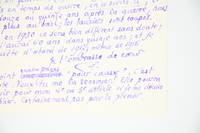
|
|
|
Pierre LOUS - (Stephane MALLARME)
"Mallarmé m'a écrit des choses pompeuses sur Lêda."" Signed autograph letter
Paris 1893. Fine. Paris 1893 13.50 x 14.50 cm quatre pages sur un feuillet remplié Autograph letter signed by Pierre Louÿs dated Christmas 1893 addressed to Georges Louis. Four pages written in blue ink on a double blue sheet bearing the writers initials and headed 49 rue Vineuse. A fine letter addressed to his brother Georges Louis with whom Pierre Louÿs maintained a deeply intimate relationship and whom he regarded as his own father. The question of Pierre Louÿss true parentage continues to fascinate biographers: His father Pierre Philippe Louis . married Jeanne Constance Blanchin in 1842; she died ten years later having borne him two children Lucie and Georges. In 1855 he married Claire Céline Maldan and from this union was born in 1857 a son Paul; then in 1870 our writer who received the given names Pierre Félix. This late birth the differences in temperament between father and son the fathers indifference toward the latter and the profound intimacy that always united Louÿs and his brother Georgesall of this has led some biographers and critics to suspect that Georges was in fact the writers father. The exceptionally close and lifelong bond between Pierre and Georges might well support such an argument. Of course no conclusive proof has ever been found and doubtless never will be. Still certain letters . are quite troubling. In 1895 for example Louÿs gravely wrote to his brother that he knew the answer to the most painful question he could ever put to him a question that had been on his lips for ten years. The following year at the height of Aphrodites success he thanked Georges effusively and closed his letter with these words: Pas un de mes amis n'a un PERE qui soit pour lui comme tu es pour moi. Arguing from the close relationship between Georges and Claire Céline in 1870 and from the jealousy the father continually displayed toward his younger son Claude Farrère did not hesitate to side with Georges Louis. And what are we to make of this dedication by Louÿs to his brother in a copy on japon of the original Pausole: Pour Georges son fils aîné / Pierre. Jean-Paul Goujon Pierre Louÿs Pierre Louÿs sent this letter to his brother when the latter had just taken up his post as Frances delegate to the International Commission of the Egyptian Debt and was in Cairo: La lettre où tu me demandais d'acheter un cadeau de jour de l'an m'est arrivée trop tard vingt quatre heures pour que je puisse l'envoyer à temps. J'espère que tu auras pu trouver quelque chose là-bas. Lacking a gift Pierre sent his brother a portrait of himself: En même temps que ma dernière lettre j'ai mis à la poste pour toi une photo du photographe ordinaire de Jane Hading et qui représente un Pierre posthume et sentimental assez ressemblant tout de même. L'épreuve n'était pas très propre mais c'était la seule que j'eusse encore reçue. Only a handful of photographic portraits of the writer are known today and we have been unable to identify the photograph mentioned here. The year 1893 marked several literary successes for Pierre Louÿs who until then had published only Astarté at his own expense in 1891 and together with his friend from the École Alsacienne André Gide and Paul Valéry had founded La Conque an anthology of the youngest poets whose first issue appeared on 15 March 1891. In quick succession came Chrysis ou la cérémonie matinale the translation of the Poésies de Méléagre and finally Lêda ou la louange des bienheureux ténèbres. The latter work is even mentioned in this letter: Mallarmé m'a écrit des choses pompeuses sur Lêda; mais de sa part cela ne signifie rien. Louÿs had been acquainted with Mallarmé since the early 1890s and met many leading figures at his celebrated Tuesdays among them Henri de Régnier. Deeply admiring the verses of the Symbolist master whom he considered the supreme incarnation of the artist one who has sacrificed everything to his ideal Ibid. Louÿs se unknown
Referenz des Buchhändlers : 77475
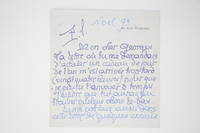
|
|

 Per e-mail erhalten
 Als pdf-Dokument herunterladen
 RSS feed
 Permanenter link


