|
[NOBLESSE].-
MEMORIAL 1939-1962. L'engagement des membres de la noblesse et de leurs alliés pendant le deuxième conflit mondial, les guerres d'Extrême Orient et d'Afrique du Nord.
2007 Paris, EHRET, 2007, grand in 8° relié pleine toile rouge de l'éditeur, 419 pages.
Référence libraire : 85487
|
|
|
[Notre Histoire]
NOTRE HISTOIRE
N° 88 (avril 1992) 74 pages, format 220 x 295 mm, illustré, broché couverture couleurs, bon état
Référence libraire : LFA-126739861
|
|
|
[Notre Histoire]
NOTRE HISTOIRE
N° 163 (Février 1999): 66 pages, format 220 x 295 mm, illustré, broché couverture couleurs, bon état
Référence libraire : LFA-126739955
|
|
|
[Notre Histoire]
NOTRE HISTOIRE
N° 202 (Septembre 2002): 66 pages, format 220 x 295 mm, illustré, broché couverture couleurs, bon état
Référence libraire : LFA-126739989
|
|
|
[NOVA et VETERA]
NOVA et VETERA
Revue Trimestrielle n° 4 (LXIVe Année) - Octobre-Décembre 1989 : 80 pages, format 155 x 225 mm, brochée, Editions Universitaires de Fribourg
Référence libraire : LFA-126710872
|
|
|
[NOEL] - LAGIER (Rosine) -
Noëls de guerre.
Strasbourg, La nuee bleue, s.d. ; petit in-4, 100 pp., cartonnage de l'éditeur. Avec jaquette, neuf sous blister.
Référence libraire : 202200390
|
|
|
[NOEL] - LAGIER (Rosine) -
Noëls de guerre.
Strasbourg, La nuee bleue, s.d. ; petit in-4, 100 pp., cartonnage de l'éditeur. Avec jaquette, neuf sous blister.
Référence libraire : 202200379
|
|
|
[NOEL] - LAGIER (Rosine) -
Noëls de guerre.
Strasbourg, La nuee bleue, s.d. ; petit in-4, 100 pp., cartonnage de l'éditeur. Avec jaquette, neuf sous blister.
Référence libraire : 202200378
|
|
|
[NORMANDIE] - MAUROIS (André).-
Rouen dévasté.
P., Nagel, 1948, in 12 broché, 154 pages ; couverture illustrée.
Référence libraire : 44647
|
|
|
[No Author Stated]
LE BOLCHEVISME N'EST PAS JUIF
Original Wraps. 8vo. 14 pages. 23 cm. First edition. In French. 'Bolshevism is not Jewish'. Nazi-era French pamphlet countering anti-Semitic propaganda about Jews and Bolshevism. Pamphlet gives a short history of Bolshevism and its non-Jewish precursors (German philosophy and social democracy, French utopian socialists, Russian populists and anarchists) , the general opposition of Jews to Bolshevism on moral and political grounds, Ludendorf's Lenin convoy, the immense reciprocal engagement of Russian Bolshevism and German social democracy and the failed German revolutions, Jews in the anti-communist party, Jewish religious opposition to communism, the red army's pogroms, the small number of Jews in the communist party, etc. Subjects: Communism and Judaism. Socialism and Judaism. Jews - Soviet Union. OCLC lists 9 copies. Wraps soiled, small tear to corner of title page, pages lightly aged, otherwise clean and fresh. Good + condition. (HOLO2-123-36)

|
|
|
[North Carolina Civil War Union Newspaper]
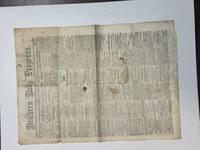
NEWBERN DAILY PROGRESS. NEWBERN N.C. SATURDAY EVENING DECEMBER 6 1862 VOLUME 5. NUMBER 59
New Bern NC: E.L. Davenport & Co. 1862. Folio. 14" x 20". 4pp printed in six columns per page. Old folds several fox blotches. Good plus. <br /> <br /> E.L. Davenport & Company issued the 'Newbern Daily Progress' and 'Newbern Weekly Progress' from 1853 until some time in 1862. As the area came under Union control it re-emerged as a newspaper run by a staff of Union soldiers and pro-Union in content. Hutchinson: NEW BERN Arcadia Publishing 2000 p.15. <br /> This issue was printed after the Union captured New Bern. George Mills Joy the Army's Recruiting Officer is listed as the new editor. Among the many advertisements is one signed in type by Joy himself: FREEMEN OF North Carolina Rally to the Support of the Stars & Stripes!" <br /> This issue prints war news and adjudications by the Provost Court mostly on charges of drunkenness and disorderly conduct. "Sam. Smith Colored" was reprimanded and discharged for being without a pass. Advertisements comprise the bulk of the printed material. E.L. Davenport & Co. unknown
Référence libraire : 41795
|
|
|
[NOUGARET Pierre Jean Baptiste].
Histoire de la guerre civile en France et des malheurs qu'elle a occasionnes depuis l'epoque de la formation des Etats-generaux en 1789 jusqu'au 18 brumaire de l'an 8. (1799) (...) par l'aut. de l'Histoire du regne de Louis XVI.
A Paris, chez Lerouge, 1803, volumi 3, in-8, legatura coeva in mezza pelle verde con titolo e numero di volume in oro su tasselli ai dorsi, tagli gialli, pp. [4], XVI, 362 - [2], 420 - [4], 516. Con antiporta allegorica incisa in rame al primo volume. Non è stato legato l'occhietto al secondo volume. Margine esterno rinforzato alle prime due carte del terzo volume. Mimimo segno di tarlo all'angolo inferiore interno (margine bianco) di diverse carte del secondo volume. Ex libris Conte Cesare S. Martino della Motta.

|
|
|
[NSDAP] - ROSENBERG (Alfred) -
Das partei programm.
Muchen, Zentralverlag der nsdap franz Eher Nacht, 1940 ; in-8, 60 pp., broché. Wesen grundsatzse und ziele der nsdap.
Référence libraire : 200804652
|
|
|
[NSDAP] - ROSENBERG (Alfred) -
Das partei programm.
Muchen, Zentralverlag der nsdap franz Eher Nacht, 1940 ; in-8, 60 pp., broché. Wesen grndsasse und ziele der nsdap.
Référence libraire : 200803009
|
|
|
[NSDAP, GUERRE 39/45] - ALBRECHT (Karl i) -
Der verratene sozialismus zehn jahre als hoher staasbeamter in der sowjetunion.
Berlin-leipzig, Nibelungen verlag , 1941 ; in-8, 652 pp., broché, couverture illustr. Bon état - mitt 110 abbildungen.
Référence libraire : 201102699
|
|
|
[NUCLÉAIRE] - GAILLOT (Jacques) -
Coup de gueule contre les essais nucléaires.
Paris, Ramsay, 1995 ; in-8, 166 pp., br. préface d'Oscar Temaru.
Référence libraire : 201300593
|
|
|
[NUCLEAR WAR -- COLD WAR].
Exercise Sage Brush 1955.
Baton Rouge LA: Army & Navy Publishing Inc. 1956. 8vo. 80 pp unpaginated. Photo-illustrated throughout many colour plates text & captions printed in blue & red black white photo illustrations colour borders. Colour-illustrated softcovers red plastic comb binding as issued minor soiling front cover minor shelfwear still VG- copy. First edition of this souvenir yearbook detailing the largest field trials held in the United States following World War II testing Army and Air Force personnel under conditions of simulated nuclear war even including the faked dropping of an atomic bomb. A number of experimental groups were introduced including a Sky Cavalry which combined the 82nd Airborne with a helicopter unit although there was controversy following the exercises with Armor wanting helicopters attached to mechanized cavalry units and Intelligence wanting aircraft with radar and infrared sensors. Unfortunately the massive maneuvers covering 45 days resulted in massive traffic jams with mechanized units trying to attack during torrential downpours and other logistics issues emerged which the US military attempted to correct when they later applied many of the results to new tactics during the Vietnam War. Worldcat locates 3 copies Filson Historical Society US Army War College Artillery School only copy dated correctly; Rickey Robertson Exercise Sage Brush 1955 Stephen F. Austin State University January 2013. Army & Navy Publishing, Inc., paperback
Référence libraire : 56600
|
|
|
[NUCLEAR WAR] KAHN, Herman
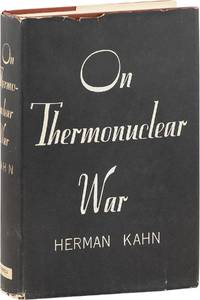
On Thermonuclear War
Princeton New Jersey: Princeton University Press 1960. First Edition. Octavo. 24cm. Publisher's terracotta cloth titled and ruled in black and gilt to spine. Dustjacket. xx; 651pp. Very light wear and bumping to spine ends and extremities strong and bright; internally clean and fresh; in a grey dustjacket with some minor edgewear and shallow chipping to the spine ends and edges a hint of toning to the spine panel and some light soiling and wear to the white rear panel. A very good handsome copy indeed.<br /> <br /> Kahn's deeply influential analysis of the spectre of thermonuclear war partly intended as a counterpoint to von Neumann's apocalyptic concept of MAD or Mutually Assured Destruction. Kahn posits the strategic possibility of a 'winnable' nuclear conflict questions the solidity of a peace structure based on thermonuclear threat and makes the highly controversial for the time suggestion that the spectre of thermonuclear conflict itself isn't actually that terrifying and that the spectre of it is really what most people get worked up about. Kahn is an analytical strategist his conclusions are based in a zone in which emotion only plays the smallest part and upon publication the book elicited some powerful reactions from readers uncomfortable with the potential at the time inevitable deaths of millions being presented in the form of graphs and calm inexorable strategic detachment. Hubert Humphrey's contemporary review of the work stated "New thoughts particularly those which contradict current assumptions are always painful for the human mind to contemplate. On Thermonuclear War is filled with such thoughts."<br /> <br /> Perhaps as inevitable antidote to the grimly sardonic nature of his analysis Kahn's work earned him a place in the eternal halls of pop culture being the impromptu scriptwriter for the character of General Buck Turgidson in "Dr. Strangelove" and with popular understanding of his theories featuring prominently in fiction from Tom Clancy to "Wargames." Kahn is also credited with the coining of the phrases "Megadeath" as a unit of fatality and "Wargasm" describing the focus of the military personnel he worked with both of which have seeped into common usage. Kahn's borderline crude delivery combining horrifying statistics with jokes about how women will come to love their two-headed babies was deliberately jarring and intended to be equally disruptive to those locked in fearful uninformed paralysis and those working towards the wargasm. The reception of his book was one of the catalyzing elements that led Kahn to be a co-founder of The Hudson Institute after his work at RAND reached its inevitable close. Regardless of how divisive Kahn was both in theory and delivery "On Thermonuclear War" ranks as one of the most important 20th century works of strategic analysis right down to the title being an updated and expanded nod to von Clausewitz's "On War. Princeton University Press unknown
Référence libraire : 85542
|
|
|
[O.A.S.] - TIXIER-VIGNANCOUR (Jean-Louis) - LE DELIOU (Yves).-
Fors l'Honneur. Introduction de Jean-Louis Tixier-Vignancour. Photos de Yves Le Déliou. Montage et légendes de Marie-Thérèse Dupuy.
1963 Paris, SERP, 1963, in 4°, cartonnage de l'éditeur, jaquette illustrée (petits défauts) ; non paginé.
Référence libraire : 23991
|
|
|
[O.A.S.] - PALMERI (Roger).-
Tribunal permanent des Forces Armées de Paris. Procès dit "des barricades". Audience du 28 février 1961. Plaidoirie pour Jean-Jacques Susini.
P., Imprimerie de l'Auxerois, sans date, in 8° agrafé ; 30 pages.
Référence libraire : 46794
|
|
|
[Occupation]
Un hiver sous les armes. Occupation des frontières suisses (2e volume).
Neuchâtel, Bassin-Clottu, 1915. In-4°, 88p. Broché, couverture illustrée.
Référence libraire : 20722
|
|
|
[Occupation]
L'occupation des frontières suisses 1914-1915 & Occupation des frontières suisses, un hiver sous les armes.
2 volumes In-4, 102-88p. Se compose essentiellement de photographies de l'époque avec légendes correspondantes. Préface du Colonel Audéoud pour le premier volume et du Colonel De Loys pour le second. Bel exemplaire.
|
|
|
[Occupation]
Un hiver sous les armes. Occupation des frontières suisses (2e volume).
In-4, 88p. Volume 2 seul. Se compose essentiellement de photographies de l'époque avec légendes correspondante. Préface du Colonel De Loys. En parfait état état.
|
|
|
[Oliver Cromwell] [English Civil War] Anon
The Perfect Politician: or A Full View of the Life and Actions Military and Civil of O. Cromwel…
London: Printed by J. Cottrell for William Roybould at the Unicorn and Henry Fletcher at the Three Gilt Cups in St. Paul's Church-Yard 1660. First edition. 8vo 7 459 I.e. 359pp. Engraved portrait frontis title page in two colors. Bound in half morocco spine lettered in gilt with gilt ruling marbled endpapers t.e.g. Lacks half title. Paper flaw to h4 affecting several words from the ends of about 4 lines on both upper and lower corners but not the sense. Otherwise text clean and complete binding tight and attractive. <br /> <br /> First edition of this important early biography of Cromwell offering a relatively sympathetic account of his military and civil career issued in the year of the Stuart Restoration. This work has been attributed to Henry Fletcher and William Raybould the publishers. There was a second edition in 1680 but the first remains quite scarce in the trade. <br /> <br /> ESTC R18473. Printed by J. Cottrell for William Roybould at the Unicorn, and Henry Fletcher at the Three Gilt Cups in St. Paul's Church-Yard unknown
Référence libraire : 9736
|
|
|
[On Behalf of the Kaizer Wilhelm II] ADMIRAL WILHELM ANTON SOUCHON, (German admiral in World War I), (1864-1946).
REWARD OF IRON CROSS MEDAL FOR WASSIF BEY FROM WILHELM II - SIGNED BY ADMIRAL SOUCHON Typescript letter signed 'Souchon' sent to 'Kapitan zur See Wassif Bey'.
Constantinople: Kommando der Flotte Konstantinopel den 12. August 1915. 1915. No Binding. Fine. 8vo - over 7¾ - 9¾" tall. Original typescript letter signed 'Souchon' addressed to Capitan lieutenant colonel Vasif Wassif Muhiddin Bey Kasimpasali. Wassif Bey was a ship commander of Hamidiye cruiser before Rauf Orbay. 27x21 cm. In German. 1 p. "Kommando der Flotte" letterhead with bilingual in German and Ottoman Turkish. 8 lines. Signed 'Souchon'. This letter includes an indication that it honors the Kaiser Wilhelm II with the Iron Cross medal for Commander of Haamidiye Wassif Bey. "Seine Majestät der Kaiser und König haben Euer Hochwohlgeboren in Anbetracht Ihrer tatkraftigen Arbeit im Interesse der Kriegsbereitschaft und Kriegsbereitschaft und Kriegsbedürfnisse der Marine das Eiserne Kreuz 2. Klasse zu verleihen geruht.". i.e. His Majesty the Emperor and King have deigned your High Wellbeing to give the Iron Cross 2nd Class to the Navy in view of your hard work in the interest of readiness for war needs. Wilhelm Anton Souchon was a German admiral in World War I. Souchon commanded the Kaiserliche Marine's Mediterranean squadron in the early days of the war. His initiative played a major part in the entry of the Ottoman Empire into World War I. Wilhelm Anton Souchon was born on 2 June 1864 in Germany to a family of Huguenot ancestry. In July 1914 hostilities erupted between the Austro-Hungarian Empire and the Kingdom of Serbia. Rear Admiral Souchon a native of Leipzig feared being trapped in the Adriatic Sea in the event of other nations joining in the conflict. Because of this Souchon took his two ships the battlecruiser Goeben and the light cruiser Breslau into the western Mediterranean. When World War I began on 4 August 1914 he bombarded the French-Algerian ports of Bône and Philippeville. He successfully eluded British attempts to corner him see Pursuit of Goeben and Breslau and on 10 August 1914 his small squadron arrived at the Dardanelles. After two days of negotiations he was allowed to take his ships to Istanbul where they were subsequently transferred officially into the Ottoman Navy. Souchon was appointed Commander-in-chief of the Ottoman Navy and served in this position until September 1917. This gesture by Germany had an enormously positive impact with the Turkish population. At the outbreak of the war Winston Churchill caused outrage when he "requisitioned" without compensation two almost completed Turkish battleships in British shipyards Sultan Osman I and Reshadieh that had been financed by public subscription. These ships were commissioned into the Royal Navy as Agincourt and Erin respectively. On 15 August 1914 in the aftermath of Souchon's daring dash to Constantinople Turkey cancelled their maritime agreement with Britain and the Royal Navy mission under Admiral Limpus and left by 15 September. The Dardanelles were fortified with German assistance and the Bosporus was secured by the presence of Goeben now Yavuz Sultan Selim. On 27 September 1914 the Straits were officially closed to all international shipping. On 29 October 1914 Souchon's fleet launched the Black Sea Raid a naval attack which brought the Ottoman Empire into World War I. His ships laid several sea minefields and shelled the Russian Black Sea ports of Sevastopol Odessa and others destroying the Russian minesweeper Prut in the process. British naval units quickly retaliated on Turkish merchant ships off Izmir Smyrna. On 2 November 1914 Russia declared war on the Ottoman Empire. On 5 November Britain followed suit and on 12 November 1914 the Ottoman government officially declared war on the Triple Entente. For the next three years Souchon attempted to reform the Ottoman Navy while conducting a number of raids on Russian shipping ports and coastal installations in the Black Sea. Promoted to vice admiral Souchon was awarded the Pour le Mérite Germany's highest military order on 29 October 1916. In September 1917 Souchon returned to Germany. There he received command of the Fourth Battleship Squadron of the High Seas F <br/> <br/> Kommando der Flotte, Konstantinopel, den 12. August 1915. unknown
Référence libraire : 053124
|
|
|
[On Behalf of the Kaizer Wilhelm II] ADMIRAL WILHELM ANTON SOUCHON, (German admiral in World War I), (1864-1946).
[REWARD OF IRON CROSS MEDAL FOR WASSIF BEY FROM WILHELM II - SIGNED BY ADMIRAL SOUCHON] Typescript letter signed 'Souchon' sent to 'Kapitan zur See Wassif Bey'.
Fine German Original typescript letter signed 'Souchon', addressed to Capitan, lieutenant colonel Vasif (Wassif) Muhiddin Bey [Kasimpasali]. Wassif Bey was a ship commander of Hamidiye cruiser before Rauf Orbay. 27x21 cm. In German. 1 p. "Kommando der Flotte" letterhead with bilingual in German and Ottoman Turkish. 8 lines. Signed 'Souchon'. This letter includes an indication that it honors the Kaiser (Wilhelm II) with the Iron Cross medal for Commander of Haamidiye, Wassif Bey. "Seine Majestät der Kaiser und König haben Euer Hochwohlgeboren in Anbetracht Ihrer tatkraftigen Arbeit im Interesse der Kriegsbereitschaft und Kriegsbereitschaft und Kriegsbedürfnisse der Marine das Eiserne Kreuz 2. Klasse zu verleihen geruht.". [i.e. His Majesty the Emperor and King have deigned your High Wellbeing to give the Iron Cross 2nd Class to the Navy in view of your hard work in the interest of readiness for war needs.]. Wilhelm Anton Souchon was a German admiral in World War I. Souchon commanded the Kaiserliche Marine's Mediterranean squadron in the early days of the war. His initiative played a major part in the entry of the Ottoman Empire into World War I. Wilhelm Anton Souchon was born on 2 June 1864 in Germany to a family of Huguenot ancestry. In July 1914, hostilities erupted between the Austro-Hungarian Empire and the Kingdom of Serbia. Rear Admiral Souchon, a native of Leipzig, feared being trapped in the Adriatic Sea in the event of other nations joining in the conflict. Because of this, Souchon took his two ships, the battlecruiser Goeben and the light cruiser Breslau, into the western Mediterranean. When World War I began on 4 August 1914, he bombarded the French-Algerian ports of Bône and Philippeville. He successfully eluded British attempts to corner him (see Pursuit of Goeben and Breslau) and on 10 August 1914, his small squadron arrived at the Dardanelles. After two days of negotiations, he was allowed to take his ships to Istanbul where they were subsequently transferred officially into the Ottoman Navy. Souchon was appointed Commander-in-chief of the Ottoman Navy and served in this position until September 1917. This gesture by Germany had an enormously positive impact with the Turkish population. At the outbreak of the war, Winston Churchill caused outrage when he "requisitioned" without compensation two almost completed Turkish battleships in British shipyards, Sultan Osman I and Reshadieh, that had been financed by public subscription. These ships were commissioned into the Royal Navy as Agincourt and Erin, respectively. On 15 August 1914, in the aftermath of Souchon's daring dash to Constantinople, Turkey cancelled their maritime agreement with Britain and the Royal Navy mission under Admiral Limpus, and left by 15 September. The Dardanelles were fortified with German assistance and the Bosporus was secured by the presence of Goeben (now Yavuz Sultan Selim). On 27 September 1914, the Straits were officially closed to all international shipping. On 29 October 1914, Souchon's fleet launched the Black Sea Raid, a naval attack which brought the Ottoman Empire into World War I. His ships laid several sea minefields and shelled the Russian Black Sea ports of Sevastopol, Odessa, and others, destroying the Russian minesweeper, Prut, in the process. British naval units quickly retaliated on Turkish merchant ships off Izmir (Smyrna). On 2 November 1914, Russia declared war on the Ottoman Empire. On 5 November, Britain followed suit and on 12 November 1914, the Ottoman government officially declared war on the Triple Entente. For the next three years, Souchon attempted to reform the Ottoman Navy while conducting a number of raids on Russian shipping, ports, and coastal installations in the Black Sea. Promoted to vice admiral, Souchon was awarded the Pour le Mérite, Germany's highest military order, on 29 October 1916. In September 1917, Souchon returned to Germany. There he received command of the Fourth Battleship Squadron of the High Seas F
|
|
|
[ON THE OCCASION OF THE SECOND VISIT TO ISTANBUL OF KAISER WILHELM II AND AUGUSTA VICTORIA, QUEEN OF PRUSSIA].
[ILLUSTRATED KAISER'S VOYAGES TO THE OTTOMAN MIDDLE EAST] Hatirâ-i seyahât: Alman Imparatoru hasmetlü Vilhelm [Kaiser II. Wilhelm] ve Imparatoriçe Ogusta Viktorya [Augusta Victoria] hazretinin Dersaadet'i def'â-yi saniye olarak ziyaretleriyle Suriye seyahatlerine bir hatirâ-i nâçiz olmak üzere (Sabah) Gazetesi tarafindan Kariyan-i Osmaniyeye hediye edilmisdir.
Very Good Turkish, Ottoman (1500-1928) Fine brown quarter leather bdg., brown boards with decorative embossing. Roy. 8vo. (24 x 17 cm). In Ottoman script (Old Turkish with Arabic script). 176 p., 33 unnumbered b/w plates of views of the Middle Eastern cities, Kaiser and queen's portraits, ills. of their maritime voyages, a general view of Beirut, a panorama of Jerusalem (in two pages), The Government House and Lake Tiberia in Beirut, a general view of Jaffa, churches and castles and Masjid-i Aksa of Jerusalem, Idlib, the interior of the Umayyad Mosque in Jerusalem, The Government House of Jaffa, Beirut - Damascus railways, street views and architectural buildings from Damascus, the market place of Jaffa, Bethlehem and the church, views of Trablus-Sam [i.e. Tripolis], ruins of Baalbek, and other numerous b/w photos, published for only this book. Slight stains on pages, a modern repair on a leaf with tape, otherwise a very good copy. Bound together with "Eski Sevda" which is a compilation of Turkish tales. First and only edition of this richly illustrated scarce and uncommon book was printed for the German Emperor Wilhelm II and his wife Augusta Victoria, the commemoration of the construction of Alman Çesmesi [i.e. German Fountain] in Constantinople, and the first anniversary of the Wilhelm II's travel to the Ottoman Empire in 1898. The fountain's design was drawn by the architect Spitta and constructed by the architect Schoele with the German architect Carlitzik and Italian architect Joseph Anthony, working on the project. The fountain was built in Germany and then transported piece by piece to Istanbul, reassembled in its current site, and officially opened on January 27, 1901, on the birthday of German Emperor Wilhelm II. Wilhelm II's voyage to the Levant in 1898 was a state visit that the German Emperor undertook in the Ottoman Empire between 25 October and 12 November 1898. The Kaiser started his journey to the Ottoman Eyalets with Istanbul on 16 October 1898; then he went by yacht to Haifa on 25 October. After visiting Jerusalem and Bethlehem, the Kaiser went back to Jaffa to embark on Beirut, where he took the train passing Aley and Zahlé to reach Damascus on 7 November. This book is richly illustrated including many views of the cities of this voyage's destinations like Jerusalem, Damascus, Beirut (Beirut), Jafa, Baalbek, etc. On 10 November, Wilhelm went to visit Baalbek before heading to Beirut to board his ship back home on 12 November. His visit spurred interest in the German Templer colonies in Palestine. One of the Kaiser's traveling companions, Colonel Joseph von Ellrichshausen, initiated the formation of a society for the advancement of the German settlements in Palestine, named the Gesellschaft Zur Förderung der Deutschen Ansiedlungen in Palästina, in Stuttgart. It enabled the settlers to acquire land for new settlements by offering them low-interest loans. A subsequent second wave of German settlers founded Wilhelma (named after the Kaiser, now called Bnei Atarot) in 1902 near Lod, Walhalla (1903) near the original Jaffa colony, followed by Bethlehem of Galilee (1906). The German Settlement Society successfully encouraged some of the Templars to return to the official, national Protestant Church. The non-Templar colony of Waldheim (now Alonei Abba) was subsequently founded next to Bethlehem of Galilee in 1907 by proselytized Templers now affiliated with the Old-Prussian State Church. The visit resulted in the highest-profile political event in the life of Theodor Herzl, considered the founder of Zionism. Through the efforts of William Hechler, via Frederick I, Grand Duke of Baden, Herzl publicly met Wilhelm II three times during the voyage, once in Istanbul (on 15 October 1898) and twice in Palestine (29 October and 2 November). The meetings significantly advanced Herzl's and Zionism's legitimacy in Jewish and world opinion. (Wikipedia). Only one copy in OCLC (Library of Congress. Karl Süssheim Collection, no. 1300) 900684728. Özege 7023
|
|
|
[OPIUM WAR- ANTIQUE PRINT]. DORe, GUSTAVE (ARTIST), LOUDAN, ROBERT (ENGRAVER).
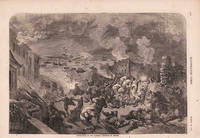
Destruction of the European factories at Canton. caption title
London.: Illustrated Times. March 211857. Full-page engraving 23.5 x 33.6 cm including caption on a single newspaper leaf relevant text on the verso edge tears no loss and creasing in very good condition. Dramatic and scarce engraving depicting the destruction of the Canton Factories principal site of Western trade with China at the onset of the Second Opium War 1856-1860 by a 25 year old Gustave Doré. He contributed to the "Illustrated Times" a chief rival to the monopoly of "The Illustrated London News". Whilst the self-taught Doré did not enjoy initial success in France for Victorian Britons Doré's art was celebrated producing with Blanchard Jerrold his landmark account of mid Victorian London "London: a pilgrimage" over four years 1869-1872. <br> <br>From the Estate of the late collector and scholar Arthur Hacker. . Illustrated Times. unknown
Référence libraire : 178579
|
|
|
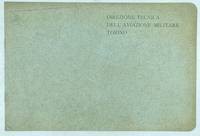
[opuscolo identificazione velivoli Grande Guerra]
DIREZIONE TECNICA DELL’AVIAZIONE MILITARE - TORINO. “Silhouettes†degli Aeroplani Italiani. CAUDRON G. 3 - CAUDRON G. 4 - M. FARMAN - NIEUPORT - AVIATIK - VOISIN - CAPRONI.
Torino: Tipografia Litografia Edoardo Pianca fu Pietro 1917 circa. Molto ben conservato. Opuscolo in brossura editoriale a stampa formato album cm 16.5 x 24.5 pp 8 illustrate in nero in carta patinata. Rara pubblicazione della Direzione Tecnica dell’Aviazione Militare di Torino per l’identificazione dei velivoli in servizio con profilo laterale e vedute dal basso in pianta e ortogonale di ciascun apparecchio. Illustrati alcuni biplani dei primi anni ’10 utilizzati dal Corpo Aeronautico Militare durante i primo conflitto mondiale: i Caudron G.3 e G.4 prodotti su licenza in Italia dalla A.E.R. di Orbassano il Maurice Farman Shorthorn MF 11/1914 prodotto su licenza da FIAT il Nieuport 10 o variante simile l'Aviatik B.I il Voisin III il Caproni Ca.1 Ca.32. La DTAM diretta dal Osvaldo Ricaldone era un reparto tecnico affiancato al Battaglione Aviatori di Torino con lo scopo di collaudare i velivoli e valutare le commesse aeronautiche. Non comune un solo esemplare in ICCU. Tipografia Litografia Edoardo Pianca fu Pietro unknown
Référence libraire : 14061
|
|
|
[ORADOUR]
LE MASSACRE D'ORADOUR SUR GLANE par les hordes Hitlérienne.
(limoge), Edité par le "Front National" Imp. Brégéras, 1944 ; in-8, 16 pp., br. Broché en bel état.
Référence libraire : 201804442
|
|
|
[ORADOUR ]
Le masssacre d'ORADOUR SUR GLANE par les hordes hitlérienne.
, Edité par le front national, 1944 ; in-8, 16 pp., broché, couverture illustr (1er plat salis). Rare plaquette ancienne.
Référence libraire : 200710142
|
|
|
[Originalfoto]
Privates (?) Foto eines am Himmel fliegenden Zeppelins.
Postkartenformat, rückseitig als Postkarte gestaltet. 14 x 9 cm (HxB). Am unteren Rand der Bildseite von privater Hand "P.L. 25 .aufgen.3.6.(19)16". Wahrscheinlicher Typ: Parseval PL 25. Dem widerspricht der folgende Eintrag bei Wikipedia, da das Luftschiff zum angegebenen Datum bereits nicht mehr geflogen wurde. "PL25 wurde am 30. März 1916 außer Dienst gestellt und zur Abwrackung in die Siemens-Halle nach Biesdorf bei Berlin überführt (Quelle: Wikipedia)". Sollte das genannte Datum korrekt sein, müsste es sich um das genannte PL 25 handeln, da die Schiffe davor und danach aus unterschiedlichen Gründen zum genannten Datum nicht mehr in Betrieb waren. Unikat. Unicat photo. Vintage photo of an airship. Dated 3.6.16.
Référence libraire : 9659

|
|
|
[OTTOMAN BIRTH CERTIFICATE - GREEK MINORITY].
[GREEK MINORITY] "Devlet-i Aliyye Nüfus Tezkîresi" Early Ottoman birth certificate of Kostaniniyye'li Yorgi Papa oglu Hedezgâr Mihail stamped by Sehremâneti in 1298 AH [1882 AD], with the tughra of Sultan Abdülhamid II.
Very Good Turkish, Ottoman (1500-1928) Original Ottoman birth certificate. 31x18 cm. In Ottoman script. 2 p. Faded on paper. A good paper. On verso, some handwritten annotations in Ottoman Turkish and Greek. [GREEK MINORITY] "Devlet-i Aliyye Nüfus Tezkîresi" Early Ottoman birth certificate of Kostaniniyye'li Yorgi Papa oglu Hedezgâr Mihail stamped by Sehremâneti in 1298 AH [1882 AD], with the tughra of Sultan Abdülhamid II.
|
|
|
[OTTOMAN BIRTH CERTIFICATE - GREEK MINORITY].
[GREEK MINORITY] "Devlet-i Aliyye Nüfus Tezkîresi" Early Ottoman birth certificate of Kostaniniyye'li Mihail oglu Areti, stamped 'Adana' in 1311 AH [1895 AD], with the tughra of Sultan Abdülhamid II.
Very Good Turkish, Ottoman (1500-1928) Original Ottoman birth certificate. 31x18 cm. In Ottoman script. 2 p. Faded on paper. A good paper. On verso, some handwritten annotations in Ottoman Turkish and Greek. With a printed stamp of "Dahiliye Nezâret-i Umûmiyyesi". [GREEK MINORITY] "Devlet-i Aliyye Nüfus Tezkîresi" Early Ottoman birth certificate of Kostaniniyye'li Mihail oglu Areti, stamped 'Adana' in 1311 AH [1895 AD], with the tughra of Sultan Abdülhamid II.
|
|
|
[OTTOMAN BIRTH CERTIFICATE - GREEK MINORITY].
[GREEK MINORITY] "Devlet-i Aliyye Nüfus Tezkîresi" Early Ottoman birth certificate of Ayasuluglu Papa Istefani in 1310 [AH] [1894 AD]; with the tughra of Sultan Abdülhamid II.
Very Good Turkish, Ottoman (1500-1928) Original Ottoman birth certificate. 31x18 cm. In Ottoman script. 2 p. Faded on paper. Otherwise a good paper. On verso, added a Greek translation of script plate beside the Ottoman Turkish. [GREEK MINORITY] "Devlet-i Aliyye Nüfus Tezkîresi" Early Ottoman birth certificate of Ayasuluglu Papa Istefani in 1310 [AH] [1894 AD]; with the tughra of Sltan Abdülhamid II.
|
|
|
[OTTOMAN DOCUMENT - TAXES].
"Harb Kazançlari Vergisi Hakkinda Ihtarnâme" [i.e. Written warning on the Tax on War Profits]: Sent by "Tarh Komisyonu Mihr-i Resmiyesi" to the owner of "Izmir Basturak Subesi Incir Mahsûlleri Sirketi" in [1920 AD] 1336 AH, March, 8.
Very Good Turkish, Ottoman (1500-1928) Original document partly printed and manuscript. Oblong: 15,5x18 cm. In Ottoman script. A tear to blank outer margin of title-page (no loss and not affecting to the printing area). The tax on war profits was on the agenda already in 1918 but it became effective only in 1919. During World War 1, the revenues procured from taxes covered only 10 percent of the government expenses. [WW I] (1914-1918 Online).
|
|
|
[OTTOMAN MANUSCRIPT - OTTOMAN SYRIA - OTTOMAN LEBANON].
[OTTOMAN SYRIA - BEYRUT] [1342] February 14, 1924 A manuscript document in Arabic: From Ottoman 'mufti' in Safed to "Yüksek Islâm Meclisi Riyâseti" [i.e. The Supreme Islamic Council Presidency], on an unpaid amount of foundation deed (with 3 stamps of HJZ 'Hijaz Railways' and OPDA 'Ottoman Public Debt Administration').
Very Good Turkish, Ottoman (1500-1928) Original manuscript document sent to the Ottoman court with postal stamps "OPDA" (Ottoman Public Debt Administration) [= Osmanli Kamu Borç Idaresi] ve "HJZ" (Hejaz Railway) [= Hicaz Demiryollari]. 28x21,5 cm. In Arabic. 1 p. 11 lines. On a paper with Grifon and "W" initial and "Original" watermarks. Paper probably from a British paper manufacturer produced the paper for the Middle Eastern market. It starts with "Yüksek Islâm Meclisi Re'isi Âlîsi'ne". There is talk of a deal made by the Safed mufti and the person concerned - stating that he has been waiting for two years for an unpaid amount after an agreement with a certain amount of Egyptian junaihs, Safed mufti demands that the rest of the money. Sayyidî, who states that he is getting older and that the money must be kept in order to be able to do the title deeds from the foundations, says that otherwise the title deed procedures will not be completed. Signed by Safed mufti named Seyyidî. On the bottom, signed by/as "Reisü'l Camiü'l Islâmiü'l Âlî, Mehmed (or, Muhammed) Sehvî]. "Safed is a city in the Northern District of Israel. Located at an elevation of 900 meters (2,953 ft), Safed is the highest city in the Galilee and in Israel. Safed has been identified with Sepph, a fortified town in the Upper Galilee mentioned in the writings of the Roman Jewish historian Josephus. The Jerusalem Talmud mentions it as one of five elevated spots where fires were lit to announce the New Moon and festivals during the Second Temple period. Safed attained local prominence under the Crusaders, who built a large fortress there in 1168. It was conquered by Saladin 20 years later, and demolished by his grandnephew al-Mu'azzam Isa in 1219. After reverting to the Crusaders in a treaty in 1240, a larger fortress was erected, which was expanded and reinforced in 1268 by the Mamluk sultan Baybars, who developed Safed into a major town and the capital of a new province spanning the Galilee. After a century of general decline, the stability brought by the Ottoman conquest in 1517 ushered in nearly a century of growth and prosperity in Safed, during which time Jewish immigrants from across Europe developed the city into a center for wool and textile production and the mystical Kabbalah movement. It became known as one of the Four Holy Cities of Judaism. As the capital of the Safad Sanjak, it was the main population center of the Galilee, with large Muslim and Jewish communities.".
|
|
|
[OTTOMAN MANUSCRIPT DOCUMENT - ARMENIAN MINORITY].
[ARMENIAN MINORITY] A manuscript law petition on the seizure of Tüfekçioglu Kirkor b. Agop's daughter's house sent to Mutasarrifate of Amasya Sanjak in 1339 AH [1923 AD].
Very Good Turkish, Ottoman (1500-1928) Original handwritten law document. 8vo. In Ottoman script. 2 p. Stamped, signed. Several confirmation annotations and signatures. [ARMENIAN MINORITY] A manuscript law petition on the seizure of Tüfekçioglu Kirkor b. Agop's daughter's house sent to Mutasarrifate of Amasya Sanjak in 1339 AH [1923 AD].
|
|
|
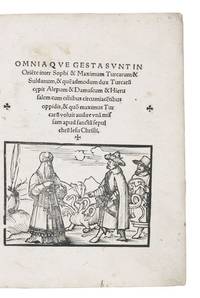
[OTTOMAN-MAMLUK WAR].
Omnia que gesta sunt in Oriente inter Sophi & Maximum Turcarum & Suldanum & quemadmodum dux Turcarum caepit Alepum & Damascum & Hierusalem cum omnibus circumiacentibus oppidis & quorum maximus Turcarum voluit audire unam missam apud sanctum sepulchrum Iesu Christi.
Basel: Pamphilus Gengenbach 1518. 19th-century pink wrappers. 4to. With woodcut illustration on title-page. Rare 16th-century news pamphlet on the Ottoman-Mamluk War 1516-1517. The booklet relates the events from June 1516 to July 1517 followed by an account of Sultan Selim's visit to Jerusalem. During the Ottoma-Mamluk war the Ottoman Sultan Selim I known as "the Grim" conquered Syria and defeated the Mamluk Sultan in the Battle of Ridaniya. He subsequently captured and sacked Cairo thereby placing the holy cities Mecca and Medina under Ottoman rule which marked the beginning of Ottoman power in Arabia.With two bookplates some browning otherwise in very good condition.l Göllner 115; USTC 679549; VD 16 O 738. Pamphilus Gengenbach, unknown
Référence libraire : G4TESVVUF9FD
|
|
|
[OTTOMAN-VENETIAN WAR] - Balthasar JENICHEN (engraver)
Warhafftige Conterfettung der Turckischen Armata von Galleen und andern Schiffen Dreihundert wie solche dess 1570 Jars in Ordnunge wider die Venedische Lendt ist aussgefahren
Nuremberg 1571. Engraving printed on two sheets of laid paper joined. Engraver's monogram at the lower left. Early manuscript caption in English in the lower margin. Plate mark: 11 x 16 inches. Sheet size: 14 5/8 x 18 3/8 inches. Very rare German news-sheet map depicting the Turkish fleet invasion of Cyprus in 1570.<br/> <br/> Exceptionally scarce engraved German broadside map depicting the Ottoman fleet sailing to Venetian-controlled Cyprus in 1570. The early English manuscript caption in ink just below image reads: "The representation of the Turkish Navall Army in ye year 1570 going forth to meet the Venetian fleet." Cyprus then under Venetian rule was a strategic point for controlling shipping and trade in the Eastern Mediterranean. The Ottomans ruled by Sultan Selim II had long desired the island. Following a series of warnings and demands the Ottoman fleet commanded by Müezzinzade Ali Pasha and Lala Mustafa Pasha sailed for Cyprus in late June 1570. Depicted here the Turkish fleet was composed of an estimated 350-400 ships and upwards of 100000 men. Following sieges and massacres at Nicosia Kyrenia and Famagusta the island was taken by August 1571. Although the invasion was long-heralded the Venetian fleet failed to prevent the invasion or the subsequent fall of Cyprus to the Turks. However they subsequently raised the support of the "Holy League" of the Catholic maritime states in the Mediterranean and defeated the Ottoman fleet at the Battle of Lepanto in October 1571 off the western coast of Greece. The victory of the Holy League prevented the Ottoman Empire expanding further along the European side of the Mediterranean though did not end their possession of Cyprus. Jenichen who signed the map with his monogram 'BI' was the leading German publisher of news-sheet maps. Jenichen and compatriot Matthias Zündt took particular interest in the conflict and produced views and maps of it that equaled and surpassed those of their Italian counterparts. Given their ephemeral nature all are rare and desirable. We can locate only one other example of this engraving appearing at auction in recent times Sotheby's London 29 April 2014 lot 157 £60000.<br/> <br/> Hollstein XL B 128; G.K. Nagler Die Monogrammisten v. 1 p. 818-819; Andresen II Nr. 276; Drugulin II 364; s.a. Meurer Jenichen S. 50. unknown
Référence libraire : 28345

|
|
|
[OULCHY-BRENY - AISNE] PHOTOGRAPHE INCONNU
PHOTOGRAPHIE ORIGINALE : OULCHY-BRENY : SCIERIE VILTANGE [BRULÉE PAR LES ALLEMANDS LE 30 MAI 1918] (VUE TRÉS ANIMÉE) 1915
OULCHY-BRENY 1915 une photographie originale albuminée (VUE TRÉS ANIMÉE), format : 11,5 x 7 cm, sans date (1915), sans nom de photographe, DEVANT LA SCIERIE STATIONNENT LES AMBULANCES DE LA CROIX-ROUGE CAR LE FRONT EST TOUT PRÈS,
Référence libraire : 26651
|
|
|
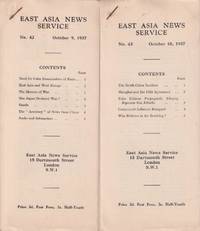
[OUTBREAK OF SECOND SINO-JAPANESE WAR].
East Asia News Service. Nos. 42 and 43.
London.: East Asia News Service. October 9 and 181937. Both issues: 5pp; staples rusted otherwise very good copies; 23.5 x 10cm. Two issues of Dōmei Tsushin's circular in Britain - rife with pro-Japanese propaganda regarding the outbreak of hostilities between China and Japan. Claims are made of Chinese interference in Western news reports and a communist conspiracy controlling the Kuomintang regime. <br> <br>While reasonable questions about Japan's aggression are posed as article headlines they are just as quickly side-stepped through double-speak and counterclaims of Chinese wrongdoing. . East Asia News Service. unknown
Référence libraire : 215433
|
|
|
[Oya, Soichi] (Editor), and Pacific War Research S
Japan's longest day.
hardcover. Good. Access codes and supplements are not guaranteed with used items. May be an ex-library book. hardcover
Référence libraire : 0285502271.G ISBN : 0285502271 9780285502277
|
|
|
[Pages d'Histoire - 1914-1915].
1. Le Guet-apens. 23-24-25 juillet. – 2. La Journée du 4 août. – 3. La Séance historique de l'Institut de France (28 octobre 1914). – 4. Les Pourparlers diplomatiques, 23 juillet-4 août. I. Le Livre bleu anglais.
Berger-Levrault, 1915, 4 vol. in-12, 40, 72, xiii-86 pp et 166 pp, 4 ouvrages de la collection “Pages d'histoire” reliés ensemble en un volume demi-chagrin noir, dos à 5 nerfs, titre doré (“Documents diplomatiques. Guerre 1914-1915, 1”), couvertures papier jaune des volumes 1, 2 et 4 conservées (rel. de l'époque), bon état
Référence libraire : 123604
|
|
|
[Pages d'Histoire - 1914-1915].
1. La Journée du 22 décembre. – 2. L.-H. GRONDIJS. Les Allemands en Belgique. Louvain et Aerschot. Notes d'un témoin hollandais. – 3. Les Poètes de la Guerre. Recueil de poésies parues depuis le 1er août 1914.
Berger-Levrault, 1915, 3 vol. in-12, 116, 123 et 136 pp, 3 ouvrages de la collection “Pages d'histoire” reliés ensemble en un volume demi-chagrin noir, dos à 5 nerfs, titre doré (“Documents diplomatiques. Guerre 1914-1915, 3”), couvertures papier jaune des volumes conservées (rel. de l'époque), bon état
Référence libraire : 123606
|
|
|
[PARIS] - ALLAN (Tony) -
C'était Paris.
Paris, Pml editions, 1987 ; in-4, 202 pp., cartonnage de l'éditeur. Avec jaquette.
Référence libraire : 201901215
|
|
|
[PARIS] - DESCAVES (Lucien).-
Dans Paris bombardé (1871 - 1914/1918).
1918 Paris, Nancy, Berger-Levrault, 1918, petit in 8° broché, 64 pages ; couvetrure illustrée.
Référence libraire : 85021
|
|
|
[PALATINAT].
Discours du Palatinat et de la dignité electorale appartenant au Prince Charles-Louis, Electeur Palatin du Rhin, contre les pretentions & l'injuste possession du Duc de Baviere avec la Généalogie de la Maison Electorale Palatine, & des diverses branches d'icelle servant à l'esclarcissement d'iceluy.
1636 demi-rel. mod. in-4, 40pp., 1 tableau généal. dépl., s.l., s.n. 1636,
Référence libraire : 8080
|
|
|
[Pages d'Histoire - 1914].
En mobilisation. 1er, 2e et 3e jours. Les violations de frontière. Les ultimatums allemands. Les violations de neutralité.
Berger-Levrault, 1914, in-12, 94 pp, broché, couv. lég. salie, bon état (Coll. Pages d'histoire)
Référence libraire : 97834
|
|
|
[PAULLI (Jacob-Henrik)]
Epistola amici ad amicum continens Censuram super Discursum qui adversus Orationem Dn. D. Legatorum Danicorum, in Confessu Dnn. Ord. General. FOEDER Belgii Hagae-Comitis 10 Jan. 1660 Habitam, Prodiit.
1660 in-4, titre, 48pp., demi-rel. mod. (s.l., s.n. ca.1660),
Référence libraire : 8067
|
|

 Recevoir par e-mail
 Télécharger en PDF
 Flux RSS
 Lien permanent


