|
[Spanish-American War] Baker, Private A[rthur] G
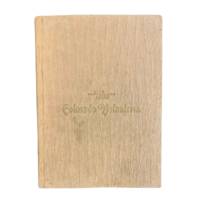
The Colorado Volunteers
Boulder 1899. First edition. 12mo 66pp. Original beige textured paper over boards title in gilt on front cover. Binding a bit shaken hinges tender. A few charming pen and pencil vignette illustrations including a frontis added by a Clair Brubaker likely a student and who has signed at the front. A very good copy. <br /> <br /> A nice little regiment history of the Colorado Volunteers and in particular the experience of the author Private Arthur G. Baker in the capture of Manila at the tail end of the Spanish-American War. Includes rosters of the officers and companies at rear. This copy nicely illustrated in a contemporary hand likely by a school-age child. <br /> <br /> Wynar 426. unknown
Riferimento per il libraio : 6247
|
|
|
[SPANISH-AMERICAN WAR -- PHILIPPINE INSURRECTION]. GANTENBEIN, Brig General CU C U
The official records of the Oregon Volunteers in the Spanish War and Philippine Insurrection. Compiled by. . .
Salem OR: W.H. Leeds 1902. Thick 8vo. xv 3 700 pp. Frontisp. numerous photos plates tables. Full leather publisher’s binding red black & gilt morocco spine labels minor bumping some minor scuffing & wear rebacked inner hinges renewed still VG- copy w/ presentation slip from Governor Theodore Thurston Geer 1851-1924 who served as governor of Oregon from 1899-1903 and was the 1st native Oregonian to hold the office and Eric Anderson brother to Sergeant Harry Anderson of Portland who served w/ the 2nd Oregon Volunteer Infantry 2nd Regiment Company E during the Insurrection. First edition of this unit history of the Second Oregon Volunteer Infantry during the Spanish-American War and the Philippine Insurrection. The 2nd Oregon fought in five campaigns and 42 battles engagements and skirmishes through 1899 with 16 killed in action 48 of related wounds and 88 wounded in action. W.H. Leeds, hardcover
Riferimento per il libraio : 63216
|
|
|
[SPANISH-AMERICAN WAR].
The United States Army and Navy including Cuba Puerto Rico The Philippines and Hawaii. History biography description illustration geography statistics. . . photographic views with appropriate explanatory text. . . .
Chicago: Donohue Henneberry & Co. 1898. Oblong folio. Appro. 150 pp unpaginated. Over 200 photo illusts. & woodcut engravings. Red & blue cloth in horizontal bands elaborate illustration & lettering in silver on front cover inor rubbing minor bumping to couple corners very minor soiling to fore-edges still a VG- bright copy. First edition of this lavishly illustrated reference of the Naval and Army forces available for the United States directly after the declaration of war in April 1898. In addition numerous photos are included of Cuba Puerto Rico the Philippines training areas in Florida and other places for the American forces and more. Donohue, Henneberry & Co., hardcover
Riferimento per il libraio : 44266
|
|
|
[SPANISH-AMERICAN WAR & HAMPTONS, NEW YORK -- PHOTO ALBUM]
Through a lens: Christmas 1898. Souvenir camera club photo book documenting events at Camp Wikoff Montauk Point Long Island as well as landmarks in and around Southampton and East Hampton following the Spanish-American War.
Long Island NY: n.p. August-Nov. 28 1898. Oblong 8vo. 7 x 5.25 in. 24 leaves unnumbered. on thick card stock. Albumen photo showing four boys seated on a ledge with one holding a camera mounted on front cover 21 mounted albumen photos sized 3.75 x 4 in. to 3.75 x 4.75 in. each w/ neatly written caption describing the scene below. Bound at gutter margin through punch-holes very minor bowing to the textblock due to the mounting of the photos occasional light foxing and very minor soiling still VG exemplar. This intriguing photo souvenir book appears to have been created by four aspiring Long Island NY photographers in 1898. Five early photographs shot August 28-29 1898 show Camp Wikoff which had been opened at Montauk Point Long Island NY a couple weeks before to house returning Spanish-American War soldiers possibly infected with malaria and other communicable disease outbreaks. By the end of August 1898 when these photos were taken the camp housed over 21000 soldiers and camp hospitals with 300 female nurses were treating over 10000 patients. The images show a panoramic view of the camp from Observatory Hill two photos of the “Rough Riders†First Cavalry Troop I seated and arranged in a group and the second showing the “Camp Barber†shaving the soldiers. Another photo shows the First Cavalry troopers in a dinner line and another the Second Cavalry Troop K heading out on maneuvers. These are followed by shots of the young boys camping on Ram Island Sept. 19-24 on Ram Island near Shelter Island were many fish processing plants and canneries operated until the opening years of the 20th Century. Other images include the Minnesunk Lake on Long Island possibly Little Fresh Pond; one of the iconic windmills at East Hampton; along with the Gothic Revival tomb of Lion Gardiner 1599-1663 designed and built in 1886 by James Renwick Jr. architect perhaps best remembered for St. Patrick’s Cathedral. In addition there are images of the Clinton Academy shown with the James Renwick 1881-1886 addition -- later demolished; the Rogers Memorial Library designed by R.H. Robertson in 1895 and opened in 1896 as well as the country residence of Walter Lewis Jagger 1846-1918 successful Southampton farmer and older brother to Charles Albert Jagger editor of the Southampton Press newspaper. n.p., unknown
Riferimento per il libraio : 55283
|
|
|
[Spanish-American War]
Typed Letter of Commendation for Sergeant Major George J. Oden of the 36th Infantry
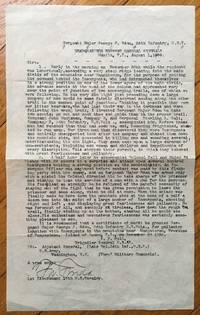
Manila 1900. Very good. Typed letter signed 1p. Typed on thin paper. Folded. A true copy of a typed letter by Gen. J.F. Bell that recommends Sgt. Maj. George J. Oden of the 36th Volunteer Infantry for a Certificate of Merit for gallantry during an engagement with Insurgents native Filipinos who rebelled against American rule after Spain ceded the islands to the United States in the mountains near Mangaterem on November 28 1899 during the Spanish-American War. According to the text of the letter "When the attack was finally made he tore down the mountain side at the head of a half dozen men into the midst of a large number of Insurgents shooting right and left and displaying great fearlessness and gallantry. He was foremost of all and seemingly tireless flew down the rough trail finally winding up at the bottom chasing all he could see alone. His enthusiasm and unconscious fearlessness was something pleasant to see." Certified as a true copy of the letter by a Buffalo Soldier a First Lieutenant in the 10th U.S. Cavalry. unknown
Riferimento per il libraio : 208
|
|
|
[SPANISH-AMERICAN WAR -- USS MAINE]. ATWOOD, F[rederick] N[elson].
USS Maine colour lithograph published in 1898 commemorating the sinking of the tragic ship which triggered the Spanish-American War reverse mounted on glass with brass chain frame.
Boston MA: F.N. Atwood c. 1895 1898. One colour lithograph reverse mounted on glass sized 8 x 13 in. fitted with brass chain frame and hanger possibly used as chimney flue cover minor edgewear to glass minor soiling to chain very minor spotting dustsoiling still an excellent piece w/ bright strong image. The USS Maine ACR-1 was launched in 1895 and was an armored cruiser together with her near-sister ship USS Texas with two gun turrets staggered en echelon rather than on the centerline with fore gun sponsoned out on the starboard side of the ship. As she took seven years to build she was out of date upon launching. She sailed with the North Atlantic Squadron operating from Norfolkd along the East Coast and the Caribbean. Feb. 15 1898 an explosion obliterated the forward third of the ship killing 260 sailors and the Spanish-American War began in April 1898 two months later. Atwood b. 1844 was a Massachusetts nautical maritime painter who operated studios in Boston and Maine and painted the original for Brigadier General H.A. Wheeler in 1895 and in 1898 the colour print was issued as a patriotic souvenir. Victorian flue covers were used after the chimney flues were removed in 19th-century homes following Winter and often served as an advertising giveaway. F.N. Atwood, unknown
Riferimento per il libraio : 54270
|
|
|
[STRASBOURG].
-FISCHBACH (Gustave). Le siège et le bombardement de Strasbourg. 4eme ed. Strasbourg Schauenburg 1870, (2ff.), 175pp., 1 plan repl. -BONNEFOY (Marc). Strasbourg en 1870. Notes et impressions d'un officier pendant le siège. Documents inédits. Paris Librairie Alsacienne-Lorraine 1911, VI, 87pp. -EUTING-BECHSTEIN. Guide illustré de la ville de Strasbourg et de la cathédrale. 9eme ed. Strasbourg 1913/14. IV, 63pp. 1 plan. -HASS J. Cathédrale de Strasbourg. Guide illustré. Strasbourg Beust 1918, 48pp. -UNGERER. L'horloge astronomique...1919, 8pp. ill.
1870 in-12, demi-velin, titre et dessin à l'encre sur le dos.
Riferimento per il libraio : 4389
|
|
|
[STEIN (Edith)].-
Edith Stein, 1891-1942. Par une moniale française. Préface de H.-I. Marrou.
P., Le Seuil (Collection "La Vigne du Carmel"), 1954, in 8° broché, 222pp. ; illustrations.
Riferimento per il libraio : 27764
|
|
|
[STALAG] - BICHET (G.A.) -
Evadés!….
Nancy, Héio-Lorraine imprimerie E. Spillmann, 1945 ; in-8, 152 pp., broché, couverture illustr. Couverture et bois originaux de Jean Paul Guiart.
Riferimento per il libraio : 200702191
|
|
|
[STOCK (Franz)] - CLOSSET (René).-
L'Aumonier de l'enfer. Franz Stock, Aumonier de Fresnes, du Cherche Midi et de la Santé, 1940-1944. 3e édition.
Mulhouse, Salvator, 1964, in 8° broché, 259 pages ; illustrations ; couverture illustrée en couleur (petits frottis).
Riferimento per il libraio : 61048
|
|
|
[STALINE] - GRIGORENKO (Piotr).-
Staline et la Deuxième Guerre Mondiale. Préfacé par Carol Head. Traduit du russe par Olivier Simon.
Sans lieu, Editions de l'Herne (Collection "Théorie et Stratégie"), 1969, in 8° broché, 147 pages ; couvetrure illustrée ; quelques passage délicatement soulignés au crayon.
Riferimento per il libraio : 61823
|
|
|
[STRASBOURG, GUERRE 39/45] - HAELLING (Gaston) -
Une préfecture désannexée strasbourg 23 novembre 1944 -8 mai 1945.
Paris, Le roux, 1954 ; in-12, 168 pp., br. Broché en bon état.
Riferimento per il libraio : 201402914
|
|
|
[STANTON, Edwin M, Secretary of War]
Instructions for Officers and Non-Commissioned Officers on Outpost and Patrol Duty and Troops in Campaign.
Washington:: Governmetn Printing Office 1863. First edition. original printed wrappers. Old pencil calculations to two pages and the wrappers eraseable; wrappers dust-soiled and spotted with light edgewear; but attractive nonetheless. . 8vo. Engraved illustrations. Governmetn Printing Office, unknown
Riferimento per il libraio : 56583
|
|
|
[State of Ohio] [Civil War]
Laws Relating to the Organization of the Militia of Ohio
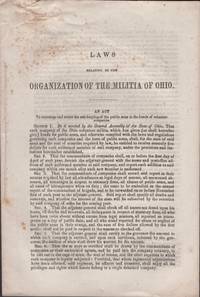
Columbus: State of Ohio 1861. Wraps. Good. Stitched wraps. Approx. 9" x 6". 11 pages 2. Title on page 1. Light foxing to the first page. Contents clean and in very good condition. Contents contain correspondence between the Speaker of the House and the Senate dated between April 12th - May 13th 1861. Scarce. From Ohio History Central: <br /> <br /> With the outbreak of the American Civil War in April 1861 Ohio Governor William Dennison dispatched George McClellan and Jacob Cox to the state arsenal in Columbus to investigate the guns and other supplies that Ohio had on hand to help equip the state's militia units. The two men discovered a few crates of rusted smoothbore muskets mildewed harnesses for horses and some six-pound cannons that could not be fired. Despite the lack of equipment Dennison encouraged Ohio communities to revive the militia system and form units that they would send to Columbus the state capital. Dennison entrusted McClellan with command of these units asking him to create a cohesive and professional force out of the volunteers. Most of these units formed the basis of Ohio Volunteer Infantry units which the State of Ohio eventually provided to the United States government for the war against the South. State of Ohio unknown
Riferimento per il libraio : 32826
|
|
|
[State of Illinois] [Civil War] [Political]
Message of His Excellency Richard Yates Governor of Illinois. To the General Assembly. January 5 1863
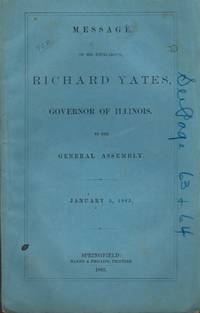
Springfield: Baker & Phillips Printers 1863. First Edition. Wraps. Fair. Wraps. Approx. 9" x 6". 64 pages. Stitched blue outer wraps with title on the front cover. Light scattered foxing to the contents. A blue note is written on the front cover referring to pages 63 and 64. Text of pages 63 and 64 are underlined with the same blue pencil and a short one word note written in the margin of page 63 not legible. <br /> <br /> Contents include the Governor's Message; Civil War and Troops; progress of the State; Wealth; Railroads; Opening of the Mississippi; Manufactures; Geological Survey; Education; Transportation; Banks; State Revenue and Debt; and much more. Baker & Phillips, Printers unknown
Riferimento per il libraio : 33575
|
|
|
[Stereographs] [Boer War]
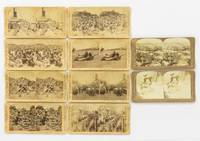
A collection of eight stereographs published by Underwood and Underwood New York; all photographs were taken in South Africa
New York: Underwood & Underwood Publishers 1900. Good. New York Underwood & Underwood Publishers 1900 and 1901. The pairs of photographs are uniformly mounted on the publishers' salmon-pink cards with English-language captions underneath the photographs repeated in six languages on the verso. The size of the arch-topped prints is approximately 80 × 78 mm; the card size is 88 × 178 mm. Some photographs and cards are a little foxed or marked; all cards are a little rubbed and marked at the extremities; minor signs of age and use; overall in good condition. Three of the photographs show activities in the field. Another card has specific Australian content: 'Skirmish Drill New South Wales Mounted Rifles Cape Town'. <p>Offered together with two similar stereographs published by M.E. Wright Excelsior Stereoscopic Tours Burnley England. The captions are 'Ladysmith and Lombard's Kop from Convent Hill' 1900 and 'Interior of a Field Hospital' 1901. Both items are in very good condition. 10 items. Underwood & Underwood, Publishers unknown
Riferimento per il libraio : 139124
|
|
|
[STONE (George)]
A letter from a p**m**e in I**l**d to a certain great man, who was out of town on the first of August last.
8vo, with half-title, [4], 44pp., disbound.
|
|
|
[SUISSE, GUERRE 39-45]
General GUISAN und der zweite weltkrieg 1939-1945.
Lausanne, Editions Marguerat, 1974 ; in-4, 163 pp., cartonnage de l'éditeur. En très bon état avec sa jaquette.
Riferimento per il libraio : 201805183
|
|
|
[SUISSE] - GAUTSCHI (Willi) -
General HENRI GUISAN.
Zurich, Verlag NZZ - neu zurcher zeitung, 1989 ; in-8, 912 pp., cartonnage de l'éditeur. Comme neuf avec sa jaquette -die schweizeriche armeefuhrung im zweiten weltkrieg - 3e edition.
Riferimento per il libraio : 201804928
|
|
|
[SUISSE] - ZIEGLER (Jean) -
La suisse, l'or et les morts.
Paris, Seuil, 1997 ; in-8, 318 pp., br. Broché comme neuf.
Riferimento per il libraio : 201804918
|
|
|
[SUISSE, GUERRE 39/45] - COLLECTIF -
Les conditions de la survie-La suisse la deuxieme guerre mondiale et la crise des année 90.
Lausanne, Cahier de la renaissance vaudoise, 2002 ; in-8, 350 pp., br.
Riferimento per il libraio : 202002245
|
|
|
[SUEZ WAR] LOVE, Kennett
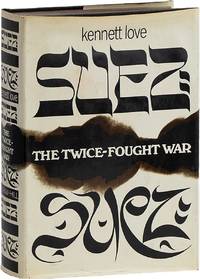
Suez: The Twice-Fought War
New York: McGraw-Hill 1969. First Edition. First printing. Thick octavo 23cm. Black cloth hardcover; brown publisher's top-stain; dustjacket; 767pp. Light wear; top-stain unevenly faded; bottom edge of text block lightly soiled; Very Good. In the original dustwrapper unclipped priced $10.00 on front flap lightly soiled and toned; Very Good. An exhaustive study of the Arab-Israeli War of 1956; the author was the New York Times Middle East correspondent from 1953-56. McGraw-Hill unknown
Riferimento per il libraio : 82207
|
|
|
[Swedenborg] [Mysticism] [Civil War] des Guays, JE Le Boys J E
The True System of Religious Philosophy in Letters to a Man of the World Disposed to Believe
Boston: Otis Clapp 1857. Third Edition. 8vo x 259pp. Publisher's brown cloth ruled in blind and lettered in gilt on spine. Corners worn spine faded few spots to lower board. Ownership signature of R.J. Ogelsby dated 1863 in Chicago on ffep. Half-circle moisture stain to outer margin of first 50 pages or so else clean internally and very good. <br /> <br /> A philosophical text with interesting provenance being owned by the Union Major General and 14th Governor of Illinois Richard J. Ogelsby 1824-1899. Ogelsby began his service in the Mexican-American War before becoming a prospector during the California Gold Rush. After volunteering for the Union Army he rose to the rank of Major General but after sustaining severe injuries in the Battle of Corinth and at the request of President Lincoln he left his commission and successfully ran for Illinois Governor in 1864. He was at Lincoln's side when he died at the Petersen House in 1865.<br /> <br /> The text itself is Swedenborgian Jean François Étienne Le Boys des Guays' outlining through a series of easily-understood letters of his ideas of rational faith and spiritual interpretations of the universe. Among topics discussed are God immortality of the soul logical reasoning in theological questions religious doubt religious skepticism existence of evil creation free agency laws of divine order the physical body and spiritual body angels the spiritual world space and time souls of animals creation of the universe infinity redemption memory and thought of man Holy Trinity and the Divine Word. This edition was translated by John Murdock and edited with corrections by Hebrew professor at NYU George Bush. Otis Clapp unknown
Riferimento per il libraio : 8855
|
|
|
[Sylvester Gordon Joubert] [World War I] [Canada]
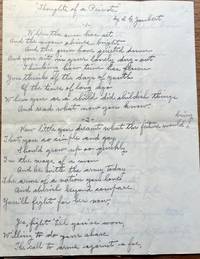
Thoughts of a Private" hand written manuscript verse. With a hand written company roster titled "Third Relief" AND A reply letter to Joubert regarding a possible death of one of the company
n.p.: n/a 1915. Paper. Good. Small group of paper relating to a Canadian World War I soldier. Group includes a 5 page hand written manuscript verse titled "Thoughts of A Private"; a partial hand written roster list "Third Relief" which lists "Petty Officer Joubert"; and a typed letter from a civilian to Joubert discussing the possible death of a Company member. The typed letter is on "Northern Lumber Co. Limited Operating Retail Yards" letterhead from Kamsak Sask. and dated October 9th 1915. Letter signed at the bottom by W. G. Bluvett. A Canadian Expeditionary forces roster listing for Sylvester Gordon Joubert found on the site "data2 dot archives dot ca": Company D; Regimental Number 81468; Rank Private; Former Corps Nil; Next of Kin W. A. Joubert; Address Boston Mass rest of information is cut off. Poem describes combat and the psychology of a soldier in the trenches. n/a unknown
Riferimento per il libraio : 36662
|
|
|
[SÉPULTURES, NÉCROPOLES, GUERRE] - SCHENK (Bernard) -
Réminiscences d'Histoire - Strasbourg un sanctuaire alsacien de la mémoire - Alsace sépultures de guerre et nécropoles nationales.
Strasbourg, Le verger editeur - association le souvenir français, 2003 ; in-4, 162 pp., cartonnage de l'éditeur.
Riferimento per il libraio : 202205480
|
|
|
[SÉPULTURES, NÉCROPOLES, GUERRE] - SCHENK (Bernard) -
Réminiscences d'Histoire - Strasbourg un sanctuaire alsacien de la mémoire - Alsace sépultures de guerre et nécropoles nationales.
Strasbourg, Le verger editeur - association le souvenir français, 2003 ; in-4, 162 pp., cartonnage de l'éditeur.
Riferimento per il libraio : 200909599
|
|
|
[Terre Magazine]
TERRE MAGAZINE - N° 22-23 - Mars-avril 1991
Revue de 80 pages, format 210 x 295 mm, illustrée, brochée couverture couleurs, bon état
Riferimento per il libraio : LFA-126724984
|
|
|
[Terre Magazine]
TERRE MAGAZINE - N° 148 - Octobre 2003
Revue de 68 pages, format 210 x 295 mm, illustrée, brochée couverture couleurs, bon état
Riferimento per il libraio : LFA-126740925
|
|
|
[Terre Information Magazine]
TERRE INFORMATION MAGAZINE - N° 229 - Novembre-décembre 2011
Revue de 58 pages, format 210 x 295 mm, illustrée, brochée couverture couleurs, bon état
Riferimento per il libraio : LFA-126740926
|
|
|
[Ten printed Schedules of Contract for work for the service of the War Department, in the South-West and Sussex District; W H Du
War Department contractors 1858 10 printed items Schedule of Contract for Carpenters' Bricklayers'; Slaters'; Plasterers'; Plumbers'; Painters'; Glaziers'; Smiths'; Cast-iron and Metal Work for the Service of the War Department .
All ten schedules: 'London: Printed by Harrison & Sons. 1858.'. The collection is of great interest providing a mass of information regarding the Victorian building trade. The owner of the volume W. H. Dudley would appear to be a War Office official and as described at the end of this entry it contains manuscript details of two contracts. The ten printed schedules - totalling 34 17 14 10 12 13 12 10 16 11 = 149 pp. folio - are uniform in design and format bound together in a contemporary half-binding with brown leather spine and corners and marbled boards. All ten are in good condition on lightly-aged paper in worn binding. Inscription across front endpapers: 'W. H. Dudley. Contractors' Schedule. 1859. 59.' Each of the ten schedules is headed: 'N.B. - Tenders will be received at the War Office Pall Mall London on or before the blank The Secretary of State for War reserves to himself the right of rejecting the whole or any of the Tenders. No notice will be taken of any Tender unless upon the proper printed form.' Each begins with extensive 'Terms of Contract' followed by several pages of 'General regulations and specifications for the work.' These are followed by a detailed description of the specifics with the cost of 'Materials and Labour' under a number of headings. As an example in the case of plastering costings are given for 'Rendering' 'Lathing and plastering' 'Stucco' 'Cementing with half Roman cement and half sand' 'Rough casting on brick' 'Cornices and mouldings in plaster of Paris' 'Friezes and soffits; Cornices and mouldings in roman cement' 'Lime white and whitewashing' 'Colouring including size' 'Sundries' and 'Day work and materials'. The recto of a flyleaf preceding the first schedule is filled with two manuscript notes in a contemporary hand. The top half of the page is headed 'Mr. Robert Stratton Contractor for the Isle of Wight under contract dated 13 April 1858 Portsmouth 1 121' and lists the percentage under the prices printed in the schedule' of eleven contracts from 'Bricklayer' to 'Plasterer'. The lower part of the page is headed: 'George Wheeler Contractor for Hurst Castle - under contract dated 15 April 1858 Portsmouth 1 126' and listing eleven contracts again from 'Bricklayer' to 'Plasterer' again with percentages of four 'under' and seven 'at Schedule Prices'. Excessively scarce: no copy of any of the ten items on COPAC or in the National Archives. All ten schedules: 'London: Printed by Harrison & Sons. 1858.' hardcover
Riferimento per il libraio : 18980
|
|
|
[TEXAS; MISSISSIPPI; CIVIL WAR] THOMTON (?) J R C
Autograph letter signed to Attorney at Law Colonel A. G. Mayers of Brandon Mississippi with stamped addressed envelope.
Crockett Houston Co. Texas Feb. 17th 1866. The writer laments "the wreck of his affairs" loss of his crops and library "and even the negroes" and hopes for news of a mutual friend; with the recipient's notation on the envelope "ratifying sale of land because I wrote him the facts & he orders a sale of the articles reserved from sale." . unknown
Riferimento per il libraio : 46350
|
|
|
[Texas]. [World War I]
Bird's Eye View. Camp Bowie Fort Worth Tex. October 1917
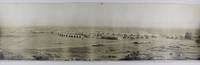
Chicago: Mayhart Studio 1917. Very good. Large panoramic photograph 8 x 90.5 inches. Rolled. Light wear at edges with a couple of small chips and very short closed tears along top edge. minor dust soiling and toning. A fabulous and extremely long panoramic photograph measuring approximately 7.5 feet in length that depicts Camp Bowie in Fort Worth during October 1917. At this time the camp was still under construction but also housed an entire infantry division in training for World War I. Ongoing construction efforts are clearly evident as piles of lumber in various states of organization occupy the field in the center foreground. Already completed barracks and other out buildings occupy the right of the image and thousands of army tents sweep into the background of the center and left portions of the image. A group of standard houses likely for officers and their families is located at the lower left of the image. The photographers Mayhart Studio of Chicago were responsible for a number of military and patriotic views during the United States' involvement in the Great War including the well-known "Living Flag" image of thousands of servicemen composing an American flag.<br /> <br /> "Construction of Camp Bowie began on July 18 1917. The camp in the Arlington Heights neighborhood about three miles west of downtown Fort Worth was established by the United States War Department to give training to the Thirty-sixth Infantry Division. Local officials expected financial gain and urged that the camp be located at Fort Worth. Including the adjacent rifle range and trench system the site encompassed 2186 acres. Camp Bowie's greatest average monthly strength was recorded in October 1917 as 30901. For about five months after the departure of the Thirty-sixth for France in July 1918 the camp functioned as an infantry replacement and training facility with monthly population ranging from 4164 to 10527. Shortly after the Armistice on November 11 1918 Camp Bowie was designated a demobilization center. By May 31 1919 it had discharged 31584 men. The heaviest traffic occurred in June when it processed thousands of combat veterans of the Thirty-sixth and Ninetieth Texas-Oklahoma divisions. The demobilization having been concluded Camp Bowie was closed on August 15 1919" -- Handbook of Texas Online.<br /> <br /> A quite remarkable photographic document of this short-lived World War I-era army camp in Fort Worth whose grounds and surrounding neighborhood are now touted by the municipal tourism office as "the city's premier commerce corridor." We locate no other examples of this excellent and large panorama. Mayhart Studio unknown
Riferimento per il libraio : 1993
|
|
|
[Texas]. [World War I]
Birds Eye View of Camp Travis. San Antonio Texas. Oct. 1917
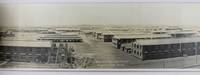
San Antonio 1917. Very good. Large panoramic photograph 8 x 92 inches. Rolled. Minor wear at edges with one very short closed tear at top edge. Light blemish in negative at center of image. Light dust soiling and toning. An outstanding and extremely long panoramic photograph measuring well over 7.5 feet in length that depicts Camp Travis in San Antonio following its recent opening. Although the camp was open and housing an entire division-in-training at the time of this image the camp was still under construction as evidenced by the organized piles of lumber at the far right of the image and the incomplete barracks building in the center foreground. The panorama nevertheless gives a sense of the scope and size of the training camp with barracks and outbuildings stretching almost as far as the eye can see in the center and left sections of the photograph. Structures are sparser in the right-hand side of the image both because they as yet unbuilt and because some of the training fields were located in this part of the camp. The photographers Mayhart Studio of Chicago were responsible for a number of military and patriotic views during the United States' involvement in the Great War including the well-known "Living Flag" image of thousands of servicemen composing an American flag. <br /> <br /> "On July 15 1917 after its selection as the training site for the Ninetieth Texas-Oklahoma Division of the army Camp Wilson was renamed Camp Travis in honor of Alamo hero William B. Travis. The camp was ready for occupancy on August 25 1917. Additional land was subsequently acquired for vital training facilities and numerous structures were erected by the soldier welfare agencies. Camp Travis comprised 18290 acres of which 5730 were on the main campsite adjoining Fort Sam Houston. The Ninetieth Division was organized at Camp Travis in September and October of 1917. During the summer of 1918 Camp Travis served as an induction and replacement center with an average strength in July of about 34000 White and Black troops. On December 3 Camp Travis was named as a demobilization center. The facility was also designated a local recruiting station and a regional recruit depot in March 1919. Some 62500 troops were discharged at Camp Travis in about eight months. The camp then became the home station of the Second Division. Its service as a separate entity was terminated however upon its absorption by Fort Sam Houston in 1922" -- Handbook of Texas Online.<br /> <br /> A quite fascinating view of this enormous World War I-era training camp in San Antonio now a part of the even larger Fort Sam Houston military base on the east side of the city. We locate no other copies of this large and remarkable panorama. unknown
Riferimento per il libraio : 1992
|
|
|
[Texas]. [Civil War]
Declaration of the Causes Which Impel the State of Texas to Secede from the Federal Union -- Also the Ordinance of Secession caption title
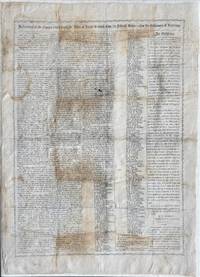
San Antonio: February 2 1861. Good. Broadside on silk 19.5 x 14 inches. Expertly cleaned and restored. Previously folded with some creasing still visible. Moderate staining and a few small holes and separations aided by conservation. Scattered contemporary manuscript notations. An exceptionally rare Texas secession broadside executed on silk satin in San Antonio in 1861. Printed in five columns with an ornamental border the broadside features both the Ordinance of Secession and the Declaration of Causes two of the three principal documents drafted by the Texas Secession Convention along with a list of delegates. According to the colophon "These sheets on Fine Satin may be had at the Herald Office for $1 or on fine Book Paper at 10 cents each." The present broadside belonged to Cyrus Halbert Randolph 1817-1889 who was the Texas State Treasurer at the time of secession. Randolph arrived in Texas in March 1838 and quickly became established as an attorney and politician. A member of the Snively Expedition in 1843 he served in several political roles in Houston County including justice of the peace 1840 chief justice of the county circa 1843 and sheriff 1847. He also represented the county in the Texas Legislature in two terms between November 1851 and November 1857. Randolph was elected state treasurer 1859 and won re-election in 1860. Notably small pencil notations are next to the names of several delegates in the list perhaps associates of Randolph. Other known copies have connections to delegates and it seems likely that the sheets printed "on Fine Satin" were ideal souvenirs for prominent Texas politicians. <br /> <br /> After South Carolina's secession in December 1860 Texas was not far behind in joining them. The Constitutional Convention was organized on February 1 1861 and voted overwhelmingly in favor of secession. The ordinance was ratified by popular vote on February 23rd. The document begins with the Declaration of Causes a fiery assertion of Texas's rights which highlights her unique history as an independent country and leaves no doubt as to the core issue at stake: "Texas abandoned her separate national existence and consented to become one of the Confederated States to promote her welfare insure domestic tranquility and secure more substantially the blessings of peace and liberty to her people. … She was received as a commonwealth holding maintaining and protecting the institution known as negro slavery -- the servitude of the African to the white race within her limits -- a relation that had existed from the first settlement of her wilderness by the white race and which her people intended should exist in all future time. Her institutions and geographical position established the strongest ties between her and other slave-holding States of the confederacy. Those ties have been strengthened by association. But what has been the course of the government of the United States and of the people and authorities of the non-slave-holding States since our connection with them"<br /> <br /> Continuing in scathing language the authors accuse the North of interfering directly as they "encouraged and sustained lawless organizations to steal our slaves;" "invaded Southern soil and murdered reoffending citizens;" "sent seditious pamphlets and papers among us to stir up servile insurrection and bring blood and carnage to our fireside;" "sent hired emissaries among us to burn our towns and distribute arms and poison to our slaves;" and "finally by the combined sectional vote of the seventeen free or non-slave-holding States they have elected as President and Vice President of the whole Confederacy two men whose chief claims to such high positions is their approval of these long continued wrongs and their pledges to continue them to the final consummation of these schemes for the ruin of the slaveholding States."<br /> <br /> What follows is a list of the 168 delegates ending with Philip A. Work distinguishing this copy as a first edition. Noted bibliographer and Texas historian Everett C. Wilkie Jr. made a detailed study of the Texas secession documents in The 1861 Printings of the Ordinance of Secession Dallas 2011 and identifies three separate editions of the broadside essentially differentiated by the list of delegates. The first edition Wilkie 23 was almost certainly printed in February 1861 and ends the delegate list with Philip A. Work. The later editions Wilkie 24 & 25 were printed in early and mid-March respectively with additional delegates added to the list. The present edition is also the only one to include six lines naming the delegates who voted against secession. <br /> <br /> Printed in the right-hand column is the Ordinance of Secession stating the Texas is once again "a separate sovereign state." The preamble encapsulates the grievances of the state "Whereas the action of the Northern States of the Union is violative of the compact between the States and the guarantees of the Constitution and whereas the recent developments in Federal affairs make it evident that the power of the Federal Government is sought to be made a weapon with which to strike down the interests and prosperity of the people of Texas and her sister slave-holding states; instead of permitting it to be as was intended our shield against outrage and aggression; therefore."<br /> <br /> Parrish & Willingham note three institutional copies: University of North Carolina University of Texas and Baylor University. The Baylor copy however is actually a 7-page pamphlet edition Parrish & Willingham 4150. The UNC and Texas are therefore the only other known copies of the first edition. A unique opportunity to acquire one of the most significant broadsides in Texas history in the first edition and on silk.<br /> Crandall 2153. Parrish & Willingham 4151. Wilkie 23. Winkler & Friend 171. February 2 unknown
Riferimento per il libraio : 6200
|
|
|
[Texas]. [World War II]
Manuscript Friendship Album of a German Prisoner of War in Texas During World War II
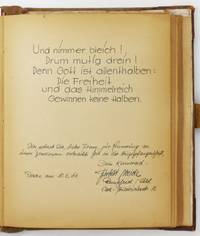
<p>Huntsville Tx 1945. Very good. 84pp. Primarily in German. Quarto. Brown cloth album with leather corners and snap closure. Manuscript initials on front cover. Corners lightly worn. Contents evenly toned. A rare friendship album kept by Franz Kozian a German prisoner of war at the POW camp in Huntsville Texas. The album contains over seventy-five entries from fellow incarcerated soldiers all of them lengthier than just an autograph. Many of them include lengthy expressions of friendship or quotations from famous German-language authors such as one that copies out the text of Rilke's poem "Herbst" "Autumn" with the illustration of a tree with falling red leaves. Most of the entries also include details of the internees' home towns and other camps they've been in. At the end of the album is a detailed list of fellow prisoners with their home addresses. By the end of World War II there were over 425000 enemy prisoners on U.S. soil and Texas had twice as many POW camps as any other state due to space and climate. The Geneva Convention specifies that prisoners must be kept in a climate similar to that of where they were captured and Texas was considered similar to northern Africa resulting in a serious influx. The present item seems to be a relatively unusual survival from the POW camps and is quite detailed in its contents. A valuable research tool for this unusual chapter of American military history.</p>
Riferimento per il libraio : 6431
|
|
|
[Texas]: [Mexican-American War]
Autograph Letter Signed by Frank Boggs a Mexican-American War Soldier Written to His Sister Sophia Boggs in Ohio Describing His Route Through Texas
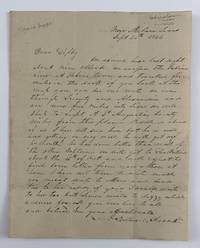
Near Milam Tx 1846. 1p. with integral blank leaf addressed on verso. Original mailing folds repairs to address leaf and small unobtrusive loss from removed wax seal. Text clean and highly readable. Very good. A rare communication from Texas during the Mexican-American War in which an Ohio Army soldier describes his march through Texas. Boggs writes as follows: "We arrived here last night about 9 o'clock. We crossed the Sabine River at Sabine town and traveled 5 miles in the dark. If you look at the map you can see our route. We came through Trinity and Alexandria and are now 5 miles into Texas. We will sleep tonight at Saint Augustine 20 miles from this place. Biddle is ahead of us. I have not seen him but he is well and getting on very well. He will get $100 per month. He has done better than most other captains. We will get to San Antonio about October and will expect to find some letters from you and those at home." Captain Charles John Biddle served as a captain in the Mexican-American War before serving as a lieutenant colonel for the Union in the Civil War. Biddle was also a prominent lawyer politician and newspaper editor in Philadelphia. unknown
Riferimento per il libraio : 12668
|
|
|
[Texas]: [Civil War]: Alexander, ME M E
Autograph Letter Signed by M.E. Alexander Written to His Sister and Brother Regarding Family Matters and the Sense of "War Fever" in Texas
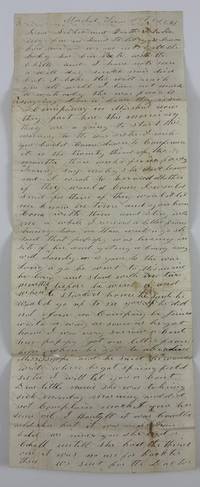
Marshall Tx 1861. 2pp. on an unusually tall folio sheet measuring 20 x 7.5 inches and totaling about 700 words. Old folds minor foxing and soiling a few small areas of loss at crossroads costing a few words. Good condition. An interesting correspondence from Civil War-era Texas. The letter opens with a report that the author and his child are unwell then swiftly makes mention of the Civil War original spelling retained: "I have not much to write only the war fever is raging down here. They is six Companys in Marshal now. They past here this morning. They are a going to start this morning to the war." A bit later he writes about a friend or family member who joined the war effort: "Tandy is gone to the war long ago. He went to Missouri. He came and staid with me two months before he went up and when he started home he said he would go up to see you if he did not join no Company. He joined." He makes another mention of the war towards the end of the weather: "If Giles goes to war you can live with me until he comes back. I have got plenty of room and plenty to eat and your company would be very exceptable." The remaining passages treat mostly with reports of friend and family matters. unknown
Riferimento per il libraio : 12666
|
|
|
[Texas]: [World War I]
Bird's Eye View. Camp Bowie Fort Worth Tex. October 1917
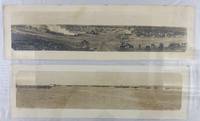
Chicago: Mayhart Studio 1917. Very good. Large panoramic photograph 8 x 90.5 inches. Rolled. Light wear at edges with a couple of small chips and very short closed tears along top edge. minor dust soiling and toning. A fabulous and extremely long panoramic photograph measuring approximately 7.5 feet in length that depicts Camp Bowie in Fort Worth during October 1917. At this time the camp was still under construction but also housed an entire infantry division in training for World War I. Ongoing construction efforts are clearly evident as piles of lumber in various states of organization occupy the field in the center foreground. Already completed barracks and other out buildings occupy the right of the image and thousands of army tents sweep into the background of the center and left portions of the image. A group of standard houses likely for officers and their families is located at the lower left of the image. The photographers Mayhart Studio of Chicago were responsible for a number of military and patriotic views during the United States' involvement in the Great War including the well-known "Living Flag" image of thousands of servicemen composing an American flag.<br /> <br /> "Construction of Camp Bowie began on July 18 1917. The camp in the Arlington Heights neighborhood about three miles west of downtown Fort Worth was established by the United States War Department to give training to the Thirty-sixth Infantry Division. Local officials expected financial gain and urged that the camp be located at Fort Worth. Including the adjacent rifle range and trench system the site encompassed 2186 acres. Camp Bowie's greatest average monthly strength was recorded in October 1917 as 30901. For about five months after the departure of the Thirty-sixth for France in July 1918 the camp functioned as an infantry replacement and training facility with monthly population ranging from 4164 to 10527. Shortly after the Armistice on November 11 1918 Camp Bowie was designated a demobilization center. By May 31 1919 it had discharged 31584 men. The heaviest traffic occurred in June when it processed thousands of combat veterans of the Thirty-sixth and Ninetieth Texas-Oklahoma divisions. The demobilization having been concluded Camp Bowie was closed on August 15 1919" -- Handbook of Texas Online.<br /> <br /> A quite remarkable photographic document of this short-lived World War I-era army camp in Fort Worth whose grounds and surrounding neighborhood are now touted by the municipal tourism office as "the city's premier commerce corridor." We locate no other examples of this excellent and large panorama. Mayhart Studio unknown
Riferimento per il libraio : 1993
|
|
|
[Texas]: [World War I]
Birds Eye View of Camp Travis. San Antonio Texas. Oct. 1917
San Antonio 1917. Very good. Large panoramic photograph 8 x 92 inches. Rolled. Minor wear at edges with one very short closed tear at top edge. Light blemish in negative at center of image. Light dust soiling and toning. An outstanding and extremely long panoramic photograph measuring well over 7.5 feet in length that depicts Camp Travis in San Antonio following its recent opening. Although the camp was open and housing an entire division-in-training at the time of this image the camp was still under construction as evidenced by the organized piles of lumber at the far right of the image and the incomplete barracks building in the center foreground. The panorama nevertheless gives a sense of the scope and size of the training camp with barracks and outbuildings stretching almost as far as the eye can see in the center and left sections of the photograph. Structures are sparser in the right-hand side of the image both because they as yet unbuilt and because some of the training fields were located in this part of the camp. The photographers Mayhart Studio of Chicago were responsible for a number of military and patriotic views during the United States' involvement in the Great War including the well-known "Living Flag" image of thousands of servicemen composing an American flag.<br /> <br /> "On July 15 1917 after its selection as the training site for the Ninetieth Texas-Oklahoma Division of the army Camp Wilson was renamed Camp Travis in honor of Alamo hero William B. Travis. The camp was ready for occupancy on August 25 1917. Additional land was subsequently acquired for vital training facilities and numerous structures were erected by the soldier welfare agencies. Camp Travis comprised 18290 acres of which 5730 were on the main campsite adjoining Fort Sam Houston. The Ninetieth Division was organized at Camp Travis in September and October of 1917. During the summer of 1918 Camp Travis served as an induction and replacement center with an average strength in July of about 34000 White and Black troops. On December 3 Camp Travis was named as a demobilization center. The facility was also designated a local recruiting station and a regional recruit depot in March 1919. Some 62500 troops were discharged at Camp Travis in about eight months. The camp then became the home station of the Second Division. Its service as a separate entity was terminated however upon its absorption by Fort Sam Houston in 1922" -- Handbook of Texas Online.<br /> <br /> A quite fascinating view of this enormous World War I-era training camp in San Antonio now a part of the even larger Fort Sam Houston military base on the east side of the city. We locate no other copies of this large and remarkable panorama. unknown
Riferimento per il libraio : 1992
|
|
|
[Texas]: [Border War]
Pennsylvania Division on the Border. Looking South from the 2nd Artillery. Camp Stewart - El Paso Tex. 1916 caption title
El Paso Tx: J.W. Medley & I. Shulman 1916. Good plus. About 9.5 x 51.25 inches. Backed on board. Some tanning to board. Minor spotting along edges minor staining and some surface lift along top left edge left edge and left bottom edge from being previously framed. One of a group of panoramic photographs depicting Camp Stewart at El Paso during the Mexican Revolution 1910-1919 known here as the Mexican Border War or Pershing's Punitive Expedition. The camp was set up in 1916 and the goal of the conflict was to stop Pancho Villa's military actions on the United States side of the border. American and Mexican forces pursued Villa for months and managed to quash the rebellion but Pancho Villa himself was never captured. This photograph provides a good view of the tents and small building erected in this dry Texas landscape. The photographers J. Urban Medley and Isaac Shulman of El Paso Texas were prolific chroniclers of the American Southwest and Mexican borderlands with a studio at 1709 Montana. A striking panoramic image of a large camp near El Paso during the Texas Border War. J.W. Medley & I. Shulman unknown
Riferimento per il libraio : 3127
|
|
|
[Texas]: [Border War]
Troop "C" 1st Virginia Cavalry Brownsville Texas. Dec. 2nd 1916 caption title
Brownsville 1916. Very good. Panoramic photograph approximately 7.5 x 39.5 inches. Mounted on card manuscript identifications along foot. Light wear minor soiling. A large formal portrait of Troop C of the 1st Virginia Cavalry in camp at Fort Brown Brownsville Texas. National guard units were called up in 1916 to guard the border while General Pershing made his incursions into Mexico against revolutionary and regular military units involved in the Mexican revolution and civil war of the 1910s. The image depicts the entire troop mounted in a single file with the commissioned officers at far left sixty-six men in all. Although the photographer does not identify himself each man in the unit is named in clear manuscript along the foot of the photograph making the present image a valuable record of the Virginia Cavalry's service in Texas during the Border War. unknown
Riferimento per il libraio : 2445
|
|
|
[Texas]: [Border War]
Two Panoramic Photographs of the First Cavalry New York National Guard and Their Camp at McAllen Texas
McAllen: Photo. by Murff & Robinson 1916. Very good. Two panoramic photographs measuring 8 x 28 and 8 x 26.5 inches. Rolled. A couple of short closed tears and small perforations otherwise minor wear and soiling. Two detailed panoramic photographs that depict the First Cavalry Regiment of the New York National Guard one unit of the 15000 guardsmen from the state that were sent to garrison the Rio Grande in South Texas during the Border War with Mexican revolutionaries and Pershing's Punitive Expedition against Pancho Villa. The New Yorkers were stationed at inadequate parched camps in Mission McAllen and Pharr. The slightly larger of the two images here shows the camp of the First Cavalry at McAllen with field tents and temporary camp buildings on the left and the regiment's allotment of horses tethered together at right. The second images shows the unit on parade being reviewed by General Frederick Funston the commander of the border garrisons. The photos are each captioned in the negative and dated August 28 1916 and October 1 1916 respectively. Scarce images of New York's encampment in Texas during the Border War. Photo. by Murff & Robinson unknown
Riferimento per il libraio : 3373
|
|
|
[Texas]: [Mexican Border War]
Vernacular Photograph Album Kept by D. Watson of the 8th United States Cavalry During the Texas Border War
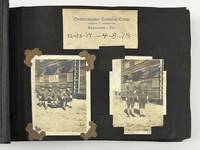
Various locations in Texas 1918. Very good. Fifteen leaves illustrated with fifty-five mounted photographs and a few ephemeral clippings identifying locations. Oblong octavo. Contemporary black cloth string-tied. Light soiling to covers. Minor wear to some photographs but overall a handsome selection. A unique collection of vernacular photographs collected by a soldier in the 8th U.S. Cavalry identified simply as D. Watson serving in southwest Texas during the Mexican Border War. The first two pictures emanate from Quartermaster Training Camp in Jacksonville Florida. This is followed by one photo from Barron Field in Everman Texas. The remaining photographs document Watson's time in Ruidosa Texas an unincorporated Texas-Mexico border town in Presidio County about a hundred miles from Terlingua. Here Watson includes photographs of himself and other soldiers and their horses posed in front of old stone structures in orange groves amongst canyons in front of an automobile and more with images of Mexican adobes a wagon advertising an "electric light company" the cavalry preparing their horses scenes of the wilds of southwest Texas and the E.H. Carlton company store. E.H. Carlton was also a principal in the Carlton Van Loan Company an oil speculation firm active in the 1920s. An eclectic and intriguing selection of Texas-Mexico border images from an important period in history. unknown
Riferimento per il libraio : 2322
|
|
|
[THIERS] - DREYFUS (Robert).-
Monsieur Thiers contre l'Empire, la guerre, la Commune. 1869-1871.
1928 P., Grasset (Collection "Les Cahiers Verts"), 1928, in 12, broché, 351 pages.
Riferimento per il libraio : 5054
|
|
|
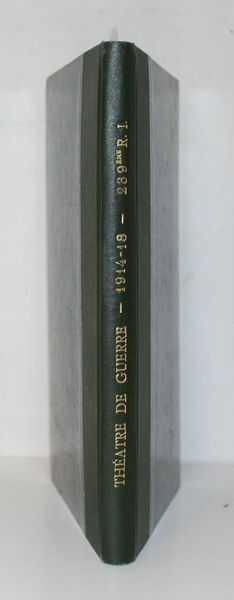
[THEATRE DE GUERRE A ROUEN] 239 ème REGIMENT D'INFANTERIE.
Yadkoislamord' ! & Mais ne chinez donc pas les Idoines ! Deux Revues en un prologue et deux actes.
Rouen, saison 1915-1916, 1916-1917. In-8 de 67 pp. & 80 pp.? Nombreuses illustrations Bradel demi-percaline verte, couvertures illustrée en couleurs conservées.
Riferimento per il libraio : 21533
|
|
|
[The American Car and Foundry Company] [World War I]
The American Car and Foundry Co. In Khaki Its Achievements in the Great War
New York: The American Car and Foundry Company 1919. First Edition. Hardcover. Good. Tall quarto. 95 pages. Illustrated with photographs of the company executives and management railroad cars artillery vehicles shell casings vehicle parts gun caissons Navy gun mounts boats plant operation pictures etc. Paper covered boards and spine. Embossed title and illustration on the front cover. Decorative end papers. Paper is creased on the spine with a small chip bottom of the spine. Approx. 3" split tear to the upper front joint. Light edge wear to the boards. This copy includes a printed one page letter and a small note card from the company with the company President's name in facsimile at the bottom. The American Car and Foundry Company hardcover
Riferimento per il libraio : 33691

|
|
|
[The Belgian resistance movement, Maquis; Froidmont, Tournai, Belgium; World War Two]:
Belgian resistance documents. Typed document titled 'ARMEE SECRETE CG48 bis Historique de la Section 802 depuis ses debuts'. With typewritten list regarding feeding and lodging of 'refractaires' and manuscript table of agents headed 'Combat'.
The 'Historique' document dated 'Froidmont le 25 septembre 1944' Tournai Belgium; the other two items without place or date. A scarce survival providing a mass of valuable information written during wartime with nothing else about this section of the Belgian resistance having been discovered. All three documents in fair condition on aged and lightly-worn paper. ONE: 'Historique de la Section 802 depuis ses debuts.' Typed document. 3pp. 4to. Rust staining from paperclip at head of first page. Type indentation indicates that this is an original document not a mimeograph. Giving an account of Section 802 from September 1941 to 9 September 1944. Sub-headings: 'PERIODE SECRETE D'ORGANISATION' with 'FORMATION DES ESCOUADES' and 'FORMATION du service sanitaire'; 'ACTIVITE SPECIALE' with 'Aide aux réfractaires' and 'Détention d'explosifs'; 'PERIODE DE SABOTAGE'; 'PERIODE DE GUERILLAS: PRELIMINAIRES' with 'OPERATIONS DE LA S.802'. Filled with facts and names as the opening indicates: 'September 1941: PARENT Marcel Ravitaillement en matériel sanitaire de tout les postes de secours de Tournai. Estafette pour COISNE Amédée sic. Agent de liaison avec Bruxelles et Mons pour la remise de documents Renseignements de toute nature à COISNE Amédé. Deux fois par mois voyage à Bruxelles pour prendre plusieurs centaines de "Libre Belgique" pour la distribution à Tournai. Soustraction de documents et photos chez le rexiste sic VAN ROY Eté disparu le 10 novembre 1942. Après l'arrestation de plusieurs membres des groupes de Tournai la S.802 fut divisée Amédé Coisne et LERICHE Louis regroupèrent la Section et avec PARENT Marcel formèrent une nouvelle section à Froidmont.' S.802's activity include 'Sauvetage et rapatriement du pilot Anglais S.B.63 John Butterfield; Mme. Béthune'. Around a page is devoted to S.802's operations between 2 and 9 September 1944. On 2 September 1944: 'Prise de cinq prisonniers allemands russes sans armes. A 20; 15 idem de 27 prisonniers allemands russes sans armes récupéréz a la Briqueterie d'EreEvacués sic sur Rumes en camion.' The entry for 4 September 1944 begins: '8 H. 15 on signale une centaine d'allemands dans le bois de PLOUY à RUMES. Déparet d'une patrouille de reconnaissance qui trouve le bois vide. d'ennemis. 16 H. Opérations au bois DELNESTE à PIC au VENT. Un paysan signale un allemand avec mitraillette dans le bois. Une auto blindée anglaise mitraille le bois. Attaque du bois par trois hommes de la S.802 et soutenus par cinq anglais venus en renfort avec une auto mitrailleuse. Prise de 4 allemands évacués par l'auto mitrailleuse anglaise unallemands sic tué par les anglais.' TWO: Typewritten list of 'réfractaires'. 1p. 4to. Folded three times into a 7 x 5cm packet for concealment. Arranged into six categories lettered A to F with 'Total: 33' at foot. The agents are identified by their number from 802-29 to 802-47 with their marital status and number of children given. The sections are titled as follows: 'Réfractaire logé et nourri'; 'Réfractaire non logé et non nourri' 'Réfractaire marié sans enfant'; 'Réfractaire marié avec enfants a charge'; 'Réfractaire se trouvant maintenant en Allemagne' 'Autres Secours'. The last two entries: 'Noëlla 47. Célibataire. Réfractaire. Total: 3 Miette. Célibataire. Réfractaire.' THREE: Manuscript table headed 'Combat'. 1p. 4to. Giving details of 40 agents from 802.10 to 802.49. Written out in red and black. Eight columns: 'Indicatif'; 'Village'; '<Comman:>'; '<>'; 'Capacité' including 'Artilleur' and 'Carabinier'; '<>'; 'Matériel'; 'Observation'. The villages include Willemeau Esplechin Froidmont; Rumes. Nine of the individuals are marked as drivers. The 'Historique' document dated 'Froidmont, le 25 septembre 1944' [Tournai, Belgium]; the other two items without place or date. unknown
Riferimento per il libraio : 23212
|
|
|
[The Bombing Of The Thielbek, Cap Arcona, and Deutschland] Rolsma, H.
NEUENGAMME: DE RAMP IN DE BOCHT VAN LUBECK
[1945] 1st Edition. Original Illustrated Paper Wrappers with red illustration of a sinking ship from the infamous May 3rd 1945 bombing of the Thielbek, Cap Arcona, and Deutschland. 8vo. 35 pages ; 21 cm. In Dutch. Title translates to, Neuengamme: The Disaster in the Bend of Lubeck. The Neuengamme concentration camp, was a German concentration camp, established in 1938 by the SS near the village of Neuengamme in the Bergedorf district of Hamburg, Germany. It was operated by the Nazis from 1938 to 1945. Over that period an estimated 106, 000 prisoners were held at Neuegamme and at its subcamps
(Wikipedia, 2016) British forces arrived on May 4, 1945. In early May 1945, the SS loaded some 9, 000-10, 000 prisonersmost of them evacuated from Neuengamme and its subcampsonto three ships anchored in the Baltic Sea off the coast of Neustadt in Schleswig-Holstein. Some 7, 000 lost their lives when the British attacked two of the ships in the course of a raid on the harbor on May 3. The Thielbek, carrying about 2, 000 prisoners, sank quickly. The Cap Arcona, carrying more than 4, 500 prisoners, burned and capsized during the attack. Only about 600 prisoners from both ships survived. (US Holocaust Museum) . This is a Dutch account of the tragedy by survivor H. Rolsma. Rolsmas byline on the cover also reads, Prisoner No. 77431 OCLC lists 6 copies worldwide, none outside of the Netherlands. Some edgewear. Good+ condition. Important story. (holo2-130-62)

|
|
|
[The Department of the Interior, War Relocation Authority]
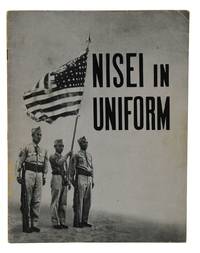
Nisei in Uniform
Washington D.C.: Issued by Department of the Interior War Relocation Authority in collaboration with the War Department 1944. Near Fine. First edition. 24pp. Publisher's original pictorial stapled wraps photo-illustrated throughout. Near Fine with light creasing light wear and toning.<p>Nisei is a Japanese term used in North and South American meaning "second generation" specifically referring to ethnically Japanese children born in the Americas to Japanese-born parents who immigrated there. This pamphlet details the heroic acts of the two Japanese-American combat units in World War II the 442nd Combat Team and the 100th Battalion. A scarce pamphlet issued by the War Relocation Authority the American governmental agency overseeing the mass internment of Japanese-Americans often mentioning relocation camps making note of soldiers who volunteered directly from them to join the US Army. Issued by Department of the Interior, War Relocation Authority, in collaboration with the War Department unknown
Riferimento per il libraio : 140940630
|
|
|
[THE GREAT TURKISH WAR].
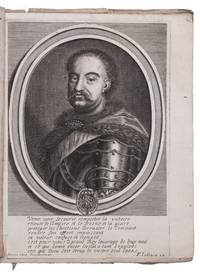
Traduction d'un exemplaire en langue Turque contenant le detail & la description des processions des jeunes & des penitences que le grand seigneur dit Mahomet Soliman Empereur Turk du soleil levant & du couchant souverain seigneur des seigneurs & veritable successeur de la race du grand prophete Mahomet a commandé de faire en tout son empire.
Bordeaux: Pierre Abegou 1687. Marbled wrappers. 4to. With an inserted latter engraved frontispiece portrait of the Polish King Jan III Sobieski engraved by F. Jollain. Very rare pamphlet published during the European wars against Turkey with a frontispiece portrait of the Holy Roman Emperor Léopold I 1640-1705 Archduke of Austria and King of Bohemia and Hungary. He succeeded his father Ferdinand III in 1657 and immediately had to fight against the Turks in the Great Turkish War also known as the War of the Holy League 1683-1699. This war finally led to the Peace of Karlowitz in 1699.This work gives directions and arrangements for ritual processions that the Turkish Sultan Suleiman III ordered after his victories during the so-called Holy Wars against the Christians. It is of great importance for our understanding of the problematic Turkish-European relations during the 17th century especially as an interesting example of counter-propaganda. One of Suleiman IIIs directions presented in the book for example ordered that one Christian slave or one Jew was to be killed every fifteen minutes as part of the procession. One can imagine the reaction of a Christian reading this text: although the crusades were over this could provoke war and violence between the parties.Wrappers worn and somewhat frayed a few worm holes but still in good condition.l Bibliotheca bibliographica Aureliana CX XVIIe siècle XIV Bordeaux 2176 not mentioning the portrait; cf. Desgraves Bordeaux 1580. Pierre Abegou, unknown
Riferimento per il libraio : 22346
|
|

 Ricevere i risultati per e-mail
 Scaricare i risultati in PDF
 RSS feed
 Link
Link


